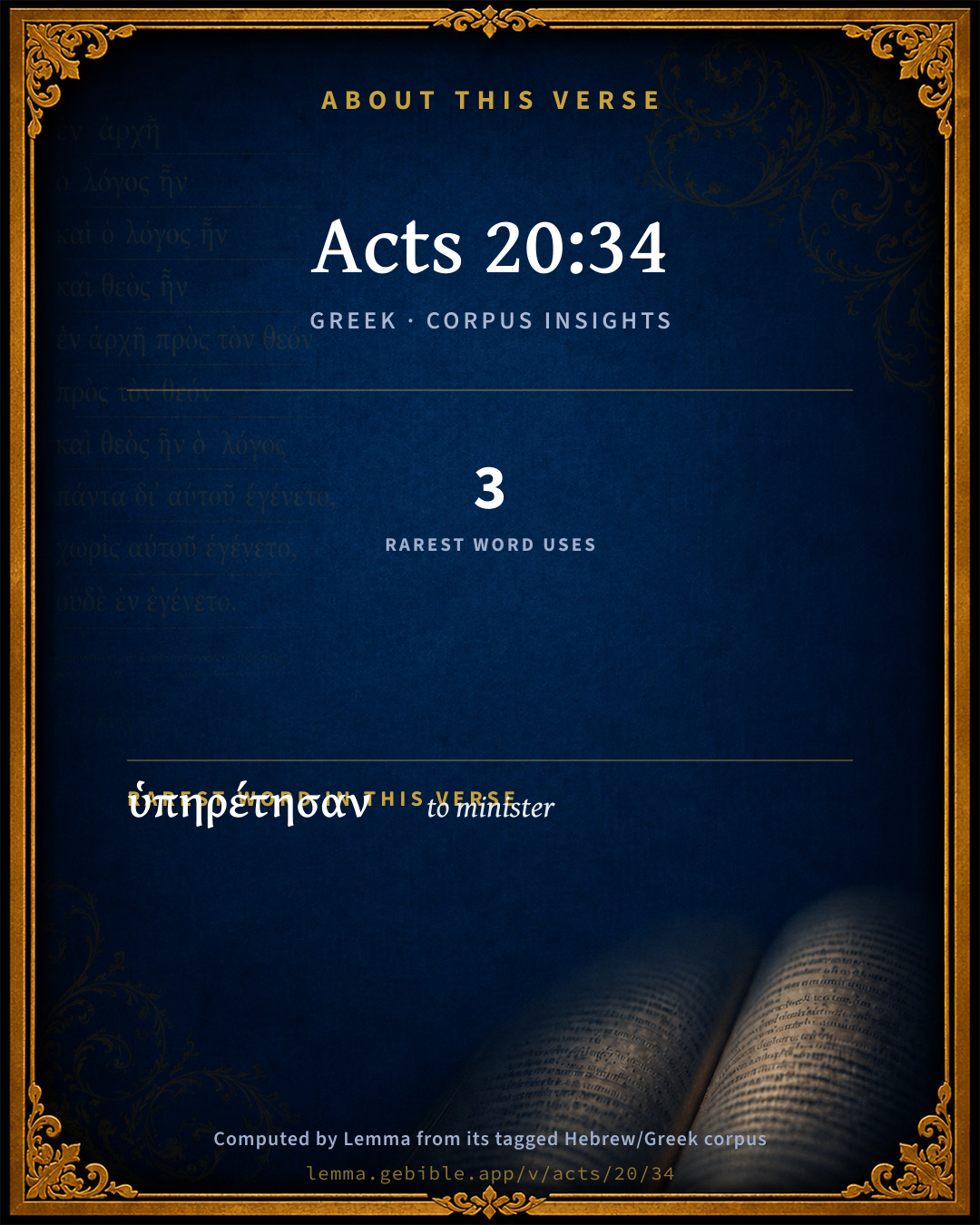
Acts 20:34

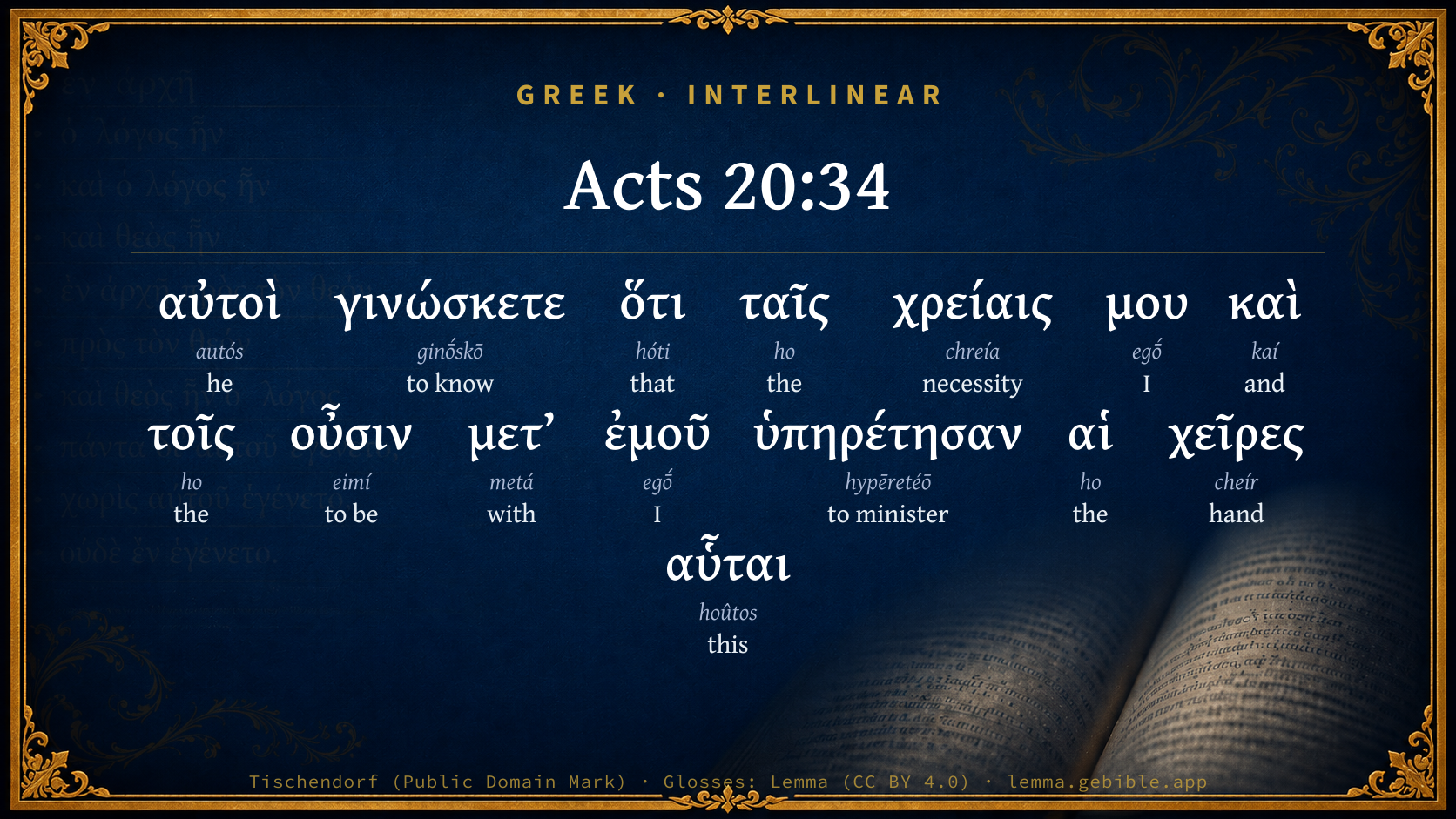
Greek (Tischendorf 8th ed.) Acts 20:34 appears in the Greek New Testament. The text above is from the Tischendorf 8th edition. Each word links to its Strong’s number and a concise gloss. Click any word for its full Thayer’s Greek Lexicon entry.
Download image
Cite this verse

Acts 20:34 (World English Bible). Public Domain. Lemma interlinear Bible study tool, https://lemma.gebible.app/v/acts/20/34.

Show BibTeX & RIS
BibTeX
RIS
English Translation
You yourselves know that these hands ministered to my necessities, and to those who were with me.
World English Bible · Public Domain
Download a study sheet

One document with this verse’s original text, its word-by-word gloss line, the meaning frame, cross-references with their text, attributed commentary, and full source and license credits — printable, and it pastes into notes with its structure intact.

This verse Autodidact and up

Study sheet (.html) Plain text (.txt)

A passage Seminary Student

Up to 50 verses in one chapter. A passage sheet keeps up to 6 commentary sources and 12 cross-references per verse, in the order this page ranks them, and says so on the sheet whenever that leaves anything out. Ask for a single verse and you get the Autodidact verse sheet above.

Everything on this page stays free to read, with no account — the sheet is a download of what is already on screen, not access to it.

Want to remove ads? Support Godless Engineer
Compare translations 3

The same verse in 3 English versions, stacked beneath the original-language interlinear above. Click any original word for its lexicon entry.

Each is an independent rendering of the whole verse — the interlinear is not word-aligned to these translations.

Highlighted words mark where these versions differ — a whole-verse word diff, not a word-by-word alignment.

  • World English Bible Public Domain
    You yourselves know that these hands ministered to my necessities, and to those who were with me.
  • King James Version Public Domain
    Yea, ye yourselves know, that these hands have ministered unto my necessities, and to them that were with me.
  • unfoldingWord Literal Text CC BY-SA 4.0
    You yourselves know that these hands ministered to my needs and to the ones being with me.

unfoldingWord Literal Text — © unfoldingWord, licensed CC BY-SA 4.0. Word-aligned USFM3 via Door43 (git.door43.org/unfoldingWord/en_ult).

Versions to compare (up to 4)

3 of 4 selected

Show all 19 translations

Every available English version of this verse, each an independent rendering of the whole verse.

  • World English Bible Public Domain
    You yourselves know that these hands ministered to my necessities, and to those who were with me.
  • Berean Standard Bible Public Domain
    You yourselves know that these hands of mine have ministered to my own needs and those of my companions.
  • Majority Standard Bible Public Domain
    You yourselves know that these hands of mine have ministered to my own needs and those of my companions.
  • King James Version Public Domain
    Yea, ye yourselves know, that these hands have ministered unto my necessities, and to them that were with me.
  • American Standard Version (1901) Public Domain
    Ye yourselves know that these hands ministered unto my necessities, and to them that were with me.
  • Revised Version (1885) Public Domain
    Ye yourselves know that these hands ministered unto my necessities, and to them that were with me.
  • Geneva Bible (1599) Public Domain
    Yea, ye knowe, that these handes haue ministred vnto my necessities, and to them that were with me.
  • Douay-Rheims (1899) Public Domain
    You yourselves know: for such things as were needful for me and them that are with me, these hands have furnished.
  • Young's Literal Translation Public Domain
    and ye yourselves know that to my necessities, and to those who were with me, minister did these hands;
  • Literal Standard Version CC BY-SA 4.0
    and you yourselves know that to my necessities, and to those who were with me, these hands ministered;
  • Unlocked Literal Bible CC BY-SA 4.0
    You yourselves know that these hands served my own needs and the needs of those who were with me.
  • unfoldingWord Literal Text CC BY-SA 4.0
    You yourselves know that these hands ministered to my needs and to the ones being with me.
  • Darby Bible Public Domain
    Yourselves know that these hands have ministered to my wants, and to those who were with me.
  • World Messianic Bible Public Domain
    You yourselves know that these hands served my necessities, and those who were with me.
  • Webster's Bible Public Domain
    And ye yourselves know, that these hands have ministered to my necessities, and to them that were with me.
  • Free Bible Version CC BY-SA 4.0
    You know that I worked with my own hands to provide for my own needs, as well as for those who were with me.
  • Bible in Basic English Public Domain
    You yourselves have seen that with these hands I got what was necessary for me and those who were with me.
  • Text-Critical English NT CC BY 4.0
    You yourselves know that these hands of mine ministered to my own needs and to the needs of those who were with me.
  • Tyndale New Testament (1534) Public Domain
    Ye knowe well that these hondes have ministred vnto my necessities and to them that were with me.

Literal Standard Version (2020), Covenant Press — licensed CC BY-SA 4.0. Text via the HelloAO Bible API (eBible.org). Unlocked Literal Bible (unfoldingWord) — licensed CC BY-SA 4.0. Text via the HelloAO Bible API (eBible.org). unfoldingWord Literal Text — © unfoldingWord, licensed CC BY-SA 4.0. Word-aligned USFM3 via Door43 (git.door43.org/unfoldingWord/en_ult). Free Bible Version, Dr. Jonathan Gallagher — licensed CC BY-SA 4.0. Text via the HelloAO Bible API (eBible.org).

Word by word

More ways to search: Search by grammar → Find every occurrence → Compare this word →

Practice this passage: Drill this verse → Learn its vocabulary →

ὑπηρέτησαν
hypēretéō
G5256
“to minister”
Verb, Aorist, Active, Indicative, 3rd person, Plural
Part of Speech
Verb
Tense
Aorist
Voice
Active
Mood
Indicative
Person
3rd person
Number
Plural
Full Thayer's Definition

Origin: from G5257

TDNT: 16:50,1

1. to act as a rower, to row 2. to minister, render services
  1. αὐτοὶ autós G846 “he” Personal pronoun, Nominative, Plural, Masculine
  2. γινώσκετε ginṓskō G1097 “to know” Verb, Present, Active, Indicative, 2nd person, Plural
  3. ὅτι hóti G3754 “that” Conjunction
  4. ταῖς ho G3588 “the” Article, Dative, Plural, Feminine
  5. χρείαις chreía G5532 “necessity” Noun, Dative, Plural, Feminine
  6. μου egṓ G1473 “I” Personal pronoun, 1st person, Genitive, Singular
  7. καὶ kaí G2532 “and” Conjunction
  8. τοῖς ho G3588 “the” Article, Dative, Plural, Masculine
  9. οὖσιν eimí G1510 “to be” Verb, Present, Active, Participle, Dative, Plural, Masculine
  10. μετ’ metá G3326 “with” Preposition
  11. ἐμοῦ egṓ G1473 “I” Personal pronoun, 1st person, Genitive, Singular
  12. αἱ ho G3588 “the” Article, Nominative, Plural, Feminine
  13. χεῖρες cheír G5495 “hand” Noun, Nominative, Plural, Feminine
  14. αὗται hoûtos G3778 “this” Demonstrative pronoun, Nominative, Plural, Feminine

About this verse

These counts appear in no published source. They are computed here, from the morphology-tagged text and Lemma’s own curated glosses. What Lemma adds →

15
words
12
distinct lemmas
Acts
section

Notable vocabulary

The rarest word here is ὑπηρέτησαν to minister G5256 — appearing just 3 times in the whole Greek New Testament.

Shared distinctive vocabulary

ὑπηρέτησαν to minister G5256 occurs in 3 verses of the Greek New Testament. Also found in:

Repetition

Words recur within this verse:

Cross-references

5

Topical passages linked to Acts 20:34 in the Treasury of Scripture Knowledge — connected by theme and wording, ordered by reader-vote popularity; previews shown in the World English Bible.

  • Acts 18:3 and because he practiced the same trade, he lived with them and worked, for by trade they were tent makers.
  • 1 Corinthians 4:12 We toil, working with our own hands. When people curse us, we bless. Being persecuted, we endure.
  • 2 Thessalonians 3:8–9 neither did we eat bread from anyone's hand without paying for it, but in labor and travail worked night and day, that we might not burden any of you;
  • Acts 19:22 Having sent into Macedonia two of those who ministered to him, Timothy and Erastus, he himself stayed in Asia for a while.
  • 1 Thessalonians 2:9 For you remember, brothers, our labor and travail; for working night and day, that we might not burden any of you, we preached to you the Gospel of God.

Cross-references courtesy of OpenBible.info (CC BY 4.0).

Commentary

Notes on Acts 20:34 from classic Christian and Jewish commentators (each source and its license shown beneath its notes). The classic Christian expositions comment on the surrounding passage and are grouped to its opening verse, so a note may address several verses; the Jewish commentaries on the Tanakh (Rashi and others) are per-verse, so they appear only where the commentator wrote on this verse.

Lemma curates 59 commentaries, every one of them public domain or Creative Commons licensed, each selected and text-cleaned for this edition rather than reprinted as found. About our sources →

Bengel's Gnomon

Johann Albrecht Bengel

Act 20:34. Αὗται, these) which are hardened with labour, as ye see.

Bengel's Gnomon of the New Testament — English translation (T&T Clark, Edinburgh, 1860) — public domain. Text from a community e-Sword module.

Expositor's Greek Testament

ed. W. Robertson Nicoll

Act 20:34 . αὐτοὶ : placed first for emphasis, so too emphasised in Act 2:22 , Act 16:37 , Act 18:15 . In 1Co 4:12 we may see an undesigned coincidence, and cf. the word κοπιῶντας in Act 20:35 , Paley, H.P. , iii., 6. ταῖς χρείαις μου καὶ τοῖς αὖσι μετʼ ἐμοῦ : so the work of the Christian convert ἐργαζ . τὸ ἀγ . ταῖς χερσίν is to be done ἵνα ἔχῃ μεταδιδόναι τῷ χρείαν ἔχοντι , Eph 4:28 , and for the word χρεία as used by St. Paul elsewhere in same sense, cf. Rom 12:13 , Phi 2:25 ; Phi 4:16 , Tit 3:14 . ὑπηρέτησαν : only in Act 13:36 , used by Paul, Act 24:23 , used of Paul ( cf. 1Co 4:1 ); Wis 16:24 . αὗται : “callosæ, ut videtis,” Bengel, so Blass; quite in Paul’s manner, cf. Act 26:29 , Act 28:20 ; so also πάντα , 1Co 9:25 ; 1Co 10:33 ; 1Co 11:2 , Eph 4:15 . Paul pursued his trade at Ephesus probably with Aquila and Priscilla, possibly with Philemon, Phm 1:17 .

The Expositor's Greek Testament, edited by W. Robertson Nicoll (1897–1910) — public domain. Text from a community e-Sword module.

Jamieson, Fausset & Brown

Robert Jamieson, A. R. Fausset & David Brown

these hands--doubtless holding them up, as before Agrippa in chains (Act 26:29).

have ministered unto my necessities, and to them that were with me--See Act 18:3; Co1 4:12; Co1 9:6, written from Ephesus; also Th1 2:9.

Jamieson, Fausset & Brown — Commentary Critical and Explanatory on the Whole Bible (1871) — public domain (CC PDM 1.0). Text via the HelloAO Bible API.

Adam Clarke's Commentary

Verse 34. These hands have ministered, &c.] It was neither "sin nor discredit" for the apostle to work to maintain himself, when the circumstances of the Church were such that it could not support him. Still many eminent ministers of God are obliged to support themselves and their families, at least in part, in the same way, while indefatigably testifying the Gospel of the grace of God. Whatever it may be to the people, it is no cause of reproach to the minister, to be obliged thus to employ himself.

Adam Clarke's Commentary on the Bible (1810–1826) — public domain. Text from a community e-Sword/MySword module.

John Calvin's Commentaries

34. Yea, ye know He doth not, in these words, precisely set down a law which all the ministers of the word must needs keep; for he did not behave himself so loftily and lordlike, that he did take that away which the Lord had granted to his servants, but doth rather in many places maintain their right, which is, that they be maintained with that which is common, Matthew 10:10; 1 Corinthians 9:14; Galatians 6:6; 1 Timothy 5:17; Philippians 4:10, 16; 2 Corinthians 11:8. Whereunto belongeth that, that he suffered many churches to minister unto him food and raiment. Neither did he only freely receive wages for the work which he did in any place of those who were there, but when he was in necessity at Corinth, he saith that he robbed other churches to relieve his poverty. Therefore, he doth not simply command pastors to maintain their life with their handy-work, but immediately after he declareth how far forth he exhorteth them to follow his example. Those men of Corinth did not deny him that which was due to him; but seeing that the false apostles did boast that they did their work freely, and get thereby praise among the people; Paul would not be behind them in this point, nor give them any occasion to accuse him falsely; as he himself affirmeth (1 Corinthians 9:15, and 2 Corinthians 11:10). Therefore, he warneth that there be no stumbling-block laid in the way of the weak, and that their faith be not overthrown. For to receive the weak, importeth as much as somewhat to bear with their rudeness and simplicity, as it is (Romans 14:1).

And to remember. We read this sentence in no place word for word; but the Evangelists have other not much unlike this, out of which Paul might gather this. Again, we know that all the sayings of Christ were not written; and he repeateth that general doctrine of the contempt of money; whereof this is a true token, when a man is more bent to give than to take. Neither did Christ speak only politicly, as if those who are liberal are therefore blessed, because they bind other men unto them with their benefits, and it is a kind of bondage to owe anything; but he had respect unto an higher thing, because, he which giveth to the poor lendeth unto the Lord, (Proverbs 19:17) that those be faithful and good stewards of God, who impart to their brethren some of that plenty which they have lent them; that men draw nearer unto God in nothing than in liberality. We do also read these titles of liberality in profane authors; and a good part of the world confess that these things are true, but they consent (as it is in the proverb) with ass’s ears. For the common life doth show how few be persuaded that nothing ought more to be wished, than that we bestow our goods to help our brethren. For which cause the disciples of Christ must more studiously think upon this felicity, that abstaining so much as in them lieth, from that which is another man’s, they accustom themselves to give. And yet they must not do this with an haughty heart, as if it were a miserable thing for them to be in any man’s danger; either through ambition, that they may bind other men to them; but only that they may exercise themselves willingly in the duties of love, and by this means make known the grace of their adoption.

John Calvin's Commentaries (1540-1563) — public domain. Text from the Calvin Translation Society English edition (1840s-50s) via the Christian Classics Ethereal Library (ccel.org). Calvin's coverage is partial (roughly two-thirds of the Bible); uncommented books and verses are honest gaps, never fabricated. The 19th-century editor's footnotes and remarks are omitted so the notes are faithfully Calvin's own voice.

Ellicott's Commentary for English Readers

(34) These hands have ministered unto my necessities.—The words clearly cover the whole three years of the Apostle’s ministry at Ephesus. The partnership with Aquila and Priscilla (Act_18:3) continued. Philemon was probably a sharer in it (Phm_1:17). And the Apostle had not been satisfied with working for himself, but ministered also to “those who were with him.” His teaching in 2Th_3:10 makes it improbable that he would have thus laboured to maintain others who were able-bodied in idleness, and the words that immediately follow make it almost certain that we must confine the statement to those who were suffering from infirmity. In 1Co_4:12, written, it will be remembered, from Ephesus, we have an undesigned coincidence confirming the statement.

A Bible Commentary for English Readers, edited by Charles John Ellicott (1878–1897) — public domain. Text from a community e-Sword module.

The Cambridge Bible for Schools and Colleges

gen. ed. J. J. S. Perowne

34. Yea, ye yourselves know] The oldest texts omit “Yea.” The working in company with Aquila and Priscilla, which the Apostle began in Corinth, was probably continued when they came together to Ephesus, and so the Apostle’s trade and his steady pursuit of it would be well known to many of the listeners. It has been suggested that he was a partner in trade-matters with Philemon during this residence at Ephesus. Cp. Phm_1:17.

that these hands have ministered] No doubt, he held them forth, and they bore marks that not only while at Ephesus, but since that time they had laboured for the means of living.

unto … them that were with me] We cannot determine under what circumstances the Apostle felt himself called upon to minister by his hand-labour to the support of his companions. We may be sure however that the necessity was there, and that St Paul, working himself, did not countenance indolence in others. And when we read of Timothy’s “often infirmities” (1Ti_5:23) we may conjecture that there were those among the companions of St Paul who were less able to work with the hands than the Apostle himself.

The Cambridge Bible for Schools and Colleges (gen. ed. J. J. S. Perowne; Cambridge University Press, 1878–1918) — public domain. Text from a community e-Sword module.

John Gill's Exposition

Sorrowing most of all for the words which he spake,.... In Act 20:25 it filled them with sorrow to part with him; but this was increased, and made almost intolerable by what he said,

that they should see his face no more: could they have hoped to have seen him again, it would have made their parting with him more easy; but to be told they should never see him more in this world, it cut them to the heart; which shows what a share the apostle had in their hearts and affections, and not without good reason: however, that they might have a sight of him as long as they could, they went along with him to see him take shipping, and to see the last of him.

And they accompanied him unto the ship: which lay at Miletus waiting for him.

Next: Acts Chapter 21

John Gill's Exposition of the Whole Bible (1746–1763) — public domain (CC PDM 1.0). Text via the HelloAO Bible API.

Trapp's Complete Commentary

John Trapp

34 Yea, ye yourselves know, that these hands have ministered unto my necessities, and to them that were with me.

Ver. 34. These hands have ministered] More shame for them to suffer it. Sed rara ingeniorum praemia, rara item et merces, saith one; and Nescio quomodo bonae mentis soror est paupertas, saith Petronius; and, Paupertas est Thilosophiae vernacula, saith Apuleius. Let God’s servant keep them honest, the world will keep them poor enough.

John Trapp, A Commentary or Exposition upon All the Books of the Old and New Testament (1647–1656) — public domain. Text from a community e-Sword module.

Albert Barnes' Notes on the Bible

Yea, ye yourselves know - By your own acquaintance with my manner of life. In Corinth he had lived and labored with Apollos (note, Act 18:3); and he refers elsewhere to the fact that he had supported himself, in part at least, by his own labor, 1Co 4:12; 1Th 2:9; 2Th 3:8. We may hence learn that it is no discredit to a minister to labor. Whatever it may be to a people who put him under a necessity to toil for his support, yet the example of Paul shows that a man should rejoice in the privilege of preaching the gospel, even if it is done while he is obliged to resort to labor for his daily bread. It is well when a minister of the gospel can make an appeal to his people like this of Paul, and say, “I have coveted no man’s gold, or silver, or apparel.” Every minister should so live that he can make this appeal to their own consciences of the sincerity and disinterestedness of his labors from the pulpit; or when called to separate from them as Paul did; or when on a dying bed. Every minister of the gospel, when be comes to lie down to die, will desire to be able to make this appeal, and to leave a solemn testimony there, that it was not for gold, or ease, or fame, that he toiled in the ministerial office. How much more influence will such a man have than he who has been worldly-minded; he who has sought to become rich; and he, the only memorials of whose life is, that he has sought “the fleece, not the flock” - that he has gained the property, not the souls of people.

Albert Barnes' Notes on the Bible (1834–1885) — public domain. Text from a community e-Sword/MySword module.

Haydock's Catholic Bible Commentary

These hands have furnished, by labouring to maintain myself, &c. (Witham)

George Leo Haydock (1774–1849), Haydock's Catholic Family Bible and Commentary, 1859 edition — public domain. Excludes Psalms (Douay-Rheims chapter numbering differs from Protestant) and Deuterocanonical books (Catholic canon only).

Matthew Poole's English Annotations

St. Paul working hard (as they all knew) for a livelihood, Act 18:3; 1Co 4:12; 1Th 2:9; which he gives an account of, 2Th 3:8, to have been done only that in such a juncture, they being poor, and the false teachers watching all advantages against him, he might not then be chargeable to them.

Matthew Poole's English Annotations on the Holy Bible (1683–1685) — public domain. Text from a community e-Sword/MySword module.

Whedon's Commentary on the Bible

Daniel D. Whedon

34. These hands—Doubtless presenting his hands, hard with the tokens of toil. Yet Dr. Hackett truly remarks: “It may be added that Paul, although he waived his own right to a maintenance from those to where he preached, was remarkable for the decision with which he asserted that eight in behalf of others. Compare Rom_15:27; 1Co_9:13-14; Gal_6:6; 1Ti_5:17-18; see also the Saviour’s rule on this subject in Luk_10:7.”

Daniel D. Whedon (gen. ed.), Commentary on the Old and New Testaments (1874–1909) — public domain. Text from a community e-Sword module.

The Pulpit Commentary

Ye for yea ye, A.V. and T.R.; ministered for have ministered, A.V. These hands. (see 1Co_4:12, written from Ephesus a few months before)

The Pulpit Commentary (1880–1919), ed. H.D.M. Spence-Jones & Joseph S. Exell — public domain. Text from a community e-Sword module.

John Wesley's Explanatory Notes

These hands - Callous, as you see, with labour. Who is he that envies such a bishop or archbishop as this?

John Wesley, Explanatory Notes Upon the Whole Bible (1754–1765) — public domain. Text via the GEBible commentary corpus.

McGarvey & Pendleton's Commentaries

J. W. McGarvey

See notes on verse 28

J. W. McGarvey (with Philip Y. Pendleton), Commentaries on the New Testament (The Fourfold Gospel, 1914; Acts; and the epistles) — public domain. Text from a community e-Sword/MySword module.

Cambridge Greek Testament for Schools and Colleges

34. αὐτοὶ γινώσκετε, ye yourselves know. The working in company with Aquila and Priscilla, which the Apostle began in Corinth, was probably continued when they came together to Ephesus, and so the Apostle’s trade and his steady pursuit of it would be well known to many of the listeners. It has been suggested that he was a partner in trade-matters with Philemon during this residence at Ephesus. Cf. Phm 1:17.

τοῖς οὖσιν μετ’ ἐμοῦ, to them that were with me. We cannot determine under what circumstances the Apostle felt himself called upon to minister by his hand-labour to the support of his companions. We may be sure however that the necessity was there, and that St Paul, working himself, did not countenance indolence in others. And when we read of Timothy’s ‘often infirmities’ (1Ti 5:23) we may conjecture that there were those among the companions of St Paul who were less able to work with the hands than the Apostle himself.

αἱ χεῖρες αὗται, these hands. No doubt, he held them forth, and they bore marks that not only while at Ephesus, but since that time they had laboured for the means of living.

Cambridge Greek Testament for Schools and Colleges (Cambridge University Press, 1896; 21 vols, various authors incl. Carr, Maclear, Plummer, Farrar, Lumby, Moule, M. R. James, Simcox) — public domain. Text from a community e-Sword module.

Alford’s Greek Testament

Henry Alford

34.] See 1Co 4:12, which he wrote when at Ephesus.

χρεία with a gen. of the person in want, is an expression of Paul only; see among reff.

ὑπηρετεῖν is used only twice more; once by Paul, ch. 13:36, once of Paul, ch. 24:23.

The construction is varied in this sentence.

ταῖς χρ. μου, καὶ (not τῶν ὄντων, but) τοῖς οὖσιν μετʼ ἐμοῦ. This is not without meaning—his friends were among his χρεῖαι—he supplied by his labour, not his and their wants, but his wants and them.

αἱ χ. αὗται] also [strikingly] in Paul’s manner: compare τῶνδεσμῶν τούτων, ch. 26:29,—and ch. 28:20.

Henry Alford, The Greek Testament (1849–1861) — public domain. Text from a community e-Sword module.

Lesson kit

Teaching starters — assembled from the data on this page, not authored interpretation. Every prompt links to the verse data it draws on. Edit before teaching.

Acts, in the Acts, opens this verse with 15 words (12 distinct Greek lemmas). Its most distinctive word is hypēretéō (“to minister”). A historical commentator’s framing appears above. Read the whole chapter for the surrounding context.

Discussion questions

  1. The word hypēretéō carries the sense “to minister.” How does it shape the verse?
  2. Acts 13:36 shares the word «to minister» with this verse. How do the two illuminate each other?
  3. “the” occurs 3× in this one verse. What is the effect of the repetition?
  4. These translations render this verse differently. What is at stake in choosing one wording over another?
  5. Reading how Bengel's Gnomon and Expositor's Greek Testament read this verse, where do the two commentators agree and where do they part?

Things to notice

Reading settings

Reading text

Shown beneath each verse's original-language words.

Old Testament
Old Testament edition

Read the OT as the Masoretic Hebrew (MT) or the Greek Septuagint (LXX).

English shown for the Greek Septuagint (in the Hebrew ↔ Greek comparison).

Comparing translations? Open the Compare panel on any verse page to stack up to four side by side.