John 11:28

Greek (Tischendorf 8th ed.) John 11:28 appears in the Greek New Testament. The text above is from the Tischendorf 8th edition. Each word links to its Strong’s number and a concise gloss. Click any word for its full Thayer’s Greek Lexicon entry.
Download image
Cite this verse

John 11:28 (World English Bible). Public Domain. Lemma interlinear Bible study tool, https://lemma.gebible.app/v/john/11/28.

Show BibTeX & RIS
BibTeX
RIS
English Translation
When she had said this, she went away, and called Mary, her sister, secretly, saying, "The Teacher is here, and is calling you."
World English Bible · Public Domain
Download a study sheet

One document with this verse’s original text, its word-by-word gloss line, the meaning frame, cross-references with their text, attributed commentary, and full source and license credits — printable, and it pastes into notes with its structure intact.

This verse Autodidact and up

Study sheet (.html) Plain text (.txt)

A passage Seminary Student

Up to 50 verses in one chapter. A passage sheet keeps up to 6 commentary sources and 12 cross-references per verse, in the order this page ranks them, and says so on the sheet whenever that leaves anything out. Ask for a single verse and you get the Autodidact verse sheet above.

Everything on this page stays free to read, with no account — the sheet is a download of what is already on screen, not access to it.

Want to remove ads? Support Godless Engineer
Compare translations 3

The same verse in 3 English versions, stacked beneath the original-language interlinear above. Click any original word for its lexicon entry.

Each is an independent rendering of the whole verse — the interlinear is not word-aligned to these translations.

Highlighted words mark where these versions differ — a whole-verse word diff, not a word-by-word alignment.

  • World English Bible Public Domain
    When she had said this, she went away, and called Mary, her sister, secretly, saying, "The Teacher is here, and is calling you."
  • King James Version Public Domain
    And when she had so said, she went her way, and called Mary her sister secretly, saying, The Master is come, and calleth for thee.
  • unfoldingWord Literal Text CC BY-SA 4.0
    And having said this, she went away and called her sister Mary privately, having said, “The Teacher is here and is calling you.”

unfoldingWord Literal Text — © unfoldingWord, licensed CC BY-SA 4.0. Word-aligned USFM3 via Door43 (git.door43.org/unfoldingWord/en_ult).

Versions to compare (up to 4)

3 of 4 selected

Show all 19 translations

Every available English version of this verse, each an independent rendering of the whole verse.

  • World English Bible Public Domain
    When she had said this, she went away, and called Mary, her sister, secretly, saying, "The Teacher is here, and is calling you."
  • Berean Standard Bible Public Domain
    After Martha had said this, she went back and called her sister Mary aside to tell her, “The Teacher is here and is asking for you.”
  • Majority Standard Bible Public Domain
    After Martha had said this, she went back and called her sister Mary aside to tell her, “The Teacher is here and is asking for you.”
  • King James Version Public Domain
    And when she had so said, she went her way, and called Mary her sister secretly, saying, The Master is come, and calleth for thee.
  • American Standard Version (1901) Public Domain
    And when she had said this, she went away, and called Mary her sister secretly, saying, The Teacher is her, and calleth thee.
  • Revised Version (1885) Public Domain
    And when she had said this, she went away, and called Mary her sister secretly, saying, The Master is here, and calleth thee.
  • Geneva Bible (1599) Public Domain
    And when she had so saide, she went her way, and called Mary her sister secretly, saying, The Master is come, and calleth for thee.
  • Douay-Rheims (1899) Public Domain
    And when she had said these things, she went, and called her sister Mary secretly, saying: The master is come, and calleth for thee.
  • Young's Literal Translation Public Domain
    And these things having said, she went away, and called Mary her sister privately, saying, `The Teacher is present, and doth call thee;'
  • Literal Standard Version CC BY-SA 4.0
    And having said these things, she went away, and called Mary her sister privately, saying, “The Teacher is present, and calls you”;
  • Unlocked Literal Bible CC BY-SA 4.0
    When she had said this, she went away and called her sister Mary privately. She said, “The Teacher is here and is calling for you.”
  • unfoldingWord Literal Text CC BY-SA 4.0
    And having said this, she went away and called her sister Mary privately, having said, “The Teacher is here and is calling you.”
  • Darby Bible Public Domain
    And having said this, she went away and called her sister Mary secretly, saying, The teacher is come and calls thee.
  • World Messianic Bible Public Domain
    When she had said this, she went away and called Miriam, her sister, secretly, saying, “The Rabbi is here and is calling you.”
  • Webster's Bible Public Domain
    And when she had so said, she went and called Mary her sister secretly, saying, The Master is come, and calleth for thee.
  • Free Bible Version CC BY-SA 4.0
    When she had said this, she went and told her sister Mary in private, “The Teacher's here, and asking to see you.”
  • Bible in Basic English Public Domain
    And having said this, she went away and said secretly to her sister Mary, The Master is here and has sent for you.
  • Text-Critical English NT CC BY 4.0
    After saying this, she went and called her sister Mary, saying in private, “The Teacher is here and is calling for yoʋ.”
  • Tyndale New Testament (1534) Public Domain
    And assone as she had so sayde she went her waye and called Marie her sister secretly sayinge: The master is come and calleth for the

Literal Standard Version (2020), Covenant Press — licensed CC BY-SA 4.0. Text via the HelloAO Bible API (eBible.org). Unlocked Literal Bible (unfoldingWord) — licensed CC BY-SA 4.0. Text via the HelloAO Bible API (eBible.org). unfoldingWord Literal Text — © unfoldingWord, licensed CC BY-SA 4.0. Word-aligned USFM3 via Door43 (git.door43.org/unfoldingWord/en_ult). Free Bible Version, Dr. Jonathan Gallagher — licensed CC BY-SA 4.0. Text via the HelloAO Bible API (eBible.org).

Word by word

More ways to search: Search by grammar → Find every occurrence → Compare this word →

Practice this passage: Drill this verse → Learn its vocabulary →

λάθρᾳ
láthra
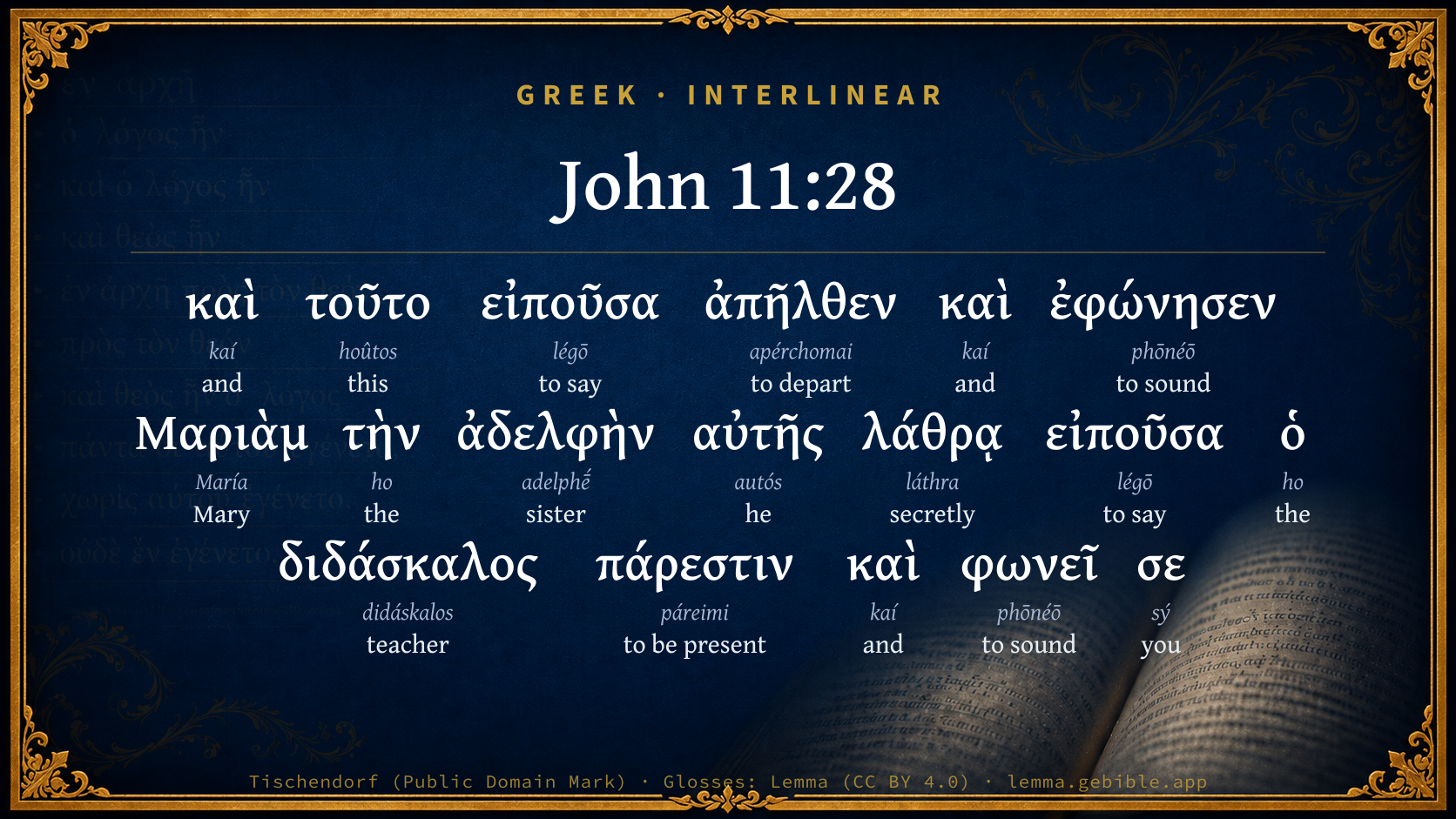
  1. καὶ kaí G2532 “and” Conjunction
  2. τοῦτο hoûtos G3778 “this” Demonstrative pronoun, Accusative, Singular, Neuter
  3. εἰποῦσα légō G3004 “to say” Verb, Aorist, Active, Participle, Nominative, Singular, Feminine
  4. ἀπῆλθεν apérchomai G565 “to depart” Verb, Aorist, Active, Indicative, 3rd person, Singular
  5. καὶ kaí G2532 “and” Conjunction
  6. ἐφώνησεν phōnéō G5455 “to sound” Verb, Aorist, Active, Indicative, 3rd person, Singular
  7. Μαριὰμ María G3137 “Mary” Noun, Proper, indeclinable
  8. τὴν ho G3588 “the” Article, Accusative, Singular, Feminine
  9. ἀδελφὴν adelphḗ G79 “sister” Noun, Accusative, Singular, Feminine
  10. αὐτῆς autós G846 “he” Personal pronoun, Genitive, Singular, Feminine
  11. εἰποῦσα légō G3004 “to say” Verb, Aorist, Active, Participle, Nominative, Singular, Feminine
  12. ὁ ho G3588 “the” Article, Nominative, Singular, Masculine
  13. διδάσκαλος didáskalos G1320 “teacher” Noun, Nominative, Singular, Masculine
  14. πάρεστιν páreimi G3918 “to be present” Verb, Present, Active, Indicative, 3rd person, Singular
  15. καὶ kaí G2532 “and” Conjunction
  16. φωνεῖ phōnéō G5455 “to sound” Verb, Present, Active, Indicative, 3rd person, Singular
  17. σε sý G4771 “you” Personal pronoun, 2nd person, Accusative, Singular

About this verse

These counts appear in no published source. They are computed here, from the morphology-tagged text and Lemma’s own curated glosses. What Lemma adds →

18
words
13
distinct lemmas
Gospels
section

Notable vocabulary

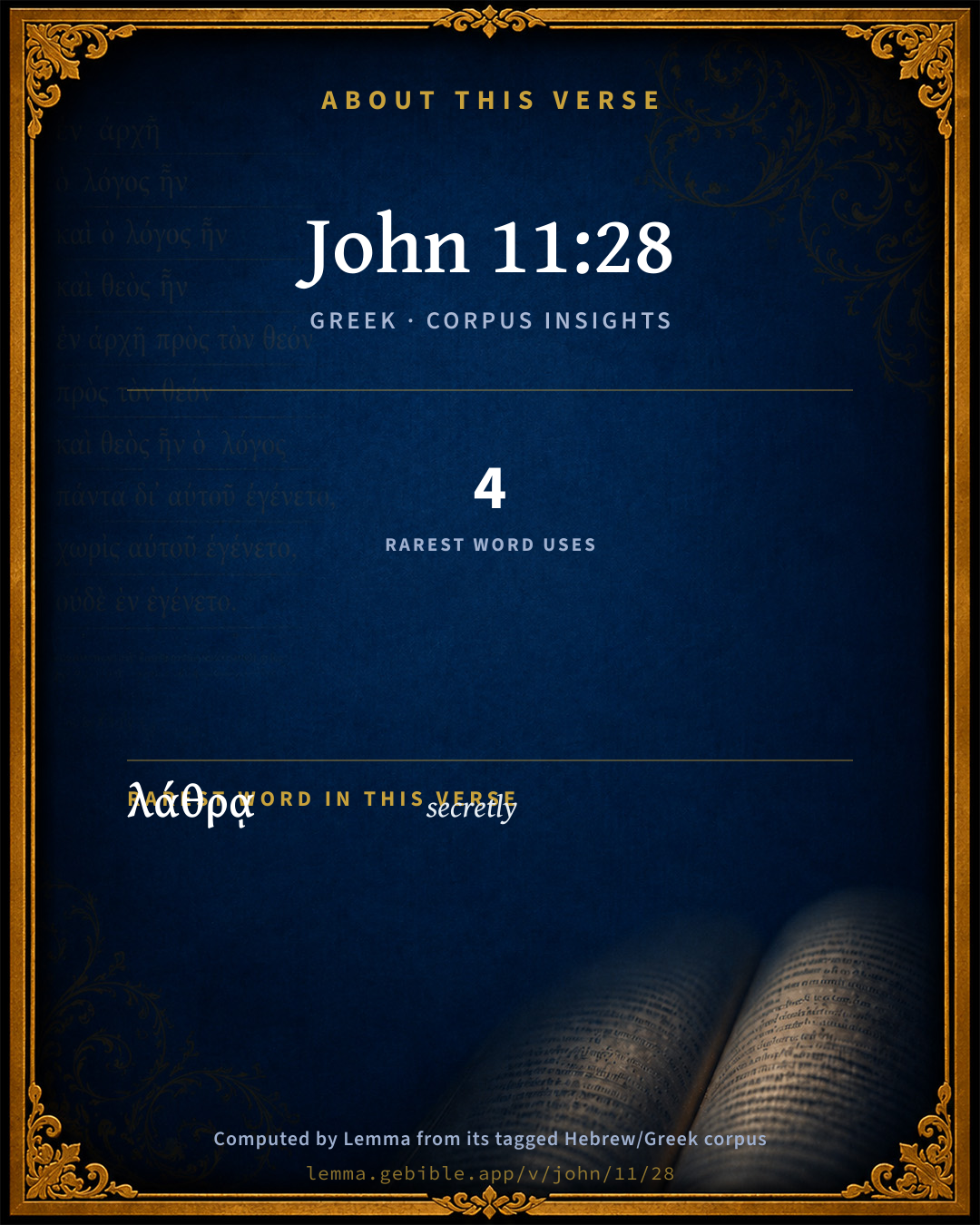
The rarest word here is λάθρᾳ secretly G2977 — appearing just 4 times in the whole Greek New Testament.

Shared distinctive vocabulary

λάθρᾳ secretly G2977 occurs in 4 verses of the Greek New Testament. Also found in:

Repetition

Words recur within this verse:

  • εἰποῦσα to say G3004 ×2
  • ἐφώνησεν to sound G5455 ×2
  • καὶ and G2532 ×3
  • τὴν the G3588 ×2

Cross-references

17

Topical passages linked to John 11:28 in the Treasury of Scripture Knowledge — connected by theme and wording, ordered by reader-vote popularity; previews shown in the World English Bible.

  • John 13:13 You call me, 'Teacher' and 'Lord.' You say so correctly, for so I am.
  • Mark 10:49 Jesus stood still, and said, "Call him." They called the blind man, saying to him, "Cheer up! Get up. He is calling you!"
  • John 11:20 Then when Martha heard that Jesus was coming, she went and met him, but Mary stayed in the house.
  • John 20:16 Jesus said to her, "Mary." She turned and said to him, "Rhabbouni!" which is to say, "Teacher!"
  • 1 Thessalonians 4:17–18 then we who are alive, who are left, will be caught up together with them in the clouds, to meet the Lord in the air. So we will be with the Lord forever.
  • Song of Solomon 2:8–14 The voice of my beloved! Behold, he comes, Leaping on the mountains, Skipping on the hills.
  • Zechariah 3:10 In that day,' says Yahweh of hosts, 'you will invite every man his neighbor under the vine and under the fig tree.'"
  • Matthew 26:18 He said, "Go into the city to a certain person, and tell him, 'The Teacher says, "My time is at hand. I will keep the Passover at your house with my disciples."'"
  • Mark 14:14 and wherever he enters in, tell the master of the house, 'The Teacher says, "Where is the guest room, where I may eat the Passover with my disciples?"'
  • Luke 10:38–42 It happened as they went on their way, he entered into a certain village, and a certain woman named Martha received him into her house.
  • Luke 22:11 Tell the master of the house, 'The Teacher says to you, "Where is the guest room, where I may eat the Passover with my disciples?"'
  • John 1:41 He first found his own brother, Simon, and said to him, "We have found the Messiah!" (which is, being interpreted, Christ).
  • John 1:45 Philip found Nathanael, and said to him, "We have found him, of whom Moses in the law, and the prophets, wrote: Jesus of Nazareth, the son of Joseph."
  • John 10:3 The gatekeeper opens the gate for him, and the sheep listen to his voice. He calls his own sheep by name, and leads them out.
  • John 21:7 That disciple therefore whom Jesus loved said to Peter, "It's the Lord!" So when Simon Peter heard that it was the Lord, he wrapped his coat around him (for he was naked), and threw himself into the sea.
  • 1 Thessalonians 5:11 Therefore exhort one another, and build each other up, even as you also do.
  • Hebrews 12:12 Therefore, lift up the hands that hang down and the feeble knees,

Cross-references courtesy of OpenBible.info (CC BY 4.0).

Commentary

Notes on John 11:28 from classic Christian and Jewish commentators (each source and its license shown beneath its notes). The classic Christian expositions comment on the surrounding passage and are grouped to its opening verse, so a note may address several verses; the Jewish commentaries on the Tanakh (Rashi and others) are per-verse, so they appear only where the commentator wrote on this verse.

Lemma curates 59 commentaries, every one of them public domain or Creative Commons licensed, each selected and text-cleaned for this edition rather than reprinted as found. About our sources →

The Biblical Illustrator

Joseph S. Exell

Joh_11:28-30

The Master is come and calleth for thee

The Master

I.

THE PROPRIETY OF THIS TITLE AS APPLIED TO OUR LORD.

1. He has a peculiar fitness for the office. He is the Master, i.e., the Teacher. Put the two together. A master teacher must have

(1) A masterly mind. All minds are not cast in the same mould. Some are princely by their very formation though they may belong to ploughboys. Such men as Napoleon, Cromwell, Washington, must rise to be masters among men. You cannot have a master teacher with a little soul. He may insinuate himself into the chair, but everyone will see that he is out of place. Many painters there are, but there have been few Raphaels or Michael Angelos; many philosophers, but a Socrates and an Aristotle will not be found every day, for great minds are rare. The Master of all the teachers must needs be a colossal spirit, and such Mary saw Christ to be. In Him we have Divinity with its omniscience and infallibility, and at the same time a full orbed manhood intensely manly and sweetly womanly. There is a grandeur about His whole human nature, so that He stands out above all other men, like some mighty Alpine peak which overtops the minor hills and casts its shadows all a down the vales.

(2) A master knowledge; and it is best if that be acquired by experience rather than by instruction. Such was the case with Jesus. He came to teach us the science of life, and He experienced life in all its phases.

(3) A masterly way of teaching. It is not every man of vast mind and knowledge who can teach. Some talk a jargon no one can understand. Jesus taught plainly and also lovingly. The way in which He taught was as sweet as His truth itself. Every one in His school felt at home. Moreover, He gave a measure of the Holy Spirit so that truths were taught to the heart as well as the ear. And that same Spirit now takes the things of Christ, and writes them on the fleshy tablets of the heart. And then Christ embodied His instruction in Himself--was at once Teacher and Lesson.

(4) A master influence. His pupils not only saw, but felt; not only knew, but loved; not only prized the lesson, but worshipped the Teacher. What a

Teacher this, whose very presence checked and ultimately cast out sin, gave new life and brought it to perfection!

2. He is by office the sole Master of the Church.

(1) He, and not Luther, Calvin, Wesley, has the right to determine what doctrines shall be believed.

(2) He, and not councils, synods, the State, etc., has the right to determine what ordinances shall be observed.

II. THE PECULIAR RECOGNITION WHICH MARY GAVE TO CHRIST AS MASTER.

1. She became His pupil. She sat reverently at His feet. Let us take every word of Jesus, and read, mark, learn, and inwardly digest it.

2. She was a disciple of nobody else, and ours must not be a divided allegiance.

3. She was a willing scholar. She chose the good part. No one sent her to Jesus. He drew her and she loved to be there. Children at school always learn well if they want to--not if driven.

4. She perseveringly stuck to Him. Her choice was not taken from her, and she did not give it up.

5. She went humbly to Him, feeling it the highest honour to be sitting in the lowest place. They learn most of Christ who think least of themselves.

III. THE SPECIAL SWEETNESS OF THE NAME TO US.

1. To teachers.

(1) Their message is not their own, but His, which relieves them of responsibility, and makes them indifferent to criticism.

(2) When the work does not seem to prosper, what a comfort to be able to go to Jesus! This applies to all--business men, housewives, church officers, etc.

2. To sufferers. A gardener preserved with great care a choice rose. One morning it was gone. He, scolding his fellow servants, and felt very grieved till one said, I saw the master take it. Oh, then, said he, I am content. Have you lost a dear one? It was He who took it. Would you wish to keep what the Master wants? (C. H. Spurgeon.)

The Master calling

I. THE TITLE GIVEN TO CHRIST. The Master, suggesting

1. His authority.

2. His prophetic office.

II. HIS APPEARANCE--is come.

1. In the Incarnation.

2. In the means of grace.

3. In special providences.

4. At His saints deathbeds.

5. At the Judgment.

III. THE APPEAL--and calleth for thee.

1. In the Word read or preached.

2. In the example of others.

3. By the power of His Spirit. This is

(1) A personal call.

(2) An important call.

(3) A gracious call (Pro_1:24). (Preachers Portfolio.)

The call of the Master

I. THE AUTHORITY OF CHRIST, The Master. Martha recognized Christ as her Teacher and Lord. This relation He bears still. All authority is given Him in heaven and earth.

1. He is the true Ruler of the world. There are many forms of government, but all are knowingly or ignorantly, willingly or unwillingly the subjects of Christ. He rules them at His pleasure.

2. He is the Ruler of His Church. His people are not their own, but His purchased possession, and He will not delegate His authority to another.

(1) Secular governments have usurped this authority, and have endeavoured to rule Christs people according to their ideas. Such have rightful authority in the world, but not in the Church. No Christian should resist it in the right sphere, but render unto Caesar, etc. But as soon as it intrudes into the spiritual sphere it is to be opposed, and God is to be obeyed rather than man.

(2) Priests have usurped this authority. The Man of Rome has declared himself to be Christs vicegerent, and Protestant popes have made similar claims. It is true that Christs ministers have authority in the Church Heb_13:17), but it is in perfect subordination to Christ.

II. THE PRESENCE OF CHRIST. He came to Bethany palpably; He comes here spiritually, Wherever two or three, etc. You would feel excited if told that Queen Victoria were here, but a greater than Victoria has come

1. To inspect. Christ sees everything--our conduct in the world and in Church.

2. To listen to the sincere, the half-hearted, the hypocritical.

3. To bless. He has pardon for the sinful, teaching for the ignorant, strength for the weak, etc.

III. THE CALL OF CHRIST.

1. To the careless sinner.

2. To the anxious inquirer.

3. The Christian, halting, idling, sad, etc. Let all respond. (J. Morgan.)

Christs call to the personal heart

The line of thought will unfold itself through three principal steps, each including a doctrine, an encouragement, and a duty. The call is

I. COMPREHENSIVE.

1. In the two sisters we see two sharply contrasted types of natural character.

(1) One is made for practical action. The anxious housekeeper whose concern is that the rooms shall be hospitably ready, and the table furnished for the Divine guest--fit representative of the efficient workers, without whom the regularities of life and the decencies of Christian worship would go to destruction.

(2) The other dwells in a world of silent communion. Religion always has its spring in the heart; and her heart life is chief. Christ blesses her in that character as He does Martha in hers.

2. Out of this marked difference we infer the comprehensiveness of the gospel, which, like the charity it puts first among the graces, suits itself without partiality to every sort and grade of human constitution.

3. Forgetfulness of this grand truth exposes us to the danger of an arrogant and conceited judgment of those who manifest their faith in a way different from our own.

II. SYMPATHETIC. The call is in sympathy with our individual constitutions. A common hindrance, to the young especially, is the feeling that religion is something restricted to one particular line and shape. But the Master calls not that He may make you a follower just like some other and all unlike yourself, but just such a self-forgetful Christian as He intended you to be when He made you what you are. You read the biography of some eminent Christian and say, I can never be a Christian like that, and it is useless for me to try. Turn from the disheartening comparison to Christ. Though you find Him higher than all, there is never anything discouraging. His sinlessness is so blended with gentleness, His majesty with His understanding of your wants and sympathy with your struggles, that you feel safe under His hand. Notice especially His tenderness towards the two womens imperfect faith. He never breaks the bruised reed, etc.

III. PERSONAL. He knows our whole personal history from the cradle. Most of us can understand the conviction of the woman of Samaria. At first sight where there is no trust this awful insight might affright us: but the longer we ponder it, the more we shall see its blessedness. There is one FRIEND who understands us, and it is safe to trust ourselves to Him, sins and all. The reason why our religion has so little power over us is that we keep Christ so far away, and regard His work as for the world in general, and not for us in particular. But the text is the appeal of the personal Christ to a person now as then. (Bp. Huntington.)

The visit and the invitation

I. THE MESSAGE.

1. The appellation given to our Lord. The rulers despised Jesus, but these women were not ashamed nor afraid to acknowledge Him as Master. Happy the families that acknowledge Him as such.

2. The message relating to Him: is come. He came to the grave of Lazarus; He comes to the graves of those dead in trespasses and sins.

II. THE PERSONS TO WHOM IT IS ADDRESSED.

1. Those who have hitherto kept at a distance from Christ without ever seeking Him.

(1) Some have not only neglected Him, but provoked Him by open sin.

(2) Others please themselves with the idea of their comparative innocence, and satisfy themselves with a cold, negative, heartless religion.

2. Those who have sought Christ, but never found Him.

3. Those who, after having been admitted to union with Him, are deprived of His sensible presence.

III. THE SEASONS WHEN IT MORE PARTICULARLY COMES.

1. The time of affliction.

2. When the means of grace are fully enjoyed.

3. When the Spirit of God strives.

4. When opportunities for religious usefulness occur.

Conclusion:

1. How much to be admired is Christs condescension in His love.

2. How great are your obligations to hearken to His call.

3. How obligatory to communicate the message to others. (H. Grey, D. D.)

Christs message

I. THE CHARACTER OF CHRISTS MESSAGE TO HIS FRIENDS.

1. Its benignity.

2. Authority.

3. Personality.

4. Suitability.

II. THE BEST WAY TO CONVEY CHRISTS MESSAGES.

1. Unostentatiously.

2. Prudently.

3. Plainly.

4. Promptly.

III. THE TREATMENT OF CHRISTS MESSAGES BY HIS FRIENDS.

1. Mary listened to it.

2. Was influenced by it.

3. Obeyed it at once. (Stems and Twigs.)

The gospel message to every man

We have it

I. CLEARLY STATED.

1. The Master is come. Come from heaven, to this earth, for every man. Of all the facts of history none is better attested, more important, or more glorious than this.

2. The Master calls individuals

(1) In the operations of nature, in the events of history, in the working of conscience, in the ministry of His servants.

(2) To heal thy diseases, to break thy chains, to enlighten thy judgment, to cleanse thy conscience, to purify thy heart, and to save thy soul.

II. RIGHTLY DELIVERED. Martha delivered her message.

1. Undoubtingly (Joh_11:27). And when she had so said she proceeds, filled with the spirit of her mission, to Mary. He who delivers the message without being assured of its truth, is no genuine preacher. That Christ has come and calls for men, must be among his most settled convictions.

2. Judiciously. He secretly suggests prudence in regard to

(1) Times;

(2) Circumstances;

(3) Moods.

III. PROPERLY RECEIVED. Mary received it as every hearer of the gospel should.

1. Promptly (Joh_11:29). She did not wait to consult her companion. The delay of a moment after the voice has come is wrong and perilous.

2. Resolutely (Joh_11:30). On an occasion so full of excitement, it required no little nerve to proceed to where Jesus was in sublime solitude. The Gospel call requires determination of soul: there are so many opposing forces and unfavourable considerations.

3. Fearlessly (Joh_11:31). Well she knew that her going forth would be contrary to the wish of the Jews; but, defiant of their prejudices, she obeys the command. Thus it must be with those who would comply with the invitations of the gospel.

4. Devoutly (Joh_11:32). At His feet, where every hearer should be.

Conclusion: Here is--

1. A fact in which humanity should rejoice. The Master is come. What fools those are who go not to meet Him!

2. An example that preachers should imitate--Marthas.

3. The conduct gospel hearers should follow. (D. Thomas, D. D.)

It is said of Sister Dora that, no matter at what hour the hospital door bell rang, she used to rise instantly to admit the patient saying, The Master is come and calleth for thee.

As soon as she heard that she arose quickly, and came unto Him.

The believer goes to the Master

I. IN PROSPERITY hastens to Him for grace to bear it.

II. IN ADVERSITY for grace to improve it.

III. IN TEMPTATION for grace to overcome it.

IV. IN A FRIENDLESS WORLD for sympathy. (M. Henry.)

The Biblical Illustrator, edited by Joseph S. Exell (c. 1880s–1900s) — public domain. Text from a community e-Sword module.

Joseph Benson's Commentary

Joh 11:28-35. When she had so said — When she had testified her faith, as in the preceding verse; she went and called Mary — Jesus having inquired for her, as is implied in the next words, designing that she and her companions should likewise have the honour and comfort of being present at the stupendous miracle which he was about to perform. As soon as she (Mary) heard that, she arose quickly, and came unto him — Without speaking a word to the company of friends, who, because she was of a softer disposition than her sister, paid a special attention to her grief; remaining with her in the house after Martha was gone out, and when she went out following her: lest she should be going to the grave to weep there. In consequence of this, they were naturally led to be eye-witnesses of all that followed. When Mary came to Jesus, being greatly affected at the sight of him in the present circumstances of their distress, she fell down at his feet — As one overwhelmed with sorrow, and with many tears, (as appears, Joh 11:33,) expressed herself as Martha had done before; Lord, if thou hadst been here, &c. — For they had often said this to one another. She was so overcome with grief that she could utter no more. She had sat at Christ’s feet to hear his word: but now she is at his feet on a different errand. Such are the changes in human life! Observe, reader, those that in a day of peace place themselves at Christ’s feet, to receive instruction from him, may with confidence and comfort cast themselves at his feet in a day of trouble, with hope of finding favour with him. When Jesus saw her weeping, &c. — When he beheld Martha and Mary, and their companions around him, all in tears, the tender feelings of love, and pity, and friendship moved him in a high degree; for his compassionate heart could not contemplate the distress of the two affectionate sisters, and that of their friends, without having a deep share in it. He therefore groaned in spirit, and was troubled — Greek, εταραξεν εαυτον, he troubled himself: an expression, both elegant and full of the highest propriety. For (as Bengelius observes) the affections of Jesus were not properly passions, but voluntary emotions, which were wholly in his own power. And this tender trouble which he now voluntarily sustained, was full of the highest order and reason. And — That he might keep them in suspense no longer, but, going to the grave, might give them immediate relief, by bringing him to life again; he asks, Where have ye laid him? — He knew where he was laid, and yet asks, because, 1st, He would thus express himself as a man, even then, when he was going to exert the power of God; non nescit sed quasi nescit, saith Austin here, he was not ignorant where he was laid, but he speaks as if he were ignorant. 2d, He would thus divert the grief of his mourning friends, by raising their expectation of his doing something great. They say, Lord, come and see — Perhaps indulging some uncertain hope of what was afterward done. Jesus wept — In remembrance of the dead, and out of sympathy with the living, as well as from a deep sense of the misery which sin had brought upon human nature. “In this grief of the Son of God,” says Macknight, “there was a greatness and generosity, not to say an amiableness of disposition, infinitely nobler than that which the Stoic philosophers aimed at, in their so much boasted apathy.”

Joseph Benson's Commentary on the Old and New Testaments (1811–1818) — public domain. Text from a community e-Sword module.

Tyndale Open Study Notes

Tyndale Open Resources

11:28-32 Mary now joined the scene on the edge of the village, repeating her sister’s plaintive cry. She fell at Jesus’ feet, not in worship but in desperate grief.

Tyndale Open Study Notes — © Tyndale Open Resources, licensed CC BY-SA 4.0. Text via the HelloAO Bible API.

Bengel's Gnomon

Johann Albrecht Bengel

Joh 11:28. Ταῦτα εἰποῦσα, having said these things) Faith, and her confession of His Messiahship, lent her alacrity.—λάθρα) Without the knowledge of the Jews, as Joh 11:31 proves.[300]—Ὁ ΔΙΔΆΣΚΑΛΟς, the Master) So they were wont to call Jesus, when speaking of Him among one another.—φωνεῖ σε, calls thee) Either Jesus expressly ordered Mary to be called: or else Martha, by His permission, called Mary; and in this case spake so, in order the more speedily to rouse up Mary. Mary’s sedate disposition was no hindrance in her way; yet she was called, in order that she might be present at the miracle.

[300] The Jews therefore mistook the motive of Mary’s going out: “She goeth unto the grave to weep there.”—E. and T.

Bengel's Gnomon of the New Testament — English translation (T&T Clark, Edinburgh, 1860) — public domain. Text from a community e-Sword module.

Expositor's Greek Testament

ed. W. Robertson Nicoll

Joh 11:28 . καὶ ταῦτα εἰποῦσα ἀπῆλθε , “and when she had said this,” and when some further conversation had taken place ( cf. φωνεῖ σε ), “she went and called Mary her sister, secretly saying to her: The Teacher is here and asks for you”. The secrecy was due not so much to the presence of Jesus’ enemies as to Martha’s desire that Mary should meet Jesus alone, unaccompanied even by friends. For the same purpose Jesus remained in the place where He had met Martha.

The Expositor's Greek Testament, edited by W. Robertson Nicoll (1897–1910) — public domain. Text from a community e-Sword module.

Jamieson, Fausset & Brown

Robert Jamieson, A. R. Fausset & David Brown

The Master is come and calleth for thee--The narrative does not give us this interesting detail, but Martha's words do.

Jamieson, Fausset & Brown — Commentary Critical and Explanatory on the Whole Bible (1871) — public domain (CC PDM 1.0). Text via the HelloAO Bible API.

Adam Clarke's Commentary

Verse 28. The Master is come] This was the appellation which he had in the family; and from these words it appears that Christ had inquired for Mary, desiring to have her present, that he might strengthen her faith, previously to his raising her brother.

Adam Clarke's Commentary on the Bible (1810–1826) — public domain. Text from a community e-Sword/MySword module.

John Calvin's Commentaries

28. And called Mary, her sister. It was probably at the request of Martha, that Christ remained on the outside of the village, that he might not enter into so great an assembly of people; for she dreaded the danger, because Christ had but lately escaped with difficulty from instant death. Accordingly, that the rumor about his arrival might not spread farther, she makes it known privately to her sister.

The Master is here. The word Master shows in what estimation Christ was held among those pious women. Though they had not hitherto profited so much as they might have done, still it was a great matter that they were entirely devoted to him as his disciples; and Mary’s sudden departure, to come and meet him, was a proof that she regarded him with no ordinary reverence.

John Calvin's Commentaries (1540-1563) — public domain. Text from the Calvin Translation Society English edition (1840s-50s) via the Christian Classics Ethereal Library (ccel.org). Calvin's coverage is partial (roughly two-thirds of the Bible); uncommented books and verses are honest gaps, never fabricated. The 19th-century editor's footnotes and remarks are omitted so the notes are faithfully Calvin's own voice.

Ellicott's Commentary for English Readers

(28) And called Mary her sister secretly.—It was done secretly to avoid attracting the notice of the Jews who were with her (Joh_11:19; Joh_11:31). This, we have seen (Joh_11:20), accounts for the fact that our Lord did not Himself go to the house. That the care was not unnecessary is seen from Joh_11:46.

The Master is come (better, is here), and calleth for thee.—The word here rendered “Master” is not the Hebrew Rabbi (comp. Note on Joh_1:38), but the Greek word answering to our “Teacher.” (Comp. Joh_13:13-14.) He is not named, but Mary at once knows who is intended. (Comp. Mar_14:14.) Perhaps the name was that by which they usually spoke of Him who had been their Teacher. We are not told that our Lord sent for Mary, but we must assume that Martha conveyed the message which she herself had heard.

A Bible Commentary for English Readers, edited by Charles John Ellicott (1878–1897) — public domain. Text from a community e-Sword module.

The Cambridge Bible for Schools and Colleges

gen. ed. J. J. S. Perowne

28. secretly] Because she knew that some of Christ’s enemies were among the guests (Joh_11:19; Joh_11:31). ‘Secretly’ belongs to ‘saying,’ not to ‘called.’

The Master is come] Or, The Teacher is come. It is not the Hebrew word ‘Rabbi’ that is here used, as in Joh_1:50, Joh_3:2; Joh_3:26, Joh_4:31, Joh_6:25, Joh_9:2; but the Greek word given in Joh_1:39 as the translation of ‘Rabbi,’ and in Joh_20:16 as the translation of ‘Rabboni,’ and used by Christ (Joh_3:10) of Nicodemus. Comp. Joh_13:13-14; Mar_14:14. Martha avoids using His name for fear of being overheard.

The Cambridge Bible for Schools and Colleges (gen. ed. J. J. S. Perowne; Cambridge University Press, 1878–1918) — public domain. Text from a community e-Sword module.

John Gill's Exposition

As soon as she heard that,.... That Christ was come, and inquired for her, and wanted to see her:

she arose quickly, and came unto him; having an equal affection for him as her sister Martha; and which she showed, by leaving her comforters at once, and by making the haste she did, to another and better comforter: both Martha and Mary, out of their great love to Christ, break through the rule for mourners mentioned in note, See Gill on Joh 11:19, of not going out of the door of the house the first week of mourning.

John Gill's Exposition of the Whole Bible (1746–1763) — public domain (CC PDM 1.0). Text via the HelloAO Bible API.

Trapp's Complete Commentary

John Trapp

28 And when she had so said, she went her way, and called Mary her sister secretly, saying, The Master is come, and calleth for thee.

Ver. 28. Called Mary her sister secretly] By Christ’s command: and secretly, belike, she did it, lest any should tell the Pharisees, and Christ thereby be brought into danger. "Be wise as serpents."

John Trapp, A Commentary or Exposition upon All the Books of the Old and New Testament (1647–1656) — public domain. Text from a community e-Sword module.

Albert Barnes' Notes on the Bible

She went her way - Jesus probably directed her to go, though the evangelist has not recorded it, for she said to Mary, The Master calleth for thee.

Secretly - Privately. So that the others did not hear her. This was done, perhaps, to avoid confusion, or because it was probable that if they knew Jesus was coming they would have made opposition. Perhaps she doubted whether Jesus desired it to be known that he had come.

The Master is come - This appears to have been the appellation by which he was known to the family. It means, literally, teacher, and was a title which he claimed for himself. “One is your Master, even Christ” Mat 23:8, Mat 23:10. The Syriac has it, “Our Master.”

Albert Barnes' Notes on the Bible (1834–1885) — public domain. Text from a community e-Sword/MySword module.

Matthew Poole's English Annotations

Mary was left at home, while Martha went out of the town to meet Christ. It seemeth by this verse, Christ had asked for her, though that be not mentioned before. Martha goeth secretly to her, and tells her that the Master was come. (It was a name they usually called their most famous teachers by).

Matthew Poole's English Annotations on the Holy Bible (1683–1685) — public domain. Text from a community e-Sword/MySword module.

Whedon's Commentary on the Bible

Daniel D. Whedon

28. Calleth for thee—The call is not narrated; but Martha gives it not only truly but secretly. None but the two sisters have as yet learned that the Saviour is present.

Daniel D. Whedon (gen. ed.), Commentary on the Old and New Testaments (1874–1909) — public domain. Text from a community e-Sword module.

The Pulpit Commentary

When she had said this, she departed, and called Mary her sister secretly. Observe the important emendation of text from tauta to touto . When she had made this great utterance, her heart is big with hope. The grim shadow of death is now transparent to a heavenly light. She must share her hope with her sister. Jesus gave the commission to fetch Mary, as is obvious from the words of Martha which follow. The term "secretly" (layra), when elsewhere used, precedes the verb with which it is associated, and therefore here it is joined with eipousa , whispering to her, lest the hostile Jews should hear and intercept the interview. The Master (the Teacher) used absolutely (cf. Joh_13:13) is here, and calleth for thee. Sacred summons! Martha expected (as Euthymius suggested) that some blessing might come from his words.

Vers. 28-37. Jesus and Mary.

Our Lord deals with Mary according to her nature and temperament.

I THE SECRET MESSAGE TO MARY. "She went away, and called Mary her sister secretly, saying, The Master is come, and calleth for thee.

1. Jesus, though he would not fly from danger, does not seek it. He did not care to attract the notice of the Jews who were with Mary. Otherwise he would at once have gone to the house of mourning.

2. How promptly but silently Mary acts upon the invitation! The true Comforter is at hand. She may well shake off her depression.

3. How blessed it is to meet Christ anywhere, but especially at his own invitation!

II MARY"S DECLARATION TO HER LORD, AND HER LORD"S ANSWER. "Lord, if thou hadst been here, our brother had not died.

1. The same thought occupied the minds of the two sisters, and perhaps that of Lazarus in his dying hour. But she adds not a word more, either in the way of faith or hope unlike Martha but falls prostrate at his feet, the place where she delighted to lie.

2. Mark how differently Jesus treats Mary. He does not minister to her faith by discourse like that which he addressed to Martha, but he shares silently in her grief. What a Friend! What a Brother is here! Yea, more than a brother.

3. He is profoundly agitated in spirit, partly by his sympathy with the sorrowing sisters, partly by the check that he puts upon the manifestation by his emotions, and partly by the hypocrisy of the Jews. "He shuddered in his spirit, and troubled himself, and said, Where have ye laid him?

4. He at last gives way to his emotion. "Jesus wept." What tears are these which the spirit of inspiration has crystallized and set like gems in the diadem of truth! Strange to find the Lord, who is just about to put forth Divine power, standing a weeper at a Jewish grave.

(1) It shows that he was such a High Priest as became us, that cannot but be touched with the feeling of our infirmities". (Heb_4:15)

(2) It touched even the Jewish spectators by the spectacle of his love for the sisters.

5. The hostile Jews found in it cause for sneering irony. "Could not this Man, who opened the eyes of the blind, have caused that even this man should not have died?

(1) The question might be interpreted as indicating a suspicion of the reality of Christ"s friendship for Lazarus,

(2) or a doubt as to his possession of miraculous power at all.

The coming and the call of Christ.

The message of Martha to Mary is the message of the Church to every child of man. "The Master is here, and calleth thee.

I THE COMING AND THE PRESENCE OF JESUS. Christ came from the Father, and has come unto men. He came once in his ministry, and he comes ever in his gospel. He is here to welcome and to bless. He is here both in his Word and in his Church.

II THE CALL OF JESUS.

1. The intent of his call.

(1) It is a call to salvation from sin, and from its power and consequences.

(2) It is a call of sympathy addressed to those in sorrow, as in the case of Lazarus"s sisters.

(3) It is a call to enter upon his service. To one he says, "Follow me!" to another, "Go, work in my vineyard!

2. The character of his call.

(1) It is sincere. He always means what he says. This is not always so with the invitations men address to their fellow-men.

(2) It is authoritative. The Master calls. This is not an invitation which may be either obeyed or disregarded, according to men"s caprice; for our Lord"s royal call is ever a command.

(3) It is effective. There is power in Christ"s voice. How many times has that voice awakened men from death to life? To such as have responded to its summons, no other voice has half the charm of this.

III THE BLESSEDNESS OF RECOGNIZING CHRIST"S PRESENCE AND RESPONDING TO HIS CALL. They who act thus are as prisoners who obey the summons to liberty; as the imperiled who answer the call which assures them of deliverance and safety; as guests who accept the invitation to the banquet; as friends who are welcomed to fellowship and to immortal honor. T.

Martha"s and Mary"s faith.

Notice

I CERTAIN FEATURES OF MARTHA"S FAITH.

1. The satisfaction of her faith. "When she had so said," etc. Her faith was unspeakably satisfied with Jesus, with his presence, with his gracious words, and his wonderful revelations. She needed no further explanations. Her mind and heart were full to the brim. She was satisfied with her own confession, that she had been so far enabled to unbosom her heart and unburden her mind, and confess her full faith in her Lord. She could remain no longer, but, spiritually buoyant, joyous and elevated above her grief, she went her way.

2. The natural affinity of her faith. She came to Mary. She went not to some of her neighbors, nor even to the Jews, who were in her house, but to her own sister. Christianity does not destroy nor check the natural instincts of relationship; but, on the contrary, revives, sanctifies, and uses them for the highest purposes to bring the soul to Jesus and Jesus to the soul, and form a spiritual alliance between them. Andrew sought his brother Simon.

3. The communicativeness of her faith. No sooner was she in the house than she called her sister. Her soul was all ablaze. Her faith was full and running over. Her heart was almost bursting to communicate its joy and satisfaction, and especially with a desire that her sister share the same, and go to the fountain to drink of its living waters. Genuine faith in Christ is ever communicative, benevolent, and sympathetic, it partakes of the genius and disposition of its object. Having found Christ for the first time, or found him more fully, or enjoyed a clearer vision of him, there is an intense desire to make it known to others, arising from the special request of the Master, and often from its own character and inspiration. We have a happy illustration of this in the woman of Samaria.

4. The discretion of her faith. Her faith met a difficulty at the threshold. There were in the house indifferent and unfriendly ears to Jesus, and it would be neither safe nor wise to make public her mission. But where there is a will there is a way. She called her sister on one side and told her secretly. Her message was secret and personal, and it was wise that it should be so conveyed. Faith should be discreet as well as bold and faithful, and encounter difficulties with discretion as well as with valour. Much harm may be done in the transmission of the message. What is intended to be private is often made public, and what is public is made private. Faith has its secret mission as well as its public one. In this case it should be whispered.

5. The message of her faith "The Master is come," etc. It is implied:

(1) That the family of Bethany had Jesus as their Master. He was their Master absolutely, and only one. He sat on the throne of their heart. He occupied that position, not on account of any worldly influence, wealth, or bearing, for he was poor. He occupied that position as the Christ, the Son of God, and the Savior. The best of masters, not by usurpation, but by the choice of faith alone.

(2) The Masters arrival. "The Master is come." He was their Master wherever he was. It was joyous news that he had come at last. And his long delay made his arrival all the sweeter. Whatever complaint there was, it was on the surface. In the depth of the heart there was the most hearty welcome and gratitude. There was a vast difference between this meeting and the last. One of the members of the family had passed away. Lazarus was in his grave, but now there is no talk of him. Grief for him is for the time lost in the joy of the Master"s arrival.

(3) The Masters invitation. "Calleth for thee." He will call some one else by-and-by. This call of Mary is not recorded by the evangelist, but it comes out in the message of faith. It is personal and gracious, and full of personal friendship and affectionate consideration and sympathy. She is not forgotten by the Master.

II CERTAIN FEATURES OF THE FAITH OF MARY.

1. The readiness of her faith. "As soon as she heard," etc. The readiness of her faith is not only proved by her prompt response to the kind invitation of Jesus, but also by the interview between them. Jesus had not so much work to inspire and strengthen Mary"s faith as he had with that of Martha. Her faith had been long ago nursed, strengthened, and prepared at his feet. Faith thrives well at the feet of Jesus.

2. The alacrity of he, faith. "She arose quickly." This was rather unusual for her. Martha was impulsive and quick in her movements. Mary was reflective and slow. Impulsiveness runs; reflection walks slowly, and often sits under its heavy but delightful burden. When the more reflective and deeper nature of Mary was thoroughly stirred, her movements were exceptionally quick, to the surprise of all who saw and knew her. Faith is very swift. There is only one swifter in movement, that is Jesus. Faith is willing to give up to him in the race. "He fainteth not, neither is weary.

3. The attractive Object of her faith. What made her rise and move so quickly? The known arrival of Jesus, his kind and gracious invitation, and the resistless attraction of his near presence. The Jews thought that she had gone to the grave to weep; but this was a mistake, and not the first nor the last mistake with regard to the movements of faith. She had now stronger attractions than those of the grave the attractions of him who "is the Resurrection and the Life." He called, and she ran. A happy illustration of the words, "Draw me, and we shall run after thee.

4. The story of her faith.

(1) The story of the death of their brother. It was the same story as that of Martha. This was the sad tale of Bethany, and especially of the bereaved family in those days of weeping. Nothing else was scarcely thought and spoken of.

(2) The story of a conditional and glorious certainty. The presence of Jesus would have certainly prevented their brother"s death. A present Savior would beyond doubt result in a living brother. "If thou," etc. How many "ifs" have we in relation to the death of dear, dear friends! If we had done or not done this or that! if the doctor were here in time! How groundless are our "ifs" generally! But in the "if" of these sisters there was a glorious certainty.

(3) The wail of a lost opportunity. Past possibilities and especially conditional certainties with regard to departed friends are ever very painful. It was so here, and the pain felt bursts forth in a wail to the Savior. "If thou," etc.

5. The attitude of her faith. Its story is the same as that of Martha"s, but its attitude differs, and this makes all the difference. "She fell down at his feet.

(1) The attitude of deep humility; of a burdened and a broken heart, and a contrite spirit; of conscious unworthiness to address him but at his feet.

(2) The attitude of profound reverence, of humble homage, affectionate devotion; an acknowledgment of the majesty and graciousness of his presence; and gratitude for his kind invitation and continued esteem.

(3) The attitude of earliest prayer. The deepest prayer of her faith could only be expressed in the silent but eloquent language of her prostrate and suppliant attitude. The attitude of simple submission and trust. Submission with regard to the past, and trust with regard to the future. What Martha said to Jesus, Mary says also, but at his feet. If she complains, she pours her complaint out at his feet; and there leaves the profoundest prayer of her faith and the heaviest burden of her heart in simple trust and submission.

LESSONS.

1. In our bereavements Jesus ever comes to us. When we are m trouble he is never far, and even his delay is only to try our faith, and agreeably surprise it at last. How welcome is his presence in such an hour!

2. In our bereavements he has a special message to us, and the message is gracious and personal. "He calleth for thee." He calls through the living and the dead. Departed pious souls are his ministering spirits. He calls us through others who have been with him. Martha, fresh from the Savior, called Mary to him to share the same comfort.

3. If Jesus is met by faith we shall find more than we have lost. He takes away to give us more to give us himself more fully. Before he could not draw us near enough to himself, neither was the way clear for him to come to us. When the temporal sea ebbs, let us look out for the flow of the eternal.

4. Rather than go to the graves of departed friends, let us go to Jesus, who is the Resurrection and the Life. And if we go to their graves, let us take Jesus with us as a Companion. He is the only safe Guide through a graveyard. Without him it is dark, dead, and dangerous; but he will fill it with light, life, and joy, and will restore our friends, not to sense, but, far better, to faith, and bring us even now into spiritual fellowship with them, and a bright prospect of a complete reunion in the future. B.T.

The Teacher wanting his disciple.

I THE PROPRIETY OF THE DESCRIPTION. What a flood of light this one word "Teacher" (didaskalov) casts on the relations of Jesus to the family at Bethany! How it corresponds with what we are told elsewhere of the docile attitude of Mary, sitting at the feet of Jesus and listening to his Word! Martha, lacking as she seems to have been in spiritual insight and sympathy, could not have known the significance and propriety of her description; but we speak ofttimes better than we know, and the description was very significant and appropriate. The time had come when Jesus had a very practical lesson for both Martha and Mary, but Mary would learn the most. The service of Jesus to mankind, always essentially the same, has many aspects, many ways of beginning. Jesus began his work in some by bodily healing, but in very many more, probably, than we imagine by dropping into their ears marvelous utterances which attracted and charmed them. And of this number Mary seems to have been one. Jesus was a Friend of the household, and Martha might have said, "Our Friend is come, and calleth for thee;" but some happy providence ruled her tongue, and she spoke just the word that set prominently forward the teaching mission of Jesus.

II THE LESSONS THE TEACHER HAD COME TO TEACH. Jesus, indeed, was always teaching, always shedding fresh light on dark places. Not one of his wonderful deeds but was full of instruction. His miracles were instructive, and his teaching was miraculous. His miracles were great object lessons, and here surely is one of the richest. How it stops the men who want to map out the laws of life and death with scientific precision! No wonder they deny the validity of such a record. Jesus comes in here, as elsewhere, with a truth greater than any our senses can tell us. Mere human experience points out the sequence thus: life, death, corruption, and so union with mother earth. Jesus comes with his power, and makes the sequence thus: life, death, incipient corruption, life again. Our experience tells us the actual, not the necessary. Then another great lesson Mary bad to learn was that of absolute trust in Jesus. Jesus was using the dead decomposing body of Lazarus for nobler purposes than one would have thought possible to reside in a corpse. Jesus can make use of the dead not less than of the living.

III WE SHOULD FEEL THAT THE TEACHER IS CALLING FOR US CONSTANTLY. Not a day but what we can apply the great leading principles of the truth as it is in Jesus. Not a day but what we can find illustrations of his laws kept and his laws broken. The very daily newspaper should be read with Jesus to explain its bearing on his great purpose. He can show us what is really great and what is really little. Without him to guide, we are very likely to overlook things of the greatest moment, and dwell admiringly on things of little worth; and especially, amid the frequent inroads of death, we need to be thoroughly taught the lesson that there is One greater than death. Jesus never points to more glorious and inspiring truth than when he points to himself. Y.

The Pulpit Commentary (1880–1919), ed. H.D.M. Spence-Jones & Joseph S. Exell — public domain. Text from a community e-Sword module.

Kretzmann's Popular Commentary

Paul E. Kretzmann

Mary’s coming to the Lord:

v. 28. And when she had so said, she went her way and called Mary, her sister, secretly, saying, The Master is come and calleth for thee.

v. 29. As soon as she heard that, she arose quickly and came unto Him.

v. 30. Now Jesus was not yet come into the town, but was in that place where Martha met Him.

v. 31. The Jews then which were with her in the house and comforted her, when they saw Mary that she rose up hastily and went out, followed her, saying, She goeth unto the grave to weep there.

v. 32. Then when Mary was come where Jesus was, and saw Him, she fell down at His feet, saying unto Him, Lord, if Thou hadst been here, my brother had not died.

Martha had gone to the Lord for comfort, and she had received it in full measure. Instead of getting the customary cold sympathy and a stereotyped mumbling of condolence which leaves the heart empty, she had received such an assurance as filled her heart with joy and peace. And she wanted her sister to partake of the same comforting hope. So she hurried back home, and on account of the presence of the Jews, of whose enmity toward Christ she was fully aware, she called Mary aside and told her privately that the Master was nearby and called her. Jesus had not expressed the wish to see Mary, but the intuition of Martha was not wrong in concluding that He would be only too glad to bring comfort to this sister also. Mary lost no time in hurrying to Jesus. Leaving the assembly of mourners without so much as a word of explanation, she went out of the town to meet Jesus along the way, for Jesus was tarrying at the place where Martha had spoken to Him. He had purposely delayed His coming, since He wanted to see and talk to the sisters alone. But when Mary hurried from the house, the Jews that were present thought that she had been overcome by a paroxysm of grief and intended to weep at the grave. So they followed her, probably with the intention of consoling her as best they could. But she left them far behind, came to Jesus, and fell down at His feet with the same words of firm faith in His power to help, not unmixed with gentle reproach, as those used by her sister. A similar lament is heard also in our days. There is a reminder connected with it that the Lord could and therefore should have prevented the misfortune. This in itself is not sinful, for a dead apathy is not a Christian virtue, but it must not go to that limit that it accuses or asks the reason for the chastising. That would be inexcusable.

Paul E. Kretzmann, Popular Commentary of the Bible (1921–1924) — public domain. Text from a community e-Sword module.

The People's New Testament

B. W. Johnson

28–30. Called Mary her sister secretly. The Lord had evidently directed her to do this, for she said, “The Master calleth for thee.” At once, with a promptitude that shows her joy, Mary arose and hastened out of the town to the place where the Lord still tarried.

B. W. Johnson's The People's New Testament with Notes (1889–1891) — public domain. Electronic text from the Christian Classics Ethereal Library (CCEL) ThML edition.

Cambridge Greek Testament for Schools and Colleges

28. λάθρα. Because of the presence of Christ’s enemies (Joh 11:19; Joh 11:31). Λάθρα with εἰποῦσα, rather than with ἐφώνησε (Mat 1:19; Mat 2:7; Act 16:37).

ὁ διδάσκαλος. Joh 1:39, Joh 13:13-14, Joh 20:16, Joh 3:10; Mar 14:14. Their friendship is based on the relation between teacher and disciple. She avoids using His name for fear of being overheard.

Cambridge Greek Testament for Schools and Colleges (Cambridge University Press, 1896; 21 vols, various authors incl. Carr, Maclear, Plummer, Farrar, Lumby, Moule, M. R. James, Simcox) — public domain. Text from a community e-Sword module.

Alford’s Greek Testament

Henry Alford

28.] Her calling her sister is characteristic of one who (as in Luk 10:40) had not been much habituated herself to listen to His instructions, but knew this to be the delight of Mary. Besides this, she evidently has hopes raised, though of a very faint and indefinite kind. προσδοκήσασά τι ἀγαθὸν ἀπὸ τῶν λόγων αὐτοῦ. Euthym.

λάθρα] ἵνα μὴ οἱ παρόντες Ἰουδαῖοι τοῦτο γνῶσι, καὶ ἴσως καταμηνύσωσιν αὐτὸν τοῖς ἐπιβουλεύουσιν. Euthym. This fear was realized (ver. 46).

φωνεῖ σε] This is not recorded. Stier thinks that the Lord had not actually asked for her, but that Martha sees such an especial fitness for her hearing in the words of vv. 25, 26, that she uses this expression. But is it not somewhat too plainly asserted, to mean only calling by inference? Meyer regards the φωνεῖ σε as proving it to have been a fact.

Henry Alford, The Greek Testament (1849–1861) — public domain. Text from a community e-Sword module.

International Critical Commentary

28. τοῦτο εἰποῦσα. This is the true reading, with אBCLW, rather than ταῦτα of ADΓΔΘ. Martha said one thing only in response to Jesus’ words of mystery; she did not make a speech.

She called (ἐφώνησεν) “Mary.” Μαριάμ does not take the article here, suggesting that the actual name was called out by Martha.

λάθρᾳ, “secretly,” presumably because she wished Mary to see Jesus privately, without the crowd of mourning friends being present. However, this did not succeed, for they followed Mary out of the house (v. 31). λάθρᾳ occurs elsewhere in N.T. at Mat 1:19, Mat 2:7, Act 16:37. D reads σιωπῇ, which gives the same sense.

ὁ διδάσκαλος. So they called Jesus among themselves, although they addressed Him as κύριε. See on 1:38, 13:13; and cf. 20:16.

καὶ φωνεῖ σε. No mention has been made hitherto of the desire of Jesus to see Mary.

International Critical Commentary — older volumes (1896–1929), various authors — public domain. Text from a community e-Sword module.

Vincent's Word Studies in the New Testament

Marvin R. Vincent

The Master [ο διδασκαλος] . Literally, the teacher. Westcott remarks that this title opens a glimpse into the private intercourse of the Lord and the disciples : so they spoke of Him.

Is come [παρεστιν] . Literally, is present. Rev., is here.

Marvin R. Vincent, Word Studies in the New Testament (1887–1900) — public domain. Text from a community e-Sword/MySword module.

Godet's Commentaries

Frédéric Louis Godet

Vv. 28-44.

1. There seems to be no sufficient reason to suppose, as many commentators do, that Jesus had bidden Martha to call her sister secretly. She acted probably on her own impulse—possibly because she feared a meeting of Jesus with the Jews, but more probably because of the natural desire that her sister, like herself, might meet the Master more privately. Mary rose as quickly on hearing of His arrival as Martha had moved before, and she said to Him the same words. The differences in the character of the two sisters, which have been often insisted upon, and much to Martha’s disadvantage, rest on rather weak foundations, so far as this passage, or even the one in Luk 10:40-42, is concerned.

2. The word ἐνεβριμήσατο has troubled all the writers on this Gospel. That the use of the word, outside of the New Testament, is confined to the feeling of anger or indignation, must, apparently, be admitted. It is to be observed, however, that the instances in which it occurs are not very numerous, and that words of this character, expressive of emotion, are those which may, perhaps, more easily than other words, pass into a somewhat wider or looser sense in the progress of a language from age to age. In the present case it is exceedingly difficult to find any satisfactory explanation of the word as meaning anger or indignation. The scene was one of sorrow—the sisters were weeping, Jesus Himself wept, even the Jews were weeping. Anger would seem inconsistent with the occasion. The idea that the tears of the Jews were crocodile tears, which Meyer suggests, is entirely without foundation in the text, and contrary to the whole impression of the apostle’s language. The suggestion that His indignation was excited against Satan, as having brought death into the world, is improbable, considering that there is no distinct reference to Satan in the sentence or in the context. This suggestion has all the characteristics of a device made to meet a difficulty. That He was indignant at Himself, or that His divine nature was indignant at His human nature, because He could not restrain His tears, is a supposition scarcely worthy of mention. That His indignation was aroused by the want or weakness of faith in the sisters is opposed by everything in the story; their faith was not weak as compared with that of His nearest disciples, and they were full of love to Him. Godet’s suggestion, that the sobs of those around Him, pressing Him to raise His friend to life, turned His thought to His own death, and that He was indignant at the diabolical perversity of His enemies, some of whom were present, which would make the act of raising Lazarus a means of bringing about His crucifixion, is, to say the least, remote from any statement made in the verses, and has in it a certain artificiality. How can the author have been supposed to suggest all this to the reader’s mind, when he says nothing about it, except in this one quite indefinite word, and when everything points to sorrow and not to indignation? In view of all the circumstances of the case, it may be seriously questioned whether the change of the word to a slightly different sense—the violent emotion of grief, rather than anger—is not to be supposed, in this passage, as belonging to the later language or the individual writer.

3. Meyer, in accordance with his theory of “crocodile tears,” regards the words of Joh 11:37 as indicating that the τινέςthere spoken of were “maliciously and wickedly disposed to treat Jesus’ tears as a welcome proof of His inability” to heal Lazarus. Weiss has a similar view. Godet also. Godet argues for this view from the fact that the expression, But some of them, is found in Joh 11:46 as designating the evil-disposed party, and from the difficulty of discovering otherwise any relation between these words and the new emotion (ἐμβριμώμενος) in Joh 11:38. But the expression τινὲς δέ is one which might be found in any case where there happened to be two divisions, and can prove nothing; and the emotion of anger (as Godet supposes it to be) has as loose a connection with what precedes in Joh 11:33, as it would have in Joh 11:38 if Joh 11:37 were taken in the favorable sense. The natural sense of Joh 11:37, as the expression of weeping and sympathizing friends of the sisters, is the favorable one, and there is no indication to the contrary.

4. Meyer finds the “mobile, practical tendency” of Martha, as contrasted with Mary, exhibited here in her words (Joh 11:39), which indicate a shuddering at the exposure of her brother’s body to the gaze of those present. But the most that can be affirmed is, that it was she, and not Mary, who spoke. The reason of her speaking may have been something else than a greater “mobile, practical tendency.” The recording of Martha’s words here is, no doubt, connected with the author’s desire to present the miracle in its greatness; the glory of God was to be displayed in the most wonderful manner.

5. The simplest explanation of the closing words of Joh 11:41 is that the requests of Jesus and the answers from the Father are so coincident that the answer anticipates the possibility of utterance in words, and so the utterance becomes a thanksgiving that the prayer is already heard. The relation of the whole action in the case to the production of faith is prominently set forth in this prayer, as well as in the words addressed to Martha in Joh 11:40.

Vv. 28-30. “And having said this, she went away and called Mary, her sister, secretly, saying, The Master is here and calls thee. 29. She, as soon as she heard this, rises directly and comes to him. 30. Now, Jesus was not yet come into the village, but was still in the place where Martha had met him.”

The words: He calls thee, are sufficient to prove that Jesus had indeed given this commission to Martha. He must have desired to prepare Mary, as He had prepared her sister; the miracle could not be really beneficial to the one or the other except on this condition. Very probably, though Weiss does not admit this idea, the precaution which Martha takes in discharging His message (λάθρα, secretly) had been recommended to her by Jesus; He had heard how Mary was surrounded; and, if He did not flee from danger, no more did He seek it (see on Joh 11:30).

The liveliness of Mary’s emotion on hearing this message is pictured in the verbs in the present tense:ἐγείρεται, she rises, and ἕρχεται, she comes. This reading, indeed, is preferable to the Alexandrian readingsἠγέρθη and ἤρχετο, she rose and she came, as in this case Tischendorf and Weiss acknowledge, who think that the aorist and imperfect were substituted for the present under the influence of the preceding ἤκουσεν, she heard.The Alexandrian reading appears to me to have been formed under the influence of Joh 4:30; but there are not the same reasons for presenting in the picturesque form the arrival of Mary here, as that of the Samaritans in chap. 4. In these cases it is painful to see how the position taken by Westcott and Hort deadens their critical tact. Jesus had not entered into Bethany. This was not only because the tomb must necessarily have been outside of the village (Luthardt). There must have been some important reason which detained Him; otherwise He would have gone directly where His heart summoned Him, to the house of mourning. His purpose was undoubtedly to avoid everything which could attract attention; and the intention of the following verse is precisely to show how this design failed by reason of a will superior to His own, which had resolved to give to this miracle the greatest possible splendor.

Jesus had done what He ought; God did what He wished. There happened here something like what is related in Mat 9:31; Mar 7:24; Mar 7:36.

Frédéric Louis Godet — Commentaries on Luke, John, Romans, and 1 Corinthians — English translation (T&T Clark, Edinburgh, 1870s–1890s) — public domain. Text from a community e-Sword module.

Lesson kit

Teaching starters — assembled from the data on this page, not authored interpretation. Every prompt links to the verse data it draws on. Edit before teaching.

John, in the Gospels, opens this verse with 18 words (13 distinct Greek lemmas). Its most distinctive word is láthra (“secretly”). A historical commentator’s framing appears above. Read the whole chapter for the surrounding context.

Discussion questions

  1. What does “secretly” (láthra) contribute to the verse as a whole?
  2. How does Matthew 1:19, which shares the word «secretly», read alongside this verse?
  3. What does the repetition of “to say” (2× in this one verse) do in this verse?
  4. The translations on this page render this verse differently — a whole-verse word diff, not a word-by-word alignment. What might account for the different wordings?
  5. Compare how The Biblical Illustrator and Joseph Benson's Commentary read this verse. Where do they agree or differ?

Things to notice

Reading settings

Reading text

Shown beneath each verse's original-language words.

Old Testament
Old Testament edition

Read the OT as the Masoretic Hebrew (MT) or the Greek Septuagint (LXX).

English shown for the Greek Septuagint (in the Hebrew ↔ Greek comparison).

Comparing translations? Open the Compare panel on any verse page to stack up to four side by side.