John 11:9

Greek (Tischendorf 8th ed.) John 11:9 appears in the Greek New Testament. The text above is from the Tischendorf 8th edition. Each word links to its Strong’s number and a concise gloss. Click any word for its full Thayer’s Greek Lexicon entry.
Download image
Cite this verse

John 11:9 (World English Bible). Public Domain. Lemma interlinear Bible study tool, https://lemma.gebible.app/v/john/11/9.

Show BibTeX & RIS
BibTeX
RIS
English Translation
Jesus answered, "Aren't there twelve hours of daylight? If a man walks in the day, he doesn't stumble, because he sees the light of this world.
World English Bible · Public Domain
Download a study sheet

One document with this verse’s original text, its word-by-word gloss line, the meaning frame, cross-references with their text, attributed commentary, and full source and license credits — printable, and it pastes into notes with its structure intact.

This verse Autodidact and up

Study sheet (.html) Plain text (.txt)

A passage Seminary Student

Up to 50 verses in one chapter. A passage sheet keeps up to 6 commentary sources and 12 cross-references per verse, in the order this page ranks them, and says so on the sheet whenever that leaves anything out. Ask for a single verse and you get the Autodidact verse sheet above.

Everything on this page stays free to read, with no account — the sheet is a download of what is already on screen, not access to it.

Want to remove ads? Support Godless Engineer
Compare translations 3

The same verse in 3 English versions, stacked beneath the original-language interlinear above. Click any original word for its lexicon entry.

Each is an independent rendering of the whole verse — the interlinear is not word-aligned to these translations.

Highlighted words mark where these versions differ — a whole-verse word diff, not a word-by-word alignment.

  • World English Bible Public Domain
    Jesus answered, "Aren't there twelve hours of daylight? If a man walks in the day, he doesn't stumble, because he sees the light of this world.
  • King James Version Public Domain
    Jesus answered, Are there not twelve hours in the day? If any man walk in the day, he stumbleth not, because he seeth the light of this world.
  • unfoldingWord Literal Text CC BY-SA 4.0
    Jesus answered, “Are there not 12 hours in the day? If someone walks in the daytime, he does not stumble, because he sees by the light of this world.

unfoldingWord Literal Text — © unfoldingWord, licensed CC BY-SA 4.0. Word-aligned USFM3 via Door43 (git.door43.org/unfoldingWord/en_ult).

Versions to compare (up to 4)

3 of 4 selected

Show all 19 translations

Every available English version of this verse, each an independent rendering of the whole verse.

  • World English Bible Public Domain
    Jesus answered, "Aren't there twelve hours of daylight? If a man walks in the day, he doesn't stumble, because he sees the light of this world.
  • Berean Standard Bible Public Domain
    Jesus answered, “Are there not twelve hours of daylight? If anyone walks in the daytime, he will not stumble, because he sees by the light of this world.
  • Majority Standard Bible Public Domain
    Jesus answered, “Are there not twelve hours of daylight? If anyone walks in the daytime, he will not stumble, because he sees by the light of this world.
  • King James Version Public Domain
    Jesus answered, Are there not twelve hours in the day? If any man walk in the day, he stumbleth not, because he seeth the light of this world.
  • American Standard Version (1901) Public Domain
    Jesus answered, Are there not twelve hours in the day? If a man walk in the day, he stumbleth not, because he seeth the light of this world.
  • Revised Version (1885) Public Domain
    Jesus answered, Are there not twelve hours in the day? If a man walk in the day, he stumbleth not, because he seeth the light of this world.
  • Geneva Bible (1599) Public Domain
    Iesus answered, Are there not twelue houres in the day? If a man walke in the day, hee stumbleth not, because he seeth the light of this world.
  • Douay-Rheims (1899) Public Domain
    Jesus answered: Are there not twelve hours of the day If a man walk in the day, he stumbleth not, because he seeth the light of this world:
  • Young's Literal Translation Public Domain
    Jesus answered, `Are there not twelve hours in the day? if any one may walk in the day, he doth not stumble, because the light of this world he doth see;
  • Literal Standard Version CC BY-SA 4.0
    Jesus answered, “Are there not twelve hours in the day? If anyone may walk in the day, he does not stumble, because he sees the light of this world;
  • Unlocked Literal Bible CC BY-SA 4.0
    Jesus answered, “Are there not twelve hours of light in a day? If someone walks in the daytime, he will not stumble, because he sees by the light of this world.
  • unfoldingWord Literal Text CC BY-SA 4.0
    Jesus answered, “Are there not 12 hours in the day? If someone walks in the daytime, he does not stumble, because he sees by the light of this world.
  • Darby Bible Public Domain
    Jesus answered, Are there not twelve hours in the day? If any one walk in the day, he does not stumble, because he sees the light of this world;
  • World Messianic Bible Public Domain
    Yeshua answered, “Aren’t there twelve hours of daylight? If a man walks in the day, he doesn’t stumble, because he sees the light of this world.
  • Webster's Bible Public Domain
    Jesus answered, Are there not twelve hours in the day? If any man walketh in the day, he stumbleth not, because he seeth the light of this world.
  • Free Bible Version CC BY-SA 4.0
    “Aren't there twelve hours in a day?” Jesus replied.
  • Bible in Basic English Public Domain
    Then Jesus said in answer, Are there not twelve hours in the day? A man may go about in the day without falling, because he sees the light of this world.
  • Text-Critical English NT CC BY 4.0
    Jesus answered, “Are there not twelve hours in the day? If anyone walks in the day, he does not stumble, because he sees the light of this world.
  • Tyndale New Testament (1534) Public Domain
    Iesus answered: are ther not twelve houres in the daye? Yf a man walke in the daye he stombleth not because he seith the lyght of this worlde.

Literal Standard Version (2020), Covenant Press — licensed CC BY-SA 4.0. Text via the HelloAO Bible API (eBible.org). Unlocked Literal Bible (unfoldingWord) — licensed CC BY-SA 4.0. Text via the HelloAO Bible API (eBible.org). unfoldingWord Literal Text — © unfoldingWord, licensed CC BY-SA 4.0. Word-aligned USFM3 via Door43 (git.door43.org/unfoldingWord/en_ult). Free Bible Version, Dr. Jonathan Gallagher — licensed CC BY-SA 4.0. Text via the HelloAO Bible API (eBible.org).

Word by word

More ways to search: Search by grammar → Find every occurrence → Compare this word →

Practice this passage: Drill this verse → Learn its vocabulary →

προσκόπτει
proskóptō
G4350
“to stumble against”
Verb, Present, Active, Indicative, 3rd person, Singular
Part of Speech
Verb
Tense
Present
Voice
Active
Mood
Indicative
Person
3rd person
Number
Singular
Full Thayer's Definition

Origin: from G4314 and G2875

TDNT: 18:25,9

1. to strike against a. of those who strike against a stone or other obstacle in the path, to stumble b. to strike one's foot against a stone 1. i.e. to meet with some harm; c. to rush upon, beat against d. to be made to stumble by a thing 1. i.e. metaph. to be induced to sin
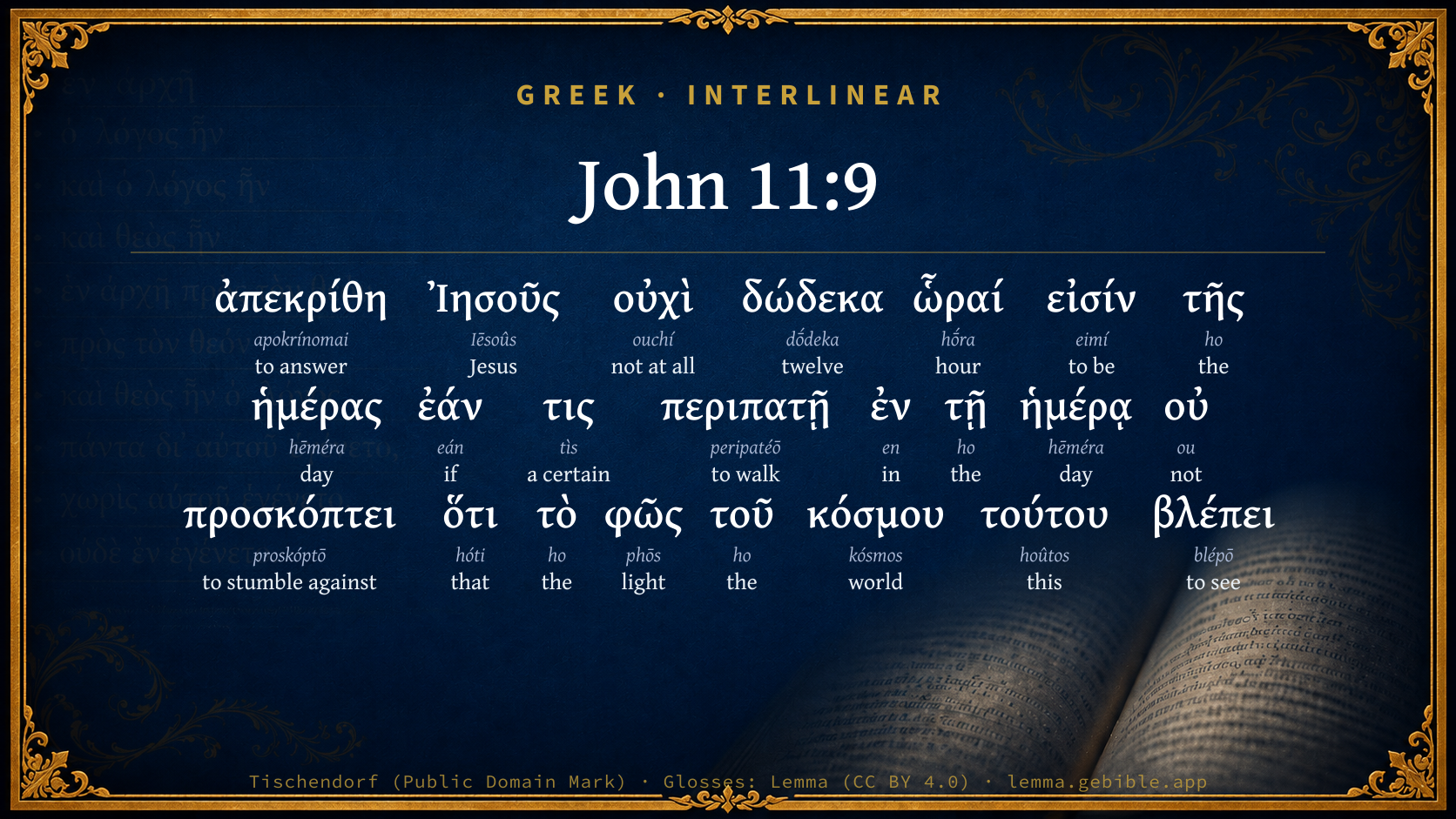
  1. ἀπεκρίθη apokrínomai G611 “to answer” Verb, Aorist, Middle deponent, Indicative, 3rd person, Singular
  2. Ἰησοῦς Iēsoûs G2424 “Jesus” Noun, Nominative, Singular, Masculine
  3. οὐχὶ ouchí G3780 “not at all” Particle, Interrogative
  4. δώδεκα dṓdeka G1427 “twelve” Adjective, Numeral (indeclinable)
  5. ὧραί hṓra G5610 “hour” Noun, Nominative, Plural, Feminine
  6. εἰσίν eimí G1510 “to be” Verb, Present, Active, Indicative, 3rd person, Plural
  7. τῆς ho G3588 “the” Article, Genitive, Singular, Feminine
  8. ἡμέρας hēméra G2250 “day” Noun, Genitive, Singular, Feminine
  9. ἐάν eán G1437 “if” Conditional
  10. τις tìs G5100 “a certain” Indefinite pronoun, Nominative, Singular, Masculine
  11. περιπατῇ peripatéō G4043 “to walk” Verb, Present, Active, Subjunctive, 3rd person, Singular
  12. ἐν en G1722 “in” Preposition
  13. τῇ ho G3588 “the” Article, Dative, Singular, Feminine
  14. ἡμέρᾳ hēméra G2250 “day” Noun, Dative, Singular, Feminine
  15. οὐ ou G3756 “not” Particle, Negative
  16. ὅτι hóti G3754 “that” Conjunction
  17. τὸ ho G3588 “the” Article, Accusative, Singular, Neuter
  18. φῶς phōs G5457 “light” Noun, Accusative, Singular, Neuter
  19. τοῦ ho G3588 “the” Article, Genitive, Singular, Masculine
  20. κόσμου kósmos G2889 “world” Noun, Genitive, Singular, Masculine
  21. τούτου hoûtos G3778 “this” Demonstrative pronoun, Genitive, Singular, Masculine
  22. βλέπει blépō G991 “to see” Verb, Present, Active, Indicative, 3rd person, Singular

About this verse

These counts appear in no published source. They are computed here, from the morphology-tagged text and Lemma’s own curated glosses. What Lemma adds →

23
words
19
distinct lemmas
Gospels
section

Notable vocabulary

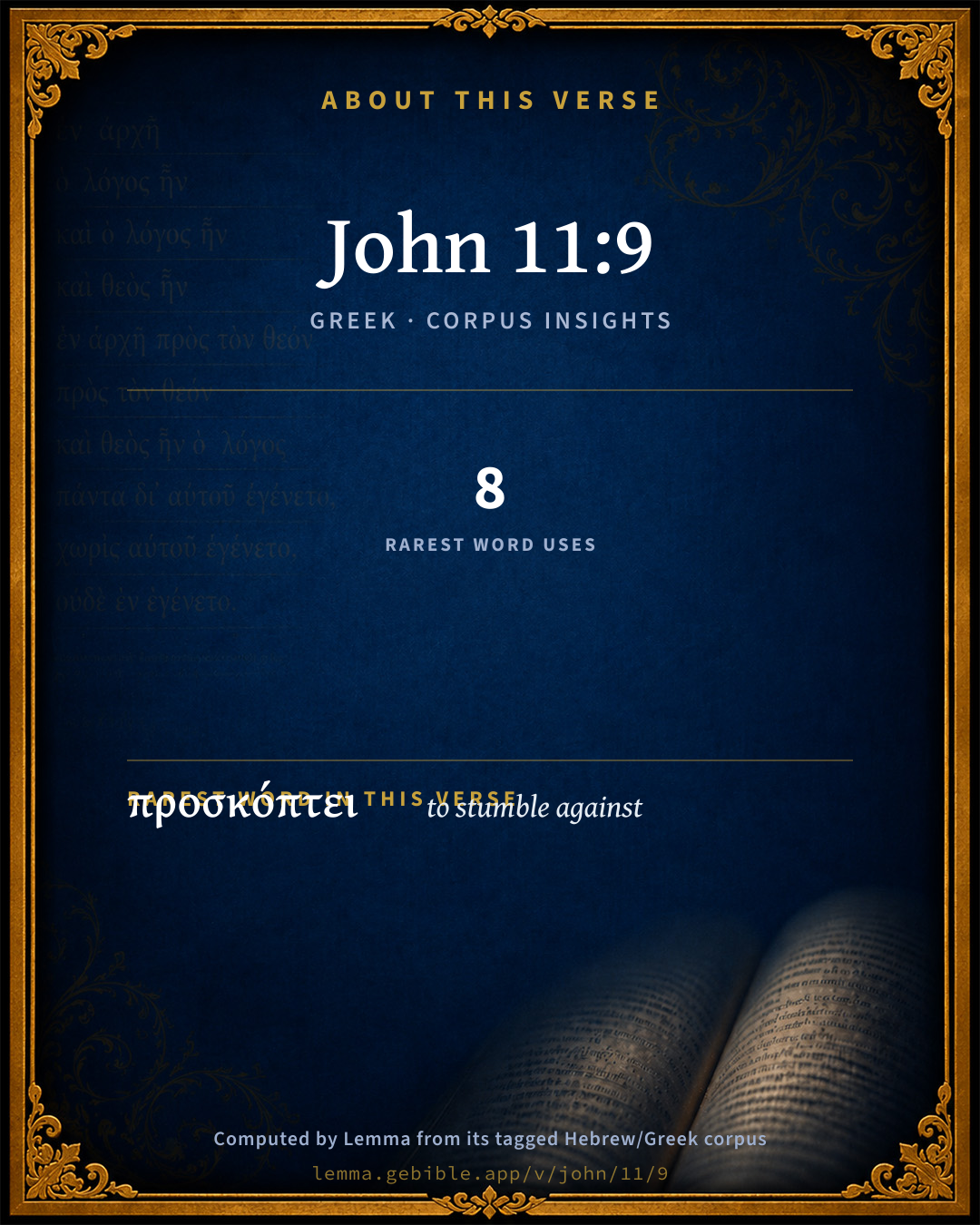
The rarest word here is προσκόπτει to stumble against G4350 — appearing just 8 times in the whole Greek New Testament.

Shared distinctive vocabulary

προσκόπτει to stumble against G4350 occurs in 8 verses of the Greek New Testament. Also found in:

Repetition

Words recur within this verse:

  • ἡμέρας day G2250 ×2
  • τῆς the G3588 ×4

Cross-references

5

Topical passages linked to John 11:9 in the Treasury of Scripture Knowledge — connected by theme and wording, ordered by reader-vote popularity; previews shown in the World English Bible.

  • John 9:4 I must work the works of him who sent me, while it is day. The night is coming, when no one can work.
  • John 12:35 Jesus therefore said to them, "Yet a little while the light is with you. Walk while you have the light, that darkness doesn't overtake you. He who walks in the darkness doesn't know where he is going.
  • Jeremiah 31:9 They shall come with weeping; and with petitions will I lead them: I will cause them to walk by rivers of waters, in a straight way in which they shall not stumble; for I am a father to Israel, and Ephraim is my firstborn.
  • Proverbs 3:23 Then you shall walk in your way securely. Your foot won't stumble.
  • Luke 13:31–33 On that same day, some Pharisees came, saying to him, "Get out of here, and go away, for Herod wants to kill you."

Cross-references courtesy of OpenBible.info (CC BY 4.0).

Commentary

Notes on John 11:9 from classic Christian and Jewish commentators (each source and its license shown beneath its notes). The classic Christian expositions comment on the surrounding passage and are grouped to its opening verse, so a note may address several verses; the Jewish commentaries on the Tanakh (Rashi and others) are per-verse, so they appear only where the commentator wrote on this verse.

Lemma curates 59 commentaries, every one of them public domain or Creative Commons licensed, each selected and text-cleaned for this edition rather than reprinted as found. About our sources →

The Biblical Illustrator

Joseph S. Exell

Joh_11:9-10

Are there not twelve hours in the day?

--What does this sentence mean here, following Joh_11:7-8? Why was it introduced? I do not know that we who are living easy and comfortable lives can quite solve that question. But many a patriot and confessor who has been concealing himself from the anger of those whom he wished to bless has learned its meaning and felt its support. If he had tried to rush forth into danger, merely in obedience to some instinct or passion of his own, he was walking in the night and was sure to stumble. If he heard a voice in his conscience bidding him go and do some work for God--go and aid some suffering friend--he would be walking in a track of light; it signified not what enemies might be awaiting him, what stones might be cast at him, he could move on fearlessly and safely. The sun was in the heavens--the stones would miss till his hour was come. If it was come, the sooner they struck the better. (F. D. Maurice, M. A.)

Twelve hours in the day

I. THE PREDESTINATION OF LIFE. God has marked out beforehand the length of the life. This was true of the life of Christ. He was in daylight till the twelfth hour. He could not die. His time was not yet come. It is true of us. God knows exactly the length of our day, and therefore of our hour. The day shall run its course, whether the season be winter or summer, whether the hour be thirty minutes or sixty. This is a call to confidence. Be not afraid to go at the summons of duty, in spite of snare, terror, accident or infection. The day will have its twelve hours.

II. THE COMPLETENESS OF LIFE. We speak of a child or young mans life as prematurely closed. Isaiah speaks of the longevity of the time when a child shall die hundred years old. Certainly there have been children whose little life has been well completed--their innocence and death testifying powerfully for Christ. Their day has had its twelve hours, though the constituent hour was less than a year. We must cast away the common measurement of time. Christs life was a short one, and how large a part was spent in preparation? No time is less wasted than that given to preparation. Christs three years of speech had in them the whole virtue, for the world, of two eternities. Christs thirty years of listening were not the prelude only, but the condition of the three. Each life, the shortest not least, is complete. Mans work depends not on his longevity. Many a young man sleeping in the churchyard sends forth the fragrance of a perpetual sanctity. Use well your time, longer or shorter, and the hours shall be twelve, and the component hour shall have its constituent moments sure.

III. THE UNITY OF LIFE. We would fain divorce hour from hour, and never recognize their bearing upon each other and the day. And it is true that repentance severs one part of the day from another, and make old age--and therefore eternity--diverse from the boyhood. It is also true that a Christian does well to take his years, months, days, one by one and to live each as if it were the only one. Nevertheless, we cannot disguise the unity of this being. We may wish we had not done that wicked thing, fallen into that evil habit, but it is there: we cannot cut off the entail. God sees the day as one: and when He writes an epitaph He does so in one of two lines. He did that which was good. He did that which was evil--the identification is complete, the character one.

IV. THE DISTRIBUTION OF LIFE. God sees it in its unity. He bids us see it in its manifoldness; in its variety of opportunity and capability of good. Where is the moment which might not contribute something? Economize. Give up some fragment to God. (Dean Vaughan.)

The twelve hours of the day; or, lifetime and lifes duty in their indissoluble unity

I. THE CERTAINTY OF LIFE WITHIN THE BOUNDS OF DUTY.

II. THE SACREDNESS OF DUTY WITHIN THE BOUNDS OF LIFE. (J. P.Lange, D. D.)

Life the golden opportunity

I. THE WISDOM OF KNOWING OUR OPPORTUNITY. This chiefly depends on

1. Our walking.

2. Our working while it is light.

II. THE DANGER OF NEGLECTING IT

1. For vain amusements.

2. In the eager pursuit of trifles. (R. Cecil, M. A.)

God takes care of His workers

The Rev. T. Charles had a remarkable escape in one of his journeys to Liverpool. His saddlebag was by mistake put into a different boat from that in which he intended to go. This made it necessary for him to change his boat, even after he had taken his seat in it. The boat in which he meant to go went to the bottom, and all in it were drowned. Thus did God in a wonderful way preserve His servant--immortal till his work was done. God had a great work for this His servant, and He supported and preserved him till it was completed.

The providential care of life

When I was stationed in Swanson, in the year 1836, I was appointed delegate to the district meeting held at St. Ives, Cornwall. One Captain Gribble offered me a passage in his vessel. I accepted the offer, and said, When are you going out? He replied, We have got our cargo, and shall go tomorrow if the wind is fair. I went to the dock on Monday, Tuesday, and Wednesday; the wind was still against him. He then advised me to take the packet to Bristol, as he said it was quite uncertain when he should be able to go to sea. I took the packet on the Thursday morning. We had a very rough passage; through mercy we arrived safe in Bristol next morning. I arrived at Hayle between one and two oclock on Sunday morning. I then walked to St. Ives, a distance of five miles. I went to Mr. Driffields. When he saw me he said, Is Joseph yet alive? I answered, Yes. He further said, We were informed you were coming with a sailing vessel, and it appears she is lost, for some of the wreck is come on shore. We have gone through the stationing and left you without a station. I was given to understand that on the morning I left for Bristol the vessel went out. The wind was fair, but after being a few hours at sea all went to the bottom, captain and crew. What a providence it appears that the vessel could not go out until I was gone! (J. Hibbs.)

The contemplated journey

I. OPPOSED BY THE DISCIPLES as

1. Dangerous (Joh_11:8).

2. Unnecessary (Joh_11:12-13). Hence

3. Imprudent, if not also

4. Wrong.

II. JUSTIFIED BY JESUS. As

1. Imperative, being undertaken at the call of His Father.

2. Safe, since He could not stumble in the path of duty.

3. Merciful, inasmuch as He went to comfort the sisters and raise Lazarus.

4. Profitable, even for those who were so strongly against it. (T. Whitelaw, D. D.)

Light and loyalty

The disciples were amazed when Jesus proposed to go to Bethany, and remonstrated with Him. Christ takes this opportunity of explaining the great principle on which He worked. I walk in Gods light which shines upon My path during the time He has fixed for My ministry. Wherever that light shines, I go, regardless of everything but it. Do you the same, My disciples. Your path of duty will be clear. Without that light you will be as men walking in the dark and meeting disaster. We are thus led up to the question of the simplicity of duty. Somehow duty has come to be to many a complicated matter. That it presents problems every one of us knows, but does the problem lie in the duty or in us? Do we not complicate the problem by adding factors of our own. The oculist says that there is a blind spot in every eye: possibly when we think duty obscure we have brought the duty into line with the blind spot. As a matter of precept, duty being a thing of universal obligation must be simple. To make it a matter of subtle casuistry or painful research would limit it. And men stumble none the less because of this simplicity. Christ does not put the blame of stumbling on the law or on the complication of duty. It is not the geological structure of the stone that makes men stumble, but darkness or blindness. And so morally. Our Lord asserts elsewhere that the lamp of the body is the eye: When thine eye is single thy whole body is full of light, etc. When a man sees two trees when there is only one, or prismatic colours in a house that is white, we do not blame the tree etc., but the mans vision, A sound moral vision recognizes duty under every shape. Hence the truth of our text is that the recognition of duty, and the practical solution of its problems, lie in the principle of loyalty to Christ. A Divinely enlightened conscience and an obedient will, not only push, but lead. See this illustrated here. Going to Bethany involved a question of duty for Christ. To one who had no thought but to do the Fathers will, the case was simple. But the disciples, in their natural timidity, put another element into the question, which complicated it--personal safety. If Jesus entertained the suggestion, He would have been diverted from the plain duty. A new question would have been raised which God had not raised. Gods commission said nothing about danger--only Go. If He meant to do right the decision presented no difficulty; if He meant to save Himself, He would have walked in darkness. Is not singleness of purpose an element of all heroism? Was there ever a great general whose thought was divided between victory and personal safety? The men who have moved society have seen nothing but the end to be won. When a physician enters on his profession, he does so with the knowledge that he must ignore contagion. That makes his duty very simple--to relieve disease wherever he finds it. The moment he begins to think about exposure to fever, etc., his usefulness is over. Luther at Worms had a terrible danger to face, but a very easy question to solve; but his inability to do anything but the one right thing (I can do no otherwise) carried the Reformation, and this singleness is the very essence of Christianity. Its first law is, treat self, as though it were not Follow Me. It is not always easy to follow Christ; but the way at least is plain. A greater difficulty arises when the question becomes one of compromising between Christ and self. The only way in which self can be adjusted to the Cross is by being nailed to it. Duty is a fixed fact. It does not adjust itself to us. There is a nebulous mass in the depths of space. The problem before the astronomer may be difficult to work out, but its nature is simple. He is to resolve that mist into its component stars. If he is bent on bringing the facts discovered by his telescope into harmony with some theory of his own, he complicates his task at once: or let the glass be cracked or the mirror dirty, and his observation only results in guess work. But, with an unprejudiced mind and a good telescope, his eye penetrates the veil and brings back tidings which enrich the records of science. So when men look at duty with loyal and obedient hearts, its lines come out sharply. Let self put a film over the spirit, duty remains unchanged, but the man sees only a mist. When the engineer decided that his railroad had to go through Mont Cenis, he had a difficult task but a simple one; and in addressing himself wholly to that solution of his problem, he at once got rid of a thousand questions as to other routes, etc. No one ever had so clear a perception of the hardness of His mission as Christ. And yet the closest study reveals not a shadow of hesitation. He goes to the Cross saying, The Scripture must be fulfilled. He comes back from the dead with, Thus it behoved Christ to suffer. His motto was, My meat is to do the will of Him that sent Me, etc. He admitted no question of stoning or crucifying, and hence it is that His life while it is the most tremendous tragedy in history is the most purely simple. Suppose duty costs popularity, etc., Christ does not promise that the man who walks in the light shall have an easy walk. He promises that he shall not stumble: but Christ did not stumble because He was crucified, nor Stephen because stoned, nor Paul because beheaded. The stumbling would have been in Christ accepting Satans offer, in Stephens keeping silence, in Paul making terms with Nero or the Jewish leader. Popularity, etc., won by evasion of duty are not gains.

Better that Christ should have gone than that the world should have lost the lesson of the Resurrection. Better all that agony than that the world should have missed a Saviour. But this steadfast light giving principle is not a mere matter of human resolve. Christ is in the soul as an inspiration and not merely before the eye as an example. And remember that though Christ in setting you on that well-lighted track of duty does not allow you to take account of the hardness, He takes account of it. You cannot live a life so hard that Christ has not lived a harder. His word is Follow Me. Do that and you cannot go wrong. (M. R. Vincent, D. D.)

If a man walk in the day, he stumbleth not

Oriental streets

are not as safe as Occidental streets, nor are Oriental roads as safe as Occidental roads. Setting aside all other differences, both streets and roads are in a chronic state of disrepair. The streets are narrow, and not too clean; the roads are often composed of nothing more than loose stones lying upon each other as chance sets them. The consequence is that it is a work of strategy to thread ones way through Oriental streets, avoiding at the same time the filth of the street and the crowding of burdened donkeys or camels, and a work of art to ride or walk over an Oriental road without coming occasionally to the ground, or having ones flesh torn by the thorns on either side. This is during the day; but at night the difficulty is increased a hundred fold; thus it is that if a man walk in the night, he stumbleth. Jesus felt that He was walking in the day, because He saw the danger, and knew how to avoid it. (S. S. Times.)

The walk of duty

It is a walk

I. of LIGHT. Walk in the day. The man who, from proper motives and with a single eye, pursues his mission in life, moves in open day. No dark cloud shadows his path, no haze hangs over him, he knows what he is about. His course lies clearly before him, and he sees the goal

II. Of SAFETY. Stumbleth not. He who moves within the bounds of duty makes no false steps, for the will of God enlightens him. But he who walks outside the limits of his vocation will err in what he does, since, not the will of God, but his own pleasure is his guide.

III. THAT MUST BE PURSUED. Though Christ was warned of the probable consequences He felt that He had to go. (D. Thomas, D. D.)

The Biblical Illustrator, edited by Joseph S. Exell (c. 1880s–1900s) — public domain. Text from a community e-Sword module.

Bengel's Gnomon

Johann Albrecht Bengel

Joh 11:9. Ὥραι, hours) The course of Jesus was now far advanced; it was now a late hour in His day: but it was however still day.—τῆς ἡμέρας) of the day, or else in the day. The whole course of life, in all its parts, is compared to the day. The standing [state] is presupposed: one standing or state in one, another in another, regarded as the Subject; to walk is the Predicate.—τίς, any one) Again used indefinitely. Comp. ch. Joh 9:4, “I must work, etc.: the night cometh, when no man can work.” This applies to the disciples, who were afraid, even for themselves.—οὐ προσκόπτει, he does not stumble) in the midst of snares of the world lying in his way.—τὸ φῶς τοῦ κόσμου τούτου, the light of this world) beaming out from the sun. The providence of the Father, in respect to Jesus, is intimated; and the providence of Christ in respect to believers.—βλέπει, He seeth) Understand, and there is light in him: and in the following verse understand, and he seeth not the light of this world. But in both instances the clause, which is expressed, is especially suited to its own passage respectively: for during the day, the light of the world, which each one sees, as it were absorbs the sense of the light which he has in himself. By night the light of the world, being not seen, increases the sense of his defect in the case of him who hath no light in himself.

Bengel's Gnomon of the New Testament — English translation (T&T Clark, Edinburgh, 1860) — public domain. Text from a community e-Sword module.

Meyer's Critical & Exegetical Commentary

Heinrich August Wilhelm Meyer

Joh_11:9-10. The sense of the allegorical answer is this: The time appointed to me by God for working is not yet elapsed; as long as it lasts, no one can do anything to me; but when it shall have come to an end, I shall fall into the hands of my enemies, like him who walketh in the night, and who stumbleth, because he is without light. In this way Jesus sets aside the anxiety of His disciples, on the one hand, by directing their attention to the fact that, as His time is not yet expired, He is safe from the apprehended dangers; and, on the other, by reminding them (Joh_11:10) that He must make use of the time apportioned to Him, before it come to an end.[72] So substantially Apollinaris (διδάσκει ὁ κύριος, ὅτι πρὸ τοῦ καιροῦ τοῦ πάθους οὐκ ἂν ὑπὸ Ἰουδαίων πάθοι· καὶ διδάσκει τοῦτο διὰ παραβολῆς, ἡμέρας μὲν καιρὸν ὀνομάζων τὸν πρὸ τοῦ πάθους, τὸν δὲ τοῦ πάθους νύκτα), Ruperti (only partially), Jansen, Maldonatus, Corn.a Lapide, Wolf, Heumann, and several others; also Maier and B. Crusius; comp. Ewald and Hengstenberg. On individual points, note further: (1) ΔΏΔΕΚΑ is placed emphatically at the beginning, signifying that the day referred to is still running on, and that anxiety is still premature (not: only twelve hours; Bengel correctly remarks: jam multa erat hora, sed tamen adhuc erat dies). The supposition that Jesus spoke the words early in the morning, at sunrise (Godet, Gumlich), is as arbitrary as it is unnecessary. (2) τὸ φῶς τ. κόσμ. is the light of the sun, so designated in harmony with the elevated tone which marks the entire saying; the words ὅτι … βλέπει belong merely to the details of the picture, and are not intended to be specially interpreted (for example, of the guidance of the divine will, as Godet thinks, following older commentators). (3) Applying the figure to Jesus, night (Joh_11:10) commenced with the ἐλήλυθεν ἡ ὥρα, Joh_17:1 (comp. Joh_12:27); the ἩΜΈΡΑ with its twelve hours was then over for Him, and, according to the divine decree, the ΠΡΟΣΚΟΠΉ in His path which, with the close of the twelfth hour, had become dark, must now follow,[73] in that He fell into the hands of His enemies; till then, however, οὔπω ἐληλύθει ἡ ὥρα αὐτοῦ, Joh_7:30, Joh_8:20. (4) The expression ὍΤΙ ΤῸ Φῶς ΟὐΚ ἜΣΤΙΝ ἘΝ ΑὐΤῷ, which is also a detail not intended for interpretation, is not equivalent to: he has not, etc. (Ewald; it is also inadmissible to take this view of Psa_90:10), but is an outflow of the notion that, in the case of a man walking in the night, it is dark in him, i.e. his representation of his surroundings is dark and without light, so that he cannot discover his whereabouts in his consciousness of that which is round about him. Grotius: in oculis ejus; but the expression ἐν αὐτῷ suggests the inner intuition and representation. (5) Substantially the same, and decisive for the view which the disciples would take, are the thought and figure in Joh_9:3 f.; hence also here neither is ἩΜΈΡΑ to be taken as an image of tempus opportunum (Morus, Rosenmüller, Paulus, Kuinoel), nor νύξ of tempus importunum; nor is it any more allowable to say, with Gumlich and Brückner (comp. Melanchthon, Beza, and Calvin), that φῶς τοῦ κ. τ. is God, who shows the Son the way, so that this latter thus walks in the day, and His person and work remain unendangered (οὐ προσκόπτει[74]); similarly Baeumlein; Lücke, on the other hand, rightly refers Τῆς ἩΜΈΡΑς to the days work of Christ, which has its definite limit (its twelve hours); but then he explains ἐν τῇ ἡμέρᾳ of fulfilling the duties of His calling (comp. Melanchthon), which is always the way of safety, and takes νύξ as an image of unfaithfulness to ones calling, which leads to destruction. In this way, however, two totally different meanings are assigned to the figurative term ἡμέρα, the second of which is the more decidedly to be rejected, as the mention of twelve hours is evidence that the temporal explanation alone is correct. For this reason, further, we must reject not only the view taken by De Wette, who regards the day as the image of upright, innocent, clear action, the twelve hours, as the ways and means of action, and the night as the lack of prudence and singlemindedness; but also that of Luthardt: He who keeps within the limits of his calling will not strike against anything, will not make false steps, for the light of the world, i.e. the will of God, gives him light; he, however, who passes beyond the limits of his calling will go wrong in his doings, seeing that he is guided, not by Gods will, but by his own pleasure. Tholuck also diverges from the consistent carrying out of the temporal view; for, though understanding the twelve hours of the day of the fixed time of the vocation, he afterwards introduces the calling itself: Whoso abides not by his calling will come to damage. Comp. Schweizer, p. 106; also Lange, who combines several very different views. According to Chrysostom, Theophylact, and Euth. Zigabenus, the walking in the day denotes either a blameless walk, in which a man has no need to be afraid; or fellowship with Christ (so also Erasmus: quamdiu vobis luceo, nihil est periculi; veniet nox, quando a me semoti conturbabimini.[75] Vatablus, Clarius, Lampe, Neander). Both are incorrect, for the simple reason that the disciples had expressed concern, not for themselves, but for Christ, by their question in Joh_11:8 (Chrysostom and his followers arbitrarily remark that they had been more in anxiety, ὑπὲρ ἑαυτῶν); and because the former of these views would furnish no explanation of the mention of the hours, which is just the key to the figure. This objection holds good also against Hilgenfeld, Lehrbegr. p. 263, who brings out as the meaning of Jesus: He has the light absolutely in Himself, and for Him, therefore, no dark point can exist in His earthly course. On this view, moreover, Joh_11:10 remains without explanation. Olshausen, adopting the second view of Chrysostom, is prepared to accept an unhermeneutical double meaning of ἡμέρα;in the one case, mindful of His near brotherly relationship to men, Jesus regarded Himself as accomplishing His ordained days work; but, in the other case, He had in view His higher dignity as the spiritual enlightener, in the rays of whose brightness the disciples would have nothing to fear.[76] Comp. Bengel, who thinks that τὸ φῶς τ. κόσμ. τούτου signifies the providentia Patris respectu Jesu, et providentia Christi respectu fidelium.

[72] Not, as Godet interprets: that He dare not lengthen the working time appointed to Him by the divine will, that He may not venture to add to it as it were a thirteenth hour. Such a thought was totally foreign to the minds of the disciples in giving their warning. All that they desired was, that He should not shorten His life by exposing Himself to the threatening danger of death.

[73] The idea set forth is therefore not the wish to be active beyond the ordained goal and limit of life, which would, indeed, be absurd (Tholucks objection); but to be set free of activity on the attainment of the ordained goal of life. When the twelfth hour has passed, night falls on the wanderer, and he stumbles.

[74] Ver. 10. τὸ φῶς οὐκ ἔστιν ἐν αὐτῷ is then explained by Brückner, after Mat_6:22 f., to mean that the eye, which has received the light, becomes itself a lamp, and so the whole man is illumined. But how could Jesus expect the disciples to understand so far-fetched an illusion? If such had been His meaning, He must have used, in agreement with Mat_6:23, some such words as: ὅτι τὸ φῶς τὸ ἐν αὐτῷ σχότος ἐστιν.

[75] So in the Paraphr. But in the Annotat. he takes substantially our view: Dies habet suas horas, nec is nostro arbitrio fit brevior aut longior; et ego tempus habeo praescriptum, quo debeam redimendi orbis negotium peragere, id Judaeorum malitia non potest anticipari: proinde nihil est, quod mihi timeatis.

[76] Ebrard adopts Olshausens view in the following more definite shape: The day has its determinate measured duration. If a man use the day as day, i.e. the time for working given him by God as a time of working, he needs to be in no fear that his working will bring him mischief, for the light of the mundane sun illumines him. But he who walks as though it were night, i.e. without working the will of God, would procure for himself eternal mischief, because he had not in him the light (in the absolute sense, Joh_1:5). In this way the essential elements are read into the passage; and what a strange difference in the conceptions found in the same expressions! How could the disciples have possibly understood their Master!

Meyer — Critical and Exegetical Commentary on the New Testament — English translation by Peter Christie, edited by Frederick Crombie (T&T Clark, 1880) — public domain. Text from a community e-Sword module.

Expositor's Greek Testament

ed. W. Robertson Nicoll

Joh 11:9 . Οὐχὶ … ἡμέρας , i.e. , each man’s day, or term of work, is a defined quantity. [ τὰ δυώδεκα μέρεα τῆς ἡμέρης παρὰ Βαβυλωνίων ἔμαθον Ἐλληνες , Herod., ii. 109; and see Rawlinson’s Appendix to his Translation .] ἐάν τις … βλέπει . So long as this day lasts, a man may go confidently forward to the duties that call him; οὐ προσκόπτει “he does not stumble,” he can walk erect and straight on amid dangers, cf. Mat 4:6 , “because he sees the light of the world”; as the sun makes all causes of stumbling manifest and saves the walker from them, so the knowledge of God’s will, which is man’s moral light, guides him; and to follow it is his only safety.

The Expositor's Greek Testament, edited by W. Robertson Nicoll (1897–1910) — public domain. Text from a community e-Sword module.

Geneva Bible (1599)

Geneva Bible translators

All things are fitly wrought and brought to pass in their season.

Geneva Bible (1599) marginal notes — public domain. Text via Bolls.life.

Jamieson, Fausset & Brown

Robert Jamieson, A. R. Fausset & David Brown

Jesus answered, Are there not twelve hours in the day?--(See on Joh 9:4). Our Lord's day had now reached its eleventh hour, and having till now "walked in the day," He would not mistime the remaining and more critical part of His work, which would be as fatal, He says, as omitting it altogether; for "if a man (so He speaks, putting Himself under the same great law of duty as all other men--if a man) walk in the night, he stumbleth, because there is no light in him."

Jamieson, Fausset & Brown — Commentary Critical and Explanatory on the Whole Bible (1871) — public domain (CC PDM 1.0). Text via the HelloAO Bible API.

Adam Clarke's Commentary

Verse 9. Are there not twelve hours in the day?] The Jews, as well as most other nations, divided the day, from sun-rising to sun-setting, into twelve equal parts; but these parts, or hours, were longer or shorter, according to the different seasons of the year. See Clarke on Joh 1:39.

Our Lord alludes to the case of a traveller, who has to walk the whole day: the day points out the time of life-the night that of death. He has already used the same mode of speech, Joh 9:4: I must work the works of him that sent me, while it is day: the night cometh when no man can work. Here he refers to what the apostles had just said-The Jews were but just now going to stone thee. Are there not, said he, twelve hours in the day? I have not travelled these twelve hours yet-my last hour is not yet come; and the Jews, with all their malice and hatred, shall not be able to bring it a moment sooner than God has purposed. I am immortal till my work is done; and this, that I am now going to Bethany to perform, is a part of it. When all is completed, then their hour, and that of the power of darkness, shall commence. See Lu 22:53.

If any man walk in the day, he stumbleth not] A traveller should use the day to walk in, and not the night. During the day he has the sun, the light of this world: he sees his way, and does not stumble: but, if he walk in the night, he stumbleth, because there is no light in it, Joh 11:10; i.e. there is no sun above the horizon. The words εν αυτω, Joh 11:10, refer not to the man, but to the world, the sun, its light, not being above the horizon. Life is the time to fulfil the will of God, and to prepare for glory. Jesus is the light of the world; he that walks in his Spirit, and by his direction, cannot stumble - cannot fall into sin, nor be surprised by an unexpected death. But he who walks in the night, in the darkness of his own heart, and according to the maxims of this dark world, he stumbles-falls into sin, and at last falls into hell. Reader! do not dream of walking to heaven in the night of thy death. God has given thee the warning: receive it, and begin to live to him, and for eternity.

Adam Clarke's Commentary on the Bible (1810–1826) — public domain. Text from a community e-Sword/MySword module.

John Calvin's Commentaries

9. Are there not twelve hours in the day? This passage has been explained in various ways. Some have thought the meaning of these words to be, that men sometimes adopt a new and different resolution every hour. This is very far from Christ’s meaning; and indeed I would not have reckoned it worthy of being mentioned, had it not been that it has passed into a common proverb. Let us therefore be satisfied with the simple and natural meaning.

First, Christ borrows a comparison from Day and Night. For if any man perform a journey in the dark, we need not wonder if he frequently stumble, or go astray, or fall; but the light of the sun by day points out the road, so that there is no danger. Now the calling of God is like the light of day, which does not allow us to mistake our road or to stumble. Whoever, then, obeys the word of God, and undertakes nothing but according to his command, always has God to guide and direct him from heaven, and with this confidence he may safely and boldly pursue his journey. For, as we are informed,

Whosoever walketh in his ways hath angels to guard him, and, under their direction, is safe, so that he cannot strike his foot against a stone, (Psalm 91:11.)

Relying on this protection, therefore, Christ advances boldly into Judea, without any dread of being stoned; for there is no danger of going astray, when God, performing the part of the sun, shines on us, and directs our course.

We are taught by these words, that whenever a man allows himself to be guided by his own suggestions, without the calling of God, his whole life is nothing else than a course of wandering and mistake; and that they who think themselves exceedingly wise, when they do not inquire at the mouth of God, and have not his Spirit to govern their actions, are blind men groping in the dark; that the only proper way is, to be fully assured of our divine calling, and to have always God before our eyes as our guide. This rule of regulating our life well is followed by a confident expectation of a prosperous result, because it is impossible that God shall not govern successfully. And this knowledge is highly necessary to us; for believers can scarcely move a foot to follow him, but Satan shall immediately interpose a thousand obstructions, hold out a variety of dangers on every side, and contrive, in every possible way, to oppose their progress. But when the Lord invites us to go forward, by holding out, as it were, his lamp to us, we ought to go forward courageously, though many deaths besiege our path; for he never commands us to advance without at the same time adding a promise to encourage us, so that we may be fully convinced, that whatever we undertake agreeably to his command will have a good and prosperous issue. This is our chariot, and whoever betakes himself to it will never fail through weariness; and even though the obstacles were so formidable that we could not be conveyed through them by a chariot, yet, furnished with these wings, we shall always succeed, till we reach the goal. Not that believers never meet with any adversity, but because adverse occurrences are aids to their salvation.

It amounts to this, that the eyes of God will always be attentive to guard those who shall be attentive to his instructions. Hence we learn also that, whenever men overlook and disregard the word of God, and consequently indulge themselves foolishly, and undertake whatever they think right, the whole course of their life is accursed by God, and vengeance is always ready to punish their presumption and their blind passions. Again, Christ here divides the day into twelve hours, according to ancient custom; for though the days are longer in summer and shorter in winter, yet they had always twelve hours of the day, and twelve of the night.

John Calvin's Commentaries (1540-1563) — public domain. Text from the Calvin Translation Society English edition (1840s-50s) via the Christian Classics Ethereal Library (ccel.org). Calvin's coverage is partial (roughly two-thirds of the Bible); uncommented books and verses are honest gaps, never fabricated. The 19th-century editor's footnotes and remarks are omitted so the notes are faithfully Calvin's own voice.

Ellicott's Commentary for English Readers

(9) Are there not twelve hours in the day?—Or more exactly, Are not the hours of the day twelve? They had expressed their fears that danger and death would be the result of going into Judæa. His answer would say that the darkness of the night which they dreaded could not come yet. The natural night would come not until its appointed hour, until the twelve hours of the day had run their course. The day of His life is marked out by limits no less sure. The night indeed cometh, but it is as yet full day, and in that day He and they must do the work which is appointed of the Father. (Comp. Joh_11:6; and Notes on Joh_2:4; Joh_7:30; Joh_8:20; Joh_9:4; Joh_12:27; Joh_17:1.)

Incidentally these words bear on the question of St. John’s method of counting the hours of the day, and support the view which from other passages seems quite evident that he follows the ordinary Babylonian numeration. (Comp. Notes on Joh_1:40; Joh_4:6; Joh_4:52; Joh_19:14.)

Because he seeth the light of this world—i.e., the natural light of the sun. While the earth is illumined by it, men follow the course of their work without danger of stumbling. In the application to their own position, the truth holds good. The day of His work is illumined by the light of heaven, and for Him and them there is safety.

A Bible Commentary for English Readers, edited by Charles John Ellicott (1878–1897) — public domain. Text from a community e-Sword module.

The Cambridge Bible for Schools and Colleges

gen. ed. J. J. S. Perowne

9. Are there not twelve hours in the day] As so often, Christ gives no direct answer to the question asked, but a general principle, involving the answer to the question. Comp. Joh_2:6; Joh_2:19, Joh_3:5; Joh_3:10, Joh_4:13; Joh_4:21, Joh_6:32; Joh_6:52, Joh_8:7; Joh_8:25; Joh_8:54, Joh_10:25. The meaning seems to be, ‘Are there not twelve working-hours in which a man may labour without fear of stumbling? I have not yet reached the end of My working-day, and so can safely continue the work I came to do. The night cometh, when I can no longer work; but it has not yet come.’ Comp. Joh_9:4. Thus it is practically equivalent to ‘Mine hour is not yet come;’ it is still safe for Him to work: but the figure here adopted is of wider application, and contains a moral for the disciples and all Christians as well as an application to Christ. The expression throws no light on S. John’s method of reckoning time. See on Joh_19:14.

the light of this world] The sun.

The Cambridge Bible for Schools and Colleges (gen. ed. J. J. S. Perowne; Cambridge University Press, 1878–1918) — public domain. Text from a community e-Sword module.

John Gill's Exposition

Jesus answered, are there not twelve hours in the day?.... So the Jews reckoned, and so they commonly say (a), , "twelve hours are a day", or a day consists of twelve hours, which they divided into four parts, each part consisting of three hours this was a matter well known, and Christ puts the question as such, it being what might be easily answered, and at once assented to:

if any man walk in the day: within any of the twelve hours, even in the last of them,

he stumbleth not, at any stone or stumbling block in the way,

because he seeth the light of this world; the sun in the horizon not being as yet set, by the light of which he sees what is before him, and avoids it; See Gill on Joh 8:12. So our Lord intimates, that as yet it was day with him, his time of life was not expired; and so, as yet, it was a time of walking and working; nor did he fear any danger he was exposed to, or any snares that were laid for him, since he could not be hurt by any, nor his life taken from him before his time.

(a) T. Bab Sanhedrin, fol. 88. 2. Avoda Zara, fol. 3. 2. Vid. Philo. de Somniis, p. 1143.

John Gill's Exposition of the Whole Bible (1746–1763) — public domain (CC PDM 1.0). Text via the HelloAO Bible API.

Trapp's Complete Commentary

John Trapp

9 Jesus answered, Are there not twelve hours in the day? If any man walk in the day, he stumbleth not, because he seeth the light of this world.

Ver. 9. Are there not twelve hours?] q.d. Is there not an appointed time to man upon earth? Job 7:1. Shall I not live out my stint? The Turks shun not the company of those that have the plague; but, pointing upon their foreheads, say, It was written there at their birth when they should die. (Blount’s Voyage into Levant.) A priest, indeed, might enter without danger into a leprous house, because he had a calling from God so to do. A man may follow God dryshod through the Red Sea. This our Saviour calls here "to walk in the day," by an excellent and elegant similitude. But he that keeps not within God’s precincts may not look for his protection. I commend the charity, but I question the discretion, of Mr Stafford, public professor of divinity in Cambridge, who, hearing that a certain priest, called Sir Henry Conjuror (in King Henry VIII’s days), lay sore sick of the plague, was so moved with pity to the poor priest’s soul, that he came to him, exhorted, and so laboured him, that he would not leave him before he had converted him, and saw his conjuring books burnt before his face. Which being done, Mr Stafford went home, and immediately sickened, and shortly after most Christianly deceased. He might have, I confess, an extraordinary call to his work. But Zanchius somewhere maketh mention of a colleague of his in the ministry, that by the like means took his death, and much bewailed upon his death bed that he had not yielded to Zanchius advising him to the contrary.

John Trapp, A Commentary or Exposition upon All the Books of the Old and New Testament (1647–1656) — public domain. Text from a community e-Sword module.

Albert Barnes' Notes on the Bible

Twelve hours - The Jews divided the day from sunrise to sunset into twelve equal parts. A similar illustration our Saviour uses in Joh 9:4-5. See the notes at that place.

If any man walk - If any man travels. The illustration here is taken from a traveler. The conversation was respecting a journey into Judea, and our Lord, as was his custom, took the illustration from the case before him.

He stumbleth not - He is able, having light, to make his journey safely. He sees the obstacles or dangers and can avoid them.

The light of this world - The light by which the world is illuminated that is, the light of the sun.

In the night - In darkness he is unable to see danger or obstacles, and to avoid them. His journey is unsafe and perilous, or, in other words, it is not a proper time to travel.

No light in him - He sees no light. It is dark; his eyes admit no light within him to direct his way. This description is figurative, and it is difficult to fix the meaning. Probably the intention was the following:

Jesus meant to say that there was an allotted or appointed time for him to live and do his Father’s will, represented here by the 12 hours of the day. Though his life was nearly spent, yet it was not entirely; a remnant of it was left. A traveler journeyed on until night. It was as proper for him to travel the twelfth hour as any other. So it was proper for Jesus to labor until the close. It was the proper time for him to work. The night of death was coming, and no work could then be done. God would defend him in this until the appointed time of his death. He had nothing to fear, therefore, in Judea from the Jews, until it was the will of God that he should die. He was safe in his hand, and he went fearlessly into the midst of his foes, trusting in him. This passage teaches us that we should be diligent to the end of life: fearless of enemies when we know that God requires us to labor, and confidently committing ourselves to Him who is able to shield us, and in whose hand, if we have a conscience void of offence, we are safe.

Albert Barnes' Notes on the Bible (1834–1885) — public domain. Text from a community e-Sword/MySword module.

Haydock's Catholic Bible Commentary

Some, by the day in this place, understand the time preceding the Passion of our Saviour; and, by the night, the time of his Passion. (Theophylactus) --- By this he encouraged his disciples, assuring them that the day of his sojournment on earth was not yet over; and therefore that the Jews, with all their malice and hatred, could not hurt him. But when the night (the time of his Passion) comes, then their power over him commenced. This is your hour, says he to them, and the power of darkness. (Calmet) --- The Hebrews then divided the day into twelve parts of equal duration, from the rising to the setting sun. (Bible de Vence)

George Leo Haydock (1774–1849), Haydock's Catholic Family Bible and Commentary, 1859 edition — public domain. Excludes Psalms (Douay-Rheims chapter numbering differs from Protestant) and Deuterocanonical books (Catholic canon only).

Matthew Poole's English Annotations

Look as in the day there are twelve hours, in which the sun shineth, and by giving its light directs men in their courses; so as they know how to guide their feet, and do not stumble, because they have the light of the sun, which God hath ordained, to direct men that walk up and down in the world.

Matthew Poole's English Annotations on the Holy Bible (1683–1685) — public domain. Text from a community e-Sword/MySword module.

Whedon's Commentary on the Bible

Daniel D. Whedon

9. Twelve hours—As precisely as the sun measures off the twelve hours, so does God mark out for him his exact time and mission; and clear as the world-light, the sun, over the path and the hours of that mission shines the divine light of duty. In that mission he is divinely safe; for death itself, being in the mission, would be true safety. A man is “immortal until his work is done.”

Daniel D. Whedon (gen. ed.), Commentary on the Old and New Testaments (1874–1909) — public domain. Text from a community e-Sword module.

The Pulpit Commentary

Jesus answered, Are there not twelve hours in the day? If a man walk in the day, he stumbleth not, because he seeth the light of this world. The answer of Jesus is a further deliverance concerning the human law and season ( kairov) of work a parable drawn from earthly and human analogies, which will unquestionably have a direct bearing on the conditions of Divine service at all time, and is therefore applicable to the disciples with himself. It receives also special significance from some aspects of Christ"s own ministry, and from the step he had just now declared that he intended to take. Of course, the parable is based upon the conditions of human work; one of these conditions is light, another of them is time. Light is necessary for all the wise efforts of men the light of day, the light of this world or the sun; we must see whither we are going, in order to avoid the occasions of stumbling. We must submit to this comprehensive condition, or we fail. (cf. here Joh_9:4, "I must work the works of him that sent me while it is day; the night cometh, when no man can work There are two kinds of night of which he speaks. One is the night which arrests all labor, the night of death; and the other is the night of ignorance and unbelief, when the light that is in a man becomes darkness, when, if a man does attempt to work or walk, he will stumble. Meyer and some others, from the reference to another condition, viz. that of time, persist in limiting the notion of the day to that of the period of service, about which the Lord says also some very solemn things; and Meyer objects to Luthardt and others, who give to the sun, to the light of this world, any moral or spiritual meaning. We need not limit the application. Light may mean knowledge of duty supplied by God"s providence and the revelation of his will, and so far as "day" is made by light, it is important to notice it here. But time is an equally important condition, and whereas in Joh_9:4, 5 the Lord laid emphasis upon the limited amount of opportunity during which the light lasts and the work can be done; so here there is an appointed period during which stumbling is unnecessary: "twelve hours in the day." This (I take to be Christ"s meaning) is one of these hours, and before the night comes "I must work." Godet suggests that the disciples, by this question, recommended him not to shorten his career by courting danger, and so to create for himself "a thirteenth hour" to the day, in which he would secure no blessing; that the Lord condemned the proposal, knowing that he was immortal till his hour had come; and that if we shrink from a call of duty, and thus save ourselves, adding an unhallowed increment to our day of useless work, we incur the like condemnation, we shall stumble. Let it be observed that the reason for working in the night is not because we have twelve hours for duty and no more, but because, though we have a time of service and an opportunity, we have let both slip past us, and then the work is difficult and perilous if we do attempt it. Some have said that Judas, Peter, Thomas, etc., walked in the night, and that they stumbled and fell.

The Pulpit Commentary (1880–1919), ed. H.D.M. Spence-Jones & Joseph S. Exell — public domain. Text from a community e-Sword module.

John Wesley's Explanatory Notes

Are there not twelve hours in the day? - The Jews always divided the space from sunrise to sunset, were the days longer or shorter, into twelve parts: so that the hours of their day were all the year the same in number, though much shorter in winter than in summer. If any man walk in the day he stumbleth not - As if he had said, So there is such a space, a determined time, which God has allotted me. During that time I stumble not, amidst all the snares that are laid for me. Because he seeth the light of this world - And so I see the light of God surrounding me.

John Wesley, Explanatory Notes Upon the Whole Bible (1754–1765) — public domain. Text via the GEBible commentary corpus.

The People's New Testament

B. W. Johnson

9, 10. Are there not twelve hours in the day? This is his answer to the protest of his disciples against going to Judea again, where the Jews seek his death. He sees his course clearly and is walking in the day.

B. W. Johnson's The People's New Testament with Notes (1889–1891) — public domain. Electronic text from the Christian Classics Ethereal Library (CCEL) ThML edition.

Cambridge Greek Testament for Schools and Colleges

9. οὐχὶ δώδεκα. As so often, Christ gives no direct answer to the question asked, but a general principle, involving the answer to the question. Comp. Joh 2:6; Joh 2:19, Joh 3:5; Joh 3:10, Joh 4:13; Joh 4:21, Joh 6:32; Joh 6:53, Joh 8:7; Joh 8:25; Joh 8:54, Joh 10:25. The meaning seems to be, ‘Are there not twelve working-hours in which a man may labour without fear of stumbling? I have not yet reached the end of My working-day, and so can safely continue the work I came to do. The night cometh, when I can no longer work; but it has not yet come.’ Comp. Joh 9:4. Thus it is practically equivalent to ‘Mine hour is not yet come;’ it is still right for Him to work: but the figure here adopted is of wider application, and contains a moral for the disciples and all Christians as well as an application to Christ; ‘Add nothing and lose nothing, but use the time that is allowed.’ The expression throws no light on S. John’s method of reckoning time. see on Joh 19:14.

προσκόπτει. Knock one’s foot against; offendere.

τὸ φῶς τ. κ. τ. The sun: the words were spoken just before the departure, which probably took place at dawn.

Cambridge Greek Testament for Schools and Colleges (Cambridge University Press, 1896; 21 vols, various authors incl. Carr, Maclear, Plummer, Farrar, Lumby, Moule, M. R. James, Simcox) — public domain. Text from a community e-Sword module.

International Critical Commentary

9. ἀπεκρίθη Ἰησοῦς. See on 1:29 for the omission of the article before Ἰησοῦς in this phrase.

οὐχὶ δώδεκα ὧραί εἰσιν τῆς ἡμέρας; “Are there not twelve hours in the day?” That is, Jesus tells them that their anxiety is premature. The hour of danger had not yet come. Jesus never acted before the appropriate time (see on v. 6).

This saying is the counterpart of 9:4. There Jesus had said that work must be done during the day, and that it could not be postponed until night without failure, and that this law applied to Him as well as to mankind at large. He implied that but a short time remained to Him. But in this passage the thought is different. The hour of His Passion was near, but it had not yet arrived. There was no need for undue haste. The “twelve hours” of His day were not yet exhausted.

For the twelve hours of the Jewish day, see on 1:39.

ἐάν τις περιπατῇ ἐν τῇ ἡμέρᾳ κτλ. We have already had the contrast between walking in the light and walking in darkness (see note on 8:12 for its significance). Here this solemn aphorism is put in connexion with what goes before. The disciples were apprehensive. But Jesus assured them that the night had not yet come. So long as men walk in the light of day they are safe, but it is the night that is the time of hazard.

Here, however, a mystical meaning lurks behind the literal meaning of the words employed. It is literally true that a man walking in the daytime does not stumble, because he sees τὸ φῶς τοῦ κόσμου τούτου, that is, the sun (see for the expression ὁ κόσμος οὗτος on 9:39). But Jesus had already spoken of Himself as the Light of the World (see on 8:12), and the suggestion is the same as in the former passage, sc. that he who walks by the light that Jesus gives does not walk in darkness.

The answer of Jesus to the disciples, then, in these verses implies first that there is no danger yet, for the day—His day—is not yet over; and suggests also that danger need not be dreaded by those who follow Him on His appointed way.

International Critical Commentary — older volumes (1896–1929), various authors — public domain. Text from a community e-Sword module.

Vincent's Word Studies in the New Testament

Marvin R. Vincent

Walk [περιπατη] . Walk about, in the pursuit of his ordinary business. Wyc., wander.

Marvin R. Vincent, Word Studies in the New Testament (1887–1900) — public domain. Text from a community e-Sword/MySword module.

Lesson kit

Teaching starters — assembled from the data on this page, not authored interpretation. Every prompt links to the verse data it draws on. Edit before teaching.

John, in the Gospels, opens this verse with 23 words (19 distinct Greek lemmas). Its most distinctive word is proskóptō (“to stumble against”). A historical commentator’s framing appears above. Read the whole chapter for the surrounding context.

Discussion questions

  1. What does “to stumble against” (proskóptō) contribute to the verse as a whole?
  2. Matthew 4:6 shares the word «to stumble against» with this verse. How do the two illuminate each other?
  3. “day” occurs 2× in this one verse. What is the effect of the repetition?
  4. These translations render this verse differently. What is at stake in choosing one wording over another?
  5. Reading how The Biblical Illustrator and Bengel's Gnomon read this verse, where do the two commentators agree and where do they part?

Things to notice

Reading settings

Reading text

Shown beneath each verse's original-language words.

Old Testament
Old Testament edition

Read the OT as the Masoretic Hebrew (MT) or the Greek Septuagint (LXX).

English shown for the Greek Septuagint (in the Hebrew ↔ Greek comparison).

Comparing translations? Open the Compare panel on any verse page to stack up to four side by side.