John 9:30

Greek (Tischendorf 8th ed.) John 9:30 appears in the Greek New Testament. The text above is from the Tischendorf 8th edition. Each word links to its Strong’s number and a concise gloss. Click any word for its full Thayer’s Greek Lexicon entry.
Download image
Cite this verse

John 9:30 (World English Bible). Public Domain. Lemma interlinear Bible study tool, https://lemma.gebible.app/v/john/9/30.

Show BibTeX & RIS
BibTeX
RIS
English Translation
The man answered them, "How amazing! You don't know where he comes from, yet he opened my eyes.
World English Bible · Public Domain
Download a study sheet

One document with this verse’s original text, its word-by-word gloss line, the meaning frame, cross-references with their text, attributed commentary, and full source and license credits — printable, and it pastes into notes with its structure intact.

This verse Autodidact and up

Study sheet (.html) Plain text (.txt)

A passage Seminary Student

Up to 50 verses in one chapter. A passage sheet keeps up to 6 commentary sources and 12 cross-references per verse, in the order this page ranks them, and says so on the sheet whenever that leaves anything out. Ask for a single verse and you get the Autodidact verse sheet above.

Everything on this page stays free to read, with no account — the sheet is a download of what is already on screen, not access to it.

Want to remove ads? Support Godless Engineer
Compare translations 3

The same verse in 3 English versions, stacked beneath the original-language interlinear above. Click any original word for its lexicon entry.

Each is an independent rendering of the whole verse — the interlinear is not word-aligned to these translations.

Highlighted words mark where these versions differ — a whole-verse word diff, not a word-by-word alignment.

  • World English Bible Public Domain
    The man answered them, "How amazing! You don't know where he comes from, yet he opened my eyes.
  • King James Version Public Domain
    The man answered and said unto them, Why herein is a marvellous thing, that ye know not from whence he is, and yet he hath opened mine eyes.
  • unfoldingWord Literal Text CC BY-SA 4.0
    The man answered and said to them, “Now this is a remarkable thing, that you do not know where he is from, and yet he opened my eyes.

unfoldingWord Literal Text — © unfoldingWord, licensed CC BY-SA 4.0. Word-aligned USFM3 via Door43 (git.door43.org/unfoldingWord/en_ult).

Versions to compare (up to 4)

3 of 4 selected

Show all 19 translations

Every available English version of this verse, each an independent rendering of the whole verse.

  • World English Bible Public Domain
    The man answered them, "How amazing! You don't know where he comes from, yet he opened my eyes.
  • Berean Standard Bible Public Domain
    “That is remarkable indeed!” the man said. “You do not know where He is from, and yet He opened my eyes.
  • Majority Standard Bible Public Domain
    “That is remarkable indeed!” the man said. “You do not know where He is from, and yet He opened my eyes.
  • King James Version Public Domain
    The man answered and said unto them, Why herein is a marvellous thing, that ye know not from whence he is, and yet he hath opened mine eyes.
  • American Standard Version (1901) Public Domain
    The man answered and said unto them, Why, herein is the marvel, that ye know not whence he is, and `yet' he opened mine eyes.
  • Revised Version (1885) Public Domain
    The man answered and said unto them, Why, herein is the marvel, that ye know not whence he is, and yet he opened mine eyes.
  • Geneva Bible (1599) Public Domain
    The man answered, and sayde vnto them, Doutlesse, this is a marueilous thing, that ye know not whence he is, and yet he hath opened mine eyes.
  • Douay-Rheims (1899) Public Domain
    The man answered, and said to them: Why, herein is a wonderful thing, that you know not from whence he is, and he hath opened my eyes.
  • Young's Literal Translation Public Domain
    The man answered and said to them, `Why, in this is a wonderful thing, that ye have not known whence he is, and he opened my eyes!
  • Literal Standard Version CC BY-SA 4.0
    The man answered and said to them, “Why, in this is a wonderful thing, that you have not known where He is from, and He opened my eyes!
  • Unlocked Literal Bible CC BY-SA 4.0
    The man answered and said to them, “This is remarkable, that you do not know where he is from, and yet he opened my eyes.
  • unfoldingWord Literal Text CC BY-SA 4.0
    The man answered and said to them, “Now this is a remarkable thing, that you do not know where he is from, and yet he opened my eyes.
  • Darby Bible Public Domain
    The man answered and said to them, Now in this is a wonderful thing, that *ye* do not know whence he is, and he has opened mine eyes.
  • World Messianic Bible Public Domain
    The man answered them, “How amazing! You don’t know where he comes from, yet he opened my eyes.
  • Webster's Bible Public Domain
    The man answered and said to them, Why, herein is a marvelous thing, that ye know not from whence he is, and yet he hath opened my eyes.
  • Free Bible Version CC BY-SA 4.0
    The man answered, “That's incredible! You don't know where he comes from but he opened my eyes.
  • Bible in Basic English Public Domain
    The man said in answer, Why, here is a strange thing! You have no knowledge where he comes from though he gave me the use of my eyes.
  • Text-Critical English NT CC BY 4.0
    The man answered them, “Why, this is an amazing thing, that you do not know where he is from, and yet he opened my eyes!
  • Tyndale New Testament (1534) Public Domain
    The man answered and sayde vnto them: this is a merveleous thinge that ye wote not whence he is seinge he hath opened myne eyes.

Literal Standard Version (2020), Covenant Press — licensed CC BY-SA 4.0. Text via the HelloAO Bible API (eBible.org). Unlocked Literal Bible (unfoldingWord) — licensed CC BY-SA 4.0. Text via the HelloAO Bible API (eBible.org). unfoldingWord Literal Text — © unfoldingWord, licensed CC BY-SA 4.0. Word-aligned USFM3 via Door43 (git.door43.org/unfoldingWord/en_ult). Free Bible Version, Dr. Jonathan Gallagher — licensed CC BY-SA 4.0. Text via the HelloAO Bible API (eBible.org).

Word by word

More ways to search: Search by grammar → Find every occurrence → Compare this word →

Practice this passage: Drill this verse → Learn its vocabulary →

θαυμαστόν
thaumastós
G2298
“marvelous”
Adjective, Nominative, Singular, Neuter
Part of Speech
Adjective
Case
Nominative
Number
Singular
Gender
Neuter
Full Thayer's Definition

Origin: from G2296

TDNT: 03:27,3

1. wonderful, marvellous a. worthy of pious admiration, admirable, excellent b. passing human comprehension c. causing amazement joined with terror d. marvellous 1. extraordinary, striking, surprising
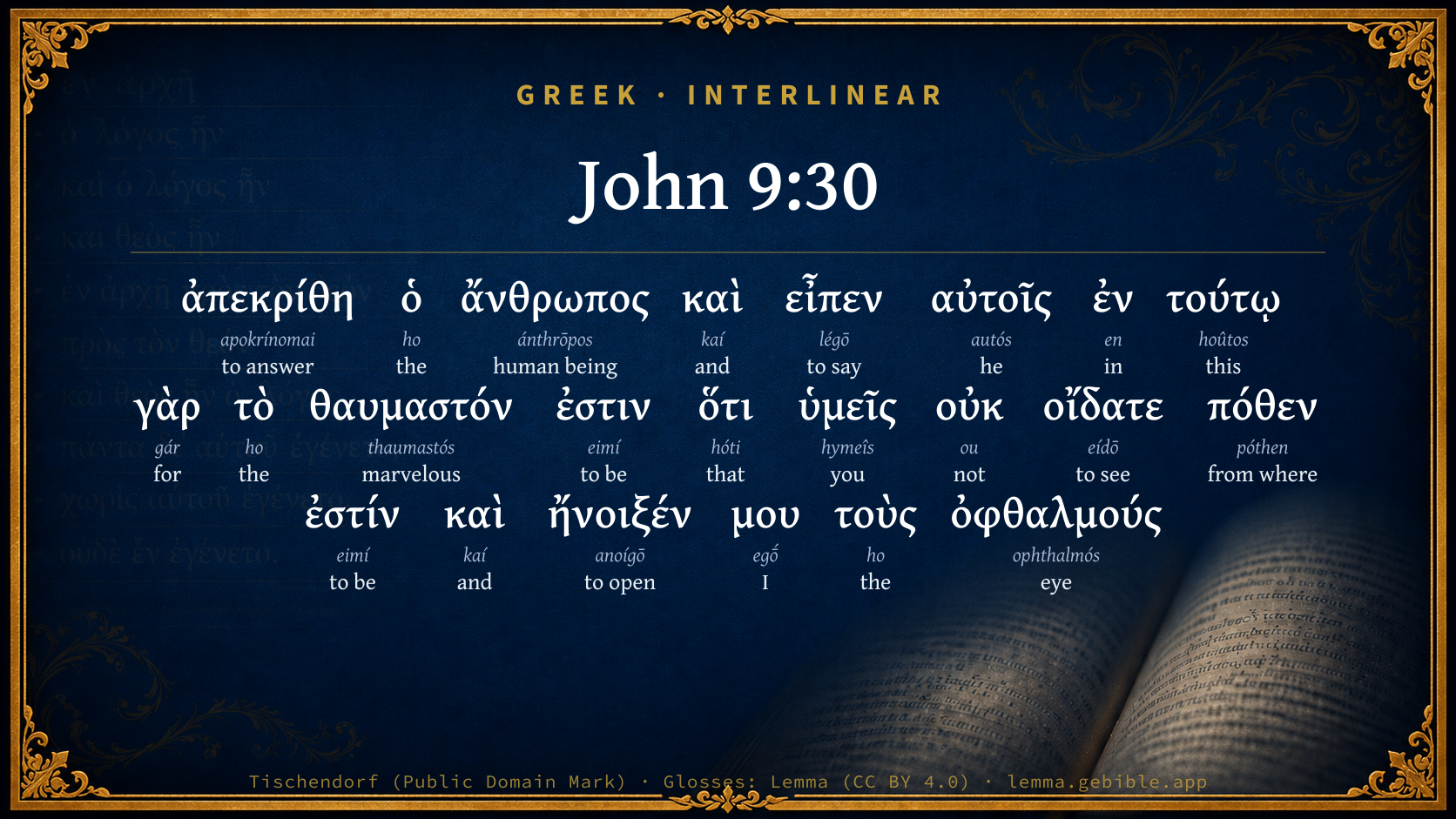
  1. ἀπεκρίθη apokrínomai G611 “to answer” Verb, Aorist, Middle deponent, Indicative, 3rd person, Singular
  2. ὁ ho G3588 “the” Article, Nominative, Singular, Masculine
  3. ἄνθρωπος ánthrōpos G444 “human being” Noun, Nominative, Singular, Masculine
  4. καὶ kaí G2532 “and” Conjunction
  5. εἶπεν légō G3004 “to say” Verb, Aorist, Active, Indicative, 3rd person, Singular
  6. αὐτοῖς autós G846 “he” Personal pronoun, Dative, Plural, Masculine
  7. ἐν en G1722 “in” Preposition
  8. τούτῳ hoûtos G3778 “this” Demonstrative pronoun, Dative, Singular, Neuter
  9. γὰρ gár G1063 “for” Conjunction
  10. τὸ ho G3588 “the” Article, Nominative, Singular, Neuter
  11. ἐστιν eimí G1510 “to be” Verb, Present, Active, Indicative, 3rd person, Singular
  12. ὅτι hóti G3754 “that” Conjunction
  13. ὑμεῖς hymeîs G5210 “you” Personal pronoun, 2nd person, Nominative, Plural
  14. οὐκ ou G3756 “not” Particle, Negative
  15. οἴδατε eídō G1492 “to see” Verb, Perfect, Active, Indicative, 2nd person, Plural
  16. πόθεν póthen G4159 “from where” Adverb, Interrogative
  17. ἐστίν eimí G1510 “to be” Verb, Present, Active, Indicative, 3rd person, Singular
  18. καὶ kaí G2532 “and” Conjunction
  19. ἤνοιξέν anoígō G455 “to open” Verb, Aorist, Active, Indicative, 3rd person, Singular
  20. μου egṓ G1473 “I” Personal pronoun, 1st person, Genitive, Singular
  21. τοὺς ho G3588 “the” Article, Accusative, Plural, Masculine
  22. ὀφθαλμούς ophthalmós G3788 “eye” Noun, Accusative, Plural, Masculine

About this verse

These counts appear in no published source. They are computed here, from the morphology-tagged text and Lemma’s own curated glosses. What Lemma adds →

23
words
19
distinct lemmas
Gospels
section

Notable vocabulary

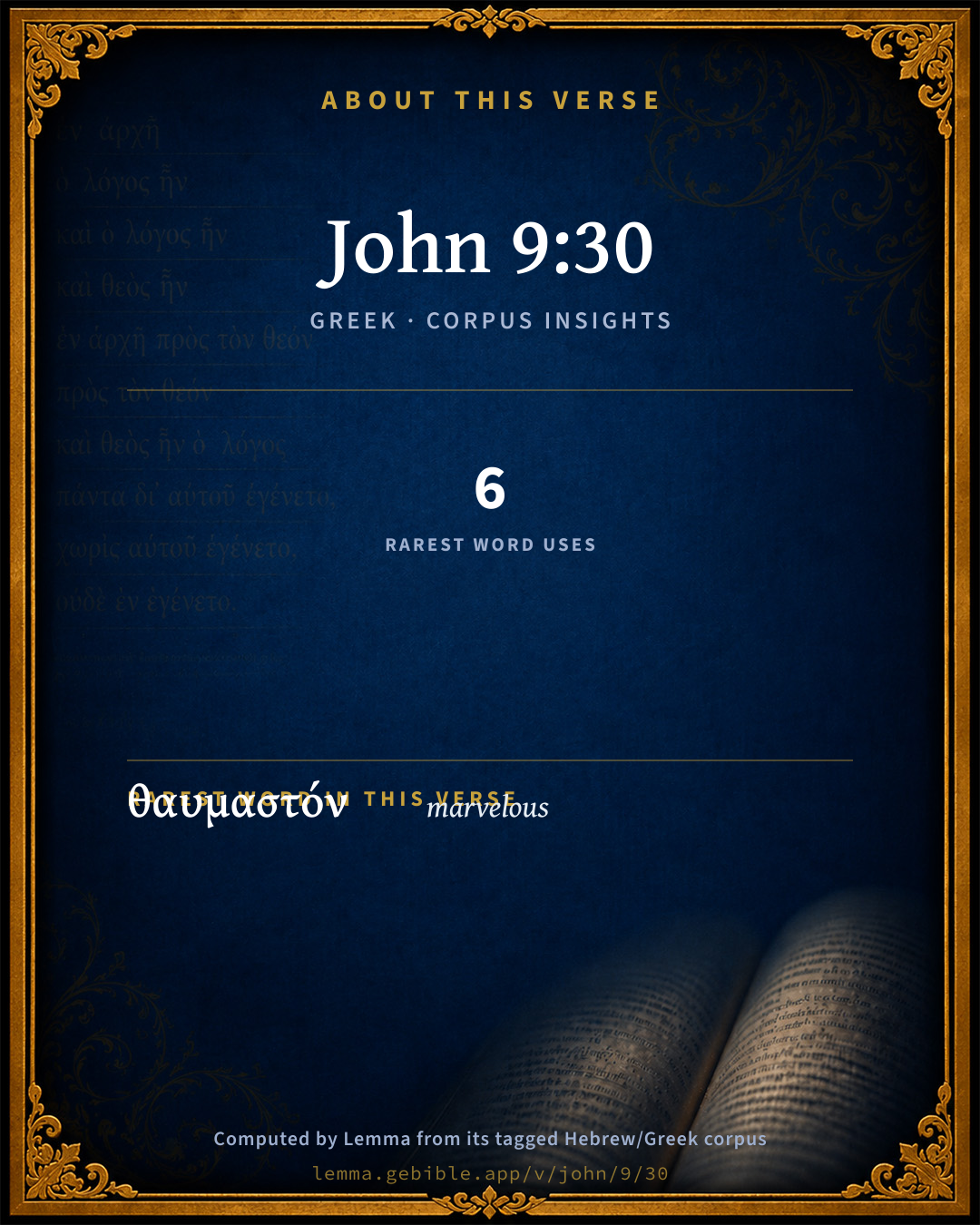
The rarest word here is θαυμαστόν marvelous G2298 — appearing just 6 times in the whole Greek New Testament.

Shared distinctive vocabulary

θαυμαστόν marvelous G2298 occurs in 6 verses of the Greek New Testament. Also found in:

Repetition

Words recur within this verse:

Cross-references

10

Topical passages linked to John 9:30 in the Treasury of Scripture Knowledge — connected by theme and wording, ordered by reader-vote popularity; previews shown in the World English Bible.

  • Psalms 119:18 Open my eyes, That I may see wondrous things out of your law.
  • John 12:37 But though he had done so many signs before them, yet they didn't believe in him,
  • Isaiah 29:18 In that day shall the deaf hear the words of the book, and the eyes of the blind shall see out of obscurity and out of darkness.
  • Isaiah 29:14 therefore, behold, I will proceed to do a marvelous work among this people, even a marvelous work and a wonder; and the wisdom of their wise men shall perish, and the understanding of their prudent men shall be hid.
  • John 3:10 Jesus answered him, "Are you the teacher of Israel, and don't understand these things?
  • Isaiah 35:5 Then the eyes of the blind shall be opened, and the ears of the deaf shall be unstopped.
  • Matthew 11:5 the blind receive their sight, the lame walk, the lepers are cleansed, the deaf hear, the dead are raised up, and the poor have good news preached to them.
  • Luke 7:22 Jesus answered them, "Go and tell John the things which you have seen and heard: that the blind receive their sight, the lame walk, the lepers are cleansed, the deaf hear, the dead are raised up, and the poor have good news preached to them.
  • 2 Corinthians 4:6 seeing it is God who said, "Light will shine out of darkness," who has shone in our hearts, to give the light of the knowledge of the glory of God in the face of Jesus Christ.
  • Mark 6:6 He marveled because of their unbelief. He went around the villages teaching.

Cross-references courtesy of OpenBible.info (CC BY 4.0).

Commentary

Notes on John 9:30 from classic Christian and Jewish commentators (each source and its license shown beneath its notes). The classic Christian expositions comment on the surrounding passage and are grouped to its opening verse, so a note may address several verses; the Jewish commentaries on the Tanakh (Rashi and others) are per-verse, so they appear only where the commentator wrote on this verse.

Lemma curates 59 commentaries, every one of them public domain or Creative Commons licensed, each selected and text-cleaned for this edition rather than reprinted as found. About our sources →

Joseph Benson's Commentary

Joh 9:30-34. The man answered — Utterly illiterate as he was: and with what strength and clearness of reason! So had God opened the eyes of his understanding, as well as his bodily eyes! Why, herein is a marvellous thing, that ye — The teachers and guides of the people; know not whence he is — From whence he comes, and who hath sent him; and yet he hath opened mine eyes — Hath wrought a miracle, the like of which was never heard of before. Surely a man who could do such a thing must be from heaven, must be sent of God. It was esteemed by the Jews a peculiar sign of the Messiah, that he should open the eyes of the blind, that is, of those born blind; a miracle never known to be wrought by Moses or any of the prophets. Now we know — Even we of the populace know; God heareth not sinners — Impenitent sinners who continue in sin, so as to answer their prayers in this manner, and assist them to perform such astonishing miracles; which, without his assistance, and that communicated in a very extraordinary degree, could not possibly have been performed. But if any man be a worshipper of God, and do his will — If any man truly worship and serve him; him he heareth — Answereth his prayers, and that sometimes, probably, in a singular sense. Since the world began, &c. — That is, from the beginning of the world; it was never heard, that any man — Who was not a worshipper of God, and a doer of his will, that is, any sinner, any impostor; opened the eyes of one that was born blind. If this man were not of God — Were not sent of God; if he were not a prophet and messenger of God; he could do nothing — Thus the beggar, though illiterate, answered that great body of learned men with such strength of reason, that they had not a word to reply. However, the evidence of his arguments had no other effect but to put them into a passion; insomuch that they railed at him, saying, Thou wast altogether born in sins, and dost thou teach us — Thou wicked, illiterate, impudent fellow, whose understanding continues still as blind as thy body was, and who wast born under the heaviest punishment of sin, dost thou pretend to instruct us in a matter of this kind? Us, who are the guides of the people, and eminent for our skill in the law? The reproach, Thou wast altogether born in sins, proceeded from the same general principle from which the question of the disciples arose, (Joh 9:2,) Who did sin, this man or his parents? They inferred from his being born blind, that he was in some peculiar way born in sins. And they cast him out — That is, passed the sentence of excommunication upon him, which was the highest punishment in their power to inflict. From this account we learn, that a plain man, void of the advantages of learning and education, but who has an upright disposition, is in a fairer way to understand the truth, than a whole council of learned doctors, who are under the power of prejudice, and of an earthly mind, lovers of wealth, honour, and pleasure, rather than lovers of God.

Joseph Benson's Commentary on the Old and New Testaments (1811–1818) — public domain. Text from a community e-Sword module.

Tyndale Open Study Notes

Tyndale Open Resources

9:30 The Jewish leaders did not know where Jesus came from. The man’s astonishment was understandable—a healing like this was unprecedented. Jesus’ works confirmed his origin as from God. Once his true identity was known, belief and discipleship should have followed, but the Jewish leaders were willfully blind.

Tyndale Open Study Notes — © Tyndale Open Resources, licensed CC BY-SA 4.0. Text via the HelloAO Bible API.

Bengel's Gnomon

Johann Albrecht Bengel

Joh 9:30. Ἐν γὰρ τούτῳ [why herein], for in this) So ἐν γὰρ τούτῳ, for in this, ch. Joh 4:37 [And herein is that saying true.—Engl. Vers.] γαρ, such being the case [videlicet], at times adds a graceful effect to a reply.—θαυμαστόν, a marvellous thing) Answering to we know not, Joh 9:29. To be ignorant and to wonder, are closely allied.—πόθεν, whence) namely, from God: Joh 9:33, “If a man were not of God he could do nothing:” Joh 9:16, “This man is not of God.”[262]

[262] The man’s words, Joh 9:33, are opposed to these words of theirs, Joh 9:16.—E. and T.

Bengel's Gnomon of the New Testament — English translation (T&T Clark, Edinburgh, 1860) — public domain. Text from a community e-Sword module.

Meyer's Critical & Exegetical Commentary

Heinrich August Wilhelm Meyer

Joh_9:30-33. The passionateness of the Jews now emboldens the man to make a further confession (Joh_9:17).

ἐν γὰρ τούτῳ τὸ (see the critical notes) θαυμ. ἐστιν] Why, herein (in this state of the case) is a marvellous thing, that ye know not from whence He is, and (that) He hath opened mine eyes. The force of the θαυμαστόν lies in καὶ ἀνέῳξε, etc., in virtue of the groundless nature of that ignorance to which actual testimony was thus borne; see Joh_9:31-33. Concerning a man who has done that, ye ought surely to know, etc. γάρ, respicit ad ea, quae alter antea dixerat, et continet cum affirmatione conclusionem, quae ex rebus ita comparatis facienda sit, Klotz, ad Devar. p. 242. Comp. on 1Co_11:22. It is often thus used, especially when miratio rei aut aliorum incredulitatis adsignificatur, Ellendt, Lex. Soph. I. p. 332. Comp. Xen. Mem. iv. 2. 6.

ὑμεῖς] Ye people, who ought to know this best.

Joh_9:31. The man now proves to them, onwards to Joh_9:33, how clearly it is evident from the act of Jesus that He is no sinner (Joh_9:16), but a pious man, yea, a man sent of God. He begins his proof with a major premiss, which he postulates as universally conceded and known (οἴδαμεν, Job_27:9; Job_35:13; Psa_66:18; Psa_109:7; Pro_15:29; Isa_1:15), and which rests on the idea that miracles are answers to prayer (comp. Joh_11:41 ff.; Mar_7:34). A sufficient reason for not assuming that Jesus actually pronounced a prayer aloud in performing the miracle (as Ewald thinks), is the silence of John, who would scarcely have omitted this detail from a narrative so minute as this. Joh_9:32. Minor premiss; then in Joh_9:33, conclusion, both in popular form.

οὐδέν] effect nothingis restricted by the connection to miraculous deeds such as the one here recorded.

Meyer — Critical and Exegetical Commentary on the New Testament — English translation by Peter Christie, edited by Frederick Crombie (T&T Clark, 1880) — public domain. Text from a community e-Sword module.

Expositor's Greek Testament

ed. W. Robertson Nicoll

Joh 9:30 . This, in the face of the miracle, seems to the man a surprising statement: Ἐν γὰρ τούτῳ , “why, herein is that which is marvellous”. τὸ θαυμαστόν is the true reading. For the use of γάρ in rejoinders see Winer, p. 559, and Klotz, p. 242. It seems to imply an entire repudiation of what has just been said: “You utter an absurdity, for …” The marvel was that they should hesitate about the origin of one who had such power as was manifest in the cure wrought on him.

The Expositor's Greek Testament, edited by W. Robertson Nicoll (1897–1910) — public domain. Text from a community e-Sword module.

Jamieson, Fausset & Brown

Robert Jamieson, A. R. Fausset & David Brown

The man answered, Herein is a marvellous thing, that ye know not from whence he is, and yet he hath opened mine eyes--He had no need to say another word; but waxing bolder in defense of his Benefactor, and his views brightening by the very courage which it demanded, he puts it to them how they could pretend inability to tell whether one who opened the eyes of a man born blind was "of God" or "a sinner"--from above or from beneath--and proceeds to argue the case with remarkable power. So irresistible was his argument that their rage burst forth in a speech of intense Pharisaism, "Thou wast altogether born in sins, and dost thou teach us?"--thou, a base-born, uneducated, impudent youth, teach us, the trained, constituted, recognized guides of the people in the things of God! Out upon thee!

Jamieson, Fausset & Brown — Commentary Critical and Explanatory on the Whole Bible (1871) — public domain (CC PDM 1.0). Text via the HelloAO Bible API.

Adam Clarke's Commentary

Verse 30. Why herein is a marvellous thing] As if he had said, This is wonderful indeed! Is it possible that such persons as you are, whose business it is to distinguish good from evil, and who pretend to know a true from a false prophet, cannot decide in a case so plain? Has not the man opened my eyes? Is not the miracle known to all the town; and could any one do it who was not endued with the power of God?

Adam Clarke's Commentary on the Bible (1810–1826) — public domain. Text from a community e-Sword/MySword module.

John Calvin's Commentaries

30. Certainly this is wonderful. He indirectly reproves them for remaining unmoved by a miracle so illustrious, and for pretending that they did not know Christ’s calling; as if he had said, that it was highly improper that such a testimony of Divine power should be held in no estimation, and that the calling of Christ, so proved and attested, should obtain no credit among them. And, in order to show more clearly their stupidity or malice, he magnifies the excellence of the miracle from this consideration, that, as far as the memory of men reaches, none was ever heard to say that such a thing was done by a man. Hence it follows that they are malicious and ungrateful, because they voluntarily shut their eyes on a manifest work of God. He infers from this, that Christ was sent by God, because he is endued with so great power of the Spirit of God, to procure credit for himself and for his doctrine.

John Calvin's Commentaries (1540-1563) — public domain. Text from the Calvin Translation Society English edition (1840s-50s) via the Christian Classics Ethereal Library (ccel.org). Calvin's coverage is partial (roughly two-thirds of the Bible); uncommented books and verses are honest gaps, never fabricated. The 19th-century editor's footnotes and remarks are omitted so the notes are faithfully Calvin's own voice.

Ellicott's Commentary for English Readers

(30) Why herein is a marvellous thing.—Several of the better MSS. read more emphatically, the marvellous thing. He again puts two contradictory positions—their assertion that they knew not by what authority Jesus did these things (whence He was), and the evident fact that He had opened his eyes. He cannot reconcile their statement with what he knows to be true, and he states his wonder in the strongest form.

That ye know not from whence he is—i.e., ye whose business it is to know, ye who claim for yourselves a special knowledge of all such questions, and whose duty it is to inquire into the authority of any one who asserts that he is a teacher or a prophet. (Comp. Note on Joh_1:24.)

A Bible Commentary for English Readers, edited by Charles John Ellicott (1878–1897) — public domain. Text from a community e-Sword module.

The Cambridge Bible for Schools and Colleges

gen. ed. J. J. S. Perowne

30. a marvellous thing] Some of the best MSS. read ‘the marvellous thing.’ ‘You, the very people who ought to know such things (Joh_3:10), know not whether He is from God or not, and yet He opened my eyes.’ ‘You’ is emphatic, and perhaps is a taunting rejoinder to their ‘we know that this man is a sinner’ (Joh_9:24) and ‘we know that God hath spoken to Moses’ (Joh_9:29). The man gains courage at their evident discomfiture.

The Cambridge Bible for Schools and Colleges (gen. ed. J. J. S. Perowne; Cambridge University Press, 1878–1918) — public domain. Text from a community e-Sword module.

John Gill's Exposition

Now we know that God heareth not sinners,.... All mankind are sinners, even God's elect; yea, such who are truly gracious and righteous persons; for there is no man without sin; and God hears such who cry unto him day and night; such Christ came to save; for such he died; and these he calls to repentance; and every penitent sinner God hears: but by "sinners" are meant notorious sinners, such in whom sin reigns, who live in sin, and particularly impostors. The man takes up the word the Jews had made use of, and applied to Christ, Joh 9:24, and suggests, that had Jesus been a sinner, that is, an impostor, God would not have heard him, or have assisted him in doing a miracle, to support an imposture, or cover and encourage a fraud; but that he was heard and assisted, was a plain case: whereas not only they, the learned doctors of the nation, but such an illiterate man as himself knew, that notoriously wicked men, cheats, and deceivers, were not heard of God; and this was known from the Scripture, and all experience; see Psa 66:18. The Persic and Ethiopic versions read, "I know, that God", &c.

but if any man be a worshipper of God; fears the Lord, and worships him in spirit and in truth, both with internal and external worship:

and doth his will; for it is not everyone that Lord, or draws nigh to God with his mouth, and honours him with his lips, that is a true and sincere worshipper of him; but he that does his will in faith, from a principle of love, and with a view to his glory: and

him he heareth; for he is nigh to all that call upon him in truth; and such an one the man intimates Jesus must be, since it was out of all dispute that God had heard him, and had bore a testimony to him.

John Gill's Exposition of the Whole Bible (1746–1763) — public domain (CC PDM 1.0). Text via the HelloAO Bible API.

Trapp's Complete Commentary

John Trapp

30 The man answered and said unto them, Why herein is a marvellous thing, that ye know not from whence he is, and yet he hath opened mine eyes.

Ver. 30. And yet he hath opened mine eyes] Which was a foretold sign of the Messiah, Isa 35:4-5, and an office whereto Paul was sent of God, Act 26:18. And surely if God set such a seal to a man’s ministry, as to make him instrumental to the conversion of others, it is a sweet and singular confirmation, Jer 23:22; 1Co 9:2-3.

John Trapp, A Commentary or Exposition upon All the Books of the Old and New Testament (1647–1656) — public domain. Text from a community e-Sword module.

Albert Barnes' Notes on the Bible

A marvelous thing - This is wonderful and amazing.

Know not from whence he is - That you cannot perceive that he who has performed such a miracle must be from God.

Albert Barnes' Notes on the Bible (1834–1885) — public domain. Text from a community e-Sword/MySword module.

Matthew Poole's English Annotations

The opening of the eyes of the blind without the application of means rationally probable for the producing such an effect, nay, by the application of means which to all human reason seemed of a quite contrary tendency; and this cure wrought upon one who was not blind by some accidental cause, but by some defect in nature, who had been so from his mother’s womb, was so manifest an effect of the Divine power, as this poor man was astonished at it, that they should not understand that it was done by such a power, either immediately or mediately; especially considering the prophecy concerning the Messias, Isa 35:5,6, to which Christ refers John and his disciples for an evidence of it, Mat 11:5.

Matthew Poole's English Annotations on the Holy Bible (1683–1685) — public domain. Text from a community e-Sword/MySword module.

Whedon's Commentary on the Bible

Daniel D. Whedon

30. Ye know not—Ye is here emphatic; ye, who of all ought to know. The opener of my eyes can be no other than God-sent; and this ye are the ones who should know.

Daniel D. Whedon (gen. ed.), Commentary on the Old and New Testaments (1874–1909) — public domain. Text from a community e-Sword module.

The Pulpit Commentary

The man answered and said to them, Whyherein is the marvelous thing. Lange translates, "With respect to this man, this is marvelous, to wit." The R.T. has accurately given the force of the gar , the combination of ge and ara , by the rendering "why?" The "herein" is the ignorance which the Jews now profess of the Divine call and mission of the Healer. Their confusion, their obscurity, their vacillation, on such a patent fact is the marvel of marvels, almost more wonderful than the cure of his blindness. That ye know not whence he is, and (yet) he opened my eyes. (kai not infrequently has the three of "and yet simple juxtaposition conveying a strong contrast; see Joh_8:55 Joh_6:70 Joh_7:4) The man rises into holy and eloquent wrath. Their entire history, their principles of judging of a prophetic call, the whole modus of Divine revelation, ought to have shown that one whose simple will stood in such vivid juxtaposition with work which none but Almighty God could do, ought to have enlightened them. "The blind man, finding he was argued with, grew bolder, and began to argue in turn; if he had not studied theology (say rabbinical casuistry and Mishnaic accretions to the Divine Law), he at least knew his catechism" (Godet).

The Pulpit Commentary (1880–1919), ed. H.D.M. Spence-Jones & Joseph S. Exell — public domain. Text from a community e-Sword module.

John Wesley's Explanatory Notes

The man answered - Utterly illiterate as he was. And with what strength and clearness of reason! So had God opened the eyes of his understanding, as well as his bodily eyes. Why, herein is a marvelous thing, that ye - The teachers and guides of the people, should not know, that a man who has wrought a miracle, the like of which was never heard of before, must be from heaven, sent by God.

John Wesley, Explanatory Notes Upon the Whole Bible (1754–1765) — public domain. Text via the GEBible commentary corpus.

Kretzmann's Popular Commentary

Paul E. Kretzmann

The proper conclusion of the former blind man:

v. 30. The man answered and said unto them, Why, herein is a marvelous thing, that ye know not from whence He is, and yet He hath opened mine eyes.

v. 31. Now we know that God heareth not sinners; but if any man be a worshiper of God, and doeth His will, him He heareth.

v. 32. Since the world began was it not heard that any man opened the eyes of one that was born blind.

v. 33. If this Man were not of God, He could do nothing.

Far from making the man dubious and timid in his statements, the method chosen by the Pharisees rather made him firmer in his position toward the Man who had given him the great blessing of sight. The astonishment of the man was well founded. The leaders of the Jews should have known such a wonderful Healer. To hesitate about the origin of one that performed such wonderful cures and manifested such divine power was foolish in his opinion, and he did not hesitate about telling the Jewish leaders that very fact. Certain it was that a sinner could not perform such deeds; God could not be induced to give such power to a person that deliberately transgressed His will. But now the deed was an evidence of the power of God in the Healer. Therefore this man Jesus could not be a sinner, but must be from God. That a miracle of such magnitude should be performed in the world was unheard of. If Jesus, therefore, could perform such miracles, He must be from God. That was the right conclusion, one which completely vanquished the rulers of the Jews. This unlearned man could argue with much more exactness and power than they themselves, because he had the truth on his side. In the same way the simplest Christian, by adhering strictly to the truth of Scriptures, is able to confound the keenest and cleverest unbelievers that make the attempt to take away his faith in his Savior.

Paul E. Kretzmann, Popular Commentary of the Bible (1921–1924) — public domain. Text from a community e-Sword module.

Burkitt's Expository Notes on the New Testament

William Burkitt

In these verses the blind man proceeds to vindicate our blessed Saviour, who had cured him of his blindness, from the exceptions of the Pharisees, and endeavours, by solid arguments to convince them, that his cure (being born blind) was truly miraculous; and consequently proved Christ to be of God.

1. The man admires that Christ having wrought such a miracle upon him, they should be ignorant of his authority, This is marvellous, that ye know not from whence he is, and yet he hath opened mine eyes. He lays down a general proposition, that no deceiver or false teacher is heard of God, or enabled by him to work such miracles as these, but only such faithful servants as do his will, as thus extraordinarily assisted by him. We know that God heareth not sinners; that is, such as love and delight in sin, such as are in a state of sin, and go on in a course of sin, God will not hear such, or answer the prayers of such. Indeed God sometimes hears a sinner’s prayer in wrath, and refuses to hear a saint’s prayer in mercy: but he never denies a saint’s prayer in wrath, or hears a saint’s prayer in mercy. The proposition laid down is an eternal truth: God heareth not sinners; that is, so long as they purpose to continue sinners, and go on in a course of sin, and remain bold and presumptuous sinners.

Learn thence, That none that live in a course of sin, can reasonably expect that God should hear them, and give in an answer of prayer to them. God heareth not sinners: but if any man be a worshipper of God, and doth his will, him he heareth: that is, if a man feareth God, and worketh righteousness, him the Lord accepteth, heareth, and answereth.

Learn hence, 1. That such as would be heard of God, and accepted with him, must be devout worshippers of him.

2. That it is not enough to prove men religious and acceptable with God, that they are devout worshippers of him, unless they walk in obedience to him, and do his will. If any man be a worshipper of God, and doth his will, him he heareth.

Observe, 3. How the blind man goes on to prove, that Christ had a special authority from God, and an extraordinary presence of God with him in what he did, because he had done such a work as was never done by Moses, or by any of the prophets, or by any person whatsoever, since the creation of the world.

From whence he wisely and well infers, that Christ was a person authorized by and sent of God.

Learn hence, 1. That Christ having done that which was never done before (namely, to give sight to one that was born blind) was an evidence of his omnipotency.

2. That this act of omnipotency proved him to be God. Whatever miracles the prophets wrought, they wrought them by Christ’s power, but Christ wrought this and all other miracles by his own power.

Observe lastly, How this blind man, though unlearned,judges more rightly of divine things, than the whole learned council of the sanhedrin.

When we learn, That we are not always to be led by the authority of councils, popes, or bishops; and that it is not absurd for laymen sometimes to vary from their opinions. These overseers being sometimes guilty of great oversights. Dr. Whitby.

William Burkitt's Expository Notes on the New Testament (1700–1703) — public domain. Text from a community e-Sword module.

The People's New Testament

B. W. Johnson

30–33. Herein is a marvellous thing. It was also a “marvellous thing” that one who was a blind beggar a few hours before should now expound theology to the very men that “sat in Moses' seat” and show a better knowledge of the spirit of the Scriptures than the great ecclesiastics. Without the power of God no man could open the eyes of one born blind.

B. W. Johnson's The People's New Testament with Notes (1889–1891) — public domain. Electronic text from the Christian Classics Ethereal Library (CCEL) ThML edition.

unfoldingWord translationNotes

Door43 World Missions Community

that you do not know where he is from

The man is surprised that the Jewish leaders question Jesus' authority when they know he has the power to heal. AT: "that you do not know where he gets his authority" (See: Assumed Knowledge and Implicit Information)

does not listen to sinners ... listens to him

"does not answer the prayers of sinners ... God answers his prayers"

translationWords

sin

unfoldingWord translationNotes — © Distant Shores Media and the Door43 World Missions Community, licensed CC BY-SA 4.0. Source: git.door43.org/Door43/en_tn.

Cambridge Greek Testament for Schools and Colleges

30. τὸ θαυμαστόν. The marvellous thing, or the marvel. ‘You, the very people who ought to know such things (Joh 3:10), know not whether He is from God or not, and yet He opened my eyes.’ ‘You’ is emphatic, and perhaps is a taunting rejoinder to their ‘we know that this man is a sinner’ (Joh 9:24) and ‘we know that God hath spoken to Moses’ (Joh 9:29). The man gains courage at their evident discomfiture: moreover, his controversy with them developes and confirms his own faith. For γάρ see Winer, p. 559.

Cambridge Greek Testament for Schools and Colleges (Cambridge University Press, 1896; 21 vols, various authors incl. Carr, Maclear, Plummer, Farrar, Lumby, Moule, M. R. James, Simcox) — public domain. Text from a community e-Sword module.

Alford’s Greek Testament

Henry Alford

30.] ἐν τ. γάρ is well expressed in E. V., Why herein is &c. Cf. Klotz, p. 242: “γάρ respicit ad ea quæ alter antea dixerat, et continet cum affirmatione conclusionem, quæ ex rebus ita comparatis facienda sit.”

ὑμεῖς, you, whose business it is to know such things.

Henry Alford, The Greek Testament (1849–1861) — public domain. Text from a community e-Sword module.

International Critical Commentary

30. The man whose sight had been restored is now thoroughly angry, and he goes on to argue in his turn, shrewdly enough, beginning with a mocking retort.

ἐν τούτῳ γὰρ (this is the order of words in אBLΘ) τὸ θαυμαστόν ἐστιν κτλ., “Why, then, here is an astonishing thing, that you (ὑμεῖς, whose business it is to know about miracle-workers) do not know whence He is, and yet (καί) He opened my eyes!” Syr. sin., with a b c ff2, om. γάρ, D and e replacing it by οὖν; but γάρ must be retained. Blass says that we should treat the sentence as an interrogative, “Is not this, then, an astonishing thing?” (see Abbott, Diat. 2683). But it is simpler to take γάρ as referring back to what had just been said, “Why, if that be so, etc.”

On καί for καιτοί, see on 1:10.

International Critical Commentary — older volumes (1896–1929), various authors — public domain. Text from a community e-Sword module.

Vincent's Word Studies in the New Testament

Marvin R. Vincent

A marvelous thing [θαυμαστον] . The correct reading adds the article, the marvel. So Rev.

Ye know not. Ye is emphatic : ye who might be expected to know about a man who has wrought such a miracle.

And yet [και] . See on Joh 8:20; Joh 1:10.

Marvin R. Vincent, Word Studies in the New Testament (1887–1900) — public domain. Text from a community e-Sword/MySword module.

Lesson kit

Teaching starters — assembled from the data on this page, not authored interpretation. Every prompt links to the verse data it draws on. Edit before teaching.

John, in the Gospels, opens this verse with 23 words (19 distinct Greek lemmas). Its most distinctive word is thaumastós (“marvelous”). A historical commentator’s framing appears above. Read the whole chapter for the surrounding context.

Discussion questions

  1. How does “marvelous” (thaumastós) shape what this verse is saying?
  2. How does Matthew 21:42, which shares the word «marvelous», read alongside this verse?
  3. What does the repetition of “to be” (2× in this one verse) do in this verse?
  4. These translations render this verse differently; the difference is in the English rendering, not the original. What questions does that raise?
  5. Compare how Joseph Benson's Commentary and Tyndale Open Study Notes read this verse. Where do they agree or differ?

Things to notice

Reading settings

Reading text

Shown beneath each verse's original-language words.

Old Testament
Old Testament edition

Read the OT as the Masoretic Hebrew (MT) or the Greek Septuagint (LXX).

English shown for the Greek Septuagint (in the Hebrew ↔ Greek comparison).

Comparing translations? Open the Compare panel on any verse page to stack up to four side by side.