John 7:32

Greek (Tischendorf 8th ed.) John 7:32 appears in the Greek New Testament. The text above is from the Tischendorf 8th edition. Each word links to its Strong’s number and a concise gloss. Click any word for its full Thayer’s Greek Lexicon entry.
Download image
Cite this verse

John 7:32 (World English Bible). Public Domain. Lemma interlinear Bible study tool, https://lemma.gebible.app/v/john/7/32.

Show BibTeX & RIS
BibTeX
RIS
English Translation
The Pharisees heard the multitude murmuring these things concerning him, and the chief priests and the Pharisees sent officers to arrest him.
World English Bible · Public Domain
Download a study sheet

One document with this verse’s original text, its word-by-word gloss line, the meaning frame, cross-references with their text, attributed commentary, and full source and license credits — printable, and it pastes into notes with its structure intact.

This verse Autodidact and up

Study sheet (.html) Plain text (.txt)

A passage Seminary Student

Up to 50 verses in one chapter. A passage sheet keeps up to 6 commentary sources and 12 cross-references per verse, in the order this page ranks them, and says so on the sheet whenever that leaves anything out. Ask for a single verse and you get the Autodidact verse sheet above.

Everything on this page stays free to read, with no account — the sheet is a download of what is already on screen, not access to it.

Want to remove ads? Support Godless Engineer
Compare translations 3

The same verse in 3 English versions, stacked beneath the original-language interlinear above. Click any original word for its lexicon entry.

Each is an independent rendering of the whole verse — the interlinear is not word-aligned to these translations.

Highlighted words mark where these versions differ — a whole-verse word diff, not a word-by-word alignment.

  • World English Bible Public Domain
    The Pharisees heard the multitude murmuring these things concerning him, and the chief priests and the Pharisees sent officers to arrest him.
  • King James Version Public Domain
    The Pharisees heard that the people murmured such things concerning him; and the Pharisees and the chief priests sent officers to take him.
  • unfoldingWord Literal Text CC BY-SA 4.0
    The Pharisees heard the crowd murmuring these things about him, and the chief priests and the Pharisees sent officers so that they might arrest him.

unfoldingWord Literal Text — © unfoldingWord, licensed CC BY-SA 4.0. Word-aligned USFM3 via Door43 (git.door43.org/unfoldingWord/en_ult).

Versions to compare (up to 4)

3 of 4 selected

Show all 19 translations

Every available English version of this verse, each an independent rendering of the whole verse.

  • World English Bible Public Domain
    The Pharisees heard the multitude murmuring these things concerning him, and the chief priests and the Pharisees sent officers to arrest him.
  • Berean Standard Bible Public Domain
    When the Pharisees heard the crowd whispering these things about Jesus, they and the chief priests sent officers to arrest Him.
  • Majority Standard Bible Public Domain
    When the Pharisees heard the crowd whispering these things about Jesus, they and the chief priests sent officers to arrest Him.
  • King James Version Public Domain
    The Pharisees heard that the people murmured such things concerning him; and the Pharisees and the chief priests sent officers to take him.
  • American Standard Version (1901) Public Domain
    The Pharisees heard the multitude murmuring these things concerning him; and the chief priests and the Pharisees sent officers to take him.
  • Revised Version (1885) Public Domain
    The Pharisees heard the multitude murmuring these things concerning him; and the chief priests and the Pharisees sent officers to take him.
  • Geneva Bible (1599) Public Domain
    The Pharises heard that the people murmured these thinges of him, and the Pharises, and high Priestes sent officers to take him.
  • Douay-Rheims (1899) Public Domain
    The Pharisees heard the people murmuring these things concerning him: and the rulers and Pharisees sent ministers to apprehend him.
  • Young's Literal Translation Public Domain
    The Pharisees heard the multitude murmuring these things concerning him, and the Pharisees and the chief priests sent officers that they may take him;
  • Literal Standard Version CC BY-SA 4.0
    The Pharisees heard the multitude murmuring these things concerning Him, and the Pharisees and the chief priests sent officers that they may take Him;
  • Unlocked Literal Bible CC BY-SA 4.0
    The Pharisees heard the crowds whispering these things about Jesus, and the chief priests and the Pharisees sent officers to arrest him.
  • unfoldingWord Literal Text CC BY-SA 4.0
    The Pharisees heard the crowd murmuring these things about him, and the chief priests and the Pharisees sent officers so that they might arrest him.
  • Darby Bible Public Domain
    The Pharisees heard the crowd murmuring these things concerning him, and the Pharisees and the chief priests sent officers that they might take him.
  • World Messianic Bible Public Domain
    The Pharisees heard the multitude murmuring these things concerning him, and the chief priests and the Pharisees sent officers to arrest him.
  • Webster's Bible Public Domain
    The Pharisees heard that the people murmured such things concerning him: and the Pharisees and the chief priests sent officers to take him.
  • Free Bible Version CC BY-SA 4.0
    When the Pharisees heard the crowd whispering this about him, they and the chief priests sent guards to arrest Jesus.
  • Bible in Basic English Public Domain
    This discussion of the people came to the ears of the Pharisees; and the chief priests and the Pharisees sent servants to take him.
  • Text-Critical English NT CC BY 4.0
    The Pharisees heard the crowd murmuring these things about Jesus, so the Pharisees and the chief priests sent officers to arrest him.
  • Tyndale New Testament (1534) Public Domain
    The pharises hearde that the people murmured suche thinges about him. Wherfore the pharises and hye prestes sent ministres forthe to take him.

Literal Standard Version (2020), Covenant Press — licensed CC BY-SA 4.0. Text via the HelloAO Bible API (eBible.org). Unlocked Literal Bible (unfoldingWord) — licensed CC BY-SA 4.0. Text via the HelloAO Bible API (eBible.org). unfoldingWord Literal Text — © unfoldingWord, licensed CC BY-SA 4.0. Word-aligned USFM3 via Door43 (git.door43.org/unfoldingWord/en_ult). Free Bible Version, Dr. Jonathan Gallagher — licensed CC BY-SA 4.0. Text via the HelloAO Bible API (eBible.org).

Word by word

More ways to search: Search by grammar → Find every occurrence → Compare this word →

Practice this passage: Drill this verse → Learn its vocabulary →

γογγύζοντος
gongýzō
G1111
“to murmur”
Verb, Present, Active, Participle, Genitive, Singular, Masculine
Part of Speech
Verb
Tense
Present
Voice
Active
Mood
Participle
Case
Genitive
Number
Singular
Gender
Masculine
Full Thayer's Definition

Origin: of uncertain derivation

TDNT: 13:08,1

1. to murmur, mutter, grumble, say anything against in a low tone a. of the cooing of doves b. of those who confer secretly together c. of those who discontentedly complain
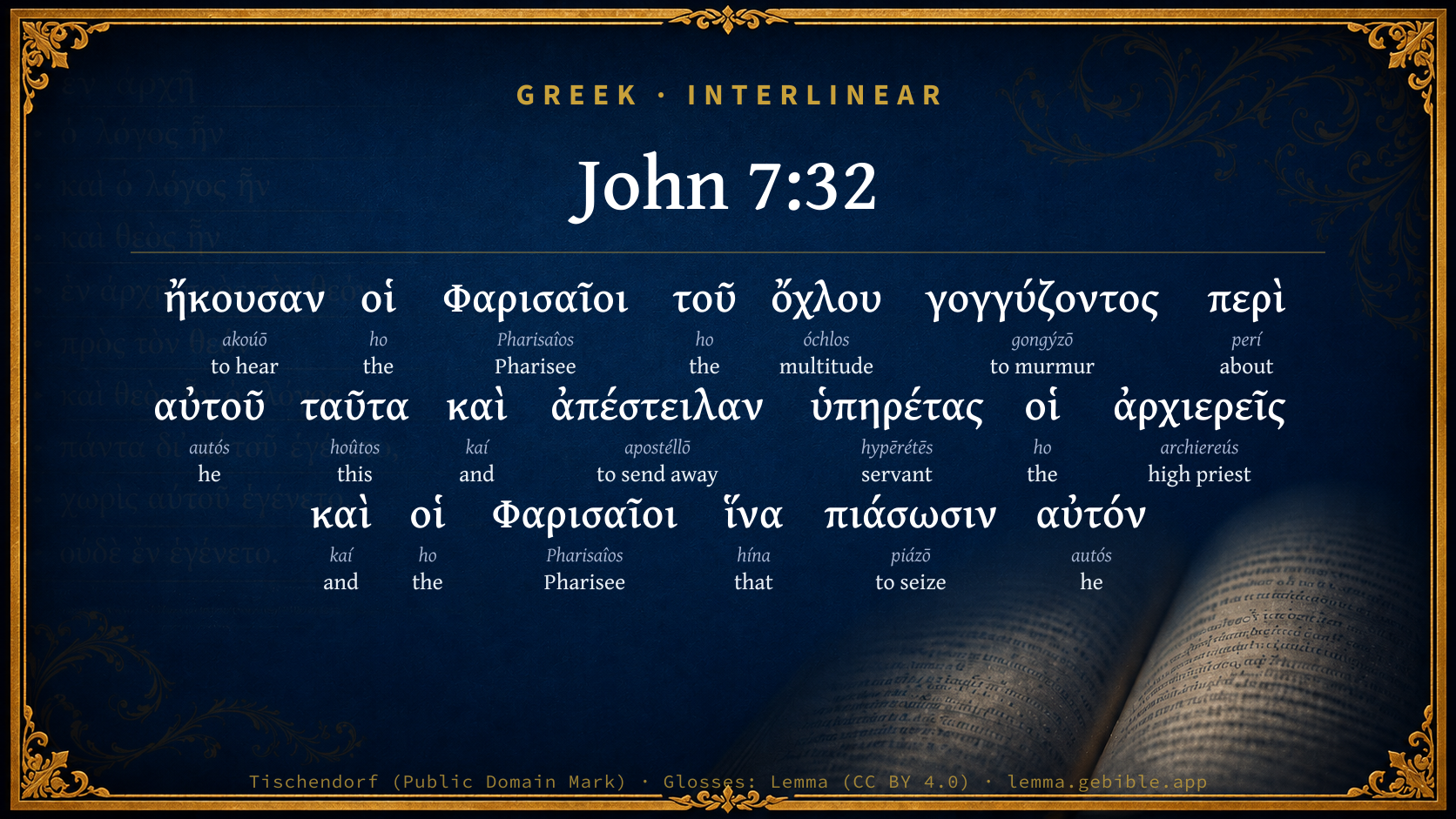
  1. ἤκουσαν akoúō G191 “to hear” Verb, Aorist, Active, Indicative, 3rd person, Plural
  2. οἱ ho G3588 “the” Article, Nominative, Plural, Masculine
  3. Φαρισαῖοι Pharisaîos G5330 “Pharisee” Noun, Nominative, Plural, Masculine
  4. τοῦ ho G3588 “the” Article, Genitive, Singular, Masculine
  5. ὄχλου óchlos G3793 “multitude” Noun, Genitive, Singular, Masculine
  6. περὶ perí G4012 “about” Preposition
  7. αὐτοῦ autós G846 “he” Personal pronoun, Genitive, Singular, Masculine
  8. ταῦτα hoûtos G3778 “this” Demonstrative pronoun, Accusative, Plural, Neuter
  9. καὶ kaí G2532 “and” Conjunction
  10. ἀπέστειλαν apostéllō G649 “to send away” Verb, Aorist, Active, Indicative, 3rd person, Plural
  11. ὑπηρέτας hypērétēs G5257 “servant” Noun, Accusative, Plural, Masculine
  12. οἱ ho G3588 “the” Article, Nominative, Plural, Masculine
  13. ἀρχιερεῖς archiereús G749 “high priest” Noun, Nominative, Plural, Masculine
  14. καὶ kaí G2532 “and” Conjunction
  15. οἱ ho G3588 “the” Article, Nominative, Plural, Masculine
  16. Φαρισαῖοι Pharisaîos G5330 “Pharisee” Noun, Nominative, Plural, Masculine
  17. ἵνα hína G2443 “that” Conjunction
  18. πιάσωσιν piázō G4084 “to seize” Verb, Aorist, Active, Subjunctive, 3rd person, Plural
  19. αὐτόν autós G846 “he” Personal pronoun, Accusative, Singular, Masculine

About this verse

These counts appear in no published source. They are computed here, from the morphology-tagged text and Lemma’s own curated glosses. What Lemma adds →

20
words
14
distinct lemmas
Gospels
section

Notable vocabulary

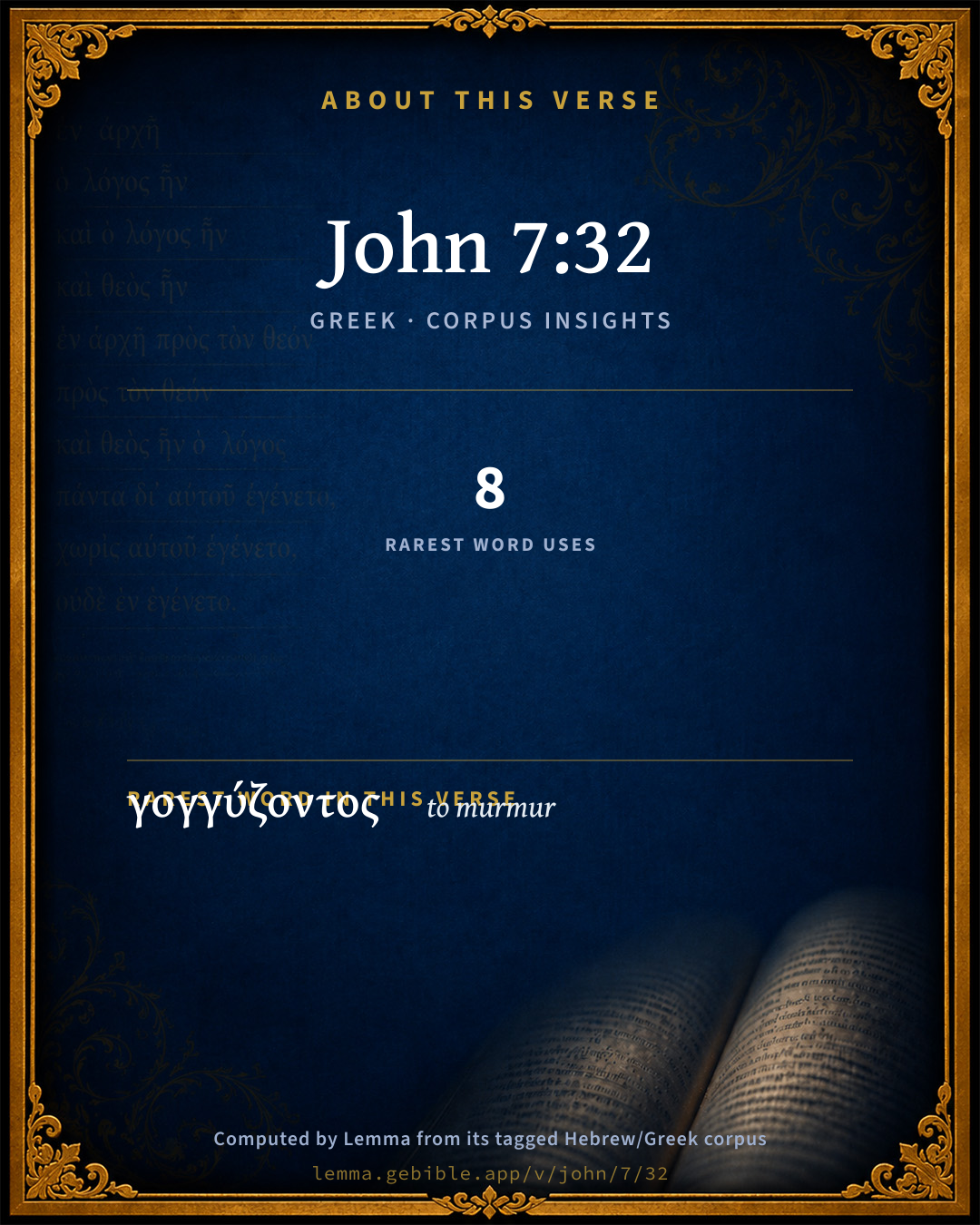
The rarest word here is γογγύζοντος to murmur G1111 — appearing just 8 times in the whole Greek New Testament.

Shared distinctive vocabulary

γογγύζοντος to murmur G1111 occurs in 7 verses of the Greek New Testament. Also found in:

Repetition

Words recur within this verse:

  • Φαρισαῖοι Pharisee G5330 ×2
  • οἱ the G3588 ×4
  • αὐτοῦ he G846 ×2
  • καὶ and G2532 ×2

Cross-references

8

Topical passages linked to John 7:32 in the Treasury of Scripture Knowledge — connected by theme and wording, ordered by reader-vote popularity; previews shown in the World English Bible.

  • Acts 5:26 Then the captain went with the officers, and brought them without violence, for they were afraid that the people might stone them.
  • Matthew 12:23–24 All the multitudes were amazed, and said, "Can this be the son of David?"
  • Matthew 23:13 "Woe to you, scribes and Pharisees, hypocrites! For you devour widows' houses, and as a pretense you make long prayers. Therefore you will receive greater condemnation.
  • Luke 22:52–53 Jesus said to the chief priests, captains of the temple, and elders, who had come against him, "Have you come out as against a robber, with swords and clubs?
  • John 7:45–53 The officers therefore came to the chief priests and Pharisees, and they said to them, "Why didn't you bring him?"
  • John 11:47–48 The chief priests therefore and the Pharisees gathered a council, and said, "What are we doing? For this man does many signs.
  • John 12:19 The Pharisees therefore said among themselves, "See how you accomplish nothing. Behold, the world has gone after him."
  • John 18:3 Judas then, having taken a detachment of soldiers and officers from the chief priests and the Pharisees, came there with lanterns, torches, and weapons.

Cross-references courtesy of OpenBible.info (CC BY 4.0).

Commentary

Notes on John 7:32 from classic Christian and Jewish commentators (each source and its license shown beneath its notes). The classic Christian expositions comment on the surrounding passage and are grouped to its opening verse, so a note may address several verses; the Jewish commentaries on the Tanakh (Rashi and others) are per-verse, so they appear only where the commentator wrote on this verse.

Lemma curates 59 commentaries, every one of them public domain or Creative Commons licensed, each selected and text-cleaned for this edition rather than reprinted as found. About our sources →

Godbey's Commentary on the New Testament

William B. Godbey

THE CHIEF PRIESTS AND PHARISEES SEND OFFICERS TO ARREST HIM

Joh 7:32-34. “The Pharisees heard the multitude murmuring these things concerning Him, the chief priests and Pharisees sent officers that they may arrest Him.” His powerful preaching during the tabernacle festival is winning many converts, so they are believing on Him on all sides, and there is a great stir among the people; the thousands from Galilee and elsewhere, who had heard Him preach and witnessed His miracles, clamoring among all the people, so there is a great commotion, and everybody talking about the wonderful Prophet of Galilee. So here, at their great camp-meeting, He is more magnetic than all the high priests, theologians, rabbis, and Pharisaical magnates combined. Consequently, they get awfully mad, and resolve to carry on their threat, as the people are already twitting them with cowardice. So they cut the matter short, and send officers to arrest and bring Him at once to the Sanhedrin, assembled in the Judgment Hall of Caiaphas on Mount Zion.

William B. Godbey, Commentary on the New Testament (1896–1900) — public domain. Text from a community e-Sword module.

Tyndale Open Study Notes

Tyndale Open Resources

7:32-36 Jesus announced his return to the one who sent him, the Father in heaven (17:1-7). However, the Pharisees misunderstood, thinking he was leaving Judea to go among Gentiles (whom Pharisees would never visit). • The leaders would not find Jesus after his ascension. • you cannot go where I am going: These Pharisees, still in darkness, could not enter heaven, so Jesus would be beyond their reach there.

Tyndale Open Study Notes — © Tyndale Open Resources, licensed CC BY-SA 4.0. Text via the HelloAO Bible API.

Bengel's Gnomon

Johann Albrecht Bengel

Joh 7:32. Οἱ Φαρισαῖοι καὶ οἱ ἀρχιερεῖς) See App. Crit. Ed. ii. on this passage. The 45th verse refers to this; where the Latin translator himself has “ad pontifices et Pharisæos.” [So [195][196][197][198][199][200] Vulg. here, οἱ ἀρχιερεῖς καὶ οἱ Φαρισαῖοι. But [201] has the reading of the Rec. Text.] The Pharisees are placed first [Beng. reading as the Rec. Text] in Joh 7:32; for these were more bitter, and it was by means of them that the chief priests were instigated.

[195] the Vatican MS., 1209: in Vat. Iibr., Rome: fourth cent.: O. and N. Test. def.

[196] Bezæ, or Cantabrig.: Univ. libr., Cambridge: fifth cent.: publ. by Kipling, 1793: Gospels, Acts, and some Epp. def.

[197] Cod. Reg., Paris, of the Gospels: the text akin to that of B: edited by Tisch.

[198] Borgiana: Veletri: part of John: fourth or fifth cent.: publ. by Georgi, 1789.

[199] Cod. Monacensis, fragments of the Gospels.

[200] Colbertinus, do.

[201] Vercellensis of the old ‘Itala,’ or Latin Version before Jerome’s, probably made in Africa, in the second century: the Gospels.

Bengel's Gnomon of the New Testament — English translation (T&T Clark, Edinburgh, 1860) — public domain. Text from a community e-Sword module.

Meyer's Critical & Exegetical Commentary

Heinrich August Wilhelm Meyer

Joh_7:32-34. The Pharisees present hear how favourable are the murmured remarks of the people concerning Jesus, and they straightway obtain an edict of the Sanhedrim (οἱ Φαρισ. κ. οἱ ἀρχιερ.,

οἱ Φαρισ. first, for they had been the first to moot the matter; otherwise in Joh_7:45), appointing officers to lay hands on Him. The Sanhedrim must have been immediately assembled. Thus rapidly did the ἐζήτουν of Joh_7:30 ripen into an actual decree of the council. The thing does not escape the notice of Jesus; He naturally recognises in the officers seeking Him, who were only waiting for a suitable opportunity to arrest Him, their designs against Him; and He therefore (οὖν) says what we have in Joh_7:33-34 in clear and calm, foresight of the nearness of His death,a death which He describes as a going away to God (comp. on Joh_6:62).

μεθʼ ὑμῶν] Jesus speaks to the whole assembly, but has here the hierarchy chiefly in his eye; comp. Joh_7:35.

πρὸς τὸν πέμψαντά με] These words are, with Paulus, to be regarded not as original, but as a Johannean addition; because, according to Joh_7:35-36, Jesus cannot have definitely indicated the goal of His going away, but must have left it enigmatical, as perhaps in Joh_8:22; comp. Joh_13:33. Had He said πρ. τ. πέμψ., His enemies could not have failed, after Joh_7:16-17; Joh_7:28-29, to recognise the words as referring to God, and could not have thought of an unknown ποῦ (against Lücke, De Wette, Godet). There is no room even for the pretence that they acted as if they could not understand the words of Jesus, after so clear a statement as πρὸς τ. πέμψ. με (against Luthardt).

ζητήσετέ με, κ.τ.λ.] not of a hostile seeking, against which is Joh_13:33; nor the seeking of the penitent (Augustine, Beza, Jansen, and most), which would not harmonize (against Olshausen) with the absolute denial of any finding, unless we brought in the doctrine of a peremptory limitation of grace, which has no foundation in Holy Scripture (not even in Heb_12:17; see Lünemann, in loc.), and which could only refer to individuals; but a seeking for help and deliverance (Chrysostom, Theophylact, Euthymius Zigabenus, Erasmus, Calvin, Aretius, Hengstenberg; comp. Luthardt, Ewald, Brückner). This refers to the time of the divine judgments in the destruction of Jerusalem (Luk_20:16 ff; Luk_19:43, al.), which were to ensue as the result of their rejection of Jesus. Then, Jesus means, the tables will be turned; after they had persecuted and killed Him who now was present, they then would anxiously long, but in vain, for Him, the absent One,[267] as the wonder-working helper, who alone could save them from the dire calamity. Comp. Pro_1:28. The prophecy of misfortune involved in ζητήσετέ με, κ.τ.λ. is not expressly declared; but it lies in the thought of retribution which the words contain,like an enigma which the history was to solve; comp. Joh_8:21. Theodoret, Heracleon (?), Maldonatus, Grotius, Lücke, De Wette, take the whole simply as descriptive of entire separation, so that nothing more is said than: Christum de terris sublatum iri, ita ut inter viros reperiri non posit, Maldonatus. The poetical passages, Psa_10:15; Psa_37:10, Isa_41:12, are appealed to. But even in these the seeking and finding is not a mere figure of speech; and here such a weakening of the signification is all the more inadmissible, because it is not annihilation, as in those passages, which is here depicted, and because the following words, καὶ ὅπου εἰμὶ ἐγὼ, κ.τ.λ., describe a longing which was not to be satisfied. Luk_17:22 is analogous.

καὶ ὅπου εἰμὶ, κ.τ.λ.] still more clearly describes the tragic οὐχ εὑρήσ.: and where I (then) am, thither ye cannot come, i.e. in order to find me as a deliverer, or to flee to me. Rightly says Euthymius Zigabenus: δηλοῖ δὲ τὴν ἐπὶ τοῦ οὐρανοῦ ἐν δεξιᾷ τοῦ πατρὸς καθέδραν. The εἶμι (I go), not found in the N. T., is not the reading here (against Nonnus, H. Stephens, Casaubon, Pearson, Bengel, Wakefield, Michaelis, and most). Comp. Joh_14:3, Joh_17:24.

[267] They would long for Him in His own person, for Jesus the rejected one, and not for the Messiah generally (Flacius, Lampe, Kuinoel, Neander, Ebrard), whom they had rejected in the person of Jesus (comp. also Tholuck and Godet),an explanation which would empty the words of all their tragic nerve and force.

Meyer — Critical and Exegetical Commentary on the New Testament — English translation by Peter Christie, edited by Frederick Crombie (T&T Clark, 1880) — public domain. Text from a community e-Sword module.

Expositor's Greek Testament

ed. W. Robertson Nicoll

Joh 7:32-36 . The Sanhedrim takes action regarding Jesus .

Joh 7:32 . Ἤκουσαν … αὐτόν . The Pharisees, perceiving that many of the people were coming under the influence of Jesus, determined to put a stop to His teaching, and persuaded the Sanhedrim [ οἱ ἀρχιερεῖς καὶ οἱ φαρισαῖοι ] to send officers to apprehend Him.

The Expositor's Greek Testament, edited by W. Robertson Nicoll (1897–1910) — public domain. Text from a community e-Sword module.

Geneva Bible (1599)

Geneva Bible translators

As the kingdom of God increaseth, so increaseth the rage of his enemies, till at length they in vain seek for those blessings absent, which they despised when they were present.

Geneva Bible (1599) marginal notes — public domain. Text via Bolls.life.

Jamieson, Fausset & Brown

Robert Jamieson, A. R. Fausset & David Brown

heard that the people murmured--that mutterings to this effect were going about, and thought it high time to stop Him if He was not to be allowed to carry away the people.

Jamieson, Fausset & Brown — Commentary Critical and Explanatory on the Whole Bible (1871) — public domain (CC PDM 1.0). Text via the HelloAO Bible API.

Adam Clarke's Commentary

Verse 32. The people murmured such things] The people began to be convinced that he was the Messiah; and this being generally whispered about, the Pharisees, c., thought it high time to put him to death, lest the people should believe on him therefore they sent officers to take him.

Adam Clarke's Commentary on the Bible (1810–1826) — public domain. Text from a community e-Sword/MySword module.

John Calvin's Commentaries

32. The Pharisees heard. Hence it appears that the Pharisees, like persons set on the watch, were anxious on all occasions not to permit Christ to be known. In the first instance the Evangelist calls them only Pharisees, and next he adds to them the priests of whom the Pharisees were a part. There can be no doubt that, as they wished to be reckoned the greatest zealots for the Law, they opposed Christ more bitterly than all the other sects; but finding that their unaided exertions were not sufficient to oppress Christ, they committed the affair to the whole order of the priests. Thus they who, in other respects, differed among themselves now conspire together, under the guidance of Satan, against the Son of God. Meanwhile, since the Pharisees had such ardent zeal and such incessant toil for defending their tyranny and the corrupt state of the Church, how much more zealous ought we to be in maintaining the kingdom of Christ! The Papists in the present day are not less mad or less eager to extinguish the Gospel; and yet it is monstrously wicked that their example does not, at least, whet our desires, and cause us to labor with greater boldness in the defense of true and sound doctrine.

John Calvin's Commentaries (1540-1563) — public domain. Text from the Calvin Translation Society English edition (1840s-50s) via the Christian Classics Ethereal Library (ccel.org). Calvin's coverage is partial (roughly two-thirds of the Bible); uncommented books and verses are honest gaps, never fabricated. The 19th-century editor's footnotes and remarks are omitted so the notes are faithfully Calvin's own voice.

Ellicott's Commentary for English Readers

(32) The Pharisees heard that the people murmured.—Or, more exactly, the Pharisees heard the multitude murmuring. In the second clause of the verse, the Authorised version follows the order of the Received text, but almost all the better MSS. read, “the chief priests and the Pharisees.” We have to think of the Pharisees as taking the first steps. They see that faith in Him is spreading among the multitude, and that there is no time to be lost. They hastily call together the Sanhedrin, and the chief priests, who were for the most part Sadducees, join with them in an official resolve to take Him by force.

A Bible Commentary for English Readers, edited by Charles John Ellicott (1878–1897) — public domain. Text from a community e-Sword module.

The Cambridge Bible for Schools and Colleges

gen. ed. J. J. S. Perowne

32. heard that the people murmured such things] Better, heard the multitude muttering these things (see on Joh_7:12): it was not reported to them, they heard it themselves, and they went and reported it in the Sanhedrin, which gives an order for His apprehension. Note that in this the reckless hierarchy, who were mainly Sadducees, combine with the Pharisees (comp. Joh_7:45, Joh_11:47; Joh_11:57, Joh_18:3).

The Cambridge Bible for Schools and Colleges (gen. ed. J. J. S. Perowne; Cambridge University Press, 1878–1918) — public domain. Text from a community e-Sword module.

John Gill's Exposition

Then said Jesus unto them,.... To the officers that were sent to take him, and other unbelieving Jews that were about him:

yet a little while am I with you; no longer than till the next passover, which was but about half a year at most: this he might say, partly to quicken the attention of the people to him, to make the best use and improvement of his ministry whilst they had it, since in a little time he would be removed from them; and partly to suggest to the officers that were sent to take him, that they, and their masters, need not have given themselves that trouble, for in a short time he should be gone from them, and till that time he should continue in spite of them.

And then I go unto him that sent me; still confirming his mission from God, expressing his death by going, and as being voluntary, and signifying his glory and happiness after it.

John Gill's Exposition of the Whole Bible (1746–1763) — public domain (CC PDM 1.0). Text via the HelloAO Bible API.

Trapp's Complete Commentary

John Trapp

32 The Pharisees heard that the people murmured such things concerning him; and the Pharisees and the chief priests sent officers to take him.

Ver. 32. The Pharisees heard] They had their scouts, and lay perdu to listen, and to keep down Christ. Like unto these are the Jesuits of this day, who give out that the devil stirred up Luther to trouble the Church; and God hath sent them forth to withstand and hinder him.

John Trapp, A Commentary or Exposition upon All the Books of the Old and New Testament (1647–1656) — public domain. Text from a community e-Sword module.

Albert Barnes' Notes on the Bible

The people murmured such things - That is, that the question was agitated whether he was the Messiah; that it excited debate and contention; and that the consequence was, he made many friends. They chose, therefore, if possible, to remove him from them.

Albert Barnes' Notes on the Bible (1834–1885) — public domain. Text from a community e-Sword/MySword module.

Haydock's Catholic Bible Commentary

The Pharisees understood well enough that his words signified he was their Messias, and the true Son of God. And they sent some servants to seize him, and bring him to them. (Witham)

George Leo Haydock (1774–1849), Haydock's Catholic Family Bible and Commentary, 1859 edition — public domain. Excludes Psalms (Douay-Rheims chapter numbering differs from Protestant) and Deuterocanonical books (Catholic canon only).

Matthew Poole's English Annotations

Murmured here is taken in a different sense from what it was before, and signifieth as much as whispered, or talked privately among themselves. The chief priests, who were afraid that their honour would abate amongst the people; and the Pharisees, who were afraid the credit of their traditions would be lost, if they suffered him to go on; and being more especially troubled for the miracles which he daily wrought, as Joh 11:47; they send messengers from their great court (kept at Jerusalem) to apprehend him.

Matthew Poole's English Annotations on the Holy Bible (1683–1685) — public domain. Text from a community e-Sword/MySword module.

Whedon's Commentary on the Bible

Daniel D. Whedon

32. The Pharisees—To which sect the rulers belonged.

Heard—Though these bystanders had not the nerve to apprehend him, they had the spirit to carry the news of Christ’s preaching and its effects to these Pharisees. They may have then been in session in the hall Gazith.

Sent officers—The success of these officers is given in their report, Joh_7:46. Our Evangelist gives this account parenthetically, and then proceeds with his narrative of the struggle of Jesus with the crowd.

Daniel D. Whedon (gen. ed.), Commentary on the Old and New Testaments (1874–1909) — public domain. Text from a community e-Sword module.

The Pulpit Commentary

The Phariseesheard the multitude (generally) murmuring these things concerning him; repeating the language of those who believed, comparing their expectations with the reality. They seem to have occasioned a hasty and informal session of the Sanhedrin, and we read that the chief priests and the Phariseessent officers servants "clothed with legal authority," and therefore intimating a decision already come to in the supreme council (cf. Joh_11:53 Joh_18:3; Joh_18:12 19:6 Act_5:22, Act_5:26) to seize him. (cf. this description of the Sanhedrin in Mat_21:45 Mat_27:62) The "chief priests a phrase often occurring in the writings of Luke, and here for the first time in this Gospel cannot be confined to the official "high priest," but may include the ex-high priests, perhaps the heads of the twenty-four courses of priests and the chiefs of the priestly party, though there is no proof of it. The Pharisees and priests were often at enmity, but there were several occasions during our Lord"s ministry when they combined against a common foe. The Pharisees had been his most steady opponents in Galilee. The eighth and ninth chapters of Matthew, with parallel passages, reveal the growing animosity of their demeanour, and their disposition to misunderstand, to oppose, and to crush every great self-revelation made by him. Their chiefs were in Jerusalem, and doubtless formed a powerful element in the great council. The formality of this session of the council may be reasonably questioned. There had been orders then for the arrest, which they had only to put at any time, if they dared, into immediate operation.

The Pulpit Commentary (1880–1919), ed. H.D.M. Spence-Jones & Joseph S. Exell — public domain. Text from a community e-Sword module.

Burkitt's Expository Notes on the New Testament

William Burkitt

Observe here, 1. How enraged the Pharisees were, when they heard that so many of the common people were brought to believe in Christ, and to cleave unto Christ, insomuch that they sent public officers, armed with authority, to apprehend our blessed Saviour: The Pharisees and chief priests sent officers to take him.

Learn thence, That nothing more enrages the enemies of religion, and draws trouble on the preachers and professors of it, than the success which the gospel at any time meets with.

Observe, 2. Our Saviour tells them that as they desired to be rid of him, so ere long they should have their desire: he would leave them, and go to his Father, and in his absence they would wish for his bodily presence again, but should not have it.

Learn, The despisers of Christ have little cause to be weary of him, and to seek to put him away by violence and persecution; for their obstinate contempt of him will cause him to depart from them, and finally to forsake them.

Observe, 3. How the Jews, not understanding our Saviour’s words aright, reasoned among themselves, whether, by leaving of them, he meant to go into some Pagan country, and teach the Gentiles the mysteries of the Jewish religion; which above all things they could not endure to hear.

Learn hence, That it is the ordinary sin of a people privileged with the means of grace, not to be sensible of the hazard or danger of Christ’s leaving and forsaking them: till at last he forsakes them finally, and casts them off, to their inevitable unutterable condemnation. Thus did our Lord deal with the Jews here; I go my way, and whither I go, ye cannot come.

William Burkitt's Expository Notes on the New Testament (1700–1703) — public domain. Text from a community e-Sword module.

The People's New Testament

B. W. Johnson

32. The Pharisees heard. The bitterest enemies of Christ. When they heard that the people were believing, they thought it time for action, so the Pharisees and chief priests, that is, the Sanhedrim, sent officers to seize him. This was an official act, the first official attempt of the Sanhedrim to take Jesus. They had purposed it before, but had not taken action.

B. W. Johnson's The People's New Testament with Notes (1889–1891) — public domain. Electronic text from the Christian Classics Ethereal Library (CCEL) ThML edition.

Cambridge Greek Testament for Schools and Colleges

32. οἱ ἀρχιερεῖς καὶ οἱ Φαρισαῖοι (S. John’s invariable order; Joh 7:45, Joh 11:47; Joh 11:57, Joh 18:3) for οἱ Φ. κ. οἱ ἀρχ., on overwhelming evidence.

32. γογγύζοντος. Here, as in Joh 7:12, mere muttering, as distinct from murmuring, seems to be meant: see on Joh 6:41. But they are restless at all this uncertainty. The Pharisees (comp. Joh 4:1) hear what they say and report it to the Sanhedrin, which orders His arrest.

ἀρχιερεῖς. First mention of them by S. John. The word signifies, not the heads of the 24 courses of priests, but Caiaphas, Annas, and the other ex-high-priests, with, perhaps, their relations in the Sanhedrin (Act 4:6). see on Joh 11:48, Joh 18:13. Note that in this the reckless hierarchy, who were mainly Sadducees, combine with the Pharisees; comp. Joh 7:45, Joh 11:47; Joh 11:57, Joh 18:3. On πιάσωσιν see on Joh 7:30.

Cambridge Greek Testament for Schools and Colleges (Cambridge University Press, 1896; 21 vols, various authors incl. Carr, Maclear, Plummer, Farrar, Lumby, Moule, M. R. James, Simcox) — public domain. Text from a community e-Sword module.

Alford’s Greek Testament

Henry Alford

32-36.] He will return to the Father.

32.] The wavering of the multitude appears to the Pharisees a dangerous sign: and the Sanhedrim (οἱ ἀρχ. κ. οἱ Φ.) send officers specially to lay hold on Him.

33,

Henry Alford, The Greek Testament (1849–1861) — public domain. Text from a community e-Sword module.

International Critical Commentary

32. οἱ φαρισαῖοι: see on 1:24. The Pharisees had heard the whispered talk of the people (cf. v. 12), and they determined to silence Jesus. Accordingly they brought the matter before the Sanhedrim, so that measures might be taken for His arrest.

The Sanhedrim (συνέδριον) was the supreme council or high court of justice in Jerusalem during the period of the Roman occupation, and successive procurators left the administration of the law for the most part in its hands. It had no power to carry into execution a sentence of death, but it was the uniform policy of the Roman administration to support its authority. Three classes of members may be distinguished: (1) The ἀρχιερεῖς, that is, the acting high priest, all ex-high priests, and probably some of their sons.1 They were the political, as well as the ecclesiastical, aristocrats of Jerusalem; and they occupied a position not unlike that of the Holy Synod in Russia before the Revolution, which comprised only the leading bishops, and had as presiding officer a highly placed layman. Their interests were centred in the Temple, and they had little concern for the synagogues, large part as these played in Jewish religious life. They were of the party known as that of “the Sadducees,” a designation occurring only once in Mk., and not at all in Jn. (2) A second class, also belonging to the Sadducee interest, were known as πρεσβύτεροι or elders: they were not priests, but were generally associated with them in policy, both the ἀρχιερεῖς and the πρεσβύτεροι being in opposition to (3) the third class, who were the Pharisees or scribes or lawyers (the titles γραμματεύς and νομικός are not found in Jn.). They were learned in the Jewish law and in the traditions that had grown up around it, being the party of austere and strict religious observance. Their influence showed itself in the synagogues rather than in the Temple, for the details of the ceremonial worship there did not come within their province. They regarded with apprehension the departure from traditional doctrines which Jesus encouraged, and it was they who first brought His teaching before the Sanhedrim (cf. 12:19). They associated themselves with the priestly or Sadducean party in bringing about His arrest and condemnation (18:3, Mat 27:62), although the chief priests appear as the principal agents. Cf. 11:49.

ἀπέστειλαν οἱ ἀρχιερεῖς καὶ οἱ φαρισαῖοι ὑπηρέτας. The rec. text has οἱ Φαρ. καὶ οἱ ἀρχ., but אBDLTWΘ place the chief priests first in order, which is obviously right. Without the consent of the ἀρχιερεῖς, the arrest of Jesus could not have been ordered by the Sanhedrim. οἱ ἀρχ. καὶ οἱ Φαρ. are coupled together again 7:45, 11:47, 57 (as also Mat 21:45, Mat 27:62), and the combination stands for the Sanhedrim as an organised council or court. They now sent officers of the Sanhedrim, or, as we might say, “Temple police” (ὑπηρέτας; cf. v. 45, 18:3, 12, 18, 19:6), to make the arrest, which some of them had been seeking (ἐζήτουν, v. 30) to bring about.

International Critical Commentary — older volumes (1896–1929), various authors — public domain. Text from a community e-Sword module.

Vincent's Word Studies in the New Testament

Marvin R. Vincent

Officers [υπηρετας] . See on Mt 5:25; Luk 1:2.

Marvin R. Vincent, Word Studies in the New Testament (1887–1900) — public domain. Text from a community e-Sword/MySword module.

Lesson kit

Teaching starters — assembled from the data on this page, not authored interpretation. Every prompt links to the verse data it draws on. Edit before teaching.

John, in the Gospels, opens this verse with 20 words (14 distinct Greek lemmas). Its most distinctive word is gongýzō (“to murmur”). A historical commentator’s framing appears above. Read the whole chapter for the surrounding context.

Discussion questions

  1. The word gongýzō carries the sense “to murmur.” How does it shape the verse?
  2. How does Matthew 20:11, which shares the word «to murmur», read alongside this verse?
  3. What does the repetition of “Pharisee” (2× in this one verse) do in this verse?
  4. These translations render this verse differently; the difference is in the English rendering, not the original. What questions does that raise?
  5. Compare how Godbey's Commentary on the New Testament and Tyndale Open Study Notes read this verse. Where do they agree or differ?

Things to notice

  • These translations choose different wording for 11 words in this verse.
  • “Pharisee” occurs 2× in this single verse.
  • 14 distinct Greek lemmas span 20 words in this verse.

Reading settings

Reading text

Shown beneath each verse's original-language words.

Old Testament
Old Testament edition

Read the OT as the Masoretic Hebrew (MT) or the Greek Septuagint (LXX).

English shown for the Greek Septuagint (in the Hebrew ↔ Greek comparison).

Comparing translations? Open the Compare panel on any verse page to stack up to four side by side.