John 18:22

Greek (Tischendorf 8th ed.) John 18:22 appears in the Greek New Testament. The text above is from the Tischendorf 8th edition. Each word links to its Strong’s number and a concise gloss. Click any word for its full Thayer’s Greek Lexicon entry.
Download image
Cite this verse

John 18:22 (World English Bible). Public Domain. Lemma interlinear Bible study tool, https://lemma.gebible.app/v/john/18/22.

Show BibTeX & RIS
BibTeX
RIS
English Translation
When he had said this, one of the officers standing by slapped Jesus with his hand, saying, "Do you answer the high priest like that?"
World English Bible · Public Domain
Download a study sheet

One document with this verse’s original text, its word-by-word gloss line, the meaning frame, cross-references with their text, attributed commentary, and full source and license credits — printable, and it pastes into notes with its structure intact.

This verse Autodidact and up

Study sheet (.html) Plain text (.txt)

A passage Seminary Student

Up to 50 verses in one chapter. A passage sheet keeps up to 6 commentary sources and 12 cross-references per verse, in the order this page ranks them, and says so on the sheet whenever that leaves anything out. Ask for a single verse and you get the Autodidact verse sheet above.

Everything on this page stays free to read, with no account — the sheet is a download of what is already on screen, not access to it.

Want to remove ads? Support Godless Engineer
Compare translations 3

The same verse in 3 English versions, stacked beneath the original-language interlinear above. Click any original word for its lexicon entry.

Each is an independent rendering of the whole verse — the interlinear is not word-aligned to these translations.

Highlighted words mark where these versions differ — a whole-verse word diff, not a word-by-word alignment.

  • World English Bible Public Domain
    When he had said this, one of the officers standing by slapped Jesus with his hand, saying, "Do you answer the high priest like that?"
  • King James Version Public Domain
    And when he had thus spoken, one of the officers which stood by struck Jesus with the palm of his hand, saying, Answerest thou the high priest so?
  • unfoldingWord Literal Text CC BY-SA 4.0
    Now he having said these things, one of the officers standing there gave Jesus a slap, saying, “Do you answer the high priest in this manner?”

unfoldingWord Literal Text — © unfoldingWord, licensed CC BY-SA 4.0. Word-aligned USFM3 via Door43 (git.door43.org/unfoldingWord/en_ult).

Versions to compare (up to 4)

3 of 4 selected

Show all 19 translations

Every available English version of this verse, each an independent rendering of the whole verse.

  • World English Bible Public Domain
    When he had said this, one of the officers standing by slapped Jesus with his hand, saying, "Do you answer the high priest like that?"
  • Berean Standard Bible Public Domain
    When Jesus had said this, one of the officers standing nearby slapped Him in the face and said, “Is this how You answer the high priest?”
  • Majority Standard Bible Public Domain
    When Jesus had said this, one of the officers standing nearby slapped Him in the face and said, “Is this how You answer the high priest?”
  • King James Version Public Domain
    And when he had thus spoken, one of the officers which stood by struck Jesus with the palm of his hand, saying, Answerest thou the high priest so?
  • American Standard Version (1901) Public Domain
    And when he had said this, one of the officers standing by struck Jesus with his hand, saying, Answerest thou the high priest so?
  • Revised Version (1885) Public Domain
    And when he had said this, one of the officers standing by struck Jesus with his hand, saying, Answerest thou the high priest so?
  • Geneva Bible (1599) Public Domain
    When he had spoken these thinges, one of the officers which stoode by, smote Iesus with his rod, saying, Answerest thou the hie Priest so?
  • Douay-Rheims (1899) Public Domain
    And when he had said these things, one of the servants standing by, gave Jesus a blow, saying: Answerest thou the high priest so?
  • Young's Literal Translation Public Domain
    And he having said these things, one of the officers standing by did give Jesus a slap, saying, `Thus dost thou answer the chief priest?'
  • Literal Standard Version CC BY-SA 4.0
    And He having said these things, one of the officers standing by gave Jesus a slap, saying, “Thus do You answer the chief priest?”
  • Unlocked Literal Bible CC BY-SA 4.0
    When Jesus had said this, one of the officers standing there struck Jesus and said, “Is that how you answer the high priest?”
  • unfoldingWord Literal Text CC BY-SA 4.0
    Now he having said these things, one of the officers standing there gave Jesus a slap, saying, “Do you answer the high priest in this manner?”
  • Darby Bible Public Domain
    But as he said these things, one of the officers who stood by gave a blow on the face to Jesus, saying, Answerest thou the high priest thus?
  • World Messianic Bible Public Domain
    When he had said this, one of the officers standing by slapped Yeshua with his hand, saying, “Do you answer the high priest like that?”
  • Webster's Bible Public Domain
    And when he had thus spoken, one of the officers who stood by, struck Jesus with the palm of his hand, saying, Answerest thou the high priest so?
  • Free Bible Version CC BY-SA 4.0
    When he said this, one of the guards standing nearby slapped Jesus, saying, “Is that any way to speak to the high priest?”
  • Bible in Basic English Public Domain
    When he said this, one of the police by his side gave him a blow with his open hand, saying, Do you give such an answer to the high priest?
  • Text-Critical English NT CC BY 4.0
    When Jesus said this, one of the officers standing nearby slapped him and said, “Is that how yoʋ answer the high priest?”
  • Tyndale New Testament (1534) Public Domain
    Why axest thou me? Axe them whiche hearde me what I sayde vnto them. Beholde they can tell what I sayde.

Literal Standard Version (2020), Covenant Press — licensed CC BY-SA 4.0. Text via the HelloAO Bible API (eBible.org). Unlocked Literal Bible (unfoldingWord) — licensed CC BY-SA 4.0. Text via the HelloAO Bible API (eBible.org). unfoldingWord Literal Text — © unfoldingWord, licensed CC BY-SA 4.0. Word-aligned USFM3 via Door43 (git.door43.org/unfoldingWord/en_ult). Free Bible Version, Dr. Jonathan Gallagher — licensed CC BY-SA 4.0. Text via the HelloAO Bible API (eBible.org).

Word by word

More ways to search: Search by grammar → Find every occurrence → Compare this word →

Practice this passage: Drill this verse → Learn its vocabulary →

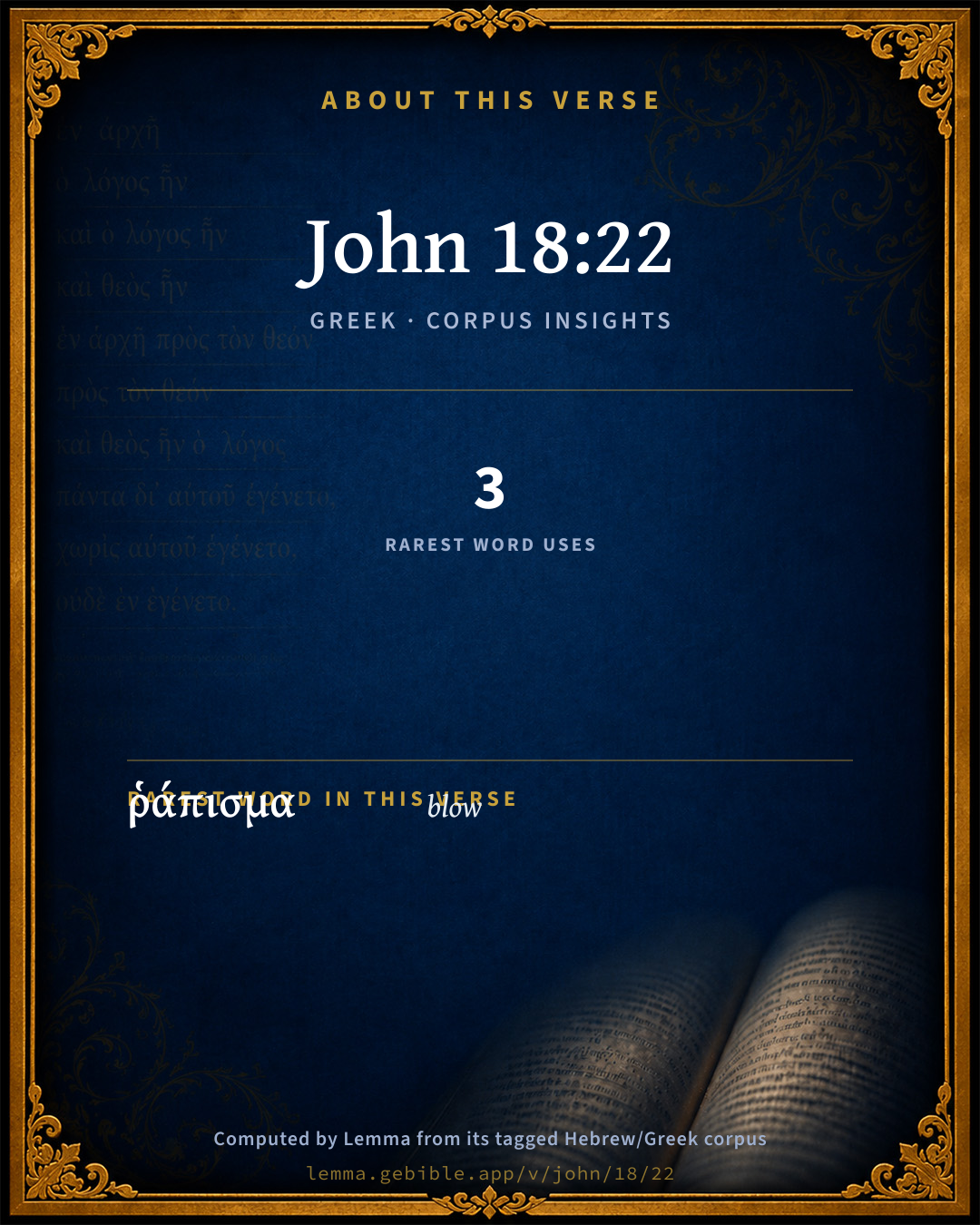
ῥάπισμα
rhápisma
G4475
“blow”
Noun, Accusative, Singular, Neuter
Part of Speech
Noun
Case
Accusative
Number
Singular
Gender
Neuter
Full Thayer's Definition

Origin: from G4474

TDNT: None

1. a blow with a rod or staff or a scourge 2. a blow with the flat of the hand, a slap in the face, box the ear
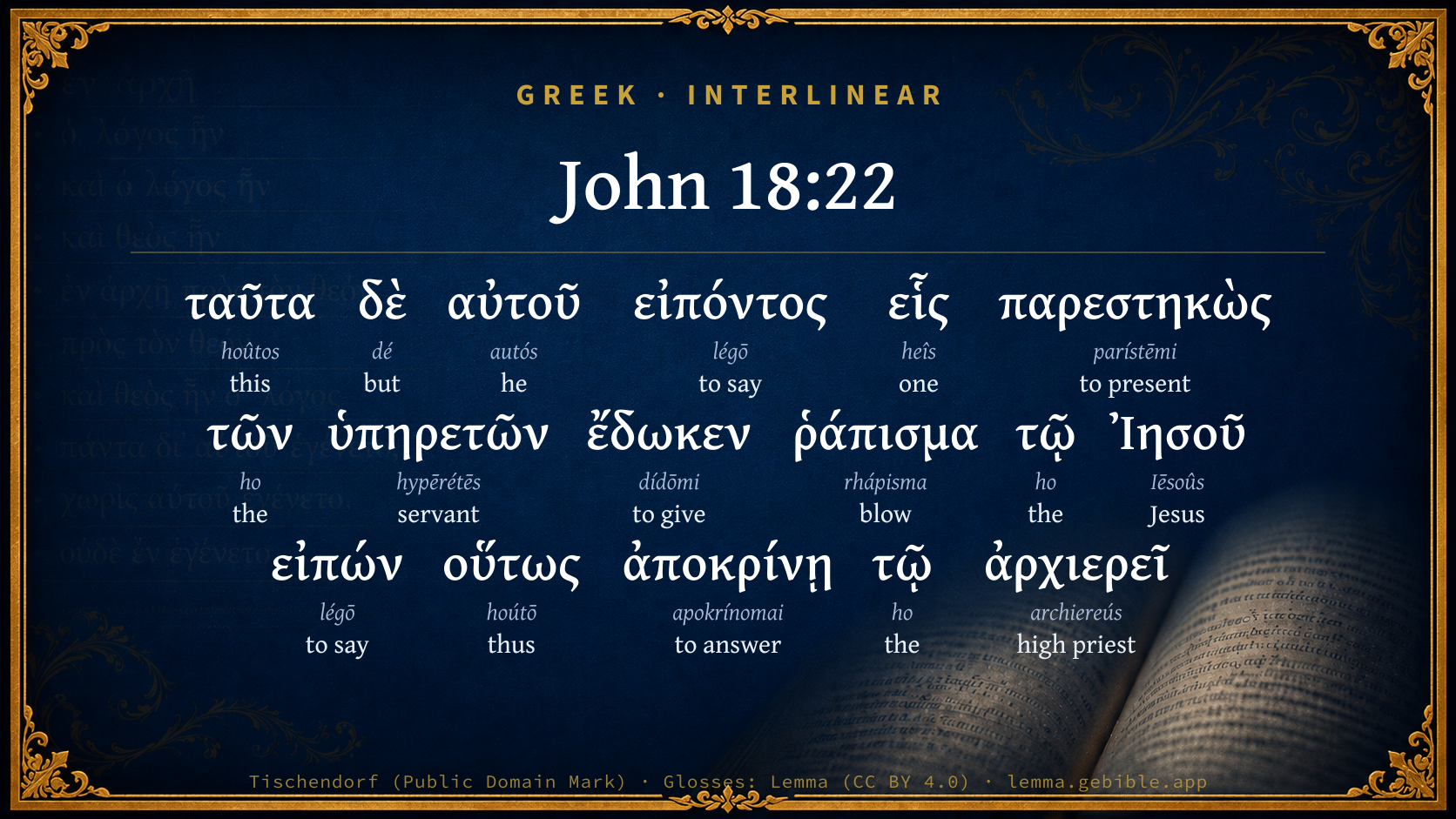
  1. ταῦτα hoûtos G3778 “this” Demonstrative pronoun, Accusative, Plural, Neuter
  2. δὲ dé G1161 “but” Conjunction
  3. αὐτοῦ autós G846 “he” Personal pronoun, Genitive, Singular, Masculine
  4. εἰπόντος légō G3004 “to say” Verb, Aorist, Active, Participle, Genitive, Singular, Masculine
  5. εἷς heîs G1520 “one” Adjective, Nominative, Singular, Masculine
  6. παρεστηκὼς parístēmi G3936 “to present” Verb, Perfect, Active, Participle, Nominative, Singular, Masculine
  7. τῶν ho G3588 “the” Article, Genitive, Plural, Masculine
  8. ὑπηρετῶν hypērétēs G5257 “servant” Noun, Genitive, Plural, Masculine
  9. ἔδωκεν dídōmi G1325 “to give” Verb, Aorist, Active, Indicative, 3rd person, Singular
  10. τῷ ho G3588 “the” Article, Dative, Singular, Masculine
  11. Ἰησοῦ Iēsoûs G2424 “Jesus” Noun, Dative, Singular, Masculine
  12. εἰπών légō G3004 “to say” Verb, Aorist, Active, Participle, Nominative, Singular, Masculine
  13. οὕτως hoútō G3779 “thus” Adverb
  14. ἀποκρίνῃ apokrínomai G611 “to answer” Verb, Present, Middle or Passive deponent, Indicative, 2nd person, Singular
  15. τῷ ho G3588 “the” Article, Dative, Singular, Masculine
  16. ἀρχιερεῖ archiereús G749 “high priest” Noun, Dative, Singular, Masculine

About this verse

These counts appear in no published source. They are computed here, from the morphology-tagged text and Lemma’s own curated glosses. What Lemma adds →

17
words
14
distinct lemmas
Gospels
section

Notable vocabulary

The rarest word here is ῥάπισμα blow G4475 — appearing just 3 times in the whole Greek New Testament.

Shared distinctive vocabulary

ῥάπισμα blow G4475 occurs in 3 verses of the Greek New Testament. Also found in:

Repetition

Words recur within this verse:

  • εἰπόντος to say G3004 ×2
  • τῶν the G3588 ×3

Cross-references

11

Topical passages linked to John 18:22 in the Treasury of Scripture Knowledge — connected by theme and wording, ordered by reader-vote popularity; previews shown in the World English Bible.

  • Isaiah 50:5–7 The Lord Yahweh has opened my ear, and I was not rebellious, neither turned away backward.
  • Matthew 26:67–68 Then they spit in his face and beat him with their fists, and some slapped him,
  • Mark 14:65 Some began to spit on him, and to cover his face, and to beat him with fists, and to tell him, "Prophesy!" The officers struck him with the palms of their hands.
  • Luke 22:63–64 The men who held Jesus mocked him and beat him.
  • John 19:3 They kept saying, "Hail, King of the Jews!" and they kept slapping him.
  • Job 16:10 They have gaped on me with their mouth; They have struck me on the cheek reproachfully. They gather themselves together against me.
  • Micah 5:1 Now you shall gather yourself in troops, Daughter of troops. He has laid siege against us; They will strike the judge of Israel with a rod on the cheek.
  • Acts 23:2–5 The high priest, Ananias, commanded those who stood by him to strike him on the mouth.
  • Job 30:10–12 They abhor me, they stand aloof from me, And don't hesitate to spit in my face.
  • Jeremiah 20:2 Then Pashhur struck Jeremiah the prophet, and put him in the stocks that were in the upper gate of Benjamin, which was in the house of Yahweh.
  • John 18:3 Judas then, having taken a detachment of soldiers and officers from the chief priests and the Pharisees, came there with lanterns, torches, and weapons.

Cross-references courtesy of OpenBible.info (CC BY 4.0).

Commentary

Notes on John 18:22 from classic Christian and Jewish commentators (each source and its license shown beneath its notes). The classic Christian expositions comment on the surrounding passage and are grouped to its opening verse, so a note may address several verses; the Jewish commentaries on the Tanakh (Rashi and others) are per-verse, so they appear only where the commentator wrote on this verse.

Lemma curates 59 commentaries, every one of them public domain or Creative Commons licensed, each selected and text-cleaned for this edition rather than reprinted as found. About our sources →

Tyndale Open Study Notes

Tyndale Open Resources

18:22-23 When Jesus reminded Annas of correct judicial procedure, one of the Temple guards viewed it as insolence and slapped Jesus. However, Jesus knew the law and represented it truthfully. No witnesses were accusing him, and no evidence was being presented.

Tyndale Open Study Notes — © Tyndale Open Resources, licensed CC BY-SA 4.0. Text via the HelloAO Bible API.

Bengel's Gnomon

Johann Albrecht Bengel

Joh 18:22. Ῥάπισμα, a stroke) with a rod or stick [Engl. Vers. “with the palm of his hand”]. Comp. ch. Joh 19:3, note; [not as Engl. Vers. “They smote Him with their hands,” but with a reed, as appears from Mar 15:19; or else with rods, as appears from] Mat 26:67, where ἐκολάφισαν is the word used to express blows with the hand; ἐῤῥάπισαν, blows with rods, which the servants had, note, Mar 14:65.—οὓτως, so) in such a manner. He was not able to impugn the truth itself; he wishes to indicate that Jesus erred in the manner, as each most innocent person is often accused by the unjust. But Jesus defends even His manner, declaring that He has spoken, not ill, but well.

Bengel's Gnomon of the New Testament — English translation (T&T Clark, Edinburgh, 1860) — public domain. Text from a community e-Sword module.

Meyer's Critical & Exegetical Commentary

Heinrich August Wilhelm Meyer

Joh_18:22-23. Whether ῥάπισμα is a blow on the face, box on the ear (so usually), or stroke with a rod (Beza, Bengel, Godet), cannot be decided. Comp. on Mat_26:67. But the former, because the blow was wont to be the chastisement for an impudent speech (comp. Act_23:2), is the more probable, and δέρεις is not opposed to it (2Co_11:20). That which here one of the officers of justice, who stood in waiting (see the critical notes), takes upon himself for the honour of his master (fortis percussor et mollis adulator, Rupert.), can hardly be conceived as taking place in an orderly sitting of the Sanhedrim before the acting high priest (in Act_23:2 it is done at the command of the latter), but rather at an extra-judicial sitting.

οὕτως] So unbecomingly (Fritzsche, ad Marc. p. 150 f.; Bremi, ad Lys. et Aesch. p. 124, 355); comp. on 1Co_5:3.

Joh_18:23. Important for the ethical idea expressed in Mat_5:39.[214] Comp. the note on Mat_5:41.

μαρτύρησον] bear witness. He must, in truth, have been an ear-witness.

[214] Luther: This thou shouldest therefore understand, that there is a great difference between these two; to turn the cheek to the one, and with words to punish him who strikes us. Christ must suffer, but nevertheless the word is put in His mouth, that He should speak and punish what is wrong. Therefore, I should separate the mouth and the hand from one another.

Meyer — Critical and Exegetical Commentary on the New Testament — English translation by Peter Christie, edited by Frederick Crombie (T&T Clark, 1880) — public domain. Text from a community e-Sword module.

Expositor's Greek Testament

ed. W. Robertson Nicoll

Joh 18:22 . Ταῦτα … ἀρχιερεῖ ; ῥάπισμα . The older meaning of ῥαπίζειν was “to strike with a rod” sc. ῥαβδίζειν ; but in later Greek it meant “to give a blow on the cheek with the open hand”. This is put beyond doubt by Field, Otium Noru. , p. 71; cf. Rutherford’s New Phryn. , p. 257. R.V [90] marg. “with a rod” is not an improvement on R.V [91] text.

[90] Revised Version.

[91] Revised Version.

The Expositor's Greek Testament, edited by W. Robertson Nicoll (1897–1910) — public domain. Text from a community e-Sword module.

Jamieson, Fausset & Brown

Robert Jamieson, A. R. Fausset & David Brown

struck Jesus with the palm . . . Answerest Thou the high priest so--(See Isa 50:6; and compare Act 23:2). (Also see on Mar 14:54.)

Jamieson, Fausset & Brown — Commentary Critical and Explanatory on the Whole Bible (1871) — public domain (CC PDM 1.0). Text via the HelloAO Bible API.

Adam Clarke's Commentary

Verse 22. One of the officers - struck Jesus] This was an outrage to all justice: for a prisoner, before he is condemned, is ever considered to be under the especial protection of justice; nor has any one a right to touch him, but according to the direction of the law. But it has been observed before that, if justice had been done to Christ, he could neither have suffered nor died.

Adam Clarke's Commentary on the Bible (1810–1826) — public domain. Text from a community e-Sword/MySword module.

John Calvin's Commentaries

22. When he had said these things. This is added, in order to inform us, first, how great was the rage of the enemies of Christ, and how tyrannical their government was; and, secondly, what sort of discipline existed among those priests. They sit like judges, but they are as cruel as ferocious beasts. A council is assembled, in which the utmost gravity ought to have prevailed; and yet a single officer is so daring and presumptuous, that, in the midst of the judicial proceedings, and in the presence of the judges, he strikes the person accused, who was not found to be in any respect guilty. We need not wonder, therefore, that the doctrine of Christ is condemned by so barbarous an assembly, from which not only all justice, but likewise all humanity and modesty, are banished.

John Calvin's Commentaries (1540-1563) — public domain. Text from the Calvin Translation Society English edition (1840s-50s) via the Christian Classics Ethereal Library (ccel.org). Calvin's coverage is partial (roughly two-thirds of the Bible); uncommented books and verses are honest gaps, never fabricated. The 19th-century editor's footnotes and remarks are omitted so the notes are faithfully Calvin's own voice.

Ellicott's Commentary for English Readers

(22) With the palm of his hand.—The Greek word occurs again in the New Testament only in Joh_19:3, and Mar_14:65 (see Note there, and on Mat_26:67). It is uncertain whether it means here a blow with the hand or, as the margin renders it, “with a rod.” The word originally means a stroke with a rod, but in classical usage it acquired also the meaning of a slap in the face, or box on the ear, and the corresponding verb is certainly used in this sense in Mat_5:39. We may gather from Act_23:2 that a blow on the face was a customary punishment for a supposed offence against the dignity of the high priest; but in that case it was ordered by the high priest himself, and the fact that it was here done without authority by one of the attendants confirms the opinion that this was not a legal trial before the judicial authority.

A Bible Commentary for English Readers, edited by Charles John Ellicott (1878–1897) — public domain. Text from a community e-Sword module.

The Cambridge Bible for Schools and Colleges

gen. ed. J. J. S. Perowne

22. struck Jesus with the palm of his hand] Literally, gave a blow, and the word for ‘blow’ (elsewhere Joh_19:3, Mar_14:65 only) etymologically means a ‘blow with a rod,’ but is also used for a ‘blow with the open hand.’ The word used for ‘smite’ in Joh_18:23 is slightly in favour of the former: but Mat_5:39 and Act_23:2 are in favour of the latter.

The Cambridge Bible for Schools and Colleges (gen. ed. J. J. S. Perowne; Cambridge University Press, 1878–1918) — public domain. Text from a community e-Sword module.

John Gill's Exposition

And when he had thus spoken,.... What was so right and reasonable, in so becoming a manner, without heat or passion:

one of the officers which stood by; it may be one of those who had been sent to him and had been a hearer of him, whom Jesus might look wistfully at, or point unto, when he said the above words, at which he might be provoked: and therefore

stroke Jesus with the palm of his hand; or gave him a rap with a rod, or smote him with a staff, as some think, is the sense of the phrase; though the Syriac, agreeably to our version, reads it, he smote him, , "upon his cheek"; gave him, what we commonly call, a slap on the face; and which is always esteemed a very great affront, and was a piece of rudeness and insolence to the last degree in this man:

saying, answerest thou the high priest so? This he said, as well as gave the blow, either out of flattery to the high priest, or to clear himself from being a favourer of Christ; which, by what had been said, he might think would be suspected: some have thought this was Malchus, whose ear Christ had healed; if so, he was guilty of great ingratitude.

John Gill's Exposition of the Whole Bible (1746–1763) — public domain (CC PDM 1.0). Text via the HelloAO Bible API.

Trapp's Complete Commentary

John Trapp

22 And when he had thus spoken, one of the officers which stood by struck Jesus with the palm of his hand, saying, Answerest thou the high priest so?

Ver. 22. One of the officers] Because our Saviour gave not the high priest his usual titles, but dealt freely with him, this officer, to curry favour, Veluti pontificii honoris vindex, beats our Saviour with his hand or stick, and is the better thought of. Like master, like man. So the bishop of Geneva’s servant discharged his pistol at Farellus (that faithful man of God) when he was convented before his Lord; but by God’s good providence missed him. Disploso sclopeto a Vicarii famulo, sed frustra impetitur. (Scultet.) Great men’s vices go as seldom unattended as their persons; they shall be sure of such about them as will lick up their spittle, and load the mouse with the lion’s praises. Ne leonum laudibus murem obruas.

John Trapp, A Commentary or Exposition upon All the Books of the Old and New Testament (1647–1656) — public domain. Text from a community e-Sword module.

Albert Barnes' Notes on the Bible

One of the officers - One of the inferior officers, or those who attended on the court.

With the palm, of his hand - This may mean: “Gave him a blow either with the open hand or with a rod” - the Greek does not determine which. In whatever way it was done, it was a violation of all law and justice. Jesus had showed no disrespect for the office of the high priest, and if he had, this was not the proper way to punish it. The Syriac reads thus: “Smote the cheek of Jesus.” The Vulgate and Arabic: “Gave him a blow.”

Albert Barnes' Notes on the Bible (1834–1885) — public domain. Text from a community e-Sword/MySword module.

Matthew Poole's English Annotations

This lets us see in what indecent disorder the Jewish government was at this time, that an inferior officer dared to strike a supposed criminal, standing before the judgment seat, and defending himself by their own known rules and methods; for what had our Saviour said or done, more than making use of the liberty their own law allowed; not confessing any thing against himself, but putting them upon the proof of what they laid to his charge? Yet we read of no notice taken of this disorder.

Matthew Poole's English Annotations on the Holy Bible (1683–1685) — public domain. Text from a community e-Sword/MySword module.

Whedon's Commentary on the Bible

Daniel D. Whedon

22. One of the officers… struck Jesus—Flattering the high dignitary by a forward and unbidden avenging of his slighted dignity. In truth the very fact that Annas was not a regular official may have rendered his adherents and retainers more jealous for his honour and authority.

With the palm—It is uncertain from the Greek whether the blow was with the hand or a staff.

Daniel D. Whedon (gen. ed.), Commentary on the Old and New Testaments (1874–1909) — public domain. Text from a community e-Sword module.

The Pulpit Commentary

And when he had said these things, oneof the officers standing by, anxious to win with his officious zeal the approval of his master, gave Jesus a rapisma . (Meyer says it cannot be settled whether this word means a stroke with a rod (as Godet, Bengel) or a blow on the cheek or ear, which was the current punishment for a word supposed to be insolent; but dereiv of Ver. 23, which means "to flay," implies a more severe punishment than a blow on the face with the hand.) This is the beginning of the coarse and terrible mockery which was the lot of the sublime Sufferer through the remaining hours of the awful day which is now dawning on him. Saying, Answerest thou the high priest so?

The Pulpit Commentary (1880–1919), ed. H.D.M. Spence-Jones & Joseph S. Exell — public domain. Text from a community e-Sword module.

John Wesley's Explanatory Notes

Answerest thou the high priest so? - With so little reverence?

John Wesley, Explanatory Notes Upon the Whole Bible (1754–1765) — public domain. Text via the GEBible commentary corpus.

Burkitt's Expository Notes on the New Testament

William Burkitt

Observe here, 1. How insolently and injuriously an officer strikes our Saviour in this court of judiacature: One of the officers struck Jesus with the palm of his hand.

What had the holy and innocent Jesus done, to deserve these buffetings?

He only made use of the liberty which their law did allow him, which was not to accuse himself, but to put them upon the proof of those accusations which were brought against him.

But from this instance of our Saviour’s sufferings, we learn, that Christ did endure painful buffetings, ignominious and contemptuous usage, even from inferior servants: giving his cheek to the smiters, to testify that shame and reproachful usage which was deserved by us, and to sanctify that condition to us, whenever it is allotted for us.

Observe, 2. The meek and gentle reproof which the Lord Jesus gives to this rude officer: he doth not strike him dead upon the place, nor cause that arm to wither which was stretched forth against the Lord’s Anointed; but only lets him know, that there was no reason for his striking of him.

Where note, that though our Saviour doth not revenge himself, yet he vindicates himself, and defends himself both with law and reason: If I have spoken evil, bear witness of the evil; but if well, why smitest thou me?

Hence we learn, 1. That we are not literally to understand the command, Mat 5:39 of turning the cheek to him that smites us. For Christ himself did not this, but defends the innocency of his words.

2. That to stand up in defence of our own innocency, is not contrary either to the duties of patience and forgiveness, or to the practice and example of our Lord Jesus.

Note, 3. That when the soldier had struck Christ upon one cheek, he did not turn to him the other also, according to Mat 5:39. Which evidently shows, that that precept, If they smite thee on one cheek, turn the other also, commands only this, that rather than take revenge, we should bear a second injury.

Christians ought rather to suffer a double wrong, than to seek a private revenge: Christianity obliges us to bear many injuries patiently, rather than avenge one privately.

But though it binds up our hands from private revenge, yet it doth not shut our mouths from complaining to public authority. Christ’s own practice here expounds the precept elsewhere, Mat 5:39. For he complains here of the officer’s injustice in smiting him before the judicatory, and challenges the man to bear witness of the evil.

Observe, lastly, how our Lord was not only buffeted, but bound, and sent bound from Annas to Caiaphas, from Caiaphas to Pilate, from Pilate to Herod, and from Herod to Pilate again: and all this on foot through the streets of Jerusalem, from one end of the city to the other; partly to render his passion more public, being made a gazing-stock to the world, and a spectacle both to angels and men.

And his condescending to go bound from one tribunal to another, teaches his people what delinquents they were before the tribunal of God, and what they deserved by reason of sin; even a sentence of eternal condemnation at the tribunal of the just and holy God.

William Burkitt's Expository Notes on the New Testament (1700–1703) — public domain. Text from a community e-Sword module.

unfoldingWord translationNotes

Door43 World Missions Community

Is that how you answer the high priest?

This remark appears in the form of a question to add emphasis. AT: "That is not how you should answer the high priest!" (See: Rhetorical Question)

testify about the wrong

"tell me what I said that was wrong"

if rightly, why do you hit me?

This remark appears in the form of a question to add emphasis to what Jesus is saying. AT: "if I said only what was right, you should not be hitting me!" (See: Rhetorical Question)

translationWords

Annas

Caiaphas

high priest

unfoldingWord translationNotes — © Distant Shores Media and the Door43 World Missions Community, licensed CC BY-SA 4.0. Source: git.door43.org/Door43/en_tn.

Cambridge Greek Testament for Schools and Colleges

22. ῥάπισμα. Elsewhere only Joh 19:3 and Mar 14:65. Literally, ‘a blow with a rod,’ and δέρεις (Joh 18:23) agrees with this. But ῥάπισμα is also used for ‘a blow with the open hand:’ comp. ῥαπίζειν, Mat 5:39. In later Greek this meaning prevailed, perhaps exclusively. Christ’s conduct here shews how Mat 5:39 is to be understood: personal retaliation is forbidden, but not calm protest and rebuke.

Cambridge Greek Testament for Schools and Colleges (Cambridge University Press, 1896; 21 vols, various authors incl. Carr, Maclear, Plummer, Farrar, Lumby, Moule, M. R. James, Simcox) — public domain. Text from a community e-Sword module.

Alford’s Greek Testament

Henry Alford

22.] See Act 23:2.

εἷς παρεστ. τ. ὑπ. was probably one of the band who took Jesus (cf. ὑπηρέται, ver. 12), and had brought Him hither.

ῥάπισμα—uncertain whether with the hand or a staff. ῥαπίσαι, ῥαβδῷ πλῆξαι ἢ ἀλοῆσαι, ;—πατάξαι τὴν γνάθον ἁπλῇ τῇ χειρί, Suidas: see Mat 5:39. ῥάπισμα is not good Greek: see Phryn. p. 175, and Lobeck’s note. They had staves, and perhaps thus used them: see note on Mat 26:67. This blow was a signal for the indignities which followed.

Henry Alford, The Greek Testament (1849–1861) — public domain. Text from a community e-Sword module.

International Critical Commentary

22. εἷς παρεστηκὼς τῶν ὑπηρετῶν. So א*BW a ff, but AC2DsuppNΓΔΘ syrr. have the order εἷς τῶν ὑπηρ. παρεστ. For the constr. εἷς τῶν … cf. 12:4, 19:34.

This ὑπηρέτης was one of the Temple policemen, who have been mentioned vv. 3, 12 as having taken part in the arrest of Jesus; he was standing by to guard the prisoner.

ῥάπισμα is also used by Mk. (14:65) in the same context, and is applied again, 19:3, to the insults offered to Jesus by the Roman soldiers. As Field has shown (in loc.), it means a slap on the cheek, given with the open hand by way of insulting rebuke rather than with the intention of inflicting bodily injury. Cf. Isa 50:6, τὸν νῶτόν μου ἔδωκα εἰς μάστιγας, τὰς δὲ σιαγόνας μου εἰς ῥαπίσματα. ῥαπίζειν was used by the older Greek writers for ῥαβδίζειν, “to strike with a stick,” but it came to be reserved for “to slap.” Cf. Hos 11:4, Mat 5:39, Mat 26:67. Abbott (Diat. 493) cites 1 Esd. 4:30, where one of the king’s favourite women slaps him playfully.

Οὕτως ἀποκρίνῃ τῷ ἀρχιερεῖ; “Answerest Thou the high priest,” i.e. probably Annas, “so unbecomingly?”

It is obvious that conduct of this kind on the part of an underling would not have been permitted at a formal judicial sitting of the Sanhedrim.

International Critical Commentary — older volumes (1896–1929), various authors — public domain. Text from a community e-Sword module.

Vincent's Word Studies in the New Testament

Marvin R. Vincent

Struck - with the palm of his hand [εδωκε ραπισμα] . Literally, gave a blow. Interpreters differ as to whether it was a blow with a rod, or with the hand. The kindred verb rJapizw, from rJapiv, a rod, is etymologically related to rJabdizw, from rJabdov, a rod, and occurs Mt 5:39, of smiting on the cheek, and Mt 26:67, where it is distinguished from kolafizw, to strike with the fist. This latter passage, however, leaves the question open, since, if the meaning to smite with a rod can be defended, there is nothing to prevent its being understood there in that sense. The earlier meaning of the word was, undoubtedly, according to its etymology, to smite with a rod. So Herodotus of Xerxes. "It is certain that he commanded those who scourged [ραπι. ζοντας] the waters (of the Hellespont) to utter, as they lashed them, these barbarian and wicked words" (vii. 35). And again : "The Corinthian captain, Adeimantus, observed, 'Themistocles, at the games they who start too soon are scourged [ραπιζονται] '" (viii. 59). It passes, in classical Greek, from this meaning to that of a light blow with the hand. The grammarian Phrynichus (A. D. 180) condemns the use of the word in the sense of striking with the hand, or slapping, as not according to good Attic usage, and says that the proper expression for a blow on the cheek with the open hand is ejpi korrhv pataxai. This shows that the un - Attic phrase had crept into use. In the Septuagint the word is clearly used in the sense of a blow with the hand. See Isa 50:6 : "I gave my cheeks to blows [εις ραπι. σματα] . Hos 11:4," As a man that smiteth [ραπιζων] upon his cheeks "(A. V. and Rev., that take off the yoke on their jaws). In 1Ki 22:24, we read," Zedekiah - smote Micaiah on the cheek [επαταξε επι την σιαγονα] . "The word in ver. 23, dereiv, literally, flayest, hence, do beat or thrash (compare Luk 12:47), seems better to suit the meaning strike with a rod; yet in 2Co 11:20, that verb is used of smiting in the face [εις προσωπον δερει] , and in 1Co 9:27, where Paul is using the figure of a boxer, he says," So fight I (pukteuw, of boxing, or fighting with the fists), not as one that beateth [δερων] the air. " These examples practically destroy the force of the argument from dereiv. It is impossible to settle the point conclusively; but, on the whole, it seems as well to retain the rendering of the A. V. and Rev. 52

Marvin R. Vincent, Word Studies in the New Testament (1887–1900) — public domain. Text from a community e-Sword/MySword module.

Godet's Commentaries

Frédéric Louis Godet

Vv. 22, 23. “When he had said this, one of the officers, who was at his side, struck him with a rod, saying, Answerest thou the high-priest so? 23. Jesus answered him, If I have spoken evil, bear witness of the evil; but if I have spoken well, why dost thou smite me?”

The answer of Jesus certainly contained a tacit rebuke intended for the one who thus interrogated Him. An officer who wished to court the favor of his chief takes occasion to remind Jesus of the respect due to the ruler of Israel. The word ῥάπισμα properly means: a blow with a rod. Undoubtedly in Mat 5:39 the verb ῥαπίζειν is taken in the sense of striking in the face. The proper sense, however, is here the more natural one; comp. the term δέρειν, to flay, Joh 18:23. Μαρτυρεῖν: to prove by a regular giving of testimony.

Jesus does not literally fulfil here His own precept, Mat 5:39; but by this reply, full of dignity and gentleness, He endeavors to bring the man to himself, which is precisely the moral fulfilment of that precept.

Frédéric Louis Godet — Commentaries on Luke, John, Romans, and 1 Corinthians — English translation (T&T Clark, Edinburgh, 1870s–1890s) — public domain. Text from a community e-Sword module.

Lesson kit

Teaching starters — assembled from the data on this page, not authored interpretation. Every prompt links to the verse data it draws on. Edit before teaching.

John, in the Gospels, opens this verse with 17 words (14 distinct Greek lemmas). Its most distinctive word is rhápisma (“blow”). A historical commentator’s framing appears above. Read the whole chapter for the surrounding context.

Discussion questions

  1. How does “blow” (rhápisma) shape what this verse is saying?
  2. Mark 14:65 shares the word «blow» with this verse. How do the two illuminate each other?
  3. “to say” occurs 2× in this one verse. What is the effect of the repetition?
  4. These translations render this verse differently; the difference is in the English rendering, not the original. What questions does that raise?
  5. Reading how Tyndale Open Study Notes and Bengel's Gnomon read this verse, where do the two commentators agree and where do they part?

Things to notice

Reading settings

Reading text

Shown beneath each verse's original-language words.

Old Testament
Old Testament edition

Read the OT as the Masoretic Hebrew (MT) or the Greek Septuagint (LXX).

English shown for the Greek Septuagint (in the Hebrew ↔ Greek comparison).

Comparing translations? Open the Compare panel on any verse page to stack up to four side by side.