
Matthew 13:15

Greek (Tischendorf 8th ed.) Matthew 13:15 appears in the Greek New Testament. The text above is from the Tischendorf 8th edition. Each word links to its Strong’s number and a concise gloss. Click any word for its full Thayer’s Greek Lexicon entry.
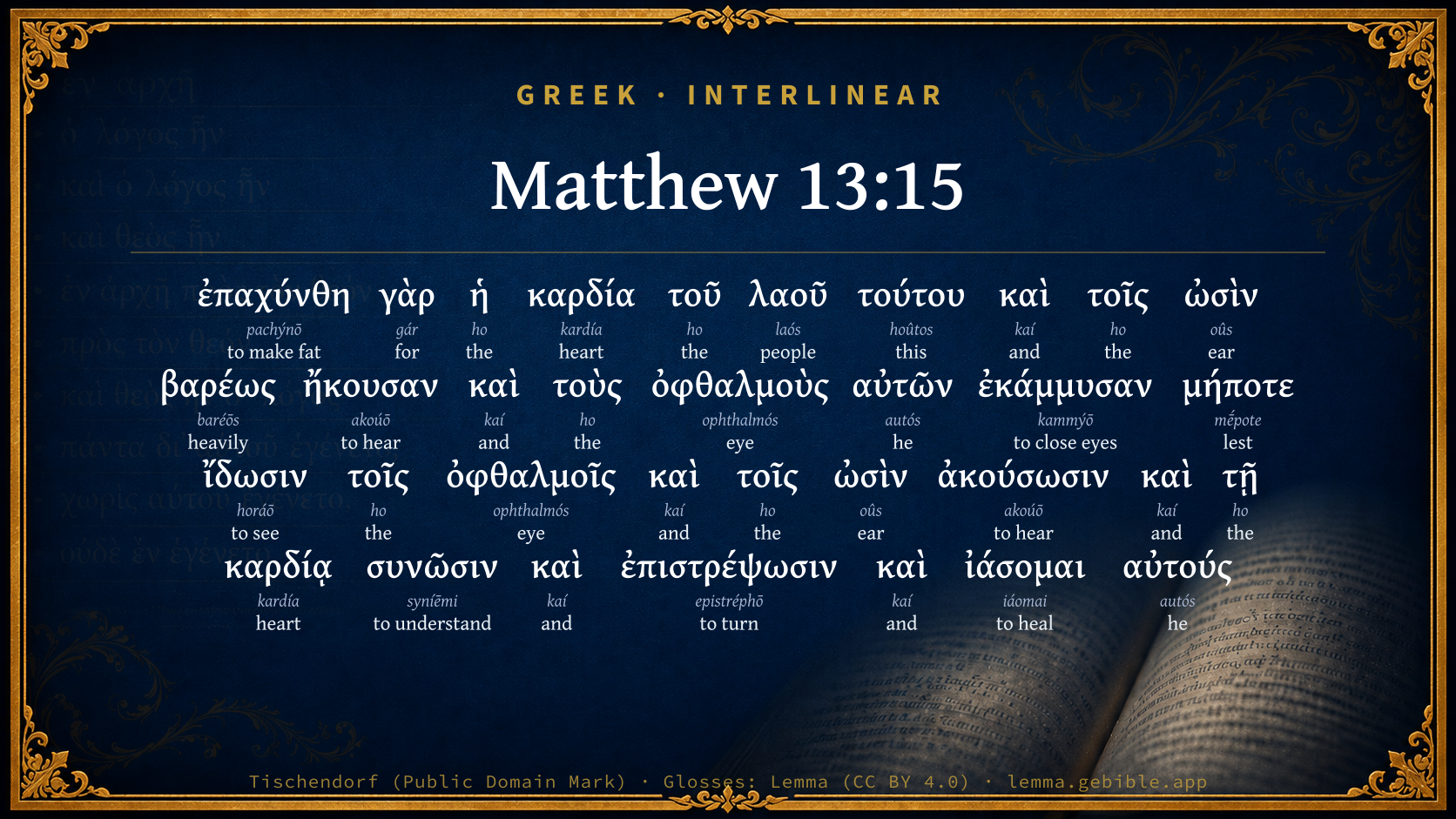
Download image
Cite this verse

Matthew 13:15 (World English Bible). Public Domain. Lemma interlinear Bible study tool, https://lemma.gebible.app/v/matthew/13/15.

Show BibTeX & RIS
BibTeX
RIS
English Translation
For this people's heart has grown callous, Their ears are dull of hearing, They have closed their eyes; Or else perhaps they might perceive with their eyes, Hear with their ears, Understand with their heart, And should turn again; And I would heal them.'
World English Bible · Public Domain
Highlights
  • 3 first appearances in the Greek New Testament
Full analysis ↓
Download a study sheet

One document with this verse’s original text, its word-by-word gloss line, the meaning frame, cross-references with their text, attributed commentary, and full source and license credits — printable, and it pastes into notes with its structure intact.

This verse Autodidact and up

Study sheet (.html) Plain text (.txt)

A passage Seminary Student

Up to 50 verses in one chapter. A passage sheet keeps up to 6 commentary sources and 12 cross-references per verse, in the order this page ranks them, and says so on the sheet whenever that leaves anything out. Ask for a single verse and you get the Autodidact verse sheet above.

Everything on this page stays free to read, with no account — the sheet is a download of what is already on screen, not access to it.

Want to remove ads? Support Godless Engineer
Compare translations 3

The same verse in 3 English versions, stacked beneath the original-language interlinear above. Click any original word for its lexicon entry.

Each is an independent rendering of the whole verse — the interlinear is not word-aligned to these translations.

Highlighted words mark where these versions differ — a whole-verse word diff, not a word-by-word alignment.

  • World English Bible Public Domain
    For this people's heart has grown callous, Their ears are dull of hearing, They have closed their eyes; Or else perhaps they might perceive with their eyes, Hear with their ears, Understand with their heart, And should turn again; And I would heal them.'
  • King James Version Public Domain
    For this people's heart is waxed gross, and their ears are dull of hearing, and their eyes they have closed; lest at any time they should see with their eyes and hear with their ears, and should understand with their heart, and should be converted, and I should heal them.
  • unfoldingWord Literal Text CC BY-SA 4.0
    For the heart of this people has been thickened, and with ears they have hardly heard, and they have shut their eyes, lest they might see with eyes, and they might hear with ears, and they might understand with heart and turn back, and I would heal them.’

unfoldingWord Literal Text — © unfoldingWord, licensed CC BY-SA 4.0. Word-aligned USFM3 via Door43 (git.door43.org/unfoldingWord/en_ult).

Versions to compare (up to 4)

3 of 4 selected

Show all 19 translations

Every available English version of this verse, each an independent rendering of the whole verse.

  • World English Bible Public Domain
    For this people's heart has grown callous, Their ears are dull of hearing, They have closed their eyes; Or else perhaps they might perceive with their eyes, Hear with their ears, Understand with their heart, And should turn again; And I would heal them.'
  • Berean Standard Bible Public Domain
    For this people’s heart has grown callous; they hardly hear with their ears, and they have closed their eyes. Otherwise they might see with their eyes, hear with their ears, understand with their hearts, and turn, and I would heal them.’
  • Majority Standard Bible Public Domain
    For this people’s heart has grown callous; they hardly hear with their ears, and they have closed their eyes. Otherwise they might see with their eyes, hear with their ears, understand with their hearts, and turn, and I would heal them.’
  • King James Version Public Domain
    For this people's heart is waxed gross, and their ears are dull of hearing, and their eyes they have closed; lest at any time they should see with their eyes and hear with their ears, and should understand with their heart, and should be converted, and I should heal them.
  • American Standard Version (1901) Public Domain
    For this people's heart is waxed gross, And their ears are dull of hearing, And their eyes they have closed; Lest haply they should perceive with their eyes, And hear with their ears, And understand with their heart, And should turn again, And I should heal them.
  • Revised Version (1885) Public Domain
    For this people’s heart is waxed gross, And their ears are dull of hearing, And their eyes they have closed; Lest haply they should perceive with their eyes, And hear with their ears, And understand with their heart, And should turn again, And I should heal them.
  • Geneva Bible (1599) Public Domain
    For this peoples heart is waxed fat, and their eares are dull of hearing, and with their eyes they haue winked, lest they should see with their eyes, and heare with their eares, and should vnderstand with their hearts, and should returne, that I might heale them.
  • Douay-Rheims (1899) Public Domain
    For the heart of this people is grown gross, and with their ears they have been dull of hearing, and their eyes they have shut: lest at any time they should see with their eyes, and hear with their ears, and understand with their heart, and be converted, and I should heal them.
  • Young's Literal Translation Public Domain
    for made gross was the heart of this people, and with the ears they heard heavily, and their eyes they did close, lest they might see with the eyes, and with the ears might hear, and with the heart understand, and turn back, and I might heal them.
  • Literal Standard Version CC BY-SA 4.0
    for the heart of this people was made obtuse, and with the ears they barely heard, and they closed their eyes, lest they might see with the eyes, and might hear with the ears, and understand with the heart, and turn back, and I might heal them.
  • Unlocked Literal Bible CC BY-SA 4.0
    For this people's heart has become dull, and they are hard of hearing, and they have closed their eyes, so they should not see with their eyes, or hear with their ears, or understand with their hearts, so they would turn again, and I would heal them.'
  • unfoldingWord Literal Text CC BY-SA 4.0
    For the heart of this people has been thickened, and with ears they have hardly heard, and they have shut their eyes, lest they might see with eyes, and they might hear with ears, and they might understand with heart and turn back, and I would heal them.’
  • Darby Bible Public Domain
    for the heart of this people has grown fat, and they have heard heavily with their ears, and they have closed their eyes as asleep, lest they should see with the eyes, and hear with the ears, and understand with the heart, and should be converted, and I should heal them.
  • World Messianic Bible Public Domain
    for this people’s heart has grown callous, their ears are dull of hearing, and they have closed their eyes; or else perhaps they might perceive with their eyes, hear with their ears, understand with their heart, and would turn again, and I would heal them.’
  • Webster's Bible Public Domain
    For this people's heart is become gross, and their ears are dull of hearing, and their eyes they have closed; lest at any time they should see with their eyes, and hear with their ears, and should understand with their heart, and should be converted, and I should heal them.
  • Free Bible Version CC BY-SA 4.0
    They have a hard-hearted attitude, they don't want to listen, and they've closed their eyes. If they didn't they might be able to see with their eyes, hear with their ears, and understand in their minds. Then they could return to me and I would heal them.’
  • Bible in Basic English Public Domain
    For the heart of this people has become fat and their ears are slow in hearing and their eyes are shut; for fear that they might see with their eyes and give hearing with their ears and become wise in their hearts and be turned again to me, so that I might make them well.
  • Text-Critical English NT CC BY 4.0
    For the heart of this people has become calloused; with their ears they have barely heard, and their eyes they have closed, lest they should see with their eyes, hear with their ears, and understand with their hearts and turn back, and I would heal them.’
  • Tyndale New Testament (1534) Public Domain
    For this peoples hertes are wexed grosse and their eares were dull of herynge and their eyes have they closed lest they shulde se with their eyes and heare with their eares and shuld vnderstonde with their hertes and shuld tourne that I myght heale them.

Literal Standard Version (2020), Covenant Press — licensed CC BY-SA 4.0. Text via the HelloAO Bible API (eBible.org). Unlocked Literal Bible (unfoldingWord) — licensed CC BY-SA 4.0. Text via the HelloAO Bible API (eBible.org). unfoldingWord Literal Text — © unfoldingWord, licensed CC BY-SA 4.0. Word-aligned USFM3 via Door43 (git.door43.org/unfoldingWord/en_ult). Free Bible Version, Dr. Jonathan Gallagher — licensed CC BY-SA 4.0. Text via the HelloAO Bible API (eBible.org).

Word by word

More ways to search: Search by grammar → Find every occurrence → Compare this word →

Practice this passage: Drill this verse → Learn its vocabulary →

ἐπαχύνθη
pachýnō
G3975
“to make fat”
Verb, Aorist, Passive, Indicative, 3rd person, Singular
Part of Speech
Verb
Tense
Aorist
Voice
Passive
Mood
Indicative
Person
3rd person
Number
Singular
Full Thayer's Definition

Origin: from a derivative of G4078 (meaning thick)

TDNT: 22:02,8

1. to make thick, to make fat, fatten 2. metaph. to make stupid (to render the soul dull or callous)
  1. γὰρ gár G1063 “for” Conjunction
  2. ἡ ho G3588 “the” Article, Nominative, Singular, Feminine
  3. καρδία kardía G2588 “heart” Noun, Nominative, Singular, Feminine
  4. τοῦ ho G3588 “the” Article, Genitive, Singular, Masculine
  5. λαοῦ laós G2992 “people” Noun, Genitive, Singular, Masculine
  6. τούτου hoûtos G3778 “this” Demonstrative pronoun, Genitive, Singular, Masculine
  7. καὶ kaí G2532 “and” Conjunction
  8. τοῖς ho G3588 “the” Article, Dative, Plural, Neuter
  9. ὠσὶν oûs G3775 “ear” Noun, Dative, Plural, Neuter
  10. βαρέως baréōs G917 “heavily” Adverb
  11. ἤκουσαν akoúō G191 “to hear” Verb, Aorist, Active, Indicative, 3rd person, Plural
  12. καὶ kaí G2532 “and” Conjunction
  13. τοὺς ho G3588 “the” Article, Accusative, Plural, Masculine
  14. ὀφθαλμοὺς ophthalmós G3788 “eye” Noun, Accusative, Plural, Masculine
  15. αὐτῶν autós G846 “he” Personal pronoun, Genitive, Plural, Masculine
  16. ἐκάμμυσαν kammýō G2576 “to close eyes” Verb, Aorist, Active, Indicative, 3rd person, Plural
  17. μήποτε mḗpote G3379 “lest” Adverb, Negative
  18. ἴδωσιν horáō G3708 “to see” Verb, Aorist, Active, Subjunctive, 3rd person, Plural
  19. τοῖς ho G3588 “the” Article, Dative, Plural, Masculine
  20. ὀφθαλμοῖς ophthalmós G3788 “eye” Noun, Dative, Plural, Masculine
  21. καὶ kaí G2532 “and” Conjunction
  22. τοῖς ho G3588 “the” Article, Dative, Plural, Neuter
  23. ὠσὶν oûs G3775 “ear” Noun, Dative, Plural, Neuter
  24. ἀκούσωσιν akoúō G191 “to hear” Verb, Aorist, Active, Subjunctive, 3rd person, Plural
  25. καὶ kaí G2532 “and” Conjunction
  26. τῇ ho G3588 “the” Article, Dative, Singular, Feminine
  27. καρδίᾳ kardía G2588 “heart” Noun, Dative, Singular, Feminine
  28. συνῶσιν syníēmi G4920 “to understand” Verb, Aorist, Active, Subjunctive, 3rd person, Plural
  29. καὶ kaí G2532 “and” Conjunction
  30. ἐπιστρέψωσιν epistréphō G1994 “to turn” Verb, Aorist, Active, Subjunctive, 3rd person, Plural
  31. καὶ kaí G2532 “and” Conjunction
  32. ἰάσομαι iáomai G2390 “to heal” Verb, Future, Middle deponent, Indicative, 1st person, Singular
  33. αὐτούς autós G846 “he” Personal pronoun, Accusative, Plural, Masculine

About this verse

These counts appear in no published source. They are computed here, from the morphology-tagged text and Lemma’s own curated glosses. What Lemma adds →

34
words
18
distinct lemmas
Gospels
section

Notable vocabulary

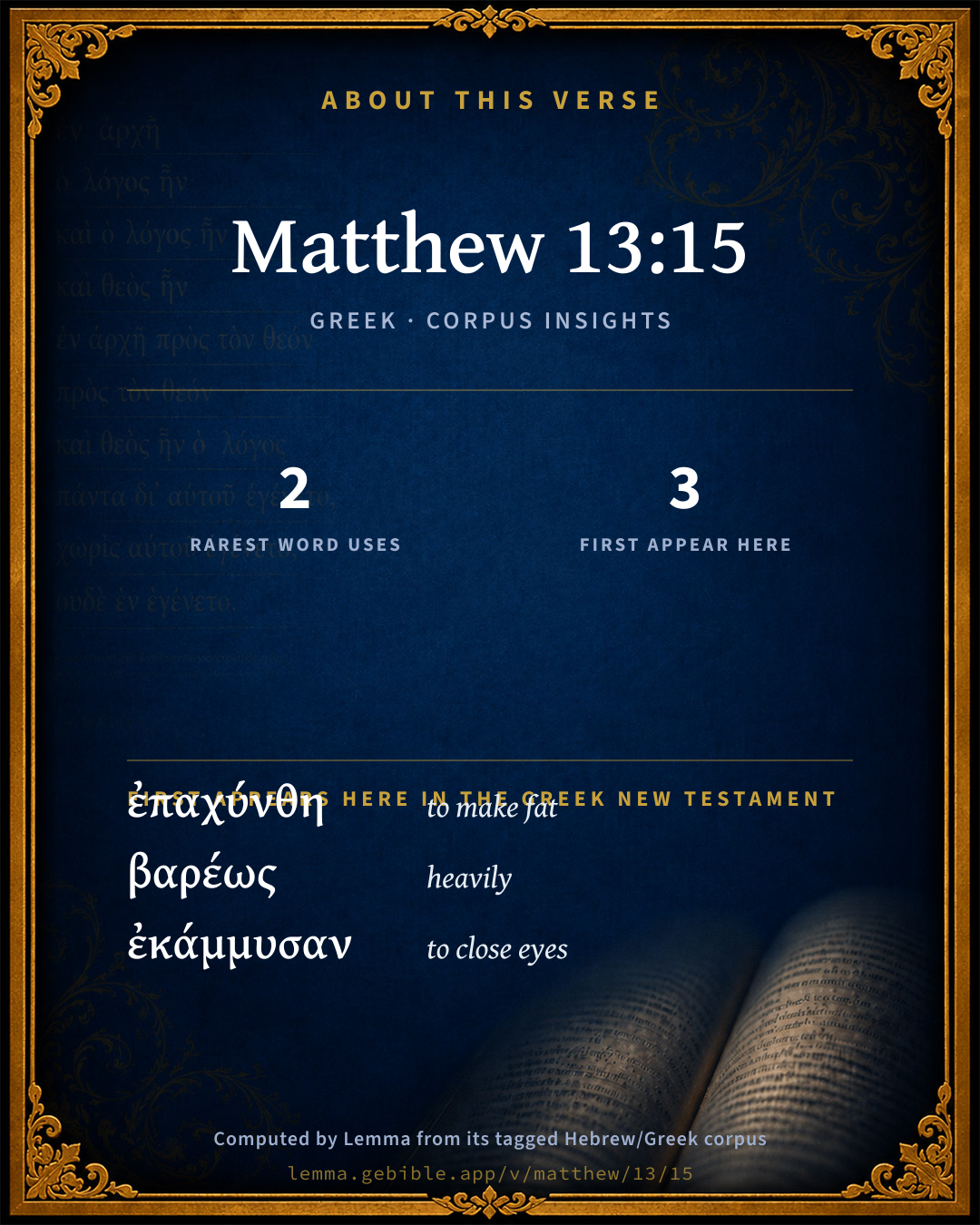
The rarest word here is ἐπαχύνθη to make fat G3975 — appearing just 2 times in the whole Greek New Testament.

First appearance in Scripture

These words make their first canonical appearance in the Greek New Testament here:

  • ἐπαχύνθη to make fat G3975
  • βαρέως heavily G917
  • ἐκάμμυσαν to close eyes G2576

Shared distinctive vocabulary

ἐπαχύνθη to make fat G3975 occurs in 2 verses of the Greek New Testament. Also found in:
Repetition

Words recur within this verse:

  • καρδία heart G2588 ×2
  • ὠσὶν ear G3775 ×2
  • ἤκουσαν to hear G191 ×2
  • ὀφθαλμοὺς eye G3788 ×2
  • ἡ the G3588 ×7
  • καὶ and G2532 ×6
  • αὐτῶν he G846 ×2

Cross-references

21

Topical passages linked to Matthew 13:15 in the Treasury of Scripture Knowledge — connected by theme and wording, ordered by reader-vote popularity; previews shown in the World English Bible.

  • Isaiah 6:10 Make the heart of this people fat; Make their ears heavy, and shut their eyes; Lest they see with their eyes, And hear with their ears, And understand with their heart, And turn again, and be healed."
  • Zechariah 7:11 But they refused to listen, and turned their backs, and stopped their ears, that they might not hear.
  • Mark 4:12 that 'seeing they may see, and not perceive; and hearing they may hear, and not understand; lest perhaps they should turn again, and their sins should be forgiven them.'"
  • John 8:43–44 Why don't you understand my speech? Because you can't hear my word.
  • 2 Timothy 2:25–26 in gentleness correcting those who oppose him: perhaps God may give them repentance leading to a full knowledge of the truth,
  • Isaiah 29:10–12 For Yahweh has poured out on you the spirit of deep sleep, and has closed your eyes, the prophets; and your heads, the seers, has he covered.
  • Jeremiah 17:14 Heal me, O Yahweh, and I shall be healed; save me, and I shall be saved: for you are my praise.
  • Malachi 4:2 But to you who fear my name shall the sun of righteousness arise with healing in its wings. You will go out, and leap like calves of the stall.
  • Psalms 119:70 Their heart is as callous as the fat, But I delight in your law.
  • Hebrews 5:11 About him we have many words to say, and hard to interpret, seeing you have become dull of hearing.
  • Acts 7:57 But they cried out with a loud voice, and stopped their ears, and rushed at him with one accord.
  • 2 Timothy 4:4 and will turn away their ears from the truth, and turn aside to fables.
  • Hebrews 6:4–6 For concerning those who were once enlightened and tasted of the heavenly gift, and were made partakers of the Holy Spirit,
  • Revelation 22:2 in the middle of its street. On this side of the river and on that was the tree of life, bearing twelve kinds of fruits, yielding its fruit every month. The leaves of the tree were for the healing of the nations.
  • Acts 3:19 "Repent therefore, and turn again, that your sins may be blotted out, so that there may come times of refreshing from the presence of the Lord,
  • Isaiah 44:20 He feeds on ashes; a deceived heart has turned him aside; and he can't deliver his soul, nor say, Is there not a lie in my right hand?
  • Isaiah 57:18 I have seen his ways, and will heal him: I will lead him also, and restore comforts to him and to his mourners.
  • Jeremiah 33:6 Behold, I will bring it health and cure, and I will cure them; and I will reveal to them abundance of peace and truth.
  • Hosea 14:4 "I will heal their waywardness. I will love them freely; For my anger is turned away from him.
  • 2 Thessalonians 2:10–11 and with all deception of wickedness for those who are being lost, because they didn't receive the love of the truth, that they might be saved.
  • Jeremiah 3:22 Return, you backsliding children, I will heal your backsliding. Behold, we are come to you; for you are Yahweh our God.

Cross-references courtesy of OpenBible.info (CC BY 4.0).

Commentary

Notes on Matthew 13:15 from classic Christian and Jewish commentators (each source and its license shown beneath its notes). The classic Christian expositions comment on the surrounding passage and are grouped to its opening verse, so a note may address several verses; the Jewish commentaries on the Tanakh (Rashi and others) are per-verse, so they appear only where the commentator wrote on this verse.

Lemma curates 59 commentaries, every one of them public domain or Creative Commons licensed, each selected and text-cleaned for this edition rather than reprinted as found. About our sources →

unfoldingWord translationNotes

Door43 World Missions Community

Connecting Statement:

Jesus finishes quoting the prophet Isaiah.

For this people's heart ... I would heal them

In Mat 13:15 God describes the people of Israel as if they have physical diseases that cause them to be unable to learn, to see, and to hear. God wants them to come to him so he will heal them. This is all a metaphor describing the people's spiritual condition. It means the people are stubborn and refuse to receive and understand God's truth. If they would, then they would repent and God would forgive them and welcome them back as his people. If the meaning is clear, keep the metaphor in your translation. (See: Metaphor)

this people's heart has become dull

Here "heart" refers to the mind. AT: "these people's minds are slow to learn" or "these people can no longer learn" (See: Metonymy)

they are hard of hearing

They are not physically deaf. Here "hard of hearing" means they refuse to listen and learn God's truth. AT: "they refuse to use their ears to listen" (See: Metonymy)

they have closed their eyes

They have not literally closed their eyes. This means they refuse to understand. AT: "they refuse to use their eyes to see" (See: Metonymy)

so they should not see with their eyes, or hear with their ears, or understand with their hearts, so they would turn again

"so that they are not able to see with their eyes, hear with their ears, or understand with their heart, and as a result turn again"

understand with their hearts

Here "hearts" is a metonym for people's minds. AT: "understand with their minds" (See: Metonymy)

turn again

"turn back to me" or "repent"

I would heal them

"have me heal them." This means God would heal them spiritually by forgiving their sins and receiving them again as his people. AT: "have me receive them again" (See: Metaphor)

translationWords

heart

cure

unfoldingWord translationNotes — © Distant Shores Media and the Door43 World Missions Community, licensed CC BY-SA 4.0. Source: git.door43.org/Door43/en_tn.

Bengel's Gnomon

Johann Albrecht Bengel

Mat 13:15. Ἐπαχύνθη γὰρ ἠ καρδία τοῦ λαοῦ τούτου, FOR this people’s heart is waxed gross) It stands thus in the S. V.; but in the Hebrew there is no word corresponding to the Greek γᾶρ, for. The language, however, rapidly turns itself away from them.[607]—ἡ καρδία, the heart, τοῖς ὠσὶ—τούς ὀφθαλμοὺς, with their ears, their eyes) These three occur again immediately in the opposite order: “with their eyes,” “with their ears,” “with their heart.” The heart is the first in the beginning, the last in the end. From the heart corruption flows into the ears and eyes; through the eyes and ears health[608] reaches the heart.—ἐκάμμυσαν—μήποτε—ἰάσωμαι αὐτούς, they have closed, lest at any time I should heal them) God therefore had wished to heal them; and it is clear that healing was close to them, if they had only turned to it. In Mar 4:12, we read “καὶ ἀφεθῇ αὐτοῖς τὰ ἁμαρτήματα;” i.e. “and their sins be forgiven them.” Cf. Psa 103:3.—συνῶσι, should understand) The seat[609] of σύνεσις, understanding, and νοήσις, perception, is the heart, not the brain: this is equally true of πώρωσις, hardening (see Joh 12:40), and of σκοτασμός, darkening (see Rom 1:21); as also of ἀπιστία, unbelief, and πίστις, faith, which is followed by ἐπιστροφή, conversion.[610]

[607] “Sermo autem celeriter se ab iis avertit.” This is one of many instances where it is impossible to find an English equivalent to the Latin “Sermo,” Bengel’s moaning is that whereas, in Mat 13:9, God had commanded the prophet to go and speak to the Jews, saying, “Hear ye indeed, but understand not; and see ye indeed, but perceive not,” in Mat 13:8, He suddenly changes the Sermo, i.e. the mode of speech, the direction of His words; and, instead of desiring Isaiah to address the people, turns from them, as it were, and gives an injunction to the prophet, regarding them, it is true, but not addressed to them: sc. “Make the heart of this people fat, etc.”—(I. B.)

[608] “Sanitas,” lit. soundness, an expression applied indifferently to mind or body, as in the well-known passage of Juvenal:—

[609] “Subjectum quo.”—(I. B.)

[610] The Hebrew accents undoubtedly connect the words καὶ ἐπιστρέψωσι (and should be converted) more closely with συνῶσι (should understand) than with ἰάσωμαι (I should heal). And in many passages of the Old Testament which are quoted in the New, the Hebrew accents agree more accurately with the force of the exact words of the Inspired original than the punctuation employed by the Greeks: e.g. Mat 4:15; Mat 19:5; Mat 21:5; Luk 4:18; Act 7:6; Act 8:32; Heb 1:12; Heb 3:9; Heb 12:26; Heb 13:6. And yet these Greeks were Christians. We ought not, therefore, to think that the Hebrew accents have originated with the modern Jews left to their blindness. Their origin is far more ancient, far more sublime.”—APP. CRIT., Ed. II., p. 120.

“Ut sit mens sana in corpere sano.”—(I. B.)

Bengel's Gnomon of the New Testament — English translation (T&T Clark, Edinburgh, 1860) — public domain. Text from a community e-Sword module.

Adam Clarke's Commentary

Verse 15. Heart is waxed gross] επαχυνθη, is become fat - inattentive stupid, insensible. They hear heavily with their ears-are half asleep while the salvation of God is preached unto them.

Their eyes they have closed] Totally and obstinately resisted the truth of God, and shut their eyes against the light.

Lest-they should see, &c.] Lest they should see their lost estate, and be obliged to turn unto God, and seek his salvation. His state is truly deplorable who is sick unto death, and yet is afraid of being cured. The fault is here totally in the people, and not at all in that God whose name is Mercy and whose nature is love.

Adam Clarke's Commentary on the Bible (1810–1826) — public domain. Text from a community e-Sword/MySword module.

Ellicott's Commentary for English Readers

(15) Lest at any time they should see.—The words point to the obstinate, wilful ignorance which refuses to look on the truth, lest the look should lead to conviction, and conviction to conversion—the ignorance of those who love darkness rather than light because their deeds are evil (Joh_3:19).

A Bible Commentary for English Readers, edited by Charles John Ellicott (1878–1897) — public domain. Text from a community e-Sword module.

The Cambridge Bible for Schools and Colleges

gen. ed. J. J. S. Perowne

15. this people’s heart is waxed gross] The heart was regarded as the seat of intelligence. Gross, literally, fat, so stolid, dull, like pinguis in Latin.

The Cambridge Bible for Schools and Colleges (gen. ed. J. J. S. Perowne; Cambridge University Press, 1878–1918) — public domain. Text from a community e-Sword module.

John Gill's Exposition

But blessed are your eyes, for they see,.... Which is to be understood both of corporal and intellectual sight: it was their happiness to see Christ in the flesh, and converse with him in person, be eyewitnesses of his majesty, and see with their own eyes the miracles performed by him, the proofs and attestations of those doctrines they were to publish to all the world; and it was still their greater happiness, that they saw his glory, as the glory of the only begotten of the Father, full of grace and truth: many saw him in the flesh, as they did, with their bodily eyes, but saw no beauty, nor comeliness in him, nothing amiable and desirable in him; but these saw his personal and transcendent glories, as the Son of God, his fulness as mediator, his suitableness as a Saviour and Redeemer, and all the characters of the Messiah in him; and so believed, and were sure that he was the Christ, the Son of the living God: they saw Christ, not in the promise, as Abraham, and other patriarchs did; nor through types and shadows, as the saints of the Old Testament did; to them it was given to know and understand the mysteries of grace, respecting the person, offices, obedience, sufferings, and death of Christ.

And your ears, for they hear. This also must be understood of corporal and intellectual hearing, another branch of their present happiness. They heard the words of truth from the lips of that great prophet Moses said should rise up among them, like unto him, whom they should hear: they heard, with their own ears, a voice from heaven, declaring him to be the beloved Son of God, in whom he was well pleased. They heard the Gospel preached by him, not only so as to be affected with it, and give their assent to it, but also to understand it spiritually, and experimentally, and to bring forth the fruit of it; and so were that sort of hearers, signified by the good ground in the parable Christ had just delivered. The forms of speech, in which the happiness of the disciples is here expressed, seem to be in common use with the Jews, when they would extol the peculiar attainments of a man, especially in matters of wisdom, knowledge, and understanding. Thus, it being told R. Jochanan ben Zaccai of some persons that had expounded the work of Mercavah, that is, the beginning of Ezekiel's prophecy, and the mysterious passages in it, and what befell them, expressed himself thus concerning them (n);

"blessed are you, and blessed are your children, , "and blessed are the eyes that so see".''

And elsewhere (o) mention being made of a book of secrets delivered to Solomon, and which he had understanding of, it is said,

, "blessed is the eye that sees, and the ear that hears", and the heart that understands, and causes to understand, the wisdom of it.''

(n) T. Bab. Chagiga, fol. 14. 2. (o) Sepher Raziel, fol. 34. 1.

John Gill's Exposition of the Whole Bible (1746–1763) — public domain (CC PDM 1.0). Text via the HelloAO Bible API.

Trapp's Complete Commentary

John Trapp

15 For this people’s heart is waxed gross, and their ears are dull of hearing, and their eyes they have closed; lest at any time they should see with their eyes, and hear with their ears, and should understand with their heart, and should be converted, and I should heal them.

Ver. 15. For this people’s heart, &c.] A fat heart is a fearful plague. "Their heart is as fat as grease, but I delight in thy law," Psa 119:70. None can delight in God’s law that are fat-hearted. Feeding cattle, we know, are most brutish and blockish. And physiognomers observe, that a full and fat heart betokens a dull and doltish disposition. Eglon’s fat paunch would not part with the poniard: and Pliny tells of bears so fat that they felt not the sharpest prickles.

Their ears are dull of hearing] So were the disbelieving Hebrews, for the which they are much taxed and tutored by the apostle. {a} Surdaster erat M. Crassus; sed illud peius, quod male audiebat, saith Cicero. These here hear very ill, for their no better hearing.

Their eyes they have closed] Or they wink hard with their eyes: they shut the windows, lest the light should come in: ut liberius peccent libenter ignorant, they do not what they might, toward the work. (Bern.)

Lest at any time they should see] See we may here (in that which they should have seen and done) the right order of repentance to salvation never to be repented of. The blind eye is opened, the deaf ear unstopped, the dull heart affected, &c. God first puts his laws into men’s minds, that they may know them, and then writes the same in their hearts, that they may have the comfort, feeling, and fruition of them. And then it is, "I will be to them a God, and they shall be to me a people," Heb 8:10.

{a} Νωθροι ταις ακοαις, Heb 5:11.

John Trapp, A Commentary or Exposition upon All the Books of the Old and New Testament (1647–1656) — public domain. Text from a community e-Sword module.

Haydock's Catholic Bible Commentary

And should be converted. In this the prophet shews the atrocity of the Jewish wickedness, and the malice of their hearts, but that he may attach them to God, their Father, he immediately subjoins, lest being converted, I should heal them; and this he says, in order to manifest to them the goodness of God, if they would repent. (St. John Chrysostom in St. Thomas Aquinas) --- There is some difference between the text of Isaias, given by St. Matthew, and the original. But we have elsewhere observed, that the evangelists attend more to the sense than the words. The Septuagint have translated this text in the same manner. The prophecy here mentioned regarded the Jews in the time of Isaias, according to the strict letter, but still more particularly the Jews in the time of Christ. (Bible de Vence) --- They were authors of their own blindness, sin, damnation, and not Jesus Christ, as Calvin teaches. See also Acts of the Apostles, xxviii. and Romans. i. and ix. 18. &c. God is not the author of evil. (Bristow)

George Leo Haydock (1774–1849), Haydock's Catholic Family Bible and Commentary, 1859 edition — public domain. Excludes Psalms (Douay-Rheims chapter numbering differs from Protestant) and Deuterocanonical books (Catholic canon only).

Whedon's Commentary on the Bible

Daniel D. Whedon

15. For this people’s heart is waxed gross — The reason is now given why those withholdings of truth are inflicted. The minds of the people had grown too gross to receive it. For instance, had the parable of the mustard seed been explained to the Pharisees as indicating that the Gospel would yet fill the earth, it would only have excited their additional hostility, and hastened their purpose of accusing him as intending to subvert the existing government. As their purpose had become too fixed, and their hearts too hard to enter into the spirit and plan of the kingdom of God, its teachings must remain mysteries to them. Dull of hearing — That is, of hearing what was most deeply essential to their good. Their eyes they have closed — It is they who have done it. Their blindness is wilful. They close their own eyes to the beauty of the Gospel, and therefore its real principles must be kept from them. I should heal them — As I would gladly do, if they would but allow it to be done.

It is the law of God’s spiritual kingdom, that resistance to truth hardens the heart. To brace their minds against the truth and to defend themselves in opposition to it, they arm themselves with countless falsehoods. Their minds thereby get into that state that it benefits them not; nay, even damages and condemns them. It may be then even a mercy to withhold it from them. They may use it to evil purposes, and it may bring them into greater sin. Or they may have so insulted it that they have by their own heinous guilt rendered themselves, like the damned in hell, unworthy of it.

Daniel D. Whedon (gen. ed.), Commentary on the Old and New Testaments (1874–1909) — public domain. Text from a community e-Sword module.

The Pulpit Commentary

For this people"s heart is waxed gross. There are two ways of understanding this verse as it comes here.

(1) It states the reason why God pronounced the judgment of ver. 14. The people"s heart had already become fat, lest (mh pote will then express the effect from the Divine point of view) they should see, etc.

(2) It merely enlarges the statement of ver. 14, expanding its meaning: (for this force of gar , cf. Mar_2:15 Luk_18:32) their heart is waxed fat (by God"s judgment for preceding sins), lest they should see, etc. This second explanation is preferable, for it alone suits the imperative found in the Hebrew. (cf. the transitive verbs in Joh_12:40) and is strictly parallel to the introductory vers. 11-13, which do not dwell upon the causes of God"s judgment. And their ears are dull of hearing, and their eyes have they closed; lest at any time (Mat_4:6, note) they should see; perceive (Revised Version) to recall the same word in ver. 14. With their eyes, and hear with their ears, and should understand with their heart. Bengel calls attention to the order; first came heart, ears, eyes; here, eyes, ears, heart. "A corde corruptio manat in aures et oculos: per oculos et aures sanitas pervenit ad cor." And should be converted; and should turn again (Revised Version, epistreqwsi); for "to be converted" has acquired too technical a meaning. And I should heal them (kai iasomai autouv). The verb is still dependent on the lest, (cf. Mat_5:25 Mat_7:6) but the future brings out the certainty of God"s healing them on their turning, etc.

The Pulpit Commentary (1880–1919), ed. H.D.M. Spence-Jones & Joseph S. Exell — public domain. Text from a community e-Sword module.

Cambridge Greek Testament for Schools and Colleges

15. ἰάσομαι, for ἰάσωμαι. The latter reading is due to the influence of grammatical uniformity, or an itacism, confusion of vowels that have a similar sound.

15. ἐπαχύνθη ἡ καρδία. The heart, regarded by the ancients as the seat of intelligence, has become gross or fat, and so closed against the perception of spiritual truth.

μήποτε ἴδωσιν … ἰάσομαι. For the sequence of the subjunctive and future indicative co-ordinately after a final particle, cp. Rev 22:14, μακάριοι οἱ πλύνοντες τὰς στολὰς αὐτῶν, ἵνα ἔσται ἡ ἐξουσία αὐτῶν … καὶ εἰσέλθωσιν. For the future, among other passages, cp. Gal 2:4, where the best editors read ἵνα ἡμᾶς καταδουλώσουσιν. See Winer, p. 361. In the classics the future indicative in pure final clauses is found after ὅπως and ὄφρα, never after ἵνα or ὡς, and very seldom after the simple μή. Goodwin’s Moods and Tenses, p. 68. Elmsley, however (Eur. Bacch., p. 164) does not admit the exception of ἵνα. See Winer, loc. cit. above. In the N.T. ὅπως occurs with the future, Matt. ch. Mat 26:59, and, on good MS. authority, Rom 3:4. As distinguished from the subjunctive in such instances the future indicative implies a more permanent condition.

Cambridge Greek Testament for Schools and Colleges (Cambridge University Press, 1896; 21 vols, various authors incl. Carr, Maclear, Plummer, Farrar, Lumby, Moule, M. R. James, Simcox) — public domain. Text from a community e-Sword module.

Alford’s Greek Testament

Henry Alford

15.] This prophecy is quoted with a similar reference Joh 12:40: Act 28:26, Act 28:27; see also Rom 11:8.

ἀναπληροῦται, is being fulfilled, ‘finds one of the stages of its fulfilment:’ a partial one having taken place in the contemporaries of the prophet. The prophecy is cited verbatim from the LXX, which changes the imperative of the Hebrew (‘Make the heart of this people fat,’ &c., E. V.) into the indicative, as bearing the same meaning.

αὐτοῖς is a dat. of relation, ‘with regard to them:’ see Kühner, Gramm. § 581.

ἐπαχύνθη, grew fat; from prosperity:—‘torpens, omni sensu carens’ (Simonis Lex. under שָׁמַן).

βαρέως ἤκουσαν, heard heavily, sluggishly and imperfectly.

ἐκάμμυσαν, closed (Heb. ‘smeared over’) their eyes. All this have they done: all this is increased in them by their continuing to do it, and all lest they should (and so that they cannot) hear, see, understand, and be saved.

ἰάσομαι αὐτ. = ἀφεθῇ αὐτοῖς Mark. This citation gives no countenance to the fatalist view of the passage, but rests the whole blame on the hard-heartedness and unreadiness of the hearers, which is of itself the cause why the very preaching of the word is a means of further darkening and condemning them (see 2Co 4:3, 2Co 4:4). On the fut. indic. after μήποτε, “verentis ne quid futurum sit, sed indicantis simul, putare se ita futurum esse ut veretur,” see Winer, § 56. 2: Herm. ad Soph. Aj. 272.

16,

Henry Alford, The Greek Testament (1849–1861) — public domain. Text from a community e-Sword module.

Vincent's Word Studies in the New Testament

Marvin R. Vincent

Is waxed gross [επαχυνθη] . Lit., was made fat. Wyc., enfatted.

Are dull of hearing [τοις ωσιν βαρεως ηκουσαν] . Lit., They heard heavily with their ears.

They have closed [εκαμμυσαν] , kata, down, muw, to close, as in musthria above. Our idiom shuts up the eyes. The Greek shuts them down. The Hebrew, in Isa 6:10, is besmear. This insensibility is described as a punishment. Compare Isa 29:10; Isa 44:18; in both of which the closing of the eyes is described as a judgment of God. Sealing up the eyes was an oriental punishment. Cheyne (" Isaiah ") cites the case of a son of the Great Mogul, who has his eyes sealed up three years by his father as a punishment. Dante pictures the envious, on the second cornice of Purgatory, with their eyes sewed up :

"For all their lids an iron wire transpierces, And sews them up, as to a sparhawk wild Is done, because it will not quiet stay." Purg., 13 70 - 72.

Be converted [επιστρεψωσιν] . Rev., turn again; ejpi, to or toward, strefw, to turn; with the idea of their turning from their evil toward God.

Marvin R. Vincent, Word Studies in the New Testament (1887–1900) — public domain. Text from a community e-Sword/MySword module.

Lesson kit

Teaching starters — assembled from the data on this page, not authored interpretation. Every prompt links to the verse data it draws on. Edit before teaching.

Matthew, in the Gospels, opens this verse with 34 words (18 distinct Greek lemmas). Its most distinctive word is pachýnō (“to make fat”). A historical commentator’s framing appears above. Read the whole chapter for the surrounding context.

Discussion questions

  1. How does “to make fat” (pachýnō) shape what this verse is saying?
  2. 3 words here appear for the first time in Scripture. What is being introduced at this debut?
  3. Acts 28:27 shares the word «to make fat» with this verse. How do the two illuminate each other?
  4. “heart” occurs 2× in this one verse. What is the effect of the repetition?
  5. These translations render this verse differently. What is at stake in choosing one wording over another?
  6. Reading how unfoldingWord translationNotes and Bengel's Gnomon read this verse, where do the two commentators agree and where do they part?

Things to notice

  • 3 words make their first canonical appearance in Scripture here.
  • These translations choose different wording for 29 words in this verse.
  • “heart” occurs 2× in this single verse.
  • 18 distinct Greek lemmas span 34 words in this verse.

Reading settings

Reading text

Shown beneath each verse's original-language words.

Old Testament
Old Testament edition

Read the OT as the Masoretic Hebrew (MT) or the Greek Septuagint (LXX).

English shown for the Greek Septuagint (in the Hebrew ↔ Greek comparison).

Comparing translations? Open the Compare panel on any verse page to stack up to four side by side.