
John 4:18

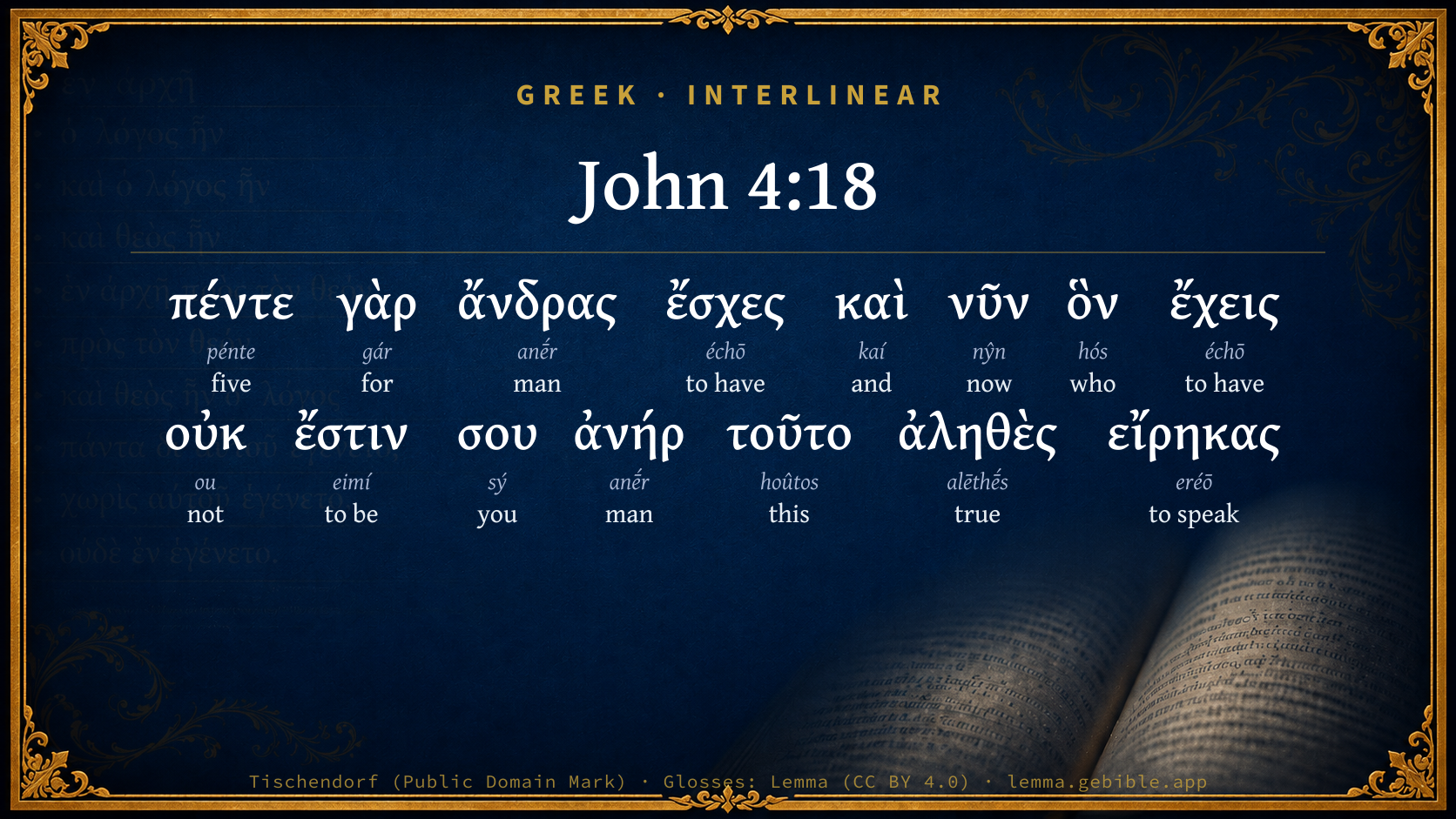
Greek (Tischendorf 8th ed.) John 4:18 appears in the Greek New Testament. The text above is from the Tischendorf 8th edition. Each word links to its Strong’s number and a concise gloss. Click any word for its full Thayer’s Greek Lexicon entry.
Download image
Cite this verse

John 4:18 (World English Bible). Public Domain. Lemma interlinear Bible study tool, https://lemma.gebible.app/v/john/4/18.

Show BibTeX & RIS
BibTeX
RIS
English Translation
for you have had five husbands; and he whom you now have is not your husband. This you have said truly."
World English Bible · Public Domain
Download a study sheet

One document with this verse’s original text, its word-by-word gloss line, the meaning frame, cross-references with their text, attributed commentary, and full source and license credits — printable, and it pastes into notes with its structure intact.

This verse Autodidact and up

Study sheet (.html) Plain text (.txt)

A passage Seminary Student

Up to 50 verses in one chapter. A passage sheet keeps up to 6 commentary sources and 12 cross-references per verse, in the order this page ranks them, and says so on the sheet whenever that leaves anything out. Ask for a single verse and you get the Autodidact verse sheet above.

Everything on this page stays free to read, with no account — the sheet is a download of what is already on screen, not access to it.

Want to remove ads? Support Godless Engineer
Compare translations 3

The same verse in 3 English versions, stacked beneath the original-language interlinear above. Click any original word for its lexicon entry.

Each is an independent rendering of the whole verse — the interlinear is not word-aligned to these translations.

Highlighted words mark where these versions differ — a whole-verse word diff, not a word-by-word alignment.

  • World English Bible Public Domain
    for you have had five husbands; and he whom you now have is not your husband. This you have said truly."
  • King James Version Public Domain
    For thou hast had five husbands; and he whom thou now hast is not thy husband: in that saidst thou truly.
  • unfoldingWord Literal Text CC BY-SA 4.0
    for you have had five husbands, and the one whom you now have is not your husband. This you have said is true.”

unfoldingWord Literal Text — © unfoldingWord, licensed CC BY-SA 4.0. Word-aligned USFM3 via Door43 (git.door43.org/unfoldingWord/en_ult).

Versions to compare (up to 4)

3 of 4 selected

Show all 19 translations

Every available English version of this verse, each an independent rendering of the whole verse.

  • World English Bible Public Domain
    for you have had five husbands; and he whom you now have is not your husband. This you have said truly."
  • Berean Standard Bible Public Domain
    In fact, you have had five husbands, and the man you now have is not your husband. You have spoken truthfully.”
  • Majority Standard Bible Public Domain
    In fact, you have had five husbands, and the man you now have is not your husband. You have spoken truthfully.”
  • King James Version Public Domain
    For thou hast had five husbands; and he whom thou now hast is not thy husband: in that saidst thou truly.
  • American Standard Version (1901) Public Domain
    for thou hast had five husbands; and he whom thou now hast is not thy husband: this hast thou said truly.
  • Revised Version (1885) Public Domain
    for thou hast had five husbands; and he whom thou now hast is not thy husband: this hast thou said truly.
  • Geneva Bible (1599) Public Domain
    For thou hast had fiue husbands, and he whom thou nowe hast, is not thine husband: that saidest thou truely.
  • Douay-Rheims (1899) Public Domain
    For thou hast had five husbands: and he whom thou now hast, is not thy husband. This thou hast said truly.
  • Young's Literal Translation Public Domain
    for five husbands thou hast had, and, now, he whom thou hast is not thy husband; this hast thou said truly.'
  • Literal Standard Version CC BY-SA 4.0
    for you have had five husbands, and now, he whom you have is not your husband; you have said this correctly.”
  • Unlocked Literal Bible CC BY-SA 4.0
    for you have had five husbands, and the one you now have is not your husband. What you have said is true.”
  • unfoldingWord Literal Text CC BY-SA 4.0
    for you have had five husbands, and the one whom you now have is not your husband. This you have said is true.”
  • Darby Bible Public Domain
    for thou hast had five husbands, and he whom now thou hast is not thy husband: this thou hast spoken truly.
  • World Messianic Bible Public Domain
    for you have had five husbands; and he whom you now have is not your husband. This you have said truly.”
  • Webster's Bible Public Domain
    For thou hast had five husbands, and he whom thou now hast, is not thy husband: in that thou hast spoken truth.
  • Free Bible Version CC BY-SA 4.0
    “You've had five husbands, and the one you're living with now is not your husband. So what you say is true!”
  • Bible in Basic English Public Domain
    You have had five husbands, and the man you have now is not your husband: that was truly said.
  • Text-Critical English NT CC BY 4.0
    for yoʋ have had five husbands, and the man yoʋ now have is not yoʋr husband; what yoʋ have said is true.”
  • Tyndale New Testament (1534) Public Domain
    For thou haste had five husbandes and he whom thou now hast is not thy husband. That saydest thou truely.

Literal Standard Version (2020), Covenant Press — licensed CC BY-SA 4.0. Text via the HelloAO Bible API (eBible.org). Unlocked Literal Bible (unfoldingWord) — licensed CC BY-SA 4.0. Text via the HelloAO Bible API (eBible.org). unfoldingWord Literal Text — © unfoldingWord, licensed CC BY-SA 4.0. Word-aligned USFM3 via Door43 (git.door43.org/unfoldingWord/en_ult). Free Bible Version, Dr. Jonathan Gallagher — licensed CC BY-SA 4.0. Text via the HelloAO Bible API (eBible.org).

Word by word

More ways to search: Search by grammar → Find every occurrence → Compare this word →

Practice this passage: Drill this verse → Learn its vocabulary →

ἀληθὲς
alēthḗs
G227
“true”
Adjective, Accusative, Singular, Neuter
Part of Speech
Adjective
Case
Accusative
Number
Singular
Gender
Neuter
Full Thayer's Definition

Origin: from G1 (as a negative particle) and G2990

TDNT: 05:07,4

1. true 2. loving the truth, speaking the truth, truthful
  1. πέντε pénte G4002 “five” Adjective, Numeral (indeclinable)
  2. γὰρ gár G1063 “for” Conjunction
  3. ἄνδρας anḗr G435 “man” Noun, Accusative, Plural, Masculine
  4. ἔσχες échō G2192 “to have” Verb, Aorist, Active, Indicative, 2nd person, Singular
  5. καὶ kaí G2532 “and” Conjunction
  6. νῦν nŷn G3568 “now” Adverb
  7. ὃν hós G3739 “who” Relative pronoun, Accusative, Singular, Masculine
  8. ἔχεις échō G2192 “to have” Verb, Present, Active, Indicative, 2nd person, Singular
  9. οὐκ ou G3756 “not” Particle, Negative
  10. ἔστιν eimí G1510 “to be” Verb, Present, Active, Indicative, 3rd person, Singular
  11. σου sý G4771 “you” Personal pronoun, 2nd person, Genitive, Singular
  12. ἀνήρ anḗr G435 “man” Noun, Nominative, Singular, Masculine
  13. τοῦτο hoûtos G3778 “this” Demonstrative pronoun, Accusative, Singular, Neuter
  14. εἴρηκας eréō G2046 “to speak” Verb, Perfect, Active, Indicative, 2nd person, Singular, Attic form

About this verse

These counts appear in no published source. They are computed here, from the morphology-tagged text and Lemma’s own curated glosses. What Lemma adds →

15
words
13
distinct lemmas
Gospels
section

Shared distinctive vocabulary

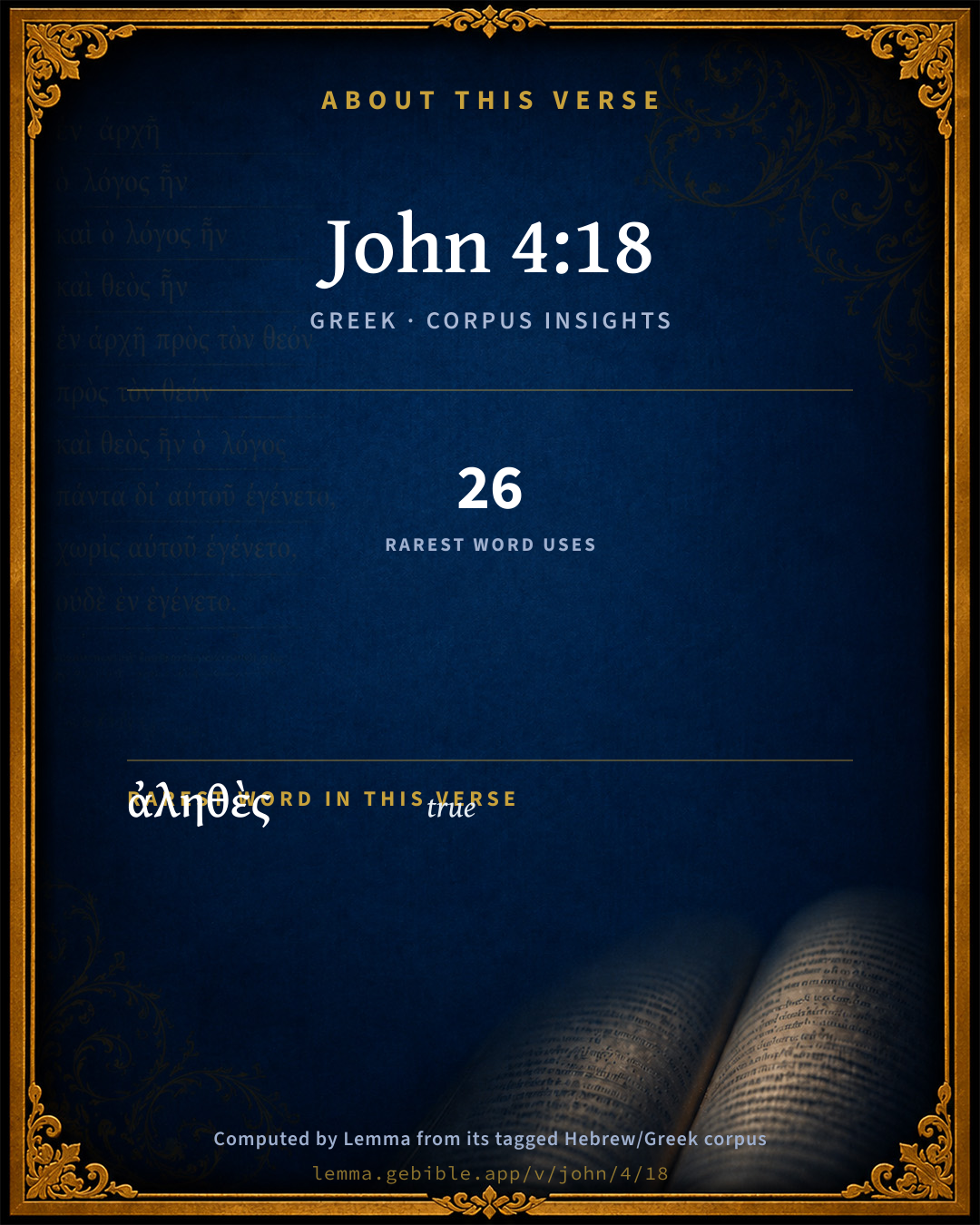
ἀληθὲς true G227 occurs in 25 verses of the Greek New Testament. Also found in:
Repetition

Words recur within this verse:

  • ἄνδρας man G435 ×2
  • ἔσχες to have G2192 ×2

Cross-references

12

Topical passages linked to John 4:18 in the Treasury of Scripture Knowledge — connected by theme and wording, ordered by reader-vote popularity; previews shown in the World English Bible.

  • Jeremiah 3:20 Surely as a wife treacherously departs from her husband, so have you dealt treacherously with me, house of Israel, says Yahweh.
  • Romans 7:3 So then if, while the husband lives, she is joined to another man, she would be called an adulteress. But if the husband dies, she is free from the law, so that she is no adulteress, though she is joined to another man.
  • 1 Corinthians 7:10–11 But to the married I command--not I, but the Lord--that the wife not leave her husband
  • Mark 10:12 If a woman herself divorces her husband, and marries another, she commits adultery."
  • Genesis 20:3 But God came to Abimelech in a dream of the night, and said to him, "Behold, you are a dead man, because of the woman whom you have taken. For she is a man's wife."
  • Genesis 34:2 Shechem the son of Hamor the Hivite, the prince of the land, saw her. He took her, lay with her, and humbled her.
  • Genesis 34:7–8 The sons of Jacob came in from the field when they heard it. The men were grieved, and they were very angry, because he had done folly in Israel in lying with Jacob's daughter; which thing ought not to be done.
  • Genesis 34:31 They said, "Should he deal with our sister as with a prostitute?"
  • Numbers 5:29 "This is the law of jealousy, when a wife, being under her husband, goes astray, and is defiled;
  • Ruth 4:10 Moreover Ruth the Moabitess, the wife of Mahlon, have I purchased to be my wife, to raise up the name of the dead on his inheritance, that the name of the dead not be cut off from among his brothers, and from the gate of his place: you are witnesses this day.
  • Ezekiel 16:32 A wife who commits adultery! who takes strangers instead of her husband!
  • Hebrews 13:4 Let marriage be held in honor among all, and let the bed be undefiled: but God will judge the sexually immoral and adulterers.

Cross-references courtesy of OpenBible.info (CC BY 4.0).

Commentary

Notes on John 4:18 from classic Christian and Jewish commentators (each source and its license shown beneath its notes). The classic Christian expositions comment on the surrounding passage and are grouped to its opening verse, so a note may address several verses; the Jewish commentaries on the Tanakh (Rashi and others) are per-verse, so they appear only where the commentator wrote on this verse.

Lemma curates 59 commentaries, every one of them public domain or Creative Commons licensed, each selected and text-cleaned for this edition rather than reprinted as found. About our sources →

Bengel's Gnomon

Johann Albrecht Bengel

Joh 4:18. Πεντε, five) Five marriage connexions embraced almost the whole life of the woman; and by the mention of them He clearly recalled to the recollection of the woman her whole life.—ἄνδρας) He means husbands, as is evident from the subsequent antithesis. Whether they all died, or whether the woman lost some of them by other ways also, her own conscience, stirred up by the Lord, was suggesting.—οὐκ ἐστι, is not) This sixth marriage was not a lawful one, or else not consummated; either desertion, or some other impediment, arising from one or other of the two parties, had occurred to prevent it. The woman is not at all said to have renounced the man, at Joh 4:28.

Bengel's Gnomon of the New Testament — English translation (T&T Clark, Edinburgh, 1860) — public domain. Text from a community e-Sword module.

Adam Clarke's Commentary

Verse 18. Thou hast had five husbands] It is not clear that this woman was a prostitute: she might have been legally married to those five, and might have been divorced through some misbehaviour of her own, not amounting to adultery; for the adulteress was to be put to death, both by the Jewish and Samaritan law, not divorced: or she might have been cast off through some caprice of her husband; for, in the time of our Lord, divorces were very common among the Jews, so that a man put away his wife for any fault. See Clarke on Mt 5:31. Some are so very fond of exaggerating that nothing can pass through their hands without an increase: hence Heracleon says she had six husbands, and Jerome modestly gives her twenty-two! Viginti duos habuisti maritos, et ille a quo sepelieris non est tuus. "Thou hast had twenty-two husbands and he by whom thou shalt be buried is not thine." Epist. xi.

He whom thou now hast is not thy husband] Νυν ὁν εχεις, ουκ εϚι σου ανηρ. Bishop Pearce would translate this clause in the following manner: There is no husband whom thou now hast-or, less literally, Thou hast no husband now: probably the meaning is, Thou art contracted to another, but not yet brought home: therefore he is not yet thy husband. See Rosenmuller. Bishop Pearce contends that our Lord did not speak these words to her by way of reproof:

1. Because it is not likely that a woman so far advanced in years as to have had five husbands should have now been found living in adultery with a sixth person.

2. Because it is not likely that our Lord would not, in some part of his discourse, have reproved her for her fornication, especially if guilty of it under such gross circumstances.

3. Nor is it likely that a woman of so bad a life should have had so much influence with the people of her city that they should, on her testimony, Joh 4:39-42, believe Jesus to be the Messiah.

4. Nor is it at all likely that when a discovery of her guilt was made to her, by one whom she acknowledged to be a prophet, Joh 4:19, the first thing which came into her thoughts should be the important question in religion, about the place appointed by God for his worship, so warmly contested between the Jews and Samaritans.

5. Nor is it at all probable that a person of such a bad life, without any mentioned sign of repentance, should have been the first (perhaps the only private person) to whom Jesus is recorded as declaring himself to be the Christ, as he does to her, Joh 4:26.

Adam Clarke's Commentary on the Bible (1810–1826) — public domain. Text from a community e-Sword/MySword module.

Ellicott's Commentary for English Readers

(18) In that saidst thou truly.—The stroke goes deeper. It lays bare the secrets of all those years over which she thought the veil of the past had for ever been drawn. The bright days of joy and dark days of sin; the heart’s promises made and broken; the sad days of death, which five times over had robbed her of a husband; or, worse than death, the sin which had severed the sacred bonds; the shame of the present shameless life—all these are at least hidden from a stranger. But His words pierce to the inmost thoughts, and prove Him to know all the acts of her life (Joh_4:29). “Thou hast well said, A husband I have not. The holy name may not be given to the paramour thou now hast; with the loss of purity is linked the loss of truthfulness; the very truth thou utterest is meant to convey to Me an untruth, but to One who knows all, the words are really true;—“in that saidst thou truly.”

A Bible Commentary for English Readers, edited by Charles John Ellicott (1878–1897) — public domain. Text from a community e-Sword module.

The Cambridge Bible for Schools and Colleges

gen. ed. J. J. S. Perowne

18. five husbands] To be understood quite literally. They were either dead or divorced, and she was now living with a man without being married to him.

in that saidst thou truly] Better, this (one thing) thou hast said truly. Christ exposes the falsehood which lurks in the literal truth of her statement.

The Cambridge Bible for Schools and Colleges (gen. ed. J. J. S. Perowne; Cambridge University Press, 1878–1918) — public domain. Text from a community e-Sword module.

John Gill's Exposition

For thou hast had five husbands,.... Which she either had had lawfully, and had buried one after another; and which was no crime, and might be: the Sadducees propose a case to Christ, in which a woman is said to have had seven husbands successively, in a lawful manner, Mat 22:25. Or rather, she had had so many, and had been divorced from everyone of them, for adultery; for no other cause it should seem did the Samaritans divorce; seeing that they only received the law of Moses, and rejected, at least, many of the traditions of the elders; and since they are particularly said (y).

"not to be expert in the law of marriages and divorces:''

and the rather this may seem to be the case, as Dr. Lightfoot observes; since these husbands are mentioned, as well as he with whom she lived in an adulterous manner; and which suggests, that she had not lived honestly with them:

and he whom thou now hast, is not thy husband; that is, not thy lawful husband, as the Persic version reads, and Nonnus paraphrases; being not married to him at all, though they cohabited as man and wife, when there was no such relation between them:

in that saidst thou truly; or that which is truth: thus Christ the omniscient God, who knew her full well, and the whole of her past infamous conversation, and her present lewd and wicked way of living, exposes all unto her.

(y) T. Bab. Kiddushin, fol 76. 1.

John Gill's Exposition of the Whole Bible (1746–1763) — public domain (CC PDM 1.0). Text via the HelloAO Bible API.

Trapp's Complete Commentary

John Trapp

18 For thou hast had five husbands; and he whom thou now hast is not thy husband: in that saidst thou truly.

Ver. 18. He whom thou now hast, &c.] Here he comes home to her conscience; so must all that will do good on it, striving not so much to please as to profit. Bees are killed with honey but quickened with vinegar. The eagle, though she love her young ones dearly, yet she pricketh and beateth them out of the nest: so must preachers drive men out of the nest of pleasure. John Speiser, preacher at Augsburg in Germany, did his work so well at first, that the common strumpets left the brothel houses (then tolerated) and betook themselves to a better course, A.D. 1523. Yet afterwards he revolted to the Papists and miserably perished. (Sculler. Annal. 118.)

John Trapp, A Commentary or Exposition upon All the Books of the Old and New Testament (1647–1656) — public domain. Text from a community e-Sword module.

Albert Barnes' Notes on the Bible

Hast had five husbands - Who have either died; or who, on account of your improper conduct, have divorced you; or whom you have left improperly, without legal divorce. Either of these might have be. en the case.

Is not thy husband - You are not lawfully married to him. Either she might have left a former husband without divorce, and thus her marriage with this man was unlawful, or she was living with him without the form of marriage, in open guilt.

Albert Barnes' Notes on the Bible (1834–1885) — public domain. Text from a community e-Sword/MySword module.

Matthew Poole's English Annotations

He tells her, that she had had five husbands; whether successively, the former being dead, and she marrying another, or five from whom she had been divorced for adultery, is not agreed; the best modern interpreters judge, that she had had five men to whom she had been in marriage, but so behaved herself toward them, that either for her adultery, or some other froward behaviour towards them, they had given her a bill of divorce; and though she now used and lived with one as her husband, yet in this she said truly, because, her former husbands yet living, he was not her husband. This seemeth more properly the sense, than that after five legal husbands’ death, she lived in whoredom with a sixth person. By this discovery, our Saviour both bringeth her to the sense of her sin, and also to an acknowledgment of him as the Messiah.

Matthew Poole's English Annotations on the Holy Bible (1683–1685) — public domain. Text from a community e-Sword/MySword module.

Whedon's Commentary on the Bible

Daniel D. Whedon

18. Five… not thy husband—The Evangelist does not state the emotions of the woman now. But her own language, (Joh_4:29,) “he told me all things that ever I did,” shows that at Jesus’s words her whole life’s history of guilt rises up so vividly to her view, that she verily believes that it was he who told her the whole! So it is said that men in the instant of drowning have seen at a glance, as in a picture, the whole of their lives, coexisting, as it were, before the mind at once.

Daniel D. Whedon (gen. ed.), Commentary on the Old and New Testaments (1874–1909) — public domain. Text from a community e-Sword module.

John Wesley's Explanatory Notes

Thou hast had five husbands - Whether they were all dead or not, her own conscience now awakened would tell her.

John Wesley, Explanatory Notes Upon the Whole Bible (1754–1765) — public domain. Text via the GEBible commentary corpus.

The People's New Testament

B. W. Johnson

18. Thou hast had five husbands; and he whom thou now hast is not thy husband. She had been married five times; the easy divorce laws of the age, permitting a “divorce for any cause,” would allow many changes without the death of either party. Some of her husbands may have died; a part were almost certainly divorced. Her sixth alliance did not have even the apology of such a marriage.

B. W. Johnson's The People's New Testament with Notes (1889–1891) — public domain. Electronic text from the Christian Classics Ethereal Library (CCEL) ThML edition.

Cambridge Greek Testament for Schools and Colleges

18. πέντε ἄνδ. Quite literally; they were either dead or divorced, and she was now living with a man without being married to him. The emphatic position of σου may possibly mean that he is the husband of some one else.

τοῦτο ἀλ. εἴρ. This thou hast said truly, literally ‘a true thing.’ Christ exposes the falsehood lurking under the literal truth.

Cambridge Greek Testament for Schools and Colleges (Cambridge University Press, 1896; 21 vols, various authors incl. Carr, Maclear, Plummer, Farrar, Lumby, Moule, M. R. James, Simcox) — public domain. Text from a community e-Sword module.

Alford’s Greek Testament

Henry Alford

18.] There was literal truth, but no more, in the woman’s answer: and the Lord, by His divine knowledge, detects the hidden falsehood of it. Notice it is ἀληθές, not ἀληθῶς: this one word was true: further shewn by the emphatic position of ἄνδρα in our Lord’s answer.

πέντε γὰρ ἄνδ. ἔσχες] These five were certainly lawful husbands; they are distinguished from the sixth, who was not;—probably the woman had been separated from some by divorce (the law of which was but loose among the Samaritans),—from some by death,—or perhaps by other reasons more or less discreditable to her character, which had now become degraded into that of an openly licentious woman. The conviction of sin here lies beneath the surface: it is not pressed, nor at the moment does it seem to have worked deeply, for she goes on with the conversation with apparent indifference to it; but our Lord’s words in vv. 25, 26 would tend to infix it more deeply, and we find at ver. 29, that it had been working during her journey back to the city.

Henry Alford, The Greek Testament (1849–1861) — public domain. Text from a community e-Sword module.

International Critical Commentary

18. πέντε ἄνδρας. It is remarkable that Heracleon (according to Origen) read ἓξ ἄνδρας, a reading unknown elsewhere. Origen, himself, finds allegory in the number five, and says that it refers to the fact that the Samaritans only recognised as canonical the five books of Moses.1

For ἀληθές, א has ἀληθῶς.

Upon the words πέντε γὰρ ἄνδρας ἔσχες κτλ. has been built a theory that the narrative of the Samaritan woman at the well is an allegory from beginning to end, and that the woman is a symbol of the Samaritan people. It is recorded (2Ki 17:24f.) that the King of Assyria brought colonists from Babylon, Cuthah, Avva, Hamath, and Sepharvaim, and planted them in Samaria; and that each set of colonists brought with them the cult of their former national deities, who were worshipped side by side with Yahweh. Here then are the five “husbands” of the Samaritan woman, while the husband who was “not a husband” stands for the spurious cult of Yahweh, which to the Jews was little better than heathenism.1 But this ingenious interpretation will not bear analysis. It appears from the narrative in 2Ki 17:30, 2Ki 17:31 that not five, but seven, strange deities were introduced into Samaria from Assyria.2 Further, these were not the objects of worship in succession, but simultaneously, so that the supposed analogy to the successive husbands of the Samaritan woman breaks down. Again, the allegory would imply that the heathen deities had been the legitimate gods of Samaria, while Yahweh whom she came to worship was not a true “husband” at all, and that therefore Samaria’s relation to Yahweh was that of an illegitimate and shameful sort, shame equally resting on her and Him who was not her “husband.” No Christian writer of the first century, or of any century, would have ventured to construct an allegory so blasphemous when its implications are examined. This fancy may safely be rejected.

Another suggestion is that “he whom thou hast is not thy husband” alludes to Simon Magus, who had a great influence in Samaria (Act 8:9-11).

But the simplest interpretation is the best. The narrative is a genuine reminiscence of an incident that actually happened, recorded many years after the event, and probably—so far as the words of the conversation are concerned—with much freedom. That Jesus expressed Himself so tersely and even enigmatically, to an ignorant woman, as the deep saying of v. 14 would suggest, without explaining what He said more fully, is improbable. On the other hand, the vividness and simplicity of the story have the note of actuality. The narrative brings out clearly the main features of the interview between Jesus and the woman, and it is easy to follow the general lines of their conversation.

When the woman got back to her friends (v. 29) she reported in eager haste what her experience had been, and told them what Jesus had said to her. She may have exaggerated or confused words here and there, but that the incident became known to any one was probably due to her own talk about it. Jesus seems to have been alone with her (v. 27), but this is not certain. If we could suppose that one of the disciples remained with his Master at the well, while the others went into Sychar to make their purchases (which would a priori be probable), then we should be able to refer the report of the conversation to the disciple’s recollection, as well as to the woman’s account of it. And that the disciple who remained with his Master is not mentioned by the evangelist would not surprise us if he were John the son of Zebedee, who is kept so much out of sight in the Fourth Gospel, while at the same time his reminiscences are behind large parts of it. But this only can be affirmed with certainty, that the woman told the story to her fellow-villagers, and with such emphasis that many of them “believed on” Jesus, so that He (and no doubt His disciples) stayed at Sychar for two days (v. 40). All the disciples who were present (see on v. 8) must have become thoroughly familiar with her report.

International Critical Commentary — older volumes (1896–1929), various authors — public domain. Text from a community e-Sword module.

Lesson kit

Teaching starters — assembled from the data on this page, not authored interpretation. Every prompt links to the verse data it draws on. Edit before teaching.

John, in the Gospels, opens this verse with 15 words (13 distinct Greek lemmas). Its most distinctive word is alēthḗs (“true”). A historical commentator’s framing appears above. Read the whole chapter for the surrounding context.

Discussion questions

  1. The word alēthḗs carries the sense “true.” How does it shape the verse?
  2. Matthew 22:16 shares the word «true» with this verse. How do the two illuminate each other?
  3. “man” occurs 2× in this one verse. What is the effect of the repetition?
  4. These translations render this verse differently; the difference is in the English rendering, not the original. What questions does that raise?
  5. Reading how Bengel's Gnomon and Adam Clarke's Commentary read this verse, where do the two commentators agree and where do they part?

Things to notice

Reading settings

Reading text

Shown beneath each verse's original-language words.

Old Testament
Old Testament edition

Read the OT as the Masoretic Hebrew (MT) or the Greek Septuagint (LXX).

English shown for the Greek Septuagint (in the Hebrew ↔ Greek comparison).

Comparing translations? Open the Compare panel on any verse page to stack up to four side by side.