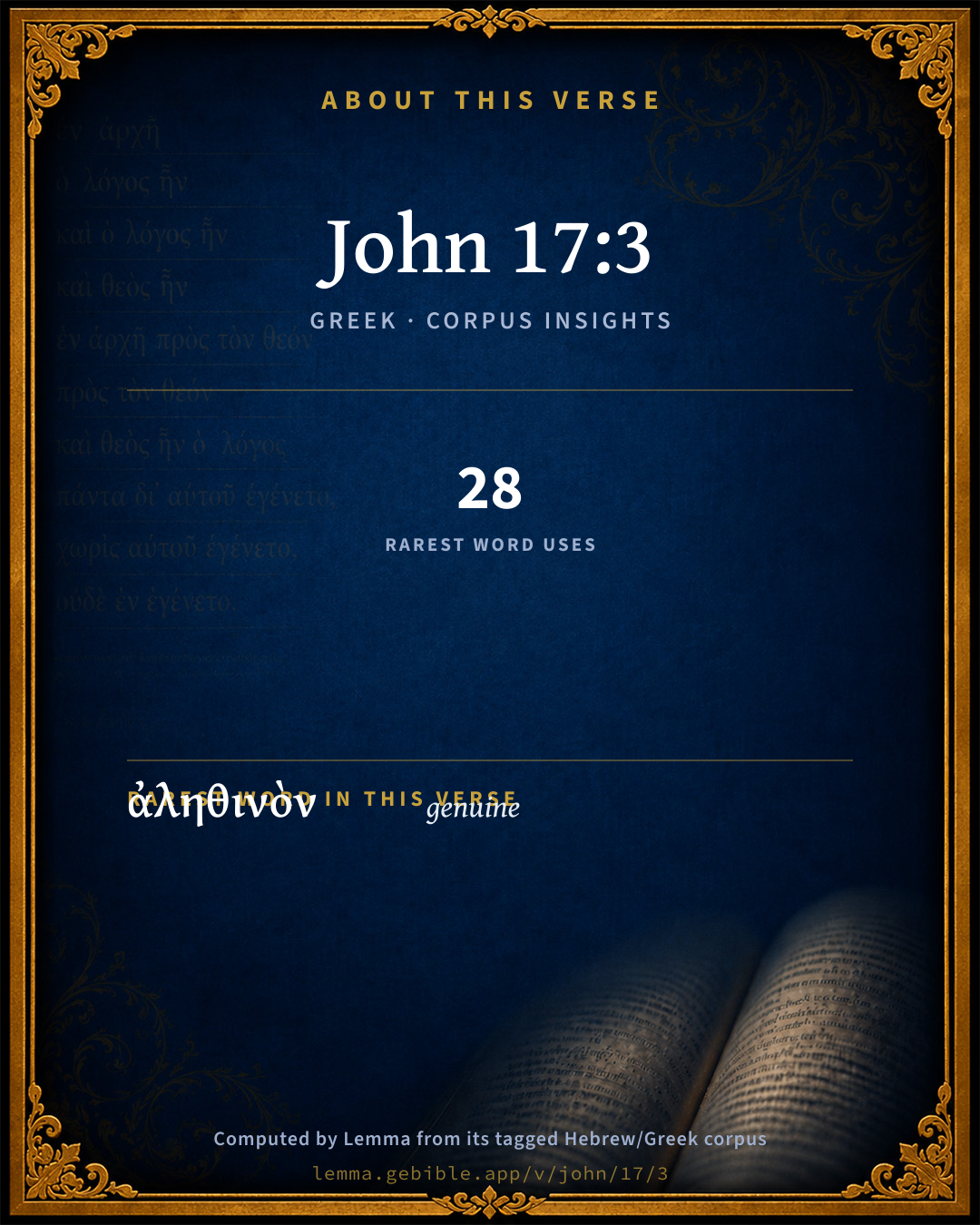
John 17:3

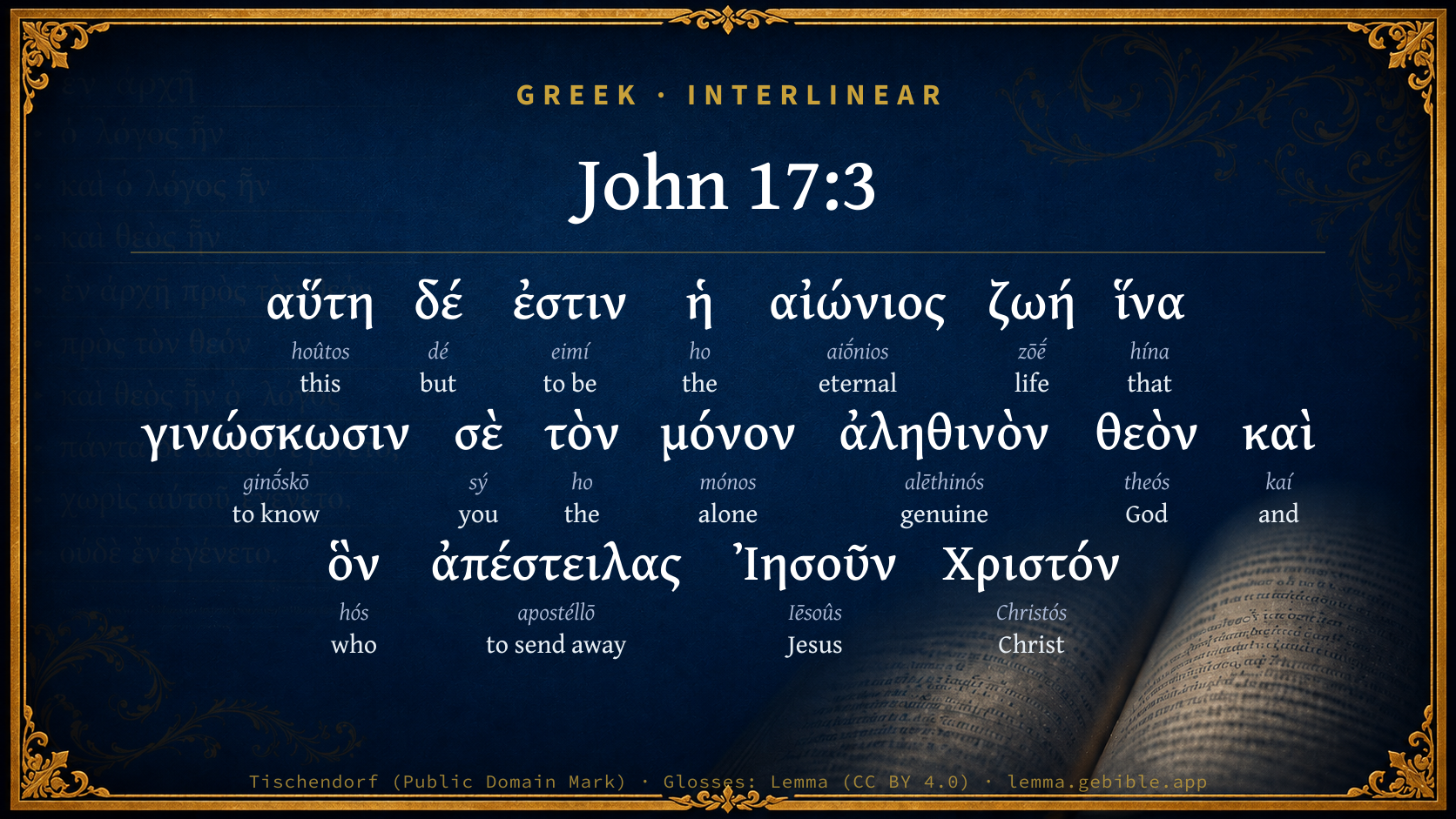
Greek (Tischendorf 8th ed.) John 17:3 appears in the Greek New Testament. The text above is from the Tischendorf 8th edition. Each word links to its Strong’s number and a concise gloss. Click any word for its full Thayer’s Greek Lexicon entry.
Download image
Cite this verse

John 17:3 (World English Bible). Public Domain. Lemma interlinear Bible study tool, https://lemma.gebible.app/v/john/17/3.

Show BibTeX & RIS
BibTeX
RIS
English Translation
This is eternal life, that they should know you, the only true God, and him whom you sent, Jesus Christ.
World English Bible · Public Domain
Download a study sheet

One document with this verse’s original text, its word-by-word gloss line, the meaning frame, cross-references with their text, attributed commentary, and full source and license credits — printable, and it pastes into notes with its structure intact.

This verse Autodidact and up

Study sheet (.html) Plain text (.txt)

A passage Seminary Student

Up to 50 verses in one chapter. A passage sheet keeps up to 6 commentary sources and 12 cross-references per verse, in the order this page ranks them, and says so on the sheet whenever that leaves anything out. Ask for a single verse and you get the Autodidact verse sheet above.

Everything on this page stays free to read, with no account — the sheet is a download of what is already on screen, not access to it.

Want to remove ads? Support Godless Engineer
Compare translations 3

The same verse in 3 English versions, stacked beneath the original-language interlinear above. Click any original word for its lexicon entry.

Each is an independent rendering of the whole verse — the interlinear is not word-aligned to these translations.

Highlighted words mark where these versions differ — a whole-verse word diff, not a word-by-word alignment.

  • World English Bible Public Domain
    This is eternal life, that they should know you, the only true God, and him whom you sent, Jesus Christ.
  • King James Version Public Domain
    And this is life eternal, that they might know thee the only true God, and Jesus Christ, whom thou hast sent.
  • unfoldingWord Literal Text CC BY-SA 4.0
    Now this is eternal life, that they would know you, the only true God, and the one you sent, Jesus Christ.

unfoldingWord Literal Text — © unfoldingWord, licensed CC BY-SA 4.0. Word-aligned USFM3 via Door43 (git.door43.org/unfoldingWord/en_ult).

Versions to compare (up to 4)

3 of 4 selected

Show all 19 translations

Every available English version of this verse, each an independent rendering of the whole verse.

  • World English Bible Public Domain
    This is eternal life, that they should know you, the only true God, and him whom you sent, Jesus Christ.
  • Berean Standard Bible Public Domain
    Now this is eternal life, that they may know You, the only true God, and Jesus Christ, whom You have sent.
  • Majority Standard Bible Public Domain
    Now this is eternal life, that they may know You, the only true God, and Jesus Christ, whom You have sent.
  • King James Version Public Domain
    And this is life eternal, that they might know thee the only true God, and Jesus Christ, whom thou hast sent.
  • American Standard Version (1901) Public Domain
    And this is life eternal, that they should know thee the only true God, and him whom thou didst send, `even' Jesus Christ.
  • Revised Version (1885) Public Domain
    And this is life eternal, that they should know thee the only true God, and him whom thou didst send, even Jesus Christ.
  • Geneva Bible (1599) Public Domain
    And this is life eternall, that they knowe thee to be the onely very God, and whom thou hast sent, Iesus Christ.
  • Douay-Rheims (1899) Public Domain
    Now this is eternal life: That they may know thee, the only true God, and Jesus Christ, whom thou hast sent.
  • Young's Literal Translation Public Domain
    and this is the life age-during, that they may know Thee, the only true God, and him whom Thou didst send -- Jesus Christ;
  • Literal Standard Version CC BY-SA 4.0
    and this is the continuous life, that they may know You, the only true God, and Him whom You sent—Jesus Christ;
  • Unlocked Literal Bible CC BY-SA 4.0
    This is eternal life: That they know you, the only true God, and him whom you sent, Jesus Christ.
  • unfoldingWord Literal Text CC BY-SA 4.0
    Now this is eternal life, that they would know you, the only true God, and the one you sent, Jesus Christ.
  • Darby Bible Public Domain
    And this is the eternal life, that they should know thee, the only true God, and Jesus Christ whom thou hast sent.
  • World Messianic Bible Public Domain
    This is eternal life, that they should know you, the only true God, and him whom you sent, Yeshua the Messiah.
  • Webster's Bible Public Domain
    And this is life eternal, that they may know thee the only true God, and Jesus Christ whom thou hast sent.
  • Free Bible Version CC BY-SA 4.0
    Eternal life is this: to know you, the only true God, and Jesus Christ whom you sent.
  • Bible in Basic English Public Domain
    And this is eternal life: to have knowledge of you, the only true God, and of him whom you have sent, even Jesus Christ.
  • Text-Critical English NT CC BY 4.0
    This is eternal life, that they may know yoʋ, the only true God, and Jesus Christ whom yoʋ have sent.
  • Tyndale New Testament (1534) Public Domain
    This is lyfe eternall that they myght knowe the that only very God and whom thou hast sent Iesus Christ.

Literal Standard Version (2020), Covenant Press — licensed CC BY-SA 4.0. Text via the HelloAO Bible API (eBible.org). Unlocked Literal Bible (unfoldingWord) — licensed CC BY-SA 4.0. Text via the HelloAO Bible API (eBible.org). unfoldingWord Literal Text — © unfoldingWord, licensed CC BY-SA 4.0. Word-aligned USFM3 via Door43 (git.door43.org/unfoldingWord/en_ult). Free Bible Version, Dr. Jonathan Gallagher — licensed CC BY-SA 4.0. Text via the HelloAO Bible API (eBible.org).

Word by word

More ways to search: Search by grammar → Find every occurrence → Compare this word →

Practice this passage: Drill this verse → Learn its vocabulary →

ἀληθινὸν
alēthinós
G228
“genuine”
Adjective, Accusative, Singular, Masculine
Part of Speech
Adjective
Case
Accusative
Number
Singular
Gender
Masculine
Full Thayer's Definition

Origin: from G227

TDNT: 05:09,4

1. that which has not only the name and resemblance, but the real nature corresponding to the name, in every respect corresponding to the idea signified by the name, real, true genuine a. opposite to what is fictitious, counterfeit, imaginary, simulated or pretended b. it contrasts realities with their semblances c. opposite to what is imperfect defective, frail, uncertain 2. true, veracious, sincere
  1. αὕτη hoûtos G3778 “this” Demonstrative pronoun, Nominative, Singular, Feminine
  2. δέ dé G1161 “but” Conjunction
  3. ἐστιν eimí G1510 “to be” Verb, Present, Active, Indicative, 3rd person, Singular
  4. ἡ ho G3588 “the” Article, Nominative, Singular, Feminine
  5. αἰώνιος aiṓnios G166 “eternal” Adjective, Nominative, Singular, Feminine
  6. ζωή zōḗ G2222 “life” Noun, Nominative, Singular, Feminine
  7. ἵνα hína G2443 “that” Conjunction
  8. γινώσκωσιν ginṓskō G1097 “to know” Verb, Present, Active, Subjunctive, 3rd person, Plural
  9. σὲ sý G4771 “you” Personal pronoun, 2nd person, Accusative, Singular
  10. τὸν ho G3588 “the” Article, Accusative, Singular, Masculine
  11. μόνον mónos G3441 “alone” Adjective, Accusative, Singular, Masculine
  12. θεὸν theós G2316 “God” Noun, Accusative, Singular, Masculine
  13. καὶ kaí G2532 “and” Conjunction
  14. ὃν hós G3739 “who” Relative pronoun, Accusative, Singular, Masculine
  15. ἀπέστειλας apostéllō G649 “to send away” Verb, Aorist, Active, Indicative, 2nd person, Singular
  16. Ἰησοῦν Iēsoûs G2424 “Jesus” Noun, Accusative, Singular, Masculine
  17. Χριστόν Christós G5547 “Christ” Noun, Accusative, Singular, Masculine

About this verse

These counts appear in no published source. They are computed here, from the morphology-tagged text and Lemma’s own curated glosses. What Lemma adds →

18
words
17
distinct lemmas
Gospels
section

Shared distinctive vocabulary

ἀληθινὸν genuine G228 occurs in 26 verses of the Greek New Testament. Also found in:

Repetition

A word recurs within this verse:

Cross-references

41

Topical passages linked to John 17:3 in the Treasury of Scripture Knowledge — connected by theme and wording, ordered by reader-vote popularity; previews shown in the World English Bible.

  • 1 John 5:20 We know that the Son of God has come, and has given us an understanding, that we know him who is true, and we are in him who is true, in his Son Jesus Christ. This is the true God, and eternal life.
  • 1 John 5:11–12 The testimony is this, that God gave to us eternal life, and this life is in his Son.
  • Jeremiah 9:23–24 Thus says Yahweh, Don't let the wise man glory in his wisdom, neither let the mighty man glory in his might, don't let the rich man glory in his riches;
  • John 3:17 For God didn't send his Son into the world to judge the world, but that the world should be saved through him.
  • John 17:25 Righteous Father, the world hasn't known you, but I knew you; and these knew that you sent me.
  • Hosea 6:3 Let us acknowledge Yahweh. Let us press on to know Yahweh. As surely as the sun rises, Yahweh will appear. He will come to us like the rain, Like the spring rain that waters the earth."
  • John 14:9–10 Jesus said to him, "Have I been with you such a long time, and do you not know me, Philip? He who has seen me has seen the Father. How do you say, 'Show us the Father?'
  • Hebrews 8:11–12 They will not teach every man his fellow citizen, Every man his brother, saying, 'Know the Lord,' For all will know me, From the least of them to the greatest of them.
  • 1 John 4:6 We are of God. He who knows God listens to us. He who is not of God doesn't listen to us. By this we know the spirit of truth, and the spirit of error.
  • 1 Chronicles 28:9 You, Solomon my son, know the God of your father, and serve him with a perfect heart and with a willing mind; for Yahweh searches all hearts, and understands all the imaginations of the thoughts: if you seek him, he will be found of you; but if you forsake him, he will cast you off forever.
  • Isaiah 61:1 The Spirit of the Lord Yahweh is on me; because Yahweh has anointed me to preach good news to the humble; he has sent me to bind up the broken-hearted, to proclaim liberty to the captives, and the opening [of the prison] to those who are bound;
  • John 3:34 For he whom God has sent speaks the words of God; for God gives the Spirit without measure.
  • John 17:23 I in them, and you in me, that they may be perfected into one; that the world may know that you sent me, and loved them, even as you loved me.
  • 2 Corinthians 4:6 seeing it is God who said, "Light will shine out of darkness," who has shone in our hearts, to give the light of the knowledge of the glory of God in the face of Jesus Christ.
  • John 17:21 that they may all be one; even as you, Father, are in me, and I in you, that they also may be one in us; that the world may believe that you sent me.
  • 2 Thessalonians 1:8 giving vengeance to those who don't know God, and to those who don't obey the Gospel of our Lord Jesus,
  • 1 John 4:14–15 We have seen and testify that the Father has sent the Son as the Savior of the world.
  • Jeremiah 31:33–34 But this is the covenant that I will make with the house of Israel after those days, says Yahweh: I will put my law in their inward parts, and in their heart will I write it; and I will be their God, and they shall be my people:
  • John 17:8 for the words which you have given me I have given to them, and they received them, and knew for sure that I came forth from you, and they have believed that you sent me.
  • John 14:26 But the Counselor, the Holy Spirit, whom the Father will send in my name, he will teach you all things, and will remind you of all that I said to you.
  • John 8:19 They said therefore to him, "Where is your Father?" Jesus answered, "You know neither me, nor my Father. If you knew me, you would know my Father also."
  • Psalms 9:10 Those who know your name will put their trust in you, For you, Yahweh, have not forsaken those who seek you.
  • Isaiah 53:11 He shall see of the travail of his soul, [and] shall be satisfied: by the knowledge of himself shall my righteous servant justify many; and he shall bear their iniquities.
  • 1 Thessalonians 1:9 For they themselves report concerning us what kind of a reception we had from you; and how you turned to God from idols, to serve a living and true God,
  • Isaiah 48:16 Come you near to me, hear you this; from the beginning I have not spoken in secret; from the time that it was, there am I: and now the Lord Yahweh has sent me, and his Spirit.
  • Jeremiah 10:10 But Yahweh is the true God; he is the living God, and an everlasting King: at his wrath the earth trembles, and the nations are not able to abide his indignation.
  • John 6:27–29 Don't work for the food which perishes, but for the food which remains to eternal life, which the Son of Man will give to you. For God the Father has sealed him."
  • John 8:54–55 Jesus answered, "If I glorify myself, my glory is nothing. It is my Father who glorifies me, of whom you say that he is our God.
  • 1 Corinthians 15:34 Wake up righteously, and don't sin, for some have no knowledge of God. I say this to your shame.
  • John 7:29 I know him, because I am from him, and he sent me."
  • John 12:49–50 For I spoke not from myself, but the Father who sent me, he gave me a commandment, what I should say, and what I should speak.
  • 2 Chronicles 15:3 Now for a long season Israel was without the true God, and without a teaching priest, and without law:
  • John 6:57 As the living Father sent me, and I live because of the Father; so he who feeds on me, he will also live because of me.
  • John 10:36 Do you say of him whom the Father sanctified and sent into the world, 'You blaspheme,' because I said, 'I am the Son of God?'
  • 1 Timothy 6:15–16 which in its own times he will show, who is the blessed and only Ruler, the King of kings, and Lord of lords;
  • Mark 9:37 "Whoever receives one such little child in my name, receives me, and whoever receives me, doesn't receive me, but him who sent me."
  • Luke 9:48 and said to them, "Whoever receives this little child in my name receives me. Whoever receives me receives him who sent me. For whoever is least among you all, this one will be great."
  • John 5:44 How can you believe, who receive glory from one another, and you don't seek the glory that comes from the only God?
  • John 5:36–37 But the testimony which I have is greater than that of John, for the works which the Father gave me to accomplish, the very works that I do, testify about me, that the Father has sent me.
  • John 11:42 I know that you always listen to me, but because of the multitude that stands around I said this, that they may believe that you sent me."
  • 1 Corinthians 8:4 Therefore concerning the eating of things sacrificed to idols, we know that no idol is anything in the world, and that there is no other God but one.

Cross-references courtesy of OpenBible.info (CC BY 4.0).

Commentary

Notes on John 17:3 from classic Christian and Jewish commentators (each source and its license shown beneath its notes). The classic Christian expositions comment on the surrounding passage and are grouped to its opening verse, so a note may address several verses; the Jewish commentaries on the Tanakh (Rashi and others) are per-verse, so they appear only where the commentator wrote on this verse.

Lemma curates 59 commentaries, every one of them public domain or Creative Commons licensed, each selected and text-cleaned for this edition rather than reprinted as found. About our sources →

The Biblical Illustrator

Joseph S. Exell

Joh_17:3

This is life eternal

The everlasting life

I.

THE INESTIMABLE BLESSING OF WHICH OUR LORD SPEAKS. Life is a great boon. My kingdom, a dying monarch is reported to have said, for an inch of time. Yet after all what is this present life in itself (Jam_4:14)? And when it is most eagerly prized and most hilariously spent, its possessor may in the saddest sense be dead (Rom_8:6). Eternal life is the highest possible life for man. Two causes may end our life on earth. It may be terminated by external force or by inward disease. Eternal life

1. Has nothing to terminate it from without. Force from God alone can end life; and the Divine power is entirely on the side of this life.

2. Is without anything to end it from within. Disease destroys physical life. But eternal life is the progress and consummation of a life begun on earth by a new birth from God, and has in it no element of evil.

II. HOW CAN THIS LIFE BE REALIZED? It is not that this knowledge leads or points out the way to attain it. Life itself consists in this knowledge

1. God and Christ are its objects. The Father is called the true God in opposition to false deities. The juxtaposition of Christ with the Father, and the knowledge of both being defined to be eternal life, is the strongest inferential evidence of the Godhead of the Son. But why does Jesus, as Mediator, thus make the knowledge of Himself essential to life?

(1) Because the Father can be known only through the Son; and

(2) known as gracious towards mankind only in Him.

2. But we must not suppose that this is bare intellectual knowledge. It is the conscious possession of God. Certain truths about God may be seen in many ways and everywhere; but the spiritual perception of God Himself can only be reached in Christ.

3. This knowledge involves spiritual submission to God, or the personal reception of Him. Only to the soul that receives Him will He reveal His Rev_3:20; Joh_14:23). To all who receive Him, He manifests Himself as He does not unto the world. With respect to our fellow-men, we frequently use such language as this: I scarcely know him, or I knew him well, and the phraseology varies according to our acquaintance with the mans character or his moral and social qualities. We may believe from report in a mans generosity; but how different is our estimate or appreciation of his character when we can say from experience that we know it. Abraham believed God and obeyed; but when the Divine promise was fulfilled, and the Divine faithfulness proved, the patriarch knew God in a way that he did not know Him before.

III. HOW COMES IT THAT THIS TRUE KNOWLEDGE OF GOD IS LIFE? We know what connection there is between knowledge and the energy and enjoyment of our every-day life. Knowledge is power. It has the power of salvation, transformation, progress. It is knowledge which lifts up the life of the savage. The highest knowledge for man must be the highest life.

1. The true knowledge of our heavenly Father involves the communication of influence, and influence flowing forth from God is quickening. Real knowledge cannot be received without a healthful influence on the soul. A penitent child cannot know that his father has forgiven him without feeling emotions of tenderness and joy. What, then, must be the influence of the knowledge of the true God, our God and Father!

2. This knowledge promotes fellowship and communion with God, which is life. To man, as a social being, fellowship with others is life. The contact of thought with thought, and the communion of affection with affection, are elements of mens true life on earth. What, then, must be the fellowship of the soul with God, but life of the highest order?

3. This knowledge promotes likeness to God; and this assimilation to God is the very highest life (1 Col_3:10). (J. Spence, D. D.)

The knowledge of God is eternal life

I. WHAT IS COMPRISED IN THE KNOWLEDGE OF GOD?

1. In answering this question, we need hardly remark that it implies a knowledge of Gods existence. The remark is self-evident. The knowledge that He is the beginning of all knowledge of God. But whilst this is comprised in a knowledge of God, it does not constitute the knowledge. A man may know that there is a God; he may not only know it from the statements of others, but he may have actually examined it, and may be well conversant with the evidence of Gods existence with which nature abounds, and be able to give to every man that asketh him a reason for his belief, and yet he may be destitute of that knowledge which is eternal life. How exquisitely the Scripture speaks upon this point! Thou believest that there is one God; thou doest well; the devils also believe and tremble. You need to know something more--something that devils do not, and cannot, know--in order to the enjoyment of eternal life.

2. Again, it comprises a knowledge of Gods attributes, such as His eternity. His omnipresence--that, as He existed throughout all time, so He fills all space and pervades all worlds. His omniscience--that, existing throughout all time, and pervading all space, He knows all things. Such are some of the attributes which are essential to Divinity; and I need not say that the knowledge of these is comprised in a knowledge of God. But, then, all that, along with the knowledge of Gods existence, does not constitute the knowledge of which our text speaks. There is reason to believe that devils know Gods nature as well as existence; and yet they tremble. Ah, my brother, this knowledge might well drive thee to despair: but it cannot give thee peace. It may convince thee of sin, and fill thee with alarm, but it cannot give thee peace. The knowledge of something more than this is necessary to eternal life.

3. In proceeding to show what it is which constitutes this knowledge, I beg you to notice that it is what is described in the text as the knowledge of Jesus Christ, whom God has sent. It is so described because it is through Christ that the knowledge is communicated.

(1) And, first of all, you have in Christ a manifestation of Gods hatred of sin. In proof of this I might refer you to the distance at which He kept Himself from all that was sinful, though inhabiting a world in which sin was fashionable, and where temptations to sin were abounding, Not at a distance as regards locality, but distance as regards character. I might refer you, too, to the manner in which He denounced the wickedness of those over whose sin He mourned and wept. If God did not wink at sin in the person of His own Son, how, think you, will He wink at sin in you? If it could not be allowed to pass unpunished when it was beheld in Christ, though He prayed, Father, if it be possible, let this cup pass from Me, will it be allowed to pass unpunished if found in you? You think God is merciful, so He is; but He is just, and He is holy--a God of spotless purity. This truth, at first sight, may excite your fears; yet it is needful for you to know it, because it supplies a powerful motive which is necessary to keep you back from sin; to lead you to mortify sin, and thus to produce in you meetness for heaven--the truth that it is not enough to know that God hates sin. This will never give you a title to heaven, nor will it produce in you a meetness for the enjoyment of eternal life.

(2) You need to have something more than this, in order to your enjoying eternal life; and this leads me to observe, secondly, that in Christ you have a manifestation of the love of God. But even this is not enough. It is not enough to know that God loves us; that though He is just, He must punish sin. You need have something more in order to your enjoying life eternal. Oh, then, ponder the statements of Gods Word in which that truth is found; and until it falls on your understanding, until it is impressed on your hearts, never to be erased--and, thank God, you need not wait long--for oh, it is plain and easy, and even now you may open your hearts to the perception of it, and even now you may enter into faith; even now you may look up to your God as your Father and your Friend; for both by word and by deed does God say, I have accepted My Sons work for thee, O sinner; I was well pleased with what He has done for thee; His death is a perfect atonement for all thy sins; I am satisfied with it; be thou satisfied with it, be at peace, be thou reconciled to God. I do not mean to say that what I have set before you contains anything like full knowledge of God. No man can find out the Almighty to perfection. It does not amount to even an index of what might be known; it is only of the knowledge which is necessary to life.

II. And now let me proceed, in the second place, to show, as briefly as I can, HOW THE KNOWLEDGE OF GOD IS ETERNAL LIFE, or in what sense it is.

1. And, first of all, it is so, if you consider eternal life as consisting in the enjoyment of Gods favour. We read in this book, And in His favour is life. Now, the knowledge of God is essential to the enjoyment of His favour. It is true that His favour rests on men, whether they know Him or not; for how else could they account for the varied blessings which they are daily receiving? But, then, though it rests on them, they do not enjoy it whilst they do not know Him. Their own feelings are just as unpleasant; their relation to God is as painful; they are as much alienated from God as if He were really their enemy.

2. And, then, again, the knowledge of God is eternal life, if you regard eternal life as signifying the privileges and enjoyments of the heavenly cities. The knowledge of God imparts that character, or produces in man that character, which increases the enjoyment of heaven. The character on which heaven is conferred is conformed into Gods image--sympathy with his feelings and his desires; or, in other words, it is living in a oneness with God. Now, the knowledge of God necessarily and invariably produces this character in man. The Cross of Christ contains a motive power which the human heart, depraved as it is, cannot both contemplate and resist. No man can truly and intelligibly say that Christ died for me, and gave Himself for me; Gods wrath was suspended over me, the Saviour stepped between me and that wrath, that it might fall on Him, and that I might be saved--no man can say that without loving God in return.

3. And then, again, the knowledge of God is eternal life, if you understand the knowledge of God as heavenly happiness. Whence, let me ask, do the redeemed in heaven derive their happiness? Is it from the splendour of the place which they occupy? from the beauty and sublimity of scenes upon which they gaze? is it from the music with which their ears are charmed, or from the delicious fruits with which they regale themselves, or from their exalted companionship? No. They know that God is love, and that is their happiness. God is set forth to their contemplation as a God of love, and they find their employment, and their enjoyment too, in meditating on the proofs of His love with which the universe abounds--every new discovery giving a new impulse to their zeal and a new zest to their praise. And, hence, you find John speaking as if this were the consummation of the saints desire: We know that when He appears we shall be like Him, for we shall see Him as He is. (W. Landels.)

Eternal life in the knowledge of God and Christ

1. When Jesus said these words, the transitoriness of life was pressing upon Him and His disciples. When life seemed frailest and most unreliable, they heard Him praying, This is life eternal. The assertion of something in life, which lasted and did not go to pieces, must have come in very solidly and nobly. So often when we are most conscious of mortality, when disease is triumphing over that which disease can touch, the least reminder of that which is immortal restores us, puts courage into our frightened hearts.

2. What is it, then, whose eternity Jesus proclaims so confidently? When everything else decays, what is it that is imperishable? Jesus says it is the knowledge of God and of Himself. Now, remember that the knowledge of God and Christ must mean, and in the Bible always does mean, s personal relationship with God and Christ. It is not mere absolute knowledge. It is what He is to us, not what He is to Himself, that we may know of God. So that to know Christ and God is to have to do with Christ and God in the way of love and service. And Jesus says that the permanent part of our life is the part which has to do with God.

3. Here is a very clear and simple test of all our life. Our houses must decay. What is there in them that will last? That which had to do with God. Not their bricks and mortar, but the tempers and the hearts that were cultivated in them. Our institutions will perish--even our churches. But that which really knew God in them no tooth of time can touch. Our friendships and relationships have a promise of permanence only as they are real spiritual intimacies knit in with one common union to God.

4. When we fasten our thoughts on this, how it changes the whole aspect of the lives and deaths of men! Here is a poor, holy man dying. How little difference death makes to him! He is to keep all that has to do with God, and to lose all the rest. What is there for him to lose? How much there is that he will keep! But another man, so much richer, lies dying. What an enormous change death is to him! All his life has been worldly. What is there that he can keep? How almost everything he must lose!

5. Thus the eternal part of us is not that which God shall choose at some future day to endow with everlasting life. Eternity is a true quality in the thing itself. This really brings me to what I wanted to preach about--the regulative and shaping power of a Christian faith in this life. What are the great deficiencies of daily moral life?

I. THE DIFFICULT BALANCE OF RESPONSIBILITY. Men know what duty is, but the even, steady pressure of duty upon the whole surface of a mans life is something which thoughtful men are always missing. On one day the sense of responsibility is overwhelming. The next day it is all gone. The consequence is doubly bad. Some tasks are wholly neglected, and others are done under a burden and a strain which exhaust us. Our life grows all spasmodic. Oh, for some power which, with broad, even weight, should press every duty into its place, coming down from such a height that it should be independent of their whims and moods, and weigh upon tomorrow and to-day alike, calm, serene, eternal. Now hear our text. There is the answer to our longing! To love God out of gratitude, and to want to serve Him out of love--there is the rescue! The doing of all duty, not only for itself, but for His sake who wants it done--this is what puts force and pliability at once into duty, making it strong enough for the largest, and supple enough for the smallest tasks, giving it that power which the great steam engine has, with equal fidelity to strike down a mountain and to pick up a pebble, adapting its movements to such different work. Is not that the redemption of responsibility?

II. THE DIFFICULT SENSE OF BROTHERHOOD. The decay of the power of feeling this is one of the sad things of all advancing life. It is not so hard for children. The young man has not settled yet into the fixed tastes and occupations which decide for him with whom he should have to do. And so he easily strikes hands with everybody, and has a certain superficial brotherhood with every one he meets. But as the man grows older his life draws in. He cannot reach out and take in a larger circle. Even patriotism is harder than it used to be. And to let his affection go sweeping out to the ends of the earth and down into the gutter where the outcasts lie--this seems preposterous. How can one keep and grow humane? This is life eternal, &c. If I have lost sight of my brethren, I must go back to my Father to find them. It is the Fathers house that we must meet. I am not merely a merchant among the merchants, a lawyer among the lawyers, a minister among the minister. I am a son of God, doing His will out of love; a son of God among the sons of God.

III. THE BEARING OF TROUBLE. Trouble comes to everybody, and what men ordinarily call bearing it, is apt to be one of the dreariest and forlornest things conceivable. How you hate and dread to go into that house of suffering. What you do find is apt to be either a man all crushed and broken into fragments, or else a man proud, cold, stern, hard, whom you pity all the more for the wretchedness of his proud, hard misery. But now neither of these men is really bearing his sorrow. Neither of them has really taken his trouble on his shoulders, to carry it whither he pleases. Each of them, in different ways, is borne by his sorrow. And now, what is the matter with both these men? Simply that they laid out a plan of life which was not broad enough or deep enough to have any place for trouble. When they designed their lives, they left sorrow out. So many lives are like ships sailing for Europe in the brilliant morning of a summers day, and, by and by, when they are out in mid-ocean, and the night comes, and the sky and water both grow black, finding that they have brought no lights of any kind. And then, if I turn aside and find a man who really does bear his sorrow, what is it that is different in him? It must be this: that he has some notion of life which is large enough to take in trouble. The Christian enters into the profoundness of consolation because he loves his Governor and his Educator. This is life eternal, &c.

IV. THE LACK OF NOBLENESS. There come occasional moments in every mans long life when he feels that he is living nobly. Something makes him forget himself, with ardent enthusiasm fire up for a principle, with easy scorn push back temptation, with deep delight glory in some friends greatness, greater than his own. The man is pitiable who has known no such moments. But one or two such in a mans life only show out by contrast the general low level at which our lives are lived. There is a littleness that wearies us. There is a drag to everything, that makes us ask: Is it worth while? Now all those qualities which make up nobleness must become permanent and constant in any man who really knows and loves God and Jesus Christ? Be a Christian constantly, and you must be noble constantly. Know Christs redemption, and, seeing all things redeemed in Him, their possibilities, their ideas must shine out to you. Unite your life to Gods, and it must glow with the enthusiasm of His certain hopes. Give yourself up to your Redeemer, and you must be rescued from selfishness. Love God, and you must hate His enemies, treading sin under foot with all His contempt and indignation. (Phillips Brooks, D. D.)

On knowing God

I. THE KNOWLEDGE OF GOD.

1. The existence of God lies at the foundation of all religion: and, therefore, the knowledge of God is the touch-stone of its principles. Error and falsehood are not going to yield to any science but that of Deity.

2. It is the lack of this knowledge which sustains impiety. The stupidity of sinners would be gone if they saw clearly what God is. That one thing they shun. They do not like to retain God in their knowledge.

3. If Christians knew God better, their piety would be increased. Those ancient saints, whose happy attainments held them superior to the world, always nurtured their piety by much study and fellowship with God.

4. This subject of knowledge can never be exhausted. A finite mind, perhaps, may reach some point in eternity when it shall have compassed all other subjects, and be able to look down upon and over all other fields of knowledge without darkness and without a doubt. But God still lies above it--beyond it!

5. By a true knowledge of God, we shall have a clear and experimental discernment of the beauty and grandeur of His character. Hence, we shall feel the desirableness of being like Him.

6. Our relations to God are such that we ought greatly to desire to know Him well. He is our Maker; He wilt be our Judge.

II. SOME ARGUMENTS FOR THIS STUDY. This knowledge of God tends

1. To humble us. When we know Him best we know ourselves best. It is this that dissipates our delusions. Woe is me! I am undone. Why? Mine eyes have seen the King, the Lord of hosts.

2. To crucify us to the world. To have a spiritual understanding of the exceeding excellencies of God makes the world seem but a very little thing. It shows us its emptiness. The heart uses that new arithmetic, to count all things loss for the excellency of the knowledge of God in Christ Jesus our Lord.

3. To purify the heart. No sight is so transforming as that of God. When we can have our minds and hearts brought so as to see with open face the glory of the Lord, we are changed into the same image from glory to glory.

4. To confirm and establish the believers heart. Speculation cannot do this. Self-examination, submission to creeds and forms, and all study of doctrines, cannot do it. To have full views of God; to know Him by direct fellowship; to live in His presence, and lie down and feel that the everlasting arms are around him, shows to the believer the fulness and the faithfulness of God, and confirms his heart in something like the full assurance of hope. Now he can call God his Father.

5. Hence such a knowledge of God is most satisfying and safe. (I. S. Spencer, D. D.)

The knowledge of God

The Holy Scriptures often use the phrase, knowledge of God, or the knowledge of the Lord, as a character of true religion. This phrase is particularly applied to that premised period in which the power of religion shall universally prevail. They shall all know Me, from the least unto the greatest. The knowledge of the Lord shall cover the earth, &c. In the ancient Scriptures the knowledge of God was usually propounded simply; here it is propounded in a manner corresponding to the clearer light of the Christian dispensation in its inseparable connection with the knowledge of Jesus Christ. And note that our Saviour connects the knowledge of God with the universal prevalence of Divine truth (Joh_17:2).

I. THE NATURE AND PROPERTY OF THIS KNOWLEDGE OF GOD. It comprehends

1. A just conception of His existence, attributes, and administration--i.e., of Him as the only true God. Consider

(1) His matchless Deity.

(2) His inimitable truth. The true God, says our Lord

(a) In opposition to all the false deities.

(b) In His enactments, promises, threatenings; so that He will in no sense deny Himself.

(c) As the sole and inexhaustible source of truth.

(3) His exclusive claim--the only true God.

2. Experimental acquaintance with Him as our God and Father and our portion. This is knowledge of the heart. By the other the eyes of the understanding are enlightened; by this the desires and affections of our hearts are filled and sanctified. It is this knowledge of God which is of the utmost importance. It is not speculation which may teach you to inquire, but faith, which constrains you to trust, which gives you the right knowledge of God.

3. A practical acknowledgment of His authority and government. This last particular shows that the true knowledge of God embraces all religion, as it elevates the mind, sanctifies the heart, and regulates the conduct. The children of Eli knew not the Lord; that is, they gave practical evidence that they were utterly estranged from an obedient acknowledgment of Him. And thou Solomon, my son, says David, know thou the God of thy father. He amplifies and explains that direction in what follows:--And serve him with a perfect heart, &c.

II. THE APPOINTED METHOD IN WHICH THIS KNOWLEDGE IS ATTAINABLE BY US. By approaching Him through the believing knowledge of Jesus Christ, whom He hath sent as our Saviour.

1. Man, until visited by the Day Spring from on high, is destitute of the knowledge of God. Is not his mind covered with darkness? Is not his heart alienated by guilt and depravity? Is not his life one continued scene of rebellion against the Most High?

2. This knowledge of God cannot be obtained by man alone. Man has had opportunities to try to do so on the largest scale. Go, then, through all the resources of human wisdom, the splendid scenes with which His universal temple is hung around; listen to all the voices which are incessantly sounding in our ears and proclaiming our Creator and Preserver; traverse the spacious Temple, mark its stately proportions, and gaze on its sublime beauty; and when you have done all, inquire, What must I do to be saved? There is nothing in all this that teaches me, a guilty and fallen creature, the way to God.

3. This is the way--the way which is opened by Jesus Christ. You cannot come to God as your Father, especially to God as your reconciled and gracious Father, but by Jesus Christ.

III. THE INESTIMABLE BLESSING WITH WHICH THIS KNOWLEDGE IS IDENTIFIED. This is life eternal. Consider the knowledge of God in Christ

1. In its commencement. Go to that simple and happy Christian believer who has just found this knowledge. He will give you, perhaps, not a doctrinal statement, but a living pattern, which in many respects is better. While he speaks of the knowledge of God in Christ, he associates it with inward experience. He will testify that he who believeth in the Son of God hath everlasting life; that he has the life of pardon and peace. He was dead in trespasses and sins, but he is quickened together with Christ.

2. In its more mature progress. Go to the experienced Christian. He may be an unlettered man, perhaps, and be perplexed if you asked him a definition, or to expound a difficult passage of the Holy Scripture; but, under the assistance of the Spirit of God, he has embraced the system of truth itself. In all his course, the knowledge of God in Christ has been inseparable from advancement in the Divine life.

3. In its consummation. Then we shall see as we are seen, and know also as we are known.

Conclusion:

1. Have we acquired this knowledge? If we have not, may I not say, Some of you have not the knowledge of Christ; I speak this to your shame. Have you spent twenty, thirty, forty, or more years, yet dark, dead, rebels against God?

2. Let me earnestly exhort you who are in quest of this knowledge of your God, that you seek it in the right way. Yea, doubtless, says the Apostle, and I count all things but loss for the excellency of the knowledge of Christ Jesus my Lord. To know Him is to know the way that leads to the Father.

3. Let me exhort you to do all you possibly can to promote this knowledge of God in Christ. We ought to do that on a large scale; we ought to unite in those truly sublime societies which are aiming to extend the knowledge of God in Christ to the uttermost parts of the earth. But if it be valuable for the ends of the earth, it is valuable for your own homes. If pagan families and vicinities ought to have it, yours ought to have it. (J. Hannah, D. D.)

Knowledge--power in religion

(Text, and Hos_4:1-19; Hos_5:1-15; Hos_6:1-11):--The adage. knowledge is power, is of universal application. That many act contrary to the truth in their possession is no proof that this is not so. That the wicked remain wicked, the drunkards remain drunkards, the selfish selfish, only proves there is another power within them which decides their course rather than the dictates of knowledge.

I. THE IMPORTANCE OF RELIGIOUS KNOWLEDGE RECOGNIZED IN THE SCRIPTURES,

1. Moses commanded the Israelites to teach their children Deu_6:9).

2. The prophets were teachers.

3. The Levitical tribe was not only a tribe of priests, but also of teachers.

4. Christ Himself is a Prophet.

5. The apostles were instruments of salvation by proclaiming its principles.

6. The work of the Church in all ages is to bear witness to the truth--to make it known.

II. HOW IS KNOWLEDGE POWER IN RELIGION?

1. Necessary to begin a new life.

(1) We are to know God, His law, duty, and our failure to obey, in order to repent.

(2) We are to know Christ, His power, His acceptableness to God, His willingness to save, in order to believe in Him. How shall they believe in Him of whom they have not heard?

2. Knowledge necessary to the growth of the new life. Life must be fed--vegetable, animal, intellectual, and spiritual life.

3. Knowledge necessary to be useful. I do not underrate silent influence of the faithful. But still the Church needs

(1) Fathers and mothers.

(2) Sabbath-school teachers.

(3) Superintendents.

(4) Helpers in prayer meetings.

(5) Church officers, and

(6) Christians in the walks of private life, with copious religious knowledge.

III. HOW IS KNOWLEDGE TO BE SECURED?

1. In the early Church it was chiefly oral instruction by preaching and catechizing.

2. In palmy days of European Protestantism it was

(1) Family catechizing.

(2) Extensive religious instruction in common schools, religious text-books.

(3) Catechizing by the Church authorities before confirmation.

3. With us the Sabbath School largely takes the place of these.

4. What are we to do?

(1) Seek to appreciate the fact stated in the text. Destruction for lack of knowledge, and Life eternal by knowledge.

(2) Return to perform the parental duties of instructing the young.

(3) Literature inculcating fact rather than fiction, e.g., sacred history, Church history, history of the Reformation, doctrine. (W. Veenschoten)

Saving knowledge

I. SALVATION CONSISTS IN THE POSSESSION OF LIFE. It is clear from the previous verse that the two are synonymous, and it is easy to see from the frequent connection of the two by Christ and the apostles how accurate it is to call salvation eternal life. Men as sinners are spiritually dead Eph_2:1). The power of evil has so worked upon their souls as to make them deaf to the voice, insensible to the goodness, and indifferent to the claims of God. So far, then, as the life of love, trust, and obedience, and joy are concerned, sinners are dead. What they need, then, is a salvation which shall put them in possession of life, which shall consist in the quickening of their dormant powers, in the righting of their perverted affections, in the bringing back of their souls into likeness to, and fellowship with, the living God. This was just the salvation Christ was sent to impart, and for which He had power over all flesh. Consequently, this is life eternal, not as being a life that belongs to eternity, but a life that is distinct from and opposed to temporal, earthly and carnal--eternal in its quality. From the moment that we accept Christ as our Saviour it is ours Joh_10:27-28; 1Jn_5:13).

II. THE LIFE IN WHICH SALVATION CONSISTS HAS ITS ROOT AND GROUND IN KNOWLEDGE. The words must be taken as they stand. This knowledge is not the means of, but is eternal life--a representation to which attention needs to be called now-a-days. Many attach to knowledge a subsidiary importance in relation to the spiritual life. There is no statement more common in certain quarters than that religion is not a creed, but a life. This divorces religion from the intellect and makes it a purely emotional thing. Christ here declares that eternal life is founded on knowledge, thus teaching that before Christianity can be a life it must be a creed. Learn here

1. The sacredness of knowledge.

2. Its importance.

3. Its perpetuity.

III. THIS KNOWLEDGE IS THAT OF GOD AND CHRIST.

1. Of God.

(1) There is a sense in which God cannot be known. He is so different from ourselves in the constitution of His Being, and so superior to us in His attributes, that there is a great gulf which no thought or imagination can overpass (Job_11:7-8). Indeed, if we could know God as we know one another, He would not be God. He would not be infinite, for the finite cannot comprehend the infinite.

(2) But there is a sense in which we can know Him; in so far as He has revealed Himself in the gospel, and sufficient for intelligent and trustful love. This knowledge then

(a) Is not simply the knowledge that we can glean from Gods works. Here we can know Gods power, skill, thought, care; but not Himself: just as from a book we may get occasional glimpses of the working of the authors mind and the features of his character, but fail in any real measure to know the man.

(b) Is not merely the knowledge we can gain from His Word. We may be familiar with the contents of Scripture and yet know no more of God Himself than we do of a man from what others have written about him.

(c) Is the knowledge which comes also from fellowship between our souls and God. This is the true ground of our knowledge of others. Souls must reveal themselves to souls through friendship.

1. We must study Gods works and read His Word, but besides this we must get into cordial fellowship. In this we must ask for the help of His Spirit, and lay ourselves open to what His Spirit shall teach.

2. Of Christ also. The line of thought just pursued must be followed here. The persons are two, but the knowledge is the same. And for this reason the mission of Christ was the manifestation of the Father. Exactly in the degree in which we know Christ the Revealer shall we know God the Revealed. This knowledge must come

(1) Through the Scriptures that teach us concerning Him.

(2) Through the fellowship which unites us to Him.

(3) Through the Spirit who takes of the things of Him and shows them unto us.

When in these ways the mind has come to accept Christ, and in the acceptance of Christ has accepted God in Him, eternal life is ours. (B. Wilkinson, F. G. S.)

Death of Fisher

When Fisher, Bishop of Rochester, came out of the Tower of London and saw the scaffold on which he was to be beheaded, he took out of his pocket a Greek Testament, and, looking up to heaven, he exclaimed, Now, oh Lord, direct to some passage which may support me through this awful scene. He opened the book and his eye glanced at this text. He instantly closed it and said, Praised be the Lord! this is sufficient for me and for eternity. (W. Baxendale.)

The Biblical Illustrator, edited by Joseph S. Exell (c. 1880s–1900s) — public domain. Text from a community e-Sword module.

Tyndale Open Study Notes

Tyndale Open Resources

17:3 to know you: The Hebrew idea of knowing encompassed experience and intimacy, which for Christians means love for God and obedience to him. • sent to earth: Jesus originated in heaven and was returning there (17:5), so he exercises divine authority as the agent of God.

Tyndale Open Study Notes — © Tyndale Open Resources, licensed CC BY-SA 4.0. Text via the HelloAO Bible API.

Bengel's Gnomon

Johann Albrecht Bengel

Joh 17:3. Ἔστιν) is; not merely brings with it.—γινώσκωσι, that they may know) Knowledge in the matter of our salvation is of the greatest moment: Joh 17:26, “The world hath not known Thee, but I have known Thee, and these have known,” etc.—μόνον, the only, the alone) The Son and Holy Spirit are not excluded by this word. Comp. μόνος, ch. Joh 8:9, “Jesus was left alone, and the woman.” But those meant to be excluded are the false gods, with the idolatrous worship of which the world was crowded. And Jesus in this place speaks of Himself, as the Apostle of the Father [ἀπέστειλας: Heb 3:1].—ὃν ἀπέστειλας, whom Thou hast sent) The aspect (relation) under which (the ground upon which) Jesus Christ is to be acknowledged. His being ‘sent,’ presupposes the Son to be one with the Father.—Χριστὸν, Christ) A most open (plain) appellation, which subsequently became altogether prevalent.

Bengel's Gnomon of the New Testament — English translation (T&T Clark, Edinburgh, 1860) — public domain. Text from a community e-Sword module.

Meyer's Critical & Exegetical Commentary

Heinrich August Wilhelm Meyer

Joh_17:3. The continuative δέ adduces, in keeping with the connection, a more precise definition[187] of ζωὴ αἰώνιος (not a transposition of its idea, as Weiss holds), and that with a retrospective glance to the glorification of the Father in Joh_17:1. On ἐστίν, comp. on Rom_14:17; Joh_3:19.

In this consists eternal life, that they should recognise (ἵνα, comp. on Joh_6:29) Thee as the only true God (as Him to whom alone belongs the reality of the idea of God, comp. 1Co_8:4), and Thy sent one Jesus as Messiah. This knowledge of God here desired (which is hence the believing, living, practical knowledge, καθὼς δεῖ γνῶναι, 1Co_8:2), is the ζωὴ αἰώνιος, so far as it is the essential subjective principle of the same, unfolding this ζωή out of itself, its continual, ever self-developing germ and impulse (comp. Sap. Joh_15:1; Joh_15:3), even now in the temporal evolution of eternal life, and at a future time, besides, after the establishment of the kingdom, in which faith, hope, and love abide (1 Corinthians 3); the fundamental essence of which is in truth nothing else than that knowledge, which in the future αἰών will be the perfected knowledge (1Co_13:12), comp. 1Jn_3:2. The contents of the knowledge are stated with the precision of a Confession,a summary of faith in opposition[188] to the polytheistic (τ. μόνον ἀληθ. θεόν, comp. Joh_5:44; Deu_6:4; 1Co_8:5; 1Th_1:9) and Jewish κόσμος, which latter rejected Jesus as Messiah, although in Him there was given, notwithstanding, the very highest revelation of the only true God. It is in the third person, however, that the praying Jesus speaks of Himself from Joh_17:1 forwards, placing Himself in an objective relation towards the Father during the first intensity of this solemn mood, and first at Joh_17:4 continuing the prayer with the familiar ἐγώ; He indeed mentions His name in Joh_17:3, because in the connection of the self-designation through the third person, it here specifically suggested itself, in correspondence to the confessional thought.

Χριστόν] is an appellative predicate: as Messiah, comp. Joh_9:22. To connect it as a proper name with Ἰησ. (Jesus Christ, comp. Joh_1:17), to ascribe to the evangelist an offence against historical decorum (Bretschneider, Lücke, De Wette), and to see in this a proof of a later reproduction (comp. Tholuck and Weizsäcker, p. 286; also Scholten, p. 238), would be to accuse the writer, especially in the report of such a prayer, of a surprising want of consideration. Luthardt also takes Χριστόν as a proper name, which he thinks was here, in this extraordinary moment, used for the first time by Jesus, and thereby at the same time determined the use of the word by the apostles (Act_2:38). So also Godet, comp. Ebrard. But Jesus prayed in Hebrew, and doubtless said יֵשׁוּע חַמָּשִּׁיהַ, from which expression a proper name could by no means be recognised. The predicative view of Τ. ΜΌΝ. ἈΛ. ΘΕΌΝ and of ΧΡΙΣΤΌΝ is also justly held by Ewald.

Although Τ. ΜΌΝΟΝ ἈΛΗΘ. ΘΕΌΝ refers solely to the Father, the true divine nature of Christ is not thereby excluded (against the Arians and Socinians, who misused this passage), all the less so as this, in accordance with His (Logos) relationship as dependent on the Godhead of the Father, forms the previous assumption in ὋΝ ἈΠΈΣΤΕΙΛΑς, as is certain from the entire connection of the Johannean Christology, and from Joh_17:5. Comp. Wetstein, and Gess, Pers. Chr. p. 162. Hence it was unnecessary,moreover, even a perversion of the passage, and running counter to the strict monotheism of John, when Augustine, Ambrose, Hilary, Beda, Thomas, Aretius, and several others explained it as if the language were: ut te et quem misisti Jesum Christum cognoscant solum verum Deum. Only One, the Father, can absolutely be termed the μόνος ἀληθ. θεός (comp. ὁ ὢν ἐπὶ πάντων θεός, Rom_9:5), not at the same time Christ (who is not even in 1Jn_5:20 the ἀληθινὸς θεός), since His divine entity stands in the relation of genetic subsistence to the Father, Joh_1:18, although He, in unity with the Father, works as His commissioner, Joh_10:30, and is His representative, Joh_14:9-10.

[187] No formal definition. See the apposite observations of Riehm in the Stud. u. Krit. 1864, p. 539 f.

[188] An antithesis which might present itself naturally and unsought to the world-embracing glance of the praying Jesus, on the boundary line of His work, which includes entire humanity. But He had also thought further of the ἐξουσία πάσης σαρκός, which was given to Him. This likewise in opposition to Weiss, Lehrbegr. p. 56, who considers the antithesis foreign to the connection.

Meyer — Critical and Exegetical Commentary on the New Testament — English translation by Peter Christie, edited by Frederick Crombie (T&T Clark, 1880) — public domain. Text from a community e-Sword module.

Expositor's Greek Testament

ed. W. Robertson Nicoll

Joh 17:3 . αὕτη δέ ἐστιν ἡ αἰώνιος ζωή ἵνα … On ἵνα in this construction, see Burton, 213, and cf. Joh 15:8 ; ὅτι in Joh 3:19 is not quite equivalent. In Isa 37:20 God is designated ὁ Θεὸς μόνος , and in Exo 34:6 ἀληθινός ; cf. 2Th 1:10 . He is the only true God in contrast to many that are “called gods,” 1Co 8:5-6 . But cf. especially 1Jn 5:20 . It was by making known to them this God, and thus glorifying the Father, that Christ “gave men eternal life”. The life He gave consisted in and was maintained by this knowledge. But to the knowledge of the Father, the knowledge of “Him whom Thou didst send, Jesus Christ,” was necessary, Joh 1:18 , Joh 14:6 . As in Joh 1:17 , so here, Ἰησοῦν Χριστόν is the double name which became common in Apostolic times, and not (as Meyer and others) “an appellative predicate,” “Jesus as the Messiah”. Whether Jesus’ naming of Himself as a third person can be accounted for by the solemnity of the occasion (“der feierliche Gebetstyl,” Lücke), or is to be ascribed to John, is much debated. Westcott seems justified in saying that “the use of the name ‘Jesus Christ’ by the Lord Himself at this time is in the highest degree unlikely.… It is no derogation from the truthfulness of the record that St. John has thus given parenthetically, and in conventional language (so to speak), the substance of what the Lord said at greater length.”

The Expositor's Greek Testament, edited by W. Robertson Nicoll (1897–1910) — public domain. Text from a community e-Sword module.

Geneva Bible (1599)

Geneva Bible translators

He calleth the Father the only very God, to set him against all false gods, and not to shut out himself and the holy Ghost, For straightway he joineth the knowledge of the Father and the knowledge of himself together, and according to his accustomed manner, setteth forth the whole Godhead in the person of the father: So is the Father alone said to be King, immortal, wise, and dwelling in the light which no man can attain unto, invisible, Rom. 16:17; 1 Tim. 1:17.

Geneva Bible (1599) marginal notes — public domain. Text via Bolls.life.

Jamieson, Fausset & Brown

Robert Jamieson, A. R. Fausset & David Brown

this is--that.

life eternal, that they might--may.

know, &c.--This life eternal, then, is not mere conscious and unending existence, but a life of acquaintance with God in Christ (Job 22:21).

thee, the only true God--the sole personal living God; in glorious contrast equally with heathen polytheism, philosophic naturalism, and mystic pantheism.

and Jesus Christ whom thou hast sent--This is the only place where our Lord gives Himself this compound name, afterwards so current in apostolic preaching and writing. Here the terms are used in their strict signification--"JESUS," because He "saves His people from their sins"; "CHRIST," as anointed with the measureless fulness of the Holy Ghost for the exercise of His saving offices (see on Mat 1:16); "WHOM THOU HAST SENT," in the plenitude of Divine Authority and Power, to save. "The very juxtaposition here of Jesus Christ with the Father is a proof, by implication, of our Lord's Godhead. The knowledge of God and a creature could not be eternal life, and such an association of the one with the other would be inconceivable" [ALFORD].

Jamieson, Fausset & Brown — Commentary Critical and Explanatory on the Whole Bible (1871) — public domain (CC PDM 1.0). Text via the HelloAO Bible API.

Adam Clarke's Commentary

Verse 3. This is life eternal] The salvation purchased by Christ, and given to them who believe, is called life:

1. Because the life of man was forfeited to Divine justice; and the sacrifice of Christ redeemed him from that death to which he was exposed.

2. Because the souls of men were dead in trespasses and sins; and Christ quickens them by his word and Spirit.

3. Because men who are not saved by the grace of Christ do not live, they only exist, no good purpose of life being answered by them. But when they receive this salvation they live - answer all the Divine purposes, are happy in themselves, useful to each other, and bring glory to God.

4. It is called eternal life to show that it reaches beyond the limits of time, and that it necessarily implies -

1. The immortality of the soul;

2. the resurrection of the body; and

3. that it is never to end, hence called αιωνιος ζωη, a life ever living; from αει, always, and ων, being or existence. And indeed no words can more forcibly convey the idea of eternity than these. It is called η αιωνιος ζωη, THAT eternal life, by way of eminence. There may be an eternal existence without blessedness; but this is that eternal life with which infinite happiness is inseparably connected.

The only true God] The way to attain this eternal life is to acknowledge, worship, and obey, the one only true God, and to accept as teacher, sacrifice, and Saviour, the Lord Jesus, the one and only true Messiah. Bishop Pearce's remark here is well worthy the reader's attention: -

"What is said here of the only true God seems said in opposition to the gods whom the heathens worshipped; not in opposition to Jesus Christ himself, who is called the true God by John, in 1Jo 5:20."

The words in this verse have been variously translated:

1. That they might acknowledge thee, and Jesus Christ whom thou hast sent, to be the only true God.

2. That they might acknowledge thee, the only true God, and Jesus, whom thou hast sent, to be the Christ or Messiah.

3. That they might acknowledge thee to be the only true God, and Jesus Christ to be him whom thou hast sent. And all these translations the original will bear.

From all this we learn that the only way in which eternal life is to be attained is by acknowledging the true God, and the Divine mission of Jesus Christ, he being sent of God to redeem men by his blood, being the author of eternal salvation to all them that thus believe, and conscientiously keep his commandments.

A saying similar to this is found in the Institutes of Menu. Brigoo, the first emanated being who was produced from the mind of the supreme God, and who revealed the knowledge of his will to mankind, is represented as addressing the human race and saying: "Of all duties, the principal is to acquire from the Upanishads (their sacred writings) a true knowledge of one supreme God; that is the most exalted of sciences, because it ensures eternal life. For in the knowledge and adoration of one God all the rules of good conduct are fully comprised." See Institutes of Menu, chap. xii. Inst. 85, 87.

Adam Clarke's Commentary on the Bible (1810–1826) — public domain. Text from a community e-Sword/MySword module.

John Calvin's Commentaries

3. And this is eternal life He now describes the manner of bestowing life, namely, when he enlightens the elect in the true knowledge of God; for he does not now speak of the enjoyment of life which we hope for, but only of the manner in which men obtain life And that this verse may be fully understood, we ought first to know that we are all in death, till we are enlightened by God, who alone is life Where he has shone, we possess him by faith, and, therefore, we also enter into the possession of life; and this is the reason why the knowledge of him is truly and justly called saving, or bringing salvation. Almost every one of the words has its weight; for it is not every kind of knowledge that is here described, but that knowledge which forms us anew into the image of God from faith to faith, or rather, which is the same with faith, by which, having been engrafted into the body of Christ, we are made partakers of the Divine adoption, and heirs of heaven.

To know thee, and Jesus Christ whom thou hast sent. The reason why he says this is, that there is no other way in which God is known but in the face of Jesus Christ, who is the bright and lively image of Him. As to his placing the Father first, this does not refer to the order of faith, as if our minds, after having known God, afterwards descend to Christ; but the meaning is, that it is by the intervention of a Mediator that God is known.

The only true God. Two epithets are added, true and only; because, in the first place, faith must distinguish God from the vain inventions of men, and embracing him with firm conviction, must never change or hesitate; and, secondly, believing that there is nothing defective or imperfect in God, faith must be satisfied with him alone. Some explain it, That they may know thee, who alone art God; but this is a poor interpretation. The meaning therefore is, That they may know thee alone to be the true God

But it may be thought that Christ disclaims for himself the right and title of Divinity. Were it replied, that the name of God is quite as applicable to Christ as to the Father, the same question might be raised about the Holy Spirit; for if only the Father and the Son are God, the Holy Spirit is excluded from that rank, which is as absurd as the former. The answer is easy, if we attend to that manner of speaking which Christ uniformly employs throughout the Gospel of John, of which I have already reminded my readers so frequently, that they must have become quite accustomed to it. Christ, appearing in the form of a man, describes, under the person of the Father, the power, essence, and majesty of God. So then the Father of Christ is the only true God; that is, he is the one God, who formerly promised a Redeemer to the world; but in Christ the oneness and truth of Godhead will be found, because Christ was humbled, in order that he might raise us on high. When we have arrived at this point, then his Divine majesty displays itself; then we perceive that he is wholly in the Father, and that the Father is wholly in him. In short, he who separates Christ from the Divinity of the Father, does not yet acknowledge Him who is the only true God, but rather invents for himself a strange god. This is the reason why we are enjoined to know God, and Jesus Christ whom he hath sent, by whom, as it were, with outstretched hand, he invites us to himself.

As to the opinion entertained by some, that it would be unjust, if men were to perish solely on account of their ignorance of God, it arises from their not considering that there is no fountain of life but in God alone, and that all who are alienated from him are deprived of life. Now, if there be no approach to God but by faith, we are forced to conclude, that unbelief keeps us in a state of death. If it be objected, that persons otherwise righteous and innocent are unjustly treated, if they are condemned, the answer is obvious, that nothing right or sincere is found in men, so long as they remain in their natural state. Now, Paul informs us that

we are renewed in the image of God by the knowledge of him, (Colossians 3:10.)

It will be of importance for us now to bring into one view those three articles of faith; first, that the kingdom of Christ brings life, and salvation; secondly, that all do not receive life from him, and it is not the office of Christ to give life to all, but only to the elect whom the Father has committed to his protection; and, thirdly, that this life consists in faith, and Christ bestow, it on those whom he enlightens in the faith of the Gospel. Hence we infer that the gift of illumination and heavenly wisdom is not common to all, but peculiar to the elect. It is unquestionably true that the Gospel is offered to all, but Christ speaks here of that secret and efficacious manner of teaching by which the children of God only are drawn to faith.

John Calvin's Commentaries (1540-1563) — public domain. Text from the Calvin Translation Society English edition (1840s-50s) via the Christian Classics Ethereal Library (ccel.org). Calvin's coverage is partial (roughly two-thirds of the Bible); uncommented books and verses are honest gaps, never fabricated. The 19th-century editor's footnotes and remarks are omitted so the notes are faithfully Calvin's own voice.

Ellicott's Commentary for English Readers

(3) And this is life eternal.—For these words, which are more frequent in St. John than in any other of the New Testament writers, comp. Joh_3:15-16; Joh_3:36; Joh_5:24; Joh_5:39; Joh_6:27; Joh_6:40; Joh_6:47; Joh_6:54; Joh_6:68; Joh_10:28; Joh_12:25; Joh_12:50; 1Jn_1:2; 1Jn_2:15; 1Jn_3:15; 1Jn_5:11; 1Jn_5:13; 1Jn_5:20. The thought of the previous verse is that the Messianic work of Christ is to give eternal life to those whom God has given Him. The thought of the following verse is that He has accomplished this work. In this verse He shows in what its accomplishment consists—viz., in revealing to men the only true God through Jesus Christ.

That they might know thee the only true God.—Better, That they might recognise Thee as the only true God. (Comp. Notes on Joh_1:9; Joh_14:7.)

And Jesus Christ, whom thou hast sent.—Better, And Him, whom Thou didst send, Jesus, as Messiah. Eternal life consists in the knowledge of the Father as the only Being answering to the ideal thought of God; and in this knowledge manifested in Him, whom God anointed and sent into the world-to declare His attributes and character. Only in the Word made flesh can we hear the voice of mercy, forgiveness, love, fatherhood; which comes to men as the breath of life, so that they become living souls.

A Bible Commentary for English Readers, edited by Charles John Ellicott (1878–1897) — public domain. Text from a community e-Sword module.

The Cambridge Bible for Schools and Colleges

gen. ed. J. J. S. Perowne

3. And this is life eternal] More exactly, But the life eternal is this. ‘The life eternal’ means that which has just been mentioned; and ‘is this’ means ‘this is what it consists in:’ comp. Joh_3:19, Joh_15:12.

that they might know] Literally, in order that they may recognise; comp. Joh_6:29, Joh_15:12; 1Jn_3:11; 1Jn_3:23; 1Jn_5:3; 2Jn_1:6. The eternal life is spoken of as already present (see on Joh_3:36, Joh_5:24, Joh_6:47; Joh_6:54); hence ‘may,’ not ‘might.’ Moreover it is the appropriation of the knowledge that is specially emphasized; hence ‘recognise’ rather than simply ‘know.’ Comp. Wis_15:3.

thee the only true God] i.e. ‘Thee as the only true God.’ For ‘true’ see note on Joh_1:9 and comp. Joh_4:23, Joh_6:32, Joh_15:1 : ‘the only true God’ is directed against the many false, spurious gods of the heathen. This portion of the truth was what the Gentiles so signally failed to recognise.

Jesus Christ, whom thou hast sent] Better, Him whom Thou didst send—Jesus Christ; or, Jesus as Christ. This portion of the truth the Jews failed to recognise. But the words are not without difficulty, even when, we insert the ‘as;’ and the run of the Greek words is rather against the insertion of ‘as.’ If ‘Christ’ were a predicate and not part of the proper name we should expect ‘Jesus, whom Thou didst send, as Christ.’ Probably in this verse we have the substance and not the exact words of Christ’s utterance. That He should use the name ‘Jesus’ here is perhaps improbable; that He should anticipate the use of ‘Jesus Christ’ as a proper name is very improbable; and the expression ‘the true God’ is not used elsewhere by Christ and is used by S. John (1Jn_5:20), We conclude, therefore, that the wording here is the Evangelist’s, perhaps abbreviated from the actual words.

The Cambridge Bible for Schools and Colleges (gen. ed. J. J. S. Perowne; Cambridge University Press, 1878–1918) — public domain. Text from a community e-Sword module.

John Gill's Exposition

And this is life eternal,.... That is, the beginning and pledge of it, the way unto it, and means of it, and what will certainly issue in it:

that they might know thee, the only true God, and Jesus Christ, whom thou hast sent. The knowledge of God here spoken of, is not the knowledge of him by the light of nature, and works of creation; for a man may know God in this sense, and not know him in Christ, nor anything of Christ; yea, may know God and profess him in words, and in works deny him, as the Heathens did; nor is eternal life known hereby, nor connected with it: nor is it such a knowledge of God as is to be obtained by the law of Moses, in which God is represented as a righteous and incensed Being; nor is there in it any discovery of God, as a God of love, grace, and mercy in Christ; nor any revelation of a Mediator, Saviour and Redeemer; nor can it either show, or give to persons eternal life; and yet what is here said of the knowledge of God and Christ, the Jews say of the law (d),

"one man said to his friend, let us dash them against that wall and kill them, because they have left , "eternal life"; (the gloss upon it is, "the law";) and employ themselves in a temporary life, the gloss says of this world, which is merchandise.''

More truly does Philo the Jew say (e), that

"fleeing to the Divine Being, "is eternal life"; and running front him is death.''

But this is to be understood of an evangelic knowledge of God, as the God and Father of Christ, as the God of all grace, pardoning iniquity, transgression and sin, and of Christ Mediator; not a general, notional, and speculative knowledge; but a practical and experimental one; a knowledge of approbation and appropriation; a fiducial one, whereby a soul believes in Christ, and trusts in his blood, righteousness, and sacrifice for salvation; and which, though imperfect, is progressive. The Arians and Unitarians urge this text, against the true and proper deity of our Lord Jesus, and his equality with the Father, but without success; since the Father is called the only true God, in opposition to the many false gods of the Heathens, but not to the exclusion of the Son or Spirit; for Christ is also styled the one Lord, and only Lord God, but not to the exclusion of the Father; yea the true God and eternal life; was he not, he would never, as here, join himself with the only true God; and besides, eternal life is made to depend as much upon the knowledge of him, as of the Father. The reason of this different mode of expression, is owing to the character of Christ as Mediator, who is said to be sent by the only true God, about the business of man's salvation. Nor is it of any moment what the Jew (f) objects, that Jesus here confesses, that the true God is only one God; nor does he call himself God, only the Messiah sent by God; and that the Apostle Paul also asserts the unity of God, Ti1 1:17; and therefore Jesus cannot be God: for Christ and his Father, the only true God, are one; and that he is the one true God with his Father, he tacitly suggests here by joining himself with him; and what the Apostle Paul says of the one and only wise God, may as well be understood of Christ, the Son of God, as of the Father; since all the characters in the text agree with him, and of him he had been speaking in the context.

(d) T. Bab. Taanith, fol. 21. 1. (e) De profugis, p. 461. (f) R. Isaac Chizzuk Emuna, par. 2. c. 55. p. 445.

John Gill's Exposition of the Whole Bible (1746–1763) — public domain (CC PDM 1.0). Text via the HelloAO Bible API.

Trapp's Complete Commentary

John Trapp

3 And this is life eternal, that they might know thee the only true God, and Jesus Christ, whom thou hast sent.

Ver. 3. That they may know thee] To know God in the face of Christ is heaven beforehand; Qui non habet Christum in horoscopo, non habet Deum in medio caeli. (Bucholcer.) "By his knowledge shall my righteous servant justify many," saith God concerning Christ, Isa 53:11, that is, by faith; which enfolds assent of the judgment, consent of the will, and affiance or assurance of the heart. Papists place faith in the will only, and exclude knowledge. Nay, Bellarmine affirmeth that faith may be better defined by ignorance (that mother of devotion) than by knowledge. They dig out men’s eyes (as they dealt by Samson) and then make sport with them; they confine faith to the will, that they may do what they will with the understanding and the heart; as the friars send men on pilgrimage, that they may lie with their wives the while.

John Trapp, A Commentary or Exposition upon All the Books of the Old and New Testament (1647–1656) — public domain. Text from a community e-Sword module.

Albert Barnes' Notes on the Bible

This is life eternal - This is the source of eternal life; or it is in this manner that it is to be obtained. The knowledge of God and of his Son Jesus Christ is itself a source of unspeakable and eternal joy. Compare Joh 11:25; Joh 6:63; Joh 12:50.

Might know thee - The word “know” here, as in other places, expresses more than a mere speculative acquaintance with the character and perfections of God. “It includes all the impressions on the mind and life which a just view of God and of the Saviour is fitted to produce.” It includes, of course, love, reverence, obedience, honor, gratitude, supreme affection. “To know God as he is” is to know and regard him as a lawgiver, a sovereign, a parent, a friend. It is to yield the whole soul to him, and strive to obey his law.

The only true God - The only God, in opposition to all false gods. What is said here is in opposition to idols, not to Jesus himself, who, in 1Jo 5:20, is called “the true God and eternal life.”

And Jesus Christ - To know Jesus Christ is to have a practical impression of him as he is - that is, to suffer his character and work to make their due impression on the heart and life. Simply to have heard that there is a Saviour is not to know it. To have been taught in childhood and trained up in the belief of it is not to know it. To know him is to have a just, practical view of him in all his perfections as God and man; as a mediator; as a prophet, a priest, and a king. It is to feel our need of such a Saviour, to see that we are sinners, and to yield the whole soul to him, knowing that he is a Saviour suited to our needs, and that in his hands our souls are safe. Compare Eph 3:19; Tit 1:16; Phi 3:10; 1Jo 5:20. In this verse is contained the sum and essence of the Christian religion, as it is distinguished from all the schemes of idolatry and philosophy, and all the false plans on which men have sought to obtain eternal life. The Gentiles worshipped many gods; the Christian worships one - the living and the true God; the Jew, the Deist, the Muslim, the Socinian, profess to acknowledge one God, without any atoning sacrifice and Mediator; the true Christian approaches him through the great Mediator, equal with the Father, who for us became incarnate, and died that he might reconcile us to God.

Albert Barnes' Notes on the Bible (1834–1885) — public domain. Text from a community e-Sword/MySword module.

Haydock's Catholic Bible Commentary

This is life everlasting; that is, the way to life everlasting, that they may know thee, the only true God, and Jesus Christ, whom thou hast sent[2]. The Arians, from these words, pretended that the Father only is the true God. St. Augustine and divers others answer, that the sense and construction is, that they may know thee, and also Jesus Christ thy Son, whom thou hast sent to be the only true God. We may also expound them with St. John Chrysostom and others, so that the Father is here called the only true God, not to exclude the Son, and the Holy Ghost, who are the same one true God with the Father; but only to exclude the false gods of the Gentiles. Let the Socinians take notice, that (1 John v. 20.) the Son of God, Jesus Christ, is expressly called the true God, even with the Greek article, upon which they commonly lay so much stress. (Witham) --- Life everlasting. Both the life of glory in heaven, and of grace here, consisteth in the knowledge of God; the former in perfect vision, the latter in faith working by charity. For knowledge of God, without keeping his commandments, is not true knowledge, but unprofitable knowledge. (1 John xi.)

===============================

[BIBLIOGRAPHY]

Ut cognoscant te, &c. St. Augustine, tract. 105. p. 671. Ordo Verborum est, ut te, & quem misisti Jesum Christum, cognoscant solum verum Deum. See also St. Ambrose (lib. v. de fide, chap. ii. t. 4. p. 138.) where he treats of this verse at large. St. John Chrysostom gives this interpretation (hom. lxxix.) Solum verum Deum, &c. ad eorum qui dii non sunt differentiam. In the Greek, (hom. lxxx. p. 474. t. 8.) Ed. Montfaucon. Greek: pros autidiastolen ton ouk onton theon phesi. See likewise St. Gregory of Nazianzus, Orat. xxxvi. p. 586.

George Leo Haydock (1774–1849), Haydock's Catholic Family Bible and Commentary, 1859 edition — public domain. Excludes Psalms (Douay-Rheims chapter numbering differs from Protestant) and Deuterocanonical books (Catholic canon only).

Matthew Poole's English Annotations

Those who deny the Divine nature of Christ, think they have a mighty argument from, this text, where Christ, (as they say), speaking to his Father, calleth him

the only true God. But divines answer, that the term only, or alone, is not to be applied to thee, but to the term God; and the sense this: To know thee to be that God which is the only true God: and this appeareth from 1Jo 5:20, where Christ is said to be the true God, which he could not be if the Father were the only true God, considered as another from the Son. The term only, or alone, is not exclusive of the other two Persons in the Trinity, but only of idols, the gods of the heathen, which are no gods; so 1Ti 6:15,16, and many other Scriptures: so Mat 11:27, where it is said, that none knoweth the Son, but the Father; neither knoweth any the Father, save the Son; where the negative doth not exclude the Holy Spirit. Besides, the term alone is in Scripture observed not always to exclude all others, as Mar 6:47. Our Saviour saith, it is life eternal to know him who is the only true God, that is, it is the way to eternal life, which is an ordinary figure used in holy writ. He adds,

and Jesus Christ, whom thou hast sent; by which he lets us know, that the Father cannot be savingly known, but in and by the Son. Knowing, in this verse, signifies not the mere comprehending of God and of Christ in men’s notions; but the receiving Christ, believing in him, loving and obeying him, &c.

Matthew Poole's English Annotations on the Holy Bible (1683–1685) — public domain. Text from a community e-Sword/MySword module.

Whedon's Commentary on the Bible

Daniel D. Whedon

3. Life eternal… might know thee—This knowing of God and Christ is that full experimental knowing which, being commenced by the believer on earth, is consummated in eternity: hence it is not the cause of eternal life, but is the very eternal life itself. The vital seed of eternal life, its first minute instalment, is placed within the believing soul on earth, and, unless on earth removed, will put forth in eternal life in heaven. It is the well of water within springing up to everlasting life.

The only true God—The only God; for there can be no other. The true God, in opposition to all false gods. Whether Jupiter, or Brahm, or Vishnu, they are false. The fancies of the idolater, of the pantheist, or the atheist, have their absolute contradiction in this the true God. He possesses those attributes of power, wisdom, and mercy; he has unfolded those attributes in such plans and deeds of redemption, as that eternal life is realized in the very knowing them in their knowable fulness.

And Jesus Christ—It is remarkable that this is the only instance in the Gospels in which the words Jesus Christ are used as one compound name. They are so used frequently in the Epistles; from which some liberalistic commentators have argued that this phrase was mistakenly used by John, according to a later custom, and falsely attributed by him to Christ. More likely, however, the apostolic custom arose in the Epistles from its original use by Jesus. It is a most expressive compound. Jesus is Saviour: Christ is Messiah; that is, Anointed King. Hence Jesus Christ is Saviour-Messiah, Saviour-King. He is a Royal Saviour sent from God to man. It is with a solemn majesty that Jesus thus pronounces his compound name of dignity, naming himself thus before God and man.

Unitarian writers, who deny the divinity of Jesus Christ, have quoted this as a primary text to show that Christ is not God, but purely man. God, as they claim, is pronounced here to be sole God, and Jesus Christ is excluded. But surely it is of that very sole God that Jesus Christ is the Sent, the manifestation, the incarnation. The Father, indeed, as the unknowable Absolute, the reserve of Deity, is often styled by the entire name of God.

So the very first verse of John’s Gospel tells us that the Word was with God; that is, with the Father. But that did not forbid his adding, “and the Word was God.” And so, that the Father is God does not disprove that Jesus Christ is God manifest in the flesh.

Daniel D. Whedon (gen. ed.), Commentary on the Old and New Testaments (1874–1909) — public domain. Text from a community e-Sword module.

The Pulpit Commentary

The life eternal, of which Jesus has just spoken, is this, (cf. for construction, Joh_15:12 1Jn_3:11, 23 5:3) that they might know should come to knowthee, the only veritable God . All ideas of God which deviate from or fall short of "the Father" revealed to us by Christ, are not the veritable God, and the knowledge of them is not life eternal. The Father is here set forth as the fens Deitatis. This does not exclude "the Son," but is inconceivable without him. The Fatherhood expresses an eternal relation. The one element involves the ether as integral to itself: "I am in the Father, and the Father in me." There is a knowledge of the Father possible even now. "Henceforth, he has said, ye have seen him, and known him;" yet not till the veil is lifted, and we see face to face, shall we know as we are known, (1Co_13:12 1Jn_3:2) shall we see him as he is. And him whom thou didst send, Jesus the Christ (not Jesus to be, or as Christ, but rather "Jesus the Christ," as the expansion and explanation of the more indefinite term, "him whom thou didst scud"). Why does our Lord add to this expression one that at first sight seems so incompatible with the idea of this prayer? It has led so careful and reverential a commentator as Westcott to remove the difficulty by supposing that the whole verse is a gloss of the evangelist, expressing the sense of what our Lord may have uttered at greater length. We are loath to admit this method of exegesis, especially as the sole reasons for it are the supposed strangeness of our Lord"s here using a phrase so unaccustomed, and thus giving himself not only his Personal Name, but his own official title. It is unusual. The phrase does undoubtedly belong to a later period for its current and constant use. Yet it must not be forgotten

(1) that this is a unique moment in his career, and unique expressions may be anticipated;

(2) that it was calculated to strengthen his disciples, to allow them to hear once from his own lips the solemn claim to Messiahship (see Godet);

(3) that John himself at once adopted it as his own; (Act_3:6, 20 1Jn_1:3 1Jn_2:1, 22 3:22 4:2, 3 5:1-20 Rev_1:1, Rev_1:2, Rev_1:5) moreover, 1Jn_5:20 Jesus Christ is, himself lifted up into the region of the alhyinov , and the apostle adds, "This is the true God, and eternal life" (Hengstenberg). It is from these very words that some critics imagine that the evangelist, rather than the Lord himself, framed the clause;

(5) yet it is quite as rational to suppose that the words uttered by Jesus dwelt like a strain of sacred music in the memory of the apostle. Moreover,

(6) the knowledge of the only true God is really conditioned by the knowledge of him who was indeed the great Revelation, Organ, and Effluence of the Father"s glory. The fullness of this knowledge is the end of all Christian striving. Paul said, "I count all things but loss for the excellency of the knowledge of Christ Jesus... and that I may know him". (Php_3:10) How much is there yet to know!

(7) Finally, as our Lord is rising more and more into the glory of an utter self-abandonment, and into the glory which he had with the Father from eternity, the human nature which he still inhabits becomes almost an appendage of his Divine Personality, and he might with awful significance, when referring to the object of human faith and knowledge, say, "Him whom thou hast sent Jesus the Christ." Moreover, on any hypothesis of the composition or framing of an intercessory prayer for the Loges Christos to utter, there is an equal difficulty in the insertion into such prayer by St. John of this reference to himself as the Christ. The knowledge of the Father as the only true God, in opposition to the heathen traditions and philosophical speculations of the world, coupled with a corresponding knowledge of the only adequate expression of the Father"s heart and nature, sent forth from him, as One promised, consecrated, and empowered to represent him, is life ere half life.

Knowledge and life: a sermon for the young.

We cannot doubt that God knows us. We cannot conceive of him otherwise than as knowing all things. "He telleth the number of the stars;" and at the same time he reads the secrets of every heart. The psalmist took a just view of his God when he exclaimed, "Thou art acquainted with all my ways: for there is not a word in my tongue, but lo Lord, thou knowest it altogether." But whilst God knows us perfectly, we can only know him imperfectly. Yet it is both a wonderful and a happy thing that we can know him at all.

I THERE IS MUCH WE CANNOT KNOW OF GOD. If we are often baffled in studying the works of his hands, we cannot be surprised that the Divine artificer is too high for us to comprehend him. If we are perplexed in our endeavors to understand the soul of man, how can we expect to fathom the mysteries of the Divine nature? It is said that King Hiero asked the philosopher Simonides, "Who is God?" The wise man asked for a day to reflect and to prepare an answer. Finding this insufficient, he asked a week, and then a year. But time and meditation brought no light which could satisfy him, and the query remained unanswered. God in the spiritual realm is like his universe in the material realm; of which the great Pascal said, "It is a circle whose center is everywhere and whose circumference is nowhere." It is said that the Emperor Trajan, addressing a Jewish rabbi, Joshua by name, said, Show me your God." The sage answered, "Come out of the house, and see one of his ambassadors." Leading him into the daylight, the rabbi bade the emperor look upon the sun, then shining in his strength. What! cannot you look in the face of the ambassador? are you blinded by his dazzling presence? How can you look upon the countenance of the King?" "No man hath seen God at any time." Who can by searching find out God? We see glimpses, we hear whisperings, of his power and wisdom; but there is an infinity which comes not within our ken. A child follows the course of the brook which flows through his father"s fields; he reaches the point where it joins the river in the valley; but he dreams not of the sea into which that river empties itself.

II WE CAN KNOW OF GOD WHAT IS OF MOST VALUE TO US. If we cannot understand the Divine nature, if there are some of his attributes, as, for example, his omnipresence, which utterly baffle our intellect, still there is much that is within our apprehension. We can know that the Lord our God is one God, that he is wise, that he is just and faithful, that he is compassionate and merciful. Now, what does it matter to a child that he cannot understand his father"s occupations, that he is not able to appreciate his father"s abilities, so long as he is sure that his father will give him good advice, so long as he is sure that his father will provide for his wants, bodily and mental? Suppose the father to be a statesman; the child cannot enter into the reasons of national polity. Suppose the father to be a lawyer; the child cannot form any opinion of his father"s conduct of a case in court. But the child can know that his father will receive with kindness any application which may be made to him for guidance, for help, for the means of acquiring knowledge or rational enjoyment. The child can know that the father"s house will not be shut against him, that he is ever welcome to the father"s table, that the father"s time is always at his service. In like manner we are quite capable of knowing what is God"s will, of understanding the propriety of obedience to that will, of valuing the opportunities we have of learning and obeying our heavenly Father.

III THERE ARE SPECIAL WAYS IN WHICH GOD GIVES US KNOWLEDGE OF HIMSELF. We cannot see him directly, but we can see him, so to speak, by reflection. He has given us two mirrors in which the spiritual lineaments of his Divine character become visible to us.

1. There is the mirror of nature. It is allowed us "to look through nature up to nature"s God." "There"s nothing bright above, below, From flowers that bloom to stars that glow, But in its light my soul can see Some feature of the Deity.

It is said that on one occasion Napoleon Bonaparte was on the deck of a ship on a calm summer night, when his officers around him were magnifying nature, and disputing the existence of God. The great commander listened, and then pointed to the hosts of heaven, saying, "All very well, gentlemen, but who created these?

2. There is the mirror of our own spiritual mature. The psalmist looked into this mirror, and saw therein the reflection of the Lord, the Ruler, the Judge, of all. "As the hart panteth after the water-brooks, so panteth my soul after thee, O God.

IV IT IS IN JESUS CHRIST THAT GOD GRANTS US THE CHIEF REVELATION OF HIMSELF. Nature and conscience are mirrors; Christ is the very shining forth of the Divine glory. We must not make an image of God; but God has given us a perfect image of himself, of his moral attributes. When we have once seen God in his dear Son, we recognize his presence everywhere and in all things. As the sun illumines a hundred snow-clad peaks, and every summit glows and glitters forth his splendor, so when God appears in Christ, his attributes are seen in all his works and all his ways. Especially do we through Jesus come to the knowledge of the Divine holiness, righteousness, and love.

V IN THE KNOWLEDGE OF GOD IN CHRIST IS THE ETERNAL LIFE. Of our Lord Jesus an apostle affirms," This is the true God, and the Eternal Life." Now, an ignorant, uninformed, uninstructed soul is a dead soul. It is knowledge that enkindles mental life, that calls forth the intellectual powers. And it is the highest knowledge which is the Divine means of awakening the highest life. This life is called eternal, because it is not like earthly life which perishes, but because it is of a higher kind because it is the life of God himself, spiritual and Divine. A boy taken from an inferior position, with few opportunities of improvement and no profitable companions, may be brought into a position where advantages are many, opportunities precious, associates inspiring. He may come to say, "This is life indeed! So Saul became Paul when he had seen and known Christ. T.

What eternal life is given for.

By the faculties inherent in natural life there comes the knowledge of every natural object. If there is to be the knowledge of more, there must be something more whereby to know. Hence it seems not enough here to take "eternal life" as but another way of expressing the knowledge of the only true God and of his Son. Rather is it true of him who has the life of eternity in him that he thereby gets that glorious knowledge which God and Jesus want him to have. As Jesus himself put it to Nicodemus, a man must be horn again to see the kingdom of God. A beast sees what a man sees so far as the image on the retina is concerned; but a man will do very different things as the result of his seeing. And so a natural man sees what a spiritual man sees so far as the image on the retina is concerned; but the spiritual man will do very different things as the result of his seeing.

I THE KNOWLEDGE OF GOD. Thus early does the theological element come in to this prayer. Jesus had to work for men through all the institutions of worship and religious faith which he found in the world. What he here says is quite in accord with the introduction to the Epistle to the Romans. There can be no peace or blessedness for mankind till the delusions and vices connected with the worship of false gods have passed away. And not only must there be deliverance from the dominion of false gods so much has been achieved by gradual perception of the absurdity of idolatry there must be deliverance from the dominion of false and defective ideas of Deity altogether. How humiliating are the narrow and superstitious thoughts of God entertained by many who have always been under the influences of Christianity. The best of us cannot easily be kept from tending towards exaggeration and one-sidedness in this matter. Notice how worshippers of the one true God and worshippers of the false gods of Rome were joined together in the acts of wickedness which brought Jesus to death. Sympathetic and adoring knowledge of the one true God is the thing that is wanted, and it comes as those who are babes in Christ Jesus grow up to the stature of perfect men in him. Not by the wisdom of this world can God ever be known.

II THE KNOWLEDGE OF THE SENT JESUS. HOW this addition sweeps away the arrogant, self-confident claims of mere general theism! Man can only get true, comforting knowledge of the one true God through him whom God sent to reveal. Knowledge of God is by revelation, not by discovery. The necessity that man should know God explains the mission and the nature of his Son Jesus. Jesus brings the knowledge of God out of the darkness wherein it was hid; and then, God being known, Jesus himself becomes more intelligible to men. The more we know Jesus, the more we know God; and the more we know God, the more we know Jesus. What barren, tantalizing teachers are those, expatiate they ever so much, who leave Jesus out of the necessary elements in explaining Deity! And similarly, those who separate Jesus the moralist from Jesus the theologian, and try to satisfy men with a scheme of glorified ethics, are soon found out. How needful, then, that we should nourish all beginnings of eternal life! all that unrest of the heart which, if only we do not kill it by mere opiates, will grow into the peace and blessedness of them who really know God. Y.

The Pulpit Commentary (1880–1919), ed. H.D.M. Spence-Jones & Joseph S. Exell — public domain. Text from a community e-Sword module.

John Wesley's Explanatory Notes

To know - By loving, holy faith, thee the only true God - The only cause and end of all things; not excluding the Son and the Holy Ghost, no more than the Father is excluded from being Lord, 1 Cor. viii, 6; but the false gods of the heathens; and Jesus Christ - As their prophet, priest, and king: this is life eternal - It is both the way to, and the essence of, everlasting happiness.

John Wesley, Explanatory Notes Upon the Whole Bible (1754–1765) — public domain. Text via the GEBible commentary corpus.

Burkitt's Expository Notes on the New Testament

William Burkitt

That is, "This is the true way and means to obtain eternal life, namely by the true knowledge of God the Father, and of Jesus Christ the Mediator, who was commissioned and sent by his Father to accomplish the work of redmption for a lost world."

Here observe, Christ calls God the Father the only true God; not in opposition to the Son and Holy Ghost, who, being one in essence with the Father, are truly and really God, as well as the Father; but in opposition to idols and false gods. There is a great difference betwixt these two propositions: the Father is the only true God, and the Father only is true God. Christ saith the former: This is life eternal, to know thee the only true God. The Socinians say the latter: this is life eternal to know only thee to be the true God, and that neither Jesus Christ nor the Spirit are God, but the Father only.

But how comes eternal life to depend as well upon the knowledge of Jesus Christ, as of God the Father, if Jesus Christ, be only man, and not truly and really God? For this our Saviour affirms, This is life eternal, to know thee and Jesus Christ.

Whence learn, 1. That the beginning, increase, and perfection of eternal life, lieth in holy knowledge.

2. That no knowledge is sufficient to eternal life, but the knowledge of God, and Jesus Christ, who is also God; for who can think that the knowledge of a mere creature should be accounted equally necessary to salvation with the knowledge of the great and mighty God?

Surely, if our happiness consists equally in the knowledge of God and Christ, then God and Christ are of the same nature, equal in power and glory. The comprehensive sense of the word seems to be this, "That the knowledge of the only true God, and of Jesus Christ the Mediator, is the life of grace, and the necessary way to the life of glory."

William Burkitt's Expository Notes on the New Testament (1700–1703) — public domain. Text from a community e-Sword module.

The People's New Testament

B. W. Johnson

3. This life is eternal, that they might know thee, etc. The knowledge of God as manifested in Jesus Christ is the first requisite to salvation and life eternal. The key to that knowledge is faith and love.

B. W. Johnson's The People's New Testament with Notes (1889–1891) — public domain. Electronic text from the Christian Classics Ethereal Library (CCEL) ThML edition.

unfoldingWord translationNotes

Door43 World Missions Community

This is eternal life ... know you, the only true God, and ... Jesus Christ

Eternal life is to know the only true God, God the Father and God the Son.

the work that you have given me to do

Here "work" is a metonym that refers to Jesus' entire earthly ministry. (See: Metonymy)

Father, glorify me ... with the glory that I had with you before the world was made

Jesus had glory with God the Father "before the world was made" because Jesus is God the Son. AT: "Father, give me honor by bringing me into your presence as we were before we made the world" (See: Assumed Knowledge and Implicit Information)

Father

This is an important title for God. (See: Translating Son and Father)

translationWords

true

God

earth

unfoldingWord translationNotes — © Distant Shores Media and the Door43 World Missions Community, licensed CC BY-SA 4.0. Source: git.door43.org/Door43/en_tn.

Cambridge Greek Testament for Schools and Colleges

3. γινώσκουσιν (ADGLYΔΛ) for γινώσκωσι: but γινώσκωσιν (אBC) is probably right.

3. αὕτη δέ. But the life eternal (just mentioned) is this: ‘is’ not ‘will be’ (see on Joh 3:36, Joh 5:24, Joh 6:47; Joh 6:54); and ‘is this’ means ‘this is what it consists in’ (Joh 3:19, Joh 15:12). The truth of man’s religion depends on his conception of God. For ἵνα after οὗτος comp. Joh 6:29; Joh 6:39; Joh 6:49-50, Joh 15:12; 1Jn 3:11; 1Jn 3:23; 1Jn 5:3; 2Jn 1:6.

ἵνα γινώσκουσιν. The present indicative after ἵνα is surprising, but not very rare in late Greek: comp. 1Co 4:6; Gal 4:17: Winer, p. 362. The future is comparatively common; Gal 2:4. There is no need to give ἵνα a local as distinct from a final meaning in such constructions; ‘where’ or ‘in which case’ instead of ‘in order that.’ The meaning is rather ‘that ye may continue to recognise, as you do now.’ But γινώσκουσιν, though adopted by Tischendorf and Tregelles, is rejected by Westcott and Hort, who retain γινώσκωσιν with Alford and the Revisers. (Westcott and Hort adopt δώσει for δώσῃ in Joh 17:2.) It is the appropriation of the knowledge that is emphasized: hence γινώσκειν, not εἰδέναι. Comp. Wis 15:3. For ἀληθινόν see on Joh 1:9, Joh 4:23: ‘the only true God’ is directed against the many false, spurious gods of the heathen. This portion of the truth the Gentiles signally failed to recognise.

ὃν ἀπ. Ἰ. Χρ. Him whom thou didst send (see on Joh 1:33),—Jesus Christ; or, Jesus as Christ. This portion of the truth the Jews failed to recognise. But the words are not without difficulty, even when we insert the ‘as;’ and the run of the Greek words is rather against the insertion of ‘as.’ If ‘Christ’ were a predicate and not part of the proper name we should expect ‘Jesus, whom Thou didst send, as Christ.’ Probably in this verse we have the substance and not the exact words of Christ’s utterance. That He should use the name ‘Jesus’ here is perhaps improbable; that He should anticipate the use of ‘Jesus Christ’ as a proper name is very improbable; and the expression ‘the true God’ is not used elsewhere by Christ and is used by S. John (1Jn 5:20). We conclude, therefore, that the wording here is the Evangelist’s, perhaps abbreviated from the actual words.

Cambridge Greek Testament for Schools and Colleges (Cambridge University Press, 1896; 21 vols, various authors incl. Carr, Maclear, Plummer, Farrar, Lumby, Moule, M. R. James, Simcox) — public domain. Text from a community e-Sword module.

Alford’s Greek Testament

Henry Alford

3.] See a similar definition of a term just used, in ch. 3:19. δέ, as there, is transitional; bringing out, in fact, the contrast between the incidental mention of the word, and its more solemn definition.

ἐστιν—is; not is the way to. The knowledge spoken of is no mere head or heart knowledge,—the mere information of the mind, or excitation of the feelings,—but that living reality of knowledge and personal realization,—that oneness in will with God, and partaking of His nature, which is itself life eternal:—the knowledge, love, enjoyment, of Him who is infinite, being themselves infinite. ἡ ὕπαρξις τῆς ζωῆς ἐκ τῆς τοῦ θεοῦ περιγίνεται μετοχῆς· μετοχὴ δὲ θεοῦ ἐστι τὸ γινώσκειν θεὸν καὶ ἀπολαύειν τῆς χρηστότητος αὐτοῦ. adv. Hær. iv. 20. 5, p. 254.

The accusatives after γινώσκ. are purely accusatives of the person, and the emphasis is on γινώσκ. From not seeing this, various mistakes have arisen—e.g. the making τὸν μόν. ἀλ. θεόν the predicate, ‘Thee to be the only true God,’ and similarly with χριστόν (which would require τὸν χρ.) or with ὃν ἀπέστειλας,—‘Jesus, whom Thou hast sent, to be (the) Christ,’—or ‘Jesus Christ to be Him whom Thou hast sent.’ It is rightly rendered in E. V.

The Latin Fathers (Aug., Amb., ), anxious to avoid the inference unwarrantably drawn by some from this verse against the Godhead of Christ, construed: ἵνα γιν. σε κ. Ἰ. χ. ὃν ἀπ., τὸν μόνον ἀλ. θεόν,—which is of course inadmissible. Others (Chrys., Euth.), construing rightly, yet regarded Jesus Christ as included in the words μόν. ἀληθ. θεόν. But all such violences to the text are unnecessary. For, first, the very juxtaposition of Jesus Christ here with the Father, and the knowledge of both being defined to be eternal life, is a proof by implication of the Godhead of the former. The knowledge of God and a creature could not be eternal life, and the juxtaposition of the two would be inconceivable. Secondly, the ὃν ἀπέστειλας most distinctly expresses the ἐξελθεῖν from God, ver. 8—implies the ἡμεῖς ἕν of ver. 22, and cannot, in connexion with what follows, possibly be understood in a Socinian, or an Arian sense. I do not scruple to use and preach on the verse as a plain proof of the co-equality of the Lord Jesus in the Godhead.

A difficulty has been found in the use of the name Jesus Christ by the Lord Himself:—and inferences have been hence made that we have John’s own language here:—but surely without any ground. He who said σου τὸν υἱόν, ver. 1, might well here, before the ἐγώ of ver. 4, use that prophetic Name [Ἰησοῦς] which had been divinely given Him as the Saviour of men, and its weighty adjunct χριστός (= υἱὸς τοῦ θεοῦ, 1Jn 5:1, 1Jn 5:5), in which Names are all the hidden treasures of that knowledge of which He here speaks.

And as to the later use of the two names together having led to their insertion here by the Apostle (gegen das geschichtliche Decorum, De Wette; similarly Lücke, and even Olshausen),—what if the converse were the case, and this solemn use of them by our Lord had given occasion to their subsequent use by the Church? This is to me much more probable than the other.

Henry Alford, The Greek Testament (1849–1861) — public domain. Text from a community e-Sword module.

International Critical Commentary

3. This verse seems to be an explanatory comment on the phrase “eternal life,” which the evangelist says that Jesus used in His prayer. Jn. often supplies such comments (see Introd., p. cxvi), and this is quite in his manner. To suppose that he means to represent Jesus as introducing a definition of “eternal life” into His prayer, and as calling Himself “Jesus Christ” when speaking to His Father, is not a probable hypothesis. Further, the sequence of thought from v. 2 to v. 4 is direct, and the interposition of a parenthesis in a prayer is unlikely.

αὕτη δέ ἐστιν … ἵνα … For this Johannine construction, cf. 1Jn 3:11, 1Jn 5:3 (also 15:12).

אBCΘ have γινώσκωσιν, but ADLNWΔ read γινώσκουσιν.

For the possibility of “knowing” the Father, see on 14:7: the present tense (γινώσκωσιν) marking that continual growth in the knowledge of God which is a characteristic of spiritual life, as physical growth is a characteristic of bodily life. The prophet’s ideal was, “We will follow on to know the Lord,” διώξομεν τοῦ γνῶναι τὸν κύριον (Hos 6:3). Cf. Jer 9:24.

τὸν μόνον ἀληθινὸν θεόν. For μόνος as applied to God, see on 5:44 above. He is described as ἀληθινός, Exo 34:6, Num 14:18, Num 14:1 Esd. 8:39, Psa 86:15, 1Th 1:9, Rev 6:10; and cf. especially 1Jn 5:20, οὗτός ἐστιν ὁ ἀληθινὸς θεὸς καὶ ζωὴ αἰώνιος. For ἀληθινός, see on 1:9. The adjectives μόνος and ἀληθινός express the central truth of Monotheism.

Wetstein quotes a verbal parallel from Athenæus (vi. p. 523c): describing the flattery of the Athenians in their reception of Demetrius, he says, ἐπᾴδοντες, ὡς εἴη μόνος θεις ἀληινός. This shows how natural is the combination of μόνις and ἀληθινός. Cf. Philo, Leg. All. ii. 17, μὰ τὸν ἀληθῆ μόνον θεόν.

That to know God is, itself, eternal life, is a doctrine which has its roots in Jewish sapiential literature. Wisdom “is a tree of life to them that lay hold on her” (Pro 3:18). Again, περίσσεια γνώσεως τῆς σοφίας ζωοποιήσει τὸν παρʼ αὐτῆς (Ecc 7:12). An even nearer parallel to Jn.’s definition of eternal life is: εἰδέναι σου τὸ κράτος ῥίζα ἀθανασίας (Wisd. 15:3).

Alford appositely cites the words of Irenæus: ἡ δὲ ὕπαρξις τῆς ζωῆς ἐκ τῆς τοῦ θεοῦ παραγίνεται μετοχῆς· μετοχὴ δὲ θεοῦ ἐστὶ τὸ γινώσκειν θεόν, καὶ ἀπολαύειν τῆς χρηστότητος αὐτοῦ (Hær. iv. 20. 5). A little lower down (§ 5, where the Greek is deficient) Irenæus combines with wonderful insight the two thoughts that the giving of eternal life by the Son is a glorification of the Father (v. 2), and that eternal life is the knowledge of God (v. 3), although he does not cite the present passage. “Gloria enim dei uiuens homo; uita autem hominis uisio dei.” It would not be easy to express these profound thoughts more succinctly.

The writer of the last paragraphs of the Epistle to Diognetus (whom Lightfoot identifies with Pantænus1), commenting on the presence in Paradise of both the Tree of Knowledge and the Tree of Life, says: οὐδὲ γὰρ ζωὴ ἄνευ γνώσεως, οὐδὲ γνῶσις ἀσφαλὴς ἄνευ ζωῆς ἀληθοῦς (§ 12. 4).

καὶ ὃν ἀπέστειλας Ἰη. χρ. To “know” Jesus Christ is eternal life; cf. 6:68. Jn. treats this knowledge as on a par with the knowledge of “the only true God.” So the apostles were bidden to “believe” not only in God, but in Christ (14:1).

For the thought of Jesus as “sent” by God (cf. vv. 8, 18, 21, 23, 25), see on 3:17 above.

The only other place in the Fourth Gospel where the historical name “Jesus Christ” occurs Isa 1:17 (see note, in loc.)

International Critical Commentary — older volumes (1896–1929), various authors — public domain. Text from a community e-Sword module.

Vincent's Word Studies in the New Testament

Marvin R. Vincent

Life eternal. With the article : the life eternal. Defining the words in the previous verse. The life eternal (of which I spoke) is this.

That [ινα] . Expressing the aim.

Might know [γινωσκωσι] . Might recognize or perceive. This is striking, that eternal life consists in knowledge, or rather the pursuit of knowledge, since the present tense marks a continuance, a progressive perception of God in Christ. That they might learn to know. Compare ver. 23; Joh 10:38; 1Jo 5:20; 1Jo 4:7, 8.

" I say, the acknowledgment of God in Christ Accepted by thy reason, solves for thee All questions in the earth and out of it, And has so far advanced thee to be wise.

Wouldst thou improve this to reprove the proved ? In life 's mere minute, with power to use that proof, Leave knowledge and revert to how it sprung? Thou hast it; use it, and forthwith, or die.

For this I say is death, and the sole death, When a man's loss comes to him from his gain, Darkness from light, from knowledge ignorance, And lack of love from love made manifest. "Robert Browning," A Death in the Desert. "

The relation of perception of God to character is stated in 1Jo 3:2, on which see note.

True [αληθινον] . See on 1 9. Compare 1Co 8:4; 1Ti 6:15.

Jesus Christ, whom Thou hast sent. The Rev. brings out better the emphasis of the Greek order : and Him whom Thou didst send, even Jesus Christ. Didst send [απεστειλας] . The aorist tense, emphasizing the historic fact of Christ 's mission.

Marvin R. Vincent, Word Studies in the New Testament (1887–1900) — public domain. Text from a community e-Sword/MySword module.

Godet's Commentaries

Frédéric Louis Godet

Vv. 3 establishes the connection between the idea of glorifying God (Joh 17:1) and that of giving eternal life(Joh 17:2): to live is to know God; to glorify God is, accordingly, to give life by giving the knowledge of Him.

Ver. 3. “Now this is eternal life, that they should know thee, the only true God, and him whom thou has sent, Jesus Christ.”

Jesus contemplates that eternal life in which He is to make mankind participate; He fathoms the essence of it; it is the knowledge of God. Such a knowledge is certainly not, in His thought, a purely rational fact. The Scriptures always take the word know in a more profound sense. When the question is of the relation between two persons, this word designates the perfect intuition which each has of the moral being of the other, their intimate meeting together in the same luminous medium. Jesus has described in Joh 14:21-23 the revealing act from which there will result for His own this only real knowledge of God. It is the work of the Spirit, making Jesus, and with Him God, dwell in us.

The epithet only neither refers, as Luthardt says, to the word true, nor to the word God, but to the entire phrase true God. The termἀληθινός, true, declares that this God is the only one who answers perfectly to the idea expressed by the word God. How is it possible not to find here, with Meyer, the contrast to manifold divinities and divinities unworthy of this name which appertained to the reigning polytheism? I do not see how Weiss can refuse to admit this tacit antithesis. It suits precisely the idea of the extension of Christ’s action beyond the limits of Israel, which is, according to him, the idea of Joh 17:2. Does not the word all flesh call up the image of all these peoples foreign to Israel, which compose the idolatrous portion of mankind?

But Meyer is certainly mistaken in making the words: the only true God, the attribute of σέ, thee : “recognize thee as the only....” In this construction the word know takes a meaning too intellectual and one contrary to the part here ascribed to the knowledge as being one with the life itself. The expression: the only true God, is appositional with σέ : “to know thee, thyself, the only true God.” Thus the word to know preserves the profound and living sense which it should have. This does not at all exclude the contrast with polytheism indicated above.

If Jesus had prayed only with a view to Himself, He would have limited Himself to these words: “That they should know thee, the only true God.” But He prays aloud, and consequently associating in His prayer those who surround Him. This is the reason why He adds: “and him whom thou hast sent, Jesus Christ.” While rendering homage to God, as the first source of eternal life, He has the consciousness of being Himself the sole intermediate agent through whom those who listen to Him can have access to this source; for it is in Him that God manifests and gives Himself (Joh 14:6). The possession of eternal life is identified therefore in His view, for all that is called man, with the knowledge of Himself, Jesus, as well as with that of God. Since Augustine, some interpreters (Lampe, etc.) have made the words “(him) whom thou hast sent,” etc., a second apposition to σέ, thee.

The aim of this impossible construction is evidently to save the divinity of Christ; but this is exposed to no danger with the natural construction. The words: “Him whom thou hast sent,” are certainly the object of the verb that they should know. No more need we make the word Christ the attribute of Jesus: “that they should know Jesus whom thou hast sent as the Christ;” this construction would bring us back to the intellectual sense of the word know. The words Jesus Christare in apposition with the object, him whom thou hast sent. But we need not unite them in one single proper name, in conformity with the later use of this phrase, as Weiss, Reuss and some others do, who see in such an expression, which could not, as they say, be placed in the mouth of Jesus Himself, a proof of the freedom with which the evangelist has reproduced this prayer.

Tholuck also finds here a coming in of the later ecclesiastical language; even Westcott regards these words, as well as the preceding ones: the only true God, as glosses due to the evangelist who is explaining the Master’s prayer—an explanation which is indeed certainly superfluous.Bretschneider is the one who has most severely criticised this form; he sees in it a gross historical impropriety from which he derives a proof against the authenticity of the Gospel. We think that this objection, on the contrary, springs from the fact that one does not place himself, in a sufficiently living way, in the historical situation in which this prayer was uttered. Until now, Jesus had always avoided assuming before the people the title of Christ. Rather than use this term, subject to so many misapprehensions, when the ordinary designation Son of man was not sufficient, He had had recourse to more strange circumlocutions (Joh 8:24, Joh 10:25 ff.). He had acted in the same way in the circle of His disciples (Joh 13:13; Joh 13:19). Once only, and by way of exception, in Samaria, on non-Jewish ground, He had openly assumed the title of Messiah (Joh 4:26). In the Synoptics, He conducts Himself in the same way. Mat 16:20, while accepting Peter’s confession, He takes occasion to forbid the disciples to designate Him publicly as the Christ. This reticence must not continue to the end. And since the moment was come when the new word of command for mankind, Jesus Messiah, was to be proclaimed throughout the whole earth by the apostles, it was necessary that once at least they should hear it coming expressly from the lips of their Master Himself. And under what more favorable circumstances and in what more solemn form could this watchword of the new religion be proclaimed than in this last conversation with His Father, which was setting the seal upon His whole work? This is what Jesus does in this solemn formula: Jeschouah hammaschiach (Jesus Messiah).

John has not therefore committed an inadvertence here. He has faithfully reproduced this inexpressibly serious and thrilling moment, when he heard Jesus Himself, by this declaration, explicitly sanction at last the faith which had not ceased to develop itself within him since the day when he for the first time drew near to Jesus (Joh 1:42)—that faith which he and his colleagues had henceforth the mission of preaching to the world. Would to God that all the confessions of faith, throughout the Church, had always been, like this, acts of adoration!

It has been objected that the word χριστόν, without the article, can only be regarded as a proper name. But comp. Joh 9:22, where John says, “If any one confessed him as the Christ,” without using the article. As to Joh 1:17, we have there the technical form indeed, but as a reproduction by the pen of the evangelist of the more living form which is found in our prayer.

This second clause of the verse separates the new religion from Judaism, as the first does from Paganism.

The Arians and Socinians have combated the divinity of Jesus Christ by means of this verse in which Jesus is placed beside and apart from the only true God. But John takes the same course in speaking of the Logos, Joh 1:1. No one is more express in his statements of subordination than John. And yet, at the same time, no one teaches more distinctly the participation of Jesus, as the Word, in the Divine nature. In this very verse Jesus is presented as the object, and not only as the intermediate agent, of the knowledge which is eternal life. How could the knowledge of a creature be the life of the human soul?

The conjunction ἵνα, that, is used here rather than ὅτι, because this knowledge is presented as an end to be reached, the supreme good to be obtained.

After this outpouring, Jesus returns to the prayer of Joh 17:1; He presents to God in a new form the same ground to justify the petition: Glorify me! He insists on all that He, Jesus, has already done, to establish on the earth this twofold knowledge which is eternal life, and on the actual necessity of a change in His position in order to finish this divine work (Joh 17:4-5).

Frédéric Louis Godet — Commentaries on Luke, John, Romans, and 1 Corinthians — English translation (T&T Clark, Edinburgh, 1870s–1890s) — public domain. Text from a community e-Sword module.

Lesson kit

Teaching starters — assembled from the data on this page, not authored interpretation. Every prompt links to the verse data it draws on. Edit before teaching.

John, in the Gospels, opens this verse with 18 words (17 distinct Greek lemmas). Its most distinctive word is alēthinós (“genuine”). A historical commentator’s framing appears above. Read the whole chapter for the surrounding context.

Discussion questions

  1. What does “genuine” (alēthinós) contribute to the verse as a whole?
  2. Luke 16:11 shares the word «genuine» with this verse. How do the two illuminate each other?
  3. “the” occurs 2× in this one verse. What is the effect of the repetition?
  4. These translations render this verse differently. What is at stake in choosing one wording over another?
  5. Reading how The Biblical Illustrator and Tyndale Open Study Notes read this verse, where do the two commentators agree and where do they part?

Things to notice

Reading settings

Reading text

Shown beneath each verse's original-language words.

Old Testament
Old Testament edition

Read the OT as the Masoretic Hebrew (MT) or the Greek Septuagint (LXX).

English shown for the Greek Septuagint (in the Hebrew ↔ Greek comparison).

Comparing translations? Open the Compare panel on any verse page to stack up to four side by side.