

John 6:9
Greek (Tischendorf 8th ed.) John 6:9 appears in the Greek New Testament. The text above is from the Tischendorf 8th edition. Each word links to its Strong’s number and a concise gloss. Click any word for its full Thayer’s Greek Lexicon entry.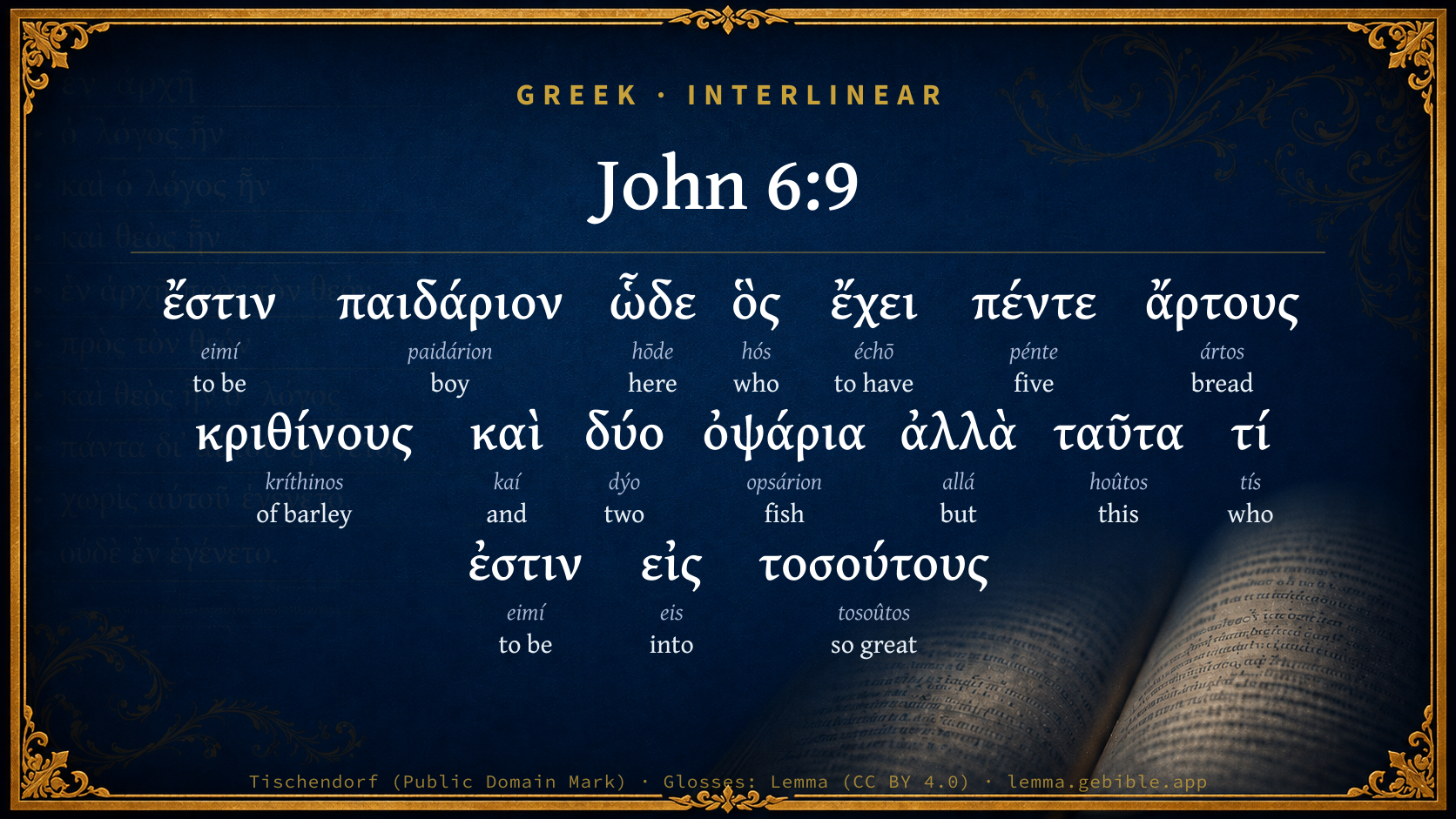
"There is a boy here who has five barley loaves and two fish, but what are these among so many?"
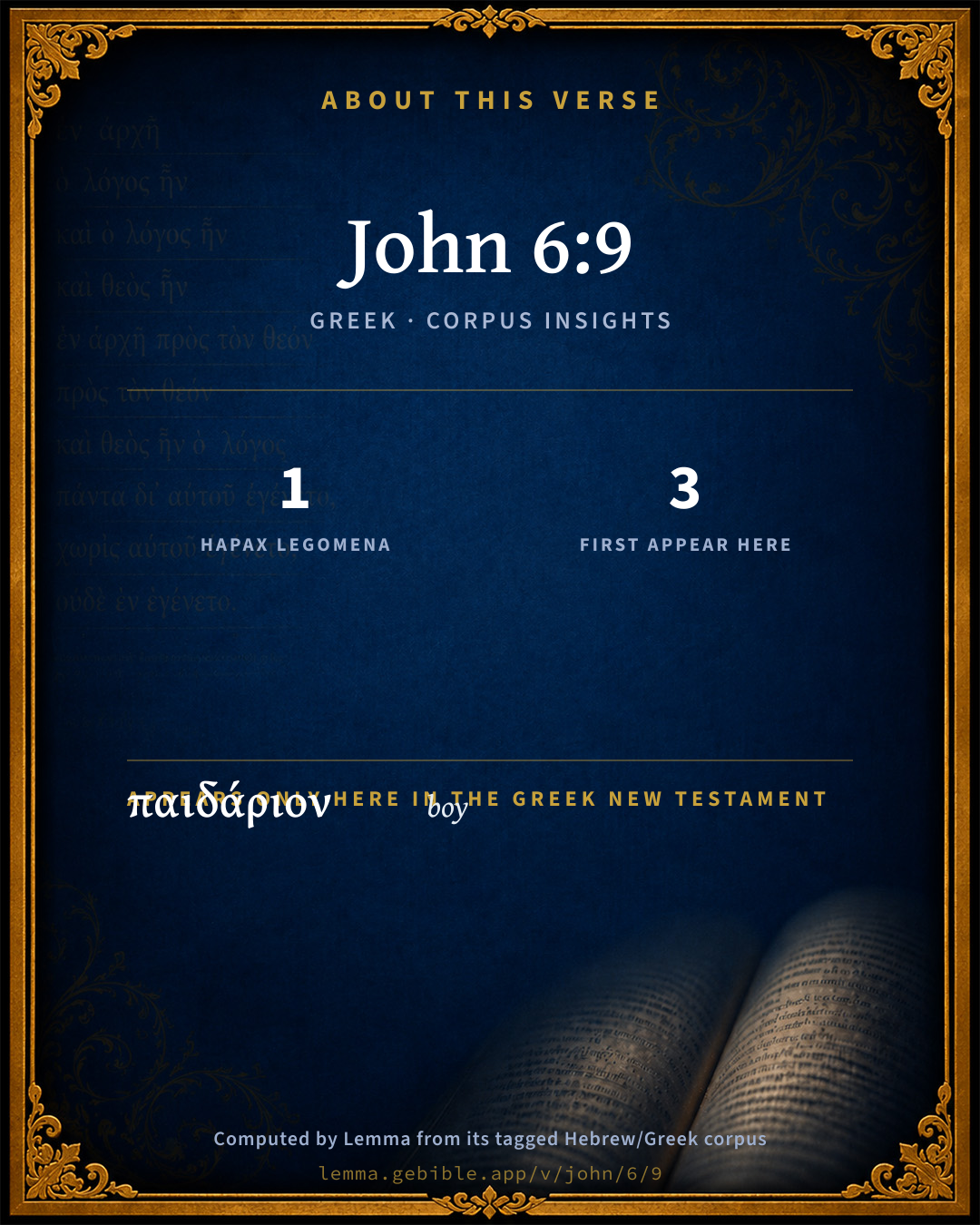
- 1 hapax legomenon — only here in the Greek New Testament
- 3 first appearances in the Greek New Testament
Download a study sheet
One document with this verse’s original text, its word-by-word gloss line, the meaning frame, cross-references with their text, attributed commentary, and full source and license credits — printable, and it pastes into notes with its structure intact.
This verse Autodidact and up
A passage Seminary Student
Up to 50 verses in one chapter. A passage sheet keeps up to 6 commentary sources and 12 cross-references per verse, in the order this page ranks them, and says so on the sheet whenever that leaves anything out. Ask for a single verse and you get the Autodidact verse sheet above.
Everything on this page stays free to read, with no account — the sheet is a download of what is already on screen, not access to it.
Compare translations 3
The same verse in 3 English versions, stacked beneath the original-language interlinear above. Click any original word for its lexicon entry.
Each is an independent rendering of the whole verse — the interlinear is not word-aligned to these translations.
Highlighted words mark where these versions differ — a whole-verse word diff, not a word-by-word alignment.
-
World English Bible Public Domain
"There is a boy here who has five barley loaves and two fish, but what are these among so many?"
-
King James Version Public Domain
There is a lad here, which hath five barley loaves, and two small fishes: but what are they among so many?
-
unfoldingWord Literal Text CC BY-SA 4.0
“Here is a little boy who has five barley bread loaves and two small fish, but what are these to so many?”
unfoldingWord Literal Text — © unfoldingWord, licensed CC BY-SA 4.0. Word-aligned USFM3 via Door43 (git.door43.org/unfoldingWord/en_ult).
Show all 19 translations
Every available English version of this verse, each an independent rendering of the whole verse.
-
World English Bible Public Domain
"There is a boy here who has five barley loaves and two fish, but what are these among so many?"
-
Berean Standard Bible Public Domain
“Here is a boy with five barley loaves and two small fish. But what difference will these make among so many?”
-
Majority Standard Bible Public Domain
“Here is a boy with five barley loaves and two small fish. But what difference will these make among so many?”
-
King James Version Public Domain
There is a lad here, which hath five barley loaves, and two small fishes: but what are they among so many?
-
American Standard Version (1901) Public Domain
There is a lad here, who hath five barley loaves, and two fishes: but what are these among so many?
-
Revised Version (1885) Public Domain
There is a lad here, which hath five barley loaves, and two fishes: but what are these among so many?
-
Geneva Bible (1599) Public Domain
There is a little boy heere, which hath fiue barlie loaues, and two fishes: but what are they among so many?
-
Douay-Rheims (1899) Public Domain
There is a boy here that hath five barley loaves, and two fishes; but what are these among so many?
-
Young's Literal Translation Public Domain
`There is one little lad here who hath five barley loaves, and two fishes, but these -- what are they to so many?'
-
Literal Standard Version CC BY-SA 4.0
“There is one little boy here who has five barley loaves and two fishes, but these—what are they to so many?”
-
Unlocked Literal Bible CC BY-SA 4.0
“There is a boy here who has five bread loaves of barley and two fish, but what are these among so many?”
-
unfoldingWord Literal Text CC BY-SA 4.0
“Here is a little boy who has five barley bread loaves and two small fish, but what are these to so many?”
-
Darby Bible Public Domain
There is a little boy here who has five barley loaves and two small fishes; but this, what is it for so many?
-
World Messianic Bible Public Domain
“There is a boy here who has five barley loaves and two fish, but what are these among so many?”
-
Webster's Bible Public Domain
There is a lad here, who hath five barley-loaves, and two small fishes: but what are they among so many?
-
Free Bible Version CC BY-SA 4.0
“There's a boy here who has five barley loaves and a couple of fish, but what good is that when there are so many people?”
-
Bible in Basic English Public Domain
There is a boy here with five barley cakes and two fishes: but what is that among such a number?
-
Text-Critical English NT CC BY 4.0
“There is a little boy here who has five barley loaves and two fish, but what good are they for so many people?”
-
Tyndale New Testament (1534) Public Domain
There ys a lad here which hath fyve barly loves and two fisshes: but what is that amonge so many?
Literal Standard Version (2020), Covenant Press — licensed CC BY-SA 4.0. Text via the HelloAO Bible API (eBible.org). Unlocked Literal Bible (unfoldingWord) — licensed CC BY-SA 4.0. Text via the HelloAO Bible API (eBible.org). unfoldingWord Literal Text — © unfoldingWord, licensed CC BY-SA 4.0. Word-aligned USFM3 via Door43 (git.door43.org/unfoldingWord/en_ult). Free Bible Version, Dr. Jonathan Gallagher — licensed CC BY-SA 4.0. Text via the HelloAO Bible API (eBible.org).
Word by word
More ways to search: Search by grammar → Find every occurrence → Compare this word →
Practice this passage: Drill this verse → Learn its vocabulary →
- Appears 1× in the Greek New Testament
- First appears here
- Part of Speech
- Noun
- Case
- Nominative
- Number
- Singular
- Gender
- Neuter
Full Thayer's Definition
- ἔστιν eimí G1510 “to be” Verb, Present, Active, Indicative, 3rd person, Singular
- παιδάριον paidárion G3808 “boy” Noun, Nominative, Singular, Neuter
- ὧδε hōde G5602 “here” Adverb
- ὃς hós G3739 “who” Relative pronoun, Nominative, Singular, Masculine
- ἔχει échō G2192 “to have” Verb, Present, Active, Indicative, 3rd person, Singular
- πέντε pénte G4002 “five” Adjective, Numeral (indeclinable)
- ἄρτους ártos G740 “bread” Noun, Accusative, Plural, Masculine
- κριθίνους kríthinos G2916 “of barley” Adjective, Accusative, Plural, Masculine
- καὶ kaí G2532 “and” Conjunction
- δύο dýo G1417 “two” Adjective, Numeral (indeclinable)
- ὀψάρια opsárion G3795 “fish” Noun, Accusative, Plural, Neuter
- ἀλλὰ allá G235 “but” Conjunction
- ταῦτα hoûtos G3778 “this” Demonstrative pronoun, Nominative, Plural, Neuter
- τί tís G5101 “who” Interrogative pronoun, Nominative, Singular, Neuter
- ἐστιν eimí G1510 “to be” Verb, Present, Active, Indicative, 3rd person, Singular
- εἰς eis G1519 “into” Preposition
- τοσούτους tosoûtos G5118 “so great” Demonstrative pronoun, Accusative, Plural, Masculine
About this verse
These counts appear in no published source. They are computed here, from the morphology-tagged text and Lemma’s own curated glosses. What Lemma adds →
- 17
- words
- 16
- distinct lemmas
- Gospels
- section
Notable vocabulary
1 hapax legomenon — a word that appears only here in the entire Greek New Testament:
- παιδάριον boy G3808
First appearance in Scripture
These words make their first canonical appearance in the Greek New Testament here:
Shared distinctive vocabulary
κριθίνους of barley G2916 occurs in 2 verses of the Greek New Testament. Also found in:
Repetition
A word recurs within this verse:
- ἔστιν to be G1510 ×2
Cross-references
20Topical passages linked to John 6:9 in the Treasury of Scripture Knowledge — connected by theme and wording, ordered by reader-vote popularity; previews shown in the World English Bible.
- 2 Kings 4:42–44 There came a man from Baal Shalishah, and brought the man of God bread of the first fruits, twenty loaves of barley, and fresh ears of grain in his sack. He said, Give to the people, that they may eat.
- Matthew 14:17 They told him, "We only have here five loaves and two fish."
- Mark 6:38 He said to them, "How many loaves do you have? Go see." When they knew, they said, "Five, and two fish."
- Luke 9:13 But he said to them, "You give them something to eat." They said, "We have no more than five loaves and two fish, unless we should go and buy food for all these people."
- Psalms 78:19 Yes, they spoke against God. They said, "Can God prepare a table in the wilderness?
- Matthew 16:9 Don't you yet perceive, neither remember the five loaves for the five thousand, and how many baskets you took up?
- Mark 8:19 When I broke the five loaves among the five thousand, how many baskets full of broken pieces did you take up?" They told him, "Twelve."
- Deuteronomy 8:8 a land of wheat and barley, and vines and fig trees and pomegranates; a land of olive trees and honey;
- Psalms 81:16 But he would have also fed them with the finest of the wheat. I will satisfy you with honey out of the rock."
- Psalms 147:14 He makes peace in your borders. He fills you with the finest of the wheat.
- 2 Corinthians 8:9 For you know the grace of our Lord Jesus Christ, that, though he was rich, yet for your sakes he became poor, that you through his poverty might become rich.
- Deuteronomy 32:14 Butter of the herd, and milk of the flock, With fat of lambs, Rams of the breed of Bashan, and goats, With the finest of the wheat; Of the blood of the grape you drank wine.
- 1 Kings 4:28 Barley also and straw for the horses and swift steeds brought they to the place where [the officers] were, every man according to his charge.
- 2 Kings 7:1 Elisha said, Hear you the word of Yahweh: thus says Yahweh, Tomorrow about this time shall a measure of fine flour be [sold] for a shekel, and two measures of barley for a shekel, in the gate of Samaria.
- Psalms 78:41 They turned again and tempted God, And provoked the Holy One of Israel.
- Ezekiel 27:17 Judah, and the land of Israel, they were your traffickers: they traded for your merchandise wheat of Minnith, and confections, and honey, and oil, and balm.
- John 6:7 Philip answered him, "Two hundred denarii worth of bread is not sufficient for them, that everyone of them may receive a little."
- John 11:21 Therefore Martha said to Jesus, "Lord, if you would have been here, my brother wouldn't have died.
- John 11:32 Therefore when Mary came to where Jesus was, and saw him, she fell down at his feet, saying to him, "Lord, if you would have been here, my brother wouldn't have died."
- Revelation 6:6 I heard a voice in the midst of the four living creatures saying, "A choenix of wheat for a denarius, and three choenix of barley for a denarius! Don't damage the oil and the wine!"
Cross-references courtesy of OpenBible.info (CC BY 4.0).
Lesson kit
Teaching starters — assembled from the data on this page, not authored interpretation. Every prompt links to the verse data it draws on. Edit before teaching.
John, in the Gospels, opens this verse with 17 words (16 distinct Greek lemmas). Its most distinctive word is paidárion (“boy”). A historical commentator’s framing appears above. Read the whole chapter for the surrounding context.
Discussion questions
- How does “boy” (paidárion) shape what this verse is saying?
- This verse holds 1 word here found nowhere else in the Greek New Testament. What might the rare word draw attention to?
- 3 words here appear for the first time in Scripture. What is being introduced at this debut?
- John 6:13 shares the word «of barley» with this verse. How do the two illuminate each other?
- “to be” occurs 2× in this one verse. What is the effect of the repetition?
- These translations render this verse differently. What is at stake in choosing one wording over another?
- Reading how Tyndale Open Study Notes and Bengel's Gnomon read this verse, where do the two commentators agree and where do they part?
Things to notice
- 1 word in this verse appears nowhere else in the Greek New Testament.
- 3 words make their first canonical appearance in Scripture here.
- These translations choose different wording for 12 words in this verse.
- “to be” occurs 2× in this single verse.
- 16 distinct Greek lemmas span 17 words in this verse.
Commentary
Notes on John 6:9 from classic Christian and Jewish commentators (each source and its license shown beneath its notes). The classic Christian expositions comment on the surrounding passage and are grouped to its opening verse, so a note may address several verses; the Jewish commentaries on the Tanakh (Rashi and others) are per-verse, so they appear only where the commentator wrote on this verse.
Lemma curates 59 commentaries, every one of them public domain or Creative Commons licensed, each selected and text-cleaned for this edition rather than reprinted as found. About our sources →
Tyndale Open Study Notes
Tyndale Open Resources
Tyndale Open Study Notes — © Tyndale Open Resources, licensed CC BY-SA 4.0. Text via the HelloAO Bible API.
Bengel's Gnomon
Johann Albrecht Bengel
Bengel's Gnomon of the New Testament — English translation (T&T Clark, Edinburgh, 1860) — public domain. Text from a community e-Sword module.
Expositor's Greek Testament
ed. W. Robertson Nicoll
The Expositor's Greek Testament, edited by W. Robertson Nicoll (1897–1910) — public domain. Text from a community e-Sword module.
Adam Clarke's Commentary
Adam Clarke's Commentary on the Bible (1810–1826) — public domain. Text from a community e-Sword/MySword module.
Ellicott's Commentary for English Readers
A Bible Commentary for English Readers, edited by Charles John Ellicott (1878–1897) — public domain. Text from a community e-Sword module.
The Cambridge Bible for Schools and Colleges
gen. ed. J. J. S. Perowne
The Cambridge Bible for Schools and Colleges (gen. ed. J. J. S. Perowne; Cambridge University Press, 1878–1918) — public domain. Text from a community e-Sword module.
John Gill's Exposition
John Gill's Exposition of the Whole Bible (1746–1763) — public domain (CC PDM 1.0). Text via the HelloAO Bible API.
Trapp's Complete Commentary
John Trapp
John Trapp, A Commentary or Exposition upon All the Books of the Old and New Testament (1647–1656) — public domain. Text from a community e-Sword module.
Cambridge Greek Testament for Schools and Colleges
Cambridge Greek Testament for Schools and Colleges (Cambridge University Press, 1896; 21 vols, various authors incl. Carr, Maclear, Plummer, Farrar, Lumby, Moule, M. R. James, Simcox) — public domain. Text from a community e-Sword module.
Alford’s Greek Testament
Henry Alford
Henry Alford, The Greek Testament (1849–1861) — public domain. Text from a community e-Sword module.
International Critical Commentary
International Critical Commentary — older volumes (1896–1929), various authors — public domain. Text from a community e-Sword module.
Vincent's Word Studies in the New Testament
Marvin R. Vincent
Marvin R. Vincent, Word Studies in the New Testament (1887–1900) — public domain. Text from a community e-Sword/MySword module.