John 7:46

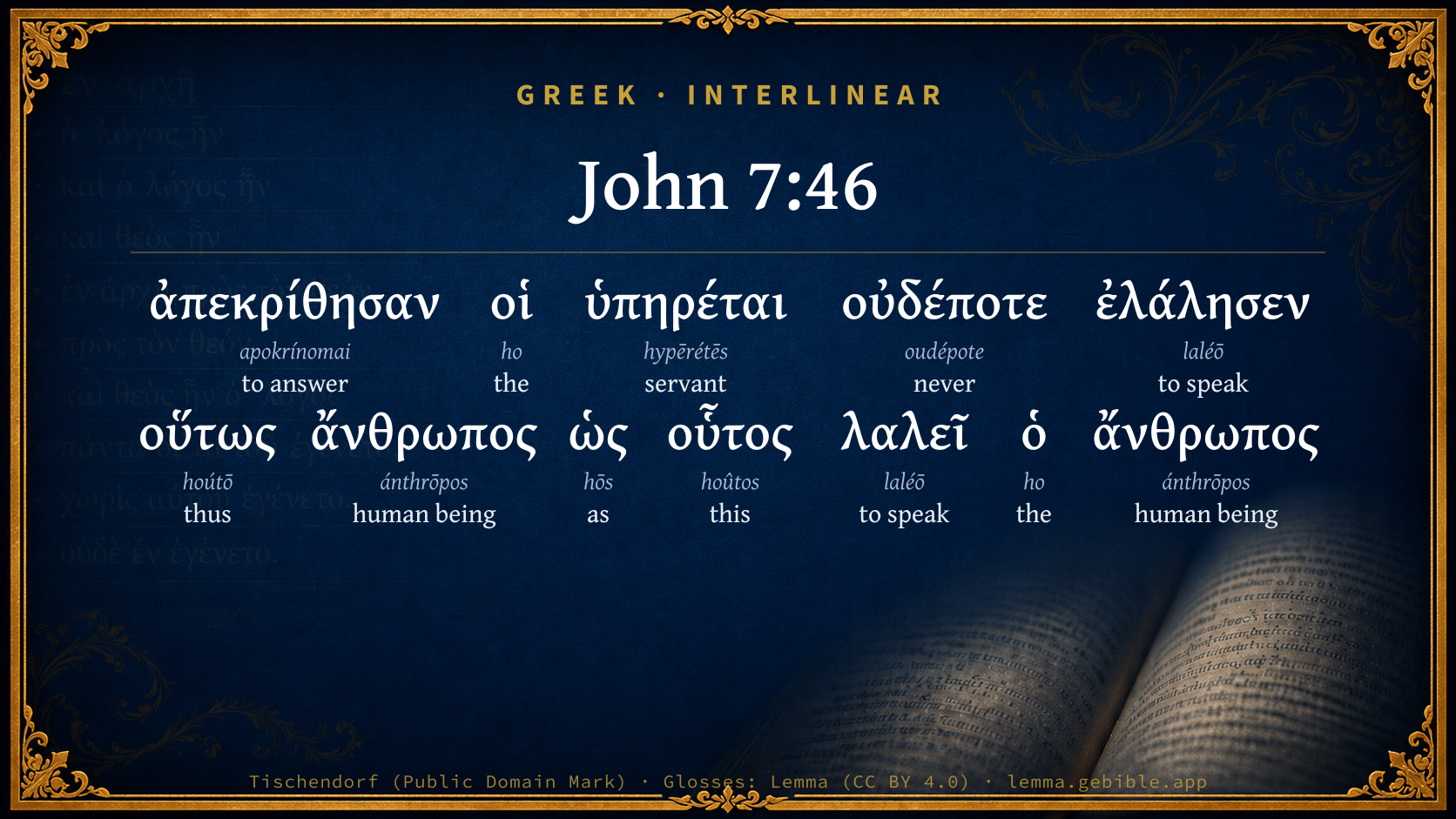
Greek (Tischendorf 8th ed.) John 7:46 appears in the Greek New Testament. The text above is from the Tischendorf 8th edition. Each word links to its Strong’s number and a concise gloss. Click any word for its full Thayer’s Greek Lexicon entry.
Download image
Cite this verse

John 7:46 (World English Bible). Public Domain. Lemma interlinear Bible study tool, https://lemma.gebible.app/v/john/7/46.

Show BibTeX & RIS
BibTeX
RIS
English Translation
The officers answered, "No man ever spoke like this man!"
World English Bible · Public Domain
Download a study sheet

One document with this verse’s original text, its word-by-word gloss line, the meaning frame, cross-references with their text, attributed commentary, and full source and license credits — printable, and it pastes into notes with its structure intact.

This verse Autodidact and up

Study sheet (.html) Plain text (.txt)

A passage Seminary Student

Up to 50 verses in one chapter. A passage sheet keeps up to 6 commentary sources and 12 cross-references per verse, in the order this page ranks them, and says so on the sheet whenever that leaves anything out. Ask for a single verse and you get the Autodidact verse sheet above.

Everything on this page stays free to read, with no account — the sheet is a download of what is already on screen, not access to it.

Want to remove ads? Support Godless Engineer
Compare translations 3

The same verse in 3 English versions, stacked beneath the original-language interlinear above. Click any original word for its lexicon entry.

Each is an independent rendering of the whole verse — the interlinear is not word-aligned to these translations.

Highlighted words mark where these versions differ — a whole-verse word diff, not a word-by-word alignment.

  • World English Bible Public Domain
    The officers answered, "No man ever spoke like this man!"
  • King James Version Public Domain
    The officers answered, Never man spake like this man.
  • unfoldingWord Literal Text CC BY-SA 4.0
    The officers answered, “Never has a man spoken like this.”

unfoldingWord Literal Text — © unfoldingWord, licensed CC BY-SA 4.0. Word-aligned USFM3 via Door43 (git.door43.org/unfoldingWord/en_ult).

Versions to compare (up to 4)

3 of 4 selected

Show all 19 translations

Every available English version of this verse, each an independent rendering of the whole verse.

  • World English Bible Public Domain
    The officers answered, "No man ever spoke like this man!"
  • Berean Standard Bible Public Domain
    “Never has anyone spoken like this man!” the officers answered.
  • Majority Standard Bible Public Domain
    “Never has anyone spoken like this man!” the officers answered.
  • King James Version Public Domain
    The officers answered, Never man spake like this man.
  • American Standard Version (1901) Public Domain
    The officers answered, Never man so spake.
  • Revised Version (1885) Public Domain
    The officers answered, Never man so spake.
  • Geneva Bible (1599) Public Domain
    The officers answered, Neuer man spake like this man.
  • Douay-Rheims (1899) Public Domain
    The ministers answered: Never did man speak like this man.
  • Young's Literal Translation Public Domain
    The officers answered, `Never so spake man -- as this man.'
  • Literal Standard Version CC BY-SA 4.0
    The officers answered, “Never so spoke man—as this Man.”
  • Unlocked Literal Bible CC BY-SA 4.0
    The officers answered, “Never has anyone spoken like this.”
  • unfoldingWord Literal Text CC BY-SA 4.0
    The officers answered, “Never has a man spoken like this.”
  • Darby Bible Public Domain
    The officers answered, Never man spoke thus, as this man [speaks].
  • World Messianic Bible Public Domain
    The officers answered, “No man ever spoke like this man!”
  • Webster's Bible Public Domain
    The officers answered, Never man spoke like this man.
  • Free Bible Version CC BY-SA 4.0
    “Nobody ever spoke like this man does,” the guards replied.
  • Bible in Basic English Public Domain
    The servants made answer, No man ever said things like this man.
  • Text-Critical English NT CC BY 4.0
    The officers answered, “Never has anyone spoken like this man.”
  • Tyndale New Testament (1534) Public Domain
    The servautes answered never man spake as this man doeth.

Literal Standard Version (2020), Covenant Press — licensed CC BY-SA 4.0. Text via the HelloAO Bible API (eBible.org). Unlocked Literal Bible (unfoldingWord) — licensed CC BY-SA 4.0. Text via the HelloAO Bible API (eBible.org). unfoldingWord Literal Text — © unfoldingWord, licensed CC BY-SA 4.0. Word-aligned USFM3 via Door43 (git.door43.org/unfoldingWord/en_ult). Free Bible Version, Dr. Jonathan Gallagher — licensed CC BY-SA 4.0. Text via the HelloAO Bible API (eBible.org).

Word by word

More ways to search: Search by grammar → Find every occurrence → Compare this word →

Practice this passage: Drill this verse → Learn its vocabulary →

About this verse

These counts appear in no published source. They are computed here, from the morphology-tagged text and Lemma’s own curated glosses. What Lemma adds →

12
words
9
distinct lemmas
Gospels
section

Notable vocabulary

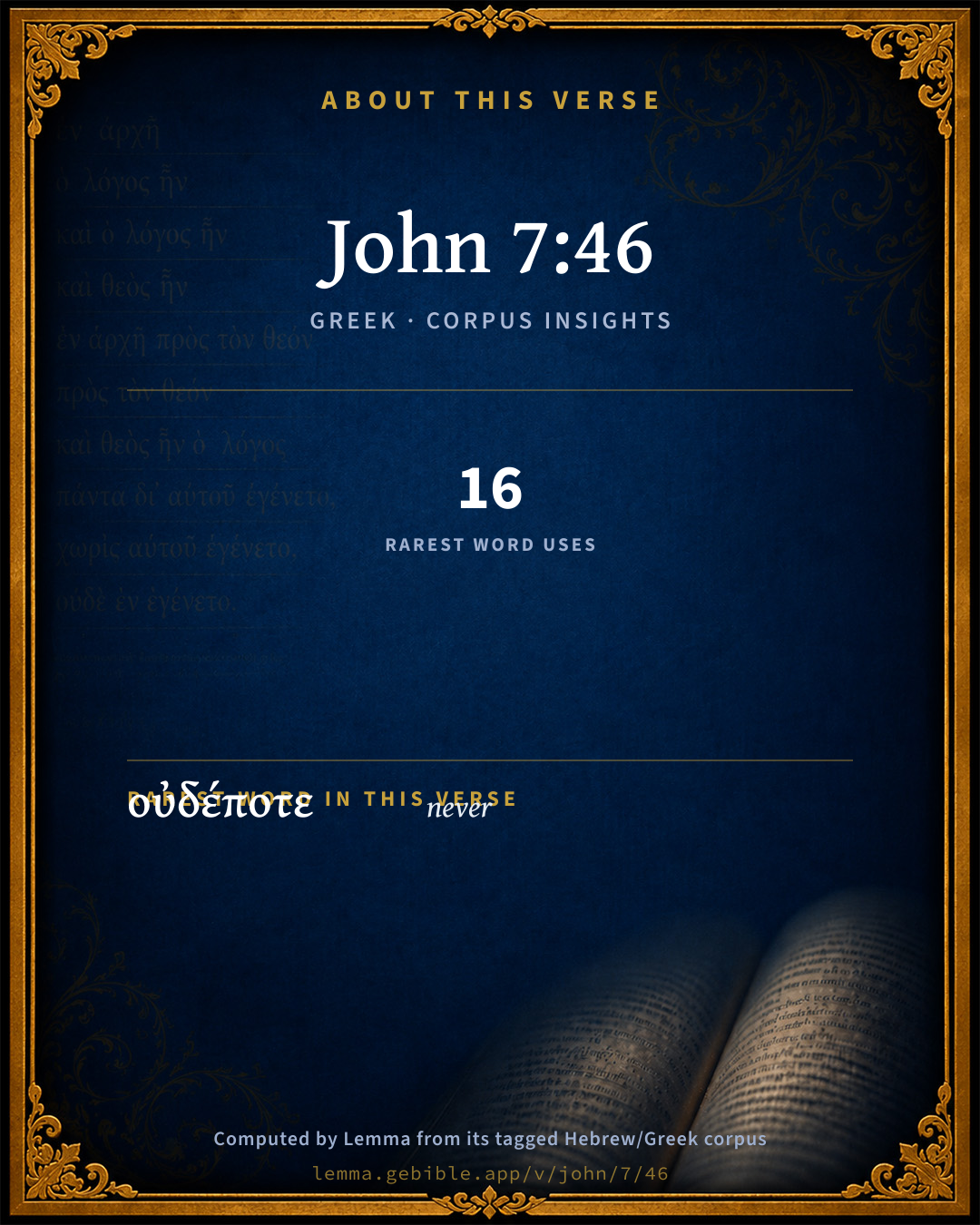
The rarest word here is οὐδέποτε never G3763 — appearing just 16 times in the whole Greek New Testament.

Shared distinctive vocabulary

οὐδέποτε never G3763 occurs in 15 verses of the Greek New Testament. Also found in:

Repetition

Words recur within this verse:

  • ἐλάλησεν to speak G2980 ×2
  • ἄνθρωπος human being G444 ×2
  • οἱ the G3588 ×2

Cross-references

3

Topical passages linked to John 7:46 in the Treasury of Scripture Knowledge — connected by theme and wording, ordered by reader-vote popularity; previews shown in the World English Bible.

  • Matthew 7:28–29 It happened, when Jesus had finished saying these things, that the multitudes were astonished at his teaching,
  • Luke 4:22 All testified about him, and wondered at the gracious words which proceeded out of his mouth, and they said, "Isn't this Joseph's son?"
  • John 7:26 Behold, he speaks openly, and they say nothing to him. Can it be that the rulers indeed know that this is truly the Christ?

Cross-references courtesy of OpenBible.info (CC BY 4.0).

Where the printed editions differ

2 variants

Places in this verse where the major printed Greek editions disagree on the wording in a way that affects the translation — a comparison of editions, not a manuscript-by-manuscript collation. The editions are the modern critical texts (Nestlé-Aland 28/27, SBL, Westcott-Hort, Tregelles, Tyndale House) and the traditional texts behind the KJV (the Textus Receptus and the Byzantine/Majority text). It is not a claim about which reading is original.

  1. Extra text
    οὗτος

    “this”

    In TregTRByz Not in NA28NA27TynSBLWH

    οὗτος (houtos) 'this' is only in traditional manuscripts (Treg+TR+Byz)

  2. Extra text
    ἄνθρωπος.

    “man.”

    In TregTRByz Not in NA28NA27TynSBLWH

    ἄνθρωπος. (anthrōpos) 'man.' is only in traditional manuscripts (Treg+TR+Byz)

Textual data: Translators Amalgamated Greek New Testament (STEPBible TAGNT) · CC BY 4.0.

Commentary

Notes on John 7:46 from classic Christian and Jewish commentators (each source and its license shown beneath its notes). The classic Christian expositions comment on the surrounding passage and are grouped to its opening verse, so a note may address several verses; the Jewish commentaries on the Tanakh (Rashi and others) are per-verse, so they appear only where the commentator wrote on this verse.

Lemma curates 59 commentaries, every one of them public domain or Creative Commons licensed, each selected and text-cleaned for this edition rather than reprinted as found. About our sources →

Bengel's Gnomon

Johann Albrecht Bengel

Joh 7:46. Ὡς, as) A characteristic of truth, convincing even ordinary unlearned men, rather than their masters. [Not seldom the more untutored come to feel the effectual power of Christ’s word more readily than the most sagacious.—V. g.]

Bengel's Gnomon of the New Testament — English translation (T&T Clark, Edinburgh, 1860) — public domain. Text from a community e-Sword module.

Expositor's Greek Testament

ed. W. Robertson Nicoll

Joh 7:46 . The servants frankly reply: οὐδέποτε … ἄνθρωπος . The testimony is notable, because the officers of a court are apt to be entirely mechanical and leave all responsibility for their actions with their superiors. Also it is remarkable that the same result should have found place with them all; for in view of the divided state of public feeling, probably five or six at least would be sent.

The Expositor's Greek Testament, edited by W. Robertson Nicoll (1897–1910) — public domain. Text from a community e-Sword module.

Jamieson, Fausset & Brown

Robert Jamieson, A. R. Fausset & David Brown

Never man spake like this man--Noble testimony of unsophisticated men! Doubtless they were strangers to the profound intent of Christ's teaching, but there was that in it which by its mysterious grandeur and transparent purity and grace, held them spellbound. No doubt it was of God that they should so feel, that their arm might be paralyzed, as Christ's hour was not yet come; but even in human teaching there has sometimes been felt such a divine power, that men who came to kill them (for example, ROWLAND HISS) have confessed to all that they were unmanned.

Jamieson, Fausset & Brown — Commentary Critical and Explanatory on the Whole Bible (1871) — public domain (CC PDM 1.0). Text via the HelloAO Bible API.

Adam Clarke's Commentary

Verse 46. Never man spake like this man.] Though these officers had gone on the errand of their masters, they had not entered into their spirit. They were sent to apprehend a seditious man, and a false prophet. They came where Jesus taught; they found him to be a different person to the description they received from their masters, and therefore did not attempt to touch or molest him. No doubt they expected when they told their employers the truth, that they would have commended them, and acknowledged their own mistake: but these simple people were not in the secret of their masters' malice. They heard, they felt, that no man ever spoke with so much grace, power, majesty, and eloquence. They had never heard a discourse so affecting and persuasive. So Jesus still speaks to all who are simple of heart. He speaks pardon - he speaks holiness - he speaks salvation to all who have ears to hear. No man ever did or can speak as he does. He teaches THE TRUTH, the whole TRUTH, and nothing but the TRUTH.

Adam Clarke's Commentary on the Bible (1810–1826) — public domain. Text from a community e-Sword/MySword module.

John Calvin's Commentaries

46. Never man spoke like this man. Those officers acknowledge that they are subdued and vanquished by the word of Christ, and yet they do not on that account repent or give due honor to the word. If it be true, that never man spoke like this man, why did not the Divine power, which they were compelled to feel, touch their hearts in such a manner as to cause them to devote themselves wholly to God? But it was necessary that the prediction of Isaiah should thus be accomplished:

he will prostrate the wicked by the breath of his mouth, (Isaiah 11:4.)

Nay more, we shall afterwards see how those who were attempting to put him to death, overwhelmed by the voice of Christ alone, and as if they had been struck down with mallets, fell backwards, (John 18:6.) Let us, therefore, learn that the doctrine of Christ possesses such power as even to terrify the wicked; but as this tends to their destruction, let us take care that we be softened, instead of being broken. Even in the present day, we see many persons who too much resemble those officers, who are reluctantly drawn into admiration of the doctrine of the Gospel, and yet are so far from yielding to Christ, that they still remain in the enemy’s camp. There are others even worse, who, for the sake of obtaining favor with the wicked, employ all the opprobrious terms which they can find for basely slandering that doctrine, which, notwithstanding, they acknowledge to be from God, because they are convinced of it in their hearts.

John Calvin's Commentaries (1540-1563) — public domain. Text from the Calvin Translation Society English edition (1840s-50s) via the Christian Classics Ethereal Library (ccel.org). Calvin's coverage is partial (roughly two-thirds of the Bible); uncommented books and verses are honest gaps, never fabricated. The 19th-century editor's footnotes and remarks are omitted so the notes are faithfully Calvin's own voice.

Ellicott's Commentary for English Readers

(46) Never man spake like this man.—Some of the oldest MSS., including the Vatican, have a shorter text, “Never man spake thus”; but the longer reading is to be preferred. The very officers acknowledged His power, and tell the professed teachers, whose opinions and words were the rule of all Jewish life, that never man spake as He whom they sought to take! It is probable that in the section immediately preceding (Joh_7:32-34), St. John gives us only a résumé of what Jesus had said, and that words which have not come down to us were among those which produced so profound an impression on the officers.

A Bible Commentary for English Readers, edited by Charles John Ellicott (1878–1897) — public domain. Text from a community e-Sword module.

The Cambridge Bible for Schools and Colleges

gen. ed. J. J. S. Perowne

46. Never man spake like this man] The reading is doubtful; some of the best MSS. have Never man so spake. Possibly Christ said a good deal more than is recorded by S. John.

The Cambridge Bible for Schools and Colleges (gen. ed. J. J. S. Perowne; Cambridge University Press, 1878–1918) — public domain. Text from a community e-Sword module.

John Gill's Exposition

But this people who knoweth not the law are cursed. With great contempt they style the followers of Jesus "this people"; the common people, the dregs of them, the refuse of the earth; and whom they call, , "the people of the earth", in distinction from the wise men, and their disciples: and when they speak the best of them, their account is this (p);

"one of the people of the earth is one that has moral excellencies, but not intellectual ones; that is, there is in him common civility, but the law is not in him;''

as here, "who knoweth not the law": they always reckon them very ignorant. Says one (q) of their writers,

"they that are without knowledge are the multitude.''

And elsewhere it is said (r),

"the old men of the people of the earth, when they grow old their knowledge is disturbed (or is lost), as it is said, Job 12:20, but so it is not with the old men of the law, when they grow old, their knowledge rests upon them, as it is said, Job 12:12, "with the ancient is wisdom".''

Upon which one of the commentators (s) has this gloss;

"these are the disciples of the wise men; for the people of the earth, what wisdom is there in them?''

By the "law" here, is meant either the written law of Moses, which the Pharisees boasted of, and of their knowledge of it, as having the key of knowledge to open it; as understanding the true sense, and capable of giving a right interpretation of it, to the people; though they themselves were wretchedly ignorant of it, as appears by their false glosses on it, refuted by our Lord in Mat 5:17; or else the oral law is here intended, which they pretended was given by word of mouth to Moses, and handed down to posterity from one to another; and this lay among the doctors: they tell us (t), that Moses received it at Sinai, and delivered it to Joshua, and Joshua to the elders, and the elders to the prophets, and the prophets to the men of the great synagogue (Ezra's), the last of which was Simeon the just: Antigonus, a man of Socho, received it from him; and Jose ben Joezer, and Jose ben Jochanan, received it from him; and Joshua ben Perachia, (whom they sometimes say was the master of Jesus of Nazareth,) and Nittai the Arbelite, received it from them; by whom it was delivered to Judah ben Tabia, and Simeon ben Shetach; and from them it was received by Shemaiah, and Abtalion, who delivered it to Hillell, and Shammai; who, or whose scholars, were, at this time, when these words were spoken, the present possessors of it, and taught it their disciples in their schools: and thus it was handed down from one to another, until the times of R. Judah, who collected the whole of the traditions of the elders together, and published it under the title of the Misna; and then, as Maimonides says (u), it was revealed to all Israel; whereas before it was but in a few hands, who instructed others in it; but as for the common people, they knew little of it, especially of the nice distinctions and decisions of it; and these people were always had in great contempt by the wise men: they would not receive a testimony from them, nor give one for them, nor deliver a secret to them, nor proclaim anything of theirs that was lost, nor walk with them in the way, nor make a guardian of any of them (w). The people of the earth were not reckoned holy or religious (x), but generally profane and wicked; that they were abandoned to sin, rejected of God, and to be cast off by men; yea, they will not allow that they shall rise again at the last day, unless it be for the sake of some wise men they are allied unto, or have done some service for. They say (y).

"whoever ministers in the light of the law, the light of the law will quicken him; but whoever does not minister in the light of the law, the light of the law will not quicken him--though it is possible for such an one to cleave to the Shekinah--for everyone that marries his daughter to a scholar of a wise man, or makes merchandise for the disciples of the wise men, and they receive any advantage from his goods, this brings on him what is written, as if he cleaved to the Shekinah.''

Thus we see in what contempt the common people were with the learned doctors, and what an opinion these men had of the followers of Christ; though, in truth, they were not so ignorant of the law as themselves: they knew the spirituality of it, that it reached to the thoughts of the heart, as well as to external actions; they knew what it required, and their own impotence to answer its demands; they knew the wrath, terror, and curses of it, and that Christ only was the fulfilling end of it, for righteousness to those that believed in him: and they were far from being cursed persons: they were blessed with all spiritual blessings: with the pardon of their sins, and the justification of their persons; with grace and peace in their souls, and would be introduced as the blessed of the Father into his kingdom and glory.

(p) Maimon. in Pirke Abot, c. 2. sect. 5. & c. 5. sect. 7. (q) Abarbinel in proph. post. fol. 473. (r) Misn. Kenim, c. 3. sect. 6. Vid. T. Bab. Sabbat, fol. 152. 1. (s) Bartenora in Misn. ib. (t) Pirke Abot, c. 1. sect. 1-12. (u) Praefat. ad Yad Hazaka. (w) Buxtorf. Lex. Talmud. col. 1626. (x) Ib. Florileg. Heb. p. 276. (y) T. Bab. Cetubot, fol. 111. 2.

John Gill's Exposition of the Whole Bible (1746–1763) — public domain (CC PDM 1.0). Text via the HelloAO Bible API.

Trapp's Complete Commentary

John Trapp

46 The officers answered, Never man spake like this man.

Ver. 46. Never man spake like this man] It is good to come to the world, though with ill intent; they that come to see fashions only, as Moses came to the bush, may be called as he was. They that come but to sleep, may be taken napping, as Father Latimer saith. They that come to catch, may be caught, as these in the text. The serpent that comes forth to sting, may be charmed ere he go back. When Henry Zutphen was preacher at Breme, the holy Catholics could not be idle, but sent their chaplains to every sermon, to trap him in his words. But God (whose footpaths are in the midst of the flood) would have his marvellous power to be seen in them, for he converted many of them; insomuch, that the greater number of them that were sent to hearken, did openly witness his doctrine to be God’s truth, against which no man can contend, and such as in all their life before they had not heard, persuading them likewise that they, forsaking all impiety, should follow the word of God, and believe the same, if they would be saved. But the chief priests, canons, and monks were so indurate and hardened, with Pharaoh, that they became the worse for these admonitions.

Never man spake] For he spake with grace, Psa 45:2, and with gravity, Mat 7:29. E cuius ore nil temere excidit, saith Scaliger, of Virgil, may we much more of Christ; they were all oracles that he uttered, honey drops that fell from him. Of Christ it might better be said than ever it was of Marcus Crassus, the Roman orator, Caeteros a Crasso semper omnes, illo autem die etiam ipsum a sese superatum. Cic. de Orat. lib. i.

John Trapp, A Commentary or Exposition upon All the Books of the Old and New Testament (1647–1656) — public domain. Text from a community e-Sword module.

Matthew Poole's English Annotations

With so much authority, evidence of truth, &c. Yet they did not cordially believe in Christ; being under the power of carnal and worldly affection, which only supernatural special grace could subdue. These were some of those, in whom the prophecy of Christ, Isa 11:4, was to be fulfilled—He shall smite the earth with the rod of his mouth, and with the breath of his lips shall he slay the wicked. The word of the Lord doth often restrain, astonish, and amaze those on whom it hath no powerful effect to eternal life and salvation. So it was with these poor officers.

Matthew Poole's English Annotations on the Holy Bible (1683–1685) — public domain. Text from a community e-Sword/MySword module.

Whedon's Commentary on the Bible

Daniel D. Whedon

46. Spake like this—The chagrin of the rulers at his not being brought must have been aggravated by the reason assigned. It was the effect of the speaking of Jesus upon the people (Joh_7:32) which first alarmed them, and produced the sending of officers for his apprehension; but how much more cause of alarm have they when their very instruments are spell-bound by his utterances! And then, again… the example of the people both influenced the opinions of the officers and frightened them from apprehending Jesus.

Daniel D. Whedon (gen. ed.), Commentary on the Old and New Testaments (1874–1909) — public domain. Text from a community e-Sword module.

The Pulpit Commentary

The incomparable words.

The testimony of these officers was at least impartial. If they were prejudiced, it was not in favour of Jesus, but against him. Persons in their position were likely to share the feelings of those by whom they were employed, and by whom they were sent on a message hostile to the Prophet of Nazareth. But the demeanour, and especially the language, of Jesus disarmed them. They came under the spell of his wisdom, his grace, his eloquence. And when they returned, without having executed their commission, they justified themselves by the exclamation, "Never man spake like this Man.

I CHRIST"S WORDS ARE INCOMPARABLE AS REVELATIONS OF TRUTH. He uttered the justest, the sublimest truths regarding the character and attributes of God; concerning the nature, the state, the sin, the peril of man; concerning religion, or the relation between man and God, especially concerning the Divine provision of salvation, and of spiritual and immortal life.

II CHRIST"S WORDS ARE INCOMPARABLE AS ANNOUNCING LAWS OF HUMAN LIFE. Where else can we find perfect precepts to govern conduct, dictates of morality so spiritual, motives to obedience so mighty? Christ"s are the authoritative words of a Divine Lawgiver, who claims to rule the hearts, and, through the hearts, the actions and habits of mankind.

III CHRIST"S WORDS ARE INCOMPARABLE IN THEIR STYLE AND THEIR ILLUSTRATIONS, ADAPTING THEM TO READERS OF EVERY CLASS. They are simple words, however profound may be the truth they embody; they are beautiful words, which charm a pure and lively imagination; they are earnest words, which rouse emotion and inspire a reverent attention. This is evident both from the place they have taken in literature, and from the fact that they are equally appreciated by the young and the old, by the cultured and the untaught.

IV CHRIST"S WORDS ARE INCOMPARABLE IN EFFICIENCY. This is the true test, and this test brings out the unequalled power of the words, which are mighty because they are the expression of the Divine mind.. Many of our Lord"s sayings might be quoted, which have, as a matter of fact, revolutionized the thoughts and doctrines of millions of men. Some of the greatest reforms in human society may be traced up with certainty to words uttered by the Nazarene.

V CHRIST"S WORDS ARE INCOMPARABLE FOR THEIR ENDURING, PERMANENT LIFE AND INFLUENCE. The words of many wise, thoughtful, and good men have perished. There are words which are full of meaning and preciousness for one generation, but which fail to affect the generations which follow. But Christ"s words are treasured with increasing reverence and attachment by succeeding generations. His own saying is verified by the lapse of time. "Heaven and earth shall pass away, but my words shall not pass away. T.

The Pulpit Commentary (1880–1919), ed. H.D.M. Spence-Jones & Joseph S. Exell — public domain. Text from a community e-Sword module.

The People's New Testament

B. W. Johnson

46. Never man spake like this man. The only answer the officers could make to the demand why they had not carried out orders was, “Man never spake like this man.” The multitude had not overawed them, but the words of Christ.

B. W. Johnson's The People's New Testament with Notes (1889–1891) — public domain. Electronic text from the Christian Classics Ethereal Library (CCEL) ThML edition.

Cambridge Greek Testament for Schools and Colleges

46. ἐλάλησεν οὕτως for οὕτως ἐλ. Omit ὡς οὗτος ὁ ἄνθρωπος after ἄνθρωπος, with BLT: other MSS. exhibit great variation.

Cambridge Greek Testament for Schools and Colleges (Cambridge University Press, 1896; 21 vols, various authors incl. Carr, Maclear, Plummer, Farrar, Lumby, Moule, M. R. James, Simcox) — public domain. Text from a community e-Sword module.

International Critical Commentary

46. The answer to the question, “Why did you not bring Him?” is surprising and unwelcome: “Never did man so speak.” These official servants of the Sanhedrim had been impressed, as the Galilæan peasants had been impressed (Mat 7:28, Mat 7:29), by the power of Jesus’ teaching. It is not to be supposed that vv. 33, 34, 37, 38, give more than fragments of what He said since the order was given for His arrest (v. 32); but it is noticeable that it was His words, not His works, that attracted attention, and it must have been disconcerting to those who were habitual teachers of the Law, to learn that the words of the new Teacher had made so deep an impression. His words were unique and without parallel, as also were His works, which He said were such as “none other did” (15:24).

After οὐδέποτε ἐλάλησεν οὕτως ἄνθρωπος, א*DNΘ add ὡς οὗτος (λαλεῖ) ὁ ἄνθρωπος. These additional words are omitted by אcBLTW, but the sense remains unaltered.

International Critical Commentary — older volumes (1896–1929), various authors — public domain. Text from a community e-Sword module.

Vincent's Word Studies in the New Testament

Marvin R. Vincent

Like this man. Some of the best texts omit.

Deceived [πεπλανησθε] . Rev., led astray. See on ver. 12.

Marvin R. Vincent, Word Studies in the New Testament (1887–1900) — public domain. Text from a community e-Sword/MySword module.

Lesson kit

Teaching starters — assembled from the data on this page, not authored interpretation. Every prompt links to the verse data it draws on. Edit before teaching.

John, in the Gospels, opens this verse with 12 words (9 distinct Greek lemmas). Its most distinctive word is oudépote (“never”). A historical commentator’s framing appears above. Read the whole chapter for the surrounding context.

Discussion questions

  1. What does “never” (oudépote) contribute to the verse as a whole?
  2. Matthew 7:23 shares the word «never» with this verse. How do the two illuminate each other?
  3. “to speak” occurs 2× in this one verse. What is the effect of the repetition?
  4. These translations render this verse differently; the difference is in the English rendering, not the original. What questions does that raise?
  5. Reading how Bengel's Gnomon and Expositor's Greek Testament read this verse, where do the two commentators agree and where do they part?

Things to notice

  • These translations choose different wording for 6 words in this verse.
  • “to speak” occurs 2× in this single verse.
  • 9 distinct Greek lemmas span 12 words in this verse.

Reading settings

Reading text

Shown beneath each verse's original-language words.

Old Testament
Old Testament edition

Read the OT as the Masoretic Hebrew (MT) or the Greek Septuagint (LXX).

English shown for the Greek Septuagint (in the Hebrew ↔ Greek comparison).

Comparing translations? Open the Compare panel on any verse page to stack up to four side by side.