
John 21:24

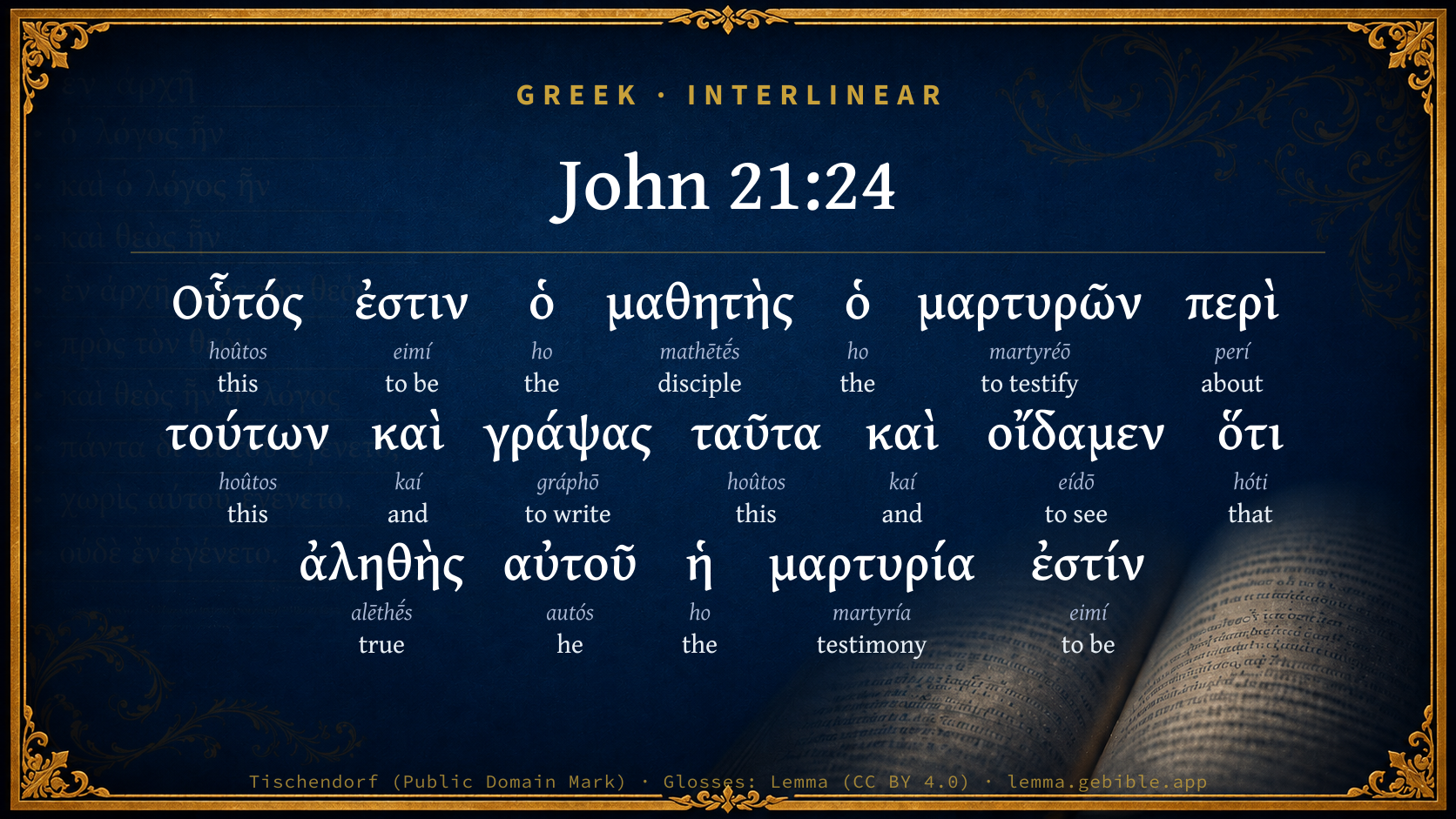
Greek (Tischendorf 8th ed.) John 21:24 appears in the Greek New Testament. The text above is from the Tischendorf 8th edition. Each word links to its Strong’s number and a concise gloss. Click any word for its full Thayer’s Greek Lexicon entry.
Download image
Cite this verse

John 21:24 (World English Bible). Public Domain. Lemma interlinear Bible study tool, https://lemma.gebible.app/v/john/21/24.

Show BibTeX & RIS
BibTeX
RIS
English Translation
This is the disciple who testifies about these things, and wrote these things. We know that his witness is true.
World English Bible · Public Domain
Download a study sheet

One document with this verse’s original text, its word-by-word gloss line, the meaning frame, cross-references with their text, attributed commentary, and full source and license credits — printable, and it pastes into notes with its structure intact.

This verse Autodidact and up

Study sheet (.html) Plain text (.txt)

A passage Seminary Student

Up to 50 verses in one chapter. A passage sheet keeps up to 6 commentary sources and 12 cross-references per verse, in the order this page ranks them, and says so on the sheet whenever that leaves anything out. Ask for a single verse and you get the Autodidact verse sheet above.

Everything on this page stays free to read, with no account — the sheet is a download of what is already on screen, not access to it.

Want to remove ads? Support Godless Engineer
Compare translations 3

The same verse in 3 English versions, stacked beneath the original-language interlinear above. Click any original word for its lexicon entry.

Each is an independent rendering of the whole verse — the interlinear is not word-aligned to these translations.

Highlighted words mark where these versions differ — a whole-verse word diff, not a word-by-word alignment.

  • World English Bible Public Domain
    This is the disciple who testifies about these things, and wrote these things. We know that his witness is true.
  • King James Version Public Domain
    This is the disciple which testifieth of these things, and wrote these things: and we know that his testimony is true.
  • unfoldingWord Literal Text CC BY-SA 4.0
    This is the disciple testifying about these things and the one having written these things, and we know that his testimony is true.

unfoldingWord Literal Text — © unfoldingWord, licensed CC BY-SA 4.0. Word-aligned USFM3 via Door43 (git.door43.org/unfoldingWord/en_ult).

Versions to compare (up to 4)

3 of 4 selected

Show all 19 translations

Every available English version of this verse, each an independent rendering of the whole verse.

  • World English Bible Public Domain
    This is the disciple who testifies about these things, and wrote these things. We know that his witness is true.
  • Berean Standard Bible Public Domain
    This is the disciple who testifies to these things and who has written them down. And we know that his testimony is true.
  • Majority Standard Bible Public Domain
    This is the disciple who testifies to these things and who has written them down. And we know that his testimony is true.
  • King James Version Public Domain
    This is the disciple which testifieth of these things, and wrote these things: and we know that his testimony is true.
  • American Standard Version (1901) Public Domain
    This is the disciple that beareth witness of these things, and wrote these things: and we know that his witness is true.
  • Revised Version (1885) Public Domain
    This is the disciple which beareth witness of these things, and wrote these things: and we know that his witness is true.
  • Geneva Bible (1599) Public Domain
    This is that disciple, which testifieth of these things, and wrote these things, and we know that his testimonie is true.
  • Douay-Rheims (1899) Public Domain
    This is that disciple who giveth testimony of these things, and hath written these things; and we know that his testimony is true.
  • Young's Literal Translation Public Domain
    this is the disciple who is testifying concerning these things, and he wrote these things, and we have known that his testimony is true.
  • Literal Standard Version CC BY-SA 4.0
    This is the disciple who is testifying concerning these things, and he wrote these things, and we have known that his testimony is true.
  • Unlocked Literal Bible CC BY-SA 4.0
    This is the disciple who testifies about these things, and who wrote these things, and we know that his testimony is true.
  • unfoldingWord Literal Text CC BY-SA 4.0
    This is the disciple testifying about these things and the one having written these things, and we know that his testimony is true.
  • Darby Bible Public Domain
    This is the disciple who bears witness concerning these things, and who has written these things; and we know that his witness is true.
  • World Messianic Bible Public Domain
    This is the disciple who testifies about these things, and wrote these things. We know that his witness is true.
  • Webster's Bible Public Domain
    This is the disciple who testifieth of these things, and wrote these things: and we know that his testimony is true.
  • Free Bible Version CC BY-SA 4.0
    This disciple confirms what happened and wrote all this down. We know that what he says is true.
  • Bible in Basic English Public Domain
    This is the disciple who gives witness about these things and who put them in writing: and we have knowledge that his witness is true.
  • Text-Critical English NT CC BY 4.0
    This is the disciple who is testifying about these things and who has written these things, and we know that his testimony is true.
  • Tyndale New Testament (1534) Public Domain
    The same disciple is he which testifieth of these thinges and wrote these thinges. And we knowe that his testimony is true.

Literal Standard Version (2020), Covenant Press — licensed CC BY-SA 4.0. Text via the HelloAO Bible API (eBible.org). Unlocked Literal Bible (unfoldingWord) — licensed CC BY-SA 4.0. Text via the HelloAO Bible API (eBible.org). unfoldingWord Literal Text — © unfoldingWord, licensed CC BY-SA 4.0. Word-aligned USFM3 via Door43 (git.door43.org/unfoldingWord/en_ult). Free Bible Version, Dr. Jonathan Gallagher — licensed CC BY-SA 4.0. Text via the HelloAO Bible API (eBible.org).

Word by word

More ways to search: Search by grammar → Find every occurrence → Compare this word →

Practice this passage: Drill this verse → Learn its vocabulary →

ἀληθὴς
alēthḗs
G227
“true”
Adjective, Nominative, Singular, Feminine
Part of Speech
Adjective
Case
Nominative
Number
Singular
Gender
Feminine
Full Thayer's Definition

Origin: from G1 (as a negative particle) and G2990

TDNT: 05:07,4

1. true 2. loving the truth, speaking the truth, truthful
  1. Οὗτός hoûtos G3778 “this” Demonstrative pronoun, Nominative, Singular, Masculine
  2. ἐστιν eimí G1510 “to be” Verb, Present, Active, Indicative, 3rd person, Singular
  3. ὁ ho G3588 “the” Article, Nominative, Singular, Masculine
  4. μαθητὴς mathētḗs G3101 “disciple” Noun, Nominative, Singular, Masculine
  5. ὁ ho G3588 “the” Article, Nominative, Singular, Masculine
  6. μαρτυρῶν martyréō G3140 “to testify” Verb, Present, Active, Participle, Nominative, Singular, Masculine
  7. περὶ perí G4012 “about” Preposition
  8. τούτων hoûtos G3778 “this” Demonstrative pronoun, Genitive, Plural, Neuter
  9. καὶ kaí G2532 “and” Conjunction
  10. γράψας gráphō G1125 “to write” Verb, Aorist, Active, Participle, Nominative, Singular, Masculine
  11. ταῦτα hoûtos G3778 “this” Demonstrative pronoun, Accusative, Plural, Neuter
  12. καὶ kaí G2532 “and” Conjunction
  13. οἴδαμεν eídō G1492 “to see” Verb, Perfect, Active, Indicative, 1st person, Plural
  14. ὅτι hóti G3754 “that” Conjunction
  15. αὐτοῦ autós G846 “he” Personal pronoun, Genitive, Singular, Masculine
  16. ἡ ho G3588 “the” Article, Nominative, Singular, Feminine
  17. μαρτυρία martyría G3141 “testimony” Noun, Nominative, Singular, Feminine
  18. ἐστίν eimí G1510 “to be” Verb, Present, Active, Indicative, 3rd person, Singular

About this verse

These counts appear in no published source. They are computed here, from the morphology-tagged text and Lemma’s own curated glosses. What Lemma adds →

19
words
13
distinct lemmas
Gospels
section

Shared distinctive vocabulary

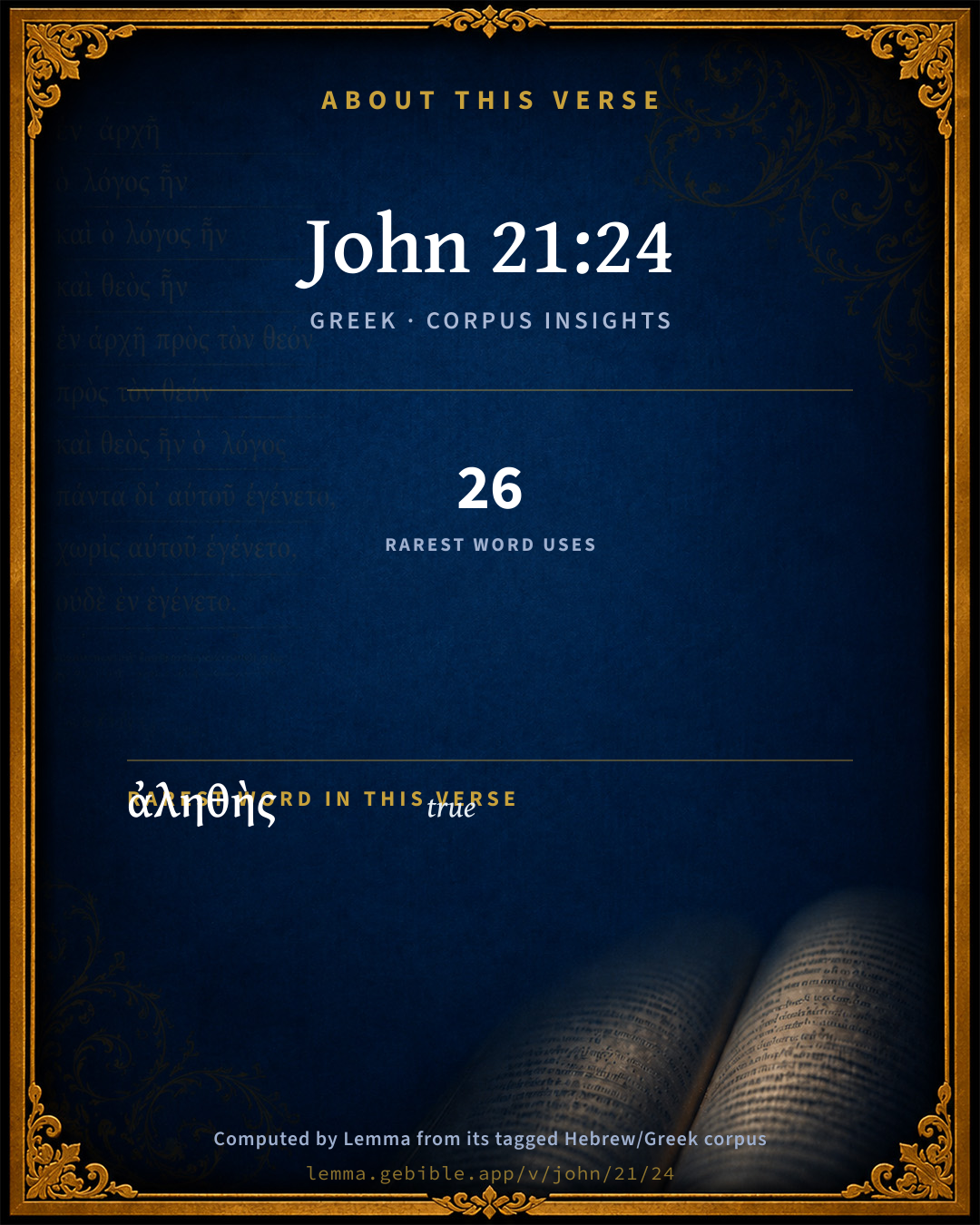
ἀληθὴς true G227 occurs in 25 verses of the Greek New Testament. Also found in:
Repetition

Words recur within this verse:

Cross-references

5

Topical passages linked to John 21:24 in the Treasury of Scripture Knowledge — connected by theme and wording, ordered by reader-vote popularity; previews shown in the World English Bible.

  • John 15:27 You will also testify, because you have been with me from the beginning.
  • John 19:35 He who has seen has testified, and his testimony is true. He knows that he tells the truth, that you may believe.
  • 1 John 1:1–2 That which was from the beginning, that which we have heard, that which we have seen with our eyes, that which we saw, and our hands touched, concerning the Word of life
  • 1 John 5:6 This is he who came by water and blood, Jesus Christ; not with the water only, but with the water and the blood. It is the Spirit who testifies, because the Spirit is the truth.
  • 3 John 1:12 Demetrius has the testimony of all, and of the truth itself; yes, we also testify, and you know that our testimony is true.

Cross-references courtesy of OpenBible.info (CC BY 4.0).

Commentary

Notes on John 21:24 from classic Christian and Jewish commentators (each source and its license shown beneath its notes). The classic Christian expositions comment on the surrounding passage and are grouped to its opening verse, so a note may address several verses; the Jewish commentaries on the Tanakh (Rashi and others) are per-verse, so they appear only where the commentator wrote on this verse.

Lemma curates 59 commentaries, every one of them public domain or Creative Commons licensed, each selected and text-cleaned for this edition rather than reprinted as found. About our sources →

Jamieson, Fausset & Brown

Robert Jamieson, A. R. Fausset & David Brown

FINAL CLOSE OF THIS GOSPEL. (Joh 21:24-25)

This is the disciple which testifieth of these things, and wrote these things--thus identifying the author of this book with all that it says of this disciple.

we know that his testimony is true--(Compare Joh 19:35).

Jamieson, Fausset & Brown — Commentary Critical and Explanatory on the Whole Bible (1871) — public domain (CC PDM 1.0). Text via the HelloAO Bible API.

The Cambridge Bible for Schools and Colleges

gen. ed. J. J. S. Perowne

24. which testifieth] Better, which beareth witness. Whether ‘these things’ refers to the whole Gospel, or only to the contents of chap. 21 cannot be determined.

wrote] Note the change from present to aorist. The witness still continues at the present time; the writing took place once for all in the past.

we know] Because S. John uses the singular, ‘he knoweth,’ in Joh_19:35, it does not follow that he would not use the plural here. It would have been out of place in the middle of his narrative to add the testimony of the Ephesian elders to his own as to details which he saw with his own eyes at the foot of the cross. But it is not unnatural that at the close of his Gospel he should claim them as joint witnesses to the fidelity with which he has committed to writing this last instalment of evangelical and apostolic traditions. Comp. 1Jn_5:18-20; 1Jn_5:15; 1Jn_3:14; 1Jn_1:1; 3Jn_1:12.

24, 25. Concluding Notes

Again the question of authorship confronts us. Are these last two verses by the writer of the rest of the chapter? Are they both by the same hand? The external evidence, as in the case of the preceding verses, is in favour of their being both by the same hand, and that the writer of the first twenty-three verses, and therefore S. John. No MS. or version is extant without Joh_21:24, and all except the Sinaitic, have Joh_21:25 also; nor is there any evidence that a copy was ever in existence lacking either this last chapter or Joh_21:24.

The internal evidence is the other way. The natural impression produced by Joh_21:24 is that it is not the writer of the Gospel who here bears witness to his own work, but a plurality of persons who testify to the trustworthiness of the Evangelist’s narrative. So that we possibly have in this verse a note added by the Ephesian elders before the publication of the Gospel. The change to the singular in Joh_21:25 would seem to imply that this verse is an addition by a third hand of a remark which the writer may have heard from S. John.

But the internal evidence is not conclusive, and the impression naturally produced by the wording of the verses need not be the right one. The aged Apostle in bringing his work a second time (Joh_20:30-31) to a conclusion may have included that inmost circle of disciples (to whom he had frequently told his narrative by word of mouth) among those who were able to guarantee his accuracy. With a glance of affectionate confidence round the group of devoted hearers, he adds their testimony to his own, and gives them a share in bearing witness to the truth of the Gospel.

The Cambridge Bible for Schools and Colleges (gen. ed. J. J. S. Perowne; Cambridge University Press, 1878–1918) — public domain. Text from a community e-Sword module.

The Biblical Illustrator

Joseph S. Exell

Joh_21:24-25

This is the disciple which testifieth of these things

The Gospel of St.

John

I. ITS TRANSCENDENT THEME.

The things which Jesus did.

1. Their number--many.

2. Their variety--other.

3. Their importance. So deep had been the impression made by them that they were even then remembered and could have been written down.

4. Their significance. The world would not contain, &c.

II. ITS UNAMED AUTHOR--the disciple whom Jesus loved. That this was John

1. The Gospel indirectly attests.

2. Ecclesiastical tradition confirms.

III. ITS VERACIOUS CHARACTER.

1. The testimony of the authors consciousness, if verse 24 be authentic.

2. The testimony of his contemporaries, probably the Ephesian

Elders, if verse 24 be non-Johannine.

Lesson: Gratitude

1. To God for His Son, Jesus Christ.

2. To Jesus Christ for the things which He did.

3. To the Holy Spirit for this sublime Gospel (T. Whitelaw, D. D.)

The revealed and the unrevealed in Christs biography

I. VERY MUCH HAS BEEN REVEALED. His four biographers have said very much about Christ, and each has presented Him in some fresh aspect.

II. MUCH MORE MIGHT HAVE BEEN REVEALED (Joh_21:25). What volumes it would have taken to record the deeds and words of Him who never spent an idle hour, but went about doing good! Conclusion:

1. We should fully appreciate the amount revealed. It teems with truths, and pulsates with inspiration. A larger amount, perchance, would have been obtrusive rather than helpful.

2. We may anticipate wonderful studies. All the unrevealed will be brought under our observation. (D. Thomas, D. D.)

The authentic and apocryphal Gospels

There are very many things written concerning Christ which are believed by others, but which I do not believe. The evidence from without I care little for, regarding only the evidence from within. Therefore it is that the reading of the uncanonical Gospels is useful in showing what a fine instinct, what a spirit of good taste, what a divinely inspired knowledge of what Christ was, the men who wrote our Four Gospels had. Between the two there is that singular difference which strikes a man of fine taste between the consummate work of a true artist and the work of a dauber, between a work of art wrought in love and one wrought only for bread. For the spirit of an artist creeps into every stroke of his brush; and in the writing of the Gospels, in settling which are canonical, every stroke is a betrayal. The apocryphal Gospels are not only a curious picture of the floating traditions of the Church; they are earthen vessels full of earthly dregs. They gather about Christ the stains of human stupidity and ignorance. Just as a man of fine taste has no difficulty in judging in a moment between a Raphael and what a coarse picture dealer declares to be one; just as one accustomed to the fine aromas of the wine of Hamburg can distinguish it from the spurious rubbish that is brought to imitate it; just as those who know the ring of true gold are proof against being deceived by the counterfeit, so there need be no difficulty in judging of these writings, as compared with the four Gospels now in use. (George Dawson, M. A.)

There are also many other things

The magnitude of Christs life

Such words as these are called strong language and exaggeration. But strong language is always true to the poet, natural to the passionate, truthful to the large-minded; and only obnoxious to the small, feeble, chill-blooded, to those who find human language big enough to live in. Human language is often felt to be like that bed of old, which was so short that a man could not stretch himself on it; and in trying to cover himself with the coverlid, found it to be too narrow. So as the next thing to having an adequate spoken language, men do what they can by extravagance to make it up. A great poet like Shakespeare presses the universe into his passion. He tells the woman he adores that her eyes outvie the brightness of the rising morning. One great ancient wished he was a star that he might look down always on her he loved. So these souls, feeling deeply, in order to say what they wish to say, since words wont do it, call upon all things to help them--the rose of Sharon, the lily of the valley--all things are called in, that the beloved may be set forth in glory. Strong language is objectionable, is it? Yes, when it is but the emphasis of emptiness; when little people make a great noise, using language stronger than the occasion requires, the sin and shame of it is that they have no feeling adequate to it. But when the heart is all aglow, and the thing to be said infinite, then the most extravagant language is poverty stricken. To hear some commentations over the phrase is charming--This passage must not be taken literally; of course the Apostle meant--Oh, thank you for nothing! I want not your dry bread of sand. What John meant was that there were so many things that might be told about Christ, that the world could not contain it all. Beautiful expression! And how adequate! Now, what does it teach? If any mans biography were to be daily written down it would make a big book. One of the most charming books was written by a man on a tour round his chamber. Put some people in a room and they behold no more than a blind horse would. But not so with the instructed man. He would pause at every part of the room, and tell tales about the woodwork, tales of the trees from which the wood came, and or the climate in which they grew--tales that would run back to Adam. Franklin tells us that he rose at six and washed. But if he had stopped to tell us all about rose, what a volume would be wanted, and so on with washed and dressed. And so one might come to think with the great poet, that the best portion of a mans life lies in the little nameless, unrecorded acts of kindness. It is the unwritten things of life that uphold the great things. So, when we think of Christs life, and of the little that is said about Him, we know there must have been much that might have been written. (George Dawson, M. A.)

The many things which Jesus did

Does St. John end his Gospel with an exaggeration? What shaft we say?

I. THERE ARE SEVERAL SOLUTIONS.

1. That the passage has been interpolated. But this view has no foundation. The verse is only wanting in one MS.

2. That it is only St. Johns way of expressing his sense of the immense diligence of Christs life, and the unparalleled number of His good works; and that, to convey that idea, he uses language which is, indeed, after the Eastern language, hyperbolical; but which could not mislead.

3. That St. John is speaking of all which Christ had done, and is doing, and will do to all eternity--in which acceptation the words would be strictly true--for then we should be dealing with the Everlasting and the Infinite--which, of course, exceeds the compass of the universe. But thecomment is strained and far-fetched.

4. That the word contain is ambiguous, and that it might be translated, the world, i.e., the ungodly world, would not receive the whole of what Jesus did.

5. That St. John is speaking not of the mere outward actions, but of what they represented and involved. And this is none other than a literal truth that if all these were written, seriatim, the world itself could not contain the account which should be written.

II. The last seems to be the only true understanding of St. Johns words: THE INCOMPREHENSIBLE FULNESS THAT THERE IS IN THE MINUTEST PORTION OF CHRISTS MINISTRY.

1. Remember

(1) It is the life of the Son of God who came to this earth for about thirty-three years, of which we have the history of only three, and in those three only a few leading, salient features.

(2) That the object of this short visit was the salvation of the whole world.

(3) That infinite love, wisdom, and power met in His every word and act.

(4) That the record, which has been given us, has been left for His Church to read, and live upon for ever. There is enough to satisfy the whole intellect and affection of the race. And if the gospel be such as this--what a weight, what an infinity, there must be in every iota. If we waste a crumb, it must be at our peril, and with great damage! Here is our duty, and here is the great work of the Holy Ghost, to find the latent senses of each fraction of that portentous narrative. The secret of the Lord,--covered thoughts, intentions sealed except to the initiated--the secret of the Lord is with them that fear Him.

2. You must consider also

(l) Every action of Christ was first a great beautiful fact, standing out to be admired.

(2) It was an illustration of His character, in which we are to read out His sympathy, wisdom, power, faithfulness, &c.

(3) We are to read, through Him, God--the only real delineation we have of the Invisible Father.

(4) It is the illustration and the pledge of what Christ is and does now He is in glory.

(5) It is our pattern and example that we may copy.

(6) It is an allegory--a parable of spiritual things which always lie underneath it.

3. Now, take any one event in our Lords ministry, and divide it into all these parts: see it in all its lights; and what a volume will be there! Regard, in this way, His baptism, or His temptation, or His transfiguration, or His death, &c., or any one of His miracles; or a prayer, a touch, a look; and into what masses and mountains of thought it all swells! What piles upon piles might be said and written!

4. Think of all that, for nearly nineteen centuries, has been said and written by the Church on those four Gospels; and yet it is not exhausted. New thoughts, new beauties, new comforts are coming up every day. And were the world to last nineteen thousand centuries more, it would be just the same! And will not these things be the themes of faculties infinitely higher, than now, throughout eternity? Do not the angels still desire to look on them?

5. Then, we must add to the account that there were many things which Jesus did which St. John knew but did not record; many more, which none knew, or could know. But all would bear the same development.

6. Then, when, for a moment, we try to draw these together and conceive the total of such an aggregate, is the language one whir too strong?

III. LET ME GATHER SOME INFERENCES.

1. When we have to do with the life of Christ, we are dealing with the most solemn immensities. The more we study it, the more we shall feel with St. John--that we are standing on the shore of a boundless ocean; that what we see is nothing compared to what lies beyond the horizon. That all human intellect put together, and all the largest hearts of men of love, if that love could go on for ever, could not contain the half of what Christ did, and what Christ was. Is that too much to say? You will not think so if you love Him and know Him.

2. Therefore you must come to the contemplation of every part of Christs life very modestly. There is much more than you have any idea of. If you think you know any verse of the Bible, you have yet a great deal to learn. You will never empty it. And, seeing it so exceeds all our proportions, you must pray for the enlargement of your own soul, that you may be able to contain it.

3. For a heart enlarged by the Holy Ghost has a greater capacity than the universe. The universe could not contain it; but, by the working of the Holy Ghost, it is promised you shall be able to comprehend with all saints, what is the length, and breadth, and depth, and height, and know that love of Christ which passeth knowledge. (J. Vaughan, M. A.)

The unwritten sayings of Jesus

When I see how much has been written of those who have lived; how the Greeks preserved every saying of Platos; how Boswell followed Johnson, gathering up every leaf that fell from that rugged old oak, and pasting it away, I almost regret that one of the disciples had not been a recording angel, to preserve the odour and richness of every word of Christ. When John says, And there are also many other things which Jesus did, the which, if they should be written every one, I suppose that even the world itself could not contain the books that should be written, it affects me more profoundly than when I think of the destruction of the Alexandrian Library, or the perishing of Grecian art in Athens or Byzantium. The creations of Phidias were cold stone, overlaid by warm thought; but Christ described His own creations when He said, The words that I speak unto you, they are life. The leaving out of these things from the New Testament, though divinely wise, seems, to my yearning, not so much the unaccomplishment of noble things, as the destruction of great treasures, which had already had oral life, but failed of incarnation in literature. (H. W. Beecher.)

The sufficiency of the Gospels

Supposing a complete biography of Christ to have been written, let us consider

I. ITS MAGNITUDE. In every life there are many transactions which would add nothing to the completeness of a biography. There are many things in the experience of us all which are like blades of grass. To distinguish them in a picture would be to impair it and give us not the field but the grass. But things were otherwise with Christ. Every miracle, prayer, look, &c., was worthy of a picture by itself. And suppose instead of our present summary we had all the details what a library there would be. And then there are many things which it takes a longer time to describe than to do.

II. ITS CUMBROUSNESS.

1. What life would be long enough to produce it.

2. What means could be adequate to disperse it.

3. What man could read, let alone remember it. Conclusion: Let us see the impossibility of making any improvement in Gods Word. There is wisdom as well in its limits as in its matter and form. (Mathematicus.)

St. Johns Gospel a collection of specimens

The materials which he has actually made use of are few in number compared with the store from which he might have drawn; he omitted many things, the record of which might have over-filled the world with books; with only a few selections from his rich treasury, he shows us the glory of the Incarnate Word--as if a painter should take a bit of grey rock, a tuft of maidenhair fern growing in a crevice, some patches of grass and heather, a tree or two, a human figure, a dim-seen mountain range, the infinite blue sky, and putting these into a picture should show us the glory of God in nature. (J. Culross, D. D.)

Christ an inexhaustable treasure

Treasures many are contained in the Bible, but not all. There are more treasures in Christ than even in the Bible. He could not transfer all the treasures of His person into a book, for if they should be written, &c. Blessed be God for the treasures contained in this precious volume before me, but the day will arrive when they shall be all exhausted. But after exhausting the treasures of the Book, the treasures of the Person will still remain. Blessed be His name for the treasures which have come through Christ, thrice blessed for the treasures that are in Christ. Dwelling in Him are treasures enough to make a dozen new Bibles, the Bibles of eternity. (J. Cynddylan Jones, D. D.)

.

The Biblical Illustrator, edited by Joseph S. Exell (c. 1880s–1900s) — public domain. Text from a community e-Sword module.

Joseph Benson's Commentary

Joh 21:24. This is the disciple which testifieth these things — Being still alive after he had written them. From this verse Grotius and some others infer, that the Ephesian bishops added this whole chapter to St. John’s gospel, after his death. But, as Dr. Macknight observes, it evidently proves the contrary, for it assures us that John wrote the things contained in this chapter. And we know that his testimony is true — The church probably added these words to this gospel, as Tertius did those to St. Paul’s epistle to the Romans, Rom 16:23. Further, though the evangelist seems to conclude his gospel, (Joh 20:31,) it is no unusual thing with the sacred writers to add new matter after such conclusions. See the epistle to the Romans, and that to the Hebrews, at the end. As to the writer of this gospel being spoken of in the third person, it is agreeable to John’s manner; (see Joh 19:35;) who likewise speaks of himself in the plural number, 1Jn 5:18-20. To conclude, the verse under consideration is shown to be genuine, by a similar passage in the conclusion of the third epistle, Joh 21:12. In detailing the events subsequent to the crucifixion, the reader may readily observe, that much matter is recorded in a small compass; and that though each evangelist has given his particular and connected narration, much new matter is introduced by each one, unnoticed by the others. To frame a general narrative by a combination of the whole, and to dispose the various circumstances in the order they are supposed to have occurred, have been objects of difficulty to harmonists. On these accounts, the following concise summary of the events, in the order they may rationally be supposed to have happened, is introduced, as arranged by Dr. Benson, and afterward adopted by Archbishop Newcome.

On the morning of the first day of the week, Jesus rises from the dead; a great earthquake happens about the time of his resurrection; and an angel appears, who rolls away the stone that closed the mouth of the sepulchre, sits upon it, and strikes the keepers with great fear; thus causing them to remove to such a distance, as to remain unnoticed by the women and others hereafter, Mat 28:2-4. After his resurrection, many bodies of the saints rise from their graves, and are seen by many in Jerusalem, Mat 27:52-53. Mary Magdalene, Mary the mother of James, Salome, Joanna, and other women, (Mar 16:1; Luk 24:1; Joh 20:1,) go very early to the sepulchre, intending to embalm the body of Jesus, (having bought spices the preceding evening for that purpose.) In their way they consult about removing the stone from the door of the sepulchre. Perceiving it already taken away, they enter into the sepulchre, yet find not the body of the Lord Jesus, Mar 16:3-5; Luk 24:2-3; Joh 20:1. Mary Magdalene, hastily returning to Jerusalem, relates to Peter and John that they had taken the Lord out of the sepulchre, Joh 20:2. The other women remaining in the sepulchre, two angels appear unto them, and one of them requests the women to inform the disciples, and Peter in particular, that Jesus was risen, &c., Mat 28:5-7; Mar 16:4-7; Luk 24:4-8. The women return from the sepulchre, relate these things to the apostles, and are discredited, Mat 28:8; Mar 16:8; Luk 24:8-11. Peter and John having heard Mary Magdalene’s report of his having been taken away, and the women’s of his having risen, run to the sepulchre, and find the body removed according to their information, and wondering at what was come to pass, return home, Luk 24:12; Joh 20:3-10. The resurrection having been stated to the disciples at Jerusalem at this period, (Luk 24:22-24,) Cleophas and his companion leave their brethren to go to Emmaus. Mary Magdalene goes again to the sepulchre, tarries there after the apostles, (Joh 20:11,) and converses with the two angels who had before appeared to the women. Turning herself back, she perceives Jesus, who gradually makes himself known unto her; she consequently hastens to the city, and announces this his first appearance to the disciples, but they believe not, Mar 16:9-11; Joh 20:11-18. The other women, having told the disciples of his resurrection, continue in the city, while Peter and John visit, and Mary Magdalene revisits, the sepulchre: they then go back again, and upon finding it deserted, return toward Jerusalem. On their way, Jesus meets and requests them to direct his disciples to depart into Galilee, Mat 28:9-10. This is his second appearance. The guards about this time leave the neighbourhood of the sepulchre, and inform the Jewish rulers of what had occurred within their knowledge, Mat 28:11-15. According to Paul, (1Co 15:5,) the third appearance is to Cephas; and the fourth, to the two who some time prior to this left their brethren to proceed to Emmaus; who, immediately returning to Jerusalem, relate it to the other disciples, and are not credited, Mat 16:12-13; Luk 24:13-36. The last time of his being seen on the day of his resurrection, being the fifth, was by the apostles as they sat at meat in the absence of Thomas, 1Co 15:5; Mar 16:14-18; Luk 24:36-49; Joh 20:19-23. This concludes the great and glorious transactions of the important day on which Jesus rose from the dead. About the eighth day after his resurrection, he again, the sixth time, appears to his disciples, when Thomas was present, Joh 20:24-29. His seventh appearance occurs between the eighth and fortieth day, at the sea of Tiberias, to his disciples, (Mat 28:16; Joh 21:1-24,) and his. eighth, to them upon the mountain in Galilee, Mat 28:16-20. Paul (1Co 15:6) relates his having been seen of above five hundred brethren at once, many of whom, at the time of his writing this epistle, were living witnesses to this the ninth appearance. His tenth is to James; and his final appearance, being the eleventh, is to the apostles, on the ascension, 1Co 15:7; Act 1:3-12; Mar 16:19-20; Luk 24:50-53.

Joseph Benson's Commentary on the Old and New Testaments (1811–1818) — public domain. Text from a community e-Sword module.

Whedon's Commentary on the Bible

Daniel D. Whedon

The attestation and conclusion, Joh_21:24-25.

Against the arrogant pretensions of modern factitious criticism, “criticism run mad,” we repudiate the notion that these verses are added by a later hand It is a modern invention, that about the Ephesian Church giving us this testimony to John! His own spirit and style breathe in every clause. This, is certain, that if it were by any other hand, the spurious writer does his best, with great success, to counterfeit the authorship he professes to authenticate. The additional verses are composed either by the apostle or by an impostor. But we believe that the Church of that day could not have been imposed upon, and would not impose upon us a counterfeiter’s endorsement of this memorable Gospel.

24. This is the disciple—Spoken in John’s usual manner of himself, in the third person.

We know—Speaking in full apostolic and inspired authority for and with the apostolic Church. From that Church, the gifted Church, endued with the discerning of spirits, we receive the sacred canon, and thereby amply prove that its books were selected under divine guidance. Even if the authors were not inspired, this testimony of the then living Church fully establishes the New Testament as the authentic announcement of the facts and doctrines of Christ’s religion. That the apostle here passes into the plural number, we know, is a dignified assumption of representative character, in communion with that Church.

Daniel D. Whedon (gen. ed.), Commentary on the Old and New Testaments (1874–1909) — public domain. Text from a community e-Sword module.

Lange's Commentary on the Holy Scriptures

IV

IV. The Testimony of John and the Testimony of the Church. Infinitude of the Evangelical History

Joh_21:24-25

24This is the disciple which [who] testifieth [ὁ μαρτυρῶν] of these things, and wrote [who wrote, ὁ γράφας] 27 these things: and we know that his testimony is true. 28 29 25And there are also many other things which 30 Jesus did, the which, if they should be written every one, I suppose that even the world itself could not contain 31 the books that should be written. Amen, [omit Amen.] 32

EXEGETICAL AND CRITICAL

Joh_21:24. This is the disciple [Οὐτός ἐστιν ὁ μαθητής].—Self-designation of John, as in Joh_19:26. [A conclusion corresponding to the one Joh_20:31, and traced to John also by Meyer anti Alford.—P. S.]

Of these things [ὁ μαρτυρῶν περὶ τούτων].—Referring to the contents of the 21st chapter.—And who wrote these things [καὶ ὁ γράψας ταῦτα].—Particularly, also, to the setting of the Christians right in regard to the tradition which had commenced to gather form. [Mark the difference of the tenses: μαρτυρῶν—the testimony continues, γράψας—the writing is an accomplished act.—P. S.]

We know that his testimony [καὶοἴδαμεν ὄτι ἀληθής αὐτοῦ ἡ μαρτυρία ἐστίν—Different interpretations:

1. Οἶδα [I know] μέν (Chrysostom, Theophylact). An exegetical conjecture (similarly Beza’s οἶδεν).

2. An indication of the ungenuineness of the conclusion or of the whole chapter (modern criticism).

3. John made himself one with his readers (Meyer). [So also Alford; comp. Joh_1:14; 1Jn_4:14; 1Jn_4:16; 1Jn_5:18.]

4. Probably a later addition from the Ephesian church. Not because, as according to Lücke, “John never wrote in the first person, either of the plural or of the singular.” See on the contrary, Joh_1:14. But the corroboration of his own testimony with the words; We know that his testimony is true, would be too strikingly singular. The expression Joh_19:35 runs differently. We have therefore bracketed the words “we know,” etc., considering them to be the only later Ephesian addition in the whole chapter.

[Meyer regards only Joh_21:25 as a later addition; Tholuck, Luthardt, Godet, etc., Joh_21:24-25; Lücke, Bleek, Ewald, etc., the whole chapter; Lange, Alford and Wordsworth accept the whole as Johannean,—Lange, however, excepting the second clause of Joh_21:24.—P. S.]

Joh_21:25. But there are also many other things [Ἐστι δὲ καὶ ἃλλα πολλὰ].—Mayer: “Apocryphal conclusion of the whole Gospel—after the addition of the Johannean supplement Joh_21:1-24.” The Evangelist thinks it important that he should remind his readers that he has not written as a chronicler, but has selected and arranged things in conformity to an organizing principle, as did also his predecessors, though not in the equal power of a concentrated, unitous, ideal view. 33 That this note of the Gospel has not at all an apocryphal aspect, but would, on the contrary, be qualified, were more attention accorded it, to strip our modern criticism of many apocryphal opinions (particularly, of the continually recurring idea that the Evangelists were chroniclers, that their writings were grounded upon one another, etc.), is evident.

If they should be written every one … one by one [ἄτινα (quippe quæ, utpote guæ, referring to the largo number) ἐὰν γράφηται καθ’ ἕν (piece for piece), οὐδ̓ αὐτὸν οἰμαιτὸν κόσμον (ne ipsum quidem mundum) χωηρ́σειν34 τὰγραφόμενα βιβλία Comp. a somewhat analogous expression Ecc_12:12 : “Of making many books (or chapters) there is no end.” Different interpretations of χωρεῖν,capere: 1. Locally: Unable to hold (capacitas loci). Restricted by Ebrard: No place in literature. 2. Intellectually: Unable to understand (capacitas intellectus). Jerome, Augustine, Calov, Bengel (“hoc non de capacitate geometrica, sed morali accipiendum est”). 3. Figuratively and hyperbolically: Any number of books would not exhaust the subject. Similarly Godet: “Divin de sa nature, l’objet de l’histoire évangélique est plus grand que le monde et que toutes les narrations que le monde pourrait contenir. L’écrivain exprime, par une image matérielle, le vif sentiment qu’il a de la richesse infinie de cette histoire.”—P. S.] According to the conclusion of the Evangelist, the world itself would be unable to contain the books that would then be written continually (γραφόμενα). Even Tholuck agrees with Meyer (who refers to similar hyperboles in Fabricius ad Cod. Apocryph. I., p. 321) in thinking this proposition1 hyperbolical. The apparent hyperbolism of the expression, however, very clearly illustrates the pure infiniteness in the life-development of the Logos, by a quantitative, local measure. We make use of a hundred similar expressions without their hyperbolism being deemed improper or apocryphal, for instance: “O dass ich tausend Zungen hätte” (“O that I had a thousand tongues”)—“Den aller Weltkreis nie umschloss” (“Whom the whole world did ne’er enclose”) 35—“The whole world lieth in wickedness—in the Evil One,” etc. Weitzel has entered the lists in defence of the propriety of the expression, Studienu. Kritiken 1849, p. 633; comp. my Leben Jesu III., p. 760. L uthardt: “For only an absolute external compass corresponds with the absolute contents of the person and life of Christ;” whereupon Meyer remarks: “Inevident to me!” “Aber, Freunde, im Raum wohnt das Erhabene nicht” (“But, O friends, the sublime dwelleth not in space”), says Schiller elucidatively. The Evangelist, however, in submitting his book to the Church, may well come forward with an unwonted οἶμαι in order, by a strong expression, to dissuade the reader from the chronistic apprehension of the Gospel, and to urge him to the historico-symbolical view which recognizes in the organically articulated selection of ideally transparent facts, the historical life-picture of the infinite fulness of the life of Jesus.36

This symbolical character, presented in pure but speaking facts, is possessed, in a peculiar degree, by the closing chapter, to which the closing words primarily have reference. The interpretation of Jerome, Augustine and others: The world would be spiritually incapable of grasping such books,—would apply even to the four small Gospels, though in sooth a Gospel developed in infinitum would pass the comprehension not only of the present world, but also of Christendom as it here exists. Here, however, emphasis is laid not upon the æonic unfathomableness of the life of Jesus, but upon its ideal infinitude, in the symbolical explicitness of the evangelical history. 37

DOCTRINAL AND ETHICAL

1. The absolutely dynamical view of the world, as the specifically Christian view of it, is the fundamental feature and the key of the Johannean Gospel, of Johannean theology. The personal principle is the royal life-principle of the world. The personality of God in the personality of Christ, annihilates the power of the anti-personal, Satanic essence, and appoints the impersonal world to the service of life; it is diffused in the personality of the Apostles, in order that it, may lift the whole world out of the abyss into the light of glorification, in which the world, as the old world, vanishes, in order to shine forth again as the eternal House of the Father, the eternal City of God. In conformity to this dynamical view, Christ’s pre-temporal rule in the world is finally summed up in the testimony of John the Baptist; His post-temporal rule, in the ministry of the twelve Apostles; the draught of fishes of the seven; the simple contrast of the following disciple and the tarrying one; finally, in the type of a friendship with Christ which remains until the Lord comes.

With this dynamical character, then, the apostolic presentation of the evangelical history also corresponds. That history is not chronistically, but æonically, executed; not atomistically expanded, but principialiy concentrated; the whole infinitude and fulness of the signs of Jesus must be reflected in a concentric selection of speaking facts, translumined by the idea. Not in outward extension—in transparent concentration, the expression of eternal life is accomplished.

2. The great distance between John’s view of the essence of evangelical historiography and the opinions or prejudices of modern criticism, becomes evident from the foregoing, and from the last Exeg. Note.

3. Even the Christian Gramma may err in the way of profuse book-making. Against this the Christian spirit of a John opposes its final words of warning; the like did the Preacher Solomon in the Old Testament (Ecc_12:12), and also Plato in Phædrus 60. The Christian spirit-word does not aim at converting the world into a vast library of sacred writings, but into the Divine House of the adorned Bride of Christ and of the marriage of the Bridegroom. To this end, Christian literature, with its testimony concerning Christ, is indeed to work, drawing all literature into His service; but the more it extends itself through the world, the more it should concentrate itself, shaping itself into the transparent life-picture of the glory of God in Christ.

HOMILETICAL AND PRACTICAL

The testimony of the friend of Jesus concerning his Lord and Master.—Together with the faithful testimony concerning Christ, the testifying disciple unconsciously immortalizes himself.—And we know that his testimony is true: 1. We know: a. we believe it, b. we not only believe it, we know it, c. we not only know it (in the sense of the world’s knowledge), we experience it. 2. We know, concerning his testimony, that it is sealed with the water and blood of Christ. 3. That it is true: a. true in spite of all the objections and contradictions of the world, b. true in the might of the Spirit who hath overcome the world.—How it is impossible, and yet possible, to depict the glory of Christ: 1. Impossible by the multitude of words, discourses and writings; 2. possible by the simple word of the Spirit concerning His great signs.—The evangelical life-picture of the Lord: 1. In respect of its finite form; 2. in respect of its infinite contents; 3. in respect of its New Testament, eternally new operation.

Strke: That which by grace we have received from God and done for the honor of God, we may well make known to others, taking care only that all boastfulness on account of our own persons is avoided, 1 Corinthians 11.

Braune: “An individual once appeared on earth who, merely by moral omnipotence, conquered remote times and founded an eternity of His own. It is that calm Spirit whom we call Jesus Christ. Only quiet teaching and quiet striving formed the melodies wherewith this higher Orpheus tamed human beasts and converted rocks into sanctuaries of God. And yet out of so divine a life,—as it were, out of a thirty years’ war against a perverse, insensible people,—we are familiar with but a few weeks. What transactions, what words of His may have been swallowed up from our knowledge before He became acquainted with the four writers of His history, those men by nature so dissimilar! If, then, out of so divine a life-book only scattered leaves have fluttered to us, so that perhaps greater deeds and words of that life are forgotten (?) than were detailed, repine not, nor pass judgment over the ship-wreck of little works and men, but recognize in that Christianity which nevertheless blossomed afterwards, the fulness with which the (All) Spirit yearly suffers the perishing blossoms to exceed in number those that thrive, without therefore forfeiting a future spring” (Jean Paul).

Schleiermacher: “For a long time there has been a fable current among men, and even in these days it is (still) frequently heard; unbelief invented it, and little faith receives it. Thus it runs: ‘There shall come a time, and perhaps it is already here, when His right shall befall even this Jesus of Nazareth. Every human memory is fruitful but for a certain period; much doth the human race owe to Him, great things hath God accomplished by Him, yet He was but one of us, and His hour of oblivion, too, must strike. If He was in earnest in desiring to make the world absolutely free, He must likewise have willed to make it free from Himself, that God might be all in all. Then men would not only perceive that they have strength enough in themselves to fulfil the divine will, but in the true understanding of the same, they would be able to exceed His measure, if they did but wish. Yes, only when the Christian name is forgotten, shall a universal kingdom of love and truth arise, in which no germ more of enmity shall lie, such as has been sown from the beginning betwixt those that believe on this Jesus and the rest of the children of men.’ But it shall not be realized,—this fable; since the days of His flesh, the Redeemer’s image has been indelibly stamped on the race of men! Even though the letter might perish, which is holy only because it preserves us the image, the image itself shall last for ever; too deeply is it graven upon men ever to be effaced, and what the disciple said, shall always be truth: ‘Lord, whither shall we go? Thou alone hast words of eternal life!’

Heubner: The pernicious making and reading of books has been greatly prejudicial to the reading of the Book of Life, and to the Christian life. Luther himself on this account often wished his books done away with, Works i. 1938; xiv. 420; xv. Anh., p. 90; xx. 1031; xxii. 85.

Yet doubtless only in a qualified sense. The books of faith should promote life,—hence should be, as living books, strictly articulated organisms of life. Their foundation and aim is the Book of Life. This is above all true of the Holy Scriptures, particularly of the Gospels, most particularly of our Gospel.

[Craven: From Burkitt: Joh_21:25. The wonderful activity, industry, and diligence of the Lord Jesus Christ; He was never idle, but His whole life was spent in doing good.

[From M. Henry: Joh_21:25. If it be asked why the gospels are not larger, it may be answered, I. It was not because they had exhausted their subject; II. Bat 1. It was not needful to write more; 2. It was not possible to write all; 3. It was not advisable to write much.

[Schaff: Joh_21:24-25. Though but little has been written on the life of Christ by the Evangelists, that little is of more accountthan all the literature of the world, and has been more productive of books, as well as thoughts and deeds, than any number of biographies of sages and saints of ancient and modern times. The Gospels, and the Bible generally, rise like Mount Ararat high above the flood of literature; they are the sacred library for all nations, the literary sanctuary for scholars and the common people; they combine word and work, letter and spirit, earth and heaven, time and eternity. The eloquent tribute of an English divine 38 to the influence of the Bible applies especially to the Gospel of John, and may appropriately conclude this Commentary. “This collection of books has been to the world what no other book has ever been to a nation. States have been founded on its principles. Kings rule by a compact based on it. Men hold the Bible in their hands when they prepare to give solemn evidence affecting life, death, or property; the sick man is almost afraid to die unless the Book be within reach of his hands; the battle-ship goes into action with one on board whose office is to expound it; its prayers, its psalms are the language which we use when we speak to God; eighteen centuries have found no holier, no diviner language. If ever there has been a prayer or a hymn enshrined in the heart of a nation, you are sure to find its basis in the Bible. There is no new religious idea given to the world, but it is merely the development of something given in the Bible. The very translation of it has fixed language and settled the idioms of speech. Germany and England speak as they speak because the Bible was translated. It has made the most illiterate peasant more familiar with the history, customs, and geography of ancient Palestine, than with the localities of his own country. Men who know nothing of the Grampians, of Snowdon, or of Skiddaw, are at home in Zion, the lake of Gennesaret, or among the rills of Carmel. People who know little about London know by heart the palaces in Jerusalem, where those blessed feet trod which were nailed to the Cross. Men who know nothing of the architecture of a Christian cathedral, can yet tell you all about the pattern of the Holy Temple. Even this shows us the influence of the Bible. The orator holds a thousand men for half-an-hour breathless—a thousand men as one, listening to his single word. But this Word of God has held a thousand nations for thrice a thousand years spell-bound; held them by an abiding power, even the universality of its truth; and we feel it to be no more a collection of books, but the Book.”—P. S.]

Footnotes:

[27]Joh_21:24.—[The article before γράψας is omitted by א1 A. C. X. Orig., Tischend., inserted by B. D. lat. (et qui scripsit.) Lachm., Treg., Alf., West. Cod. B. inserts καὶ before μαρτυρῶν.—P. S.]

[28]Joh_21:24.—[Dr. Lange brackets the last clause: καὶ οί́δαμεν ὅτι ἀληθής αὐτοῦ ἡ μαρτυρία ἐστίν, considering it an addition of the elders of Ephesus and friends of John, while he ascribes all the rest, including Joh_21:25, to John. See Exeg.—P. S.]

[29]Joh_21:25.—This verse is wanting in Cod. 63 [?],—a circumstance of no importance, however. (On the Sin. see Tischend.) [Lachmann, Tregelles, Alford, and Westcott retain Joh_21:25, except the concluding ἀμήν, Westcott, however, separates it from the preceding text. Tischendorf alone, ed. VIII., excludes it from the text on the sole authority of the Sinaitic MS. which indeed contains the verse, but, as he asserts, written by another hand, see his note, p. 965. But in the large quasi-fac-simile ed. of the Cod. which I have used all along, there is no perceptible difference. He then also corrects an error with regard to Cod. 63, which was quoted by Mill, Wetstein, Griesbach, Lange (in the preceding remark), etc., in favor of omission, but according to Scrivener, the last page of that Cod. with the 25th verse is lost. Tischendorf here gives too much weight to Cod. Sin. which he had the good fortune to discover. The omission, if such could be proven, has little weight in view of the many instances of carelessness on the part of the copyist, and of the filling up of the lacuna by the first corrector, who, according to Tischendorf, was cotemporary with the copyist. All other known MSS. contain Joh_21:25, though many state in a note that it was regarded by some as a later addition.—P. S.]

[30]Joh_21:25.—The reading ἅ in accordance with Codd. א. B. D. * etc., Lachmann [Treg., Alf., West., instead of text rec. ὅσα which is retained by A. C.2 D. and expresses the quantitative relation, quæet quanta, quotquot, what and how many; comp, Rev_1:2.—P.S.]

[31]Joh_21:25.—[Lachm., Alfd. χωρῆσαι, with A. B. C.2 D. text. rec.; Treg., Tisch., West. χωρήσειν, with א. B. C *.—P. S.]

[32]Joh_21:25.—The ἀμήν of the Recepta (Codd. E. G. H. K. M. etc.) is wanting in Codd. [א.] A. B. C. D. etc. [Amen is a liturgical or devotional addition, and justly omitted by Lachm., Treg., Alf., Westc. and H.—P. S.] On the various subscriptions: εὑαγγέλιον κατὰ Ἰωάννην (A. C. E. [אa]); κατὰ Ἰωάννην (B.) etc., comp. Tischendorf. K. M. U. X. [also א Γ.] have no subscription. [Tischendorf states that the subscription in א is not written by the same hand, but by א corr.la On the Latin subscriptions, see Tischend. p. 967.—P. S.]

[33]

[So also Alford: “The purpose of this verse seems to be to assert and vindicate the fragmentary character of the

Gospel, considered merely as a historical narrative:—for that the doings of the Lord were so many—His life so rich in matter of record,—that, in a popular hyperbole, we can hardly imagine the world containing them all, if singly written down; thus setting forth the superfluity and cumber-ousness of anything like a perfect detail, in the strongest terms, and in terms which certainly look as if fault had been found with this Gospel for want of completeness, by some objectors.”—P. S.]

[34][Or, according to the other reading infin. aor. χωρῆσαι, which after οἶμαι without ἄν is pure Greek, and expresses more strongly the faith in the certainty of the fact stated than the fut. χωρήσειν.—P. S.]

[35]

“Vom Himmcl steigend Jesus bracht

Des Evangcliums ewige Schrift,

Den Jungern las Er sie Tag und Nacht;

Ein göttlich Wort, es wirkt und trifft.

Er stieg zurück, nahm’s wicder mit,

Sie aber hatten’s gut gefühlt,

Und Jeder schrieb so Schritt für Schritt,

Wie er’s in seinem Sinn behielt.

Verschieden: Es hat nickts zu bedeuten

Sie hatten nicht gleiche Fähigkiten;

Duck damit kinnen sich dic Christen

Bis zu dem jüngsten Tage fristen.”

(Goethe).]

[36][Wordsworth puts into the first person singular οἶμαι, which John nowhere else uses in the Gospel, the intention of the writer to guard against the inference that Joh_21:25 was written by a person different from John, who wrote in the plural οί́δαμεν in the preceding verse. But this would have been done more effectually by using the singular in both cases. Godet conjectures that the subject of the οἶμαι is one of the apostles present with John at Ephesus, probably Andrew, who, with John, was the oldest disciple of Christ (John 1).—P. S.]

[37][Lines of two celebrated German hymns. To these may be added similar expressions in English hymns, as,

“Oh! for a thousand tongues to sing,” etc.

“Had I a thousand hearts to give,” etc.

“Were the whole realm of nature mine,” etc.

But these and similar expressions are desires poetically expressed, while here we have a statement in prose.—P. S.]

[38][I saw it in a respectable Magazine attributed to the Rev. F. Robertson, the late gifted preacher of Brighton, but I have been unable to verify the quotation and cannot vouch for its accuracy.—P. S.]

Lange's Commentary on the Holy Scriptures (Critical, Doctrinal, and Homiletical), ed. John Peter Lange, English translation edited by Philip Schaff (1864–1880) — public domain. Text from a community e-Sword module.

Tyndale Open Study Notes

Tyndale Open Resources

21:24 This disciple is the one who testifies . . . and has recorded: John’s Gospel is anchored in his personal experiences. It is not a story written from hearsay or speculation, but from the remembrance of a man who spent life-changing years with Jesus and recalled, with the help of the Holy Spirit (14:26), what Jesus said and did. • we know: This account of the life of Christ was not speculation or weak reminiscence. Rather, it was based on the confident knowledge of reliable eyewitness accounts.

Tyndale Open Study Notes — © Tyndale Open Resources, licensed CC BY-SA 4.0. Text via the HelloAO Bible API.

Bengel's Gnomon

Johann Albrecht Bengel

Joh 21:24. Οὗτος, this) Therefore at that time, as yet the disciple was remaining, and his remaining showed the truth of the Lord’s words, after so many years had elapsed, and the power of His will [“If I will”].—ὁ μαρτυρῶν) He who was testifying) viz. in his words, as yet surviving. The γράψας, he who wrote, corresponds to this.—καὶ οἴδαμεν, and we know) John himself may have prescribed this clause to the Church, which accordingly would, with no unwillingness, read it in public, and acknowledge it as obligatory with believing assent. But if the Church has added this, it does not derogate from the authority of the work, any more than that little verse which Tertius interwove with the Epistle to the Romans: or, if I may add this, than the little clause added to the Commentaries of Sleidanus concerning his death, and which was perhaps begun by himself and finished by a friend.

Bengel's Gnomon of the New Testament — English translation (T&T Clark, Edinburgh, 1860) — public domain. Text from a community e-Sword module.

Meyer's Critical & Exegetical Commentary

Heinrich August Wilhelm Meyer

Joh_21:24. Conclusion by John to this his supplement, Joh_21:1-23, which he makes known as his work, and the contents of which he maintains to be true. To his book he had given the conclusion, Joh_20:31; all the less should the apostolic legitimation be wanting to the appendix added by him at a later time.

περὶ τούτων and ταῦτα refer to the supplementary narrative in Joh_21:1-23.

Observe the change of participles, pres. μαρτυρῶν (for his witness, i.e. his eye- and ear-witness, still continued a living one in an oral form) and aor. γράψας.[292]

οἴδαμεν] Not οἰδα μὲν (Chrysostom, Theophylact); but John, as he has avoided throughout in the Gospel, in accordance with his delicate peculiarity, the self-designation by I, here speaks out of the consciousness of fellowship with his readers at that time, none of whom the aged apostle justly presupposed would doubt the truth of his testimony. With this good apostolical confidence he utters his οἴδαμεν. He might have written, as in Joh_19:35, οἶδεν (Beza so conjectured). But his book up to this appendix, chap. 21, had belonged in truth already for a considerable time to the narrower circle of his first readers; they could not therefore but know from it how truly he had testified concerning all that he had written; all the more could he now, when by way of supplement he further added the appendix, conceive what was to be said concerning the truth of the contents in the above form of fellowship, and as he conceived it, so he says it; as he is in so doing certain of the concurrence of his readers (comp. 3Jn_1:12) with his own consciousness, so he writes it. According to this, no satisfactory reason is apparent for recognising in οἴδαμεν a composer different from the γράψας (Bleek, Baeumlein), and conceiving of the Ephesian presbyters or friends of the apostle as the subject, whether the chapter be now ascribed to them (or to an individual among them) (Grotius, Lücke, Ewald, Bleek, and several others), or only Joh_21:24-25 (Tholuck, Luthardt, Godet, and several others), or again merely Joh_21:24, Joh_21:25 being rejected (Tischendorf).

[292] Note also how the witness is identical with the γράψας, so that John himself expressly announces himself as the composer of the appendix, and consequently also of the whole Gospel, with which the assumption that the Gospel proceeds from the apostle through a second hand, stands in contradiction.

Meyer — Critical and Exegetical Commentary on the New Testament — English translation by Peter Christie, edited by Frederick Crombie (T&T Clark, 1880) — public domain. Text from a community e-Sword module.

Cambridge Greek Testament for Schools and Colleges

24, 25. CONCLUDING NOTES

Again the question of authorship confronts us. Are these last two verses by the writer of the rest of the chapter? Are they both by the same hand? The external evidence, as in the case of the preceding verses, is in favour of their being both by the same hand, and by the writer of the first twenty-three verses, and therefore S. John. No MS. or version is extant without Joh 21:24, and all except the Sinaitic have Joh 21:25 also; nor is there any evidence that a copy was ever in existence lacking either this last chapter or Joh 21:24.

The internal evidence is the other way. The natural impression produced by Joh 21:24 is that it is not the writer of the Gospel who here bears witness to his own work, but a plurality of persons who testify to the trustworthiness of the Evangelist’s narrative. So that we possibly have in this verse a note added by the Ephesian elders before the publication of the Gospel. The change to the singular in Joh 21:25 would seem to imply that this verse is an addition by a third hand of a remark which the writer may have heard from S. John.

But the internal evidence is not conclusive, and the impression naturally produced by the wording of the verses need not be the right one. The aged Apostle in bringing his work a second time (Joh 20:30-31) to a conclusion may have included that inmost circle of disciples (to whom he had frequently told his narrative by word of mouth) among those who were able to guarantee his accuracy. With a glance of affectionate confidence round the group of devoted hearers, he adds their testimony to his own, and gives them a share in bearing witness to the truth of the Gospel. But this is less simple than the other hypothesis.

24. τούτων … ταῦτα. It is more natural to understand ‘these things’ as referring to the whole Gospel and not to the appendix only. The Johannean phraseology is here of little weight as regards authorship: the Ephesian elders would naturally follow Joh 19:35. The change from present (μαρτυρῶν) to aorist (γράψας) indicates that the witness continues, the writing took place once for all. S. Chrysostom’s proposal to read οἶδα μέν for οἴδαμεν is quite inadmissible: but it does not follow from οἶδεν in Joh 19:35 that S. John would not write οἴδαμεν here. It would have been out of place in the middle of his narrative to add the testimony of the Ephesian elders to his own as to details which he saw with his own eyes at the foot of the cross. But it is not unnatural that at the close of his Gospel he should claim them as joint witnesses to the fidelity with which he has committed to writing this last instalment of evangelical and apostolic traditions. Comp. 1Jn 5:18-20; 1Jn 5:15; 1Jn 3:14; 1Jn 1:1; 3Jn 1:12.

Cambridge Greek Testament for Schools and Colleges (Cambridge University Press, 1896; 21 vols, various authors incl. Carr, Maclear, Plummer, Farrar, Lumby, Moule, M. R. James, Simcox) — public domain. Text from a community e-Sword module.

International Critical Commentary

24. The Appendix to the Gospel needed a conclusion; it could not have ended with v. 23. V. 24 identifies the Beloved Disciple, of whom vv. 22, 23 tell, with the author (in some sense) of the Gospel; an identification which has not hitherto been made explicitly; and v. 25 adds that much remains unrecorded about the works of Jesus

V. 24 (like 19:35), being an explanatory comment on what has gone before, is thoroughly Johannine (see on 2:21). Jn., i.e. the actual writer of the Gospel, explains that the narratives which he has recorded were derived from the “witness” of the Beloved Disciple. For the present participle μαρτυρῶν, the Sinai Syriac has “bare witness,” perhaps implying that the μαθητής was dead at the time when the Appendix (or at any rate the postscript) was added. But the language used and the tense of μαρτυρῶν rather suggests that he was alive; cf. “he knoweth” at 19:35.

περὶ τούτων probably refers to the whole content of the Gospel, and not merely to the episode recorded in c. 21, although it includes at any rate the latter part of this.

καὶ ὁ γράψας ταῦτα. Prima facie, this indicates that the Beloved Disciple actually wrote the Gospel with his own hand,1 including the Appendix, and not only that his reminiscences are behind it. But γράφειν is sometimes used when dictation only is intended. E.g. “Pilate wrote a title and put it on the cross” (19:19) means that Pilate was responsible for the wording of the titulus, but hardly that he wrote himself on the wooden board. So Paul says, “I write the more boldly to you” (Rom 15:15), while it appears from Rom 16:22 that the scribe of the epistle was one Tertius. Cf. Gal 6:11, and 1Pe 5:12. The employment of scribes was very common. Further, in Jdg 8:14 the LXX has ἔγραψεν πρὸς αὐτόν (v.l. ἀπεγράψατο), where the meaning is “he described,” i.e. “he caused to be written down,” not necessarily that the young prisoner wrote down the list of names sua manu. This is the meaning which we attach to ἔγραψεν in the present passage. The elders of the Church certified that the Beloved Disciple caused these things to be written. They were put into shape by the writer who took them down, and afterwards published them, not as his own, but as “the Gospel according to John.” See Introd., p. lxiv.

καὶ οἴδαμεν κτλ. Chrysostom (in loc.) seems to have read οἴδα μέν …, and this would give a good sense. “I know,” that is, the writer whom we call Jn. knew, that the testimony of the aged disciple was truthful; but it was not to be taken as a complete account of all that Jesus did, μέν in v. 24 being balanced by δέ in v. 25. Such an attestation, however, by a writer who conceals his name and identity, would not be so impressive as οἴδαμεν (which all the versions follow), the plural representing the concurrence of the presbyters of the Church at Ephesus where the Gospel was produced. For the early traditions to this effect, see Introd., pp. lvi, lix.

Jn. is prone to use οἴδαμεν when he wishes to express the common belief and assurance of the Christian community, e.g. 1Jn 3:2, 1Jn 3:14, 1Jn 3:5:15, 1Jn 3:19, 1Jn 3:20; see also on 3:11.

ὅτι ἀληθὴς αὐτοῦ ἡ μαρτυρία ἐστίν. So BC*DW, while the rec. has ἀληθ. ἐστ. ἡ μαρτ. αὐτοῦ, with אAC3ΓΔΘ. Cf. 3Jn 1:12, οἶδας ὅτι ἡ μαρτυρία ἡμῶν ἀληθής ἐστιν, as well as the parallel 19:35, where see note. In the paraphrase of Nonnus this attestation clause is omitted at 21:24.

For the stress laid by Jn. on “truth” and “witness” see on 1:7, 14, and cf. Introd., p. xci.

International Critical Commentary — older volumes (1896–1929), various authors — public domain. Text from a community e-Sword module.

Godet's Commentaries

Frédéric Louis Godet

Conclusion of the Appendix: Joh 21:24-25.

Vv. 24, 25. “This is the disciple who testifies of these things and who wrote them;and we know that his testimony is true. 25. There are also many other things which Jesus did; and if they were written in detail, I do not think that the world itself could contain the books which would be written.”

This postscript attests two things: 1. The composition of the Gospel by the apostle John (Joh 21:24); 2. The infinite richness of the evangelic history, which would not let itself be confined in any written word, whatever might be its extent (Joh 21:25).

There are three very different opinions respecting the origin of these two verses. Some (Hengstenberg, Weitzel, Hoelemann, Hilgenfeld, etc.) ascribe them both to the author of ch. 21, who is at the same time the author of the entire book, either the apostle John (the first three) or a pseudo-John (Hilgenfeld). So Lange and Schaff, who ascribe only the words: “And we know that his testimony is true,” to another hand. Meyer, Tischendorf, etc., ascribe Joh 21:24 to the author of the whole, but they see in Joh 21:25 a later interpolation. The third party (Tholuck, Luthardt, Keil) regard Joh 21:24-25 as both added by another hand than that of John, the author of the whole of ch. 21. De Wette, Lucke, Weiss ascribe them also to the author of the appendix, but without admitting that he is the apostle.

The pronoun οὖτος, he, can only refer to the disciple whom Jesus loved (Joh 21:23), and the pronouns τούτωνand ταῦτα, these things, only to the contents of the entire book. For the appendix alone (Joh 21:1-23) would not have importance enough to occasion such a declaration. It may even be asked whether ch. 21 is itself included in the expression: these things —in this case we should also have in Joh 21:24 the attestation of the Johannean origin of this chapter—or whether it is not rather the author himself of this ch. 21, who concludes the appendix by bearing witness to the Johannean origin of the Gospel properly so called. This second view seems to me more probable; for, as we have seen, the connection of Joh 21:23-24 is so close that it is difficult not to ascribe them to the same pen.

As the conclusion Joh 20:30-31 ended the Gospel, so this new conclusion, an imitation of the previous one, closes the entire work, completed by the appendix. The author of this postscript says of the beloved disciple, that it is he who testifies (ὁ μαρτυρῶν) of the facts related and who wrote them (ὁ γράψας). If we do not hold that there is a pure and simple imposture here, we must acknowledge that “this declaration, which is so precise, excludes all possibility of a merely indirect composition by the apostle John.” Thus Weiss expresses himself in answer toWeizsacker and Hase; we add: and to Reuss. The latter thinks that the redactors of this supplement (those who say: “we know”) may have acted in good faith in erroneously ascribing the redaction of the Gospel to the apostle John. At a certain distance they may have mistaken the distinction which the author had himself expressly made between his person and that of the apostle—witness in the passage Joh 19:35 (Theol . joh., p.

105). But Reuss surrenders himself here to an amiable illusion. By affirming the Johannean redaction of the Gospel, these men give themselves out as persons who are acquainted with the state of things, who even know the apostle personally (see below); an involuntary error is therefore impossible. They say: who testifies and who wrote. The present testifies refers, according to most (Weiss, Keil, etc.), to the permanence of the testimony in this writing composed by John. But in this case the epithet ὁ μαρτυρῶν, who testifies, should have been placed after ὁ γράψας: “who wrote, and who thus testifies in the Church in a lasting way.” But the priority of the words who testifies and the contrast between this present par ticiple and the past participle which follows do not allow any other meaning than: “who testifies at present, still at this hour” (Meyer, Luthardt, etc.). This postscript was added, therefore, during the lifetime of the apostle, “Johanne adhuc in corpore constituto,” as a manuscript of the Vatican says, citing Papias (Tischendorf: Wann wurden uns. Ev. verf., p. 119); which agrees with the design of the appendix. Who, more than John, should have been anxious that the meaning of the saying which the Lord had uttered with respect to him should be set right?

The verb οἴδαμεν, we know, cannot have as its subject John himself, either alone, as Chrysostom would have it, reading οἶδα μέν, I know undoubtedly, or in company with the persons who surround him (Weitzel), or even the readers (Meyer). It can only be a plurality of individuals outside of which John himself is found. Who then? The Fragment of Muratori places on the scene the apostle Andrew and other apostles (Philip perhaps) who lived in Asia at that time, and then the bishops of Ephesus. If the question is of apostles, the we know signifies: that, knowing of themselves the facts related, they can testify to their accuracy; “recognoscentibus cunctis,” says the same Fragment. But if this wedesignates the Christians who surrounded John at Ephesus, this “we know” means that, having lived personally with John, they know his sincerity and declare him incapable of relating anything false. There is nothing to prevent us from uniting in the we these two classes of persons, in whose number may also be found Aristion and the presbyter John, of whom Papias speaks. The persons who speak thus were in any case the depositaries in whose hands the apostle had placed his work and who had received from him the charge to publish it at a suitable time. It was in the discharge of this commission that they added, no doubt, the appendix of ch. 21, and then they affixed to it the attestation of Joh 21:24. Perhaps it was rendered necessary in their view by the striking differences which existed between the history of John and the Synoptic narratives which were already spread abroad in the Church.

Does Joh 21:25 come from the same plurality of witnesses? Three indications prevent us from thinking so:

1. The grammatical and syntactic form is more complicated than that of Joh 21:24;

2. The singular οἶμαι, I think, forms a contrast with the plural οἴδαμεν, we know.

Finally, 3. The exaggeration, not without emphasis, which characterizes this verse is in contrast with the simple gravity of Joh 21:24.

On the other hand, we have no right to conclude from this that this verse was interpolated at a time posterior to the publication, as Meyer and Tischendorf think. True, theSinaitic MS. omits it, but this MS. is alone in this case, and we know how it abounds in omissions and inaccuracies. We may suppose, moreover, an intentional omission occasioned by the strange hyberbole which distinguishes this verse. As it is wanting nowhere else, it is probable that, as in Joh 21:24, it was added to the Gospel at the time of its publication. It is probably a personal addition proceeding from that one of the friends of John, who, in company with all his associates, had drawn up the 24th verse. He afterwards added, of his own impulse, Joh 21:25. Hence the change from the first person plural to the first person singular, a thing which proves his good faith. Hence also may come, perhaps, the difference of style between these two verses. The tone of the latter is not without some resemblance to that of the emphatic descriptions of Papias, in his picture of the millennial reign, or in his story of the death of Judas, and one might be tempted to find in the aged bishop of Hierapolis the subject of the verb: I think.Herein may be the truth pertaining to that strange note in the manuscript of the Vatican which we quoted just now, according to which Papias was the secretary of John in the redaction of his Gospel. In any case, the author of this verse means to say that, if this Gospel is all of it the truth (Joh 21:24), it is not the whole truth. And in speaking thus, the object of his enthusiasm is evidently not the apostle and his writing, but the Master and His work. A complete evangelic narrative is, in his view, a task which cannot be realized by reason of the boundlessness of its subject. He expresses this just and profound sentiment by means of a somewhat strange Oriental hyperbole, such as we find constantly in the letters of Ignatius, but taking care to weaken it by the words: I think. It is, indeed, that the infinite inevitably goes beyond the finite, and that the category of the spirit is always absolutely superior to that of space. Let writings be added to writings to describe “the glory of the only begotten Son of God, full of grace and truth,” one of two things must follow: either this series of writings will not exhaust the subject, or, if they exhaust it, they will not be contained in the world!

From this study of the twenty-first chapter we conclude: 1. That the story, Joh 21:1-23, comes, if not from the hand, at least from the oral narration of the author of the Gospel; 2. That Joh 21:24 is an attestation emanating from the friends who surrounded him and who, after having called forth the composition of his work, had received it from him in trust to publish it at the fitting time; 3. That Joh 21:25 proceeds from the hand of the one among them who had drawn up the postscript, Joh 21:24, in the name of all; 4. That the addition of this solemn attestation (Joh 21:24-25) was made, also, during the lifetime of the apostle.

After this, it only remains to hold: either that John is the author and the redactor of our Gospel, as those who publish it testify, or that the anonymous author who composed it in the second century (after having presented himself to the world in this narrative with all the characteristics of the apostle) has carried his shamelessness so far as to cause to be given out by an accomplice of his fraud, or rather—for to such a man nothing is impossible—has himself given out, as if in the name of one or several of John’s friends, a certificate of his identity with the apostle. If any one is willing to accept such a story, let him accept it. In our view, it contains its own refutation.

The work, the study of which we are closing, traces out the realization of an ideal which, as we have more than once observed, in order to be described must have been beheld, and in order to have been beheld, must have been lived. It is not an abstract description, like a character of La Bruye:re; it is a concrete picture, detailed, abounding in positive and precise facts, as well as in sayings original and full of appropriateness—a true human life which is like the transparency through which the divine life shines even upon us.—Every sincere heart will always feel itself as incapable of denying this ideal as it is powerless to create it.

ADDITIONAL NOTES BY THE AMERICAN EDITOR.

Vv. 24, 25. It is worthy of notice that the most full and complete designation of the disciple who is nowhere mentioned by name in this Gospel is given in this place, and this is immediately followed by the words, “This is the disciple who wrote,” etc. We have, therefore, in this verse the strongest affirmation that this disciple is the writer of the book. If the contrast in the tenses of the two participles γράψας and μαρτυρῶν, which Godet presses, is to be insisted upon, the evidence of the sentence is very strong that the author of the Gospel was still living when this verse was written. It will follow from this understanding of the words, also, that the verse was either written by the author himself, designating himself by the use of the third person as in other places, or by contemporaries who could say of his testimony, “We know that it is true.” Weiss, however, claims that ὁ μαρτυρῶν determines nothing as to this question, and Westcott says that it may not determine the point. The position of Westcott may be admitted.

But the passage Joh 1:15, to which both of these writers appeal—“John bears witness (μαρτυρεῖ) and has cried (κέκραγεν), saying,” etc.—is hardly altogether parallel. The perfect κέκραγε in that passage may, not improbably, be used in the sense of the present (see Meyer on that verse), and the propositional present form is adapted to the character of the statements in the Prologue. Here, however, there is a natural contrast, as in Joh 19:35 betweenμεμαρτύρηκεν and οἶδεν ὅτι λέγει, and if there were a reference to a permanent testimony in the book, it would more naturally be set forth either by putting the expression in such a form as to declare it distinctly, or at least by placing the participle which speaks of testimony after (instead of before) that which speaks of the preparation of the book.

That the disciple whom Jesus loved was the author of this Gospel is proved without this passage, as we have seen. This passage only adds, at the most, a definite and distinct declaration of what is contained elsewhere in incidental references or statements, and is suggested, above all, by the manifold evidence of his personality and his remembered experience, which we find throughout the entire history which is presented before us.

Frédéric Louis Godet — Commentaries on Luke, John, Romans, and 1 Corinthians — English translation (T&T Clark, Edinburgh, 1870s–1890s) — public domain. Text from a community e-Sword module.

Geneva Bible (1599)

Geneva Bible translators

The history of Christ is true and warily written: not for the curiosity of men, but for the salvation of the godly.

Geneva Bible (1599) marginal notes — public domain. Text via Bolls.life.

Adam Clarke's Commentary

Verse 24. This is the disciple] It is, I think, very likely that these two verses were added by some of the believers at that time, as a testimony to the truth of the preceding narration; and I allow, with Bishop Pearce and others, that it is possible that John may mean himself when he says WE know, c., yet, I think that it is very unlikely. It is certain that this Gospel loses no part of its authority in admitting the suffrage of the Church of God: it rather strengthens the important truths which are delivered in it and in the mouths of so many witnesses the sacred matters which concern the peace and salvation of the world, are still more abundantly established. See the last note on the preceding chapter. See Clarke on Joh 21:25.

We know] Instead of οιδαμεν, we know, some have written οιδα μεν, I know indeed; but this is mere conjecture, and is worthy of no regard. It is likely that these verses were added by those to whom John gave his work in charge.

Adam Clarke's Commentary on the Bible (1810–1826) — public domain. Text from a community e-Sword/MySword module.

John Calvin's Commentaries

24. This is that disciple. Having hitherto mentioned himself in the third person, John now declares that it is himself; that greater weight may be attached to the statements of one who was an eye-witness, and who had fully known all that he relates.

John Calvin's Commentaries (1540-1563) — public domain. Text from the Calvin Translation Society English edition (1840s-50s) via the Christian Classics Ethereal Library (ccel.org). Calvin's coverage is partial (roughly two-thirds of the Bible); uncommented books and verses are honest gaps, never fabricated. The 19th-century editor's footnotes and remarks are omitted so the notes are faithfully Calvin's own voice.

Ellicott's Commentary for English Readers

(24) This is the disciple which testifieth of these things, and wrote these things.—Comp. Joh_20:30-31. As we have there the formal close of what seems to have been the original Gospel, we have here the formal close of the epilogue. The words are, however, too wide to be limited to the epilogue, and clearly refer to all that has preceded. They identify the writer with the disciple just mentioned, i.e., the disciple whom Jesus loved, and the form of the sentence implies that he who wrote these things was still living, and bearing witness to their truth. He is still testifying to the things of which he wrote.

And we know that his testimony is true.—Our first and natural thought is that these are not the words of the writer of the Gospel, but the additional witness of persons knowing him and testifying to his writing. It is usual to explain the “we know” by referring to 1Jn_5:18-20; but the plural of a letter ought not to be quoted to explain the plural in an historic document, and it is probable that the natural thought is the true one. But though the words are an addition, they are a contemporaneous addition present in every important MS. and version, and an undoubted part of the original text. We cannot tell who are the persons whose words we here read—Andrew it may be, or Philip, or some of the seventy disciples who had been witnesses of the work of Christ, or some of the Ephesian Church, as Aristion or John the Presbyter, who felt that the Apostle’s personal character gave the stamp of truth to all he said, and add here the conviction that all these words were true. (Comp. Introduction, p. 377.)

A Bible Commentary for English Readers, edited by Charles John Ellicott (1878–1897) — public domain. Text from a community e-Sword module.

John Gill's Exposition

This is the disciple which testifieth of these things,.... Recorded in this chapter concerning the appearance of Christ to his disciples at the sea of Tiberias, and what were done by him in their presence, what passed between them; particularly the conversation he had with Peter, both concerning himself, and the disciple John: and also, of all things that are written in this whole Gospel. These are testified to be true by this very disciple John, concerning whom the above report went upon a mistaken sense of Christ's words, and who himself

wrote these things; all that is contained in this book, as well as the particulars relating to this conversation of Christ with Peter:

and we know that his testimony is true. The testimony of one that was an eye and ear-witness, as John was, of all that he testified and wrote, must be known, owned, and allowed by all to be true, firm, and unquestionable; and therefore the apostle speaks in the plural number, as being not only his own sense, but the sense of all men. Though some take this to be the attestation of the Ephesian church, or of the bishops of the Asiatic churches, who put John upon writing this Gospel; of which they give their judgment and testimony, as believing it to be a true and faithful narrative.

John Gill's Exposition of the Whole Bible (1746–1763) — public domain (CC PDM 1.0). Text via the HelloAO Bible API.

Trapp's Complete Commentary

John Trapp

24 This is the disciple which testifieth of these things, and wrote these things: and we know that his testimony is true.

Ver. 24. This is the disciple] Not the doctor, the master, as Magistri nostri Parisienses. So the Sorbonists will needs be styled. The schoolmen have their Doctor Angelicus, Doctor Seraphicus, Doctor resolutissimus. So Bacon the Carmelite was called, because he would endure no guessing or maybes. The Italian friars, as they increase in their supposed holiness, so they proceed in their titles, from Padre Benedicto to Padre Angelo, then Archangelo, Cherubino, and lastly, Cerephino, which is the top of perfection. Our evangelist delights not in any of these swelling titles. He doth not so much as name himself in all this work of his, takes no other style than the beloved disciple, makes no more of himself than a witness to the truth, a recorder of what he had heard and seen. The proud person speaks "great swelling words of vanity," 2Pe 2:18; he loves uppermost rooms, and to be called Rabbi, Rabbi, to be cried up and pointed at for a nonesuch, Mat 23:6. I hear, saith Tertullian (speaking of the pope, who then began to peep out), that there is a decree published in peremptory terms, Pontifex scilicet Maximus, Episcopus episcoporum, &c. I ever hated the pride of that Roman Church, saith Basil. {a} Ambition, like the crocodile, groweth while it liveth; like the ivy, which rising at the feet, will overtop the highest wall; or, like the marigold (a flower of no good smell), which opens and shuts with the sun. Humility, on the contrary, is like the lily, saith Bernard, or violet which grows low to the ground, hangs the head downward, and hides itself with its own leaves. It prefers the Euge well done of conscience before the Hic est This is of the world: and were it not that its fragrant smell betrays it to the observation of others, would choose to live and die in its well contenting secrecy.

{a} Odi fastum illius ecclesiae. Hunc οφρυν δυτικην appellare solitus est.

John Trapp, A Commentary or Exposition upon All the Books of the Old and New Testament (1647–1656) — public domain. Text from a community e-Sword module.

Albert Barnes' Notes on the Bible

This is the disciple ... - This proves that the beloved disciple was John.

We know - That is, it is known; it is universally admitted. It was so decidedly his character that he always declared the truth, that it had become known and was unquestioned, so that he himself might appeal to the universal testimony in his behalf. In this case, therefore, we have the testimony of a man whose character for nearly a century was that of a man of truth - so much so that it had become, in a manner, proverbial, and was put beyond a doubt. It is impossible to believe that such a man would sit down deliberately to impose on mankind, or to write a book which was false; and if not, then this book is true, and that is the same as saying that Christianity is a religion from heaven.

Albert Barnes' Notes on the Bible (1834–1885) — public domain. Text from a community e-Sword/MySword module.

Haydock's Catholic Bible Commentary

This is that disciple, &c. Some conjecture, that these words wer added by the Church of Ephesus. But the ancient Fathers, St. John Chrysostom, St. Cyril, St. Augustine, expound them as they do the rest, without any such remark. Nor is it unusual for a person to write in this manner of himself, as of a third person. It is what St. John hath done of himself, chap. xix. ver. 35. (Witham) --- Some conjecture, that these words were added by the Church of Ephesus, to point out St. John to be the real author of this history, and to record their own assent to this his testimony. But the ancient Fathers give no such comment. Nor is it unusual for a person to write of himself, as of a third person. It is what St. John hath done before.

George Leo Haydock (1774–1849), Haydock's Catholic Family Bible and Commentary, 1859 edition — public domain. Excludes Psalms (Douay-Rheims chapter numbering differs from Protestant) and Deuterocanonical books (Catholic canon only).

Matthew Poole's English Annotations

John, who wrote this Gospel, was that disciple whom Jesus loved, who leaned on our Saviour’s breast at supper, and inquired who should betray Christ; of whom Peter spake, Joh 21:21, and who testifieth these things, both concerning Peter, and concerning himself, and the church: the ancient church knew his testimony was true.

Matthew Poole's English Annotations on the Holy Bible (1683–1685) — public domain. Text from a community e-Sword/MySword module.

The Pulpit Commentary

Vers. 24, 25. (4) Note of subsequent editors with reference to the authorship and the fullness of unrecorded traditions touching the words and deeds of Jesus.

This is the disciple who testifieth concerning these things whether those narrated in the twenty-first chapter or in the entire Gospel. He is still testifying. He has not yet departed. He still proclaims his gospel of the love of God, his memories of "the Word made flesh," of "the Light of the world," his doctrine of the "eternal life which was with the Father, and has been manifested unto us." And wrote these things compare "these things write we unto you, that your joy may be full" (1Jn_1:4) and we know (as a matter of fact, oidamen) that his testimony is true (alhyhv), "veracious." We know him; we believe in his representation; we know without any shadow of doubt upon our mind that what he has said answers to the fact. It does not need that any of the elders should have seen the Lord to justify the use of oidamen . Meyer supposes that these words, notwithstanding their plural form, simply show that John identifies himself with his readers, and, from the peculiar delicacy of his mind, hides himself and his individuality among them or behind them. Alford compares it with Joh_1:14, "We have seen his glory," and 1Jn_4:14, 16 5:18. Chrysostom and Theophylact read, in place of oidamen oida men ," I indeed know that his testimony is true." This ingenious method is rejected by modern scholars, on the principle that the writer would not thus have passed from third person to first. This does not seem to be insuperable: Paulus adopted this solution. The chief difficulty of admitting that these words are a note by the Ephesian presbyters, and of ignoring Chrysostom"s suggestion, is that ver. 25 contains an unquestionable reintroduction of the first person in the oimai . This difficulty is, however, surmounted by Meyer, on the supposition that the last verse is not Johannine. Meyer and Tischendorf (who excludes it from his text) suppose it to have been a gloss by later hands, one which departs from the gravity and dignity of an apostle by its strong hyperbole. Still no codex but the Sinaitieus omits it, and the omission may be due to the loss of the last folio, on which it may have been written; while every other codex contains it. Godet thinks the writer was one of the elders who had joined in the previous authentication, and refers to "the strange notice which Tischendorf records from a manuscript in the Vatican, that Papias was the secretary to whom John dictated the entire Gospel," and imagines that the hyperbolic style of sores of the extant fragments of Papias might account for the extravagance of the statement it contains. Lange and Alford regard the whole verse, together with ver. 24, as Johannine, and suppose that John here speaks in propria persona when the fullness of his memory baffled all expression. Some treat the oimai , etc., as a possible saying of John"s which was added by the authors of both verses. We think that the presence of the oimai (a very unusual word in the New Testament) is possibly accounted for by the recollection which some of those who had often heard the beloved apostle speak may have had of his way of describing the superlative richness of the life of our Lord, and that the brief appendix by those who bore this testimony to the veracity and authenticity and apostolic origin of the whole narrative is of priceless value. Undoubtedly it asserts with perfect clearness that John the son of Zebedee was the author of the Gospel. If, nevertheless, the work be that of a forger, who secured an accomplice in his deed of imposition, he is a moral anomaly; for, while acting so unworthily, he was nevertheless glorifying the doctrine that God is true, and that every lie is of the devil, (Joh_8:44) and has produced a work which turns from end to end on a realization of the truth. The words on which so many speculations have been raised are

Vers. 24, 25. Conclusion of the appendix to the Gospel.

These last words are added, not by the apostle, but by some other hand.

I A TESTIMONY TO THE AUTHORSHIP AND TRUTH OF THIS GOSPEL. "This is the disciple which testifieth of these things, and wrote these things: and we know that his testimony is true." This language implies:

1. That John was still alive.

2. That he was an eye-witness and an ear-witness of all recorded in this Gospel.

3. That the narratives were written by his hand in a spirit of truth, free from all exaggeration or falsehood.

II A COMPLETE LIFE OF CHRIST WOULD BE PRACTICALLY OF INFINITE DIMENSIONS. "And there are also many other things which Jesus did, the which, if they should be written every one, I suppose that even the world itself could not contain the books that should be written.

1. A book of limited extent could never describe the acts of an infinite Being.

2. Thee emphatic place given to our Lord"s works, including his miracles, shows the stress that is to be laid, evidentially, upon miracles as an argument for Christianity.

3. The passage implies a vast activity of Christ. After all, we have but few miracles of his life recorded. He verily" went about every day doing good." What an amount of beneficial work he compressed into the three years of his public ministry!

4. It is satisfactory for faith to know that nothing is omitted in the record of Scripture essential to salvation.

5. It was a sign of Divine consideration to the wants of men that the Scriptures should be suitable, in respect of their extent as well as their contents. The Bible is large enough, but not too large for human use.

6. Let us prize it as the exhibition of a Divine life revealed for the salvation of the world.

Witness authenticating witness.

That the last two verses of this Gospel are not the composition of the evangelist whose name it bears is plain enough. But it is almost equally plain that this fact does not detract from their value, but, all things considered, rather adds to it.

I IT IS EVIDENT THAT THIS GOSPEL WAS KNOWN TO THE CONTEMPORARIES OF THE APOSTLE JOHN. Whoever wrote these supplementary sentences, this appendix to the treatise, it is clear that the treatise itself was in his hands, and that he added his witness in the earliest age, and in all likelihood while the aged John was still living.

II JOHN HIMSELF WAS KNOWN BY THE WRITER OF THIS APPENDIX TO BE THE AUTHOR OF THE GOSPEL. No one who is unprejudiced can suppose that this addition was made long after the writer was dead, and longer still after the death of the great Subject of the memoir. We have not here the record of an opinion; it is not the case of an anonymous Christian giving expression to his judgment that, as a matter of criticism, John was probably the author of the Gospel. "We know ," he says speaking for others as well as for himself his the beloved disciple"s testimony is true." They had doubtless heard many of the contents of the book from the lips of John himself, and they had doubtless heard the aged apostle acknowledge the authorship.

III THE VERSE CONTAINS A GUARANTEE OF THE VERACITY OF JOHN. In stating that they knew that John"s testimony was true, the guarantors and attestors must have been deliberately laying claim to independent sources of information. What more reasonable than to believe that they had seen and listened to some who had been witnesses of the Lord"s death and of his resurrection-life? They may not only have entertained other apostles at Ephesus; they may have visited Jerusalem, and have seen those who in their youth had seen the Lord. In many ways they may have satisfied themselves that the records of John were not "cunningly devised fables;" that he had spoken what his eyes had seen and his ears had heard of the Word of life.

IV THE WITNESS THUS BORNE TO THE GOSPEL CONFIRMS ITS CLAIM UPON OUR REVERENT ATTENTION AND FAITH. This was the intention with which the appendix was added. And as the interest and value of the document center in the Being to whom it mainly relates, we may justly acknowledge that we are under a moral obligation to study the testimony borne. The Gospel of John is to be treated as an ordinary book in so far that its acceptance as credible depends upon evidence of an appropriate and convincing character. But its contents are far from ordinary; they are so extraordinary that it is reasonable and right for the reader to look for a valid foundation for his credence. And inasmuch as the manifest purpose, the professed purpose, for which the Gospel was written was to produce faith in the Lord Jesus Christ, we shall only receive the testimony of this unnamed but credible and veracious attestor so as to secure our highest enlightenment and welfare, if we are convinced that Jesus Christ is indeed the Son of God and the Savior of mankind. Even assent to historical truth is insufficient; for this is the means to an end, and that end is "saving faith. T.

The Pulpit Commentary (1880–1919), ed. H.D.M. Spence-Jones & Joseph S. Exell — public domain. Text from a community e-Sword module.

John Wesley's Explanatory Notes

This is the disciple who testifieth - Being still alive after he had wrote. And we know that his testimony is true - The Church added these words to St. John's, Gospel, as Tertius did those to St. Paul's Epistle to the Romans, Rom. xvi, 22.

John Wesley, Explanatory Notes Upon the Whole Bible (1754–1765) — public domain. Text via the GEBible commentary corpus.

Kretzmann's Popular Commentary

Paul E. Kretzmann

Conclusion:

v. 24. This is the disciple which testifieth of these things and wrote these things; and we know that his testimony is true.

v. 25. And there are also many other things which Jesus did, the which, if they should be written every one, I suppose that even the world itself could not contain the books that should be written. Amen.

Here John, in a final note, defends the trustworthiness of the record which he has offered in his gospel. He has not written on the basis of questionable sources, but he knows that the witness which he hereby bears is true: Incidentally he affirms that if all the sayings and all the miracles and signs of Jesus had been recorded and described, it would be such a great mass, as one might say, that the world could not contain all the books, could not comprehend and grasp the wonders thus offered. But what John has recorded is fully sufficient for his purpose and that of the Spirit that spoke through him, namely, to teach the deity and the redemption of Jesus Christ, the Savior of the world, that all that believe on Him might not perish, but have everlasting life.

Summary.Jesus appears to seven disciples at the Sea of Galilee, gives them another miraculous draught of fishes, and, in a searching interview, reinstates Peter into his discipleship.

Paul E. Kretzmann, Popular Commentary of the Bible (1921–1924) — public domain. Text from a community e-Sword module.

Burkitt's Expository Notes on the New Testament

William Burkitt

The great modesty of the holy evangelist St. John, is all along throughout his gospel very observable; he mentioneth himself hitherto under a third person; he calleth himself a disciple, a learner, who excelled the most accomplished doctors of the ages ever since. Here he speaks more plainly and expressly concerning himself, declaring that he was an eye-witness and an ear-witness of what he wrote, for the greater certainty therof. And this protestation here made by the evangelist of the truth of what he wrote, was highly necessary, lest any should think that Christ’s extraordinary love and affection to him, (he being the beloved disciple) should move him to exceed (as we are prone to do) in writing the history of their lives who are dear to us, and we to them.

Learn hence, that this gospel was written by John the beloved disciple, and the narration is of divine truth, worthy to be embraced and received by us as a perfect rule of faith and life. We know that his testimony is true.

William Burkitt's Expository Notes on the New Testament (1700–1703) — public domain. Text from a community e-Sword module.

The People's New Testament

B. W. Johnson

24, 25. We know that his testimony is true. Many suppose the last two verses were added by another hand than John's, perhaps by the elders of the church at Ephesus, where John wrote, who give their endorsement to his record.

I suppose. An opinion of the endorsers, or rather a hyperbole. It is added to show how little comparatively of the words and works of that wonderful life have been recorded.

B. W. Johnson's The People's New Testament with Notes (1889–1891) — public domain. Electronic text from the Christian Classics Ethereal Library (CCEL) ThML edition.

unfoldingWord translationNotes

Door43 World Missions Community

General Information:

This is the end of the Gospel of John. Here the author, the Apostle John, gives a closing comment about himself and what he has written in this book. (See: End of Story)

the disciple

"the disciple John"

who testifies about these things

Here "testifies" means that he personally sees something. AT: "who has seen all these things" (See: Assumed Knowledge and Implicit Information)

we know

Here "we" refers to those who trust in Jesus. AT: "we who trust in Jesus know" (See: Assumed Knowledge and Implicit Information)

If each one were written down

You can translate this in an active form. AT: "If someone wrote down all of them" (See: Active or Passive)

even the world itself could not contain the books

John exaggerates to emphasize that Jesus did many more miracles than what people could write about in many books. (See: Hyperbole and Generalization)

the books that would be written

You can translate this in an active form. AT: "the books that people could write about what he did" (See: Active or Passive)

translationWords

testimony

true

written

unfoldingWord translationNotes — © Distant Shores Media and the Door43 World Missions Community, licensed CC BY-SA 4.0. Source: git.door43.org/Door43/en_tn.

Alford’s Greek Testament

Henry Alford

24.] περὶ τούτων and ταῦτα certainly refer to the whole Gospel, not merely to the Appendix—and are quite in John’s style: see ch. 12:41; 20:31.

οἴδαμεν is in John’s style—see reff.: also 1Jn 4:14, 16 . fr. On ὅτι ἀλ. ἐστ.… see 3Jn 1:12, and ch. 5:32.

Henry Alford, The Greek Testament (1849–1861) — public domain. Text from a community e-Sword module.

Lesson kit

Teaching starters — assembled from the data on this page, not authored interpretation. Every prompt links to the verse data it draws on. Edit before teaching.

John, in the Gospels, opens this verse with 19 words (13 distinct Greek lemmas). Its most distinctive word is alēthḗs (“true”). A historical commentator’s framing appears above. Read the whole chapter for the surrounding context.

Discussion questions

  1. The word alēthḗs carries the sense “true.” How does it shape the verse?
  2. Matthew 22:16 shares the word «true» with this verse. How do the two illuminate each other?
  3. “to be” occurs 2× in this one verse. What is the effect of the repetition?
  4. These translations render this verse differently; the difference is in the English rendering, not the original. What questions does that raise?
  5. Reading how Jamieson, Fausset & Brown and The Cambridge Bible for Schools and Colleges read this verse, where do the two commentators agree and where do they part?

Things to notice

Reading settings

Reading text

Shown beneath each verse's original-language words.

Old Testament
Old Testament edition

Read the OT as the Masoretic Hebrew (MT) or the Greek Septuagint (LXX).

English shown for the Greek Septuagint (in the Hebrew ↔ Greek comparison).

Comparing translations? Open the Compare panel on any verse page to stack up to four side by side.