John 12:34

Greek (Tischendorf 8th ed.) John 12:34 appears in the Greek New Testament. The text above is from the Tischendorf 8th edition. Each word links to its Strong’s number and a concise gloss. Click any word for its full Thayer’s Greek Lexicon entry.
Download image
Cite this verse

John 12:34 (World English Bible). Public Domain. Lemma interlinear Bible study tool, https://lemma.gebible.app/v/john/12/34.

Show BibTeX & RIS
BibTeX
RIS
English Translation
The multitude answered him, "We have heard out of the law that the Christ remains forever. How do you say, 'The Son of Man must be lifted up?' Who is this Son of Man?"
World English Bible · Public Domain
Download a study sheet

One document with this verse’s original text, its word-by-word gloss line, the meaning frame, cross-references with their text, attributed commentary, and full source and license credits — printable, and it pastes into notes with its structure intact.

This verse Autodidact and up

Study sheet (.html) Plain text (.txt)

A passage Seminary Student

Up to 50 verses in one chapter. A passage sheet keeps up to 6 commentary sources and 12 cross-references per verse, in the order this page ranks them, and says so on the sheet whenever that leaves anything out. Ask for a single verse and you get the Autodidact verse sheet above.

Everything on this page stays free to read, with no account — the sheet is a download of what is already on screen, not access to it.

Want to remove ads? Support Godless Engineer
Compare translations 3

The same verse in 3 English versions, stacked beneath the original-language interlinear above. Click any original word for its lexicon entry.

Each is an independent rendering of the whole verse — the interlinear is not word-aligned to these translations.

Highlighted words mark where these versions differ — a whole-verse word diff, not a word-by-word alignment.

  • World English Bible Public Domain
    The multitude answered him, "We have heard out of the law that the Christ remains forever. How do you say, 'The Son of Man must be lifted up?' Who is this Son of Man?"
  • King James Version Public Domain
    The people answered him, We have heard out of the law that Christ abideth for ever: and how sayest thou, The Son of man must be lifted up? who is this Son of man?
  • unfoldingWord Literal Text CC BY-SA 4.0
    Then the crowd answered him, “We have heard from the law that the Christ remains into eternity. And how do you say that it is necessary for the Son of Man to be lifted up? Who is this Son of Man?”

unfoldingWord Literal Text — © unfoldingWord, licensed CC BY-SA 4.0. Word-aligned USFM3 via Door43 (git.door43.org/unfoldingWord/en_ult).

Versions to compare (up to 4)

3 of 4 selected

Show all 19 translations

Every available English version of this verse, each an independent rendering of the whole verse.

  • World English Bible Public Domain
    The multitude answered him, "We have heard out of the law that the Christ remains forever. How do you say, 'The Son of Man must be lifted up?' Who is this Son of Man?"
  • Berean Standard Bible Public Domain
    The crowd replied, “We have heard from the Law that the Christ will remain forever. So how can you say that the Son of Man must be lifted up? Who is this Son of Man?”
  • Majority Standard Bible Public Domain
    The crowd replied, “We have heard from the Law that the Christ will remain forever. So how can You say that the Son of Man must be lifted up? Who is this Son of Man?”
  • King James Version Public Domain
    The people answered him, We have heard out of the law that Christ abideth for ever: and how sayest thou, The Son of man must be lifted up? who is this Son of man?
  • American Standard Version (1901) Public Domain
    The multitude therefore answered him, We have heard out of the law that the Christ abideth for ever: and how sayest thou, The Son of man must be lifted up? who is this Son of man?
  • Revised Version (1885) Public Domain
    The multitude therefore answered him, We have heard out of the law that the Christ abideth for ever: and how sayest thou, The Son of man must be lifted up? who is this Son of man?
  • Geneva Bible (1599) Public Domain
    The people answered him, We haue heard out of the Law, that that Christ bideth for euer: and howe sayest thou, that that Sonne of man must be lift vp? Who is that Sonne of man?
  • Douay-Rheims (1899) Public Domain
    The multitude answered him: We have heard out of the law, that Christ abideth for ever; and how sayest thou: The Son of man must be lifted up? Who is this Son of man?
  • Young's Literal Translation Public Domain
    the multitude answered him, `We heard out of the law that the Christ doth remain -- to the age; and how dost thou say, That it behoveth the Son of Man to be lifted up? who is this -- the Son of Man?'
  • Literal Standard Version CC BY-SA 4.0
    the multitude answered Him, “We heard that the Christ remains out of the Law—throughout the age; and how do You say that it is required that the Son of Man be lifted up? Who is this—the Son of Man?”
  • Unlocked Literal Bible CC BY-SA 4.0
    The crowd answered him, “We have heard from the law that the Christ will stay forever. How can you say, 'The Son of Man must be lifted up'? Who is this Son of Man?”
  • unfoldingWord Literal Text CC BY-SA 4.0
    Then the crowd answered him, “We have heard from the law that the Christ remains into eternity. And how do you say that it is necessary for the Son of Man to be lifted up? Who is this Son of Man?”
  • Darby Bible Public Domain
    The crowd answered him, We have heard out of the law that the Christ abides for ever; and how sayest thou that the Son of man must be lifted up? Who *is* this, the Son of man?
  • World Messianic Bible Public Domain
    The multitude answered him, “We have heard out of the law that the Messiah remains forever. How do you say, ‘The Son of Man must be lifted up’? Who is this Son of Man?”
  • Webster's Bible Public Domain
    The people answered him, We have heard out of the law that Christ abideth for ever: and how sayest thou, The Son of man must be lifted up? Who is this Son of man?
  • Free Bible Version CC BY-SA 4.0
    The crowd responded, “The Law tells us that the Messiah will live forever, so how can you say the Son of man must be ‘lifted up’? Who is this ‘Son of man’?”
  • Bible in Basic English Public Domain
    Then the people in answer said to him, The law says that the Christ will have life without end: how say you then that it is necessary for the Son of man to be lifted up? Who is this Son of man?
  • Text-Critical English NT CC BY 4.0
    The crowd responded to him, “We have heard from the law that the Christ remains forever, so how can yoʋ say, ‘The Son of Man must be lifted up’? Who is this ‘Son of Man’?”
  • Tyndale New Testament (1534) Public Domain
    The people answered him: We have hearde of the lawe that Christ bydeth ever: and how sayest thou then that the sonne of man must be lifte vp? who is that sonne of man?

Literal Standard Version (2020), Covenant Press — licensed CC BY-SA 4.0. Text via the HelloAO Bible API (eBible.org). Unlocked Literal Bible (unfoldingWord) — licensed CC BY-SA 4.0. Text via the HelloAO Bible API (eBible.org). unfoldingWord Literal Text — © unfoldingWord, licensed CC BY-SA 4.0. Word-aligned USFM3 via Door43 (git.door43.org/unfoldingWord/en_ult). Free Bible Version, Dr. Jonathan Gallagher — licensed CC BY-SA 4.0. Text via the HelloAO Bible API (eBible.org).

Word by word

More ways to search: Search by grammar → Find every occurrence → Compare this word →

Practice this passage: Drill this verse → Learn its vocabulary →

ὑψωθῆναι
hypsóō
G5312
“to exalt”
Verb, Aorist, Passive, Infinitive
Part of Speech
Verb
Tense
Aorist
Voice
Passive
Mood
Infinitive
Full Thayer's Definition

Origin: from G5311

TDNT: 18:06,1

1. to lift up on high, to exalt 2. metaph. a. to raise to the very summit of opulence and prosperity b. to exalt, to raise to dignity, honour and happiness
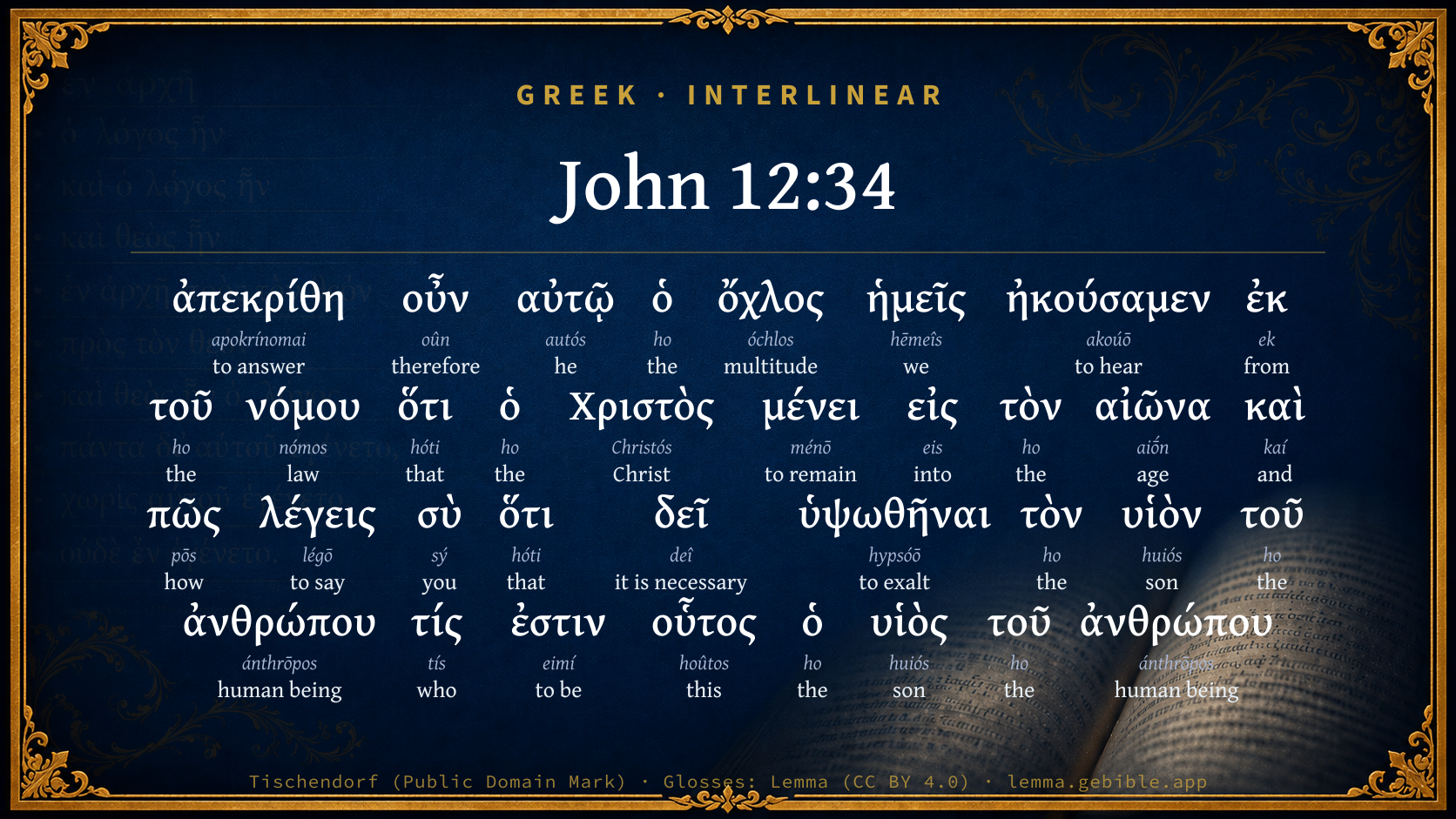
  1. ἀπεκρίθη apokrínomai G611 “to answer” Verb, Aorist, Middle deponent, Indicative, 3rd person, Singular
  2. οὖν oûn G3767 “therefore” Conjunction
  3. αὐτῷ autós G846 “he” Personal pronoun, Dative, Singular, Masculine
  4. ὁ ho G3588 “the” Article, Nominative, Singular, Masculine
  5. ὄχλος óchlos G3793 “multitude” Noun, Nominative, Singular, Masculine
  6. ἡμεῖς hēmeîs G2249 “we” Personal pronoun, 1st person, Nominative, Plural
  7. ἠκούσαμεν akoúō G191 “to hear” Verb, Aorist, Active, Indicative, 1st person, Plural
  8. ἐκ ek G1537 “from” Preposition
  9. τοῦ ho G3588 “the” Article, Genitive, Singular, Masculine
  10. νόμου nómos G3551 “law” Noun, Genitive, Singular, Masculine
  11. ὅτι hóti G3754 “that” Conjunction
  12. ὁ ho G3588 “the” Article, Nominative, Singular, Masculine
  13. Χριστὸς Christós G5547 “Christ” Noun, Nominative, Singular, Masculine
  14. μένει ménō G3306 “to remain” Verb, Present, Active, Indicative, 3rd person, Singular
  15. εἰς eis G1519 “into” Preposition
  16. τὸν ho G3588 “the” Article, Accusative, Singular, Masculine
  17. αἰῶνα aiṓn G165 “age” Noun, Accusative, Singular, Masculine
  18. καὶ kaí G2532 “and” Conjunction
  19. πῶς pōs G4459 “how” Adverb, Interrogative
  20. λέγεις légō G3004 “to say” Verb, Present, Active, Indicative, 2nd person, Singular
  21. σὺ sý G4771 “you” Personal pronoun, 2nd person, Nominative, Singular
  22. ὅτι hóti G3754 “that” Conjunction
  23. δεῖ deî G1163 “it is necessary” Verb, Present, Active, Indicative, 3rd person, Singular
  24. τὸν ho G3588 “the” Article, Accusative, Singular, Masculine
  25. υἱὸν huiós G5207 “son” Noun, Accusative, Singular, Masculine
  26. τοῦ ho G3588 “the” Article, Genitive, Singular, Masculine
  27. ἀνθρώπου ánthrōpos G444 “human being” Noun, Genitive, Singular, Masculine
  28. τίς tís G5101 “who” Interrogative pronoun, Nominative, Singular, Masculine
  29. ἐστιν eimí G1510 “to be” Verb, Present, Active, Indicative, 3rd person, Singular
  30. οὗτος hoûtos G3778 “this” Demonstrative pronoun, Nominative, Singular, Masculine
  31. ὁ ho G3588 “the” Article, Nominative, Singular, Masculine
  32. υἱὸς huiós G5207 “son” Noun, Nominative, Singular, Masculine
  33. τοῦ ho G3588 “the” Article, Genitive, Singular, Masculine
  34. ἀνθρώπου ánthrōpos G444 “human being” Noun, Genitive, Singular, Masculine

About this verse

These counts appear in no published source. They are computed here, from the morphology-tagged text and Lemma’s own curated glosses. What Lemma adds →

35
words
25
distinct lemmas
Gospels
section

Notable vocabulary

The rarest word here is ὑψωθῆναι to exalt G5312 — appearing just 20 times in the whole Greek New Testament.

Shared distinctive vocabulary

ὑψωθῆναι to exalt G5312 occurs in 16 verses of the Greek New Testament. Also found in:

Repetition

Words recur within this verse:

  • υἱὸν son G5207 ×2
  • ἀνθρώπου human being G444 ×2
  • ὁ the G3588 ×8
  • ὅτι that G3754 ×2

Cross-references

24

Topical passages linked to John 12:34 in the Treasury of Scripture Knowledge — connected by theme and wording, ordered by reader-vote popularity; previews shown in the World English Bible.

  • Ezekiel 37:24–25 My servant David shall be king over them; and they all shall have one shepherd: they shall also walk in my ordinances, and observe my statutes, and do them.
  • Isaiah 9:7 Of the increase of his government and of peace there shall be no end, on the throne of David, and on his kingdom, to establish it, and to uphold it with justice and with righteousness from henceforth even forever. The zeal of Yahweh of Hosts will perform this.
  • Daniel 7:14 There was given him dominion, and glory, and a kingdom, that all the peoples, nations, and languages should serve him: his dominion is an everlasting dominion, which shall not pass away, and his kingdom that which shall not be destroyed.
  • Psalms 110:4 Yahweh has sworn, and will not change his mind: "You are a priest forever in the order of Melchizedek."
  • Daniel 2:44 In the days of those kings shall the God of heaven set up a kingdom which shall never be destroyed, nor shall the sovereignty of it be left to another people; but it shall break in pieces and consume all these kingdoms, and it shall stand forever.
  • Daniel 7:27 The kingdom and the dominion, and the greatness of the kingdoms under the whole the sky, shall be given to the people of the saints of the Most High: his kingdom is an everlasting kingdom, and all dominions shall serve and obey him.
  • 2 Samuel 7:13 He shall build a house for my name, and I will establish the throne of his kingdom forever.
  • John 3:14–16 As Moses lifted up the serpent in the wilderness, even so must the Son of Man be lifted up,
  • Psalms 89:36–37 His seed will endure forever, His throne like the sun before me.
  • John 5:25–27 Most assuredly, I tell you, the hour comes, and now is, when the dead will hear the Son of God's voice; and those who hear will live.
  • Psalms 72:17–19 His name endures forever. His name continues as long as the sun. Men shall be blessed by him. All nations will call him blessed.
  • Micah 4:7 And I will make that which was lame a remnant, And that which was cast far off a strong nation: And Yahweh will reign over them on Mount Zion from then on, even forever.
  • Matthew 22:42–45 saying, "What do you think of the Christ? Whose son is he?" They said to him, "Of David."
  • Psalms 72:7 In his days, the righteous shall flourish, And abundance of peace, until the moon is no more.
  • Romans 5:18 So then as through one trespass, all men were condemned; even so through one act of righteousness, all men were justified to life.
  • Isaiah 53:8 By oppression and judgment he was taken away; and as for his generation, who [among them] considered that he was cut off out of the land of the living for the disobedience of my people to whom the stroke [was due]?
  • John 8:53–58 Are you greater than our father, Abraham, who died? The prophets died. Who do you make yourself out to be?"
  • John 10:34 Jesus answered them, "Isn't it written in your law, 'I said, you are gods?'
  • John 12:32 And I, if I am lifted up from the earth, will draw all people to myself."
  • John 15:25 But this happened so that the word may be fulfilled which was written in their law, 'They hated me without a cause.'
  • Romans 3:19 Now we know that whatever things the law says, it speaks to those who are under the law, that every mouth may be closed, and all the world may be brought under the judgment of God.
  • Matthew 8:20 Jesus said to him, "The foxes have holes, and the birds of the sky have nests, but the Son of Man has nowhere to lay his head."
  • Matthew 16:13 Now when Jesus came into the parts of Caesarea Philippi, he asked his disciples, saying, "Who do men say that I, the Son of Man, am?"
  • Matthew 21:10 When he had come into Jerusalem, all the city was stirred up, saying, "Who is this?"

Cross-references courtesy of OpenBible.info (CC BY 4.0).

Where the printed editions differ

1 variant

Places in this verse where the major printed Greek editions disagree on the wording in a way that affects the translation — a comparison of editions, not a manuscript-by-manuscript collation. The editions are the modern critical texts (Nestlé-Aland 28/27, SBL, Westcott-Hort, Tregelles, Tyndale House) and the traditional texts behind the KJV (the Textus Receptus and the Byzantine/Majority text). It is not a claim about which reading is original.

  1. Extra text
    οὖν

    “therefore”

    In NA28NA27TynSBLWH Not in TregTRByz

    οὖν (oun) 'therefore' is only in older manuscripts (NA28+NA27+Tyn+SBL+WH)

Textual data: Translators Amalgamated Greek New Testament (STEPBible TAGNT) · CC BY 4.0.

Commentary

Notes on John 12:34 from classic Christian and Jewish commentators (each source and its license shown beneath its notes). The classic Christian expositions comment on the surrounding passage and are grouped to its opening verse, so a note may address several verses; the Jewish commentaries on the Tanakh (Rashi and others) are per-verse, so they appear only where the commentator wrote on this verse.

Lemma curates 59 commentaries, every one of them public domain or Creative Commons licensed, each selected and text-cleaned for this edition rather than reprinted as found. About our sources →

The Biblical Illustrator

Joseph S. Exell

Joh_12:34-36

We have heard out of the law that Christ abideth forever.

Misunderstandings and explanations

I. MISUNDERSTANDINGS (Joh_12:34). They considered perhaps that Ps Isa_9:7; Dan_7:13 referred to Christ. Their question would be, therefore, If Thou art to die, how canst Thou be the Messiah? We know who the Son of Man in the Old Testament is; but who is this Son of Man? Men have always misunderstood the Cross. It is foolishness to the Greek, etc.

1. Some now speak of the Cross as a means of appeasing the wrath of the Almighty.

2. Some as a transaction that will purchase souls.

3. Some as the procuring cause of Gods love.

4. Whereas it is the effect, demonstration, channel of Gods love for man.

II. EXPLANATIONS. Christ does not explain the difficulty by logical disquisition, but by exhorting them to practice holiness (verse 35). It is the pure heart, not the logical understanding, that solves the problems of Christianity. Christ urges the spirit of holiness on three considerations.

1. Their possession a special advantage. They had the light with them. From Christs presence, words, deeds, holiness beamed brightly on them. They were moving in the rays of the highest moral excellence.

2. Their special advantage was only temporary--Yet a little while. A few days more and their moral sun would be set. Mans opportunities for spiritual improvement are very transient.

3. The departure of their special advantage would expose them to danger--He that walketh in darkness, etc. To walk on in moral darkness to the great eternity, how dismal and dangerous!

4. The right use of their advantage would fill them with light (verse 36). Trust in Christ will fill the soul with Divine illumination. The entrance of Thy Word giveth light. (D. Thomas, D. D.)

Who is this Son of Man?

The Son of Man

This question of utter bewilderment negatives the supposition that it was equivalent to the Messiah. The two names do not cover the same ground; for our Lord avoided the one and habitually used the other. The name is found on no other lips, and no man applied it to Christ but Stephen. The two apparent instances in which it occurs--in Revelation--probably read a, not the Son of Man. It has been supposed to be taken from Daniel. No doubt there is a connection, but the Prophet speaks of one like a Son of Man, in contradistinction to the bestial forms. What, then, is the force of the name?

I. CHRIST THEREBY IDENTIFIES HIMSELF WITH US.

1. The name declares the fact of the Incarnation and the reality and fulness of His humanity. It is employed where special emphasis is to be placed on our Lords manhood.

(1) As, e.g., when He would bring into view the depth of His humiliation--Foxes have holes, etc. Not merely am I individually homeless, but Iam so because I am truly a Man, the only creature who builds houses, and the only creature that has not a home. Foxes can rest any where; any bough will do for birds; I, as the representative of humanity, wander a pilgrim. We are all restless and homeless: the creatures correspond to their environment. We have desires and needs that wander through eternity; our Representative hath not where to lay His head.

(2) When He would emphasize the completeness of His participation in our conditions. The Son of Man came eating and drinking--having ordinary dependence on external things: nor unwilling to taste whatever gladnesses may be found in mans path through the supply of natural appetites.

(3) When He would emphasize this manhood as having truly taken upon itself the whole weight and weariness of mans sin. The Son of Man came not to be ministered unto, etc.

2. All these instances suggest to us

(1) How truly and blessedly He is bone of our bone etc. All our joys, sorrows, wants were His. The Son of Man is our Brother and Example.

(2) Is it not beautiful that this name, which emphasizes humiliation, and weakness, and likeness to ourselves, should be always on His lips. Just as if some teacher who went away into savage life might adopt some barbarous designation and say, That is my name now.

II. CHRIST THEREBY DISTINGUISHES HIMSELF FROM US, and plainly claims an unique relationship to the whole world. How absurd it would be for one of us to perpetually insist on the fact that He was a man, and the very frequency and emphasis with which the name comes from our Lords lips lead one to suspect that there is something behind it. The impression is confirmed by the article the.

1. Appropriately, then, the name is used with suggestions of authority and dignity, contrasting with those of humiliation. The Son of Man is Lord of the Sabbath, hath power on earth to forgive sins, etc. And it is significant that the designation occurs more frequently in the first three Gospels than in the fourth, which is alleged to present higher notions of Jesus. In substance Christ claims, what Paul claimed for Him, to be the Second Adam. Aristotle is but the rubbish of an Adam, and Adam is but the dim outline sketch of a Jesus. The one man as God meant him, the perfect humanity, is He who claimed that for Himself, and as He did so said, I am meek and lowly of heart. Who is this Son of Man? A perfect Son of Man must be more than a Son of man--the Christ the Son of the living God.

2. The name is employed in connections in which He desires to set Himself forth as the solitary medium of all blessing to mankind--The Son of Man came to give His life a ransom for many, the angels of God ascending and descending, etc.,--the Medium of all communication between earth and heaven. He who is perfect manhood touches all men, and all men touch Him, and the Son of Man whom God hath sealed will give to every one of us bread from heaven.

III. THE PREDICTIVE CHARACTER OF THIS DESIGNATION. If not a quotation from it is an allusion to the prophecy of Daniel. Hence we find the name occurring in passages which refer to Christs second coming--Hereafter ye shall see, etc. He hath given Him authority, etc. Standing at the right hand of God.

1. The name carries with it a blessed message of the present activity and perpetual manhood of the risen Lord. Stephen does not see Him sitting, but standing, as if He had sprung to His feet on response to the cry of faith from the first of a long train of sufferers. He is the ever-present Helper.

2. That perfect manhood will be our Judge. It could not end its relationship on the cross or at the Ascension. That He should come again is the only possible completion of His work. That Judge is our Brother. So in the deepest sense we are tried by our Peer. With the omniscience of Divinity will be blended the sympathy of humanity. Conclusion: Let us lay hold by true faith on the mighty work which He has done on the cross, then we shall rejoice to see our Brother on the throne. (A. Maclaren, D. D.)

Yet a little while is the light with you

Light and its little while

I. THE LIGHT. Light is that which reveals, as darkness hides. Christ is the Light: He reveals the Father, the Fathers love and righteousness, and all the riches of His grace; and we, opening our eyes to take in this light, are thereby enlightened.

II. THE SIGHT WITH US. The first gleam came in the first promise. After that the rays multiplied. Then the Light came and remained here for thirty-three years. It is still, though impersonally, with us; and it will be yet more gloriously so when Christ comes again. We may withdraw from it, but it never withdraws from us. We may shut our eyes and our windows, but the light still shineth--not starlight or moonlight, but sunlight. The darkness comprehendeth it not. Oh dark world, child of darkness, when wilt thou let in the light.

III. THE LITTLE WHILE OF THE LIGHT. Our Lords personal presence. There are other little whiles. Israel had hers; the Churches have had or are having theirs; so with nations, congregations, souls. A little while of Sabbaths, sermons, sacraments, providences, and all is done. Then the light departs, and its little while for thee may be near. Improve it. Jesus is coming, but with darkness to the despisers of the light.

IV. THE USING OF THE LIGHT. Walking is equivalent to the whole of a mans life. Our Lords meaning is Use this light for whatever you do.

1. Believe in the light, and in no other. The light of reason, literature, science will do nothing for the soul. At best they are but starlight, clear but cold, distinct but distant. God proclaims His testimony concerning this light, and it wants admission.

2. Become children of the light. He into whom it enters becomes a child of light, and a light to others.

V. THE REFUSAL TO USE THE LIGHT--by neglect, delay, hatred, rejection. (H. Bonar, D. D.)

Too late

A man who would enjoy the pleasures of this world said it was too soon for him to think of another world. He journeyed, and was taken ill very suddenly, and in the middle of the night, at an inn. The people there sent for a clergyman. He came; and the dying man, looking him in the face, before he could speak, said to him, Sir, it is too late! The minister said, Christ is able to save to the uttermost, and explained the gospel to him. He replied, Sir, it is too late! The clergyman asked, Will you allow me to pray with you? His only reply was, Sir, it is too late! He died, saying, It is too late! (Arvine.)

The similitude of the light

I. A GRACIOUS PRIVILEGE. While, or as ye have, etc.

1. Great. A day without light, a world without the sun, expressive but faint emblems of a soul without spiritual illumination, of humanity without Christ.

2. Present. The world was never without it, but only since the Incarnation has it attained to meridian splendour.

3. Temporary. It is not permanent to us any more than it was to the Jews, or than the natural light is to any.

II. A SOLEMN DUTY. Believe in the light.

1. Plain. Christs language neither vague nor ambiguous.

2. Easy. It is not work or suffer for, but only believe, trust, walk in the light.

3. Continuous. It is not one act of faith and then all is done. Walk implies continuance and progress.

III. A GLORIOUS RESULT--That ye may become, etc.

1. Magnificent. The light, for man, can illuminate his understanding, purify his heart, quicken his conscience, vitalize his spirit, direct his conduct, beautify and dignify His whole life. It can put Him in direct contact with and assimilate him to Him who is the Light.

2. Designed. This it does not unexpectedly or accidentally, but purposely and necessarily.

3. Certain. He who walks in the light will as certainly be transfigured by it as the flower is transformed into a spectacle of beauty by the beams of the sun. Lessons

1. Thankfulness to Him who hath furnished the light.

2. Watchfulness lest the light should pass away unimproved.

3. Hopefulness with respect to the future of those who believe on the Saviour.

4. Pitifulness for the fate of those who still walk in darkness. (T. Whitelaw, D. D.)

The gospel of light

The gospel is light. This marks its origin from heaven. It is no human device, but comes from God Himself. It is light. This denotes its truth. It is fitting that what is truth, without mixture of error, should be compared to the most simple substance in nature. It is called light because of its penetrating and subtle nature. Kindle it up, and no shade is so gross that it cannot penetrate it; there is no imposture so well devised which it will not expose; there are no works of darkness which it will not drag to light and shame; there is no conscience so callous but this light will search it. It is called light, because of the discoveries which it makes. It is a great light. It makes manifest the invisible God, in His awful and mild glories. It shows Him in His works, His providence, and His grace; it opens to view the path of peace which has been so long lost; it presents the model and the promises of holiness; displays the connection between the present state of probation and eternity; it plays round the darkness of the tomb, and illuminates the mansion of the grave with hope of a resurrection; it makes the future start to sight, and is both the substance of things hoped for, and the evidence of things not seen. But it is called light for another reason. It is life and health to the world; it shows us the Sun of Righteousness, rising with healing in His wings. The comparison is made to the parent bird, warming her young to life, and giving health and strength by brooding over them. Such is the sun to nature. It warms to life, purges the atmosphere of its vapours, and renews the health of the world. Such is the light of the gospel. Where it prevails, spiritual life is inspired, and the moral disorders of the soul give place to health and vigour. (R. Watson.)

Children of light

I. LIGHT is the symbol of

1. God the Father (1Jn_1:5). He is the Medium through which all spiritual things are discerned. It is only in God, as light, that we can see God or have any notion of Him. The old pervasiveness of light, too, is an apt emblem of omnipresence.

2. Christ Himself (Joh_1:4). He is the Light of God to man in a state of darkness. Without Him we cannot know God, ourselves, or the relations between the two.

3. The written Word (Psa_119:105). The fact of our receiving the light in any of these senses throws upon us a vast amount of responsibility.

II. BELIEVE IN THE LIGHT. Not believe it, or about it, or reason about it, but believe so as to participate in it. Of what use is it for man to believe in the fact of the sun, or in some theory about it, or to reason about its effects, especially if he is charged with some mission which requires its light, if he persists in keeping his shutters closed. Yet how many there are who, requiring the Light of the World to illuminate their path to heaven, content themselves with mere orthodox views about Him. Numbers are more ready to argue about the Divinity of Christ than to say with adoring trust, My Lord and my God. Numbers more are content with acknowledging Gods claims and the reasonableness of Bible precepts who never think of fulfilling the one or walking by the other.

III. CHILDREN OF THE LIGHT means more than being enlightened. Children implies parentage, propagating power. Light produces light, and by believing in Him who is the Light we become light in the Lord. And if light as applied to God sets forth His perfections, the enjoyment of that light means the perpetration in us of holiness, truthfulness, etc. (G. Fisk, LL. B.)

Gospel light

I. THERE ARE SEVERAL KINDS OF LIGHT WHICH YET FALL SHORT OF THE GOSPEL, and leave a man in fatal obscurity. As

1. The light of nature.

2. There is the light of infidel philosophy. This is full of self-importance and swelling pride.

3. There is the light of enthusiasm. This is a sort of wild-fire, it blazes as straw, bewilders the mind, and produces an obstinacy not easily eradicated.

4. But Christ is the Light of Life. That which is pure, unadulterated, and unchangeable. This blessed light centres in Christ, and emanates from Him. Jesus Christ neglected--disregarded--undervalued, must give the death-wound to a mans brightest hopes, and his best felicity (see 1Co_16:22).

II. THE DARKNESS OF THE HEART IS MADE EVIDENT BY SOME CERTAIN SYMPTOMS.

1. Gross ignorance; a mind perfectly uninformed. The Sadducees did not know the Scriptures nor the power of God.

2. A heart inflated with vanity, and puffed up with its own consequence. Some of the Corinthians were thus puffed up. If they had a little light, they had much darkness.

3. Self-righteousness and self-sufficiency are evidences of positive darkness dwelling within (see Rom_10:3-4; Mat_23:1-39). Affected royalty in a lunatic provokes a smile, but self-righteousness in a sinner ought to produce astonishment and grief.

III. THE WAY TO BE SECURE IS TO TAKE HEED. To look well within and wisely around. We must guard against pride, the operations of which preclude the entrance of truth, as the gay colouring of cathedral windows excludes the common light of day. We must guard against prepossessions and prejudice. These often operate upon the mind greatly to a mans disadvantage. Prejudice will turn that which is beautiful into deformity, and then reject it. Beware of two great evils, negligence and unbelief.

Negligence (see Heb_6:12; Pro_19:15). Unbelief (see Heb_3:12-19). Do not resist conviction, do not shut out the light.

1. Let the infidel take heed lest his boasted light terminate in a worse than Egyptian darkness.

2. Let the proud, self-righteous Pharisee come down from the pinnacle of his elevation, and seek both light and life in Jesus Christ.

3. Let the profane sinner, venturesome as he now is, look out in time; go to Jesus Christ the Sun of righteousness, in time.

IV. MENTAL DARKNESS, THAT OF THE UNDERSTANDING, IS THE WORST KIND OF DARKNESS. It produces enmity to the truth of God, and neglect of His ways. Permit me to give you a word of friendly counsel in reference to this light.

1. Set a just value on it. Buy it at any expense, sell it not on any account.

2. Labour to gain more of it.

3. Communicate it to others, and that to the extent of your abilities.

4. Remove obstacles to its shining whenever you can.

5. Triumph in the happy victories which the light and truth of God may at any time gain, in any one family, at any one place.

6. Look forward to its final and complete triumphs, its unfading and eternal splendour! (The Evangelist.)

Believing in the light and its effects

In certain parts of Asia there is a curious plant which grows in the forests. These forests are very dense and gloomy, for the trees grow thick together, and twine their branches into one another at the top, till the forest almost seems to have a great roof over it keeping out the sunlight. This plant at first is a very slim and feeble-looking plant--just a straight stalk, with only a thin leaf here and there upon it. But it shoots up and up, and gathers strength as it grows, till it becomes like a tall bamboo rod. And now it reaches up to the first branches of the trees, then up to the middle ones, then up to the topmost boughs, and pierces its way through the thick roof of leaves at the top; then, for the first time, it lifts its head unto the sunshine. And now, it does what it never did and never could have done before. It puts out beautiful blossoms and flowers; and, by and by, out of these it brings fruits and seeds. Once it has become a child of the light it begins to blossom and be fruitful. This explains the text in this way: at first the plant had a little light, and that little made it glad. It loved the light, and believed it was good for it. It believed in the light, and it found that the more it loved the light the more light it got, because it was growing more up to it, and from being a sickly, pale plant it became strong and beautiful. Now Jesus is the Light of the soul. We know a little about Him, that He loved us and died to save us, and wants to make us good. We have a little light, and what we have now to do is to love that light and believe that light, that our souls may be changed by the light from day to day, till we also become children of light. Suppose that plant, when it had only a little light, had said to itself, Ah, I dont want the light, I dont want the light; I am tired of always trying to grow higher into the light. I think it would be much nicer if I could become a creeper and grow on the dark ground! Well, if the plant said that and did that, it would bend down and down and away from the light, and it would receive less light and less light, and it would never have any flowers or any kind of fruit, just because when it had the light it would not believe in the light, or try to get more of it, or love it. It is the same with you. If you do not want that light, if you do not believe in it, if you prefer to do this thing and that which is sinful, then you will be growing away from the light, and receive less and less light still, and you will forget the light you once had, and your life will be lost. (J. R. Howat.)

Light limited in duration

Alexander the Great, when he besieged a certain city, kindled a torch, and offered pardon and peace to the besieged citizens if they would surrender themselves so long as the torch continued to burn, but threatened them with destruction and death if they did not surrender during the blazing light of the torch. So will it be with God and ourselves. Let us therefore work while we can enjoy the light that shines from heaven and leads us to heaven, for when this light is quenched, if we have not before surrendered ourselves to God, we must certainly, as He has warned us, meet with eternal death and destruction at His hands. (T. H.Leary, D. C. L.)

Delay leads to the winter of the soul

How dangerous to defer those momentous reformations which conscience is solemnly preaching to the heart! If they are neglected, the difficulty and indisposition are increasing every month. The mind is receding, degree after degree, from the warm and hopeful zone; till at last it will enter the arctic circle, and become fixed in relentless and eternal ice. (J. Foster.)

The Biblical Illustrator, edited by Joseph S. Exell (c. 1880s–1900s) — public domain. Text from a community e-Sword module.

Joseph Benson's Commentary

Joh 12:34-36. The people answered — Understanding the phrase as implying some violent death shortly to come upon him; We have heard out of the law, that Christ abideth for ever — On hearing Jesus affirm that he was to be lifted up, or taken off by a violent death, they told him that it was inconsistent with the character of the Messiah, who, according to the law, (so they named the whole of their sacred writings,) was never to die. And how sayest thou, The Son of man must be lifted up? — How can these things be reconciled? Who is this Son of man? — Is he a different person from the Messiah, whom we have been taught to expect under the title of the Son of man? If not, what sort of a Messiah must he be that is to die? Then Jesus said — Not answering them directly, but exhorting them to improve what they had heard already; Yet a little while is the light with you — As if he had said, Do not cavil at what I now say; but remember how short this opportunity is, which through the divine goodness you now enjoy; and improve by my instructions, who am the light of the world. See on Joh 8:12. Lest darkness — That is, spiritual blindness; come upon you — By the just judgment of God. Rom 11:25. If that should happen to you, ye will be in a miserable condition indeed: For he that walketh in darkness, knoweth not whither he goeth — Knoweth neither the way he is walking in, nor the end he is walking toward: he knows not into what danger and misery he may fall the very next step he takes: and much more dreadful will it be for you to be deserted of God, and left to the darkness and folly of your own hearts. Observe, reader, he that is destitute of the light of the gospel, that is unacquainted with its discoveries and directions, wanders endlessly in mistakes and errors, in a thousand crooked paths, and is not aware of it: he is probably going to destruction, and knows not his danger: he is sleeping, or sporting, on the brink of the pit. While you have the light, therefore, believe in the light — While you enjoy the benefit of my doctrine, example, and miracles, which clearly prove my mission from God, believe on me; for it is thus alone you can become children of light — Children of God, wise, holy, and happy. These things spake Jesus — When the Greeks applied themselves to him; and as the unbelieving Jews were greatly irritated by the actions and discourses of the day, and would not be awakened to conviction, he left them and departed thence to a retired place. Greek, απελθων εκρυβη απ’ αυτων, which Dr. Campbell renders, He withdrew himself privately from them: observing, that he thinks our translation, he departed and did hide himself from them, “conveys a sense different from that of the original, which denotes simply, that in retiring he took care not to be observed by them.”

Joseph Benson's Commentary on the Old and New Testaments (1811–1818) — public domain. Text from a community e-Sword module.

MacLaren's Expositions of Holy Scripture

Alexander MacLaren

John

THE SON OF MAN

Joh 12:34.

I have thought that a useful sermon may be devoted to the consideration of the remarkable name which our Lord gives to Himself-’the Son of Man.’ And I have selected this instance of its occurrence, rather than any other, because it brings out a point which is too frequently overlooked, viz. that the name was an entirely strange and enigmatical one to the people who heard it. This question of utter bewilderment distinctly shows us that, and negatives, as it seems to me, the supposition which is often made, that the name ‘Son of Man,’ upon the lips of Jesus Christ, was equivalent to Messiah. Obviously there is no such significance attached to it by those who put this question. As obviously, for another reason, the two names do not cover the same ground; for our Lord sedulously avoided calling Himself the Christ, and habitually called Himself the Son of Man.

Now one thing to observe about this name is that it is never found upon the lips of any but Jesus Christ. No man ever called him the Son of Man whilst He was upon earth, and only once do we find it applied to Him in the rest of Scripture, and that is on the occasion on which the first martyr, Stephen, dying at the foot of the old wall, saw ‘the heavens opened, and the Son of Man standing at the right hand of God.’ Two other apparent instances of the use of the expression occur, both of them in the Book of Revelation, both of them quotations from the Old Testament, and in both the more probable reading gives ‘a Son of Man,’ not ‘the Son of Man.’

One more preliminary remark and I will pass to the title itself. The name has been often supposed to be taken from the remarkable prophecy in the Book of Daniel, of one ‘like a son of man,’ who receives from the Ancient of Days an everlasting kingdom which triumphs over those kingdoms of brute force which the prophet had seen. No doubt there is a connection between the prophecy and our Lord’s use of the name, but it is to be observed that what the prophet speaks of is not ‘the Son,’ but ‘one like a son of man’; or in other words, that what the prophecy dwells upon is simply the manhood of the future King in contradistinction to the bestial forms of Lion and Leopard and Bear, whose kingdoms go down before him. Of course Christ fulfils that prediction, and is the ‘One like a son of man,’ but we cannot say that the title is derived from the prophecy, in which, strictly speaking, it does not occur.

What, then, is the force of this name, as applied to Himself by our Lord?

First, we have in it Christ putting out His hand, if I may say so, to draw us to Himself-identifying Himself with us. Then we have, just as distinctly, Christ, by the use of this name, in a very real sense distinguishing Himself from us, and claiming to hold a unique and solitary relation to mankind. And then we have Christ, by the use of this name in its connection with the ancient prophecy, pointing us onward to a wonderful future.

I. First then, Christ thereby identifies Himself with us.

The name Son of Man, whatever more it means, declares the historical fact of His Incarnation, and the reality and genuineness, the completeness and fullness, of His assumption of humanity. And so it is significant to notice that the name is employed continually in the places in the Gospels where especial emphasis is to be placed, for some reason or other, upon our Lord’s manhood, as, for instance, when He would bring into view the depth of His humiliation. It is this name that He uses when He says: ‘Foxes have holes and the birds of the air have nests, but the Son of Man hath not where to lay His head.’ The use of the term there is very significant and profound; He contrasts His homelessness, not with the homes of men that dwell in palaces, but with the homes of the inferior creatures. As if He would say, ‘Not merely am I individually homeless and shelterless, but I am so because I am truly a man, the only creature that builds houses, and the only creature that has not a home. Foxes have holes, anywhere they can rest, the birds of the air have,’ not as our Bible gives it, ‘nests,’ but ‘roosting-places, any bough will do for them. All living creatures are at home in this material universe; I, as a Representative of humanity, wander a pilgrim and a sojourner.’ We are all restless and homeless; the creatures correspond to their environment. We have desires and longings, wild yearnings, and deep-seated needs, that ‘wander through eternity’; the Son of Man, the representative of manhood, ‘hath not where to lay His head.’

Then the same expression is employed on occasions when our Lord desires to emphasise the completeness of His participation in all our conditions. As, for instance, ‘the Son of Man came eating and drinking,’ knowing the ordinary limitations and necessities of corporeal humanity; having the ordinary dependence upon external things; nor unwilling to taste, with pure and thankful lip, whatever gladness may be found in man’s path through the supply of natural appetites.

And the name is employed habitually on occasions when He desires to emphasise His manhood as having truly taken upon itself the whole weight and weariness of man’s sin, and the whole burden of man’s guilt, and the whole tragicalness of the penalties thereof, as in the familiar passages, so numerous that I need only refer to them and need not attempt to quote them, in which we read of the Son of Man being ‘betrayed into the hands of sinners’; or in those words, for instance, which so marvellously blend the lowliness of the Man and the lofty consciousness of the mysterious relation which He bears to the whole world; ‘The Son of Man came, not to be ministered unto, but to minister, and to give His life a ransom for the many.’

Now if we gather all these instances together {and they are only specimens culled almost at random}, and meditate for a moment on the Name as illuminated by such words as these, they suggest to us, first, how truly and how blessedly He is ‘bone of our bone, and flesh of our flesh.’ All our human joys were His. He knew all human sorrow. The ordinary wants of human nature belonged to Him; He hungered, He thirsted, and was weary; He ate and drank and slept. The ordinary wants of the human heart He knew; He was hurt by hatred, stung by ingratitude, yearned for love; His spirit expanded amongst friends, and was pained when they fell away. He fought and toiled, and sorrowed and enjoyed. He had to pray, to trust, and to weep. He was a Son of Man, a true man among men. His life was brief; we have but fragmentary records of it for three short years. In outward form it covers but a narrow area of human experience, and large tracts of human life seem to be unrepresented in it. Yet all ages and classes of men, in all circumstances, however unlike those of the peasant Rabbi who died when he was just entering mature manhood, may feel that this man comes closer to them than all beside. Whether for stimulus for duty, or for grace and patience in sorrow, or for restraint in enjoyment, or for the hallowing of all circumstances and all tasks, the presence and example of the Son of Man are sufficient. Wherever we go, we may track His footsteps by the drops of His blood upon the sharp flints that we have to tread. In all narrow passes, where the briars tear the wool of the flock, we may see, left there on the thorns, what they rent from the pure fleece of the Lamb of God that went before. The Son of Man is our Brother and our Example.

And is it not beautiful, and does it not speak to us touchingly and sweetly of our Lord’s earnest desire to get very near us and to bring us very near to Him, that this name, which emphasises humiliation and weakness and the likeness to ourselves, should be the name that is always upon His lips? Just as, if I may compare great things with small, some teacher or philanthropist, that went away from civilised into savage life, might leave behind him the name by which he was known in Europe, and adopt some barbarous designation that was significant in the language of the savage tribe to whom he was sent, and say to them: ‘That is my name now, call me by that,’ so this great Leader of our souls, who has landed upon our coasts with His hands full of blessings, His heart full of love, has taken a name that makes Him one of ourselves, and is never wearied of speaking to our hearts, and telling us that it is that by which He chooses to be known. It is a touch of the same infinite condescension which prompted His coming, that makes Him choose as His favourite and habitual designation the name of weakness and identification, the name ‘Son of Man.’

II. But now turn to what is equally distinct and clear in this title. Here we have our Lord distinguishing Himself from us, and plainly claiming a unique relationship to the whole world.

Just fancy how absurd it would be for one of us to be perpetually insisting on the fact that he was a man, to be taking that as his continual description of himself, and pressing it upon people’s attention as if there was something strange about it. The idea is preposterous; and the very frequency and emphasis with which the name comes from our Lord’s lips, lead one to suspect that there is something lying behind it more than appears on the surface. That impression is confirmed and made a conviction, if you mark the article which is prefixed, the Son of Man. A Son of man is a very different idea. When He says ‘the Son of Man’ He seems to declare that in Himself there are gathered up all the qualities that constitute humanity; that He is, to use modern language, the realised Ideal of manhood, the typical Man, in whom is everything that belongs to manhood, and who stands forth as complete and perfect. Appropriately, then, the name is continually used with suggestions of authority and dignity contrasting with those of humiliation. ‘The Son of Man is Lord of the Sabbath,’ ‘The Son of Man hath power on earth to forgive sins’ and the like. So that you cannot get away from this, that this Man whom the whole world has conspired to profess to admire for His gentleness, and His meekness, and His lowliness, and His religious sanity, stood forward and said: ‘I am complete and perfect, and everything that belongs to manhood you will find in Me.’

And it is very significant in this connection that the designation occurs more frequently in the first three Gospels than in the fourth; which is alleged to present higher notions of the nature and personality of Jesus Christ than are found in the other three. There are more instances in Matthew’s Gospel in which our Lord calls Himself the Son of Man, with all the implication of uniqueness and completeness which that name carries; there are more even in the Gospel of the Servant, the Gospel according to Mark, than in the Gospel of the Word of God, the Gospel according to John. And so I think we are entitled to say that by this name, which the testimony of all our four Gospels makes it certain, even to the most suspicious reader, that Christ applied to Himself, He declared His humanity, His absolutely perfect and complete humanity.

In substance He is claiming the same thing for Himself that Paul claimed for Him when he called Him ‘the second Adam.’ There have been two men in the world, says Paul, the fallen Adam, with his infantile and undeveloped perfections, and the Christ, with His full and complete humanity. All other men are fragments, He is the ‘entire and perfect chrysolite.’ As one of our epigrammatic seventeenth-century divines has it, ‘Aristotle is but the rubbish of an Adam,’ and Adam is but the dim outline sketch of a Jesus. Between these two there has been none. The one Man as God meant him, the type of man, the perfect humanity, the realised ideal, the home of all the powers of manhood, is He who Himself claimed that place for Himself, and stepped into it with the strange words upon His lips, ‘I am meek and lowly of heart.’

‘Who is this Son of Man?’ Ah, brethren! ‘who can bring a clean thing out of an unclean? Not one.’ A perfect Son of Man, born of a woman, ‘bone of our bone and flesh of our flesh,’ must be more than a Son of Man. And that moral completeness and that ideal perfection in all the faculties and parts of His nature which drove the betrayer to clash down the thirty pieces of silver in the sanctuary in despair that ‘he had betrayed innocent blood’; which made Pilate wash his hands ‘of the blood of this just person’; which stopped the mouths of the adversaries when He challenged them to convince Him of sin, and which all the world ever since has recognised and honoured, ought surely to lead us to ask the question, ‘Who is this Son of Man?’ and to answer it, as I pray we all may answer it, ‘Thou art the Christ, the Son of the living God!’

This fact of His absolute completeness invests His work with an altogether unique relationship to the rest of mankind. And so we find the name employed upon His own lips in connections in which He desires to set Himself forth as the single and solitary medium of all blessing and salvation to the world-as, for instance, ‘The Son of Man came to give His life a ransom for the many’; ‘Ye shall see the heavens opened, and the angels of God ascending and descending on the Son of Man.’ He is what the ladder was in the vision to the patriarch, with his head upon the stone and the Syrian sky over him-the Medium of all communication between earth and heaven. And that ladder which joins heaven to earth, and brings all angels down on the solitary watchers, comes straight down, as the sunbeams do, to every man wherever he is. Each of us sees the shortest line from his own standing-place to the central light, and its beams come straight to the apple of each man’s eye. So because Christ is more than a man, because He is the Man, His blessings come to each of us direct and straight, as if they had been launched from the throne with a purpose and a message to us alone. Thus He who is in Himself perfect manhood touches all men, and all men touch Him, and the Son of Man, whom God hath sealed, will give to every one of us the bread from heaven. The unique relationship which brings Him into connection with every soul of man upon earth, and makes Him the Saviour, Helper, and Friend of us all, is expressed when He calls Himself the Son of Man.

III. And now one last word in regard to the predictive character of this designation.

Even if we cannot regard it as being actually a quotation of the prophecy in the Book of Daniel, there is an evident allusion to that prophecy, and to the whole circle of ideas presented by it, of an everlasting dominion, which shall destroy all antagonistic power, and of a solemn coming for judgment of One like a Son of Man.

We find, then, the name occurring on our Lord’s lips very frequently in that class of passages with which we are so familiar, and which are so numerous that I need not quote them to you; in which He speaks of the second coming of the Son of Man; as, for instance, that one which connects itself most distinctly with the Book of Daniel, the words of high solemn import before the tribunal of the High Priest. ‘Hereafter shall ye see the Son of Man sitting at the right hand of power, and coming in the glories of heaven’; or as when He says, ‘He hath given Him authority to execute judgment also because He is the Son of Man’; or as when the proto-martyr, with his last words, declared in sudden burst of surprise and thrill of gladness, ‘I see the heavens opened, and the Son of Man standing at the right hand of God.’

Two thoughts are all that I can touch on here. The name carries with it a blessed message of the present activity and perpetual manhood of the risen Lord. Stephen does not see Him as all the rest of Scripture paints Him, sitting at the right hand of God, but standing there. The emblem of His sitting at the right hand of God represents triumphant calmness in the undisturbed confidence of victory. It declares the completeness of the work that He has done upon earth, and that all the history of the future is but the unfolding of the consequences of that work which by His own testimony waa finished when He bowed His head and died. But the dying martyr sees him standing, as if He had sprung to His feet in response to the cry of faith from the first of the long train of sufferers. It is as if the Emperor upon His seat, looking down upon the arena where the gladiators are contending to the death, could not sit quiet amongst the flashing axes of the lictors and the purple curtains of His throne, and see their death-struggles, but must spring to His feet to help them, or at least bend down with the look and with the reality of sympathy. So Christ, the Son of Man, bearing His manhood with Him,

‘Still bends on earth a Brother’s eye,’

and is the ever-present Helper of all struggling souls that put their trust in Him.

Then as to the other and main thought here in view-the second coming of that perfect Manhood to be our Judge. It is too solemn a subject for human lips to say much about. It has been vulgarised, and the power taken out of it by many well-meant attempts to impress it upon men’s hearts. But that coming is certain. That manhood could not end its relationship to us with the Cross, nor yet with the slow, solemn, upward progress which bore Him, pouring down blessings, up into the same bright cloud that had dwelt between the cherubim and had received Him into its mysterious recesses at the Transfiguration. That He should come again is the only possible completion of His work.

That Judge is our Brother. So in the deepest sense we are tried by our Peer. Man’s knowledge at its highest cannot tell the moral desert of anything that any man does. You may judge action, you may sentence for breaches of law, you may declare a man clear of any blame for such, but for any one to read the secrets of another heart is beyond human power; and if He that is the Judge were only a man there would be wild work, and many a blunder in the sentences that were given. But when we think that it is the Son of Man that is our Judge, then we know that the Omniscience of divinity, that ponders the hearts and reads the motives, will be all blended with the tenderness and sympathy of humanity; that we shall be judged by One who knows all our frame, not only with the knowledge of a Maker, if I may so say, as from outside, but with the knowledge of a possessor, as from within; that we shall be judged by One who has fought and conquered in all temptations; and most blessed of all, that we shall be judged by One with whom we have only to plead His own work and His own love and His Cross that we may stand acquitted before His throne.

So, brethren, in that one mighty Name all the past, present, and future are gathered and blended together. In the past His Cross fills the retrospect: for the future there rises up, white and solemn, His judgment throne. ‘The Son of Man is come to give His life a ransom for the many’; that is the centre point of all history. The Son of Man shall come to judge the world; that is the one thought that fills the future. Let us lay hold by true faith on the mighty work which He has done on the Cross, then we shall rejoice to see our Brother on the throne, when the ‘judgment is set and the books are opened.’ Oh, friends, cleave to Him ever in trust and love, in communion and imitation, in obedience and confession, that ye may be accounted worthy ‘to stand before the Son of Man’ in that day!

Alexander MacLaren, Expositions of Holy Scripture (1904–1910) — public domain. Text from a community e-Sword module.

Kretzmann's Popular Commentary

Paul E. Kretzmann

Walking in the Light. Joh 12:34-41

The necessity of believing in the Light:

v. 34. The people answered Him, We have heard out of the Law that Christ abideth forever; and how sayest Thou, The Son of Man must be lifted up? Who is this Son of Man?

v. 35. Then Jesus said unto them, Yet a little while is the light with you. Walk while ye have the light, lest darkness come upon you; for he that walketh in darkness knoweth not whither he goeth.

v. 36. While ye have light, believe in the light, that ye may be the children of light. These things spake Jesus, and departed, and did hide Himself from them.

For once the people understood at least a part of the message which Jesus tried to convey to them; they comprehended that He was referring to His death. But now the Law, the Old Testament Scripture, contained some prophecies, Psa 110:4; Isa 9:5; Dan 7:13-14, which spoke of an eternal kingdom of the Messiah. The Jews could not make these statements agree with the words of Christ. And so they impatiently asked who this Son of Man was to whom He was always referring. It was true enough: Christ should abide forever, but not in an earthly, visible kingdom. Through His death He was to enter into this new life, in which He was to live and reign forever. Jesus did not answer their question directly, but gave them such instructions as would enable them to find out the truth for themselves. It would now be only a very short time that He, the Light of the World, would be with them. And therefore they should make the best use of this time. They should walk in this Light; they should give the rays from this wonderful Light an opportunity of shining into their hearts. If they would not receive light from this Light, then the darkness of their own heart and the destruction which follows it would remain for them. The man that travels in darkness is always in danger of losing his way and of landing in pitfalls. He that is without Christ, the true and only Light, is helpless in the midst of the thousands of spiritual dangers in these latter days. Therefore Jesus urges that the Jews believe in the Light, put their faith and trust in Him, their Savior. This faith would make them children of light, would give them the manner, the attributes of the true Light. They would then be filled with love toward God, with truth and righteousness, with all the virtues that characterize the true believer. This was the climax of Christ’s sermon; He had again sent forth His call of grace; He had again invited them to partake of the blessings which He offered to them all. He now went away from them, He hid Himself after He had given the people the explanation recorded at the end of the Chapter.

Paul E. Kretzmann, Popular Commentary of the Bible (1921–1924) — public domain. Text from a community e-Sword module.

Tyndale Open Study Notes

Tyndale Open Resources

12:34 Popular Judaism believed that the Messiah would live forever and triumph over his foes. Jesus’ point of view seemed incomprehensible. • who is this Son of Man, anyway? The Jews did not understand what sort of Messiah planned to die.

Tyndale Open Study Notes — © Tyndale Open Resources, licensed CC BY-SA 4.0. Text via the HelloAO Bible API.

Bengel's Gnomon

Johann Albrecht Bengel

Joh 12:34. Ἡμεῖς, we) This word has in it something of irony in this passage.[322]—ἐκ τοῦ νόμου) out of the Law, under which are comprehended the prophets and psalms.—μένει, abideth) Psa 16:10, “Neither wilt Thou suffer Thine Holy One to see corruption;” Psa 45:7 [6?], “Thy throne, O God, is for ever and ever;” Psa 72:5, “They shall fear Thee as long as the sun and moon endureth, throughout all generations;” Psa 89:29, “His throne as the days of heaven;” Isa 53:8, “Who shall declare His generation?” Joh 12:10, “He shall prolong His days.”—[323] καί, and) The Jews join together things which ought not to have been joined:[324] Isa 53:8, “He was taken from prison and from judgment: and who shall declare His generation?” Death itself was His path to everlasting duration.—πῶς, τίς, how, who) They ask a double question: concerning His being lifted up, from Joh 12:32; concerning His being the Son of man, from Joh 12:23, “The hour is come, that the Son of man should be glorified” [with which comp. ch. Joh 8:28, “When ye have lifted up the Son of man, then shall ye know that I am He”].—τίς) Who is, say they, the Son of man, if the Christ be not? And yet Thou sayest, that the Son of man is about to be lifted up; whereas the Christ does not die: τίς, who, of what nature and character.

[322] We had always heard so and so, but you, in sooth, are wiser.—E. and T.

[323] εἰς τὀν αἰῶνα, for ever) They therefore were entertaining exalted sentiments concerning the Christ.—V. g.

[324] i.e. They ought not to have confounded together His everlasting dominion and His death: the former is distinct from, though to be preceded necessarily by the latter.—E. and T.

Bengel's Gnomon of the New Testament — English translation (T&T Clark, Edinburgh, 1860) — public domain. Text from a community e-Sword module.

Meyer's Critical & Exegetical Commentary

Heinrich August Wilhelm Meyer

Joh_12:34. The peoplerightly understanding ἐὰν ὑψ. ἐκ τ. γῆς, Joh_12:32, of an exaltation to take place by the way of deathgather thence, that in accordance therewith no everlasting duration of life (μένει, see on Joh_21:22) is destined for Him on the earth, and do not find this reconcilable with that which they on their part (ἡμεῖς) had heard out of the Scripture (νόμος, as in Joh_10:34) of the Messiah (ἠκούσ., namely, by reading, comp. Gal_4:21). They reflect on the scriptural doctrine (comp. also the older book of Enoch) of the everlasting kingdom of the Messiah, which they apprehend as an earthly kingdom, and especially on passages like Psa_110:4, Isa_9:5; Isa_9:7, and particularly Dan_7:13-14.

From the latter passage, not from Joh_12:23, where He does not speak to the people, they put in the mouth of Christ the words τὸν υἱὸν τοῦ ἀνθρ., as He had designated Himself so frequently by this Messianic appellation, in order at once to make manifest that He, although He so terms Himself, yet on account of the contradictory token of the ὑψωθῆναι ἐκ τ. γῆς which He ascribes to Himself, cannot be the Danielian Son of man, He who was so characterized in the Scripture; the Son of man, by which name He is wont to designate Himself, must in truth be quite another person.

οὗτος] this strange Son of man, who is in opposition to the Scripture, over whom that ὑψωθῆναι is said to be impending.[117] That the speakers, however, were unacquainted with the appellation ὁ υἱὸς τοῦ ἀνθρ. for Jesus (Brückner) is, after the first half of the verse, not to be assumed.

[117] The inquiry has in it something pert, saucy, as if they said: A fine Son of man art thou, who art not to remain for ever in life, but, as thou dost express it, art to be exalted! To the Danielian Son of man an everlasting kingdom is given, Dan_7:14. This also in answer to Hofmann, Schriftbew. II. 1, p. 79.

Meyer — Critical and Exegetical Commentary on the New Testament — English translation by Peter Christie, edited by Frederick Crombie (T&T Clark, 1880) — public domain. Text from a community e-Sword module.

Expositor's Greek Testament

ed. W. Robertson Nicoll

Joh 12:34 . The crowd apparently understood the allusion to His death, for they objected: Ἡμεῖς ἠκούσαμεν … ἀνθρώπου ; “we have heard out of the law,” i.e. , out of Scripture ( cf. Joh 10:34 , Joh 15:25 , and Schechter, Studies in Judaism , p. 15: “under the word Torah were comprised not only the Law, but also the contributions of later times expressing either the thoughts or the emotions of holy and sincere men”), “that the Christ abides for ever”; this impression was derived from Psa 110:4 , Isa 9:7 , Eze 37:25 , Dan 7:14 . A different belief was also current. Their belief regarding the Messiah seemed so to contradict His allusion to death that it occurred to them that after all “the Son of Man” might not be identical with “the Messiah” as they had been supposing. So they ask, τίς ἐστιν οὗτος ὁ υἱὸς τοῦ ἀνθρώπου ; This among other passages shows that the “Son of Man” was a title suggestive of Messiahship, but not quite definite in its meaning and not quite identical with “Messiah”.

The Expositor's Greek Testament, edited by W. Robertson Nicoll (1897–1910) — public domain. Text from a community e-Sword module.

Godet's Commentaries

Frédéric Louis Godet

Ver. 34. “The multitude answered him, We have heard from the law that the Christ abides for ever; how sayest thou then, The Son of man must be lifted up? Who is this Son of man?”

Joh 12:34. “How sayest thou, thou?” This thou is opposed to we, ἡμεῖς : we who are acquainted with the law and those among us who explain it. The passages to which the Jews allude are those in which the Messiah is represented as founding on the ruins of the heathen empires an eternal kingdom: Isa 9:6; Psa 110:2-4; Dan 7:14, etc. On the term the law, see p. 165. In order to resolve the difficulty, the objectors themselves make a supposition respecting which they ask to be enlightened. Jesus has the habit of designating Himself as the Son of man; might this name perhaps designate in His mouth a personage different from the Christ? This question is not without analogy to that which John the Baptist addressed to Jesus from the centre of his prison: “Art thou he that should come or are we to look for another?” (Vol. I., p. 323f.). The Jews certainly do not mean: Is this Son of man thyself or some other? He has just applied to Himself this title, Joh 12:23. As Jesus has always refused to take openly before them the title of Christ, they ask themselves rather if the term Son of man does not designate a different personage from the Messiah, one of the numerous forerunners who were looked for. Meyer and Weiss explain differently: “What a strange Messiah is he who wishes to go away, instead of transforming everything!” But the terms of the question do not express this idea. The expression must have been: What sort of Christ is this! and not: Who is this Son of man? These words of the people appear to me to prove that the title Son of man was not generally used in Israel to designate the Messiah; and, as we have already seen, it was precisely for this reason that Jesus had chosen it to designate Himself habitually (vol. I., p. 338f.). We find ourselves in accord on this point with Colani. The question proposed by His hearers leads Jesus to explain to them the vital importance of the present hour for Israel in particular.

Frédéric Louis Godet — Commentaries on Luke, John, Romans, and 1 Corinthians — English translation (T&T Clark, Edinburgh, 1870s–1890s) — public domain. Text from a community e-Sword module.

Jamieson, Fausset & Brown

Robert Jamieson, A. R. Fausset & David Brown

We have heard out of the law--the scriptures of the Old Testament (referring to such places as Psa 89:28-29; Psa 110:4; Dan 2:44; Dan 7:13-14).

that Christ--the Christ "endureth for ever."

and how sayest thou, The Son of Man must be lifted up, &c.--How can that consist with this "uplifting?" They saw very well both that He was holding Himself up as the Christ and a Christ to die a violent death; and as that ran counter to all their ideas of the Messianic prophecies, they were glad to get this seeming advantage to justify their unyielding attitude.

Jamieson, Fausset & Brown — Commentary Critical and Explanatory on the Whole Bible (1871) — public domain (CC PDM 1.0). Text via the HelloAO Bible API.

Adam Clarke's Commentary

Verse 34. We have heard out of the law] That is, out of the sacred writings. The words here are quoted from Ps 110:4; but the Jews called every part of the sacred writings by the name, The Law, in opposition to the words or sayings of the scribes. See Clarke on Joh 10:34.

That Christ abideth for ever] There was no part of the law nor of the Scripture that said the Messiah should not die; but there are several passages that say as expressly as they can that Christ must die, and die for the sin of the world too. See especially Isa 53:1, c. Da 9:24; Da 9:27. But as there were several passages that spoke of the perpetuity of his reign, as Isa 9:7; Eze 37:25; Da 7:14, they probably confounded the one with the other, and thus drew the conclusion, The Messiah cannot die; for the Scripture hath said, his throne, kingdom, and reign shall be eternal. The prophets, as well as the evangelists and apostles, speak sometimes of the Divine, sometimes of the human nature of Christ: when they speak of the former, they show forth its glory, excellence, omnipotence, omniscience, and eternity; when they speak of the latter, they show forth its humiliations, afflictions, sufferings, and death. And those who do not make the proper distinction between the two natures of Christ, the human and the Divine, will ever make blunders as well as the Jews. It is only on the ground of two natures in Christ that the Scriptures which speak of him, either in the Old or New Testament, can be possibly understood. No position in the Gospel is plainer than this, God was manifest in the flesh.

Adam Clarke's Commentary on the Bible (1810–1826) — public domain. Text from a community e-Sword/MySword module.

John Calvin's Commentaries

34. We have heard from the law. Their intention undoubtedly was, to carp malignantly at the words of Christ; and therefore their malice blinds them, so that they perceive nothing amidst the clearest light. They say that Jesus ought not to be regarded as the Christ, because he said that he would die, while the Law ascribes perpetuity to the Messiah; as if both statements had not been expressly made in the Law that Christ will die, and that afterwards his kingdom will flourish to the end of the world. But they seize on the second clause, and make it a ground of calumny. The origin of their error was, that they judged of the splendor of Messiah’s kingdom according to their carnal views; in consequence of which, they reject Christ because he does not correspond to their foolish notion. Under the term the Law they embrace also the Prophets, and the present tense — remaineth — -is used, agreeably to the Hebrew idiom, instead of the future tense, will remain

Who is that Son of man? This is a reproachful question, as if that short refutation vanquished Christ so completely that he had nothing more to say. This shows how haughty their ignorance was; for it is as if they had said, “Go now, and boast that thou art the Christ, since thine own confession proves that thou hast nothing to do with the Messiah.”

John Calvin's Commentaries (1540-1563) — public domain. Text from the Calvin Translation Society English edition (1840s-50s) via the Christian Classics Ethereal Library (ccel.org). Calvin's coverage is partial (roughly two-thirds of the Bible); uncommented books and verses are honest gaps, never fabricated. The 19th-century editor's footnotes and remarks are omitted so the notes are faithfully Calvin's own voice.

Ellicott's Commentary for English Readers

(34) we have heard out of the law that Christ abideth for ever.. . . . .—The term “law” refers to the whole of the Old Testament Scripture, as we have seen in Joh_10:34. (Comp. Note there.) They may have referred to such passages as Psa_89:36; Psa_110:4; Isa_9:6; Dan_7:13-14. This remark is an instance of the knowledge of Rabbinic theology which interpreted such passages of a temporal Messianic reign. They had witnessed His triumphal entry into the royal city, and had joined in the acclamations which hailed Him as their King. They expected Him to free them from Roman bondage, and to rule over them in an earthly paradise to which there should be no end. The Christ they thought was to abide for ever.

How sayest thou, The Son of man must be lifted up?—His words have conveyed to them the idea of His death, and we find “lifted up” used not unfrequently in the Rabbinical writings in this sense; but they do not understand more than this. It contradicts all their visions of a Messianic reign. The Son of man to be lifted up! What meant, then, such words as these—“And there was given him dominion, and glory, and a kingdom, that all people, nations, and languages should serve him: his dominion is an everlasting dominion, which shall not pass away, and his kingdom that which shall not be destroyed” (Dan_7:14)? They cannot reconcile these things, and they ask Him to explain them.

He had not at this time used the exact words they quote, if St. John has given to us the conversation in full, but they occur in Joh_3:14, and the title “Son of man” occurs in this context in Joh_12:23. It was, moreover, present to their thoughts from the passage in Daniel, and must have been familiarly known as used by Christ of Himself. (Comp. Note on Joh_1:51.)

Who is this Son of man?—“Who is this Son of man?” they would say. “We know who is the Son of man who is to abide for ever, but this Son of man who is to die we know not.” The words express that they are wavering in their attachment to Him. The question was asked probably on the Wednesday. It came midway between the “Hosanna” of the entry into Jerusalem and the “Crucify him!” of the trial.

The words are remarkable as throwing light upon the sudden changes of feeling which swayed the multitude from the pole of faith to that of rejection. They heard words from Christ or saw works done by Him which carried conviction to all minds; but then there came some technical interpretation of an Old Testament passage declaring what the Messiah was to be, and in the cooler moments, when no word was speaking to the ear and no work presented itself to the eye, this test seemed fatal to the claim, and disbelief took the place of belief, and hatred that of love. We have met this again and again in the case of the priests and Pharisees. They did not, we may well believe, during the last days, leave any means untried by which they might move the fickle minds of the masses. (Comp. Mat_27:20.)

A Bible Commentary for English Readers, edited by Charles John Ellicott (1878–1897) — public domain. Text from a community e-Sword module.

The Cambridge Bible for Schools and Colleges

gen. ed. J. J. S. Perowne

34–36. The Perplexity of the Multitude

34. The people answered] The multitude therefore answered.

out of the law] In its widest sense, including the Psalms and the Prophets. Comp. Psa_89:29; Psa_89:36; Psa_110:4; Isa_9:7; Eze_37:25, &c. The people rightly understand ‘lifted up from the earth’ to mean removal from the earth by death; and they argue—‘Scripture says that the Christ (see on Joh_1:20) will abide for ever. You claim to be the Christ, and yet you say that you will be lifted up and therefore not abide.’

who is this Son of man?] ‘This’ is contemptuous: ‘a strange Messiah this, with no power to abide!’ (on ‘Son of Man’ see Joh_1:51). “Here we have the secret, unexplained by the Synoptists, why even when the scale is seeming to turn for a moment in favour of belief, it is continually swayed down again by the discovery of some new particular in which the current ideas respecting the Messiah are disappointed and contradicted.” S. p. 199. One moment the people are convinced by a miracle that Jesus is the Messiah, the next that it is impossible to reconcile His position with the received interpretations of Messianic prophecy. It did not occur to them to doubt the interpretations.

The Cambridge Bible for Schools and Colleges (gen. ed. J. J. S. Perowne; Cambridge University Press, 1878–1918) — public domain. Text from a community e-Sword module.

John Gill's Exposition

Then Jesus said unto them,.... Not directly answering to their questions, but suggests to them their ignorance and stupidity, amidst so much light, that was about them:

yet a little while is the light with you: meaning either himself, the light of the world, Joh 8:12, who was to be but a very little while longer with them, a few days more, and he was to go away from them by death, and be seen and heard no more by them: or the Gospel, which, though that was to continue somewhat longer, it being, after Christ's death, resurrection, and ascension, to be preached to the Jews, both in Judea, and in other parts of the world; yet that would be but for a little while, as the event has shown; for the Jews rejecting the Gospel, and putting it away from them, the apostles, as they were ordered, turned to the Gentiles, Act 13:46;

walk while ye have the light: that is, as it is explained in Joh 12:36, "believe ye in the light": which the Persic version adds here, and leaves out there: and the sense is, believe in the Messiah, and in his Gospel; embrace him and that, and walk on in him, and worthy of him and of his Gospel, as children of the light:

lest darkness come upon you; suddenly, at an unawares; either a greater degree of the darkness of ignorance and unbelief; even a judicial blindness and stupidity, which did seize on that people, and continues upon them to this day; or the darkness of afflictions, calamities, and distress, and which have come upon them to the uttermost, to the destruction of their temple, city, and nation; or else a worse darkness, even blackness of darkness, outer darkness in hell, where are weeping, wailing, and gnashing of teeth.

For he that walketh in darkness, knoweth not whither he goeth; he cannot see his way, nor the stumbling blocks that lie in it, and the dangers he is exposed unto; nor does he know where it leads, and what is the end of it; and just so it is with a man in a state of unregeneracy, and more especially under judicial blindness: he is not aware of the pits and snares that lie in his way, or of the dark mountains on which he stumbles; and though destruction and misery are in his ways, he knows not that he is going thereunto.

John Gill's Exposition of the Whole Bible (1746–1763) — public domain (CC PDM 1.0). Text via the HelloAO Bible API.

Trapp's Complete Commentary

John Trapp

34 The people answered him, We have heard out of the law that Christ abideth for ever: and how sayest thou, The Son of man must be lifted up? who is this Son of man?

Ver. 34. We have heard out of the law] But had they never heard out of the law that Christ must first suffer, and then enter into his glory? Isa 53:2; Dan 9:26. There is none of us Jews, saith Josephus, but being asked of any point of the law, can answer to it more readily than tell his own name. Quilibet nostrum de lege interrogators, facilius quam nomini suo respondet. Is it then ignorance or malice that they thus cavil and quarrel our Saviour?

John Trapp, A Commentary or Exposition upon All the Books of the Old and New Testament (1647–1656) — public domain. Text from a community e-Sword module.

Albert Barnes' Notes on the Bible

We have heard out of the law - Out of the Old Testament; or rather we have been so taught by those who have interpreted the law to us.

That Christ - That the Messiah.

Abideth for ever - Will remain forever, or will live forever. The doctrine of many of them certainly was that the Messiah would not die; that he would reign as a prince forever over the people. This opinion was founded on such passages of Scripture as these: Psa 110:4, “Thou art a priest forever;” Dan 2:44; Dan 8:13-14. In the interpretation of these passages they had overlooked such places as Isa 53:1-12; nor did they understand how the fact that he would reign for ever could be reconciled with the idea of his death. To us, who understand that his reign does not refer to a temporal, an earthly kingdom, it is easy.

How sayest thou ... - We have understood by the title “the Son of man” the same as the Messiah, and that he is to reign forever. How can he be put to death?

Who is this Son of man? - “The Son of man we understand to be the Messiah spoken of by Daniel, who is to reign forever. To him, therefore, you cannot refer when you say that he must be lifted up, or must die. Who is it - what other Son of man is referred to but the Messiah?” Either ignorantly or willfully, they supposed he referred to some one else than the Messiah.

Albert Barnes' Notes on the Bible (1834–1885) — public domain. Text from a community e-Sword/MySword module.

Haydock's Catholic Bible Commentary

How sayest thou the Son of man must be lifted up? By these words of the people, Christ, in this discourse must have called himself the Son of man, though it is not here mentioned by the evangelist. The people also tell him, they had heard that their Messias was to abide for ever: which was true as to his spiritual kingdom of grace, not as to such a glorious temporal kingdom, as they imagined. (Witham)

George Leo Haydock (1774–1849), Haydock's Catholic Family Bible and Commentary, 1859 edition — public domain. Excludes Psalms (Douay-Rheims chapter numbering differs from Protestant) and Deuterocanonical books (Catholic canon only).

Matthew Poole's English Annotations

Here again the law is taken in a larger sense than in some places, where it is only significant of the books of Moses, in opposition to the prophets and other holy writings, as we had it before, Joh 10:34; for the places of Scripture which the people seem to refer to, seem to be Psa 110:4, where Christ is called a priest for ever; or else Dan 7:14, where the kingdom of the Messiah is said to be an everlasting dominion, which should not pass away, a kingdom that should not be destroyed: so also, Dan 2:44; Mic 4:7. These old prophecies of the Messiah the people could not reconcile to what our Saviour here told them of his death; the reason was, their not understanding the true notion of the Messiah, and of his kingdom, which they fancied not to be a spiritual and eternal kingdom, but a temporal kingdom here on earth. This made them ask, how, (that is, with what consistency to those prophecies), if he indeed were the Messias, he said, The Son of man should die; for that they understood by the term

lifted up, which maketh it very plain, that it was a phrase they used to express that kind of death by. They ask who he meant by the Son of man.

Matthew Poole's English Annotations on the Holy Bible (1683–1685) — public domain. Text from a community e-Sword/MySword module.

Whedon's Commentary on the Bible

Daniel D. Whedon

34-36. From chapter 13 to chapter 17, inclusive, the Evangelist narrates the discourse of our Lord to the circle of his disciples after the close of his public ministry to the world, preparatory to his death. Previous to that John occupies the remainder of this chapter in giving the Lord’s closing utterances to the Jews. So that in fact nearly half the Gospel of John is occupied with the scenes of passion week. In this paragraph we have their final cavil and his final admonition. In paragraph 37-43 John gives a summary of the unbelieving rejection of Jesus by the people. In paragraph 44-50, he gives a summary of the general preaching of Jesus, which was by them rejected.

34. The people answered high—At the clear intimations by Jesus of his approaching death, the same people who, in Joh_12:29, had interpreted the voice of God into thunder now cavil at the thought of a dying Messiah. They had witnessed his triumphal entry into Jerusalem, amid the acclamations of what we might call the entire nation assembled at the Passover, and had hoped that now was the time for the announcement of a hero-Messiah. They cannot away with the thought of a martyr instead of a conqueror.

Christ abideth for ever—Christ is but the Greek form of the Jewish word Messiah; and these people had cherished the interpretation of the law, that is, of the Old Testament, that the Messiah should come, establish a kingdom, and reign forever.

Lifted up—This people rightly interpret the phrase lifted up to indicate death. And, as this death is affirmed of the Son of man, namely himself, they instantly assume that he is not the Messiah, and abruptly demand, who is this Son of man?

Daniel D. Whedon (gen. ed.), Commentary on the Old and New Testaments (1874–1909) — public domain. Text from a community e-Sword module.

The Pulpit Commentary

The audience of Jesus on this occasion has swollen into a vast group. The few Greeks, with Philip and Andrew, the other disciples, the smaller circle of sympathetic listeners, the disturbed and feverish crowd, are all about him, as he claims by death itself to judge the world, to win all men, and east out the spirit and prince of the world from his usurped throne. The multitude thenanswered him, We heard received information by public teachingout of the Law that the Christ abideth forever. Numerous passages may have been reasonably in their minds Ps 110 Isa 9 Eze_37:25 Dan_7:13, 14 in which the glories of an everlasting kingdom were predicted. In ver. 23 the Lord had in their hearing spoken of himself as "Son of man." Meyer, by giving the dominant sense of glorification to the uqwyw , thinks that the people must be contrasting, in pert criticism, the lowly "Son of man" before them with the "Son of man" of Daniel"s vision. But it would be far more probable that the people accepted Christ"s intimation of the manner of his death, and hence felt the incongruity of such a Son of man One who dies, and therefore lives again with the glowing pictures of Daniel or the "Book of Henoch." "The Christ abideth forever." And how sayest thou that the Son of man must be lifted up? Who is this Son of man? They did not identify "the Son of man" with the Messiah. They probably supposed two manifestations. They may have doubted, as John the Baptist did, whether Jesus had fulfilled the whole conception of the ercomenov . It was once more a vague, dull inquiry, "Who art thou?" We are still in doubt who thou art, and how thou canst claim to be the Christ of our prophecies. To be our Christ, and die, is a contradiction in terms.

The Son of man.

Perplexity and inquiry mingle in this question which the Jews were prompted to put, when they heard the language in which Jesus claimed authority in his death to gather mankind around himself.

I THE DESIGNATION APPLIED TO JESUS. The expression, "Son of man," was familiar to the Jews.

1. In the Old Testament it was used as equivalent to "man." It is applied in the Book of Ezekiel to that prophet himself, in about eighty passages. There is one passage in the Book of Daniel in which the Messiah is introduced as "like a Son of man.

2. In the New Testament the expression occurs eighty-two times, and in almost all instances it is used by Jesus of himself. It is found in all four Gospels. Here only in the Gospels is it used by others of our Lord, and as if it were desired to understand the full meaning of the phrase. Stephen, when threatened with the martyr"s, death, made use of this appellation, which shows that it was well known and current among the early Christians. The same is apparent from its employment by John in the Apocalypse, when describing the ascended Christ.

3. There are passages from which it would seem that "Son of man" was regarded as almost equivalent to "Son of God." Thus in Peter"s great confession, in answer to Christ"s inquiry. (see Mat_16:13-16) And again in Caiaphas"s interpretation of our Lord"s language. (see Luk_22:69, Luk_22:70)

4. To the Christian the designation is suggestive of great and distinctively Christian doctrines. The Son of man is to him incarnate Deity, and yet Deity in participation with our nature, in priestly fellowship with our life, in human sympathy with our feelings, in humiliation and sacrifice. And on the other hand, the Son of man assures us that he is our Representative above, our Mediator and Friend, our Lord and Judge.

II THE QUESTION ASKED CONCERNING JESUS. "Who is this Son of man?

1. It is a question which is prompted by our acquaintance with the facts of Christ"s ministry. The record of what Jesus did, suffered, and said, is the most amazing record in the history of humanity. Is it possible, seriously and thoughtfully, to make acquaintance with the facts of his life, death, and resurrection, without being urged to the inquiry, "Who is this?

2. It is a question upon the answer to which great issues depend. Was Jesus an impostor, or a fanatic, or an altogether mythical personage? Upon many questions we can afford to suspend our judgment; but not upon this. It makes all the difference to the world, it makes all the difference to ourselves, whether or not Jesus be the Savior from sin, and the Lord of righteousness and life.

3. It is a question which admits but of one reply. Reason and conscience alike are satisfied, and can find rest, when the assurance is given that the Son of man is Son of God. T.

The Pulpit Commentary (1880–1919), ed. H.D.M. Spence-Jones & Joseph S. Exell — public domain. Text from a community e-Sword module.

John Wesley's Explanatory Notes

How sayest thou, The Son of man must be lifted up? - How can these things be reconciled? Very easily. He first dies, and then abideth forever. Who is this Son of man? - Is he the Christ? Psalm cx, 4.

John Wesley, Explanatory Notes Upon the Whole Bible (1754–1765) — public domain. Text via the GEBible commentary corpus.

Burkitt's Expository Notes on the New Testament

William Burkitt

Observe here, 1. The objection which the Jews make against our Saviour’s being the true Messias. Their argument runs thus: " It was foretold under the law, that Christ or the Messias abideth for ever; but thou sayest, the Son of man must be lifted up and die. How then canst thou be the promised Messias?" The answer is, " In his state of humiliation unto death, he was lifted up: but, in his state of exaltation, he abideth for ever."

Learn hence, that Christ’s lifting up by death, and his abiding for ever, do very well consist together; for both are true of him, the one in his state of humiliation, the other in his state of exaltation.

Observe, 2. Our Saviour returns no answer to their cavilling objection, nor doth he undertake to demonstrate how his sufferings and his abiding for ever, are consistent: but gives them intimations that he was the light of the world, and advises them, whilst they had, the light with them, to prize it highly, and improve it faithfully. Yet a little while is the light with you, walk whilst ye have the light, lest darkness come upon you.

Note here, 1. A choice and singular privilege enjoyed; the light is with you, a personal light, Christ; a doctrinal light, the gospel: both these brought with them a light of knowledge, answering our darkness of ignorance; a light of grace and holiness, answering our darkness of sin, which we had brought upon ourselves; and a light of joy and comfort, answering the darkness of misery and horror, which we lay under by reason of our guilt.

Note, 2. The time of enjoying this privilege limited: yet a little while is the light with you. The time of a people’s enjoying the light and liberty of the gospel, it is a limited time, it is a short time.

Note, 3. A duty enjoined by Christ answerable to the privilege enjoyed by us; Walk whilst ye have the light. An uniform and constant course of holy walking, according to the rule of the gospel, is the indispensible duty and obligation of all those that enjoy the light and liberty of the gospel; namely, to walk according to the precepts and commands of the gospel, answerable to the privileges and prerogatives of the gospel, answerable to the helps and supplies of grace which the gospel affords, and answerable to the glorious hope and expectation which the gospel raises us unto.

Note, 4. A danger threatened to the neglecters of this duty; lest darkness come upon you; namely, a darkness of ignorance and judicial blindness, a darkness of error and seduction, a darkness of horror and despair, and the fatal and final darkness of death and hell; for all contemners of gospel-light, there is reserved the blackness of darkness for ever. Where sin and torment run parallel, their torment makes them sin, and their sin feeds their torment.

William Burkitt's Expository Notes on the New Testament (1700–1703) — public domain. Text from a community e-Sword module.

The People's New Testament

B. W. Johnson

34. We have heard out of the law that Christ abideth forever. The multitude were perplexed. Their idea of the Messiah was an eternal king. Now he spoke of death.

B. W. Johnson's The People's New Testament with Notes (1889–1891) — public domain. Electronic text from the Christian Classics Ethereal Library (CCEL) ThML edition.

unfoldingWord translationNotes

Door43 World Missions Community

The Son of Man must be lifted up

The phrase "lifted up" means crucified. You may translate this in a way that includes the implied words "on a cross." AT: "The Son of Man must be lifted up on a cross" (See: Ellipsis)

Who is this Son of Man?

Possible meanings are 1) "What is the identity of this Son of Man? or 2) "What kind of Son of Man are you talking about?"

The light will still be with you for a short amount of time. Walk while you have the light, so that darkness does not overtake you. He who walks in the darkness does not know where he is going

Here "light" is a metaphor for Jesus' teachings which reveal the truth of God. To "walk in darkness" is a metaphor that means to live without God's truth. AT: "My words are like a light to you, to help you understand how to live as God wants you to. I will not be with you much longer. You need to follow my instructions while I am still with you. If you reject my words, it will be like walking in darkness and you cannot see where you are going" (See: Metaphor)

While you have the light, believe in the light so that you may be sons of light

The "light" is a metaphor for the teachings of Jesus which reveal the truth of God. "sons of light" is a metaphor for those who accept the message of Jesus and live according to God's truth. AT: "While I am with you, believe what I teach so that God's truth will be in you" (See: Metaphor)

translationWords

law

Christ

eternity

Son of Man

light

walk

darkness

believe

overtake

son

unfoldingWord translationNotes — © Distant Shores Media and the Door43 World Missions Community, licensed CC BY-SA 4.0. Source: git.door43.org/Door43/en_tn.

Cambridge Greek Testament for Schools and Colleges

34–36. THE PERPLEXITY OF THE MULTITUDE

34. ἐκ τ. νόμου. In its widest sense, including the Psalms and the Prophets, as in Joh 10:34, Joh 15:25. Comp. Psa 89:29; Psa 89:36; Psa 110:4; Isa 9:7; Eze 37:25, &c. The people rightly understand ‘lifted up from the earth’ to mean removal from the earth by death; and they argue—‘Scripture says that the Christ (see on Joh 1:20) will abide for ever. You claim to be the Christ, and yet you say that you will be lifted up and therefore not abide.’ For δεῖ see on Joh 3:14.

οὗτος ὁ υἱ. τ. ἀν. Οὗτος is contemptuous (Joh 9:16): ‘a strange Messiah this, with no power to abide!’ (See Joh 1:51.) Once more we see with how firm a hand the Evangelist has grasped the complicated situation. One moment the people are convinced by a miracle that Jesus is the Messiah, the next that it is impossible to reconcile His position with the received interpretations of Messianic prophecy. It did not occur to them to doubt the interpretations.

Cambridge Greek Testament for Schools and Colleges (Cambridge University Press, 1896; 21 vols, various authors incl. Carr, Maclear, Plummer, Farrar, Lumby, Moule, M. R. James, Simcox) — public domain. Text from a community e-Sword module.

Alford’s Greek Testament

Henry Alford

34.] In such passages as Psa 89:36, and perhaps 110:4: Dan 7:13, Dan 7:14.

τοῦ νόμου] The O.T.: see ch. 10:34.

The actual words ὅτι δεῖ ὑψ. τ. υἱ. τ. ἀνθ. had not been on this occasion used by Jesus; but in His discourse with Nicodemus, ch. 3:14, and perhaps in other parts of His teaching which have not been recorded.

τίς ἐστιν …] They thought some other Son of Man, not the Messiah, was meant; because this lifting up (which they saw implied taking away) was inapplicable to their idea of the Messiah, usually known as the Son of Man.

Henry Alford, The Greek Testament (1849–1861) — public domain. Text from a community e-Sword module.

International Critical Commentary

34. ἀπεκρ. οὖν αὐτῷ κτλ. אBLW support οὖν, which Θ and the rec. text omit.

ἡμεῖς ἠκούσαμεν ἐκ τοῦ νόμου ὅτι ὁ Χριστὸς μένει εἰς τὸν αἰῶνα. “The Law” (see on 10:34) often includes more than the Pentateuch, and the reference is somewhat vague. Eze 37:25 has “David my servant shall be their prince for ever”; Psa 89:4, Psa 110:4 are apposite, as also Isa 9:7. Cf. Orac. Sibyll. iii. 767, and Psalms of Solomon, xvii. 4.

πῶς λέγεις σὺ ὅτι δεῖ ὑψωθῆναι τὸν υἱὸν τοῦ ἄνθρώπου; τίς ἐστιν οὗτος ὁ υἱὸς τοῦ ἀνθρώπου; We have seen (Introd., p. cxxiii) that Jesus habitually spoke of Himself in the third person as “the Son of Man,” and Jn. implies here that Jesus had used this way of speech when He said that He would be “lifted up,” i.e. crucified. But His present hearers did not understand what He meant; they were not accustomed to His habits of speech, and the title “the Son of Man” was unfamiliar to them (cf. 9:35). “Who is this ‘Son of Man’?” they asked. The form of the question is exactly the same as τίς ἐστιν οὗτος ὁ λόγος ὅν εἶπεν; (7:36). There is no emphasis on οὗτος in either passage. We must not translate “Who is this Son of Man,” as if there were another “Son of Man,” of whom they had often heard; for Jn. does not express emphasis by such a use of οὗτος, and “the Son of Man” was not a recognised title of the Christ.1

On the other hand, if we could suppose that in popular speech the Christ was sometimes called “the Son of Man,” the meaning of the passage would be somewhat different. It would represent the crowd as puzzled that any one should seem to tell them that the Christ was to suffer a dishonourable death. “The Son of Man must be crucified, you say … Who can this Son of Man be? … He cannot be the Christ or the Son of Man of Daniel’s vision (Dan 7:13), whose dominion is to be everlasting.” Cf. Enoch, lxii. 14, “With that Son of Man will they eat and lie down and rise up for ever.” But if this was what the objectors meant, we should have expected them to say, “the Son of Man abides for ever,” rather than “the Christ abides for ever,” as more apposite to the objection which they are putting forward. We prefer the view that the title “Son of Man” as applied to Messiah was unfamiliar to them.1

There is a passage in Justin (Tryph. 32) which recalls their argument on any interpretation. Justin has quoted Dan_7, and Trypho the Jew objects, “These scriptures indeed compel us to expect that Great and Glorious One who as a son of man receives the eternal kingdom from the Ancient of Days; but this your so-called Christ became dishonoured and inglorious so that he fell under the last curse in the law of God (Deu 21:23), for he was crucified.” The Jews, with whom Trypho was in accord, did not expect a Suffering Messiah.

International Critical Commentary — older volumes (1896–1929), various authors — public domain. Text from a community e-Sword module.

Vincent's Word Studies in the New Testament

Marvin R. Vincent

The law. See on 10 34.

35 With you [μεθ υμων] . The best texts read panta, among you.

While ye have [εως] . The best texts read wJv, as : walk in conformity with the fact that you have the Light among you.

Lest darkness come upon you [ινα μη σξοτια υμας καταλαβη] . Rev., better, that darkness overtake you not. On overtake see on taketh, Mr 9:18; and perceived, Act 4:13.

Marvin R. Vincent, Word Studies in the New Testament (1887–1900) — public domain. Text from a community e-Sword/MySword module.

Lesson kit

Teaching starters — assembled from the data on this page, not authored interpretation. Every prompt links to the verse data it draws on. Edit before teaching.

John, in the Gospels, opens this verse with 35 words (25 distinct Greek lemmas). Its most distinctive word is hypsóō (“to exalt”). A historical commentator’s framing appears above. Read the whole chapter for the surrounding context.

Discussion questions

  1. The word hypsóō carries the sense “to exalt.” How does it shape the verse?
  2. How does Matthew 11:23, which shares the word «to exalt», read alongside this verse?
  3. What does the repetition of “son” (2× in this one verse) do in this verse?
  4. These translations render this verse differently; the difference is in the English rendering, not the original. What questions does that raise?
  5. Compare how The Biblical Illustrator and Joseph Benson's Commentary read this verse. Where do they agree or differ?

Things to notice

Reading settings

Reading text

Shown beneath each verse's original-language words.

Old Testament
Old Testament edition

Read the OT as the Masoretic Hebrew (MT) or the Greek Septuagint (LXX).

English shown for the Greek Septuagint (in the Hebrew ↔ Greek comparison).

Comparing translations? Open the Compare panel on any verse page to stack up to four side by side.