
John 9:6

Greek (Tischendorf 8th ed.) John 9:6 appears in the Greek New Testament. The text above is from the Tischendorf 8th edition. Each word links to its Strong’s number and a concise gloss. Click any word for its full Thayer’s Greek Lexicon entry.
Download image
Cite this verse

John 9:6 (World English Bible). Public Domain. Lemma interlinear Bible study tool, https://lemma.gebible.app/v/john/9/6.

Show BibTeX & RIS
BibTeX
RIS
English Translation
When he had said this, he spat on the ground, made mud with the saliva, anointed the blind man's eyes with the mud,
World English Bible · Public Domain
Highlights
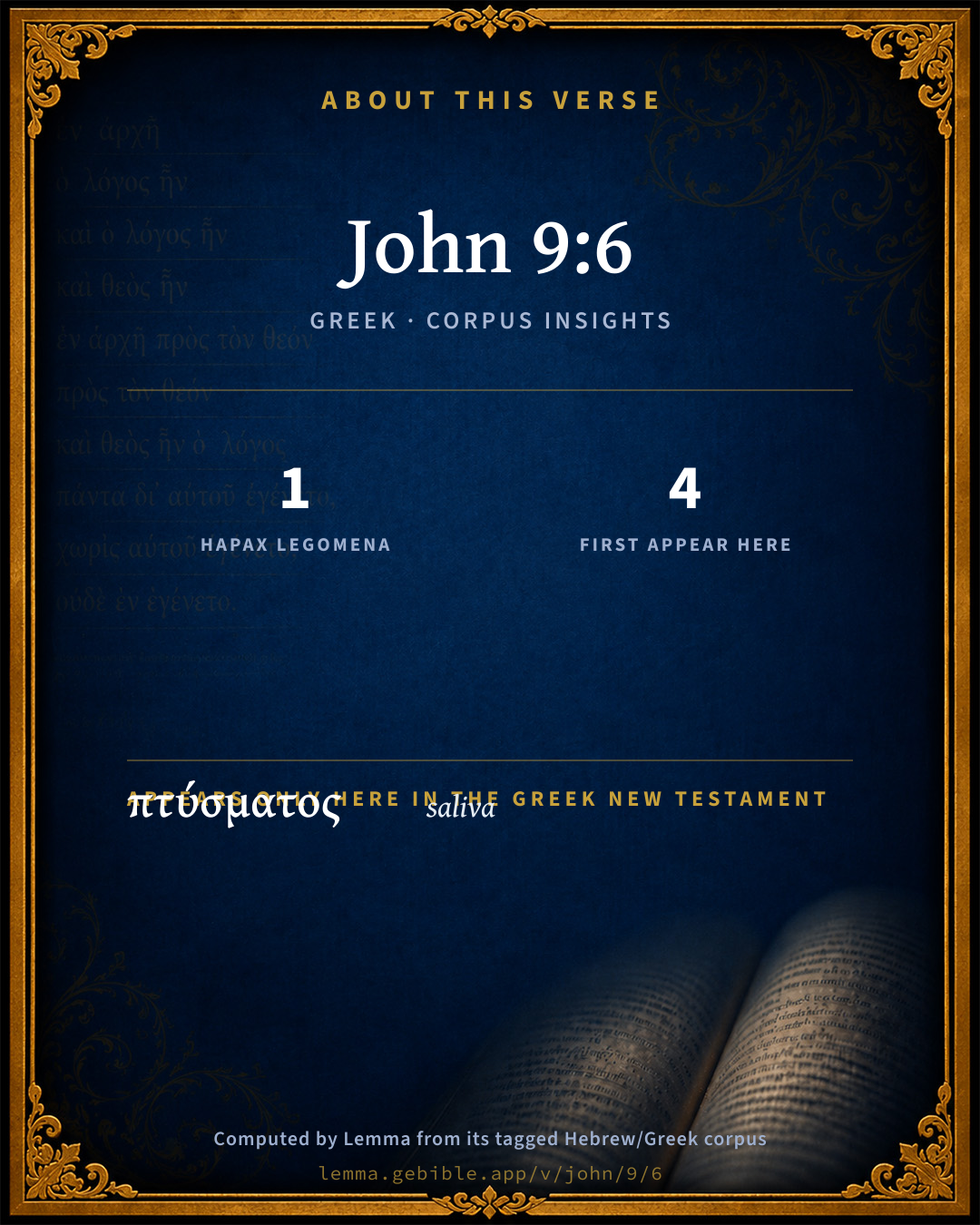
  • 1 hapax legomenon — only here in the Greek New Testament
  • 4 first appearances in the Greek New Testament
Full analysis ↓
Download a study sheet

One document with this verse’s original text, its word-by-word gloss line, the meaning frame, cross-references with their text, attributed commentary, and full source and license credits — printable, and it pastes into notes with its structure intact.

This verse Autodidact and up

Study sheet (.html) Plain text (.txt)

A passage Seminary Student

Up to 50 verses in one chapter. A passage sheet keeps up to 6 commentary sources and 12 cross-references per verse, in the order this page ranks them, and says so on the sheet whenever that leaves anything out. Ask for a single verse and you get the Autodidact verse sheet above.

Everything on this page stays free to read, with no account — the sheet is a download of what is already on screen, not access to it.

Want to remove ads? Support Godless Engineer
Compare translations 3

The same verse in 3 English versions, stacked beneath the original-language interlinear above. Click any original word for its lexicon entry.

Each is an independent rendering of the whole verse — the interlinear is not word-aligned to these translations.

Highlighted words mark where these versions differ — a whole-verse word diff, not a word-by-word alignment.

  • World English Bible Public Domain
    When he had said this, he spat on the ground, made mud with the saliva, anointed the blind man's eyes with the mud,
  • King James Version Public Domain
    When he had thus spoken, he spat on the ground, and made clay of the spittle, and he anointed the eyes of the blind man with the clay,
  • unfoldingWord Literal Text CC BY-SA 4.0
    Having said these things, he spat on the ground and made mud from the saliva and smeared on him the mud on his eyes.

unfoldingWord Literal Text — © unfoldingWord, licensed CC BY-SA 4.0. Word-aligned USFM3 via Door43 (git.door43.org/unfoldingWord/en_ult).

Versions to compare (up to 4)

3 of 4 selected

Show all 19 translations

Every available English version of this verse, each an independent rendering of the whole verse.

  • World English Bible Public Domain
    When he had said this, he spat on the ground, made mud with the saliva, anointed the blind man's eyes with the mud,
  • Berean Standard Bible Public Domain
    When Jesus had said this, He spit on the ground, made some mud, and applied it to the man’s eyes.
  • Majority Standard Bible Public Domain
    When Jesus had said this, He spit on the ground, made some mud, and applied it to the eyes of the blind man.
  • King James Version Public Domain
    When he had thus spoken, he spat on the ground, and made clay of the spittle, and he anointed the eyes of the blind man with the clay,
  • American Standard Version (1901) Public Domain
    When he had thus spoken, he spat on the ground, and made clay of the spittle, and anointed his eyes with the clay,
  • Revised Version (1885) Public Domain
    When he had thus spoken, he spat on the ground, and made clay of the spittle, and anointed his eyes with the clay,
  • Geneva Bible (1599) Public Domain
    Assoone as he had thus spoken, he spat on the ground, and made clay of the spettle, and anointed the eyes of the blinde with the clay,
  • Douay-Rheims (1899) Public Domain
    When he had said these things, he spat on the ground, and made clay of the spittle, and spread the clay on his eyes,
  • Young's Literal Translation Public Domain
    These things saying, he spat on the ground, and made clay of the spittle, and rubbed the clay on the eyes of the blind man, and said to him,
  • Literal Standard Version CC BY-SA 4.0
    Saying these things, He spat on the ground, and made clay of the spittle, and rubbed the clay on the eyes of the blind man, and said to him,
  • Unlocked Literal Bible CC BY-SA 4.0
    After Jesus said these things, he spit on the ground, made mud with the saliva, and smeared the mud on his eyes.
  • unfoldingWord Literal Text CC BY-SA 4.0
    Having said these things, he spat on the ground and made mud from the saliva and smeared on him the mud on his eyes.
  • Darby Bible Public Domain
    Having said these things, he spat on the ground and made mud of the spittle, and put the mud, as ointment, on his eyes.
  • World Messianic Bible Public Domain
    When he had said this, he spat on the ground, made mud with the saliva, anointed the blind man’s eyes with the mud,
  • Webster's Bible Public Domain
    When he had thus spoken, he spit on the ground, and made clay of the spittle, and he anointed the eyes of the blind man with the clay,
  • Free Bible Version CC BY-SA 4.0
    After he'd said this, Jesus spat on the ground and made some mud with the saliva which he put on the man's eyes.
  • Bible in Basic English Public Domain
    Having said these words, he put earth, mixed with water from his mouth, on the man's eyes,
  • Text-Critical English NT CC BY 4.0
    After saying this, he spit on the ground and made mud with the saliva. Then he rubbed the mud on the blind man's eyes
  • Tyndale New Testament (1534) Public Domain
    Assone as he had thus spoken he spate on the grounde and made claye of the spetle and rubbed the claye on the eyes of the blynde

Literal Standard Version (2020), Covenant Press — licensed CC BY-SA 4.0. Text via the HelloAO Bible API (eBible.org). Unlocked Literal Bible (unfoldingWord) — licensed CC BY-SA 4.0. Text via the HelloAO Bible API (eBible.org). unfoldingWord Literal Text — © unfoldingWord, licensed CC BY-SA 4.0. Word-aligned USFM3 via Door43 (git.door43.org/unfoldingWord/en_ult). Free Bible Version, Dr. Jonathan Gallagher — licensed CC BY-SA 4.0. Text via the HelloAO Bible API (eBible.org).

Word by word

More ways to search: Search by grammar → Find every occurrence → Compare this word →

Practice this passage: Drill this verse → Learn its vocabulary →

πτύσματος
ptýsma
G4427
“saliva”
Noun, Genitive, Singular, Neuter
Part of Speech
Noun
Case
Genitive
Number
Singular
Gender
Neuter
Full Thayer's Definition

Origin: from G4429

TDNT: None

1. spittle
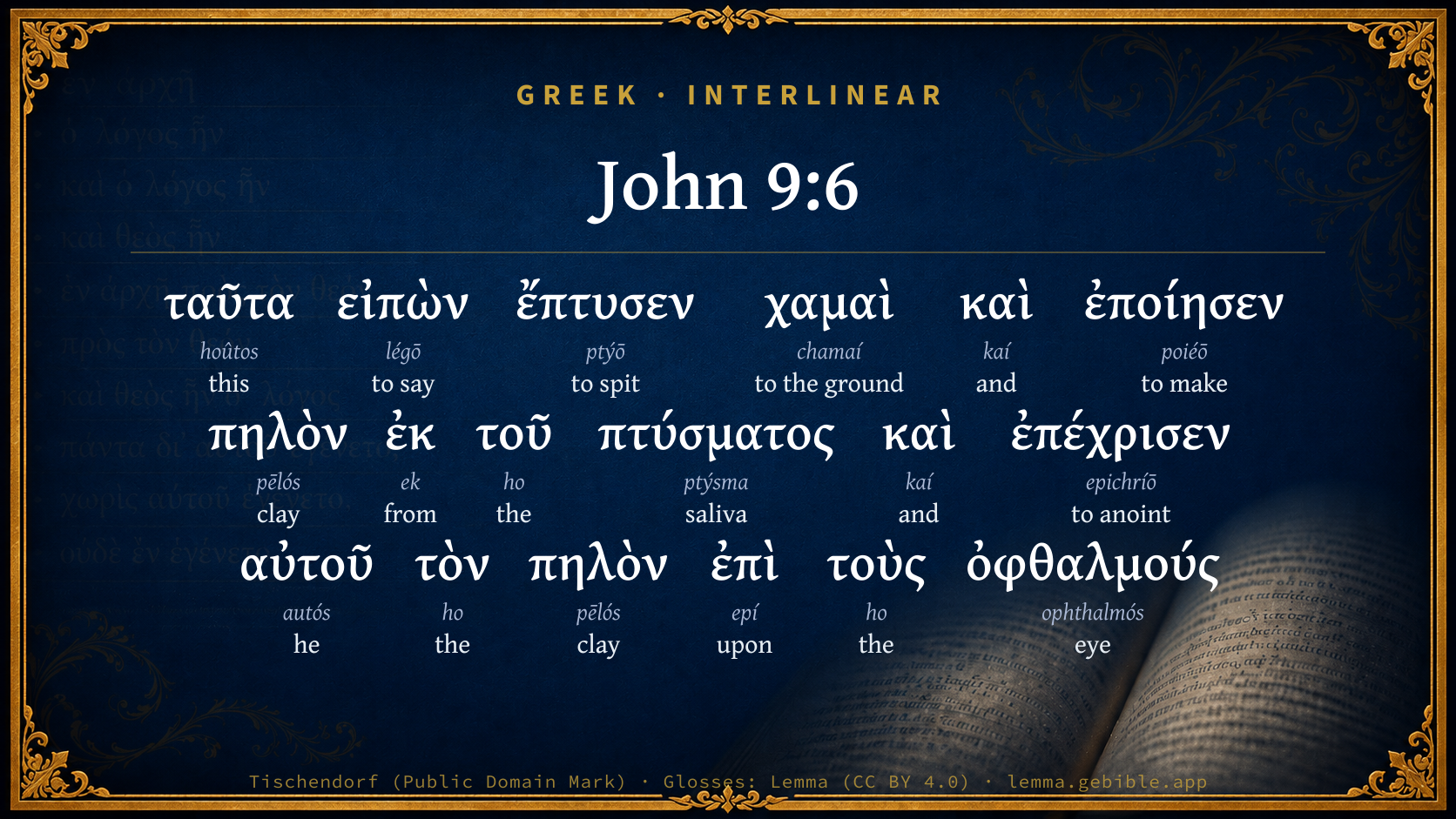
  1. ταῦτα hoûtos G3778 “this” Demonstrative pronoun, Accusative, Plural, Neuter
  2. εἰπὼν légō G3004 “to say” Verb, Aorist, Active, Participle, Nominative, Singular, Masculine
  3. ἔπτυσεν ptýō G4429 “to spit” Verb, Aorist, Active, Indicative, 3rd person, Singular
  4. χαμαὶ chamaí G5476 “to the ground” Adverb
  5. καὶ kaí G2532 “and” Conjunction
  6. ἐποίησεν poiéō G4160 “to make” Verb, Aorist, Active, Indicative, 3rd person, Singular
  7. πηλὸν pēlós G4081 “clay” Noun, Accusative, Singular, Masculine
  8. ἐκ ek G1537 “from” Preposition
  9. τοῦ ho G3588 “the” Article, Genitive, Singular, Neuter
  10. καὶ kaí G2532 “and” Conjunction
  11. ἐπέχρισεν epichríō G2025 “to anoint” Verb, Aorist, Active, Indicative, 3rd person, Singular
  12. αὐτοῦ autós G846 “he” Personal pronoun, Genitive, Singular, Masculine
  13. τὸν ho G3588 “the” Article, Accusative, Singular, Masculine
  14. πηλὸν pēlós G4081 “clay” Noun, Accusative, Singular, Masculine
  15. ἐπὶ epí G1909 “upon” Preposition
  16. τοὺς ho G3588 “the” Article, Accusative, Plural, Masculine
  17. ὀφθαλμούς ophthalmós G3788 “eye” Noun, Accusative, Plural, Masculine

About this verse

These counts appear in no published source. They are computed here, from the morphology-tagged text and Lemma’s own curated glosses. What Lemma adds →

18
words
14
distinct lemmas
Gospels
section

Notable vocabulary

1 hapax legomenon — a word that appears only here in the entire Greek New Testament:

  • πτύσματος saliva G4427

First appearance in Scripture

These words make their first canonical appearance in the Greek New Testament here:

  • χαμαὶ to the ground G5476
  • πηλὸν clay G4081
  • πτύσματος saliva G4427
  • ἐπέχρισεν to anoint G2025

Shared distinctive vocabulary

χαμαὶ to the ground G5476 occurs in 2 verses of the Greek New Testament. Also found in:
Repetition

Words recur within this verse:

Cross-references

3

Topical passages linked to John 9:6 in the Treasury of Scripture Knowledge — connected by theme and wording, ordered by reader-vote popularity; previews shown in the World English Bible.

  • Mark 7:33 He took him aside from the multitude, privately, and put his fingers into his ears, and he spat, and touched his tongue.
  • Mark 8:23 He took hold of the blind man by the hand, and brought him out of the village. When he had spit on his eyes, and laid his hands on him, he asked him if he saw anything.
  • Revelation 3:18 I counsel you to buy from me gold refined by fire, that you may become rich; and white garments, that you may clothe yourself, and that the shame of your nakedness may not be revealed; and eye salve to anoint your eyes, that you may see.

Cross-references courtesy of OpenBible.info (CC BY 4.0).

Where the printed editions differ

1 variant

Places in this verse where the major printed Greek editions disagree on the wording in a way that affects the translation — a comparison of editions, not a manuscript-by-manuscript collation. The editions are the modern critical texts (Nestlé-Aland 28/27, SBL, Westcott-Hort, Tregelles, Tyndale House) and the traditional texts behind the KJV (the Textus Receptus and the Byzantine/Majority text). It is not a claim about which reading is original.

  1. Different wording
    ἐπέχρισεν

    “he rubbed”

    In NA28NA27TynSBLTregTRByz Not in WH

    ἐπέθηκεν (epethēken) 'he laid on' occurs in a few manuscripts (WH) instead of ἐπέχρισεν (epechrisen) 'he rubbed' in older manuscripts (NA28+NA27+Tyn+SBL+Treg+TR+Byz)

Textual data: Translators Amalgamated Greek New Testament (STEPBible TAGNT) · CC BY 4.0.

Commentary

Notes on John 9:6 from classic Christian and Jewish commentators (each source and its license shown beneath its notes). The classic Christian expositions comment on the surrounding passage and are grouped to its opening verse, so a note may address several verses; the Jewish commentaries on the Tanakh (Rashi and others) are per-verse, so they appear only where the commentator wrote on this verse.

Lemma curates 59 commentaries, every one of them public domain or Creative Commons licensed, each selected and text-cleaned for this edition rather than reprinted as found. About our sources →

The Biblical Illustrator

Joseph S. Exell

Joh_9:6

He spat on the ground and made clay of the spittle and He anointed the eyes

The blind made to see, and the seeing made blind

I.

We have here OUR LORD UNVEILING HIS DEEPEST MOTIVES FOR BESTOWING AN UNSOUGHT BLESSING. It is remarkable that out of the eight miracles recorded in this Gospel, there is only one in which our Lord responds to a request to manifest His miraculous power; the others are all spontaneous. In the other Gospels He heals sometimes because of the pleading of the sufferer; sometimes because of the request of the compassionate friends or bystanders; sometimes unasked, because His own heart went out to those that were in pain and sickness. But in Johns Gospel, predominantly we have the Son of God, who acts throughout as moved by His own deep heart. That view of Christ reaches its climax in His own profound words about His own laying down of His life: I came forth from the Father, and am come into the world. Again, I leave the world and go unto the Father. So, not so much influenced by others as deriving motive and impulse and law from Himself, He moves upon earth a fountain and not a reservoir, the Originator and Beginner of the blessings that He bears. Thus, moved by sorrow, recognizing in mans misery the dumb cry for help, seeing in it the opportunity for the manifestation of the higher mercy of God; taking all evil to be the occasion for a brighter display of the love and the good which are Divine; feeling that His one purpose on earth was to crowd the moments with obedience to the will, and with the doing of the works of Him that sent Him; and possessing the sole and strange consciousness that from His person streams out all the light which illuminates the world--the Christ pauses before the unconscious blind man, and looking upon the poor, useless eyeballs, unaware how near light and sight stood, obeys the impulse that shapes His whole life. And when He had spoken thus proceeds to the strange cure.

II. So we come, in the next place, to consider CHRIST AS VEILING HIS POWER UNDER MATERIAL MEANS. This healing by material means in order to accommodate Himself to the weak faith which He seeks to evoke, and to strengthen thereby, is parallel, in principles, to His own incarnation, and to His appointment of external rites and ordinances. Baptism, the Lords Supper, a visible Church, outward means of worship, and so on, all these come under the same category. There is no life nor power in them except His will works through them, but they are crutches and helps for a weak and sense-bound faith to climb to the apprehension of the spiritual reality. It is not the clay, it is not the water, it is not the Church, the ordinances, the outward worship, the form of prayer, the Sacrament--it is none of these things that have the healing and the grace in them. They are only ladders by which we may ascend to Him.

III. Then, still farther, WE HAVE HERE OUR LORD SUSPENDING HEALING ON OBEDIENCE. Go and wash. As He said to the impotent man: Stretch forth thine hand; as He said to the paralytic in this Gospel: Take up thy bed and walk; so here He says, Go and wash. And some friendly hand being stretched out to the blind man, or he himself feeling his way over the familiar path, he comes to the pool and washes, and returns seeing. There is, first, the general truth that healing is suspended by Christ on the compliance with His conditions. He does not simply say to any man, Be whole. He could and did say so sometimes in regard to bodily healing. But He cannot do so as regards the cure of our blind souls. To the sin-sick and sin-blinded man He says, Thou shalt be whole, if--or I will make thee whole, provided that--what?--provided that thou goest to the fountain where He has lodged the healing power. The condition on which sight comes to the blind is compliance with Christs invitation, Come to Me; trust in Me; and thou shalt be whole. Then there is a second lesson here, and that is, Obedience brings sight. If any man will do His will he shall know of the doctrine. Are there any of you groping in darkness, compassed about with theological perplexities and religious doubts? Bow your wills to the recognized truth. He who has made all his knowledge into action will get more knowledge as soon as he needs it. Go and wash; and he went, and came seeing.

IV. And now, lastly, we have here our LORD SHADOWING HIS HIGHEST WORK AS THE HEALER OF BLIND SOULS. The blind man stands for an example of honest ignorance, knowing itself ignorant, and not to be coaxed or frightened or in any way provoked to pretending to knowledge which it does not possess, firmly holding by what it does know, and because conscious of its little knowledge, therefore waiting for light and willing to be led. Hence he is at once humble and sturdy, docile and independent, ready to listen to any voice which can really teach, and formidably quick to prick with wholesome sarcasm the inflated claims of mere official pretenders. The Pharisees, on the other hand, are sure that they know everything that can be known about anything in the region of religion and morality, and in their absolute confidence in their absolute possession of the truth, in their blank unconsciousness that it was more than their official property and stock-in-trade, in their complete incapacity to discern the glory of a miracle which contravened ecclesiastical proprieties and conventionalities, in their contempt for the ignorance which they were responsible for and never thought of enlightening, in their cruel taunt directed against the mans calamity, and in their swift resort to the weapon of excommunication of one whom it was much easier to cast out than to answer, are but too plain a type of a character which is as ready to corrupt the teachers of the Church as of the synagogue. (A. Maclaren, D. D.)

The use of means

Our Lord would teach us, by His peculiar mode of proceeding here, that He is not tied to any one means of doing good, and that we may expect to find variety in His methods of dealing with souls as well as with bodies. May He not also wish to teach us that He can, when He thinks fit, invest material things with an efficacy which is not inherent in them? We are not to despise Baptism and the Lords Supper, because water, bread, and wine are mere material elements. To many who use them, no doubt they are nothing more than mere material things, and never do them the slightest good. But to those who use the sacraments rightly, worthily, and with faith, Christ can make water, bread, and wine, instruments of doing real good. He that was pleased to use clay in healing a blind man may surely use material things, if He thinks fit, in His own ordinances. The water in Baptism, and the bread and wine in the Lords Supper, while they are not to be treated as idols, ought not to be treated with irreverence and contempt. It was, of course, not the clay that healed the blind man, but Christs word and power. Nevertheless the clay was used. So the brazen serpent in itself had no medicinal power to cure the bitten Israelites. But without it they were not cured. The selection of clay for anointing the blind mans eyes is thought by some to be significant, and to contain a possible reference to the original formation of man out of the dust. He that formed man with all his bodily faculties out of the dust could easily restore one of those lost faculties, even sight, when He thought fit. He that healed these blind eyes with clay was the same Being who originally formed man out of the clay. (Bp. Ryle.)

The use of common agencies

This cure is distinguished from most others by the careful use in it of intermediate agencies. Christ does not merely speak the word; there is a process of healing, and the use of these agencies is part of the sign to which St. John wishes to draw our attention. If the other signs testified that there is an invisible power at work in all the springs of our life--that there is a Fountain of life from which these springs are continually renewed--did not this testify that there is a potency and virtue in the commonest things; that God has stored all nature with instruments for the blessing and healing of His creatures? The mere miracle worker who draws glory to himself wishes to dispense with these things lest he should be confounded with the ordinary physician. The Great Physician, who works because His Father works, puts an honour on earth and water as well as upon all art which has true observation and knowledge for its basis. He only distinguishes Himself from other healers by showing that the source of their healing and renovating power is in Him. We have put our faith and our science at an immeasurable distance from each other. May not the separation lead to the ruin of both. (F. D. Maurice, M. A.)

The meaning of Christs action

Jesus would not try weak faith too sternly. Just as you would not give a little child the moral law in all its baldness and harshness to keep, but first sweeten the way of obedience by little rewards and promises which become helps to the doing of right, so the kindly Healer of all deals with the people, who were as little children in faith and spiritual insight. He knew a medicinal value was attributed to saliva for diseases of the eye. It was a little harmless giving way to superstition to let the man have the help of his old belief, such as it was. If you could heal a childs hurt by the magic of a word, the child would not feel half as cured as if you had applied some salve. Jesus applies harmless salve that the man might be helped to believe by having something external done to him. Your straitlaced dogmatists will never see the kindly spirit of such action as this. They would see the man blind all his days before they would pander to such notions. Theirs are the unkindly hands which try to make the child climb to heaven by, first of all knocking down the ladders of childish fancy which its untaught thinking has reared, instead of fixing their ladder to the end of the childs. Jesus is more kindly reasonable. He does not attempt to argue the notion out of the mans mind. He simply lets it alone, and helps the man through his grandmotherly beliefs to healing, and finally to a strong faith in the Divine power. If my child believed that the Heavenly Father came down to the park every night to wrap up the birds in their nests I would not destroy that idea of Providence till I could graft a richer one upon it. Let us learn the Christlike lesson of being weak to the weak and ignorant to the ignorant. (E. H. Higgins.)

The way of faith criticised by the world

It meets with many modern criticisms. In the first place, the mode of cure seems very eccentric. Spat and made clay with the spittle and the dust! Very singular! Very odd! Thus odd and singular is the gospel in the judgment of the worldly wise. Why, saith one, it seems such a strange thing that we are to be saved by believing. Men think it so odd that fifty other ways are invented straightway. Though the new methods are not one of them worth describing, yet everybody seems to think that the old-fashioned way of Believe on the Lord Jesus Christ might have been greatly improved upon. (C. H. Spurgeon.)

The way of faith glorifies Christ

Suppose, instead thereof, He had put His hand into His pocket and had taken out a gold or ivory box, and out of this box He had taken a little crystal bottle. Suppose He had taken out the stopper, and then had poured a drop on each of those blind eyes, and they had been opened, what would have been the result? Everybody would have said, What a wonderful medicine! I wonder what it was! How was it compounded? Who wrote the prescription? Perhaps He found the charm in the writings of Solomon, and so He learned to distil the matchless drops. Thus you see the attention would have been fixed on the means used, and the cure would have been ascribed to the medicine rather than to God. Our Saviour used no such rare oils or choice spirits, but simply spat and made clay of the spittle; for He knew that nobody would say, The spittle did it, or It was the clay that did it. No, if our Lord seems to be eccentric in the choice of means, yet is He eminently prudent. (C. H. Spurgeon.)

The Biblical Illustrator, edited by Joseph S. Exell (c. 1880s–1900s) — public domain. Text from a community e-Sword module.

Joseph Benson's Commentary

Joh 9:6-7. When he had thus spoken, he spat on the ground, &c. — He did the things here mentioned, that he might exercise the faith and obedience of the patient, and show that he could command efficacy from whatever means he should please to use; could work without means, or even by such as seemed evidently calculated to produce an effect contrary to that intended. The clay, here put on the eyes of the blind man, might almost have blinded a person that had sight. But what could it do toward curing the blind? It reminds us that God is no farther from the event designed, whether he uses any means to accomplish it or not; and that all the creatures are only that which his almighty operation makes them. To try still further the faith and submission of the blind man, Jesus said unto him, Go, wash in the pool of Siloam — Perhaps, by giving this command, our Lord intended to make the miracle more taken notice of. For a crowd of people would naturally gather round the man, to observe the event of so strange a prescription. And it is exceeding probable that the guide who must have led him, in traversing a great part of the city, would mention the errand he was going upon, and so call those who saw him to a greater attention. Which is by interpretation, Sent — And so was a type of the Messiah, who was sent of God. This remark, Grotius and Dr. S. Clarke think was designed to intimate, that Christ’s command to the blind man was symbolical, teaching him that he owed his cure to the Messiah, one of whose names was Shiloh, the sent of God. The waters here mentioned came from a spring that was in the rocks of mount Zion, and were gathered into two great basins, the lower called the Pool of Fleeces, and the upper, Shiloah, because the waters that filled it were sent to them by the goodness of God, from the bowels of the earth; for in Judea springs of water, being very rare, were esteemed peculiar blessings. Hence the waters of Shiloah were made by the prophet a type of David’s descendants, and among the rest, of the Messiah, Isa 8:5 : whose benefits are fitly represented by the image of water, for his blood purifies the soul from the foulest stains of sin, just as water cleanses the body from its defilements. Moreover, his doctrine imparts wisdom, and affords refreshment to the spirit, like that which cool draughts of water impart to one who is ready to faint away with thirst and heat. He went, therefore, and washed, and came seeing — He believed, and obeyed, and obtained the blessing he desired. Had he been wise in his own eyes, and reasoned like Naaman, on the impropriety of the means, he would justly have been left in darkness. Lord, may our proud hearts be subdued to the methods of thy recovering grace! May we leave thee to choose how thou wilt bestow favours which it is our highest interest to receive on any terms. This amazing miracle was, doubtless, wrought in the presence of great numbers of people, partly accompanying the man as he passed along the streets, and partly of such as he found at the pool, which was a place much frequented. All these, seeing him led thither blind, with his eyes bedaubed with clay, must have gathered about him, eager to know the cause of so strange an appearance. And “having examined and found that he was stone blind, they could not but be prodigiously struck with his relation, when, after washing in the pool, they saw the new faculty instantly imparted to him; especially if his relation was confirmed by the person who led him, as in all probability it would be. For it is reasonable to suppose, that his conductor was one of them who stood by when Jesus anointed his eyes, and ordered him to wash them in Siloam. Accordingly, when he went away, and washed, and came seeing, that is, walked by the assistance of his own eyes, without being led, the miracle was earnestly and accurately inquired into by all his acquaintance, and was so universally known, that it became the general topic of conversation at Jerusalem, as the evangelist informs us, Joh 9:8-9; nay, it was accurately examined by the literati there. For the man was brought before them; they looked at his eyes; they inquired what had been done to them; they sent for his parents, to know from them if he had been really born blind; and they excommunicated the man, because he would not join them in saying that Jesus, who had cured him, was an impostor.”

Joseph Benson's Commentary on the Old and New Testaments (1811–1818) — public domain. Text from a community e-Sword module.

MacLaren's Expositions of Holy Scripture

Alexander MacLaren

John

THE SIXTH MIRACLE IN JOHN’S GOSPEL

THE BLIND MADE TO SEE, AND THE SEEING MADE BLIND

Joh 9:6 - Joh 9:7.

The proportionate length at which this miracle and its accompanying effects are recorded, indicates very clearly the Evangelist’s idea of their relative importance. Two verses are given to the story of the miracle; all the rest of the chapter to its preface and its issues. It was a great thing to heal a man that was blind from his birth, but the story of the gradual illumination of his spirit until it came to the full light of the perception of Christ as the Son of God, was far more to the Evangelist, and ought to be far more to us than giving the outward eye power to discern the outward light.

The narrative has a prologue and an epilogue, and the true point of view from which to look at it is found in the solemn words with which our Lord closes the incident. ‘For judgment am I come into this world, that they which see not might see, and that they which see might be made blind.’

So then the mere sign, important as it is, is the least thing that we have to look at in our contemplations now.

I. We have here our Lord unveiling His deepest motives for bestowing an unsought blessing.

It is remarkable, I think, that out of the eight miracles recorded in this Gospel, there is only one in which our Lord responds to a request to manifest His miraculous power; the others are all spontaneous.

In the other Gospels He heals sometimes because of the pleading of the sufferer; sometimes because of the request of compassionate friends or bystanders; sometimes unasked, because His own heart went out to those that were in pain and sickness. But in John’s Gospel, predominantly we have the Son of God, who acts throughout as moved by His own deep heart. That view of Christ reaches its climax in His own profound words about His own laying down of His life: ‘I came forth from the Father, and am come into the world. Again, I leave the world and go unto the Father.’ So, not so much influenced by others as deriving motive and impulse and law from Himself, He moves upon earth a fountain and not a reservoir, the Originator and the Beginner of the blessings that He bears.

And that is the point of view from which most strikingly the prologue of our narrative sets forth His action in the miracle here. ‘As Jesus passed by,’ says the story, ‘He saw a man which was blind from his birth.’ He fixes His eye upon him. No cry from the blind man’s lips draws Him. He sits there unconscious of the kind eyes that were fastened upon him. The disciples stand at Christ’s side, and have no share in His feelings. They ask Him to do nothing. To them the blind man is-what? A theological problem. No trace of pity touches their hearts. They do not even seem to have reckoned upon or expected Christ’s miraculous intervention. And that is a very remarkable feature in the Gospels. At all events, they evidently do not expect it here; but all that the sight of this lifelong sufferer does in them is to raise a question, ‘Who did sin; he or his parents?’ Perhaps they do not quite see to the bottom of the alternative that they are suggesting; and we need not trouble ourselves to ask whether there was a full-blown notion of the pre-existence of the man’s soul in their minds as they ask the question. Perhaps they remembered the impotent man to whom our Lord said, ‘Go and sin no more lest a worse thing come unto thee.’ And they may have thought that they had His sanction to the doctrine-as old as Job’s friends-that wherever there was great suffering there must first have been great sin.

That is all that the sight of sorrow does for some people. It leads to censorious judgments, or to mere idle and curious speculations. Christ lets us see what it did for Him, and what it is meant to do for us. ‘Neither hath this man sinned nor his parents, but he is born blind that the works of God may be made manifest in him.’ That is to say, human sorrow is to be looked at by us as an opportunity for the manifestation through us of God’s mercy in relieving and stanching the wounds through which the lifeblood is ebbing away. Do not stand coldly curious or uncharitably censorious. Do not make miserable men theological problems, but see in them a call for service. See in them an opportunity for letting the light of God, so much of it as is in you, shine from you, and your hands move in works of mercy.

And then the Master goes on to state still more distinctly the law which dominated His life, and which ought to dominate ours: ‘I must work the works of Him that sent Me while it is day; the night cometh when no man can work.’ Then poor men’s misery is an occasion for the love of God manifesting itself. Yes. But the love of God manifests itself through human media, through persons; and if we adopt the reading of these words which you will find in the Revised Version, and instead of saying ‘I must work,’ read ‘We must work,’ then we have Christ extending the law which ruled over His own life to all His followers, and making it supremely obligatory and binding upon each of us. He for His part, as I have said, moves through this Gospel as the Son of God, whose mercy, and all whose doings are self-originated. But the other side of that is that He moves through this Gospel in the humble attitude of filial obedience, ever recognising that the Father’s will is supreme in His life; and that He is bound, with an obligation in which He rejoices, to do the will of Him that sent Him. The consciousness of a mission, the sense of filial obedience, the joyful surrender and harmonising of the will of the Son with the will of the Father; these things were the secret of the Master’s life.

And coupled with them, even in Him there was the consciousness that time was short; and although beyond the Cross and the grave there stretched for Him an eternity in which He would work for the blessing of the world, yet the special work which He had to do, while wearing the veil and weakness of flesh, had but few days and hours in which it could be done. Therefore, as we ought to do, He worked under the limitations of mortality, and recognised in the brevity of life another call to eager and continuous service.

These were His motives which, in common with Him, we may share. But He adds another in which we have no share; and declares the unique consciousness which ever stirred Him to His self-manifesting and God-manifesting acts: ‘As long as I am in the world I am the Light of the world.’

Thus, moved by sorrow, recognising in man’s misery the dumb cry for help, seeing in it the opportunity for the manifestation of the higher mercy of God; taking all evil to be the occasion for a brighter display of the love and the good which are divine; feeling that His one purpose upon earth was to crowd the moments with obedience to the will, and with the doing of the works of Him that sent Him; and possessing the sole and strange consciousness that from His person streams out all the light which illuminates the world-the Christ pauses before the unconscious blind man, and looking upon the poor, useless eyeballs, unaware how near light and sight stood, obeys the impulse that shapes His whole life, ‘and when He had spoken thus,’ proceeds to the strange cure.

II. So we come, in the next place, to consider Christ as veiling His power under material means.

There is only one other instance in the Gospels where a miracle is wrought in the singular fashion which is here employed, namely, the healing of the deaf-mute recorded in Mark’s Gospel, where, in like manner, our Lord makes clay of the spittle, and anoints the ears of the deaf man with the clay. The variety of method in our Lord’s miracles serves important purposes, as teaching us that the methods are nothing, and that He moved freely amongst them all, the real cause in every case being one and the same, the bare forth-putting of His will; and teaching us further that in each specific case there were reasons in the moral and religious condition of the persons operated upon for the adoption of the specific means employed, which we of course have no means of discovering. There is here, first then, healing by material means. The clay had no power of healing; the water of Siloam had no power of healing. The thing that healed was Christ’s will, but He uses these externals to help the poor blind man to believe that he is going to be healed. He condescends to drape and veil His power in order that the dim eye, unaccustomed to the light, may look upon that shadowed representation of it when it could not gaze upon the pure brightness; as an eye may look upon a shaded lamp which could not bear its brilliance unsoftened and naked.

This healing by material means in order to accommodate Himself to the weak faith which He seeks to evoke, and to strengthen thereby, is parallel, in principle, to His own Incarnation, and to His appointment of external rites and ordinances. Baptism, the Lord’s Supper, a visible Church, outward means of worship, and so on, all these come under that same category. There is no life nor power in them except His will works through them, but they are crutches and helps for a weak and sense-bound faith to climb to the apprehension of the spiritual reality. It is not the clay, it is not the water, it is not the Church, the ordinances, the outward worship, the form of prayer, the sacrament-it is none of these things that have the healing and the grace in them. They are only ladders by which we may ascend to Him. So let us neither presumptuously antedate the time when we shall be able to do without them-the Heaven in ‘which there is no Temple’-nor grovellingly and superstitiously elevate them to a place of importance and of power in the Christian life which Christ never meant them to fill. He heals through material means; the true source of healing is His own loving will.

Further, He heals at a distance. We have here a parallel with the story of the nobleman’s son at Capernaum, which we have already considered. There, too, we have the same phenomenon, the healing power sent forth from the Master, and operating far away from His corporeal personal presence. This was a test of faith, as the use of the clay had been a help to faith. Still He works His healing from afar, because to Him there is neither near nor far. In His divine ubiquity, that Son of Man, who in His glorified manhood is at the right hand of God the Father Almighty, is here and everywhere where there are weakness and suffering that turn to Him; ready to help, ready to bless and heal. ‘Lo, I am with you always, even unto the end of the world.’

Our Evangelist sees in the very name of that fountain in which the man washed, a symbol which is not to be passed by. ‘Go, wash in the Pool of Siloam,’ which, says John, ‘is by interpretation, Sent.’ We have heard already about the Pool of Siloam in this section of the Gospel. In Joh 7:37 we read, ‘In the last day, that great day of the Feast, Jesus stood and said, “If any man thirst let him come to Me and drink.”‘ These words were probably spoken on the last day of the Feast of Tabernacles, on which one part of the ceremonial was the drawing, with exuberant rejoicing, of water from the Pool of Siloam, and bearing it up to the Temple. In these words Christ pointed to that fountain which rises ‘fast by the oracles of God,’ and wells up from beneath the hill, that on which the Temple is built, as being a symbol of Himself.

And here the Evangelist would have us suppose that, in like manner, the very name which the fountain bore {whether as being an outgush from beneath the Temple rock, or whether as being the gift of God} as applicable to Himself. The lesson to be learned is that the fountain in which we have to be cleansed ‘from sin and from uncleanness,’ whose waters are the lotion that will give eyesight to the blind, the true ‘fountain of perpetual youth,’ which men have sought for in every land, is Christ Himself. In Him we have the welling forth of the heart of God, the water of life, the water of gladness, the immortal stream of which ‘whoso drinketh shall never thirst,’ and which, touching the blind eyeballs, washes away obscuration and gives new power of vision.

III. Then, still further, we have here our Lord suspending healing on obedience.

‘Go and wash.’ As He said to the impotent man: ‘Stretch forth thine hand’; as He said to the paralytic in this Gospel: ‘Take up thy bed and walk’; so here He says, ‘Go and wash.’ And some friendly hand being stretched out to the blind man, or he himself feeling his way over the familiar path, he comes to the pool and washes, and returns seeing.

There is a double lesson there, on which I have no need to dwell. There is, first, the general truth that healing is suspended by Christ on compliance with His conditions. He does not simply say to any man, Be whole. He could and did say so sometimes in regard to bodily healing. But He cannot do so as regards the cure of our blind souls. To the sin-sick and sin-blinded man He says, ‘Thou shalt be whole, if’-or ‘I will make thee whole, provided that’-what?-provided that thou goest to the fountain where He has lodged the healing power. The condition on which sight comes to the blind is compliance with Christ’s invitation, ‘Come to Me; trust in Me; and thou shalt be whole.’

Then there is a special lesson here, and that is, Obedience brings sight. ‘If any man will do His will he shall know of the doctrine.’ Are there any of you groping in darkness, compassed about with theological perplexities and religious doubts? Obey what you know. Do what you see clearly you ought to do. Bow your wills to the recognised truth. He who has turned all his knowledge into action will get more knowledge as soon as he needs it. ‘Go and wash; and he went, and came seeing.’

IV. And now, lastly, we have here our Lord shadowing His highest work as the Healer of blind souls.

It is impossible for me to enter upon that wonderfully dramatic and instructive narrative which follows the account of the miracle, and describe the controversies between the sturdy, quick-witted, candid, blind man, and the narrow, bitter Pharisees. But just notice one or two points.

The two parties are evidently represented as types of two contrasted classes. The blind man stands for an example of honest ignorance, knowing itself ignorant, and not to be coaxed or frightened or in any way provoked to pretending to knowledge which it does not possess; firmly holding by what it does know, and because conscious of its little knowledge, therefore waiting for light and willing to be led. Hence he is at once humble and sturdy, docile and independent, ready to listen to any voice which can really teach, and formidably quick to prick with wholesome sarcasm the inflated claims of mere official pretenders. The Pharisees, on the other hand, are sure that they know everything that can be known about anything in the region of religion and morality, and in their absolute confidence of their absolute possession of the truth, in their blank unconsciousness that it was more than their official property and stock-in-trade, in their complete incapacity to discern the glory of a miracle which contravened ecclesiastical proprieties and conventionalities, in their contempt for the ignorance which they were responsible for and never thought of enlightening, in their cruel taunt directed against the man’s calamity, and in their swift resort to the weapon of excommunication of one whom it was much easier to cast out than to answer, are but too plain a type of a character which is as ready to corrupt the teachers of the Church as of the synagogue.

One cannot but notice how constantly the phrase ‘We know’ occurs. The parents of the man use it thrice. The Pharisees have it on their lips in their first interview with him: ‘We know that this man is a sinner.’ He answers, declining to affirm anything about the character of the Man Jesus, because he, for his part, ‘knows not,’ but standing firmly by the solid reality which he ‘knows,’ in a very solid fashion, that his eyes have been opened. So we have the first encounter between knowledge which is ignorant, and ignorance which knows, to the manifest victory of the latter. Again, in the second round, they try to overbear the man’s cool sarcasm with their vehement assertion of knowledge that God spake to Moses, but by the admission that even their knowledge did not reach to the determination of the question of the origin of Jesus’ mission, lay themselves open to the sudden thrust of keen-eyed, honest humility’s sharp rapier-like retort. ‘Herein is a marvellous thing,’ that you Know-alls, whose business it is to know where a professed miracle-worker comes from, ‘know not from whence He is, and yet He hath opened mine eyes.’ ‘Now we know’ {to use your own words} ‘that God heareth not sinners, but if any man be a worshipper of God, and doeth His will, him He heareth.’

Then observe how, on both sides, a process is going on. The man is getting more and more light at each step. He begins with ‘a Man which is called Jesus.’ Then he gets to a ‘prophet,’ then he comes to ‘a worshipper of God, and one that does His will.’ Then he comes to, ‘If this man were not of God,’ in some very special sense, ‘He could do nothing.’ These are his own reflections, the working out of the impression made by the fact on an honest mind; and because he had so used the light which he had, therefore Jesus gives him more, and finds him with the question, ‘Dost thou believe on the Son of God?’ Then the man who had shown himself so strong in his own convictions, so independent, and hard to cajole or coerce, shows himself now all docile and submissive, and ready to accept whatever Jesus says: ‘Lord, who is He, that I might believe on Him?’ That was not credulity. He already knew enough of Christ to know that he ought to trust Him. And to his docility there is given the full revelation; and he hears the words which Pharisees and unrighteous men were not worthy to hear: ‘Thou hast both seen it is He that talketh with thee.’ Then intellectual conviction, moral reliance, and the utter prostration and devotion of the whole man bow him at Christ’s feet. ‘Lord, I believe; and He worshipped Him.’

There is the story of the progress of an honest, ignorant soul that knew itself blind, into the illumination of perfect vision.

And as he went upwards, so steadily and tragically, downwards went the others. For they had light and they would not look at it; and it blasted and blinded them. They had the manifestation of Christ, and they scoffed and jeered at it, and turned their backs upon it, and it became a curse to them; falling not like dew but like vitriol on their spirits, blistering, not refreshing.

Therefore Christ pronounces their fate, and sums up the story in the solemn two-edged sentence: ‘For judgment am I come into the world, that they which see not might see, and that they which see might be made blind.’

The purpose of His coming is not to judge, but to save. But if men will not let Him save, the effect of His coming will be to harm. Therefore, His coming will separate men into two parts, as a magnet will draw all the iron filings out of a heap and leave the brass. He comes not to judge, but His coming does judge. He is set for the rise or for the fall of men, and is ‘a discerner of the thoughts and intents of the heart.’

Light has a twofold effect. It is torture to the diseased eye; it is gladdening to the sound one. Christ is the light, as He is also both the power of seeing and the thing seen. Therefore, it cannot but be that His shining upon men’s hearts shall judge them, and shall either enlighten or darken.

We all have eyes-the organs by which we may see ‘the light of the knowledge of the glory of God.’ We have all blinded ourselves by our sin. Christ is come to show us God, to be the light by which we see God, and to strengthen and restore our faculty of seeing Him. If you welcome Him, and take Him into your hearts, He will be at once light and eyesight to you. But if you turn away from Him He will be blindness and darkness to you. He comes to pour eyesight on the blind, but He comes therefore also, most assuredly, to make still blinder those who do not know themselves to be blind, and conceit themselves to be clear-sighted. ‘I thank Thee, Father, that Thou hast hid these things from the wise and prudent, and hast revealed them unto babes.’

They who see themselves to be blind, who know themselves to be ignorant, the lowly who recognise their sinfulness and misery and helplessness, and turn in their sore need to Christ, will be led by paths of growing knowledge and blessedness to the perfect day where their strengthened vision will be able to see light in the blaze which to us now is darkness. They who say ‘I see,’ and know not that they are miserable and blind, nor hearken to His counsel to ‘anoint their eyes with eye salve that they may see,’ will have yet another film drawn over their eyes by the shining of the light which they reject, and will pass into darkness where only enough of light and of eyesight remain to make guilt. Jesus Christ is for us light and vision. Trust to Him, and your eyes will be blessed because they see God. Turn from Him and Egyptian darkness will settle on your soul. ‘To him that hath shall be given, and from him that hath not, even that which he hath shall be taken away.’

Alexander MacLaren, Expositions of Holy Scripture (1904–1910) — public domain. Text from a community e-Sword module.

Tyndale Open Study Notes

Tyndale Open Resources

9:6 During the New Testament era, saliva was used for medical purposes (see Mark 7:32-35; 8:22-25).

Tyndale Open Study Notes — © Tyndale Open Resources, licensed CC BY-SA 4.0. Text via the HelloAO Bible API.

Bengel's Gnomon

Johann Albrecht Bengel

Joh 9:6. Εἰπών, having spoken) in the hearing of the blind man. Jesus also prayed, Joh 9:31, “If any man be a worshipper of God, and doeth His will, him He heareth.”—πηλόν, clay) Clean spittle, mixed with clean dust, was a clean medicine. Man was created from the earth: now the creation of sight is taken from the same earth.—ἐπὶ τοὺς ὀφθαλμούς, upon the eyes) It is a poetic fancy of Nonnus, that he has represented that there was not even the trace of eyes on the face of this blind man: Joh 9:10 disproves it [How were thine eyes opened?]

Bengel's Gnomon of the New Testament — English translation (T&T Clark, Edinburgh, 1860) — public domain. Text from a community e-Sword module.

Meyer's Critical & Exegetical Commentary

Heinrich August Wilhelm Meyer

Joh_9:6 f. For what reason Jesus anointed the eyes of the blind man with clay John does not inform us; but this does not justify us in leaving the question unanswered (Brückner). The procedure was certainly not adopted for the purpose of defying the hierarchy (Ewald) because it was the Sabbath, according to which view it would have had nothing to do with the healing itself. At the same time, it was equally far from being of a medicinal nature; for often as spittle was applied in the case of diseases of the eye (see Wetstein and Lightfoot), the means employed bore no proportion to the rapidity with which the cure took place, especially considering that the man was born blind; the same remark applies also to Mar_7:32; Mar_8:23. To treat the anointing with the clay as merely a means of awakening faith (comp. Lücke), or as a test of faith (Calvin), and, consequently, as having a purely psychological effect, is to represent the entire procedure as adopted solely with an eye to appearances, to making an impression on the blind man. On this view, accordingly, the ointment of clay had in itself nothing to do with the cure performed, which is scarcely reconcilable with the truthfulness and dignity of Jesus. Regard for this latter rather compels the assumption that the ointment was the real medium of the cure, and formed an essential part of the act; and that, accordingly, the spittle was the continens of the objective healing virtue, by means of which it came into, and remained actively in contact with, the organism. Comp. Tholuck and Olshausen, who characterize the spittle as the conductor of the healing virtue; Lange also, who, however, conjoins therewith the psychological action referred to above; and even Nonnus, though he draws a very arbitrary distinction, terming the spittle λυσίπονον, and the πηλός, φαεσφόρον. There is nothing against this mode of viewing the matter, in the fact that Jesus used a medium in so few of His miracles of healing, and in so many others employed no medium at all (as also in the case of the blind men of Jericho, Mat_20:20 ff.; Mar_10:46 ff.); for He must Himself have known when it was necessary and when not, though no clearer insight into the causal connection between the means and the result is vouchsafed to us. We have no authority for attributing to John a view of miracles which regarded them as mysteries, and which prevailed at a later date (De Wette, comp. B. Crusius); for with his christology he, least of all, would find occasion for its adoption; besides, that the procedure followed in the case of this miracle was unique, and thus its speciality was carefully substantiated by the judicial investigation which grew out of the occurrence. According to Baur (comp. Ewald, as above), the miracle was performed in this circumstantial way in order that it might wear the appearance of a work done on the Sabbath; the supposition, however, is incorrect, if for no other reason, because the healing by itself, apart altogether from the circumstances attending it, was a breaking of the Sabbath. Baur, indeed, regards the whole narrative, notwithstanding the remarkable circumstantiality and naive liveliness which mark it, as an invention; so also Strauss, Weiss, comp. the note after Joh_9:41. In harmony with his view of the figurative design of the entire healing, Luthardt (comp. also Godet) interprets the anointing with clay to mean: He must become blind who wishes to receive sight (the sending to the pool of Siloam being intended to typify the ἔρχεσθαι πρὸς αὐτόν, Joh_3:20 f.). But interpretations of this sort have no warrant in the text, and furnish at the same time unintentional support to the unhistorical view of those who treat the narrative as the mere vehicle of an idea,a remark which holds good against Hengstenberg, who, like Erasmus[45] and others, regards πηλός, after Gen_2:7, as the symbol of creative influence, although in this case we have only to do with an opening of the eyes (Joh_9:10; Joh_9:14), and that by means of a subsequent washing away of the πηλός.

καὶ ἐπέχρισεν αὐτοῦ τ. πηλὸν ἐπὶ τ. ὀφθ. τ. τυφλοῦ] According to this reading (see the critical note), ΑὐΤΟῦ must be referred to the spittle of Jesus; He rubbed the ointment made of it and the clay on the eyes of the blind man.[46]

εἰς τὴν κολυμβ.] not dependent on ὝΠΑΓΕ (comp. on Mat_2:23), which is not connected with ΝΊΨΑΙ even by a ΚΑΊ (against Lücke and Winer), but: Into the pool of Siloam, so that the πηλός is washed away into the pool by the process of cleansing which takes place on the edge of the basin. Comp. on the pregnancy of this mode of expression, Kühner, ad Xen. Anab. ii. 2. 10; Winer, p. 387 [E. T. p. 517]).

On the Pool Siloam (Fountain, Isa_8:6; Luk_13:4 : Pool, Neh_3:15) and its doubtful situation,which, however, Robinson (II. p. 142 ff.), following Josephus, re-discovered at the entrance of the Tyropoeum Valley, on the south-east side of Zion,see Tobler, d. Siloahquelle u. d. Oelberg, 1852, p. 1 ff.; Rödiger in Gesen. Thes. III. p. 1416; Leyrer in Herzogs Encykl. XIV. p. 371 ff. The expression κολυμβ. τοῦ Σιλ. denotes the pool formed by the fountain Siloam (ὁ Σιλ., Luk_13:4; Isa_8:6).

The washing in the pool of Siloam is no more to be regarded as a medicinal prescription than the application of the πηλός (the Rabbinical traces of a healing virtue of the water relate to the digestive organs, see Schoettgen), but was required by Jesus for the purpose of allowing the clay the necessary time for producing its effect, and, at the same time, this particular water, the pool of Siloam, was mentioned as being nearest to the scene of the action (in the vicinity of the temple, Joh_8:59, Joh_9:1), and as certainly also well known to the blind man. According to Lange, L. J. p. 635, the intention of Jesus, in prescribing the sacred fountain of the temple, was to set manifestly forth the co-operation of Jehovah in this repeated Sabbath act. But neither John nor the discussion that follows in Joh_9:13 ff.in the course of which, indeed, the pool is not once mentionedbetray the slightest trace of this supposed mystery. This also in answer to the meaning imported by Godet into the text, that Siloam is represented as the type of all the blessings of which Christ is the reality, so that, in the form of an action, Christ says, Ce que Siloé est typiquement, je le suis en réalité. This does not at all harmonize with the narrative; in fact, on such a view, the confused notion would result, that the true Siloam sent the blind man to the typical Siloam in order to the completion of his cure,that the Antitype, in other words, sent him to the Type!

ἀπεσταλμένος] The name שִׁילוֹחַ (which even the LXX. and Josephus give in Greek as ΣΙΛΩΆΜ) denotes originally missio (sc. aquarum), i.e. outflow; but John, adopting a typical etymology, renders it directly שָׁלוּחַ, missus, which in itself was grammatically allowable, either after the analogy of יִלּוֹד (see Hitzig on Isa_8:6), so that the word would be a strengthened particip. Kal with a passive signification, or, in virtue of the resolution of the dagesh forte in the particip. Piel into yod (see Tholuck, Beiträge zur Spracherklär. p. 120 ff.; Ewald, Lehrb. d. Hebr. Spr. §156 a.). He thus finds, namely, in the name of the pool, a noteworthy typical reference, not indeed to Christ, the messenger of God, the true Siloam (as Theophylact, Erasmus, Beza, Calvin, Corn. a Lapide, and many other earlier commentators, also Schweizer, Ebrard, Luthardt, Hilgenfeld, Lange, Hengstenberg, Brückner, Godet maintain), but to the circumstance that the blind man was sent to this pool by Christ. The pool of שלוח has the nomen et omen of this sending away. The context naturally suggests nothing further than this.[47] Nonnus aptly remarks: ὝΔΩΡ ΣΤΕΛΛΟΜΈΝΟΙΟ ΠΡΟΏΝΥΜΟΝ ἘΚ ΣΈΟ ΠΟΜΠῆς. Comp. Euth. Zigabenus: ΔΙᾺ ΤῸΝ ἈΠΕΣΤΑΛΜΈΝΟΝ ἘΚΕῖ ΤΌΤΕ ΤΥΦΛΌΝ. It is arbitrary with Wassenberg and Kuinoel to pronounce the entire parenthesis spurious (it is absent only in Syr. and Pers. p.), a view to which Lücke also inclined, out of regard for John. But why should a fondness for typical etymologies have been foreign to John? Comp. the much more peculiar example of Paul in Gal_4:25. Such things leave the pneumatic character of the evangelist unaffected.

ἈΠῆΛΘΩΝ] which he, being well acquainted with the neighbourhood, was able to do without any one to take him by the hand, ΤΥΦΛῷ ΠΟΔΊ (Eur. Hec. 1050), as, indeed, many blind men are able in like manner to find their way about alone.

ἦλθε] namely, to his dwelling, as is indicated by the words οἱ οὖν γείτονες which follow. Jesus did not meet him again till Joh_9:35.

[45] Erasmus, Paraphr.: paternum videlicet ac suum verius opificium referens, quo primum hominem ex argilla humore macerata finxerat. Ejusdem autem erat auctoris restituere quod perierat, qui condiderat quod non erat. So substantially, also, Theophylact, Euth. Zigabenus, Beza, and several others. Comp. also Iren. 5. 15.

[46] Note the naive, attractive circumstantiality which is characteristic of the entire narrative.

[47] Not to the fact that in ἀπεσταλμ., which would denote freely flowing, streaming, a deliverance from certain evils was found, as Ewald supposes. It is quite a mistake to suppose any allusion to the water of baptism (Calovius, after Ambrose, Jerome, and others); as also to identify the name with שלה in Gen_49:6 (Grotius). The simple and correct view is taken also by Bengel, De Wette, and several others; by Baeumlein with hesitation.

Meyer — Critical and Exegetical Commentary on the New Testament — English translation by Peter Christie, edited by Frederick Crombie (T&T Clark, 1880) — public domain. Text from a community e-Sword module.

Expositor's Greek Testament

ed. W. Robertson Nicoll

Joh 9:6 . Ταῦτα εἰπὼν , i.e. , “in this connection,” ἔπτυσε χαμαί … “He spat on the ground and made clay of the spittle,” “quia aqua ad manum non erat,” says Grotius; but that spittle was considered efficacious Lightfoot proves by an amusing anecdote and Wetstein by several citations. Tacitus ( Hist. , iv. 81) relates that the blind man who sought a cure from Vespasian begged “ut … oculorum orbes dignaretur respergere oris excremento”. Probably the idea was that the saliva was of the very substance of the person. Tylor ( Prim. Culture , ii. 400) is of opinion the Roman Catholic priest’s touching with his spittle the ears and nostrils of the infant at baptism is a survival of the custom in Pagan Rome in accordance with which the nurse touched with spittle the lips and forehead of the week-old child. Virtue was also attributed to clay in diseases of the eye. A physician of the time of Caracalla prescribes “turgentes oculos vili circumline coeno”. That Jesus supposed some virtue lay in the application of the clay is contradicted by the fact that in other cases of blindness He did not use it. See Mar 10:46 . But if He applied the clay to encourage the man to believe, as is the likely solution, the question of accommodation arises (see Lücke). The whole process of which the man was the subject was apparently intended to deepen his faith.

The Expositor's Greek Testament, edited by W. Robertson Nicoll (1897–1910) — public domain. Text from a community e-Sword module.

Geneva Bible (1599)

Geneva Bible translators

Christ healing the man born blind, by taking the sign of clay, and afterward the sign of the fountain of Siloam (which signifieth Sent) showeth that as he at the beginning made man, so doth he again restore both his body and soul: and yet so, that he himself cometh first of his own accord to heal us.

Geneva Bible (1599) marginal notes — public domain. Text via Bolls.life.

Jamieson, Fausset & Brown

Robert Jamieson, A. R. Fausset & David Brown

he spat on the ground, and made clay . . . and he anointed the eyes of the blind man--These operations were not so incongruous in their nature as might appear, though it were absurd to imagine that they contributed in the least degree to the effect which followed. (See Mar 6:13 and see on Joh 7:33.)

Jamieson, Fausset & Brown — Commentary Critical and Explanatory on the Whole Bible (1871) — public domain (CC PDM 1.0). Text via the HelloAO Bible API.

Adam Clarke's Commentary

Verse 6. Anointed the eyes of the blind man] It would be difficult to find out the reason which induced our Lord to act thus. It is certain, this procedure can never be supposed to have been any likely medical means to restore sight to a man who was born blind; this action, therefore, had no tendency to assist the miracle. If his eye-lids had been only so gummed together that they needed nothing but to be suppled and well washed, it is not likely that this could possibly have been omitted from his birth until now. The Jews believed that there was some virtue in spittle to cure the diseases of the eye; but then they always accompanied this with some charm. Our Lord might make clay with the spittle to show that no charms or spells were used, and to draw their attention more particularly to the miracle which he was about to work. Perhaps the best lesson we can learn from this is: That God will do his own work in his own way; and, to hide pride from man, will often accomplish the most beneficial ends by means not only simple or despicable in themselves, but by such also as appear entirely contrary, in their nature and operation, to the end proposed to be effected by them.

Adam Clarke's Commentary on the Bible (1810–1826) — public domain. Text from a community e-Sword/MySword module.

John Calvin's Commentaries

6. He spat on the ground. The intention of Christ was, to restore sight to the blind man, but he commences the operation in a way which appears to be highly absurd; for, by anointing his eyes with clay, he in some respects doubles the blindness Who would not have thought either that he was mocking the wretched man, or that he was practising senseless and absurd fooleries? But in this way he intended to try the faith and obedience of the blind man, that he might be an example to all. It certainly was no ordinary proof of faith, that the blind man, relying on a bare word, is fully convinced that his sight will be restored to him, and with this conviction hastens to go to the place where he was commanded. It is an illustrious commendation of his obedience, that he simply obeys Christ, though there are many inducements to an opposite course. And this is the trial of true faith, when the devout mind, satisfied with the simple word of God, promises what otherwise appears incredible. Faith is instantly followed by a readiness to obey, so that he who is convinced that God will be his faithful guide calmly yields himself to the direction of God. There can be no doubt that some suspicion and fear that he was mocked came into the mind of the blind man; but he found it easy to break through every obstruction, when he arrived at the conclusion that it was safe to follow Christ. It may be objected that the blind man did not know Christ; and, therefore, could not render the honor which was due to him as the Son of God. I acknowledge this to be true; but as he believed that Christ had been sent by God, he submits to him, and not doubting that he speaks the truth, he beholds in him nothing but what is Divine; and, in addition to all this, his faith is entitled to the greater commendation, because, while his knowledge was so small, he devoted himself wholly to Christ.

John Calvin's Commentaries (1540-1563) — public domain. Text from the Calvin Translation Society English edition (1840s-50s) via the Christian Classics Ethereal Library (ccel.org). Calvin's coverage is partial (roughly two-thirds of the Bible); uncommented books and verses are honest gaps, never fabricated. The 19th-century editor's footnotes and remarks are omitted so the notes are faithfully Calvin's own voice.

Ellicott's Commentary for English Readers

(6) And he anointed the eyes of the blind man with the clay.—The words “blind man” are omitted in some of the older MSS. The marginal rendering, and He spread the clay upon the eyes of the blind man (or, upon his eyes), is to be preferred.

The details given in this and the next verse are evidently to be regarded as part of the sign. They impressed themselves as such upon the eye-witnesses, and they have been recorded as such for us. We have then to seek their interpretation. At the outset we are met by the undoubted fact that our Lord here made use of means which, in part at least, were natural, and found their place in the ordinary prescriptions of the day. We know from the pages of Pliny, and Tacitus, and Suetonius, that the saliva jejuna was held to be a remedy in cases of blindness, and that the same remedy was used by the Jews is established by the writings of the Rabbis. That clay was so used is not equally certain, but this may be regarded as the vehicle by means of which the saliva was applied. Here, then, as elsewhere, we may recognise the Divine manifested by means of the human, and see the ordinary remedy of every-day life blessed to meet a case that was beyond human power. Physicians had applied such means commonly to cases of post-natal blindness, but congenital blindness had always been regarded as incurable, and no instance to the contrary had ever been heard of (Joh_9:32). The Great Physician, then, by using the ordinary means, will teach men that the healing powers of nature are His gracious gift, and that they are increased at the Giver’s will. Our daily sustenance in health and strength, our restored power after sickness or accident, the whole of ordinary life, which we too commonly connect only with ordinary means, is lifted to the higher region of union with Him in whom we live, and move, and have our being.

Another interpretation sees in the use of clay a symbolism which is to be traced to the first Creation, when man was formed from the dust of the earth. We find this as early as Irenaeus, and it may well, therefore, represent an oral explanation, going back to the days of the Evangelist himself. The thought would be that our Lord will here exercise the same creative power as that which made man, and will complete, by the gift of sight, this man, who had hitherto been maimed and without the chief organ of sense.

The use of means by which the healing power is conveyed is common to this instance with that of the blind man at Bethsaida (Mar_8:22-26), and that of the deaf and dumb man in Decapolis (Mar_7:32-37); while the two blind men in the house (Mat_9:27-31), and the two blind men at Jericho (Mat_20:29-34), are touched and receive their sight. The reader is referred to the Notes on these passages of St. Matthew and St. Mark. Here it will be enough to observe that in each case the loss of a channel of communication between the individual man and the outer world is compensated by some special means which may help to assure him of the presence of the true Healer, and may furnish a foundation for his faith and hope. The deaf man cannot hear the tones of a voice that tells of mercy and love, but the touch applied to the ear may in part convey the same gracious truths. The blind man cannot see the look of compassion which others can see, but the saliva or the clay applied to the eye gives force to the word which is heard by the ear. In every case we should remember that the means is chiefly moral, preparing in the sufferer a mental condition which can receive the gift of healing, and that the physical gift is itself regarded as a stage in the spiritual education. The wisest physicians of the body, and the wisest physicians of the soul, have alike sought to follow in the steps of Him who is their common Master. There are conditions of physical disease for which the truest medicines would be faith, and love, and hope—a mind at peace with itself and with God. There are morbid states of spiritual life that have their cause in physical derangement, and would find their truest remedy in the healthy tone of a restored and vigorous body.

A Bible Commentary for English Readers, edited by Charles John Ellicott (1878–1897) — public domain. Text from a community e-Sword module.

The Cambridge Bible for Schools and Colleges

gen. ed. J. J. S. Perowne

6–12. The Sign

6. anointed the eyes of the blind man with the clay] ‘Of the blind man’ should probably be omitted, ‘of it’ inserted, and the rendering in the margin adopted: spread the clay of it (clay made with the spittle) upon his eyes. Regard for Christ’s truthfulness compels us to regard the clay as the means of healing; not that He could not heal without it, but that He willed this to be the channel of His power. Elsewhere He uses spittle; to heal a blind man (Mar_8:23); to heal a deaf and dumb man (Mar_7:33). Spittle was believed to be a remedy for diseased eyes (comp. Vespasian’s reputed miracle, Tac. Hist. iv. 81, and other instances); clay also, though less commonly. So that Christ selects an ordinary remedy and gives it success in a case confessedly beyond its supposed powers (Joh_9:32). This helps us to conclude why He willed to use means, instead of healing without even a word; viz. to help the faith of the sufferer. It is easier to believe, when means can be perceived; it is still easier, when the means seem to be appropriate.

The Cambridge Bible for Schools and Colleges (gen. ed. J. J. S. Perowne; Cambridge University Press, 1878–1918) — public domain. Text from a community e-Sword module.

John Gill's Exposition

And when he had thus spoken,.... In answer to the disciples' question, and declaring his own work and office in the world, and the necessity he was under of performing it:

he spat on the ground, and made clay of the spittle; the Misnic doctors speak (c) of , "clay that is spitted", or "spittle clay", which their commentators say (d) was a weak, thin clay, like spittle or water; but this here was properly spittle clay, or clay made of spittle, for want of water; or it may be rather, through choice Christ spat upon the dust of the earth, and worked it together into a consistence, like clay:

and he anointed the eyes of the blind man with the clay; however, spittle, especially fasting spittle, might be thought proper in some disorder of the eyes, to be used, as it was by the Jews; See Gill on Joh 9:16; yet clay was a most unlikely means of restoring sight to a man that was born blind, which might be thought rather a means of making a man blind that could see. This may be an emblem of the word of God, the eye salve of the Gospel; which is a very unlikely means in the opinion of a natural man, who counts it foolishness, of enlightening and saving sinners; and yet by this foolishness of preaching God does save those that believe.

(c) Misn. Mikvaot, c. 7. sect. 1. (d) Jarchi, Maimon. & Bartenora in ib.

John Gill's Exposition of the Whole Bible (1746–1763) — public domain (CC PDM 1.0). Text via the HelloAO Bible API.

Trapp's Complete Commentary

John Trapp

6 When he had thus spoken, he spat on the ground, and made clay of the spittle, and he anointed the eyes of the blind man with the clay,

Ver. 6. Made clay] As he did at first in making man (the poets tell us some such thing of their Prometheus), to show that this cure was done by that Almighty power that he put forth in the Creation.

John Trapp, A Commentary or Exposition upon All the Books of the Old and New Testament (1647–1656) — public domain. Text from a community e-Sword module.

Albert Barnes' Notes on the Bible

And made clay ... - Two reasons may be assigned for making this clay, and anointing the eyes with it. One is, that the Jews regarded spittle as medicinal to the eyes when diseased, and that they forbade the use of medicines on the Sabbath. They regarded the Sabbath so strictly that they considered the preparation and use of medicines as contrary to the law. Especially it was particularly forbidden among them to use spittle on that day to heal diseased eyes. See instances in Lightfoot. Jesus, therefore, by making this spittle, showed them that their manner of keeping the day was superstitious, and that he dared to do a thing which they esteemed unlawful. He showed that their interpretation of the law of the Sabbath was contrary to the intention of God, and that his disciples were not bound by their notions of the sacredness of that day. Another reason may have been that it was common for prophets to use some symbolical or expressive action in working miracles. Thus, Elisha commanded his staff to be laid on the face of the child that he was about to restore to life, 2Ki 4:29. Compare the notes at Isa 8:18. In such instances the prophet showed that the miracle was performed by power communicated through him; so, in this case, Jesus by this act showed to the blind man that the power of healing came from him who anointed his eyes. He could not see him, and the act of anointing convinced him of what might have been known without such an act, could he have seen him that Jesus had power to give sight to the blind.

Albert Barnes' Notes on the Bible (1834–1885) — public domain. Text from a community e-Sword/MySword module.

Haydock's Catholic Bible Commentary

He spat on the ground. With clay and spittle he cured the blind man, to make the miracle more visible. (Witham) --- From the example of Jesus Christ, religious ceremonies are introduced in the administration of the sacraments; and can the Church be blamed for copying her divine Founder? (Haydock)

George Leo Haydock (1774–1849), Haydock's Catholic Family Bible and Commentary, 1859 edition — public domain. Excludes Psalms (Douay-Rheims chapter numbering differs from Protestant) and Deuterocanonical books (Catholic canon only).

Matthew Poole's English Annotations

Several mysterious allegories are found out by men of luxuriant fancies, with reference to the manner of our Saviour’s curing this blind man; as if our Saviour had made choice of clay, to show, that as he at first made man of the dust of the earth, so he could again cure him with dust; and that his spittle denoted the efficacy of Christ’s humanity, being now personally united to the Divine nature. Others think, he made use of spittle, because the Jews had a great opinion of the medicinal virtue of spittle; and, they say, forbade the medicinal use of it on the sabbath day, on which day this miracle was wrought. But all these things are great uncertainties, for which we want any guidance from holy writ. It is most probable, that our Saviour made use of the spittle in working this miracle because he had no water at hand, for water was a very scarce thing in those hot countries. That which we are chiefly to attend in this great miraculous operation is, Christ’s demonstration of his Divine nature, for the confirmation of the truth of which he doubtless wrought this great work, as well as to show his charity to this poor creature. To this purpose,

1. He maketh choice, not of a blind man only, but one who was born so, and so incurable according to all judgment of human art.

2. He maketh use of no means that had any appearance of a natural virtue in it; nay, which was more likely to put out the eyes of one that saw, than to give sight to one that was blind.

Matthew Poole's English Annotations on the Holy Bible (1683–1685) — public domain. Text from a community e-Sword/MySword module.

Whedon's Commentary on the Bible

Daniel D. Whedon

6. He spat on the ground—The Lord uses instrumentalities for the end, to show that the end was the purposed end, and not mere coincidence or chance. He uses instrumentalities plainly inadequate, to show that the power was miraculous. Both spittle and clay were often used by the ancients as an ointment for the cure of weak eyes; and this again indicates that our Lord purposes, by their use, to show that the cure is the result of his purpose. Yet no one could ever believe that the cure of one born blind could ever be effected naturally by such means. The cure was, therefore, an intended result and a miraculous one.

Made clay—Made a clay mortar or mixture.

Daniel D. Whedon (gen. ed.), Commentary on the Old and New Testaments (1874–1909) — public domain. Text from a community e-Sword module.

The Pulpit Commentary

When he had said these things, he spat on the ground, and made clay of the spittle, and with the clay thereof anointed his (the) eyes (of the blind man). The precise meaning and motive of the process here described has been a source of great perplexity to the commentators. We see that, on other occasions, our Lord used his own saliva as a means of cure. (Mar_7:33 8:23) Theme finds in the spittle the symbol of the impurity of the man thus dealt with, (Isa_1:5, Isa_1:6) but somewhat inconsistently compares the "clay" with the "collyrium" of Rev_3:17-19, and the "ausfiuss des Logos." On some occasions Jesus touched the diseased or deficient organ, put his hand on the leper, and his fingers in the ears of the deaf mute. On other occasions, again, he healed with his word only, and even from a distance, those who. in the freeness and royalty of his love, he elected to relieve from their sufferings. He was moved, doubtless, in every case by the "special condition and temperament of the objects of his compassion. The use of these means was probably intended to evoke the nascent faith that predisposed him to receive healing, to stir the mind of the sufferer into some conscious relation will himself through those other powers of tactile sensitiveness which were in all similar cases singularly acute. Moreover, the virtue of saliva in cases of blindness was well understood. Lightfoot gives some curious proof of this, and Tacitus ("Hist.," 4:81) and Suetonius ("Vesp.," Joh 7) both record the healing of a blind man by the Emperor Vespasian by the use of jejuna saliva. Pliny ("Hist. Nat.," 28:7) speaks of the same remedy for the diseases of the eye. "Clay" also is spoken of as being sanative by a physician by name Serenus Samonicus (see Tholuck, Wetistein, Lange, in loc.). These ideas may have had some truth in them, and for the blind man to find the process described, applied to himself by One who spoke of the Divine operations being wrought in him, would work some powerful effect on his moral, physical, and spiritual nature. Such result our Lord intended to produce. But this was only part of the healing process.

The Pulpit Commentary (1880–1919), ed. H.D.M. Spence-Jones & Joseph S. Exell — public domain. Text from a community e-Sword module.

John Wesley's Explanatory Notes

He anointed the eyes of the blind man with the clay - This might almost have blinded a man that had sight. But what could it do toward curing the blind? It reminds us that God is no farther from the event, when he works either with, or without means, and that all the creatures are only that which his almighty operation makes them.

John Wesley, Explanatory Notes Upon the Whole Bible (1754–1765) — public domain. Text via the GEBible commentary corpus.

Burkitt's Expository Notes on the New Testament

William Burkitt

Two things concurred towards the cure of this blind man, namely, an act of divine power on Christ’s part, and an act of faith and obedience on the man’s part.

1. An act of divine power on Christ’s part, he tempers clay and spittle together, and anoints the man’s eyes therewith, and behold he sees.

What an improbable remedy and means was this to human reason! Much fitter to put out a seeing man’s eyes than to cure a blind man’s. Had Christ pulled out his box, and applied some medicinal ointment to his eyes, then the praise had been ascribed to his kill, not to his power; but now it plainly appeared, that all the virtue was in Christ, not in the means.

Lord! what great things canst thou do by weak and unlikely means; yea, by opposite and contrary means! but it is the praise of Omnipotency to work by probabilities. From the contemptibleness of the means or instrument, always redounds the greater honour to the agent.

Observe, 2. An act of faith and obedience on the man’s part; He went away and washed his eyes in the pool of Siloam, and returned seeing.

Where note, 1. How Christ delights to exercise and try the faith of his people, by their subjection and obedience to difficult commands.

2. That true faith, joined with sincere obedience, never faileth the expectation of them that exercise it: especially in obeying the most hard and difficult commands. Therefore the Evangelist added, that the blind man, after washing, returned seeing.

William Burkitt's Expository Notes on the New Testament (1700–1703) — public domain. Text from a community e-Sword module.

The People's New Testament

B. W. Johnson

6, 7. Go, wash in the pool of Siloam. It was Christ's rule to require an act of faith. Hence, instead of bidding him to see, he sent him to Siloam to wash the clay from his eyes. Siloam is a rock-hewn basin fifty-three feet long, eighteen wide, and nineteen deep, fed by a spring. It is named in Isa. 8:6 and Neh. 3:15, and can still be seen in Jerusalem.

B. W. Johnson's The People's New Testament with Notes (1889–1891) — public domain. Electronic text from the Christian Classics Ethereal Library (CCEL) ThML edition.

unfoldingWord translationNotes

Door43 World Missions Community

made mud with the saliva

Jesus used his fingers to mix the dirt and saliva. AT: "and used his fingers to mix the dirt and saliva to make mud" (See: Assumed Knowledge and Implicit Information)

wash ... washed

You may need to make explicit that Jesus wanted him to wash the mud off of his eyes in the pool and that that is what the man did.

which is translated "Sent"

A brief break occurs here in the story line so John can explain to his readers what "Siloam" means. AT: "which means 'Sent'" (See: Background Information)

unfoldingWord translationNotes — © Distant Shores Media and the Door43 World Missions Community, licensed CC BY-SA 4.0. Source: git.door43.org/Door43/en_tn.

Cambridge Greek Testament for Schools and Colleges

6–12. THE SIGN

6. ἐπέχρισεν αὐτοῦ for ἐπέχρισε. Omit τοῦ τυφλοῦ (explanatory gloss) after ὀφθαλμούς with אBL against AC.

6. ἐπέχρισεν αὐτοῦ τ. π. Either spread the clay thereof (made with the spittle), or spread His clay (made by Him) upon his eyes. Jewish tradition expressly forbade putting spittle to the eyes on the Sabbath: of course it would forbid making clay on the Sabbath: comp. Joh 5:10. Regard for Christ’s truthfulness compels us to regard the clay as the means of healing; not that He could not heal without it, but that He willed this to be the channel of His power. Elsewhere He uses spittle; to heal a blind man (Mar 8:23); to heal a deaf and dumb man (Mar 7:33). Spittle was believed to be a remedy for diseased eyes (comp. Vespasian’s reputed miracle, Tac. Hist. IV. 8, and other instances); clay also, though less commonly. So that Christ selects an ordinary remedy and gives it success in a case confessedly beyond its supposed powers (Joh 9:32). This helps us to conclude why He willed to use means, instead of healing without even a word; viz. to help the faith of the sufferer. It is easier to believe, when means can be perceived; it is still easier, when the means seem to be appropriate.

Perhaps the whole act was symbolical. To the man’s natural blindness Jesus added an artificial blindness, and pointed out a cure for the latter, which, being accepted by the man’s faith, cured the former also. To the natural blindness of the Jews Jesus added an artificial blindness by teaching in parables (Mar 4:11-12). The interpretation of the teaching would have cured both forms of blindness. But the Jews rejected it.

Cambridge Greek Testament for Schools and Colleges (Cambridge University Press, 1896; 21 vols, various authors incl. Carr, Maclear, Plummer, Farrar, Lumby, Moule, M. R. James, Simcox) — public domain. Text from a community e-Sword module.

Alford’s Greek Testament

Henry Alford

6.] See reff. Mark. The virtue especially of the saliva jejuna, in cases of disorders of the eyes, was well known to antiquity. Pliny, . . xxviii. 7, says, “Lippitudines matutina quotidie velut inunctione arceri.” In both accounts (Suet. Vesp. 7: Tacitus, Hist. iv. 8) of the restoring of a blind man to sight attributed to Vespasian, the use of this remedy occurs. See also Wetstein in loc. (Trench, Miracles, 293 note, edn. 2). The use of clay also for healing the eyes was not unknown. Serenus Samonicus (in the time of Caracalla) says: “Si tumor insolitus typho se tollat inani, Turgentes oculos vili circumline cœno.”

No rule can be laid down which our Lord may seem to have observed, as to using, or dispensing with, the ordinary human means of healing. He Himself determined by considerations which are hidden from us. Whatever the means used, the healing was not in them, but in Him alone. The ‘conductor’ of the miraculous power was generally the faith of the recipient: and if such means served to awaken that faith, their use would be accounted for.

Henry Alford, The Greek Testament (1849–1861) — public domain. Text from a community e-Sword module.

International Critical Commentary

6. Jesus is represented here (as also at 5:6) as curing the sufferer without waiting to be asked. This is unlike the Synoptic narratives of healing, e.g. Mar 8:23, the cure of the blind man at Bethsaida, who was brought to Jesus by his friends. In that case, however, as in this, Jesus is said to have resorted to the use of physical means for the recovery of the patient, sc. the eyes were treated with spittle (cf. also Mar 7:33).

The curative effects of saliva (especially of fasting saliva) have been, and still are, accepted in many countries. “Magyars believe that styes on the eye can be cured by some one spitting on them.”1 A blind man who sought a cure from Vespasian asked “ut … oculorum orbes dignaretur respergere oris excremento” (Tacitus, Hist. iv. 81). Lightfoot (Hor. Hebr. in loc.) quotes a Rabbinical story which embodies the same idea. It was, apparently, a current belief in Judæa that spittle was good for diseased eyes, and that Jesus accommodated Himself to that belief is reported both by Mk. and Jn., although in neither case is it stated that He Himself accepted it as well founded. This tradition of Jesus curing blindness by means of His spittle is not found in Mt. or Lk. It is evidently the oldest tradition.

Severus Sammonicus, a second-century physician, quoted by Wetstein, prescribes the use of clay for smearing bad eyes, “turgentes oculos uili circumline caeno.”2

These strange remedies may be compared with those mentioned in a second-century inscription:3 Οὐαλερίῳ Ἄπρῳ στρατιώτῃ τυφλῷ ἐχρημάτισεν ὁ θεὸς ἐλθεῖν καὶ λαβεῖν αἷμα ἐξ ἀλεκτρυῶνος λευκοῦ μετὰ μέλιτος καὶ κολλυρίου συντρῖψαι (cf. the mixture of clay and spittle) καὶ ἐπὶ τρεῖς ἡμέρας ἐπιχρεῖσαι ἐπὶ τοὺς ὀφθαλμοὺς (cf. ἐπέχρισεν … ἐπὶ τοὺς ὀφθαλμούς, v. 6) καὶ ἀνέβλεψεν καὶ ἐλήλυθεν καὶ ηὐχαρίστησεν δημοσίᾳ τῷ θεῷ.1

ἔπτυσεν χαμαί. πτύειν occurs again only Mar 7:33, Mar 7:8:23; it should be noted that at Mar 8:23 Jesus spat into the eyes of the blind man, πτύσας εἰς τὰ ὄμματα αὐτοῦ. χαμαί only occurs again 18:6.

ἐπέχρισεν. So אADNWΘ; BC* give ἐπέθηκεν. In the N.T. ἐπιχρίω occurs again only at v. 11.

The true text (אBLNΘ) proceeds: αὐτοῦ τὸν πηλὸν ἐπὶ τοὺς ὀφθαλμούς, i.e. “and smeared its clay” (sc. the clay which He had mixed with His spittle) “on the eyes.” The rec. text after ὀφθαλμούς adds τοῦ τυφλοῦ, “He smeared the clay on the eyes of the blind man.”

Irenæus has a curious comment on the use of clay. He says (Hær. v. xv. 2) that the true work of God (cf. v. 3) is the creation of man, “plasmatio hominis,” and he quotes Gen 2:7 of God making man out of the dust of the earth. He concludes that the use of clay for the cure of the blind man was similar to this; being blind from his birth, he had virtually no eyes, and Jesus created them out of the clay.

International Critical Commentary — older volumes (1896–1929), various authors — public domain. Text from a community e-Sword module.

Vincent's Word Studies in the New Testament

Marvin R. Vincent

On the ground [χαμαι] . Only here and Joh 18:6. Anointed [επεχρισε] . Only here and ver. 11. The spittle was regarded as having a peculiar virtue, not only as a remedy for diseases of the eye, but generally as a charm, so that it was employed in incantations. Persius, describing an old crone handling an infant, says : "She takes the babe from the cradle, and with her middle finger moistens its forehead and lips with spittle to keep away the evil eye" (" Sat., "2, 32, 33). Tacitus relates how one of the common people of Alexandria importuned Vespasian for a remedy for his blindness, and prayed him to sprinkle his cheeks and the balls of his eyes with the secretion of his mouth (" History," 4, 81). Pliny says : "We are to believe that by continually anointing each morning with fasting saliva (i. e., before eating), inflammations of the eyes are prevented" (" Natural History, " 28, 7). Some editors read here ejpeqhken, put upon, for ejpecrisen, anointed.

Of the blind man. Omit, and read as Rev., his eyes.

Marvin R. Vincent, Word Studies in the New Testament (1887–1900) — public domain. Text from a community e-Sword/MySword module.

Godet's Commentaries

Frédéric Louis Godet

Vv. 6, 7. “Having said this, he spat on the ground and made clay of the spittle, and he anointed with this clay the eyes of the blind Man 1:7 and he said to him; Go, wash in the pool of Siloam (a name which means, Sent). He went away therefore and washed, and came seeing.”

By the words: having said this, the evangelist presents the following act as the immediate application of the principle which Jesus has just laid down. In Mat 20:34 (Mar 10:46), Jesus heals a blind man by a simple touch. In Mar 7:33; Mar 8:23, He uses, as here, His saliva for effecting cures. He makes use of an external means, therefore, only in some cases. Hence it follows that He does not use it as a medical agency. Is this the vehicle or the conductor of His miraculous power, as some have thought?

The same reason prevents us from deciding for this view. We must rather see in this manner of acting a pedagogic measure, not with the aim of putting the faith of the sick man to the test, as He is about to do with the blind man (Calvin), but to the end of entering into more direct and personal contact with him. When Jesus had to do with sick persons who possessed all their senses, He could act upon them with a look or with a word. But in cases like that of the deaf-mute (Mar 7:33 ff.) and of the blind man (Mar 8:23) we see Him making use of some material means to put them in relation to His person and to present to their faith its true object. It was necessary that they should know that their cure emanated from His person. This knowledge was the starting-point for their faith in Him as the author of their salvation.

And if in the case with which we are occupied, Jesus does more than anoint the eyes of the blind man, if He covers them with a mass of clay, adding thus to the natural blindness an artificial blindness, and sends him to wash in Siloam, the aim of this course of action can hardly be that which Meyer andWeiss suppose,—to give to the organ, which had never performed its functions before, time to be formed and to be made ready to act; for when once miraculous power is admitted, it cannot be limited in this way; it is more probable that in this point also the aim of Jesus was of a moral nature. The pool of Siloam had played an important part in the feast which had come to its end. In the solemn and daily libation (p. 75), this fountain had been presented to the people as the emblem of the theocratic favors and the pledge of all the Messianic blessings. This typical significance of Siloam rested upon the Old Testament which had established a contrast between this humble fountain, springing up noiselessly at the foot of the temple mountain (the waters of Shiloah which flow sweetly), emblem of the divine salvation wrought by the Messiah (Emmanuel), and the great waters (of the Euphrates), the symbol of the brute force of the enemies of the theocracy (Isa 8:7). What then does Jesus do by adding to the real blindness of this man, which He alone can cure, this artificial and symbolic blindness, which the water of Siloam is to remove? In the first place, He expressly gives to the sacred fountain a part in His work of healing, as He had not done in chap. 5 with reference to the pool of Bethesda, and He thus places this work more evidently to the eyes of all under the protection of God Himself. God is thereby associated, as it were, in this new Sabbatic work (Lange). Then, He presents Himself as the real fountain of Siloam of which the prophet had spoken (Isa 8:7) and thus declares to the people that this type of the grace of Jehovah is now fulfilled in Him.

It is undoubtedly this symbolic significance attributed to the water of Siloam, which explains the remark of the evangelist: a name which signifies: Sent. From the philological point of view, the correctness of the translation given by John is no longer disputed. It is acknowledged that the name Siloam is a verbal substantive or adjective fromשָׁלַח, H8938, and derived from the passive participle Kal or rather Piel (with the solution of the daghesh forte in the into י). What was the origin of this title? The pool of Siloam, discovered by Robinson near the place where the three valleys of Tyropeon, Hinnom and Jehoshaphat meet together, is fed by a subterranean conduit recently discovered, which starts from the fountain of the Virgin in the valley of Jehoshaphat and crosses in a zigzag way the side of the rock of Ophel, the southern prolongation of the temple mountain. The name sent can therefore be explained in this sense: water brought from far. Or we may think, with Ewald, of the jet itself of the spring, that is of the intermittent fountain which feeds the reservoir (see Vol. I., p. 455). Or finally we may see herein the idea of agift of Jehovah (Hengstenberg), springs being regarded in the East as gifts of God. In any case, this parenthesis has as its purpose to establish a relation between this spring celebrated by the prophet as the emblem of the Messianic salvation (the typical sent) and the sent one properly so-called who really brings this salvation.

As Franke remarks (p. 314), this case, being the only one in which Jesus rests upon the meaning of a name, must be explained by the circumstance that Isaiah had already brought the water of Siloam into connection with the salvation of which He recognized the accomplishment in Jesus.

Meyer and others explain this parenthesis by supposing that John saw prefigured in this name sent thesending of the blind man himself to Siloam. As if there were the least logical correspondence between this sending and the name of this reservoir; as if the name of sent were not above all the constant title of Jesus Himself in our Gospel. To get rid of this parenthesis which embarrassed him, Lucke had recourse, with hesitation, to the hypothesis of an interpolation. The Peschito actually omits these words. But this omission in a Syriac translation is very naturally explained, since the word translated belongs to that language.

According to the Alexandrian reading, we must translate in Joh 9:6: “He applied His clay to...” Weiss, to save this objectionable reading, proposes to refer the pronoun αὐτοῦ, not to Jesus, but to πτύσματος, the saliva: “He applied the clay of the saliva.” The fact is that here, as frequently, one must know how to free one’s self from the prejudice which attributes to the Alexandrian text a kind of infallibility. The preposition of motion, εἰς, into, is used with the verb νίψαι, wash, probably because the blind man was obliged to go down into the reservoir. Meyerexplains the εἰς, by mentioning that in washing, the blind man would necessarily make the clay fall into the basin(!). It is a matter of course that the blind man found a guide among the persons present. How can Reuss make a charge against the narrative on the point of this omission? The evangelist says: He returned seeing; this signifies, no doubt, that the blind man returned to the place where he had left Jesus that he might render thanks to Him, and that, not finding Him there,—Jesus was only passing by (Joh 9:1),—he returned to his dwelling. This appears, indeed, from the following expression (Joh 9:8): the neighbors, as well as from Joh 9:35; Joh 9:37. Reuss: “We are not told where the man went after having washed, why he did not return to his benefactor...” What is to be said of such criticism?

Frédéric Louis Godet — Commentaries on Luke, John, Romans, and 1 Corinthians — English translation (T&T Clark, Edinburgh, 1870s–1890s) — public domain. Text from a community e-Sword module.

Lesson kit

Teaching starters — assembled from the data on this page, not authored interpretation. Every prompt links to the verse data it draws on. Edit before teaching.

John, in the Gospels, opens this verse with 18 words (14 distinct Greek lemmas). Its most distinctive word is ptýsma (“saliva”). A historical commentator’s framing appears above. Read the whole chapter for the surrounding context.

Discussion questions

  1. The word ptýsma carries the sense “saliva.” How does it shape the verse?
  2. This verse holds 1 word here found nowhere else in the Greek New Testament. What might the rare word draw attention to?
  3. 4 words here appear for the first time in Scripture. What is being introduced at this debut?
  4. John 18:6 shares the word «to the ground» with this verse. How do the two illuminate each other?
  5. “clay” occurs 2× in this one verse. What is the effect of the repetition?
  6. The translations on this page render this verse differently — a whole-verse word diff, not a word-by-word alignment. What might account for the different wordings?
  7. Reading how The Biblical Illustrator and Joseph Benson's Commentary read this verse, where do the two commentators agree and where do they part?

Things to notice

  • 1 word in this verse appears nowhere else in the Greek New Testament.
  • 4 words make their first canonical appearance in Scripture here.
  • These translations choose different wording for 17 words in this verse.
  • “clay” occurs 2× in this single verse.
  • 14 distinct Greek lemmas span 18 words in this verse.

Reading settings

Reading text

Shown beneath each verse's original-language words.

Old Testament
Old Testament edition

Read the OT as the Masoretic Hebrew (MT) or the Greek Septuagint (LXX).

English shown for the Greek Septuagint (in the Hebrew ↔ Greek comparison).

Comparing translations? Open the Compare panel on any verse page to stack up to four side by side.