
Genesis 14:8

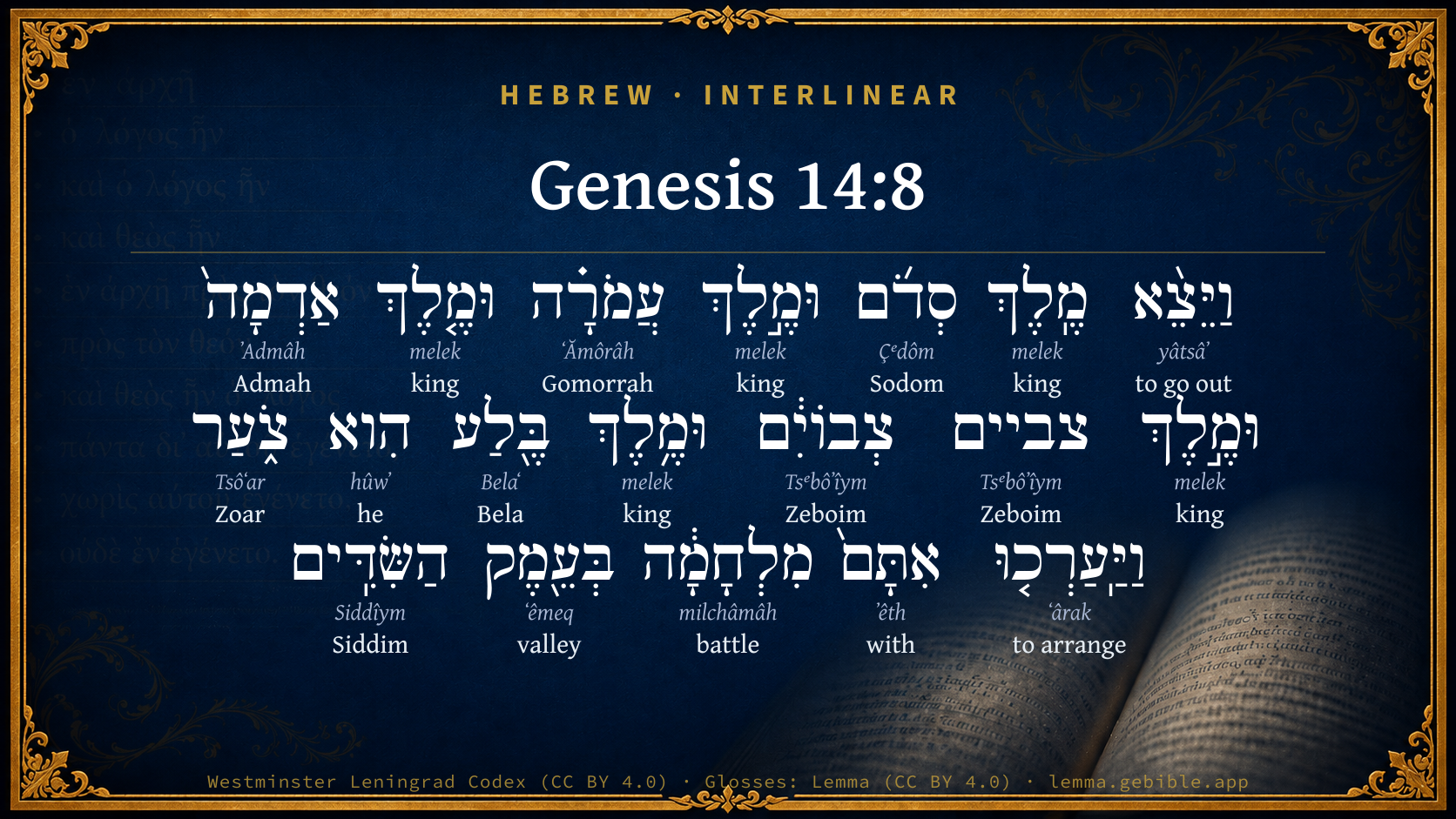
Hebrew (Westminster Leningrad Codex) Genesis 14:8 appears in the Hebrew Old Testament. The text above is from the Westminster Leningrad Codex. Each word links to its Strong’s number, a concise gloss, and parsing drawn from the Open Scriptures Hebrew Bible morphology. Click any word for its full Brown-Driver-Briggs (BDB) entry.
Download image
Cite this verse

Genesis 14:8 (World English Bible). Public Domain. Lemma interlinear Bible study tool, https://lemma.gebible.app/v/genesis/14/8.

Show BibTeX & RIS
BibTeX
RIS
English Translation
There went out the king of Sodom, and the king of Gomorrah, and the king of Admah, and the king of Zeboiim, and the king of Bela (the same is Zoar); and they set the battle in array against them in the valley of Siddim;
World English Bible · Public Domain
Highlights
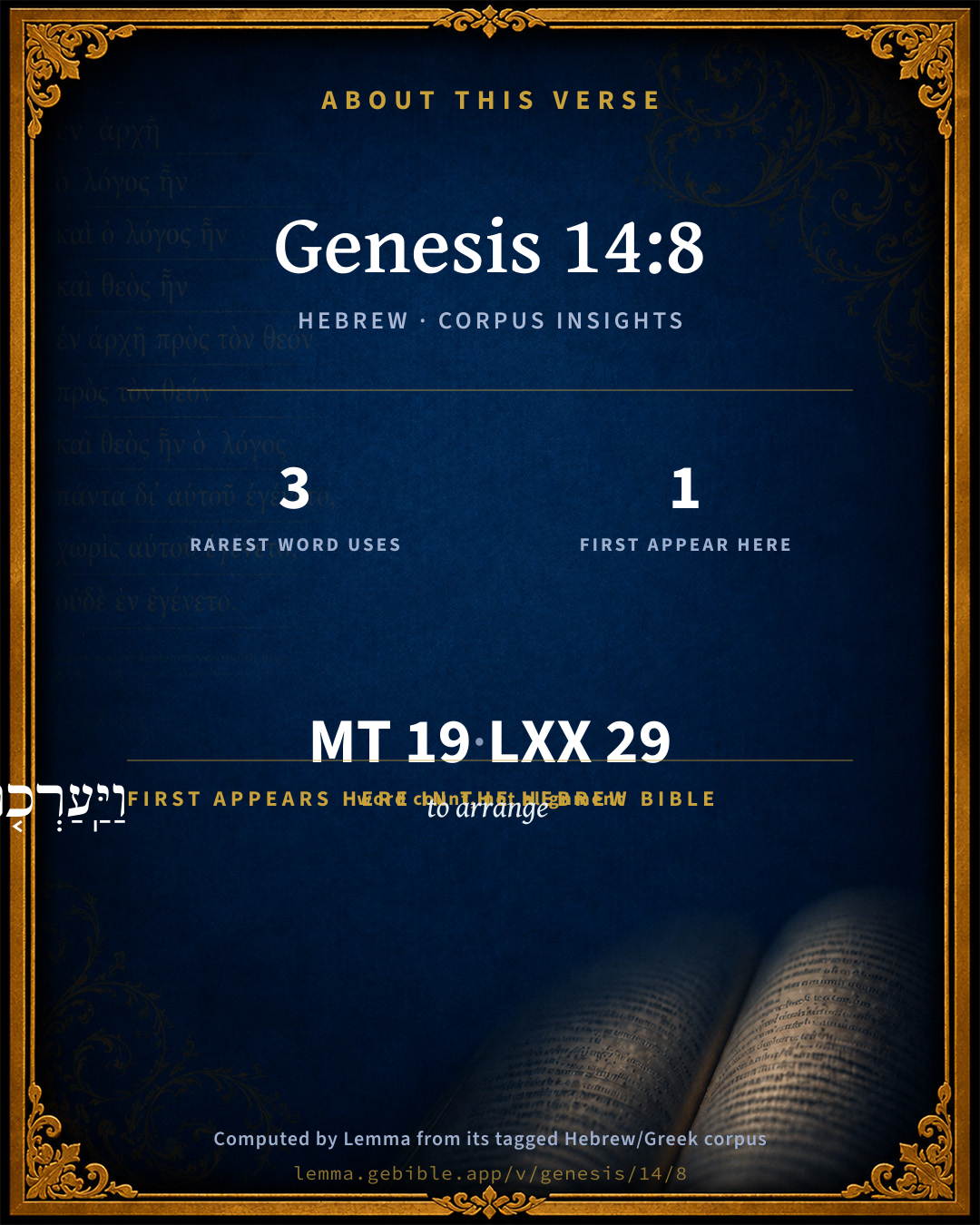
  • 1 first appearance in the Hebrew Bible
Full analysis ↓
Download a study sheet

One document with this verse’s original text, its word-by-word gloss line, the meaning frame, cross-references with their text, attributed commentary, and full source and license credits — printable, and it pastes into notes with its structure intact.

This verse Autodidact and up

Study sheet (.html) Plain text (.txt)

A passage Seminary Student

Up to 50 verses in one chapter. A passage sheet keeps up to 6 commentary sources and 12 cross-references per verse, in the order this page ranks them, and says so on the sheet whenever that leaves anything out. Ask for a single verse and you get the Autodidact verse sheet above.

Everything on this page stays free to read, with no account — the sheet is a download of what is already on screen, not access to it.

Want to remove ads? Support Godless Engineer
Compare translations 3

The same verse in 3 English versions, stacked beneath the original-language interlinear above. Click any original word for its lexicon entry.

Each is an independent rendering of the whole verse — the interlinear is not word-aligned to these translations.

Highlighted words mark where these versions differ — a whole-verse word diff, not a word-by-word alignment.

  • World English Bible Public Domain
    There went out the king of Sodom, and the king of Gomorrah, and the king of Admah, and the king of Zeboiim, and the king of Bela (the same is Zoar); and they set the battle in array against them in the valley of Siddim;
  • King James Version Public Domain
    And there went out the king of Sodom, and the king of Gomorrah, and the king of Admah, and the king of Zeboiim, and the king of Bela (the same is Zoar;) and they joined battle with them in the vale of Siddim;
  • unfoldingWord Literal Text CC BY-SA 4.0
    Then the king of Sodom, and the king of Gomorrah, and the king of Admah, and the king of Zeboiim, and the king of Bela, which Zoar, went out into the Valley of Siddim and arranged themselves for battle

unfoldingWord Literal Text — © unfoldingWord, licensed CC BY-SA 4.0. Word-aligned USFM3 via Door43 (git.door43.org/unfoldingWord/en_ult).

Versions to compare (up to 4)

3 of 4 selected

Show all 18 translations

Every available English version of this verse, each an independent rendering of the whole verse.

  • World English Bible Public Domain
    There went out the king of Sodom, and the king of Gomorrah, and the king of Admah, and the king of Zeboiim, and the king of Bela (the same is Zoar); and they set the battle in array against them in the valley of Siddim;
  • Berean Standard Bible Public Domain
    Then the king of Sodom, the king of Gomorrah, the king of Admah, the king of Zeboiim, and the king of Bela (that is, Zoar) marched out and arrayed themselves for battle in the Valley of Siddim
  • Majority Standard Bible Public Domain
    Then the king of Sodom, the king of Gomorrah, the king of Admah, the king of Zeboiim, and the king of Bela (that is, Zoar) marched out and arrayed themselves for battle in the Valley of Siddim
  • King James Version Public Domain
    And there went out the king of Sodom, and the king of Gomorrah, and the king of Admah, and the king of Zeboiim, and the king of Bela (the same is Zoar;) and they joined battle with them in the vale of Siddim;
  • American Standard Version (1901) Public Domain
    And there went out the king of Sodom, and the king of Gomorrah, and the king of Admah, and the king of Zeboiim, and the king of Bela (the same is Zoar); and they set the battle in array against them in the vale of Siddim;
  • Revised Version (1885) Public Domain
    And there went out the king of Sodom, and the king of Gomorrah, and the king of Admah, and the king of Zeboiim, and the king of Bela (the same is Zoar); and they set the battle in array against them in the vale of Siddim;
  • Geneva Bible (1599) Public Domain
    Then went out the King of Sodom, and the King of Gomorah, and the King of Admah, and the King of Zeboiim, and the King of Bela, which is Zoar: and they ioyned battell with them in the vale of Siddim:
  • Douay-Rheims (1899) Public Domain
    And the king of Sodom, and the king of Gomorrha, and the king of Adama, and the king of Seboim, and the king of Bala, which is Segor, went out: and they set themselves against them in battle array in the woodland vale:
  • Young's Literal Translation Public Domain
    And the king of Sodom goeth out, and the king of Gomorrah, and the king of Admah, and the king of Zeboim, and the king of Bela, which `is' Zoar; and they set the battle in array with them in the valley of Siddim,
  • Literal Standard Version CC BY-SA 4.0
    And the king of Sodom goes out, and the king of Gomorrah, and the king of Admah, and the king of Zeboim, and the king of Bela, which [is] Zoar; and they set in array [for] battle with them in the Valley of Siddim,
  • Unlocked Literal Bible CC BY-SA 4.0
    Then the king of Sodom, the king of Gomorrah, the king of Admah, the king of Zeboyim, and the king of Bela (also called Zoar) went out and prepared for battle in the Valley of Siddim
  • unfoldingWord Literal Text CC BY-SA 4.0
    Then the king of Sodom, and the king of Gomorrah, and the king of Admah, and the king of Zeboiim, and the king of Bela, which Zoar, went out into the Valley of Siddim and arranged themselves for battle
  • Darby Bible Public Domain
    And the king of Sodom and the king of Gomorrah, and the king of Admah, and the king of Zeboim, and the king of Bela, which is Zoar, went out, and they joined battle with them in the vale of Siddim,
  • World Messianic Bible Public Domain
    The king of Sodom, and the king of Gomorrah, the king of Admah, the king of Zeboiim, and the king of Bela (also called Zoar) went out; and they set the battle in array against them in the valley of Siddim
  • Webster's Bible Public Domain
    And there went out the king of Sodom, and the king of Gomorrah, and the king of Admah, and the king of Zeboiim, and the king of Bela, (the same is Zoar;) and they joined battle with them in the vale of Siddim;
  • Free Bible Version CC BY-SA 4.0
    Then the king of Sodom, the king of Gomorrah, the king of Admah, the king of Zeboiim, and the king of Bela (otherwise known as Zoar) marched out and prepared for battle in the Valley of Siddim.
  • Bible in Basic English Public Domain
    And the king of Sodom with the king of Gomorrah and the king of Admah and the king of Zeboiim and the king of Bela (that is Zoar), went out, and put their forces in position in the valley of Siddim,
  • JPS Tanakh (1917) Public Domain
    And there went out the king of Sodom, and the king of Gomorrah, and the king of Admah, and the king of Zeboiim, and the king of Bela — the same is Zoar; and they set the battle in array against them in the vale of Siddim;

Literal Standard Version (2020), Covenant Press — licensed CC BY-SA 4.0. Text via the HelloAO Bible API (eBible.org). Unlocked Literal Bible (unfoldingWord) — licensed CC BY-SA 4.0. Text via the HelloAO Bible API (eBible.org). unfoldingWord Literal Text — © unfoldingWord, licensed CC BY-SA 4.0. Word-aligned USFM3 via Door43 (git.door43.org/unfoldingWord/en_ult). Free Bible Version, Dr. Jonathan Gallagher — licensed CC BY-SA 4.0. Text via the HelloAO Bible API (eBible.org).

Word by word

More ways to search: Search by grammar → Find every occurrence → Compare this word →

Practice this passage: Drill this verse → Learn its vocabulary →

הַשִּׂדִּֽים
Siddîym
H7708
“the · Siddim”
Particle, Definite Article + Noun, Proper
Part of Speech
Particle + Noun
Type
Proper
Full BDB Definition

Origin: pl. from the same as H7704

TWOT: None

Siddim = "field" or " plain" - valley where the Dead Sea is located
  1. וַיֵּצֵ֨א yâtsâʼ H3318 “and · to go out” Conjunction + Verb, Qal, Sequential Imperfect, 3rd Person, Masculine, Singular
  2. מֶֽלֶךְ melek H4428 “king of” Noun, Common, Masculine, Singular, Construct
  3. סְדֹ֜ם Çᵉdôm H5467 “Sodom” Noun, Proper
  4. וּמֶ֣לֶךְ melek H4428 “and · king of” Conjunction + Noun, Common, Masculine, Singular, Construct
  5. עֲמֹרָ֗ה ʻĂmôrâh H6017 “Gomorrah” Noun, Proper
  6. וּמֶ֤לֶךְ melek H4428 “and · king of” Conjunction + Noun, Common, Masculine, Singular, Construct
  7. אַדְמָה֙ ʼAdmâh H126 “Admah” Noun, Proper
  8. וּמֶ֣לֶךְ melek H4428 “and · king of” Conjunction + Noun, Common, Masculine, Singular, Construct
  9. צביים Tsᵉbôʼîym H6636 “Zeboim” Noun, Proper
  10. צְבוֹיִ֔ם Tsᵉbôʼîym H6636 “Zeboim” Noun, Proper
  11. וּמֶ֥לֶךְ melek H4428 “and · king of” Conjunction + Noun, Common, Masculine, Singular, Construct
  12. בֶּ֖לַע Belaʻ H1106 “Bela” Noun, Proper
  13. הִוא hûwʼ H1931 “he” Pronoun, Personal, 3rd Person, Feminine, Singular
  14. צֹ֑עַר Tsôʻar H6820 “Zoar” Noun, Proper
  15. וַיַּֽעַרְכ֤וּ ʻârak H6186 “and · to arrange” Conjunction + Verb, Qal, Sequential Imperfect, 3rd Person, Masculine, Plural
  16. אִתָּם֙ ʼêth H854 “with · them” Preposition + Suffix, Personal, 3rd Person, Masculine, Plural
  17. מִלְחָמָ֔ה milchâmâh H4421 “battle” Noun, Common, Feminine, Singular, Absolute
  18. בְּעֵ֖מֶק ʻêmeq H6010 “in/at · valley of” Preposition + Noun, Common, Masculine, Singular, Construct

About this verse

These counts appear in no published source. They are computed here, from the morphology-tagged text and Lemma’s own curated glosses. What Lemma adds →

19
words
14
distinct lemmas
Pentateuch
section

Notable vocabulary

The rarest word here is הַשִּׂדִּֽים Siddim H7708 — appearing just 3 times in the whole Hebrew Bible.

First appearance in Scripture

This word makes its first canonical appearance in the Hebrew Bible here:

  • וַיַּֽעַרְכ֤וּ to arrange H6186

Shared distinctive vocabulary

הַשִּׂדִּֽים Siddim H7708 occurs in 3 verses of the Hebrew Bible. Also found in:

Grammatical profile

  • 2 verbs
  • 15 nouns
  • 1 pronoun
  • 1 preposition

Verb forms

  • וַיֵּצֵ֨א Qal · Sequential Imperfect
  • וַיַּֽעַרְכ֤וּ Qal · Sequential Imperfect

Repetition

Words recur within this verse — often emphatic in Hebrew:

  • מֶֽלֶךְ king H4428 ×5
  • צביים Zeboim H6636 ×2

Hebrew & Septuagint length

In English translation the verse runs 45 words from the Hebrew and 41 from the Septuagint (LXX English) — closely comparable.

A rough comparison of the two English renderings, which tokenize alike — not a word-level alignment.

Word counts can differ between the Hebrew and the Greek without any difference in meaning — e.g. the Hebrew direct-object marker אֵת has no separate Greek word, and Greek often adds the article ὁ.

In the original languages it is 19 Hebrew tokens and 29 Greek tokens — but the two are counted differently (Hebrew bundles its prefixes and suffixes into one token; the Greek is in lemma form), so that isn’t a like-for-like length.

Cross-references

5

Topical passages linked to Genesis 14:8 in the Treasury of Scripture Knowledge — connected by theme and wording, ordered by reader-vote popularity; previews shown in the World English Bible.

  • Genesis 13:10 Lot lifted up his eyes, and saw all the plain of the Jordan, that it was well watered every where, before Yahweh destroyed Sodom and Gomorrah, like the garden of Yahweh, like the land of Egypt, as you go to Zoar.
  • Genesis 19:20 See now, this city is near to flee to, and it is a little one. Oh let me escape there (isn't it a little one?), and my soul will live."
  • Genesis 19:22 Hurry, escape there, for I can't do anything until you get there." Therefore the name of the city was called Zoar.
  • Genesis 14:2–3 that they made war with Bera, king of Sodom, and with Birsha, king of Gomorrah, Shinab, king of Admah, and Shemeber, king of Zeboiim, and the king of Bela (the same is Zoar).
  • Genesis 14:10 Now the valley of Siddim was full of tar pits; and the kings of Sodom and Gomorrah fled, and they fell there, and those who remained fled to the mountain.

Cross-references courtesy of OpenBible.info (CC BY 4.0).

Hebrew and Greek witnesses Masoretic Hebrew ↔ Greek Septuagint

The same verse in the two great witnesses to the Old Testament, shown verse-for-verse.

These are two independent witnesses, not word-aligned to each other, and the Septuagint is shown in lemma (dictionary) form.

Hebrew Genesis 14:8 Masoretic · Westminster Leningrad Codex

וַיֵּצֵ֨א מֶֽלֶךְ סְדֹ֜ם וּמֶ֣לֶךְ עֲמֹרָ֗ה וּמֶ֤לֶךְ אַדְמָה֙ וּמֶ֣לֶךְ צביים צְבוֹיִ֔ם וּמֶ֥לֶךְ בֶּ֖לַע הִוא צֹ֑עַר וַיַּֽעַרְכ֤וּ אִתָּם֙ מִלְחָמָ֔ה בְּעֵ֖מֶק הַשִּׂדִּֽים

There went out the king of Sodom, and the king of Gomorrah, and the king of Admah, and the king of Zeboiim, and the king of Bela (the same is Zoar); and they set the battle in array against them in the valley of Siddim;

World English Bible · Public Domain

Greek LXX Genesis 14:8 Septuagint · lemma form

ἐκἔρχομαι δέ βασιλεύς σοδομα καί βασιλεύς γομορρα καί βασιλεύς αδαμα καί βασιλεύς σεβωιμ καί βασιλεύς βαλακ οὗτος εἰμί σηγωρ καί παρατάσσω αὐτός εἰς πόλεμος ἐν ὁ κοιλάς ὁ ἁλυκός

And the king of Sodom went out, and the king of Gomorrha, and king of Adama, and king of Seboim, and king of Balac, this is Segor, and they set themselves in array against them for war in the salt valley,

LXX2012 (modern English Septuagint) · Public Domain

Hebrew: Westminster Leningrad Codex (CC BY 4.0). Greek: Septuagint (public domain); English from LXX2012 (modern English Septuagint) (Public Domain). How the Septuagint differs from the Hebrew →

Targum (Aramaic paraphrase)

2

The Targum is the ancient Jewish Aramaic paraphrase of the Hebrew Scriptures — an interpretive translation, not the Hebrew text itself. Onkelos (literal) and Pseudo-Jonathan (expansive) render the Torah, and Jonathan the Prophets. Coverage is partial: where no permissively-licensed English translation exists for a verse, only the Aramaic is shown. This is verse-level text, not a word-by-word alignment to the Hebrew.

  1. Targum Onkelos Torah (Genesis–Deuteronomy)
    וּנְפַק מַלְכָּא דִסְדוֹם וּמַלְכָּא דַעֲמוֹרָה וּמַלְכָּא דְאַדְמָה וּמַלְכָּא דִצְבוֹיִם וּמַלְכָּא דְבֶלַע הִיא צוֹעַר וְסַדָרוּ עִמְהוֹן קְרָבָא בְּמֵישַׁר חַקְלַיָא

    And the king of Sedom, and the king of Amoraah, and the king of Admah, and the king of Zeboim, and tile king of Bela, which is Zoar, went forth and set the battle in array against them in the plain of the field,

    Targum Onkelos — Aramaic: “Onkelos Genesis” (public domain); “Onkelos Exodus” (public domain); “Onkelos Leviticus” (public domain); “Onkelos Numbers” (public domain); “Onkelos Deuteronomy” (public domain). English: “Sefaria Community Translation” (CC0 1.0 (public-domain dedication)); “J.W. Etheridge. The Targums of Onkelos and Jonathan Ben Uzziel on the Pentateuch. London: Longmans, Green, 1862” (public domain). Text via Sefaria.

  2. Targum Pseudo-Jonathan Torah (Genesis–Deuteronomy)
    וּנְפַק מַלְכָּא דִסְדוֹם וּמַלְכָּא דַעֲמוֹרָה וּמַלְכָּא דְאַדְמָה וּמַלְכָּא דִצְבוֹיִים וּמַלְכָּא דְקַרְתָּא דִבְלָעַת דַיְרָהָא אִיהִי זוֹעַר וְסָדְרוּ עִמְהוֹן סִדְרֵי קְרָבָא בְּמֵישַׁר פַּרְדְסַיָא

    And the king of Sedom, and the king of Amorah, and the kind of Admah, and the king of Zeboim, and the king of the city which consumed its inhabitants, which is Zoar, went forth, and set the array of battle against them in the valley of the gardens;

    Targum Pseudo-Jonathan — Aramaic: “Targum Jonathan on Genesis” (public domain); “Targum Jonathan on Exodus” (public domain); “Targum Jonathan on Leviticus” (public domain); “Targum Jonathan on Numbers” (public domain); “Targum Jonathan on Deuteronomy” (public domain). English: “The Targum of Jonathan ben Uzziel, trans. J. W. Etheridge, London, 1862” (public domain). Text via Sefaria.

Commentary

Notes on Genesis 14:8 from classic Christian and Jewish commentators (each source and its license shown beneath its notes). The classic Christian expositions comment on the surrounding passage and are grouped to its opening verse, so a note may address several verses; the Jewish commentaries on the Tanakh (Rashi and others) are per-verse, so they appear only where the commentator wrote on this verse.

Lemma curates 59 commentaries, every one of them public domain or Creative Commons licensed, each selected and text-cleaned for this edition rather than reprinted as found. About our sources →

Trapp's Complete Commentary

John Trapp

Gen 14:8 And there went out the king of Sodom, and the king of Gomorrah, and the king of Admah, and the king of Zeboiim, and the king of Bela (the same [is] Zoar;) and they joined battle with them in the vale of Siddim;

Ver. 8. And there went out the king of Sodom, &c.] These five neighbouring kings were combined against the four kings that invaded them. It was not then a civil dissension, that worst of wars, such as was that of France (and is now, alas, of England), wherein the sons fought against their fathers, and brothers against brothers; and even women took arms on both sides for defence of their religion. {a} That was not more monstrous, that the Suevian women threw their young children at the Romans, their enemies, instead of darts, {b} than that other was piteous between the Romans themselves, those that were for Vitellius, and the other for Vespasian; that, when the women brought the Vitellians food by night, into the camp, they not only refreshed themselves, but their adversaries also, with food and drink. Each man called to his adversary by name, and said, Accipe, mi commilito, ede: Non enim tibi gladium proebeo, sed panem. Accipe rursum et bibe: Non enim tibi scutum, sed poculum trado: ut, sive tu me interficias, sive ego te, moriamur facilius: atque ut ne me, enervata atque imbecilla manu occidas, aut ego te. Hae nostrae sunt exequiae, nobis adhuc viventibus. {c} Thus they greeted over night, and the next day despatched one another; they gave wounds, and took wounds; they slew, and were slain, as the same author hath it. {d} Which as oft as I think on, I cannot but highly commend that speech of Otho the Emperor to his soldiers, a little before he took his end: I hate civil wars, though I were sure to overcome. {e} I know not why any Englishman should love it, that shall call to mind, that in the civil dissensions between the houses of York and Lancaster, there were slain (ere the quarrel ended) fourscore princes of the blood royal, and twice as many natives of England as were lost in the two conquests of France. {f} War is easily taken up, saith the wise historian, {g} but not so easily laid down again; neither is the beginning and the end of a war in any one man’s power. If the Scots should come in on the one side, and the French or Irish on the other, what an Aceldama should we soon become! what an Ireland, a seat of wrath, because a seat of war! It is never to be forgotten by us, that the dissension between England and Scotland consumed more Christian blood, wrought more spoil and destruction, and continued longer than ever quarrel we read of did between any two people of the world. Our Edward I adjured his son and nobles, that, if he died on his journey into Scotland, they should carry his corpse about Scotland, and not suffer it to be interred, till they had absolutely subdued the country. A desire more martial than Christian; a design of revenge beyond his life. Such spirits are raised in men "that delight in war". {Psa 68:30} "Oh! pray for the peace of Jerusalem." So saith David. {Psa 122:6} And so doth David in the next verse, "Peace be within thy walls, and prosperity within thy palaces." The Athenians, when they had gotten the better at sea of the Lacedemonians, were so overjoyed, that they then first set up altars to the public peace; and appointed a cushion to be laid thereon, for that goddess to rest upon. {h} Oh, would the Lord but once more grant us, that "righteousness and peace might kiss each other, and mercy and truth meet" in our land, {Psa 85:9-10} how happy should we hold ourselves; how infinitely obliged to sing, Servati sumus, ut serviamus !{ Luk 1:74} How should we prize our restored peace, and improve it as Abram did here, to the paying of tithes, in token of thankfulness; yea, to the setting up of altars, not to public peace, as those heathens, but to the God of peace, as Abram after this did, when he had concluded a peace with King Abimelech, and his general, Phichol! {Gen 21:32-33}

{a} Hist. of Counc. of Trent, 647.

{b} Heyl. Geog., p. 289.

{c} Dio in Vita Vitellii.

{d} ετιτρωσκον ετιτρωσκοντο: εφονευον, εφονευοντο. - Dio.

{e} Mισω πολεμον εμφυλιον, καν κρατων. - Dio in Vita Othonis.

{f} Daniel’s Chron. continued by Trussel., fol. 249.

{g} Omne bellum sumitur facile, caeterum aegerrime desin it. Non enim in eiusdem potestate est initium belli, eiusque finis . - Salust, in Jug.

{h} Tum primum arae Paci publicae sunt factae, eique Deae pulvinar institutum . - Cornel. Nepos.

John Trapp, A Commentary or Exposition upon All the Books of the Old and New Testament (1647–1656) — public domain. Text from a community e-Sword module.

Tyndale Open Study Notes

Tyndale Open Resources

14:8-12 The five cities of the plain were close together at the south end of the Dead Sea. The Mesopotamian kings defeated the frail uprising, looted the cities of Sodom and Gomorrah, and carried off Lot with the other captives.

Tyndale Open Study Notes — © Tyndale Open Resources, licensed CC BY-SA 4.0. Text via the HelloAO Bible API.

Adam Clarke's Commentary

Verse 8. Bela, the same is Zoar] That is, it was called Zoar after the destruction of Sodom, c., mentioned in Ge 19:24 Ge 19:25.

Adam Clarke's Commentary on the Bible (1810–1826) — public domain. Text from a community e-Sword/MySword module.

Ellicott's Commentary for English Readers

(8) They joined battle with them.—Heb., they set themselves in array against them. As the five kings left their cities to do battle with the invaders “in the vale of Siddim,” it is plain, as was said in Gen_14:3, that the vale embraces a far wider extent of country than merely the site of the five cities.

A Bible Commentary for English Readers, edited by Charles John Ellicott (1878–1897) — public domain. Text from a community e-Sword module.

John Gill's Exposition

And there went out the king of Sodom,.... With his armed men to meet the four kings, and give them battle, being so near him, and in so much danger from them, that if they could not stand their ground, they might flee to the mountains, and not perish in the city:

and the king of Gomorrah, and the king of Admah, and the King of Zeboiim; whose names are before given, Gen 14:2,

and the king of Bela, the same is Zoar: as in Gen 14:2,

and they joined battle with them in the vale of Siddim; where the five Canaanitish kings met, of which see Gen 14:3; and fought the four kings that were come forth against them, and whose names are repeated, and are as follow:

John Gill's Exposition of the Whole Bible (1746–1763) — public domain (CC PDM 1.0). Text via the HelloAO Bible API.

The Pulpit Commentary

Vers. 8, 9. And there went out (to resist the onslaught of the victorious Asiatics) the king of Sodom, and the king of Gomorrah, and the king of Admah, and the king of Zeboiim, and the king of Bela (the same is Zoar); (i.e. the five revolted monarchs of the Pentapolis) and they joined battle with them in the vale of Siddim (vide Ver. 3); with Chedorlaomer the king of Elam, and with Tidal king of nations, and Amraphel king of Shinar, and Arioch king of Ellasar; four kings with five.

The Pulpit Commentary (1880–1919), ed. H.D.M. Spence-Jones & Joseph S. Exell — public domain. Text from a community e-Sword module.

Kretzmann's Popular Commentary

Paul E. Kretzmann

The Capture of Lot

v. 8. And there went out the king of Sodom, and the king of Gomorrah, and the king of Admah, and the king of Zeboiim, and the king of Bela, (the same is Zoar;) and they joined battle with them in the vale of Siddim;

v. 9. with Chedorlaomer, the king of Elam, and with Tidal, king of nations, and Amraphel, king of Shinar, and Arioch, king of Ellasar; four kings with five. Flushed with their recent conquests, by which they had eliminated all the possible confederates of the southern confederacy, the kings of the north poured their victorious hordes into the vale of Siddim, near the beautiful Sea of the Plain.

v. 10. And the vale of Siddim was full of slime-pits; and the kings of Sodom and Gomorrah fled and fell there; and they that remained fled to the mountain. This was the outcome of the battle: the five southern kings were routed by the armies of the north and sought to save their lives. The kings of Sodom and Gomorrah were familiar with the country and fell into one of the asphalt-pits which abounded in the neighborhood, that is, they quickly hid themselves there, while their allies fled to the secluded canyons of what was afterward the country of Moab, where the many hiding-places prevented their being found by the enemy.

v. 11. And they took all the goods of Sodom and Gomorrah and all their victuals, and went their way. Even in those days the spoils belonged to the victors; they plundered the cities of the conquered armies, down to the last remnant of food, and then marched on.

v. 12. And they took Lot, Abram’s brother’s son, who dwelt in Sodom, and his goods, and departed. Thus Lot was obliged to suffer with the godless people among whom he lived, whose city he had chosen for his home, This was to prove an excellent chastisement and correction for him.

Paul E. Kretzmann, Popular Commentary of the Bible (1921–1924) — public domain. Text from a community e-Sword module.

Radak

Rabbi David Kimhi (Radak)

ויצא מלך סדום...ויערכו אתם מלחמה. The five kings that went out from their cities and prepared plans for a battle were confident that they would win, and they may have thought that others might join them. Their rebellion had been inspired by the hope that other kingdoms that were similarly subservient to Kedorleomer would make common cause with them. They believed that they would enjoy a numerical advantage, seeing the opposing kings were only four in number. If the four kings proved victorious over greater numbers than themselves, this was due to G’d wanting that Avram acquire the reputation of being a mighty warrior, if need be. This is part of the way in which G’d fulfilled His promise to Avram “I will make your name great.” (12,2) It was also designed to demonstrate to the people at large Avram’s righteousness and his abiding trust in the Lord, without whose help such a victory by 318 men over the mightiest armies of that period had been inconceivable. Concerning Avram and men of his ilk, Solomon wrote in Proverbs 29,25: “ובוטח בה' ישגב, he who trusts in the Lord will be safeguarded.” In order to underscore the point still further, the Torah describes the victory of Kedorleomer as the “victory of four kings versus five.”

Radak on the Tanakh — English translations: “Sefaria Community Translation” (CC0 1.0 (public-domain dedication)); “Eliyahu Munk, HaChut Hameshulash” (CC BY 4.0); “Rabbi Mike Feuer, Jerusalem Anthology” (CC BY 4.0); and “R. David Kimhi on the first book of Psalms, Translated by R.G. Finch, London, 1919” (public domain). Text via Sefaria.

Lesson kit

Teaching starters — assembled from the data on this page, not authored interpretation. Every prompt links to the verse data it draws on. Edit before teaching.

Genesis, in the Pentateuch, opens this verse with 19 words (14 distinct Hebrew lemmas). Its most distinctive word is Siddîym (“Siddim”). A historical commentator’s framing appears above. Read the whole chapter for the surrounding context.

Discussion questions

  1. How does “Siddim” (Siddîym) shape what this verse is saying?
  2. This is the first place “to arrange” appears in Scripture (first appears here). What does its debut here establish?
  3. How does Genesis 14:3, which shares the word «Siddim», read alongside this verse?
  4. What does the repetition of “king” (5× in this one verse) do in this verse?
  5. The translations on this page render this verse differently — a whole-verse word diff, not a word-by-word alignment. What might account for the different wordings?
  6. «וַיֵּצֵ֨א» is a Qal Sequential Imperfect verb. How does that grammatical form shape the action described?
  7. Compare how Trapp's Complete Commentary and Tyndale Open Study Notes read this verse. Where do they agree or differ?

Things to notice

Reading settings

Reading text

Shown beneath each verse's original-language words.

Old Testament
Old Testament edition

Read the OT as the Masoretic Hebrew (MT) or the Greek Septuagint (LXX).

English shown for the Greek Septuagint (in the Hebrew ↔ Greek comparison).

Comparing translations? Open the Compare panel on any verse page to stack up to four side by side.