
John 9:22

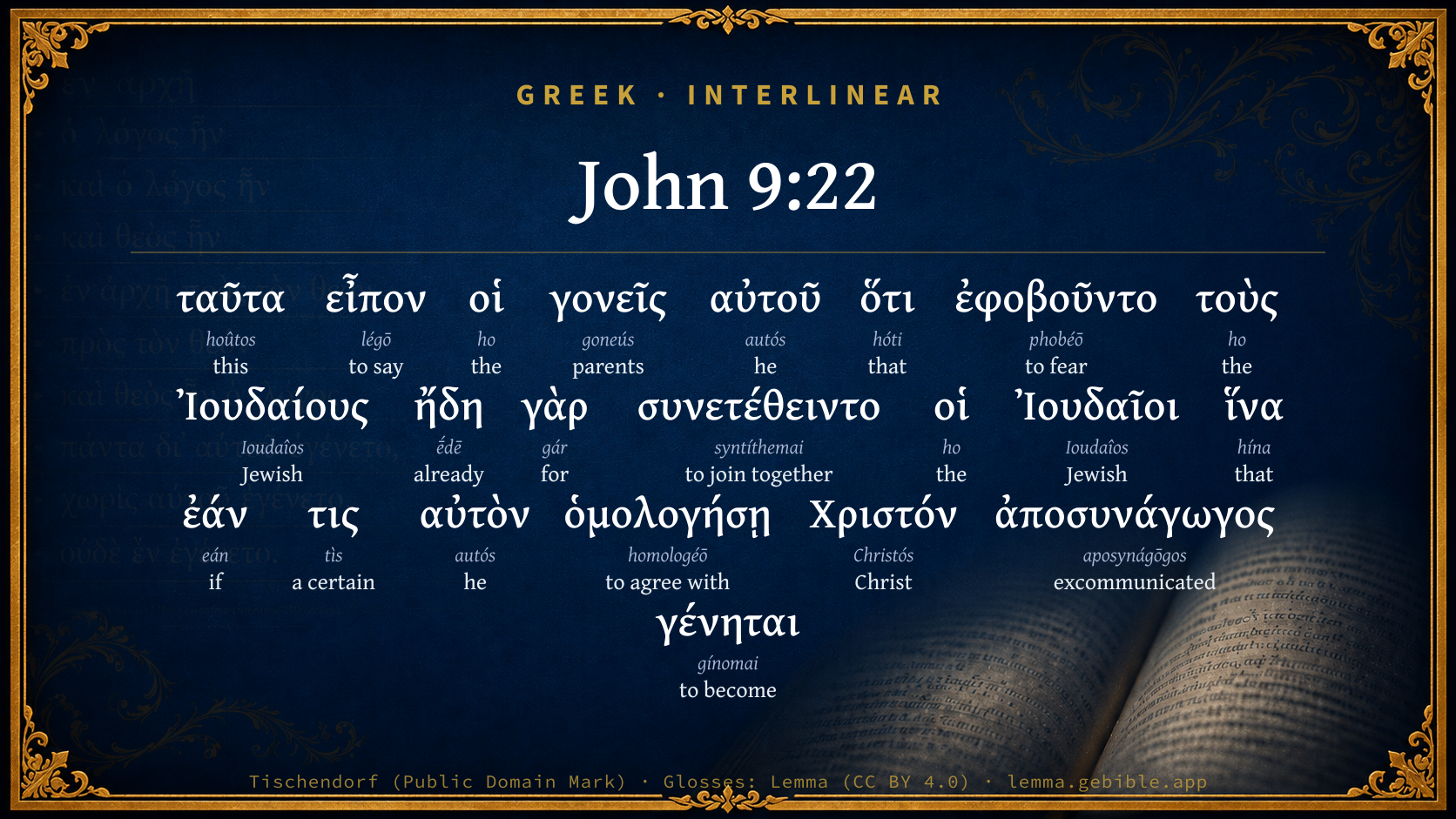
Greek (Tischendorf 8th ed.) John 9:22 appears in the Greek New Testament. The text above is from the Tischendorf 8th edition. Each word links to its Strong’s number and a concise gloss. Click any word for its full Thayer’s Greek Lexicon entry.
Download image
Cite this verse

John 9:22 (World English Bible). Public Domain. Lemma interlinear Bible study tool, https://lemma.gebible.app/v/john/9/22.

Show BibTeX & RIS
BibTeX
RIS
English Translation
His parents said these things because they feared the Jews; for the Jews had already agreed that if any man would confess him as Christ, he would be put out of the synagogue.
World English Bible · Public Domain
Highlights
  • 1 first appearance in the Greek New Testament
Full analysis ↓
Download a study sheet

One document with this verse’s original text, its word-by-word gloss line, the meaning frame, cross-references with their text, attributed commentary, and full source and license credits — printable, and it pastes into notes with its structure intact.

This verse Autodidact and up

Study sheet (.html) Plain text (.txt)

A passage Seminary Student

Up to 50 verses in one chapter. A passage sheet keeps up to 6 commentary sources and 12 cross-references per verse, in the order this page ranks them, and says so on the sheet whenever that leaves anything out. Ask for a single verse and you get the Autodidact verse sheet above.

Everything on this page stays free to read, with no account — the sheet is a download of what is already on screen, not access to it.

Want to remove ads? Support Godless Engineer
Compare translations 3

The same verse in 3 English versions, stacked beneath the original-language interlinear above. Click any original word for its lexicon entry.

Each is an independent rendering of the whole verse — the interlinear is not word-aligned to these translations.

Highlighted words mark where these versions differ — a whole-verse word diff, not a word-by-word alignment.

  • World English Bible Public Domain
    His parents said these things because they feared the Jews; for the Jews had already agreed that if any man would confess him as Christ, he would be put out of the synagogue.
  • King James Version Public Domain
    These words spake his parents, because they feared the Jews: for the Jews had agreed already, that if any man did confess that he was Christ, he should be put out of the synagogue.
  • unfoldingWord Literal Text CC BY-SA 4.0
    His parents said these things because they were afraid of the Jews. For the Jews had already agreed that if anyone would confess him the Christ, he would be put out of the synagogue.

unfoldingWord Literal Text — © unfoldingWord, licensed CC BY-SA 4.0. Word-aligned USFM3 via Door43 (git.door43.org/unfoldingWord/en_ult).

Versions to compare (up to 4)

3 of 4 selected

Show all 19 translations

Every available English version of this verse, each an independent rendering of the whole verse.

  • World English Bible Public Domain
    His parents said these things because they feared the Jews; for the Jews had already agreed that if any man would confess him as Christ, he would be put out of the synagogue.
  • Berean Standard Bible Public Domain
    His parents said this because they were afraid of the Jews. For the Jews had already determined that anyone who confessed Jesus as the Christ would be put out of the synagogue.
  • Majority Standard Bible Public Domain
    His parents said this because they were afraid of the Jews. For the Jews had already determined that anyone who confessed Jesus as the Christ would be put out of the synagogue.
  • King James Version Public Domain
    These words spake his parents, because they feared the Jews: for the Jews had agreed already, that if any man did confess that he was Christ, he should be put out of the synagogue.
  • American Standard Version (1901) Public Domain
    These things said his parents, because they feared the Jews: for the Jews had agreed already, that if any man should confess him `to be' Christ, he should be put out of the synagogue.
  • Revised Version (1885) Public Domain
    These things said his parents, because they feared the Jews: for the Jews had agreed already, that if any man should confess him to be Christ, he should be put out of the synagogue.
  • Geneva Bible (1599) Public Domain
    These wordes spake his parents, because they feared the Iewes: for the Iewes had ordeined already, that if any man did confesse that he was Christ, he should be excommunicate out of the Synagogue.
  • Douay-Rheims (1899) Public Domain
    These things his parents said, because they feared the Jews: for the Jews had already agreed among themselves, that if any man should confess him to be Christ, he should be put out of the synagogue.
  • Young's Literal Translation Public Domain
    These things said his parents, because they were afraid of the Jews, for already had the Jews agreed together, that if any one may confess him -- Christ, he may be put out of the synagogue;
  • Literal Standard Version CC BY-SA 4.0
    His parents said these things, because they were afraid of the Jews, for the Jews had already agreed together, that if anyone may confess Him—Christ, he may be put out of the synagogue;
  • Unlocked Literal Bible CC BY-SA 4.0
    His parents said these things, because they were afraid of the Jews. For the Jews had already agreed that if anyone would confess him to be the Christ, he would be thrown out of the synagogue.
  • unfoldingWord Literal Text CC BY-SA 4.0
    His parents said these things because they were afraid of the Jews. For the Jews had already agreed that if anyone would confess him the Christ, he would be put out of the synagogue.
  • Darby Bible Public Domain
    His parents said these things because they feared the Jews, for the Jews had already agreed that if any one confessed him [to be the] Christ, he should be excommunicated from the synagogue.
  • World Messianic Bible Public Domain
    His parents said these things because they feared the Judeans; for the Judeans had already agreed that if any man would confess him as Messiah, he would be put out of the synagogue.
  • Webster's Bible Public Domain
    These words his parents spoke, because they feared the Jews: for the Jews had agreed already, that if any man confessed that he was Christ, he should be put out of the synagogue.
  • Free Bible Version CC BY-SA 4.0
    The reason his parents said this was because they were afraid of what the Jewish leaders would do. The Jewish leaders had already announced that anyone who declared that Jesus was the Messiah would be thrown out of the synagogue.
  • Bible in Basic English Public Domain
    They said this because of their fear of the Jews: for the Jews had come to an agreement that if any man said that Jesus was the Christ he would be put out of the Synagogue.
  • Text-Critical English NT CC BY 4.0
    (His parents said this because they were afraid of the Jews, for the Jews had already agreed that if anyone should confess that Jesus was the Christ, he would be put out of the synagogue.
  • Tyndale New Testament (1534) Public Domain
    Suche wordes spake his father and mother because they feared the Iewes. For the Iewes had conspyred all redy that yf eny man dyd confesse that he was Christ he shuld be excommunicat out of the synagoge.

Literal Standard Version (2020), Covenant Press — licensed CC BY-SA 4.0. Text via the HelloAO Bible API (eBible.org). Unlocked Literal Bible (unfoldingWord) — licensed CC BY-SA 4.0. Text via the HelloAO Bible API (eBible.org). unfoldingWord Literal Text — © unfoldingWord, licensed CC BY-SA 4.0. Word-aligned USFM3 via Door43 (git.door43.org/unfoldingWord/en_ult). Free Bible Version, Dr. Jonathan Gallagher — licensed CC BY-SA 4.0. Text via the HelloAO Bible API (eBible.org).

Word by word

More ways to search: Search by grammar → Find every occurrence → Compare this word →

Practice this passage: Drill this verse → Learn its vocabulary →

ἀποσυνάγωγος
aposynágōgos
G656
“excommunicated”
Adjective, Nominative, Singular, Masculine
Part of Speech
Adjective
Case
Nominative
Number
Singular
Gender
Masculine
Full Thayer's Definition

Origin: from G575 and G4864

TDNT: 21:08,1

1. excluded from sacred assemblies of Israelites, excommunicated
  1. ταῦτα hoûtos G3778 “this” Demonstrative pronoun, Accusative, Plural, Neuter
  2. εἶπον légō G3004 “to say” Verb, Aorist, Active, Indicative, 3rd person, Plural
  3. οἱ ho G3588 “the” Article, Nominative, Plural, Masculine
  4. γονεῖς goneús G1118 “parents” Noun, Nominative, Plural, Masculine
  5. αὐτοῦ autós G846 “he” Personal pronoun, Genitive, Singular, Masculine
  6. ὅτι hóti G3754 “that” Conjunction
  7. ἐφοβοῦντο phobéō G5399 “to fear” Verb, Imperfect, Middle or Passive deponent, Indicative, 3rd person, Plural
  8. τοὺς ho G3588 “the” Article, Accusative, Plural, Masculine
  9. Ἰουδαίους Ioudaîos G2453 “Jewish” Adjective, Accusative, Plural, Masculine
  10. ἤδη ḗdē G2235 “already” Adverb
  11. γὰρ gár G1063 “for” Conjunction
  12. συνετέθειντο syntíthemai G4934 “to join together” Verb, Pluperfect, Middle, Indicative, 3rd person, Plural
  13. οἱ ho G3588 “the” Article, Nominative, Plural, Masculine
  14. Ἰουδαῖοι Ioudaîos G2453 “Jewish” Adjective, Nominative, Plural, Masculine
  15. ἵνα hína G2443 “that” Conjunction
  16. ἐάν eán G1437 “if” Conditional
  17. τις tìs G5100 “a certain” Indefinite pronoun, Nominative, Singular, Masculine
  18. αὐτὸν autós G846 “he” Personal pronoun, Accusative, Singular, Masculine
  19. ὁμολογήσῃ homologéō G3670 “to agree with” Verb, Aorist, Active, Subjunctive, 3rd person, Singular
  20. Χριστόν Christós G5547 “Christ” Noun, Accusative, Singular, Masculine
  21. γένηται gínomai G1096 “to become” Verb, Aorist, Middle deponent, Subjunctive, 3rd person, Singular

About this verse

These counts appear in no published source. They are computed here, from the morphology-tagged text and Lemma’s own curated glosses. What Lemma adds →

22
words
18
distinct lemmas
Gospels
section

Notable vocabulary

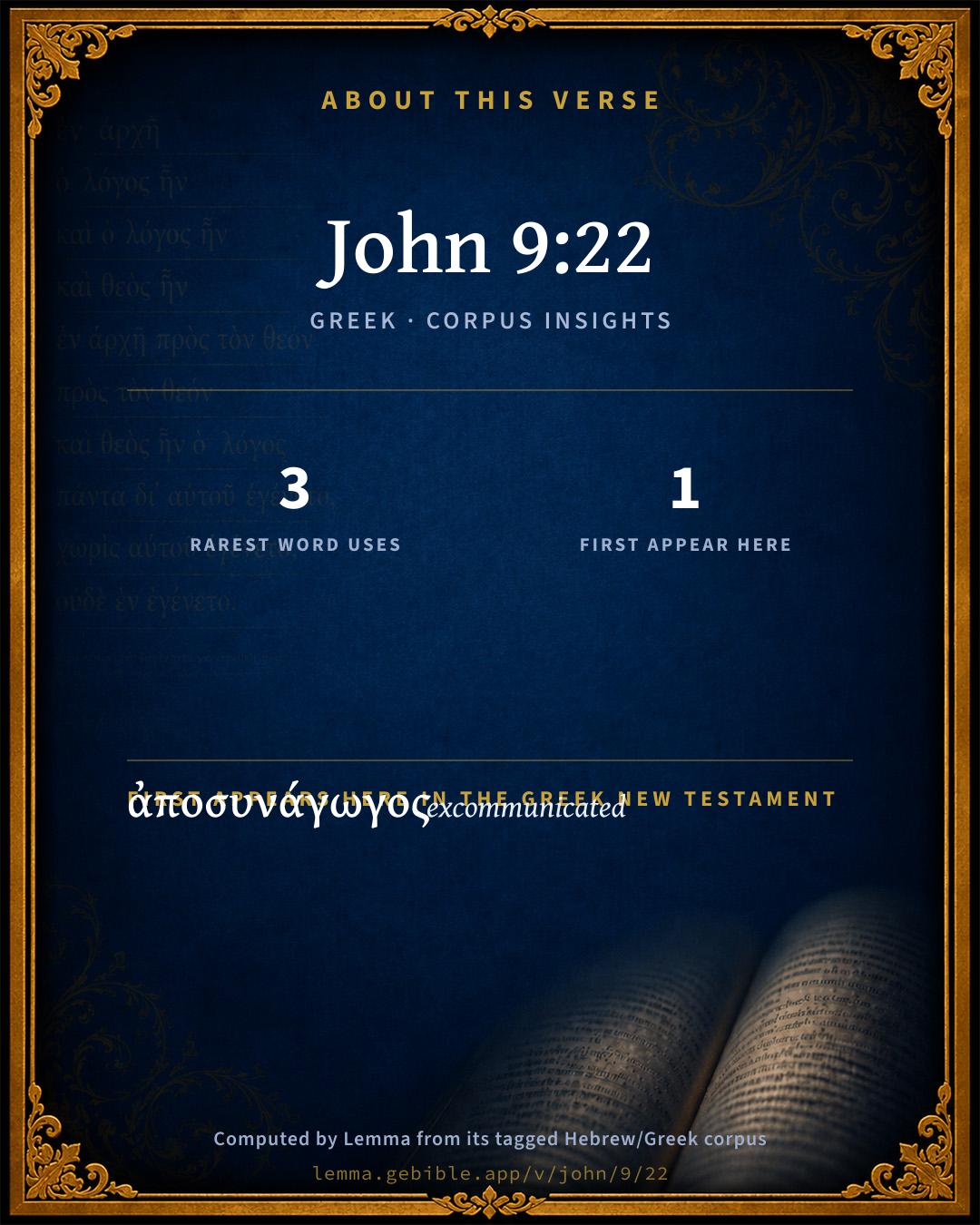
The rarest word here is ἀποσυνάγωγος excommunicated G656 — appearing just 3 times in the whole Greek New Testament.

First appearance in Scripture

This word makes its first canonical appearance in the Greek New Testament here:

  • ἀποσυνάγωγος excommunicated G656

Shared distinctive vocabulary

ἀποσυνάγωγος excommunicated G656 occurs in 3 verses of the Greek New Testament. Also found in:
Repetition

Words recur within this verse:

  • Ἰουδαίους Jewish G2453 ×2
  • οἱ the G3588 ×3
  • αὐτοῦ he G846 ×2

Cross-references

20

Topical passages linked to John 9:22 in the Treasury of Scripture Knowledge — connected by theme and wording, ordered by reader-vote popularity; previews shown in the World English Bible.

  • John 7:13 Yet no one spoke openly of him for fear of the Jews.
  • John 16:2 They will put you out of the synagogues. Yes, the time comes that whoever kills you will think that he offers service to God.
  • Luke 6:22 Blessed are you when men shall hate you, and when they shall exclude and mock you, and throw out your name as evil, for the Son of Man's sake.
  • John 9:34 They answered him, "You were altogether born in sins, and do you teach us?" They threw him out.
  • John 12:42–43 Nevertheless even of the rulers many believed in him, but because of the Pharisees they didn't confess it, so that they wouldn't be put out of the synagogue,
  • Psalms 27:1–2 Yahweh is my light and my salvation. Whom shall I fear? Yahweh is the strength of my life. Of whom shall I be afraid?
  • Proverbs 29:25 The fear of man proves to be a snare, But whoever puts his trust in Yahweh is kept safe.
  • Isaiah 51:7 Listen to me, you who know righteousness, the people in whose heart is my law; don't you fear the reproach of men, neither be you dismayed at their insults.
  • Isaiah 51:12 I, even I, am he who comforts you: who are you, that you are afraid of man who shall die, and of the son of man who shall be made as grass;
  • Isaiah 57:11 Of whom have you been afraid and in fear, that you lie, and have not remembered me, nor laid it to your heart? Haven't I held my peace even of long time, and you don't fear me?
  • Luke 12:4–9 "I tell you, my friends, don't be afraid of those who kill the body, and after that have no more that they can do.
  • Luke 22:56–61 A certain servant girl saw him as he sat in the light, and looking intently at him, said, "This man also was with him."
  • John 7:45–52 The officers therefore came to the chief priests and Pharisees, and they said to them, "Why didn't you bring him?"
  • John 19:38 After these things, Joseph of Arimathaea, being a disciple of Jesus, but secretly for fear of the Jews, asked of Pilate that he might take away Jesus' body. Pilate gave him permission. He came therefore and took away his body.
  • John 20:19 When therefore it was evening, on that day, the first day of the week, and when the doors were locked where the disciples were assembled, for fear of the Jews, Jesus came and stood in the midst, and said to them, "Peace be to you."
  • Acts 4:18 They called them, and charged them not to speak at all nor teach in the name of Jesus.
  • Acts 5:13 None of the rest dared to join them, however the people honored them.
  • Acts 5:40 They agreed with him. Summoning the apostles, they beat them and charged them not to speak in the name of Jesus, and let them go.
  • Galatians 2:11–13 But when Peter came to Antioch, I resisted him to the face, because he stood condemned.
  • Revelation 21:8 But for the cowardly, unbelieving, sinners, abominable, murderers, sexually immoral, sorcerers, idolaters, and all liars, their part is in the lake that burns with fire and sulfur, which is the second death."

Cross-references courtesy of OpenBible.info (CC BY 4.0).

Commentary

Notes on John 9:22 from classic Christian and Jewish commentators (each source and its license shown beneath its notes). The classic Christian expositions comment on the surrounding passage and are grouped to its opening verse, so a note may address several verses; the Jewish commentaries on the Tanakh (Rashi and others) are per-verse, so they appear only where the commentator wrote on this verse.

Lemma curates 59 commentaries, every one of them public domain or Creative Commons licensed, each selected and text-cleaned for this edition rather than reprinted as found. About our sources →

The Biblical Illustrator

Joseph S. Exell

Joh_9:22

If any man did confess that he was Christ

Confession of Christ

1.

Confession, ὁμολογε͂ιν, is

(1) To say the same thing with others. To agree with.

(2) To promise.

(3) To acknowledge, to declare a person or thing to be what he or it really is.

2. To confess Christ is therefore to acknowledge Him to be what He really is and declares Himself to be.

(1) The Son of God;

(2) God manifest in the flesh;

(3) The Saviour of the world;

(4) The Lord.

I. The NATURE of this confession.

1. It is not enough that we cherish the conviction in our hearts, or confess it to ourselves, to God, or to friends who agree with us.

2. It must be done publicly, or before men, friends and foes: amid good and evil report; when it brings reproach and danger as well as when it incurs no risk.

3. It must be with the mouth. It is not enough that men may infer from our conduct that we are Christians. We must audibly declare it.

4. This must be done

(1) In our ordinary intercourse.

(2) In the way of Gods appointment, i.e., by Baptism and the

Lords Supper.

5. It must be sincere. Not everyone that saith Lord, Lord, etc. It is only when the outward act is a revelation of the heart that it has any value.

II. ITS ADVANTAGES.

1. It strengthens faith.

2. It is a proof of regeneration, because it supposes the apprehension of the glory of God in the face of Jesus Christ.

3. It is an indispensable condition of salvation. Because

(1) God requires it.

(2) Not to confess is to deny.

(3) Denial implies want of faith or devotion.

4. Christ will acknowledge them who acknowledge Him--publicly, before the angels, and to our eternal salvation.

III. ITS DUTY.

1. It is not merely a commandment.

2. It is the highest moral duty to acknowledge the truth, and especially to acknowledge God to be God.

3. It is the most direct means we can take to honour Christ, and to bring others to acknowledge Him (see Mat_10:32; Luk_12:8; Mar_8:38; Rom_10:9-10; 2Ti_2:12; 1Jn_4:2; 1Jn_4:15). (C. Hodge, D. D.)

He should be put out of the synagogue

Excommunication

(cf. Joh_16:2; Luk_6:22)

1. The lightest kind of excommunication continued for thirty days and prescribed four cubits as a distance within which the person may not approach anyone, not even wife and children; with this limitation it did not make exclusion from the synagogue necessary.

2. The severer included absolute banishment from all religious meetings, and absolute giving up of intercourse with all persons, and was formally pronounced with curses.

3. The severest was a perpetual banishment from all meetings and a practical exclusion from the fellowship of Gods people. It has been sometimes supposed that the words of Luk_6:22

(1) Separate you;

(2) reproach you;

(3) cast out your name refer to these gradations, but probably the only practice known in the time of our Lord was that which was later regarded as the intermediate form, falling short of perpetual banishment, but being, while the ban lasted, exclusion from all the cherished privileges of an Israelite.

(Archdeacon Watkins.)

The Biblical Illustrator, edited by Joseph S. Exell (c. 1880s–1900s) — public domain. Text from a community e-Sword module.

Godbey's Commentary on the New Testament

William B. Godbey

EXCOMMUNICATION

Joh 9:22-34. “His parents said this because they feared the Jews; for already the Jews had entered into a covenant that if any one may confess Christ, he must be put out of the synagogue.” It is said that at that time there were four hundred and fifty synagogues in Jerusalem, where all the people gathered on the Sabbath, that they might hear the Scriptures read and expounded by their pastors and theologians. Jesus was the Leader of the holiness movement at that time in the Jewish Church. You see how they resorted to this diabolical stratagem to intimidate people from confessing Him, the authorities passing a resolution that all such should be turned out of the Church. Much of the same thing has been done in this country in the last twenty years, and is still going on. Ecclesiastical ostracism has accompanied the bloody persecutions in all ages, the civil law in this country, happily for us, preventing the latter.

William B. Godbey, Commentary on the New Testament (1896–1900) — public domain. Text from a community e-Sword module.

Bengel's Gnomon

Johann Albrecht Bengel

Joh 9:22. Ἐφοβοῦντο, they were afraid of) to such a degree that they left their son [at whose receiving of the gift of sight, however, they without doubt were exceedingly rejoiced.—V. g.] alone in the danger; and not only did not acknowledge that Jesus is the Christ, but did not even acknowledge that, from which it followed as a consequence.—ἀποσυναγωγος, expelled from the synagogue) which was a most severe punishment.

Bengel's Gnomon of the New Testament — English translation (T&T Clark, Edinburgh, 1860) — public domain. Text from a community e-Sword module.

Meyer's Critical & Exegetical Commentary

Heinrich August Wilhelm Meyer

Joh_9:22. ʼΉδη γὰρ συνετέθ.] forso great cause had they for that fearthe Jews had already agreed, had already come to an understanding with each other; conspiraverant, Vulgate. Comp. Luk_22:5; Act_23:20; Thuc. 4. 19; 1Ma_9:70; Ast, Lex. Plat. III. p. 340. The context does not justify the assumption of a decree of the Sanhedrim to that effect. The hope, however, was cherished of being able without difficulty to convert the arrangement in question into a decree of the Sanhedrim; and the parents of the blind man might easily have come to know of this. We can easily understand that they should prefer exposing their son rather than themselves to this danger, since they must have been certain that he would not for the sake of his benefactor refuse to make the dangerous confession.

ἵνα] that which they had agreed on is conceived as the intention of their agreement. Comp. ἀξιοῦν ἵνα in Dem. de Cor. 155 (see Dissen on the passage), and Nägelsbach on the Iliad, p. 62, ed. 3.

ἀποσυνάγ. γέν.] Exclusion from the fellowship of the synagogue, and in connection therewith from the common intercourse of life, was probably at this time the sole form of excommunication. See on Luk_6:22.

Meyer — Critical and Exegetical Commentary on the New Testament — English translation by Peter Christie, edited by Frederick Crombie (T&T Clark, 1880) — public domain. Text from a community e-Sword module.

Expositor's Greek Testament

ed. W. Robertson Nicoll

Joh 9:22 . Ταῦτα … ἐρωτήσατε . The reluctance of the parents to answer brings out the circumstance that already the members of the Sanhedrim had come to an understanding with one another that any one who acknowledged Jesus as the Messiah should be excommunicated, ἀποσυνάγωγος γένηται . Of excommunication there were three degrees: the first lasted for thirty days; then followed “a second admonition,” and if impenitent the culprit was punished for thirty days more; and if still impenitent he was laid under the Cherem or ban, which was of indefinite duration, and which entirely cut him off from intercourse with others. He was treated as if he were a leper. This, to persons so poor as the parents of this beggar, would mean ruin and death (see Edersheim, Life of Christ , ii. 183 4).

The Expositor's Greek Testament, edited by W. Robertson Nicoll (1897–1910) — public domain. Text from a community e-Sword module.

Adam Clarke's Commentary

Verse 22. Put out of the synagogue.] That is, excommunicated - separated from all religious connection with those who worshipped God. This was the lesser kind of excommunication among the Jews and was termed nidui. The cherem, or anathema, was not used against the followers of Christ till after the resurrection.

Adam Clarke's Commentary on the Bible (1810–1826) — public domain. Text from a community e-Sword/MySword module.

John Calvin's Commentaries

22. The Jews had determined. This passage shows that the custom of excommunication is ancient, and has been observed in all ages; for excommunication was not then for the first time invented, but it was a custom which had been anciently used against apostates and despisers of the Law, and was turned against the disciples of Christ. We learn, therefore, that the practice of excommunication arose out of the most ancient discipline of the Church. We learn also that it is a crime which has not been of recent origin, and has not been peculiar to a single age, that wicked and unbelieving men should corrupt the holy ordinances of God by their deeds of sacrilege. God determined, from the beginning of the world, that there should be some form of correction, by which rebels should be restrained. The priests and scribes not only abused this power in a tyrannical manner to oppress innocent men; but at length they basely attacked God himself and his doctrine. The truth of Christ being so powerful that they were not able to put it down by law, or by a regular course of proceedings, they launched the thunders of excommunications to crush it.

The same thing has also been done with the Christian people; for it is impossible to express the barbarous tyranny which the pretended bishops have exercised in enslaving the people, so that no man dared to whisper; and now we see with what cruelty they throw this dart of excommunication against all who worship God. But we ought to believe that excommunication, when it is violently applied to a different purpose by the passions of men, may safely be treated with contempt. For when God committed to his Church the power of excommunicating, he did not arm tyrants or executioners to strangle souls, but laid down a rule for governing his people; and that on the condition that he should hold the supreme government, and that he should have men for his ministers. Let the pretended bishops then thunder as they think fit, by their empty noises they will not terrify any but those who wander about in doubt and uncertainty, not having yet been instructed, by the voice of the Chief Shepherd, what is the true fold.

In short, nothing can be more certain than that those who, we see, are not subject to Christ are deprived of the lawful power of excommunicating. Nor ought we to dread being excluded by them from their assembly, since Christ, who is our life and salvation, is banished from it. So far are we from having any reason to dread being thrown out, that, on the contrary, if we desire to be united to Christ, we must, of our own accord, withdraw from the synagogues of Satan. Yet though the ordinance of excommunication was so basely corrupted in the ancient Church, still Christ did not intend that it should be abolished by his coming, but restored it to its purity, that it might be in full vigor amongst us. Thus, though at the present day there prevails in Popery a base profanation of this holy discipline, yet, instead of abolishing it, we ought rather to give the utmost diligence to restore it to its former completeness. There never will be so good order the world, that even the holiest Laws of God shall not degenerate into corruption, through the fault of men. Assuredly, it would give too much power to Satan, if he could reduce to nothing every thing that he corrupts. We would then have no Baptism, no Lord’s Supper, and, in short, no religion; for there is no part of it which he has left uncontaminated by its pollutions.

John Calvin's Commentaries (1540-1563) — public domain. Text from the Calvin Translation Society English edition (1840s-50s) via the Christian Classics Ethereal Library (ccel.org). Calvin's coverage is partial (roughly two-thirds of the Bible); uncommented books and verses are honest gaps, never fabricated. The 19th-century editor's footnotes and remarks are omitted so the notes are faithfully Calvin's own voice.

Ellicott's Commentary for English Readers

(22) For the Jews had agreed already.—This does not imply a formal decree of the Sanhedrin, but an agreement on the part of the leaders which they had made known to the people, and which they would have had little difficulty in carrying into effect. The word rendered “agreed” occurs again in the New Testament only twice. It expresses the covenant made with Judas, in Luk_22:5, and the agreement of the Jews to kill Paul, in Act_23:20.

He should be put out of the synagogue.—Comp. Joh_16:2, and Note on Luk_6:22. The Jews at a later date distinguished three kinds of excommunication. (1) The lightest continued for thirty days, and prescribed four cubits as a distance within which the person may not approach any one, not even wife or children; with this limitation, it did not make exclusion from the synagogue necessary. (2) The severer included absolute banishment from all religious meetings, and absolute giving up of intercourse with all persons, and was formally pronounced with curses. (3) The severest was a perpetual banishment from all meetings, and a practical exclusion from the fellowship of God’s people. It has been sometimes supposed that the words of Luk_6:22, (a) “separate you,” (b) “reproach you,” (c) “cast out your name,” refer to these gradations, but probably the only practice known in the time of our Lord was that which was later regarded as the intermediate form, falling short of perpetual banishment, but being, while the ban lasted, exclusion from all the cherished privileges of an Israelite.

A Bible Commentary for English Readers, edited by Charles John Ellicott (1878–1897) — public domain. Text from a community e-Sword module.

The Cambridge Bible for Schools and Colleges

gen. ed. J. J. S. Perowne

22. had agreed] It does not appear when; but we are probably to understand an informal agreement among themselves rather than a decree of the Sanhedrin. A formal decree would be easily obtained afterwards. The word for ‘agreed’ is used of the agreement with Judas (Luk_22:5, where it is translated ‘covenanted’), and of the agreement of the Jews to kill S. Paul (Act_23:20), and nowhere else. ‘Assented’ in Act_24:9 is a different compound of the same verb.

that if any man] Literally, in order that if any man: what they agreed upon is represented as the purpose of their agreement. See on Joh_9:2-3, and Joh_8:56.

put out of the synagogue] i.e. excommunicated. The Jews had three kinds of anathema. (1) Excommunication for thirty days, during which the excommunicated might not come within four cubits of any one. (2) Absolute exclusion from all intercourse and worship for an indefinite period. (3) Absolute exclusion for ever; an irrevocable sentence. This third form was very rarely if ever used. It is doubtful whether the second was in use at this time for Jews; but it would be the ban under which all Samaritans were placed. This passage and ‘separate’ in Luk_6:22 probably refer to the first and mildest kind of anathema. The principle of all anathema was found in the Divine sentence on Meroz (Jdg_5:23): Comp. Ezr_10:8. The word for ‘out of the synagogue’ is peculiar to S. John, occurring Joh_12:42, Joh_16:2, and nowhere else.

The Cambridge Bible for Schools and Colleges (gen. ed. J. J. S. Perowne; Cambridge University Press, 1878–1918) — public domain. Text from a community e-Sword module.

John Gill's Exposition

These words spake his parents,.... these were the answers they returned to the three questions put to them: and the reason why they answered in the manner they did to the third, was,

because they feared the Jews; the Jewish sanhedrim, otherwise they were Jews themselves:

for the Jews had agreed already; the sanhedrim had made a decree, either at this time, upon this account, or some time before,

that if any man did confess that he was Christ; that Jesus of Nazareth was the Messiah,

he should be put out of the synagogue; which was not that sort of excommunication which they called "Niddui", a separation from civil society for the space of four cubits, and which held but thirty days, if the person repented; if he did not, it was continued to sixty days; and after that, in case of non-repentance, to ninety days; and if no amendment, then they proceeded to another excommunication called "Cherem", or "Shammatha", whereby such were anathematized, and cut off from the whole body of the Jewish church and people, called sometimes the synagogue and congregation of Israel (r); and this struck great terror in the minds of the people; and this was what intimidated the parents of the blind man, being what is intended here. Though these are sometimes put one for another, and signify the same thing; and he that was under the former of those censures, is said to be "separated from the congregation" (s), a phrase by which the word here used may be very well rendered: but in some things there was a difference between them; the one was without cursing, the other with; he that was under "Niddui", might teach others the traditions, and they might teach him; he might hire workmen, and be hired himself: but he that was under "Cherem" might neither teach others, nor they teach him; but he might teach himself, that he might not forget his learning; and he might neither hire, nor be hired; and they did not trade with him, nor did they employ him in any business, unless in very little, just to keep him alive (t); yea, the goods which he was possessed of, were confiscated, and which they conclude should be done from (u) Ezr 10:8, which may be compared with this passage; so that this greatly and chiefly affected them in the affairs of civil life, and which made it so terrible: for I do not find that they were obliged to abstain from the temple, or temple worship, or from the synagogue, and the worship of it, and which is the mistake of some learned men: it is certain, they might go into places of worship, though with some difference from others; for it is said (w), that

"all that go into the temple, go in, in the right hand way, and go round, and come out in the left, except such an one to whom anything has befallen him, and he goes about to the left; (and when asked) why dost thou go to the left? (he answers) because I am a mourner; (to whom it is replied) he that dwells in this house comfort thee: (or) , "because I am excommunicated"; (to whom they say) he that dwells in this house put it into thy heart (that thou mayest hearken to the words of thy friends, as it is afterwards explained) and they may receive thee.''

And it is elsewhere said (x), that

"Solomon, when he built the temple, made two gates, the one for bridegrooms, and the other for mourners and excommunicated persons; and the Israelites, when they went in on sabbath days, or feast days, sat between these two gates; and when anyone came in by the gate of the bridegrooms, they knew he was a bridegroom, and said unto him, he that dwells in this house make thee cheerful with sons and daughters: and when anyone came in at the gate of mourners, and his upper lip covered, they knew that he was a mourner, and said unto him, he that dwells in this house comfort thee: and when anyone came in at the gate of mourners, and his upper lip was not covered, they knew , "that he was excommunicated"; and said unto him, he that dwells in this house comfort thee, and put it into thy heart to hearken to thy friends.''

And it is afterwards also said in the same place, that when the temple was destroyed, it was decreed that such persons should come into synagogues and schools; but then they were not reckoned as members of the Jewish church, but as persons cut off from the people of Israel, and scarce allowed to be of their commonwealth. And it may be further observed, that excommunication with the Jews was not only on religious accounts, but on civil accounts; on account of money, or when a man would not pay his debts, according to the decree of the sanhedrim (y). The twenty four reasons of excommunication, given by Maimonides (z), chiefly respect contempt of the sanhedrim, and of the wise men, and breach of the traditions of the elders; sometimes they excommunicated for immorality, particularly the Essenes, as Josephus relates, who says (a), that such who are taken in grievous sins, they cast them out of their order; and he that is so dealt with commonly dies a miserable death; for being bound by oaths and customs, he cannot eat the food of others, and so starves. The same is reported (b) by R. Abraham Zachuth: and sometimes excommunication was for Epicurism, or heresy, and such they reckoned the belief of Jesus of Nazareth, as the Messiah, on account of which this decree was made, and which continued with them; for not only this blind man was cast out of the synagogue by virtue of it, but our Lord tells his disciples, that they should be so treated by the Jews after his death; and we find it remained in force and practice many hundreds of years afterwards. Athanasius (c) relates of a Jew, that lived in Berytus, a city in Syria, between Tyre and Sidon, that an image of Christ being found in his house by another Jew, though unknown to him; and this being discovered to the chief priests and elders of the Jews, they cast him out of the synagogue. Sometimes this sentence was pronounced by word of mouth, and sometimes it was delivered in writing: the form of one is given us by Buxtorf (d), out of an ancient Hebrew manuscript; and a dreadful shocking one it is; and is as follows:

"according to the mind of the Lord of lords, let such an one, the son of such an one, be in "Cherem", or anathematized, in both houses of judgment, of those above, and those below; and with the anathema of the saints on high, with the anathema of the "Seraphim" and "Ophanim", and with the anathema of the whole congregation, great and small; let great and real stripes be upon him, and many and violent diseases; and let his house be an habitation of dragons; and let his star be dark in the clouds; and let him be for indignation, wrath, and anger; and let his carcass be for beasts and serpents; and let those that rise up against him, and his enemies, rejoice over him; and let his silver and his gold be given to others; and let all his children be exposed at the gate of his enemies, and at his day may others be amazed; and let him be cursed from the mouth of Addiriron and Actariel, (names of angels, as are those that follow,) and from the mouth of Sandalphon and Hadraniel, and from the mouth of Ansisiel and Pathchiel, and from the mouth of Seraphiel and Zaganzael, and from the mouth of Michael and Gabriel, and from the mouth of Raphael and Meshartiel; and let him be anathematized from the mouth of Tzabtzabib, and from tile mouth of Habhabib, he is Jehovah the Great, and from the mouth of the seventy names of the great king, and from the side of Tzortak the great chancellor; and let him be swallowed up as Korah and his company, with terror, and with trembling; let his soul go out; let the reproof of the Lord kill him; and let him be strangled as Ahithophel in his counsel; and let his leprosy be as the leprosy of Gehazi; and let there be no raising him up from his fall; and in the sepulchres of Israel let not his grave be; and let his wife be given to another; and let others bow upon her at his death: in this anathema, let such an one, the son of such an one be, and let this be his inheritance; but upon me, and upon all Israel, may God extend his peace and his blessing. Amen.''

And if he would, he might add these verses in Deu 29:19, "and it come to pass when he heareth the words of this curse, that he bless himself in his heart, saying, I shall have peace, though I walk in the imagination of mine heart, to add drunkenness to thirst: the Lord will not spare him, but then the anger of the Lord, and his jealousy shall smoke against that man, and all the curses that are written in this book shall lie upon him, and the Lord shall blot out his name from under heaven. And the Lord shall separate, him unto evil, out of all the tribes of Israel, according, to all the curses of the covenant, that are written in this book of the law". There were many rites and ceremonies, which in process of time were used, when such a sentence was pronounced, as blowing of horns and trumpets, and lighting of candles, and putting them out: hence, trumpets are reckoned (d) a among the instruments of judges. It is said (e) of R. Judah, that being affronted by a certain person, he resented the injury, and brought out the trumpets and excommunicated him: and they tell us (f), that Barak anathematized Meroz, whom they take to be some great person, with four hundred trumpets: and they also say (g), that four hundred trumpets were brought out, and they excommunicated Jesus of Nazareth; though these words are left out in some editions of the Talmud. Now this was done in order to inject terror both into those that were guilty, and also into the whole congregation of the people, that they might hear and fear; for the "Cherem", or that sort of excommunication which goes by that name, was done publicly before the whole synagogue, all the heads and elders of the church being gathered together; and then candles were lighted, and as soon as the form of the curse was finished, they were put out, as a sign that the excommunicated person was unworthy of the heavenly light (h). Very likely the Papists took their horrible custom from hence of cursing with bell, book, and candle.

(r) Vid. Maimon. Talmud Tora, c. 7. sect. 6. Buxtorf. Lex. Rab. col. 1303. & Epist. Heb. Institut. p. 57. (s) Maimon. Hilchod Talmud Tora, c. 7. sect. 4. (t) Ib. sect. 5. (u) T. Bab. Moed Katon, fol. 16. 1. (w) Misn. Middot, c. 2. sect. 2. (x) Pirke Eiiezer, c. 17. (y) T. Bab. Moed Katon, fol. 16. 1. & Gloss in ib. (z) Hilchot Talmud Tora, c. 6. sect. 14. (a) De Bello Jud. l. 2. c. 8. sect. 8. (b) Juchasin, fol. 139. 2. (c) Oper. ejus, Tom. 2. p. 12, 17. Ed. Commelin. (d) Lex Rab. col. 828. (d) T. Bab. Sanhedrin, fol 7. 2. (e) T. Bab. Kiddushin, c. 4. in Beth Israel, fol. 57. 1. (f) T. Bab. Moed Katon, fol. 16. 1. & Shebuot, fol. 36. 1. (g) T. Bab. Sanhedrin, fol. 107. 2. Ed. Venet. (h) Buxtorf. Epist. Heb. Institut. c. 6. p. 56.

John Gill's Exposition of the Whole Bible (1746–1763) — public domain (CC PDM 1.0). Text via the HelloAO Bible API.

Trapp's Complete Commentary

John Trapp

22 These words spake his parents, because they feared the Jews: for the Jews had agreed already, that if any man did confess that he was Christ, he should be put out of the synagogue.

Ver. 22. Put out of the synagogue] This was that kind of excommunication they called Niddui, or separation; and such were by the Greeks called Αποδεδοκιμασμενοι and Αμνημονευτοι. There were two other more heavy kind of excommunications in use among the Jews, Cherem and Samatha or Maranatha, which they derive as low as from Enoch, Jdg 1:14. The heathens also had their public execrations, not rashly to be used against any; Est enim execratio res tristis, et mali ominis, saith Plutarch; who therefore highly commends that Athenian priest, that being commanded by the people to curse Alcibiades, refused to do it. That archflamen of Rome, the pope, is like a wasp; no sooner angry but out comes a sting (an excommunication), which, being once out, is like a fool’s dagger, rattling and snapping without an edge. Cum Pontifex Rom. diras in Ludovic 12, Gall. Regem evomeret; Atqui (ait rex) Precandi ille, non imprecandi causa pontifex constitutus est. (Firron. lib. 2. de Gestu. Gallor.) It was grown to a proverb among our forefathers, In nomine Domini incipit omne malum. In the name of God, begins all evil. John Cornford (one of the six last that were burnt in England for the true religion), when he heard himself and his fellows excommunicated, stirred with a vehement zeal of God, and proceeding in a more true excommunication against the Papists, in the name of them all, pronounced sentence against them in these words, In the name of our Lord Jesus Christ, and by the power of his Holy Spirit and the authority of his holy Catholic and Apostolic Church, we do give here into the hands of Satan to be destroyed, the bodies of all those blasphemers and heretics that do maintain any error against his most holy word, or do condemn his most holy truth for heresy, to the maintaining of any false Church or feigned religion; so that by this thy just judgment, most mighty God, against thine adversaries, thy true religion may be known, to thy glory, and our comforts, and to the edifying of all our nation. Good Lord, so be it.

John Trapp, A Commentary or Exposition upon All the Books of the Old and New Testament (1647–1656) — public domain. Text from a community e-Sword module.

Haydock's Catholic Bible Commentary

The Jews had already agreed, or combined together, that if any one owned him for the Messias, he should be turned out of their synagogues, as a person excommunicated. (Witham)

George Leo Haydock (1774–1849), Haydock's Catholic Family Bible and Commentary, 1859 edition — public domain. Excludes Psalms (Douay-Rheims chapter numbering differs from Protestant) and Deuterocanonical books (Catholic canon only).

Matthew Poole's English Annotations

The reason why his parents answered so very warily, and avoided saying any thing to the Pharisees third question, which probably they could not go of their particular personal knowledge, was, that they were afraid of the rulers of the Jews. Solomon saith,

The fear of man bringeth a snare, Pro 29:25; it is often a temptation to men to deny the truth, or, at least, not to own and confess it when God calls to them for a public owning and confession of it: but nothing of that nature appeareth in this case; for it doth not appear that his parents were present when Christ wrought this great miracle; which if they were not, they were not obliged to tell the Pharisees what themselves had only received by rumour and hearsay: so that their answer seems but a prudential answer, to avoid an eminent danger. For they were not ignorant of a decree made by the Jewish sanhedrim. That if any did publicly say, or declare, that Jesus was Christ, he should be excommunicated; for that is meant by being

put out of the synagogue.

Matthew Poole's English Annotations on the Holy Bible (1683–1685) — public domain. Text from a community e-Sword/MySword module.

Whedon's Commentary on the Bible

Daniel D. Whedon

22. Had agreed already—Doubtless this agreement was published by authority, or these parents could not have known it. To these Jews, therefore, there are chargeable two crimes against truth. They predetermined that no evidence of the divinity of Jesus should be admitted as valid, and thus they rejected truth by positive will. They decreed that all acknowledgments of his Messiahship, on whatever evidence, should be suppressed by force; and this was persecution. They ignored truth, and they persecuted what they feared to be truth.

He was Christ—They might have acknowledged Jesus to be a prophet, or a worker of miracles, without confessing him to be Christ or Messiah. But then, so varying was the notion in regard to Christ, that they might fear that any acknowledgment of his supernatural claims might incur the penalty. The tyranny that can pass a persecuting decree can stretch it to any shape that suits its own malice.

Daniel D. Whedon (gen. ed.), Commentary on the Old and New Testaments (1874–1909) — public domain. Text from a community e-Sword module.

The Pulpit Commentary

The evangelist accounts for the reticence of the parents by their fear of consequences. These things said his parents, because they feared the Jews. This passage provides strong evidence of the technical use of the term "the Jews." Doubtless these parents were Israelites, but they were not "Jews" in the Johannine sense. The "Jews" were the hierarchical and ecclesiastico-political authorities. For they had already come to the agreement; (Luk_22:5 Act_23:20 /RAPC 1Ma 9:70) had mutually determined it does not follow that the Sanhedrin had issued a public order, but that a formidable party of "Jews" had made a sunyhkh , had pledged each other and made it sufficiently known even to such persons as the poverty-stricken parents of the blind beggar, that it would be carried out by the adequate authority in such a matterthat if any man should confess that he was Christ ("he" (auton) is remarkable it shows how full the thoughts of the evangelist were of the Personality of Jesus), he should be put out of the synagogue; or, become unsynagoqued. The Talmud speaks of three kinds of excommunication, (of. Mat_5:22) of which the first two were disciplinary; the third answers to complete and final expulsion (in "Jeremiah Moed. K.," 81, d, lhqm ldby awh, Edersheim). The general designation was shammata, from dm to destroy. The first form of it was called nesephah, and did not amount to more than severe rebuke. It would exclude from religious privileges for seven or thirty days, according to the dignity of the authority by whom it was pronounced. (cf. 1Ti_5:1) The second form of shammata was called niddui, which lasted for thirty days at the least, and might be repeated at the end of them. If these admonitions failed to produce their right effect, it might lead to the third and final excommunication, called cherem, or ban, whose duration was indefinite. The second of these forms was accompanied by blast of trumpet and terrible curses, which deprived the sufferer of all kinds of social intercourse. He was avoided as a leper; if he died, he was buried without funeral or mourning. The cherem was even a more terrible anathema, and might last for life. The parents of the blind man might easily fear such a curse. The ban to which this blind man was eventually exposed did not prevent him from moving about the city. The ban pronounced on Jesus led doubtless to the condemnation, issuing in his ignominy and trial for a capital offence. It was probably the second of the three forms of anathema to which he was ultimately condemned. It was quite sufficient temptation for these poor parents to have preserved an obstinate reticence.

Excommunication.

Here is a weapon that attacks religion in the name of religion. Here are people whom the plainest facts would prompt into a confession of Jesus as the Christ, if only they were left to themselves. The truth as it is in Jesus is on one side; threatenings of dire consequences on the other; and truth suffers for the time from the ecclesiastical powers that be.

I SUPERSTITION AS OPPOSED TO JESUS. Here is a special foe, over and above the ordinary foes with whom Jesus has to deal. Whether any real confession of Jesus would have come from the parents of the blind man, if they had been left to themselves, cannot be conjectured. That which deters one does not deter another. There are people who would not be deterred from confessing Jesus by any amount of physical pain. They can rise above that; it is merely a thing of the body; something specific and measurable. But the same people, if a threat of excommunication came in, would at once begin to hesitate. We do well to study the difficulties the gospel has ever met with through superstition, just because they are difficulties foreign to most who are brought up in a Christian land. We are not likely either to be threatened into Christianity or threatened out of it. But undoubtedly there are many parts of the world where the fear of some dreadful spiritual consequence operates to keep many from even looking at the claims of Jesus. How different the spirit of the true religion is from the spirit of the false ones! The priests of superstition have to use every available means to keep their dupes under control.

II THE SUCCESS OF THESE SPIRITUAL THREATENINGS. While we have to deplore the hindrances to the gospel which come from these erroneous instructions and traditions, we must also rejoice at what good there is in evil. That is not utterly evil which proves the hold of the supernatural on mankind.

III THE FAILURE OF THESE SPIRITUAL THREATENINGS. In the case of the parents the threat was successful; in the case of the son it failed. There will always be a few, at all events, whom no possible inducement can keep back from faithfulness to truth. Fear of losing their place in the true great assembly is a mightier motive than that of keeping connection with any visible ecclesiastical system. Y.

The Pulpit Commentary (1880–1919), ed. H.D.M. Spence-Jones & Joseph S. Exell — public domain. Text from a community e-Sword module.

John Wesley's Explanatory Notes

He should be put out of the synagogue - That is be excommunicated.

John Wesley, Explanatory Notes Upon the Whole Bible (1754–1765) — public domain. Text via the GEBible commentary corpus.

The People's New Testament

B. W. Johnson

22. Because they feared the Jews. The rulers. They knew that it was agreed to excommunicate any one who confessed Christ. Hence they said, He was born blind, he now sees, you must ask him how he was cured. He is of age. To be cast out of the synagogue was an awful punishment to a Jew. It put him on a level with the heathen.

B. W. Johnson's The People's New Testament with Notes (1889–1891) — public domain. Electronic text from the Christian Classics Ethereal Library (CCEL) ThML edition.

unfoldingWord translationNotes

Door43 World Missions Community

General Information:

In verse 22 there is a break from the main story line as John provides background information about the man's parents being afraid of the Jews. (See: Background Information)

they were afraid of the Jews

Here "Jews" is a synecdoche for the "Jewish leaders" who opposed Jesus. AT: "they were afraid of what the Jewish leaders might do to them" (See: Synecdoche)

afraid

This refers to the unpleasant feeling a person has when there is a threat of harm to oneself or others.

would confess him to be the Christ

"would say that Jesus is the Christ"

he would be thrown out of the synagogue

Here "be thrown out of the synagogue" is a metaphor for no longer being allowed to go into the synagogue and no longer belonging to the group of people who attend services at the synagogue. AT: "he would not be allowed to go into the synagogue" or "he would no longer belong to the synagogue" (See: Metaphor)

He is an adult

"he is a man" or "he is no longer a child." See how you translated this in John 09:21.

translationWords

fear

confess

Christ

synagogue

unfoldingWord translationNotes — © Distant Shores Media and the Door43 World Missions Community, licensed CC BY-SA 4.0. Source: git.door43.org/Door43/en_tn.

Cambridge Greek Testament for Schools and Colleges

22. συνετέθειντο. It does not appear when; but the tense and ἤδη indicate some previous arrangement, and probably an informal agreement among themselves. A formal decree of the Sanhedrin would be easily obtained afterwards. Συντίθεσθαι occurs in Luk 22:5 of the compact with Judas, and in Act 23:20 of the Jews’ compact to kill S. Paul, and nowhere else.

ἀποσυνάγωηος. Put away from the synagogue, or excommunicated. The word is peculiar to S. John, occurring here, Joh 12:42, and Joh 16:2, only. The Jews had three kinds of anathema. (1) Excommunication for thirty days, during which the excommunicated might not come within four cubits of any one. (2) Absolute exclusion from all intercourse and worship for an indefinite period. (3) Absolute exclusion for ever; an irrevocable sentence. This third form was very rarely if ever used. It is doubtful whether the second was in use at this time for Jews; but it would be the ban under which all Samaritans were placed. This passage and ‘separate’ in Luk 6:22 probably refer to the first and mildest kind of anathema. The principle of all anathema was found in the Divine sentence on Meroz (Jdg 5:23): Comp. Ezr 10:8.

Cambridge Greek Testament for Schools and Colleges (Cambridge University Press, 1896; 21 vols, various authors incl. Carr, Maclear, Plummer, Farrar, Lumby, Moule, M. R. James, Simcox) — public domain. Text from a community e-Sword module.

Alford’s Greek Testament

Henry Alford

22.] It is not said when this resolution was come to; and this also speaks for an interval between ch. 7. 8., and this incident. It could hardly have been before the council at the conclusion of ch. 7.

ἀποσυν.] Probably the first of the three stages of Jewish excommunication,—the being shut out from the synagogue and household for thirty days, but without any anathema. The other two,—the repetition of the above, accompanied by a curse,—and final exclusion,—would be too harsh, and perhaps were not in use so early. Trench (Mirr. 299, edn. 2) regards the resolution not as a token that the Sanhedrim had pronounced Him a false Christ, but as shewing that they forbade a private man to anticipate their decision on this point by confessing Him (?).

Henry Alford, The Greek Testament (1849–1861) — public domain. Text from a community e-Sword module.

International Critical Commentary

22. ταῦτα εἶπαν … ὅτι ἐφοβοῦντο τοὺς Ἰουδαίους. The fear of “the Jews” (see 1:19, 5:10), the Jewish opponents of Jesus, whose leaders were the Pharisees, was very definite (cf. 7:13). They were determined to check His success, and to put down His popularity. Cf. 7:44f.

ἤδη συνετέθειντο, they had formed a compact (cf. 7:32, 47-49), and decided that strong measures must be taken against any one confessing (see on 1:20) Jesus as Christ. He had not yet declared Himself openly in Jerusalem (10:24), but it had been debated whether He were not indeed the Christ (7:26f.).

Except when Jn. is interpreting Μεσσίας (1:41, 4:25), this is the only place in the Gospel where we find Χριστός without the def. article: “if any one should confess Him as Christ.” Cf. Rom 10:9 for a similar constr.: ἐὰν ὁμολογήσῃς Κύριον Ἰησοῦν, “if thou shalt confess Jesus as Lord.”

ἀποσυνάγωγος, “excommunicate.” The word is found in the Greek Bible only here and at 12:42, 16:2. Full excommunication involved a cutting off from the whole “congregation of Israel” (cf. Mat 18:17); but it is probable that the lesser penalty of exclusion from the synagogue for a month (the usual period) is all that is indicated here. That he who acknowledged Jesus as the Messiah was to be treated as ἀποσυνάγωγος is mentioned again 12:42.1

International Critical Commentary — older volumes (1896–1929), various authors — public domain. Text from a community e-Sword module.

Vincent's Word Studies in the New Testament

Marvin R. Vincent

Had agreed - that [συνετεθειντο - ινα] . The sense is, had formed an agreement in order to bring about this end, viz., that the confessor of Christ should be excommunicated.

Confess [ομολογηση] . See on Mt 7:23; Mt 10:32.

He should be put out of the synagogue [αποσυναγωγος] . The literal rendering cannot be neatly given, as there is no English adjective corresponding to ajposunagwgov, which means excluded from the synagogue : as nearly as possible - that He should become banished from the synagogue. The adjective occurs only in John's Gospel - here, Joh 12:42; Joh 16:2. Three kinds of excommunication were recognized, of which only the third was the real cutting off, the other two being disciplinary. The first, and lightest, was called rebuke, and lasted from seven to thirty days. The second was called thrusting out, and lasted for thirty days at least, followed by a "second admonition," which lasted for thirty days more. This could only be pronounced in an assembly of ten. It was accompanied by curses, and sometimes proclaimed with the blast of the horn. The excommunicated person would not be admitted into any assembly of ten men, nor to public prayer. People would keep at the distance of four cubits from him, as if he were a leper. Stones were to be cast on his coffin when dead, and mourning for him was forbidden. If all else failed, the third, or real excommunication was pronounced, the duration of which was indefinite. The man was to be as one dead. No intercourse was to be held with him; one must not show him the road, and though he might buy the necessaries of life, it was forbidden to eat and drink with him. These severer forms appear to have been of later introduction, so that the penalty which the blind man's parents feared was probably separation from all religious fellowship, and from ordinary intercourse of life for perhaps thirty days.

Marvin R. Vincent, Word Studies in the New Testament (1887–1900) — public domain. Text from a community e-Sword/MySword module.

Lesson kit

Teaching starters — assembled from the data on this page, not authored interpretation. Every prompt links to the verse data it draws on. Edit before teaching.

John, in the Gospels, opens this verse with 22 words (18 distinct Greek lemmas). Its most distinctive word is aposynágōgos (“excommunicated”). A historical commentator’s framing appears above. Read the whole chapter for the surrounding context.

Discussion questions

  1. What does “excommunicated” (aposynágōgos) contribute to the verse as a whole?
  2. The word “excommunicated” first appears here in Scripture. What is being introduced at this debut?
  3. John 12:42 shares the word «excommunicated» with this verse. How do the two illuminate each other?
  4. “Jewish” occurs 2× in this one verse. What is the effect of the repetition?
  5. These translations render this verse differently. What is at stake in choosing one wording over another?
  6. Reading how The Biblical Illustrator and Godbey's Commentary on the New Testament read this verse, where do the two commentators agree and where do they part?

Things to notice

  • 1 word makes its first canonical appearance in Scripture here.
  • These translations choose different wording for 13 words in this verse.
  • “Jewish” occurs 2× in this single verse.
  • 18 distinct Greek lemmas span 22 words in this verse.

Reading settings

Reading text

Shown beneath each verse's original-language words.

Old Testament
Old Testament edition

Read the OT as the Masoretic Hebrew (MT) or the Greek Septuagint (LXX).

English shown for the Greek Septuagint (in the Hebrew ↔ Greek comparison).

Comparing translations? Open the Compare panel on any verse page to stack up to four side by side.