
John 7:27

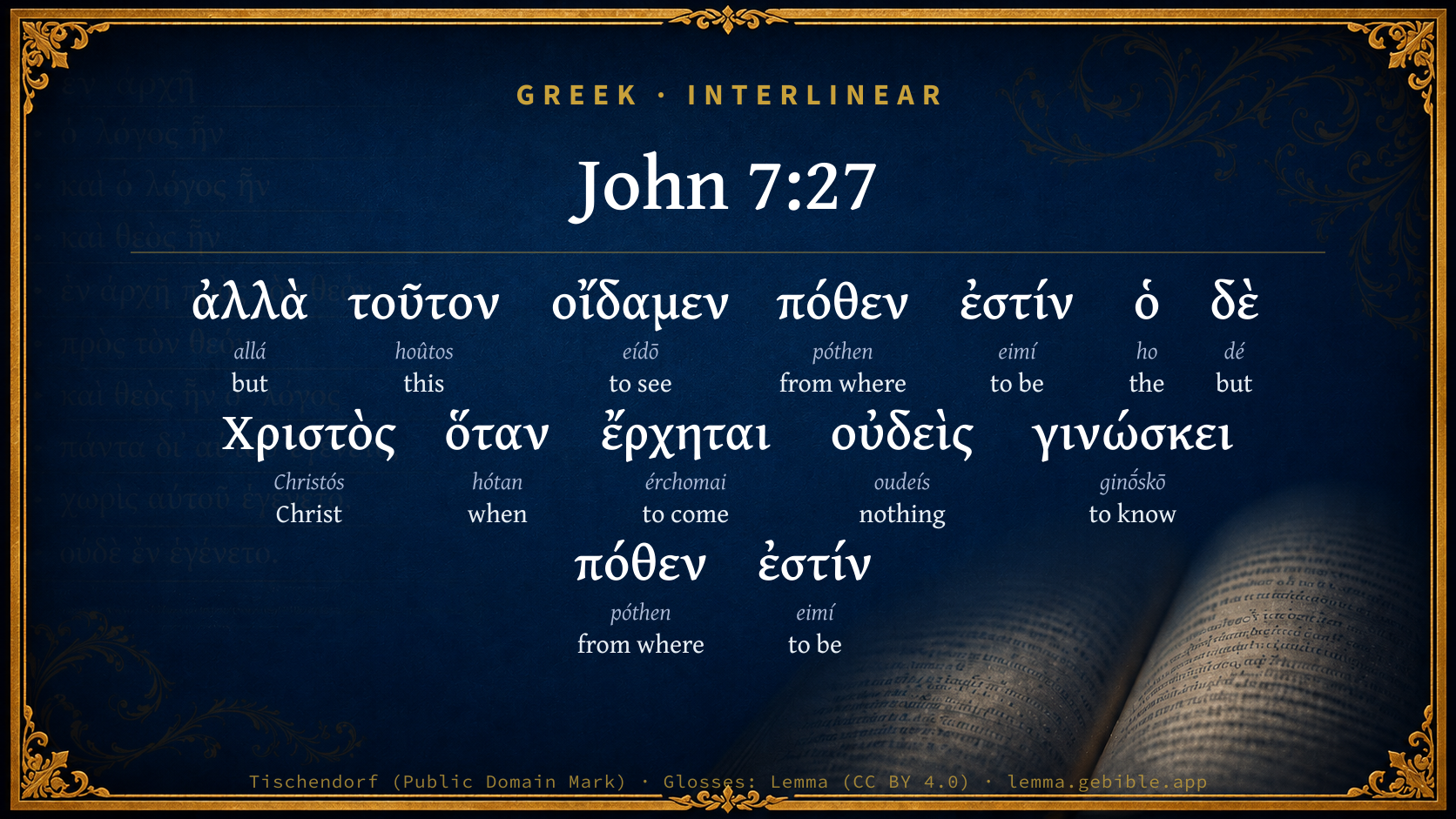
Greek (Tischendorf 8th ed.) John 7:27 appears in the Greek New Testament. The text above is from the Tischendorf 8th edition. Each word links to its Strong’s number and a concise gloss. Click any word for its full Thayer’s Greek Lexicon entry.
Download image
Cite this verse

John 7:27 (World English Bible). Public Domain. Lemma interlinear Bible study tool, https://lemma.gebible.app/v/john/7/27.

Show BibTeX & RIS
BibTeX
RIS
English Translation
However we know where this man comes from, but when the Christ comes, no one will know where he comes from."
World English Bible · Public Domain
Download a study sheet

One document with this verse’s original text, its word-by-word gloss line, the meaning frame, cross-references with their text, attributed commentary, and full source and license credits — printable, and it pastes into notes with its structure intact.

This verse Autodidact and up

Study sheet (.html) Plain text (.txt)

A passage Seminary Student

Up to 50 verses in one chapter. A passage sheet keeps up to 6 commentary sources and 12 cross-references per verse, in the order this page ranks them, and says so on the sheet whenever that leaves anything out. Ask for a single verse and you get the Autodidact verse sheet above.

Everything on this page stays free to read, with no account — the sheet is a download of what is already on screen, not access to it.

Want to remove ads? Support Godless Engineer
Compare translations 3

The same verse in 3 English versions, stacked beneath the original-language interlinear above. Click any original word for its lexicon entry.

Each is an independent rendering of the whole verse — the interlinear is not word-aligned to these translations.

Highlighted words mark where these versions differ — a whole-verse word diff, not a word-by-word alignment.

  • World English Bible Public Domain
    However we know where this man comes from, but when the Christ comes, no one will know where he comes from."
  • King James Version Public Domain
    Howbeit we know this man whence he is: but when Christ cometh, no man knoweth whence he is.
  • unfoldingWord Literal Text CC BY-SA 4.0
    But we know where this one is from. But when the Christ would come, no one knows where he is from.”

unfoldingWord Literal Text — © unfoldingWord, licensed CC BY-SA 4.0. Word-aligned USFM3 via Door43 (git.door43.org/unfoldingWord/en_ult).

Versions to compare (up to 4)

3 of 4 selected

Show all 19 translations

Every available English version of this verse, each an independent rendering of the whole verse.

  • World English Bible Public Domain
    However we know where this man comes from, but when the Christ comes, no one will know where he comes from."
  • Berean Standard Bible Public Domain
    But we know where this man is from. When the Christ comes, no one will know where He is from.”
  • Majority Standard Bible Public Domain
    But we know where this man is from. When the Christ comes, no one will know where He is from.”
  • King James Version Public Domain
    Howbeit we know this man whence he is: but when Christ cometh, no man knoweth whence he is.
  • American Standard Version (1901) Public Domain
    Howbeit we know this man whence he is: but when the Christ cometh, no one knoweth whence he is.
  • Revised Version (1885) Public Domain
    Howbeit we know this man whence he is: but when the Christ cometh, no one knoweth whence he is.
  • Geneva Bible (1599) Public Domain
    Howbeit we know this man whence he is: but when that Christ commeth, no man shall knowe whence he is.
  • Douay-Rheims (1899) Public Domain
    But we know this man, whence he is: but when the Christ cometh, no man knoweth whence he is.
  • Young's Literal Translation Public Domain
    but this one -- we have known whence he is; and the Christ, when he doth come, no one doth know whence he is.'
  • Literal Standard Version CC BY-SA 4.0
    But this One—we have known where He is from; and the Christ, when He comes, no one knows where He is from.”
  • Unlocked Literal Bible CC BY-SA 4.0
    Yet we know where this one is from. But when the Christ comes, no one will know where he is from.”
  • unfoldingWord Literal Text CC BY-SA 4.0
    But we know where this one is from. But when the Christ would come, no one knows where he is from.”
  • Darby Bible Public Domain
    But [as to] this [man] we know whence he is. Now [as to] the Christ, when he comes, no one knows whence he is.
  • World Messianic Bible Public Domain
    However, we know where this man comes from, but when the Messiah comes, no one will know where he comes from.”
  • Webster's Bible Public Domain
    But we know this man, whence he is: whereas when Christ cometh, no man knoweth whence he is.
  • Free Bible Version CC BY-SA 4.0
    But that's not possible because we know where he comes from. When the Messiah comes, nobody will know where he's from.”
  • Bible in Basic English Public Domain
    However, it is clear to us where this man comes from: but when the Christ comes no one will have knowledge where he comes from.
  • Text-Critical English NT CC BY 4.0
    Yet we know where this man is from, but when the Christ comes, no one will know where he is from.”
  • Tyndale New Testament (1534) Public Domain
    How be it we knowe this man whence he is: but when Christ cometh no man shall knowe whence he is.

Literal Standard Version (2020), Covenant Press — licensed CC BY-SA 4.0. Text via the HelloAO Bible API (eBible.org). Unlocked Literal Bible (unfoldingWord) — licensed CC BY-SA 4.0. Text via the HelloAO Bible API (eBible.org). unfoldingWord Literal Text — © unfoldingWord, licensed CC BY-SA 4.0. Word-aligned USFM3 via Door43 (git.door43.org/unfoldingWord/en_ult). Free Bible Version, Dr. Jonathan Gallagher — licensed CC BY-SA 4.0. Text via the HelloAO Bible API (eBible.org).

Word by word

More ways to search: Search by grammar → Find every occurrence → Compare this word →

Practice this passage: Drill this verse → Learn its vocabulary →

πόθεν
póthen
G4159
“from where”
Adverb, Interrogative
Part of Speech
Adverb
Degree
Interrogative
Full Thayer's Definition

Origin: from the base of G4213 with enclitic adverb of origin

TDNT: None

1. of place: from where, from what condition 2. of origin or source: from what author or giver 3. of cause: how is that?, how can that be?
  1. ἀλλὰ allá G235 “but” Conjunction
  2. τοῦτον hoûtos G3778 “this” Demonstrative pronoun, Accusative, Singular, Masculine
  3. οἴδαμεν eídō G1492 “to see” Verb, Perfect, Active, Indicative, 1st person, Plural
  4. ἐστίν eimí G1510 “to be” Verb, Present, Active, Indicative, 3rd person, Singular
  5. ὁ ho G3588 “the” Article, Nominative, Singular, Masculine
  6. δὲ dé G1161 “but” Conjunction
  7. Χριστὸς Christós G5547 “Christ” Noun, Nominative, Singular, Masculine
  8. ὅταν hótan G3752 “when” Conjunction
  9. ἔρχηται érchomai G2064 “to come” Verb, Present, Middle or Passive deponent, Subjunctive, 3rd person, Singular
  10. οὐδεὶς oudeís G3762 “nothing” Adjective, Nominative, Singular, Masculine, Negative
  11. γινώσκει ginṓskō G1097 “to know” Verb, Present, Active, Indicative, 3rd person, Singular
  12. πόθεν póthen G4159 “from where” Adverb, Interrogative
  13. ἐστίν eimí G1510 “to be” Verb, Present, Active, Indicative, 3rd person, Singular

About this verse

These counts appear in no published source. They are computed here, from the morphology-tagged text and Lemma’s own curated glosses. What Lemma adds →

14
words
12
distinct lemmas
Gospels
section

Shared distinctive vocabulary

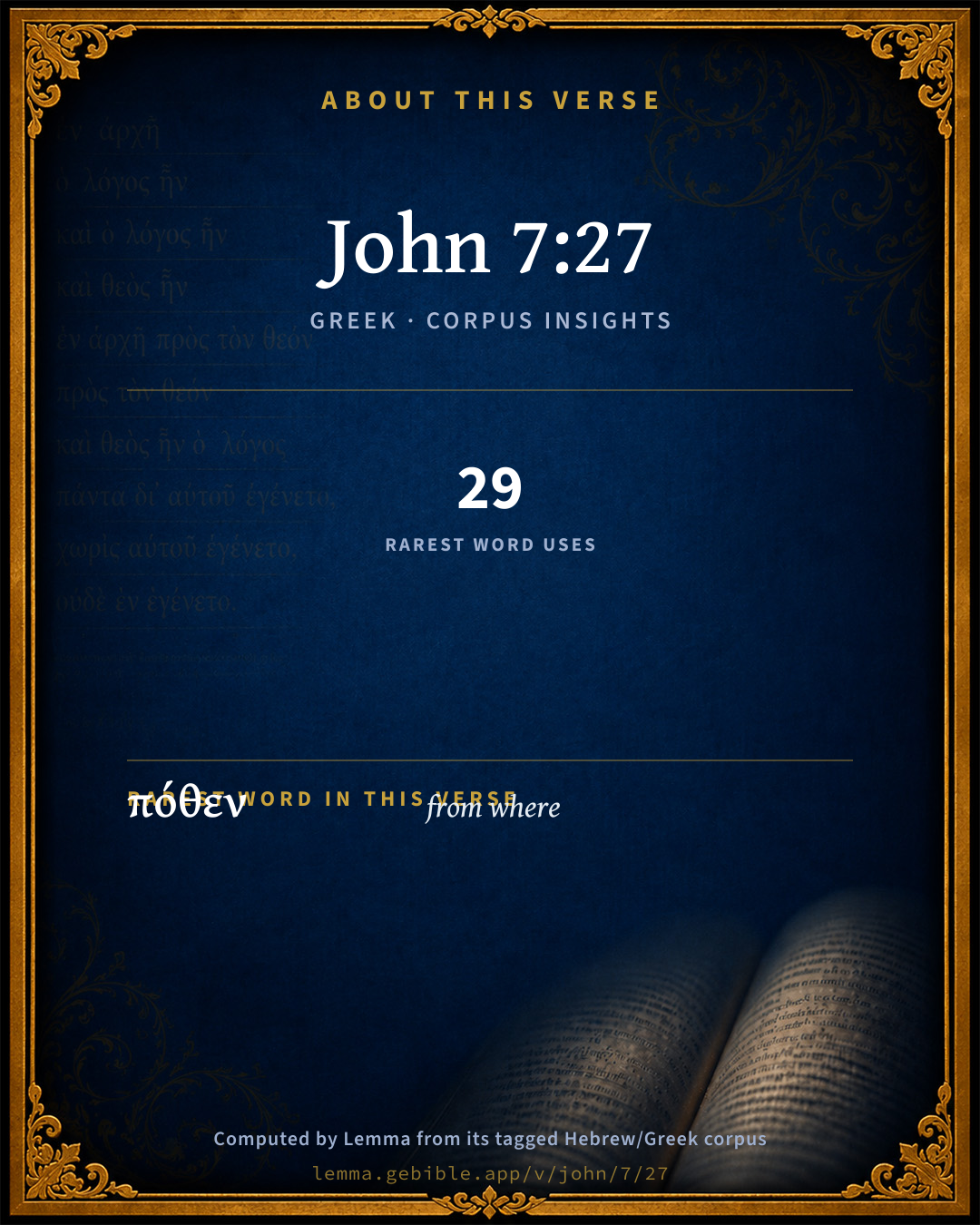
πόθεν from where G4159 occurs in 26 verses of the Greek New Testament. Also found in:
Repetition

Words recur within this verse:

  • πόθεν from where G4159 ×2
  • ἐστίν to be G1510 ×2

Cross-references

11

Topical passages linked to John 7:27 in the Treasury of Scripture Knowledge — connected by theme and wording, ordered by reader-vote popularity; previews shown in the World English Bible.

  • Micah 5:2 But you, Bethlehem Ephrathah, Being small among the clans of Judah, Out of you one will come forth to me that is to be ruler in Israel; Whose goings forth are from of old, from everlasting.
  • John 7:41–42 Others said, "This is the Christ." But some said, "What, does the Christ come out of Galilee?
  • John 6:42 They said, "Isn't this Jesus, the son of Joseph, whose father and mother we know? How then does he say, 'I have come down out of heaven?'"
  • John 9:29 We know that God has spoken to Moses. But as for this man, we don't know where he comes from."
  • Matthew 13:54–57 Coming into his own country, he taught them in their synagogue, so that they were astonished, and said, "Where did this man get this wisdom, and these mighty works?
  • Jeremiah 30:21 Their prince shall be of themselves, and their ruler shall proceed from the midst of them; and I will cause him to draw near, and he shall approach to me: for who is he who has had boldness to approach to me? says Yahweh.
  • Mark 6:3 Isn't this the carpenter, the son of Mary, and brother of James, Joses, Judas, and Simon? Aren't his sisters here with us?" They were offended at him.
  • Isaiah 11:1 There shall come forth a shoot out of the stock of Jesse, and a branch out of his roots shall bear fruit.
  • Matthew 2:5–6 They said to him, "In Bethlehem of Judea, for thus it is written through the prophet,
  • Luke 4:22 All testified about him, and wondered at the gracious words which proceeded out of his mouth, and they said, "Isn't this Joseph's son?"
  • Jeremiah 23:5 Behold, the days come, says Yahweh, that I will raise to David a righteous Branch, and he shall reign as king and deal wisely, and shall execute justice and righteousness in the land.

Cross-references courtesy of OpenBible.info (CC BY 4.0).

Commentary

Notes on John 7:27 from classic Christian and Jewish commentators (each source and its license shown beneath its notes). The classic Christian expositions comment on the surrounding passage and are grouped to its opening verse, so a note may address several verses; the Jewish commentaries on the Tanakh (Rashi and others) are per-verse, so they appear only where the commentator wrote on this verse.

Lemma curates 59 commentaries, every one of them public domain or Creative Commons licensed, each selected and text-cleaned for this edition rather than reprinted as found. About our sources →

Tyndale Open Study Notes

Tyndale Open Resources

7:27 Some of the crowd thought that since they could trace Jesus’ earthly origins, he could not be the Messiah. They believed that the Messiah would simply appear.

Tyndale Open Study Notes — © Tyndale Open Resources, licensed CC BY-SA 4.0. Text via the HelloAO Bible API.

Bengel's Gnomon

Johann Albrecht Bengel

Joh 7:27. Ἀλλά, [howbeit], but) They believed in human authority, in rejecting Christ: they notwithstanding do not believe in human authority, in acknowledging Christ. Here may be observed the Jewish prejudices. The reasoning of the Jews was to this effect; the Christ has an unknown parentage; Jesus has not an unknown parentage: therefore Jesus is not the Christ. The Lord answers at Joh 7:28, “Ye both know Me, and ye know whence I am; and I am not come of Myself,” etc.—τοῦτον οἴδαμεν, we know this man) ch. Joh 6:42, “Is not this Jesus, the son of Joseph, whose father and mother we know.”—οὐδείς, no man) That really happened in the case of this, the true Messiah. Foll, v., “He that sent Me is true, whom ye know not.” Ch. Joh 9:29, “We know that God spake unto Moses, but as for this fellow, we know not from whence He is.” For not even now did they know His country. Joh 7:42, “Hath not the Scripture said, That Christ cometh of the seed of David, and out of the town of Bethlehem?” when in fact Jesus was born at Bethlehem.[194] [Some one may fancy, that it is an idle question, whether the circumstances of the birth of Christ be known or unknown; but a false opinion on a very slight point was in fact sufficient to prove the greatest obstacle to faith. One may observe the same result in the case of various unsound maxims, by which the world suffers itself to be held in bondage.—V. g.]

[194] And not in Galilee as they supposed.—E. and T.

Bengel's Gnomon of the New Testament — English translation (T&T Clark, Edinburgh, 1860) — public domain. Text from a community e-Sword module.

Geneva Bible (1599)

Geneva Bible translators

Men are very wise to procure stops and stays to themselves.

Geneva Bible (1599) marginal notes — public domain. Text via Bolls.life.

Jamieson, Fausset & Brown

Robert Jamieson, A. R. Fausset & David Brown

Howbeit we know this man, &c.--This seems to refer to some current opinion that Messiah's origin would be mysterious (not altogether wrong), from which they concluded that Jesus could not be He, since they knew all about His family at Nazareth.

Jamieson, Fausset & Brown — Commentary Critical and Explanatory on the Whole Bible (1871) — public domain (CC PDM 1.0). Text via the HelloAO Bible API.

Adam Clarke's Commentary

Verse 27. No man knoweth whence he is.] The generality of the people knew very well that the Messiah was to be born in Bethlehem, in the city, and of the family, of David; see Joh 7:42. But, from Isaiah Isa 53:8, Who shall declare his generation? they probably thought that there should be something so peculiarly mysterious in his birth, or in the manner of his appearing, that no person could fully understand. Had they considered his miraculous conception, they would have felt their minds relieved on this point. The Jews thought that the Messiah, after his birth, would hide himself for some considerable time; and that when he began to preach no man should know where he had been hidden, and whence he had come. The rabbins have the following proverb: Three things come unexpectedly:

1. A thing found by chance.

2. The sting of a scorpion: and,

3. The Messiah.

It was probably in reference to the above that the people said, No man knoweth whence he is. However, they might have spoken this of his parents. We know that the Messiah is to be born in Bethlehem, of the family of David; but no man can know his parents: therefore they rejected him: Joh 6:42, Is not this Jesus, the son of Joseph, whose father and mother we know?

Adam Clarke's Commentary on the Bible (1810–1826) — public domain. Text from a community e-Sword/MySword module.

John Calvin's Commentaries

27. But we know whence this man is. Here we see not only how great is the blindness of men, when they ought to judge about the things of God, but this vice is almost natural to them, to be ingenious in contriving what may hinder them from arriving at the knowledge of the truth. It is frequently, indeed, from the craft of Satan that offenses arise, which cause many to turn away from Christ; but though the road were plain and smooth, every man would contrive an offense for himself. So long as the rulers were opposed to Christ, their unbelief would of itself have kept back this multitude; but when that obstacle has been removed, they contrive a new reason for themselves, that they may not come to the faith. And even though it were proper that they should be influenced by the example of their rulers, they are so far from following what is right, that they willingly stumble at the first step. Thus it frequently happens, that men who had begun well fall away quickly, unless the Lord conduct them to the very end of their career.

But when Christ shall come. The argument by which they obstruct their own progress is this: “The Prophets have testified that the origin of Christ will be unknown. Now we know whence this man is, and therefore we cannot reckon him to be the Christ.” Hence we are reminded how pernicious it is to mangle the Scriptures, and even Christ himself, so as not to admit more than the half of him. God promised that the Redeemer would be of the seed of David; but he frequently claims this office as peculiar to himself; therefore, he must have been God manifested in the flesh, that he might be the Redeemer of his Church. Thus Micah points out the place where Christ would be born. Out of thee, Bethlehem, he says, a Prince shall come, to govern my people But, immediately afterwards, he speaks of another going forth which is far loftier, and then he says that it is hidden and secret, (Micah 5:2.) Yet those wretched men, when they perceived in Christ nothing but what is liable to contempt, draw the absurd conclusion, that he is not the person who had been promised. On the mean condition of Christ in the flesh let us therefore learn to look in such a manner, that this state of humiliation, which is despised by wicked men, may raise us to his heavenly glory. Thus Bethlehem, where the man was to be born, will be to us a door by which we may enter into the presence of the eternal God.

John Calvin's Commentaries (1540-1563) — public domain. Text from the Calvin Translation Society English edition (1840s-50s) via the Christian Classics Ethereal Library (ccel.org). Calvin's coverage is partial (roughly two-thirds of the Bible); uncommented books and verses are honest gaps, never fabricated. The 19th-century editor's footnotes and remarks are omitted so the notes are faithfully Calvin's own voice.

Ellicott's Commentary for English Readers

(27) Howbeit we know this man.—They at once supply a corrective answer to their own question. They know this Man whence He is. He is the carpenter’s son, and His mother, and brethren, and sisters, are well known (Mat_13:55-56). His brothers, indeed, are part of that multitude (Joh_7:10). They know that the Messiah will be of the seed and town of David (Joh_7:42); but they have no knowledge of an earthly home and earthly relations, and all their ideas are of a Being who will not be subject to the ordinary conditions of life, and whose immediate origin no man can know. God’s Anointed living among them as a man, with mother, and brothers, and sisters! This cannot be. What meant the coming in the clouds of heaven of Daniel’s vision (Dan_7:13), or the coming suddenly to the Temple of Malachi’s prophecy? (Mal_3:1.) Why did Isaiah tell of His being “Wonderful, Counsellor, the Everlasting Father, the Prince of Peace?” (Isa_9:6.) In such thoughts they fulfilled another prophecy of the same Isaiah, which their own Rabbis interpreted of the Messiah, “He hath no form nor comeliness; and when we shall see Him, there is no beauty that we should desire Him” (Isa_53:2).

A Bible Commentary for English Readers, edited by Charles John Ellicott (1878–1897) — public domain. Text from a community e-Sword module.

The Cambridge Bible for Schools and Colleges

gen. ed. J. J. S. Perowne

27. when Christ cometh] Better, when the Christ cometh: see on Joh_1:20.

no man knoweth whence he is] Literally, no man comes to know (see on Joh_7:26 and Joh_8:55) whence He is. ‘Whence’ does not refer to the Messiah’s birthplace, which was known (Joh_7:41-42); nor to His remote descent, for He was to be the Son of David (ibid.); but to His parentage (Joh_6:42), immediate and actual. This text is the strongest, if not the only evidence that we have of the belief that the immediate parents of the Messiah would be unknown: but the precision and vivacity of this passage carries conviction with it, and shews how familiar the ideas current among the Jews at that time were to S. John. It never occurs to him to explain. The belief might easily grow out of Isa_53:8, ‘Who shall declare His generation?’ Justin Martyr tells us of a kindred belief, that the Messiahship of the Messiah would be unknown, even to Himself, until He was anointed by Elijah. (Trypho, pp. 226, 336.)

The Cambridge Bible for Schools and Colleges (gen. ed. J. J. S. Perowne; Cambridge University Press, 1878–1918) — public domain. Text from a community e-Sword module.

John Gill's Exposition

Then cried Jesus in the temple as he taught,.... Overhearing the reasonings of these men, however, knowing what they said; so the Persic version adds, "having secretly known this"; exalted his voice as he was teaching in the temple, and in the midst of his discourse, publicly before all the people, in the temple, spoke out with a loud voice, that all might hear:

saying, ye both know me, and ye know whence I am; some, as the Ethiopic version, read these words by way of interrogation, "do ye both know me, and do ye know from whence I am?" no; you do not. Or they may be considered as an ironical concession; yes, you know me, and you know whence I am; you know me to be Jesus of Nazareth, but you are wrong, I am not of Nazareth; you suppose I come, from Galilee, but that is your ignorance; you take me to be the real son of Joseph, to be begotten by him on Mary, but that is your mistake: such is your knowledge of me: you know me indeed who I am, and from whence I come.

And I am not come of myself; into this world, by incarnation, or the assumption of human nature, to work out the salvation of men; the Father called him to it, and he agreeing to do it, was in the fulness of time sent about it; this was not a device of his own, or an honour he took to himself; he was not alone in it; it was a mutual agreement between him and his Father, in consequence of which he was sent and came.

But he that sent me is true; to the covenant he made with Christ, and to the promises he made to the fathers of the Old Testament, concerning the mission of his Son; and he is true to be believed, in the testimonies he gave of him, particularly by a voice from heaven, declaring him his beloved Son.

Whom ye know not; so that notwithstanding all their boasted knowledge of him, they knew not his Father, from whence he came, and by whom he was sent; and notwithstanding also their boasted knowledge of the one, only, true, and living God, see Rom 2:17; yet they knew him not in a spiritual sense; they knew him not in Christ, nor as the Father of Christ; they knew neither the Father nor the Son: and this their ignorance of both was the reason of their hatred of Christ, and of his followers, Joh 15:21.

John Gill's Exposition of the Whole Bible (1746–1763) — public domain (CC PDM 1.0). Text via the HelloAO Bible API.

Trapp's Complete Commentary

John Trapp

27 Howbeit we know this man whence he is: but when Christ cometh, no man knoweth whence he is.

Ver. 27. No man knoweth whence he is] This error might arise out of some texts of Scripture misunderstood, as Isa 53:8; Psa 110:4. We should, whenever we open the Bible, pray, "Lord, open mine eyes, that I may see the wondrous things of thy law," Psa 119:18.

John Trapp, A Commentary or Exposition upon All the Books of the Old and New Testament (1647–1656) — public domain. Text from a community e-Sword module.

Albert Barnes' Notes on the Bible

Howbeit - But. They proceeded to state a reason why they supposed that he could not be the Messiah, whatever the rulers might think.

We know this man whence he is - We know the place of his birth and residence.

No man knoweth whence he is - From Mat 2:5, it appears that the common expectation of the Jews was that the Messiah would be born at Bethlehem; but they had also feigned that after his birth he would be hidden or taken away in some mysterious manner, and appear again from some unexpected quarter. We find allusions to this expectation in the New Testament, where our Saviour corrects their common notions, Mat 24:23; “Then if any man shall say unto you, Lo, here is Christ, or there, believe it not.” And again Joh 7:26, “If they shall say unto you, Behold, he is in the desert, go not forth; behold, he is in the secret chambers, believe it not.” The following extracts from Jewish writings show that this was the common expectation: “The Redeemer shall manifest himself, and afterward be hid. So it was in the redemption from Egypt. Moses showed himself and then was hidden.” So on the passage, Son 2:9 - “My beloved is like a roe or a young hart” - they say: “A roe appears and then is hid; so the Redeemer shall first appear and then be concealed, and then again be concealed and then again appear.” “So the Redeemer shall first appear and then be hid, and then, at the end of 45 days, shall reappear, and cause manna to descend.” See Lightfoot. Whatever may have been the source of this opinion, it explains this passage, and shows that the writer of this gospel was well acquainted with the opinions of the Jews, however improbable those opinions were.

Albert Barnes' Notes on the Bible (1834–1885) — public domain. Text from a community e-Sword/MySword module.

Haydock's Catholic Bible Commentary

We know this man whence he is. They looked upon him as no more than a man, and they thought they knew his father to be St. Joseph; they knew his Mother and kindred. --- But when the Christ cometh, no man knoweth whence he is. Thus said some of the people; but, doubtless, the more learned knew Christ was to be born at Bethlehem. (Witham) --- The Jews had imbibed this opinion of the secrecy of the origin of Christ from the prophet Isaias, Chap. liii. Who shall relate his generation? But they likewise were acquainted with many other texts of Scripture relative to the Messias, which plainly point out the place of his birth, viz. Bethlehem, and also the place of his residence, when it is said, He shall be called a Nazarite. His generation is indeed unknown with regard to his divinity, as Christ himself told the Jews in his answer: He is true that sent me, but you know him not. But as to his humanity, his origin is well known: You know me, and whence I am you know. (St. Augustine, tract. 31. in Joan.)

George Leo Haydock (1774–1849), Haydock's Catholic Family Bible and Commentary, 1859 edition — public domain. Excludes Psalms (Douay-Rheims chapter numbering differs from Protestant) and Deuterocanonical books (Catholic canon only).

Matthew Poole's English Annotations

We know this man whence he is; we know he is of Nazareth, and that Joseph is his reputed father. They also knew whence the Messias was to come, that he was to be of the family of David, of the tribe of Judah, of the town of Bethlehem: the chief priests and scribes answered Herod to that purpose, without the least hesitation, Mat 2:5,6, but they had no revelation to guide them to know of what particular family he should be: thus this verse is easily reconciled to Joh 7:42. Others think that they spake of the second manifestation of Christ. They had a tradition, which was bottomed on holy writ, That he was to come out of Bethlehem: but then they had another tradition, that he should be taken away from thence, and hidden for some years, and then again appear as a person unknown whence he came. Which opinion, say some, was bottomed on the revelations of the Old Testament concerning a double regeneration of Christ, Isa 53:8, Who shall declare his generation? and Mic 5:2; the one of which is to be understood of his eternal generation, which none can declare; the other, as to the generation of his human nature. But the Jews not understanding that the Messiah was to be God man, understood both of his human nature; which made them fancy, that though he was to be born at Bethlehem, according to Mic 5:2, yet he was to be carried away for some years some where; so as when he came to appear to the world, none should know whence he came, but he should appear as a man dropped down from heaven. Now Christ having been offered in the temple at his mother’s purification, went back again with his parents, Luk 2:39, came to Nazareth, and ordinarily went up to Jerusalem; there he was found disputing with the doctors, Joh 7:46; and at last we find him resting with his parents at Nazareth, and being subject to them; after which we read no more of him, till he came to John to be baptized: so as the Jews had known and observed the whole course of Christ’s life.

Matthew Poole's English Annotations on the Holy Bible (1683–1685) — public domain. Text from a community e-Sword/MySword module.

Whedon's Commentary on the Bible

Daniel D. Whedon

27. Howbeit—Notwithstanding this appearance in his favour.

No man knoweth whence—Contrary to the theory of these Jerusalemites, prophecy had foretold the descent of the Messiah, namely, from David; and the place of his birth, Bethlehem. Yet there are passages, such as Isa_53:8, Mic_5:2. which maintain the mystery of his origin, which Jesus rightly explains in the next verse by applying to his divine nature.

Daniel D. Whedon (gen. ed.), Commentary on the Old and New Testaments (1874–1909) — public domain. Text from a community e-Sword module.

The Pulpit Commentary

Howbeit we know this Man whence he is; that is, they knew his parentage, the place of his early life, the father, mother, brothers, and sisters. (Mat_13:55, Mat_13:58) There was none of the mystery about him which they anticipated for their Messiah. It is even intimated that it was known where he was born (vers. 41, 42), and that the Christ would be born in Bethlehem, so that the mere fact of birthplace is not the difficulty that occurred to them. A tradition had gathered, which was perhaps originated Dan_7:13 or Mal_3:1, that he would make a sudden descent on the temple a dazzling appearance at his Messianic enthronization, coming in the clouds of heaven, and that none would "declare his generation." So, according to "Sanh.," 97, a, "three things are wholly unexpected Messiah, a god-send, and a scorpion" (cf. "Mid. on Cantic. 2:9"). Justin Martyr puts into the lips of Trypho, "Dial.," 8, "But Christ if he has indeed been born, and exists anywhere is unknown, and does not even know himself, and has no power until Elias come to anoint him and make him manifest to all." So these Jerusalemites said, When the Christ cometh (erchtai makes his Christwise manifestation is in act of coming), no one knoweth whence he is. This Messianic manifestation has been tardy and gradual, if it be one at all We know the home, the daily upbringing of Jesus we know whence he is, or think we do; and so the whole affair clashes with a current expectation. We know enough, too much, of this Jesus for it to be possible for him to fill up this portion of the Messianic programme. This may have been the outcome of the general criticism. Other defects, according to their idea, may have been urged. The many-sidedness of the hope, the vagueness of the dream, as it shaped itself in current Jewish thought, suffered almost any amount of doubt as to the exact form of the approaching manifestation. That to which our Lord especially replied revealed the practical and ethical claim he advanced to their acceptance from himself of the word of the Lord.

The Pulpit Commentary (1880–1919), ed. H.D.M. Spence-Jones & Joseph S. Exell — public domain. Text from a community e-Sword module.

John Wesley's Explanatory Notes

When Christ cometh, none knoweth whence he is - This Jewish tradition was true, with regard to his Divine nature: in that respect none could declare his generation. But it was not true with regard to his human nature, for both his family and the place of his birth were plainly foretold.

John Wesley, Explanatory Notes Upon the Whole Bible (1754–1765) — public domain. Text via the GEBible commentary corpus.

Cambridge Greek Testament for Schools and Colleges

27. ὁ δὲ Χρ. ὅταν ἔρχ. But when the Christ cometh; see on Joh 1:20. οὐδεὶς γινώσκει. No one cometh to know (Joh 7:26) or perceiveth. Note the change from οἴδαμεν to γινώσκει and comp. Joh 8:55, Joh 13:7, Joh 14:7, Joh 21:17. Πόθεν does not refer to the Messiah’s birthplace, which was known (Joh 7:41-42); nor to His remote descent, for He was to be the Son of David (ibid.); but to His parentage (Joh 6:42), immediate and actual. This text is the strongest, if not the only evidence that we have of the belief that the immediate parents of the Messiah would be unknown: but the precision and vivacity of this passage carry conviction with them, and shew how familiar the ideas current among the Jews at that time were to S. John. It never occurs to him to explain. The belief might easily grow out of Isa 53:8, ‘Who shall declare His generation?’ Justin Martyr tells us of a kindred belief, that the Messiahship of the Messiah would be unknown, even to Himself, until He was anointed by Elijah (Trypho, pp. 226, 336).

Cambridge Greek Testament for Schools and Colleges (Cambridge University Press, 1896; 21 vols, various authors incl. Carr, Maclear, Plummer, Farrar, Lumby, Moule, M. R. James, Simcox) — public domain. Text from a community e-Sword module.

Alford’s Greek Testament

Henry Alford

27.] Perhaps they refer to the idea (see Justin Mart., Dial. c. Tryph. 8, 110, pp. 110, 203) that the Messiah would not be known (ἄγνωστός ἐστι καὶ οὐδὲ αὐτός πω ἑαυτὸν ἐπίσταται) until anointed by Elias, when He would suddenly come forth from obscurity.

They may allude to Isa 53:8.

The place of the Messiah’s birth was known, ver. 42.

At all events we see here, that the Jews regarded their Messiah not as a mere man, but one to be supernaturally sent into the world.

28,

Henry Alford, The Greek Testament (1849–1861) — public domain. Text from a community e-Sword module.

International Critical Commentary

27. However, the Jews dismiss as untenable the thought which had passed through their minds that Jesus might be the Messiah (cf. 4:29), and that their “rulers” knew it. ἀλλά …, Nay, but …

τοῦτον οἴδαμεν πόθεν ἐστίν, “this man, we know whence he is.” Cf. 6:42, where “the Jews” said that they knew the family of Jesus. There was no mystery about Him now, as they thought. Many people knew His home at Nazareth (Mat 13:55). Presumably His disciples were with Him hence forward.

ὁ δὲ Χριστός ὅταν ἔρχηται, οὐδεὶς γινώσκει πόθεν ἐστίν. The birthplace of Messiah was held to be known, sc. Bethlehem (see on v. 42), but all else as to the time or the manner of His Advent was believed to be hidden. Westcott quotes a Rabbinical saying, “Three things come wholly unexpected—Messiah, a godsend, and a scorpion” (Sanhedr. 97a). The phrase “will be revealed” used of His appearance, 2 Esd. 7:28, 13:32, and in Apocalypse of Baruch xxix. 3, suggests (as Charles has pointed out) an emergence from concealment; and with this agrees the Jewish doctrine described in Justin, Tryph. 110, “They say that He has not yet come … and that even if He has come, it is not known who He is (οὐ γινώσκεται ὅς ἐστιν), but that when He has become manifest and glorious then it shall be known who He is.” At an earlier point (Tryph. 8) the Jewish interlocutor says of the Christ, “If He be born and is anywhere, He is unknown, and does not even know Himself (ἄγνωστός ἐστι καὶ οὐδὲ αὐτός πω ἑαυτὸν ἐπίσταται), nor has He any power until Elijah having come anoints Him and makes Him manifest to all.” These passages show that the evangelist accurately reports here the Jewish doctrine as to the mysterious emergence of Messiah from obscurity.

ἔρχηται. So BDLTW; אD*NΘ have ἔρχεται. ὅταν with the pres. subj. is rare in Jn. (cf. 8:44, 16:21), although not uncommon elsewhere (e.g. Mar 12:25, Mar 13:4, Luk 11:2, Luk 11:21).

International Critical Commentary — older volumes (1896–1929), various authors — public domain. Text from a community e-Sword module.

Vincent's Word Studies in the New Testament

Marvin R. Vincent

Howbeit [αλλα] . But, it cannot be that the rulers have made such a discovery, for we know whence this man is.

We know [οιδαμεν] . The knowing of the rulers is expressed by egnwsan; have they ascertained by searching and watching. The people's knowledge, oidamen, is that of settled conviction.

Whence [ποθεν] . Referring to His parentage and family.

No one knoweth whence He is. Opinions differ as to the precise reference of these words. Some explain by a popular idea that the Messiah would not be known until anointed by Elias, when he would suddenly appear. Others refer to Isa 53:8; or to Dan 7:13. Meyer says that while the popular belief that the immediate ancestry of the Messiah would be unknown when He came cannot further be historically proved, it is credible, partly from the belief in His divine origin, and partly from the obscurity into which the Davidic family had sunk.

Marvin R. Vincent, Word Studies in the New Testament (1887–1900) — public domain. Text from a community e-Sword/MySword module.

Lesson kit

Teaching starters — assembled from the data on this page, not authored interpretation. Every prompt links to the verse data it draws on. Edit before teaching.

John, in the Gospels, opens this verse with 14 words (12 distinct Greek lemmas). Its most distinctive word is póthen (“from where”). A historical commentator’s framing appears above. Read the whole chapter for the surrounding context.

Discussion questions

  1. The word póthen carries the sense “from where.” How does it shape the verse?
  2. How does Matthew 13:27, which shares the word «from where», read alongside this verse?
  3. What does the repetition of “from where” (2× in this one verse) do in this verse?
  4. These translations render this verse differently. What is at stake in choosing one wording over another?
  5. Compare how Tyndale Open Study Notes and Bengel's Gnomon read this verse. Where do they agree or differ?

Things to notice

  • These translations choose different wording for 13 words in this verse.
  • “from where” occurs 2× in this single verse.
  • 12 distinct Greek lemmas span 14 words in this verse.

Reading settings

Reading text

Shown beneath each verse's original-language words.

Old Testament
Old Testament edition

Read the OT as the Masoretic Hebrew (MT) or the Greek Septuagint (LXX).

English shown for the Greek Septuagint (in the Hebrew ↔ Greek comparison).

Comparing translations? Open the Compare panel on any verse page to stack up to four side by side.