John 18:30

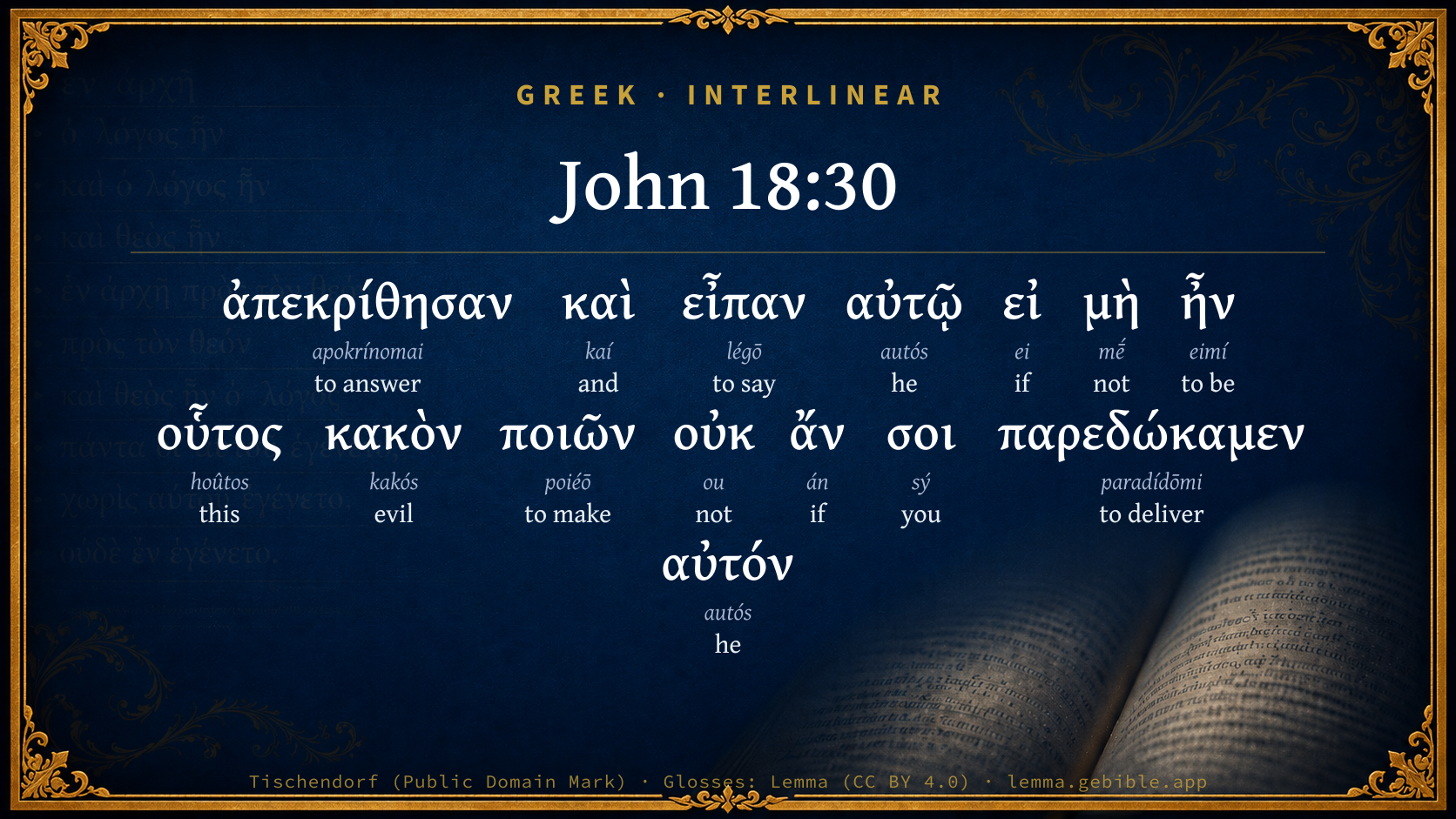
Greek (Tischendorf 8th ed.) John 18:30 appears in the Greek New Testament. The text above is from the Tischendorf 8th edition. Each word links to its Strong’s number and a concise gloss. Click any word for its full Thayer’s Greek Lexicon entry.
Download image
Cite this verse

John 18:30 (World English Bible). Public Domain. Lemma interlinear Bible study tool, https://lemma.gebible.app/v/john/18/30.

Show BibTeX & RIS
BibTeX
RIS
English Translation
They answered him, "If this man weren't an evildoer, we wouldn't have delivered him up to you."
World English Bible · Public Domain
Download a study sheet

One document with this verse’s original text, its word-by-word gloss line, the meaning frame, cross-references with their text, attributed commentary, and full source and license credits — printable, and it pastes into notes with its structure intact.

This verse Autodidact and up

Study sheet (.html) Plain text (.txt)

A passage Seminary Student

Up to 50 verses in one chapter. A passage sheet keeps up to 6 commentary sources and 12 cross-references per verse, in the order this page ranks them, and says so on the sheet whenever that leaves anything out. Ask for a single verse and you get the Autodidact verse sheet above.

Everything on this page stays free to read, with no account — the sheet is a download of what is already on screen, not access to it.

Want to remove ads? Support Godless Engineer
Compare translations 3

The same verse in 3 English versions, stacked beneath the original-language interlinear above. Click any original word for its lexicon entry.

Each is an independent rendering of the whole verse — the interlinear is not word-aligned to these translations.

Highlighted words mark where these versions differ — a whole-verse word diff, not a word-by-word alignment.

  • World English Bible Public Domain
    They answered him, "If this man weren't an evildoer, we wouldn't have delivered him up to you."
  • King James Version Public Domain
    They answered and said unto him, If he were not a malefactor, we would not have delivered him up unto thee.
  • unfoldingWord Literal Text CC BY-SA 4.0
    They answered and said to him, “If this one were not an evildoer, we would not have handed him over to you.”

unfoldingWord Literal Text — © unfoldingWord, licensed CC BY-SA 4.0. Word-aligned USFM3 via Door43 (git.door43.org/unfoldingWord/en_ult).

Versions to compare (up to 4)

3 of 4 selected

Show all 19 translations

Every available English version of this verse, each an independent rendering of the whole verse.

  • World English Bible Public Domain
    They answered him, "If this man weren't an evildoer, we wouldn't have delivered him up to you."
  • Berean Standard Bible Public Domain
    “If He were not a criminal,” they replied, “we would not have handed Him over to you.”
  • Majority Standard Bible Public Domain
    “If He were not a criminal,” they replied, “we would not have handed Him over to you.”
  • King James Version Public Domain
    They answered and said unto him, If he were not a malefactor, we would not have delivered him up unto thee.
  • American Standard Version (1901) Public Domain
    They answered and said unto him, If this man were not an evildoer, we should not have delivered him up unto thee.
  • Revised Version (1885) Public Domain
    They answered and said unto him, If this man were not an evil-doer, we should not have delivered him up unto thee.
  • Geneva Bible (1599) Public Domain
    They answered, and saide vnto him, If hee were not an euill doer, we woulde not haue deliuered him vnto thee.
  • Douay-Rheims (1899) Public Domain
    They answered, and said to him: If he were not a malefactor, we would not have delivered him up to thee.
  • Young's Literal Translation Public Domain
    they answered and said to him, `If he were not an evil doer, we had not delivered him to thee.'
  • Literal Standard Version CC BY-SA 4.0
    They answered and said to him, “If He were not doing evil, we had not delivered Him to you.”
  • Unlocked Literal Bible CC BY-SA 4.0
    They answered and said to him, “If this man was not an evildoer, we would not have given him over to you.”
  • unfoldingWord Literal Text CC BY-SA 4.0
    They answered and said to him, “If this one were not an evildoer, we would not have handed him over to you.”
  • Darby Bible Public Domain
    They answered and said to him, If this [man] were not an evildoer, we should not have delivered him up to thee.
  • World Messianic Bible Public Domain
    They answered him, “If this man weren’t an evildoer, we wouldn’t have delivered him up to you.”
  • Webster's Bible Public Domain
    They answered and said to him, If he were not a malefactor, we would not have delivered him up to thee.
  • Free Bible Version CC BY-SA 4.0
    “If he wasn't a criminal, we would not have handed him over to you,” they answered.
  • Bible in Basic English Public Domain
    They said to him in answer, If the man was not a wrongdoer we would not have given him up to you.
  • Text-Critical English NT CC BY 4.0
    They answered him, “If he were not an evildoer, we would not have handed him over to yoʋ.”
  • Tyndale New Testament (1534) Public Domain
    Pylate then went out vnto the and sayde: what accusacion bringe ye agaynste this man?

Literal Standard Version (2020), Covenant Press — licensed CC BY-SA 4.0. Text via the HelloAO Bible API (eBible.org). Unlocked Literal Bible (unfoldingWord) — licensed CC BY-SA 4.0. Text via the HelloAO Bible API (eBible.org). unfoldingWord Literal Text — © unfoldingWord, licensed CC BY-SA 4.0. Word-aligned USFM3 via Door43 (git.door43.org/unfoldingWord/en_ult). Free Bible Version, Dr. Jonathan Gallagher — licensed CC BY-SA 4.0. Text via the HelloAO Bible API (eBible.org).

Word by word

More ways to search: Search by grammar → Find every occurrence → Compare this word →

Practice this passage: Drill this verse → Learn its vocabulary →

κακὸν
kakós
G2556
“evil”
Adjective, Accusative, Singular, Neuter
Part of Speech
Adjective
Case
Accusative
Number
Singular
Gender
Neuter
Full Thayer's Definition

Origin: apparently a primary word

TDNT: 10:49,4

1. of a bad nature a. not such as it ought to be 2. of a mode of thinking, feeling, acting a. base, wrong, wicked 3. troublesome, injurious, pernicious, destructive, baneful
  1. ἀπεκρίθησαν apokrínomai G611 “to answer” Verb, Aorist, Middle deponent, Indicative, 3rd person, Plural
  2. καὶ kaí G2532 “and” Conjunction
  3. εἶπαν légō G3004 “to say” Verb, Aorist, Active, Indicative, 3rd person, Plural
  4. αὐτῷ autós G846 “he” Personal pronoun, Dative, Singular, Masculine
  5. εἰ ei G1487 “if” Conditional
  6. μὴ mḗ G3361 “not” Particle, Negative
  7. ἦν eimí G1510 “to be” Verb, Imperfect, Active, Indicative, 3rd person, Singular
  8. οὗτος hoûtos G3778 “this” Demonstrative pronoun, Nominative, Singular, Masculine
  9. ποιῶν poiéō G4160 “to make” Verb, Present, Active, Participle, Nominative, Singular, Masculine
  10. οὐκ ou G3756 “not” Particle, Negative
  11. ἄν án G302 “if” Particle
  12. σοι sý G4771 “you” Personal pronoun, 2nd person, Dative, Singular
  13. παρεδώκαμεν paradídōmi G3860 “to deliver” Verb, Aorist, Active, Indicative, 1st person, Plural
  14. αὐτόν autós G846 “he” Personal pronoun, Accusative, Singular, Masculine

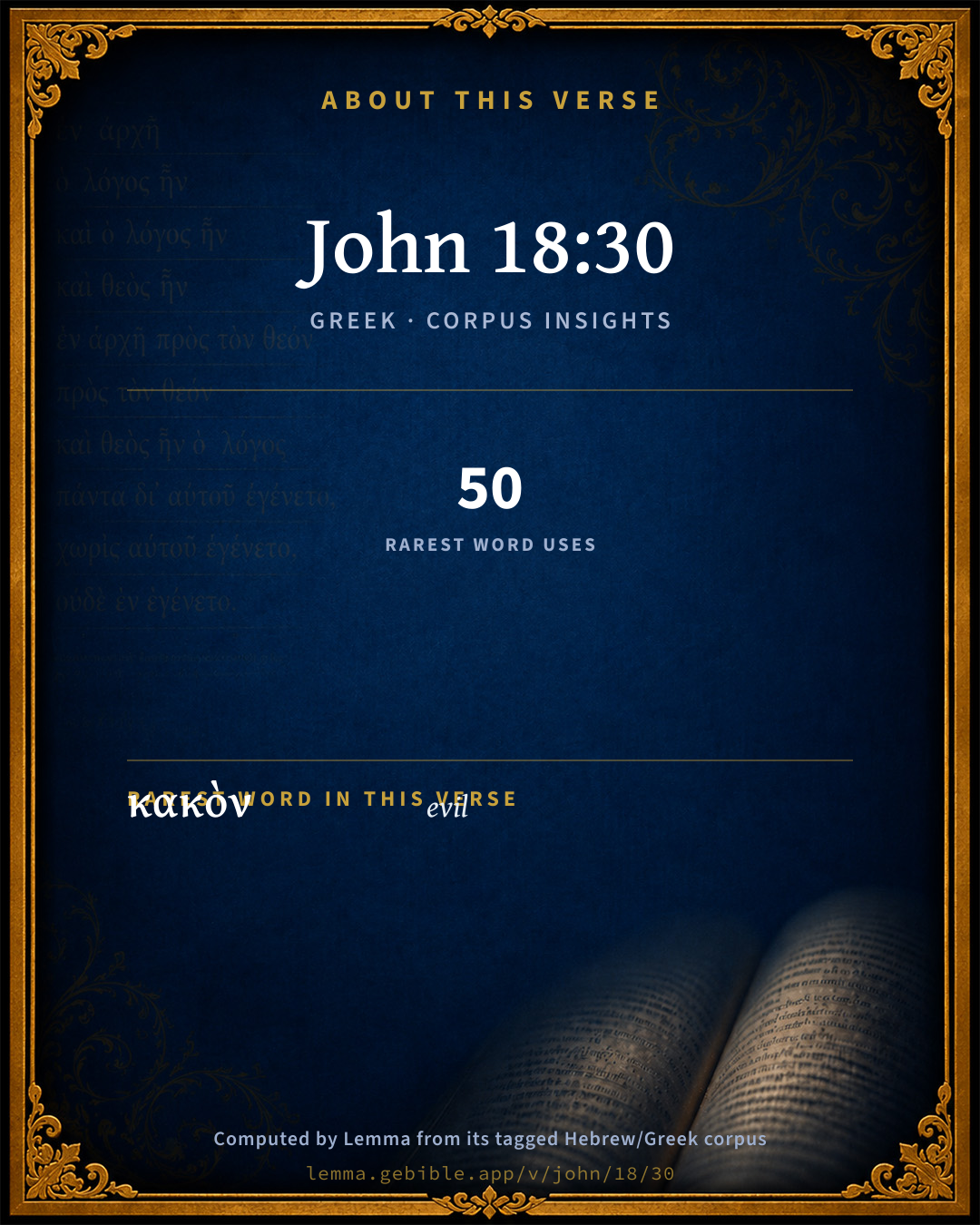
About this verse

These counts appear in no published source. They are computed here, from the morphology-tagged text and Lemma’s own curated glosses. What Lemma adds →

15
words
14
distinct lemmas
Gospels
section

Shared distinctive vocabulary

κακὸν evil G2556 occurs in 45 verses of the Greek New Testament. Also found in:

Repetition

A word recurs within this verse:

  • αὐτῷ he G846 ×2

Cross-references

7

Topical passages linked to John 18:30 in the Treasury of Scripture Knowledge — connected by theme and wording, ordered by reader-vote popularity; previews shown in the World English Bible.

  • Mark 10:33 "Behold, we are going up to Jerusalem. The Son of Man will be delivered to the chief priests and the scribes. They will condemn him to death, and will deliver him to the Gentiles.
  • Mark 15:3 The chief priests accused him of many things.
  • Luke 20:19–26 The chief priests and the scribes sought to lay hands on Him that very hour, but they feared the people--for they knew He had spoken this parable against them.
  • Luke 23:2–5 They began to accuse him, saying, "We found this man perverting the nation, forbidding paying taxes to Caesar, and saying that he himself is Christ, a king."
  • Luke 24:7 saying that the Son of Man must be delivered up into the hands of sinful men, and be crucified, and the third day rise again?"
  • John 19:12 At this, Pilate was seeking to release him, but the Jews cried out, saying, "If you release this man, you aren't Caesar's friend! Everyone who makes himself a king speaks against Caesar!"
  • Acts 3:13 The God of Abraham, Isaac, and Jacob, the God of our fathers, has glorified his Servant Jesus, whom you delivered up, and denied in the presence of Pilate, when he had determined to release him.

Cross-references courtesy of OpenBible.info (CC BY 4.0).

Where the printed editions differ

1 variant

Places in this verse where the major printed Greek editions disagree on the wording in a way that affects the translation — a comparison of editions, not a manuscript-by-manuscript collation. The editions are the modern critical texts (Nestlé-Aland 28/27, SBL, Westcott-Hort, Tregelles, Tyndale House) and the traditional texts behind the KJV (the Textus Receptus and the Byzantine/Majority text). It is not a claim about which reading is original.

  1. Editions differ
    κακὸν

    “evil”

    In NA28NA27TynSBLWHTregTR»1Byz»1 Not in TRByz

Textual data: Translators Amalgamated Greek New Testament (STEPBible TAGNT) · CC BY 4.0.

Commentary

Notes on John 18:30 from classic Christian and Jewish commentators (each source and its license shown beneath its notes). The classic Christian expositions comment on the surrounding passage and are grouped to its opening verse, so a note may address several verses; the Jewish commentaries on the Tanakh (Rashi and others) are per-verse, so they appear only where the commentator wrote on this verse.

Lemma curates 59 commentaries, every one of them public domain or Creative Commons licensed, each selected and text-cleaned for this edition rather than reprinted as found. About our sources →

Bengel's Gnomon

Johann Albrecht Bengel

Joh 18:30. Εἰ μὴ, if not) It is a monstrous calumny to treat the cause of an innocent person as if it were a case of notorious criminality. They wish to relieve Pilate of the labour of investigation, so as that he should not trouble himself about their law, but only inflict the punishment.—οὗτος, this man) Answering to, against this man, in Joh 18:29.

Bengel's Gnomon of the New Testament — English translation (T&T Clark, Edinburgh, 1860) — public domain. Text from a community e-Sword module.

Jamieson, Fausset & Brown

Robert Jamieson, A. R. Fausset & David Brown

If he were not a malefactor, we would not have delivered him up unto thee--They were conscious they had no case of which Pilate could take cognizance, and therefore insinuate that they had already found Him worthy of death by their own law; but not having the power, under the Roman government, to carry their sentence into execution, they had come merely for his sanction.

Jamieson, Fausset & Brown — Commentary Critical and Explanatory on the Whole Bible (1871) — public domain (CC PDM 1.0). Text via the HelloAO Bible API.

Adam Clarke's Commentary

Verse 30. If he were not a malefactor] So they did not wish to make Pilate the judge, but the executor of the sentence which they had already illegally passed.

Adam Clarke's Commentary on the Bible (1810–1826) — public domain. Text from a community e-Sword/MySword module.

John Calvin's Commentaries

30. If he were not a malefactor, we would not have delivered him to thee. They indirectly complain of Pilate, that he has not a proper reliance on their integrity. “Why do you not, without further concerns” say they, “hold it to be certain, that the person whom we prosecute deserves to die?” Such is the manner in which wicked men, whom God has raised to a high degree of honor, blinded as it were by their own greatness, allow themselves to do whatever they choose. Such, too, is the intoxicating nature of pride. They wish that Christ should be reckoned a malefactor, and for no other reason but because they accuse him. But if we come to the truth of the matter, what deeds of a malefactor shall we find in him, except that he has cured every kind of diseases, has driven the devils out of men, has made the paralytics and the lame to walk, has restored sight to the blind, hearing to the deaf, and life to the dead? Such were the real facts, and those men knew them well; but, as I said a little ago, when men are intoxicated with pride, nothing is more difficult than to arouse them to form a sound and correct judgment.

John Calvin's Commentaries (1540-1563) — public domain. Text from the Calvin Translation Society English edition (1840s-50s) via the Christian Classics Ethereal Library (ccel.org). Calvin's coverage is partial (roughly two-thirds of the Bible); uncommented books and verses are honest gaps, never fabricated. The 19th-century editor's footnotes and remarks are omitted so the notes are faithfully Calvin's own voice.

Ellicott's Commentary for English Readers

(30) If he were not a malefactor, we would not have delivered him up unto thee.—They take the position that the Roman is the executive, and their own the judicial power. They bring no legal charge against Jesus, but assert, in effect that they themselves, who understood and had investigated the whole matter, had condemned Him to death, and that the fact that they had done so was in itself sufficient proof that He was worthy of death. They use the vague word “malefactor,” “evil-doer,” though in the trial before Caiaphas they had not sought to prove any evil deed, and they expect that upon this assertion Pilate will pronounce on Him, as on other malefactors, the sentence of death.

A Bible Commentary for English Readers, edited by Charles John Ellicott (1878–1897) — public domain. Text from a community e-Sword module.

The Cambridge Bible for Schools and Colleges

gen. ed. J. J. S. Perowne

30. a malefactor] Literally, ‘doing evil’ or an evil-doer; not the same expression as Luk_23:32. The Jews are taken aback at Pilate’s evident intention of trying the case himself. They had expected him merely to carry out their sentence, and had not come provided with any definite accusation. Blasphemy, for which they had condemned Him (Mat_26:65-66), might be no crime with Pilate (comp. Act_18:16). Hence the vagueness of their first charge. Later on (Joh_19:7) they throw in the charge of blasphemy; but they rely mainly on three distinct charges, which being political, Pilate must hear; (1) seditious agitation, (2) forbidding to give tribute to Caesar, (3) assuming the title, ‘King of the Jews’ (Luk_23:3).

The Cambridge Bible for Schools and Colleges (gen. ed. J. J. S. Perowne; Cambridge University Press, 1878–1918) — public domain. Text from a community e-Sword module.

John Gill's Exposition

They answered and said unto him,.... Offended at the question put to them, and filled with indignation that they should be so interrogated, with an air of haughtiness and insolence reply to him:

if he were not a malefactor, we would not have delivered him up unto thee; insinuating, that he was guilty of some very wicked action; not merely of a breach of some of their laws peculiar to them; for then they would have tried and judged him according to them, and not have brought him before him; but they suggest, that he was guilty of some crimes recognizable by Caesar's court; and which they did not care to mention expressly, lest they should not succeed, not having it may be as yet, their witnesses ready; and hoped he would have took their own word for it, without any further proof, they being men of such rank and dignity, and of so much knowledge, learning, and religion; and therefore took it ill of him, that he should ask such persons as they were, so famous for their prudence, integrity, and sanctity, such a question: however, they own themselves to be the betrayers and deliverers up of our Lord, which Christ had before foretold, and which Stephen afterwards charged them with.

John Gill's Exposition of the Whole Bible (1746–1763) — public domain (CC PDM 1.0). Text via the HelloAO Bible API.

Trapp's Complete Commentary

John Trapp

30 They answered and said unto him, If he were not a malefactor, we would not have delivered him up unto thee.

Ver. 30. If he were not a malefactor] Why? what evil had he done them? Might he not have said to them, as Themistocles to his Athenians, Are ye weary of receiving so many benefits by one man?

John Trapp, A Commentary or Exposition upon All the Books of the Old and New Testament (1647–1656) — public domain. Text from a community e-Sword module.

Albert Barnes' Notes on the Bible

If he were not a malefactor - A violator of the law. If we had not determined that he was such, and was worthy of death, Mat 26:66. From this it appears that they did not deliver him up to be tried, but hoped that Pilate would at once, give sentence that he should be executed according to their request. It is probable that in ordinary cases the Roman governor was not accustomed to make very strict inquiry into the justice of the sentence. The Jewish Sanhedrin tried causes and pronounced sentence, and the sentence was usually approved by the governor; but in this case Pilate, evidently contrary to their expectations, proceeded himself to rehear and retry the cause. He had doubtless heard of the miracles of Jesus. He seems to have been strongly pre-possessed with the belief of his innocence. He knew that they had delivered him from mere envy Mat 27:18, and hence, he inquired of them the nature of the case, and the kind of charge which they expected to substantiate against him.

Albert Barnes' Notes on the Bible (1834–1885) — public domain. Text from a community e-Sword/MySword module.

Matthew Poole's English Annotations

They had in their sanhedrim before judged him guilty of blasphemy, Mat 26:65, but this they durst not mention, lest Pilate should have rejected them, as being not concerned in questions of their law; they therefore only exclaimed against him in the general as a great malefactor, but of what kind they do not say. It should seem they would have had Pilate have added his civil authority to confirm and execute their ecclesiastical censure, without so much as hearing any thing of the cause (as at this day frequent in popish countries); but they met with a more equal judge.

Matthew Poole's English Annotations on the Holy Bible (1683–1685) — public domain. Text from a community e-Sword/MySword module.

Whedon's Commentary on the Bible

Daniel D. Whedon

30. If… not a malefactor—Uttered in a sarcastic tone, this reply would be of a very irritating character. Uttered, however, in a tone of courteous sauvity, it apologizes for troubling Pilate, assuring him that nothing but the fact that they had a malefactor could have brought them there.

Their real purpose, under either meaning, is to precipitate Pilate into the slaying of Jesus. They first wished to do this, if possible, by making Pilate execute him in implicit compliance with their judgment. Or, failing in that, they will accuse Jesus of treason, and induce Pilate to condemn and crucify. And failing in that, they will boldly threaten Pilate himself, and compel him to execute whether he condemn or not. Pilate, after availing himself of every possible subterfuge, finally yields to their last master-stroke.

Daniel D. Whedon (gen. ed.), Commentary on the Old and New Testaments (1874–1909) — public domain. Text from a community e-Sword module.

The Pulpit Commentary

Vers. 30, 31. They answered and said, if he were not a malefactor,we should not have delivered him up to thee. This was somewhat audacious. It was as much as to say, "We have judged, you have only to register our decisions. We are not bound to go through our evidence before you." If it had been so, the deprivation of the jus gladii, the power of capital execution would have mattered little to them. Pilate, in scorn and irony, replies, "If that be so, why have ye brought him to me? If you are unwilling to comply with the terms of Roman jurisprudence, then it must be some ease which you can dispose of according to your own rules." Take ye him yourselves, and according to your Law judge him. Pilate saw their animus, and that they were thirsting for the blood of Jesus, and wished at once to flout them and make them confess their impotence and admit his suzerainty. For them to judge (krinein) was not equivalent to put to death ( apokteimai), and Pilate clearly suggested that much. The Jews therefore said to him, It is not lawful (ouk exesti) to us to put any man to death. This was perfectly true, notwithstanding the tumultuary and violent acts and threats, and incipient stonings of Jesus, to which the Gospel refers. (Joh_8:3, 59 7:25) Other interpretations of this exclamation have been supplied, viz. "to execute criminals of state" (Krebs), "to do so on feast-days" (Semler); but the power had been formally taken from even the supreme court, forty years before the destruction of Jerusalem. The instance of the massacre of James the Just, occurring between the departure of one Roman governor and the arrival of another, is mentioned by Josephus ("Ant.," 20:9. 1) as a distinct infringement and violation of law. The stoning of Stephen in a wild tumult, and the proceedings of Herod Agrippa, are rather confirmations than violations of the rule. Thus the malign disposition and distinct purpose of the Jews were revealed. They would not have brought Jesus at all before the Roman governor, nor admitted his claim to decide any case involving religious ideas and practices, if they had not fully decided that Jesus must die. Bat John sees a deeper reason still.

The Pulpit Commentary (1880–1919), ed. H.D.M. Spence-Jones & Joseph S. Exell — public domain. Text from a community e-Sword module.

Cambridge Greek Testament for Schools and Colleges

30. κακὸν ποιῶν (א3BL) for κακοποιός (Acts 3 for simplification; the word perhaps comes from 1Pe 2:12; 1Pe 2:14; 1Pe 3:16; 1Pe 4:15).

We enter now upon the second part of the second main division of the Gospel. The Evangelist having given us the INNER GLORIFICATION OF CHRIST IN HIS LAST DISCOURSES (13–17), now sets forth HIS OUTER GLORIFICATION IN HIS PASSION AND DEATH (18, 19). This part, like the former (see Introduction to chap. 13), may be divided into four sections. 1. The Betrayal (Joh 18:1-11); 2. The Jewish Trials (12–27); 3. The Roman Trial (Joh 18:28 to Joh 19:16); 4. The Death and Burial (17–42).

Dr Westcott (Speaker’s Commentary, N.T., Vol. II. p. 249) observes; “1. It is a superficial and inadequate treatment of his narrative to regard it as a historical supplement of the other narratives, or of the current oral narrative on which they are based.… The record is independent and complete in itself. It is a whole, and like the rest of the Gospel an interpretation of the inner meaning of the history which it contains.

“Thus in the history of the Passion three thoughts among others rise into clear prominence:

(1) The voluntariness of Christ’s sufferings; Joh 18:4; Joh 18:8; Joh 18:11; Joh 18:36; Joh 19:28; Joh 19:30.

(2) The fulfilment of a divine plan in Christ’s sufferings; Joh 18:4; Joh 18:9; Joh 18:11, Joh 19:11; Joh 19:24; Joh 19:28; Joh 19:36-37.

(3) The Majesty which shines through Christ’s sufferings; Joh 18:6; Joh 18:20-23 (comp. Luk 22:53), 37, Joh 19:11; Joh 19:26-27; Joh 19:30.

“The narrative in this sense becomes a commentary on earlier words which point to the end; (1) Joh 10:17-18; (2) Joh 13:1; (3) Joh 13:31.

“2. In several places the full meaning of S. John’s narrative is first obtained by the help of words or incidents preserved by the synoptists. His narrative assumes facts found in them: e.g. Joh 18:11; Joh 18:33; Joh 18:40, Joh 19:41.

“3. The main incidents recorded by more than one of the other Evangelists which are omitted by S. John are: (by all three) the agony, traitor’s kiss, mockery as prophet, council at daybreak, impressment of Simon, reproaches of the spectators, darkness, confession of the centurion; (by S. Matthew and S. Mark) the desertion by all, examination before the Sanhedrin at night, false witness, adjuration, great Confession, mockery after condemnation, cry from Psalms 22, rending of the veil.

“Other incidents omitted by S. John are recorded by single Evangelists: (S. Matthew) power over the hosts of heaven, Pilate’s wife’s message, Pilate’s hand-washing, self-condemnation of the Jews, earthquake; (S. Mark) flight of the young man, Pilate’s question as to the death of Christ; (S. Luke) examination before Herod, lamentation of the women, three ‘words’ from the Cross (Luk 23:34; Luk 23:43; Luk 23:46), repentance of one of the robbers.

“4. The main incidents peculiar to S. John are: the words of power at the arrest, examination before Annas, first conference of the Jews with Pilate and Pilate’s private examination, first mockery and Ecce Homo, Pilate’s maintenance of his words, the last charge (Joh 19:25-27), the thirst, piercing of the side, ministry of Nicodemus.

“5. In the narrative of incidents recorded elsewhere S. John constantly adds details, often minute and yet most significant: e.g. Joh 18:1-2; Joh 18:10-12; Joh 18:15-16; Joh 18:26; Joh 18:28, Joh 19:14; Joh 19:17; Joh 19:41. See the notes.

“6. In the midst of great differences of detail the Synoptists and S. John offer many impressive resemblances as to the spirit and character of the proceedings: e.g. (1) the activity of the ‘High Priests’ (i.e. the Sadducaean hierarchy) as distinguished from the Pharisees; (2) the course of the accusation—civil charge, religious charge, personal influence; (3) the silence of the Lord in His public accusations, with the significant exception, Mat 26:64; (4) the tone of mockery; (5) the character of Pilate.”

Cambridge Greek Testament for Schools and Colleges (Cambridge University Press, 1896; 21 vols, various authors incl. Carr, Maclear, Plummer, Farrar, Lumby, Moule, M. R. James, Simcox) — public domain. Text from a community e-Sword module.

Alford’s Greek Testament

Henry Alford

30.] They do not mention the charge of blasphemy brought against Him by the Sanhedrim, for fear of the entire rejection of their cause, as by Gallio, Act 18:16. The Procurators in such cases had a discretionary power. On what they did say, Grot. observes, “Quod probationibus deerat, id supplere volunt sua auctoritate.”

Henry Alford, The Greek Testament (1849–1861) — public domain. Text from a community e-Sword module.

International Critical Commentary

30. The Jews are not sure of their case, and so they hesitate to specify the charge in explicit terms. They say, in effect, “That is our business; we would not have brought the prisoner for sentence, if we were not satisfied with His guilt.”

Εἰ μὴ ἦν οὗτος κακὸν ποιῶν κτλ. “If this person were not doing wrong, we should not have delivered Him up to thee.” For κακὸν ποιῶν (אcBLW e), the rec., with AC3DsuppNΓΔΘ, has κακοποιός, a word found in N.T. only in 1Pe 2:12, 1Pe 2:14, 1Pe 2:3:16, 1Pe 2:4:15. Perhaps ἦν followed by the pres. part. suggests a habitual evil-doer (cf. Abbott, Diat. 2277).

οὐκ ἄν σοι παρεδώκαμεν αὐτόν. σοι may be emphatic, “we should not have delivered Him up to thee” (cf. Abbott, Diat. 2566b). In any case, the reply of the Jews is an insolent one.

International Critical Commentary — older volumes (1896–1929), various authors — public domain. Text from a community e-Sword module.

Vincent's Word Studies in the New Testament

Marvin R. Vincent

Malefactor [κακοποιος] . Rev., evil - doer. From kakon, evil, and poiew, to do. Luke uses a different word, kakourgov, from kakon, evil, and ergw, to work. See on 1Pe 2:12.

Marvin R. Vincent, Word Studies in the New Testament (1887–1900) — public domain. Text from a community e-Sword/MySword module.

Lesson kit

Teaching starters — assembled from the data on this page, not authored interpretation. Every prompt links to the verse data it draws on. Edit before teaching.

John, in the Gospels, opens this verse with 15 words (14 distinct Greek lemmas). Its most distinctive word is kakós (“evil”). A historical commentator’s framing appears above. Read the whole chapter for the surrounding context.

Discussion questions

  1. How does “evil” (kakós) shape what this verse is saying?
  2. How does Matthew 21:41, which shares the word «evil», read alongside this verse?
  3. What does the repetition of “he” (2× in this one verse) do in this verse?
  4. The translations on this page render this verse differently — a whole-verse word diff, not a word-by-word alignment. What might account for the different wordings?
  5. Compare how Bengel's Gnomon and Jamieson, Fausset & Brown read this verse. Where do they agree or differ?

Things to notice

Reading settings

Reading text

Shown beneath each verse's original-language words.

Old Testament
Old Testament edition

Read the OT as the Masoretic Hebrew (MT) or the Greek Septuagint (LXX).

English shown for the Greek Septuagint (in the Hebrew ↔ Greek comparison).

Comparing translations? Open the Compare panel on any verse page to stack up to four side by side.