John 5:38

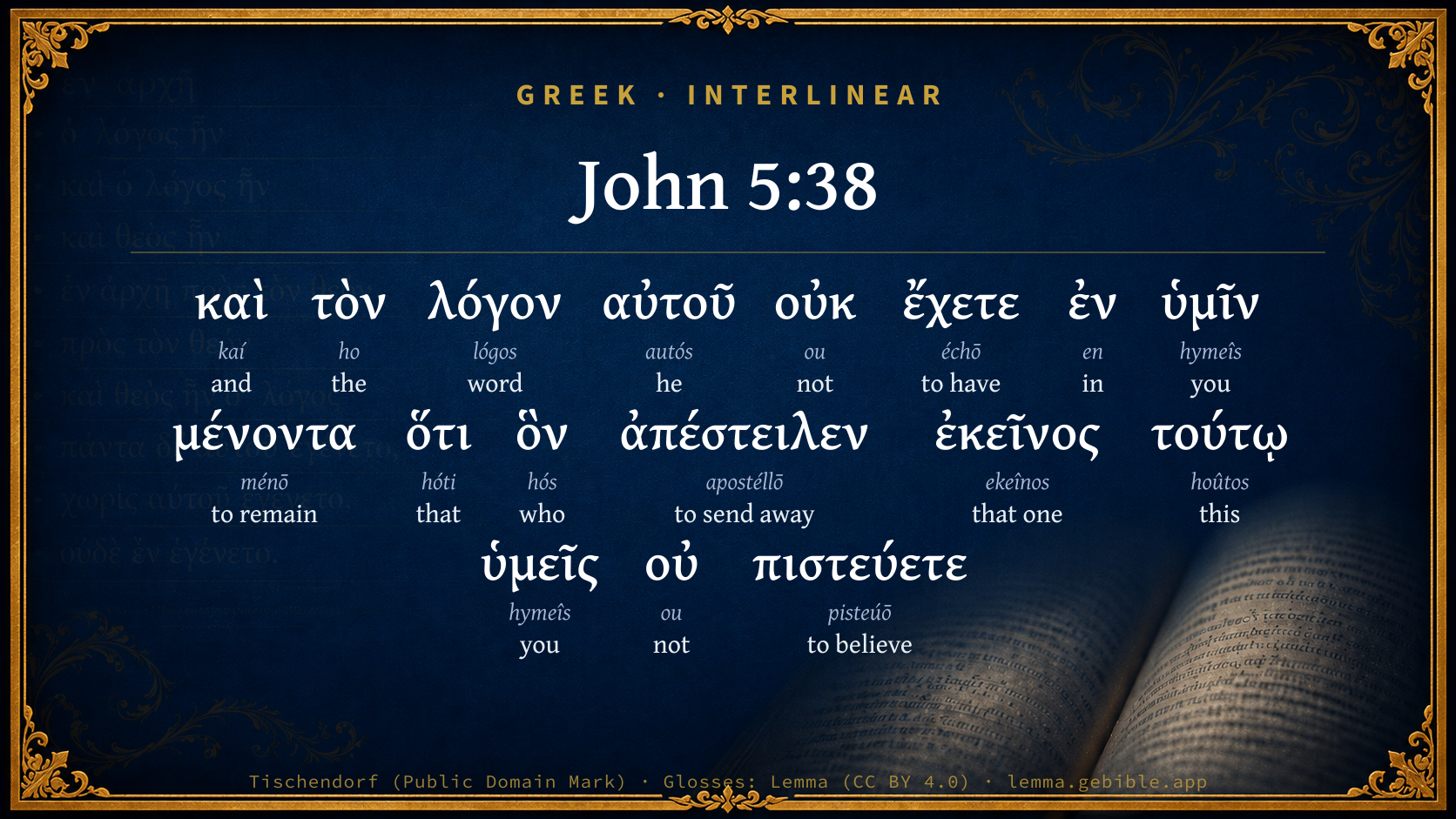
Greek (Tischendorf 8th ed.) John 5:38 appears in the Greek New Testament. The text above is from the Tischendorf 8th edition. Each word links to its Strong’s number and a concise gloss. Click any word for its full Thayer’s Greek Lexicon entry.
Download image
Cite this verse

John 5:38 (World English Bible). Public Domain. Lemma interlinear Bible study tool, https://lemma.gebible.app/v/john/5/38.

Show BibTeX & RIS
BibTeX
RIS
English Translation
You don't have his word living in you; because you don't believe him whom he sent.
World English Bible · Public Domain
Download a study sheet

One document with this verse’s original text, its word-by-word gloss line, the meaning frame, cross-references with their text, attributed commentary, and full source and license credits — printable, and it pastes into notes with its structure intact.

This verse Autodidact and up

Study sheet (.html) Plain text (.txt)

A passage Seminary Student

Up to 50 verses in one chapter. A passage sheet keeps up to 6 commentary sources and 12 cross-references per verse, in the order this page ranks them, and says so on the sheet whenever that leaves anything out. Ask for a single verse and you get the Autodidact verse sheet above.

Everything on this page stays free to read, with no account — the sheet is a download of what is already on screen, not access to it.

Want to remove ads? Support Godless Engineer
Compare translations 3

The same verse in 3 English versions, stacked beneath the original-language interlinear above. Click any original word for its lexicon entry.

Each is an independent rendering of the whole verse — the interlinear is not word-aligned to these translations.

Highlighted words mark where these versions differ — a whole-verse word diff, not a word-by-word alignment.

  • World English Bible Public Domain
    You don't have his word living in you; because you don't believe him whom he sent.
  • King James Version Public Domain
    And ye have not his word abiding in you: for whom he hath sent, him ye believe not.
  • unfoldingWord Literal Text CC BY-SA 4.0
    And you do not have his word remaining in you, for the one whom he has sent, this one you do not believe.

unfoldingWord Literal Text — © unfoldingWord, licensed CC BY-SA 4.0. Word-aligned USFM3 via Door43 (git.door43.org/unfoldingWord/en_ult).

Versions to compare (up to 4)

3 of 4 selected

Show all 19 translations

Every available English version of this verse, each an independent rendering of the whole verse.

  • World English Bible Public Domain
    You don't have his word living in you; because you don't believe him whom he sent.
  • Berean Standard Bible Public Domain
    nor does His word abide in you, because you do not believe the One He sent.
  • Majority Standard Bible Public Domain
    nor does His word abide in you, because you do not believe the One He sent.
  • King James Version Public Domain
    And ye have not his word abiding in you: for whom he hath sent, him ye believe not.
  • American Standard Version (1901) Public Domain
    And ye have not his word abiding in you: for whom he sent, him ye believe not.
  • Revised Version (1885) Public Domain
    And ye have not his word abiding in you: for whom he sent, him ye believe not.
  • Geneva Bible (1599) Public Domain
    And his worde haue you not abiding in you: for whom he hath sent, him ye beleeued not.
  • Douay-Rheims (1899) Public Domain
    And you have not his word abiding in you: for whom he hath sent, him you believe not.
  • Young's Literal Translation Public Domain
    and His word ye have not remaining in you, because whom He sent, him ye do not believe.
  • Literal Standard Version CC BY-SA 4.0
    and you do not have His word remaining in you, because you do not believe Him whom He sent.
  • Unlocked Literal Bible CC BY-SA 4.0
    You do not have his word remaining in you, for you are not believing in the one whom he has sent.
  • unfoldingWord Literal Text CC BY-SA 4.0
    And you do not have his word remaining in you, for the one whom he has sent, this one you do not believe.
  • Darby Bible Public Domain
    and ye have not his word abiding in you; for whom *he* hath sent, him ye do not believe.
  • World Messianic Bible Public Domain
    You don’t have his word living in you, because you don’t believe him whom he sent.
  • Webster's Bible Public Domain
    And ye have not his word abiding in you: for whom he hath sent, him ye believe not.
  • Free Bible Version CC BY-SA 4.0
    and you don't accept what he says, because you don't trust in the one he sent.
  • Bible in Basic English Public Domain
    And you have not kept his word in your hearts, because you have not faith in him whom he has sent.
  • Text-Critical English NT CC BY 4.0
    And you do not have his word abiding in you, for you do not believe him whom he sent.
  • Tyndale New Testament (1534) Public Domain
    therto his wordes have ye not abydinge in you. For whome he hath sent: him ye beleve not.

Literal Standard Version (2020), Covenant Press — licensed CC BY-SA 4.0. Text via the HelloAO Bible API (eBible.org). Unlocked Literal Bible (unfoldingWord) — licensed CC BY-SA 4.0. Text via the HelloAO Bible API (eBible.org). unfoldingWord Literal Text — © unfoldingWord, licensed CC BY-SA 4.0. Word-aligned USFM3 via Door43 (git.door43.org/unfoldingWord/en_ult). Free Bible Version, Dr. Jonathan Gallagher — licensed CC BY-SA 4.0. Text via the HelloAO Bible API (eBible.org).

Word by word

More ways to search: Search by grammar → Find every occurrence → Compare this word →

Practice this passage: Drill this verse → Learn its vocabulary →

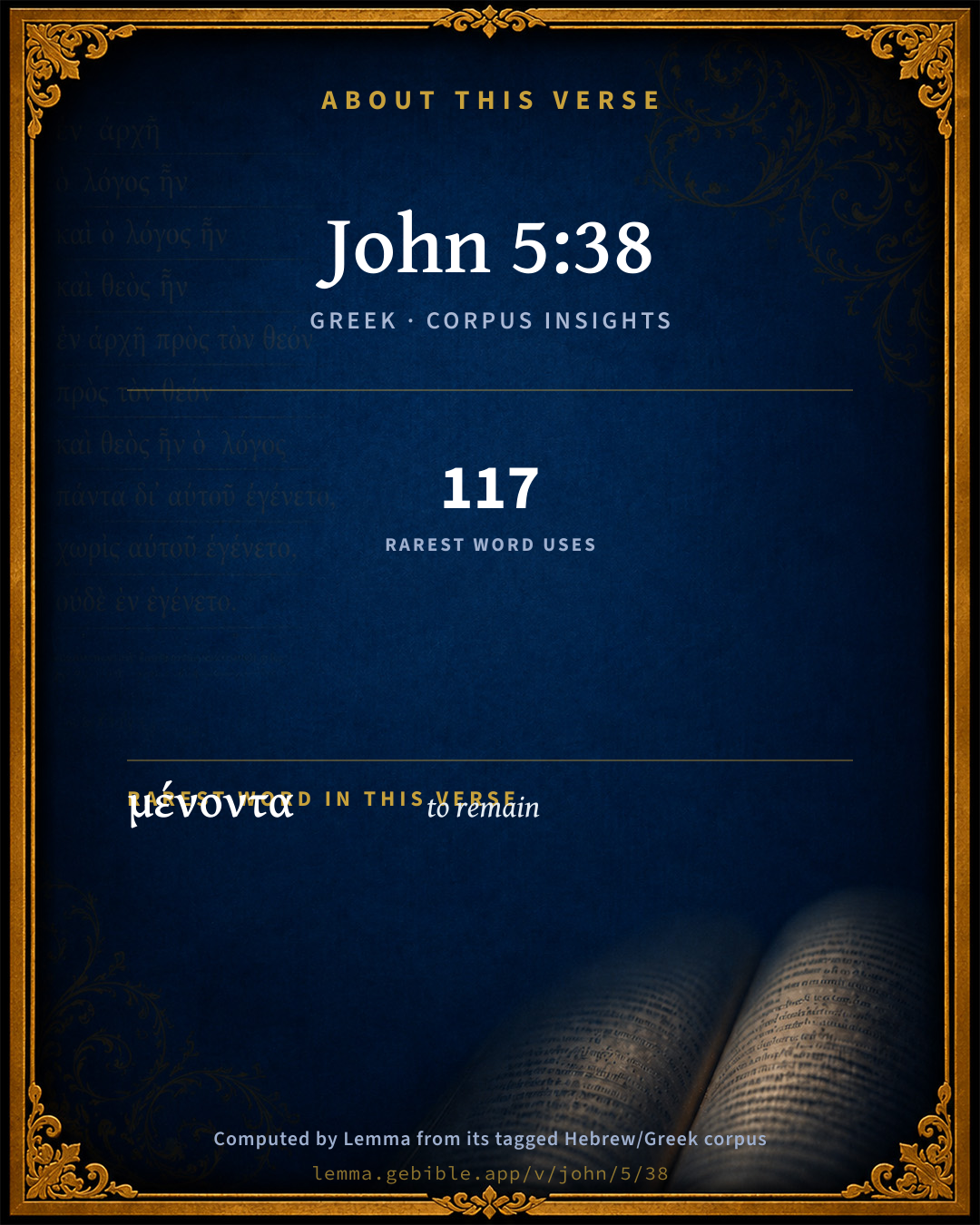
μένοντα
ménō
G3306
“to remain”
Verb, Present, Active, Participle, Accusative, Singular, Masculine
Part of Speech
Verb
Tense
Present
Voice
Active
Mood
Participle
Case
Accusative
Number
Singular
Gender
Masculine
Full Thayer's Definition

Origin: a root word

TDNT: 13:34,6

1. to remain, abide a. in reference to place 1. to sojourn, tarry 2. not to depart 1a b. to continue to be present 1a c. to be held, kept, continually d. in reference to time 1. to continue to be, not to perish, to last, endure 1b e. of persons, to survive, live f. in reference to state or condition 1. to remain as one, not to become another or different 2. to wait for, await one
  1. καὶ kaí G2532 “and” Conjunction
  2. τὸν ho G3588 “the” Article, Accusative, Singular, Masculine
  3. λόγον lógos G3056 “word” Noun, Accusative, Singular, Masculine
  4. αὐτοῦ autós G846 “he” Personal pronoun, Genitive, Singular, Masculine
  5. οὐκ ou G3756 “not” Particle, Negative
  6. ἔχετε échō G2192 “to have” Verb, Present, Active, Indicative, 2nd person, Plural
  7. ἐν en G1722 “in” Preposition
  8. ὑμῖν hymeîs G5210 “you” Personal pronoun, 2nd person, Dative, Plural
  9. ὅτι hóti G3754 “that” Conjunction
  10. ὃν hós G3739 “who” Relative pronoun, Accusative, Singular, Masculine
  11. ἀπέστειλεν apostéllō G649 “to send away” Verb, Aorist, Active, Indicative, 3rd person, Singular
  12. ἐκεῖνος ekeînos G1565 “that one” Demonstrative pronoun, Nominative, Singular, Masculine
  13. τούτῳ hoûtos G3778 “this” Demonstrative pronoun, Dative, Singular, Masculine
  14. ὑμεῖς hymeîs G5210 “you” Personal pronoun, 2nd person, Nominative, Plural
  15. οὐ ou G3756 “not” Particle, Negative
  16. πιστεύετε pisteúō G4100 “to believe” Verb, Present, Active, Indicative, 2nd person, Plural

About this verse

These counts appear in no published source. They are computed here, from the morphology-tagged text and Lemma’s own curated glosses. What Lemma adds →

17
words
15
distinct lemmas
Gospels
section

Repetition

Words recur within this verse:

Cross-references

18

Topical passages linked to John 5:38 in the Treasury of Scripture Knowledge — connected by theme and wording, ordered by reader-vote popularity; previews shown in the World English Bible.

  • 1 John 2:14 I have written to you, fathers, because you know him who is from the beginning. I have written to you, young men, because you are strong, and the word of God remains in you, and you have overcome the evil one.
  • Deuteronomy 6:6–9 These words, which I command you this day, shall be on your heart;
  • John 12:44–48 Jesus cried out and said, "Whoever believes in me, believes not in me, but in him who sent me.
  • Proverbs 7:1–2 My son, keep my words. Lay up my commandments within you.
  • Isaiah 53:1–3 Who has believed our message? and to whom has the arm of Yahweh been revealed?
  • James 1:21–22 Therefore, putting away all filthiness and overflowing of wickedness, receive with humility the implanted word, which is able to save your souls.
  • Joshua 1:8 This book of the law shall not depart out of your mouth, but you shall meditate thereon day and night, that you may observe to do according to all that is written therein: for then you shall make your way prosperous, and then you shall have good success.
  • Proverbs 2:1–2 My son, if you will receive my words, And store up my commandments within you;
  • Isaiah 49:7 Thus says Yahweh, the Redeemer of Israel, [and] his Holy One, to him whom man despises, to him whom the nation abhors, to a servant of rulers: Kings shall see and arise; princes, and they shall worship; because of Yahweh who is faithful, [even] the Holy One of Israel, who has chosen you.
  • John 1:11 He came to his own, and those who were his own didn't receive him.
  • John 3:17–21 For God didn't send his Son into the world to judge the world, but that the world should be saved through him.
  • John 5:42–43 But I know you, that you don't have God's love in yourselves.
  • John 5:46–47 For if you believed Moses, you would believe me; for he wrote about me.
  • John 8:37 I know that you are Abraham's seed, yet you seek to kill me, because my word finds no place in you.
  • John 8:46–47 Which of you convicts me of sin? If I tell the truth, why do you not believe me?
  • John 15:7 If you remain in me, and my words remain in you, you will ask whatever you desire, and it will be done for you.
  • Psalms 119:11 I have hidden your word in my heart, That I might not sin against you.
  • Colossians 3:16 Let the word of Christ dwell in you richly; in all wisdom teaching and admonishing one another with psalms, hymns, and spiritual songs, singing with grace in your heart to the Lord.

Cross-references courtesy of OpenBible.info (CC BY 4.0).

Commentary

Notes on John 5:38 from classic Christian and Jewish commentators (each source and its license shown beneath its notes). The classic Christian expositions comment on the surrounding passage and are grouped to its opening verse, so a note may address several verses; the Jewish commentaries on the Tanakh (Rashi and others) are per-verse, so they appear only where the commentator wrote on this verse.

Lemma curates 59 commentaries, every one of them public domain or Creative Commons licensed, each selected and text-cleaned for this edition rather than reprinted as found. About our sources →

Bengel's Gnomon

Johann Albrecht Bengel

Joh 5:38. Ὅτι, because) Therefore, those who believe, in hearing the Son, hear the Father; ch. Joh 6:45, “Every man that hath heard, and hath learned of the Father, cometh unto Me;” and in seeing the Son they see the Father; ch. Joh 14:9, [Jesus to Philip] “He that hath seen Me hath seen the Father” and how sayest thou then, Show us the Father?” although previously they had not heard nor seen Him: “No man hath seen God at any time; the only-begotten Son, which is in the bosom of the Father, He hath declared Him;” and they have abiding in them the Word of the Father, which is the same as the Word of the Son.

Bengel's Gnomon of the New Testament — English translation (T&T Clark, Edinburgh, 1860) — public domain. Text from a community e-Sword module.

Meyer's Critical & Exegetical Commentary

Heinrich August Wilhelm Meyer

Joh_5:38. At the end of Joh_5:37 we must place only a comma. John might have continued: οὔτε τὸν λόγον, κ.τ.λ.; instead of which he attaches the negation not to the particle, but to the verb (οὔτε … καὶ, see on Joh_4:11), and thus the new thought comes in more independently: And ye have not His word abiding in you; ye lack an inner and permanent appropriation of it; comp. 1Jn_2:14. The λόγος θεοῦ is not the inner revelation of God in the conscience (Olshausen, Frommann), but, conformably with the context (Joh_5:37; Joh_5:39), what God has spoken in the O. T., and this according to its purport. Had they given ear to this as, what it is in truth, the word of God (but they had no ear for Gods voice, Joh_5:37), had they discerned therein Gods manifestation of Himself (but they had no eye for Gods form, Joh_5:37), what God had spoken would have penetrated through the spiritual ear and eye into the heart, and would have become the abiding power of their inner life.

ὅτι ὃν ἀπέστειλεν, κ.τ.λ.] demonstration of the fact. He who rejects the sent of God cannot have that word abiding in him, which witnesses to Him who is sent (Joh_5:37). Quomodo mandata regis discet qui legatum excludit? Grotius.

τούτῳ ὑμεῖς] observe the emphasis in the position of the words here.

Meyer — Critical and Exegetical Commentary on the New Testament — English translation by Peter Christie, edited by Frederick Crombie (T&T Clark, 1880) — public domain. Text from a community e-Sword module.

Expositor's Greek Testament

ed. W. Robertson Nicoll

Joh 5:38 . καὶ τὸν λόγον … you have not heard His voice as you have heard mine (Joh 5:25 ) and His word which you have heard, and which has been coming to you through all these centuries, you do not admit to an abiding and influential place within you. τὸν λόγον αὐτοῦ is God’s revelation, which the Jews were conscious they had received; but though the word of God had come to them, they did not have it “abiding in” them; cf. 1Jn 3:15 ; a phrase which in John denotes permanent possession and abiding influence. God’s message does no good until it inwardly possesses those to whom it comes. The proof that the Jews had not thus received it is: ὅτι ὃν ἀπέστειλεν … “whom God hath sent, Him ye believe not”. Had the revelation or word of God in law and prophets possessed them, they would inevitably have recognised Jesus as from the same source, and as the consummation of the message, the fulfilment of the promise. Not that the Jews held their Scriptures in no esteem, no, (Joh 5:39 ), ἐρευνᾶτε τὰς γραφάς ; the indicative is to be preferred, “Ye search the Scriptures”; the reason being ὅτι ὑμεῖς δοκεῖτε ἐν αὐταῖς ζωὴν αἰώνιον ἔχειν , “because you suppose that in them you have life eternal” already it is hinted, by the emphatic ὑμεῖς implicitly opposed to a contrasted ἐγώ , and by the emphatic ἐν αὐταῖς suggesting another source, that eternal life was not to be had in the Scriptures, but in something else. But it is of me these Scriptures themselves into which you search testify. καὶ ἐκεῖναι … ἐμοῦ . “They testify that in me is life eternal; and yet you will not come to me that you may have life.”

The Expositor's Greek Testament, edited by W. Robertson Nicoll (1897–1910) — public domain. Text from a community e-Sword module.

Jamieson, Fausset & Brown

Robert Jamieson, A. R. Fausset & David Brown

not his word abiding in you--passing now from the Witness to the testimony borne by Him in "the lively oracles" (Act 7:38): both were alike strangers to their breasts, as was evidenced by their rejecting Him to whom all that witness was borne.

Jamieson, Fausset & Brown — Commentary Critical and Explanatory on the Whole Bible (1871) — public domain (CC PDM 1.0). Text via the HelloAO Bible API.

Adam Clarke's Commentary

Verse 38. Ye have not his word abiding in you] Though ye believe the Scriptures to be of God, yet ye do not let them take hold of your hearts-his word is in your mouth, but not in your mind. What a miserable lot! to read the Scriptures as the true sayings of God, and yet to get no salvation from them! Thy word, says David, (Ps 119:11,) have I hid in my heart, that I might not sin against thee. This, these Jews had not done. Reader, hast thou?

Adam Clarke's Commentary on the Bible (1810–1826) — public domain. Text from a community e-Sword/MySword module.

John Calvin's Commentaries

38. And you have not his word abiding in you. This is the true way of profiting, when the word of God takes root in us, so that, being impressed on our hearts, it has its fixed abode there. Christ affirms that the heavenly doctrine has no place among the Jews, because they do not receive the Son of God, on whom it everywhere bestows commendation. And justly does he bring this reproach against them; for it was not in vain that God spake by Moses and the Prophets. Moses had no other intention than to invite all men to go straight to Christ; and hence it is evident that they who reject Christ are not the disciples of Moses. Besides, how can that man have the word of life abiding in him who drives from him the life itself? How can that man keep the doctrine of the Law who destroys the soul of the Law, as far as lies in his power? For the Law without Christ is empty and has no solidity. Just in proportion, therefore, as any man knows Christ, is the proficiency which he has made in the word of God.

John Calvin's Commentaries (1540-1563) — public domain. Text from the Calvin Translation Society English edition (1840s-50s) via the Christian Classics Ethereal Library (ccel.org). Calvin's coverage is partial (roughly two-thirds of the Bible); uncommented books and verses are honest gaps, never fabricated. The 19th-century editor's footnotes and remarks are omitted so the notes are faithfully Calvin's own voice.

Ellicott's Commentary for English Readers

(38) Abiding in you.—This striking thought of the word taking up its abode in the mind, and forming the mind in which it dwells, meets us only in St. John. (Comp. Joh_15:7; 1Jn_2:14; 1Jn_2:24; 1Jn_3:9; 1Jn_3:17; and Note on Joh_6:36.) They had, indeed, the word of God, but they had it not as a power ever living in them. They locked it up with sacred care in ark and synagogue, but it found no home in their inmost life, and had no real power on their practice. They could take it up and put it down. It was something outside themselves. Had it been in them, it would have produced in them a moral consciousness, which would have accepted, as of the same nature with itself, every fuller revelation from God. Their own spirits, moulded by the word of God dwelling in them, would have received the Word of God now among them. (Comp. Excursus A: Doctrine of the Word.) The fact that they believed not Him whom God sent (not “hath sent”) was itself the proof that they had not the abiding word.

A Bible Commentary for English Readers, edited by Charles John Ellicott (1878–1897) — public domain. Text from a community e-Sword module.

The Cambridge Bible for Schools and Colleges

gen. ed. J. J. S. Perowne

38. And ye have not his word] ‘And hence it is that ye have no inner appropriation of the word’—seeing that ye have never received it either by hearing or vision. ‘His word’ is not a fresh testimony different from the ‘voice’ and ‘shape:’ all refer to the same thing,—the testimony of Scripture to the Messiah.

for whom he hath sent] Better, because whom He sent. This is the proof of the previous negation: one who had the word abiding in his heart could not reject Him to whom that word bears witness. Comp. 1Jn_2:14; 1Jn_2:24.

The Cambridge Bible for Schools and Colleges (gen. ed. J. J. S. Perowne; Cambridge University Press, 1878–1918) — public domain. Text from a community e-Sword module.

John Gill's Exposition

And ye have not his word abiding in you,.... Which some understand of Christ himself, the Logos, or word: who, though he was now with them, being made flesh, and dwelling among them, yet would not long continue with them: though rather this designs the written word, or the Scriptures of truth; and especially that part of them, which contains prophecies concerning the Messiah, which did not dwell in them richly, nor they dwell in their meditation on them, as was requisite. Or rather, it may intend that word of God expressed in the testimony he bore to the sonship of Christ at his baptism, by a voice from heaven, which made no lasting impression upon the minds and hearts of the Jews that heard it; as appears by what follows:

for whom he hath sent, him ye believe not; meaning himself; for if they had had either a due regard to the sacred oracles, or to that voice from heaven at his baptism, they would have received and embraced him as the Messiah, and sent of God, and not have disbelieved and rejected him, as now they did.

John Gill's Exposition of the Whole Bible (1746–1763) — public domain (CC PDM 1.0). Text via the HelloAO Bible API.

Trapp's Complete Commentary

John Trapp

38 And ye have not his word abiding in you: for whom he hath sent, him ye believe not.

Ver. 38. And you have not his word abiding in you] As an "engrafted word," Jas 1:21: ye have heard it, but with your bodily ears only, with those gristles that grow upon your heads: ye have not drawn up the ears of your minds to the ears of your bodies, that one sound piercing both, ye might believe; ye have not mixed the word with faith in your hearts, as in a vessel, &c.

John Trapp, A Commentary or Exposition upon All the Books of the Old and New Testament (1647–1656) — public domain. Text from a community e-Sword module.

Albert Barnes' Notes on the Bible

His word abiding in you - His law does not abide in you - that is, you do not regard or obey it. This was the “third” thing that he charged them with.

They had not obeyed the command of God. They had not regarded his manifestations, either in the times of the old dispensation, or now through the Messiah. They did not yield to what he had said in the revelation of the Old Testament.

For whom he hath sent - God had foretold that the Messiah would come. He had now given evidence that Jesus was he; but now they rejected him, and this was proof that they did not regard the word of God.

Albert Barnes' Notes on the Bible (1834–1885) — public domain. Text from a community e-Sword/MySword module.

Haydock's Catholic Bible Commentary

You do not observe the commandment he gave you. (Deuteronomy xviii. 15. 19.) of listening to the prophet He would send you.

George Leo Haydock (1774–1849), Haydock's Catholic Family Bible and Commentary, 1859 edition — public domain. Excludes Psalms (Douay-Rheims chapter numbering differs from Protestant) and Deuterocanonical books (Catholic canon only).

Matthew Poole's English Annotations

Though they had heard the word of the Lord, their forefathers by the prophets, and in that generation by John the Baptist, (the messenger sent before Christ’s face), and now by Christ himself, whom the Father had sent; yet the word of the Lord had no place in their hearts, Joh 8:37; it was unto them as a tale told; they received the sound of it, but it was not graven in their hearts. And this appeared, because as of themselves they had no intimacy of communion with God to know his mind; so, when the Son was sent out of the bosom of the Father to reveal God unto them, yet they would not receive him, so as to give any steady, fixed assent to what he revealed, and to yield him any just and true obedience.

Matthew Poole's English Annotations on the Holy Bible (1683–1685) — public domain. Text from a community e-Sword/MySword module.

Whedon's Commentary on the Bible

Daniel D. Whedon

3. God’s testimony to Christ through the Holy Scripture, Joh_5:39-40.

The mention of voice has prepared a transition to the written word of the Old Testament.

38. His word—His revealed truth; whether by work, by spirit, by testimony, or by Scripture.

Ye believe not—The very fact that they accepted not Him to whom the word testified, proved that the word dwelt not in their heads or hearts.

Daniel D. Whedon (gen. ed.), Commentary on the Old and New Testaments (1874–1909) — public domain. Text from a community e-Sword module.

The Pulpit Commentary

And further, you have not his Word (TON LOGON AUTOU) abiding in you. The Word of the Father (for the autou refers to the Father), i.e. the full expression of the Father"s heart, was sounding through the voice of the Son of God, and might have entered into and become an abiding power in their inmost conscience and their spiritual life; but they had not received the "Word" of the Lord through the "Voice" of the Lord. The reason given is, Because him whom he (the Father) sent, him (this One) ye believe not. In other words, "Your lack of faith in me accounts for your perverse misconception, for your inability to see and hear all that there is of the Father"s personal testimony to me." Some suspect a petitio principii in this argument, but the reasoning seems to be this; there is abundant evidence, corroboration, and cooperative glory, affirming the truth of all that Christ has said about himself as the Source of life and Judge of man; but the moral susceptibility of his hearers is paralyzed, and their faith in the most fundamental facts of their own experience is at fault. They seem impervious, not only to Christ"s Word, but to the corroborative testimonies themselves.

The Pulpit Commentary (1880–1919), ed. H.D.M. Spence-Jones & Joseph S. Exell — public domain. Text from a community e-Sword module.

John Wesley's Explanatory Notes

Ye have not his word - All who believe have the word of the Father (the same with the word of the Son) abiding in them, that is, deeply ingrafted in their hearts.

John Wesley, Explanatory Notes Upon the Whole Bible (1754–1765) — public domain. Text via the GEBible commentary corpus.

Cambridge Greek Testament for Schools and Colleges

38. ‘And hence it is that ye have no inner appropriation of the word’—seeing that ye have never received it either by hearing or vision. Ὁ λόγος is not a fresh testimony different from φωνή and εἶδος: all refer to the same—the witness of Scripture to the Messiah.

ὅτι ὃν ἀπ. Because whom He sent: see on Joh 1:33. Proof of the previous negation. One who had the word abiding in his heart could not reject Him to whom that word bears witness. 1Jn 2:14; 1Jn 2:24.

τούτῳ ὑμεῖς. In emphatic opposition. See on Joh 1:12, Joh 6:30, Joh 3:32.

Cambridge Greek Testament for Schools and Colleges (Cambridge University Press, 1896; 21 vols, various authors incl. Carr, Maclear, Plummer, Farrar, Lumby, Moule, M. R. James, Simcox) — public domain. Text from a community e-Sword module.

International Critical Commentary

38. καὶ τὸν λόγον αὐτοῦ οὐκ ἔχετε ἐν ὑμῖν μένοντα. καί. (as in v. 40 καὶ οὐ θέλετε) stands for and yet, as often in Jn. (see note on 1:10). The sequence of thought is: The Father has borne witness of me, and yet you have not His word abiding in you, you have not appropriated this Divine word of revelation.

The λόγος of God is used sometimes by Jn. to signify the message or revelation or command which God has given. Thus in 10:35 there is allusion to the λόγος of God which came to men of the olden time with the revelation “Ye are gods … ye are sons of the Most High” (Psa 82:6). Such a word of God, when it comes to a faithful heart, abides there. To the young men whom Jn. commends, he writes, ὁ λόγος τοῦ θεοῦ ἐν ὑμῖν μένει (1Jn 2:14). And, again, of self-deceivers who claim to be sinless, ὁ λόγος αὐτοῦ οὐκ ἔστιν ἐν ἡμῖν (1Jn 1:10). So, in 17:6, Jesus says of His faithful apostles, τὸν λόγον σου τετήρηκαν. Cf. 15:3.

The metaphor is different at 8:31, where Jesus speaks of the faithful disciples as “abiding in His word” (ἐὰν μείνητε ἐν τῷ λόγῳ τῷ ἐμῷ). Here He speaks of the word of the Father abiding in them, which is really the Father’s “witness.” But, in fact, the two expressions “abiding in His word” and “His word abiding in us” imply each other in Jn. Similarly (see on 6:56), to “abide in Christ” implies that He “abides in us” (cf. also 15:4, 7). The two go together.

ὄτι ὃν ἀπέστειλεν ἐκεῖνος τούτῳ ὑμεῖς οὐ πιστεύετε, “because He whom He sent—Him you do not believe.” For the constr., viz. a casus pendens reinforced by a pronoun, see on 1:12. The order of pronouns, τούτῳ ὑμεῖς, is emphatic.

The failure to appropriate the Father’s witness, the fact that the λόγος of the Father, which surely came to them revealing Jesus as His Son, did not “abide” in them, is traced to the lack of faith, just as in 1Jn 5:10 ὁ μὴ πιστεύων τῷ θεῷ ψεύστην πεποίηκεν αὐτόν, ὄτι οὐ πεπίστευκεν εἰς τὴν μαρτυρίαν ἥν μεμαρτύρηκεν ὁ θεὸς περὶ τοῦ υἱοῦ αὐτοῦ.

This λόγος of the Father in men’s hearts is His sure witness, although it cannot be used for the conviction of unbelievers.

International Critical Commentary — older volumes (1896–1929), various authors — public domain. Text from a community e-Sword module.

Vincent's Word Studies in the New Testament

Marvin R. Vincent

His word. Emphatic, commencing the sentence. Compare Joh 17:6 sqq.; 1Jo 1:10; 1Jo 2:14.

Marvin R. Vincent, Word Studies in the New Testament (1887–1900) — public domain. Text from a community e-Sword/MySword module.

Godet's Commentaries

Frédéric Louis Godet

Vv. 38-40. “And his word ye have not abiding in you, for ye believe not him whom he hath sent. 39. Ye search the Scriptures, because ye think that in them ye have eternal life; and these are they which bear witness of me. 40. And ye will not come to me that ye may have life.”

The written word might have supplied the place of the personal revelation; they have had it in their hands and on their lips, but not in the heart. They have studied the letter, but have not appropriated to themselves the contents, the thought, the spirit. Thus it has not become a light lighted within them to guide them, a power to bear sway over them. Jesus gives a proof of this inward fact—it is their unbelief towards Him, the divine messenger. Undoubtedly, there is no argument here; for the reality of His divine mission was precisely the point in question. It is a judgment which Jesus pronounces, and which has its point of support, like the entire discourse, in the miracle which He had wrought.

The 39th verse may be regarded as a concession: No doubt, you study the Scriptures with care. But we must rather see herein the indication of a fact which Jesus is about to contrast with another. “You search the Scriptures with so much care; you scrutinize the externals of them with the most scrupulous exactness, hoping to make eternal life spring forth from this minute study; and at the same time you obstinately reject the one to whom they bear testimony!” We take the verb ἐρευνᾶτε, therefore, as an indicative: you search; as do Cyril, Erasmus, Bengel, Lucke, Westcott, and now also Luthardt. A large number of commentators and translators (Chrysostom, Augustine, Luther, Calvin, Stier, Hofmann, Keil, Ostervald,) make this verb an imperative: Search. Jesus would exhort them to a profound study of the Scriptures. But, in that case, He should not have said, “because you believe you have in them...,” but “because you will have in them;” or at least “because you yourselves think you have in them.” And then He should have continued, in order to give a ground for the exhortation, by saying: “For these are they.” The verb ἐρευνᾶν, search, is very suitable as characterizing the Rabbinical study of the Scriptures, the dissection of the letter. ᾿Εκεῖναι, they, still with the emphatic and exclusive meaning which this pronoun has in John: and it is precisely they.

The copula καί, and, in Joh 5:40, sets forth, as so often in John, the moral contradiction between the two things which unbelief succeeds in causing to move on together: to study the Scriptures which testify of Christ, and, at the same time, not to come to Christ! They seek life, and they reject Him who brings it! The words: ye will not, mark the voluntary side of unbelief, the moral antipathy which is the real cause of it. We find again in this passage the sorrowful tone of that saying preserved in the Synoptics: “Jerusalem, Jerusalem, how often would I.... But ye would not!” This passage clearly shows how Jesus recognized Himself in the Old Testament. He beheld there so fully His own figure, that it seemed to Him impossible to have sincerely studied that book and not come to Him immediately.

But whence arises, then, the not willing pointed out in Joh 5:40, and what will be its result? These are the two questions which Jesus answers in the words which close the discourse, and which are, as it were, the practical application of it.

Frédéric Louis Godet — Commentaries on Luke, John, Romans, and 1 Corinthians — English translation (T&T Clark, Edinburgh, 1870s–1890s) — public domain. Text from a community e-Sword module.

Lesson kit

Teaching starters — assembled from the data on this page, not authored interpretation. Every prompt links to the verse data it draws on. Edit before teaching.

John, in the Gospels, opens this verse with 17 words (15 distinct Greek lemmas). Its most distinctive word is ménō (“to remain”). A historical commentator’s framing appears above. Read the whole chapter for the surrounding context.

Discussion questions

  1. How does “to remain” (ménō) shape what this verse is saying?
  2. How does 1 John 2:14, which shares this passage’s theme, read alongside this verse?
  3. What does the repetition of “not” (2× in this one verse) do in this verse?
  4. The translations on this page render this verse differently — a whole-verse word diff, not a word-by-word alignment. What might account for the different wordings?
  5. Compare how Bengel's Gnomon and Meyer's Critical & Exegetical Commentary read this verse. Where do they agree or differ?

Things to notice

Reading settings

Reading text

Shown beneath each verse's original-language words.

Old Testament
Old Testament edition

Read the OT as the Masoretic Hebrew (MT) or the Greek Septuagint (LXX).

English shown for the Greek Septuagint (in the Hebrew ↔ Greek comparison).

Comparing translations? Open the Compare panel on any verse page to stack up to four side by side.