John 11:51

Greek (Tischendorf 8th ed.) John 11:51 appears in the Greek New Testament. The text above is from the Tischendorf 8th edition. Each word links to its Strong’s number and a concise gloss. Click any word for its full Thayer’s Greek Lexicon entry.
Download image
Cite this verse

John 11:51 (World English Bible). Public Domain. Lemma interlinear Bible study tool, https://lemma.gebible.app/v/john/11/51.

Show BibTeX & RIS
BibTeX
RIS
English Translation
Now he didn't say this of himself, but being high priest that year, he prophesied that Jesus would die for the nation,
World English Bible · Public Domain
Download a study sheet

One document with this verse’s original text, its word-by-word gloss line, the meaning frame, cross-references with their text, attributed commentary, and full source and license credits — printable, and it pastes into notes with its structure intact.

This verse Autodidact and up

Study sheet (.html) Plain text (.txt)

A passage Seminary Student

Up to 50 verses in one chapter. A passage sheet keeps up to 6 commentary sources and 12 cross-references per verse, in the order this page ranks them, and says so on the sheet whenever that leaves anything out. Ask for a single verse and you get the Autodidact verse sheet above.

Everything on this page stays free to read, with no account — the sheet is a download of what is already on screen, not access to it.

Want to remove ads? Support Godless Engineer
Compare translations 3

The same verse in 3 English versions, stacked beneath the original-language interlinear above. Click any original word for its lexicon entry.

Each is an independent rendering of the whole verse — the interlinear is not word-aligned to these translations.

Highlighted words mark where these versions differ — a whole-verse word diff, not a word-by-word alignment.

  • World English Bible Public Domain
    Now he didn't say this of himself, but being high priest that year, he prophesied that Jesus would die for the nation,
  • King James Version Public Domain
    And this spake he not of himself: but being high priest that year, he prophesied that Jesus should die for that nation;
  • unfoldingWord Literal Text CC BY-SA 4.0
    (Now this he said not from himself, but being high priest that year, he prophesied that Jesus was going to die for the nation,

unfoldingWord Literal Text — © unfoldingWord, licensed CC BY-SA 4.0. Word-aligned USFM3 via Door43 (git.door43.org/unfoldingWord/en_ult).

Versions to compare (up to 4)

3 of 4 selected

Show all 19 translations

Every available English version of this verse, each an independent rendering of the whole verse.

  • World English Bible Public Domain
    Now he didn't say this of himself, but being high priest that year, he prophesied that Jesus would die for the nation,
  • Berean Standard Bible Public Domain
    Caiaphas did not say this on his own. Instead, as high priest that year, he was prophesying that Jesus would die for the nation,
  • Majority Standard Bible Public Domain
    Caiaphas did not say this on his own. Instead, as high priest that year, he was prophesying that Jesus would die for the nation,
  • King James Version Public Domain
    And this spake he not of himself: but being high priest that year, he prophesied that Jesus should die for that nation;
  • American Standard Version (1901) Public Domain
    Now this he said not of himself: but, being high priest that year, he prophesied that Jesus should die for the nation;
  • Revised Version (1885) Public Domain
    Now this he said not of himself: but being high priest that year, he prophesied that Jesus should die for the nation;
  • Geneva Bible (1599) Public Domain
    This spake hee not of himselfe: but being hie Priest that same yere, he prophecied that Iesus should die for that nation:
  • Douay-Rheims (1899) Public Domain
    And this he spoke not of himself: but being the high priest of that year, he prophesied that Jesus should die for the nation.
  • Young's Literal Translation Public Domain
    And this he said not of himself, but being chief priest of that year, he did prophesy that Jesus was about to die for the nation,
  • Literal Standard Version CC BY-SA 4.0
    And he did not say this of himself, but being chief priest of that year, he prophesied that Jesus was about to die for the nation,
  • Unlocked Literal Bible CC BY-SA 4.0
    Now this he said not from himself. Instead, being high priest that year, he prophesied that Jesus should die for the nation;
  • unfoldingWord Literal Text CC BY-SA 4.0
    (Now this he said not from himself, but being high priest that year, he prophesied that Jesus was going to die for the nation,
  • Darby Bible Public Domain
    But this he did not say of himself; but, being high priest that year, prophesied that Jesus was going to die for the nation;
  • World Messianic Bible Public Domain
    Now he didn’t say this of himself, but being high priest that year, he prophesied that Yeshua would die for the nation,
  • Webster's Bible Public Domain
    And this he spoke not of himself: but being high priest that year, he prophesied that Jesus should die for that nation;
  • Free Bible Version CC BY-SA 4.0
    He didn't say this on his own behalf, but as chief priest that year he was prophesying that Jesus would die for the nation.
  • Bible in Basic English Public Domain
    He did not say this of himself, but being the high priest that year he said, as a prophet, that Jesus would be put to death for the nation;
  • Text-Critical English NT CC BY 4.0
    (He said this not of his own accord, but as high priest that year he prophesied that Jesus was going to die for the nation,
  • Tyndale New Testament (1534) Public Domain
    This spake he not of him selfe but beinge hye preste that same yeare he prophesied that Iesus shulde dye for the people

Literal Standard Version (2020), Covenant Press — licensed CC BY-SA 4.0. Text via the HelloAO Bible API (eBible.org). Unlocked Literal Bible (unfoldingWord) — licensed CC BY-SA 4.0. Text via the HelloAO Bible API (eBible.org). unfoldingWord Literal Text — © unfoldingWord, licensed CC BY-SA 4.0. Word-aligned USFM3 via Door43 (git.door43.org/unfoldingWord/en_ult). Free Bible Version, Dr. Jonathan Gallagher — licensed CC BY-SA 4.0. Text via the HelloAO Bible API (eBible.org).

Word by word

More ways to search: Search by grammar → Find every occurrence → Compare this word →

Practice this passage: Drill this verse → Learn its vocabulary →

ἐνιαυτοῦ
eniautós
G1763
“year”
Noun, Genitive, Singular, Masculine
Part of Speech
Noun
Case
Genitive
Number
Singular
Gender
Masculine
Full Thayer's Definition

Origin: prolongation from a primary enos (a year)

TDNT: None

1. a year, in a wider sense, for some fixed definite period of time
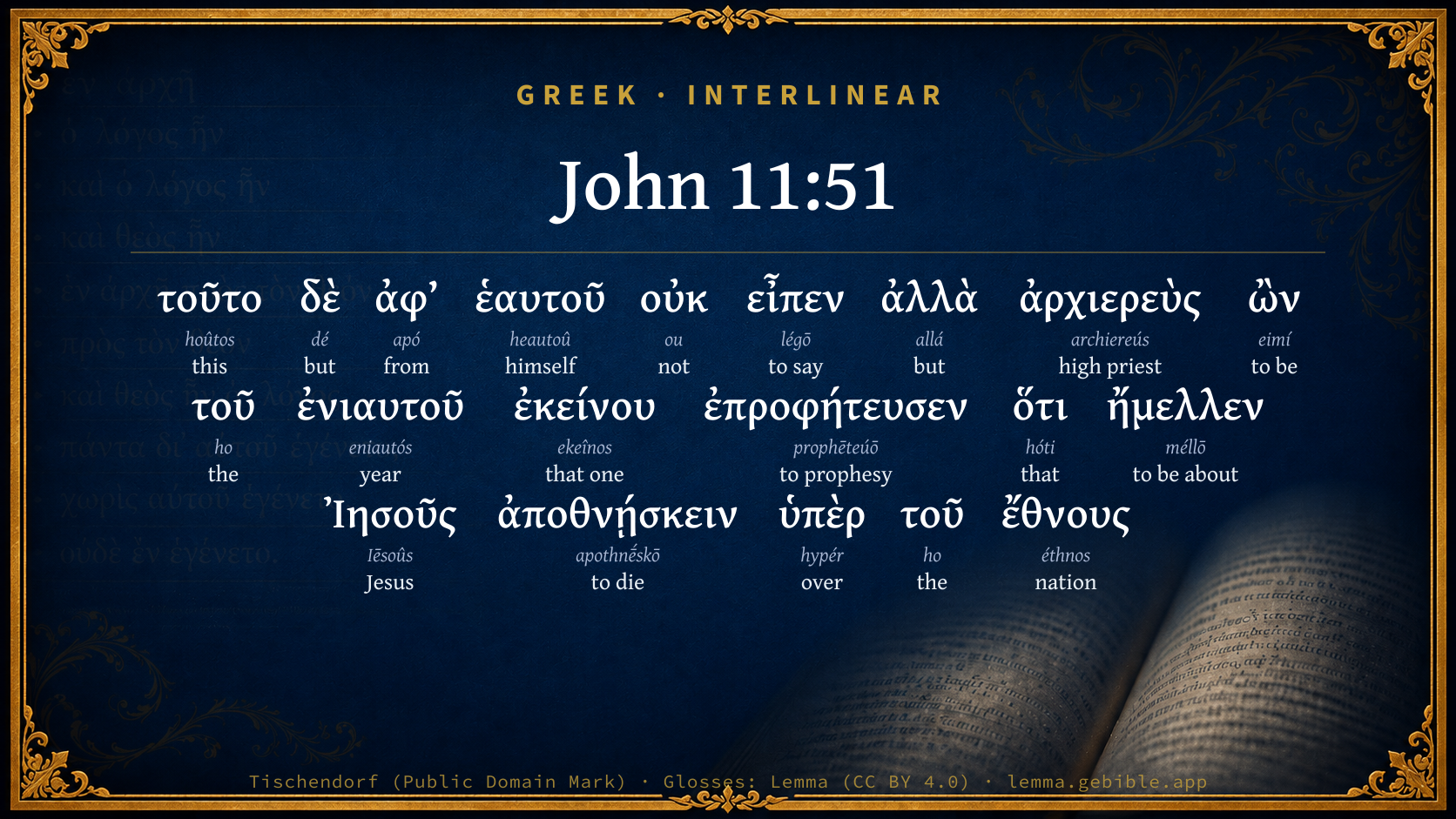
  1. τοῦτο hoûtos G3778 “this” Demonstrative pronoun, Accusative, Singular, Neuter
  2. δὲ dé G1161 “but” Conjunction
  3. ἀφ’ apó G575 “from” Preposition
  4. ἑαυτοῦ heautoû G1438 “himself” Reflexive pronoun, 3rd person, Genitive, Singular, Masculine
  5. οὐκ ou G3756 “not” Particle, Negative
  6. εἶπεν légō G3004 “to say” Verb, Aorist, Active, Indicative, 3rd person, Singular
  7. ἀλλὰ allá G235 “but” Conjunction
  8. ἀρχιερεὺς archiereús G749 “high priest” Noun, Nominative, Singular, Masculine
  9. ὢν eimí G1510 “to be” Verb, Present, Active, Participle, Nominative, Singular, Masculine
  10. τοῦ ho G3588 “the” Article, Genitive, Singular, Masculine
  11. ἐκείνου ekeînos G1565 “that one” Demonstrative pronoun, Genitive, Singular, Masculine
  12. ἐπροφήτευσεν prophēteúō G4395 “to prophesy” Verb, Aorist, Active, Indicative, 3rd person, Singular
  13. ὅτι hóti G3754 “that” Conjunction
  14. ἤμελλεν méllō G3195 “to be about” Verb, Imperfect, Active, Indicative, 3rd person, Singular, Attic form
  15. Ἰησοῦς Iēsoûs G2424 “Jesus” Noun, Nominative, Singular, Masculine
  16. ἀποθνῄσκειν apothnḗskō G599 “to die” Verb, Present, Active, Infinitive
  17. ὑπὲρ hypér G5228 “over” Preposition
  18. τοῦ ho G3588 “the” Article, Genitive, Singular, Neuter
  19. ἔθνους éthnos G1484 “nation” Noun, Genitive, Singular, Neuter

About this verse

These counts appear in no published source. They are computed here, from the morphology-tagged text and Lemma’s own curated glosses. What Lemma adds →

20
words
19
distinct lemmas
Gospels
section

Notable vocabulary

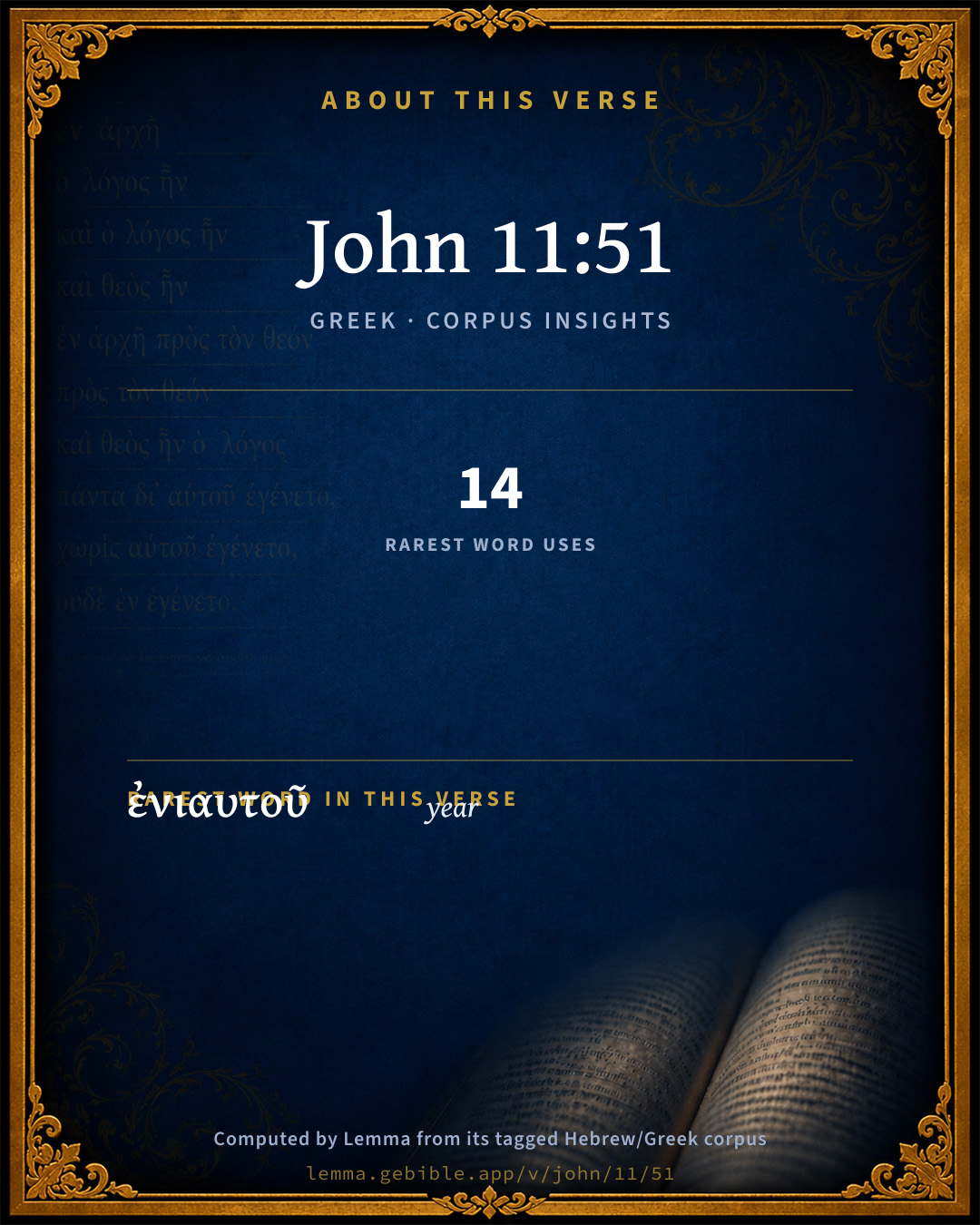
The rarest word here is ἐνιαυτοῦ year G1763 — appearing just 14 times in the whole Greek New Testament.

Shared distinctive vocabulary

ἐνιαυτοῦ year G1763 occurs in 14 verses of the Greek New Testament. Also found in:

Repetition

A word recurs within this verse:

Cross-references

20

Topical passages linked to John 11:51 in the Treasury of Scripture Knowledge — connected by theme and wording, ordered by reader-vote popularity; previews shown in the World English Bible.

  • Daniel 9:26 After the sixty-two weeks the Anointed One shall be cut off, and shall have nothing: and the people of the prince who shall come shall destroy the city and the sanctuary; and the end of it shall be with a flood, and even to the end shall be war; desolations are determined.
  • 2 Corinthians 5:21 For him who knew no sin he made to be sin on our behalf; so that in him we might become the righteousness of God.
  • Exodus 28:30 You shall put in the breastplate of judgment the Urim and the Thummim; and they shall be on Aaron's heart, when he goes in before Yahweh: and Aaron shall bear the judgment of the children of Israel on his heart before Yahweh continually.
  • 1 Samuel 23:9 David knew that Saul was devising mischief against him; and he said to Abiathar the priest, Bring here the ephod.
  • Matthew 20:28 even as the Son of Man came not to be served, but to serve, and to give his life as a ransom for many."
  • Galatians 4:4–5 But when the fullness of the time came, God sent out his Son, born to a woman, born under the law,
  • Numbers 22:28 Yahweh opened the mouth of the donkey, and she said to Balaam, What have I done to you, that you have struck me these three times?
  • Numbers 24:2 Balaam lifted up his eyes, and he saw Israel dwelling according to their tribes; and the Spirit of God came on him.
  • Numbers 24:14–25 Now, behold, I go to my people: come, [and] I will advertise you what this people shall do to your people in the latter days.
  • Judges 20:27–28 The children of Israel asked of Yahweh (for the ark of the covenant of God was there in those days,
  • 1 Samuel 28:6 When Saul inquired of Yahweh, Yahweh didn't answer him, neither by dreams, nor by Urim, nor by prophets.
  • Isaiah 53:5–8 But he was pierced for our transgressions, he was crushed for our iniquities; the punishment that brought our peace was on him; and by his wounds we are healed.
  • Matthew 7:22–23 Many will tell me in that day, 'Lord, Lord, didn't we prophesy in your name, in your name cast out demons, and in your name do many mighty works?'
  • John 10:15 even as the Father knows me, and I know the Father. I lay down my life for the sheep.
  • Romans 3:25–26 whom God set forth to be an atoning sacrifice, through faith in his blood, for a demonstration of his righteousness through the passing over of prior sins, in God's forbearance;
  • 1 Corinthians 13:2 If I have the gift of prophecy, and know all mysteries and all knowledge; and if I have all faith, so as to remove mountains, but don't have love, I am nothing.
  • Galatians 3:13 Christ redeemed us from the curse of the law, having become a curse for us. For it is written, "Cursed is everyone who hangs on a tree,"
  • 1 Peter 2:24 who his own self bore our sins in his body on the tree, that we, having died to sins, might live to righteousness; by whose stripes you were healed.
  • 1 Peter 3:18 Because Christ also suffered for sins once, the righteous for the unrighteous, that he might bring you to God; being put to death in the flesh, but made alive in the spirit;
  • 2 Peter 2:15–17 forsaking the right way, they went astray, having followed the way of Balaam the son of Beor, who loved the wages of wrong-doing;

Cross-references courtesy of OpenBible.info (CC BY 4.0).

Commentary

Notes on John 11:51 from classic Christian and Jewish commentators (each source and its license shown beneath its notes). The classic Christian expositions comment on the surrounding passage and are grouped to its opening verse, so a note may address several verses; the Jewish commentaries on the Tanakh (Rashi and others) are per-verse, so they appear only where the commentator wrote on this verse.

Lemma curates 59 commentaries, every one of them public domain or Creative Commons licensed, each selected and text-cleaned for this edition rather than reprinted as found. About our sources →

Bengel's Gnomon

Johann Albrecht Bengel

Joh 11:51. Ἀφʼ ἑαυτοῦ, of his own self) as men, who deliberate, otherwise are wont.—σὐκ εἶπει, said not) By this is explained the verb εἶπεν, said, which was used in Joh 11:49.—ὑπερ τοῦ ἔθνους, for the nation) Caiaphas had said, ὑπὲρ τοῦ λαοῦ, for the people, Joh 11:50. But John does not now any longer call them λαόν, a people, since their polity was expiring.

Bengel's Gnomon of the New Testament — English translation (T&T Clark, Edinburgh, 1860) — public domain. Text from a community e-Sword module.

Meyer's Critical & Exegetical Commentary

Heinrich August Wilhelm Meyer

Joh_11:51-52. Observation of John, that Caiaphas did not speak this out of his own self-determination, but with these portentous wordsin virtue of the high priests office which he held in that yearinvoluntarily delivered a prophecy.[96]

The high priest passed in the old Israelitish time for the bearer of the divine oracle, for the organ of the revelation of the divine decisions,[97] which were imparted to him through the interrogation of the Urim and Thummim (Exo_28:30; Num_27:21). This mode of inquiry disappeared, indeed, at a later time (Josephus, Antt. iii. 8. 9), as the high-priestly dignity in general fell gradually from its glory; nevertheless, there is still found in the prophetic age the belief in the high priests prophetical gift (Hos_3:4), exactly as, in Josephus, Antt. vi. 6. 3, the idea of the old high-priesthood as the bearer of the oracle distinctly appears, and Philo, de Creat. Princ. II. p. 367, sets forth at least the true priest as prophet, and consequently idealizes the relation. Accordinglyas closely connected with that venerable and not yet extinct recollection, and with still surviving esteem for the high-priestly officeit was a natural and obvious course for John, after pious reflection on those remarkable words which were most appropriate to the sacrificial death of Jesus, to find in them a disclosure of the divine decree,expressed without self-knowledge and will,and that by no means with a sacred irony (Ebrard). Here, too, the extraordinary year in which the speaker was invested with the sacred office, carries with it the determination of the judgment; since, if at any time, it was assuredly in this very year, in which God purposed the fulfilment of His holy counsel through the atoning death of His Son, that a revelation through the high-priestly organ appeared conceivable. ἀρχιερ. ὤν certainly bears the main emphasis: but ΤΟῦ ἘΝΙΑΥΤ. ἘΚ. is again significantly added to it (not, as De Wette thinks, mechanically, as it were), as in Joh_11:49.[98] For Rabbinical passages on unconscious prophecies, see in Schoettgen, p. 349. The notion of prophecy, however, is different from that of the בַּת־קוֹל (against De Wette); comp. on Joh_12:27-28. The latter is a heavenly voice of revelation.

ὅτι] not: that, according to which what follows would directly state the contents of προεφήτ., but: he gave utterance to a prophecy in reference to the fact that (Joh_2:18, Joh_9:17, et al.). For what follows goes beyond that which the words of Caiaphas express.

ὙΠῈΡ ΤΟῦ ἜΘΝΟΥς] Caiaphas had said: ὙΠῈΡ ΤΟῦ ΛΑΟῦ; but John turns to the negative part of Joh_11:50 (κ. μὴ ὅλ. τὸ ἔθνος ἀπόλ.), because he wishes to set the Gentiles over against the Jews, and this separation is national. Comp. Luk_7:5; Joh_18:35. For the benefit of the nation Christ was to die; for through His atoning death the Jews, for whom, in the first instance, the Messianic salvation was designed, Joh_4:22, were to become partakers by means of faith in the eternal saving deliverance. But the object of His death extended still further than the Jews; not for the benefit of the nation alone, but in order also to bring together into one the scattered children of God. These are the Gentiles, who believe on Him, and thereby are partakers of the atonement, children of God (Joh_1:12). The expression is prophetic and, just as in Joh_10:16, proleptic,[99] according to the N. T. predestinarian point of view (Rom_9:24 ff; Rom_15:27; Gal_3:14; Eph_1:9 ff.; Rom_8:29-30; Rom_11:25-26; Rom_16:25-26; Eph_3:4 ff.; Col_1:27; Act_13:48; Act_18:10), from which they appear as those who, in order to further their entrance into the filial state, are drawn by God (Joh_6:44), are given by the Father to the Son (Joh_6:37), and endowed with the inward preparation (Joh_6:65). Euth. Zigabenus rightly remarks: τέκνα μὲν οὖν τοῦ θεοῦ τὰ ἔθνη ὠνόμασεν ὡς μέλλοντα γενέσθαι. This likewise in answer to Hilgenfeld, Lehrbegr. p. 153, Evang. p. 297, according to whom the Gentiles, as natural children of God, who do not first become so through Christianity, are said to be meant (but see Joh_1:12, Joh_3:3; Joh_3:6, et al.). A filial state toward God out of Christ is opposed to the N. T., not only as Hilgenfeld puts it, from a Gnostic, dualistic point of view, but also, as Luthardt conceives it (comp. also Messner, Lehre der Ap. p. 330 f.), referring the essence of it only to the desire after Christ (Tholuck, Weiss, Godet, to the susceptibility). This is only the preliminary step to the filial state. The gathering into one, i.e. to a unity, to an undivided community, is not intended in a local sense; but, amid their local dispersion, they were to become united in a higher sense, in virtue of a faith, etc., through the κοινωνία τοῦ ἁγίου πνεύματος, as one communion ἐν Χριστῷ. Chrysostom aptly remarks: ἓν σῶμα ἐποίησεν· ὁ ἐν Ῥώμῃ καθήμενος τοὺς Ἰνδοὺς μέλος εἶναι νομίζει ἑαυτοῦ. The uniting with the believing Jews (the ποιεῖν τὰ ἀμφότερα ἕν, Eph_2:14) is not spoken of here, but in Joh_10:16; here only the Christian folding together of the scattered Gentiles themselves. For the expression συνάγειν (and the like) εἰς ἕν, comp. Plat. Phileb. p. 378 C; Eur. Or. 1640, Phoen. 465.

[96] Here there is the conception of an unconscious prophecy, so far as that which Caiaphas spoke in another sense must yet, according to divine direction, typically set forth the substance and object of the redemptive death. See Düsterdieck, De rei propheticae naturâ ethicâ, Göttingen 1852, p. 76.

[97] See generally Ewald, Alterth. p. 385; Keil, Arch. I. p. 182.

[98] According to Tholuck, τ. ἐνιαυτοῦ ἐκ. should be understood in the sense that the high priest himself was bound to explain that in this year a greater and more general collective sacrifice was to be offered than that offered by him once a year on behalf of the people (Heb_9:7). But how can this lie in τ. ἐνιαυτοῦ ἐκ.? especially as ἀρχιερεὺς, κ.τ.λ., is said only to make the προεφήτ. explicable, but expresses nothing as to the relation of the high-priestly sacrifice. This also against Luthardts similar interpretation, I. p. 87.

[99] Calvin well remarks: Filios ergo Dei, etiam antequam vocentur, ab electione aestimat, qui fide tandem et sibi et aliis manifestari incipiunt.

Meyer — Critical and Exegetical Commentary on the New Testament — English translation by Peter Christie, edited by Frederick Crombie (T&T Clark, 1880) — public domain. Text from a community e-Sword module.

Expositor's Greek Testament

ed. W. Robertson Nicoll

Joh 11:51 . Τοῦτο δὲ ἀφʼ ἑαυτοῦ οὐκ εἶπεν … προεφήτευσεν . ἀφʼ ἑαυτοῦ , “at his own instigation,” is contrasted with “at the instigation of God” implied in ἐπροφήτευσεν [Kypke gives interesting examples of the use of ἀφʼ ἑαυτοῦ in classical writers]. “None but a Jew would be likely to know of the old Jewish belief that the high priest by means of the Urim and Thummim was the mouthpiece of the Divine oracle.” Plummer. Calvin calls him “bilingual,” and compares his unconscious service to that of Balaam. John sees that this unscrupulous diplomatist, who supposed that he was moving Jesus and the council and the Romans as so many pieces in his own game, was himself used as God’s mouthpiece to predict the event which brought to a close his own and all other priesthood. In the irony of events he unconsciously used his high-priestly office to lead forward that one sacrifice which was for ever to take away sin and so make all further priestly office superfluous. He prophesied “that Jesus was to die for the nation, and not for the nation only, but that also the children of God who were scattered in various places should be gathered into one”. ὅτι is rendered “because” by Weiss and others. Jesus was to die ὑπὲρ τὸ ἔθνος although not in Caiaphas’ sense; and His death had the wider object of bringing into one whole, of truer solidarity than the nation, all God’s children wherever at present scattered. Cf. Joh 10:16 , Eph 2:14 . The expression τὰ τέκνα τοῦ Θεοῦ is used proleptically of the Gentiles who were destined to become God’s children. So Euthymius. For the phrase συνάγειν εἰς ἕν Meyer refers to Plato, Phileb. , 378, C, and Eurip., Orestes , 1640.

The Expositor's Greek Testament, edited by W. Robertson Nicoll (1897–1910) — public domain. Text from a community e-Sword module.

Geneva Bible (1599)

Geneva Bible translators

Christ doth sometimes so turn the tongues, even of the wicked, that in cursing, they bless.

Geneva Bible (1599) marginal notes — public domain. Text via Bolls.life.

Jamieson, Fausset & Brown

Robert Jamieson, A. R. Fausset & David Brown

Caiaphas . . . prophesied that Jesus should die for that nation--He meant nothing more than that the way to prevent the apprehended ruin of the nation was to make a sacrifice of the Disturber of their peace. But in giving utterance to this suggestion of political expediency, he was so guided as to give forth a divine prediction of deep significance; and God so ordered it that it should come from the lips of the high priest for that memorable year, the recognized head of God's visible people, whose ancient office, symbolized by the Urim and Thummim, was to decide in the last resort, all vital questions as the oracle of the divine will.

Jamieson, Fausset & Brown — Commentary Critical and Explanatory on the Whole Bible (1871) — public domain (CC PDM 1.0). Text via the HelloAO Bible API.

Adam Clarke's Commentary

Verse 51. This spake he not of himself] Wicked and worthless as he was, God so guided his tongue that, contrary to his intention, he pronounced a prophecy of the death of Jesus Christ.

I have already remarked that the doctrine of a vicarious atonement had gained, long before this time, universal credit in the world. Words similar to these of Caiaphas are, by the prince of all the Roman poets, put in the mouth of Neptune, when promising Venus that the fleet of AEneas should be preserved, and his whole crew should be saved, one only excepted, whose death he speaks of in these remarkable words:-

"Unum pro multis dabitar caput."

"One life shall fall, that many may be saved."

Which victim the poet informs us was Palinurus, the pilot of AEneas's own ship, who was precipitated into the deep by a Divine influence. See VIRG. AEn. v. l. 815, c.

There was no necessity for the poet to have introduced this account. It was no historic fact, nor indeed does it tend to decorate the poem. It even pains the reader's mind for, after suffering so much in the sufferings of the pious hero and his crew, he is at once relieved by the interposition of a god, who promises to allay the storm, disperse the clouds, preserve the fleet, and the lives of the men; but, - one must perish! The reader is again distressed, and the book ominously closes with the death of the generous Palinurus, who strove to the last to be faithful to his trust, and to preserve the life of his master and his friend. Why then did the poet introduce this? Merely, as it appears to me, to have the opportunity of showing in a few words his religious creed, on one of the most important doctrines in the world; and which the sacrificial system of Jews and Gentiles proves that all the nations of the earth credited.

As Caiaphas was high priest, his opinion was of most weight with the council; therefore God put these words in his mouth rather than into the mouth of any other of its members. It was a maxim among the Jews that no prophet ever knew the purport of his own prophecy, Moses and Isaiah excepted. They were in general organs by which God chose to speak.

Adam Clarke's Commentary on the Bible (1810–1826) — public domain. Text from a community e-Sword/MySword module.

John Calvin's Commentaries

51. Now he spoke this, not of himself. When the Evangelist says that Caiaphas did not speak this of himself, he does not mean that Caiaphas — like one who was mad, or out of his senses — uttered what he did not understand; for he spoke what was his own opinion. But the Evangelist means that a higher impulse guided his tongue, because God intended that he should make known, by his mouth, something higher than what occurred to his mind. Caiaphas, therefore, might be said, at that time, to have two tongues; for he vomited out the wicked and cruel design of putting Christ to death, which he had conceived in his mind; but God turned his tongue to a different purpose, so that, under ambiguous words, he likewise uttered a prediction. God intended that the heavenly oracle should proceed from the high priest’s seat, that the Jews might have less excuse. For, though not one person in the whole assembly had his conscience moved, yet they afterwards perceived that their insensibility was not entitled to forgiveness. Nor did the wickedness of Caiaphas prevent his tongue from being the organ of the Holy Spirit, for God looked at the priesthood which he had instituted rather than at the person of the man. And this was the reason which I glanced at, that a voice uttered from a lofty place might be more distinctly heard, and might have greater reverence and authority. In the same manner, God intended to bless his people by the mouth of Balaam, on whom he had bestowed the spirit of prophecy.

But it is highly ridiculous in the Papists to infer from this that we ought to reckon as an oracle whatever the Roman high priest may think fit to pronounce. First, granting what is false, that every man who is a high priest is also a prophet, still they will be under the necessity of proving that the Roman high priest is appointed by the command of God; for the priesthood was abolished by the coming of one man, who is Christ, and we no where read that it was afterwards enjoined by God that any one man should be the ruler of the whole Church. Granting to them, in the second place, that the power and title of high priest was conveyed to the Bishop of Rome, we must see of what advantage it was to the priests that they accepted the prediction of Caiaphas In order to concur in his opinion, they conspire to put Christ to death. But far from us be that kind of obedience which drives us to horrid apostacy by denying the Son of God. With the same voice Caiaphas blasphemes and also prophesies. They who follow his suggestion despise the prophecy, and adopt the blasphemy. We ought to guard against the same thing happening to us, if we listen to the Caiaphas of Rome; for otherwise the comparison would be defective. Besides, I ask, Must we conclude that, because Caiaphas once prophesied, every word uttered by the high priest is always a prophecy? But soon afterwards Caiaphas condemned as blasphemy (Matthew 26:65) the most important article of our faith. Hence we conclude, that what the Evangelist now relates was an extraordinary occurrence, and that it would be foolish to adduce it as an example.

That Jesus would die. First, the Evangelist shows that the whole of our salvation consists in this, that Christ should assemble us into one; for in this way he reconciles us to the Father, in whom is the fountain of life, (Psalm 36:9.) Hence, also, we infer, that the human race is scattered and estranged from God, until the children of God are assembled under Christ their Head. Thus, the communion of saints is a preparation for eternal life, because all whom Christ does not gather to the Father remain in death, as we shall see again under the seventeenth chapter. For the same reason Paul also teaches that Christ was sent, in order

that he might gather together all things which are in heaven and in earth, (Ephesians 1:10.)

Wherefore, that we may enjoy the salvation brought by Christ, discord must be removed, and we must be made one with God and with angels, and among ourselves. The cause and pledge of this unity was the death of Christ, by which he drew all things to himself; but we are daily gathered by the Gospel into the fold of Christ.

John Calvin's Commentaries (1540-1563) — public domain. Text from the Calvin Translation Society English edition (1840s-50s) via the Christian Classics Ethereal Library (ccel.org). Calvin's coverage is partial (roughly two-thirds of the Bible); uncommented books and verses are honest gaps, never fabricated. The 19th-century editor's footnotes and remarks are omitted so the notes are faithfully Calvin's own voice.

Ellicott's Commentary for English Readers

(51) And this spake he not of himself.—There is a moral beauty in the Words, in spite of the diabolical intent with which they are uttered; and St. John adds the explanation that they had an origin higher than him who spake them. Writing after the events, he has seen them fulfilled, and regards them as an unconscious prophecy. Like another Balaam, Caiaphas was the oracle or God in spite of himself, and there is in his words a meaning far beyond any that he had intended.

Being high priest that year, he prophesied that Jesus should die for that nation.—He stood, therefore, in a relation which made him the official representative of God to the people, and gave him an official capacity to convey God’s truth. This was represented in the days of Samuel by the Urim and Thummim; and John, himself a Jew, still thinks of the high priest’s breast as bearing the oracle which declared the will of God, whatever unworthy human thoughts may have filled the heart beneath. It may be that another reference to the high priest’s office is present in these thrice-written words. It was the high priest’s duty to “enter within the veil,” and “make an atonement for the children of Israel for all their sins once a year” (Leviticus 16). In that year the veil was rent, and the first step taken by which the holy place was destroyed, and the high priest’s office ceased to exist. With the destruction of the holy place the Jewish day of Atonement lost its significance, but the high priest that year, by his counsel and action in the Sanhedrin, was causing the sacrifice which should be presented by another high priest, in the Holy of Holies as an Atonement for the world—“Christ being come an high priest of good things to come, by a greater and more perfect tabernacle, not made with hands, that is to say, not of this building; neither by the blood of goats and calves, but by His own blood He entered in once into the holy place, having obtained eternal redemption” (Heb_9:11-12).

A Bible Commentary for English Readers, edited by Charles John Ellicott (1878–1897) — public domain. Text from a community e-Sword module.

The Cambridge Bible for Schools and Colleges

gen. ed. J. J. S. Perowne

51. not of himself] Like Saul, Caiaphas is a prophet in spite of himself.

being high priest] None but a Jew would be likely to know of the old Jewish belief that the high-priest by means of the Urim and Thummim was the mouth-piece of the Divine oracle. The Urim and Thummim had been lost, and the high-priest’s office had been shorn of much of its glory, but the remembrance of his prophetical gift did not become quite extinct (Hos_3:4); and ‘in that fatal year’ S. John might well believe that the gift would be restored.

The Cambridge Bible for Schools and Colleges (gen. ed. J. J. S. Perowne; Cambridge University Press, 1878–1918) — public domain. Text from a community e-Sword module.

John Gill's Exposition

And this spake he not of himself,.... Not of his own devising and dictating, but by the Spirit of God; as a wicked man sometimes may, and as Balaam did; the Spirit of God dictated the words unto him, and put them into his mouth; nor did he use them in the sense, in which the Holy Ghost designed them:

but being high priest that year; by his office he was the oracle of God, and was so esteemed by the people, and therefore a proper person to be made use of in this way; and especially being high priest that year, in which the priesthood was to be changed, and vision and prophecy to be sealed up:

he prophesied; though he did not know he did, as did Pharaoh, Exo 10:28, and the people of the Jews, Mat 27:25.

That Jesus should die for that nation; these words, with what follows in the next verse, are the words of the evangelist, interpreting the prophecy of Caiaphas, according to the sense of the Holy Ghost that Jesus should die, which was contrary to a notion the Jews had imbibed, concerning the Messiah; see Joh 12:34. But Jesus the true Messiah must die; this was determined in the counsel of God, agreed to by Christ in the covenant of grace, foretold by the prophets from the beginning of the world, typified by sacrifices and other things, under the former dispensation, predicted by Christ himself, and accordingly came to pass; and upon the above accounts was necessary, as well as for the salvation of his people, who otherwise must have perished; and yet was free and voluntary in him, and a strong expression, and a demonstrative proof of his love to them: and not only this prophecy declared, that Jesus should die, but that he should die for that nation, for the nation of the Jews; not for every individual in it, for all of them were not saved by him; some received him not; they rejected him as the Messiah, Saviour, and Redeemer, and died in their sins; but for all the elect of God among them, the sheep of the house of Israel, to whom he was sent, and whom he came to seek and save; and whom he blessed, by turning them away from their iniquities, and by taking away their iniquities from them: and moreover, this prophecy suggests, that Jesus was to die, not merely as a martyr, to confirm with his blood the doctrine he preached, nor only as an example of courage, meekness, patience, and love, but for, or in the room and stead of his people, as their surety; giving his life a ransom and himself a sacrifice to the justice of God, for them; there by fulfilling the law and satisfying it, and appeasing the wrath of God on their account.

John Gill's Exposition of the Whole Bible (1746–1763) — public domain (CC PDM 1.0). Text via the HelloAO Bible API.

Trapp's Complete Commentary

John Trapp

51 And this spake he not of himself: but being high priest that year, he prophesied that Jesus should die for that nation;

Ver. 51. This he spake, not of himself] God spake through him, as through a trunk, or as the angel spake in Balaam’s ass. Wholesome sugar may be found in a poisoned cane, a precious stone in a toad’s head, a flaming torch in a blind man’s hand.

John Trapp, A Commentary or Exposition upon All the Books of the Old and New Testament (1647–1656) — public domain. Text from a community e-Sword module.

Albert Barnes' Notes on the Bible

Not of himself - Though he uttered what proved to be a true prophecy, yet it was accomplished in a way which he did not intend He had a wicked design. He was plotting murder and crime. Yet, wicked as he was, and little as he intended it, God so ordered it that he delivered a most precious truth respecting the atonement. Remark:

God may fulfill the words of the wicked in a manner which they do not wish or intend. He may make even their malice and wicked plots the very means of accomplishing his purposes. What they regard as the fulfillment of their plans God may make the fulfillment of his, yet so as directly to overthrow their designs, and prostrate them in ruin. Sinners should tremble and be afraid when they lay plans against God, or seek to do unjustly to others.

Being high priest that year - It is not to be supposed that Caiaphas was a true prophet, or was conscious of the meaning which John has affixed to his words; but his words express the truth about the atonement of Jesus, and John records it as a remarkable circumstance that the high priest of the nation should unwittingly deliver a sentiment which turned out to be the truth about the death of Jesus. Great importance was attached to the opinion of the high priest by the Jews, because it was by him that the judgment by Urim and Thummim was formerly declared in cases of importance and difficulty, Num 27:21. It is not certain or probable that the high priest ever was endowed with the gift of prophecy; but he sustained a high office, the authority of his name was great, and it was thence remarkable that he uttered a declaration which the result showed to be true, though not in the sense that he intended.

He prophesied - He uttered words which proved to be prophetic; or he expressed at that time a sentiment which turned out to be true. It does not mean that he was inspired, or that he deserved to be ranked among the true prophets; but his words were such that they accurately expressed a future event. The word “prophecy” is to be taken here not in the strict sense, but in a sense which is not uncommon in the sacred writers. Act 21:9; “and the same man had four daughters, virgins, which did prophesy.” See the Rom 12:6 note; 1Co 14:1 note; compare Mat 26:68; Luk 22:64.

That Jesus should die - Die in the place of men, or as an atonement for sinners. This is evidently the meaning which John attaches to the words.

For that nation - For the Jews. As a sacrifice for their sins. In no other sense whatever could it be said that he died for them. His death, so far from saving them in the sense in which the high priest understood it, was the very occasion of their destruction. They invoked the vengeance of God when they said, “His blood be on us and on our children” Mat 27:25, and all these calamities came upon them because they would not come to him and be saved - that is, because they rejected him and put him to death, Mat 23:37-39.

Albert Barnes' Notes on the Bible (1834–1885) — public domain. Text from a community e-Sword/MySword module.

Haydock's Catholic Bible Commentary

The same words have an impious and sacrilegious sense in the intention of the high priest, the enemy of Jesus Christ: and a divine and prophetic sense, in the intention of the Holy Ghost. (Bible de Vence) --- We here behold the privilege of the office and order, though in a wicked person: and as we have the assistance of God for the utterance of truth, which Caiphas neither meant nor knew, we may rest satisfied that Christ will not leave Peter’s chair; (Luke xxii. 32.) whose faith he promises should never fail, though the occupants be as bad as their enemies describe them.

George Leo Haydock (1774–1849), Haydock's Catholic Family Bible and Commentary, 1859 edition — public domain. Excludes Psalms (Douay-Rheims chapter numbering differs from Protestant) and Deuterocanonical books (Catholic canon only).

Matthew Poole's English Annotations

So far as this was a prophecy, he spake not of himself: take the words of Caiaphas in the sense that he spake them, they were such as might well enough come out of such a wretched mouth, speaking out of the abundance of a vile and wretched heart; Melius pereat unus quam unitas, That it was better that one man should die, let him be never so good, just, and innocent, than that for his sake mischief should come upon a nation. This was now suitable enough to the religion of such a high priest. But that in this (the words being capable of a double sense) Caiaphas should deliver a great truth, That this year one should die for the people; that is, The Messiah should be cut off, but not for himself, as we read, Dan 9:26; this was no more from himself, than the words which Balaam’s ass spake were from itself. The Spirit of prophecy sometimes fell upon wicked men; God revealed to Pharaoh and Nebuchadnezzar (both of whom were pagans) the things which he intended to do. There was a time also when Saul (though a man rejected of God) did also prophesy; and the worst of the princes of Judah had a use of the Urim and Thummim. So also here, Caiaphas, though a vile and wicked man, was here influenced by God to prophesy, and speak an oracle. Nor are those words,

being high priest that year, superfluously put in; for it being consistent with the holiness of God, sometimes to make use of the tongues of the worst of men to declare his will, it seems agreeable to the wisdom of God in doing it, to make use of principal men, they being persons whose words are most likely to be regarded, and so make impression upon people. The papists would from hence infer the infallibility of the pope, because he is the high priest: but they ought to prove:

1. That the office of the pope hath any foundation in the word of God.

2. That this was a gift given to particular priests, and at particular times; for the Jewish high priests were fallible enough ordinarily; witness Aaron’s making the golden calf, and Urijah the altar after the pattern of Damascus, 2Ki 16:10,11.

The words, being high priest, are not given as a reason why Caiaphas prophesied, though they are a good reason why God was pleased to choose his tongue, and overrule it beyond his own thoughts and intentions, to serve his design in this revelation. He did not prophesy intentionally, as designing such a thing, only materially: the matter of his words were indeed a Divine revelation, though his intention and scope was fit for none but a base, carnal politician. God made him a prophet in what he said, though he meant not so.

Matthew Poole's English Annotations on the Holy Bible (1683–1685) — public domain. Text from a community e-Sword/MySword module.

Whedon's Commentary on the Bible

Daniel D. Whedon

51. Not of himself—But by impulse from a higher power.

High priest… prophesied—John clearly implies that the prophetic impulse was connected with the pontifical office. Whether this was a popular notion or not is not, as some assume, the question. It is John’s idea of the fact. It was the high priest who anciently drew responses from the Urim and Thummim. Both Josephus and Philo are quoted by Alford as sustaining the belief that the priesthood was occasionally prophetic. The momentary gift belonged not to the impious man but to the office. Nor did he even know the supernatural import of his own expression. The devil instigated his thoughts, but God overruled his words. As Pilate, (Stier in substance says,) the representative of the secular power, testified by the superscription to Jesus as King, so Caiaphas, the head of the ecclesiastical system, symbolized Jesus as the true priest and sacrifice. That year—In Joh_18:13, the phrase is, of that same year. The words do not imply that the high-priesthood was an annual office; but Caiaphas was high priest “of that memorable year.”

Daniel D. Whedon (gen. ed.), Commentary on the Old and New Testaments (1874–1909) — public domain. Text from a community e-Sword module.

The Pulpit Commentary

Vers. 51, 52. The evangelist discerned the presence of a deeper meaning in his words not intended by himself. As Balaam and Nebuchadnezzar and even Pharaoh had uttered unconscious or unwilling prophecies, and as in all genuine prophecies there are meanings meant by God beyond what the utterer of them at all conceived possible. So here.

This he spake not from himself: but being high priest that awful, critical year, he prophesied. The high priest was believed in ancient times to have the power of drawing from Urim and Thummim the Divine decisions as to future events: (Exo_28:30 Num_27:2-8, and Caiaphas, as priest-prophet, may thus have conveyed an awful and sublime truth through base and evil dispositions. Curious instances occur elsewhere Joh_7:27, Joh_7:35) "He saved others; himself he cannot save!"; (Mar_15:31) when the people said, "His blood be upon us"; (Mat_27:25) when Pilate, by unconscious prophecy, ironically declared him to be "King of the Jews". (Mat_27:37) Wunsche quotes a curious case of unconscious prophecy, which the rabbinical writers attributed to Pharaoh"s daughter, when she forecast the future legislator in the infant derelict. The substance of the prophetic word extracted from his saying was that Jesus should die for the nation. Hengstenberg wisely says, Caiaphas could not have spoken other than of the laov ." When John wrote, the difference between the laov and the eynh had vanished away. Israel had become an eynov , like the rest. And not for the nation only, but that he might also gather together into one (laon) the children of God scattered abroad constitute a new center, life-giving and sacred in the covenant of his blood. (cf. 1Jn_2:2, a very remarkable parallelism) Who are the tekna tou Yeou dieskorpismena ? According to some, the dispersed Israelites, but surely the passage corresponds with the "other sheep," of Joh_10:16, and refers to all who enter by living faith in him into the full realization of the Divine Fatherhood (see Joh_1:12 and Eph_2:14) and their own sonship. Christ is the true Union of Jew and Gentile.

The Pulpit Commentary (1880–1919), ed. H.D.M. Spence-Jones & Joseph S. Exell — public domain. Text from a community e-Sword module.

The People's New Testament

B. W. Johnson

51, 52. This spake he not of himself. He thought he spoke of himself, but without his knowledge, God used the lips of the high priest for a prophecy. It “did behoove Jesus to die,” in order to save, not that nation only, but that he should gather together in one the children of God.

B. W. Johnson's The People's New Testament with Notes (1889–1891) — public domain. Electronic text from the Christian Classics Ethereal Library (CCEL) ThML edition.

unfoldingWord translationNotes

Door43 World Missions Community

General Information:

In verses 51 and 52 John explains that Caiaphus was prophesying even though he did not realize it at the time. This is background information. (See: Background Information)

die for the nation

The word "nation" is a synecdoche and refers to the people of the nation of Israel. (See: Synecdoche)

would be gathered together into one

This is an ellipsis. The word "people" is implied by the context. AT: "would be gathered into one people" (See: Ellipsis)

children of God

This refers to people who belong to God through faith in Jesus and are spiritually God's children.

translationWords

high priest

prophet

Jesus

nation

children

die

unfoldingWord translationNotes — © Distant Shores Media and the Door43 World Missions Community, licensed CC BY-SA 4.0. Source: git.door43.org/Door43/en_tn.

Cambridge Greek Testament for Schools and Colleges

51. ἐπροφήτευσεν for προεφήτευσεν (correction to usual form). In N.T. the better MSS. place the augment before the preposition (Mat 7:22; Mat 11:13; Mat 15:7; Mar 7:6; Luk 1:67; Act 19:6): Jud 1:14 is possibly an exception. Winer, p. 84.

ἤμελλεν for ἔμελλεν: comp. Joh 4:47, Joh 12:33, Joh 18:32. In Joh 6:71 ἔμελλεν is better attested: comp. ἐδύνατο in Joh 11:37. Winer, p. 82.

51. ἀφ’ ἑαυ. οὐκ εἶπ. Like Saul, Caiaphas is a prophet in spite of himself. None but a Jew would be likely to know of the old Jewish belief that the high-priest by means of the Urim and Thummim was the mouthpiece of the Divine oracle. The Urim and Thummim had been lost, and the high-priest’s office had been shorn of much of its glory, but the remembrance of his prophetical gift did not become quite extinct (Hos 3:4); and ‘in that fatal year’ S. John might well believe that the gift would be restored. For ἤμελλεν see on Joh 6:71.

Cambridge Greek Testament for Schools and Colleges (Cambridge University Press, 1896; 21 vols, various authors incl. Carr, Maclear, Plummer, Farrar, Lumby, Moule, M. R. James, Simcox) — public domain. Text from a community e-Sword module.

International Critical Commentary

51. This is one of those editorial comments of which Jn. gives his readers many (cf. Introd., p. xxxiv). The words of Caiaphas, he notes, were an unconscious prophecy, for it was true in a deeper sense than Caiaphas understood that the Death of Jesus would be expedient for the Jews, as well as for the wider circle of all God’s children.

The Jews ascribed a measure of prophetic faculty to the high priest, when, after being duly vested, he “inquired of Yahweh” (Exo 28:30, Lev 8:8, Num 27:21). Josephus has left on record that he, as a priest, claimed to have power to read the future (B.J. III. viii. 3). And Philo says that the true priest is always potentially a prophet (de const. principum, 8). The word ἐπροφήτευσεν is applied to Zacharias the priest (Luk 1:67), just as it is here (its only occurrence in Jn.) to Caiaphas: “He, being high priest that year (see on v. 49), prophesied.”

Caiaphas spoke not “of himself,” but being, as it were, inspired by the Spirit of God, ἐπροφήτευσεν. See on 19:21.

Note that ἐπροφήτευσεν (אBDLΘ) is the true form of the aorist, not προεφήτευσεν, with the rec. text. The augment precedes the preposition, there being no simple verb φητεύω.

ὅτι ἤμελλεν Ἰησοῦς ἀποθνήσκειν κτλ. For ἤμελλεν (ABDLWΘ) א has ἔμεκλλεν. The def. art. before Ἰησοῦς is omitted by אABDLW (see on 1:29).

For ἤμελλεν, used of the Death of Jesus, cf. 12:33, 18:32. It conveys in these passages the sense of predestined inevitableness, which is always present to the mind of Jn. (see on 2:4, 3:14; and cf. Introd., p. cii). See also for μέλλειν on 4:47, 6:71.

ὑπὲρ τοῦ ἔθνους. See for ὑπέρ on 1:30; and cf. 6:51, 10:11. Jn. alters the phrase of Caiaphas ὐπὲρ τοῦ λαοῦ (v. 50) to ὑπὲρ τοῦ ἔθνους, perhaps because he wishes to suggest that by their rejection of Jesus the Jews had forfeited their privilege as the λαός of God. But he is prone, when he repeats a phrase, to alter it slightly (see on 3:16); and in any case, as we have seen, we cannot distinguish very sharply between ἔθνος and λαός.

International Critical Commentary — older volumes (1896–1929), various authors — public domain. Text from a community e-Sword module.

Godet's Commentaries

Frédéric Louis Godet

Vv. 51, 52. “Now he did not say this of himself; but being high-priest of that year, he prophesied that Jesus should die for the nation, 52 and not for the nation only, but also that he might gather in one body the children of God who are scattered abroad.”

This opinion of the high-priest was made especially remarkable by the contrast between the divine truth which it expressed and the diabolical design which inspired it. The evangelist calls attention to this. Some interpreters (Luthardt, Bruckner) deny that John ascribes the gift of prophecy here to the high-priest as such. It was not as high-priest, but as high-priest of that year, that Caiaphas uttered this prophetic declaration. But the relation between the present participle ὤν, being, and the aorist, προεφήτευσεν, he prophesied, leads us naturally to the idea that the evangelist attaches to the office of Caiaphas the prophetic character of the words which he uttered at this moment. This must be acknowledged even if we are to find here only a Jewish superstition. In the Old Testament, the normal centre of the theocratic people is, not the royal office, but the priesthood. In all the decisive moments for the life of the people, it is the high- priest who is the organ of God for passing over to the people the decision with which its salvation is connected (Exo 28:30; Num 27:21; 1Sa 30:7 ff.). It is true that this prerogative came not from a prophetic gift, but from the possession of a mysterious power, the Urim and Thummim. It is also true that from the time of the captivity, and even from the reign of Solomon, there is no longer any question of this power (see Keil, Bibl. Archaeol., p. 191). But the high-priest nevertheless remained by reason of his very office the head of the theocratic body, and this in spite of the moral contrast which might exist between the spirit of his office and his personal character.

If the heart of the high-priest was in harmony with his office, his heart became the normal organ of the divine decision. But if there was opposition in this personage between the disposition of his heart and the holiness of his office, it must be expected that, as in the present case, the divine oracle would be seen coming from this consecrated mouth in the form of the most diabolical maxim. What, indeed, more worthy of the Divine Spirit than to condemn His degenerate organ thus to utter the truth of God at the very moment when he was speaking as the organ of his own particular interest! Without attributing to Caiaphas a permanent prophetic gift, John means to say that, at this supreme moment for the theocracy and for humanity, it was not without the participation of the Divine activity that the most profound mystery of the plan of God was proclaimed by him in the form of the most detestable maxim. John has already more than once remarked how the adversaries of Jesus, when speaking derisively, were prophesying in spite of themselves: “No one knows whence he is” (Joh 7:27). “Will he go and teach the Greeks” (Joh 7:35)? If the devil often travesties the words of God, it pleases God sometimes to parody those of the devil, by giving to them an unexpected truth. This “divine irony” manifested itself in the highest degree on this occasion, which was the prelude to the accomplishment of the most divine mystery under the form of the most monstrous act.

According to some interpreters, the ὅτι is not a direct complement of the verb he prophesied. Meyer: “he prophesied as to the fact that ...” Luthardt, Weiss, Keil: “he prophesied, seeing that really Jesus was to...” Joh 11:52 is what has led them to these explanations, because this verse goes in fact beyond the import of the saying of Caiaphas. But it is quite unnatural to take this word: he prophesied, in an absolute sense: John certainly did not mean to insist so especially on this idea of prophecy. The meaning is simply: “he declared prophetically that to...” As to Joh 11:52, it is an explanatory appendix, which John adds in order to indicate that in the divine thought the force of the expression: one for all, had a far wider application than that which Caiaphas himself gave it. John never forgets his Greek readers, and he loses no occasion of recalling to them their part in the accomplishment of the divine promises. If we take into consideration the parallelism between this Joh 11:52 and the saying of Joh 10:16, we shall have no hesitation in applying the term children of God to heathen predisposed to faith through the revelation of the Logos (Joh 1:4; Joh 1:10); the sense is the same as that in which John uses the expressions: to be of God (Joh 8:47), to be of the truth(Joh 19:37). The term children of God naturally involves an anticipation; it designates the actual condition of these future believers from the point of view of its result which was to come. Meyer, Luthardt and others prefer to explain this term from the standpoint of the divine predestination. But we should be obliged to infer from this that all the rest of the heathen are the objects of an opposite predestination.

Frédéric Louis Godet — Commentaries on Luke, John, Romans, and 1 Corinthians — English translation (T&T Clark, Edinburgh, 1870s–1890s) — public domain. Text from a community e-Sword module.

Lesson kit

Teaching starters — assembled from the data on this page, not authored interpretation. Every prompt links to the verse data it draws on. Edit before teaching.

John, in the Gospels, opens this verse with 20 words (19 distinct Greek lemmas). Its most distinctive word is eniautós (“year”). A historical commentator’s framing appears above. Read the whole chapter for the surrounding context.

Discussion questions

  1. What does “year” (eniautós) contribute to the verse as a whole?
  2. How does Luke 4:19, which shares the word «year», read alongside this verse?
  3. What does the repetition of “the” (2× in this one verse) do in this verse?
  4. These translations render this verse differently. What is at stake in choosing one wording over another?
  5. Compare how Bengel's Gnomon and Meyer's Critical & Exegetical Commentary read this verse. Where do they agree or differ?

Things to notice

Reading settings

Reading text

Shown beneath each verse's original-language words.

Old Testament
Old Testament edition

Read the OT as the Masoretic Hebrew (MT) or the Greek Septuagint (LXX).

English shown for the Greek Septuagint (in the Hebrew ↔ Greek comparison).

Comparing translations? Open the Compare panel on any verse page to stack up to four side by side.