Numbers 1:5

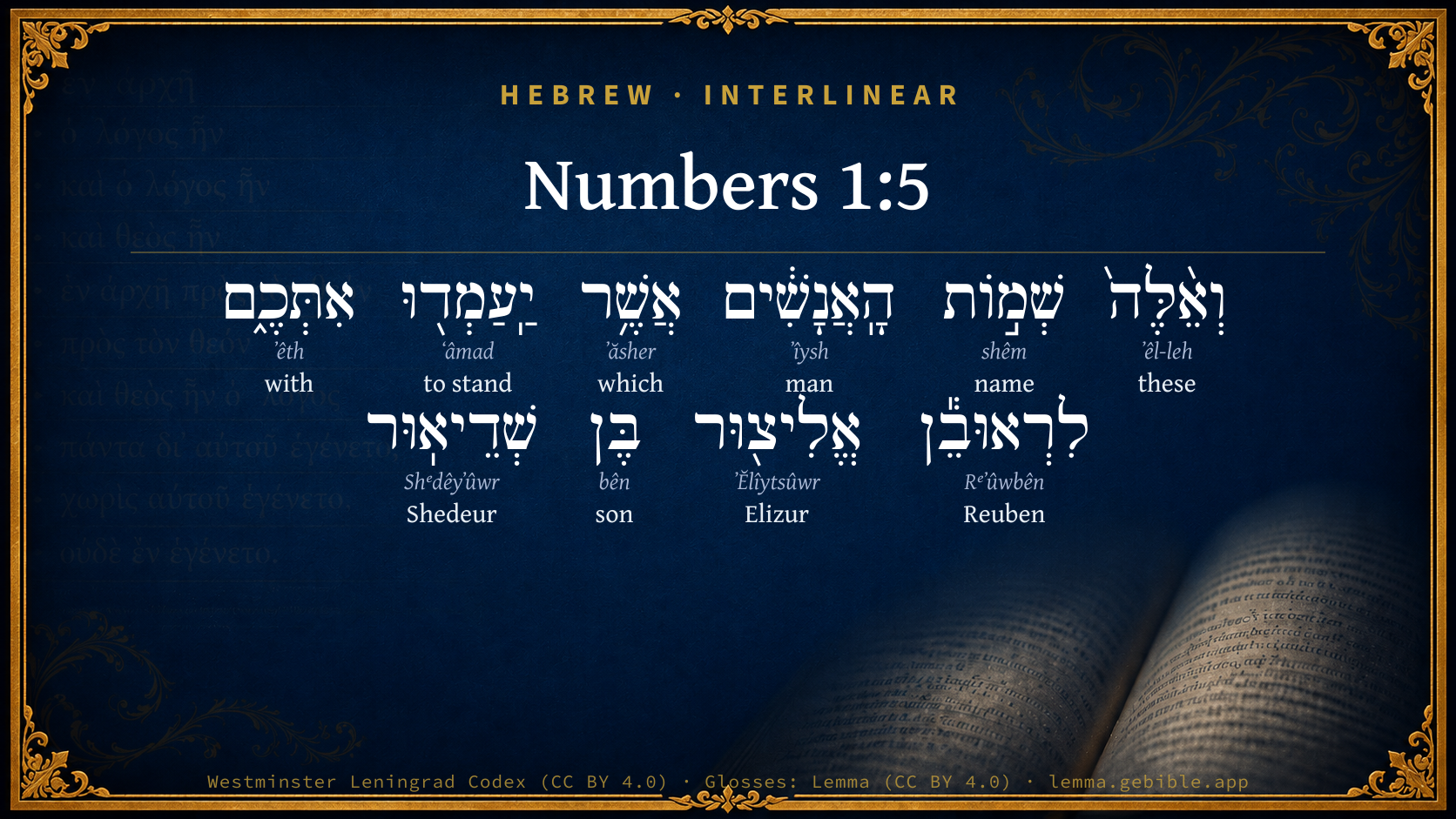
Hebrew (Westminster Leningrad Codex) Numbers 1:5 appears in the Hebrew Old Testament. The text above is from the Westminster Leningrad Codex. Each word links to its Strong’s number, a concise gloss, and parsing drawn from the Open Scriptures Hebrew Bible morphology. Click any word for its full Brown-Driver-Briggs (BDB) entry.
Download image
Cite this verse

Numbers 1:5 (World English Bible). Public Domain. Lemma interlinear Bible study tool, https://lemma.gebible.app/v/numbers/1/5.

Show BibTeX & RIS
BibTeX
RIS
English Translation
These are the names of the men who shall stand with you: Of Reuben: Elizur the son of Shedeur.
World English Bible · Public Domain
Highlights
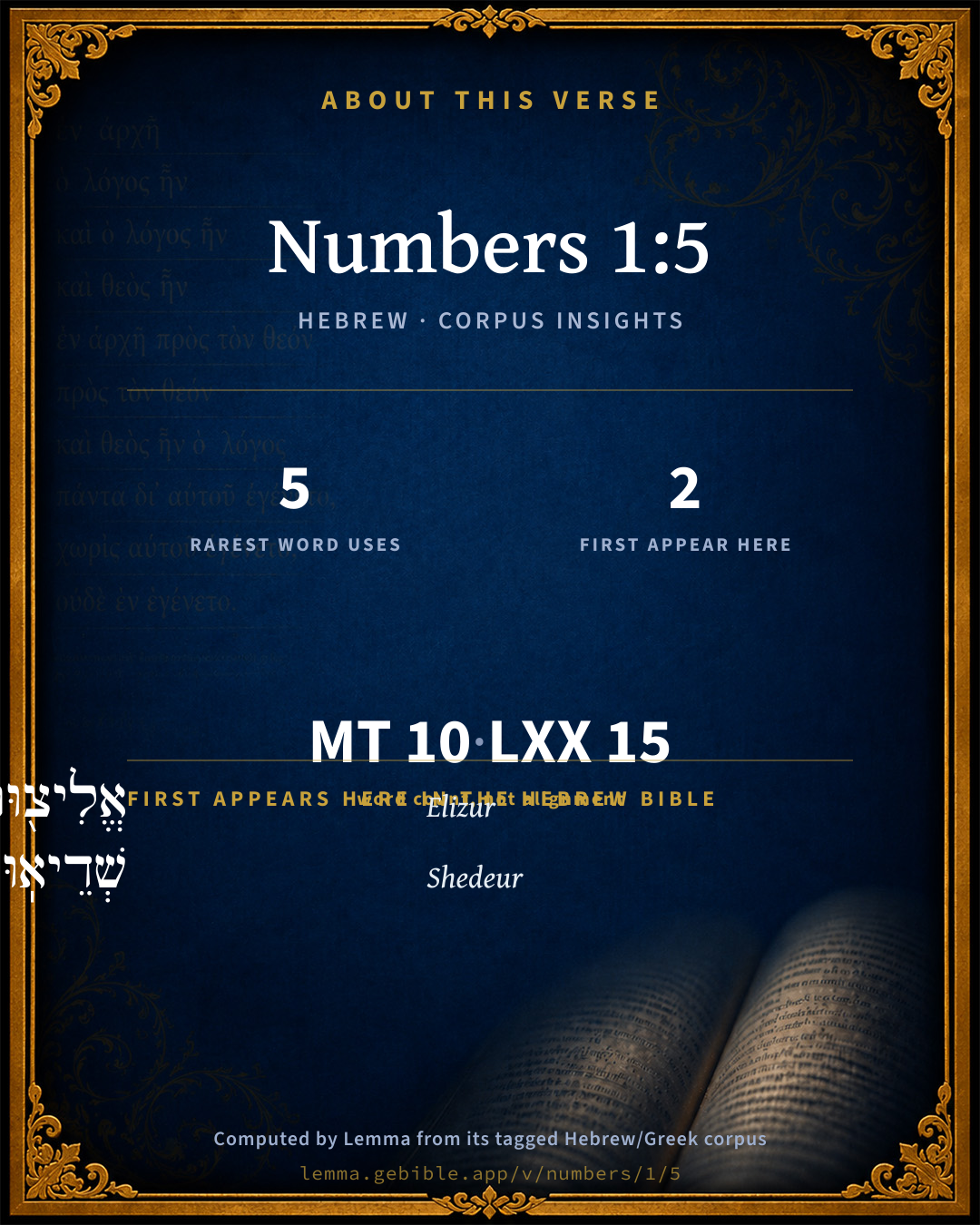
  • 2 first appearances in the Hebrew Bible
Full analysis ↓
Download a study sheet

One document with this verse’s original text, its word-by-word gloss line, the meaning frame, cross-references with their text, attributed commentary, and full source and license credits — printable, and it pastes into notes with its structure intact.

This verse Autodidact and up

Study sheet (.html) Plain text (.txt)

A passage Seminary Student

Up to 50 verses in one chapter. A passage sheet keeps up to 6 commentary sources and 12 cross-references per verse, in the order this page ranks them, and says so on the sheet whenever that leaves anything out. Ask for a single verse and you get the Autodidact verse sheet above.

Everything on this page stays free to read, with no account — the sheet is a download of what is already on screen, not access to it.

Want to remove ads? Support Godless Engineer
Compare translations 3

The same verse in 3 English versions, stacked beneath the original-language interlinear above. Click any original word for its lexicon entry.

Each is an independent rendering of the whole verse — the interlinear is not word-aligned to these translations.

Highlighted words mark where these versions differ — a whole-verse word diff, not a word-by-word alignment.

  • World English Bible Public Domain
    These are the names of the men who shall stand with you: Of Reuben: Elizur the son of Shedeur.
  • King James Version Public Domain
    And these are the names of the men that shall stand with you: of the tribe of Reuben; Elizur the son of Shedeur.
  • unfoldingWord Literal Text CC BY-SA 4.0
    And these the names of the men who will stand with you: of Reuben, Elizur, the son of Shedeur,

unfoldingWord Literal Text — © unfoldingWord, licensed CC BY-SA 4.0. Word-aligned USFM3 via Door43 (git.door43.org/unfoldingWord/en_ult).

Versions to compare (up to 4)

3 of 4 selected

Show all 18 translations

Every available English version of this verse, each an independent rendering of the whole verse.

  • World English Bible Public Domain
    These are the names of the men who shall stand with you: Of Reuben: Elizur the son of Shedeur.
  • Berean Standard Bible Public Domain
    These are the names of the men who are to assist you: From the tribe of Reuben, Elizur son of Shedeur;
  • Majority Standard Bible Public Domain
    These are the names of the men who are to assist you: From the tribe of Reuben, Elizur son of Shedeur;
  • King James Version Public Domain
    And these are the names of the men that shall stand with you: of the tribe of Reuben; Elizur the son of Shedeur.
  • American Standard Version (1901) Public Domain
    And these are the names of the men that shall stand with you. Of Reuben: Elizur the son of Shedeur.
  • Revised Version (1885) Public Domain
    And these are the names of the men that shall stand with you: of Reuben; Elizur the son of Shedeur.
  • Geneva Bible (1599) Public Domain
    And these are the names of the men that shall stand with you, of the tribe of Reuben, Elizur, the sonne of Shedeur:
  • Douay-Rheims (1899) Public Domain
    Whose names are these: Of Ruben, Elisur the son of Sedeur.
  • Young's Literal Translation Public Domain
    `And these `are' the names of the men who stand with you: `For Reuben -- Elizur son of Shedeur.
  • Literal Standard Version CC BY-SA 4.0
    And these [are] the names of the men who stand with you: for Reuben, Elizur son of Shedeur;
  • Unlocked Literal Bible CC BY-SA 4.0
    These are the names of the leaders who must fight with you: From the tribe of Reuben, Elizur son of Shedeur;
  • unfoldingWord Literal Text CC BY-SA 4.0
    And these the names of the men who will stand with you: of Reuben, Elizur, the son of Shedeur,
  • Darby Bible Public Domain
    And these are the names of the men that shall stand with you: for Reuben, Elizur the son of Shedeur;
  • World Messianic Bible Public Domain
    These are the names of the men who shall stand with you: Of Reuben: Elizur the son of Shedeur.
  • Webster's Bible Public Domain
    And these are the names of the men that shall stand with you: Of the tribe of Reuben; Elizur the son of Shedeur.
  • Free Bible Version CC BY-SA 4.0
    These are the names of the men who will work with you: From the tribe of Reuben, Elizur, son of Shedeur;
  • Bible in Basic English Public Domain
    These are the names of those who are to be your helpers: from Reuben, Elizur, the son of Shedeur;
  • JPS Tanakh (1917) Public Domain
    And these are the names of the men that shall stand with you: of Reuben, Elizur the son of Shedeur.

Literal Standard Version (2020), Covenant Press — licensed CC BY-SA 4.0. Text via the HelloAO Bible API (eBible.org). Unlocked Literal Bible (unfoldingWord) — licensed CC BY-SA 4.0. Text via the HelloAO Bible API (eBible.org). unfoldingWord Literal Text — © unfoldingWord, licensed CC BY-SA 4.0. Word-aligned USFM3 via Door43 (git.door43.org/unfoldingWord/en_ult). Free Bible Version, Dr. Jonathan Gallagher — licensed CC BY-SA 4.0. Text via the HelloAO Bible API (eBible.org).

Word by word

More ways to search: Search by grammar → Find every occurrence → Compare this word →

Practice this passage: Drill this verse → Learn its vocabulary →

About this verse

These counts appear in no published source. They are computed here, from the morphology-tagged text and Lemma’s own curated glosses. What Lemma adds →

10
words
10
distinct lemmas
Pentateuch
section

Notable vocabulary

The rarest word here is אֱלִיצ֖וּר Elizur H468 — appearing just 5 times in the whole Hebrew Bible.

First appearance in Scripture

These words make their first canonical appearance in the Hebrew Bible here:

  • אֱלִיצ֖וּר Elizur H468
  • שְׁדֵיאֽוּר Shedeur H7707

Shared distinctive vocabulary

אֱלִיצ֖וּר Elizur H468 occurs in 5 verses of the Hebrew Bible. Also found in:

Grammatical profile

  • 1 verb
  • 6 nouns
  • 1 pronoun
  • 1 preposition
  • 1 particle

Verb forms

  • יַֽעַמְד֖וּ Qal · Imperfect

Hebrew & Septuagint length

In English translation the verse runs 19 words from the Hebrew and 24 from the Septuagint (LXX English) — closely comparable.

A rough comparison of the two English renderings, which tokenize alike — not a word-level alignment.

Word counts can differ between the Hebrew and the Greek without any difference in meaning — e.g. the Hebrew direct-object marker אֵת has no separate Greek word, and Greek often adds the article ὁ.

In the original languages it is 10 Hebrew tokens and 15 Greek tokens — but the two are counted differently (Hebrew bundles its prefixes and suffixes into one token; the Greek is in lemma form), so that isn’t a like-for-like length.

Cross-references

11

Topical passages linked to Numbers 1:5 in the Treasury of Scripture Knowledge — connected by theme and wording, ordered by reader-vote popularity; previews shown in the World English Bible.

  • Numbers 7:30 On the fourth day Elizur the son of Shedeur, prince of the children of Reuben
  • Genesis 29:32–35 Leah conceived, and bore a son, and she named him Reuben. For she said, "Because Yahweh has looked at my affliction. For now my husband will love me."
  • Genesis 30:5–20 Bilhah conceived, and bore Jacob a son.
  • Genesis 35:17–26 It happened that, when she was in hard labor, that the midwife said to her, "Don't be afraid, for now you will have another son."
  • Genesis 46:8–24 These are the names of the children of Israel, who came into Egypt, Jacob and his sons: Reuben, Jacob's firstborn.
  • Genesis 49:1–33 Jacob called to his sons, and said: "Gather yourselves together, that I may tell you that which will happen to you in the days to come.
  • Exodus 1:2–5 Reuben, Simeon, Levi, and Judah,
  • Numbers 2:10 "On the south side shall be the standard of the camp of Reuben according to their divisions. The prince of the children of Reuben shall be Elizur the son of Shedeur.
  • Numbers 10:18 The standard of the camp of Reuben set forward according to their hosts: and over his host was Elizur the son of Shedeur.
  • Deuteronomy 33:1–29 This is the blessing, with which Moses the man of God blessed the children of Israel before his death.
  • Revelation 7:4–8 I heard the number of those who were sealed, one hundred forty-four thousand, sealed out of every tribe of the children of Israel:

Cross-references courtesy of OpenBible.info (CC BY 4.0).

Hebrew and Greek witnesses Masoretic Hebrew ↔ Greek Septuagint

The same verse in the two great witnesses to the Old Testament, shown verse-for-verse.

These are two independent witnesses, not word-aligned to each other, and the Septuagint is shown in lemma (dictionary) form.

Hebrew Numbers 1:5 Masoretic · Westminster Leningrad Codex

וְאֵ֨לֶּה֙ שְׁמ֣וֹת הָֽאֲנָשִׁ֔ים אֲשֶׁ֥ר יַֽעַמְד֖וּ אִתְּכֶ֑ם לִרְאוּבֵ֕ן אֱלִיצ֖וּר בֶּן שְׁדֵיאֽוּר

These are the names of the men who shall stand with you: Of Reuben: Elizur the son of Shedeur.

World English Bible · Public Domain

Greek LXX Numbers 1:5 Septuagint · lemma form

καί οὗτος ὁ ὄνομα ὁ ἀνήρ ὅστις παραἵστημι μετά σύ ὁ ρουβην ελισουρ υἱός σεδιουρ

And these are the names of the men who shall be present with you; of the tribe of Ruben, Elisur the son of Sediur.

LXX2012 (modern English Septuagint) · Public Domain

Hebrew: Westminster Leningrad Codex (CC BY 4.0). Greek: Septuagint (public domain); English from LXX2012 (modern English Septuagint) (Public Domain). How the Septuagint differs from the Hebrew →

Targum (Aramaic paraphrase)

2

The Targum is the ancient Jewish Aramaic paraphrase of the Hebrew Scriptures — an interpretive translation, not the Hebrew text itself. Onkelos (literal) and Pseudo-Jonathan (expansive) render the Torah, and Jonathan the Prophets. Coverage is partial: where no permissively-licensed English translation exists for a verse, only the Aramaic is shown. This is verse-level text, not a word-by-word alignment to the Hebrew.

  1. Targum Onkelos Torah (Genesis–Deuteronomy)
    וְאִלֵין שְׁמָהַת גֻבְרַיָא דִי יְקוּמוּן עִמְכוֹן לִרְאוּבֵן אֶלִיצוּר בַּר שְׁדֵיאוּר

    (no public-domain English translation for this verse)

    Targum Onkelos — Aramaic: “Onkelos Genesis” (public domain); “Onkelos Exodus” (public domain); “Onkelos Leviticus” (public domain); “Onkelos Numbers” (public domain); “Onkelos Deuteronomy” (public domain). English: “Sefaria Community Translation” (CC0 1.0 (public-domain dedication)); “J.W. Etheridge. The Targums of Onkelos and Jonathan Ben Uzziel on the Pentateuch. London: Longmans, Green, 1862” (public domain). Text via Sefaria.

  2. Targum Pseudo-Jonathan Torah (Genesis–Deuteronomy)
    וְאִלֵין שְׁמָהָיַית גוּבְרַיָא דִיקוּמוּן עִמְכוֹן לִרְאוּבֵן אַמַרְכּוֹל אֱלִיצוּר בַּר שְׁדֵיאוּר

    And these are the names of the men who shall stand with you. Of Reuben, Elizur bar Shedeur:

    Targum Pseudo-Jonathan — Aramaic: “Targum Jonathan on Genesis” (public domain); “Targum Jonathan on Exodus” (public domain); “Targum Jonathan on Leviticus” (public domain); “Targum Jonathan on Numbers” (public domain); “Targum Jonathan on Deuteronomy” (public domain). English: “The Targum of Jonathan ben Uzziel, trans. J. W. Etheridge, London, 1862” (public domain). Text via Sefaria.

Commentary

Notes on Numbers 1:5 from classic Christian and Jewish commentators (each source and its license shown beneath its notes). The classic Christian expositions comment on the surrounding passage and are grouped to its opening verse, so a note may address several verses; the Jewish commentaries on the Tanakh (Rashi and others) are per-verse, so they appear only where the commentator wrote on this verse.

Lemma curates 59 commentaries, every one of them public domain or Creative Commons licensed, each selected and text-cleaned for this edition rather than reprinted as found. About our sources →

The Cambridge Bible for Schools and Colleges

gen. ed. J. J. S. Perowne

5. The twenty-four names in the following verses recur in chs. 2, 7. and Num_10:14-27. Some of them are of types which were frequent in early times, Amminadab (Num_1:7), Ammhud (Num_1:10), Elishama (id. [Note: d. idem, ‘the same,’ referring to the book last mentioned.] ), Abidan (Num_1:11), Ahiezer (Num_1:12), Ahira (Num_1:15), but others are unknown to pre-exilic O.T. writings, Nethanel (Num_1:8), Gamaliel (Num_1:10), and the names compounded with Zur and Shaddai (including Shedeur, Num_1:5). No certain traces of names compounded with Shaddai have been found apart from this list. It is probable that the compiler made an artificial selection of ancient and modern names. See Gray, Numbers, pp. 6 f., and Heb. Proper Names, pp. 191–211.

The Cambridge Bible for Schools and Colleges (gen. ed. J. J. S. Perowne; Cambridge University Press, 1878–1918) — public domain. Text from a community e-Sword module.

John Gill's Exposition

And these are the names of the men that shall stand with you,.... Be present with Moses and Aaron when numbering the people; not merely as spectators of the affair, and inspectors of the accounts, but as assistants in the work; each man in his tribe, being best acquainted with the families and houses in it; and these men were not pitched upon by Moses and Aaron, nor chosen by their respective tribes, but were appointed and named by the Lord himself, which was doing them great honour:

of the tribe of Reuben: or "for Reuben" (c), for the taking the number of men in this tribe; and so of all the rest, see Num 1:44,

Elizur the son of Shedeur; from Num 1:5 the names of those several men are given, which were very proper for Moses and Aaron to know, though of little importance to us; nor the signification of their several names, given by Ainsworth and others; only, as Bishop Patrick observes, most of them show how much God was in the thoughts of those who, imposed these names on their children, several of them having in them "El" or "Eli", "God" or "my God", and "Shaddai", "Almighty" or "all-sufficient": to which may be added, that in some of them they seem to respect the Messiah, as Elizur, signifying "my God the rock"; and Shelumiel may be rendered, "God my peace"; and Zurishaddai, "my rock the Almighty", or "all-sufficient"; and Pedazhur, "the rock redeemeth": nor is there anything of any moment to be remarked, unless the order in which the several tribes are placed; and first the children of Leah, beginning with Reuben, the firstborn; and the rest, Simeon and Judah, are ranked according to their birth; Levi being omitted, because that tribe was not now numbered, and besides, Moses and Aaron were of it; and then Issachar and Zebulun; after those the children of Rachel, because of her honour and glory above the handmaids, as Aben Ezra remarks; who further observes, that it begins with Ephraim, following Jacob our father, that is, because of the blessing of Jacob, who preferred Ephraim the younger to Manasseh the elder; and here Ephraim and Manasseh are set before Benjamin, because they were in the place of Joseph; and after that the account goes on with Dan, because, he was the firstborn of the handmaids; and after him Asher, though the second son of Zilpah, is placed before Gad, the first son, because, says the same Aben Ezra, the Lord knew that he would be the head of those that encamped by the standard of Dan, and so is placed next to him; and after him Gad, who was the firstborn of Leah's handmaid; and Naphtali last of all, the second son of Bilhah: this order seems to be designed to suit with their encampments, and the form of them.

(c) "pro Ruben", Samar. vers. "ipsi Reuben", Montanus.

John Gill's Exposition of the Whole Bible (1746–1763) — public domain (CC PDM 1.0). Text via the HelloAO Bible API.

Joseph Benson's Commentary

Num 1:5. Reuben — The tribes are here numbered according to the order or quality of their birth, first the children of Leah, then of Rachel, and then of the handmaids.

Joseph Benson's Commentary on the Old and New Testaments (1811–1818) — public domain. Text from a community e-Sword module.

Geneva Bible (1599)

Geneva Bible translators

And assist you when ye number the people.

Geneva Bible (1599) marginal notes — public domain. Text via Bolls.life.

Jamieson, Fausset & Brown

Robert Jamieson, A. R. Fausset & David Brown

these are the names of the men that shall stand with you, &c.--Each is designated by adding the name of the ancestors of his tribe, the people of which were called "Beni-Reuben," "Beni-Levi," sons of Reuben, sons of Levi, according to the custom of the Arabs still, as well as other nations which are divided into clans, as the Macs of Scotland, the Aps of Wales, and the O's and the Fitzes of Ireland [CHALMERS].

Jamieson, Fausset & Brown — Commentary Critical and Explanatory on the Whole Bible (1871) — public domain (CC PDM 1.0). Text via the HelloAO Bible API.

Ellicott's Commentary for English Readers

(5) Of the tribe of Reuben.—Hebrew, for Reuben.

A Bible Commentary for English Readers, edited by Charles John Ellicott (1878–1897) — public domain. Text from a community e-Sword module.

Albert Barnes' Notes on the Bible

The princes of the tribes, selected Num 1:4 under divine direction, were for the most part the same persons as those chosen a few months previously at the counsel of Jethro Exo 18:21-26. Nahshon, prince of Judah, is mentioned in Exo 6:23, and Elishama, in 1Ch 7:26-27. The peers of men like these were no doubt entitled, among their fellows, to the epithet “renowned,” Num 1:16.

Albert Barnes' Notes on the Bible (1834–1885) — public domain. Text from a community e-Sword/MySword module.

Matthew Poole's English Annotations

With you, to wit, with Moses and Aaron, who were the chief managers of the work. The tribes are here numbered according to the order or quality of their birth, first the children of Leah, then of Rachel, and then of the hand-maids.

Matthew Poole's English Annotations on the Holy Bible (1683–1685) — public domain. Text from a community e-Sword/MySword module.

Whedon's Commentary on the Bible

Daniel D. Whedon

5-15. These are the names — Chosen by the Divine Executive of the Hebrew nation. Little is known of these “renowned” men. Elishama was grandfather of Joshua, (1Ch_7:26-27,) and Nahshon was brother-in-law of Aaron. Exo_6:23. His name occurs in the genealogy of Jesus Christ, (Mat_1:4 and Luk_3:32,) where it is spelled Naasson. He was the first phylarch, or captain, of Judah, and the first prince to present his offering at the dedication of the tabernacle. One general comment applies to all these chiefs. Their names appear in connexion with the census, and as phylarchs of their tribes, in chaps. 2 and 10; and again as liberal donors of gold, silver, incense, and animals at the dedication of the tabernacle, in chap. 7.

Deuel — For Reuel. Chaps. Num_2:14. Supposed to be a mistake of ר, resh, for ד, daleth. The weight of evidence is in favour of Deuel. Num_7:42; Num_7:47; Num_10:20.

Daniel D. Whedon (gen. ed.), Commentary on the Old and New Testaments (1874–1909) — public domain. Text from a community e-Sword module.

The Pulpit Commentary

These are the names of the men. The tribes are here mentioned (through their princes) very nearly in the order of their subsequent encampment south, east, west, and north. Gad alone is displaced, in order that he may be classed with the other sons of the handmaids after the sons of the free women.

Vers. 5-16. The men of renown who managed the census.

I THEY ARE MERE NAMES TO US. Were we asked who Eliab was, we should say the eldest, envious, angry brother of David, not the census-taker for Zebulun; or Gamaliel, he who stood up in the council, not the census-taker for Manasseh. High as they may have been once, their position in human history is little better than oblivion. The long, proud tale of swelling fame Dried to a brief and barren name.

II Yet though mere names now, they WERE ONCE WELL KNOWN. Every child of Zebulun would be taught to look up to Eliab.

III Though mere names to us, THEY DID A USEFUL WORK IN THEIR TIME. It would be no small satisfaction to them, if they looked at the thing rightly, to consider that they had been able to undertake for Moses such an important work as making sure of the fighting strength of each tribe.

IV There was doubtless some appreciation of their services AT THE TIME, both by Moses and the sober-minded of the people.

V But in any case GOD HAS MARKED WHAT THEY DID. He has the record of all the faithful and the holy who have only their names in human history, and the far greater part of them not even that. Y.

The Pulpit Commentary (1880–1919), ed. H.D.M. Spence-Jones & Joseph S. Exell — public domain. Text from a community e-Sword module.

John Wesley's Explanatory Notes

Reuben - The tribes are here numbered according to the order or quality of their birth, first the children of Leah, then of Rachel, and then of the handmaids.

John Wesley, Explanatory Notes Upon the Whole Bible (1754–1765) — public domain. Text via the GEBible commentary corpus.

Lesson kit

Teaching starters — assembled from the data on this page, not authored interpretation. Every prompt links to the verse data it draws on. Edit before teaching.

Numbers, in the Pentateuch, opens this verse with 10 words (10 distinct Hebrew lemmas). Its most distinctive word is ʼĔlîytsûwr (“Elizur”). A historical commentator’s framing appears above. Read the whole chapter for the surrounding context.

Discussion questions

  1. How does “Elizur” (ʼĔlîytsûwr) shape what this verse is saying?
  2. 2 words here appear for the first time in Scripture. What is being introduced at this debut?
  3. Numbers 2:10 shares the word «Elizur» with this verse. How do the two illuminate each other?
  4. The translations on this page render this verse differently — a whole-verse word diff, not a word-by-word alignment. What might account for the different wordings?
  5. The verb «יַֽעַמְד֖וּ» is Qal Imperfect. How does its form color the action?
  6. Reading how The Cambridge Bible for Schools and Colleges and John Gill's Exposition read this verse, where do the two commentators agree and where do they part?

Things to notice

Reading settings

Reading text

Shown beneath each verse's original-language words.

Old Testament
Old Testament edition

Read the OT as the Masoretic Hebrew (MT) or the Greek Septuagint (LXX).

English shown for the Greek Septuagint (in the Hebrew ↔ Greek comparison).

Comparing translations? Open the Compare panel on any verse page to stack up to four side by side.