John 12:25

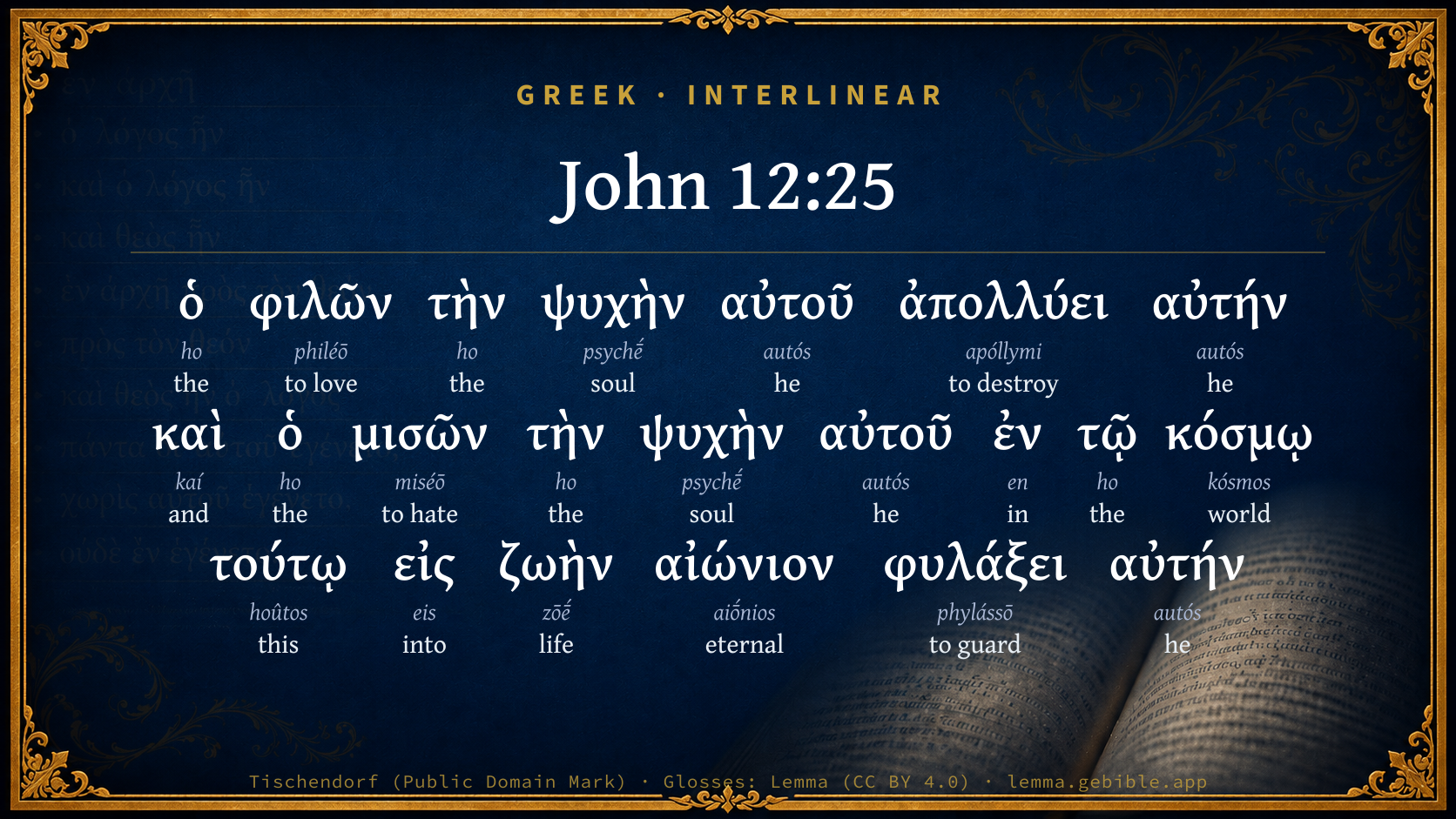
Greek (Tischendorf 8th ed.) John 12:25 appears in the Greek New Testament. The text above is from the Tischendorf 8th edition. Each word links to its Strong’s number and a concise gloss. Click any word for its full Thayer’s Greek Lexicon entry.
Download image
Cite this verse

John 12:25 (World English Bible). Public Domain. Lemma interlinear Bible study tool, https://lemma.gebible.app/v/john/12/25.

Show BibTeX & RIS
BibTeX
RIS
English Translation
He who loves his life will lose it. He who hates his life in this world will keep it to eternal life.
World English Bible · Public Domain
Download a study sheet

One document with this verse’s original text, its word-by-word gloss line, the meaning frame, cross-references with their text, attributed commentary, and full source and license credits — printable, and it pastes into notes with its structure intact.

This verse Autodidact and up

Study sheet (.html) Plain text (.txt)

A passage Seminary Student

Up to 50 verses in one chapter. A passage sheet keeps up to 6 commentary sources and 12 cross-references per verse, in the order this page ranks them, and says so on the sheet whenever that leaves anything out. Ask for a single verse and you get the Autodidact verse sheet above.

Everything on this page stays free to read, with no account — the sheet is a download of what is already on screen, not access to it.

Want to remove ads? Support Godless Engineer
Compare translations 3

The same verse in 3 English versions, stacked beneath the original-language interlinear above. Click any original word for its lexicon entry.

Each is an independent rendering of the whole verse — the interlinear is not word-aligned to these translations.

Highlighted words mark where these versions differ — a whole-verse word diff, not a word-by-word alignment.

  • World English Bible Public Domain
    He who loves his life will lose it. He who hates his life in this world will keep it to eternal life.
  • King James Version Public Domain
    He that loveth his life shall lose it; and he that hateth his life in this world shall keep it unto life eternal.
  • unfoldingWord Literal Text CC BY-SA 4.0
    The one loving his life loses it, but the one hating his life in this world will keep it for eternal life.

unfoldingWord Literal Text — © unfoldingWord, licensed CC BY-SA 4.0. Word-aligned USFM3 via Door43 (git.door43.org/unfoldingWord/en_ult).

Versions to compare (up to 4)

3 of 4 selected

Show all 19 translations

Every available English version of this verse, each an independent rendering of the whole verse.

  • World English Bible Public Domain
    He who loves his life will lose it. He who hates his life in this world will keep it to eternal life.
  • Berean Standard Bible Public Domain
    Whoever loves his life will lose it, but whoever hates his life in this world will keep it for eternal life.
  • Majority Standard Bible Public Domain
    Whoever loves his life will lose it, but whoever hates his life in this world will keep it for eternal life.
  • King James Version Public Domain
    He that loveth his life shall lose it; and he that hateth his life in this world shall keep it unto life eternal.
  • American Standard Version (1901) Public Domain
    He that loveth his life loseth it; and he that hateth his life in this world shall keep it unto life eternal.
  • Revised Version (1885) Public Domain
    He that loveth his life loseth it; and he that hateth his life in this world shall keep it unto life eternal.
  • Geneva Bible (1599) Public Domain
    He that loueth his life, shall lose it, and he that hateth his life in this world, shall keepe it vnto life eternall.
  • Douay-Rheims (1899) Public Domain
    Itself remaineth alone. But if it die, it bringeth forth much fruit. He that loveth his life shall lose it; and he that hateth his life in this world, keepeth it unto life eternal.
  • Young's Literal Translation Public Domain
    he who is loving his life shall lose it, and he who is hating his life in this world -- to life age-during shall keep it;
  • Literal Standard Version CC BY-SA 4.0
    he who is cherishing his life will lose it, and he who is hating his life in this world will keep it to continuous life;
  • Unlocked Literal Bible CC BY-SA 4.0
    He who loves his life will lose it; but he who hates his life in this world will keep it for eternal life.
  • unfoldingWord Literal Text CC BY-SA 4.0
    The one loving his life loses it, but the one hating his life in this world will keep it for eternal life.
  • Darby Bible Public Domain
    He that loves his life shall lose it, and he that hates his life in this world shall keep it to life eternal.
  • World Messianic Bible Public Domain
    He who loves his life will lose it. He who hates his life in this world will keep it to eternal life.
  • Webster's Bible Public Domain
    He that loveth his life shall lose it; and he that hateth his life in this world, shall keep it to life eternal.
  • Free Bible Version CC BY-SA 4.0
    If you love your own life you will lose it, but if you don't love your own life in this world you will keep your life forever.
  • Bible in Basic English Public Domain
    He who is in love with life will have it taken from him; and he who has no care for his life in this world will keep it for ever and ever.
  • Text-Critical English NT CC BY 4.0
    Whoever loves his life will lose it, but whoever hates his life in this world will keep it for eternal life.
  • Tyndale New Testament (1534) Public Domain
    He that loveth his lyfe shall destroye it: and he that hateth his lyfe in this worlde shall kepe it vnto lyfe eternall.

Literal Standard Version (2020), Covenant Press — licensed CC BY-SA 4.0. Text via the HelloAO Bible API (eBible.org). Unlocked Literal Bible (unfoldingWord) — licensed CC BY-SA 4.0. Text via the HelloAO Bible API (eBible.org). unfoldingWord Literal Text — © unfoldingWord, licensed CC BY-SA 4.0. Word-aligned USFM3 via Door43 (git.door43.org/unfoldingWord/en_ult). Free Bible Version, Dr. Jonathan Gallagher — licensed CC BY-SA 4.0. Text via the HelloAO Bible API (eBible.org).

Word by word

More ways to search: Search by grammar → Find every occurrence → Compare this word →

Practice this passage: Drill this verse → Learn its vocabulary →

φιλῶν
philéō
G5368
“to love”
Verb, Present, Active, Participle, Nominative, Singular, Masculine
Part of Speech
Verb
Tense
Present
Voice
Active
Mood
Participle
Case
Nominative
Number
Singular
Gender
Masculine
Full Thayer's Definition

Origin: from G5384

TDNT: 10:54,1

1. to love a. to approve of b. to like c. sanction d. to treat affectionately or kindly, to welcome, befriend 2. to show signs of love a. to kiss 3. to be fond of doing a. be wont, use to do
  1. ὁ ho G3588 “the” Article, Nominative, Singular, Masculine
  2. τὴν ho G3588 “the” Article, Accusative, Singular, Feminine
  3. ψυχὴν psychḗ G5590 “soul” Noun, Accusative, Singular, Feminine
  4. αὐτοῦ autós G846 “he” Personal pronoun, Genitive, Singular, Masculine
  5. ἀπολλύει apóllymi G622 “to destroy” Verb, Present, Active, Indicative, 3rd person, Singular
  6. αὐτήν autós G846 “he” Personal pronoun, Accusative, Singular, Feminine
  7. καὶ kaí G2532 “and” Conjunction
  8. ὁ ho G3588 “the” Article, Nominative, Singular, Masculine
  9. μισῶν miséō G3404 “to hate” Verb, Present, Active, Participle, Nominative, Singular, Masculine
  10. τὴν ho G3588 “the” Article, Accusative, Singular, Feminine
  11. ψυχὴν psychḗ G5590 “soul” Noun, Accusative, Singular, Feminine
  12. αὐτοῦ autós G846 “he” Personal pronoun, Genitive, Singular, Masculine
  13. ἐν en G1722 “in” Preposition
  14. τῷ ho G3588 “the” Article, Dative, Singular, Masculine
  15. κόσμῳ kósmos G2889 “world” Noun, Dative, Singular, Masculine
  16. τούτῳ hoûtos G3778 “this” Demonstrative pronoun, Dative, Singular, Masculine
  17. εἰς eis G1519 “into” Preposition
  18. ζωὴν zōḗ G2222 “life” Noun, Accusative, Singular, Feminine
  19. αἰώνιον aiṓnios G166 “eternal” Adjective, Accusative, Singular, Feminine
  20. φυλάξει phylássō G5442 “to guard” Verb, Future, Active, Indicative, 3rd person, Singular
  21. αὐτήν autós G846 “he” Personal pronoun, Accusative, Singular, Feminine

About this verse

These counts appear in no published source. They are computed here, from the morphology-tagged text and Lemma’s own curated glosses. What Lemma adds →

22
words
14
distinct lemmas
Gospels
section

Notable vocabulary

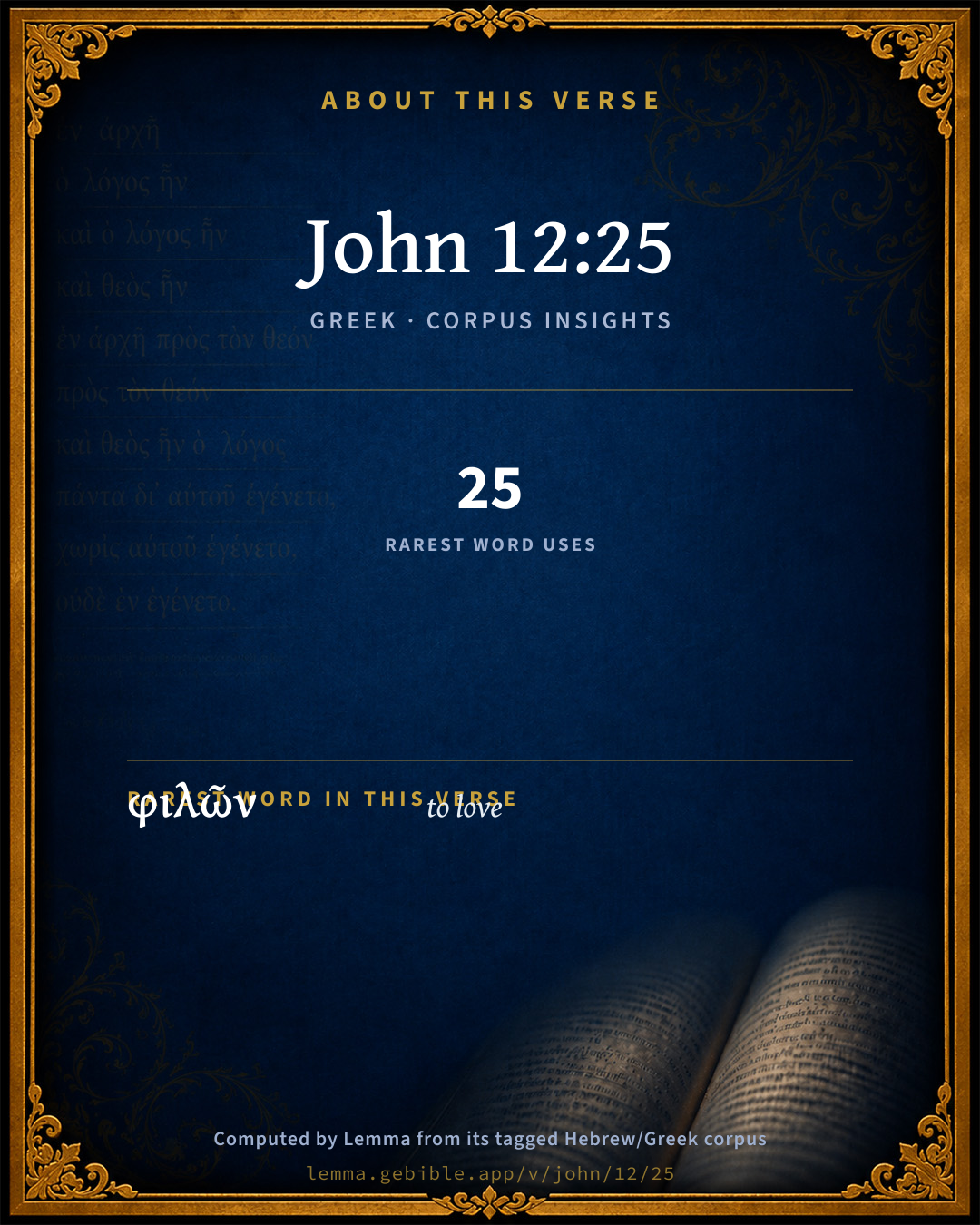
The rarest word here is φιλῶν to love G5368 — appearing just 25 times in the whole Greek New Testament.

Shared distinctive vocabulary

φιλῶν to love G5368 occurs in 21 verses of the Greek New Testament. Also found in:

Repetition

Words recur within this verse:

  • ψυχὴν soul G5590 ×2
  • ὁ the G3588 ×5
  • αὐτοῦ he G846 ×4

Cross-references

11

Topical passages linked to John 12:25 in the Treasury of Scripture Knowledge — connected by theme and wording, ordered by reader-vote popularity; previews shown in the World English Bible.

  • Matthew 10:39 He who finds his life will lose it; and he who loses his life for my sake will find it.
  • Luke 9:23–24 He said to all, "If anyone desires to come after me, let him deny himself, take up his cross, and follow me.
  • Mark 8:35 For whoever wants to save his life will lose it; and whoever will lose his life for my sake and the Gospel's will save it.
  • Luke 17:33 Whoever seeks to save his life loses it, but whoever loses his life preserves it.
  • Matthew 16:25 For whoever desires to save his life will lose it, and whoever will lose his life for my sake will find it.
  • Luke 14:26 "If anyone comes to me, and doesn't hate his own father, mother, wife, children, brothers, and sisters, yes, and his own life also, he can't be my disciple.
  • Matthew 19:29 Everyone who has left houses, or brothers, or sisters, or father, or mother, or wife, or children, or lands, for my name's sake, will receive one hundred times, and will inherit eternal life.
  • Acts 20:24 But these things don't count; nor do I hold my life dear to myself, so that I may finish my race with joy, and the ministry which I received from the Lord Jesus, to fully testify to the Gospel of the grace of God.
  • Revelation 12:11 They overcame him because of the Lamb's blood, and because of the word of their testimony. They didn't love their life, even to death.
  • Ecclesiastes 2:17 So I hated life, because the work that is worked under the sun was grievous to me; for all is vanity and a chasing after wind.
  • Acts 21:13 Then Paul answered, "What are you doing, weeping and breaking my heart? For I am ready not only to be bound, but also to die at Jerusalem for the name of the Lord Jesus."

Cross-references courtesy of OpenBible.info (CC BY 4.0).

Commentary

Notes on John 12:25 from classic Christian and Jewish commentators (each source and its license shown beneath its notes). The classic Christian expositions comment on the surrounding passage and are grouped to its opening verse, so a note may address several verses; the Jewish commentaries on the Tanakh (Rashi and others) are per-verse, so they appear only where the commentator wrote on this verse.

Lemma curates 59 commentaries, every one of them public domain or Creative Commons licensed, each selected and text-cleaned for this edition rather than reprinted as found. About our sources →

Tyndale Open Study Notes

Tyndale Open Resources

12:25 For disciples, sacrifice and self-effacement are means of gaining the fullness of life provided by Jesus’ sacrifice. Those who renounce the world will join Jesus in eternity and be honored by God just as Jesus is.

Tyndale Open Study Notes — © Tyndale Open Resources, licensed CC BY-SA 4.0. Text via the HelloAO Bible API.

Bengel's Gnomon

Johann Albrecht Bengel

Joh 12:25. Τὴν ψυχὴν αὐτοῦ, his life) that is, himself.—ἀπολέσει, shall lose it) unto eternity.—ὁ μισῶν, he who hateth) The soul attains to this hatred, when it is imbued with a feeling of the words of Christ, which occur at Joh 12:24.[317]—ἐν τῷ κόσμῳ τούτῳ) in this world, which is the object of mere sight, and is vain, perishing, and evil. This is not expressed in the preceding sentence [He that loveth his life]; for this world of itself draws us to the love of life; but to hate life in this world, is the great thing[318] [a great attainment].

[317] Implying, as in Christ, so in the believer also, the need that the corn of wheat must first die, if it is afterwards to bring forth much fruit.—E. and T.

[318] Φνλάξει, shall keep it) This is prudence, in the true sense of the word. V. g.

Bengel's Gnomon of the New Testament — English translation (T&T Clark, Edinburgh, 1860) — public domain. Text from a community e-Sword module.

Meyer's Critical & Exegetical Commentary

Heinrich August Wilhelm Meyer

Joh_12:25. As it is my vocation, so also is it that of those who are mine, to surrender the temporal, in order to gain the eternal life. Comp. Mat_10:39; Luk_9:24; Luk_17:33.

The ψυχή is in each instance the soul, as αὐτήν also is to be taken in like manner in each instance. This is clear from its being distinguished from ζωή. He who loves his soul, will not let it go (ὁ φιλοψυχῶν ἐν καιρῷ μαρτυρίου, Euth. Zigabenus), loses it (see critical notes)i.e. he thereby brings about that it falls into the death of everlasting condemnation; and he who hates his soul in this world (gives it up with joy, as something which, moreover, is a hindrance to eternal salvation, and in so far must be hated) will preserve it for everlasting life, keep it to himself as a possession in the everlasting Messianic life. Note the correlatives: φιλῶν and μισῶν ἀπολέσει, and φυλάξει (comp. Joh_17:12), ἐν τῷ κόσμῳ τούτῳ (in the pre-Messianic world), and εἰς ζωὴν αἰώνιον.

On μισεῖν, whose meaning is not to be altered, but to be understood relatively, in opposition to φιλοψυχία, comp. Luk_14:26. Amor, ut pereat; odium ne pereat; si male amaveris, tunc odisti; si bene oderis, tunc amasti, Augustine.

Meyer — Critical and Exegetical Commentary on the New Testament — English translation by Peter Christie, edited by Frederick Crombie (T&T Clark, 1880) — public domain. Text from a community e-Sword module.

Expositor's Greek Testament

ed. W. Robertson Nicoll

Joh 12:25 . ὁ φιλῶν … αὐτήν , he that so prizes his life [ φιλοψυχεῖν is used in the classics of excessive love of life. See Kypke] that he cannot let it out of his own hand or give it up to good ends checks its growth and it withers and dies: whereas he who treats his life as if he hated it, giving i up freely to the needs of other men, shall keep it to life eternal. φυλάξει , “shall guard,” suggested by the apparent lack of guarding and preserving in the μισῶν . He has not guarded it from the claims made upon it in this world, but thus has guarded it to life eternal.

The Expositor's Greek Testament, edited by W. Robertson Nicoll (1897–1910) — public domain. Text from a community e-Sword module.

Jamieson, Fausset & Brown

Robert Jamieson, A. R. Fausset & David Brown

He that loveth his life shall lose it; and he that hateth his life in this world shall keep it unto life eternal--(See on Luk 9:24). Did our Lord mean to exclude Himself from the operation of the great principle here expressed--self-renunciation, the law of self-preservation; and its converse, self-preservation, the law of self-destruction? On the contrary, as He became Man to exemplify this fundamental law of the Kingdom of God in its most sublime form, so the very utterance of it on this occasion served to sustain His own Spirit in the double prospect to which He had just alluded.

Jamieson, Fausset & Brown — Commentary Critical and Explanatory on the Whole Bible (1871) — public domain (CC PDM 1.0). Text via the HelloAO Bible API.

Adam Clarke's Commentary

Verse 25. He that loveth his life] See Clarke on Mt 10:39; and see Clarke "Lu 14:26". I am about to give up my life for the salvation of men; but I shall speedily receive it back with everlasting honour, by my resurrection from the dead. In this I should be imitated by my disciples, who should, when called to it, lay down their lives for the truth; and, if they do, they shall receive them again with everlasting honour.

Adam Clarke's Commentary on the Bible (1810–1826) — public domain. Text from a community e-Sword/MySword module.

John Calvin's Commentaries

25. He who loveth his soul shall destroy it. To doctrine Christ joins exhortation; for if we must die in order that we may bring forth fruit, we ought patiently to permit God to mortify us. But as he draws a contrast between the love of life and the hatred of lit, we ought to understand what it is to love and hate life. He who, under the influence of immoderate desire of the present life, cannot leave the world but by constraint, is said to love life; but he who, despising life, advances courageously to death, is said to hate life. Not that we ought absolutely to hate life, which is justly reckoned to be one of the highest of God’s blessings; but because believers ought cheerfully to lay it down, when it retards them from approaching to Christ; just as a man, when he wishes to make haste in any matter, would shake off from his shoulders a heavy and disagreeable burden. In short, to love this life is not in itself wrong, provided that we only pass through it as pilgrims, keeping our eyes always fixed on our object. For the true limit of loving life, is, when we continue in it as long as it pleases God, and when we are prepared to leave it as soon as he shall order us, or — to express it in a single word — when we carry it, as it were, in our hands, and offer it to God as a sacrifice. Whoever carries his attachment to the present life beyond this limit, destroys his life; that is, he consigns it to everlasting ruin. For the word destroy (ἀπολέσει) does not signify to lose, or to sustain the loss of something valuable, but to devote it to destruction.

His soul. It frequently happens that the word ψυχή, soul, is put for life. Some consider it as denoting, in this passage, the seat of the affections; as if Christ had said, “tie who too much indulges the (desires of his flesh destroys his soul.” But that is a forced interpretation, and the other is more natural, that he who disregards his own life takes the best method of enjoying it eternally.

In this world. To make the meaning still more clear, the phrase in this world, which is but once expressed, ought to be twice repeated, so that the meaning may be, “They do not take the proper method of preserving their life who love it in this world, but, on the other hand, they truly know how to preserve their life who despise it in this world.” And, indeed, whoever is attached to the world does, of his own accord, deprive himself of the heavenly life, of which we cannot be heirs in any other way than by being strangers and foreigners in the world. The consequence is, that the more anxious any person is about his own safety, the farther does he remove himself from the kingdom of God, that is, from the true life.

He who hateth his soul I have already suggested that this expression is used comparatively; because we ought to despise life, so far as it hinders us from living to God; for if meditation on the heavenly life were the prevailing sentiment in our hearts:. the world would have no influence in detaining us. Hence, too, we obtain a reply to an objection that might be urged. “Many persons, through despair, or for other reasons, and chiefly from weariness of life, kill themselves; and yet we will not say that such persons provide for their own safety, while others are hurried to death by ambition, who also rush down to ruin.” But here Christ speaks expressly of that hatred or contempt of this fading life, which believers derive: from the contemplation of a better life. Consequently, whoever does not look to heaven, has not yet learned in what way life must be preserved. Besides, this latter clause was added by Christ, in order to strike terror into those who are too desirous of the earthly life; for if we are overwhelmed by the love of the world, so that we cannot easily forget it, it is impossible for us to go to heaven. But since the Son of God arouses us so violently, it would be the height of folly to sleep a mortal sleep.

John Calvin's Commentaries (1540-1563) — public domain. Text from the Calvin Translation Society English edition (1840s-50s) via the Christian Classics Ethereal Library (ccel.org). Calvin's coverage is partial (roughly two-thirds of the Bible); uncommented books and verses are honest gaps, never fabricated. The 19th-century editor's footnotes and remarks are omitted so the notes are faithfully Calvin's own voice.

Ellicott's Commentary for English Readers

(25) He that loveth his life shall lose it.—The reading here is uncertain, and may be, perhaps with slightly more probability is, He that loveth his life loses it—i.e., that the loss of life is not in the future only, but that in the present, in every moment when a man loves and seeks to save his own life, he is then, and by that very seeking, actually losing it.

The words of this verse are familiar to us from the earlier Gospels, and have been explained in Notes on Mat_10:39; Mat_16:25; Mar_8:35; Luk_9:24; Luk_17:33. The disciples had heard them laid down as the law of their own life and work. They now hear the mysterious words again, and they are asserted as the law to which even His life is submitted. There is even in His human nature a physical and emotional life which would shrink from sacrifice and death (Joh_12:27; comp. Note on Mat_26:39), but in self-sacrifice and death is His own glory and the life of the world. There is in all human nature a principle which would seek as the highest good the life of the body and of the soul, as distinct from the higher life of the spirit, and would shrink from sacrifice and death; but the true principle of life is of the spirit, and only in the sacrifice of the desires of the lower physical and emotional life is that spiritual life realised.

A Bible Commentary for English Readers, edited by Charles John Ellicott (1878–1897) — public domain. Text from a community e-Sword module.

The Cambridge Bible for Schools and Colleges

gen. ed. J. J. S. Perowne

25. loveth his life … hateth his life … life eternal] ‘Life’ is here used in two senses, and in the Greek two different words are used. In the first two cases ‘life’ means the life of the individual, in the last, life in the abstract. By sacrificing life in the one sense, we may win life in the other. See notes on Mat_10:39; Mat_16:25; Mar_8:35; Luk_9:24; Luk_17:33. A comparison of the texts will shew that most of them refer to different occasions, so that this solemn warning must have been often on His lips. The present utterance is distinct from all the rest.

shall lose it] Better, loseth it; the Greek may mean destroyeth it.

hateth his life] i.e. is ready to act towards it as if he hated it, if need so require. Neither here nor in Luk_14:26 must ‘hate’ be watered down to mean ‘be not too fond of;’ it means that and a great deal more. The word rendered ‘life’ in ‘loveth his life’ and ‘hateth his life’ might also mean ‘soul,’ and some would translate it so: but would Christ have spoken of hating one’s soul as the way to eternal life?

The Cambridge Bible for Schools and Colleges (gen. ed. J. J. S. Perowne; Cambridge University Press, 1878–1918) — public domain. Text from a community e-Sword module.

John Gill's Exposition

If any man serve, me,.... Or is willing to be a servant of Christ, and to be esteemed as such;

let him follow me; as in the exercise of the graces of love, humility, patience, self-denial, and resignation of will to the will of God, and in the discharge of every duty, walking as he walked, so in a way of suffering; for as the master, so the servants, as the head, so the members, through many tribulations, must enter the kingdom; to which he encourages by the following things:

and where I am; in heaven, as he now was, as the Son of God; or "where I shall be", as the Syriac and Persic versions render it, even as man, in the human nature, when raised from the dead:

there shall also my servant be; when he has done his work, and the place is prepared for him, and he for that, and where he shall ever abide; and as a further encouragement, he adds,

if any man serve me, him will my Father honour; by accepting his service, affording him his gracious presence here, and by giving him eternal glory hereafter, to which he has called him.

John Gill's Exposition of the Whole Bible (1746–1763) — public domain (CC PDM 1.0). Text via the HelloAO Bible API.

Trapp's Complete Commentary

John Trapp

25 He that loveth his life shall lose it; and he that hateth his life in this world shall keep it unto life eternal.

Ver. 25. He that loveth his life] As Christ loved not his life to the death for us, so neither must we for him. If every hair of my head were a man, I would suffer death in the opinion and faith that I am now in, said John Ardley, martyr, to Bonner. God be praised, said Dr Taylor, since my condemnation, I was never afraid to die. God’s will be done; if I shrink from God’s truth, I am sure of another manner of death than had Judge Hales.

John Trapp, A Commentary or Exposition upon All the Books of the Old and New Testament (1647–1656) — public domain. Text from a community e-Sword module.

Albert Barnes' Notes on the Bible

He that loveth his life ... - This was a favorite principle, a sort of “axiom” with the Lord Jesus, which he applied to himself as well as to his followers. See the Mat 10:39 note; Luk 9:24 note.

Albert Barnes' Notes on the Bible (1834–1885) — public domain. Text from a community e-Sword/MySword module.

Matthew Poole's English Annotations

We had much the same in the other evangelists, Mat 10:39; Luk 14:26. Some think that our Saviour repeateth it here, to show, that as Christ first suffered, and then entered into his glory; so his disciples must also lay the foundation of their glory in their sufferings and through much tribulation enter into the kingdom of God, Act 14:22. Or what if we should say, that our blessed Lord doth here prophesy what sufferings would attend the first preaching of the gospel, and encourage his disciples to what he knew they must meet with and undergo, by letting them know that the ready way to lose their share in life eternal, was to be so fond of this life, and the comforts of it, as not to be ready to lay them down for him; but if any person hated, that is, less loved his life, and all that in this world is dear to him, than Christ and his service, he should, if not be preserved from enemies’ rage, yet most certainly be recompensed with eternal life?

Matthew Poole's English Annotations on the Holy Bible (1683–1685) — public domain. Text from a community e-Sword/MySword module.

Whedon's Commentary on the Bible

Daniel D. Whedon

25. Loveth… life… lose it—The same law of death resulting in life which the Lord obeys his followers must also accept. A virtual death must be by us undergone in order that we may spiritually and eternally live. If we perversely maintain a worldly life and refuse martyrdom in spirit or in reality, that life we can never attain. But he that hateth his life in this world, who abhors and renounces the selfish love of life, shall keep it unto life eternal. Thus are lord and servant under the same law of death and life.

Daniel D. Whedon (gen. ed.), Commentary on the Old and New Testaments (1874–1909) — public domain. Text from a community e-Sword module.

The Pulpit Commentary

Vers. 25, 26. The Lord here introduces a solemn, almost oracular utterance, which proves how close and intimate is the relationship between the synoptics and the Fourth Gospel. On several great occasions our Lord has impressed this law of the Spirit of life upon his disciples. Thus in Mat_10:37-39, in the lengthened commission given to the twelve, after calling on his followers to place his own claim on their affection as greater than that of father, mother, friend, and calling for self-sacrifice, and self-crucifixion, he said, "He that findeth his life (quch) shall lose it: he that loseth his life for my sake shall find it." Again, (Mat_16:25, etc.) after rebuking Peter for his unwillingness to recognize the necessity and significance of the killing of "the Son of the living God," he laid down the same law once more, calling for self-denial and daily cross-bearing, and adds, "Whosoever will save his life shall lose it: and whosoever will lose his life for my sake shall find it." (So also Luk_9:23, etc. Luk_15:26) also introduces the same solemn aphorism in our Lord"s discourse concerning the close of the Jewish national life. Surely here he is applying to his own case the law of the Divine life which he had shown to be universal, and of which he was on the point of giving the crowning and climacteric expression. He does it with amplifications and a supply of motives. If life be regarded as an end in itself; if it be treated as complete when rounded with its own individuality; if life shrink from sacrifice, if it "love itself," and will at all hazards preserve itself; if the natural and instinctive fear of death, and instinct of self-preservation, become a self-idolatry; that life will "abide alone." If it sacrifice itself for higher ends than self; if it regard the higher end as more valuable than itself; if it lose itself in the object to which it is consecrated; if it be content to "die; it abideth no longer "alone," but "bringeth forth much fruit.

He that loves his own life (quch); life used as equivalent to "self," in that totality of being which, like the life of the seed-corn, survives the accident of deathhe that loves his own life (self) is losing it; or, perhaps, destroying it, ipso facto. There are ends and objects of love so much greater than" the self," that to keep it by some act of will and recreant fear is to make it utterly valueless, is really to destroy its true vitality. And he that hateth his (quch) life (self) in this world, wherever the greater claim of Christ and of the Father would be compromised by loving it, shall veritably preserve it, viz. the self, unto eternal (zwh) life; i.e. to the blessedness of eternal being. The quch is a great possession; and "what advantageth a man if he should gain the whole world, and lose it?" But if a man persists in gaining the world, and forgets that this earthly existence is not capable of satisfying the demands or finding a sphere for the true self, and so makes the earthly reign or enjoyment of the quch the end of all striving, then he miserably fails. So far it is clear that our Lord is applying a great principle of the true life to the case of his own Messianic work and ministry. He draws, from a law of the superiority of the Divine life to the fear of death and to the fact of death, a justification of his own approaching doom. He can only by dying live his perfect life, win his greatest triumph; reap his world-wide harvest.

The Pulpit Commentary (1880–1919), ed. H.D.M. Spence-Jones & Joseph S. Exell — public domain. Text from a community e-Sword module.

John Wesley's Explanatory Notes

He that loveth his life - More than the will of God; shall lose it eternally: and he that hateth his life - In comparison of the will of God, shall preserve it. Matt. x, 39.

John Wesley, Explanatory Notes Upon the Whole Bible (1754–1765) — public domain. Text via the GEBible commentary corpus.

Scofield Reference Notes

C. I. Scofield

world

kosmos = world-system.

Joh 14:17; Joh 14:19; Joh 14:22; Joh 14:27; Joh 14:30; Joh 7:7 (See Scofield "Rev 13:8").

The Scofield Reference Bible (1917 edition), notes by C. I. Scofield — public domain. Text from a community e-Sword module.

The People's New Testament

B. W. Johnson

25. He that loveth his life shall lose it. He announces a principle that underlies all exaltation. He gave his life and found eternal exaltation; the grain gives its life and lives a hundred-fold; those who consecrate their lives, give them up for others, dedicate them to their holy work, will live eternally.

B. W. Johnson's The People's New Testament with Notes (1889–1891) — public domain. Electronic text from the Christian Classics Ethereal Library (CCEL) ThML edition.

unfoldingWord translationNotes

Door43 World Missions Community

He who loves his life will lose it

Here "loves his life" means to consider one's own physical life to be more valuable than the lives of others. AT: "whoever values his own life more than others will not receive eternal life" (See: Assumed Knowledge and Implicit Information)

he who hates his life in this world will keep it for eternal life

Here the one who "hates his life" refers to one who loves his own life less than he loves the lives of others. AT: "whoever considers the lives of others as more important than his own life will live with God forever" (See: Assumed Knowledge and Implicit Information)

where I am, there will my servant also be

Jesus implies that those who serve him will be with him in heaven. AT: "when I am in heaven, my servant will also be there with me" (See: Assumed Knowledge and Implicit Information)

the Father will honor him

Here "Father" is an important title for God. (See: Translating Son and Father)

translationWords

life

world

eternity

servant

servant

God the Father

honor

unfoldingWord translationNotes — © Distant Shores Media and the Door43 World Missions Community, licensed CC BY-SA 4.0. Source: git.door43.org/Door43/en_tn.

Cambridge Greek Testament for Schools and Colleges

25. ἀπολλύει (אBL) for ἀπολέσει (AD).

25. ψυχήν … ζωήν. Ψυχή is the life of the individual, ζωή life in the abstract. By a noble disregard of the former we win the latter: sacrifice of self is the highest self-preservation. See on Mat 10:39; Mat 16:25; Mar 8:35; Luk 9:24; Luk 17:33. Most of these texts refer to different occasions, so that this solemn warning must have been often on His lips. This occasion is distinct from all the rest. Ἀπολλύει is either destroyeth it or loseth it: selfishness is self-ruin.

ὁ μισῶν. He who, if necessary, is ready to act towards his ψυχή as if he hated it. Neither here nor in Luk 14:26 must μισεῖν be watered down to mean ‘be not too fond of:’ it means that and a great deal more. For ζωὴν αἰώνιον see on Joh 3:15-16.

Cambridge Greek Testament for Schools and Colleges (Cambridge University Press, 1896; 21 vols, various authors incl. Carr, Maclear, Plummer, Farrar, Lumby, Moule, M. R. James, Simcox) — public domain. Text from a community e-Sword module.

Alford’s Greek Testament

Henry Alford

25.] And this same divine Law prevails for the disciples, as well as for their Master: see Mat 10:39 and note. But the saying here proclaims more plainly its true extent,—by its immediate connexion with ver. 24, and by εἰς ζ. αἰών.

ψυχή is not really in a double sense: as the wheat-corn retains its identity, though it die, so the ψυχή: so that the two senses are, in their depth, but one. ψυχή is the life in both cases;—not the soul, in the present acceptation of that term.

Henry Alford, The Greek Testament (1849–1861) — public domain. Text from a community e-Sword module.

International Critical Commentary

25. We now come to the second illustration of the great paradox of the Cross: “He that loveth his life (ψυχή) loseth it (ἀπολλύει, with אBLW, is to be preferred to the rec. ἀπολέσει), and he that hateth his life in this world (ἐν τῷ κόσμῳ τούτῳ, cf. 8:23) shall keep it unto life eternal (for ζωὴ αἰώνιος, see on 4:14).”

ψυχή is the conscious organ of feeling and desire, not so near the Divine as πνεῦμα, sometimes (as here) to be distinguished from πνεῦμα, but often used as its equivalent, just as in English we do not always sharply differentiate “soul” from “spirit” (see on 11:33).

This great saying may have been repeated by Jesus more than once, representing as it does the central lesson of His teaching and His life. In the Marcan tradition it is placed after the Confession of Peter (Mar 8:35, Mat 16:25, Luk 9:24), when Jesus began to tell the Twelve that His Mission would issue in death. It is found also in other settings in the Mt.—Lk. tradition (Mat 10:39, Luk 17:33), where it comes from the source Q. In its most literal meaning it was applicable to the choice between martyrdom and apostasy, which Christians of the first century (as well as later) were sometimes called to make. But selfishness is always the death of the true life of man.

The strong expression “hateth his life” (ὁ μισῶν τὴν ψυχὴν αὐτοῦ) is softened down in the Synoptic parallels, but it is found in another context, Luk 14:26.

International Critical Commentary — older volumes (1896–1929), various authors — public domain. Text from a community e-Sword module.

Vincent's Word Studies in the New Testament

Marvin R. Vincent

Life [ψυχην] . See on Mr 12:30; Luk 1:46.

Shall lose [απολεσει] . The best texts read ajpolluei, loseth. See on Luk 9:25.

In this world. This earthly economy, regarded as alien and hostile to God. The words are added in order to explain the strong phrase, hateth his life or soul.

Shall keep [φυλαξει] . See on 1Pe 1:4.

Marvin R. Vincent, Word Studies in the New Testament (1887–1900) — public domain. Text from a community e-Sword/MySword module.

Godet's Commentaries

Frédéric Louis Godet

Ver. 25. Application of the figure: “He who loves his life, loses it; and he who hates his life in this world, shall preserve it unto life eternal.”

The relation between this sentence and the two preceding verses does not allow us to doubt that Jesus here applies it to Himself. To this fundamental law of human life, which He has so often declared with reference to His disciples (Mat 10:39; Mat 16:25; Mar 8:35; Luk 9:24; Luk 17:33), He here declares that He is Himself subjected, like themselves. By the expression, his life, ψυχή, Jesus designates the breath of the natural life, with all the faculties with which this life is endowed in the case of man.

This physical and psychical life is good, as the starting-point of the human existence; Jesus also possesses it. But the destiny of the natural life is not to sustain and perpetuate itself as such; it must be transformed, by a superior force, into a spiritual, eternal life; but, in order to do this, it must be voluntarily surrendered, sacrificed, immolated in the form of self-renunciation. Otherwise, after having flourished for a time, and more or less satisfied itself, it decays and withers for ever. This law applies even to a pure being and to his lawful tastes. One may be called to sacrifice an honorable desire in order to respond to a higher duty; to refuse this call is to keep one’s life, but in order to lose it.

Everything which is not surrendered to God by a free act of sacrifice, contains a germ of death. Jesus, seeking his own safety, His personal life, might now, if He wished, escape from death, become the Socrates of the Greeks, the Caesar of the Romans, the Solomon of the Jews; but this way of preserving His life would be to lose it. Not having surrendered it to God, He could not receive it from Him transformed and glorified (Joh 12:23); and, thus preserved, it would remain devoted to unfruitfulness and to earthly frailty. In order to become a Christ, He must renounce being a sage; He must not wish to ascend the throne of a Solomon, if He desires to take His place on that of God. Lange has profoundly remarked that this saying contains in particular the judgment of Hellenism. What was Greek civilization? The effort to realize an ideal of human life consisting in enjoyment and escaping the law of sacrifice. It is probable that the true reading is the present loses(ἀπολλύει) which was replaced by the future shall lose (ἀπολέσει), under the influence of the verb of the following clause. The idea of losing goes beyond that of abiding alone (Joh 12:14). The term μισεῖν, to hate, expresses the feeling of a generous contempt, arising from the view of what one would lose by devoting himself to the keeping of this natural life. The expression: unto life eternal, placed in opposition, as it is here, to in this world, refers not only to the more elevated nature of this life (Reuss), but also to the future epoch in which it will break forth in its perfection. This saying, which means that man gives himself to find himself again, is that which Jesus has most frequently uttered (see above); it expresses the most profound law of human life. How should not this moral axiom, which governed the life of the Master, be applicable also to that of the disciples? It is evidently with a view to these latter also, that Jesus expresses it for a last time in this so solemn moment.

Frédéric Louis Godet — Commentaries on Luke, John, Romans, and 1 Corinthians — English translation (T&T Clark, Edinburgh, 1870s–1890s) — public domain. Text from a community e-Sword module.

Lesson kit

Teaching starters — assembled from the data on this page, not authored interpretation. Every prompt links to the verse data it draws on. Edit before teaching.

John, in the Gospels, opens this verse with 22 words (14 distinct Greek lemmas). Its most distinctive word is philéō (“to love”). A historical commentator’s framing appears above. Read the whole chapter for the surrounding context.

Discussion questions

  1. How does “to love” (philéō) shape what this verse is saying?
  2. How does Matthew 6:5, which shares the word «to love», read alongside this verse?
  3. What does the repetition of “soul” (2× in this one verse) do in this verse?
  4. These translations render this verse differently. What is at stake in choosing one wording over another?
  5. Compare how Tyndale Open Study Notes and Bengel's Gnomon read this verse. Where do they agree or differ?

Things to notice

Reading settings

Reading text

Shown beneath each verse's original-language words.

Old Testament
Old Testament edition

Read the OT as the Masoretic Hebrew (MT) or the Greek Septuagint (LXX).

English shown for the Greek Septuagint (in the Hebrew ↔ Greek comparison).

Comparing translations? Open the Compare panel on any verse page to stack up to four side by side.