John 12:36

Greek (Tischendorf 8th ed.) John 12:36 appears in the Greek New Testament. The text above is from the Tischendorf 8th edition. Each word links to its Strong’s number and a concise gloss. Click any word for its full Thayer’s Greek Lexicon entry.
Download image
Cite this verse

John 12:36 (World English Bible). Public Domain. Lemma interlinear Bible study tool, https://lemma.gebible.app/v/john/12/36.

Show BibTeX & RIS
BibTeX
RIS
English Translation
While you have the light, believe in the light, that you may become children of light." Jesus said these things, and he departed and hid himself from them.
World English Bible · Public Domain
Download a study sheet

One document with this verse’s original text, its word-by-word gloss line, the meaning frame, cross-references with their text, attributed commentary, and full source and license credits — printable, and it pastes into notes with its structure intact.

This verse Autodidact and up

Study sheet (.html) Plain text (.txt)

A passage Seminary Student

Up to 50 verses in one chapter. A passage sheet keeps up to 6 commentary sources and 12 cross-references per verse, in the order this page ranks them, and says so on the sheet whenever that leaves anything out. Ask for a single verse and you get the Autodidact verse sheet above.

Everything on this page stays free to read, with no account — the sheet is a download of what is already on screen, not access to it.

Want to remove ads? Support Godless Engineer
Compare translations 3

The same verse in 3 English versions, stacked beneath the original-language interlinear above. Click any original word for its lexicon entry.

Each is an independent rendering of the whole verse — the interlinear is not word-aligned to these translations.

Highlighted words mark where these versions differ — a whole-verse word diff, not a word-by-word alignment.

  • World English Bible Public Domain
    While you have the light, believe in the light, that you may become children of light." Jesus said these things, and he departed and hid himself from them.
  • King James Version Public Domain
    While ye have light, believe in the light, that ye may be the children of light. These things spake Jesus, and departed, and did hide himself from them.
  • unfoldingWord Literal Text CC BY-SA 4.0
    While you have the light, believe in the light so that you may be sons of light.” Jesus said these things, and having departed, was hidden from them.

unfoldingWord Literal Text — © unfoldingWord, licensed CC BY-SA 4.0. Word-aligned USFM3 via Door43 (git.door43.org/unfoldingWord/en_ult).

Versions to compare (up to 4)

3 of 4 selected

Show all 19 translations

Every available English version of this verse, each an independent rendering of the whole verse.

  • World English Bible Public Domain
    While you have the light, believe in the light, that you may become children of light." Jesus said these things, and he departed and hid himself from them.
  • Berean Standard Bible Public Domain
    While you have the Light, believe in the Light, so that you may become sons of light.” After Jesus had spoken these things, He went away and was hidden from them.
  • Majority Standard Bible Public Domain
    While you have the Light, believe in the Light, so that you may become sons of light.” After Jesus had spoken these things, He went away and was hidden from them.
  • King James Version Public Domain
    While ye have light, believe in the light, that ye may be the children of light. These things spake Jesus, and departed, and did hide himself from them.
  • American Standard Version (1901) Public Domain
    While ye have the light, believe on the light, that ye may become sons of light. These things spake Jesus, and he departed and hid himself from them.
  • Revised Version (1885) Public Domain
    While ye have the light, believe on the light, that ye may become sons of light. These things spake Jesus, and he departed and hid himself from them.
  • Geneva Bible (1599) Public Domain
    While ye haue that light, beleeue in that light, that ye may be the children of the light. These things spake Iesus, and departed, and hid himselfe from them.
  • Douay-Rheims (1899) Public Domain
    Whilst you have the light, believe in the light, that you may be the children of light. These things Jesus spoke; and he went away, and hid himself from them.
  • Young's Literal Translation Public Domain
    while ye have the light, believe in the light, that sons of light ye may become.' These things spake Jesus, and having gone away, he was hid from them,
  • Literal Standard Version CC BY-SA 4.0
    while you have the light, believe in the light, that you may become sons of light.” Jesus spoke these things, and having gone away, He was hid from them,
  • Unlocked Literal Bible CC BY-SA 4.0
    While you have the light, believe in the light so that you may be sons of light.” Jesus said these things and then departed and hid from them.
  • unfoldingWord Literal Text CC BY-SA 4.0
    While you have the light, believe in the light so that you may be sons of light.” Jesus said these things, and having departed, was hidden from them.
  • Darby Bible Public Domain
    While ye have the light, believe in the light, that ye may become sons of light. Jesus said these things, and going away hid himself from them.
  • World Messianic Bible Public Domain
    While you have the light, believe in the light, that you may become children of light.” Yeshua said these things, and he departed and hid himself from them.
  • Webster's Bible Public Domain
    While ye have light, believe in the light, that ye may be the children of light. These things spoke Jesus, and departed, and concealed himself from them.
  • Free Bible Version CC BY-SA 4.0
    Put your trust in the light while you still have it so that you can become children of light.” When Jesus had told them this, he left and hid himself from them.
  • Bible in Basic English Public Domain
    In so far as you have the light, put your faith in the light so that you may become sons of light. With these words Jesus went away and for a time was not seen again by them.
  • Text-Critical English NT CC BY 4.0
    While you have the light, believe in the light, so that you will become sons of light.” The Unbelief of the People After saying these things, Jesus went away and was hidden from them.
  • Tyndale New Testament (1534) Public Domain
    Whyll ye have light beleve on the light that ye maye be the chyldren of light. These thinges spake Iesus and departed and hyd him silfe from them.

Literal Standard Version (2020), Covenant Press — licensed CC BY-SA 4.0. Text via the HelloAO Bible API (eBible.org). Unlocked Literal Bible (unfoldingWord) — licensed CC BY-SA 4.0. Text via the HelloAO Bible API (eBible.org). unfoldingWord Literal Text — © unfoldingWord, licensed CC BY-SA 4.0. Word-aligned USFM3 via Door43 (git.door43.org/unfoldingWord/en_ult). Free Bible Version, Dr. Jonathan Gallagher — licensed CC BY-SA 4.0. Text via the HelloAO Bible API (eBible.org).

Word by word

More ways to search: Search by grammar → Find every occurrence → Compare this word →

Practice this passage: Drill this verse → Learn its vocabulary →

ἐκρύβη
krýptō
G2928
“to hide”
Verb, Aorist, Passive, Indicative, 3rd person, Singular
Part of Speech
Verb
Tense
Aorist
Voice
Passive
Mood
Indicative
Person
3rd person
Number
Singular
Full Thayer's Definition

Origin: a primary verb

TDNT: 18:57,5

1. to hide, conceal, to be hid 2. escape notice 3. metaph. to conceal (that it may not become known)
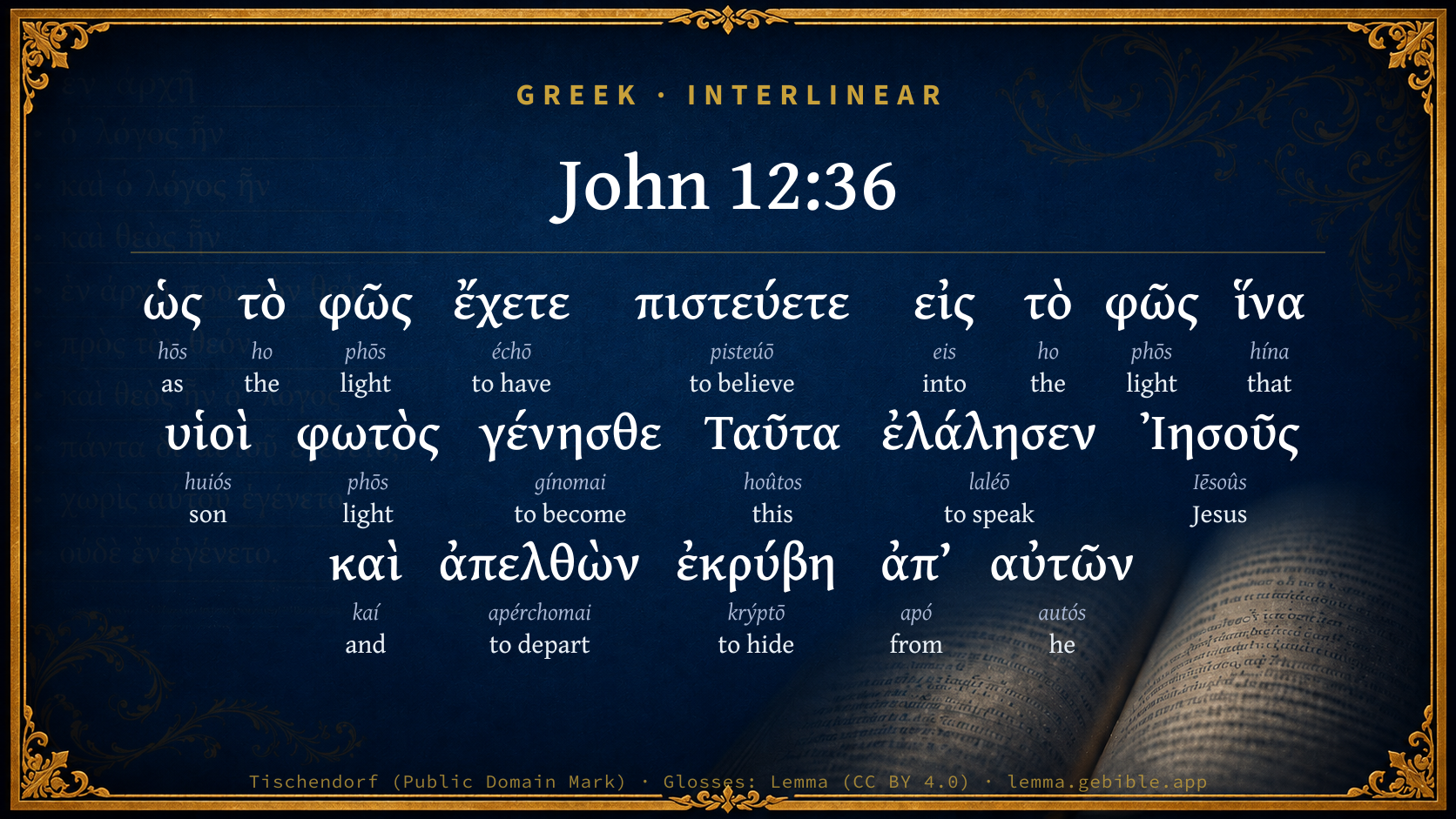
  1. ὡς hōs G5613 “as” Adverb
  2. τὸ ho G3588 “the” Article, Accusative, Singular, Neuter
  3. φῶς phōs G5457 “light” Noun, Accusative, Singular, Neuter
  4. ἔχετε échō G2192 “to have” Verb, Present, Active, Indicative, 2nd person, Plural
  5. πιστεύετε pisteúō G4100 “to believe” Verb, Present, Active, Imperative, 2nd person, Plural
  6. εἰς eis G1519 “into” Preposition
  7. τὸ ho G3588 “the” Article, Accusative, Singular, Neuter
  8. φῶς phōs G5457 “light” Noun, Accusative, Singular, Neuter
  9. ἵνα hína G2443 “that” Conjunction
  10. υἱοὶ huiós G5207 “son” Noun, Nominative, Plural, Masculine
  11. φωτὸς phōs G5457 “light” Noun, Genitive, Singular, Neuter
  12. γένησθε gínomai G1096 “to become” Verb, Aorist, Middle deponent, Subjunctive, 2nd person, Plural
  13. Ταῦτα hoûtos G3778 “this” Demonstrative pronoun, Accusative, Plural, Neuter
  14. ἐλάλησεν laléō G2980 “to speak” Verb, Aorist, Active, Indicative, 3rd person, Singular
  15. Ἰησοῦς Iēsoûs G2424 “Jesus” Noun, Nominative, Singular, Masculine
  16. καὶ kaí G2532 “and” Conjunction
  17. ἀπελθὼν apérchomai G565 “to depart” Verb, Aorist, Active, Participle, Nominative, Singular, Masculine
  18. ἀπ’ apó G575 “from” Preposition
  19. αὐτῶν autós G846 “he” Personal pronoun, Genitive, Plural, Masculine

About this verse

These counts appear in no published source. They are computed here, from the morphology-tagged text and Lemma’s own curated glosses. What Lemma adds →

20
words
17
distinct lemmas
Gospels
section

Notable vocabulary

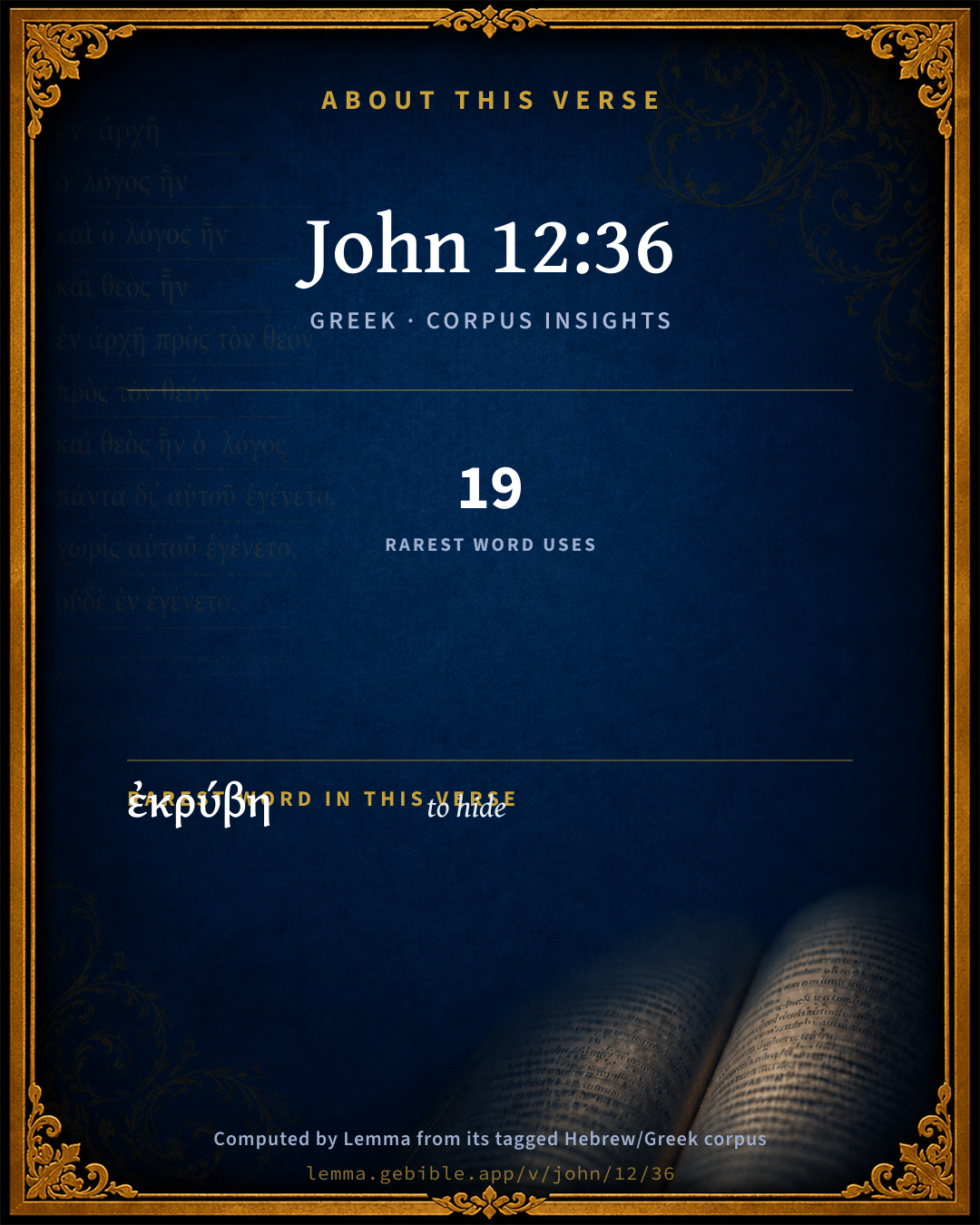
The rarest word here is ἐκρύβη to hide G2928 — appearing just 19 times in the whole Greek New Testament.

Shared distinctive vocabulary

ἐκρύβη to hide G2928 occurs in 18 verses of the Greek New Testament. Also found in:

Repetition

Words recur within this verse:

Cross-references

13

Topical passages linked to John 12:36 in the Treasury of Scripture Knowledge — connected by theme and wording, ordered by reader-vote popularity; previews shown in the World English Bible.

  • Ephesians 5:8 For you were once darkness, but are now light in the Lord. Walk as children of light,
  • John 8:59 Therefore they took up stones to throw at him, but Jesus was hidden, and went out of the temple, having gone through the midst of them, and so passed by.
  • 1 Thessalonians 5:5 You are all children of light, and children of the day. We don't belong to the night, nor to darkness,
  • Isaiah 60:1 Arise, shine; for your light is come, and the glory of Yahweh is risen on you.
  • Luke 16:8 "His lord commended the dishonest manager because he had done wisely, for the children of this world are, in their own generation, wiser than the children of the light.
  • John 1:7 The same came as a witness, that he might testify about the light, that all might believe through him.
  • Acts 13:47–48 For so has the Lord commanded us, saying, 'I have set you as a light for the Gentiles, That you should bring salvation to the uttermost parts of the earth.'"
  • Matthew 21:17 He left them, and went out of the city to Bethany, and lodged there.
  • John 3:21 But he who does the truth comes to the light, that his works may be revealed, that they have been done in God."
  • John 10:39–40 They sought again to seize him, and he went out of their hand.
  • John 11:54 Jesus therefore walked no more openly among the Jews, but departed from there into the country near the wilderness, to a city called Ephraim. He stayed there with his disciples.
  • 1 Thessalonians 5:8 But let us, since we belong to the day, be sober, putting on the breastplate of faith and love, and, for a helmet, the hope of salvation.
  • 1 John 2:9–11 He who says he is in the light and hates his brother, is in the darkness even until now.

Cross-references courtesy of OpenBible.info (CC BY 4.0).

Commentary

Notes on John 12:36 from classic Christian and Jewish commentators (each source and its license shown beneath its notes). The classic Christian expositions comment on the surrounding passage and are grouped to its opening verse, so a note may address several verses; the Jewish commentaries on the Tanakh (Rashi and others) are per-verse, so they appear only where the commentator wrote on this verse.

Lemma curates 59 commentaries, every one of them public domain or Creative Commons licensed, each selected and text-cleaned for this edition rather than reprinted as found. About our sources →

Tyndale Open Study Notes

Tyndale Open Resources

12:36 Jesus was the light (1:4, 7-9; 3:19-21; 8:12), and he urged the crowd to quickly make the choice to believe in him before it was too late. • They had the choice of becoming children of the light by rebirth through the power of God (1:12-13). • Jesus . . . was hidden from them: Jesus withdrew first from Judea (11:54) and then from this audience (12:36), and soon he would withdraw from the world (17:11).

Tyndale Open Study Notes — © Tyndale Open Resources, licensed CC BY-SA 4.0. Text via the HelloAO Bible API.

Bengel's Gnomon

Johann Albrecht Bengel

Joh 12:36. Υἱοὶ φωτός, the children of light) who remain always attached to the light, ch. Joh 8:35, “The servant abideth not in the house for ever: but the Son abideth ever.”—γένησθε) that ye may become [not be, as Engl. Vers.]; inasmuch as ye are not so of yourselves.—ἀπελθὼν ἐκρύβη. He departed and hid Himself) By this very act He intimated what would afterwards befal them [He would hide Himself from them]; Mat 23:39, “Ye shall not see Me henceforth, till ye shall say, Blessed is He that cometh in the name of the Lord.”

Bengel's Gnomon of the New Testament — English translation (T&T Clark, Edinburgh, 1860) — public domain. Text from a community e-Sword module.

Expositor's Greek Testament

ed. W. Robertson Nicoll

Joh 12:36 . In Joh 12:36 it becomes evident that under τὸ φῶς He refers to Himself. He urges them to yield to that light in Him which penetrates the conscience. Thus they will become υἱοὶ φωτός , see 1Th 5:5 , “children of light,” not “of the Light”. The expression is the ordinary form used by the Hebrews to indicate close connection; see Mat 8:12 ; Mat 9:15 , Mar 3:17 , Luk 16:8 , etc. To be υἱοὶ φωτός is to be such as find their truest life in the truth, recognising and delighting in all that Christ reveals. “These words Jesus spoke and departed and was hidden from them.” His warning that the Light would not always be available for them was at once followed by its removal. Where He was hidden is not said.

The Expositor's Greek Testament, edited by W. Robertson Nicoll (1897–1910) — public domain. Text from a community e-Sword module.

Geneva Bible (1599)

Geneva Bible translators

That is, partakers of light.

Geneva Bible (1599) marginal notes — public domain. Text via Bolls.life.

Jamieson, Fausset & Brown

Robert Jamieson, A. R. Fausset & David Brown

These things spake Jesus, and departed, and did hide himself from them--He who spake as never man spake, and immediately after words fraught with unspeakable dignity and love, had to "hide Himself" from His auditors! What then must they have been? He retired, probably to Bethany. (The parallels are: Mat 21:17; Luk 21:37).

Jamieson, Fausset & Brown — Commentary Critical and Explanatory on the Whole Bible (1871) — public domain (CC PDM 1.0). Text via the HelloAO Bible API.

Adam Clarke's Commentary

Verse 36. Children of light] Let the light, the truth of Christ, so dwell in and work by you that ye may be all light in the Lord: that as truly as a child is the produce of his own parent, and partakes of his nature, so ye may be children of the light, having nothing in you but truth and righteousness.

Did hide himself from them.] Either by rendering himself invisible, or by suddenly mingling with the crowd, so that they could not perceive him. See Joh 8:59. Probably it means no more than that he withdrew from them, and went to Bethany, as was his custom a little before his crucifixion; and concealed himself there during the night, and taught publicly every day in the temple. It was in the night season that they endeavoured to seize upon him, in the absence of the multitude.

Adam Clarke's Commentary on the Bible (1810–1826) — public domain. Text from a community e-Sword/MySword module.

John Calvin's Commentaries

36. Believe in the light. He exhorts them to retain by faith the possession of the light, for he gives the appellation, children of light, to those who, like true heirs, enjoy it to the end.

These things spoke Jesus. We might have wondered why he withdrew himself from them, when they were so eager to receive him; but from the other Evangelists it may easily be inferred that what is here said relates to adversaries, who burned with envy on account of the godly zeal of good and sincere disciples. For the strangers, who had gone out to meet Christ, followed him even to the temple, where he met with the saints and with the multitude of the inhabitants of the town.

John Calvin's Commentaries (1540-1563) — public domain. Text from the Calvin Translation Society English edition (1840s-50s) via the Christian Classics Ethereal Library (ccel.org). Calvin's coverage is partial (roughly two-thirds of the Bible); uncommented books and verses are honest gaps, never fabricated. The 19th-century editor's footnotes and remarks are omitted so the notes are faithfully Calvin's own voice.

Ellicott's Commentary for English Readers

(36) While ye have light, believe in the light.—Better, as above, According as ye have the light. The words are repeated and placed in the most emphatic position in the sentence.

That ye may be the children of light.—Better, that ye may become sons of light. (Comp. for this phrase Notes on Joh_17:12; Luk_10:6; Luk_16:8; also Eph_5:8.) The thought here is the one familiar in St. John, that the believer should become like unto Him in whom he believed. Those who believed in the light should receive light, and become themselves centres whence light should radiate to others and illumine their own paths.

These things spake Jesus, and departed.—(Comp. Note on Luk_21:37.) He retired probably to Bethany.

A Bible Commentary for English Readers, edited by Charles John Ellicott (1878–1897) — public domain. Text from a community e-Sword module.

The Cambridge Bible for Schools and Colleges

gen. ed. J. J. S. Perowne

36. While ye have] Here again the better reading is as ye have; and ‘light’ should be ‘the Light.’ Note the emphatic repetition so common in S. John.

that ye may be] Rather, that ye may become. Faith is only the beginning; it does not at once make us children.

children of light] No article: but in all the four preceding cases ‘light’ has the article and means Christ, the Light, as in Joh_1:5; Joh_1:7-9. The expression ‘child of’ or ‘son of’ is frequent in Hebrew poetry to indicate very close connexion as between product and producer (see on Joh_17:12). Thus, ‘son of peace,’ Luk_10:6; ‘children of this world,’ Joh_16:8; ‘sons of thunder,’ Mar_3:17. Such expressions are very frequent in the most Hebraistic of the Gospels: comp. Mat_5:9; Mat_8:12; Mat_9:15; Mat_13:38; Mat_23:15.

and departed] Probably to Bethany, to spend the last few days before His hour came in retirement. Comp. Mat_21:17; Mar_11:11; Luk_21:37.

did hide himself] Rather, was hidden.

The Cambridge Bible for Schools and Colleges (gen. ed. J. J. S. Perowne; Cambridge University Press, 1878–1918) — public domain. Text from a community e-Sword module.

John Gill's Exposition

But though he had done so many miracles before them,.... Openly, and in the presence of them; meaning those miracles which were done at Jerusalem, as those which brought Nicodemus to him, and to an acknowledgment of him as a teacher sent from God; and particularly the cure of the lame man at Bethesda's pool, the giving sight to the man that was born blind, by anointing his eyes with clay, and sending him to wash in the Pool of Siloam, and the raising Lazarus from the dead at Bethany, which was within two miles of Jerusalem, in the presence of many of them who were come there to comfort Martha and Mary. Yet

they believed not on him; the miracles done by Christ before their eyes, which they could not deny, nor disprove, and were so many, and so great, were aggravations of their unbelief; and such indeed is the nature of that sin, and so deeply rooted is it, that the most powerful means, and mighty works, will not bring a person to believe in Christ, without the powerful and efficacious grace of God.

John Gill's Exposition of the Whole Bible (1746–1763) — public domain (CC PDM 1.0). Text via the HelloAO Bible API.

Trapp's Complete Commentary

John Trapp

36 While ye have light, believe in the light, that ye may be the children of light. These things spake Jesus, and departed, and did hide himself from them.

Ver. 36. Whiles ye have the light] God is but a while with men in the opportunities of grace; and this will be a bodkin one day at the hearts of unbelievers, that they "loved darkness rather than light;" viz. when they are cast into outer darkness.

John Trapp, A Commentary or Exposition upon All the Books of the Old and New Testament (1647–1656) — public domain. Text from a community e-Sword module.

Albert Barnes' Notes on the Bible

While ye have light - This implied two things:

1.That he was the light, or was the Messiah.

2.That he was soon to be taken away by death.

In this manner he answered their question - not directly, but in a way to convey the truth to their minds, and at the same time to administer to them a useful admonition. Jesus never aroused the prejudices of men unnecessarily, yet he never shrank from declaring to them the truth in some way, however unpalatable it might be.

Believe in the light - That is, in the Messiah, who is the light of the world.

That ye may be the children ... - That ye may be the friends and followers of the Messiah. See the notes at Mat 1:1. Compare Joh 8:12; Eph 5:8; “Now are ye light in the Lord; walk as children of light.”

Did hide himself from them - Joh 8:59. He went out to Bethany, where he commonly passed the night, Luk 21:37.

Albert Barnes' Notes on the Bible (1834–1885) — public domain. Text from a community e-Sword/MySword module.

Matthew Poole's English Annotations

He either expounds what he meant before, by his calling to them to walk in the light, viz. believing in him who is the true and great Light of the world; or else he declares faith in him to be their duty, as well as obedience to him, which is a point our Saviour had often before pressed. While I am amongst you, and when I shall be gone from you and the light of the gospel yet stayeth behind amongst you, embrace me, and receive me as your Saviour, and yield all obedience to the prescriptions of my gospel, that ye may be the children of light: this the apostle expounds and enlargeth upon, Eph 5:8-11. After Christ had spoken these things in Jerusalem, he departed to Bethany, where he obscured himself from his enemies.

Matthew Poole's English Annotations on the Holy Bible (1683–1685) — public domain. Text from a community e-Sword/MySword module.

Whedon's Commentary on the Bible

Daniel D. Whedon

36. While ye have light—The period for explanation is past. This people, though the light is beaming upon them, wilfully preferring their own corrupt prepossessions, shut out the light, and choose to walk in their own loved darkness. Jesus therefore gives them not interpretation but admonition.

Departed—Abandoned them forever.

Did hide himself from them—He retired to the privacy of his apostolic college.

Daniel D. Whedon (gen. ed.), Commentary on the Old and New Testaments (1874–1909) — public domain. Text from a community e-Sword module.

The Pulpit Commentary

But he concludes with one more glorious invitation. As, up to this moment, you have the Light, Believe in the Light; treat it as light receive the revelation I have given you (cf. the ninth and eleventh chapters); "Work while it is called today;" "stumble not;" make no irreparable mistake. "Become so walk that ye may become yourselves sons of Light, illumined and luminous. This fine expression is found in Luk_16:8 1Th_5:5; and, with alteration of uioi into tekra , in Eph_5:8. This last word, public word, of Jesus, which was in part accepted by some of his hearers, as we see from ver. 42, corresponds with the Beatitudes, and sustains one at least of the main theses of the prologue: "The Life was the Light of men." These things spake Jesus, and departed, and was hidden from them. This utterance records the close of the Lord"s public ministry, and therefore the solemn termination of the various scenes and discourses preserved in the synoptic narrative. The people of his love saw him no more till he appeared as a criminal in the hands" of the officers of the Sanhedrin, on his way to the Praetorium. In the silence of the home- at Bethany he probably spent the last day of his earthly ministry, which terminated in the marvelous converse at the Last Supper. This time it was no mere cloud which obscured the sun, for to them the sun itself had set." And now, through several verses, the evangelist presents his own reflections on the cause of the strange paradoxical proceeding which led his own" not to receive him.

"Sons of light.

This remarkable expression occurs four times in the New Testament. In Luk_16:8 the Lord Jesus contrasts with the children of this generation the sons of light. In this passage he holds out the prospect before those who believe on the Light that they will become sons of light. Paul, in Eph_5:8, admonishes Christians to walk as children of light, and 1Th_5:5 assures Christians that they are all sons of light. The designation is instructive and appropriate as indicating

I THEIR ORIGIN; FOR THE GOD OF LIGHT IS THEIR FATHER. God is Light; he is the Author of natural light, for he first said, "Let there be light: and there was light." He too "hath shined into our hearts, to give the light of the knowledge of the glory of God in the face of Jesus Christ.

II THEIR ILLUMINATION; FOR CHRIST BY THE HOLY SPIRIT ENLIGHTENS THEM. In the forty-sixth verse it is recorded that Jesus said, "I am come a Light into the world, that whosoever believeth on me may not abide in the darkness." Not only does Christ as the Light of the world shine upon us in spiritual glory; but the Holy Spirit illumines the inner nature by opening the eyes of the understanding to perceive the truth and grace of heaven.

III THEM CHARACTER; FOR THEY ARE LIGHT IN THE LORD. Christians possess the light of knowledge, distinguishing their state from the darkness of ignorance; the light of holiness, by which their condition contrasts with that of those who love and do the works of darkness; the light of happiness and spiritual joy, for they are delivered from the gloom of despondency and of fear.

IV THEIR CALLING AND WORK; FOR THEIR MISSION IS TO SHINE UPON A BENIGHTED WORLD. "Heaven doth with us as we with torches do Not light them for themselves. It is distinctive of true Christians that they not only receive the light, but diffuse it abroad. They thus adorn their profession, become the agents in the salvation of others, and glorify their God.

V THEIR FINAL GOAL AND HOME; FOR THEY ARE PREPARING FOR AND HASTENING UNTO THE HEAVEN OF LIGHT. There is a sense in which this present state is the night, which is far spent; the day is at hand. The fullness of light is where God is in his glory, and where he purposes that his people shall be with him, and see his face. The prospect before the sons of light is none other than "the inheritance of the saints in light. T.

The Pulpit Commentary (1880–1919), ed. H.D.M. Spence-Jones & Joseph S. Exell — public domain. Text from a community e-Sword module.

John Wesley's Explanatory Notes

The children of light - The children of God, wise, holy, happy.

John Wesley, Explanatory Notes Upon the Whole Bible (1754–1765) — public domain. Text via the GEBible commentary corpus.

The People's New Testament

B. W. Johnson

36. Believe in the light, that ye may be the children of light. That they might receive the light of the Light of the world they must believe on him.

B. W. Johnson's The People's New Testament with Notes (1889–1891) — public domain. Electronic text from the Christian Classics Ethereal Library (CCEL) ThML edition.

Cambridge Greek Testament for Schools and Colleges

36. ὡς τ. φῶς ἔχετε. As ye have the Light (as in Joh 12:35), believe on the Light, that ye may become sons of light. Note the impressive repetition of φῶς (comp. Joh 1:10, Joh 3:17; Joh 3:31, Joh 15:19, Joh 17:14), and the absence of the article before φωτός. In all the four preceding cases τὸ φῶς means Christ, as in Joh 1:5; Joh 1:7-9. The expression ‘child of’ or ‘son of’ is frequent in Hebrew to indicate very close connexion as between product and producer (see on Joh 17:12): υἱὸς εἰρήνης, Luk 10:6; οἱ υἱοὶ τ. αἰῶνος τούτου, Joh 16:8; υἱοὶ βροντῆς, Mar 3:17. Such expressions are very frequent in the most Hebraistic of the Gospels; Mat 5:9; Mat 8:12; Mat 9:15; Mat 13:38; Mat 23:15.

ταῦτα ἐλάλησεν. He gave them no other answer, departed, and did not return. S. John is silent as to the place of retirement, which was probably Bethany (Mat 21:17; Mar 11:11; Luk 21:37). The one point which he would make prominent is the Christ’s withdrawal from His people. Their time of probation is over. They have closed their eyes again and again to the Light; and now the Light itself is gone. He was hidden from them.

Cambridge Greek Testament for Schools and Colleges (Cambridge University Press, 1896; 21 vols, various authors incl. Carr, Maclear, Plummer, Farrar, Lumby, Moule, M. R. James, Simcox) — public domain. Text from a community e-Sword module.

Alford’s Greek Testament

Henry Alford

36.] It is by believing on the Light, that men become sons of Light: see ch. 1:12.

Our Lord probably went to Bethany, Luk 21:37.

Henry Alford, The Greek Testament (1849–1861) — public domain. Text from a community e-Sword module.

International Critical Commentary

36. ὡς τὸ φῶς ἔχετε, sc. while Jesus was among them; but the exhortation has a wider application, and is for all time.

πιστεύετε εἰς τὸ φῶς. For the Johannine phrase πιστεύειν εἰς … see on 1:12; τὸ φῶς indicates here the Person who is the Light (1:4). To trust the Light, and walk in confidence that it will not mislead, is necessary for those who would become “sons of light.”

υἱοὶ φωτός. The Oriental “looked upon any very intimate relationship—whether of connexion, origin, or dependence— as a relation of sonship, even in the spiritual sphere”;1 but there is nothing necessarily Hebraic in such a phrase as υἱὸς φωτός, which is not alien to the genius of the Greek language (cf. 17:12). It is equivalent to “an enlightened man,” and first appears in a saying of Jesus recorded in Luk 16:8, that the υἱοὶ τοῦ αἰῶνος τούτου are sometimes more prudent than the υἱοὶ τοῦ φωτός. The contrast between those who are in darkness and those who are υἱοὶ φωτός, as Paul called his converts, appears in 1Th 5:5; and there is a similar exhortation in Eph 5:8 ὡς τέκνα φωτὸς περιπατεῖτε. φωτισμός became soon the regular word for the grace of baptism (cf. Heb 6:4, Heb 10:32); but there is no trace of this usage in Jn.

The Final Rejection by the Jews: The Evangelist’s Comment on Their Unbelief as Foreordained in Prophecy (vv. 36b-43)

36b. It is explained above (on v. 44) that the section vv. 44-50 has been transposed, so as to place v. 44 immediately after v. 36a. Thus the connexion of ideas is unbroken, and we now come to v. 36b.

“These things spake Jesus, and He departed and hid Himself from them.” This is the conclusion of Part II. of the Gospel,1 the climax of the Jerusalem ministry, the rejection of Jesus by the Jews. He had hidden Himself before (8:59), when the Jews sought to stone Him; but He went into seclusion now because He had given His last warning. The time for teaching was over.

In Mk. (13:35, 36) the final word to the Jews is, “Watch, … lest the Master coming suddenly find you sleeping.” But the final word in Jn. is more sombre, and is suggestive in its phrases of the judgment that afterwards came on the Jews: “Walk while ye have the Light, lest darkness overtake you. … While ye have the Light, believe in the Light” (vv. 35, 36). He had reiterated His august claims (vv. 44-50), and then He withdrew. Jn. does not say where He withdrew, but according to Luk 21:37 it seems to have been in Bethany that He passed the last nights.

International Critical Commentary — older volumes (1896–1929), various authors — public domain. Text from a community e-Sword module.

Lesson kit

Teaching starters — assembled from the data on this page, not authored interpretation. Every prompt links to the verse data it draws on. Edit before teaching.

John, in the Gospels, opens this verse with 20 words (17 distinct Greek lemmas). Its most distinctive word is krýptō (“to hide”). A historical commentator’s framing appears above. Read the whole chapter for the surrounding context.

Discussion questions

  1. What does “to hide” (krýptō) contribute to the verse as a whole?
  2. How does Matthew 5:14, which shares the word «to hide», read alongside this verse?
  3. What does the repetition of “light” (3× in this one verse) do in this verse?
  4. These translations render this verse differently. What is at stake in choosing one wording over another?
  5. Compare how Tyndale Open Study Notes and Bengel's Gnomon read this verse. Where do they agree or differ?

Things to notice

Reading settings

Reading text

Shown beneath each verse's original-language words.

Old Testament
Old Testament edition

Read the OT as the Masoretic Hebrew (MT) or the Greek Septuagint (LXX).

English shown for the Greek Septuagint (in the Hebrew ↔ Greek comparison).

Comparing translations? Open the Compare panel on any verse page to stack up to four side by side.