
Luke 24:21

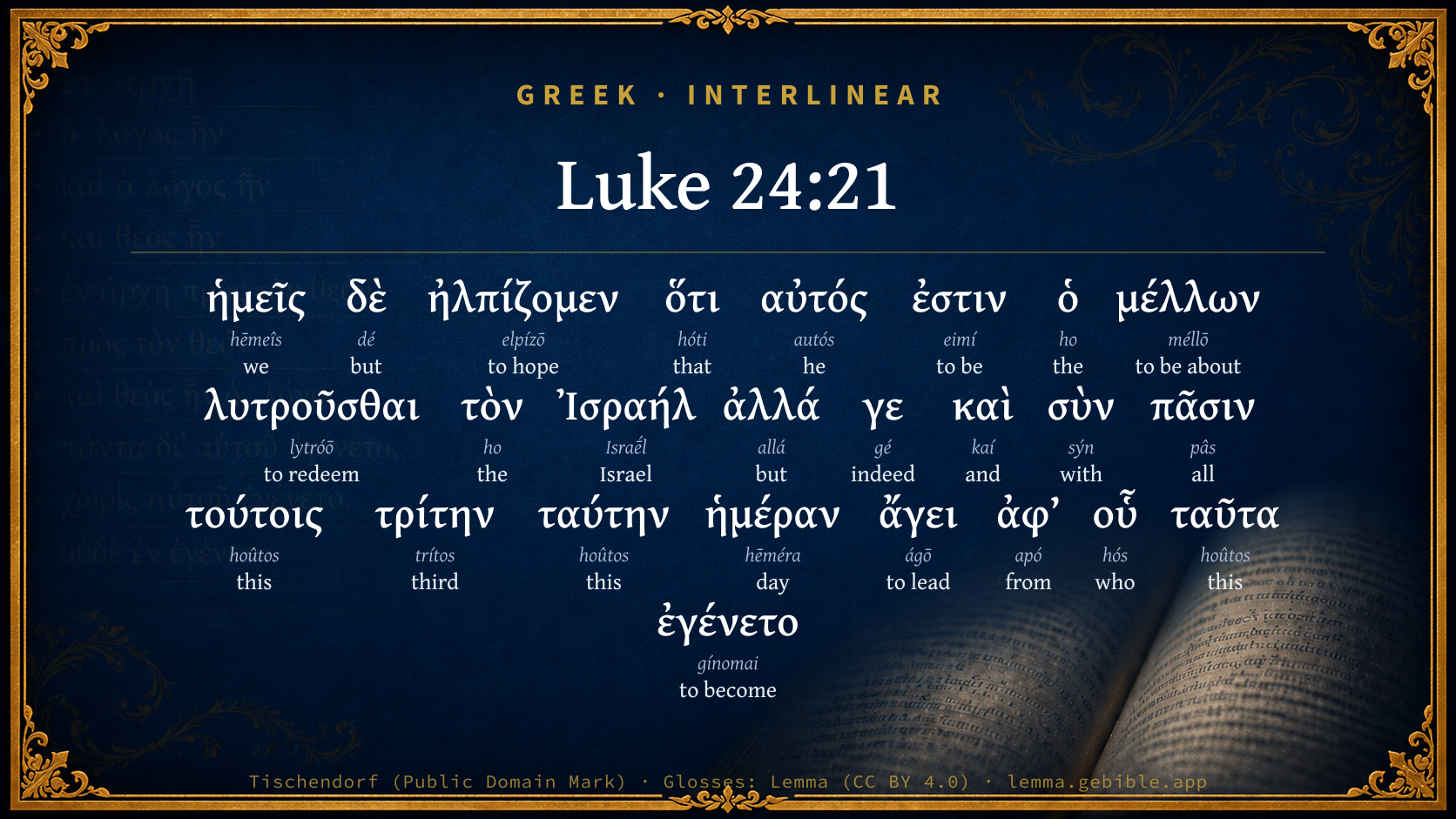
Greek (Tischendorf 8th ed.) Luke 24:21 appears in the Greek New Testament. The text above is from the Tischendorf 8th edition. Each word links to its Strong’s number and a concise gloss. Click any word for its full Thayer’s Greek Lexicon entry.
Download image
Cite this verse

Luke 24:21 (World English Bible). Public Domain. Lemma interlinear Bible study tool, https://lemma.gebible.app/v/luke/24/21.

Show BibTeX & RIS
BibTeX
RIS
English Translation
But we were hoping that it was he who would redeem Israel. Yes, and besides all this, it is now the third day since these things happened.
World English Bible · Public Domain
Highlights
  • 1 first appearance in the Greek New Testament
Full analysis ↓
Download a study sheet

One document with this verse’s original text, its word-by-word gloss line, the meaning frame, cross-references with their text, attributed commentary, and full source and license credits — printable, and it pastes into notes with its structure intact.

This verse Autodidact and up

Study sheet (.html) Plain text (.txt)

A passage Seminary Student

Up to 50 verses in one chapter. A passage sheet keeps up to 6 commentary sources and 12 cross-references per verse, in the order this page ranks them, and says so on the sheet whenever that leaves anything out. Ask for a single verse and you get the Autodidact verse sheet above.

Everything on this page stays free to read, with no account — the sheet is a download of what is already on screen, not access to it.

Want to remove ads? Support Godless Engineer
Compare translations 3

The same verse in 3 English versions, stacked beneath the original-language interlinear above. Click any original word for its lexicon entry.

Each is an independent rendering of the whole verse — the interlinear is not word-aligned to these translations.

Highlighted words mark where these versions differ — a whole-verse word diff, not a word-by-word alignment.

  • World English Bible Public Domain
    But we were hoping that it was he who would redeem Israel. Yes, and besides all this, it is now the third day since these things happened.
  • King James Version Public Domain
    But we trusted that it had been he which should have redeemed Israel: and beside all this, to day is the third day since these things were done.
  • unfoldingWord Literal Text CC BY-SA 4.0
    But we were hoping that he was the one going to redeem Israel. But indeed also with all these things, he is spending this third day since these things happened.

unfoldingWord Literal Text — © unfoldingWord, licensed CC BY-SA 4.0. Word-aligned USFM3 via Door43 (git.door43.org/unfoldingWord/en_ult).

Versions to compare (up to 4)

3 of 4 selected

Show all 19 translations

Every available English version of this verse, each an independent rendering of the whole verse.

  • World English Bible Public Domain
    But we were hoping that it was he who would redeem Israel. Yes, and besides all this, it is now the third day since these things happened.
  • Berean Standard Bible Public Domain
    But we were hoping He was the One who would redeem Israel. And besides all this, it is the third day since these things took place.
  • Majority Standard Bible Public Domain
    But we were hoping He was the One who would redeem Israel. And besides all this, today is the third day since these things took place.
  • King James Version Public Domain
    But we trusted that it had been he which should have redeemed Israel: and beside all this, to day is the third day since these things were done.
  • American Standard Version (1901) Public Domain
    But we hoped that it was he who should redeem Israel. Yea and besides all this, it is now the third day since these things came to pass.
  • Revised Version (1885) Public Domain
    But we hoped that it was he which should redeem Israel. Yea and beside all this, it is now the third day since these things came to pass.
  • Geneva Bible (1599) Public Domain
    But we trusted that it had bene he that should haue deliuered Israel, and as touching all these things, to day is ye third day, that they were done.
  • Douay-Rheims (1899) Public Domain
    But we hoped, that it was he that should have redeemed Israel: and now besides all this, to day is the third day since these things were done.
  • Young's Literal Translation Public Domain
    and we were hoping that he it is who is about to redeem Israel, and also with all these things, this third day is passing to-day, since these things happened.
  • Literal Standard Version CC BY-SA 4.0
    and we were hoping that it is He who is about to redeem Israel, and also with all these things, this third day is passing today since these things happened.
  • Unlocked Literal Bible CC BY-SA 4.0
    But we had confidence that he was the one who was going to redeem Israel. Yes, and what is more, it is now the third day since all these things happened.
  • unfoldingWord Literal Text CC BY-SA 4.0
    But we were hoping that he was the one going to redeem Israel. But indeed also with all these things, he is spending this third day since these things happened.
  • Darby Bible Public Domain
    But *we* had hoped that *he* was [the one] who is about to redeem Israel. But then, besides all these things, it is now, to-day, the third day since these things took place.
  • World Messianic Bible Public Domain
    But we were hoping that it was he who would redeem Israel. Yes, and besides all this, it is now the third day since these things happened.
  • Webster's Bible Public Domain
    But we trusted that it had been he who would have redeemed Israel: and besides all this, to-day is the third day since these things were done.
  • Free Bible Version CC BY-SA 4.0
    We had hoped he was the one who was going to rescue Israel. It's been three days now since all this happened.
  • Bible in Basic English Public Domain
    But we were hoping that he would be the Saviour of Israel. In addition to all this he has now let three days go by from the time when these things took place;
  • Text-Critical English NT CC BY 4.0
    But we had hoped that he was the one who would redeem Israel. And besides all this, today is now the third day since these things happened.
  • Tyndale New Testament (1534) Public Domain
    But we trusted that it shuld have bene he that shuld have delyvered Israel. And as touchynge all these thinges to daye is even the thyrd daye that they were done.

Literal Standard Version (2020), Covenant Press — licensed CC BY-SA 4.0. Text via the HelloAO Bible API (eBible.org). Unlocked Literal Bible (unfoldingWord) — licensed CC BY-SA 4.0. Text via the HelloAO Bible API (eBible.org). unfoldingWord Literal Text — © unfoldingWord, licensed CC BY-SA 4.0. Word-aligned USFM3 via Door43 (git.door43.org/unfoldingWord/en_ult). Free Bible Version, Dr. Jonathan Gallagher — licensed CC BY-SA 4.0. Text via the HelloAO Bible API (eBible.org).

Word by word

More ways to search: Search by grammar → Find every occurrence → Compare this word →

Practice this passage: Drill this verse → Learn its vocabulary →

λυτροῦσθαι
lytróō
G3084
“to redeem”
Verb, Present, Middle, Infinitive
Part of Speech
Verb
Tense
Present
Voice
Middle
Mood
Infinitive
Full Thayer's Definition

Origin: from G3083

TDNT: 09:49,5

1. to release on receipt of ransom 2. to redeem, liberate by payment of ransom a. to liberate b. to cause to be released to one's self by payment of a ransom c. to redeem d. to deliver: from evils of every kind, internal and external
  1. ἡμεῖς hēmeîs G2249 “we” Personal pronoun, 1st person, Nominative, Plural
  2. δὲ dé G1161 “but” Conjunction
  3. ἠλπίζομεν elpízō G1679 “to hope” Verb, Imperfect, Active, Indicative, 1st person, Plural
  4. ὅτι hóti G3754 “that” Conjunction
  5. αὐτός autós G846 “he” Personal pronoun, Nominative, Singular, Masculine
  6. ἐστιν eimí G1510 “to be” Verb, Present, Active, Indicative, 3rd person, Singular
  7. ὁ ho G3588 “the” Article, Nominative, Singular, Masculine
  8. μέλλων méllō G3195 “to be about” Verb, Present, Active, Participle, Nominative, Singular, Masculine
  9. τὸν ho G3588 “the” Article, Accusative, Singular, Masculine
  10. Ἰσραήλ Israḗl G2474 “Israel” Noun, Proper, indeclinable
  11. ἀλλά allá G235 “but” Conjunction
  12. γε gé G1065 “indeed” Particle
  13. καὶ kaí G2532 “and” Conjunction
  14. σὺν sýn G4862 “with” Preposition
  15. πᾶσιν pâs G3956 “all” Adjective, Dative, Plural, Neuter
  16. τούτοις hoûtos G3778 “this” Demonstrative pronoun, Dative, Plural, Neuter
  17. τρίτην trítos G5154 “third” Adjective, Accusative, Singular, Feminine
  18. ταύτην hoûtos G3778 “this” Demonstrative pronoun, Accusative, Singular, Feminine
  19. ἡμέραν hēméra G2250 “day” Noun, Accusative, Singular, Feminine
  20. ἄγει ágō G71 “to lead” Verb, Present, Active, Indicative, 3rd person, Singular
  21. ἀφ’ apó G575 “from” Preposition
  22. οὗ hós G3739 “who” Relative pronoun, Genitive, Singular, Masculine
  23. ταῦτα hoûtos G3778 “this” Demonstrative pronoun, Nominative, Plural, Neuter
  24. ἐγένετο gínomai G1096 “to become” Verb, Aorist, Middle deponent, Indicative, 3rd person, Singular

About this verse

These counts appear in no published source. They are computed here, from the morphology-tagged text and Lemma’s own curated glosses. What Lemma adds →

25
words
22
distinct lemmas
Gospels
section

Notable vocabulary

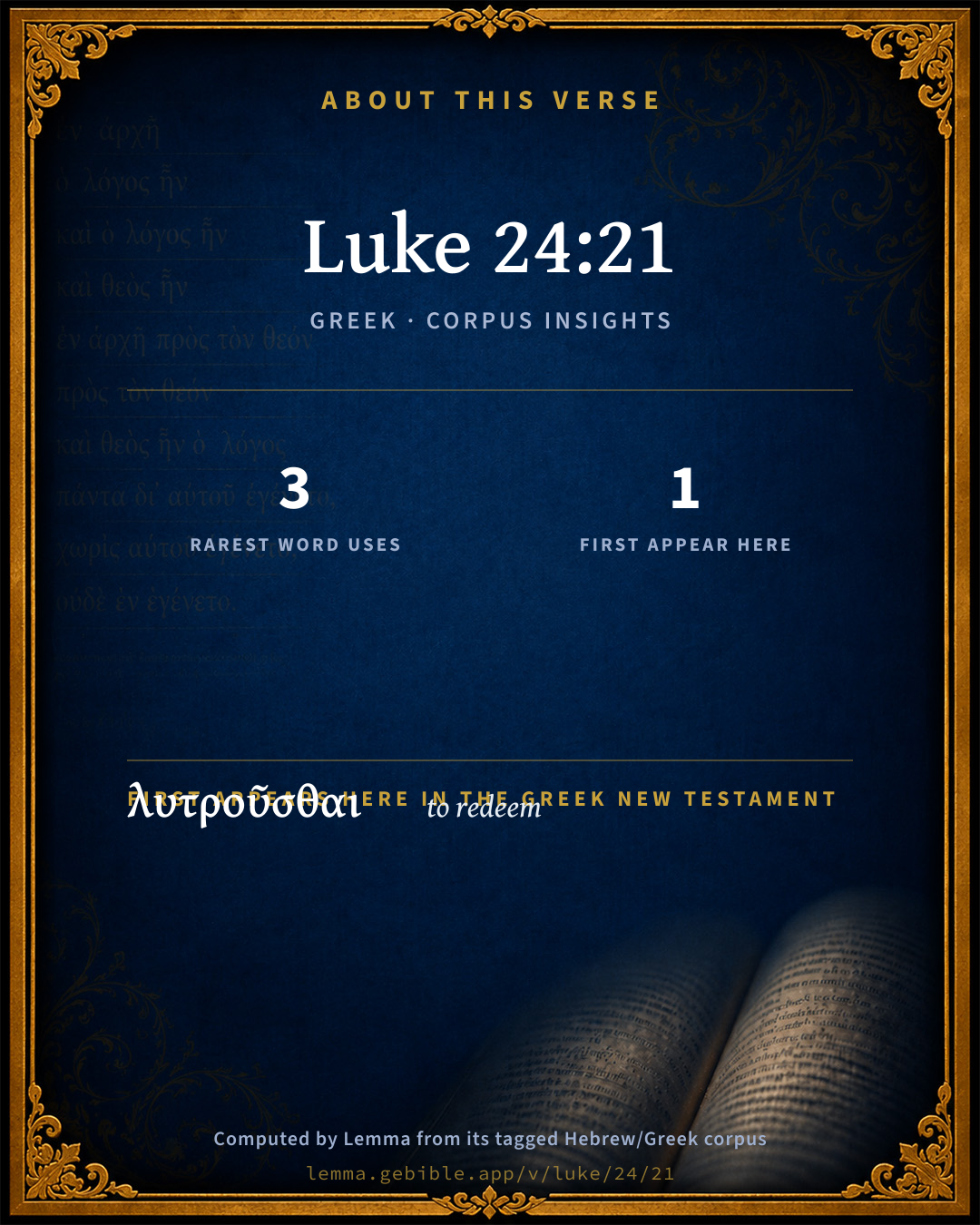
The rarest word here is λυτροῦσθαι to redeem G3084 — appearing just 3 times in the whole Greek New Testament.

First appearance in Scripture

This word makes its first canonical appearance in the Greek New Testament here:

  • λυτροῦσθαι to redeem G3084

Shared distinctive vocabulary

λυτροῦσθαι to redeem G3084 occurs in 3 verses of the Greek New Testament. Also found in:
Repetition

Words recur within this verse:

Cross-references

7

Topical passages linked to Luke 24:21 in the Treasury of Scripture Knowledge — connected by theme and wording, ordered by reader-vote popularity; previews shown in the World English Bible.

  • Luke 1:68 "Blessed be the Lord, the God of Israel, For he has visited and worked redemption for his people;
  • Isaiah 59:20 A Redeemer will come to Zion, and to those who turn from disobedience in Jacob, says Yahweh.
  • Luke 2:38 Coming up at that very hour, she gave thanks to the Lord, and spoke of him to all those who were looking for redemption in Jerusalem.
  • 1 Peter 1:18–19 knowing that you were redeemed, not with corruptible things, with silver or gold, from the useless way of life handed down from your fathers,
  • Psalms 130:8 He will redeem Israel from all their sins.
  • Acts 1:6 Therefore, when they had come together, they asked him, "Lord, are you now restoring the kingdom to Israel?"
  • Revelation 5:9 They sang a new song, saying, "You are worthy to take the book, And to open its seals: For you were killed, And bought us for God with your blood, Out of every tribe, language, people, and nation,

Cross-references courtesy of OpenBible.info (CC BY 4.0).

Commentary

Notes on Luke 24:21 from classic Christian and Jewish commentators (each source and its license shown beneath its notes). The classic Christian expositions comment on the surrounding passage and are grouped to its opening verse, so a note may address several verses; the Jewish commentaries on the Tanakh (Rashi and others) are per-verse, so they appear only where the commentator wrote on this verse.

Lemma curates 59 commentaries, every one of them public domain or Creative Commons licensed, each selected and text-cleaned for this edition rather than reprinted as found. About our sources →

Tyndale Open Study Notes

Tyndale Open Resources

24:21 We had hoped he was the Messiah: Literally we had hoped he was the one who would deliver Israel. This is a reference to the Messiah—the crucifixion had dashed their hopes.

Tyndale Open Study Notes — © Tyndale Open Resources, licensed CC BY-SA 4.0. Text via the HelloAO Bible API.

Bengel's Gnomon

Johann Albrecht Bengel

Luk 24:21. Σὺν πᾶσι τούτοις, besides all these things) Hebr. עם כל זה.—τρίτην, third) Therefore alter the death of Jesus they seem to have entertained some hope on the first and second day, which however they lay aside on that very day on which the hope is fulfilled.—ἄγει) used impersonally.

Bengel's Gnomon of the New Testament — English translation (T&T Clark, Edinburgh, 1860) — public domain. Text from a community e-Sword module.

Expositor's Greek Testament

ed. W. Robertson Nicoll

Luk 24:21 . ἡμεῖς δὲ , but we , on the other hand, as opposed to the priests and rulers. ἠλπίζομεν , were hoping; the hope dead or in abeyance now. But how wide asunder these disappointed ones from the rulers, ethically, in that they could regard such an one as Jesus as the Redeemer of Israel! λυτροῦσθαι is to be taken in the sense of Luk 1:68 ; Luk 1:74 . ἀλλά γε : these two particles stand together here contrary to the ordinary usage of Greek writers, who separate them by an intervening word. It is not easy to express the turn of feeling they represent. Does the ἐστιν in the previous clause mean that they think of Him as still living, hoping against hope on the ground of the women’s report, mentioned in the following clause, and does the ἀλλά γε express a swing of feeling away in the opposite direction of hopelessness? = we hoped, we would like to hope still; yet how can we? He is dead three days, and yet again on the other hand ( ἀλλά καὶ , Luk 24:22 ) there is a story going that looks like a resurrection. How true to life this alternation between hope and despair! σὺν πᾶσι τούτοις , in addition to all these things, i.e. , all that caused them to hope: prophetic gifts, marvellous power in word and work, favour with the people: there is the hard fact making hope impossible. ἄγει : probably to be taken impersonally = agitur , one lives this third day since. So Grotius and many others. Other suggestions are that χρόνος or ὁ Ἰησοῦς is to be understood ( cf. Act 19:38 ).

The Expositor's Greek Testament, edited by W. Robertson Nicoll (1897–1910) — public domain. Text from a community e-Sword module.

Jamieson, Fausset & Brown

Robert Jamieson, A. R. Fausset & David Brown

we trusted, &c.--They expected the promised Deliverance at His hand, but in the current sense of it, not by His death.

besides all this--not only did His death seem to give the fatal blow to their hopes, but He had been two days dead already, and this was the third. It is true, they add, some of our women gave us a surprise, telling us of a vision of angels they had at the empty grave this morning that said He was alive, and some of ourselves who went thither confirmed their statement; but then Himself they saw not. A doleful tale truly, told out of the deepest despondency.

Jamieson, Fausset & Brown — Commentary Critical and Explanatory on the Whole Bible (1871) — public domain (CC PDM 1.0). Text via the HelloAO Bible API.

Adam Clarke's Commentary

Verse 21. - 24. Cleopas paints the real state of his own mind in these verses. In his relation there is scarcely any thing well connected; important points are referred to, and not explained, though he considered the person to whom he spoke as entirely unacquainted with these transactions: his own hopes and fears he cannot help mixing with the narration, and throwing over the whole that confusion that dwells in his own heart. The narration is not at all in Luke's style; but as it is probable he was the other disciple who was present, and had heard the words of Cleopas, he gave them in that simple, natural, artless manner in which they were spoken. Had the account been forged, those simple, natural touches would not have appeared.

To-day is the third day] Our Lord had often said that he would rise again the third day; and though Alpheus had little hope of this resurrection, yet he could not help recollecting the words he had heard, especially as they seemed to be confirmed by the relation of the women, Lu 24:22-24.

Adam Clarke's Commentary on the Bible (1810–1826) — public domain. Text from a community e-Sword/MySword module.

Ellicott's Commentary for English Readers

(21) But we trusted.—The pronoun is emphatic. “We, the disciples, were hoping . . . ,”whatever might be the judgment of others.

Which should have redeemed Israel.—More exactly, He that is about to redeem . . . The two travellers belonged apparently to those who now, as at the time of the Nativity, were waiting for redemption in Jerusalem (Luk_2:38).

To day is the third day .—We note how naturally the disciples fall, from the first, into this method of describing the interval since the Crucifixion.

A Bible Commentary for English Readers, edited by Charles John Ellicott (1878–1897) — public domain. Text from a community e-Sword module.

The Cambridge Bible for Schools and Colleges

gen. ed. J. J. S. Perowne

21. we trusted] This would imply that now their hope was dimmed, if not quenched. This perhaps led to the reading ‘we trust’ (elpizomen for elpizomen) inand some inferior MSS., which Alford calls a “correction for decorum.”

which should have redeemed Israel] The form of the expected redemption is explained in Act_1:6.

to day is the third day] The words might be literally rendered ‘He is leading this third day.’ The expression seems to imply, ‘if there had been any hope it would have been confirmed before now.’

The Cambridge Bible for Schools and Colleges (gen. ed. J. J. S. Perowne; Cambridge University Press, 1878–1918) — public domain. Text from a community e-Sword module.

John Gill's Exposition

And when they found not his body,.... In the sepulchre, as they expected, and so could not do what they intended:

they came; they returned from the sepulchre with great haste, and in a very great fright, and came to the disciples, where they were assembled;

saying, that they had also seen a vision of angels. The Syriac and Persic versions add, "there"; at the sepulchre, for there were two of them at least, if not three; see Luk 24:4. They not only reported, that they could not find the body of Jesus, but also that they had seen some angels: or the sense may be, that they told them, that though they could not find the dead body of their Lord, yet they had seen him alive, as they did by the way, as they were returning, Mat 28:9 and also that a vision of angels had appeared to them:

which said that he was alive; see Luk 24:5. So that it was not a deception of their sight, they certainly saw both Christ and the angels; and were assured from their testimony, as well as by their own eyes and ears, that he was certainly risen: now, though this was so clear a point, and so well attested, the disciples knew not how to believe it; they were perplexed about it; they could neither receive it, nor discredit it; they hoped it might be so, but feared it was not.

John Gill's Exposition of the Whole Bible (1746–1763) — public domain (CC PDM 1.0). Text via the HelloAO Bible API.

Trapp's Complete Commentary

John Trapp

21 But we trusted that it had been he which should have redeemed Israel: and beside all this, to day is the third day since these things were done.

Ver. 21. But we trusted] q.d. Indeed now we cannot tell what to say to it. Here their hope hangs the wing extremely, their buckler is much battered, and needs beating out again. Ferendum et sperandum, speaking and hoping, said the philosopher. (οιστεον και ελπιστεον. Epictet.) And good men find it more easy to bear evil than to wait for good, Heb 10:36.

John Trapp, A Commentary or Exposition upon All the Books of the Old and New Testament (1647–1656) — public domain. Text from a community e-Sword module.

Albert Barnes' Notes on the Bible

We trusted - We hoped and expected.

Should have redeemed Israel - That he was the Messiah, who would have delivered the nation from the Romans.

Besides all this - It is to be observed that Cleopas states things just as they occurred to his own mind. There is little connection. His mind is confused and distracted. There were so many things that were remarkable in Jesus; there was so much evidence that he was the Messiah; their hopes had been so suddenly dashed by his death, and the succeeding events had been so wonderful, that his mind was confused, and he knew not what to think. The things which he now stated served to increase his perplexity. The expressions here are perfectly natural. They bespeak an agitated mind. They are simple touches of nature, which show that the book was not forged. If the book had been the work of imposture, this artless and perplexed narrative would not have been thought of.

Today is the third day ... - Jesus had foretold them that he would rise on the third day. This they did not understand; but it is not improbable that they looked to this day expecting something wonderful, and that the visit to the sepulchre had called it to their recollection, and they were more and more amazed when they put all these things together. As if they had said, “The third day is come, and we have not seen him. Yet we begin to remember his promise - the angels have informed us that he is alive - but we do not know how to put these things together, or what to make of them.”

Albert Barnes' Notes on the Bible (1834–1885) — public domain. Text from a community e-Sword/MySword module.

Haydock's Catholic Bible Commentary

We hoped, &c. as if they had lost their former hopes, or now knew not what to hope for: but perhaps, as St. Augustine observes, they might use this caution speaking before a stranger. (Witham) --- These two disciples were in the same error as the other Jews; who expected that the Messias would deliver them from subjection to strangers, and re-establish them in their ancient liberty. The cross and passion had been a subject of scandal and fall to them. They say, we did hope; as if their hopes were now at an end. What increased their diffidence was, that Christ had promised to rise again the third day, and some of the women had said that he really had risen. But they expected as public and glorious a manifestation of his resurrection, as his death had been ignominious and known to the whole world. Behold, now this is already the third day since these things are passed:; if he had wished to manifest his power, he should have done it already. Thus the disciples reason, as if the third day were already past, and as if it were certain that he was not risen again. So difficult a thing is it to believed what we very ardently wish? (Calmet) Proprium hoc miseros sequitur vitum

Nunquam rebus credere lætis.

George Leo Haydock (1774–1849), Haydock's Catholic Family Bible and Commentary, 1859 edition — public domain. Excludes Psalms (Douay-Rheims chapter numbering differs from Protestant) and Deuterocanonical books (Catholic canon only).

Whedon's Commentary on the Bible

Daniel D. Whedon

21. Should have redeemed Israel—Equivalent to saying, we once had faith that he would be the true Messiah. To redeem Israel, doubtless included the idea of removing the Roman yoke; but it also implied the introduction of a reign of truth and righteousness. Perhaps even the world would be renovated to its Edenic state, inhabited by the holy dead in their resurrection glory.

The third day—They doubtless here refer to the three days so often mentioned as connected with his death and burial. The period had passed, but the world is not renewed.

Daniel D. Whedon (gen. ed.), Commentary on the Old and New Testaments (1874–1909) — public domain. Text from a community e-Sword module.

The Pulpit Commentary

But we trusted that it had been he which should have redeemed Israel. And we who were his friends and followers, we thought we had found in him the Redeemer of Israel, King Messiah! Think! the Redeemer crucified! Although the Redeemer, in the sense they probably understood the word, was something very different to the sense we give to it, the idea was still something very lofty and sublime. It in-eluded, no doubt, much of earthly glory and dominion for Israel, but in some definite sense the Gentile world, too, would share in the blessings of Messiah. And to think of the shameful cross putting an end to all these hopes! And beside all this, to-day is the third day since these things were done.

But yet terrible and despairing as was the story of Cleopas and his friend, their tone was not quite hopeless; for they went on, "And now we have come to the third day since they crucified him." No doubt they dwelt a short space on the expression, "third day," telling the Stranger how their dead Master, when alive, had bade his friends watch for the third day from his death. The third day, he had told them, would be the day of his triumphant return to them; and, strangely enough, on the early morning of this third day, something did happen which had stirred, excited, and perplexed them. Certain women of their company, who had been early to the grave of the Master, meaning to embalm the corpse, found the sepulchre empty, and they came back reporting how they had seen a vision of angels there, who told them their Master lived. What did it all mean?

The Pulpit Commentary (1880–1919), ed. H.D.M. Spence-Jones & Joseph S. Exell — public domain. Text from a community e-Sword module.

John Wesley's Explanatory Notes

Today is the third day - The day he should have risen again, if at all.

John Wesley, Explanatory Notes Upon the Whole Bible (1754–1765) — public domain. Text via the GEBible commentary corpus.

Scofield Reference Notes

C. I. Scofield

trusted (See Scofield "Mat 3:2")

redeemed (See Scofield "Rom 3:24").

The Scofield Reference Bible (1917 edition), notes by C. I. Scofield — public domain. Text from a community e-Sword module.

The People's New Testament

B. W. Johnson

21. We hoped that it was he which should redeem Israel. They hoped. They did not now hope. Their hopes were buried.

B. W. Johnson's The People's New Testament with Notes (1889–1891) — public domain. Electronic text from the Christian Classics Ethereal Library (CCEL) ThML edition.

unfoldingWord translationNotes

Door43 World Missions Community

Connecting Statement:

The two men continue responding to Jesus.

who was going to redeem Israel

The Romans ruled over the Jews. AT: "who would free the Israelites from our Roman enemies" (See: Assumed Knowledge and Implicit Information)

Yes, and what is more,

This introduces another reason why they believed Jesus would not free Israel. AT: "Now that does not seem possible because"

the third day

The Jews counted any portion of a day as a day. Therefore, the day Jesus was raised was the "third day" because it followed the day of his burial and the Sabbath day. See how you translated this in Luke 24:7. (See: Ordinal Numbers)

since all these things happened

"since all the many actions that led up to the death of Jesus have taken place"

translationWords

free

Israel

unfoldingWord translationNotes — © Distant Shores Media and the Door43 World Missions Community, licensed CC BY-SA 4.0. Source: git.door43.org/Door43/en_tn.

Cambridge Greek Testament for Schools and Colleges

21. ἠλπίζομεν. ‘Our hope was.’ This would imply that now their hope was dimmed, if not quenched. This perhaps led to the reading ‘we trust’ (ἐλπίζομεν) in א and some inferior MSS., which Alford calls a “correction for decorum.”

λυτροῦσθαι. The form of the expected redemption is explained in Act 1:6.

ἀλλά γε. These words properly mean “yet at least,” and in classical writers are separated by some other word. They do not occur again in the N. T.

σὺν πᾶσιν τούτοις. ‘Along with (i.e. beside) all these things.’ The use of σὺν is more general than usual. See Winer, p. 488.

τρίτην ταύτην ἡμέραν ἄγει. The words might be literally rendered ‘He is leading this third day.’ The unexpressed nominative is not ὁ χρόνος or ὁ ἥλιος, but Ἰησοῦς. The expression seems to imply, ‘if there had been any hope it would have been confirmed before now.’

Cambridge Greek Testament for Schools and Colleges (Cambridge University Press, 1896; 21 vols, various authors incl. Carr, Maclear, Plummer, Farrar, Lumby, Moule, M. R. James, Simcox) — public domain. Text from a community e-Sword module.

Alford’s Greek Testament

Henry Alford

21.] ἠλπ. is a word of weakened trust, and shrinking from the avowal that they ‘believed’ this.

λυτροῦσθαι—in the theocratic sense—including both the spiritual and political kingdom: see ch. 1:68, 69, 74, 75, and compare Act 1:6.

σὺν π. τ., rightly rendered in E. V. beside all this: see reff.

ἄγει, not impersonal (as . and recently Wordsw.), nor to be supplied with a nom. case θεός or ὁ ἥλιος, &c., but spoken of Jesus. He is now in the third day, since &c. This is the usage of later Greek:—and the words are spoken not without a reference, in the mind of the speaker, to His promise of rising on the third day.

Henry Alford, The Greek Testament (1849–1861) — public domain. Text from a community e-Sword module.

International Critical Commentary

21. ἡμεῖς δὲ ἠλπίζομεν. “But we were hoping,” until His death put an end to our expectation, “that precisely He,” and no other, “was the one who should redeem Israel.” Comp. the use of ὁ μέλλων in 22:23; Mat 11:14; Joh 12:4.

λυτροῦσθαι. “To cause to be released to oneself, set free for oneself the slave of another, redeem, ransom.” Comp. Tit 2:4; Deu 13:5; 2Sa 7:23; Hos 13:14.

The οἱ δὲ εἶπαν justifies us in concluding that vv. 19-24 were spoken partly by Cleopas and partly by his companion. But the attempt to assign definite portions to each (19, 20 to Cl., 21a to the other, 21b to Cl., and so on) is wasted ingenuity.

ἀλλά γε. The combination occurs elsewhere in N.T. 1Co 9:2. In class. Grk. another particle must immediately follow, and with this the γε coalesces, as ἀλλά γε δή or ἀλλά γε τοι. Otherwise a word or more must” separate ἀλλά from γε. The force of the two is concessive. See Stallbaum on Plat. Rep. 1:331 B. The καί after ἀλλά γε is certainly genuine (B C L D 33, Arm.)

σὺν πᾶσιν τούτοις. Super hæc omnia (Vulg.): rather a lax use of σύν, Comp. Neh. v. 18; 3 Mac. 1:22. Syr-Sin. omits.

τρίτην ταύτην ἡμέραν ἄγει. The verb is probably impersonal. “one is keeping the third day, we are at the third day” (Grot. Beng. De W. Nösg. Wordsw. Hahn). Perhaps we may understand ὁ Ἰησοῦς (Mey. Godet, Weiss, Alf): the speaker has an impression that there was a prediction about the third day. But it is not probable that either ὁ ἥλιος, or ὁ οὐρανός or χρόνος or Ἰσραήλ is to be supplied. Comp. περιέχει ἐν γραφῇ (1Pe 2:6). The σήμερον after ἄγει (A P X Γ Δ etc. Syr-Pesh. Sah. Aeth. Vulg.) may be omitted (א B G, Boh. Syr-Cur. Syr-Sin. Arm.) with Tisch. WH. RV.

International Critical Commentary — older volumes (1896–1929), various authors — public domain. Text from a community e-Sword module.

Vincent's Word Studies in the New Testament

Marvin R. Vincent

Trusted [ηλπιζομαν] . More correctly, hoped. Imperfect : were hoping all the while.

Should have redeemed. Rev., more correctly, should redeem [λυτρουσθαι] . See on 1Pe 1:18.

Beside all this (sun pasin toutoiv). Lit., with all these things : his betrayal and crucifixion, etc.

Today is the third day (trithn tauthn hJmeran agei shmeron). The best texts omit today. The phrase forms an idiom which cannot be neatly rendered. Literally it is, "He (Christ) is passing [αγει] this day as the third." Rev., It is now the third day since, etc.

Marvin R. Vincent, Word Studies in the New Testament (1887–1900) — public domain. Text from a community e-Sword/MySword module.

Lesson kit

Teaching starters — assembled from the data on this page, not authored interpretation. Every prompt links to the verse data it draws on. Edit before teaching.

Luke, in the Gospels, opens this verse with 25 words (22 distinct Greek lemmas). Its most distinctive word is lytróō (“to redeem”). A historical commentator’s framing appears above. Read the whole chapter for the surrounding context.

Discussion questions

  1. How does “to redeem” (lytróō) shape what this verse is saying?
  2. The word “to redeem” first appears here in Scripture. What is being introduced at this debut?
  3. Titus 2:14 shares the word «to redeem» with this verse. How do the two illuminate each other?
  4. “this” occurs 3× in this one verse. What is the effect of the repetition?
  5. These translations render this verse differently. What is at stake in choosing one wording over another?
  6. Reading how Tyndale Open Study Notes and Bengel's Gnomon read this verse, where do the two commentators agree and where do they part?

Things to notice

  • 1 word makes its first canonical appearance in Scripture here.
  • These translations choose different wording for 22 words in this verse.
  • “this” occurs 3× in this single verse.
  • 22 distinct Greek lemmas span 25 words in this verse.

Reading settings

Reading text

Shown beneath each verse's original-language words.

Old Testament
Old Testament edition

Read the OT as the Masoretic Hebrew (MT) or the Greek Septuagint (LXX).

English shown for the Greek Septuagint (in the Hebrew ↔ Greek comparison).

Comparing translations? Open the Compare panel on any verse page to stack up to four side by side.