John 8:20

Greek (Tischendorf 8th ed.) John 8:20 appears in the Greek New Testament. The text above is from the Tischendorf 8th edition. Each word links to its Strong’s number and a concise gloss. Click any word for its full Thayer’s Greek Lexicon entry.
Download image
Cite this verse

John 8:20 (World English Bible). Public Domain. Lemma interlinear Bible study tool, https://lemma.gebible.app/v/john/8/20.

Show BibTeX & RIS
BibTeX
RIS
English Translation
Jesus spoke these words in the treasury, as he taught in the temple. Yet no one arrested him, because his hour had not yet come.
World English Bible · Public Domain
Download a study sheet

One document with this verse’s original text, its word-by-word gloss line, the meaning frame, cross-references with their text, attributed commentary, and full source and license credits — printable, and it pastes into notes with its structure intact.

This verse Autodidact and up

Study sheet (.html) Plain text (.txt)

A passage Seminary Student

Up to 50 verses in one chapter. A passage sheet keeps up to 6 commentary sources and 12 cross-references per verse, in the order this page ranks them, and says so on the sheet whenever that leaves anything out. Ask for a single verse and you get the Autodidact verse sheet above.

Everything on this page stays free to read, with no account — the sheet is a download of what is already on screen, not access to it.

Want to remove ads? Support Godless Engineer
Compare translations 3

The same verse in 3 English versions, stacked beneath the original-language interlinear above. Click any original word for its lexicon entry.

Each is an independent rendering of the whole verse — the interlinear is not word-aligned to these translations.

Highlighted words mark where these versions differ — a whole-verse word diff, not a word-by-word alignment.

  • World English Bible Public Domain
    Jesus spoke these words in the treasury, as he taught in the temple. Yet no one arrested him, because his hour had not yet come.
  • King James Version Public Domain
    These words spake Jesus in the treasury, as he taught in the temple: and no man laid hands on him; for his hour was not yet come.
  • unfoldingWord Literal Text CC BY-SA 4.0
    He said these words in the treasury, teaching in the temple, and no one arrested him, because his hour had not yet come.

unfoldingWord Literal Text — © unfoldingWord, licensed CC BY-SA 4.0. Word-aligned USFM3 via Door43 (git.door43.org/unfoldingWord/en_ult).

Versions to compare (up to 4)

3 of 4 selected

Show all 19 translations

Every available English version of this verse, each an independent rendering of the whole verse.

  • World English Bible Public Domain
    Jesus spoke these words in the treasury, as he taught in the temple. Yet no one arrested him, because his hour had not yet come.
  • Berean Standard Bible Public Domain
    He spoke these words while teaching in the temple courts, near the treasury. Yet no one seized Him, because His hour had not yet come.
  • Majority Standard Bible Public Domain
    Jesus spoke these words while teaching in the temple courts, near the treasury. Yet no one seized Him, because His hour had not yet come.
  • King James Version Public Domain
    These words spake Jesus in the treasury, as he taught in the temple: and no man laid hands on him; for his hour was not yet come.
  • American Standard Version (1901) Public Domain
    These words spake he in the treasury, as he taught in the temple: and no man took him; because his hour was not yet come.
  • Revised Version (1885) Public Domain
    These words spake he in the treasury, as he taught in the temple: and no man took him; because his hour was not yet come.
  • Geneva Bible (1599) Public Domain
    These wordes spake Iesus in the treasurie, as hee taught in the Temple, and no man layde handes on him: for his houre was not yet come.
  • Douay-Rheims (1899) Public Domain
    These words Jesus spoke in the treasury, teaching in the temple: and no man laid hands on him, because his hour was not yet come.
  • Young's Literal Translation Public Domain
    These sayings spake Jesus in the treasury, teaching in the temple, and no one seized him, because his hour had not yet come;
  • Literal Standard Version CC BY-SA 4.0
    Jesus spoke these sayings in the treasury, teaching in the temple, and no one seized Him, because His hour had not yet come;
  • Unlocked Literal Bible CC BY-SA 4.0
    He said these words in the treasury as he taught in the temple, and no one arrested him because his hour had not yet come.
  • unfoldingWord Literal Text CC BY-SA 4.0
    He said these words in the treasury, teaching in the temple, and no one arrested him, because his hour had not yet come.
  • Darby Bible Public Domain
    These words spoke he in the treasury, teaching in the temple; and no one took him, for his hour was not yet come.
  • World Messianic Bible Public Domain
    Yeshua spoke these words in the treasury, as he taught in the temple. Yet no one arrested him, because his hour had not yet come.
  • Webster's Bible Public Domain
    These words Jesus spoke in the treasury, as he taught in the temple: and no man laid hands on him, for his hour was not yet come.
  • Free Bible Version CC BY-SA 4.0
    Jesus explained this while he was teaching near the Temple treasury. Yet no one arrested him because his time had not yet come.
  • Bible in Basic English Public Domain
    Jesus said these words in the place where the offerings were stored, while he was teaching in the Temple: but no man took him because his time was still to come.
  • Text-Critical English NT CC BY 4.0
    (Jesus spoke these words in the treasury as he taught in the temple courts. But no one arrested him, because his hour had not yet come.)
  • Tyndale New Testament (1534) Public Domain
    Then sayde Iesus agayne vnto them. I goo my waye and ye shall seke me and shall dye in youre synnes. Whyther I goo thyther can ye not come.

Literal Standard Version (2020), Covenant Press — licensed CC BY-SA 4.0. Text via the HelloAO Bible API (eBible.org). Unlocked Literal Bible (unfoldingWord) — licensed CC BY-SA 4.0. Text via the HelloAO Bible API (eBible.org). unfoldingWord Literal Text — © unfoldingWord, licensed CC BY-SA 4.0. Word-aligned USFM3 via Door43 (git.door43.org/unfoldingWord/en_ult). Free Bible Version, Dr. Jonathan Gallagher — licensed CC BY-SA 4.0. Text via the HelloAO Bible API (eBible.org).

Word by word

More ways to search: Search by grammar → Find every occurrence → Compare this word →

Practice this passage: Drill this verse → Learn its vocabulary →

γαζοφυλακίῳ
gazophylákion
G1049
“storehouse”
Noun, Dative, Singular, Neuter
Part of Speech
Noun
Case
Dative
Number
Singular
Gender
Neuter
Full Thayer's Definition

Origin: from G1047 and G5438

TDNT: None

1. a repository of treasure, especially of public treasure, a treasury
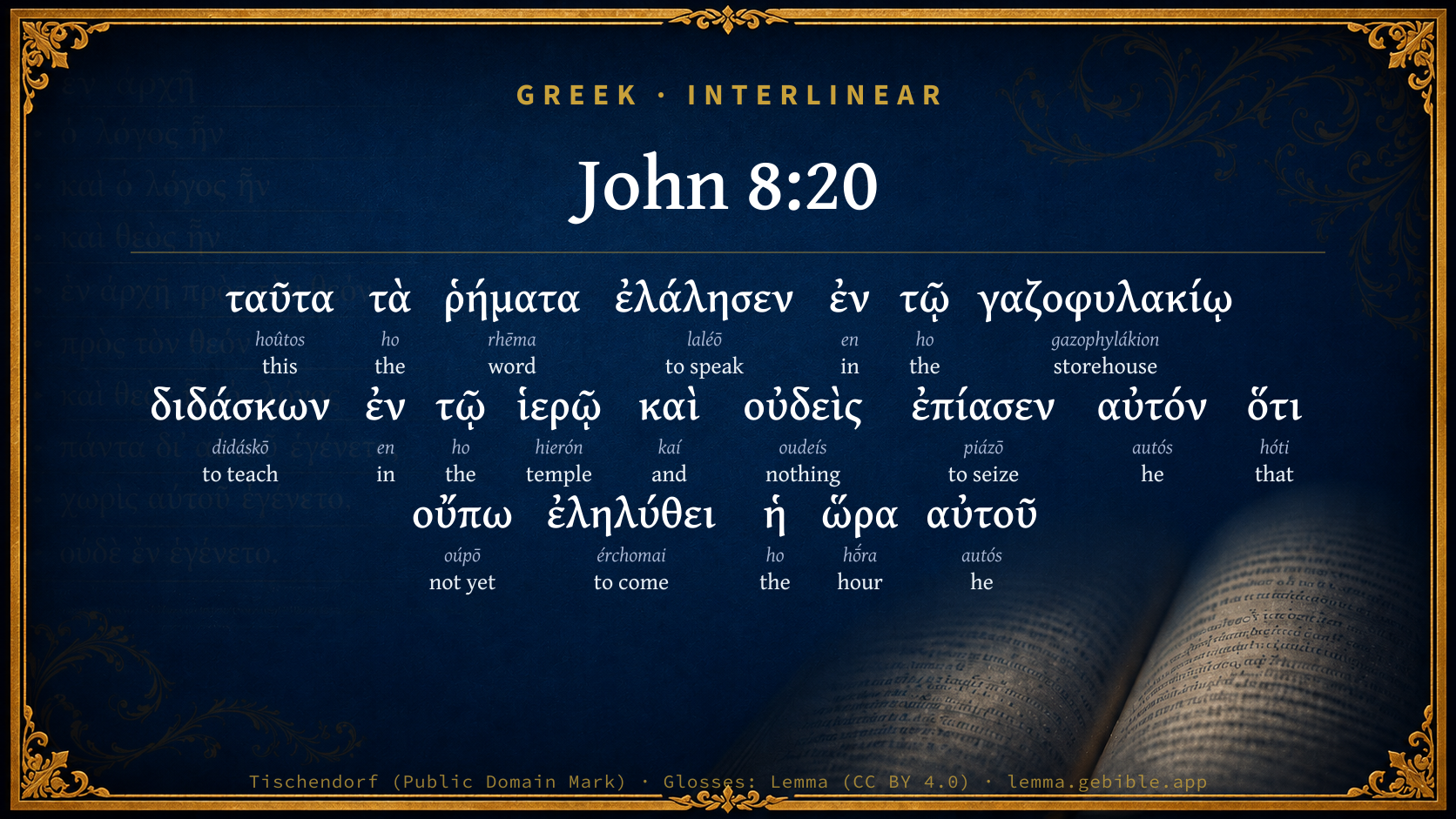
  1. ταῦτα hoûtos G3778 “this” Demonstrative pronoun, Accusative, Plural, Neuter
  2. τὰ ho G3588 “the” Article, Accusative, Plural, Neuter
  3. ῥήματα rhēma G4487 “word” Noun, Accusative, Plural, Neuter
  4. ἐλάλησεν laléō G2980 “to speak” Verb, Aorist, Active, Indicative, 3rd person, Singular
  5. ἐν en G1722 “in” Preposition
  6. τῷ ho G3588 “the” Article, Dative, Singular, Neuter
  7. διδάσκων didáskō G1321 “to teach” Verb, Present, Active, Participle, Nominative, Singular, Masculine
  8. ἐν en G1722 “in” Preposition
  9. τῷ ho G3588 “the” Article, Dative, Singular, Neuter
  10. ἱερῷ hierón G2411 “temple” Noun, Dative, Singular, Neuter
  11. καὶ kaí G2532 “and” Conjunction
  12. οὐδεὶς oudeís G3762 “nothing” Adjective, Nominative, Singular, Masculine, Negative
  13. ἐπίασεν piázō G4084 “to seize” Verb, Aorist, Active, Indicative, 3rd person, Singular
  14. αὐτόν autós G846 “he” Personal pronoun, Accusative, Singular, Masculine
  15. ὅτι hóti G3754 “that” Conjunction
  16. οὔπω oúpō G3768 “not yet” Adverb, Negative
  17. ἐληλύθει érchomai G2064 “to come” Verb, Pluperfect, Active, Indicative, 3rd person, Singular
  18. ἡ ho G3588 “the” Article, Nominative, Singular, Feminine
  19. ὥρα hṓra G5610 “hour” Noun, Nominative, Singular, Feminine
  20. αὐτοῦ autós G846 “he” Personal pronoun, Genitive, Singular, Masculine

About this verse

These counts appear in no published source. They are computed here, from the morphology-tagged text and Lemma’s own curated glosses. What Lemma adds →

21
words
16
distinct lemmas
Gospels
section

Notable vocabulary

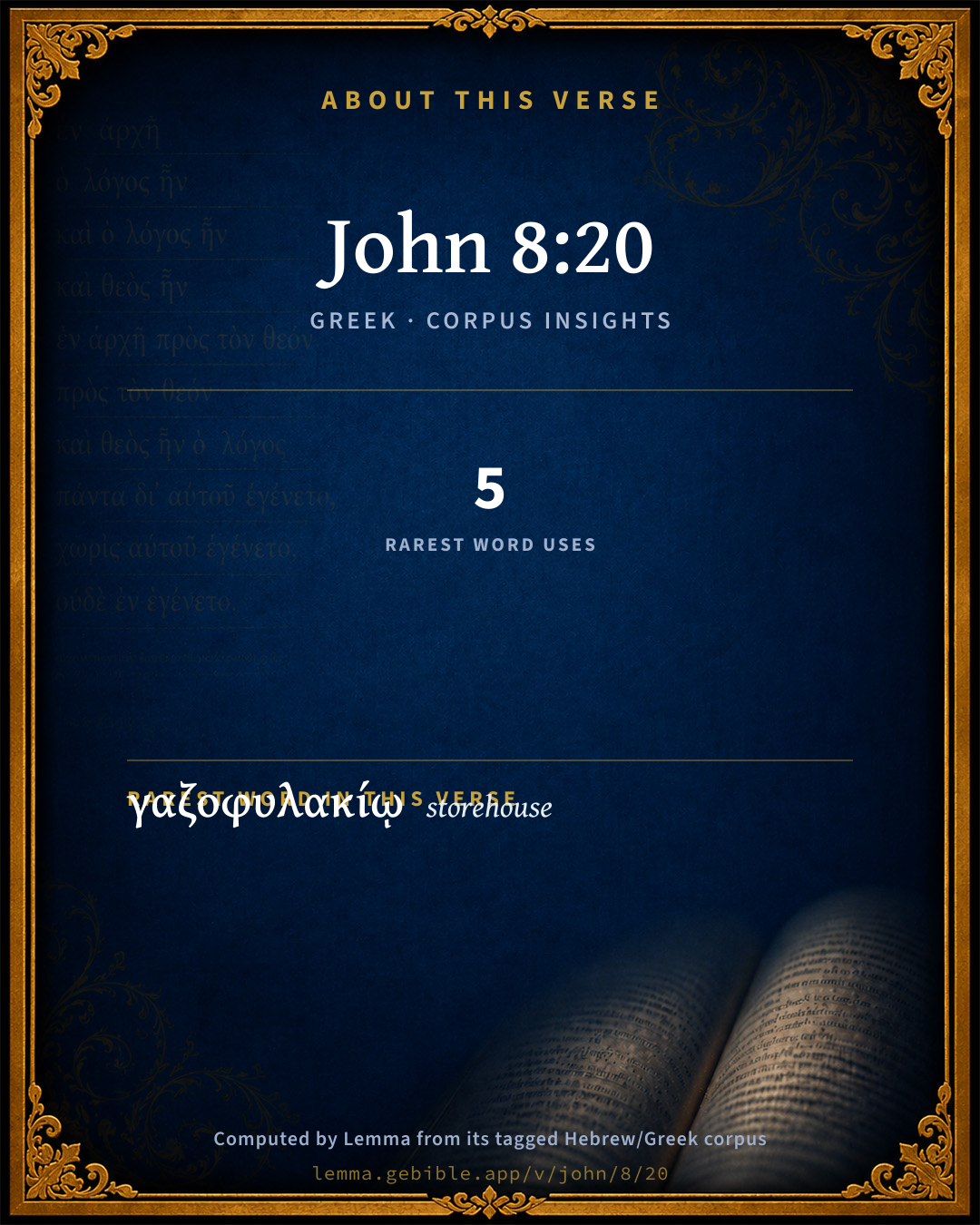
The rarest word here is γαζοφυλακίῳ storehouse G1049 — appearing just 5 times in the whole Greek New Testament.

Shared distinctive vocabulary

γαζοφυλακίῳ storehouse G1049 occurs in 4 verses of the Greek New Testament. Also found in:

Repetition

Words recur within this verse:

Cross-references

12

Topical passages linked to John 8:20 in the Treasury of Scripture Knowledge — connected by theme and wording, ordered by reader-vote popularity; previews shown in the World English Bible.

  • John 7:30 They sought therefore to take him; but no one laid a hand on him, because his hour had not yet come.
  • Mark 12:41 Jesus sat down opposite the treasury, and saw how the multitude cast money into the treasury. Many who were rich cast in much.
  • John 7:8 You go up to the feast. I am not yet going up to this feast, because my time is not yet fulfilled."
  • Matthew 27:6 The chief priests took the pieces of silver, and said, "It's not lawful to put them into the treasury, since it is the price of blood."
  • Mark 12:43 He called his disciples to himself, and said to them, "Most assuredly I tell you, this poor widow gave more than all those who are giving into the treasury,
  • John 7:44 Some of them would have arrested him, but no one laid hands on him.
  • 1 Chronicles 9:26 for the four chief porters, who were Levites, were in an office of trust, and were over the chambers and over the treasuries in the house of God.
  • Luke 13:31–33 On that same day, some Pharisees came, saying to him, "Get out of here, and go away, for Herod wants to kill you."
  • Luke 20:19 The chief priests and the scribes sought to lay hands on Him that very hour, but they feared the people--for they knew He had spoken this parable against them.
  • John 8:59 Therefore they took up stones to throw at him, but Jesus was hidden, and went out of the temple, having gone through the midst of them, and so passed by.
  • John 10:39 They sought again to seize him, and he went out of their hand.
  • John 11:9–10 Jesus answered, "Aren't there twelve hours of daylight? If a man walks in the day, he doesn't stumble, because he sees the light of this world.

Cross-references courtesy of OpenBible.info (CC BY 4.0).

Commentary

Notes on John 8:20 from classic Christian and Jewish commentators (each source and its license shown beneath its notes). The classic Christian expositions comment on the surrounding passage and are grouped to its opening verse, so a note may address several verses; the Jewish commentaries on the Tanakh (Rashi and others) are per-verse, so they appear only where the commentator wrote on this verse.

Lemma curates 59 commentaries, every one of them public domain or Creative Commons licensed, each selected and text-cleaned for this edition rather than reprinted as found. About our sources →

The Biblical Illustrator

Joseph S. Exell

Joh_8:20

These words spake Jesus in the Treasury

The Treasury

From Mar_12:41 and Luk_21:1 it is clear that this word was applied to the brazen trumpet-shaped chests placed in the Court of the Women for the reception of alms.

There were thirteen of them, and each bore an inscription showing to what purpose the alms placed in it would be devoted. Here the word is apparently used of the place itself, in which the chests were deposited. This notice is interesting in many ways. The Court of the Women was one of the most public places in the Temple area. Christ taught there openly and fearlessly. The chamber in which the Sanhedrim held their session was between the Court of the Women and that of the Men. They had on that or the previous day been assembled to take counsel against Him (chap. 7:45-52). This gives point to the words which here follow. (Archdeacon Watkins.)

No man laid hands on Him; for His hour was not yet come

Divine Providence

I. EXERTS A RESTRAINING POWER ON WICKED MEN. No man, etc. Why? Jewish rage was almost at its height; the Sanhedrims lacked neither disposition, muscular power, nor public cooperation. It was because His hour was not yet come. There was a mysterious power holding them back, an invisible hand restraining them. In relation to this restraining power of Gods moral government of the world, note

1. It is not always a matter of consciousness. Sometimes, it may be, men feel that they are reined in, some mysterious power preventing them from doing what they desire. History presents us with monsters that have felt themselves like caged lions. But as a rule the restraining force is so subtle, so delicate, that men are unconscious of it.

2. It interferes not with human freedom. A man is not free from the guilt of a wrong act because he has not the power or the opportunity to embody it. The guilt is in the desire, the volition. As a man thinketh in his heart, so is he. At first sight it seems morally absurd that God should restrain a man from committing a crime, and yet hold him guilty for it. The solution is here: the crime is in the wish.

3. It is an incalculable advantage to the race. What was in the Alexanders, the Caligulas, the Napoleons, the Lauds, and the Bonners, is for the most part in every unregenerate soul. Were there no restraining hand upon depraved hearts, all social decency, order, peace, and enjoyment would be at an end. The world would be a Pandemonium. We rejoice that He who reigns in the ocean and keeps it within bounds, holds in the passions and impulses of the depraved soul. The kings heart is in the hand of the Lord, etc.

II. HAS SETTLED PERIODS FOR THE DEVELOPMENT OF EVENTS. For His hour was not yet come. Christ recognized that there was a particular hour or crisis for everything He had to do. There was an hour for the commence, merit of His miracles, for His baptism, for His death. His death was the hour of hours. Father, the hour has come. God has appointed scenes in space and in duration for all things that occur in His vast dominion. Nothing He allows to be done in one scene that is intended to occur in another, nothing in one season that is fixed for another. To everything there is a season. Every orb that rolls through immensity has a point it is bound to reach, and an hour; it is never behind its time. So it is not only in the epochs and eras of human history, but in all the events of individual life. Mans decrees and purposes often fail from the fickleness of his own mind, from his want of foresight, and from his want of power. It is altogether otherwise with the designs of the Almighty. When His set time for working comes, not all the power in the universe can stay His hand. When we first look abroad, indeed, upon the busy field of human affairs, and observe the numerous actors, all moving, planning, arranging, we may be tempted for the moment to imagine that destiny itself is in their hands. But when we have looked a little longer and have seen all their schemes deranged, and a result emerging the very opposite, it may be, we begin to discover that there is a power out of sight mightier than all--One whose purposes are from everlasting to everlasting, whose counsel shall stand, and who will do all His pleasure. (D. Thomas, D. D.)

The Biblical Illustrator, edited by Joseph S. Exell (c. 1880s–1900s) — public domain. Text from a community e-Sword module.

Joseph Benson's Commentary

Joh 8:20. These words spake Jesus in the treasury — Which was a certain part of the women’s court, where the chests were placed for receiving the offerings of those who came to worship; and consequently was a place of great concourse. And no man laid hands on him — Though he so plainly intimated that God was his Father, and charged the Jews with being ignorant of him, while they boasted that he was in a peculiar sense their God; yet, their spirits were kept under such a powerful, though secret restraint, that no one seized him; which was the more wonderful, as it was a place much frequented by his greatest enemies, and from which it would not have been easy for him to have escaped without a miracle; for his hour was not yet come — In which he was, by divine permission, to be delivered into the hands of these wicked men.

Joseph Benson's Commentary on the Old and New Testaments (1811–1818) — public domain. Text from a community e-Sword module.

Tyndale Open Study Notes

Tyndale Open Resources

8:20 The Treasury was located in the section of the Temple called the Court of the Women. Jesus often taught there so that both men and women could hear him (Mark 12:41). • his time: See notes on John 2:4; 12:23.

Tyndale Open Study Notes — © Tyndale Open Resources, licensed CC BY-SA 4.0. Text via the HelloAO Bible API.

Bengel's Gnomon

Johann Albrecht Bengel

Joh 8:20. Ἐν τῷ γαζοφυλακίῳ, in the treasury) in that place, where any one might easily have been taken; where there was a very great crowd of men.—διδάσκων, teaching) The Didacticks of Jesus may be here considered, especially from the means of judging furnished by John. Christ, the Teacher, one, true, and good. One, Mat 23:18, One is your διδάσκαλος; Joh 8:10, One is your καθηγητής, even Christ], of the highest dignity, Joh 8:8; power, Joh 8:9, “One is your Father, which is in heaven;” and authority, Joh 8:10. He is the true teacher, John 7; for He was sent by God, and teaches the truth [Joh 8:18, He that seeketh His glory that sent Him, the same is true, and no unrighteousness is in Him.] Good; apt to teach, 2 Timothy 2 [Joh 8:24], Three kinds of teachers are distinguished in Matthew 23 : Prophets, Wise men, Scribes. He did not Himself bear the title of a Scribe, but He left it to His disciples, Mat 13:52, “Every scribe, which is instructed unto the kingdom of heaven.” He had no need of learning, Joh 7:15. Only once He read, Luk 4:17 [viz. the book of Isaiah, in the synagogue of Nazareth], He found the place [where it was written, The Spirit of the Lord is upon Me, etc.] Only once He wrote, Joh 8:6. Thus then He did not write books in His own name, as the apostles did, nor did He use the apparatus of books; yet He dictated some epistles, Revelation 1 [Joh 8:11, What thou seest write in a book, and send it unto the Seven Churches—in Asia]. There remain the two titles, Wisdom and Prophet, applied to Him by implication, Mat 12:41-42, “Behold, a greater than Jonas is here:—Behold, a greater than Solomon is here.” The name, Prophet, is otherwise greater than that of Wisdom. In the case of Christ, the name, Wisdom, is in some measure more sublime than Prophet. He prayed, ever following the Father’s commands. He sweetly drew disciples to Himself; 1) as recorded in Joh 1:38, etc.; comp. ch. Joh 8:30; John 2) in Luke, etc. He taught them in order, first, concerning His own person, concerning Himself as the Christ, 1) in the presence of the people; 2) in the presence of His adversaries; 3) by themselves apart: moreover also concerning His passion and resurrection; He taught them first in plain language, afterwards by parables, Matthew 13; first at a marriage feast, afterwards on other occasions. He taught the people in one way, the Pharisees in another way, the disciples of John in another, His own disciples in another. He taught concerning the fasting of the disciples of John, concerning the baptism of John, Matthew 21, concerning the tribute-money, etc. He taught by His works, rather than by His words, Mat 11:1, etc. [To the disciples of John, inquiring, “Art Thou He that should come?” He replied, Go and show John again those things which ye do hear and see. The blind receive their sight, etc.] He taught also by gesture and look, Luk 20:17, “He beheld them, and said,” etc. [ἐμβλέψας]. He avoided celebrity and a crowd, Matthew 12 [16–21]. He taught by asking questions Himself: He taught also those who asked Him questions. He also observed a distinction in the disciples among one another. He taught in one way before the resurrection, and in another way after the resurrection. His prediction of His passion was, 1) enigmatical; 2) subsequently plain and open. His valedictory address followed, in fine, His departure itself, 1) at His passion; 2) at His ascension. He did not give over, until He was able to say, Now ye believe, Joh 16:31. He confirmed His doctrine out of the Scriptures and by miracles. He desired the disciples to learn by experimental proof, Joh 16:22-23, at the beginning, “In that day ye shall ask Me nothing” [ἐρωτήσετε]. He wisely took His opportunities, John 4. [The woman of Samaria at the well]. In a short interview on each occasion, He taught Nathanaël, and the Samaritan woman, what the disciples had taken several years to learn. Before the more elevated class of hearers He set elevated truths: John 3.[Nicodemus], He gradually opened out His subject: Joh 16:4; Joh 16:12, “I have yet many things to say unto you; but ye cannot bear them now;” Joh 11:13. He did not state all things altogether plainly; but wrapt them up in appropriate enigmatical forms. Many err by indiscriminate perspicuity. Our style of writing should not pass beyond the accustomed order of doctrinal teaching: if in any instance it shall be different, it will not glide off to philosophical aphorisms, but will betake itself to Holy Scripture. Moreover Christ did not remain in one place, nor always with the same persons. See Joh 4:44, “He left His own country for Galilee, testifying that a prophet is not in honour in his own country.” He had the powers of a good teacher, and exhibited them sweetly and gently; Matthew 11; Luke 4. He sent forth twelve disciples, afterwards seventy. He gradually taught them to pray; Luk 11:1; Joh 16:24, etc., “Hitherto have ye asked nothing in My name: ask, and ye shall receive, that your joy may he full.”—οὐδεὶς ἐπίασεν, no one laid hands on Him) although they attempted it.

Bengel's Gnomon of the New Testament — English translation (T&T Clark, Edinburgh, 1860) — public domain. Text from a community e-Sword module.

Meyer's Critical & Exegetical Commentary

Heinrich August Wilhelm Meyer

Joh_8:20. Ταῦτα τὰ ῥήματα] Joh_8:12-13. Godet arbitrarily imports into the text words so important. Comp. Joh_6:50.

ἐν τῷ γαζοφυλ.] At the treasury. On ἐν, as denoting immediate neighbourhood, see Kühner, ad Xen. Anab. iv. 8. 22; Ast, Lex. Plat. I. p. 700; Winer, p. 360 [E. T. p. 481], who, however, is of opinionthough it cannot be substantiatedthat the place itself where the treasury stood was called γαξοφυλ.; so also Tholuck, Brückner. Respecting the γαζοφυλάκιον, which consisted of thirteen brazen chests destined to receive the taxes and charitable offerings in the temple, see on Mar_12:41. In a place so much frequented in the forecourt of the women did Jesus thus speak,and no one laid hands on Him.

καὶ οὐδεὶς, etc.] Historical refrain, constituting a kind of triumphal (comp. Joh_7:30) close to the delivery of this discourse.

Meyer — Critical and Exegetical Commentary on the New Testament — English translation by Peter Christie, edited by Frederick Crombie (T&T Clark, 1880) — public domain. Text from a community e-Sword module.

Geneva Bible (1599)

Geneva Bible translators

We live and die at the pleasure of God and not of men: Therefore this one thing remaineth that we go forward constantly in our vocation.

This was some place appointed for the gathering of the offerings.

Geneva Bible (1599) marginal notes — public domain. Text via Bolls.life.

Jamieson, Fausset & Brown

Robert Jamieson, A. R. Fausset & David Brown

These words spake Jesus in the treasury--a division, so called, of the fore court of the temple, part of the court of the women [JOSEPHUS, Antiquities, 19.6.2, &c.], which may confirm the genuineness of Joh 8:2-11, as the place where the woman was brought.

no man laid hands on him, &c.--(See on Joh 7:30). In the dialogue that follows, the conflict waxes sharper on both sides, till rising to its climax, they take up stones to stone him.

Jamieson, Fausset & Brown — Commentary Critical and Explanatory on the Whole Bible (1871) — public domain (CC PDM 1.0). Text via the HelloAO Bible API.

Adam Clarke's Commentary

Verse 20. The treasury] Lightfoot observes, from the rabbins, that the treasury was in what was called the court of the women-that there were thirteen chests in it; in the thirteenth only the women were permitted to put their offerings. Probably the other twelve were placed there in reference to the twelve tribes; each perhaps inscribed with the name of one of Jacob's twelve sons.

It seems that our Lord sometimes sat in this court to teach the people. See Mr 12:41, &c.

His hour was not yet come.] The time was not arrived, in which he had determined to give himself up into the hands of his crucifiers.

Adam Clarke's Commentary on the Bible (1810–1826) — public domain. Text from a community e-Sword/MySword module.

John Calvin's Commentaries

20. These words spoke Jesus in the treasury. The treasury was a part of the temple where the sacred offerings were laid up. It was a much frequented place, and hence we infer that this sermon was delivered by Christ amidst a large assembly of men, so that the people had less excuse. The Evangelist likewise holds out to us the astonishing power of God in this respect, that they were constrained to endure Christ openly teaching in the temple, though but lately they sought to seize him, and put him to death. For since they held an undisputed sway in the temple, so that they ruled there with the fierceness of tyrants, they might have banished Christ from it by a single word. And when he ventured to take upon himself the office of a teacher, why do they not instantly lay violent hands on him? We see then that God caused men to hear him, and guarded him by his protection, so that those savage beasts did not touch him, though they had their throats opened to swallow him. The Evangelist again mentions his hour, that we may learn that it is not by the will of men, but by the will of God, that we live and die.

John Calvin's Commentaries (1540-1563) — public domain. Text from the Calvin Translation Society English edition (1840s-50s) via the Christian Classics Ethereal Library (ccel.org). Calvin's coverage is partial (roughly two-thirds of the Bible); uncommented books and verses are honest gaps, never fabricated. The 19th-century editor's footnotes and remarks are omitted so the notes are faithfully Calvin's own voice.

Ellicott's Commentary for English Readers

(20) These words spake Jesus in the treasury.—Comp. Notes on Mar_12:41 and Luk_21:1. From the passage it is clear that the word “treasury” was applied to the brazen trumpet-shaped chests placed in the court of the women for the reception of alms. There were thirteen of them, and each bore an inscription showing to what purpose the alms placed in it would be devoted. Here the word is apparently used of the place itself in which the chests were deposited, or the preposition must be taken as including the immediate neighbourhood. This notice of place is interesting in many ways. The court of the women was one of the most public places in the Temple area. He taught, then, openly and fearlessly. The chamber in which the Sanhedrin held their session was between the court of the women and that of the men. They had on that very day been assembled to take counsel against Him (Joh_7:45-52). This gives point to the words which follow, “and no man laid hands on Him, for His hour was not yet come.” The court of the women, moreover, was the spot where the great candelabra stood. (See Note on Joh_8:12.)

A Bible Commentary for English Readers, edited by Charles John Ellicott (1878–1897) — public domain. Text from a community e-Sword module.

The Cambridge Bible for Schools and Colleges

gen. ed. J. J. S. Perowne

20. in the treasury] At the treasury is an admissible and in one respect safer translation. It is not certain that there was a separate building called the treasury; and if there was, it is not probable that Christ would be able to address the multitude there. But the thirteen brazen chests, into which people put their offerings for the temple and other charitable objects, stood in the Court of the Women (see on Mar_12:41), and these chests seem to have been called ‘the treasury.’ The point seems to be that in so public and frequented a place as this did He say all this, and yet no man laid hands on Him (see on Joh_7:30). Moreover the Hall Gazith, where the Sanhedrin mot, was close to the Court of the Women; so that He was teaching close to His enemies’ head quarters.

The Cambridge Bible for Schools and Colleges (gen. ed. J. J. S. Perowne; Cambridge University Press, 1878–1918) — public domain. Text from a community e-Sword module.

John Gill's Exposition

Then said the Jews, will he kill himself?.... Which was not only a wicked, but a foolish consequence, drawn from his words: for it by no means followed, because he was going away, and whither they could not come, that therefore he must destroy himself; this seems to be what they would have been glad he would have done, and suggested the thought that he might do it, in which they imitated Satan, Mat 4:6, under whose influence they now apparently were, and hoped that he would, which would at once extricate them out of their difficulties on his account:

because he sayeth, whither I go ye cannot come: this is no reason at all; for had Christ's meaning been, as they blasphemously intimate, they might have destroyed themselves too, and have gone after him.

John Gill's Exposition of the Whole Bible (1746–1763) — public domain (CC PDM 1.0). Text via the HelloAO Bible API.

Trapp's Complete Commentary

John Trapp

20 These words spake Jesus in the treasury, as he taught in the temple: and no man laid hands on him; for his hour was not yet come.

Ver. 20. For his hour was not yet come] And they could neither hasten it nor prevent it. No man hath power over the life of another. "My times are in thine hand," saith David. {See Trapp on "Joh 7:44"}

John Trapp, A Commentary or Exposition upon All the Books of the Old and New Testament (1647–1656) — public domain. Text from a community e-Sword module.

Albert Barnes' Notes on the Bible

The treasury - See the notes at Mat 21:12.

His hour was not yet come - The time for him to die had not yet arrived, and God restrained them, and kept his life. This proves that God has power over wicked men to control them, and to make them accomplish his own purposes.

Albert Barnes' Notes on the Bible (1834–1885) — public domain. Text from a community e-Sword/MySword module.

Matthew Poole's English Annotations

The treasury was a public place in the temple; concerning which, See Poole on "Mat 27:6", See Poole on "Mar 12:41", See Poole on "Mar 12:43" and See Poole on "Luk 21:1". Christ taught sometimes in one part of the temple, sometimes in another: but that no man should lay hold on him, considering the search made for him in the beginning of the feast, and their sending messengers to take him, as we read Joh 7:32, and the affront he had given to the scribes and Pharisees, of which we read in the beginning of this chapter, was very miraculous; nor can any account be given of it besides what is here given, viz. that his

hour was not yet come; which was the reason we heard given before in the same case, Joh 7:30. Men shall be able to do nothing against Christ, or any that belong unto him, till the time cometh that God hath set in his wise and eternal thoughts.

Matthew Poole's English Annotations on the Holy Bible (1683–1685) — public domain. Text from a community e-Sword/MySword module.

Whedon's Commentary on the Bible

Daniel D. Whedon

20. The treasury—In the court of the women. See note on Mar_12:41.

Hour… not… come—See note on Joh_2:4. The hour of his submission to death at their hands. Jewish rage could not go beyond the fixed bounds. When they rejected Jesus, it was not his misfortune so truly as theirs.

Daniel D. Whedon (gen. ed.), Commentary on the Old and New Testaments (1874–1909) — public domain. Text from a community e-Sword module.

The Pulpit Commentary

Vers. 20-30. (3) Further controversy with different groups, ending in partial admission of his claims by some.

These words an expression which emphasized the foregoing interview, and shut it off from the following contextspake he (Jesus) in the treasury, as he taught in the temple courts. The gazofulakion (Mar_12:41 Luk_20:1) may be the chamber in which the thirteen chests, with trumpet like orifices for the reception of alms, were erected. If so, it was in the "court of the women," or the place of public assembly most abundantly frequented by the multitude, and beyond which the women could not penetrate into the "court of the priests." Edersheim disputes Westcott"s suggestion, that the gazith, or session house of the Sanhedrin, was close by, and that the language of Jesus was within earshot of them. This chamber, gazith, was in the southeast corner of the "court of the priests," and therefore far away from the treasure chamber. Supposing that the word gazofulakion was the treasury itself the en tw may point to the neighbourhood of the sacred enclosure. The reference shows that the locality even of the discourse had made profound impression on one of the disciples, and implies great publicity and imminent peril from these bold avowals. The clause added by the evangelist, And no man seized him; because his hour was not yet come, is a phrase repeated frequently, and one which delays, by a strange refrain, the tragic consummation (see Introduction, 5 (4)). Here it shows that some further attempt was made to lay violent hands on him, which for the moment failed. Seeing that avowals of his Divine nature wrought to a frenzy the passions of soma of his hearers, and finally led to his condemnation for a capital offence, the evangelist again and again shows that the Lord who made these claims on his trial, as given in the synoptists had frequently reiterated them at peril of his life. The language of the high priest shows how bitterly the ecclesiastical authorities resented this assumption. The Fourth Gospel makes the synoptic account of this matter more intelligible by showing us that it was not an isolated occurrence.

The Pulpit Commentary (1880–1919), ed. H.D.M. Spence-Jones & Joseph S. Exell — public domain. Text from a community e-Sword module.

The People's New Testament

B. W. Johnson

20. These words spake Jesus in the treasury. Of the temple. See notes on Mark 12:41 and Luke 21:1.

B. W. Johnson's The People's New Testament with Notes (1889–1891) — public domain. Electronic text from the Christian Classics Ethereal Library (CCEL) ThML edition.

Cambridge Greek Testament for Schools and Colleges

20, 21. Omit (אBDLT) ὁ Ἰησοῦς: comp. Joh 3:2, Joh 4:46, Joh 6:14.

20. ἐν τῷ γαζοφ. At the treasury is an admissible and in one respect safer translation. It is not certain that there was a separate building called the treasury, but comp. 1Ma 14:49; and if there was, it is not probable that Christ would be able to address the multitude there. But the thirteen brazen chests, into which people put their offerings for the temple and other charitable objects, stood in the Court of the Women (see on Mar 12:41), and these chests seem to have been called ‘the treasury.’ The point appears to be that in so public and frequented a place as this did He say all this, and yet no man laid hands on Him (see on Joh 7:30), Moreover the Hall Gazith, where the Sanhedrin met, was close to the Court of the Women; so that He was teaching close to His enemies’ head-quarters.

καὶ οὐδεὶς ἐπ. And (yet) no one took Him; see on Joh 7:30. Comp. Joh 6:70, Joh 9:30, Joh 16:32.

Cambridge Greek Testament for Schools and Colleges (Cambridge University Press, 1896; 21 vols, various authors incl. Carr, Maclear, Plummer, Farrar, Lumby, Moule, M. R. James, Simcox) — public domain. Text from a community e-Sword module.

Alford’s Greek Testament

Henry Alford

20. τῷ γαζοφυλακίῳ] See Luk 21:1, and note on Mar 12:41. It was in the court of the women.

οὔπω ἐληλύθει ἡ ὥρα αὐτοῦ] See ch. 7:8, 30.

Henry Alford, The Greek Testament (1849–1861) — public domain. Text from a community e-Sword module.

International Critical Commentary

20. ταῦτα τὰ ῥήματα. Emphatic, and therefore placed at the beginning of the sentence.

ἐλάλησεν ἐν τῷ γαζοφυλακίῳ. The γαζοφυλάκιον was the name for the treasure-chamber of the Temple (cf. Mar 12:41, Luk 21:1, and 2 Macc. 3:6, 4:42). It abutted on the Court of the Women, and against its walls were placed chests, trumpet-like in form, as receptacles for the offerings of the worshippers. It is not probable that Jesus was teaching within a treasure-chamber, and so it seems that ἐν should be taken as denoting proximity only, “near the treasury” (cf. ἐν δεξιᾷ τοῦ θεοῦ, Rom 8:34). Hence ἐν τῷ γαζοφυλακίῳ διδάσκων ἐν τῷ ἱερῷ means “teaching in the Temple precincts (see on 2:14) near the treasury chamber,” i.e. in the colonnade between it and the open court (cf. Mar 12:41). The hall where the Sanhedrim met was hard by, and probably within earshot of the place where Jesus was teaching.

καὶ οὐδεὶς ἐπίασεν αὐτόν κτλ., “and yet” (καί being used for καίτοι, as often in Jn.; see on 1:10) “no man took Him, because His hour was not yet come.” This is almost verbally repeated from 7:30, where see note. For οὔπω ἐληλύθει ἡ ὤρα αὐτοῦ, see also on 2:4.

Jesus Develops His Lofty Claims: Some of the Jews Who Hear Believe (vv. 21-30)

International Critical Commentary — older volumes (1896–1929), various authors — public domain. Text from a community e-Sword module.

Vincent's Word Studies in the New Testament

Marvin R. Vincent

The Treasury [γαζοφυλακιω] . From gaza, treasure, a Persian word, occurring only once in the New Testament (Act 8:27), and fulakh, guard. Used by John only here. The Treasury was in the Court of the Women, so called, not because it was appropriated to the worship of women exclusively, but because they were not allowed to proceed further, except for sacrificial purposes. The court covered a space upwards of two hundred feet square, and was surrounded by a colonnade, within which, and against the wall, were the thirteen trumpet - shaped chests, called "trumpets" from their shape, for charitable contributions. This court was the most public part of the temple.

And no man laid hands on Him [και ουδεις επιασεν αυτον] . Notice the connection with the previous sentence by the simple and, where another writer would have said and yet : the sense being that though Jesus was teaching where He might easily have been apprehended, yet no one attempted to arrest Him. See on 1 10. Laid hands on is better rendered, as elsewhere, took (compare Joh 7:30). The inconsistency of the A. V. in the renderings of the same word, of which this is only one of many instances, is noteworthy here from the fact that in the only two passages in which John uses the phrase laid hands on (vii. 30; Joh 7:44), he employs the common formula, ejpiballein tav ceirav, or thn ceira, and in both these passages the word piasai is rendered take. The use of this latter word is confined almost exclusively to John, as it is found only three times elsewhere (Act 3:7; Act 12:4; 2Co 11:32).

Marvin R. Vincent, Word Studies in the New Testament (1887–1900) — public domain. Text from a community e-Sword/MySword module.

Godet's Commentaries

Frédéric Louis Godet

Ver. 20. “Jesus spoke these words as he was teaching near the treasury, in the temple;and no one laid hands on him, because his hour was not yet come.”

The position which the words ταῦτα τὰ ῥήματα, these words, occupy at the beginning of the sentence, gives them, notwithstanding the denial of Weiss, an emphatic sense: words of such gravity. Even the recollection of the locality in which they had been uttered had remained deeply engraved in the memory of the evangelist. The term γαζοφυλάκιον, treasury, probably designates, by reason of the preposition ἐν, in, the whole place where were deposited the sums collected for the maintenance of the temple and for other pious uses. It appears from Mar 12:41, and Luk 21:1, that the trunks or chests of brass, thirteen in number, which were designed to receive the gifts of the faithful, were properly called by this name. They were in the court of the women, and bore, each of them, an inscription indicating the purpose to which the money which was deposited in it was consecrated. It was before the one which was designed for the poor that Jesus was sitting, when He saw the widow cast into it her mite. It is probable that the apartment called treasury was that in which were kept the sums coming from these trunks, and that it was near these trunks. This locality was almost contiguous to that in which was the famous hall called Gazith, where the Sanhedrim held its meetings, between the court of the women and the inner court (Keil, Handb. der bibl.Archaol . I., p. 146, note 13). This last circumstance explains the importance which the evangelist attaches to the indication of this locality (Joh 7:45-52). It was, in some sort under the eyes and in the hearing of the assembled Sanhedrim (Joh 7:45-52), that Jesus was teaching when He uttered such words. The expression in the temple serves to make prominent the sacred character of the locality indicated: in the treasury, in the midst of the temple at Jerusalem! The and which follows evidently takes, in this connection, the sense of: and yet. If there was a place where Jesus found Himself under the hands and at the mercy of His enemies, it was here; but their arm was still paralyzed by their conscience and by the public favor which gathered around Jesus.

Frédéric Louis Godet — Commentaries on Luke, John, Romans, and 1 Corinthians — English translation (T&T Clark, Edinburgh, 1870s–1890s) — public domain. Text from a community e-Sword module.

Lesson kit

Teaching starters — assembled from the data on this page, not authored interpretation. Every prompt links to the verse data it draws on. Edit before teaching.

John, in the Gospels, opens this verse with 21 words (16 distinct Greek lemmas). Its most distinctive word is gazophylákion (“storehouse”). A historical commentator’s framing appears above. Read the whole chapter for the surrounding context.

Discussion questions

  1. What does “storehouse” (gazophylákion) contribute to the verse as a whole?
  2. How does Mark 12:41, which shares the word «storehouse», read alongside this verse?
  3. What does the repetition of “the” (4× in this one verse) do in this verse?
  4. These translations render this verse differently; the difference is in the English rendering, not the original. What questions does that raise?
  5. Compare how The Biblical Illustrator and Joseph Benson's Commentary read this verse. Where do they agree or differ?

Things to notice

Reading settings

Reading text

Shown beneath each verse's original-language words.

Old Testament
Old Testament edition

Read the OT as the Masoretic Hebrew (MT) or the Greek Septuagint (LXX).

English shown for the Greek Septuagint (in the Hebrew ↔ Greek comparison).

Comparing translations? Open the Compare panel on any verse page to stack up to four side by side.