
John 13:17

Greek (Tischendorf 8th ed.) John 13:17 appears in the Greek New Testament. The text above is from the Tischendorf 8th edition. Each word links to its Strong’s number and a concise gloss. Click any word for its full Thayer’s Greek Lexicon entry.
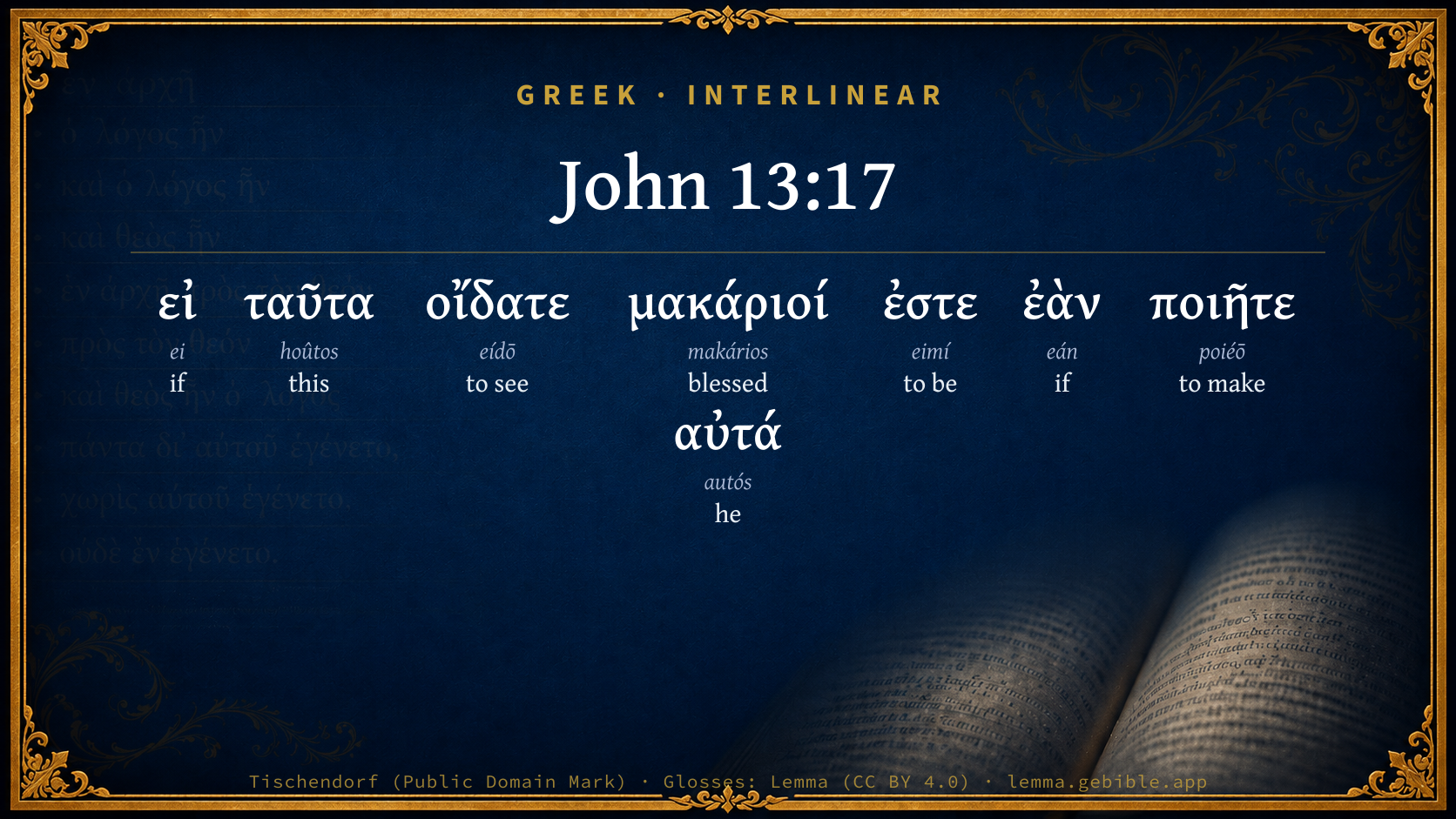
Download image
Cite this verse

John 13:17 (World English Bible). Public Domain. Lemma interlinear Bible study tool, https://lemma.gebible.app/v/john/13/17.

Show BibTeX & RIS
BibTeX
RIS
English Translation
If you know these things, blessed are you if you do them.
World English Bible · Public Domain
Download a study sheet

One document with this verse’s original text, its word-by-word gloss line, the meaning frame, cross-references with their text, attributed commentary, and full source and license credits — printable, and it pastes into notes with its structure intact.

This verse Autodidact and up

Study sheet (.html) Plain text (.txt)

A passage Seminary Student

Up to 50 verses in one chapter. A passage sheet keeps up to 6 commentary sources and 12 cross-references per verse, in the order this page ranks them, and says so on the sheet whenever that leaves anything out. Ask for a single verse and you get the Autodidact verse sheet above.

Everything on this page stays free to read, with no account — the sheet is a download of what is already on screen, not access to it.

Want to remove ads? Support Godless Engineer
Compare translations 3

The same verse in 3 English versions, stacked beneath the original-language interlinear above. Click any original word for its lexicon entry.

Each is an independent rendering of the whole verse — the interlinear is not word-aligned to these translations.

Highlighted words mark where these versions differ — a whole-verse word diff, not a word-by-word alignment.

  • World English Bible Public Domain
    If you know these things, blessed are you if you do them.
  • King James Version Public Domain
    If ye know these things, happy are ye if ye do them.
  • unfoldingWord Literal Text CC BY-SA 4.0
    If you know these things, you are blessed if you do them.

unfoldingWord Literal Text — © unfoldingWord, licensed CC BY-SA 4.0. Word-aligned USFM3 via Door43 (git.door43.org/unfoldingWord/en_ult).

Versions to compare (up to 4)

3 of 4 selected

Show all 19 translations

Every available English version of this verse, each an independent rendering of the whole verse.

  • World English Bible Public Domain
    If you know these things, blessed are you if you do them.
  • Berean Standard Bible Public Domain
    If you know these things, you will be blessed if you do them.
  • Majority Standard Bible Public Domain
    If you know these things, you will be blessed if you do them.
  • King James Version Public Domain
    If ye know these things, happy are ye if ye do them.
  • American Standard Version (1901) Public Domain
    If ye know these things, blessed are ye if ye do them.
  • Revised Version (1885) Public Domain
    If ye know these things, blessed are ye if ye do them.
  • Geneva Bible (1599) Public Domain
    If ye know these things, blessed are ye, if ye doe them.
  • Douay-Rheims (1899) Public Domain
    If you know these things, you shall be blessed if you do them.
  • Young's Literal Translation Public Domain
    if these things ye have known, happy are ye, if ye may do them;
  • Literal Standard Version CC BY-SA 4.0
    if you have known these things, you are blessed if you may do them;
  • Unlocked Literal Bible CC BY-SA 4.0
    If you know these things, you are blessed if you do them.
  • unfoldingWord Literal Text CC BY-SA 4.0
    If you know these things, you are blessed if you do them.
  • Darby Bible Public Domain
    If ye know these things, blessed are ye if ye do them.
  • World Messianic Bible Public Domain
    If you know these things, blessed are you if you do them.
  • Webster's Bible Public Domain
    If ye know these things, happy are ye if ye do them.
  • Free Bible Version CC BY-SA 4.0
    Now that you understand these things, you will be blessed if you do them.
  • Bible in Basic English Public Domain
    If these things are clear to you, happy are you if you do them.
  • Text-Critical English NT CC BY 4.0
    Now that you know these things, you are blessed if you do them.
  • Tyndale New Testament (1534) Public Domain
    If ye vnderstonde these thinges happy are ye yf ye do them.

Literal Standard Version (2020), Covenant Press — licensed CC BY-SA 4.0. Text via the HelloAO Bible API (eBible.org). Unlocked Literal Bible (unfoldingWord) — licensed CC BY-SA 4.0. Text via the HelloAO Bible API (eBible.org). unfoldingWord Literal Text — © unfoldingWord, licensed CC BY-SA 4.0. Word-aligned USFM3 via Door43 (git.door43.org/unfoldingWord/en_ult). Free Bible Version, Dr. Jonathan Gallagher — licensed CC BY-SA 4.0. Text via the HelloAO Bible API (eBible.org).

Word by word

More ways to search: Search by grammar → Find every occurrence → Compare this word →

Practice this passage: Drill this verse → Learn its vocabulary →

About this verse

These counts appear in no published source. They are computed here, from the morphology-tagged text and Lemma’s own curated glosses. What Lemma adds →

8
words
8
distinct lemmas
Gospels
section

Shared distinctive vocabulary

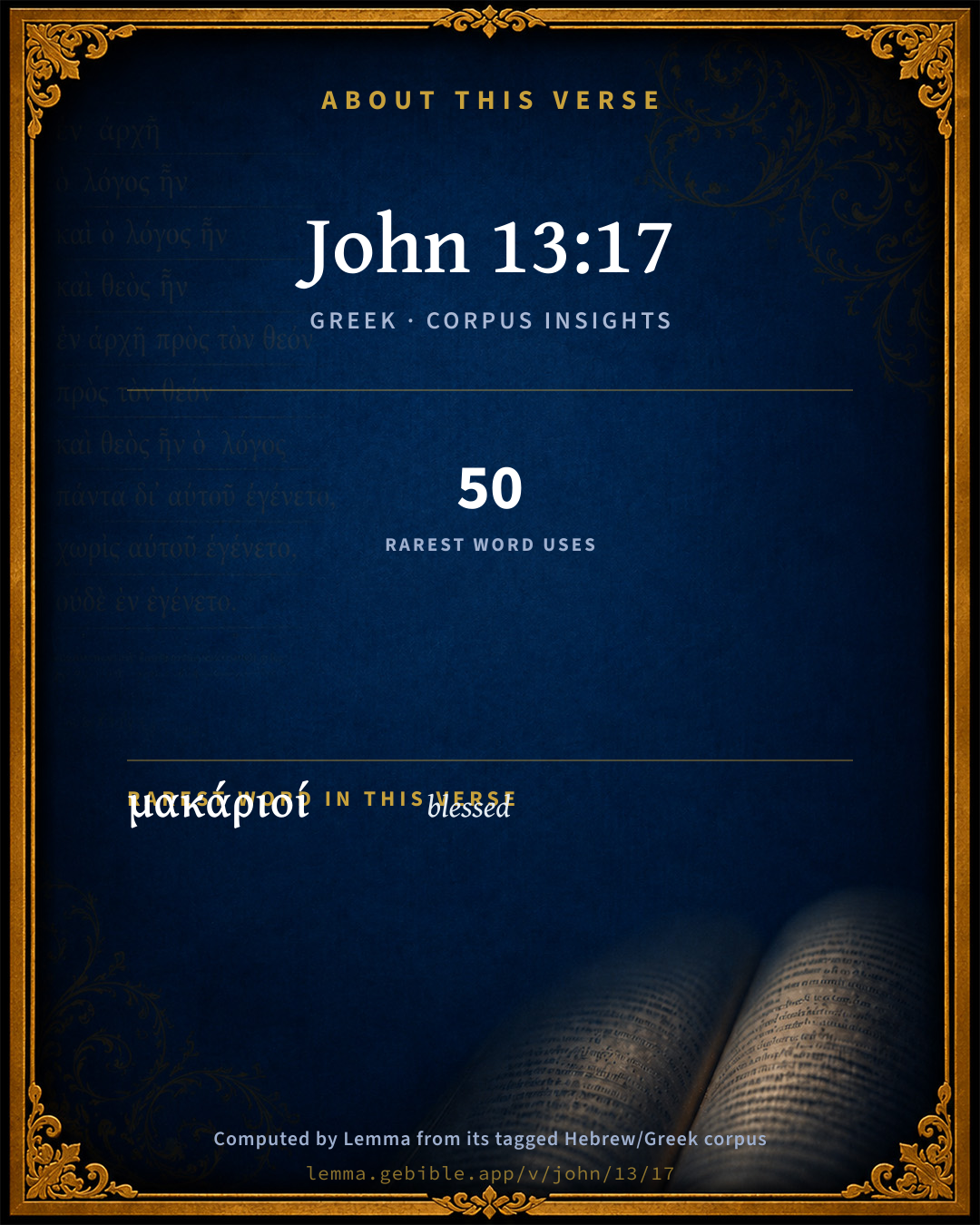
μακάριοί blessed G3107 occurs in 49 verses of the Greek New Testament. Also found in:
Cross-references

18

Topical passages linked to John 13:17 in the Treasury of Scripture Knowledge — connected by theme and wording, ordered by reader-vote popularity; previews shown in the World English Bible.

  • Luke 11:28 But he said, "On the contrary, blessed are those who hear the word of God, and keep it."
  • James 4:17 To him therefore who knows to do good, and doesn't do it, to him it is sin.
  • James 1:25 But he who looks into the perfect law, the law of freedom, and continues, not being a hearer who forgets but a doer of the work, this man will be blessed in what he does.
  • Matthew 7:24–25 "Everyone therefore who hears these words of mine, and does them, I will liken him to a wise man, who built his house on a rock.
  • Exodus 40:16 Thus did Moses: according to all that Yahweh commanded him, so he did.
  • Ezekiel 36:27 I will put my Spirit within you, and cause you to walk in my statutes, and you shall keep my ordinances, and do them.
  • Luke 12:47–48 That servant, who knew his lord's will, and didn't prepare, nor do what he wanted, will be beaten with many stripes,
  • Psalms 19:11 Moreover by them is your servant warned. In keeping them there is great reward.
  • Revelation 22:14 Blessed are those who do his commandments, that they may have the right to the tree of life, and may enter in by the gates into the city.
  • Psalms 119:1–5 Blessed are those whose ways are blameless, Who walk according to Yahweh's law.
  • Hebrews 11:7–8 By faith, Noah, being warned about things not yet seen, moved with godly fear, prepared an ark for the saving of his house, through which he condemned the world, and became heir of the righteousness which is according to faith.
  • James 2:20–24 But do you want to know, vain man, that faith apart from works is dead?
  • Genesis 6:22 Thus Noah did. According to all that God commanded him, so he did.
  • Matthew 12:50 For whoever does the will of my Father who is in heaven, he is my brother, and sister, and mother."
  • Galatians 5:6 For in Christ Jesus neither circumcision amounts to anything, nor uncircumcision, but faith working through love.
  • John 15:14 You are my friends, if you do whatever I command you.

Cross-references courtesy of OpenBible.info (CC BY 4.0).

Commentary

Notes on John 13:17 from classic Christian and Jewish commentators (each source and its license shown beneath its notes). The classic Christian expositions comment on the surrounding passage and are grouped to its opening verse, so a note may address several verses; the Jewish commentaries on the Tanakh (Rashi and others) are per-verse, so they appear only where the commentator wrote on this verse.

Lemma curates 59 commentaries, every one of them public domain or Creative Commons licensed, each selected and text-cleaned for this edition rather than reprinted as found. About our sources →

Bengel's Gnomon

Johann Albrecht Bengel

Joh 13:17. Ταῦτα) these things, which I have done.

Bengel's Gnomon of the New Testament — English translation (T&T Clark, Edinburgh, 1860) — public domain. Text from a community e-Sword module.

Expositor's Greek Testament

ed. W. Robertson Nicoll

Joh 13:17 . These are obvious first principles in Christian discipleship, but the mere knowledge of them is not enough: εἰ ταῦτα οἴδατε , μακάριοί ἐστε ἐὰν ποιῆτε αὐτά . ταῦτα refers to what Jesus had just declared to be the significance of His action. εἰ οἴδατε , “if ye know,” as you do know; ἐὰν ποιῆτε , a supposition. “The knowing is objectively granted, the doing subjectively conditioned.” Meyer. On the double protasis see Burton, 268. μακάριοι is usually translated “blessed,” Mat 5:3 , Joh 20:29 , and should be so here.

The Expositor's Greek Testament, edited by W. Robertson Nicoll (1897–1910) — public domain. Text from a community e-Sword module.

International Critical Commentary

17. εἰ ταῦτα οἴδατε κτλ., “If ye know these things,” sc. if you thoroughly understand and appreciate what I have been saying to you (for the force of οἴδατε, see on 1:26). Judas had not reached to this point.

μακάριοί ἐστε κτλ., “blessed are ye, if ye do them.” The dignity of διακονία is an easy lesson to understand, but is hard to put into practice (cf. Luk 11:28). Yet it is he who does this, who humbles himself like a child, who is great in the kingdom of heaven (Mat 18:4). μακάριος is used only once again by Jn., at 20:29, where he quotes other words of Jesus, μακάριοι οἱ μὴ ἰδόντες καὶ πιστεύσαντες. This latter saying is the Benediction of Faith; that in 13:17 is the Benediction of Ministry. Both are blessed, not only εὐλογητός that is, lauded by men, but μακάριος, as God is μακάριος (1Ti 1:11, 1Ti 6:15).

International Critical Commentary — older volumes (1896–1929), various authors — public domain. Text from a community e-Sword module.

Adam Clarke's Commentary

Verse 17. If ye know these things, happy, c.] True happiness consists in the knowledge of God, and in obedience to him. A man is not happy because he knows much but because he receives much of the Divine nature, and is, in all his conduct, conformed to the Divine will. "They who have read many books (says Menu) are more exalted than such as have seldom studied; they who retain what they have read, than forgetful readers; they who fully understand, than such as only remember; and they who perform their known duty, than such as barely know it. Sacred knowledge and devotedness to God are the means by which a man can arrive at beatitude." See Institutes of MENU, c. xii. Inst. 103, 104. For a heathen this saying is very remarkable.

Adam Clarke's Commentary on the Bible (1810–1826) — public domain. Text from a community e-Sword/MySword module.

John Calvin's Commentaries

17. If you know these things. He declares that they are happy, if they know and do these things; for knowledge is not entitled to be called true, unless it produce such an effect on believers as to lead them to conform themselves to their Head. On the contrary, it is a vain imagination, when we look upon Christ, and the things which belong to Christ, as separate from ourselves. We may infer from this that, until a man has learned to yield to his brethren, he does not know if Christ be the Master. Since there is no man who performs his duty to his brethren in all respects, and since there are many who are careless and sluggish in brotherly offices, this shows us that we are still at a great distance from the full light of faith.

John Calvin's Commentaries (1540-1563) — public domain. Text from the Calvin Translation Society English edition (1840s-50s) via the Christian Classics Ethereal Library (ccel.org). Calvin's coverage is partial (roughly two-thirds of the Bible); uncommented books and verses are honest gaps, never fabricated. The 19th-century editor's footnotes and remarks are omitted so the notes are faithfully Calvin's own voice.

Ellicott's Commentary for English Readers

(17) If ye know these things, happy are ye if ye do them.—The first clause of this verse assumes their knowledge of the things which He had been teaching them (Joh_13:13-17). They were, indeed, old lessons taught before in word, and now taught in act and word.

The second clause makes their blessedness depend upon their combining action with knowledge. They had known the truth before, but their knowledge had not profited them, and they needed on this very day to be taught them again.

A Bible Commentary for English Readers, edited by Charles John Ellicott (1878–1897) — public domain. Text from a community e-Sword module.

The Cambridge Bible for Schools and Colleges

gen. ed. J. J. S. Perowne

17. happy are ye if ye do them] Better, blessed are ye, &c. It is the same Greek word as is used in Joh_20:29 and in the Beatitudes both in S. Matthew and in S. Luke. Comp. Luk_11:28; Luk_12:43; Mat_7:21; Rev_1:3.

The Cambridge Bible for Schools and Colleges (gen. ed. J. J. S. Perowne; Cambridge University Press, 1878–1918) — public domain. Text from a community e-Sword module.

John Gill's Exposition

If ye know these things,.... The duties they owed to him, and one another; those kind offices of love and respect to each other; the humility, condescension, and brotherly love, which ought to be in them, and of which he had given them an example:

happy are ye if ye do them; for the bare theory, or a mere speculative knowledge of these things, is not sufficient; not he that knows and does not, but he that knows and does his master's will, is blessed; he is blessed with communion with his Lord, and shall hereafter enter into his joy, with "well done good and faithful servant". There is an happiness "in" doing well, and which follows "on" it, though not "for" it, in a way of merit; on the other hand, persons who know and do not, are very unhappy; the Jews have a saying (a),

, "he that learns but not to do", it would have been better for him, if he had never been created; and says R. Jochanan, he that learns but not to do, it would have been better for him if his secundine had been turned upon his face, and he had never come into the world.''

(a) Hieros. Beracot, fol. 3. 2.

John Gill's Exposition of the Whole Bible (1746–1763) — public domain (CC PDM 1.0). Text via the HelloAO Bible API.

Trapp's Complete Commentary

John Trapp

17 If ye know these things, happy are ye if ye do them.

Ver. 17. If ye know these things, &c.] Knowledge without practice is but as rain in the middle region; or as a horn in the unicorn’s head, which if it were in a wise man’s head, would be very useful and medicinabie, but as now is hurtful.

John Trapp, A Commentary or Exposition upon All the Books of the Old and New Testament (1647–1656) — public domain. Text from a community e-Sword module.

Matthew Poole's English Annotations

He tells them, that it is not the bare comprehension of these things in their notion that would do them any good, unless they brought their knowledge into practice; for to him that knoweth to do good, and doeth it not, it is sin, Jam 4:17. Faith without works is dead, and the knowledge of our Master’s will, if we do it not, doth but expose us to many stripes.

Matthew Poole's English Annotations on the Holy Bible (1683–1685) — public domain. Text from a community e-Sword/MySword module.

Whedon's Commentary on the Bible

Daniel D. Whedon

17. If ye know… do—If this lesson has entered your understanding, cease all strife for predominancy, and only surpass in service to each other.

Daniel D. Whedon (gen. ed.), Commentary on the Old and New Testaments (1874–1909) — public domain. Text from a community e-Sword module.

The Pulpit Commentary

If ye know these things, blessed are ye if ye do them. Knowing and doing are often perilously divorced. (cf. Mat_7:21,lu Mat 6:46 Mat_12:47; and Jam_1:25) The sublime principle by itself may be something, but if it be never put into practice, the last great beatitude is forfeited. Mere admiration of an ethical or a Christian principle degenerating into a heartless and fruitless ceremony is hardening to the heart and deadening to the conscience. The same truths had been taught independently of parable and symbol, in Mat_23:8-12 Mat_20:28.

The blessedness of intelligent obedience.

Our Lord Jesus taught, practiced, and commanded. His teaching was perfectly true and wise; his conduct was perfectly good and right; his directions were perfectly just and authoritative. His instructions were sometimes verbal, sometimes by example, and sometimes symbolical. Christ taught the lesson of humility not only by words, but in his whole demeanor and conduct; nor was this all, for he illustrated his lesson, now by setting a little child in the midst of his disciples as an example, and again by washing the feet of his apostles. Many were the means he used to impress this and other lessons of moral excellence upon his disciples. But he always insisted that true discipleship was not in an intellectual acquaintance with his teaching, but in a cheerful compliance with his will. As Lord of all, he sought to bring the whole nature under his control; and as their Master and Lord, he assured them with authority that their true welfare lay in their not only knowing, but in their doing, his commandments.

I KNOWLEDGE. Man is made to know. It is his privilege and prerogative to exercise his understanding and reason. Truth is within man"s reach not all truth, but certainly such as is most necessary for his wellbeing. Of all knowledge, none is so valuable as the knowledge of God in Christ. The highest truth is presented in our Lord"s life, his deeds arid words, his sufferings and glory. He is the one great Lesson for mankind to study and to learn. The twelve had abundant means of knowing Christ, of becoming acquainted with his character and his will. But through our possession of the New Testament we have sufficient opportunities of learning Christ. In order that our knowledge may be complete, as far as our position allows, we must study the Savior and his revelation of himself, his declaration of his will, with reverence and meekness, with faith and prayer.

II PRACTICE. Our nature is not only intellectual; it is also active. Our life is not one of pure contemplation; it is eminently practical. Knowledge without corresponding conduct is vain, is even worse than ignorance. It is like steam which is generated in the boiler, but which is not brought to bear as motive power upon an engine. It is like the blossom which in itself is beautiful, but which is followed by no fruit. Those who believe that there is a revelation should receive it. Those who are convinced that Christ is the Son of God should live by faith in him. Those who are persuaded that Christ"s law is the highest standard of morality should obey that law and conform to that standard. Those who believe that there is a future life, and that they are accountable to a righteous Judge, should prepare for judgment and for immortality. Knowledge without corresponding conduct is seen to be useless in every department of life; how reprehensible must it be in religion! A young man may study law through a long series of years, and under the superintendence of able practitioners; of what avail is his knowledge if, when the time comes for him to act for himself, he cannot draw a deed in chambers, or construct a defense for a client in court? The pupil of an engineer may have a good knowledge of mathematics, may be able to make accurate drawings of other men"s work; but is his theoretical ability of service to him in practice? That is the important question; for no one will employ a man to build a bridge, or to bore a tunnel, unless he has shown himself capable of carrying out such works. A cadet may pass the preliminary examinations, may study the art of fortification, the laws of projectiles, the tactics adopted by famous generals in historical campaigns; but all this is preparatory to actual warfare, and he will have studied to good purpose only if, when the time comes, when some unexpected responsibility falls upon him, he is able to lead a force or to defend a city. In like manner young people are taught the Scriptures, are made familiar with the doctrines, the principles, the laws of Christianity. To what end? Surely with the intention that they may not merely call Jesus Master and Lord, but that they may do the things which he bids.

III BLESSEDNESS. It is wrong to make happiness the one great end of life. Yet happiness is a merciful addition to life an ornament and a recompense appointed by a benevolent Providence. It is remarkable how often the Lord Jesus pronounced those happy who shared his character and obeyed his will. The pursuit and acquirement of knowledge are attended with happiness; but the truest happiness is the fruit of obedience.

1. This appears from the consideration that those who know and do Christ"s will employ all their powers in true harmony. The capacity for knowledge and the faculty for action in such a case work together towards an end, and such co-operation he who made our nature has designed to be productive of a tranquil joy. "This man," says James, speaking of the doer of the work, "shall be happy in his doing.

2. They who know and do Christ"s will are happy, because they have a good conscience. If a man feels and says, "I know that I ought to follow such a line of conduct, but I confess that I do not carry out my convictions," how can he have peace? The conviction and reproof of the inward monitor will not let him rest. On the other hand, when there is no schism between knowledge and practice, the voice of conscience speaks approval, and such approbation is blessedness indeed.

3. Obedience as the fruit of knowledge is accepted and commended by the Lord Christ. His approving smile rests upon his true and loyal disciple and servant, who takes up his cross, when so summoned, and follows his Lord. Hereafter the blessedness shall be perfect, for Christ shall say to the faithful servant, "Enter thou into the joy of thy Lord. T.

The happiness of Christian activity.

I ONCE MORE JESUS PROVES HIS DESIRE FOR HUMAN HAPPINESS. This is amply proved by his putting the thought of human happiness in the forefront of his teaching in the sermon on the mount. There he evidently made it his business to show men, in a way not to be misunderstood, that human happiness is not a mere subordinate result of Christianity, a something that may be present or absent. Human happiness is an essential part of Christianity. If Christ is not making his people happy, increasingly and exuberantly happy, there is something wrong in their connection with him. For this is just one of the aims of Jesus, to take away misery and dullness and ennui, and put happiness in their place.

II THERE IS NO HAPPINESS IN MERE KNOWLEDGE. There may be a great deal of pleasure in the acquiring of it, but it is quite possible that so much time may have been spent in acquiring knowledge that other things may have been neglected. We may very easily shut ourselves up from our fellow-creatures, and lose many an opportunity of doing good that would have made us far happier than any pleasure of the mere intellect.

III WE MUST TAKE CARE THAT WE DO REALLY UNDERSTAND WHAT JESUS WANTS us TO Do. His words are not as maps of the country through which we have to travel; they are rather finger-posts showing the direction. Each finger-post sends you on to another. The words of Jesus are meant to secure within us a certain inward spirit; if that be secured, the proper outward actions will follow as a natural consequence. We have not yet comprehended one very important warning to Christian disciples unless we have been made to feel, from reading the Gospels, how easy it is to misunderstand Jesus. His most important words, his most significant deeds, were to be meditated over, seen in their position as parts of the living whole of truth.

IV THERE IS NO HAPPINESS IN MERE DOING. To leave the right thing undone, and to do the wrong thing, equally lead to misery. Increase of activity, unless the right principles and methods underlie it, only means increase of mischief and misery. We must not be deceived by mere external activity. There may be a great deal of real doing doing such as Jesus counts doing, where there is little to show men. The right spirit must pervade and suffuse the doing, and it can only pervade and suffuse what is right in itself. Y.

The Pulpit Commentary (1880–1919), ed. H.D.M. Spence-Jones & Joseph S. Exell — public domain. Text from a community e-Sword module.

Burkitt's Expository Notes on the New Testament

William Burkitt

Our Lord here intimates unto us these two things:

1. The necessity of knowledge, in order unto practice.

2. The necessity of practice, in order unto happiness.

A man may know the will of God indeed, and not do it; but he can never do the will of God (acceptably) and not know it. The knowledge of God’s will and our duty, is necessary to the practice of it. The knowledge of our duty, and the practice of it, may be and too often are separated; but the practice of religion, and doing what we know to be our duty is the only way to true happiness.

Learn thence, 1. That Christ doth not approve of a blind obedience in his people, but requires that their practice and obedience be founded upon understanding and knowledge.

2. That the first care of those that will be Christ’s disciples and followers must be this, with all seriousness to apply themselves to the knowlege of their Master’s will.

3. That next to the knowlege of our duty, our first and chief care must be, to practice everything that we understand and know to be our duty.

4. That a right knowledge and practice of our duty, will certainly make us happy: If ye know these things, happy are ye if ye do them.

William Burkitt's Expository Notes on the New Testament (1700–1703) — public domain. Text from a community e-Sword module.

The People's New Testament

B. W. Johnson

17. If ye know these things, happy are ye if ye do them. Know what things? Of course they knew that Christ had washed their feet. But did they know what he meant? The meaning is clearly, “If ye understand the meaning of my act, happy are ye if ye exemplify the same spirit in your lives.”

B. W. Johnson's The People's New Testament with Notes (1889–1891) — public domain. Electronic text from the Christian Classics Ethereal Library (CCEL) ThML edition.

Cambridge Greek Testament for Schools and Colleges

17. μακάριοί ἐστε. Blessed are ye, as in the Beatitudes: comp. Joh 20:29; Rev 1:3; Rev 14:13, &c. Knowledge must influence conduct. Εἰ introduces the general supposition, if ye know; ἐάν the particular condition, provided ye do them. Comp. Rev 2:5; 1Co 7:36; Gal 1:8-9; Act 5:38. Winer, p. 370.

Cambridge Greek Testament for Schools and Colleges (Cambridge University Press, 1896; 21 vols, various authors incl. Carr, Maclear, Plummer, Farrar, Lumby, Moule, M. R. James, Simcox) — public domain. Text from a community e-Sword module.

Alford’s Greek Testament

Henry Alford

17.] The proverbial expression οὐκ ἔστιν δ.… is used here in a different sense from ch. 15:20. Here it is, ‘if the Master thus humble Himself, much more should His servants and messengers:’ see Mat 10:24: Luk 6:40; and on ver. 17, Luk 12:47, Luk 12:48. The mere recognition of such a duty of humility, is a very much more easy matter than the putting it in practice.

Henry Alford, The Greek Testament (1849–1861) — public domain. Text from a community e-Sword module.

Vincent's Word Studies in the New Testament

Marvin R. Vincent

Happy [μακαριοι] . Better, as Rev., blessed. See on Mt 5:3.

Marvin R. Vincent, Word Studies in the New Testament (1887–1900) — public domain. Text from a community e-Sword/MySword module.

Lesson kit

Teaching starters — assembled from the data on this page, not authored interpretation. Every prompt links to the verse data it draws on. Edit before teaching.

John, in the Gospels, opens this verse with 8 words (8 distinct Greek lemmas). Its most distinctive word is makários (“blessed”). A historical commentator’s framing appears above. Read the whole chapter for the surrounding context.

Discussion questions

  1. How does “blessed” (makários) shape what this verse is saying?
  2. How does Matthew 5:3, which shares the word «blessed», read alongside this verse?
  3. These translations render this verse differently; the difference is in the English rendering, not the original. What questions does that raise?
  4. Compare how Bengel's Gnomon and Expositor's Greek Testament read this verse. Where do they agree or differ?

Things to notice

Reading settings

Reading text

Shown beneath each verse's original-language words.

Old Testament
Old Testament edition

Read the OT as the Masoretic Hebrew (MT) or the Greek Septuagint (LXX).

English shown for the Greek Septuagint (in the Hebrew ↔ Greek comparison).

Comparing translations? Open the Compare panel on any verse page to stack up to four side by side.