Judges 1:9

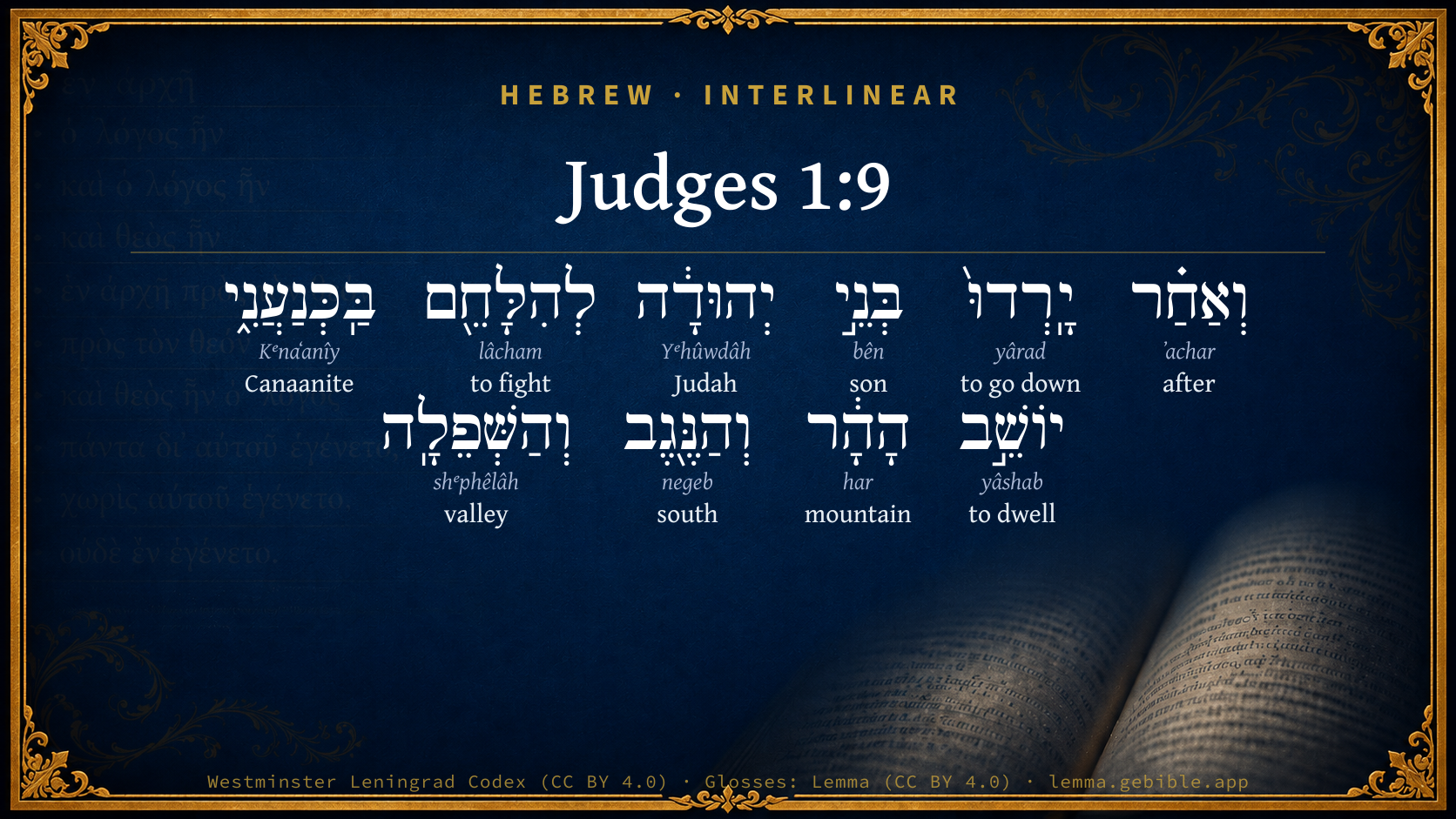
Hebrew (Westminster Leningrad Codex) Judges 1:9 appears in the Hebrew Old Testament. The text above is from the Westminster Leningrad Codex. Each word links to its Strong’s number, a concise gloss, and parsing drawn from the Open Scriptures Hebrew Bible morphology. Click any word for its full Brown-Driver-Briggs (BDB) entry.
Download image
Cite this verse

Judges 1:9 (World English Bible). Public Domain. Lemma interlinear Bible study tool, https://lemma.gebible.app/v/judges/1/9.

Show BibTeX & RIS
BibTeX
RIS
English Translation
Afterward the children of Judah went down to fight against the Canaanites who lived in the hill-country, and in the South, and in the lowland.
World English Bible · Public Domain
Download a study sheet

One document with this verse’s original text, its word-by-word gloss line, the meaning frame, cross-references with their text, attributed commentary, and full source and license credits — printable, and it pastes into notes with its structure intact.

This verse Autodidact and up

Study sheet (.html) Plain text (.txt)

A passage Seminary Student

Up to 50 verses in one chapter. A passage sheet keeps up to 6 commentary sources and 12 cross-references per verse, in the order this page ranks them, and says so on the sheet whenever that leaves anything out. Ask for a single verse and you get the Autodidact verse sheet above.

Everything on this page stays free to read, with no account — the sheet is a download of what is already on screen, not access to it.

Want to remove ads? Support Godless Engineer
Compare translations 3

The same verse in 3 English versions, stacked beneath the original-language interlinear above. Click any original word for its lexicon entry.

Each is an independent rendering of the whole verse — the interlinear is not word-aligned to these translations.

Highlighted words mark where these versions differ — a whole-verse word diff, not a word-by-word alignment.

  • World English Bible Public Domain
    Afterward the children of Judah went down to fight against the Canaanites who lived in the hill-country, and in the South, and in the lowland.
  • King James Version Public Domain
    And afterward the children of Judah went down to fight against the Canaanites, that dwelt in the mountain, and in the south, and in the valley.
  • unfoldingWord Literal Text CC BY-SA 4.0
    And afterward the sons of Judah went down to fight with the Canaanite living the hill country and the Negev and the Shephelah.

unfoldingWord Literal Text — © unfoldingWord, licensed CC BY-SA 4.0. Word-aligned USFM3 via Door43 (git.door43.org/unfoldingWord/en_ult).

Versions to compare (up to 4)

3 of 4 selected

Show all 18 translations

Every available English version of this verse, each an independent rendering of the whole verse.

  • World English Bible Public Domain
    Afterward the children of Judah went down to fight against the Canaanites who lived in the hill-country, and in the South, and in the lowland.
  • Berean Standard Bible Public Domain
    Afterward, the men of Judah marched down to fight against the Canaanites living in the hill country, in the Negev, and in the foothills.
  • Majority Standard Bible Public Domain
    Afterward, the men of Judah marched down to fight against the Canaanites living in the hill country, in the Negev, and in the foothills.
  • King James Version Public Domain
    And afterward the children of Judah went down to fight against the Canaanites, that dwelt in the mountain, and in the south, and in the valley.
  • American Standard Version (1901) Public Domain
    And afterward the children of Judah went down to fight against the Canaanites that dwelt in the hill-country, and in the South, and in the lowland.
  • Revised Version (1885) Public Domain
    And afterward the children of Judah went down to fight against the Canaanites that dwelt in the hill country, and in the South, and in the lowland.
  • Geneva Bible (1599) Public Domain
    Afterwarde also the children of Iudah went downe to fight against the Canaanites, that dwelt in the mountaine, and towarde the South, and in the lowe countrey.
  • Douay-Rheims (1899) Public Domain
    And afterwards they went down and fought against the Chanaanite, who dwelt in the mountains, and in the south, and in the plains.
  • Young's Literal Translation Public Domain
    and afterwards have the sons of Judah gone down to fight against the Canaanite, inhabiting the hill-country, and the south, and the low country;
  • Literal Standard Version CC BY-SA 4.0
    and afterward the sons of Judah have gone down to fight against the Canaanite inhabiting the hill-country, and the south, and the low country;
  • Unlocked Literal Bible CC BY-SA 4.0
    After that, the men of Judah went down to fight against the Canaanites who lived in the hill country, in the Negev, and the western foothills.
  • unfoldingWord Literal Text CC BY-SA 4.0
    And afterward the sons of Judah went down to fight with the Canaanite living the hill country and the Negev and the Shephelah.
  • Darby Bible Public Domain
    And afterward the men of Judah went down to fight against the Canaanites who dwelt in the hill country, in the Negeb, and in the lowland.
  • World Messianic Bible Public Domain
    After that, the children of Judah went down to fight against the Canaanites who lived in the hill country, and in the South, and in the lowland.
  • Webster's Bible Public Domain
    And afterward the children of Judah went down to fight against the Canaanites that dwelt on the mountain, and in the south, and in the valley.
  • Free Bible Version CC BY-SA 4.0
    After this the men of Judah went to fight against the Canaanites living in the hill country, in the Negev, and in the foothills of the lowlands.
  • Bible in Basic English Public Domain
    After that the children of Judah went down to make war on the Canaanites living in the hill-country and in the south and in the lowlands.
  • JPS Tanakh (1917) Public Domain
    And afterward the children of Judah went down to fight against the Canaanites that dwelt in the hill-country, and in the South, and in the Lowland.

Literal Standard Version (2020), Covenant Press — licensed CC BY-SA 4.0. Text via the HelloAO Bible API (eBible.org). Unlocked Literal Bible (unfoldingWord) — licensed CC BY-SA 4.0. Text via the HelloAO Bible API (eBible.org). unfoldingWord Literal Text — © unfoldingWord, licensed CC BY-SA 4.0. Word-aligned USFM3 via Door43 (git.door43.org/unfoldingWord/en_ult). Free Bible Version, Dr. Jonathan Gallagher — licensed CC BY-SA 4.0. Text via the HelloAO Bible API (eBible.org).

Word by word

More ways to search: Search by grammar → Find every occurrence → Compare this word →

Practice this passage: Drill this verse → Learn its vocabulary →

וְהַשְּׁפֵלָֽה
shᵉphêlâh
H8219
“and · the · valley”
Conjunction + Particle, Definite Article + Noun, Common, Feminine, Singular, Absolute
Part of Speech
Conjunction + Particle + Noun
Type
Common
Gender
Feminine
Number
Singular
State
Absolute
Full BDB Definition

Origin: from H8213

TWOT: 2445d

lowland, valley - lowland - strip west of Judean mountains (technical term) - the Shephelah - strip near coast north of Carmel
  1. וְאַחַ֗ר ʼachar H310 “and · after” Conjunction + Adverb
  2. יָֽרְדוּ֙ yârad H3381 “to go down” Verb, Qal, Perfect, 3rd Person, Common, Plural
  3. בְּנֵ֣י bên H1121 “sons of” Noun, Common, Masculine, Plural, Construct
  4. יְהוּדָ֔ה Yᵉhûwdâh H3063 “Judah” Noun, Proper
  5. לְהִלָּחֵ֖ם lâcham H3898 “to fight” Preposition + Verb, Niphal, Infinitive Construct
  6. בַּֽכְּנַעֲנִ֑י Kᵉnaʻanîy H3669 “in/at the · Canaanite” Preposition, Determined + Noun, Gentilic, Masculine, Singular, Absolute
  7. יוֹשֵׁ֣ב yâshab H3427 “dwelling” Verb, Qal, Participle Active, Masculine, Singular, Absolute
  8. הָהָ֔ר har H2022 “the · mountain” Particle, Definite Article + Noun, Common, Masculine, Singular, Absolute
  9. וְהַנֶּ֖גֶב negeb H5045 “and · the · south” Conjunction + Particle, Definite Article + Noun, Common, Masculine, Singular, Absolute

About this verse

These counts appear in no published source. They are computed here, from the morphology-tagged text and Lemma’s own curated glosses. What Lemma adds →

10
words
10
distinct lemmas
Historical
section

Notable vocabulary

The rarest word here is וְהַשְּׁפֵלָֽה valley H8219 — appearing just 20 times in the whole Hebrew Bible.

Shared distinctive vocabulary

וְהַשְּׁפֵלָֽה valley H8219 occurs in 19 verses of the Hebrew Bible. Also found in:

Grammatical profile

  • 3 verbs
  • 6 nouns
  • 1 adverb

Verb forms

  • יָֽרְדוּ֙ Qal · Perfect
  • לְהִלָּחֵ֖ם Niphal · Infinitive Construct
  • יוֹשֵׁ֣ב Qal · Participle Active

Hebrew & Septuagint length

In English translation the verse runs 25 words from the Hebrew and 25 from the Septuagint (LXX English) — the same length.

A rough comparison of the two English renderings, which tokenize alike — not a word-level alignment.

Word counts can differ between the Hebrew and the Greek without any difference in meaning — e.g. the Hebrew direct-object marker אֵת has no separate Greek word, and Greek often adds the article ὁ.

Cross-references

3

Topical passages linked to Judges 1:9 in the Treasury of Scripture Knowledge — connected by theme and wording, ordered by reader-vote popularity; previews shown in the World English Bible.

  • Joshua 10:36 Joshua went up from Eglon, and all Israel with him, to Hebron; and they fought against it:
  • Joshua 11:21 Joshua came at that time, and cut off the Anakim from the hill-country, from Hebron, from Debir, from Anab, and from all the hill-country of Judah, and from all the hill-country of Israel: Joshua utterly destroyed them with their cities.
  • Joshua 15:13–20 To Caleb the son of Jephunneh he gave a portion among the children of Judah, according to the commandment of Yahweh to Joshua, even Kiriath Arba, [which Arba was] the father of Anak (the same is Hebron).

Cross-references courtesy of OpenBible.info (CC BY 4.0).

Hebrew and Greek witnesses Masoretic Hebrew ↔ Greek Septuagint

The same verse in the two great witnesses to the Old Testament, shown verse-for-verse.

These are two independent witnesses, not word-aligned to each other, and the Septuagint is shown in lemma (dictionary) form.

Hebrew Judges 1:9 Masoretic · Westminster Leningrad Codex

וְאַחַ֗ר יָֽרְדוּ֙ בְּנֵ֣י יְהוּדָ֔ה לְהִלָּחֵ֖ם בַּֽכְּנַעֲנִ֑י יוֹשֵׁ֣ב הָהָ֔ר וְהַנֶּ֖גֶב וְהַשְּׁפֵלָֽה

Afterward the children of Judah went down to fight against the Canaanites who lived in the hill-country, and in the South, and in the lowland.

World English Bible · Public Domain

Greek LXX Judges 1:9 Septuagint · lemma form

καί μετά οὗτος καταβαίνω ὁ υἱός ιουδα ὁ πολεμέω πρός ὁ χαναναῖος ὁ καταοἰκέω ὁ ὀρεινή καί ὁ νότος καί ὁ πεδεινός

And afterwards the children of Judas went down to fight with the Chananite dwelling in the hill country, and the south, and the plain country.

LXX2012 (modern English Septuagint) · Public Domain

Hebrew: Westminster Leningrad Codex (CC BY 4.0). Greek: Septuagint (public domain); English from LXX2012 (modern English Septuagint) (Public Domain). How the Septuagint differs from the Hebrew →

Targum (Aramaic paraphrase)

1

The Targum is the ancient Jewish Aramaic paraphrase of the Hebrew Scriptures — an interpretive translation, not the Hebrew text itself. Onkelos (literal) and Pseudo-Jonathan (expansive) render the Torah, and Jonathan the Prophets. Coverage is partial: where no permissively-licensed English translation exists for a verse, only the Aramaic is shown. This is verse-level text, not a word-by-word alignment to the Hebrew.

  1. Targum Jonathan Prophets (Joshua–Malachi)
    וּבָתַר כֵּן נְחָתוּ בְּנֵי יְהוּדָה לְאַגָחָא קְרָבָא בִּכְנַעֲנָאֵי יָתֵיב טוּרָא וְדָרוֹמָא וּשְׁפֶלְתָּא:

    (no public-domain English translation for this verse)

    Targum Jonathan — Aramaic: “Mikraot Gedolot” (public domain). English: “Sefaria Community Translation” (CC0 1.0 (public-domain dedication)); “London "Chaldee Paraphrase," 1871” (public domain). Text via Sefaria.

Commentary

Notes on Judges 1:9 from classic Christian and Jewish commentators (each source and its license shown beneath its notes). The classic Christian expositions comment on the surrounding passage and are grouped to its opening verse, so a note may address several verses; the Jewish commentaries on the Tanakh (Rashi and others) are per-verse, so they appear only where the commentator wrote on this verse.

Lemma curates 59 commentaries, every one of them public domain or Creative Commons licensed, each selected and text-cleaned for this edition rather than reprinted as found. About our sources →

Matthew Henry's Commentary

We have here a further account of that glorious and successful campaign which Judah and Simeon made. 1. The lot of Judah was pretty well cleared of the Canaanites, yet not thoroughly. Those that dwelt in the mountain (the mountains that were round about Jerusalem) were driven out (Jdg 1:9, Jdg 1:19), but those in the valley kept their ground against them, having chariots of iron, such as we read of, Jos 17:16. Here the men of Judah failed, and thereby spoiled the influence which otherwise their example hitherto might have had on the rest of the tribes, who followed them in this instance of their cowardice, rather than in all the other instances of their courage. They had iron chariots, and therefore it was thought not safe to attack them: but had not Israel God on their side, whose chariots are thousands of angels (Psa 68:17), before whom these iron chariots would be but as stubble to the fire? Had not God expressly promised by the oracle (Jdg 1:2) to give them success against the Canaanites in this very expedition, without excepting those that had iron chariots? Yet they suffered their fears to prevail against their faith, they could not trust God under any disadvantages, and therefore durst not face the iron chariots, but meanly withdrew their forces, when with one bold stroke they might have completed their victories; and it proved of pernicious consequence. They did run well, what hindered them? Gal 5:7. 2. Caleb was put in possession of Hebron, which, though given him by Joshua ten or twelve years before (as Dr. Lightfoot computes), yet being employed in public service, for the settling of the tribes, which he preferred before his own private interests, it seems he did not till now make himself master of; so well content was that good man to serve others, while he left himself to be served last; few are like-minded, for all seek their own, Phi 2:20, Phi 2:21. Yet now the men of Judah all came in to his assistance for the reducing of Hebron (Jdg 1:10), slew the sons of Anak, and put him in possession of it, Jdg 1:20. They gave Hebron unto Caleb. And now Caleb, that he might return the kindness of his countrymen, is impatient to see Debir reduced and put into the hands of the men of Judah, to expedite which he proffers his daughter to the person that will undertake to command in the siege of that important place, Jdg 1:11, Jdg 1:12. Othniel bravely undertakes it, and wins the town and the lady (Jdg 1:13), and by his wife's interest and management with her father gains a very good inheritance for himself and his family, Jdg 1:14, Jdg 1:15. We had this passage before, Jos 15:16-19, where it was largely explained and improved. 3. Simeon got ground of the Canaanites in his border, Jdg 1:17, Jdg 1:18. In the eastern part of Simeon's lot, they destroyed the Canaanites in Zephath, and called it Hormah - destruction, adding this to some other devoted cities not far off, which they had some time ago, with good reason, called by that name, Num 21:2, Num 21:3. And this perhaps was the complete performance of the vow they them made that they would utterly destroy these cities of the Canaanites in the south. In the western part they took Gaza, Askelon, and Ekron, cities of the Philistines; they gained present possession of the cities, but, not destroying the inhabitants, the Philistines in process of time recovered the cities, and proved inveterate enemies to the Israel of God, and no better could come of doing their work by the halves. 4. The Kenites gained a settlement in the tribe of Judah, choosing it there rather than in any other tribe, because it was the strongest, and there they hoped to be safe and quiet, Jdg 1:16. These were the posterity of Jethro, who either went with Israel when Moses invited them (Num 10:29) or met them about the same place when they came up from their wanderings in the wilderness thirty-eight years after, and went with them then to Canaan, Moses having promised them that they should fare as Israel fared, Num 10:32. They had at first seated themselves in the city of palm-trees, that is, Jericho, a city which never was to be rebuilt, and therefore the fitter for those who dwelt in tents, and did not mind building. But afterwards they removed into the wilderness of Judah, either out of their affection to that place, because solitary and retired, or out of their affection to that tribe, which perhaps had been in a particular manner kind to them. Yet we find the tent of Jael, who was of that family, far north, in the lot of Naphtali, when Sisera took shelter there, Jdg 4:17. This respect Israel showed them, to let them fix where they pleased, being a quiet people, who, wherever they were, were content with a little. Those that molested none were molested by none. Blessed are the meek, for thus they shall inherit the earth.

Matthew Henry's Commentary on the Whole Bible (1708–1710) — public domain (CC PDM 1.0). Text via the HelloAO Bible API.

Trapp's Complete Commentary

John Trapp

Jdg 1:9 And afterward the children of Judah went down to fight against the Canaanites, that dwelt in the mountain, and in the south, and in the valley.

Ver. 9. Went down.] Being heartened by their former successes, but especially by that sweet promise in Jdg 1:2.

9 Yet Michael the archangel, when contending with the devil he disputed about the body of Moses, durst not bring against him a railing accusation, but said, The Lord rebuke thee.

Ver. 9. About the body of Moses] As desirous thereby to set up himself in the hearts of the living. There is a strange strife still, not of earthly, but of spiritual powers, about the possession of man’s heart. If Satan can get that, he is safe. And so Satan’s vicar. It was a watchword in Gregory XIII’s time in Queen Elizabeth’s days, "My son, give me thy heart." Be in heart a Papist, and go where you will, and do what you will.

Durst not bring against him a railing accusation, but said, The Lord rebuke thee] Let us also answer the devil in like sort: or as Grynaeus (out of Chrysostom) when he sent back Pistorius’s railing letters, not so much as opening the seal, Inhonestum est honestam matronam cam meretrice litlgare, It is not seemly for an honest matron to scold with a base harlot.

John Trapp, A Commentary or Exposition upon All the Books of the Old and New Testament (1647–1656) — public domain. Text from a community e-Sword module.

Whedon's Commentary on the Bible

Daniel D. Whedon

CONQUESTS IN THE TERRITORY OF JUDAH, Jdg_1:9.

9. Afterward — After the burning of Jerusalem.

Went down — Proceeded southward. As went up (Jdg_1:4) indicates a starting off to battle, so went down indicates a continuation of the war.

The mountain… the south… the valley — The three principal geographical divisions of the territory of Judah. See note on Jos_15:19. Here the thread of the narrative is broken off to introduce the episode about Caleb and Othniel, and the notice of the Kenites.

Daniel D. Whedon (gen. ed.), Commentary on the Old and New Testaments (1874–1909) — public domain. Text from a community e-Sword module.

Lange's Commentary on the Holy Scriptures

The sons of Judah smite the Anakim and take Hebron

Jdg_1:9-10

9And afterward [Hereupon] the children [sons] of Judah went down [proceeded] to fight against the Canaanites that dwelt in the mountain [mountains], and in the south, and in the valley [lit. depression, low country]. 10And Judah went against the Canaanites that dwelt in Hebron: (now the name of Hebron before [formerly] was Kirjath-arba [The Four Cities30]:) and they slew [smote] Sheshai, and Ahiman, and Talmai.

TEXTUAL AND GRAMMATICAL

[1 Jdg_1:10. This is the nearest we can come in English to Dr. Cassel’s Vierstadt, Tetrapolis. Against the common Interpretation, “City of Arba,”—Arba being taken as the name of a person,—cf. Mr. Grove in Smith’s Bib. Dict., s. v Kirjath-arba.—Tr.]

EXEGETICAL AND DOCTRINAL

Jdg_1:9 f.. Hereupon the sons of Judah proceeded. They advanced, proceeded, ירְדוּ. While עָלָה, ‘ ‘ascendere,” was used to express the first attack (Jdg_1:4), the continuation of the conflict is indicated by יָרַד, “descendere,” although they advance mountain-ward. Verse 9 sets forth the full extent of the task undertaken by the tribes. Before advancing into the territory allotted them, they have been obliged to resist the attack of Adoni-bezek at its border. They divide their work proper into the conquest of the mountains, the occupancy of the southern tract from the Dead Sea to Beer-sheba, and the seizure of the western lowlands. Details of these undertakings are given us only so far as they concern Caleb and his house. Hence, the conquest of Hebron is first of all related. About this ancient city,31 where Abraham tarried, and the patriarchs repose in the family-vault, the recollections of the tribe of Judah concentrate themselves. It was of old the dwelling-place of valiant people. The robust vine-dressers of the valley, ages before, supported Abraham in his victorious expedition against the eastern hosts. But on the mountains there dwelt a wild and warlike race, the sons of Anak, before whom the faint-hearted spies of Moses formerly trembled. Only Caleb and Joshua were full of confidence in God. On this account, Caleb received the special assurance of Moses that he should possess the land which he had seen; and therefore at the division of the country by Joshua, he brings forward his claim to it (Jos_14:12). Joshua allows it. It is no lightly-gained inheritance that Caleb asks: “Therefore give me (he says) this mountain, whereof the Lord spake in that day; for thou hast heard that there are Anakim there, and cities great and fenced; perhaps the Lord will be with me that I drive them out” (Jos_14:12). Now, although the conquest of the city, and the expulsion of the Anakim, are already recorded in Jos_15:14, that is only an anticipatory historical notice in connection with the description of boundaries. The events actually occur now, in connection with the first efforts to gain permanent possession of the territory. Caleb, it is true, is old; but younger heroes surround him. They defeated the Anakim.

Jdg_1:10. Hebron, formerly called the Four Cities (Kirjath-arba). It is difficult to see why modern expositors32 take offense at the idea that in Hebron an earlier Tetrapolis is to be recognized. The remark, Jos_14:15 : “And the name of Hebron was formerly Kirjath-arba, בָעֲנָקים הוּא הָאָדָם הַגָּדוֹל,” cannot furnish the ground; for אָדָם is here a collective term, like gens, as appears indubitably from Jos_15:13, where we have the expression, “Kirjath-arba, the father of Anak (אֲבִי הָעֲנָק) which is Hebron.” The Tetrapolis was the ancient seat of powerful tribes, whom the traditions of Israel described as giants. Similar tetrapolitan cities are elsewhere met with. The Indians had a Káturgrâma, the Four Villages (Lassen, Ind. Alterth., i. 72). In Phrygia, Cibyra and three other places formed a Tetrapolis (Strabo, lib. xiii. 1, 17). I am inclined to find in the name Cibyra the same idea as in the Arabic Cheibar33 and the Hebrew Chebron (Hebron), namely, that of confederation, community of interest. It is a suggestive fact that Abraham’s expedition is joined by the brothers Eshcol, Aner, and Mamre (Gen_14:13); concerning Mamre it is remarked, “the same is Hebron” (Gen_23:19). The Upper City (Acropolis), situated upon the mountains, and the lower cities lying in the fertile valley which these mountains inclose, together constituted the Tetrapolis. At the present day the city in the valley is still divided into three parts.34 Three sons of Anak are enumerated, manifestly three tribes, probably named after ancient heroes, which tribes coalesced with the mountain city.35 As late as the time of David, the phraseology is, that he dwelt in “the cities of Hebron” (2Sa_2:3). Probably the name Hebron was originally given to the mountain36 (the הַר which Caleb claims, Jos_14:12), as forming the common defense, and was then after the suppression of the Anakim, transferred to the whole city. The names of the three families of Anakim do not admit of any certain interpretation. אָחִימַן might with most probability be interpreted after the analogy of Achijah (Ahijah or Ahiah), “Friend of God.” מַן, מְנִי, is the heathen deity (Isa_65:11), who also occurs in Phœnician inscriptions, in proper names like עברמני, “servant of Meni.” The name שֵׁשַׁי, “Sheshai,” reminds one of the Egyptian king שִׁישׁק, Shishak, Sechonchis, who made war on Rehoboam (1Ki_14:25). The name שֵׁשְׁבּצַּר (“Sheshbazzar,” Ezr_1:8) may also be compared. The third name, Talmai, leaves it doubtful whether it is to be taken primarily as the name of a place or of a person. Stephanus Byzantinus speaks of an Arabic place which he calls Castle Θελαμο͂υζα. It is possible, however, that analogous mythical ideas come into contact with each other, in the Greek legend concerning Salmoneus,37 father of Tyro, and husband of Sidero. Hesiod already (in a Fragment, ed. Göttling. p. 259) calls him an ἄδικος καὶ ν̔πέρθυμος. Josephus (Ant. v. 2, 3) says that the Anakim were a race of giants, “whose bones are still shown to this very day.” What stories were current about the discovery of gigantic human remains in Asia Minor and Syria, may be learned from the Heroica of Philostratus (ed. Jacobs, p. 28). A body of gigantic length was found in the bed of the Orontes. It was thought also that the bodies of Orestes and Ajax had been seen. The faint-hearted spies had depicted the Anakim as Nephilim, men like the prehistoric Nibelungen of German story; and from this Josephus constructed his giant-tale.

Jos_15:14 remarks, “And Caleb drove thence the three sons of Anak.” A contradiction has been found therein with what we read here, “And they smote.” None really exists. The narrative is actually more exact than is generally supposed. The statement of Jos_15:14 refers to Jdg_1:20. The tribe of Judah had now indeed taken Hebron, and conquered the Anakim; but for peaceable possession the time had not yet come. Accompanied by Simeon, Judah proceeded onward to gain possession of the whole territory. At Jdg_1:19 the whole campaign is finished. Then they give Hebron to Caleb, and he drives out whatever remains of the Anakim. It was not with three per sons, but with three tribes or nations, that they had to do.

Footnotes:

[30][Jdg_1:10. This is the nearest we can come in English to Dr. Cassel’s Vierstadt, Tetrapolis. Against the common Interpretation, “City of Arba,”—Arba being taken as the name of a person,—cf. Mr. Grove in Smith’s Bib. Dict., s. v Kirjath-arba.—Tr.]

[31]Hebron is said to be seven years older than Zoan (Tanis) in Egypt (Num_13:22). The number “seven” is here also to be regarded as a round number. It expresses the finished lapse of a long period.

[32]Ritter’s remarks (xvi. 211 [Gage’s Trans]. iii. 292, seq.]), would admit of many corrections. Jerome, it is true, follows Jewish traditions (cf. Pirke, R. Eliezer, ch. xx.) when he thinks that the Civitas Quatuor was so named from the patriarchs who were buried there. It is, however, none the less evident from this, that the Jews of old interpreted Kirjath-arba as meaning “Tetrapolis.” Nor does Num_13:22 afford the slightest occasion for doubting the truth of the statement that Kirjath-arba was the former name of Hebron. Ritter seems especially to have followed Robinson (Bibl. Res. ii. 88.)

[33]Cf. my History of the Jews, in Ersch and Gruber’s Encyklopadie, ii. 27, p. 166.

[34]Robinson, Bibl. Res., ii. 74.

[35]In a manner analogous perhaps to the fusion of the Ramnes, Tities, and Luceres, into the one Roma of the Ramnes.

[36]Ritter (xvi. 228 [Gage’s Transl. iii. 301]) proves that the ancient Hebron lay higher than the present, which however can refer only to a part of the city. The great importance of the place is explained by its protected situation in the mountains, along whose slopes it extended down into the valley. That fact only adapted it to be the capital of David’s kingdom. Cf. Jos_11:21 (מִן הָהָר).

[37]Cf. Heyne on Apollodorus, i. 9, p. 59. The later Jews write תַּלְמָי for Ptolemy. Cf. Ewald, Gesch. Israel’s, i. 309, 311.

Lange's Commentary on the Holy Scriptures (Critical, Doctrinal, and Homiletical), ed. John Peter Lange, English translation edited by Philip Schaff (1864–1880) — public domain. Text from a community e-Sword module.

Adam Clarke's Commentary

Verse 9. The Canaanites, that dwelt to the mountain] The territories of the tribe of Judah lay in the most southern part of the promised land, which was very mountainous, though towards the west it had many fine plains. In some of these the Canaanites had dwelt; and the expedition marked here was for the purpose of finally expelling them. But probably this is a recapitulation of what is related Jos 10:36; Jos 11:21; Jos 15:13.

Adam Clarke's Commentary on the Bible (1810–1826) — public domain. Text from a community e-Sword/MySword module.

Ellicott's Commentary for English Readers

(9) Went down to fight.—“Went up” is the phrase applied to military expeditions (see Jdg_1:2); “went down” is the phrase for special battles (1Sa_26:10; 1Sa_29:4), like the Latin descendere in aciem. No doubt the phrase arose from the custom of always encamping on hills when it was possible to do so.

In the mountain, and in the south, and in the valley.—These are three marked regions of Palestine—the “hill-country” (ha-Har, Jos_9:1), in which were Hebron and Debir (Jdg_1:10-11); the south or Negeb (Jos_15:21), in which were Arad and Zephath; and the valley, or rather low lands (Shephelah, Jos_11:16; Jos_15:33), in which were the three Philistian towns of Gaza, Askelon, and Ekron (Jdg_1:18). The Har is the central or highland district of Palestine, which runs through the whole length of the country, broken only by the plain of Jezreel. The Negeb, derived from a root which means “dry,” was the region mainly occupied by the tribe of Simeon. The Shephelah, or low maritime plains (of which the root is perhaps also found in Hi-Spalis, Seville—see Stanley, Sin. and Pal. 485), is Palestine proper, i.e., the region of Philistia, the sea-coast south of the Plain of Sharon. In the E.V. the name is sometimes rendered as here, “the valley” (Deu_1:7; Jos_9:1, &c.), sometimes we find it as “the plain” (Oba_1:19, &c.), or “the low plains” (1Ch_27:28).

A Bible Commentary for English Readers, edited by Charles John Ellicott (1878–1897) — public domain. Text from a community e-Sword module.

John Gill's Exposition

And afterwards the children of Judah,.... After the taking of Bezek, and the king of it, having him to Jerusalem, where he died: they

went down; from Jerusalem; which was on high ground:

to fight against the Canaanites that dwelt in the mountain, and in the south, and in the valley; into which several parts the lot of the tribe of Judah was divided; in each of which they had cities, and some, as it seems, yet unsubdued, and in the hands of the Canaanites; of these several parts, and the cities in them, see Jos 15:21.

John Gill's Exposition of the Whole Bible (1746–1763) — public domain (CC PDM 1.0). Text via the HelloAO Bible API.

Haydock's Catholic Bible Commentary

Plains, towards the west, which were very fruitful. They did not expel all the inhabitants from this part, as they had done from the mountains, which lay on the south of the promised land, ver. 19. (Calmet)

George Leo Haydock (1774–1849), Haydock's Catholic Family Bible and Commentary, 1859 edition — public domain. Excludes Psalms (Douay-Rheims chapter numbering differs from Protestant) and Deuterocanonical books (Catholic canon only).

The Pulpit Commentary

The valley, i.e. the Shephelah, or lowlands, between the mountains and the coast of the Mediterranean, occupied by the Philistines.

The Pulpit Commentary (1880–1919), ed. H.D.M. Spence-Jones & Joseph S. Exell — public domain. Text from a community e-Sword module.

Lesson kit

Teaching starters — assembled from the data on this page, not authored interpretation. Every prompt links to the verse data it draws on. Edit before teaching.

Judges, in the Historical, opens this verse with 10 words (10 distinct Hebrew lemmas). Its most distinctive word is shᵉphêlâh (“valley”). A historical commentator’s framing appears above. Read the whole chapter for the surrounding context.

Discussion questions

  1. What does “valley” (shᵉphêlâh) contribute to the verse as a whole?
  2. Deuteronomy 1:7 shares the word «valley» with this verse. How do the two illuminate each other?
  3. These translations render this verse differently; the difference is in the English rendering, not the original. What questions does that raise?
  4. The verb «יָֽרְדוּ֙» is Qal Perfect. How does its form color the action?
  5. Reading how Matthew Henry's Commentary and Trapp's Complete Commentary read this verse, where do the two commentators agree and where do they part?

Things to notice

Reading settings

Reading text

Shown beneath each verse's original-language words.

Old Testament
Old Testament edition

Read the OT as the Masoretic Hebrew (MT) or the Greek Septuagint (LXX).

English shown for the Greek Septuagint (in the Hebrew ↔ Greek comparison).

Comparing translations? Open the Compare panel on any verse page to stack up to four side by side.