John 5:3

Greek (Tischendorf 8th ed.) John 5:3 appears in the Greek New Testament. The text above is from the Tischendorf 8th edition. Each word links to its Strong’s number and a concise gloss. Click any word for its full Thayer’s Greek Lexicon entry.
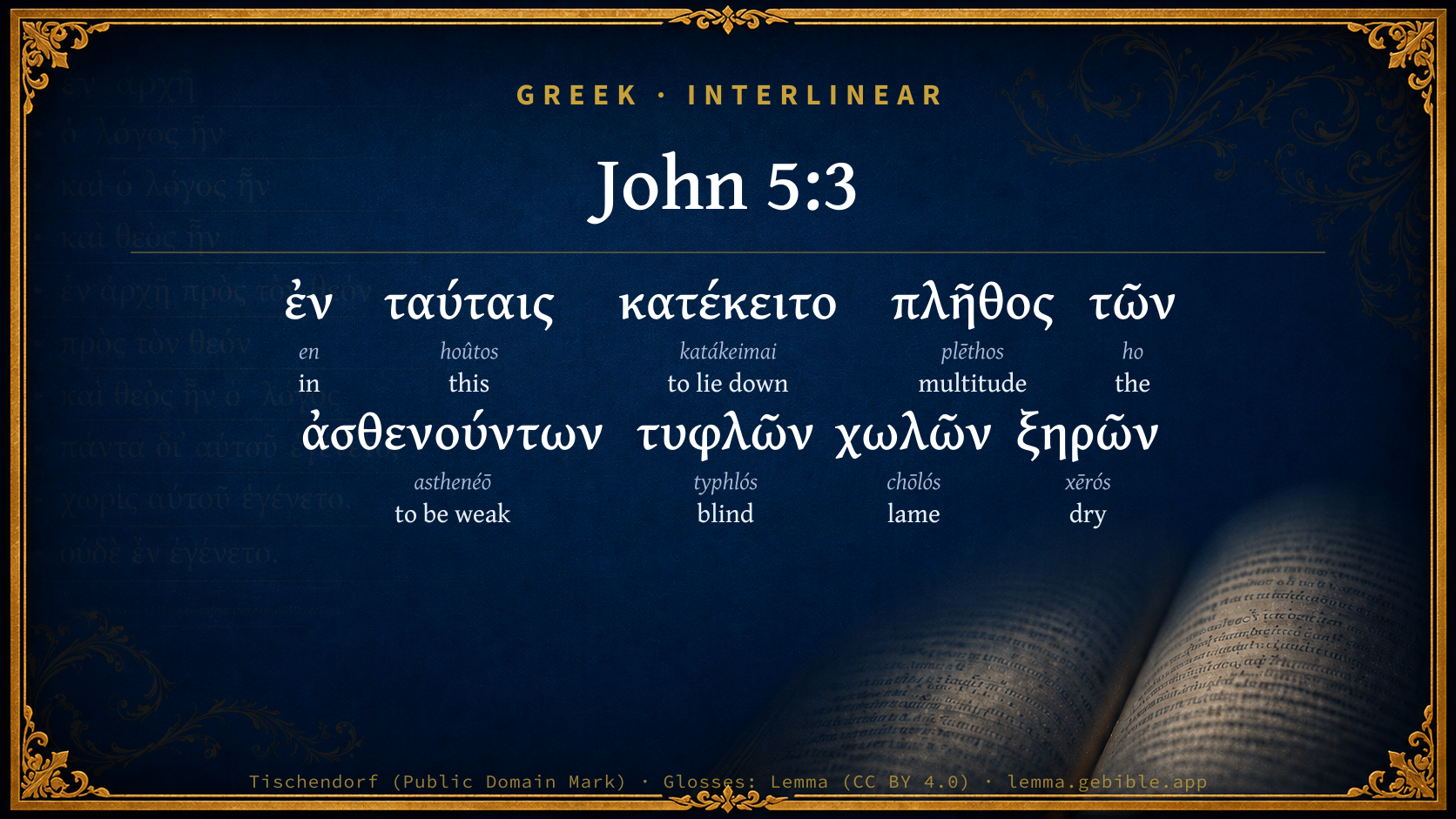
Download image
Cite this verse

John 5:3 (World English Bible). Public Domain. Lemma interlinear Bible study tool, https://lemma.gebible.app/v/john/5/3.

Show BibTeX & RIS
BibTeX
RIS
English Translation
In these lay a great multitude of those who were sick, blind, lame, or paralyzed, waiting for the moving of the water;
World English Bible · Public Domain
Download a study sheet

One document with this verse’s original text, its word-by-word gloss line, the meaning frame, cross-references with their text, attributed commentary, and full source and license credits — printable, and it pastes into notes with its structure intact.

This verse Autodidact and up

Study sheet (.html) Plain text (.txt)

A passage Seminary Student

Up to 50 verses in one chapter. A passage sheet keeps up to 6 commentary sources and 12 cross-references per verse, in the order this page ranks them, and says so on the sheet whenever that leaves anything out. Ask for a single verse and you get the Autodidact verse sheet above.

Everything on this page stays free to read, with no account — the sheet is a download of what is already on screen, not access to it.

Want to remove ads? Support Godless Engineer
Compare translations 3

The same verse in 3 English versions, stacked beneath the original-language interlinear above. Click any original word for its lexicon entry.

Each is an independent rendering of the whole verse — the interlinear is not word-aligned to these translations.

Highlighted words mark where these versions differ — a whole-verse word diff, not a word-by-word alignment.

  • World English Bible Public Domain
    In these lay a great multitude of those who were sick, blind, lame, or paralyzed, waiting for the moving of the water;
  • King James Version Public Domain
    In these lay a great multitude of impotent folk, of blind, halt, withered, waiting for the moving of the water.
  • unfoldingWord Literal Text CC BY-SA 4.0
    In these were lying a crowd of the ones being sick, blind, lame, paralyzed.

unfoldingWord Literal Text — © unfoldingWord, licensed CC BY-SA 4.0. Word-aligned USFM3 via Door43 (git.door43.org/unfoldingWord/en_ult).

Versions to compare (up to 4)

3 of 4 selected

Show all 19 translations

Every available English version of this verse, each an independent rendering of the whole verse.

  • World English Bible Public Domain
    In these lay a great multitude of those who were sick, blind, lame, or paralyzed, waiting for the moving of the water;
  • Berean Standard Bible Public Domain
    On these walkways lay a great number of the sick, the blind, the lame, and the paralyzed.
  • Majority Standard Bible Public Domain
    On these walkways lay a great number of the sick, the blind, the lame, and the paralyzed, awaiting the moving of the water.
  • King James Version Public Domain
    In these lay a great multitude of impotent folk, of blind, halt, withered, waiting for the moving of the water.
  • American Standard Version (1901) Public Domain
    In these lay a multitude of them that were sick, blind, halt, withered, `waiting for the moving of the water.'
  • Revised Version (1885) Public Domain
    In these lay a multitude of them that were sick, blind, halt, withered.
  • Geneva Bible (1599) Public Domain
    In the which lay a great multitude of sicke folke, of blinde, halte, and withered, wayting for the mouing of the water.
  • Douay-Rheims (1899) Public Domain
    In these lay a great multitude of sick, of blind, of lame, of withered; waiting for the moving of the water.
  • Young's Literal Translation Public Domain
    in these were lying a great multitude of the ailing, blind, lame, withered, waiting for the moving of the water,
  • Literal Standard Version CC BY-SA 4.0
    in these were lying a great multitude of the ailing, blind, lame, withered, [[waiting for the moving of the water,
  • Unlocked Literal Bible CC BY-SA 4.0
    A large number of people who were sick, blind, lame, or paralyzed were lying there.
  • unfoldingWord Literal Text CC BY-SA 4.0
    In these were lying a crowd of the ones being sick, blind, lame, paralyzed.
  • Darby Bible Public Domain
    In these lay a multitude of sick, blind, lame, withered, [awaiting the moving of the water.
  • World Messianic Bible Public Domain
    In these lay a great multitude of those who were sick, blind, lame, or paralyzed, waiting for the moving of the water;
  • Webster's Bible Public Domain
    In these lay a great multitude of impotent persons, of blind, halt, withered, waiting for the moving of the water.
  • Free Bible Version CC BY-SA 4.0
    Crowds of sick people were lying in these porches—those who were blind, lame, or paralyzed.
  • Bible in Basic English Public Domain
    In these doorways there were a great number of people with different diseases: some unable to see, some without the power of walking, some with wasted bodies.
  • Text-Critical English NT CC BY 4.0
    In the porticoes were lying a great multitude of disabled people, including the blind, the lame, and the paralyzed, who were waiting for the moving of the water.
  • Tyndale New Testament (1534) Public Domain
    in which laye a greate multitude of sicke folke of blinde halt and wyddered waytinge for the movinge of the water.

Literal Standard Version (2020), Covenant Press — licensed CC BY-SA 4.0. Text via the HelloAO Bible API (eBible.org). Unlocked Literal Bible (unfoldingWord) — licensed CC BY-SA 4.0. Text via the HelloAO Bible API (eBible.org). unfoldingWord Literal Text — © unfoldingWord, licensed CC BY-SA 4.0. Word-aligned USFM3 via Door43 (git.door43.org/unfoldingWord/en_ult). Free Bible Version, Dr. Jonathan Gallagher — licensed CC BY-SA 4.0. Text via the HelloAO Bible API (eBible.org).

Word by word

More ways to search: Search by grammar → Find every occurrence → Compare this word →

Practice this passage: Drill this verse → Learn its vocabulary →

About this verse

These counts appear in no published source. They are computed here, from the morphology-tagged text and Lemma’s own curated glosses. What Lemma adds →

9
words
9
distinct lemmas
Gospels
section

Notable vocabulary

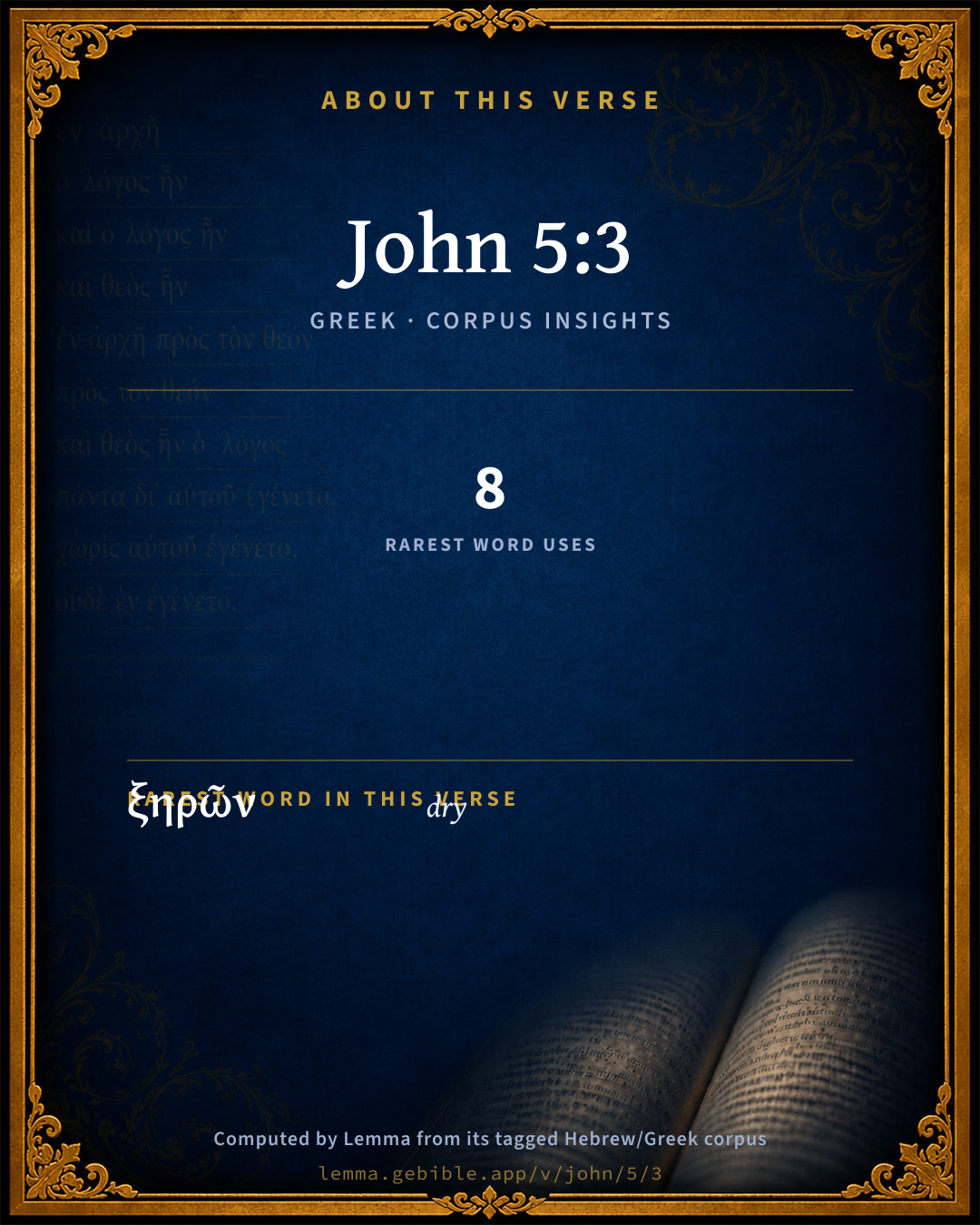
The rarest word here is ξηρῶν dry G3584 — appearing just 8 times in the whole Greek New Testament.

Shared distinctive vocabulary

ξηρῶν dry G3584 occurs in 8 verses of the Greek New Testament. Also found in:

Cross-references

9

Topical passages linked to John 5:3 in the Treasury of Scripture Knowledge — connected by theme and wording, ordered by reader-vote popularity; previews shown in the World English Bible.

  • Mark 3:1–4 He entered again into the synagogue, and there was a man there who had his hand withered.
  • Matthew 15:30 Great multitudes came to him, having with them the lame, blind, mute, maimed, and many others, and they put them down at his feet. He healed them,
  • Luke 7:22 Jesus answered them, "Go and tell John the things which you have seen and heard: that the blind receive their sight, the lame walk, the lepers are cleansed, the deaf hear, the dead are raised up, and the poor have good news preached to them.
  • Zechariah 11:17 Woe to the worthless shepherd who leaves the flock! The sword will be on his arm, and on his right eye. His arm will be completely withered, and his right eye will be totally blinded!"
  • Lamentations 3:26 It is good that a man should hope and quietly wait for the salvation of Yahweh.
  • James 5:7 Be patient therefore, brothers, until the coming of the Lord. Behold, the farmer waits for the precious fruit of the earth, being patient over it, until it receives the early and late rain.
  • 1 Kings 13:4 It happened, when the king heard the saying of the man of God, which he cried against the altar in Bethel, that Jeroboam put forth his hand from the altar, saying, Lay hold on him. His hand, which he put forth against him, dried up, so that he could not draw it back again to him.
  • Proverbs 8:34 Blessed is the man who hears me, Watching daily at my gates, Waiting at my door posts.
  • Romans 8:25 But if we hope for that which we don't see, we wait for it with patience.

Cross-references courtesy of OpenBible.info (CC BY 4.0).

Where the printed editions differ

2 variants

Places in this verse where the major printed Greek editions disagree on the wording in a way that affects the translation — a comparison of editions, not a manuscript-by-manuscript collation. The editions are the modern critical texts (Nestlé-Aland 28/27, SBL, Westcott-Hort, Tregelles, Tyndale House) and the traditional texts behind the KJV (the Textus Receptus and the Byzantine/Majority text). It is not a claim about which reading is original.

  1. Extra text
    πολὺ

    “great”

    In TRByz Not in NA28NA27TynSBLWHTreg

    πολὺ (polu) 'great' is only in traditional manuscripts (TR+Byz)

  2. Extra text
    ἐκδεχομένων τὴν τοῦ ὕδατος κίνησιν.

    “waiting for <the> of the water motion.”

    In TRByz Not in NA28NA27TynSBLWHTreg

    ἐκδεχομένων τὴν τοῦ ὕδατος κίνησιν. (ekdechomenōn tēn tou hudatos kinēsin) 'waiting for of the water motion.' is only in traditional manuscripts (TR+Byz)

Textual data: Translators Amalgamated Greek New Testament (STEPBible TAGNT) · CC BY 4.0.

Commentary

Notes on John 5:3 from classic Christian and Jewish commentators (each source and its license shown beneath its notes). The classic Christian expositions comment on the surrounding passage and are grouped to its opening verse, so a note may address several verses; the Jewish commentaries on the Tanakh (Rashi and others) are per-verse, so they appear only where the commentator wrote on this verse.

Lemma curates 59 commentaries, every one of them public domain or Creative Commons licensed, each selected and text-cleaned for this edition rather than reprinted as found. About our sources →

Ellicott's Commentary for English Readers

(3) In these lay a great multitude.—The word “great” before multitude, and the latter clause of the verse “waiting for the moving of the water,” and the whole of Joh_5:4, is omitted by most of the oldest MSS., including the Sinaitic and the Vatican, and is judged to be no part of the original text by a consensus of modern editors, including Tischendorf, Tregelles, Alford, and Westcott and Hort. It is interesting to note how a gloss like this has found its way into the narrative, and, for ninety-nine out of every hundred readers, is now regarded as an integral part of St. John’s Gospel. We meet with it very early. It is found in the Alexandrian MS., and in the Latin and early Syrian versions. Tertullian refers to it. This points to a wide acceptance from the second century downwards, and points doubtless to the popular interpretation of that day. It explains the man’s own view in Joh_5:7, and the fact of the multitude assembled round the pool (Joh_5:3). The bubbling water moving as it were with life, and in its healing power seeming to convey new energy to blind and halt and lame, was to them as the presence of a living messenger of God. They knew not its constituent elements, and could not trace the law of its action, but they knew the Source of all good, who gave intellect to man and healing influence to matter, effect to the remedy and skill to the physician, and they accepted the gift as direct from Him. Scientists of the present century will smile at these Christians of the second century. The Biblical critic is glad that he can remove these words from the record, and cannot be called upon to explain them. But it may be fairly asked, which is most truly scientific—to grasp the Ultimate Cause of all, even without the knowledge of intermediate links; or to trace these links, and express them in so-called laws, and make these abstract laws lifeless representatives of the living God? There is a via media which, here as elsewhere, wisdom will seek rather than either extreme. All true theology must be, in the best sense, scientific; and all true science must be, in the best sense, religious.

A Bible Commentary for English Readers, edited by Charles John Ellicott (1878–1897) — public domain. Text from a community e-Sword module.

Tyndale Open Study Notes

Tyndale Open Resources

5:3 The pool of Bethesda had become a healing sanctuary for crowds of sick people who believed miraculous cures were possible. • Most scholars believe that the variant reading in the NLT textual note was not part of John’s original text, but it represents an ancient tradition that provided helpful background information.

Tyndale Open Study Notes — © Tyndale Open Resources, licensed CC BY-SA 4.0. Text via the HelloAO Bible API.

Bengel's Gnomon

Johann Albrecht Bengel

Joh 5:3. Κατέκειτο, lay) Therefore many were there during the whole time:[102] such at least was the case with this impotent man whom the Lord healed; for he had no one [to put him in], Joh 5:7.—ΚΊΝΗΣΙΝ, the moving) by which the mud was stirred up.

[102] Of their infirmity.—E. and T.

Bengel's Gnomon of the New Testament — English translation (T&T Clark, Edinburgh, 1860) — public domain. Text from a community e-Sword module.

Expositor's Greek Testament

ed. W. Robertson Nicoll

Joh 5:3 . ἐκδεχομένων … νοσήματι . See critical note.

The Expositor's Greek Testament, edited by W. Robertson Nicoll (1897–1910) — public domain. Text from a community e-Sword module.

Cambridge Greek Testament for Schools and Colleges

3. Omit ἐκδεχομένων τὴν τοῦ ὕδατος κίνησιν after ξηρῶν, with אA1BC1L against D and the great mass of later authorities; a gloss suggested by Joh 5:7, and added before Joh 5:4.

3. τυφλ., χ., ξ. The special kinds of ἀσθενοῦντες. The words which follow in T.R., and the whole of Joh 5:4 are an interpolation, though a very ancient one, for it was known to Tertullian (De Bapt. v.). “The whole passage is omitted by the oldest representatives of each great group of authorities” (Westcott). The conclusion of Joh 5:3 was added first as a gloss on Joh 5:7; and Joh 5:4 may represent the popular belief with regard to the intermittent bubbling of the healing water, first added as a gloss, and then inserted into the text. The water was probably mineral, and the people may have been right in supposing that it was most efficacious when it was most violent. The MSS. which contain the insertion vary very much.

Cambridge Greek Testament for Schools and Colleges (Cambridge University Press, 1896; 21 vols, various authors incl. Carr, Maclear, Plummer, Farrar, Lumby, Moule, M. R. James, Simcox) — public domain. Text from a community e-Sword module.

Godet's Commentaries

Frédéric Louis Godet

Vv. 3, 4. “In these porches lay a great number of sick persons, blind, lame, withered, [ waiting for the movement of the water. 4. For an angel descended from time to time into the pool and troubled the water; whosoever then first entered in after the troubling of the water, was healed of whatever disease he had ].”

The spectacle which this portico surrounding the pool presented is reproduced in some sort de visu by Bovet, describing the baths of Ibrahim, near Tiberias: “The hall where the spring is found is surrounded by several porticos, in which we see a multitude of people crowded one upon another, laid upon pallets or rolled in blankets, with lamentable expressions of misery and suffering..... The pool is of white marble, of circular form and covered by a cupola supported by columns; the basin is surrounded on the interior by a bench on which persons may sit.” Ξηροί, impotent, properly denotes those who have some member affected with atrophy, or, according to the common expression, wasting away. The end of Joh 5:3 and the 4th verse are wanting in the larger part of the Alexandrian MSS., and are rejected by Tischendorf, Lucke, Tholuck, Olshausen, Meyer.

The large number of variants and the indications of doubt by which this passage is marked in several MSS., favor the rejection. The defenders of the authenticity of the passage, for example Reuss, explain the omission of it by the Alexandrian authorities by a dogmatic antipathy which, they hold, betrayed itself in the similar omission Luk 22:43-44 (the appearance of the angel at Gethsemane). This supposition would not, by any means, apply either to the SinaiticMS., which has the passage in Luke entire, or to the Alexandrian which, in our passage, reads the fourth verse. TheVatican MS., alone presents the two omissions together; which evidently is not enough to justify the suspicion expressed above.

I held with Ewald, in my earlier editions, that the true reading is the one presented by theCambridge MS., and by numerous MSS. of the Itala, which preserve the close of Joh 5:3 while omitting the whole of Joh 5:4. The words: waiting for the movement of the water, if they are authentic, may indeed easily have occasioned the gloss of Joh 5:4. And Joh 5:7 seems to demand, in what precedes, something like the last words of Joh 5:3. Still it seems to me difficult to understand what should have occasioned the omission of these words in so large a number of documents, if they had originally formed part of the text. I am inclined, therefore, to hold with Weiss, Keil, etc., that they, as well as Joh 5:4, were added. The whole was at first written on the margin by a copyist; then this marginal remark was introduced into the text, as is observed in so many cases. This interpolation must be very ancient, for it is found already in one of the Syriac Versions (Syr sch), and Tertullian seems to allude to it (de Bapt., c. 5). It was the expression of the popular opinion respecting the periodical movement of the water. According to the authentic text, there is nothing supernatural in the phenomenon of Bethesda. The whole is reduced to the intermittence which is so frequently observed in thermal waters. It is known that these waters have the greatest efficacy at the moment when they spring up, set in ebullition by the increased action of the gas, and it was at this moment that each sick person tried to be the first to feel its influence.Hengstenberg, who admits the intervention of the angel, extends the same explanation to all thermal waters. But it would be necessary, in this case, to hold a singular exaggeration in the terms of Joh 5:4. For after all no mineral water instantaneously heals the sick and all the kinds of maladies which are here mentioned.

Frédéric Louis Godet — Commentaries on Luke, John, Romans, and 1 Corinthians — English translation (T&T Clark, Edinburgh, 1870s–1890s) — public domain. Text from a community e-Sword module.

Jamieson, Fausset & Brown

Robert Jamieson, A. R. Fausset & David Brown

impotent--infirm.

Jamieson, Fausset & Brown — Commentary Critical and Explanatory on the Whole Bible (1871) — public domain (CC PDM 1.0). Text via the HelloAO Bible API.

Adam Clarke's Commentary

Verse 3. Blind, halt, withered] To these the Codex Bezae, three copies of the Itala, and both the Persic, add παραλυτικων, paralytic; but they are probably included among the withered.

Waiting for the moving of the water.] This clause, with the whole of the fourth verse, is wanting in some MSS. and versions; but I think there is no sufficient evidence against their authenticity. Griesbach seems to be of the same opinion; for though he has marked the whole passage with the notes of doubtfulness, yet he has left it in the text. Some have imagined that the sanative virtue was communicated to the waters by washing in them the entrails of the beasts which were offered in sacrifice; and that the angel meant no more than merely a man sent to stir up from the bottom this corrupt sediment, which, being distributed through the water, the pores of the person who bathed in it were penetrated by this matter, and his disorder repelled! But this is a miserable shift to get rid of the power and goodness of God, built on the merest conjectures, self-contradictory, and every way as unlikely as it is insupportable. It has never yet been satisfactorily proved that the sacrifices were ever washed; and, could even this be proved, who can show that they were washed in the pool of Bethesda? These waters healed a man in a moment of whatsoever disease he had. Now, there is no one cause under heaven that can do this. Had only one kind of disorders been cured here, there might have been some countenance for this deistical conjecture-but this is not the case; and we are obliged to believe the relation just as it stands, and thus acknowledge the sovereign power and mercy of God, or take the desperate flight of an infidel, and thus get rid of the passage altogether.

Adam Clarke's Commentary on the Bible (1810–1826) — public domain. Text from a community e-Sword/MySword module.

John Calvin's Commentaries

3. In these lay a great multitude. It is possible that diseased persons lay in the porches to ask alms when the people were passing there who were going into the temple to worship; and there, too, it was customary to purchase the beasts which were to be offered in sacrifice. Yet at each feast God cured a certain number, that, in this way, he might recommend the worship prescribed in the Law and the holiness of the temple. But might it not appear foolish to believe, while we read of nothing of this kind having been done at a time when religion was in the most flourishing condition, and even since in the age of the Prophets miracles were not performed but on extraordinary occasions, that when the affairs of the nation were so decayed and almost ruinous, the power and grace of God were displayed with more than ordinary lustre? I reply, there were, in my opinion, two reasons. As the Holy Spirit, dwelling in the Prophets, was a sufficient witness of the divine presence, religion at that time needed no other confirmation; for the Law had been sanctioned by abundantly sufficient miracles, and God ceased not to express, by innumerable testimonies, his approbation of the worship which he had enjoined. But about the time of Christ’s coming, as they were deprived of the Prophets and their condition was very wretched, and as various temptations pressed upon them on every hand, they needed this extraordinary aid, that they might not think that God had entirely left them, and thus might be discouraged and fall away. For we know that Malachi was the last of the Prophets, and, therefore, he closes his doctrine with this admonition, that the Jews may

remember the Law delivered by Moses, (Malachi 4:4,)

until Christ appear. God saw it to be advantageous to deprive them of the Prophets, and to keep them in suspense for a time, that they might be inflamed with a stronger desire for Christ, and might receive him with greater reverence, when he should be manifested to them. Yet, that testimonies might not be wanting to the temple and sacrifices, and to the whole of that worship by which salvation should be made known to the world, the Lord retained among the Jews this gift of healing, that they might know that there was a good reason why God separated them from the other nations. For God, by curing the diseased, showed plainly — as by an arm stretched out from heaven — that he approved of this kind of worship which they derived from the injunction of the Law. Secondly, I have no doubt that God intended to remind them by these signs that the time of redemption was approaching, and that Christ, the Author of salvation, was already at hand, that the minds of all might be the better aroused. I think that signs, in that age, served this twofold purpose; first, that the Jews might know that God was present with them, and thus might remain steady in their obedience to the Law; and, secondly, that they might earnestly hope for a new and unwonted condition.

Of lame, blind, withered. For the purpose of informing us that the diseases cured by our Lord were not of an ordinary kind, the Evangelist enumerates some classes of them; for human remedies could be of no avail to the lame, blind, and withered. It was indeed a mournful spectacle, to see in so large a body of men so many kinds of deformities in the members; but yet the glory of God shone more brightly there than in the sight of the most numerous and best disciplined army. For nothing is more magnificent than when an unwonted power of God corrects and restores the defects of nature; and nothing is more beautiful or more delightful than when, through his boundless goodness, he relieves the distresses of men. For this reason the Lord intended that this should be a splendid theater, in which not only the inhabitants of the country, but strangers also, might perceive and contemplate His majesty; and, as I have already suggested, it was no small ornament and glory of the temple, when God, by stretching out his hand, clearly showed that He was present.

John Calvin's Commentaries (1540-1563) — public domain. Text from the Calvin Translation Society English edition (1840s-50s) via the Christian Classics Ethereal Library (ccel.org). Calvin's coverage is partial (roughly two-thirds of the Bible); uncommented books and verses are honest gaps, never fabricated. The 19th-century editor's footnotes and remarks are omitted so the notes are faithfully Calvin's own voice.

The Cambridge Bible for Schools and Colleges

gen. ed. J. J. S. Perowne

3. lay a great multitude] Better, were lying a multitude.

blind, halt, withered] These are the special kinds of ‘impotent folk.’

waiting for the moving of the water] These words and the whole of Joh_5:4 are almost certainly an interpolation, though a very ancient one. They are omitted by the best MSS. Other important MSS. omit Joh_5:4 or mark it as suspicious. Moreover, those MSS. which contain the passage vary very much. The passage is one more likely to be inserted without authority than to be omitted if genuine; and very probably it represents the popular belief with regard to the intermittent bubbling of the healing water, first added as a gloss, and then inserted into the text. The water was probably mineral in its elements, and the people may or may not have been right in supposing that it was most efficacious when the spring was most violent.

The Cambridge Bible for Schools and Colleges (gen. ed. J. J. S. Perowne; Cambridge University Press, 1878–1918) — public domain. Text from a community e-Sword module.

John Gill's Exposition

In these lay a great multitude of impotent folk,.... Sick and weak persons; who were an emblem of men under the law of works, and in a state of unregeneracy; who are enfeebled by sin, and are impotent and unable to do anything of themselves; as to keep the law of God, to which they have neither will nor power, and to atone for the transgressions of it; nor to redeem themselves from the curse of the law or to begin and carry on a work of grace upon their souls; or to do anything that is spiritually good; no, not to think a good thought, or to do a good action, as is required:

of blind; these also may represent men a state of nature, who are ignorant of, and blind to everything that is spiritual; as to the true knowledge of God in Christ, the way of salvation by him, the plague of their own hearts, and the exceeding sinfulness of sin; to the Spirit of God, and his work upon the soul; and to the truths of the Gospel, in the power of them:

halt, or "lame"; this word sometimes is used of persons in suspense about religious things, hesitating concerning them, halting between two opinions; and sometimes designs the infirmities of the saints, and their faulterings in religious exercises; and here maybe expressive in a figurative way, of the incapacity natural men, to go or walk of themselves; as to come to Christ for grace and life, which no man can do, except the Father draw him; or to walk by faith in him: it is added,

withered; one limb or another of them dried up: their arms or legs were withered, and their sinews shrunk, and were without radical moisture, or the free use of the animal spirits; and may point out carnal persons, such as are sensual, not having the Spirit, destitute of the grace of God, without faith, hope, love, knowledge, and the fear of God; without God, Christ, and the Spirit; and in a lifeless, helpless, hopeless, and perishing condition:

waiting for the moving of the water; hereafter mentioned: and so it is in providence, and a wonderful thing it is, that the hearts of so many unregenerate persons should be inclined to attend upon the outward means of grace, and should be waiting at Wisdom's gates, and watching at the posts of her door.

John Gill's Exposition of the Whole Bible (1746–1763) — public domain (CC PDM 1.0). Text via the HelloAO Bible API.

Trapp's Complete Commentary

John Trapp

3 In these lay a great multitude of impotent folk, of blind, halt, withered, waiting for the moving of the water.

Ver. 3. Of impotent folk] That had tried all other ways, and could not otherwise be cured, Omnipotenti medico, nullus insanabilis occurrit morbus. (Isidore.)

John Trapp, A Commentary or Exposition upon All the Books of the Old and New Testament (1647–1656) — public domain. Text from a community e-Sword module.

Albert Barnes' Notes on the Bible

Impotent folk - Sick people; or people who were weak and feeble by long disease. The word means those who were “feeble” rather than those who were afflicted with “acute” disease.

Halt - Lame.

Withered - Those who were afflicted with one form of the palsy that withered or dried up the part affected. See the notes at Mat 4:24.

Moving of the water - It appears that this pool had medicinal properties only when it was “agitated” or “stirred.” It is probable that at regular times or intervals the fountain put forth an unusual quantity of water, or water of special properties, and that “about” these times the people assembled in multitudes who were to be healed.

Albert Barnes' Notes on the Bible (1834–1885) — public domain. Text from a community e-Sword/MySword module.

Matthew Poole's English Annotations

In these apartments (called here porches) there were a great number of sick persons, some labouring under one infirmity, some under another, some blind, some lame, waiting for the time the water should be troubled.

Matthew Poole's English Annotations on the Holy Bible (1683–1685) — public domain. Text from a community e-Sword/MySword module.

Whedon's Commentary on the Bible

Daniel D. Whedon

3. Impotent folk—Infirm people.

Halt—Limping or lame. The word is cognate with hold, and implies the holding, or withholding, in the walk of a lame person.

Daniel D. Whedon (gen. ed.), Commentary on the Old and New Testaments (1874–1909) — public domain. Text from a community e-Sword module.

The Pulpit Commentary

Vers. 3, 4. In these (porches) lay a multitude of sick folk, blind, lame, withered, waiting for the moving of the water; for an angel went down season by season into the pool, and troubled the waters: he then that first stepped in after the troubling of the water became whole of whatsoever disease he Had. the interesting gloss discussed below conveys the idea of magical cure, without moral significance, and attributes such cure to angelic ministry. This is the natural and popular explanation of the Bethesda healings, and would easily occur to a copyist who has not taken pains to use New Testament diction. Wunsche quotes from "Chullin," fol. 105, b, a testimony that "deadly qualities of water were attributed to demons, and healing ones to the angels." The crowds which gather in all countries round medicinal and intermittent springs are still unable to explain their curative quality by scientific analogies; and there is nothing more likely to have suggested itself to the mind of a copyist than the intervention of an angel. The absence from Scripture elsewhere of non-moral miracles is powerful internal reason for the lack of authenticity for the poetic gloss. The text. when deprived of this dubious gloss, loses all character that is inconsistent with the authenticity of the narrative. The close of ver. 3, "waiting for the moving of the waters," is far better attested than ver. 4, and, moreover, is consistent with John"s manner, and with well ascertained matters of fact; and the clause would give authentic ground for the gloss that fellows. Hoffmann and Hengstenberg defend the passage, and believe that the angel at "the waters" in the Apocalypse betrays the same hand. But there can be no fair comparison between a historical fact and a symbolical figure.

The Pulpit Commentary (1880–1919), ed. H.D.M. Spence-Jones & Joseph S. Exell — public domain. Text from a community e-Sword module.

Scofield Reference Notes

C. I. Scofield

waiting for

The Sinai MS. omits "waiting for the moving of the water." and all of Joh 5:4.

The Scofield Reference Bible (1917 edition), notes by C. I. Scofield — public domain. Text from a community e-Sword module.

The People's New Testament

B. W. Johnson

3, 4. In these lay a great multitude. All that follows the word “withered” in the third verse and all the fourth are wanting in the best MSS., and are evidently an interpolation.

B. W. Johnson's The People's New Testament with Notes (1889–1891) — public domain. Electronic text from the Christian Classics Ethereal Library (CCEL) ThML edition.

Alford’s Greek Testament

Henry Alford

3.] ξηρῶν, those who were afflicted with the loss of vital power in any of their limbs by stiffness or paralysis. Of this kind was the man on whom the miracle was wrought.

[ἐκδεχ.… κίησιν, and ver. 4. The spuriousness of this controverted passage seems to me more clear than when I prepared my Second Edition. The very reasons which Stier and De Wette allege in its favour, and which then weighed with me, will on more consideration be found to range themselves on the other side. Let us conceive of the matter thus. The facts, of the assemblage of sick persons round the pool, and of the answer of the sick man in ver. 7, were recorded in the sacred text as we now find them, and nothing else. In the background, and explanatory of both, was the popular belief of the Jews, not alleged by the Evangelist. In very early times, this deficiency was supplied by the insertion of the spurious passage. I say, in very early times: for Tertullian refers to it in a way which leaves no doubt that he read it entire. “Piscinam Bethsaidam (cf. digest on ver. 2) angelus interveniens commovebat: observabant qui valetudinem querebantur. Nam si quis prævenerat descendere illuc, queri post lavacrum desinebat.” De Bapt. c. 5, vol. i. p. 1205. So that the fact of so many different kinds of sick persons being mentioned here (Stier), and that of the connexion of the account almost requiring this passage as its explanation (De Wette), points to the reason why it was put in, to clear up a narrative otherwise obscure. I would not lay much stress on the variations in the passage, which are only such as are perpetually meeting us in the undoubted text: but the fact that there are no less than seven words used either here only, or here only in this sense, is strong against its genuineness: as is the concurrence of , , , and in omitting it. Of N.T. critics, Griesb. brackets it, ., Meyer, and . omit it,—while Lachm. retains it in his text. De Wette, Lücke, and Luthardt, are undecided, but inclined more or less strongly against it. As a marginal gloss, it certainly does good service, as explaining both the obscure points—the assemblage of sick, and the answer in ver. 7.

κατὰ καιρόν, here, apparently, at intervals: and those irregular ones, or the sick need not have waited there for them.

κατέβαινεν, was in the habit of descending: the imperfects continue throughout.]

Henry Alford, The Greek Testament (1849–1861) — public domain. Text from a community e-Sword module.

International Critical Commentary

3. The picture of the sick people lying under the covered arcades (it would have been too cold at the Passover season to lie out in the open air) waiting for the bubbling up of the intermittent spring, which was supposed to have healing properties, is most natural and vivid.

ἐν ταύταις, sc. in the στοαί or arches.

κατέκειτο. The verb does not appear again in Jn. The rec. text inserts πολύ after πλῆθος,, but om. אBCDLW.

τυφλῶν, χωλῶν, ξηρῶν, “blind, halt, withered.” ξηροί were those who had atrophied limbs (cf. Mat 12:10, Luk 6:8). The Western text (D a b) adds παραλυτικῶν, but this is only a gloss explanatory of ξηρῶν: om. אA*BC*LWΘ.

After ξηρῶν, παραλυτικῶν, the rec. adds ἐκδεχομένων τῆν τοῦ ὓδατος κίνησιν. This, again, is a Western (and Syrian) amplification; it is omitted by אA*BC*L, although supported by DWΓΔΘ syrr. It was suggested by the mention in v. 7 of the disturbance of the healing waters.

International Critical Commentary — older volumes (1896–1929), various authors — public domain. Text from a community e-Sword module.

Vincent's Word Studies in the New Testament

Marvin R. Vincent

Great multitude. The best texts omit great.

Impotent [ασθεςουντων] . Rev., sick. Yet the A. V. gives the literal meaning, people without strength. Wyc., languishing.

Withered [ζηρων] . Literally, dry. So Wyc.. The following words, to the end of ver. 4, are omitted by the best texts.

Marvin R. Vincent, Word Studies in the New Testament (1887–1900) — public domain. Text from a community e-Sword/MySword module.

Lesson kit

Teaching starters — assembled from the data on this page, not authored interpretation. Every prompt links to the verse data it draws on. Edit before teaching.

John, in the Gospels, opens this verse with 9 words (9 distinct Greek lemmas). Its most distinctive word is xērós (“dry”). A historical commentator’s framing appears above. Read the whole chapter for the surrounding context.

Discussion questions

  1. How does “dry” (xērós) shape what this verse is saying?
  2. How does Matthew 12:10, which shares the word «dry», read alongside this verse?
  3. The translations on this page render this verse differently — a whole-verse word diff, not a word-by-word alignment. What might account for the different wordings?
  4. Compare how Ellicott's Commentary for English Readers and Tyndale Open Study Notes read this verse. Where do they agree or differ?

Things to notice

Reading settings

Reading text

Shown beneath each verse's original-language words.

Old Testament
Old Testament edition

Read the OT as the Masoretic Hebrew (MT) or the Greek Septuagint (LXX).

English shown for the Greek Septuagint (in the Hebrew ↔ Greek comparison).

Comparing translations? Open the Compare panel on any verse page to stack up to four side by side.