John 11:26

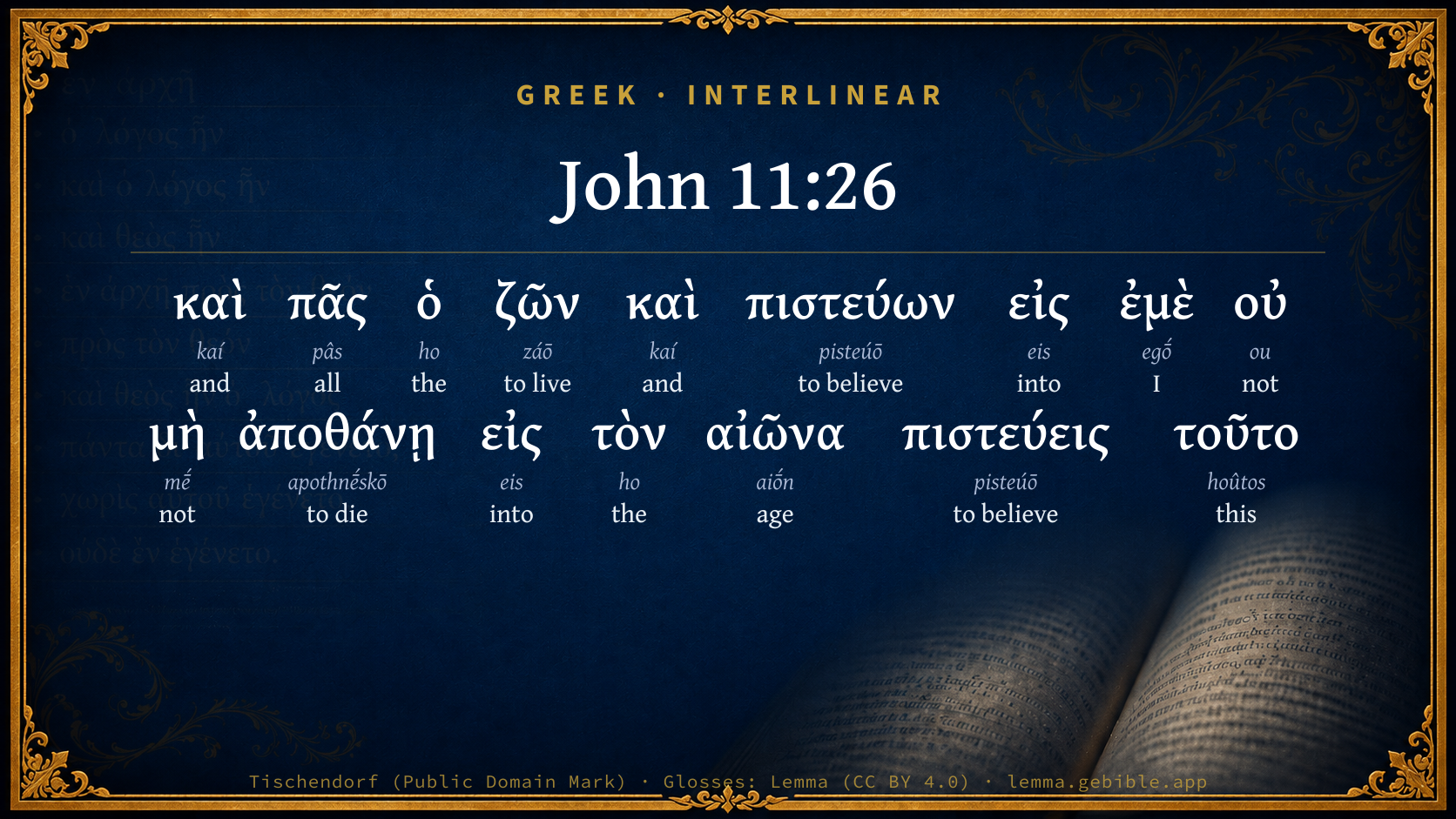
Greek (Tischendorf 8th ed.) John 11:26 appears in the Greek New Testament. The text above is from the Tischendorf 8th edition. Each word links to its Strong’s number and a concise gloss. Click any word for its full Thayer’s Greek Lexicon entry.
Download image
Cite this verse

John 11:26 (World English Bible). Public Domain. Lemma interlinear Bible study tool, https://lemma.gebible.app/v/john/11/26.

Show BibTeX & RIS
BibTeX
RIS
English Translation
Whoever lives and believes in me will never die. Do you believe this?"
World English Bible · Public Domain
Download a study sheet

One document with this verse’s original text, its word-by-word gloss line, the meaning frame, cross-references with their text, attributed commentary, and full source and license credits — printable, and it pastes into notes with its structure intact.

This verse Autodidact and up

Study sheet (.html) Plain text (.txt)

A passage Seminary Student

Up to 50 verses in one chapter. A passage sheet keeps up to 6 commentary sources and 12 cross-references per verse, in the order this page ranks them, and says so on the sheet whenever that leaves anything out. Ask for a single verse and you get the Autodidact verse sheet above.

Everything on this page stays free to read, with no account — the sheet is a download of what is already on screen, not access to it.

Want to remove ads? Support Godless Engineer
Compare translations 3

The same verse in 3 English versions, stacked beneath the original-language interlinear above. Click any original word for its lexicon entry.

Each is an independent rendering of the whole verse — the interlinear is not word-aligned to these translations.

Highlighted words mark where these versions differ — a whole-verse word diff, not a word-by-word alignment.

  • World English Bible Public Domain
    Whoever lives and believes in me will never die. Do you believe this?"
  • King James Version Public Domain
    And whosoever liveth and believeth in me shall never die. Believest thou this?
  • unfoldingWord Literal Text CC BY-SA 4.0
    and everyone living and believing in me may certainly not die into eternity. Do you believe this?”

unfoldingWord Literal Text — © unfoldingWord, licensed CC BY-SA 4.0. Word-aligned USFM3 via Door43 (git.door43.org/unfoldingWord/en_ult).

Versions to compare (up to 4)

3 of 4 selected

Show all 19 translations

Every available English version of this verse, each an independent rendering of the whole verse.

  • World English Bible Public Domain
    Whoever lives and believes in me will never die. Do you believe this?"
  • Berean Standard Bible Public Domain
    And everyone who lives and believes in Me will never die. Do you believe this?”
  • Majority Standard Bible Public Domain
    And everyone who lives and believes in Me will never die. Do you believe this?”
  • King James Version Public Domain
    And whosoever liveth and believeth in me shall never die. Believest thou this?
  • American Standard Version (1901) Public Domain
    and whosoever liveth and believeth on me shall never die. Believest thou this?
  • Revised Version (1885) Public Domain
    and whosoever liveth and believeth on me shall never die. Believest thou this?
  • Geneva Bible (1599) Public Domain
    And whosoeuer liueth, and beleeueth in me, shall neuer die: Beleeuest thou this?
  • Douay-Rheims (1899) Public Domain
    And every one that liveth, and believeth in me, shall not die for ever. Believest thou this?
  • Young's Literal Translation Public Domain
    and every one who is living and believing in me shall not die -- to the age;
  • Literal Standard Version CC BY-SA 4.0
    and everyone who is living and believing in Me will not die—throughout the age;
  • Unlocked Literal Bible CC BY-SA 4.0
    and whoever lives and believes in me will never die. Do you believe this?”
  • unfoldingWord Literal Text CC BY-SA 4.0
    and everyone living and believing in me may certainly not die into eternity. Do you believe this?”
  • Darby Bible Public Domain
    and every one who lives and believes on me shall never die. Believest thou this?
  • World Messianic Bible Public Domain
    Whoever lives and believes in me will never die. Do you believe this?”
  • Webster's Bible Public Domain
    And whoever liveth, and believeth in me, shall never die. Believest thou this?
  • Free Bible Version CC BY-SA 4.0
    All who live in me and trust in me will never die. Do you believe this?”
  • Bible in Basic English Public Domain
    And no one who is living and has faith in me will ever see death. Is this your faith?
  • Text-Critical English NT CC BY 4.0
    No one who lives and believes in me will ever die. Do yoʋ believe this?”
  • Tyndale New Testament (1534) Public Domain
    And whosoever lyveth and belevest on me shall never dye. Beleveth thou this?

Literal Standard Version (2020), Covenant Press — licensed CC BY-SA 4.0. Text via the HelloAO Bible API (eBible.org). Unlocked Literal Bible (unfoldingWord) — licensed CC BY-SA 4.0. Text via the HelloAO Bible API (eBible.org). unfoldingWord Literal Text — © unfoldingWord, licensed CC BY-SA 4.0. Word-aligned USFM3 via Door43 (git.door43.org/unfoldingWord/en_ult). Free Bible Version, Dr. Jonathan Gallagher — licensed CC BY-SA 4.0. Text via the HelloAO Bible API (eBible.org).

Word by word

More ways to search: Search by grammar → Find every occurrence → Compare this word →

Practice this passage: Drill this verse → Learn its vocabulary →

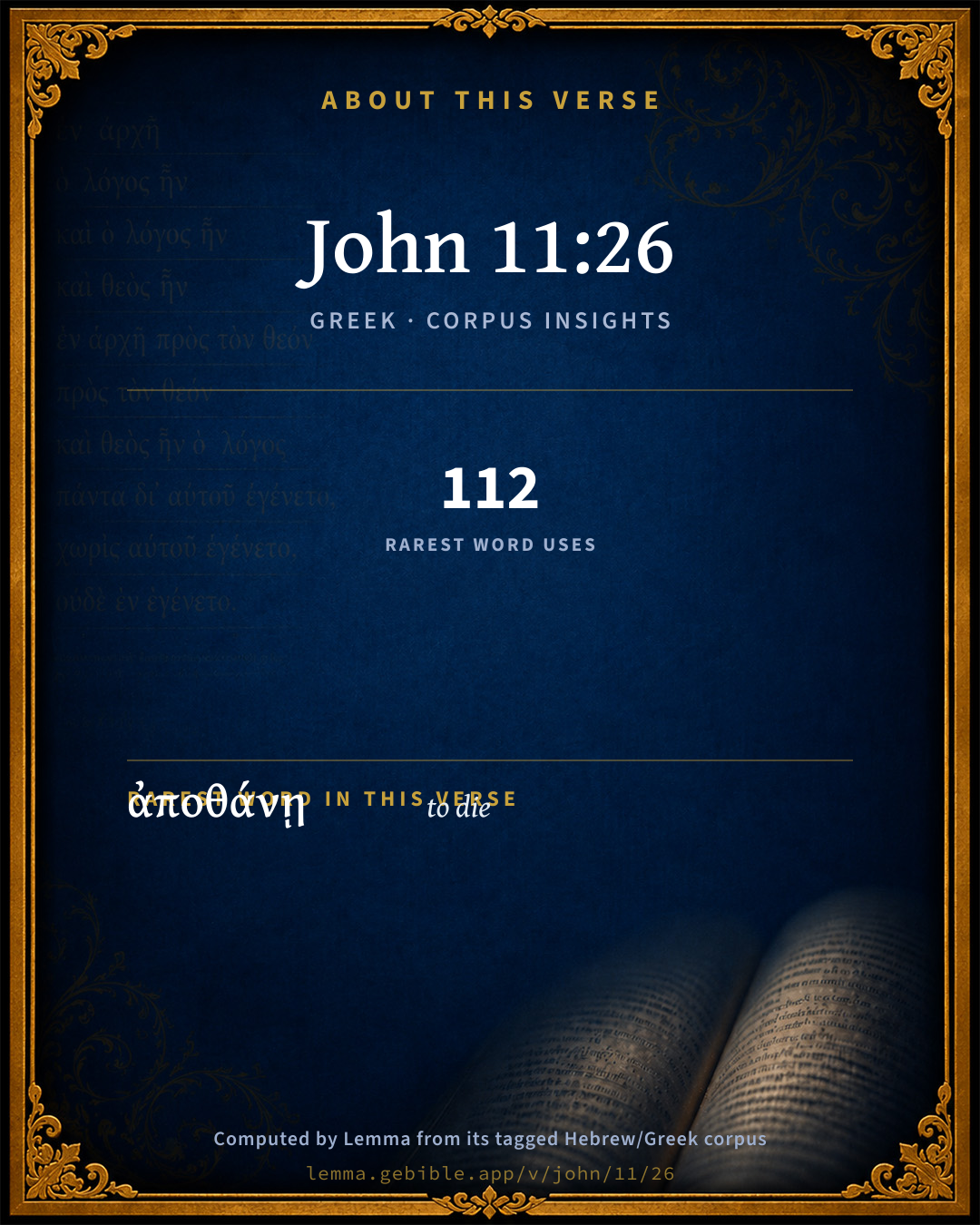
ἀποθάνῃ
apothnḗskō
G599
“to die”
Verb, Aorist, Active, Subjunctive, 3rd person, Singular
Part of Speech
Verb
Tense
Aorist
Voice
Active
Mood
Subjunctive
Person
3rd person
Number
Singular
Full Thayer's Definition

Origin: from G575 and G2348

TDNT: 03:07,3

1. to die a. of the natural death of man b. of the violent death of man or animals c. to perish by means of something d. of trees which dry up, of seeds which rot when planted e. of eternal death, to be subject to eternal misery in hell
  1. καὶ kaí G2532 “and” Conjunction
  2. πᾶς pâs G3956 “all” Adjective, Nominative, Singular, Masculine
  3. ὁ ho G3588 “the” Article, Nominative, Singular, Masculine
  4. ζῶν záō G2198 “to live” Verb, Present, Active, Participle, Nominative, Singular, Masculine
  5. καὶ kaí G2532 “and” Conjunction
  6. πιστεύων pisteúō G4100 “to believe” Verb, Present, Active, Participle, Nominative, Singular, Masculine
  7. εἰς eis G1519 “into” Preposition
  8. ἐμὲ egṓ G1473 “I” Personal pronoun, 1st person, Accusative, Singular
  9. οὐ ou G3756 “not” Particle, Negative
  10. μὴ mḗ G3361 “not” Particle, Negative
  11. εἰς eis G1519 “into” Preposition
  12. τὸν ho G3588 “the” Article, Accusative, Singular, Masculine
  13. αἰῶνα aiṓn G165 “age” Noun, Accusative, Singular, Masculine
  14. πιστεύεις pisteúō G4100 “to believe” Verb, Present, Active, Indicative, 2nd person, Singular
  15. τοῦτο hoûtos G3778 “this” Demonstrative pronoun, Accusative, Singular, Neuter

About this verse

These counts appear in no published source. They are computed here, from the morphology-tagged text and Lemma’s own curated glosses. What Lemma adds →

16
words
12
distinct lemmas
Gospels
section

Repetition

Words recur within this verse:

  • πιστεύων to believe G4100 ×2
  • εἰς into G1519 ×2
  • καὶ and G2532 ×2
  • ὁ the G3588 ×2

Cross-references

14

Topical passages linked to John 11:26 in the Treasury of Scripture Knowledge — connected by theme and wording, ordered by reader-vote popularity; previews shown in the World English Bible.

  • John 10:28 I give eternal life to them. They will never perish, and no one will snatch them out of my hand.
  • John 5:24 "Most assuredly I tell you, he who hears my word, and believes him who sent me, has eternal life, and doesn't come into judgment, but has passed out of death into life.
  • Romans 8:13 For if you live after the flesh, you must die; but if by the Spirit you put to death the deeds of the body, you will live.
  • 1 John 5:10–12 He who believes in the Son of God has the testimony in himself. He who doesn't believe God has made him a liar, because he has not believed in the testimony that God has given concerning his Son.
  • John 8:51–53 Most assuredly, I tell you, if a person keeps my word, he will never see death."
  • John 6:54–58 He who eats my flesh and drinks my blood has eternal life, and I will raise him up at the last day.
  • John 3:15–18 that whoever believes in him should not perish, but have eternal life.
  • John 6:50–51 This is the bread which comes down out of heaven, that anyone may eat of it and not die.
  • John 4:14 but whoever drinks of the water that I will give him will never thirst again; but the water that I will give him will become in him a well of water springing up to eternal life."
  • John 14:10 Don't you believe that I am in the Father, and the Father in me? The words that I tell you, I speak not from myself; but the Father who lives in me does his works.
  • Matthew 9:28 When he had come into the house, the blind men came to him. Jesus said to them, "Do you believe that I am able to do this?" They told him, "Yes, Lord."
  • Mark 9:23 Jesus said to him, "If you can believe, all things are possible to him who believes."
  • John 9:35 Jesus heard that they had thrown him out, and finding him, he said, "Do you believe in the Son of God?"
  • Matthew 26:53 Or do you think that I couldn't ask my Father, and he would even now send me more than twelve legions of angels?

Cross-references courtesy of OpenBible.info (CC BY 4.0).

Commentary

Notes on John 11:26 from classic Christian and Jewish commentators (each source and its license shown beneath its notes). The classic Christian expositions comment on the surrounding passage and are grouped to its opening verse, so a note may address several verses; the Jewish commentaries on the Tanakh (Rashi and others) are per-verse, so they appear only where the commentator wrote on this verse.

Lemma curates 59 commentaries, every one of them public domain or Creative Commons licensed, each selected and text-cleaned for this edition rather than reprinted as found. About our sources →

Joseph Benson's Commentary

Joh 11:26. And whosoever liveth — That Isaiah , 1 st, A natural life; whosoever lives in this world, whether he be Jew or Gentile, and wherever, in whatever country or age he lives; and believeth — That is, believeth while he liveth in this world, while he is here, in this state of probation; for, after death, it will be too late to believe. Or, 2d, Whosoever believeth, and liveth a spiritual life, and continues to believe, that he may continue so to live. For he that lives and believes, is he that lives by faith, a faith that influences his conversation: he that, by faith, is born again to a heavenly, holy, and divine life; to whom, to live is Christ, and whose life is continually derived from Christ. Such a one shall never die — A promise this which ensures a blessed immortality, 1st, To the soul: he who, being united to Christ by faith, lives a spiritual life by virtue of that union, shall never die; his spiritual life shall never be extinguished, but perfected in eternal life. For, as the soul, being in its nature spiritual, is therefore immortal; so, if by faith it live here a spiritual life, consonant to its nature, its felicity shall be immortal too. And there shall be no interruption of its life, as there is of the life of the body. The body indeed dies, or sleeps rather, but not for ever, as the original expression here used, ου μη αποθανη, εις τον αιωνα, applied to it, is rendered by some. For, 2d, This promise ensures future life and happiness to it also. All the difficulties that attend the state of the dead are here overlooked by our Lord, and made nothing of, while he speaks of himself as the resurrection and the life. Though the body be dead because of sin; though the sentence of death passed upon it be just; though the effects of death be dismal; though the bands of death be strong; though the body be not only dead, but putrefied; though the scattered dust be so mixed with common dust, that no art of man can distinguish, much less separate them; yet we are sure it shall live again. Christ asks Martha, Believest thou this? — Canst thou take my word for it, and rely firmly on its accomplishment? Reader, when we hear the word of Christ concerning the great things of the other world, we should seriously ask ourselves, Do we believe this? This truth in particular; this, which is attended with so many difficulties; this, which is suited to my case? Doth my belief of it realize it to me, and give my soul an assurance of it? so that I can say, not only this I believe, but thus I believe. Martha’s mind was occupied with the idea of her brother’s being raised to life in this world; before Christ gave her hopes of that, he directed her thoughts to another life, and another world. As if he had said, That is of comparatively little importance, but believest thou this that I tell thee concerning a future state? The crosses and comforts of this present time would not make half that impression upon us which they do, if we did but believe the things of eternity as we ought.

Joseph Benson's Commentary on the Old and New Testaments (1811–1818) — public domain. Text from a community e-Sword module.

Tyndale Open Study Notes

Tyndale Open Resources

11:26-27 Do you believe this? Jesus was not asking if Martha believed he could bring Lazarus from the grave. Rather, did she believe that life itself is linked to Jesus? • “Yes, Lord”: Even though the full implications were beyond her comprehension, she acknowledged that Jesus was indeed the Messiah. Yet she was surprised at the power he held.

Tyndale Open Study Notes — © Tyndale Open Resources, licensed CC BY-SA 4.0. Text via the HelloAO Bible API.

Bengel's Gnomon

Johann Albrecht Bengel

Joh 11:26. Πᾶς, every one [‘whosoever’]) This word, which was not employed in Joh 11:25, brings on the discourse to greater things.—ζῶν) that liveth, namely, this present life of the body. The antithesis to this lies in the words, Joh 11:25, even though he die [κἂν ἀποθάνῃ: “though he were dead,” Engl. Vers.] Those especially treated of here, are they who then were alive and saw the Son: ch. Joh 6:40, “This is the will of Him that sent Me, that every one which seeth the Son, and believeth on Him, may have everlasting life.”—οὐ μὴ ἀποθάνῃ, shall not die) Shall be exempt from death, to all eternity. The antithetic word to this is ζήσεται, shall live, restored to life; Joh 11:25. There is a great difference between the death [mortem] of believers before the death of Jesus Christ, and the departure [obitum; metaphor from setting of heavenly bodies] of believers after the death of Jesus Christ. These latter are altogether exempt from the judgment.[298]—πιστεύεις τοῦτο; believest thou this?) An application of the truth, in the second person, to all collectively and individually, which is often found elsewhere, and which here, by means of the unexpected interrogation, is very pungent. Thus [by means of this personal application] Martha is completely won over to faith.

[298] Condemnation: ch. Joh 5:24, He that henreth My word, and believeth on Him that sent Me, hath everlasting life, and shall not come into condemnation, but is passed from death unto life.—E. and T.

Bengel's Gnomon of the New Testament — English translation (T&T Clark, Edinburgh, 1860) — public domain. Text from a community e-Sword module.

Adam Clarke's Commentary

Verse 26. Shall never die.] Or, Shall not die for ever. Though he die a temporal death. he shall not continue under its power for ever; but shall have a resurrection to life eternal.

Believest thou this?] God has determined to work in the behalf of men only in proportion to their faith in him: it was necessary, therefore, that these persons should be well instructed concerning his nature, that they might find no obstacles to their faith. These sisters had considered him only as a prophet hitherto; and it was necessary that they should now be farther instructed, that, as God was to exert himself, they might believe that God was there.

Adam Clarke's Commentary on the Bible (1810–1826) — public domain. Text from a community e-Sword/MySword module.

John Calvin's Commentaries

26. And whosoever liveth, and believeth in me. This is the exposition of the second clause, how Christ is the life; and he is so, because he never permits the life which he has once bestowed to be lost, but preserves it to the end. For since flesh is so frail, what would become of men, if, after having once obtained life, they were afterwards left to themselves? The perpetuity of the life must, therefore, be founded on the power of Christ himself, that he may complete what he has begun.

Shall never die. The reason why it is said that believers never die is, that their souls, being born again of incorruptible seed, (1 Peter 1:23,) have Christ dwelling in them, from whom they derive perpetual vigor; for, though

the body be subject to death on account of sin, yet the spirit is life on account of righteousness, (Romans 8:10.)

That the outward man daily decays in them is so far from taking anything away from their true life, that it aids the progress of it, because the inward man is renewed from day to day, (2 Corinthians 4:16.) What is still more, death itself is a sort of emancipation from the bondage of death.

Dost thou believe this? Christ seems, at first sight, to discourse about spiritual life, for the purpose of withdrawing the mind of Martha from her present desire. Martha wished that her brother should be restored to life Christ replies, that he is the Author of a more excellent life; and that is, because he quickens the souls of believers by divine power. Yet I have no doubt that he intended to include both favors; and therefore he describes, in general terms, that spiritual life which he bestows on all his followers, but wishes to give them some opportunity of knowing this power, which he was soon afterwards to manifest in raising Lazarus.

John Calvin's Commentaries (1540-1563) — public domain. Text from the Calvin Translation Society English edition (1840s-50s) via the Christian Classics Ethereal Library (ccel.org). Calvin's coverage is partial (roughly two-thirds of the Bible); uncommented books and verses are honest gaps, never fabricated. The 19th-century editor's footnotes and remarks are omitted so the notes are faithfully Calvin's own voice.

Ellicott's Commentary for English Readers

(26) And whosoever liveth and believeth in me.—This is to be understood of the physical life answering to “though he have died” of the last verse.

Shall never die.—Comp. especially Note on Joh_8:51. He shall by no means die for ever. Not through the infinite course of ages shall there be that which makes for him the sting of death. The fact of what we call physical death is not denied, but in the fulness of the thought of life it is regarded as the passage to a new and higher life.

A Bible Commentary for English Readers, edited by Charles John Ellicott (1878–1897) — public domain. Text from a community e-Sword module.

The Cambridge Bible for Schools and Colleges

gen. ed. J. J. S. Perowne

26. shall never die] See on Joh_8:51; the form of expression is the same; ‘shall assuredly never die.’

Believest thou this?] A searching question, suddenly put. She answers with confidence, and gives the ground of her confidence.

The Cambridge Bible for Schools and Colleges (gen. ed. J. J. S. Perowne; Cambridge University Press, 1878–1918) — public domain. Text from a community e-Sword module.

John Gill's Exposition

She saith unto him, yea, Lord,.... That is, she firmly believed all that he said concerning himself, and the happiness of those that believed in him: and for the confirmation of it adds,

I believe: or "I have believed", as the Vulgate Latin version renders it; that is, long ago, ever since she knew him:

that thou art the Christ the Son of God, which should come into the world; that he was the true Messiah, and the proper and natural Son of God, of the same nature with God, equal to him, having the same perfections with him; and who was long promised, much prophesied of, and greatly expected to come into the world; and was now come into the world by the assumption of human nature, to work out salvation for his people, and therefore, since she believed all this of him, she must believe that he was able to raise the dead to life, and to secure those that believe in him from dying eternally.

John Gill's Exposition of the Whole Bible (1746–1763) — public domain (CC PDM 1.0). Text via the HelloAO Bible API.

Trapp's Complete Commentary

John Trapp

26 And whosoever liveth and believeth in me shall never die. Believest thou this?

Ver. 26. Believest thou this?] He saith not, Understandest thou this? For the mysteries of the Christian religion, saith Rupertus, are much better understood by believing than believed by understanding.

John Trapp, A Commentary or Exposition upon All the Books of the Old and New Testament (1647–1656) — public domain. Text from a community e-Sword module.

Albert Barnes' Notes on the Bible

Whosoever liveth - He had just spoken of the prospects of the pious dead. He now says that the same prospects are before the living who have like faith. Greek, “Every one living and believing on me.”

Shall never die - As the dead, though dead, shall yet live, so the living shall have the same kind of life. They shall never come into eternal death. See Joh 6:50-51, Joh 6:54, Joh 6:58. Greek, “Shall by no means die forever.”

Believest thou this? - This question was doubtless asked because it implied that he was then able to raise up Lazarus, and because it was a proper time for her to test her own faith. The time of affliction is a favorable period to try ourselves to ascertain whether we have faith. If we still have confidence in God, if we look to him for comfort in such seasons, it is good evidence that we are his friends. He that loves God when he takes away his comforts, has the best evidence possible of true attachment to him.

Albert Barnes' Notes on the Bible (1834–1885) — public domain. Text from a community e-Sword/MySword module.

Matthew Poole's English Annotations

He had before proved himself to be the resurrection, now he proveth himself to be the life. He saith, he that liveth, that liveth a natural life, if he be one who receiveth and embraces me as the true Messiah and Saviour of the world, and committeth himself and all the concerns of his soul to me, shall never die. Though his body shall die because of sin, yet his spirit shall live because of righteousness; and God shall in the great day quicken again his mortal body, through the Holy Spirit which dwelleth in him, and is united to him, Rom 8:10,11. He asketh Martha if she believed this. We shall observe, that our Saviour, not here only, but Mat 9:22,28, before he wrought his miraculous operations, required people’s faith as a prerequisite. And, Mat 13:58, he could not do many mighty works in his own country, because of their unbelief. And, Mat 17:20, he tells his disciples, that the reason why they could not cure the man possessed with the devil, was because of their unbelief: so great an honour hath God given to the exercise of faith.

Matthew Poole's English Annotations on the Holy Bible (1683–1685) — public domain. Text from a community e-Sword/MySword module.

Scofield Reference Notes

C. I. Scofield

never die

i.e. the "second death." Cf. Rev 2:1; Rev 20:6.

The Scofield Reference Bible (1917 edition), notes by C. I. Scofield — public domain. Text from a community e-Sword module.

The People's New Testament

B. W. Johnson

26. Whosoever liveth and believeth in me shall never die. Those dead, who believed in him, shall be raised and live, and those living who believe, shall never perish. Death will only be a change to a better existence.

B. W. Johnson's The People's New Testament with Notes (1889–1891) — public domain. Electronic text from the Christian Classics Ethereal Library (CCEL) ThML edition.

Cambridge Greek Testament for Schools and Colleges

26. πᾶς. There is no limitation; Joh 3:15, Joh 12:46. Comp. Joh 1:18, Joh 4:14, Joh 6:51, Joh 8:51, Joh 10:9. For οὐ μὴ ἀπ. εἰς τ. αἰῶνα see on Joh 8:51. Πιστεύεις τοῦτο; is a searching question suddenly put. She answers with confidence and gives the ground for her confidence.

Cambridge Greek Testament for Schools and Colleges (Cambridge University Press, 1896; 21 vols, various authors incl. Carr, Maclear, Plummer, Farrar, Lumby, Moule, M. R. James, Simcox) — public domain. Text from a community e-Sword module.

Alford’s Greek Testament

Henry Alford

26.] These words, as Stier observes, are the central point of the history; the great testimony to Himself, of which the subsequent miracle is the proof. The intention of the saying seems to have been, to awaken in Martha the faith that He could raise her brother from the dead, in its highest and proper form. This He does by announcing Himself (ἐγώ, I, and no other …) as ‘the Resurrection’ (q. d.—that resurrection in the last day shall be only by my Power, and therefore I can raise now as well), and more than that, the Life itself: so that he that believeth in me (= Lazarus, in her mind), even though he have died (ἀποθάνῃ, past) shall live; and he that liveth (physically, ‘is not yet dead’) and believeth in me, shall never die: i.e. ‘faith in Me is the source of life, both here and hereafter; and those who have it, have Life, so that they shall never die;’ physical death being overlooked and disregarded, in comparison with that which is really and only death. Compare 4 Macc. 7:19. The ζῶν must be (against Lampe, Olshausen, and Stier) taken of physical life, for it stands opposed to κἂν ἀποθάνῃ.

ὁ πιστ. εἰς ἐμέ is the subject of both clauses; in the former it is said that he κἂν ἀποθ., ζήσεται: in the second, that he ζῶν, οὐ μὴ ἀποθάνῃ. Olshausen’s remark, that ζῶν and ἀποθ. in the second clause must both be physical, if one is, is wrong; the antithesis consisting, in both clauses, in the reciprocation of the two senses, physical and spiritual; and serving in the latter clause, as a key hereafter to the condition of Lazarus, when raised from the dead.

There can hardly be any reference in ver. 26 to the state of the living faithful at the Lord’s coming (πάντες οὐ κοιμηθησόμεθα, πάντες δὲ ἀλλαγησόμεθα, 1Co 15:51),—for although the Apostle there, speaking of believers primarily and especially, uses the first person,—the saying would be equally true of unbelievers, on whose bodies the change from to τὸ φθαρτόν to ἀφθαρσία will equally pass, and of whom the οὐ ἀποθάνῃ here would be equally true,—whereas the saying is one setting forth an exclusive privilege of ὁ ζῶν κ. πιστεύων εἰς ἐμέ. Besides, such an interpretation would set aside all reference to Lazarus, or to present circumstances.

Henry Alford, The Greek Testament (1849–1861) — public domain. Text from a community e-Sword module.

International Critical Commentary

26. καὶ πᾶς ὁ ζῶν κτλ. The verse is susceptible of two meanings. (1) If πᾶς ὁ ζῶν is understood as meaning “every living man,” sc. living in this earthly life (cf. ἐνώπιον παντὸς ζῶντος, Tob. 13:4), then v. 26 is but the repetition in other words of what has already been said in v. 25, “no living man who believes in me shall ever die.” Such repetition is quite in the Johannine style (see 3:3, 5), and it gives a good sense here. (2) But inasmuch as ζήσεται in v. 25 refers to spiritual life, the life of the believer after the death of the body, it is preferable to take ζῶν in v. 26 as having the same reference, and to treat v. 26 as continuing the topic of v. 25, but not repeating it. “Every one who is living (sc. in the heavenly life) and a believer in me shall never die.” Verse 25 gives only the promise of life after physical death; v. 26 gives the assurance of that future life being immortal. For this use of ζῶν as indicating one who is living, not on earth, but in the spiritual world, cf. the saying of Jesus to the Sadducees, that God is not the God of the dead, but of the living (ζώντων, Mar 12:27 and parallels).

For this use of εἰς τὸν αἰῶνα, “shall never die,” cf. 4:14, and esp. 8:51.

It should be observed that vv. 25, 26, do not suggest to Martha that Lazarus will live again on earth. They are general pronouncements applying to every believer in Jesus, and the emphasis is laid on the words ὁ πιστεύων εἰς ἐμέ. It is this essential condition of life in its deepest sense that is proclaimed to Martha. She is asked if she believes it, and she says “Yes”; but her answer does not indicate that she understood what was involved.

International Critical Commentary — older volumes (1896–1929), various authors — public domain. Text from a community e-Sword module.

Lesson kit

Teaching starters — assembled from the data on this page, not authored interpretation. Every prompt links to the verse data it draws on. Edit before teaching.

John, in the Gospels, opens this verse with 16 words (12 distinct Greek lemmas). Its most distinctive word is apothnḗskō (“to die”). A historical commentator’s framing appears above. Read the whole chapter for the surrounding context.

Discussion questions

  1. How does “to die” (apothnḗskō) shape what this verse is saying?
  2. How does John 10:28, which shares this passage’s theme, read alongside this verse?
  3. What does the repetition of “to believe” (2× in this one verse) do in this verse?
  4. These translations render this verse differently; the difference is in the English rendering, not the original. What questions does that raise?
  5. Compare how Joseph Benson's Commentary and Tyndale Open Study Notes read this verse. Where do they agree or differ?

Things to notice

  • These translations choose different wording for 20 words in this verse.
  • “to believe” occurs 2× in this single verse.
  • 12 distinct Greek lemmas span 16 words in this verse.

Reading settings

Reading text

Shown beneath each verse's original-language words.

Old Testament
Old Testament edition

Read the OT as the Masoretic Hebrew (MT) or the Greek Septuagint (LXX).

English shown for the Greek Septuagint (in the Hebrew ↔ Greek comparison).

Comparing translations? Open the Compare panel on any verse page to stack up to four side by side.