
John 1:2

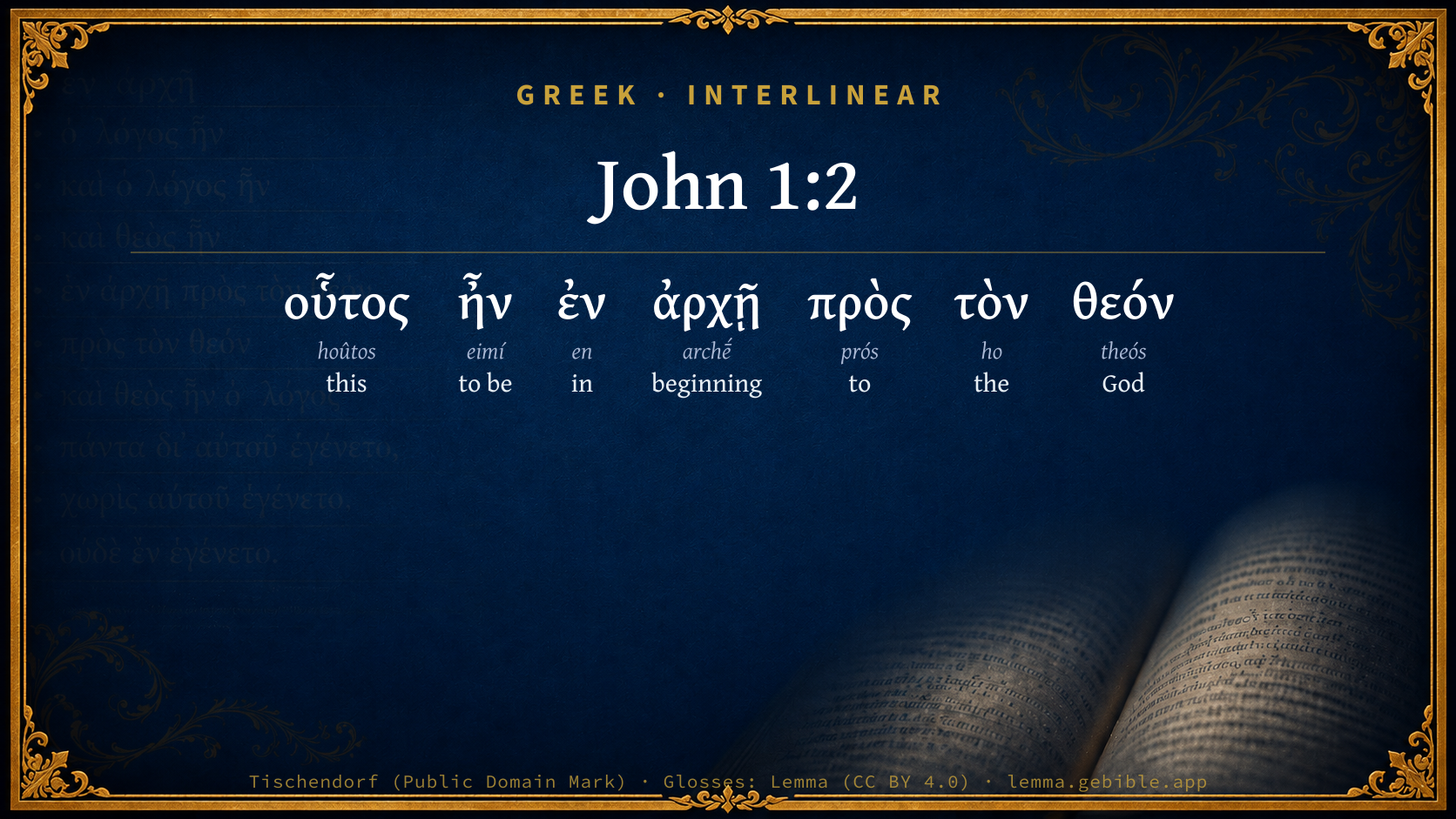
Greek (Tischendorf 8th ed.) John 1:2 appears in the Greek New Testament. The text above is from the Tischendorf 8th edition. Each word links to its Strong’s number and a concise gloss. Click any word for its full Thayer’s Greek Lexicon entry.
Download image
Cite this verse

John 1:2 (World English Bible). Public Domain. Lemma interlinear Bible study tool, https://lemma.gebible.app/v/john/1/2.

Show BibTeX & RIS
BibTeX
RIS
English Translation
The same was in the beginning with God.
World English Bible · Public Domain
Download a study sheet

One document with this verse’s original text, its word-by-word gloss line, the meaning frame, cross-references with their text, attributed commentary, and full source and license credits — printable, and it pastes into notes with its structure intact.

This verse Autodidact and up

Study sheet (.html) Plain text (.txt)

A passage Seminary Student

Up to 50 verses in one chapter. A passage sheet keeps up to 6 commentary sources and 12 cross-references per verse, in the order this page ranks them, and says so on the sheet whenever that leaves anything out. Ask for a single verse and you get the Autodidact verse sheet above.

Everything on this page stays free to read, with no account — the sheet is a download of what is already on screen, not access to it.

Want to remove ads? Support Godless Engineer
Compare translations 3

The same verse in 3 English versions, stacked beneath the original-language interlinear above. Click any original word for its lexicon entry.

Each is an independent rendering of the whole verse — the interlinear is not word-aligned to these translations.

Highlighted words mark where these versions differ — a whole-verse word diff, not a word-by-word alignment.

  • World English Bible Public Domain
    The same was in the beginning with God.
  • King James Version Public Domain
    The same was in the beginning with God.
  • unfoldingWord Literal Text CC BY-SA 4.0
    He was in the beginning with God.

unfoldingWord Literal Text — © unfoldingWord, licensed CC BY-SA 4.0. Word-aligned USFM3 via Door43 (git.door43.org/unfoldingWord/en_ult).

Versions to compare (up to 4)

3 of 4 selected

Show all 19 translations

Every available English version of this verse, each an independent rendering of the whole verse.

  • World English Bible Public Domain
    The same was in the beginning with God.
  • Berean Standard Bible Public Domain
    He was with God in the beginning.
  • Majority Standard Bible Public Domain
    He was with God in the beginning.
  • King James Version Public Domain
    The same was in the beginning with God.
  • American Standard Version (1901) Public Domain
    The same was in the beginning with God.
  • Revised Version (1885) Public Domain
    The same was in the beginning with God.
  • Geneva Bible (1599) Public Domain
    This same was in the beginning with God.
  • Douay-Rheims (1899) Public Domain
    The same was in the beginning with God.
  • Young's Literal Translation Public Domain
    this one was in the beginning with God;
  • Literal Standard Version CC BY-SA 4.0
    this One was in the beginning with God;
  • Unlocked Literal Bible CC BY-SA 4.0
    This one was in the beginning with God.
  • unfoldingWord Literal Text CC BY-SA 4.0
    He was in the beginning with God.
  • Darby Bible Public Domain
    *He* was in the beginning with God.
  • World Messianic Bible Public Domain
    The same was in the beginning with God.
  • Webster's Bible Public Domain
    The same was in the beginning with God.
  • Free Bible Version CC BY-SA 4.0
    From the very beginning he was with God.
  • Bible in Basic English Public Domain
    This Word was from the first in relation with God.
  • Text-Critical English NT CC BY 4.0
    He was in the beginning with God.
  • Tyndale New Testament (1534) Public Domain
    The same was in the beginnynge with God.

Literal Standard Version (2020), Covenant Press — licensed CC BY-SA 4.0. Text via the HelloAO Bible API (eBible.org). Unlocked Literal Bible (unfoldingWord) — licensed CC BY-SA 4.0. Text via the HelloAO Bible API (eBible.org). unfoldingWord Literal Text — © unfoldingWord, licensed CC BY-SA 4.0. Word-aligned USFM3 via Door43 (git.door43.org/unfoldingWord/en_ult). Free Bible Version, Dr. Jonathan Gallagher — licensed CC BY-SA 4.0. Text via the HelloAO Bible API (eBible.org).

Word by word

More ways to search: Search by grammar → Find every occurrence → Compare this word →

Practice this passage: Drill this verse → Learn its vocabulary →

ἀρχῇ
archḗ
G746
“beginning”
Noun, Dative, Singular, Feminine
Part of Speech
Noun
Case
Dative
Number
Singular
Gender
Feminine
Full Thayer's Definition

Origin: from G756

TDNT: 08:59,8

1. beginning, origin 2. the person or thing that commences, the first person or thing in a series, the leader 3. that by which anything begins to be, the origin, the active cause 4. the extremity of a thing a. of the corners of a sail 5. the first place, principality, rule, magistracy a. of angels and demons
  1. οὗτος hoûtos G3778 “this” Demonstrative pronoun, Nominative, Singular, Masculine
  2. ἦν eimí G1510 “to be” Verb, Imperfect, Active, Indicative, 3rd person, Singular
  3. ἐν en G1722 “in” Preposition
  4. πρὸς prós G4314 “to” Preposition
  5. τὸν ho G3588 “the” Article, Accusative, Singular, Masculine
  6. θεόν theós G2316 “God” Noun, Accusative, Singular, Masculine

About this verse

These counts appear in no published source. They are computed here, from the morphology-tagged text and Lemma’s own curated glosses. What Lemma adds →

7
words
7
distinct lemmas
Gospels
section

Shared distinctive vocabulary

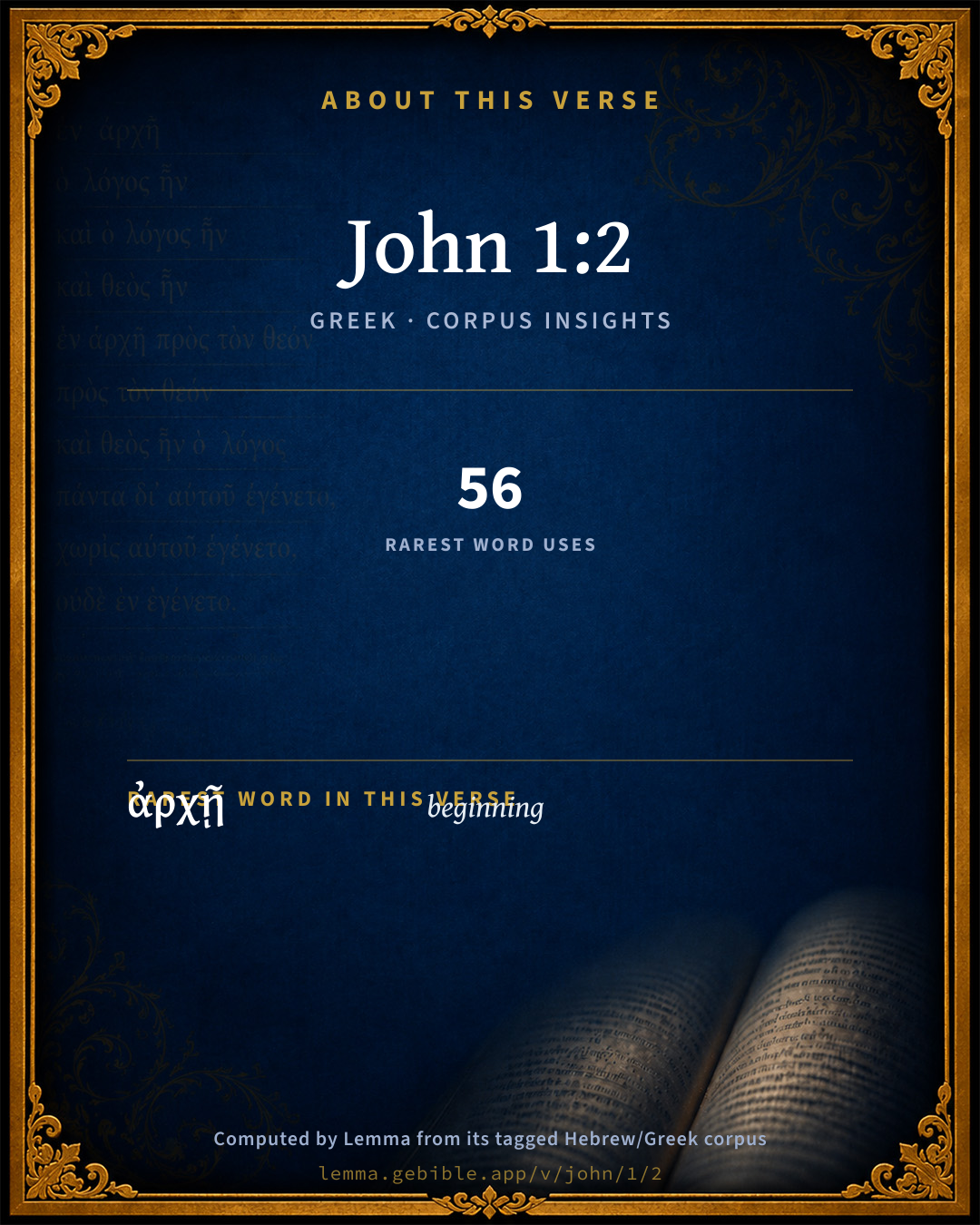
ἀρχῇ beginning G746 occurs in 55 verses of the Greek New Testament. Also found in:
Commentary

Notes on John 1:2 from classic Christian and Jewish commentators (each source and its license shown beneath its notes). The classic Christian expositions comment on the surrounding passage and are grouped to its opening verse, so a note may address several verses; the Jewish commentaries on the Tanakh (Rashi and others) are per-verse, so they appear only where the commentator wrote on this verse.

Lemma curates 59 commentaries, every one of them public domain or Creative Commons licensed, each selected and text-cleaned for this edition rather than reprinted as found. About our sources →

Jamieson, Fausset & Brown

Robert Jamieson, A. R. Fausset & David Brown

The same, &c.--See what property of the Word the stress is laid upon--His eternal distinctness, in unity, from God--the Father (Joh 1:2).

Jamieson, Fausset & Brown — Commentary Critical and Explanatory on the Whole Bible (1871) — public domain (CC PDM 1.0). Text via the HelloAO Bible API.

Matthew Poole's English Annotations

These words of the evangelist are a further confirmation and explication of what the evangelist had said before; asserting the eternity of the Son, and his relation to the Father, and oneness of essence with the Father. Whether the evangelist, forewarned by the Spirit of God, did add this repetition to forearm Christians against those errors which did afterward trouble the church, I cannot say; but certain it is, that these words do effectually confute the Eunomians, who distinguished between the Word which in the beginning was with God, and that Word by which all things were made; and the Arians, who make the Father to have existed before the Son; as also the Anomians, who would make the Father and the Son diverse both in nature and will. Some others make this verse a transition to Joh 1:4, and the sense to be, This same was not manifest to the world from the beginning of the world, but was with God until he came to be manifested in the flesh: thus, 1Jo 1:2, it is said, he was with the Father, and was manifested unto us. He was manifested in the flesh, 1Ti 3:16.

Matthew Poole's English Annotations on the Holy Bible (1683–1685) — public domain. Text from a community e-Sword/MySword module.

The Biblical Illustrator

Joseph S. Exell

Joh_1:2

The same was in the beginning with God.

This repetition teaches

I. HOW LITTLE ABLE WE ARE TO COMPREHEND THIS GREAT MYSTERY, which we can but take in by little and little, and must put that together, as children do letters, syllables, and words, till we attain a more full understanding thereof, for our comfort and salvation.

II. HOW MUCH AND OFTEN IT IS TO BE INCULCATED UPON BELIEVERS to study again and again, as having more in it than will be seen at first view; and when they have found most in it, yet there is infinitely more to be found in that inexhaustible fountain.

III. That believers may read ALL THAT TENDER-HEARTEDNESS, compassion, mercifulness, and sympathy which is in Him, TO BE NOT A MANS ONLY, and in our kinsman, but in Him who is also the eternal God, whose thoughts and purposes are eternal and immutable, like Himself.

IV. That believers may see THE WISDOM AND LOVE OF GOD, who has found a way of reconciliation of lost man BY THE SAME IN NATURE AND ESSENCE, WHO IS THE PARTY OFFENDED. (G. Hutcheson.)

The Word which was in the beginning a testimony

I. To the ETERNAL PERSONALITY, as the ground of all things.

II. To the ETERNAL SPIRIT--Light--as the law of all things.

III. To the ETERNAL LOVE, as the kernel of all things.

IV. To the ETERNAL LIFE, as the life of all things. (Lange.)

The Word in His exaltation over time

He

I. IN THE BEGINNING founded all things.

II. IN THE MIDDLE executed all things; that He may,

III. IN THE END, judge all things. (Lange.)

The eternity of Christ an argument for His oneness with the Father

Does the radiance of the sun proceed from the substance itself of the sun or from some other source? Any one not deprived of his senses must needs confess that it proceeds from the substance itself. Yet, although the radiance proceeds from the sun itself, we cannot say that it is later in point of time than the subsistence of that body, since the sun has never appeared without its rays. It is for this reason that St. Paul calls Him Brightness Heb_1:3), setting forth thereby His being from God and His eternity. (Chrysostom.)

The value of Scripture repetitions

Repetitions have divers uses in Scripture. In prayer they argue affection. In prophecy they note celerity and certainty. In threatenings they note unavoidableness and suddenness. In precepts they note a necessity of performing them. In truths, like that before us, they serve to show the necessity of believing and knowing them. (Arrowsmith.)

With God

These words express the co-existence, but at the same time the distinction of person. They imply relation with, intercourse with. (Comp. the in the bosom of the Father of Joh_1:18, and Let us make man of Gen_1:26 Throned face to face with God, the gaze ever directed towards God, have been given as paraphrases, and the full sense cannot be expressed in fewer words. The with represents motion towards. The Being whose existence is asserted in the was is regarded as distinct, but not alone, as ever going forth in communion with God. (Comp. the use of the same word with in Mat_13:56; Mat_26:15; Mar_6:3; Mar_9:19; 1Co_16:6-7; Gal_1:18; Gal_4:18.) (H. W.Watkins, D. D.)

Christ and the Creation

The old Gnostic Christians held that the world was not created by the Great God, but by Demiurgus, a spirit descending from the AEons, which were themselves derived from the Deity. Johns statement stands in direct antagonism to this. From this we infer

I. THAT CHRIST IS OLDER THAN THE UNIVERSE. The worker must be older than his productions.

II. THAT CHRIST IS GREATER THAN THE UNIVERSE. As the architect is greater than his building, the author than his work, the artist than his productions, Christ is greater than the universe.

1. Greater in extent. But Christs being extends beyond the limits of the universe.

2. Greater in force.

3. Greater in beauty.

III. THAT CHRIST IS OWNER OF THE UNIVERSE. Production gives the highest right to possession. (D. Thomas, D. D.)

The Biblical Illustrator, edited by Joseph S. Exell (c. 1880s–1900s) — public domain. Text from a community e-Sword module.

Bengel's Gnomon

Johann Albrecht Bengel

Joh 1:2. Οὗτος, He) He alone. The He comprises [includes in its application] the whole of the verse immediately preceding it, as He, in the 7th verse, comprises the 6th verse.—πρὸς τὸν Θεόν, with God) This, being repeated [from Joh 1:1], is now put in antithesis to His subsequent mission to men. The three weighty truths, put dividedly in the preceding verse, are repeated and brought together in one in this verse. He, the Logos, who was God, was in the beginning, and was with God. A remarkable antithesis, comp. Joh 1:14, as also 1Jn 2:1 [which contain the same antithetic contrast.]

the word

Was in the beginning God:

Was made flesh,

With God:

And dwelt among us.

Moreover the very congeries of this second verse manifestly supports this antithesis, the appellation of Logos being intermitted between Joh 1:2; Joh 1:14.

Bengel's Gnomon of the New Testament — English translation (T&T Clark, Edinburgh, 1860) — public domain. Text from a community e-Sword module.

Meyer's Critical & Exegetical Commentary

Heinrich August Wilhelm Meyer

Joh_1:2 again emphatically combines the first and second clauses of Joh_1:1, in order to connect with them the work of creation, which was wrought by the λόγος.[75] In this way, however, the subject also of the third clause of Joh_1:1 is included in and expressed by οὗτος. On this οὗτοςto which, then, πάντα standing at the beginning of Joh_1:3 significantly correspondslies the emphasis in the continuation of the discourse. In Joh_1:2 is given the necessary premiss to Joh_1:3; for if it was this same Logos, and no other than He, who Himself was God, who lived in the beginning in fellowship with God, and consequently when creation began, the whole creation, nothing excepted, must have come into existence through Him. Thus it is assumed, as a self-evident middle term, that God created the world not immediately, but, according to Genesis 1, through the medium of the Word.

[75] Who accordingly now worked as λόγος προφορικός.

Meyer — Critical and Exegetical Commentary on the New Testament — English translation by Peter Christie, edited by Frederick Crombie (T&T Clark, 1880) — public domain. Text from a community e-Sword module.

Expositor's Greek Testament

ed. W. Robertson Nicoll

Joh 1:2 . οὑτος ἦν ἐν ἀρχῇ πρὸς τὸν θεόν . Not a mere repetition of what has been said in Joh 1:1 . There John has said that the Word was in the beginning and also that He was with God: here he indicates that these two characteristics existed contemporaneously. “He was in the beginning with God.” He wishes also to emphasise this in view of what he is about to tell. In the beginning He was with God, afterwards, in time, He came to be with man. His pristine condition must first be grasped, if the grace of what succeeds is to be understood.

The Expositor's Greek Testament, edited by W. Robertson Nicoll (1897–1910) — public domain. Text from a community e-Sword module.

John Calvin's Commentaries

2. He was in the beginning. In order to impress more deeply on our minds what had been already said, the Evangelist condenses the two preceding clauses into a brief summary, that the Speech always was, and that he was with God; so that it may be understood that the beginning was before all time.

John Calvin's Commentaries (1540-1563) — public domain. Text from the Calvin Translation Society English edition (1840s-50s) via the Christian Classics Ethereal Library (ccel.org). Calvin's coverage is partial (roughly two-thirds of the Bible); uncommented books and verses are honest gaps, never fabricated. The 19th-century editor's footnotes and remarks are omitted so the notes are faithfully Calvin's own voice.

Ellicott's Commentary for English Readers

(2) The same was.—This is a summary in one clause of the three assertions made in the first verse.

The same, that is, the Word who was God, existed before any act of creation, and in that existence was a person distinct from God. Yet it is more than a re-statement. We have arrived at the thought that the Word was one in nature with God. From this higher point of view, the steps below us are more clearly seen. The Word was God; the eternal pre-existence and personality are included in the thought.

A Bible Commentary for English Readers, edited by Charles John Ellicott (1878–1897) — public domain. Text from a community e-Sword module.

The Cambridge Bible for Schools and Colleges

gen. ed. J. J. S. Perowne

2. The same] More literally, He or This (Word), with emphasis (comp. Joh_7:18). This verse takes up the first two clauses and combines them. Such recapitulations are characteristic of S. John.

The Cambridge Bible for Schools and Colleges (gen. ed. J. J. S. Perowne; Cambridge University Press, 1878–1918) — public domain. Text from a community e-Sword module.

John Gill's Exposition

The same was in the beginning with God. This is a repetition of what is before said, and is made to show the importance of the truths before delivered; namely, the eternity of Christ, his distinct personality, and proper deity; and that the phrase, in the beginning, is to be joined to each of the above sentences; and so proves, not only his eternal existence, but his eternal existence with the Father, and also his eternal deity; and is also made to carry on the thread of the discourse, concerning the word, and not God the Father; and to express, not only his co-existence in nature, but his co-operation in the works of creation next mentioned.

The same was in the beginning with God. This is a repetition of what is before said, and is made to show the importance of the truths before delivered; namely, the eternity of Christ, his distinct personality, and proper deity; and that the phrase, in the beginning, is to be joined to each of the above sentences; and so proves, not only his eternal existence, but his eternal existence with the Father, and also his eternal deity; and is also made to carry on the thread of the discourse, concerning the word, and not God the Father; and to express, not only his co-existence in nature, but his co-operation in the works of creation next mentioned.

John 1:3

joh 1:3

joh 1:3

joh 1:3All things were made by him,.... Which is a proof at once of all that is said before; as that he was in the beginning; and that he was with God the Father in the beginning; and that he was God; otherwise all things could not have been made by him, had either of these been untrue: which is to be understood, not of the new creation; for this would be a restraining "all" things to a "few" persons only; nor is it any where said, that all things are new made, but made; and it is false, that all were converted, that have been converted, by the ministry of Christ, as man: all men are not renewed, regenerated, nor reformed; and the greater part of those that were renewed, were renewed before Christ existed, as man; and therefore could not be renewed by him, as such: though indeed, could this sense be established, it would not answer the end for which it is coined; namely, to destroy the proof of Christ's deity, and of his existence before his incarnation; for in all ages, from the beginning of the world, some have been renewed; and the new creation is a work of God, and of almighty power, equally with the old; for who can create spiritual light, infuse a principle of spiritual life, take away the heart of stone, and give an heart of flesh, or produce faith, but God? Regeneration is denied to be of man, and is always ascribed to God; nor would Christ's being the author of the new creation, be any contradiction to his being the author of the old creation, which is intended here: by "all things", are meant the heaven, and all its created inhabitants, the airy, starry, and third heavens, and the earth, and all therein, the sea, and every thing that is in that; and the word, or Son of God, is the efficient cause of all these, not a bare instrument of the formation of them; for the preposition by does not always denote an instrument, but sometimes an efficient, as in Co1 1:9 and so here, though not to the exclusion of the Father, and of the Spirit:

and without him was not any thing made that was made: in which may be observed the conjunct operation of the word, or Son, with the Father, and Spirit, in creation; and the extent of his concern in it to every thing that is made; for without him there was not one single thing in the whole compass of the creation made; and the limitation of it to things that are made; and so excludes the uncreated being, Father, Son, and Spirit; and sin also, which is not a principle made by God, and which has no efficient, but a deficient cause. So the Jews ascribe the creation of all things to the word. The Targumists attribute the creation of man, in particular, to the word of God: it is said in Gen 1:27. "God created man in his own image": the Jerusalem Targum of it is,

"and the word of the Lord created man in his likeness.

And Gen 3:22 "and the Lord God said, behold the man is become as one of us", the same Targum paraphrases thus,

"and the word of the Lord God said, behold the man whom I have created, is the only one in the world.

Also in the same writings, the creation of all things in general is ascribed to the word: the passage in Deu 33:27 "the eternal God is thy refuge, and underneath are the everlasting arms", is paraphrased by Onkelos,

"the eternal God is an habitation, by whose word the world was made.

In Isa 48:13 it is said, "mine hand also hath laid the foundation of the earth". The Targum of Jonathan ben Uzziah on it is,

"yea, by my word I have founded the earth:

which agrees with what is said in Heb 11:3, and the same says Philo the Jew, who not only calls him the archetype, and exemplar of the world, but the power that made it: he often ascribes the creation of the heavens, and the earth unto him, and likewise the creation of man after whose image, he says, he was made (t). The Ethiopic version adds, at the end of this verse, "and also that which is made is for himself",

(t) De Mundi Opificio, p. 4, 5, 31, 32. De Alleg. l. 1. p. 44. De Sacrificiis Abel & Cain, p. 131. De Profugis, p. 464. & de Monarch. p. 823.

John Gill's Exposition of the Whole Bible (1746–1763) — public domain (CC PDM 1.0). Text via the HelloAO Bible API.

Trapp's Complete Commentary

John Trapp

2 The same was in the beginning with God.

Ver. 2. The same was in the beginning] In the instant of creation, as Gen 1:1, therefore also before the creation, therefore from eternity, Eph 1:4; 1Pe 1:10; Pro 8:22-23. {a} "The Lord possessed me" (saith Christ, the essential Wisdom of God there) "in the beginning of his way." Arius corrupted the Greek text, reading it thus, {b} "The Lord created me in the beginning," &c.; and therehence blasphemously inferred that Christ was no more than a creature. But he was "set up from everlasting from the beginning, or ever the earth was," Pro 8:23; Psa 45:6. {c} Hence he is called the "Ancient of days," Dan 7:9. And Thales, one of the seven Sages of Greece, styleth him, "The most ancient of anything that hath being," πρεσβυτατον των οντων.

With God] Being alius another from his Father, not aliud; a distinct person, yet co-essential and co-eternal; for he was with him in the beginning of "the creature which God created," as himself speaketh, Mar 13:19.

{a} Hinc Iohannes augustum illud et magnificum Evangelis sui initium assumpsit. Mercer in loc.

{b} For εκτησε in place of εκτισε.

{c} Uncta sum in reginam et dominatricem oleo loetitiae. Psa 45:6.

John Trapp, A Commentary or Exposition upon All the Books of the Old and New Testament (1647–1656) — public domain. Text from a community e-Sword module.

Albert Barnes' Notes on the Bible

The same - The Word, or the λόγος Logos.

Was in the beginning with God - This seems to be a repetition of what was said in the first verse; but it is stated over again to “guard the doctrine,” and to prevent the possibility of a mistake. John had said that he existed before the creation, and that he was “with God;” but he had not said in the first verse “that the union with God existed in the beginning.” He now expresses that idea, and assures us that that union was not one which was commenced in time, and which might be, therefore, a mere union of feeling, or a compact, like that between any other beings, but was one which existed in eternity, and which was therefore a union of nature or essence.

Albert Barnes' Notes on the Bible (1834–1885) — public domain. Text from a community e-Sword/MySword module.

Haydock's Catholic Bible Commentary

The same was in the beginning with God. In the text is only, "this was in the beginning;" but the sense and construction certainly is, this word was in the beginning. (Witham)

George Leo Haydock (1774–1849), Haydock's Catholic Family Bible and Commentary, 1859 edition — public domain. Excludes Psalms (Douay-Rheims chapter numbering differs from Protestant) and Deuterocanonical books (Catholic canon only).

The Pulpit Commentary

The same Logos whom the writer has just affirmed to have been God himself, was, though it might seem at first reading to be incompatible with the first or third clause of the first verse, nevertheless in the beginning with God the beginning," and therefore, as we have seen, eternally in relation with God. The previous statements are thus stringently enforced, and, notwithstanding their tendency to diverge, are once more bound into a new, unified, and emphatic utterance. Thus the autov of the following sentences is charged with the sublime fulness of meaning which is involved in the three utterances of ver. 1. The first clause

(1) declared that the Logos preceded the origination of all things, was the eternal ground of the world; the second

(2) asserted his unique personality, so that he stands over against the eternal God, in mutual communion with the Absolute and Eternal One; the third clause

(3) maintains further that the Logos was not a second God, nor merely Divine (Yeiov) or God-like, nor is he described as proceeding out of or from God (ek Yeou or apo Yeou), nor is he to be called o Yeov , "the God absolute," as opposed to all his manifestations; but the Logos is said to be Yeov , i.e. GodGod in his nature and being. This second verse reasserts the eternal relation of such a personality "with God," and prepares the way for the statements of the following verses. The unity of the Logos and Theos might easily be supposed to reduce the distinction between them to subjective relations. The second verse emphasizes the objective validity of the relation.

The Pulpit Commentary (1880–1919), ed. H.D.M. Spence-Jones & Joseph S. Exell — public domain. Text from a community e-Sword module.

John Wesley's Explanatory Notes

The same was in the beginning with God - This verse repeats and contracts into one the three points mentioned before. As if he had said, This Word, who was God, was in the beginning, and was with God.

John Wesley, Explanatory Notes Upon the Whole Bible (1754–1765) — public domain. Text via the GEBible commentary corpus.

Cambridge Greek Testament for Schools and Colleges

2. οὖτος ἦν κ.τ.λ. Takes up the first two clauses and combines them. Such recapitulations are characteristic of S. John. Οὗτος, He or This (Word), illustrates S. John’s habit of using a demonstrative pronoun to sum up what has preceded, or to recall a previous subject, with emphasis. Comp. Joh 1:7, Joh 3:2, Joh 6:46, Joh 7:18.

Cambridge Greek Testament for Schools and Colleges (Cambridge University Press, 1896; 21 vols, various authors incl. Carr, Maclear, Plummer, Farrar, Lumby, Moule, M. R. James, Simcox) — public domain. Text from a community e-Sword module.

Alford’s Greek Testament

Henry Alford

2.] In order to direct the mind to the difference (in unity) between this λόγος and ὁ θεός, John recalls the reader’s attention to the two first clauses of ver. 1, which he now combines, in order to pass on to the creative work, which distinctly belongs to the λόγος. Thus also this verse fixes the reference of αὐτοῦ in ver. 3, which might otherwise, after the mention of θεός, have seemed ambiguous.

Henry Alford, The Greek Testament (1849–1861) — public domain. Text from a community e-Sword module.

International Critical Commentary

2. This verse reiterates, after a fashion which we shall find Jn. to favour, what has been said already in v. 1, laying stress, however, upon the fact that the relationship with Deity implied in πρὸς τὸν θεόν was eternal; it, too, was “in the beginning.” That is to say, v. 2 is a summary statement of the three propositions laid down in v. 1, all of which were true ἐν ἀρχῇ.

For the emphatic use of οὗτος, cf. 1:15, 6:46, 7:18, 15:5.

The Creative Word (V. 3)

International Critical Commentary — older volumes (1896–1929), various authors — public domain. Text from a community e-Sword module.

Vincent's Word Studies in the New Testament

Marvin R. Vincent

The same [ουτος] . Literally, this one; the one first named; the Word. Was in the beginning with God. In ver. 1 the elements of this statement have been given separately : the Word, the eternal being of the Word, and his active communion with God. Here they are combined, and with new force. This same Word not only was coeternal with God in respect of being [ην, ωασ] , but was eternally in active communion with Him (in the beginning with God : pro, v ton Qeon) : "not simply the Word with God, but God with God" [μουλτον] . Notice that here Qeon has the article, as in the second proposition, where God is spoken of absolutely. In the third proposition, the Word was God, the article was omitted because Qeov described the nature of the Word and did not identify his person. Here, as in the second proposition, the Word is placed in personal relation to God. This verse forms the transition point from the discussion of the personal being of the Word to His manifestation in creation. If it was this same Word, and no other, who was Himself God, and who, from all eternity, was in active communion with God, then the statement follows naturally that all things were created through Him, thus bringing the essential nature of the Word and His manifestation in creation into connection. As the idea of the Word involves knowledge and will, wisdom and force, the creative function is properly His. Hence His close relation to created things, especially to man, prepares the way for His incarnation and redeeming work. The connection between creation and redemption is closer than is commonly apprehended. It is intimated in the words of Isaiah (xlvi. 4), "I have made, and I will bear." Redemption, in a certain sense, grows out of creation. Because God created man in His own image, He would restore him to that image. Because God made man, He loves him, educates him, bears with him carries on the race on the line of His infinite patience, is burdened with its perverseness and blindness, and expresses and effectuates all this in the incarnation and redemptive work of Jesus Christ. God is under the stress of the parental instinct (humanly speaking) to redeem man.

Marvin R. Vincent, Word Studies in the New Testament (1887–1900) — public domain. Text from a community e-Sword/MySword module.

Godet's Commentaries

Frédéric Louis Godet

[See also the "General Considerations on the Prologue" in the comments of Joh 1:18.]

Vv. 2. “This Word was in the beginning with God.”

With this Logos which John has in a manner just discovered in eternity, he takes his place at that beginning of time (Joh 1:1) from which he went backward even to what was before time, and now he comes down the course of the ages, to the end of showing the Logos operating in the history of the world as the organ of God, before the moment when He is Himself to appear on the earth. The pronoun οὗτος, this Logos, reproduces more particularly the idea of the third proposition of Joh 1:1 : this Word-God;but the apostle joins with it that of the first two, in such a way as to resume in this verse the substance of the three propositions of Joh 1:1, and thus to explain the part of Creator which he is about to ascribe to the Logos in Joh 1:3. There is, therefore, no contrast in the pronoun οὖτος to any other being whatever, as Meyer supposes, and as the translation of Rilliet would indicate: “It is he who was...” The allusion to the account in Genesis in the words: with God, is no less evident here than in Joh 1:1; comp. Gen 1:26 (let us make,...our image,... our likeness).

Frédéric Louis Godet — Commentaries on Luke, John, Romans, and 1 Corinthians — English translation (T&T Clark, Edinburgh, 1870s–1890s) — public domain. Text from a community e-Sword module.

Lesson kit

Teaching starters — assembled from the data on this page, not authored interpretation. Every prompt links to the verse data it draws on. Edit before teaching.

John, in the Gospels, opens this verse with 7 words (7 distinct Greek lemmas). Its most distinctive word is archḗ (“beginning”). A historical commentator’s framing appears above. Read the whole chapter for the surrounding context.

Discussion questions

  1. The word archḗ carries the sense “beginning.” How does it shape the verse?
  2. Matthew 19:4 shares the word «beginning» with this verse. How do the two illuminate each other?
  3. The translations on this page render this verse differently — a whole-verse word diff, not a word-by-word alignment. What might account for the different wordings?
  4. Reading how Jamieson, Fausset & Brown and Matthew Poole's English Annotations read this verse, where do the two commentators agree and where do they part?

Things to notice

Reading settings

Reading text

Shown beneath each verse's original-language words.

Old Testament
Old Testament edition

Read the OT as the Masoretic Hebrew (MT) or the Greek Septuagint (LXX).

English shown for the Greek Septuagint (in the Hebrew ↔ Greek comparison).

Comparing translations? Open the Compare panel on any verse page to stack up to four side by side.