
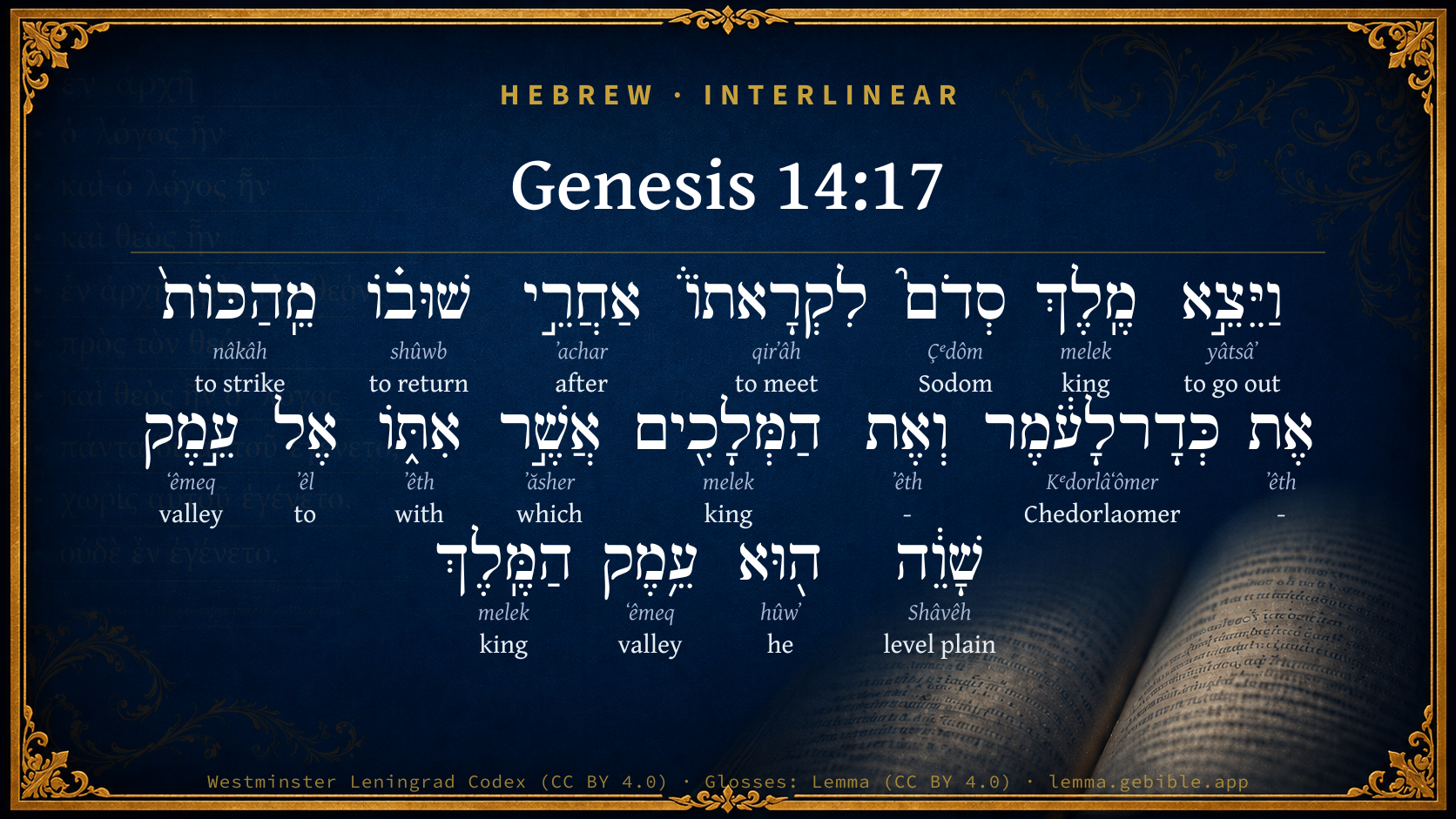
Genesis 14:17

Hebrew (Westminster Leningrad Codex) Genesis 14:17 appears in the Hebrew Old Testament. The text above is from the Westminster Leningrad Codex. Each word links to its Strong’s number, a concise gloss, and parsing drawn from the Open Scriptures Hebrew Bible morphology. Click any word for its full Brown-Driver-Briggs (BDB) entry.
Download image
Cite this verse

Genesis 14:17 (World English Bible). Public Domain. Lemma interlinear Bible study tool, https://lemma.gebible.app/v/genesis/14/17.

Show BibTeX & RIS
BibTeX
RIS
English Translation
The king of Sodom went out to meet him, after his return from the slaughter of Chedorlaomer and the kings who were with him, at the valley of Shaveh (the same is the King's Valley).
World English Bible · Public Domain
Highlights
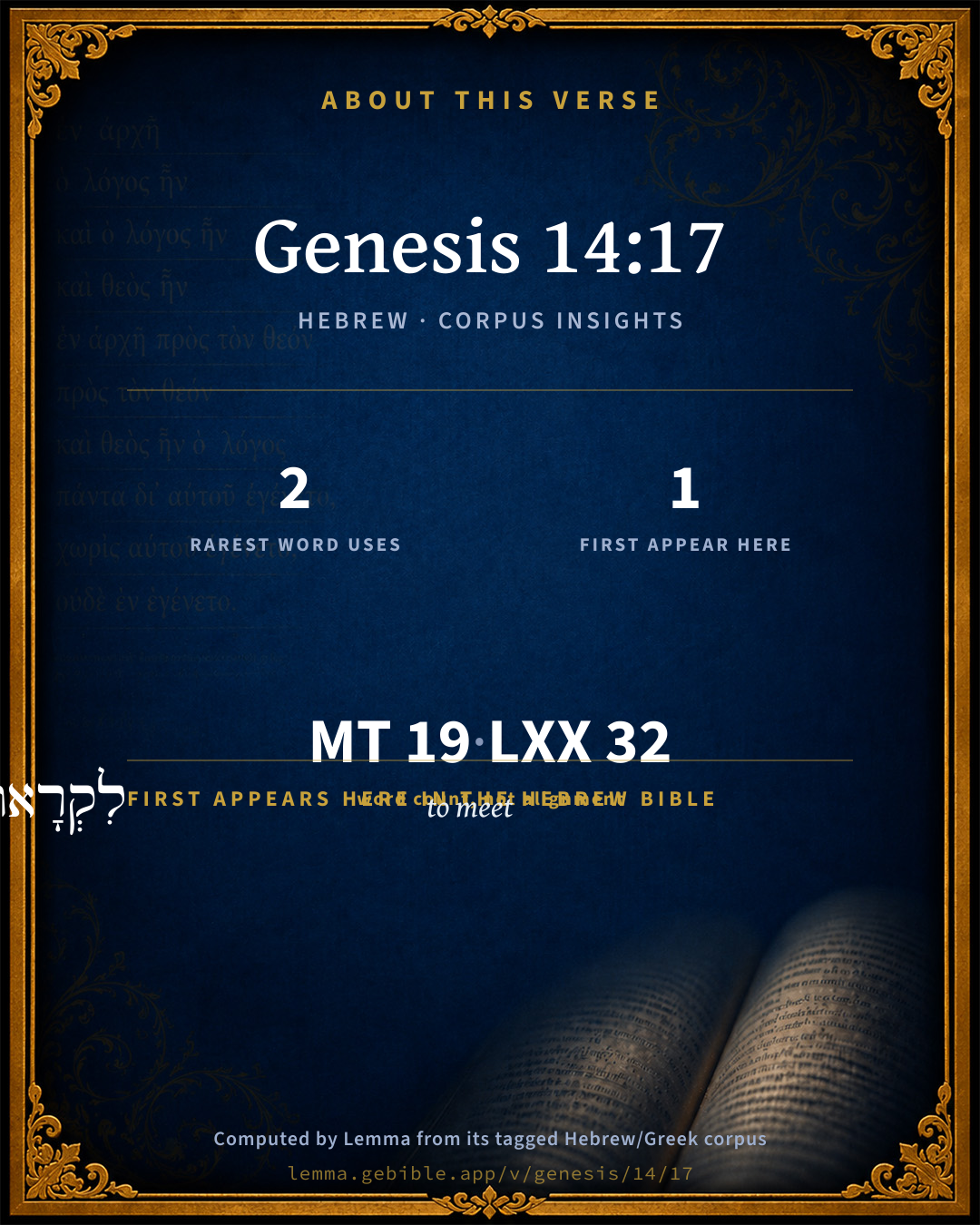
  • 1 first appearance in the Hebrew Bible
Full analysis ↓
Download a study sheet

One document with this verse’s original text, its word-by-word gloss line, the meaning frame, cross-references with their text, attributed commentary, and full source and license credits — printable, and it pastes into notes with its structure intact.

This verse Autodidact and up

Study sheet (.html) Plain text (.txt)

A passage Seminary Student

Up to 50 verses in one chapter. A passage sheet keeps up to 6 commentary sources and 12 cross-references per verse, in the order this page ranks them, and says so on the sheet whenever that leaves anything out. Ask for a single verse and you get the Autodidact verse sheet above.

Everything on this page stays free to read, with no account — the sheet is a download of what is already on screen, not access to it.

Want to remove ads? Support Godless Engineer
Compare translations 3

The same verse in 3 English versions, stacked beneath the original-language interlinear above. Click any original word for its lexicon entry.

Each is an independent rendering of the whole verse — the interlinear is not word-aligned to these translations.

Highlighted words mark where these versions differ — a whole-verse word diff, not a word-by-word alignment.

  • World English Bible Public Domain
    The king of Sodom went out to meet him, after his return from the slaughter of Chedorlaomer and the kings who were with him, at the valley of Shaveh (the same is the King's Valley).
  • King James Version Public Domain
    And the king of Sodom went out to meet him after his return from the slaughter of Chedorlaomer, and of the kings that were with him, at the valley of Shaveh, which is the king's dale.
  • unfoldingWord Literal Text CC BY-SA 4.0
    Then the king of Sodom came out to meet him in the Valley of Shaveh, which the King’s Valley, after he returned from striking Chedorlaomer and the kings who with him.

unfoldingWord Literal Text — © unfoldingWord, licensed CC BY-SA 4.0. Word-aligned USFM3 via Door43 (git.door43.org/unfoldingWord/en_ult).

Versions to compare (up to 4)

3 of 4 selected

Show all 18 translations

Every available English version of this verse, each an independent rendering of the whole verse.

  • World English Bible Public Domain
    The king of Sodom went out to meet him, after his return from the slaughter of Chedorlaomer and the kings who were with him, at the valley of Shaveh (the same is the King's Valley).
  • Berean Standard Bible Public Domain
    After Abram returned from defeating Chedorlaomer and the kings allied with him, the king of Sodom went out to meet him in the Valley of Shaveh (that is, the King’s Valley).
  • Majority Standard Bible Public Domain
    After Abram returned from defeating Chedorlaomer and the kings allied with him, the king of Sodom went out to meet him in the Valley of Shaveh (that is, the King’s Valley).
  • King James Version Public Domain
    And the king of Sodom went out to meet him after his return from the slaughter of Chedorlaomer, and of the kings that were with him, at the valley of Shaveh, which is the king's dale.
  • American Standard Version (1901) Public Domain
    And the king of Sodom went out to meet him, after his return from the slaughter of Chedorlaomer and the kings that were with him, at the vale of Shaveh (the same is the King's Vale).
  • Revised Version (1885) Public Domain
    And the king of Sodom went out to meet him, after his return from the slaughter of Chedorlaomer and the kings that were with him, at the vale of Shaveh (the same is the King’s Vale).
  • Geneva Bible (1599) Public Domain
    After that he returned from the slaughter of Chedor-laomer, and of the Kings that were with him, came the King of Sodom foorth to meete him in the valley of Shaueh, which is the Kings dale.
  • Douay-Rheims (1899) Public Domain
    And the king of Sodom went out to meet him, after he returned from the slaughter of Chodorlahomor, and of the kings that were with him in the vale of Save, which is the king's vale.
  • Young's Literal Translation Public Domain
    And the king of Sodom goeth out to meet him (after his turning back from the smiting of Chedorlaomer, and of the kings who `are' with him), unto the valley of Shaveh, which `is' the king's valley.
  • Literal Standard Version CC BY-SA 4.0
    And the king of Sodom goes out to meet him (after his turning back from the striking of Chedorlaomer, and of the kings who [are] with him), to the Valley of Shaveh, which [is] the king’s valley.
  • Unlocked Literal Bible CC BY-SA 4.0
    After Abram returned from defeating Kedorlaomer and the kings who were with him, the king of Sodom went out to meet him at the Valley of Shaveh (also called the King's Valley).
  • unfoldingWord Literal Text CC BY-SA 4.0
    Then the king of Sodom came out to meet him in the Valley of Shaveh, which the King’s Valley, after he returned from striking Chedorlaomer and the kings who with him.
  • Darby Bible Public Domain
    And the king of Sodom went out to meet him after he had returned from smiting Chedorlaomer, and the kings that were with him, into the valley of Shaveh, which is the king's valley.
  • World Messianic Bible Public Domain
    The king of Sodom went out to meet him after his return from the slaughter of Chedorlaomer and the kings who were with him, at the valley of Shaveh (that is, the King’s Valley).
  • Webster's Bible Public Domain
    And the king of Sodom went out to meet him after his return from the slaughter of Chedorlaomer, and of the kings that were with him, at the valley of Shaveh, which is the king's dale.
  • Free Bible Version CC BY-SA 4.0
    When Abram returned after defeating Chedorlaomer and his allies, the king of Sodom came out to meet him at the Valley of Shaveh (or Valley of the King).
  • Bible in Basic English Public Domain
    And when he was coming back after putting to flight Chedorlaomer and the other kings, he had a meeting with the king of Sodom in the valley of Shaveh, that is, the King's Valley.
  • JPS Tanakh (1917) Public Domain
    And the king of Sodom went out to meet him, after his return from the slaughter of Chedorlaomer and the kings that were with him, at the vale of Shaveh — the same is the King's Vale.

Literal Standard Version (2020), Covenant Press — licensed CC BY-SA 4.0. Text via the HelloAO Bible API (eBible.org). Unlocked Literal Bible (unfoldingWord) — licensed CC BY-SA 4.0. Text via the HelloAO Bible API (eBible.org). unfoldingWord Literal Text — © unfoldingWord, licensed CC BY-SA 4.0. Word-aligned USFM3 via Door43 (git.door43.org/unfoldingWord/en_ult). Free Bible Version, Dr. Jonathan Gallagher — licensed CC BY-SA 4.0. Text via the HelloAO Bible API (eBible.org).

Word by word

More ways to search: Search by grammar → Find every occurrence → Compare this word →

Practice this passage: Drill this verse → Learn its vocabulary →

שָׁוֵ֔ה
Shâvêh
H7740
“level plain”
Noun, Proper
Part of Speech
Noun
Type
Proper
Full BDB Definition

Origin: from H7737

TWOT: 2342a

Shaveh = "plain" or " level plain" - the valley where the king of Sodom met Abram after a battle
  1. וַיֵּצֵ֣א yâtsâʼ H3318 “and · to go out” Conjunction + Verb, Qal, Sequential Imperfect, 3rd Person, Masculine, Singular
  2. מֶֽלֶךְ melek H4428 “king of” Noun, Common, Masculine, Singular, Construct
  3. סְדֹם֮ Çᵉdôm H5467 “Sodom” Noun, Proper
  4. לִקְרָאתוֹ֒ qirʼâh H7125 “to meet · him” Preposition + Verb, Qal, Infinitive Construct + Suffix, Personal, 3rd Person, Masculine, Singular
  5. אַחֲרֵ֣י ʼachar H310 “after” Preposition
  6. שׁוּב֗וֹ shûwb H7725 “to return · him” Verb, Qal, Infinitive Construct + Suffix, Personal, 3rd Person, Masculine, Singular
  7. מֵֽהַכּוֹת֙ nâkâh H5221 “from · to strike” Preposition + Verb, Hiphil, Infinitive Construct
  8. אֶת ʼêth H853 “-” Particle, Direct Object
  9. כְּדָרלָעֹ֔מֶר Kᵉdorlâʻômer H3540 “Chedorlaomer” Noun, Proper
  10. וְאֶת ʼêth H853 “and · -” Conjunction + Particle, Direct Object
  11. הַמְּלָכִ֖ים melek H4428 “the · kings” Particle, Definite Article + Noun, Common, Masculine, Plural, Absolute
  12. אֲשֶׁ֣ר ʼăsher H834 “which” Particle, Relative
  13. אִתּ֑וֹ ʼêth H854 “with · him” Preposition + Suffix, Personal, 3rd Person, Masculine, Singular
  14. אֶל ʼêl H413 “to” Preposition
  15. עֵ֣מֶק ʻêmeq H6010 “valley of” Noun, Common, Masculine, Singular, Construct
  16. ה֖וּא hûwʼ H1931 “he” Pronoun, Personal, 3rd Person, Masculine, Singular
  17. עֵ֥מֶק ʻêmeq H6010 “valley of” Noun, Common, Masculine, Singular, Construct
  18. הַמֶּֽלֶךְ melek H4428 “the · king” Particle, Definite Article + Noun, Common, Masculine, Singular, Absolute

About this verse

These counts appear in no published source. They are computed here, from the morphology-tagged text and Lemma’s own curated glosses. What Lemma adds →

19
words
15
distinct lemmas
Pentateuch
section

Notable vocabulary

The rarest word here is שָׁוֵ֔ה level plain H7740 — appearing just 2 times in the whole Hebrew Bible.

First appearance in Scripture

This word makes its first canonical appearance in the Hebrew Bible here:

  • לִקְרָאתוֹ֒ to meet H7125

Shared distinctive vocabulary

שָׁוֵ֔ה level plain H7740 occurs in 2 verses of the Hebrew Bible. Also found in:

Grammatical profile

  • 4 verbs
  • 8 nouns
  • 1 pronoun
  • 3 prepositions
  • 3 particles

Verb forms

  • וַיֵּצֵ֣א Qal · Sequential Imperfect
  • לִקְרָאתוֹ֒ Qal · Infinitive Construct
  • שׁוּב֗וֹ Qal · Infinitive Construct
  • מֵֽהַכּוֹת֙ Hiphil · Infinitive Construct

Repetition

Words recur within this verse — often emphatic in Hebrew:

  • מֶֽלֶךְ king H4428 ×3
  • עֵ֣מֶק valley H6010 ×2

Hebrew & Septuagint length

In English translation the verse runs 35 words from the Hebrew and 35 from the Septuagint (LXX English) — the same length.

A rough comparison of the two English renderings, which tokenize alike — not a word-level alignment.

Word counts can differ between the Hebrew and the Greek without any difference in meaning — e.g. the Hebrew direct-object marker אֵת has no separate Greek word, and Greek often adds the article ὁ.

In the original languages it is 19 Hebrew tokens and 32 Greek tokens — but the two are counted differently (Hebrew bundles its prefixes and suffixes into one token; the Greek is in lemma form), so that isn’t a like-for-like length.

Cross-references

6

Topical passages linked to Genesis 14:17 in the Treasury of Scripture Knowledge — connected by theme and wording, ordered by reader-vote popularity; previews shown in the World English Bible.

  • 2 Samuel 18:18 Now Absalom in his lifetime had taken and reared up for himself the pillar, which is in the king's dale; for he said, I have no son to keep my name in memory: and he called the pillar after his own name; and it is called Absalom's monument, to this day.
  • Proverbs 19:4 Wealth adds many friends, But the poor is separated from his friend.
  • Hebrews 7:1 For this Melchizedek, king of Salem, priest of God Most High, who met Abraham returning from the slaughter of the kings and blessed him,
  • Judges 11:34 Jephthah came to Mizpah to his house; and, behold, his daughter came out to meet him with tambourines and with dances: and she was his only child; besides her he had neither son nor daughter.
  • 1 Samuel 18:6 It happened as they came, when David returned from the slaughter of the Philistine, that the women came out of all the cities of Israel, singing and dancing, to meet king Saul, with tambourines, with joy, and with instruments of music.
  • Proverbs 14:20 The poor person is shunned even by his own neighbor, But the rich person has many friends.

Cross-references courtesy of OpenBible.info (CC BY 4.0).

Hebrew and Greek witnesses Masoretic Hebrew ↔ Greek Septuagint

The same verse in the two great witnesses to the Old Testament, shown verse-for-verse.

These are two independent witnesses, not word-aligned to each other, and the Septuagint is shown in lemma (dictionary) form.

Hebrew Genesis 14:17 Masoretic · Westminster Leningrad Codex

וַיֵּצֵ֣א מֶֽלֶךְ סְדֹם֮ לִקְרָאתוֹ֒ אַחֲרֵ֣י שׁוּב֗וֹ מֵֽהַכּוֹת֙ אֶת כְּדָרלָעֹ֔מֶר וְאֶת הַמְּלָכִ֖ים אֲשֶׁ֣ר אִתּ֑וֹ אֶל עֵ֣מֶק שָׁוֵ֔ה ה֖וּא עֵ֥מֶק הַמֶּֽלֶךְ

The king of Sodom went out to meet him, after his return from the slaughter of Chedorlaomer and the kings who were with him, at the valley of Shaveh (the same is the King's Valley).

World English Bible · Public Domain

Greek LXX Genesis 14:17 Septuagint · lemma form

ἐκἔρχομαι δέ βασιλεύς σοδομα εἰς συνάντησις αὐτός μετά ὁ ἀναστρέφω αὐτός ἀπό ὁ κοπή ὁ χοδολλογομορ καί ὁ βασιλεύς ὁ μετά αὐτός εἰς ὁ κοιλάς ὁ σαυη οὗτος εἰμί ὁ πεδίον βασιλεύς

And the king of Sodom went out to meet him, after he returned from the slaughter of Chodollogomor, and the kings with him, to the valley of Saby; this was the plain of the kings.

LXX2012 (modern English Septuagint) · Public Domain

On this verse, The Pulpit Commentary discusses the Septuagint’s reading. Read the note in Commentary ↓

Hebrew: Westminster Leningrad Codex (CC BY 4.0). Greek: Septuagint (public domain); English from LXX2012 (modern English Septuagint) (Public Domain). How the Septuagint differs from the Hebrew →

Targum (Aramaic paraphrase)

2

The Targum is the ancient Jewish Aramaic paraphrase of the Hebrew Scriptures — an interpretive translation, not the Hebrew text itself. Onkelos (literal) and Pseudo-Jonathan (expansive) render the Torah, and Jonathan the Prophets. Coverage is partial: where no permissively-licensed English translation exists for a verse, only the Aramaic is shown. This is verse-level text, not a word-by-word alignment to the Hebrew.

  1. Targum Onkelos Torah (Genesis–Deuteronomy)
    וּנְפַק מַלְכָּא דִסְדוֹם לְקַדָמוּתֵה בָּתַר דְתָב מִלְמִמְחֵי יָת כְּדָרְלָעוֹמֶר וְיָת מַלְכַיָא דִי עִמֵהּ לְמֵישַׁר מַפְנָא הוּא אֲתַר בֵּית רֵיסָא דְמַלְכָּא

    And the king of Sedom came out to meet him after returning from the smiting of Kedar‑laomer and the kings who were with him, at the plain of Mephana, which was the king's place of racing.

    Targum Onkelos — Aramaic: “Onkelos Genesis” (public domain); “Onkelos Exodus” (public domain); “Onkelos Leviticus” (public domain); “Onkelos Numbers” (public domain); “Onkelos Deuteronomy” (public domain). English: “Sefaria Community Translation” (CC0 1.0 (public-domain dedication)); “J.W. Etheridge. The Targums of Onkelos and Jonathan Ben Uzziel on the Pentateuch. London: Longmans, Green, 1862” (public domain). Text via Sefaria.

  2. Targum Pseudo-Jonathan Torah (Genesis–Deuteronomy)
    וּנְפַק מַלְכָּא דִסְדוֹם לְקָדָמוּתֵיהּ בָּתַר דְתַב מִלְמִמְחֵי יַת כְּדָרְלָעוֹמֶר וְיַת מַלְכַיָא דְעִימֵיהּ לְמֵישַׁר מְפַנָא הוּא בֵּית רֵיסָא דְמַלְכָּא

    And the king of Sedom came forth, after that he returned from destroying Kedarlaomer and the kings who were with him, to meet him at the plain of Mephana, which was the king's race-course.

    Targum Pseudo-Jonathan — Aramaic: “Targum Jonathan on Genesis” (public domain); “Targum Jonathan on Exodus” (public domain); “Targum Jonathan on Leviticus” (public domain); “Targum Jonathan on Numbers” (public domain); “Targum Jonathan on Deuteronomy” (public domain). English: “The Targum of Jonathan ben Uzziel, trans. J. W. Etheridge, London, 1862” (public domain). Text via Sefaria.

Commentary

Notes on Genesis 14:17 from classic Christian and Jewish commentators (each source and its license shown beneath its notes). The classic Christian expositions comment on the surrounding passage and are grouped to its opening verse, so a note may address several verses; the Jewish commentaries on the Tanakh (Rashi and others) are per-verse, so they appear only where the commentator wrote on this verse.

Lemma curates 59 commentaries, every one of them public domain or Creative Commons licensed, each selected and text-cleaned for this edition rather than reprinted as found. About our sources →

Trapp's Complete Commentary

John Trapp

Gen 14:17 And the king of Sodom went out to meet him after his return from the slaughter of Chedorlaomer, and of the kings that [were] with him, at the valley of Shaveh, which [is] the king’s dale.

Ver. 17. The king’s dale.] So called here by way of anticipation. {2Sa 18:18}

John Trapp, A Commentary or Exposition upon All the Books of the Old and New Testament (1647–1656) — public domain. Text from a community e-Sword module.

The Biblical Illustrator

Joseph S. Exell

Gen_14:17

Return from the slaughter

I.

THE TRIUMPHANT RETURN. Abram returning from the subjugation of the kings, accompanied with Lot, whom he had rescued, and laden with spoils of war.

1. The aged chieftain, Abram, 83 years of age; hale, vigorous, victorious. Not always that mans return from the late enterprises of life is triumphant.

2. His retainers. His 318 servants (some, perhaps, left behind). How proud would these be of their leader.

3. Lot. Grateful that he had been rescued from captivity.

4. Other rescued captives. Their joy and thankfulness.

5. The first recorded war ended in the triumph of right.

6. The victory secured by a servant of God with limited resources. Prophetic of the greater war in which the great Seed of Abraham rescued, from a more cruel bondage, a greater number, who come off more than conquerors through Him who loved them.

7. His welcome home. The king of Sodom goes forth to meet him. The joy of those who have friends and property restored.

II. THE HIGH PRIESTS BLESSING.

1. The approbation of the holy, the most valuable of all human praise. The praise of some is humiliating to the receiver. Woe be unto you when all men speak well of you. To please God, and hear His well done, the best end to seek.

2. Melchizedek, a priest of God, would approve success less than character.

3. He was hospitable, and provided refreshment for weary men. A good mans obligation to one who, for others, had fought a battle in the right. His sympathy with the emancipated. His respect for the deliverer.

4. He was faithful; and reminded Abram of the most high God, who possessed all things. Men, in their successes especially, have often need to be reminded of this; and that it is God who giveth the victory.

5. Such a reminder may do a thoughtless man good, and can do a good man no harm. Abram humbly received the reminder.

III. THE DIVISION OF THE SPOIL. Many would have fought over it, and, if so well able as Abram, would have kept all they could.

1. He gave one-tenth of all to God. Did homage thus to Divine claims and principles in the person of Melchizedek.

2. Declined to take anything as his own share. Would not have it ever said that any man had made him rich. Though none could have said it justly.

3. Would not impose his rule upon others. Stipulated for the right of other men. Had the power to dictate, but left them to their own free choice. Would not have them coerced by his example, but claimed a portion for them. LEARN--

I. To love peace, and only enter upon righteous conflicts.

II. So to fight lifes battle as to return victorious and with honest satisfaction.

III. Cheerfully to recognize the successes of others.

IV. To be more anxious about the right and true than about the profit.

V. To rejoice in the Captain of our salvation, who has conquered for us, and who has rescued us from present captivity and future death. (J. C. Gray.)

Lessons

1. Conquerors usually want not observance and congratulations from the world.

2. The powers of the earth are sometimes forced to acknowledge the prowess of Gods saints.

3. Humanity persuades men to the acknowledgment of God to any, whom God makes helpful to them.

4. The killing of the slayer, and breaking the yoke of the oppressor is cause of congratulation to the oppressed.

5. Nature will not be slow to meet and congratulate its deliverers.

6. Deliverance may make men go far to acknowledge Gods servants, who before would scarce vouchsafe to go out of doors for them. (G. Hughes, B. D.)

The Biblical Illustrator, edited by Joseph S. Exell (c. 1880s–1900s) — public domain. Text from a community e-Sword module.

Whedon's Commentary on the Bible

Daniel D. Whedon

ABRAM AND MELCHIZEDEK, Gen_14:17-20.

17. The king of Sodom — Hence it appears that this king survived the defeat, probably by flight to the hills. Gen_14:10 does not necessarily mean that the kings there named were killed. Some expositors, however, so understand it, and suppose that the king here mentioned was successor to the one who fell in battle.

Valley of Shaveh — According to Gesenius and Furst, Shaveh means plain or valley. This valley was afterwards known as the king’s dale, probably from the occurrences here recorded. We find the name again in 2Sa_18:18, and old tradition identifies it with the valley of the Kedron. In the absence of any thing more definitely known, and in view of the probability that Salem was the ancient name of Jerusalem, we do well to adhere to the traditional location of Shaveh. Abram returning southward from the source of the Jordan may well have passed through the Kedron valley; and there would have been a suitable place both for the king of Sodom to meet him, and for the king of Salem to bring forth refreshments.

Daniel D. Whedon (gen. ed.), Commentary on the Old and New Testaments (1874–1909) — public domain. Text from a community e-Sword module.

The Pulpit Commentary

CHAPTER 14:17-24

And the king of Sodom Bera, or his successor (vide Ver. 10)went out to meet him (i.e. Abram) after his return from the slaughter (perhaps too forcible an expression for mere defeat) of Chedorlaomer, and the kings that were with him (the entire clause from "after" is parenthetical), at the valley of Shaveh. A valley about two stadia north of Jerusalem (Josephus, "Ant.," 8:10), supposed to be the valley of the Upper Kedron, where Absalom s pillar was after. wards erected; (2Sa_18:10) which may be correct if the Salem afterwards mentioned was Jerusalem (vide infra); but if it was not, then the exact site of Shaveh must be left undetermined. Which is the king"s dale. Or valley (emek); so styled because suitable for kingly sports or military exercises (Onkelos); because of its beauty (Poole); because Melchisedeck had his camp and palace there (Malvenda); or most likely because of the interview between him and Abram which there occurred (Keil, Lange), with which agrees the rendering toon twn basilewn, (LXX).

Vers. 17-24.

Visited by kings.

I THE KING OF SALEM.

1. His exalted person. Neither a supramundane being, an angel, the Holy Ghost, or Christ; nor one of the early patriarchs, such as Enoch or Shem; but a Canaanitish (Shemite?) prince, whose capital was Salem (Jerusalem), and who united in his person the double function of priest and monarch of his people; probably the last official representative of the primitive religion, who here advances to meet and welcome the new faith in the person of Abram, as at a later period John Baptist recognized and saluted Christ.

2. His twofold designation. Melchisedeck, king of Salem, i.e. king of righteousness and king of peace; (Heb_7:2) descriptive of

(1) Personal excellence. Pious in spirit and peace-loving in disposition, he was not only fitted to be a type of the Meek and Holy One, but admirably qualified to be a governor of men and a minister of religion. Happy the land whose throne is filled by purity and love, and the Church whose teachers illustrate by their lives the religion they profess!

(2) Regal sway. Righteous in principle, as a consequence his kingly rule was peaceful in administration; thus again constituting him an eminent foreshadowing of the righteous King and Prince of peace, as well as an instructive pattern and guide to earth"s rulers. When righteousness and peace occupy the throne they seldom fail to reign throughout the land.

(3) Priestly work. The specific function of his sacerdotal office being to make peace between God and sinful men, probably by means of sacrifice, and thus to cover with righteousness as with a garment those who were exposed to condemnation, he a third time symbolized the great King-Priest of the New Testament Church; while at the same time he seemed to proclaim this important truth, that they who labor in the priest"s office should diligently strive for the salvation of souls.

3. His mysterious appearance. Of unknown parentage, of unrecorded genealogy, of unchronicled existence, the unique personality of this grand old king-priest flashes meteor-like across the path of the conquering patriarch, emerging from the gloom of historical obscurity, and almost instantaneously vanishing into inscrutable seclusion. Spirit-taught writers of later times discerned in this ancient figure, so enigmatical and mysterious, a Divinely-appointed type of the ever-living High Priest, "the Son who is consecrated for evermore.

4. His regal hospitality. Whatever additional significance attached to the banquet on the plain of Shaveh, it was clearly designed as a refreshment for the victorious patriarch and his wearied soldiers. So should earthly monarchs gratefully and sumptuously reward those who at the risk of their lives maintain the cause and vindicate the rights of the oppressed within their borders. So does heaven"s King provide for his toiling followers.

5. His priestly benediction.

(1) The blessing conferred on Abram was not simply the expression of a wish, but the actual conveyance by Divine authority of the good which it proclaimed; and so is Christ invested with supreme power to bless and save.

(2) The ascription of praise to God was a sincere declaration of the patriarch"s gratitude for the heavenly succor vouchsafed in connection with his military expedition; and so should God"s redeemed ones, whom he has delivered out of the hands of the enemy, cherish a lively recollection of Divine mercies, and offer heartfelt thanksgivings through the one Mediator.

6. His public recognition. In presence of the king of Sodom and his people, his confederates and their forces, as well as of his own domestics, the patriarch delivered into the hands of Melchisedeck a tenth part of the spoils. Designed as a solemn act of worship to Jehovah, it was both an acknowledgment of the claim which God"s minister had upon his countenance and support, and a symbol of the service, the voluntary devotement of a liberal portion of their substance, which should by all saints be yielded to him who has been constituted a Priest for ever after the order of Melchisedeck.

II THE KING OF SODOM.

1. His courteous behavior. Displayed in retiring before Melchisedeck"s advance, and deferring the prosecution of his suit till the termination of the king-priest"s interview with the patriarch, it may be regarded as suggesting

(1) the politeness which in all ranks of society, but especially in intelligent and educated circles, should regulate the intercourse of man with man;

(2) the deference which should be paid, by even kings and those in authority, to the ministers of religion;

(3) the homage which, though unwillingly, the world sometimes is obliged to render to the Church; and

(4) the preference which should ever be assigned to heaven"s business over that of earth.

2. His generous proposal. Made to Abram, this evinced

(1) Lively gratitude towards the patriarch for his distinguished services. Persons of known profligacy of character and life at times discover sparks of true nobility which proclaim them not entirely lost; and not infrequently individuals not professing to be pious outshine the followers of Christ in acts of self-renunciation, and in thankful acknowledgment of benefits. (Luk_17:17)

(2) Peaceful disposition in himself, which, while it might have claimed the entire spoil, and perhaps vindicated the justness of such claim by an appeal to arms, was forward to avoid strife by asking only the persons. Even the world may occasionally instruct the Church how to follow peace with all men.

(3) Remarkable discernment as to the respective values of men and things, being prepared to forego the goods and chattels if only the persons were restored to his dominion.

3. His rejected liberality. Generous as from the king of Sodom"s standpoint the proposal was, it was repudiated by the patriarch

(1) In absolute entirety, without the reservation of so much as a thread or shoe-latchet; another proof of the wholly unworldly character of the patriarch, another instance of self-sacrificing magnanimity, of a piece with his surrender of the land to Lot.

(2) With shuddering apprehension, lest his fair name should be contaminated by participation in the wealth of Sodom. So should God"s people not let their good be evil spoken of, and in particular look well to the channels through which the treasures that enrich them come. There is ever an important difference between the wealth which proceeds from the devil and that which is bestowed by the hand of Christ.

(3) With unmistakable sincerity, as revealed by his solemn adjuration. God"s name, while to be taken in vain by none, may on appropriate occasions be appealed to by his servants to vindicate their truthfulness.

(4) After equitable reservation of the just claims of others, of the rations of his soldiers, which were not to be repaid, and the portions of his allies, which were not to be appropriated unless with their consent. The sacrifices made by God"s people should be composed of their own, and not of their neighbor"s property.

Learn

1. That God"s faithful servants are sure to win the approbation of good men and the benediction of Heaven.

2. That the friendship of wicked men and the congratulations of the world should never be desired by the saints.

The Pulpit Commentary (1880–1919), ed. H.D.M. Spence-Jones & Joseph S. Exell — public domain. Text from a community e-Sword module.

The Preacher's Complete Homiletical Commentary

Joseph S. Exell (gen. ed.)

CRITICAL NOTES.—

Gen_14:17. Valley of Shaveh] Shaveh means valley or dale. Nothing is known of its situation.—

Gen_14:18. Melchizedek, King of Righteousness] The Jews identify him with Shem. Thus the Targum of Jonathan: “But Melchizedek he is Shem, the son of Noah, king of Jerusalem.” Also the Jerusalem Targum: “But Melchizedek, king of Jerusalam, he is Shem, who was the great priest of the Most High.” This statement is manifestly absurd, for the genealogy of Shem is clearly given in the Scriptures. The priesthood of Shem would not be of a different order from Levi’s, whereas in Heb_7:6, the contrary is asserted. “His person, his office, his relation to Christ, and the seat of his sovereignty, have given rise to innumerable discussions, which even now can scarcely be considered as settled.” (Bullock, Bible Dict.) “Everything combines to show that Melchizedek was a Canaanitish king who had retained the worship of the true God, and combined in his own person the offices of king and priest.” (Alford.)—King of Salem] “King of peace.” (Heb_7:2.) It is doubtful whether this refers to the place afterwards called Jerusalem. Most probably Salem is to be understood in its strict sense as part of the title.—Most High God] Heb. El Elyon. This name of God occurs here for the first time. El signifies strength. “Hence we perceive that the unity, the omnipotence, and the absolute pre-eminence of God were still living in the memory and conscience of a section at least of the inhabitants of this land.” (Murphy)—

MAIN HOMILETICS OF THE PARAGRAPH.—Gen_14:17-20

THE TRUE PRIEST FOR MANKIND

There is in man such a deep consciousness of sin that he feels he is not fit to appear before God. He needs some one who shall be his mediator and representative, and who offers up that sacrifice for sin which turns away wrath and restores the forfeited favour of God. Hence the necessity for a priest. The idea of a priesthood is universal, and no improvement of human society can ever supersede it; for the fact must still remain that, by nature, there is a deep gulf between man’s soul and God. This office has often been abused to serve the purposes of tyranny and oppression, and to retard the civil and intellectual progress of mankind. Still, with all the abuses which have degraded it, the office stands. Wherever men go they seek, in some form or other, the aid of the priest. To this need of the human heart the Providence of God has given an answer. In the verses before us we have the true ideal of a priest such as man requires and God approves. What must be the qualifications of such?

I. The true priest is divinely appointed. Melchizedek was “priest of the Most High God.” This implies—1 That he was called of God. As it is the prerogative of God, in His dealings with His creatures, to take the first step of approach and to state His own terms, so no one can become a mediator in such a matter unless God appoints him to that office. As the purpose of mercy belongs to God, so He must choose the means of its conveyance to mankind. No man, therefore, can take this office upon himself. Unless he receives the Divine call he is an impostor and profane.

2. That he was separated from the rest of mankind. The true priest must be holy by vocation; and one of the essential parts of holiness is separation from all that is evil. By some lustration, or white robe, or other external sign, he must be distinguished from the profane crowd, and possess, at least, symbolic purity. Melchizedek has stood apart from all mankind, as reflecting the awful holiness of his God. Men require the mediation of some one who stands nearer to God than themselves. Holiness is the raiment wherewith God clothes His priests.

II. The true priest is one with the race he represents. This “priest of the Most High God” was not an angelic being, but of the same flesh and blood as the rest of mankind. The true priest must be taken from among men. There is a deep conviction in the heart of humanity that deliverance can only come through some one selected from among themselves. He alone who partakes of our nature can have a real fellow-feeling with us, and know how to have compassion upon our infirmity. He who represents the human race, and is a mediator with God on their account, must himself be one of that race. Humanity is a necessary element in a Redeemer. We can only be saved through a Divine man; for he touches God at one extremity and ourselves at the other, and brings us together. From this we learn—

1. The dignity of human nature. There must be something in human nature which makes it capable of representing what is Divine, or else the Incarnation would have been impossible. The great preparations for human redemption imply that man has a sublime value, and can be rendered capable of partaking of the Divine nature. We learn also—

2. The destiny of human nature. If man and God can be brought together through the agency of a mediator, then that reconciliation with God must have the tendency to draw man continually God-wards, and thus his soul is made to enter upon the upward path. When God pardons sin He is removing the barrier between the sinner and Himself, so that the objects of His mercy may be fitted to dwell with Him and see His glory.

III. The true priest has the power to bless. “And he blessed him, and said, Blessed be Abram of the Most High God, possessor of heaven and earth” (Gen_14:19). This was a sacerdotal act, and he who administered it was, in regard to his office, superior to him on whom it was bestowed. “The less is blessed of the better” (Heb_7:7). Thus it is the office of the true priest—

1. To pronounce blessings on men. He is not the origin of blessing, but only declares authoritatively what God offers and bestows. He does not make the fact of God’s pardon and peace, but announces it as an ambassador who has authority to act for his sovereign.

2. To bless God on their behalf. When man receives a benefit, God should be praised. We must not selfishly rest in the enjoyment of His goodness so as to forget the glory due to His name. The priest who stretches forth his hands to bless men, also lifts his eyes towards heaven to bless God on their behalf.

3. To declare God’s benefits towards men. “And Melchizedek, king of Salem, brought forth bread and wine” (Gen_14:18). These are the standing elements of the body’s sustenance and refreshment. Bread is the staff of life, and wine maketh glad the heart of man. These were brought forth by this priest of the Most High God, in order to serve the lower use of the refreshment of the body. Such was the first intention of this act; but there was a second and more important one which can hardly escape our notice. These gifts of God, so essential to the life of the body, signified spiritual blessings—the soul’s necessary food. Melchizedek was, therefore, the minister of holy symbols; which, while they visibly represented blessings not discerned by sense, were, at the same time, the means of the conveyance of those blessings to the soul. The pure and good gifts of God in the natural world shadow forth those of the spiritual. Both the visible and invisible worlds come from one Creator, and correspond to each other as type and antitype. Hence the use of symbolical worship and teaching. Our Blessed Lord took hold of these emblems of bread and wine, constituting them a holy ordinance for the remembrance of His death and passion, and effectual means of grace to the soul. In partaking of this bread and wine, Abraham was enjoying a spiritual repast which strengthened and refreshed the inner man. All the ministries and symbols of religion are but means to an end, and that end is the sanctification of our nature. Spiritual good is the only abiding reality; all else is representative and shadowy. The priests are of no value who lead us only to what is outward and visible, and who do not offer real blessings and urge us forwards to their attainment.

IV. The true priest is a mediator between God and men. He is the appointed medium of bringing together man and God upon terms which the Divine mercy has approved. Thus the true priest is the channel of blessings which flow in opposite directions—from God to man, and from man to God.

1. He receives gifts from God for men. Gifts of pardon, peace, reconciliation—the tokens of God’s favour. There can be no religion unless God imparts something to men. If heaven is but a wall of brass then the prayers and aspirations of mankind are of no avail. He can be no true priest who has not something to offer from God to men.

2. He receives gifts from men for God. We cannot, strictly speaking, add anything to God’s riches or His glory by our works or gifts. As we have nothing but what we have received from His bounty, so we can really give Him nothing that was not previously His own. But God is pleased to receive our thanks and praises—our easiest recompense. He receives offerings of man’s worldly substance which testify of the gratitude of his heart and soul. Thus Melchizedek took gifts from Abram that he might offer them to God. “And he gave him tithes of all.” Such was Abram’s response to the priestly benediction. The offering of tithes is an acknowledgment on the part of man that all belongs to God. The king-priest received them from the patriarch that he might offer them to God, who has a right to all that man possesses, and to his entire service. “In presenting the tenth of all the spoils of victory, Abram makes a practical acknowledgment of the absolute and exclusive supremacy of the God whom Melchizedek worshipped, and of the authority and validity of the priesthood which he exercised. We have here all the indications of a stated order of sacred rites, in which a costly service, with a fixed official, is maintained at a public expense, according to a definite rate of contribution” (Murphy). Religion demands that man shall give some token of his allegiance to God, and man is appointed to receive such in His name. The ministry of man to men, on behalf of God, belongs to the nature of the Church’s work on earth. But the full idea was not realised until God was manifest in the flesh. Then had we a Mediator, who was compassionate because He was human, and strong because He was Divine. Other mediators had been commissioned to convey spiritual blessings to mankind, but Christ alone brought salvation with Him and bestowed it from Himself.

MELCHIZEDEK A TYPE OF CHRIST

We have inspired authority for regarding this “priest of the Most High God” as a type of our blessed Lord. The author of the Epistle to the Hebrews gives this application to the prophecy of the Psalmist, “Thou art a priest for ever after the order of Melchizedek” (Psa_110:4; Heb_5:6; Heb_6:20). The history of the meeting of the patriarch with this remarkable man must be read by the light which Christ throws back upon it. Abraham rejoiced to see the day of the Son of Man, and to Him, in the person of Melchizedek, he did homage and received blessing. Christ was present to the minds of both. He was truly in their midst, making the blessing effectual, and the gifts truly an offering to God. Let us see how Melchizedek was fitted to be a type of Christ.

I. He was a royal priest. The priesthood of Aaron’s house and of the Levitical order were all purely and simply priests. They had no regal state or function. Melchizedek combined in his person the offices and powers both of priest and king. In this regard he was not a partial, but a complete representative and type of the Messiah, who is described by the prophet as “a priest upon His throne” (Zec_6:13), and who reigns over a kingdom of righteousness and peace (Psalms 72) Either character by itself could not be an exact and complete type of Christ, who holds the double office. Our souls need His priesthood for expiation, and His kingship, that they may preserve that righteousness which belongs to His kingdom.

II. His genealogy is mysterious. As a priest Melchizedek has no pedigree. He is not a single unit in the order of succession, for he has none going before or coming after him in the priestly office. His function and state are not transmitted to others, but remain attached to himself. Hence that strange description of him in the Epistle to the Hebrews:—“Without father, without mother, without descent, having neither beginning of days nor end of life, but made like unto the Son of God, abideth a priest continually.” Both ends of the life of this remarkable man are shrouded in mystery, and he is therefore a fitting type of the Son of God, whose manifestation in our flesh must of necessity be mysterious. “Who shall declare His generation?” for, in reference to His human nature He had no father, and in reference to His Divine nature He had no mother. In this respect Our Lord stands alone among all the sons of men, and Melchizedek, whose origin and end are purposely made obscure, is chosen herein to be His type.

III. He was perpetually a priest. Melchizedek in his own person was mortal and shared the common lot of mankind; but that type of priesthood which he represented was perpetual. As it began before, so it lasted throughout the whole of the Jewish history. The Jewish priesthood had “beginning of days and end of life,” but that of Melchizedek continued in Christ for ever. To that eternal priesthood the honour of God was committed, it shared the unchangeableness of His nature; but the priesthood of Aaron’s line was, as it were, parenthetical in the Divine plan, to endure only while such a temporary provision was necessary. The greater light was to swallow up the lesser, and to continue a joy for ever to the Church of God. Melchizedek was the type of those real attributes of our Lord’s priesthood which in their very nature are eternal.

IV. He was an universal priest. The Jewish priesthood was limited to their own nation and people. Strangers in race and blood were neither permitted to sustain that office nor to enjoy the most important benefits which it conferred. The range of it was narrow and confined, scarcely at all affecting the great mass of mankind outside. But Melchizedek was the priest of humanity at large, and was therefore an exact type of Christ, who was the all-sufficient priest for mankind of every age and nation.

V. He was a priest of the highest type. As compared with the priesthood of Aaron that of Melchizedek was superior—

1. In time. It belonged to an earlier age, and therefore had the prescription of antiquity in its favour. Such was the priesthood of Our Lord: though late as to the supreme moment in which it became a fact, it had been fashioned early in the counsels of God. This priest, as well as His offering, had been from the foundations of the world. It was also superior—

2. In dignity. Levi virtually acknowledged a priesthood higher than his own, when he paid tithes to Melchizedek and received his blessing.

3. Superior in duration. Unlike the Levitical, his priesthood was not designed to serve a temporary purpose. It belonged to an order of things which endures, not through one short stage but through the whole of human history. Christ is “a priest for ever.” His office and the virtues of it last as as long as sinful man needs forgiveness.

VI. His priesthood has the highest confirmation. It was confirmed by the Divine oath—by an appeal to two immutable things—the Divine word and the Divine nature. The Levitical priesthood was not introduced or confirmed by such a solemnity, because it formed no part of the eternal plan of God. It could not sustain the full honour of that glorious Name which meant much more for man than the most fitly chosen types and ceremonies could signify. God will only give the highest confirmation to that priest who brings grace and truth—who gives to men the reality instead of the shadow, and reveals the fulness and beauty of the Divine love.

SUGGESTIVE COMMENTS ON THE VERSES

Gen_14:17. Abram is now congratulated upon his success. His faith obtained a good report.

Abram has now won the praise of the world—the result of those works by which his faith was made perfect (Jas_2:22). This was a new trial to his faith, but the strength of his religious character was shown in his superiority to all worldly aims and possessions.

There are events in history which force the world to acknowledge the servants of God.

This expedition of Abram and his friends excited great attention among the Canaanites. At the very time when all must have been given up for lost, they are, without any effort of their own, recovered, and the spoilers spoiled. The little victorious band, now returning in peace, are hailed by everyone that meets them. The kings of the different cities go forth to congratulate them, and thank them as the deliverers of their country. If Abram had been of the disposition of those marauders whom he had defeated, he would have followed up his victory, and made himself master of the whole country, which he might probably have done with ease in their present enfeebled and scattered condition. But thus did not Abram, because of the fear of God.—(Fuller).

Gen_14:18. Melchizedek—the first priest on record.

The typology connected with Melchizedek does not require that he himself should be regarded as any superhuman person, but merely exalts the human circumstances under which he appears into symbols of superhuman things. Everything combines to show that Melchizedek was a Canaanitish king who had retained the worship of the true God, and combined in his own person the offices of king and priest. It is to be observed that there is not used regarding him, nor does he use, the title of Jehovah, but that of the HIGH GOD, a title found also in the question addressed (Mic_6:6) by the Moabitish king, Balak, to his prophet Balaam; but that Abram in answering the King of Sodom probably in his presence, affirms the identity of his covenant-God, Jehovah, with the High God, possessor of heaven and earth, of whom Melchizedek had spoken.—(Alford).

Melchizedek was not only a type of Christ, but also represented the genius of the Christian religion. His priesthood was not limited to one nation or country, but was universal. Such is the Christian Church, which offers a home to all people.

The universal element in religion is the permanent. Judaism, which was but a temporary provision, has passed away, but that order of things which Melchizedek represented will stand till the end of time.

Some of the highest examples of the knowledge of the eternal verities of religion, and of faith in God, have been furnished by the heathen world—Melchizedek, Job, the Centurion, the Syro-Phœnician woman, Cornelius.

Bread and Wine. These are significant as the staple elements of refreshment for the body. Bread is the acknowledged staff of life, and hence was presented in the holy place of the Tabernacle as the shew-bread, or bread of the Presence. So it was presented at the Pentecost—the loaves representing the fruit of the Gospel work, and significant of the harvest and ingathering of the people. And so the wine was poured out as a libation at the daily sacrifice as a drink-offering (Exo_29:40), also at the presentation of the first-fruits (Lev_23:13), and other offerings (Num_15:5). And from this Old Testament ordinance it passed to the Lord’s Supper by Divine institution, and its significance in the latter was explained as symbolical of the blood-shedding of Christ for sinners, and the participation of it as an element of the Gospel feast becomes joyous to the Christian soul. They had a meaning, therefore, in the hands of Melchizedek, and in this sacred, official transaction. Abram is thus welcomed to a share in the sacred sacramental ceremonial, and witnessed to as having a right to that ancient communion of saints. This solitary priest hails him as one whom he recognises and rejoices in—as the head of the faithful, and the triumphant “friend of God.”—(Jacobus).

This feast was significant of the life, strength, and joy which the Gospel would bring to the world. Thus there was represented to Abram what a blessing he would be to all nations.

Melchizedek refreshed the warriors after the battle, and Christ ordained His Last Supper to refresh the weary soldiers of the Cross.

Bread and wine are common things, familiar to the eye, the touch, and taste of men. The Great Teacher takes them out of the hands of man as emblems of grace, mercy, and peace, through an accepted ransom, of the lowliest as well as the loftiest boon of an everlasting salvation, and they have never lost their significance or appropriateness.—(Murphy).

The Most High God. This is a name of God here first found in the Scripture. El, signifying strength, is the base of the name Elohim—the original, absolute name of God, by which He is known in the history of the Creation, and appropriate to His creatorship. This is the evidence that the one God was worshipped, as a testimony against polytheism and idolatry, as the Living God, omnipotent and supreme. And this was done formally, publicly, and statedly by a set ministry, and in such form of worship as acknowledged the need of the great blood-shedding for atonement, and of the great high priesthood to come.—(Jacobus.)

Gen_14:19. God has ordained that all blessings shall come to men through His own Priest. Melchizedek was the type, but Christ was the reality.

The Christian religion has only one Priest, who is now in heaven, and who is the only fount of blessing for man-kind.

Melchizedek blessed Abram. He therefore acts in a priestly capacity. This sacerdotal act of his is that which is so significant, as interpreted by the New Testament:—“For the less is blessed of the better” (Heb_7:7). And Abram, in receiving the blessing, admits the superiority of this king priest. The friend of God, the covenant-head and father of the faithful, has victory granted him over kings, and is thus a type of every true Christian and of the Church of Christ on the earth, while he expresses his faith and religious reverence and obedience by paying tithes to the accredited functionary of God’s worship. The key to this mystery is, that both these personages were types of Christ; and their meeting here is a significant confluence of the streams of prophecy and promise, rushing onward to the destined consummation.—(Jacobus).

Melchizedek, in pronouncing this blessing, was only setting his seal to that which was already a fact in Abram’s spiritual life. The patriarch already belonged to the Most High God, was His servant, His child, His friend. Thus the human instrument only declares the blessing, but does not make it.

The Most High God is here designated as the Founder of heaven and earth, the Great Architect or Builder, and, therefore, Possessor of all things. There is here no indistinct allusion to the creation of “heaven and earth” mentioned in the opening of the Book of God. This is a manifest identification of the God of Melchizedek with the one Creator and Upholder of all things. We have here no mere local or national deity with limited power and province, but the sole and supreme God of the universe and of man.—(Murphy).

All blessings become assured to us by the fact that they are the gift of Him who made the heavens and the earth. No other Being can confer any lasting good.

God, who possesses all things, had the right to dispose of them as it seemed good unto Him. He could give the land to Abram and to his seed.

God is the Proprietor of all things. We hold all blessings by His bounty and as His stewards.

Gen_14:20. Blessings received by man must be followed by thanksgiving to God. God blesses us, and we bless Him.

The second part of this benedictory prayer is a thanksgiving to the common God of Melchizedek and Abram for the victory which had been vouchsafed to the latter. Thy foes. Here Abram is personally addressed. Melchizedek as a priest first appeals to God on behalf of Abram, and then addresses Abram on behalf of God. He thus performs the part of a mediator.—(Murphy).

This Royal Priest in blessing God manifested—

1. His piety and devotion. He looks away from the good which has been bestowed, to the fountainhead of all blessing.

2. His appreciation of the true source of all victorious effort on the part of God’s people. Instead of praising Abram’s valour and skill, he praises the God of Abram who gave the victory.

Here is the first conflict of the children of faith with the world-power, and the victory vouchsafed to the former points to their final triumph. Those who are on the side of God must prevail in the end. There is no other really strong power.

And he gave him a tithe of all. This is a very significant act. In presenting the tenth of all the spoils of victory, Abram makes a practical acknowledgment of the absolute and exclusive supremacy of the God whom Melchizedek worshipped, and of the authority and validity of the priesthood which he exercised. We have here all the indications of a stated order of sacred rites, in which costly service, with a fixed official, is maintained at the public expense, according to a definite rate of contribution. The gift in the present case is the tenth of the spoils of war. This act of Abram, though recorded last, may have taken place at the commencement of the interview. At all events, it renders it extremely probable that a sacrifice had been offered to God, through the intervention of Melchizedek, before he brought forth the bread and wine of the accepted feast.—(Murphy).

Christ, as the true Priest, still demands the consecration of our worldly substance to His service.

Christ, our Mediator, not only receives gifts from God to convey them to men, but also receives gifts from men to present them to God.

ILLUSTRATIONS

BY THE

REV. WM. ADAMSON

Battle and Blessing! Gen_14:1-24.

(1) Numerous as are the mountains of Switzerland, one stands out singular and unique. It belongs to Switzerland, and bears signs of resemblance to the other hills and valleys of the country; yet it has its own peculiar individuality. Who does not recognise the special prominence of Mont Blanc?

(2) The rocky mountains of the far West are a magnificent range, evidencing their continuous and successive resemblance one with the other. Yet there is a spur, so singular and unique in its formation and contour, that for a moment the traveller almost fancies it is out of place.

(3) This chapter has the air and aspect of an episode in history. It stands out singular and unique. As Candlish says, “The warlike character which Abram assumes is a solitary exception to the usual tenor of his life; while his subsequent interview with the royal priest is altogether peculiar.

(4) A plant grows in Eastern jungles which sheds a clear light when all beside is dark. To midnight travellers amid Himalayan hills it seems as if it were a lamp to guide them on their wanderings. And the appearance of Melchizedek is just such a plant-lamp, pointing to Him who is a Priest for ever, after the order of Melchizedek.

“On the truth thus dimly shadowed

Later days a lustre shed,

When the Great High Priest eternal

Offers us both wine and bread.”

Abram’s Authority! Gen_14:17-24.

(1) In early days, when the white man first appeared amid the vast pinewoods and hunting grounds of the Red Indians, some of these red children of the wild were possessed of the conviction that the new-comers would by-and-by be owners of the soil. No doubt this was largely due to the consciousness of their keen Indian perceptive powers that the “white foreigners from over the water” were in many respects superior to them in intelligence and resource. But there was also a premonition, the origin of which was doubtless due to supernatural influence, that the “white man” was to possess the Indian’s land. Hence some of these Indians became the fast friends of the early settlers.

(2) In the time of Abram certain of the Canaanite leaders were impressed with the conviction that this “pilgrim-pastor” would be the future lord of Palestine. Apparently Abimelech and Hamor had some such presentiment, that Canaanite ascendancy would give way before the Abrahamic posterity. Under supernatural conviction of a similar character the King of Salem comes forth to greet the deliverer of Lot on his return from the pursuit and overthrow of the four kings.

“Stay, pilgrim warrior, on thy road,

Refresh thy strength awhile;

Here is the banquet of thy God

To soothe thy warfare-toil.”

Return Home! Gen_14:17.

(1) Ships, which have been parted by night, and the swift stroke of the tempest, come hurrying back at morning to their anchorage. What anxious inquiries follow as to the perils of the past night! What mutual felicitations ensue as they discover that all are safe in spite of the storm!

(2) The meeting between Lot and Abram, the princes of Sodom, and their rescued warriors, must have been full of agitation and excitement. When their hosts were defeated, and Lot’s family carried off, there was little prospect, humanly speaking, of a happy reunion. Now they are safe home again.

(3) Christians are scattered and carried off by the marauding bands of death; but the Captain of our Salvation delivers them from the power of the grave. They shall meet again in the “King’s Dale “at Salem, for Jerusalem which is above is free. What mutual congratulations and recognitions will then ensue! How all will unite in praising their Deliverer; in whom

“Majesty, combined with meekness,

Righteousness and peace unite,

To insure those blessed conquests,

His possession and full right;

Ride triumphant,

Decked in robes of purest light.”

Melchizedek and Salem! Gen_14:18.

(1) Stanley refers to the Jerome tradition that Salem was not Jerusalem, but a smaller town not far from the scene of the interior in the “King’s Dale.” He appears for a moment, and then vanishes from our view altogether. It is this which wraps him round in that mysterious obscurity which has rendered his name the symbol of all such sudden, abrupt apparitions—the interruptions or dislocations of the ordinary succession of cause and effect and matter of fact in the varied stages of the history of the Church.

(2) Candlish says that whether this Salem was the city which afterwards became Jerusalem, or some other place near the Vale of Siddim and the River Jordan, does not appear. Nor, indeed, is it the precise locality, but the name, which is important. It was the King of Righteousness and Peace whom Abram acknowledged in the very height of his own triumph, when he accepted Melchizedek’s hospitality of bread and wine.

“When the patriarch was returning,

Crowned with triumph from the fray,

Him the peaceful King of Salem,

Came to meet upon his way”.

Melchizedek Meeting! Gen_14:18-20.

(1) Stanley says that the meeting of the ancient chiefs of Canaan and the founder of the chosen-people in the “King’s Dale,” personifies to us the meeting between what, in later times, has been called Natural and Revealed Religion. He adds that Abram’s receiving the blessing from Melchizedek, and tendering to him reverent homage, is a likeness of the recognition which true historical faith will always humbly receive and gratefully render when it comes in contact with “Natural Religion.”

(2) Law says that in Melchizedek we have a figure, not of “Natural Religion,” but of Christ the Messiah. He is the true Melchizedek, without beginning of days or end of years. Abram, the weary warrior, typifies the soldiers of Christ, for whom refreshment is provided by their Royal Priest of Salem, which is peace. The fight of faith is fierce, the journey of life ofttimes long, but our true Melchizedek comes forth with the solid sustenance of the Word, with the overflowing cup of promise, with the spiritual food of His own body and blood.

“Good soldier of the Cross, well done!

Press forward more and more;

And still forgetting things behind,

Reach forth to things before.”—Maguire.

Shaveh-Shadows! Gen_14:18, etc.

(1). The faith of Jonathan burning bright and pure in his father Saul’s corrupt court is a lovely sight. In the interview between Jonathan and David, we have, as it were, the noble warrior handing the torch of royal trust to the son of Jesse. This was done in faith, “I know that God will establish thee king.”

(2). Melchizedek seems thus to come forth and meet Abram in the “King’s Dale.” By his heroism of faith, Abram has shown his readiness to enter upon the rights and trusts of Canaan: and Melchizedek, as the preserver of the old primitive patriarchal hope, comes to surrender the charge to Abram.

(3). It is as if the torch was here visibly handed over from the last of the former band to the first of that which is to succeed. The interview between the two is the connecting link between the two dispensations—the one of which is waxing old, and the other of which is just beginning to appear.

(4). It is like aged Simeon embracing in his arms the infant Saviour; the last patriarch and prophet of the law not departing till he sees and hails the new-born hope of the Gospel arising on the world with healing in His wings.

(5). It is the lingering twilight of declining day in the Northern climes mingling with the dawn of a better morn. Both Melchizedek and Abram understood it thus. As debtors to the same grace, they realise that their actions now are shadows of good things to come. Both see Christ in all, and in the eye of their faith Christ is all in all.

“Though the altar has crumbled, and incense has ceased,

True worship still rises, through JESUS our PRIEST.”

The Preacher's Complete Homiletical Commentary (gen. ed. Joseph S. Exell; Funk & Wagnalls, c. 1892) — public domain (pre-1929). A full-Bible homiletical/sermon-outline anthology covering 65 of 66 books (2 John is absent from the source module). Text from a community e-Sword module.

Tyndale Open Study Notes

Tyndale Open Resources

14:17 The valley of Shaveh or King’s Valley was probably the Kidron Valley (see 2 Sam 18:18).

Tyndale Open Study Notes — © Tyndale Open Resources, licensed CC BY-SA 4.0. Text via the HelloAO Bible API.

Matthew Henry's Commentary

This paragraph begins with the mention of the respect which the king of Sodom paid to Abram at his return from the slaughter of the kings; but, before a particular account is given of this, the story of Melchizedek is briefly related, concerning whom observe,

I. Who he was. He was king of Salem and priest of the most high God; and other glorious things are said of him, Heb 7:1, etc. 1. The rabbin, and most of our rabbinical writers, conclude that Melchizedek was Shem the son of Noah, who was king and priest to those that descended from him, according to the patriarchal model. But this is not at all probable; for why should his name be changed? And how came he to settle in Canaan? 2. Many Christian writers have thought that this was an appearance of the Son of God himself, our Lord Jesus, known to Abram, at this time, by this name, as afterwards, Hagar called him by another name, Gen 16:13. He appeared to him as a righteous king, owning a righteous cause, and giving peace. It is difficult to imagine that any mere man should be said to be without father, without mother, and without descent, having neither beginning of days nor end of life, Heb 7:3. It is witnessed of Melchizedek that he liveth, and that he abideth a priest continually (Gen 14:3, Gen 14:8); nay (Gen 14:13, Gen 14:14), the apostle makes him of whom these things are spoken to be our Lord who sprang out of Judah. It is likewise difficult to think that any mere man should, at this time, be greater than Abram in the things of God, that Christ should be a priest after the order of any mere man, and that any human priesthood should so far excel that of Aaron as it is certain that Melchizedek's did. 3. The most commonly received opinion is that Melchizedek was a Canaanitish prince, that reigned in Salem, and kept up the true religion there; but, if so, why his name should occur here only in all the story of Abram, and why Abram should have altars of his own and not attend the altars of his neighbour Melchizedek who was greater than he, seem unaccountable. Mr. Gregory of Oxford tells us that the Arabic Catena, which he builds much upon the authority of, gives this account of Melchizedek, That he was the son of Heraclim, the son of Peleg, the son of Eber, and that his mother's name was Salathiel, the daughter of Gomer, the son of Japheth, the son of Noah.

II. What he did. 1. He brought forth bread and wine, for the refreshment of Abram and his soldiers, and in congratulation of their victory. This he did as a king, teaching us to do good and to communicate, and to be given to hospitality, according to our ability; and representing the spiritual provisions of strength and comfort which Christ has laid up for us in the covenant of grace for our refreshment, when we are wearied with our spiritual conflicts. 2. As priest of the most high God, he blessed Abram, which we may suppose a greater refreshment to Abram than his bread and wine were. Thus God, having raised up his Son Jesus, has sent him to bless us, as one having authority; and those whom he blesses are blessed indeed. Christ went to heaven when he was blessing his disciples (Luk 24:51); for this is what he ever lives to do.

III. What he said, Gen 14:19, Gen 14:20. Two things were said by him: - 1. He blessed Abram from God: Blessed be Abram, blessed of the most high God, Gen 14:19. Observe the titles he here gives to God, which are very glorious. (1.) The most high God, which bespeaks his absolute perfections in himself and his sovereign dominion over all the creatures; he is King of kings. Note, It will greatly help both our faith and our reverence in prayer to eye God as the most high God, and to call him so. (2.) Possessor of heaven and earth, that is, rightful owner, and sovereign Lord, of all the creatures, because he made them. This bespeaks him a great God, and greatly to be praised (Psa 24:1), and those a happy people who have an interest in his favour and love. 2. He blessed God for Abram (Gen 14:20): and blessed be the most high God. Note, (1.) In all our prayers, we must praise God, and join hallelujahs with all our hosannahs. These are the spiritual sacrifices we must offer up daily, and upon particular occasions. (2.) God, as the most high God, must have the glory of all our victories, Exo 17:15; Sa1 7:10, Sa1 7:12; Jdg 5:1, Jdg 5:2; Ch2 20:21. In them he shows himself higher than our enemies (Exo 18:11), and higher than we; for without him we could do nothing. (3.) We ought to give thanks for others' mercies as for our own, triumphing with those that triumph. (4.) Jesus Christ, our great high priest, is the Mediator both of our prayers and praises, and not only offers up ours, but his own for us. See Luk 10:21.

IV. What was done to him: Abram gave him tithes of all, that is, of the spoils, Heb 7:4. This may be looked upon, 1. As a gratuity presented to Melchizedek, by way of return for his tokens of respect. Note, Those that receive kindness should show kindness. Gratitude is one of nature's laws. 2. As an offering vowed and dedicated to the most high God, and therefore put into the hands of Melchizedek his priest. Note, (1.) When we have received some signal mercy from God, it is very fit that we should express our thankfulness by some special act of pious charity. God must always have his dues out of our substance, especially when, by any particular providence, he has either preserved or increased it to us. (2.) That the tenth of our increase is a very fit proportion to be set apart for the honour of God and the service of his sanctuary. (3.) That Jesus Christ, our great Melchizedek, is to have homage done him, and to be humbly acknowledged by every one of us as our king and priest; and not only the tithe of all, but all we have, must be surrendered and given up to him.

Matthew Henry's Commentary on the Whole Bible (1708–1710) — public domain (CC PDM 1.0). Text via the HelloAO Bible API.

Adam Clarke's Commentary

Verse 17. The king of Sodom went out to meet him] This could not have been Bera, mentioned Ge 14:2, for it seems pretty evident, from Ge 14:10, that both he and Birsha, king of Gomorrah, were slain at the bitumen-pits in the vale of Siddim; but another person in the meantime might have succeeded to the government.

Adam Clarke's Commentary on the Bible (1810–1826) — public domain. Text from a community e-Sword/MySword module.

John Calvin's Commentaries

17. And the king of Sodom went out. Although the king of Sodom knew that Abram had taken arms only on account of his nephew, yet he went to meet him with due honor, in order to show his gratitude. For it is a natural duty to acknowledge benefits conferred upon us, even when not intentionally rendered, but only from unexpected circumstances and occasions, or (as we say) by accident. Moreover, the whole affair yields greater glory to God, because the victory of Abram was celebrated in this manner. He also marks the place where the king of Sodom met Abram, namely, “the king’s dale,” which I think was so called, rather after some particular king, than because those kings met there for their pleasure.

John Calvin's Commentaries (1540-1563) — public domain. Text from the Calvin Translation Society English edition (1840s-50s) via the Christian Classics Ethereal Library (ccel.org). Calvin's coverage is partial (roughly two-thirds of the Bible); uncommented books and verses are honest gaps, never fabricated. The 19th-century editor's footnotes and remarks are omitted so the notes are faithfully Calvin's own voice.

Ellicott's Commentary for English Readers

(17) The slaughter.—Heb., the smiting, that is, the defeat of Chedorlaomer.

The valley of Shaven.—That is, the valley of the plain (see on Gen_14:5). It was the place where Absalom erected his pillar (2Sa_18:18), and lay on the northern side of Jerusalem, probably where the Kedron valley widens out. Its other name, “the king’s dale,” may have been given it from this meeting of the kings of Salem and Sodom with the victorious Abram; but Onkelos, with far greater probability, considers that it was so called because upon this level ground the kings of Judah in subsequent times assembled and exercised their forces.

A Bible Commentary for English Readers, edited by Charles John Ellicott (1878–1897) — public domain. Text from a community e-Sword module.

The Cambridge Bible for Schools and Colleges

gen. ed. J. J. S. Perowne

17. the king of Sodom] See note on Gen_14:10. The writer evidently assumes that this is the same king who had fallen in “the slime pits”; for only the king who had lost property and wealth, but saved his life, could suggest to Abram that the latter should keep the booty.

from the slaughter of Chedorlaomer] Lit. “from the smiting of.” We need not suppose that Chedorlaomer and his vassal kings were personally involved in the overthrow.

the vale of Shaveh (the same is the King’s Vale)] “The King’s Vale” is mentioned in 2Sa_18:18 as the site of the monument raised by Absalom, and was supposed in the days of Josephus to be two “stadia” from Jerusalem (Ant. vii. 10, 3). The word Shaveh means “a plain,” cf. Gen_14:5.

The meeting of the king of Sodom with Abram is here strangely interrupted by the story of the appearance of Melchizedek, and is resumed at Gen_14:21.

The Cambridge Bible for Schools and Colleges (gen. ed. J. J. S. Perowne; Cambridge University Press, 1878–1918) — public domain. Text from a community e-Sword module.

John Gill's Exposition

And the king of Sodom went out to meet him,.... While Abram was in pursuit of the four kings, the king of Sodom came down from the mountain whither he and those that escaped with him fled, and came to Sodom: and from hence he went out, not alone, but accompanied with his retinue, to meet Abram:

after his return from the slaughter of Chedorlaomer, and of the kings that were with him; to congratulate him upon the victory he had obtained over them; and this meeting was

at the valley of Shaveh; a most plain and even valley, as the word signifies, clear of trees and everything that obstructs sight or passage, as Jarchi observes, and so a proper place to have an interview in:

which is the king's dale; some say King Melchizedek's, but one should rather think it was the king of Sodom's; the Targum of Jonathan calls it the place of the king's exercise, where he had his diversions in riding, walking, &c. it can hardly be that in Sa2 18:18; though some are of this opinion, being near to Jerusalem, which they suppose to be the same with Salem in Gen 14:18.

John Gill's Exposition of the Whole Bible (1746–1763) — public domain (CC PDM 1.0). Text via the HelloAO Bible API.

Matthew Poole's English Annotations

So called either upon this occasion of the meeting of divers kings here; or because king Melchizedek either had his habitation, or was much delighted with it, and conversant in it. See 2Sa 18:18.

Matthew Poole's English Annotations on the Holy Bible (1683–1685) — public domain. Text from a community e-Sword/MySword module.

Keil & Delitzsch

C. F. Keil & F. Delitzsch

As Abram returned with the booty which he had taken from the enemy, the king of Sodom (of course, the successor to the one who fell in the battle) and Melchizedek, king of Salem, came to meet him to congratulate him on his victory; the former probably also with the intention of asking for the prisoners who had been rescued. They met him in "the valley of Shaveh, which is (what was afterwards called) the King's dale." This valley, in which Absalom erected a monument for himself (Sa2 18:18), was, according to Josephus, two stadia from Jerusalem, probably by the brook Kidron therefore, although Absalom's pillar, which tradition places there, was of the Grecian style rather than the early Hebrew. The name King's dale was given to it undoubtedly with reference to the event referred to here, which points to the neighbourhood of Jerusalem. For the Salem of Melchizedek cannot have been the Salem near to which John baptized (Joh 3:23), or Aenon, which was eight Roman miles south of Scythopolis, as a march of about forty hours for the purpose of meeting Abraham, if not romantic, would, at least be at variance with the text of Scripture, where the kings are said to have gone out to Abram after his return. It must be Jerusalem, therefore, which is called by the old name Salem in Psa 76:2, out of which the name Jerusalem (founding of peace, or possession of peace) was formed by the addition of the prefix ירוּ = ירוּי "founding," or ירוּשׁ "possession." Melchizedek brings bread and wine from Salem "to supply the exhausted warriors with food and drink, but more especially as a mark of gratitude to Abram, who had conquered for them peace, freedom, and prosperity" (Delitzsch). This gratitude he expresses, as a priest of the supreme God, in the words, "Blessed be Abram of the Most High God, the founder of heaven and earth; and blessed be God, the Most High, who hath delivered thine enemies into thy hand." The form of the blessing is poetical, two parallel members with words peculiar to poetry, צריך for איביך, and מגּן. - עליון אל without the article is a proper name for the supreme God, the God over all (cf. Exo 18:11), who is pointed out as the only true God by the additional clause, "founder of the heaven and the earth." On the construction of בּרוּך with ל, vid., Gen 31:15; Exo 12:16, and Ges. 143, 2. קנה, founder and possessor: קנה combines the meanings of κτίζειν and κτᾶσθαι. This priestly reception Abram reciprocated by giving him the tenth of all, i.e., of the whole of the booty taken from the enemy. Giving the tenth was a practical acknowledgment of the divine priesthood of Melchizedek; for the tenth was, according to the general custom, the offering presented to the Deity. Abram also acknowledged the God of Melchizedek as the true God; for when the king of Sodom asked for his people only, and would have left the rest of the booty to Abram, he lifted up his hand as a solemn oath "to Jehovah, the Most High God, the founder of heaven and earth," - acknowledging himself as the servant of this God by calling Him by the name Jehovah, - and swore that he would not take "from a thread to a shoe-string," i.e., the smallest or most worthless thing belonging to the king of Sodom, that he might not be able to say, he had made Abram rich. אם, as the sign of an oath, is negative, and in an earnest address is repeated before the verb. "Except (בּלעדי, lit., not to me, nothing for me) only what the young men (Abram's men) have eaten, and the portion of my allies...let them take their portion:" i.e., his followers should receive what had been consumed as their share, and the allies should have the remainder of the booty.

Of the property belonging to the king of Sodom, which he had taken from the enemy, Abram would not keep the smallest part, because he would not have anything in common with Sodom. On the other hand, he accepted from Salem's priest and king, Melchizedek, not only bread and wine for the invigoration of the exhausted warriors, but a priestly blessing also, and gave him in return the tenth of all his booty, as a sign that he acknowledged this king as a priest of the living God, and submitted to his royal priesthood. In this self-subordination of Abram to Melchizedek there was the practical prediction of a royal priesthood which is higher than the priesthood entrusted to Abram's descendants, the sons of Levi, and foreshadowed in the noble form of Melchizedek, who blessed as king and priest the patriarch whom God had called to be a blessing to all the families of the earth. The name of this royal priest is full of meaning: Melchizedek, i.e., King of Righteousness. Even though, judging from Jos 10:1, Jos 10:3, where a much later king is called Adonizedek, i.e., Lord of Righteousness, this name may have been a standing title of the ancient kings of Salem, it no doubt originated with a king who ruled his people in righteousness, and was perfectly appropriate in the case of the Melchizedek mentioned here. There is no less significance in the name of the seat of his government, Salem, the peaceful or peace, since it shows that the capital of its kings was a citadel of peace, not only as a natural stronghold, but through the righteousness of its sovereign; for which reason David chose it as the seat of royalty in Israel; and Moriah, which formed part of it, was pointed out to Abraham by Jehovah as the place of sacrifice for the kingdom of God which was afterwards to be established. And, lastly, there was something very significant in the appearance in the midst of the degenerate tribes of Canaan of this king of righteousness, and priest of the true God of heaven and earth, without any account of his descent, or of the beginning and end of his life; so that he stands forth in the Scriptures, "without father, without mother, without descent, having neither beginning of days nor end of life." Although it by no means follows from this, however, that Melchizedek was a celestial being (the Logos, or an angel), or one of the primeval patriarchs (Enoch or Shem), as Church fathers, Rabbins, and others have conjectured, and we can see in him nothing more than one, perhaps the last, of the witnesses and confessors of the early revelation of God, coming out into the light of history from the dark night of heathenism; yet this appearance does point to a priesthood of universal significance, and to a higher order of things, which existed at the commencement of the world, and is one day to be restored again. In all these respects, the noble form of this king of Salem and priest of the Most High God was a type of the God-King and eternal High Priest Jesus Christ; a thought which is expanded in Heb 7 on the basis of this account, and of the divine utterance revealed to David in the Spirit, that the King of Zion sitting at the right hand of Jehovah should be a priest for ever after the order of Melchizedek (Psa 110:4).

Keil & Delitzsch — Biblical Commentary on the Old Testament (1861–1891) — public domain (CC PDM 1.0). Text via the HelloAO Bible API. (Old Testament only.)

Kretzmann's Popular Commentary

Paul E. Kretzmann

Abraham’s Return

v. 17. And the king of Sodom went out to meet him after his return from the slaughter of Chedorlaomer, and of the kings that were with him, at the valley of Shaveh, which is the king’s dale. The news of Abram’s victory preceded him, for, with all the spoil and the women, he was unable to travel so rapidly as he had hurried in pursuit. The king of Sodom, who had saved his life by his self-possession, went forth to meet the returning victors at a place situated probably on the Kidron, which from that time bore the name "King’s Dale," 2Sa 18:18.

v. 18. And Melchizedek, king of Salem, brought forth bread and wine; and he was the priest of the most high God. of this Melchizedek, king of Salem, probably Jerusalem, nothing more is known. Cf Heb 7:3. He seems to have been one of those that clung to the worship of the true God after the majority of the people had plunged into the depths of heathendom; to this God he was a priest. He now showed his appreciation and gratitude toward Abram and his little army by bringing forth bread and wine to refresh and strengthen the weary soldiers.

v. 19. And he blessed him and said, Blessed be Abram of the most high God, possessor of heaven and earth;

v. 20. and blessed be the most high God, which hath delivered thine enemies into thine hand. And he gave him tithes of all. So Melchizedek transmitted to Abram the blessing of God, of the Most Exalted One, of the Founder and Owner of heaven and earth. And, in turn, he praised the Lord, the Exalted One, to whom the victory of Abram must be ascribed. It was a prayer for prosperity and blessing, in beautiful, poetical form. Melchizedek is a type of Christ, The great High Priest of the New Testament, Psa 110:4, and the entire 7th Chapter of Hebrews is really a commentary on this passage. Abram acknowledged Melchizedek as a priest by giving him tithes of all, Heb 7:4. This was the more important transaction at the meeting.

v. 21. And the king of Sodom said unto Abram, Give me the persons, and take the goods to thyself. His intention was to repay Abram for the work which he performed in delivering the captive Sodomites, especially the women and children, from the hands of the enemy. He asked only for the souls, the people whom Abram had brought back, proposing that Abram keep the spoil that had originally belonged to the men of Sodom, in return for his victory.

v. 22. And Abram said to the king of Sodom, I have lift up mine hand unto the Lord, the most high God, the Possessor of heaven and earth,

v. 23. that I will not take from a thread even to a shoe-latchet, and that I will not take anything that is thine, lest thou shouldest say, I have made Abram rich;

v. 24. save only that which the young men have eaten, and the portion of the men which went with me, Aner, Eshcol, and Mamre; let them take their portion. It is a kind, but solemn and emphatic refusal. With a confession in the true God, in whose name he swears, Abram declares that the men belonging to his allies may take advantage of the offer and claim their share of the spoils, and he would be willing to accept what his servants had consumed in food daring their campaign; but as for himself, not even a thread or a sandal-strap would he accept from the king of Sodom, lest the latter might afterward boast that Abram owed his riches to him. Abram wanted to be under no obligations to the heathen king. Even so the believers today are encouraged to do good also to the unbelievers; but beyond that they should not go, lest their Christianity be endangered.

Paul E. Kretzmann, Popular Commentary of the Bible (1921–1924) — public domain. Text from a community e-Sword module.

unfoldingWord translationNotes

Door43 World Missions Community

returned

The implied information about where he was returning to can be made explicit. AT: "returned to where he was living" (See: Assumed Knowledge and Implicit Information)

Melchizedek, king of Salem

This is the first time this king is mentioned.

bread and wine

People commonly ate bread and wine. See how you translated "bread" in Genesis 3:19 and "wine" in Genesis 9:21.

translationWords

Abraham

Melchizedek

king

bread

wine

priest

God

Most High

unfoldingWord translationNotes — © Distant Shores Media and the Door43 World Missions Community, licensed CC BY-SA 4.0. Source: git.door43.org/Door43/en_tn.

Rashi

Rabbi Shlomo Yitzchaki (Rashi)

עמק שוה THE VALLEY OF SHAVEH— So was its name; but the Targum translates it, “to the empty plain” — clear of trees and all impediments.

עמק המלך THE KINGS VALE Onkelos translates it by the king’s race-course: a hippodrome that was thirty “kona” (measuring rods) and was set apart for the king’s sport. The Midrashic explanation is that it was the valley where all the nations unanimously agreed (הושוו) in appointing Abraham as prince and leader over them (Genesis Rabbah 43:5).

Rashi on the Tanakh — English translations: “The Judaica Press complete Tanach with Rashi, translated by A. J. Rosenberg” (CC BY 4.0); “Pentateuch with Rashi's commentary by M. Rosenbaum and A.M. Silbermann, 1929-1934” (public domain); “The Metsudah Tanach series, Lakewood, N.J” (CC BY 4.0); and “The Book of Joshua, Metsudah Publications, 1997” (CC BY 4.0). Text via Sefaria.

Radak

Rabbi David Kimhi (Radak)

ויצא...אל עמק שוה, this was a spot reserved for horse racing as it was a flat piece of land without hills or depressions. The reason it was also called עמק המלך, valley of the king, was that the king and his riders used it as a training ground for their race horses. Onkelos translates it as למישר מפונא, meaning that this plain was free from obstacles such as stones, tree stumps, etc. He translates the words עמק המלך as בית ריסא דמלכא, describing the size of the 180 cubits, the distances over which horses raced.

Radak on the Tanakh — English translations: “Sefaria Community Translation” (CC0 1.0 (public-domain dedication)); “Eliyahu Munk, HaChut Hameshulash” (CC BY 4.0); “Rabbi Mike Feuer, Jerusalem Anthology” (CC BY 4.0); and “R. David Kimhi on the first book of Psalms, Translated by R.G. Finch, London, 1919” (public domain). Text via Sefaria.

Lesson kit

Teaching starters — assembled from the data on this page, not authored interpretation. Every prompt links to the verse data it draws on. Edit before teaching.

Genesis, in the Pentateuch, opens this verse with 19 words (15 distinct Hebrew lemmas). Its most distinctive word is Shâvêh (“level plain”). A historical commentator’s framing appears above. Read the whole chapter for the surrounding context.

Discussion questions

  1. What does “level plain” (Shâvêh) contribute to the verse as a whole?
  2. This is the first place “to meet” appears in Scripture (first appears here). What does its debut here establish?
  3. How does Genesis 14:5, which shares the word «level plain», read alongside this verse?
  4. What does the repetition of “king” (3× in this one verse) do in this verse?
  5. These translations render this verse differently; the difference is in the English rendering, not the original. What questions does that raise?
  6. «וַיֵּצֵ֣א» is a Qal Sequential Imperfect verb. How does that grammatical form shape the action described?
  7. Compare how Trapp's Complete Commentary and The Biblical Illustrator read this verse. Where do they agree or differ?

Things to notice

Reading settings

Reading text

Shown beneath each verse's original-language words.

Old Testament
Old Testament edition

Read the OT as the Masoretic Hebrew (MT) or the Greek Septuagint (LXX).

English shown for the Greek Septuagint (in the Hebrew ↔ Greek comparison).

Comparing translations? Open the Compare panel on any verse page to stack up to four side by side.