John 15:12

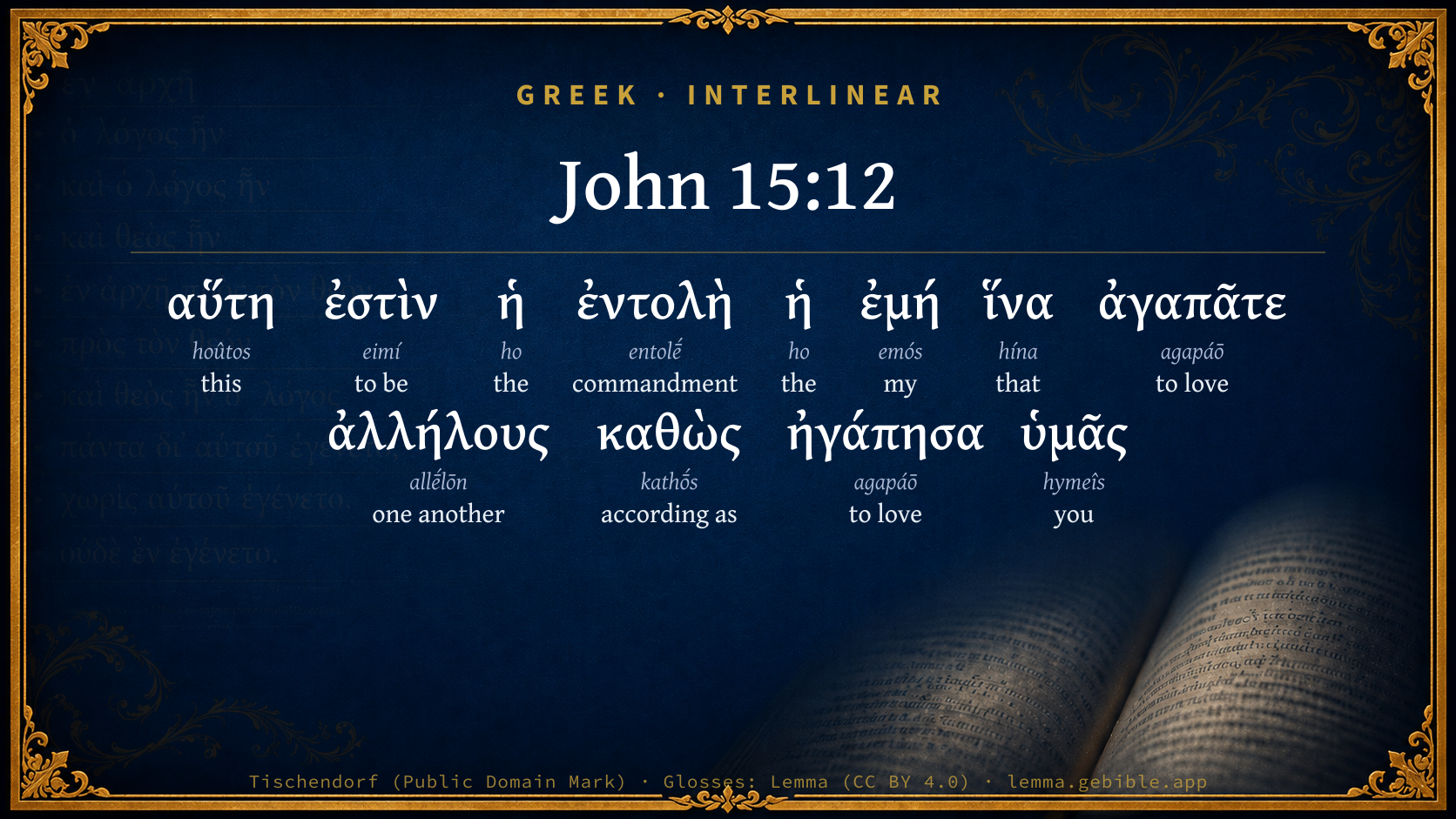
Greek (Tischendorf 8th ed.) John 15:12 appears in the Greek New Testament. The text above is from the Tischendorf 8th edition. Each word links to its Strong’s number and a concise gloss. Click any word for its full Thayer’s Greek Lexicon entry.
Download image
Cite this verse

John 15:12 (World English Bible). Public Domain. Lemma interlinear Bible study tool, https://lemma.gebible.app/v/john/15/12.

Show BibTeX & RIS
BibTeX
RIS
English Translation
"This is my commandment, that you love one another, even as I have loved you.
World English Bible · Public Domain
Download a study sheet

One document with this verse’s original text, its word-by-word gloss line, the meaning frame, cross-references with their text, attributed commentary, and full source and license credits — printable, and it pastes into notes with its structure intact.

This verse Autodidact and up

Study sheet (.html) Plain text (.txt)

A passage Seminary Student

Up to 50 verses in one chapter. A passage sheet keeps up to 6 commentary sources and 12 cross-references per verse, in the order this page ranks them, and says so on the sheet whenever that leaves anything out. Ask for a single verse and you get the Autodidact verse sheet above.

Everything on this page stays free to read, with no account — the sheet is a download of what is already on screen, not access to it.

Want to remove ads? Support Godless Engineer
Compare translations 3

The same verse in 3 English versions, stacked beneath the original-language interlinear above. Click any original word for its lexicon entry.

Each is an independent rendering of the whole verse — the interlinear is not word-aligned to these translations.

Highlighted words mark where these versions differ — a whole-verse word diff, not a word-by-word alignment.

  • World English Bible Public Domain
    "This is my commandment, that you love one another, even as I have loved you.
  • King James Version Public Domain
    This is my commandment, That ye love one another, as I have loved you.
  • unfoldingWord Literal Text CC BY-SA 4.0
    This is my commandment, that you would love one another just as I have loved you.

unfoldingWord Literal Text — © unfoldingWord, licensed CC BY-SA 4.0. Word-aligned USFM3 via Door43 (git.door43.org/unfoldingWord/en_ult).

Versions to compare (up to 4)

3 of 4 selected

Show all 19 translations

Every available English version of this verse, each an independent rendering of the whole verse.

  • World English Bible Public Domain
    "This is my commandment, that you love one another, even as I have loved you.
  • Berean Standard Bible Public Domain
    This is My commandment, that you love one another as I have loved you.
  • Majority Standard Bible Public Domain
    This is My commandment, that you love one another as I have loved you.
  • King James Version Public Domain
    This is my commandment, That ye love one another, as I have loved you.
  • American Standard Version (1901) Public Domain
    This is my commandment, that ye love one another, even as I have loved you.
  • Revised Version (1885) Public Domain
    This is my commandment, that ye love one another, even as I have loved you.
  • Geneva Bible (1599) Public Domain
    This is my commandement, that ye loue one another, as I haue loued you.
  • Douay-Rheims (1899) Public Domain
    This is my commandment, that you love one another, as I have loved you.
  • Young's Literal Translation Public Domain
    `This is my command, that ye love one another, according as I did love you;
  • Literal Standard Version CC BY-SA 4.0
    This is My command, that you love one another, according as I loved you;
  • Unlocked Literal Bible CC BY-SA 4.0
    This is my commandment, that you love one another as I have loved you.
  • unfoldingWord Literal Text CC BY-SA 4.0
    This is my commandment, that you would love one another just as I have loved you.
  • Darby Bible Public Domain
    This is my commandment, that ye love one another, as I have loved you.
  • World Messianic Bible Public Domain
    “This is my commandment, that you love one another, even as I have loved you.
  • Webster's Bible Public Domain
    This is my commandment, That ye love one another, as I have loved you.
  • Free Bible Version CC BY-SA 4.0
    This is my command: love one another as I have loved you.
  • Bible in Basic English Public Domain
    This is the law I give you: Have love one for another, even as I have love for you.
  • Text-Critical English NT CC BY 4.0
    “This is my commandment, that you love one another, just as I have loved you.
  • Tyndale New Testament (1534) Public Domain
    This is my commaundement that ye love togedder as I have loved you.

Literal Standard Version (2020), Covenant Press — licensed CC BY-SA 4.0. Text via the HelloAO Bible API (eBible.org). Unlocked Literal Bible (unfoldingWord) — licensed CC BY-SA 4.0. Text via the HelloAO Bible API (eBible.org). unfoldingWord Literal Text — © unfoldingWord, licensed CC BY-SA 4.0. Word-aligned USFM3 via Door43 (git.door43.org/unfoldingWord/en_ult). Free Bible Version, Dr. Jonathan Gallagher — licensed CC BY-SA 4.0. Text via the HelloAO Bible API (eBible.org).

Word by word

More ways to search: Search by grammar → Find every occurrence → Compare this word →

Practice this passage: Drill this verse → Learn its vocabulary →

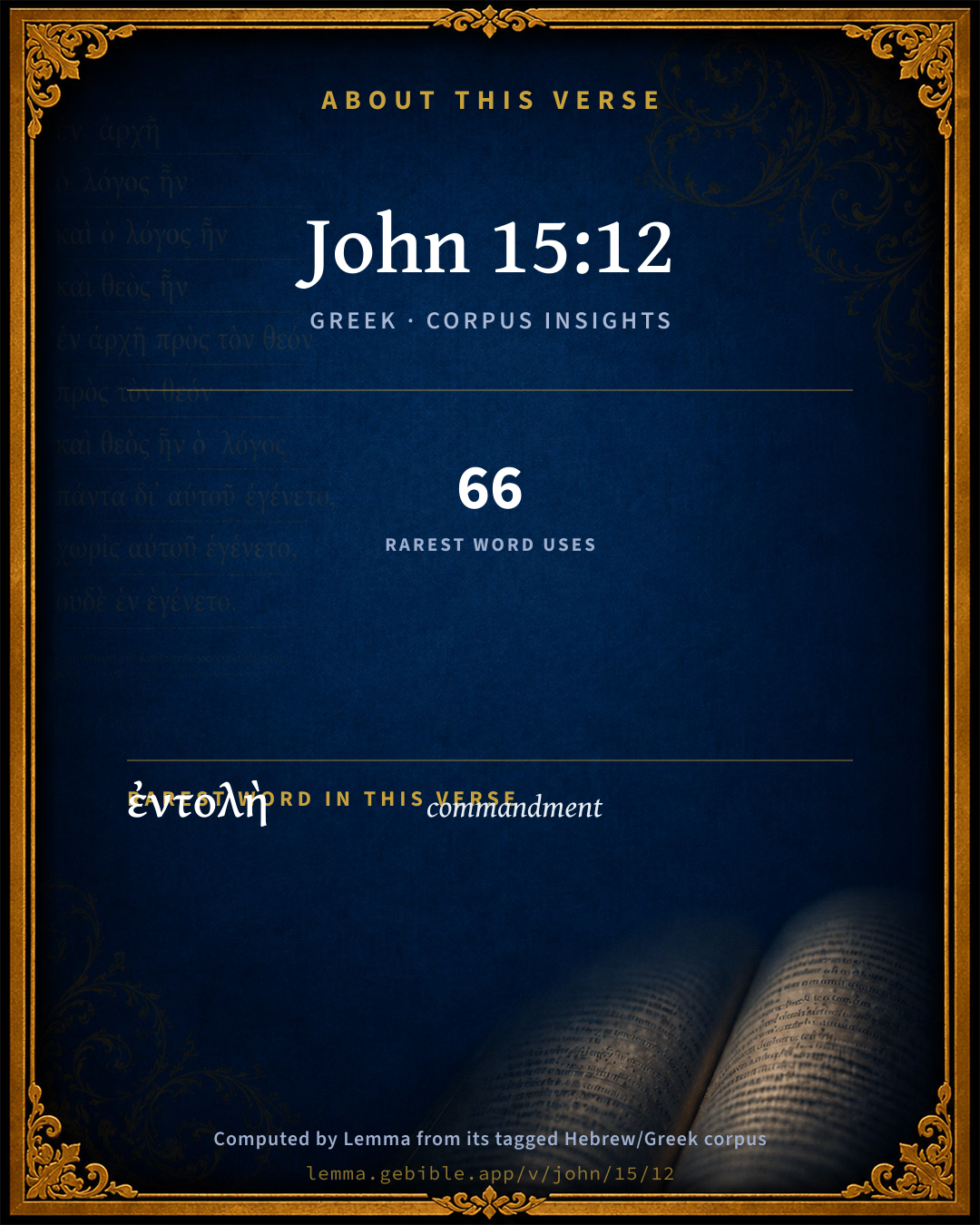
ἐντολὴ
entolḗ
G1785
“commandment”
Noun, Nominative, Singular, Feminine
Part of Speech
Noun
Case
Nominative
Number
Singular
Gender
Feminine
Full Thayer's Definition

Origin: from G1781

TDNT: 11:05,2

1. an order, command, charge, precept, injunction a. that which is prescribed to one by reason of his office 2. a commandment a. a prescribed rule in accordance with which a thing is done 1. a precept relating to lineage, of the Mosaic precept concerning the priesthood 2. ethically used of the commandments in the Mosaic law or Jewish tradition
  1. αὕτη hoûtos G3778 “this” Demonstrative pronoun, Nominative, Singular, Feminine
  2. ἐστὶν eimí G1510 “to be” Verb, Present, Active, Indicative, 3rd person, Singular
  3. ἡ ho G3588 “the” Article, Nominative, Singular, Feminine
  4. ἡ ho G3588 “the” Article, Nominative, Singular, Feminine
  5. ἐμή emós G1699 “my” Possessive pronoun, 1st person, Nominative, Singular, Feminine
  6. ἵνα hína G2443 “that” Conjunction
  7. ἀγαπᾶτε agapáō G25 “to love” Verb, Present, Active, Subjunctive, 2nd person, Plural
  8. ἀλλήλους allḗlōn G240 “one another” Reciprocal pronoun, Accusative, Plural, Masculine
  9. καθὼς kathṓs G2531 “according as” Adverb
  10. ἠγάπησα agapáō G25 “to love” Verb, Aorist, Active, Indicative, 1st person, Singular
  11. ὑμᾶς hymeîs G5210 “you” Personal pronoun, 2nd person, Accusative, Plural

About this verse

These counts appear in no published source. They are computed here, from the morphology-tagged text and Lemma’s own curated glosses. What Lemma adds →

12
words
10
distinct lemmas
Gospels
section

Repetition

Words recur within this verse:

  • ἀγαπᾶτε to love G25 ×2
  • ἡ the G3588 ×2

Cross-references

13

Topical passages linked to John 15:12 in the Treasury of Scripture Knowledge — connected by theme and wording, ordered by reader-vote popularity; previews shown in the World English Bible.

  • 1 John 4:21 This commandment we have from him, that he who loves God should also love his brother.
  • 1 Peter 4:8 And above all things be earnest in your love among yourselves, for love covers a multitude of sins.
  • John 13:34 A new commandment I give to you, that you love one another, just like I have loved you; that you also love one another.
  • Ephesians 5:2 Walk in love, even as Christ also loved you, and gave himself up for us, an offering and a sacrifice to God for a sweet-smelling fragrance.
  • Romans 12:10 In love of the brothers be tenderly affectionate one to another; in honor preferring one another;
  • 1 John 3:23 This is his commandment, that we should believe in the name of his Son, Jesus Christ, and love one another, even as he commanded.
  • 1 Peter 3:8 Finally, be all like-minded, compassionate, loving as brothers, tenderhearted, courteous,
  • 1 Peter 1:22 Seeing you have purified your souls in your obedience to the truth through the Spirit in sincere brotherly affection, love one another from the heart fervently:
  • 1 Thessalonians 4:9 But concerning brotherly love, you have no need that one write to you. For you yourselves are taught by God to love one another,
  • 1 Thessalonians 3:12 and the Lord make you to increase and abound in love one toward another, and toward all men, even as we also do toward you,
  • 1 John 3:11–18 For this is the message which you heard from the beginning, that we should love one another;
  • 2 Thessalonians 1:3 We are bound to always give thanks to God for you, brothers, even as it is appropriate, because your faith grows exceedingly, and the love of each and every one of you towards one another abounds;
  • 1 John 2:7–10 Brothers, I write no new commandment to you, but an old commandment which you had from the beginning. The old commandment is the word which you heard from the beginning.

Cross-references courtesy of OpenBible.info (CC BY 4.0).

Commentary

Notes on John 15:12 from classic Christian and Jewish commentators (each source and its license shown beneath its notes). The classic Christian expositions comment on the surrounding passage and are grouped to its opening verse, so a note may address several verses; the Jewish commentaries on the Tanakh (Rashi and others) are per-verse, so they appear only where the commentator wrote on this verse.

Lemma curates 59 commentaries, every one of them public domain or Creative Commons licensed, each selected and text-cleaned for this edition rather than reprinted as found. About our sources →

The Biblical Illustrator

Joseph S. Exell

Joh_15:12-17

This is My commandment, that ye love one another

The great commandment of Christ

I.

THE LOVE OF CHRIST. Remember

1. How free it was. We did not merit it, ask for it, nor even desire it. And here is the wonder of it. It is love which found nothing to draw it forth. It was entirely self-moved. Disinterestedness then must be one main ingredient in the love we are to bear our fellow men. It is not to stop and ask, Why should I love that man? What has he done for me? That is a love like Christs, which rises up spontaneously. It does not wait to be bought or won.

2. How costly. Ye know the grace of our Lord Jesus Christ; though He was rich, yet for our sakes He became poor. Moved by His grace, He paid for our redemption the price that His law demanded. And what a price! Oh to find a man who will break through any thing but the law of God for his fellow man! That is the man, who embodies this precept of our Lord; a self-denying man, one who even in his love is willing to take up his cross and follow Christ.

3. How compassionate and tender! In looking at its greatness, we often lose sight of this. But the softness of a mothers love never equalled our Lords. Read His life. It is not here and there that His compassion comes out, it is everywhere. And this is the point in which the love of many real Christians is most deficient. Our neighbours want our hearts as well as our hands. There is ten-fold more sorrow in mens minds, than pain in mens bodies, or sickness and poverty in mens houses. Would you show it mercy? Then carry a feeling heart through it. This will do more for the worlds comfort than the richest purse.

4. How bountiful! No good thing will He withhold from us. Freely ye have received, freely give. The measure of what our love is to do for others and give to others, is simply this, the measure of our ability to give and do. That is Christs standard in His love; it must be our standard in ours.

5. How extensive! It is discriminating. It took almost as many forms as love could take. The love of country was strong in Him, and the love of kindred and the love of friends. But then look, at the same time, at its extent. Who was excluded from it? His enemies? No, with His last breath He prayed for the very men who murdered Him. Or the world? There is not a guilty being on the wide earth whom He does not pity, and load daily with benefits. His love is like the sun in the heavens--they who are the nearest to it are warmed, and gladdened by it the most, but they who are the farthest off from it behold its light. And this is the unfailing character of all true Christian love. Worldly love is narrow, and generally becomes more so as we grow older. This is expansive. No one object can absorb it; no one house or family can hold it; no sect or party can confine it.

II. THE CHARGE OUR LORD GIVES US TO IMITATE HIM IN HIS LOVE.

1. There is a commandment in the case. It is remarkable that our Lord, who seldom uses this word on other occasions, uses it again and again in reference to this love. Here, you observe, is authority pressing down on us. We are to be without this love at our peril. We little think what we are doing when we keep back the helping hand or the pitying heart from a suffering brother. We are setting up once more for our own masters.

2. It is Christs commandment. He stamps it with His own authority. Viewed in this light, there is an appeal in this charge to our gratitude and affection. When our Lord calls it a commandment, He says, Dread to dispise it; and when He calls it His commandment, He urges us by His mercies towards us to obey it. And there may be a reference here to a custom of the times. Each of the different sects among the Jews had some particular tenet or practice to distinguish it. Now I, says our Lord, fix on this as the mark and badge of My followers--mutual love. You shall be as well known by this love, as the priests of the Temple are by their garments, or the Roman soldiers by their standards.

3. It is His last and great commandment. Herein He shows us

(1) The amazing tenderness of His own love. His love for them triumphs over every other feeling and desire.

(2) The importance in itself of this mutual love. Our all-wise Lord would not have spoken thus emphatically of a trifle. St. Paul says that this love is the fulfilling of the law, and the end of the commandment. Just so our Lord speaks of it (Joh_15:17). (C. Bradley, M. A.)

Brotherly love

I. HAS THE HIGHEST MODEL. As I have loved you. How did Christ love?

1. Disinterestedly. There was not a taint of selfishness in His love. He looked for no compensation, no advantage.

2. Earnestly. It was an all-pervading, all-commanding passion. It was a zeal consuming Him.

3. Practically. It was not a love that slept as an emotion in the heart, that expended itself in words and professions; it was a love that worked all the faculties to the utmost, and led Him to the sacrifice of Himself. This is the kind of love we should have one toward another. This is the brotherly love that

(1) Unites Christs disciples together.

(2) Honours Christ.

(3) Blesses the world with the most beneficient influences.

II. FORMS THE HIGHEST FRIENDSHIP. Ye are My friends, etc.

1. It not only establishes a friendship, but a friendship between them and Christ. A true friendship between man and man is the greatest blessing on earth.

2. A friendship between man and Christ is the consummation of mans well being. If Christ is my friend what want I more?

III. HAS THE HIGHEST SOURCE. Ye have not chosen Me, etc. We did not choose to love Christ first, but He chose to love us. His love to us generates our love to Him. He chose His first disciples from their worldly avocations and called them into His circle; this inspired them with His love. Men will never love one another properly until Christ sheds abroad His love in their hearts. He is to all His disciples what the sun is to the planets; around Him they revolve and from Him derive their life and unity. They are united one to another by the bonds that unite them to Christ.

IV. REALISES THE HIGHEST GOOD.

1. Spiritual fruitfulness. Ordained you, appointed you, that ye bring forth fruit. The fruit involves two things

(1) The highest excellence of character.

(2) The highest usefulness of life. Rendering others the highest service.

2. Successful prayer. Whatsoever ye shall ask, etc. (D. Thomas, D. D.)

Christians bound to love one another

I. THE DUTY.

1. Mutual love. There is a love which all men owe to all men. Thou shalt love thy neighbour as thyself: but the love which is the subject of our Lords precept, is obviously much more comprehensive in its elements, and much less extensive in its range, than this. It is the love of which none but a disciple can be either the object or the subject. Its component elements are esteem, complacency, benevolence, and its appropriate manifestations,--highly valuing each others Christian gifts and graces,--delighting in such association with each other as naturally calls forth into exercise all that is peculiarly Christian in the character,--defending each others Christian reputation when attacked,--sympathising with each others Christian joys and sorrows,--promoting each others personal Christian holiness and comfort.

and cordially cooperating with each other in enterprises calculated to promote the common Christian cause, the cause of Gods glory, and mans improve ment and happiness.

2. Love like that of our Lord. As I have loved you.

(1) Discriminative.

(2) Sincere.

(3) Spontaneous.

(4) Fervent and copious.

(5) Disinterested.

(6) Active.

(7) Self-sacrificing.

(8) Considerate and wise.

(9) Generously confiding and kindly forbearing.

(10) Constant.

(11) Enduring.

(12) Holy and spiritual.

(13) Universal.

II. THE MOTIVES.

1. The commandment of Christ. There is no duty which the apostles, more frequently, or more authoritively, enjoin. To enable us to form some estimate of the force of this motive we have only to propose and answer the question, Who is this who speaketh? This is a commandment which Christ claims as His own, in a peculiar sense; and it is addressed to a class who stand in a peculiar relation to Him.

2. The example of Christ. How did Christ love

(1) He was just about to give them the greatest proof of friendship which can be given. Greater love hath no man than this, etc.

(2) He had made them the objects of His peculiar complacent regard, as persons who were really desirous of doing whatever He commanded them. Ye are My friends, if ye do whatsoever I command you.

(3) He had treated them as friends, by unfolding to them, so far as they were capable of apprehending it, the whole truth respecting the wonderful communication He had come from heaven to earth to make, and the wonderful work He had come from heaven to earth to perform--the economy of salvation. Henceforth I call you not servants, etc.

(4) He had selected them, and appointed them to a great, important, salutary work, their success in which was assured by all necessary assistance in it being secured in answer to believing prayer. Ye have not chosen Me, etc. (J. Brown, D. D.)

The Cross the means of perpetuating Christian love

The fire of charity is never extinguished, but will always be rekindled by the wood of the cross. (St. Ignatius.)

The oneness of the branches

The union between Christ and His disciples has been set forth in the parable of the vine. We now turn to the union between the disciples, which is the consequences of their common union to the Lord. There are four things suggested.

I. THE OBLIGATION.

1. The two ideas of commandment and love do not go well together. You cannot pump up love to order, and if you try you generally produce sentimental hypocrisy, hollow and unreal. Still we can do a great deal for the cultivation and strengthening of any emotion. We can cast ourselves into the attitude which is favourable or unfavourable to it. We can look at the subjects which will create it or at those which will cheek it.

2. This is an obligation

(1) Because He commands it. He puts Himself here in the position.

(2) Because such an attitude is the only fitting expression of the mutual relation of Christian men, through their common relation to the vine. However unlike any two Christian people are in character, culture, circumstances, the bond that knits those who have the same relations to Jesus Christ is far deeper, more real, and ought to be far closer, than the bond that knits them to the men or women to whom they are likest in all these other respects, and to whom they are unlike in this one central one. Let all secondary grounds of union and of separation be relegated to their proper subordinate place; and let us recognize this, that the children of one father are brethren. And do not let it be said, that brethren in the Church means a great deal less than brothers in the world.

II. THE SUFFICIENCY OF LOVE.

1. Our Lord has been speaking in a former verse about the keeping of His commandments. Now He gathers them all up into one: the all comprehensive simplification of duty--love.

2. If the heart be right all else will be right; and if there be a deficiency of love nothing will be right. You cannot help anybody except on condition of having an honest and benevolent regard towards him. You may pitch him benefits, and you will neither get nor deserve thanks for them; you may try to teach him, and your words will be hopeless and profitless. As we read Corinthians 13--the lyric praise of charity--all kinds of blessing and sweetness and gladness come out of this.

3. And Jesus Christ, leaving the little flock of His followers in the world, gave them no other instruction for their mutual relationship? He did not talk to them about institutions and organizations, about orders of the ministry and sacraments, or Church polity. His one commandment was Love one another, and that will make you wise. Love one another and you will shape yourselves into the right forms.

III. THE PATTERN OF LOVE. As I have loved you. Greater love hath no man than this, etc.

1. Christ sets Himself forward here, as He does in all aspects of human conduct and character, as being the realized ideal of them all. Reflect upon the strangeness of a man thus calmly saying to the whole world, I am the embodiment of all that love ought to be. The pattern that He proposes is more august than appears at first sight. A verse or two before our Lord had said, As the Father hath loved Me so I have loved you. Now He says, Love one another as I have loved you.

2. But then our Lord here sets forth the very central point of His work, even His death upon the cross for us, as being the pattern to which our poor affection ought to aspire, and after which it must tend to be conformed. That is to say, the heart of the love that He commands is self-sacrifice, reaching to death if death be needful. And no man loves as Christ would have Him love who does not bear in his heart affection which has so conquered selfishness that, if need be, he is ready to die. It is a solemn obligation, which many well make us tremble, that is laid on us in these words, As I have loved you. Calvary was less than twenty-four hours off, and He says to us, That is your pattern!

3. Remember, too, that the restriction which here seems to be cast around the flow of His love is not a restriction in reality, but rather a deepening of it. The friends for whom He dies are the same persons as the Apostle, in his sweet variation upon these words, has called by the opposite name when he says that He died for His enemies. There is an old wild ballad that tells of how a knight found, coiling round a tree in a dismal forest, a loathly dragon breathing out poison; and how, undeterred by its hideousness and foulness, he cast his arms round it and kissed it on the mouth. Three times he did it undisgusted, and at the third the shape changed into a fair lady, and he won his bride. Christ kisses with the kisses of His mouth His enemies, and makes them His friends because He loves them. If He had never died for His enemies, says one of the old fathers, He would never have possessed His friends. And so He teaches us, that the way by which we are to meet even alienation and hostility is by pouring upon it the treasures of an unselfish, self-sacrificing affection which will conquer at the last.

IV. THE MOTIVE. As I have loved you. The novelty of Christian morality lies here, that in its law there is a self-fulfilling force. We have not to look to one place for the knowledge of our duty, and somewhere else for the strength to do it, but both are given to us in the one thing, the gift of the dying Christ and His immortal love. (A. Maclaren, D. D.)

Love the means of unity

In the early spring, when the wheat is green and young, and scarcely appears above the ground, it springs in the lines in which it was sown, parted from one another and distinctly showing their separation, and the furrows. But, when the full corn in the ear waves on the autumn plain, all the lines and separations have disappeared, and there is one unbroken tract of sunny fruitfulness. And so when the life in Christ is low and feeble, His servants may be separated and drawn up in rigid lines of denominations, and churches, and sects; but as they grow the lines disappear. If to the churches of England today there came a sudden accession of knowledge of Christ, and of union with Him, the first thing that would go would be the wretched barriers that separate us from one another. For if we have the life of Christ in any mature measure in ourselves, we shall certainly bare grown up above the fences behind which we began to grow, and shall be able to reach out to all that love the Lord Jesus Christ, and feel with thankfulness that we are one in Him. (A. Maclaren, D. D.)

The Biblical Illustrator, edited by Joseph S. Exell (c. 1880s–1900s) — public domain. Text from a community e-Sword module.

Joseph Benson's Commentary

Joh 15:12. This is my commandment — This I especially enjoin you, whether as apostles or private Christians; that ye love one another — Cordially and constantly; even, if it be possible, with as great fervency and constancy, as I have loved you — So as to be ready to sacrifice your lives for each other, as I expose and give up mine for you. It is remarkable, that no one duty is more frequently inculcated, or more pathetically urged upon his disciples, by our Lord, than that of mutual love. This is my commandment, he says, as if it were the most necessary of all the commandments. The reason might be, 1st, That as under the law, the prohibition of idolatry was the commandment more insisted on than any other, because God foresaw the people would be prone to that sin; so Christ, foreseeing that the Christian Church would be addicted to uncharitable contentions and divisions, strife and animosity, thought proper to lay the greatest stress upon this precept. 2d, Mutual love among Christians is a duty which both includes many other duties, and has a good influence upon all: and to this duty, Christ’s love to us all should at once direct, animate, and urge us; he having thereby both shown us our duty in this respect, and laid us under the most powerful obligations to perform it. Add to this, that our Lord was thus earnest in pressing his disciples to the duty of mutual love, not only because it was the great design of his gospel to promote it, but because this virtue exercised by his apostles and first disciples among themselves, and toward all mankind, would be one great means of making their preaching successful; just as Christ’s immense love to men will always have a great influence in drawing them to him.

Joseph Benson's Commentary on the Old and New Testaments (1811–1818) — public domain. Text from a community e-Sword module.

Whedon's Commentary on the Bible

Daniel D. Whedon

The commandment of mutual love, based upon his example of love, Joh_15:12-17.

12. As I have loved you—Very perfect indeed is that authority in the commandment of love which is based upon the example of him who commands. Christ is the only preacher of absolute perfection who fully exemplified, in his own instance, the perfection he preached. All true human preaching is above the practice of even the best preacher.

Daniel D. Whedon (gen. ed.), Commentary on the Old and New Testaments (1874–1909) — public domain. Text from a community e-Sword module.

MacLaren's Expositions of Holy Scripture

Alexander MacLaren

John

THE ONENESS OF THE BRANCHES

Joh 15:12 - Joh 15:13.

The union between Christ and His disciples has been tenderly set forth in the parable of the Vine and the branches. We now turn to the union between the disciples, which is the consequence of their common union to the Lord. The branches are parts of one whole, and necessarily bear a relation to each other. We may modify for our present purpose the analogous statement of the Apostle in reference to the Lord’s Supper, and as He says, ‘We being many, are one body, for we are all partakers of that one bread,’ so we may say-The branches, being many, are one Vine, for they are all partakers of that one Vine. Of this union amongst the branches, which results from their common inherence in the Vine, the natural expression and manifestation is the mutual love, which Christ here gives as the commandment, and commends to us all by His own solemn example.

There are four things suggested to me by the words of our text-the Obligation, the Sufficiency, the Pattern, and the Motive, of Christian love.

I. First, the Obligation of love.

The two ideas of commandment and love do not go well together. You cannot pump up love to order, and if you try you generally produce, what we see in abundance in the world and in the Church, sentimental hypocrisy, hollow and unreal. But whilst that is true, and whilst it seems strange to say that we are commanded to love, still we can do a great deal, directly and indirectly, for the cultivation and strengthening of any emotion. We can either cast ourselves into the attitude which is favourable or unfavourable to it. We can either look at the facts which will create it or at those who will check it. We can go about with a sharp eye for the lovable or for the unlovable in man. We can either consciously war against or lazily acquiesce in our own predominant self-absorption and selfishness. And in these and in a number of other ways, our feelings towards other Christian people are very largely under our own control, and therefore are fitting subjects for commandment.

Our Lord lays down the obligation which devolves upon all Christian people, of cherishing a kindly and loving regard to all others who find their place within the charmed circle of His Church. It is an obligation because He commands it. He puts Himself here in the position of the absolute Lawgiver, who has the right of entire and authoritative control over men’s affections and hearts. And it is further obligatory because such an attitude is the only fitting expression of the mutual relation of Christian men, through their common relation to the Vine. If there be the one life-sap circling through all parts of the mighty whole, how anomalous and how contradictory it is that these parts should not be harmoniously concordant among themselves! However unlike any two Christian people are to each other in character, in culture, in circumstances, the bond that knits those who have the same relations to Jesus Christ one to another is far deeper, far more real, and ought to be far closer, than the bond that knits either of them to the men or women to whom they are likest in all these other respects, and to whom they are unlike in this central one. Christian men! you are closer to every other Christian man, down in the depths of your being, however he may be differenced from you by things that are very hard to get over, than you are to the people that you like best, and love most, if they do not participate with you in this common love to Jesus Christ.

I dread talking mere sentiment about this matter, for there is perhaps no part of Christian duty which has been so vulgarised and pawed over by mere unctuous talk, as that of the fellowship that should subsist between all Christians. But I have one plain question to put,-Does anybody believe that the present condition of Christendom, and the relations to one another even of good Christian people in the various churches and communions of our own and of other lands, is the sort of thing that Jesus Christ meant, or is anything like a fair and adequate representation of the deep, essential unity that knits us all together?

We need far more to realise the fact that our emotions towards our brother Christians are not matters in which our own inclinations may have their way, but that there is a simple commandment given to us, and that we are bound to cherish love to every man who loves Jesus Christ. Never mind though he does not hold your theology; never mind though he be very ignorant and narrow as compared with you; never mind though your outlook on the world may be entirely unlike his. Never mind though you be a rich man and he a poor one, or you a poor one and he rich, which is just as hard to get over. Let all these secondary grounds of union and of separation be relegated to their proper subordinate place; and let us recognise this, that the children of one Father are brethren. And do not let it be possible that it shall be said, as so often has been said, and said truly, that ‘brethren’ in the Church means a great deal less than brothers in the world. Lift your eyes beyond the walls of the little sheepfold in which you live, and hearken to the bleating of the flocks away out yonder, and feel-’Other sheep He has which are not of this fold’; and recognise the solemn obligation of the commandment of love.

II. Note, secondly, the Sufficiency of love.

Our Lord has been speaking in a former verse about the keeping of His commandments. Now He gathers them all up into one. ‘This is my commandment, that ye love one another’ All duties to our fellows, and all duties to our brethren, are summed up in, or resolved into, this one germinal, encyclopaediacal, all-comprehensive simplification of duty, into the one word ‘love.’

Where the heart is right the conduct will be right. Love will soften the tones, will instinctively teach what we ought to be and do; will take the bitterness out of opposition and diversity, will make even rebuke, when needful, only a form of expressing itself. If the heart be right all else will be right; and if there be a deficiency of love nothing will be right. You cannot help anybody except on condition of having an honest, beneficent, and benevolent regard towards him. You cannot do any man in the world any good unless there is a shoot of love in your heart towards him. You may pitch him benefits, and you will neither get nor deserve thanks for them; you may try to teach him, and your words will be hopeless and profitless. The one thing that is required to bind Christian men together is this common affection. That being there, everything will come. It is the germ out of which all is developed. As we read in that great chapter to the Corinthians-the lyric praise of Charity,-all kinds of blessing and sweetness and gladness come out of this, It is the central force which, being present, secures that all shall be right, which, being absent, ensures that all shall be wrong.

And is it not beautiful to see how Jesus Christ, leaving the little flock of His followers in the world, gave them no other instruction for their mutual relationship? He did not instruct them about institutions and organisations, about orders of the ministry and sacraments, or Church polity and the like. He knew that all these would come. His one commandment was, ‘Love one another,’ and that will make you wise. Love one another, and you will shape yourselves into the right forms. He knew that they needed no exhortations such as ecclesiastics would have put in the foreground. It was not worth while to talk to them about organisations and officers. These would come to them at the right time and in the right way. The ‘one thing needful’ was that they should be knit together as true participators of His life. Love was sufficient as their law and as their guide.

III. Note, further, the Pattern of love.

‘As I have loved you. Greater love hath no man than this, that a man lay down his life for his friends.’ Christ sets Himself forward then, here and in this aspect, as He does in all aspects of human conduct and character, as being the realised Ideal of them all. And although the thought is a digression from my present purpose, I cannot but pause for a moment to reflect upon the strangeness of a man thus calmly saying to the whole world, ‘I am the embodiment of all that love ought to be. You cannot get beyond Me, nor have anything more pure, more deep, more self-sacrificing, more perfect, than the love which I have borne to you.’

But passing that, the pattern that He proposes for us is even more august than appears at first sight. For, if you remember, a verse or two before our Lord had said, ‘As the Father hath loved Me so I have loved you.’ Now He says, ‘Love one another as I have loved you.’ There stand the three, as it were, the Father, the Son, the disciple. The Son in the midst receives and transmits the Father’s love to the disciple, and the disciple is to love his fellows, in some deep and august sense, as the Father loved the Son. The divinest thing in God, and that in which men can be like God, is love. In all our other attitudes to Him we rather correspond than copy. His fullness is met by our emptiness, His giving by our recipiency, His faithfulness by our faith, His command by our obedience, His light by our eye. But here it is not a case of correspondence only, but of similarity. My faith answers God’s gift to me, but my love is like God’s love. ‘Be ye, therefore, imitators of God as beloved children’; and having received that love into your hearts, ray it out, ‘and walk in love as God also hath loved us.’

But then our Lord here, in a very wonderful manner, sets forth the very central point of His work, even His death upon the Cross for us, as being the pattern to which our poor affection ought to aspire, and after which it must tend to be conformed. I need not remind you, I suppose, that our Lord here is not speaking of the propitiatory character of His death, nor of the issues which depend upon it, and upon it alone, viz., the redemption and salvation of the world. He is not speaking, either, of the peculiar and unique sense in which He lays down His life for us, His friends and brethren, as none other can do. He is speaking about it simply in its aspect of being a voluntary surrender, at the bidding of love, for the good of those whom He loved, and that, He tells us-that, and nothing else-is the true pattern and model towards which all our love is bound to tend and to aspire. That is to say, the heart of the love which He commands is self-sacrifice, reaching to death if death be needful. And no man loves as Christ would have him love who does not bear in his heart affection which has so conquered selfishness that, if need be, he is ready to die.

The expression of Christian life is not to be found in honeyed words, or the indolent indulgence in benevolent emotion, but in self-sacrifice, modelled after that of Christ’s sacrificial death, which is imitable by us.

Brethren, it is a solemn obligation, which may well make us tremble, that is laid on us in these words, ‘As I have loved you.’ Calvary was less than twenty-four hours off, and He says to us, ‘That is your pattern!’ Contrast our love at its height with His-a drop to an ocean, a poor little flickering rushlight held up beside the sun. My love, at its best, has so far conquered my selfishness that now and then I am ready to suffer a little inconvenience, to sacrifice a little leisure, to give away a little money, to spend a little dribble of sympathy upon the people who are its objects. Christ’s love nailed Him to the Cross, and led Him down from the throne, and shut for a time the gates of the glory behind Him. And He says, ‘That is your pattern!’

Oh, let us bow down and confess how His word, which commands us, puts us to shame, when we think of how miserably we have obeyed.

Remember, too, that the restriction which here seems to be cast around the flow of His love is not a restriction in reality, but rather a deepening of it. He says, ‘Greater love hath no man than this, that a man lay down his life for his friends.’ But evidently He calls them so from His point of view, and as He sees them, not from their point of view, as they see Him-that is to say, He means by ‘friends’ not those who love Him, but those whom He loves. The ‘friends’ for whom He dies are the same persons as the Apostle, in his sweet variation upon the words of my text, has called by the opposite name, when He says that He died for His ‘enemies.’

There is an old, wild ballad that tells of how a knight found, coiling round a tree in a dismal forest, a loathly dragon breathing out poison; and how, undeterred by its hideousness and foulness, he cast his arms round it and kissed it on the mouth. Three times he did it undisgusted, and at the third the shape changed into a fair lady, and he won his bride. Christ ‘kisses with the kisses of His mouth’ His enemies, and makes them His friends because He loves them. ‘If He had never died for His enemies’ says one of the old fathers, ‘He would never have possessed His friends.’ And so He teaches us here in what seems to be a restriction of the purpose of His death and the sweep of His love, that the way by which we are to meet even alienation and hostility is by pouring upon it the treasures of an unselfish, self-sacrificing affection which will conquer at the last.

Christ’s death is the pattern for our lives as well as the hope of our hearts.

IV. Lastly, we have here by implication, though not by direct statement, the Motive of the love.

Surely that, too, is contained in the words, ‘As I have loved you.’ Christ’s commandment of love is a new commandment, not so much because it is a revelation of a new duty, though it is the casting of an old duty into new prominence, as because it is not merely a revelation of an obligation, but the communication of power to fulfil it. The novelty of Christian morality lies here, that in its law there is a self-fulfilling force. We have not to look to one place for the knowledge of our duty, and somewhere else for the strength to do it, but both are given to us in the one thing, the gift of the dying Christ and His immortal love.

That love, received into our hearts, will conquer, and it alone will conquer, our selfishness. That love, received into our hearts, will mould, and it alone will mould, them into its own likeness. That love, received into our hearts, will knit, and it alone will knit, all those who participate in it into a common bond, sweet, deep, sacred, and all-victorious.

And so, brethren, if we would know the blessedness and the sweetness of victory over these miserable, selfish hearts of ours, and to walk in the liberty of love, we can only get it by keeping close to Jesus Christ. In any circle, the nearer the points of the circumference are to the centre, the closer they will necessarily be to one another. As we draw nearer, each for himself, to our Centre, we shall feel that we have approximated to all those who stand round the same centre, and draw from it the same life. In the early spring, when the wheat is green and young, and scarcely appears above the ground, it comes up in the lines in which it was sown, parted from one another and distinctly showing their separation and the furrows. But when the full corn in the ear waves on the autumn plain, all the lines and separations have disappeared, and there is one unbroken tract of sunny fruitfulness. And so when the life in Christ is low and feeble, His servants may be separated and drawn up in rigid lines of denominations, and churches, and sects; but as they grow the lines disappear. If to the churches of England to-day there came a sudden accession of knowledge of Christ, and of union with Him, the first thing that would go would be the wretched barriers that separate us from one another. For if we have the life of Christ in any adequate measure in ourselves, we shall certainly have grown up above the fences behind which we began to grow, and shall be able to reach out to all that love the Lord Jesus Christ, and feel with thankfulness that we are one in Him.

Alexander MacLaren, Expositions of Holy Scripture (1904–1910) — public domain. Text from a community e-Sword module.

Tyndale Open Study Notes

Tyndale Open Resources

15:12-13 This is my commandment: Love each other: See 13:34. • Jesus demonstrated his love by sacrificing his life at the cross.

Tyndale Open Study Notes — © Tyndale Open Resources, licensed CC BY-SA 4.0. Text via the HelloAO Bible API.

Bengel's Gnomon

Johann Albrecht Bengel

Joh 15:12. Ἡ ἐντολὴ, commandment) Previously, in this and the preceding chapter, He said in the Plural commandments. They all are comprised in the one, ‘love.’—ἵνα—καθὼς) even as I have loved you: this clause is handled, Joh 15:13-16. The inference of the former clause from this, viz. that ye love one another, is deduced in Joh 15:17.

Bengel's Gnomon of the New Testament — English translation (T&T Clark, Edinburgh, 1860) — public domain. Text from a community e-Sword module.

Meyer's Critical & Exegetical Commentary

Heinrich August Wilhelm Meyer

Joh_15:12-13. Now, for the purpose of furnishing a more exact guide to this joy, is given the precept of reciprocal love, founded on the love of Christ (Joh_13:34), which is the sum of the conception of the ἐντολαί, Joh_15:10, Jesus peculiar, specific precept (ἡ ἐμή).

ἵνα] you should (see on Joh_6:29).

Joh_15:13 characterizes the καθὼς ἠγάπ. ὑμᾶς. A greater love than this (just designated by καθὼς ἠγάπ. ὑμᾶς) no one cherishes; it is the greatest love which any one can have, such as, according to the divine purpose, shall impel to this (ἵνα), that (after my example) one (indefinite) should give up his soul for the advantage of his friends. For a like readiness to self-sacrifice the greatness of my love shall be the motive, 1Jn_3:16. The ordinary interpretation, according to which ἵνα is taken as expository of ταύτης, does not correspond to the idea of purpose in ἵνα, and the attempts to preserve this conception (e.g. De Wette: in ἀγάπη there lies a law, a will, comp. Luthardt, Lange; Godet: the culminating point of loving effort lies therein) are unsatisfactory and forced expedients. On τιθέναι τ. ψυχ., see on Joh_10:11; on τὶς, corresponding to the universal one (man, Ger.), any one, see Nägelsbach, z. Ilias, p. 299, ed. 3.

The difference between the present passage and Rom_5:6 ff. (ὑπὲρ ἀσεβῶν) does not rest upon the thing itself, but only on the different point of view, which in Romans is general, and here is limited, according to the special connection, to the circle of friends, without excepting the friends from the general category of sinners. To designate them, however, by that quality, was not relevant in this place. Against the weakening of the idea of φίλων: those who are actually objects of His love (Ebrard), Joh_15:14 should have been a sufficient guard.

Meyer — Critical and Exegetical Commentary on the New Testament — English translation by Peter Christie, edited by Frederick Crombie (T&T Clark, 1880) — public domain. Text from a community e-Sword module.

Expositor's Greek Testament

ed. W. Robertson Nicoll

Joh 15:12 . And that they might know definitely what His commandment (Joh 15:10 ) is, He says, αὕτη … ὑμᾶς . “This is my commandment, that ye love one another as I have loved you.” Perhaps they expected minute, detailed instructions such as they had received when first sent out (Mat 10 ). Instead of this, love was to be their sufficient guide. καθὼς ἠγάπησα ὑμᾶς . His love was at once the source and the measure of theirs. In His love for them they were to find the spring of love to one another, and were to become transparencies through which His love would shine.

The Expositor's Greek Testament, edited by W. Robertson Nicoll (1897–1910) — public domain. Text from a community e-Sword module.

Godet's Commentaries

Frédéric Louis Godet

ADDITIONAL NOTES BY THE AMERICAN EDITOR.

Vv. 12-17.

1. The statement of Joh 15:13 is, of course, to be interpreted in view of the subject which is occupying the thought of Jesus. The love of enemies is not under contemplation.

2. The proof which Jesus gives, that He regards them as friends (Joh 15:15), is that He has made known to them all things which He has heard from God. This is not to be understood as inconsistent with what is said in Joh 16:12, but only as declaring that He had treated them with all openness and friendliness, concealing nothing for the purpose of concealment.

3. The word ἐξελεξάμην of Joh 15:16, from its connection with φίλους, seems to refer to the choice of the eleven as friends. In the relation of the thought to the bearing of fruit, the idea of the apostleship is no doubt before the mind, and not improbably the turn to this idea is to be found in the verb ἔθηκα .

4. The second ἵνα clause of Joh 15:16 is to be understood, with Meyer, Weiss, Godet and others, as co-ordinate with the first. This co-ordination, and the placing of the second ἵνα clause where it is, serve to show, once more, how completely the thought of answers to prayer is limited, in these chapters, to the matters of spiritual life and fruit-bearing.

Ver. 12. “This is my commandment, that you love one another as I have loved you.”

Comp. Joh 13:34. This is the normal relation of the branches to one another, which has as its condition the normal relation of each one to the vine. So Hengstenberg finds in Joh 15:1-11 the resume of the first part of the summary of the law, and in Joh 15:12-17, that of the second.

In Joh 15:13-16, Jesus raises the mutual love of His own to its full height by giving as a model for it that which He has had for them. These four verses are the commentary on the word as in the words: “As I have loved you.” And first, Joh 15:13 : the point to which His love has carried devotion—death; then, Joh 15:14-15 : the character of full intimacy which He has given to this relation of love; it was the confidence of the friend rather than the authority of the master; finally, Joh 15:16 : the free initiative with which He has Himself laid the foundation of this relation. The meaning of this whole development is this: “When therefore you ask yourselves what limits are to be set to your mutual love, begin by asking yourselves, what limits, in these various points, that love which I have had for you has set for itself!” Or: “And when you would know what it is to love, look at me!” (Gess).

Frédéric Louis Godet — Commentaries on Luke, John, Romans, and 1 Corinthians — English translation (T&T Clark, Edinburgh, 1870s–1890s) — public domain. Text from a community e-Sword module.

Jamieson, Fausset & Brown

Robert Jamieson, A. R. Fausset & David Brown

That ye love one another, &c.--(See on Joh 13:34-35).

Jamieson, Fausset & Brown — Commentary Critical and Explanatory on the Whole Bible (1871) — public domain (CC PDM 1.0). Text via the HelloAO Bible API.

Adam Clarke's Commentary

Verse 12. That ye love one another] See Clarke on Joh 13:34. So deeply was thus commandment engraved on the heart of this evangelist that St. Jerome says, lib. iii. c. 6, Com. ad Galat., that in his extreme old age, when he used to be carried to the public assemblies of the believers, his constant saying was, Little children, love one another. His disciples, wearied at last with the constant repetition of the same words, asked him, Why he constantly said the same thing? "Because (said he) it is the commandment of the Lord, and the observation of it alone is sufficient." Quia praeceptum Domini est, et, si solum fiat, sufficit.

Adam Clarke's Commentary on the Bible (1810–1826) — public domain. Text from a community e-Sword/MySword module.

John Calvin's Commentaries

12. This is my commandment. Since it is proper that we regulate our life according to the commandment of Christ, it is necessary, first of all, that we should understand what it is that he wills or commands He now therefore repeats what he had formerly said, that it is his will, above all things, that believers should cherish mutual love among themselves. True, the love and reverence for God comes first in order, but as the true proof of it is love toward our neighbors, he dwells chiefly on this point. Besides, as he formerly held himself out for a pattern in maintaining the general doctrine, so he now holds himself out for a pattern in a particular instance; for he loved all his people, that they may love each other. Of the reason why he lays down no express rule, in this passage, about loving unbelievers, we have spoken under the former chapter.

John Calvin's Commentaries (1540-1563) — public domain. Text from the Calvin Translation Society English edition (1840s-50s) via the Christian Classics Ethereal Library (ccel.org). Calvin's coverage is partial (roughly two-thirds of the Bible); uncommented books and verses are honest gaps, never fabricated. The 19th-century editor's footnotes and remarks are omitted so the notes are faithfully Calvin's own voice.

Ellicott's Commentary for English Readers

(12) This is my commandment.—Comp. Note on Joh_13:34. In Joh_15:10 keeping of His commandments was laid down as the means of abiding in His love. He now reminds them that that which was specially the commandment to them was love to one another. Love to God is proved by love to mankind. The two great commandments of the law are really one. “If a man love not his brother whom he hath seen, how can he love God whom he hath not seen?”

A Bible Commentary for English Readers, edited by Charles John Ellicott (1878–1897) — public domain. Text from a community e-Sword module.

The Cambridge Bible for Schools and Colleges

gen. ed. J. J. S. Perowne

12–17. The Union of the Disciples with one another in Christ

12. This is my commandment] Literally, This is the commandment that is Mine (see on Joh_14:17). In Joh_15:10 He said that to keep His commandments was the way to abide in His love. He now reminds them what His commandment is (see on Joh_13:34). It includes all others. A day or two before this Christ had been teaching that all the Law and the Prophets hang on the two great commands, ‘love God with all thy heart’ and ‘love thy neighbour as thyself’ (Mat_22:37-40). S. John teaches us that the second really implies the first (1Jn_4:20).

That ye love one another] Literally, in order that ye love one another: this is the purpose of the commandment. See next verse and on Joh_15:8, Joh_6:29, and Joh_17:3.

as I have loved] Even as I loved; comp. Joh_15:9. Christ looks back from a point still further.

The Cambridge Bible for Schools and Colleges (gen. ed. J. J. S. Perowne; Cambridge University Press, 1878–1918) — public domain. Text from a community e-Sword module.

John Gill's Exposition

Greater love hath no man than this,.... By these words our Lord shows, how far love to another should extend, even to the laying down of our lives for the brethren; which is the highest instance of love among men;

that a man lay down his life for his friends; and in which believers, should not come short of them; and also his great love to his people, and explains what he had just said, "as I have loved you", Joh 13:34; which in a little time would be seen, by his laying down his life for them: for he not only came down from heaven, and laid aside his glory and royal majesty, but he laid down his life; not his gold and silver, and the riches of this world, which were all his, but his life; than which, nothing is dearer to a man, is himself, his all: and besides, Christ's life was not a common one, it was not the life of an innocent person only, or the life of a mere man, but of a man in union with the Son of God; it was the Lord of glory and Prince of life, who was crucified, and slain; a life that was entirely at his own dispose; it had never been forfeited by sin, nor could it have been forced away from him by men or devils; it was laid down of and by himself, freely and voluntarily; and that "for", in the room, and instead of his people, as a ransom for them; he being their surety and substitute, and standing in their legal place and stead, he took their sins upon him, bore the curse of the law, sustained his Father's wrath, and all the punishment due to sin; and so suffered death, the death of the cross; the just, in the room and stead of the unjust; the persons for whom be laid down his life, are described as "his friends"; not that they were originally so; being enemies and enmity itself to God, when he laid down his life for them, and reconciled them; they were not such as had carried themselves friendly, or had shown any love and affection to him, but all the reverse: but they are so called, because he had chosen them for his friends; he had pitched upon them, and resolved to make them so; and by dying for them, reconciled them who were enemies; and in consequence of this, by his Spirit and grace, of enemies makes them friends; so that his love in dying for his people, is greater than any instance of love among men: he laid down his life for his enemies, without any sinister selfish views, and that freely and voluntarily; whereas among men, when one man has laid down his life for others, either they have been very deserving, or he has been forced to it, or it has been done with the view of popular applause and vain glory.

John Gill's Exposition of the Whole Bible (1746–1763) — public domain (CC PDM 1.0). Text via the HelloAO Bible API.

Trapp's Complete Commentary

John Trapp

12 This is my commandment, That ye love one another, as I have loved you.

Ver. 12. This is my commandment] Love is the complement of the law and the supplement of the gospel.

John Trapp, A Commentary or Exposition upon All the Books of the Old and New Testament (1647–1656) — public domain. Text from a community e-Sword module.

Albert Barnes' Notes on the Bible

This is my commandment - The special law of Christianity, called hence “the new commandment.” See the notes at Joh 13:34.

As I have loved you - That is, with the same tender affection, willing to endure trials, to practice self-denials, and, if need be, to lay down your lives for each other, 1Jo 3:16.

Albert Barnes' Notes on the Bible (1834–1885) — public domain. Text from a community e-Sword/MySword module.

Matthew Poole's English Annotations

This is that which our Lord called the new commandment. Joh 13:34; See Poole on "Joh 13:34". He had before pressed the keeping of his words, continuing and abiding in his words, keeping his commandments, &c. Here he tells them what was his commandment: not his only commandment, but that which he laid a very great stress upon; a commandment most necessary to be pressed, because so necessary to keep up and uphold his church in the world, (love being the very ligament of that society), and because there was a greater failure in obedience to this than in some others, as may be learned from our Saviour’s correction of the Pharisees’ interpretation of that law, Mat 5:1-48. This he presseth to a higher degree, as he had loved them; not that it is possible that our love to our brethren can rise up in any proportion to that love wherewith Christ hath loved us; but to mind us to eye him, to press forward toward this mark.

As here again doth not signify equality, but a comparison; as truly and sincerely as I have loved you, and pressing after the highest degree of love.

Matthew Poole's English Annotations on the Holy Bible (1683–1685) — public domain. Text from a community e-Sword/MySword module.

The Pulpit Commentary

This is my commandment, that ye love one another, even as I loved you. This (Joh_13:34) was given as a "new commandment;" now he gathers the many commandments into one, as though all were included in it. (1Jn_3:16) This thought is further vindicated by an endeavor to explain in what sense and way he was loving them.

Vers. 12-15. Christ"s friendship for his people.

Human friendship is both beautiful to perceive and precious to enjoy. If affection and sympathy were thrust out of life, and if interest alone bound men together, how uninteresting and dismal would this world of humanity become! Every instance of friendship has its charm. The young, who share their pursuits and confidences; the middle-aged, who are guided by the same tastes, or principles, or occupations; the old, who interchange their recollections of bygone years; all furnish examples of the power and the beauty of friendship even amongst faulty and imperfect beings. Who is not grateful for friends? Who would be without them? Who has not found friendship a charm, a stimulus, a power, in life? But whether earthly friends are few or many, faithful or unkind, there is a Divine, a heavenly Friend, whose love is declared to us by his own language, and proved by his own acts and sufferings. Christ deigns to call his disciples friends!

I CHRIST"S FRIENDSHIP TOWARDS HIS PEOPLE IS A WONDERFUL FACT, DECLARED BY HIMSELF. The wonder is apparent when we consider who we are; when we reflect that we are poor, sinful, and helpless beings, who could not, apart from his assurances, venture to claim or to hope for the friendship of Christ. For who is he? Jesus is not merely the best of beings; he is the Son of God. It is hard for us to realize that "God is Love." But in the Person of Christ the eternal and supreme Lord comes down to our level, walks our way, dwells on our earth, reveals to us his love. He is the friend, the Well-wisher, of sinners; he is the Friend, in a fuller sense, of those who know and love him. If this is a wonderful truth, it is also a delightful truth.

II CHRIST"S FRIENDSHIP IS PROVED BY HIS INTIMACY AND HIS CONVERSATIONS. Men"s talk with one another often indicates their relationship. There is conversation which is ordinary and casual, and there is conversation which is confidential and intimate. There is the speech of acquaintances, upon common subjects; there is the speech of the master to the servant, conveying orders; there is the speech which is distinctive of close and affectionate friendship, upon matters of personal interest and concern. Now, the intimacy between the Divine Father and the Divine Son is of the most confidential and unreserved nature. The Son is "in the bosom" of the Father, i.e. is in possession of the counsels and feelings of his mind; he is "one" with the Father. it is very observable that, according to our Lord"s own declaration, he, having perfect knowledge of the Father"s thoughts, communicates those thoughts to his people. As the Father has no secrets from the Son, so the Son has no secrets from his disciples. This is a conclusive proof of our Lord"s friendship for us. He makes known to us "all things" which the Father purposes that bear upon our salvation and eternal life. This accounts for the unexampled power of our Lord"s language, its sublimity, its tenderness, fits authority. The words of the Redeemer are the communications of his friendship, the tokens of his brotherly love. To the unspiritual and unsympathetic, Christ"s words are now, as they were when they were first spoken, uninteresting and without value. But the true friends of Jesus feel their sweetness and their might; applied by the Spirit of God, they are the lessons, the counsels, the promises, of a Divine and faithful Friend. How could he better prove his friendship than by revealing to us in his words the thoughts and the purposes of the Father"s heart? There is one way even more effective, and this our Lord describes.

III CHRIST"S FRIENDSHIP IS FURTHER PROVED BY HIS SELFSACRIFICING BENEVOLENCE. Self-denial is a recognized element in true love and friendship. Men are found willing to give up money, time, rank, etc., for the benefit of their friends. But it is the highest proof of love when one is found ready to resign life to secure the life of a friend. "Peradventure for a good man one would even dare to die." This is the proof of self-sacrificing friendship which the Lord Jesus was resolved to give. He laid down his life for the sheep. "Greater love hath no man than this, that a man lay down his life for his friends." Jesus not only gave us knowledge by his teaching; he gave us salvation by his death. This willing sacrifice was in order to win our hearts, to make us his friends indeed, to bring to bear upon our nature a spiritual, principle and power, to bind us to himself for ever by the chains of gratitude and devotion.

IV CHRIST"S FRIENDSHIP IS PROVED BY HIS WHOLE DEMEANOR AND HIS WHOLE TREATMENT OF US NOW THAT HE HAS ASCENDED. In his ministry he taught us, by his death he saved us, in his mediatorial life he blesses us. He is a sympathizing Friend, touched with a feeling of our infirmities. He is a forbearing and patient Friend, who is not repelled by the imperfect response he meets with on our part. He is a practical and helpful Friend, who expresses his friendship in deeds and spiritual ministrations. He is an unchanging and eternal Friend. "Who shall separate us from the love of Christ? T.

Vers. 12-15. Our friendship for Christ.

Friendship is a relation between two parties. On both sides it is voluntary. It is mutual and reciprocal. We have seen how Christ shows his friendship towards us. We have to consider how we prove our friendship towards Christ, what he justly expects and requires from us.

I OUR FRIENDSHIP FOR CHRIST IS SHOWN IN THE FEELINGS OF OUR HEARTS TOWARDS HIM.

1. We admire his character. In varying degree we admire the principles, the dispositions, the conduct, of our earthly friends. But inasmuch as there is no imperfection in the character of Immanuel, there is no qualification in our love towards him.

2. We are attracted by the congeniality of his nature. There is a "drawing" of heart towards him, which originates in some sympathy of disposition, and which issues in a more complete sympathy.

3. We delight in his society. Great was the privilege of the chosen twelve, who were permitted to enjoy the company of their Lord during his earthly ministry. But this fellowship is a privilege open to us, who, not having seen Jesus, yet love him. The above are ordinary manifestations of friendship. But the relation between Jesus and his people is unique, and evokes feelings altogether special. Thus:

4. We revere his Divine dignity and glory. This is growingly apprehended with growing knowledge of Christ and with growing conformity to Christ. As we approach a mountain we realize its magnitude; the nearer we draw to Christ, the more majestic and venerable does he appear to our spiritual vision.

5. We are grateful for his love and sacrifice. Gratitude does not enter as an element into ordinary human friendship, which is rather interfered with than promoted by obligations. But our indebtedness to the Lord Jesus is immeasurable, and gives its own color to the friendship subsisting between him and us.

6. We cherish devotion to him. As Christ is infinitely the superior in this spiritual kindred, it is natural that he should receive from us the consecration of heart and life.

II OUR FRIENDSHIP FOR CHRIST IS SHOWN IN OUR OBEDIENCE TO HIM

1. This is a paradox. It seems at first sight altogether incongruous that obedience should be required of friends. The master commands his servant, but he does not command his friend. And in this very passage Jesus says, "I call you not servants, but friends

2. Yet Jesus makes this service and submission a proof of his disciples" friendship. "Ye are my friends, if ye do whatsoever I command you." Our Lord cannot divest himself of his authority. Our Friend is a King, and he does not cease to be a King even when he toils and suffers for us.

3. The Divine law is this: Love is the best motive to obedience, and obedience is the best proof of love. A forced, mechanical service is not what Christ wants, is not what Christ will accept. It is a willing, cheerful, cordial service which he asks, and without which no worthless words and formal acts can satisfy him. It is the part of the Christian to serve his Master, but not in the spirit of a bondman; rather in that of a grateful and affectionate friend.

III OUR FRIENDSHIP FOR CHRIST IS THE BASIS OF OUR MUTUAL FRIENDSHIP AMONG OURSELVES.

1. Here we find the motive to the friendship which is appointed as the mark of true discipleship. It is our Lord"s new commandment that his disciples love one another. In this love all is comprised; it is the fulfilling of the Law. The true Church of Christ is the society which is cemented by reciprocal confidence and by brotherly love.

2. Here, too, we find the model of Christian friendship. "As I loved you." Such is the rule, such is the appeal, of our Savior. The powers that tend to separation, to distrust, to enmity, are many and mighty. " A great, comprehensive, constant power is needed to counteract and vanquish these. This power we have in the manifested love and the uttered commandment of our redeeming Lord. T.

The Pulpit Commentary (1880–1919), ed. H.D.M. Spence-Jones & Joseph S. Exell — public domain. Text from a community e-Sword module.

John Wesley's Explanatory Notes

Your joy will be full, if ye so love one another.

John Wesley, Explanatory Notes Upon the Whole Bible (1754–1765) — public domain. Text via the GEBible commentary corpus.

Burkitt's Expository Notes on the New Testament

William Burkitt

Our Lord had often in this farewell sermon of his to his dear disciples, pressed upon them the duty of loving one another, chap. 13 and 14. And yet here he inforces it from his own example: As I have loved you, so love you one another; that is, as truly and as sincerely for the manner, though not in the same proportion and degree.

Learn hence, That for the disciples of Christ to love one another upon such grounds, and in such a way as he loved them, is that which his heart greatly desires, and is very much set upon.

2. That Christ’s love unto believers is both an obligation unto mutual love, and also a pattern and example for it. This is my commandment, that ye love one another, as I have loved you.

William Burkitt's Expository Notes on the New Testament (1700–1703) — public domain. Text from a community e-Sword module.

unfoldingWord translationNotes

Door43 World Missions Community

No one has greater love than this

This kind of love comes from God and desires the good of others, even when it does not benefit oneself. This kind of love cares for others, no matter what they do. AT: "You can have no greater love than this"

life

This refers to physical life.

translationWords

command

love

life

unfoldingWord translationNotes — © Distant Shores Media and the Door43 World Missions Community, licensed CC BY-SA 4.0. Source: git.door43.org/Door43/en_tn.

Cambridge Greek Testament for Schools and Colleges

12–17. THE UNION OF THE DISCIPLES WITH ONE ANOTHER IN CHRIST

12. ἡ ἐντ. ἡ ἐμή. see on Joh 3:29. In Joh 15:10 He said that to keep His commandments was the way to abide in His love. He now reminds them what His commandment is (see on Joh 13:34). It includes all others. A day or two before this Christ had been teaching that all the Law and the Prophets hang on the two great commands, ‘love God with all thy heart’ and ‘love thy neighbour as thyself’ (Mat 22:37-40). S. John teaches us that the second really implies the first (1Jn 4:20). For ἵνα see on Joh 1:8 and comp. Joh 11:57, Joh 13:34, Joh 15:17.

Cambridge Greek Testament for Schools and Colleges (Cambridge University Press, 1896; 21 vols, various authors incl. Carr, Maclear, Plummer, Farrar, Lumby, Moule, M. R. James, Simcox) — public domain. Text from a community e-Sword module.

Alford’s Greek Testament

Henry Alford

12-17.] Union in love with one another enjoined on them.

12.] That He may shew them that it is no rigid code of keeping commandments in the legal sense, ver. 11 is inserted, and now the commandment (as including all others) is again explained (see ch. 13:34) to be, mutual love,—and that, after His example of Love to them.

Henry Alford, The Greek Testament (1849–1861) — public domain. Text from a community e-Sword module.

International Critical Commentary

12. αὕτη ἐστὶν ἡ ἐντολὴ ἡ ἐμή κτλ. Jesus had spoken of “commandments” to the disciples whom He was so soon to leave, and had promised that if they kept His commandments they would “abide in His love.” But He gives no detailed instructions, no set of precepts for the conduct of their lives. He gives only one commandment, for it will be enough, if fully realised.

ἵνα ἀγαπᾶτε ἀλλήλους κτλ., “that you love one another.” This was the commandment, repeated a little later in the evening, when it is described as a new commandment, as something that had never been enjoined before (13:34, where see note). That Christian disciple must “love” Christian disciple, because of their common discipleship, was a new idea, perhaps not yet universally understood.

καθὼς ἠγάπησα ὑμᾶς. This mutual love is to be no faint affection of goodwill; it must be a love which will pour itself out in sacrifice, if it is to be like the love of Jesus for all of them. This is the commandment which must be fulfilled by the disciple who will claim the promise “Ye shall abide in my love” (v. 10). You can live in the shelter of my love only if you love one another. Cf. Eph 5:2.

Abbott (Diat. 2529) calls attention to the frequent use of the present subjunctive in these Last Discourses, “that you may be loving,” etc., the precept extending to all future generations of Christian disciples.

International Critical Commentary — older volumes (1896–1929), various authors — public domain. Text from a community e-Sword module.

Vincent's Word Studies in the New Testament

Marvin R. Vincent

My commandment [η εντολη η εμη] . The commandment which is mine.

That ye love [ινα] . Indicating not merely the nature of the commandment, but its purport.

Marvin R. Vincent, Word Studies in the New Testament (1887–1900) — public domain. Text from a community e-Sword/MySword module.

Lesson kit

Teaching starters — assembled from the data on this page, not authored interpretation. Every prompt links to the verse data it draws on. Edit before teaching.

John, in the Gospels, opens this verse with 12 words (10 distinct Greek lemmas). Its most distinctive word is entolḗ (“commandment”). A historical commentator’s framing appears above. Read the whole chapter for the surrounding context.

Discussion questions

  1. How does “commandment” (entolḗ) shape what this verse is saying?
  2. 1 John 4:21 shares this passage’s theme. How do the two illuminate each other?
  3. “to love” occurs 2× in this one verse. What is the effect of the repetition?
  4. These translations render this verse differently; the difference is in the English rendering, not the original. What questions does that raise?
  5. Reading how The Biblical Illustrator and Joseph Benson's Commentary read this verse, where do the two commentators agree and where do they part?

Things to notice

  • These translations choose different wording for 3 words in this verse.
  • “to love” occurs 2× in this single verse.
  • 10 distinct Greek lemmas span 12 words in this verse.

Reading settings

Reading text

Shown beneath each verse's original-language words.

Old Testament
Old Testament edition

Read the OT as the Masoretic Hebrew (MT) or the Greek Septuagint (LXX).

English shown for the Greek Septuagint (in the Hebrew ↔ Greek comparison).

Comparing translations? Open the Compare panel on any verse page to stack up to four side by side.