
John 16:30

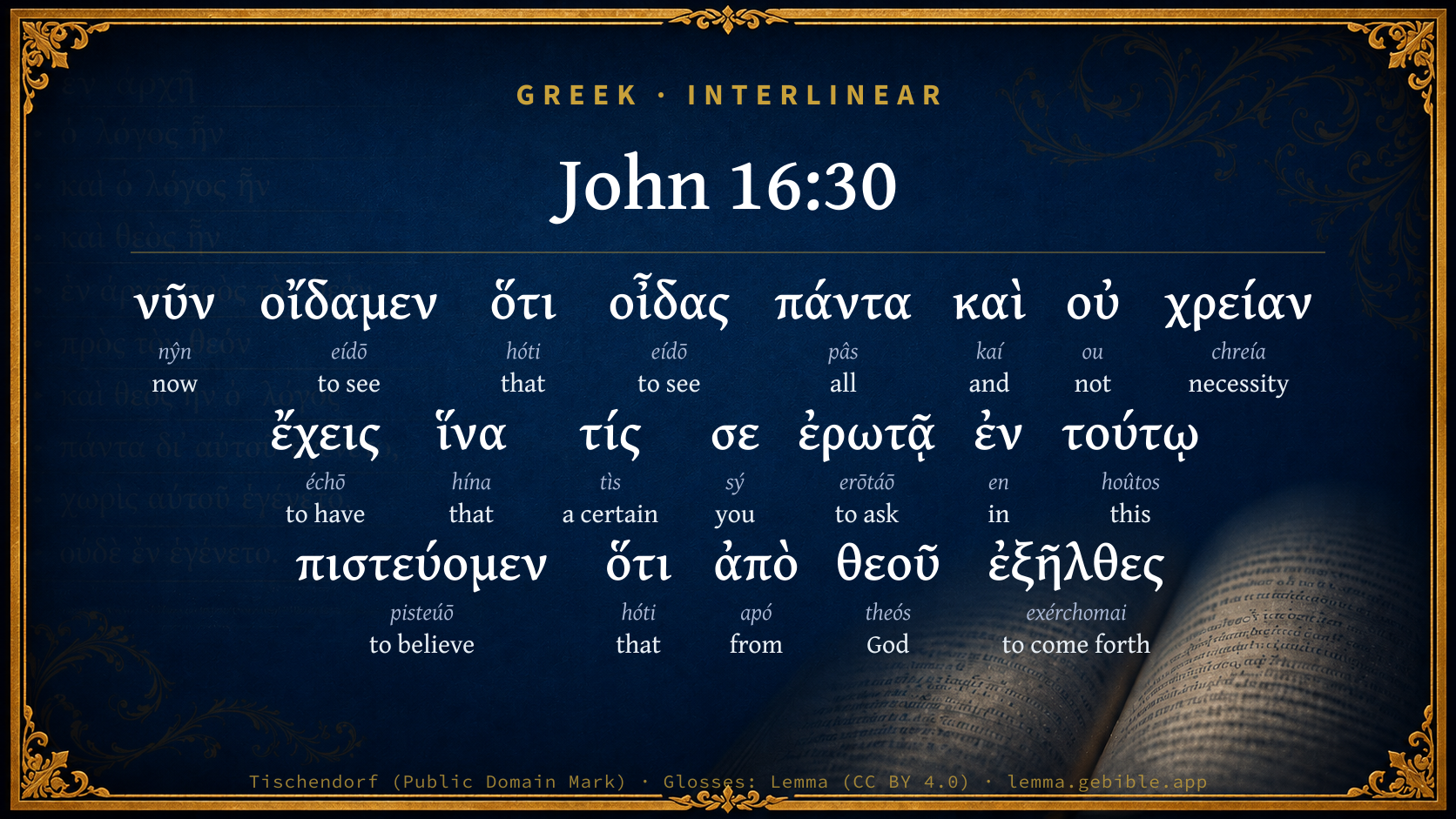
Greek (Tischendorf 8th ed.) John 16:30 appears in the Greek New Testament. The text above is from the Tischendorf 8th edition. Each word links to its Strong’s number and a concise gloss. Click any word for its full Thayer’s Greek Lexicon entry.
Download image
Cite this verse

John 16:30 (World English Bible). Public Domain. Lemma interlinear Bible study tool, https://lemma.gebible.app/v/john/16/30.

Show BibTeX & RIS
BibTeX
RIS
English Translation
Now we know that you know all things, and don't need for anyone to question you. By this we believe that you came forth from God."
World English Bible · Public Domain
Download a study sheet

One document with this verse’s original text, its word-by-word gloss line, the meaning frame, cross-references with their text, attributed commentary, and full source and license credits — printable, and it pastes into notes with its structure intact.

This verse Autodidact and up

Study sheet (.html) Plain text (.txt)

A passage Seminary Student

Up to 50 verses in one chapter. A passage sheet keeps up to 6 commentary sources and 12 cross-references per verse, in the order this page ranks them, and says so on the sheet whenever that leaves anything out. Ask for a single verse and you get the Autodidact verse sheet above.

Everything on this page stays free to read, with no account — the sheet is a download of what is already on screen, not access to it.

Want to remove ads? Support Godless Engineer
Compare translations 3

The same verse in 3 English versions, stacked beneath the original-language interlinear above. Click any original word for its lexicon entry.

Each is an independent rendering of the whole verse — the interlinear is not word-aligned to these translations.

Highlighted words mark where these versions differ — a whole-verse word diff, not a word-by-word alignment.

  • World English Bible Public Domain
    Now we know that you know all things, and don't need for anyone to question you. By this we believe that you came forth from God."
  • King James Version Public Domain
    Now are we sure that thou knowest all things, and needest not that any man should ask thee: by this we believe that thou camest forth from God.
  • unfoldingWord Literal Text CC BY-SA 4.0
    Now we know that you know all things, and you do not have need that anyone would question you. In this we believe that you have come from God.”

unfoldingWord Literal Text — © unfoldingWord, licensed CC BY-SA 4.0. Word-aligned USFM3 via Door43 (git.door43.org/unfoldingWord/en_ult).

Versions to compare (up to 4)

3 of 4 selected

Show all 19 translations

Every available English version of this verse, each an independent rendering of the whole verse.

  • World English Bible Public Domain
    Now we know that you know all things, and don't need for anyone to question you. By this we believe that you came forth from God."
  • Berean Standard Bible Public Domain
    Now we understand that You know all things and that You have no need for anyone to question You. Because of this, we believe that You came from God.”
  • Majority Standard Bible Public Domain
    Now we understand that You know all things and that You have no need for anyone to question You. Because of this, we believe that You came from God.”
  • King James Version Public Domain
    Now are we sure that thou knowest all things, and needest not that any man should ask thee: by this we believe that thou camest forth from God.
  • American Standard Version (1901) Public Domain
    Now know we that thou knowest all things, and needest not that any man should ask thee: by this we believe that thou camest forth from God.
  • Revised Version (1885) Public Domain
    Now know we that thou knowest all things, and needest not that any man should ask thee: by this we believe that thou camest forth from God.
  • Geneva Bible (1599) Public Domain
    Nowe knowe wee that thou knowest all things, and needest not that any man should aske thee. By this we beleeue, that thou art come out from God.
  • Douay-Rheims (1899) Public Domain
    Now we know that thou knowest all things, and thou needest not that any man should ask thee. By this we believe that thou camest forth from God.
  • Young's Literal Translation Public Domain
    now we have known that thou hast known all things, and hast no need that any one do question thee; in this we believe that from God thou didst come forth.'
  • Literal Standard Version CC BY-SA 4.0
    now we have known that You have known all things, and have no need that anyone questions You; in this we believe that You came forth from God.”
  • Unlocked Literal Bible CC BY-SA 4.0
    Now we know that you know all things, and you do not need anyone to ask you questions. Because of this, we believe that you have come from God.”
  • unfoldingWord Literal Text CC BY-SA 4.0
    Now we know that you know all things, and you do not have need that anyone would question you. In this we believe that you have come from God.”
  • Darby Bible Public Domain
    Now we know that thou knowest all things, and hast not need that any one should demand of thee. By this we believe that thou art come from God.
  • World Messianic Bible Public Domain
    Now we know that you know all things, and don’t need for anyone to question you. By this we believe that you came from God.”
  • Webster's Bible Public Domain
    Now are we sure that thou knowest all things, and needest not that any man should ask thee: by this we believe that thou camest from God.
  • Free Bible Version CC BY-SA 4.0
    Now we're certain that you know everything, and that in order to know what questions people are thinking you don't need to ask them. This convinces us that you came from God.”
  • Bible in Basic English Public Domain
    Now we are certain that you have knowledge of all things and have no need for anyone to put questions to you: through this we have faith that you came from God.
  • Text-Critical English NT CC BY 4.0
    Now we know that yoʋ know all things and have no need for anyone to question yoʋ; because of this we believe that yoʋ came from God.”
  • Tyndale New Testament (1534) Public Domain
    Nowe knowe we that thou vnderstondest all thinges and nedest not that eny man shuld axe the eny question. Therfore beleve we that thou camst from god.

Literal Standard Version (2020), Covenant Press — licensed CC BY-SA 4.0. Text via the HelloAO Bible API (eBible.org). Unlocked Literal Bible (unfoldingWord) — licensed CC BY-SA 4.0. Text via the HelloAO Bible API (eBible.org). unfoldingWord Literal Text — © unfoldingWord, licensed CC BY-SA 4.0. Word-aligned USFM3 via Door43 (git.door43.org/unfoldingWord/en_ult). Free Bible Version, Dr. Jonathan Gallagher — licensed CC BY-SA 4.0. Text via the HelloAO Bible API (eBible.org).

Word by word

More ways to search: Search by grammar → Find every occurrence → Compare this word →

Practice this passage: Drill this verse → Learn its vocabulary →

χρείαν
chreía
G5532
“necessity”
Noun, Accusative, Singular, Feminine
Part of Speech
Noun
Case
Accusative
Number
Singular
Gender
Feminine
Full Thayer's Definition

Origin: from the base of G5530 or G5534

TDNT: None

1. necessity, need 2. duty, business
  1. νῦν nŷn G3568 “now” Adverb
  2. οἴδαμεν eídō G1492 “to see” Verb, Perfect, Active, Indicative, 1st person, Plural
  3. ὅτι hóti G3754 “that” Conjunction
  4. οἶδας eídō G1492 “to see” Verb, Perfect, Active, Indicative, 2nd person, Singular
  5. πάντα pâs G3956 “all” Adjective, Accusative, Plural, Neuter
  6. καὶ kaí G2532 “and” Conjunction
  7. οὐ ou G3756 “not” Particle, Negative
  8. ἔχεις échō G2192 “to have” Verb, Present, Active, Indicative, 2nd person, Singular
  9. ἵνα hína G2443 “that” Conjunction
  10. τίς tìs G5100 “a certain” Indefinite pronoun, Nominative, Singular, Masculine
  11. σε sý G4771 “you” Personal pronoun, 2nd person, Accusative, Singular
  12. ἐρωτᾷ erōtáō G2065 “to ask” Verb, Present, Active, Subjunctive, 3rd person, Singular
  13. ἐν en G1722 “in” Preposition
  14. τούτῳ hoûtos G3778 “this” Demonstrative pronoun, Dative, Singular, Neuter
  15. πιστεύομεν pisteúō G4100 “to believe” Verb, Present, Active, Indicative, 1st person, Plural
  16. ὅτι hóti G3754 “that” Conjunction
  17. ἀπὸ apó G575 “from” Preposition
  18. θεοῦ theós G2316 “God” Noun, Genitive, Singular, Masculine
  19. ἐξῆλθες exérchomai G1831 “to come forth” Verb, Aorist, Active, Indicative, 2nd person, Singular

About this verse

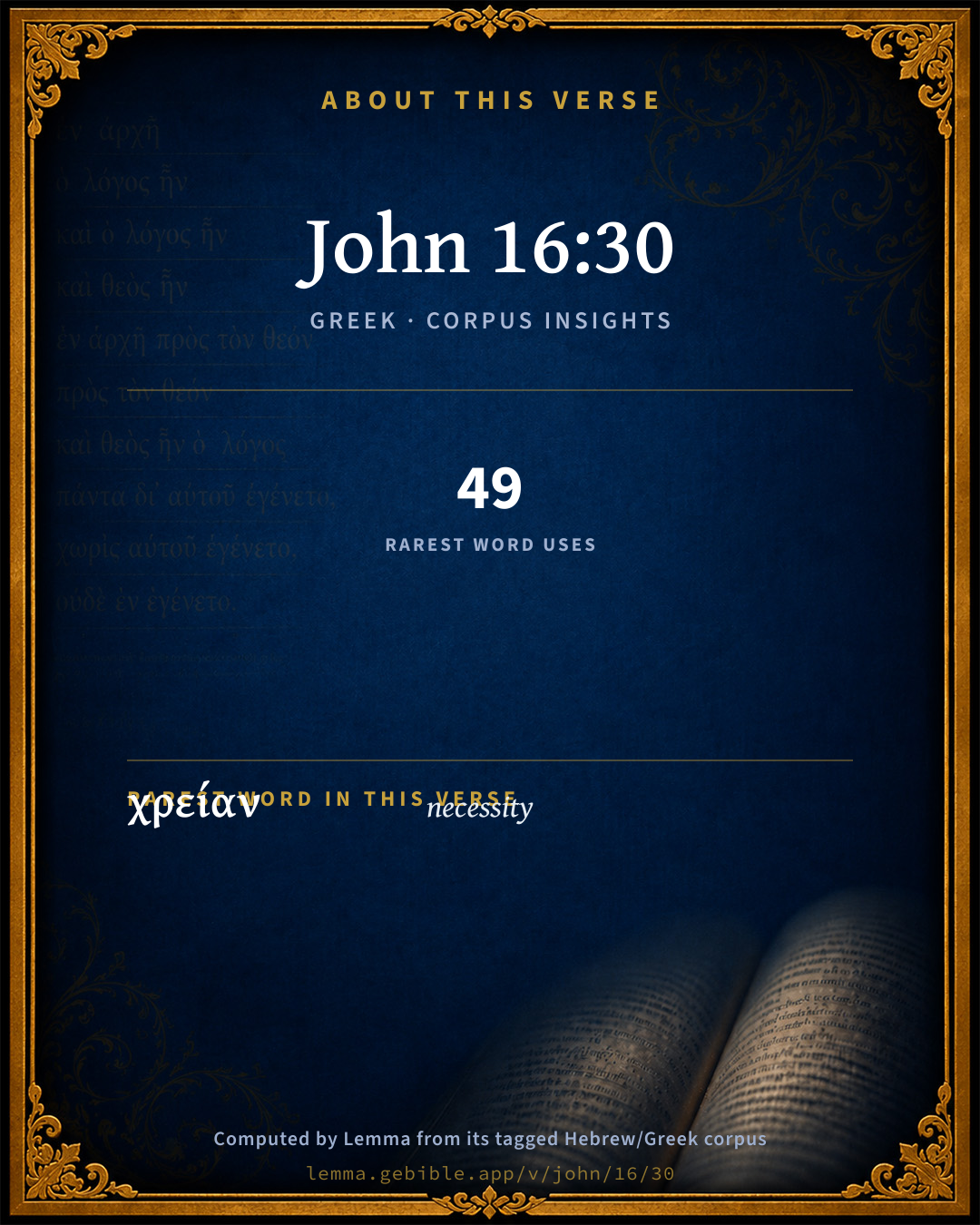
These counts appear in no published source. They are computed here, from the morphology-tagged text and Lemma’s own curated glosses. What Lemma adds →

20
words
18
distinct lemmas
Gospels
section

Shared distinctive vocabulary

χρείαν necessity G5532 occurs in 47 verses of the Greek New Testament. Also found in:
Repetition

Words recur within this verse:

  • οἴδαμεν to see G1492 ×2
  • ὅτι that G3754 ×2

Cross-references

6

Topical passages linked to John 16:30 in the Treasury of Scripture Knowledge — connected by theme and wording, ordered by reader-vote popularity; previews shown in the World English Bible.

  • John 21:17 He said to him the third time, "Simon, son of Jonah, do you have affection for me?" Peter was grieved because he asked him the third time, "Do you have affection for me?" He said to him, "Lord, you know everything. You know that I have affection for you." Jesus said to him, "Feed my sheep.
  • John 16:17 Some of his disciples therefore said to one another, "What is this that he says to us, 'A little while, and you won't see me, and again a little while, and you will see me;' and, 'Because I go to the Father?'"
  • John 17:8 for the words which you have given me I have given to them, and they received them, and knew for sure that I came forth from you, and they have believed that you sent me.
  • Hebrews 4:13 There is no creature that is hidden from his sight, but all things are naked and laid open before the eyes of him with whom we have to do.
  • John 5:20 For the Father has affection for the Son, and shows him all things that he himself does. He will show him greater works than these, that you may marvel.
  • John 16:27–28 for the Father himself loves you, because you have loved me, and have believed that I came forth from God.

Cross-references courtesy of OpenBible.info (CC BY 4.0).

Commentary

Notes on John 16:30 from classic Christian and Jewish commentators (each source and its license shown beneath its notes). The classic Christian expositions comment on the surrounding passage and are grouped to its opening verse, so a note may address several verses; the Jewish commentaries on the Tanakh (Rashi and others) are per-verse, so they appear only where the commentator wrote on this verse.

Lemma curates 59 commentaries, every one of them public domain or Creative Commons licensed, each selected and text-cleaned for this edition rather than reprinted as found. About our sources →

Bengel's Gnomon

Johann Albrecht Bengel

Joh 16:30. Πάντα, all things) even the state of men’s hearts. Even though thou art asked no question by any man, yet thy words are adapted to all.—καὶ οὐ, and thou needest not) There is one Teacher alone, who, without being asked, satisfies the wants of His disciples. Many in our days learn but little, because they are not wont to ask any questions of their teachers, who certainly are not omniscient [so as to know their wants without being told them].—πιστεύομεν, ὅτι ἀπὸ Θεοῦ ἐξῆλθες, we believe that Thou earnest forth from God) i.e. we “believe in God, and believe also in Thee.” And so Jesus has convinced them. Comp. ch. Joh 14:1, Believe (Imperative, not Indic. as Engl. Vers. See Beng., note).

Bengel's Gnomon of the New Testament — English translation (T&T Clark, Edinburgh, 1860) — public domain. Text from a community e-Sword module.

Expositor's Greek Testament

ed. W. Robertson Nicoll

Joh 16:30 . νῦν οἴδαμεν … ἐρωτᾷ . The reference is to Joh 16:19 , where they manifested dissatisfaction with the obscurity of His utterances. Here in Joh 16:30 two things are stated, that Jesus has perfect knowledge, οἶδὰς πάντα , and that He knows how to communicate it, οὐ χρείαν ἔχεις ἵνα τίς σε ἐρωτᾷ . Convinced that He possessed these qualifications, they felt constrained to accept Him as a teacher come from God, ἐν τούτῳ (“herein,” or “by this,” ἐκ τούτου in modern Greek version) πιστεύομεν ὅτι ἀπὸ Θεοῦ ἐξῆλθες , cf. Joh 3:2 .

The Expositor's Greek Testament, edited by W. Robertson Nicoll (1897–1910) — public domain. Text from a community e-Sword module.

Adam Clarke's Commentary

Verse 30. Now are we sure that thou knowest all things] Is not the following the meaning of the disciples? We believe that thou art not only the Messiah who camest out from God, but that thou art that God who searchest the heart and triest the reins, and needest not to be asked in order to make thee acquainted with the necessities of thy creatures; for thou perfectly knowest their wants, and art infinitely disposed to relieve them.

Adam Clarke's Commentary on the Bible (1810–1826) — public domain. Text from a community e-Sword/MySword module.

Ellicott's Commentary for English Readers

(30) Now are we sure that thou knowest all things.—Comp. Joh_16:19; Joh_16:23. The “now” is emphatic, as in the previous verse. They see in His present knowledge of their thoughts, and in the light which has come to them from the statements of Joh_16:28, the fulfilment of the promise which He has made for the future (Joh_16:23). They think that the day has already come when they shall ask Him nothing, for He knows all things, and communicates to them the fulness of truth.

By this we believe that thou camest forth from God.—They had believed this before (Joh_16:27), but here, as frequently, St. John remembers the development of their faith. (Comp. Note on Joh_2:11.) They find, in His knowledge of their thoughts (Joh_16:19), and in the full solution which He gives to their difficulties, ground for a new faith; and upon this new proof of His divinity they have a new faith in Him. (Comp. the instance of Nathanael’s faith at the end of John 1)

A Bible Commentary for English Readers, edited by Charles John Ellicott (1878–1897) — public domain. Text from a community e-Sword module.

The Cambridge Bible for Schools and Colleges

gen. ed. J. J. S. Perowne

30. are we sure] Better, we know; it is the same verb as ‘thou knowest,’ and the capricious change of rendering is regrettable. There is a similarly capricious change 2Co_12:2-3. Christ had spoken in the future tense (Joh_16:23); they emphatically speak in the present; ‘now we know.’ They feel that His gracious promise is already being fulfilled.

thou knowest all things] He had shewn them that He had read their hearts (Joh_16:19); like the Samaritan woman (Joh_4:29; Joh_4:39) they conclude that He knows all.

by this] Or, Herein (see on Joh_4:37); literally ‘in this.’ His all-embracing knowledge is that in which their faith has root.

we believe that] The Greek might mean, ‘we believe, because, &c.’ But the A. V. is more in accordance with the context and with S. John’s usage.

forth from God] They refer to Christ’s mission only (Joh_16:27), not to the Eternal Generation of the Son (Joh_16:28).

The Cambridge Bible for Schools and Colleges (gen. ed. J. J. S. Perowne; Cambridge University Press, 1878–1918) — public domain. Text from a community e-Sword module.

John Gill's Exposition

These things I have spoken unto you,.... As this is the conclusion of our Lord's sermons to his disciples, these words may well enough be thought to have regard to all that he had said in general; as concerning his departure from them; his going to prepare a place for them; his union to them, and their communion with him; and the various persecutions and afflictions they should endure for his sake; and the many blessings both of grace and glory they should enjoy; and particularly what he had said in the context, concerning their forsaking him, which supposed tribulation, and would be a prelude of what they were afterwards to have in the world; and concerning the presence of his Father with him, and which they might also expect to have:

that in me ye might have peace; not in the world, in which they were to have tribulation: there is no true, solid peace, to be enjoyed in the world, and the things of it; the world can neither give it, nor take it away; nor have the men of it any knowledge and understanding of it; and much less enjoy it: nor in themselves; spiritual peace does not arise from any duties, services, and performances of men; no, not from an attendance on the Gospel, and the ordinances of it; nor even from the graces of the Spirit; for though peace may be enjoyed herein, and hereby, and through these, as means; yet does not come from them, but from Christ, in whose strength alone all duties are performed aright; who is the sum and substance of the Gospel, and the ordinances of it, and the object of all grace: it is in him, and in him only, in his person, blood, righteousness, and sacrifice, which speak peace, pardon, and atonement, that a soul finds any true, solid peace, rest, comfort, and joy; and here he may, and does find it, in opposition to the cry of sin, law, and justice, for wrath, ruin, hell, and damnation. There is a peace by Christ, which he has made for his people by the blood of his cross; and there is a peace in him, which is enjoyed through faith's looking to his blood for pardon, to his righteousness for justification, to his sacrifice for atonement and satisfaction; and by having communion with him, and discoveries of his love, and by seeing safety and security in him.

In the world ye shall have tribulation; this is certain from this declaration of Christ, who is the omniscient God, and truth itself; from the instance and example of Christ, who was all his life a man of sorrows; from the conformity of the members to the head; from the divine appointment that has so determined it; from the natural enmity of the world to the saints; from the experience of the people of God in all ages; from the usefulness of tribulation to try the graces, and bring about the temporal, spiritual, and eternal good of believers: and though they have tribulation in the world, yet not by way of punishment for sin, but as fatherly corrections and chastenings for their good, that they may not be condemned with the world; and it is only in this present world they have it; as soon as they have done with the world, they will have done with tribulation:

but be of good cheer, I have overcome the world; it is very observable how the phrase, "in the world ye shall have tribulation", stands, and is encompassed, before, with these words, "that in me ye might have peace", and behind, with these, "be of good cheer", &c. Believers, of all men, notwithstanding their tribulations, have reason to be of good cheer, since their sins are forgiven, the love of God is shed abroad in their hearts, their redemption draws nigh, and they have hopes of glory; and particularly, because as Christ here says, for their encouragement under all their tribulations in the world, "I have overcome the world": Satan, the god and prince of the world, with all his principalities and powers, which Christ has led captive, ransomed his people from, and delivers them from the power of; and all that is in the world, the lusts and sins of it, their damning power by the sacrifice of himself, and their governing power by his Spirit and grace; and the men of the world with all their rage and fury, whom he has trodden down in his anger, restrains by his power, and causes the remainder of their wrath to praise him; in all which conquests he makes his people share, and even makes them more than conquerors, through himself: so that they have nothing to fear from the world; nor any reason to be cast down by the tribulation they meet with in it.

Next: John Chapter 17

John Gill's Exposition of the Whole Bible (1746–1763) — public domain (CC PDM 1.0). Text via the HelloAO Bible API.

Trapp's Complete Commentary

John Trapp

30 Now are we sure that thou knowest all things, and needest not that any man should ask thee: by this we believe that thou camest forth from God.

Ver. 30. Now we are sure, &c.] What! not till now? Nicodemus was before you then, Joh 3:2. But better late than never: Nunquam sero, si serto.

John Trapp, A Commentary or Exposition upon All the Books of the Old and New Testament (1647–1656) — public domain. Text from a community e-Sword module.

Albert Barnes' Notes on the Bible

Now are we sure that thou knowest ... - Their difficulty had been to understand what was the meaning of his declaration in Joh 16:16. About this they conversed among themselves, Joh 16:17-19. It is evident that they had not mentioned their difficulty to him, and that he had not even heard their conversation among themselves, Joh 16:19. When, therefore, by his answers to them Joh 16:20-28, he showed that he clearly understood their doubts; and when he gave them an answer so satisfactory without their having inquired of him, it satisfied them that he knew the heart, and that he assuredly came from God. They were convinced that there was” no need that any man should ask him,” or propose his difficulties to him, since he knew them all and could answer them.

Albert Barnes' Notes on the Bible (1834–1885) — public domain. Text from a community e-Sword/MySword module.

Matthew Poole's English Annotations

This confirmeth us in that faith, or persuasion, which we before had, though it was in us but weak, that indeed thou art come forth from God.

Matthew Poole's English Annotations on the Holy Bible (1683–1685) — public domain. Text from a community e-Sword/MySword module.

Whedon's Commentary on the Bible

Daniel D. Whedon

30. Now are we sure—The emphatic now they earnestly repeat. So delicately and effectively had the great Master suited his words to their hearts as to convince them anew that he knew their hearts.

Ask thee—So well does he know their questionings of heart that he is able to answer without hearing them.

Thou camest forth from God—And so it is that the Gospel adjusts itself to the sins, the penitence, the moral wants of our nature, so as to test its own divine origin.

Daniel D. Whedon (gen. ed.), Commentary on the Old and New Testaments (1874–1909) — public domain. Text from a community e-Sword module.

The Pulpit Commentary

Now know we that thou knowest all things. He had answered their unutterable yearning. That which stirred them very deeply on many occasions was this proof that nothing in their hearts was hidden from him. Nathanael was one of them, and now he saw "angels of God ascending and descending on the Son of man." "Thou knowest all things." The idea in their minds does not embrace the full range of human inquiry, nor the depths of Deity, but all the things which are in their hearts to ask him. Their word is true even if in their intention they fall short of ascribing omniscience to their Lord. And thou hast no need that any one should put to thee these inquiries. Thou hast sounded the depths of our hearts, and found out the unutterable and unuttered within us. When we were afraid to ask thee concerning "the little while," thou didst discern our unspoken yearning, and now thou art so establishing thy Divine claim upon our reverence and affection, that we can trust thee to give us all needful illumination when we most require it. In this fact, in this consideration just stated, we find our justification and the cause of our faith. We believe that thou earnest forth from (apo) God (apo differs from the solemnity of the para or the ek of Ver. 28. Though Lange makes the oti equivalent to "because," yet generally John gives to the oti which follows a verb after en toutw the sense of "that," thus introducing the object of the verb, though in one place, 1Jn_4:13, both constructions are seen in the same sentence. The objective force of "that" is to be preferred here). We believe that thy whole ministry and message is a revelation of God, a coming near to us of the Father. Thy name is "Immanuel, God with us." A question arises whether the disciples in this gush of faith said more than they really meant, and deserved reproof, or whether they had reached an elevation of thought from which they never would absolutely recede.

The Pulpit Commentary (1880–1919), ed. H.D.M. Spence-Jones & Joseph S. Exell — public domain. Text from a community e-Sword module.

John Wesley's Explanatory Notes

Thou knowest all things - Even our hearts. Although no question is asked thee, yet thou answerest the thoughts of every one. By this we believe that thou camest forth from God - They, as it were, echo back the words which he had spoken in ver. 27, implying, We believe in God; we believe also in thee.

John Wesley, Explanatory Notes Upon the Whole Bible (1754–1765) — public domain. Text via the GEBible commentary corpus.

Cambridge Greek Testament for Schools and Colleges

30. οἴδαμεν ὄτι οἶδας. We know that Thou knowest (comp. 2Co 12:2-3, where the A.V. is similarly capricious). Christ had spoken in the future tense (Joh 16:25): they speak in the present. They feel that His gracious promise is already coming true. He had shewn them that He had read their hearts (Joh 16:19); like Nathanael (Joh 1:50) and the Samaritan woman (Joh 4:29; Joh 4:39), and S. Thomas (Joh 20:28), they conclude that He knows all.

ἐν τούτῳ. Herein: see on Joh 4:37. His all-embracing knowledge is that in which their faith has root. The ὅτι is probably ‘that,’ not ‘because,’ as the context and S. John’s usage shew: Joh 13:35; 1Jn 2:3; 1Jn 2:5; 1Jn 3:19; 1Jn 3:24; 1Jn 5:2. The disciples’ ἀπὸ Θεοῦ implies a less intimate union between the Father and Jesus than either παρὰ τ. π. (Joh 16:27) or ἐκ. τ. π. (Joh 16:28). Their views of Christ are still very imperfect.

Cambridge Greek Testament for Schools and Colleges (Cambridge University Press, 1896; 21 vols, various authors incl. Carr, Maclear, Plummer, Farrar, Lumby, Moule, M. R. James, Simcox) — public domain. Text from a community e-Sword module.

Alford’s Greek Testament

Henry Alford

30.] ‘Thou hast spoken so clearly of our feeling towards Thee, and of Thyself, that we have no occasion to ask Thee any thing;—and this was what Thou didst announce would be;—we know therefore, by its being so, that Thou knowest the secrets of our hearts (πάντα by inference),—and hence believe that Thou camest forth from God:’ the whole being a misunderstanding of what had gone before, vv. 23, 25.

Henry Alford, The Greek Testament (1849–1861) — public domain. Text from a community e-Sword module.

International Critical Commentary

30. νῦν οἴδαμεν κτλ. They were so surprised that He had discerned their thoughts, and so bewildered at His words (see v. 19), that they assure Him of their absolute confidence in Him as all-knowing. With οἶδας πάντα cf. 21:17. Jn. comes back again and again to the penetrating insight of Jesus into men’s thoughts; see on 2:25.

ἵνα τίς σε ἐρωτᾷ, “that any one shall question thee,” ἐρωτᾶν being here used in its most frequent sense of asking questions; see on v. 23 above.

ἐν τούτῳ, “by this,” ἐν being used in a quasi-causal sense, as at 13:35, where see note.

πιστεύομεν ὅτι ἀπὸ θεοῦ ἐξῆλθες. Nicodemus had confessed as much (3:2); what Jesus had said of their faith was that they had come to believe ὅτι ἐγὼ παρὰ τοῦ πατρὸς ἐξῆλθον. But they were not yet strong in this faith, as He reminds them in His reply. See note on 13:3 and also on v. 28 above. Strictly, ἀπό ought to signify mission, while παρά or (especially) ἐκ ought to signify origin; but these prepositions are not sharply distinguished in Jn.

International Critical Commentary — older volumes (1896–1929), various authors — public domain. Text from a community e-Sword module.

Vincent's Word Studies in the New Testament

Marvin R. Vincent

We are sure [οιδαμεν] . Better, as Rev., we know.

By this [εν τουτω] . Literally, in this. Compare 1Jo 2:3, 5; 1Jo 3:16, 19, 24; 1Jo 4:9, 10, 1 3, 17; 1Jo 5:2.

Marvin R. Vincent, Word Studies in the New Testament (1887–1900) — public domain. Text from a community e-Sword/MySword module.

Lesson kit

Teaching starters — assembled from the data on this page, not authored interpretation. Every prompt links to the verse data it draws on. Edit before teaching.

John, in the Gospels, opens this verse with 20 words (18 distinct Greek lemmas). Its most distinctive word is chreía (“necessity”). A historical commentator’s framing appears above. Read the whole chapter for the surrounding context.

Discussion questions

  1. How does “necessity” (chreía) shape what this verse is saying?
  2. How does Matthew 3:14, which shares the word «necessity», read alongside this verse?
  3. What does the repetition of “to see” (2× in this one verse) do in this verse?
  4. These translations render this verse differently. What is at stake in choosing one wording over another?
  5. Compare how Bengel's Gnomon and Expositor's Greek Testament read this verse. Where do they agree or differ?

Things to notice

Reading settings

Reading text

Shown beneath each verse's original-language words.

Old Testament
Old Testament edition

Read the OT as the Masoretic Hebrew (MT) or the Greek Septuagint (LXX).

English shown for the Greek Septuagint (in the Hebrew ↔ Greek comparison).

Comparing translations? Open the Compare panel on any verse page to stack up to four side by side.