John 7:25

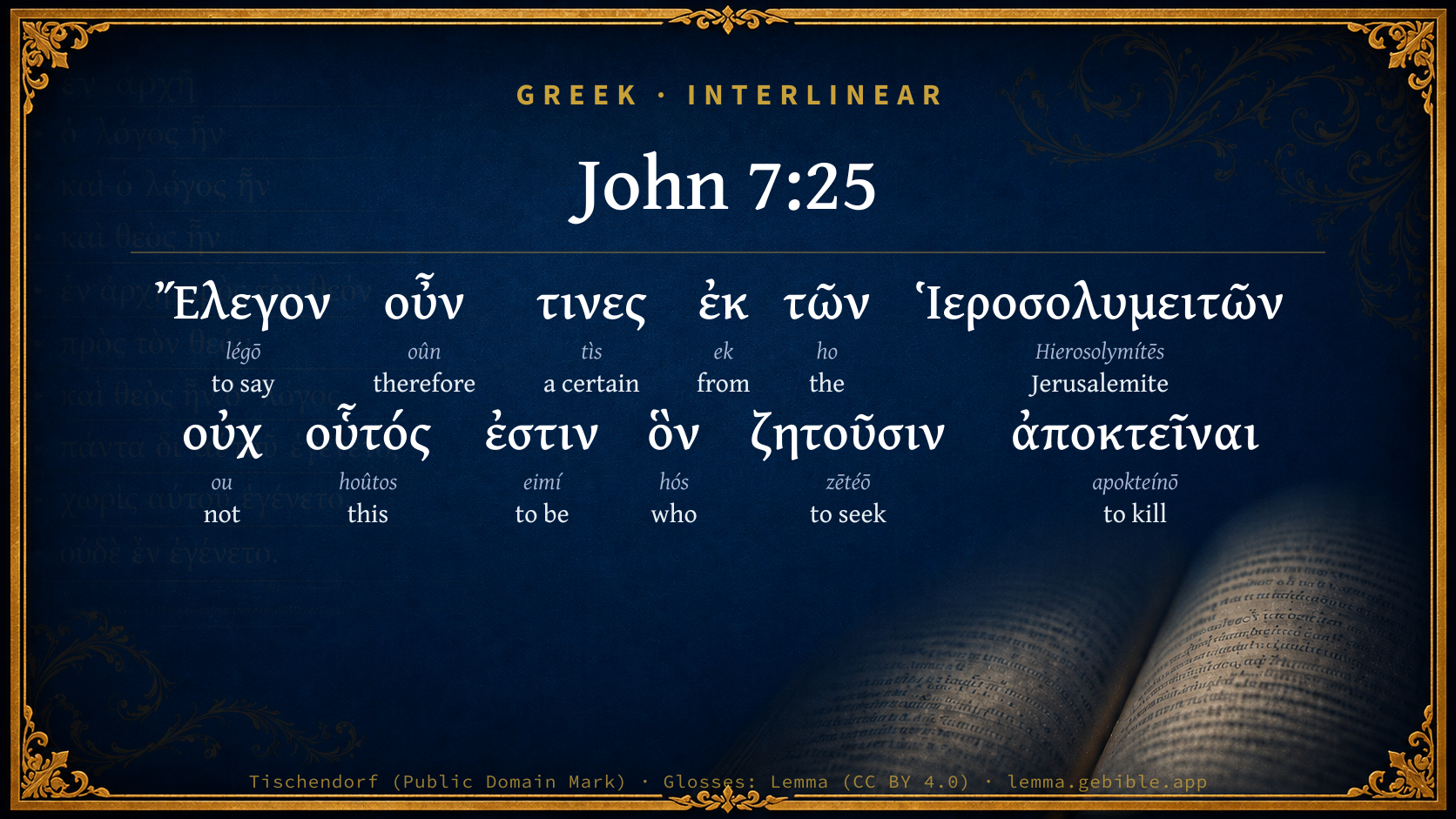
Greek (Tischendorf 8th ed.) John 7:25 appears in the Greek New Testament. The text above is from the Tischendorf 8th edition. Each word links to its Strong’s number and a concise gloss. Click any word for its full Thayer’s Greek Lexicon entry.
Download image
Cite this verse

John 7:25 (World English Bible). Public Domain. Lemma interlinear Bible study tool, https://lemma.gebible.app/v/john/7/25.

Show BibTeX & RIS
BibTeX
RIS
English Translation
Therefore some of them of Jerusalem said, "Isn't this he whom they seek to kill?
World English Bible · Public Domain
Download a study sheet

One document with this verse’s original text, its word-by-word gloss line, the meaning frame, cross-references with their text, attributed commentary, and full source and license credits — printable, and it pastes into notes with its structure intact.

This verse Autodidact and up

Study sheet (.html) Plain text (.txt)

A passage Seminary Student

Up to 50 verses in one chapter. A passage sheet keeps up to 6 commentary sources and 12 cross-references per verse, in the order this page ranks them, and says so on the sheet whenever that leaves anything out. Ask for a single verse and you get the Autodidact verse sheet above.

Everything on this page stays free to read, with no account — the sheet is a download of what is already on screen, not access to it.

Want to remove ads? Support Godless Engineer
Compare translations 3

The same verse in 3 English versions, stacked beneath the original-language interlinear above. Click any original word for its lexicon entry.

Each is an independent rendering of the whole verse — the interlinear is not word-aligned to these translations.

Highlighted words mark where these versions differ — a whole-verse word diff, not a word-by-word alignment.

  • World English Bible Public Domain
    Therefore some of them of Jerusalem said, "Isn't this he whom they seek to kill?
  • King James Version Public Domain
    Then said some of them of Jerusalem, Is not this he, whom they seek to kill?
  • unfoldingWord Literal Text CC BY-SA 4.0
    Then some from the Jerusalemites said, “Is not this the one they seek to kill?

unfoldingWord Literal Text — © unfoldingWord, licensed CC BY-SA 4.0. Word-aligned USFM3 via Door43 (git.door43.org/unfoldingWord/en_ult).

Versions to compare (up to 4)

3 of 4 selected

Show all 19 translations

Every available English version of this verse, each an independent rendering of the whole verse.

  • World English Bible Public Domain
    Therefore some of them of Jerusalem said, "Isn't this he whom they seek to kill?
  • Berean Standard Bible Public Domain
    Then some of the people of Jerusalem began to say, “Isn’t this the man they are trying to kill?
  • Majority Standard Bible Public Domain
    Then some of the people of Jerusalem began to say, “Isn’t this the man they are trying to kill?
  • King James Version Public Domain
    Then said some of them of Jerusalem, Is not this he, whom they seek to kill?
  • American Standard Version (1901) Public Domain
    Some therefore of them of Jerusalem said, Is not this he whom they seek to kill?
  • Revised Version (1885) Public Domain
    Some therefore of them of Jerusalem said, Is not this he whom they seek to kill?
  • Geneva Bible (1599) Public Domain
    Then saide some of them of Hierusalem, Is not this he, whom they goe about to kill?
  • Douay-Rheims (1899) Public Domain
    Some therefore of Jerusalem said: Is not this he whom they seek to kill?
  • Young's Literal Translation Public Domain
    Certain, therefore, of the Jerusalemites said, `Is not this he whom they are seeking to kill?
  • Literal Standard Version CC BY-SA 4.0
    Certain, therefore, of the Jerusalemites said, “Is this not He whom they are seeking to kill?
  • Unlocked Literal Bible CC BY-SA 4.0
    Some of them from Jerusalem said, “Is not this the one they seek to kill?
  • unfoldingWord Literal Text CC BY-SA 4.0
    Then some from the Jerusalemites said, “Is not this the one they seek to kill?
  • Darby Bible Public Domain
    Some therefore of those of Jerusalem said, Is not this he whom they seek to kill?
  • World Messianic Bible Public Domain
    Therefore some of them of Jerusalem said, “Isn’t this he whom they seek to kill?
  • Webster's Bible Public Domain
    Then said some of them of Jerusalem, Is not this he whom they seek to kill?
  • Free Bible Version CC BY-SA 4.0
    Then some of those from Jerusalem began wondering, “Isn't this the one they're trying to kill?
  • Bible in Basic English Public Domain
    Then some of the people of Jerusalem said, Is not this the man whose death is desired?
  • Text-Critical English NT CC BY 4.0
    Now some of the people of Jerusalem were saying, “Is this not the man whom they are seeking to kill?
  • Tyndale New Testament (1534) Public Domain
    Then sayd some of them of Ierusalem: Is not this he who they goo aboute to kyll?

Literal Standard Version (2020), Covenant Press — licensed CC BY-SA 4.0. Text via the HelloAO Bible API (eBible.org). Unlocked Literal Bible (unfoldingWord) — licensed CC BY-SA 4.0. Text via the HelloAO Bible API (eBible.org). unfoldingWord Literal Text — © unfoldingWord, licensed CC BY-SA 4.0. Word-aligned USFM3 via Door43 (git.door43.org/unfoldingWord/en_ult). Free Bible Version, Dr. Jonathan Gallagher — licensed CC BY-SA 4.0. Text via the HelloAO Bible API (eBible.org).

Word by word

More ways to search: Search by grammar → Find every occurrence → Compare this word →

Practice this passage: Drill this verse → Learn its vocabulary →

About this verse

These counts appear in no published source. They are computed here, from the morphology-tagged text and Lemma’s own curated glosses. What Lemma adds →

12
words
12
distinct lemmas
Gospels
section

Notable vocabulary

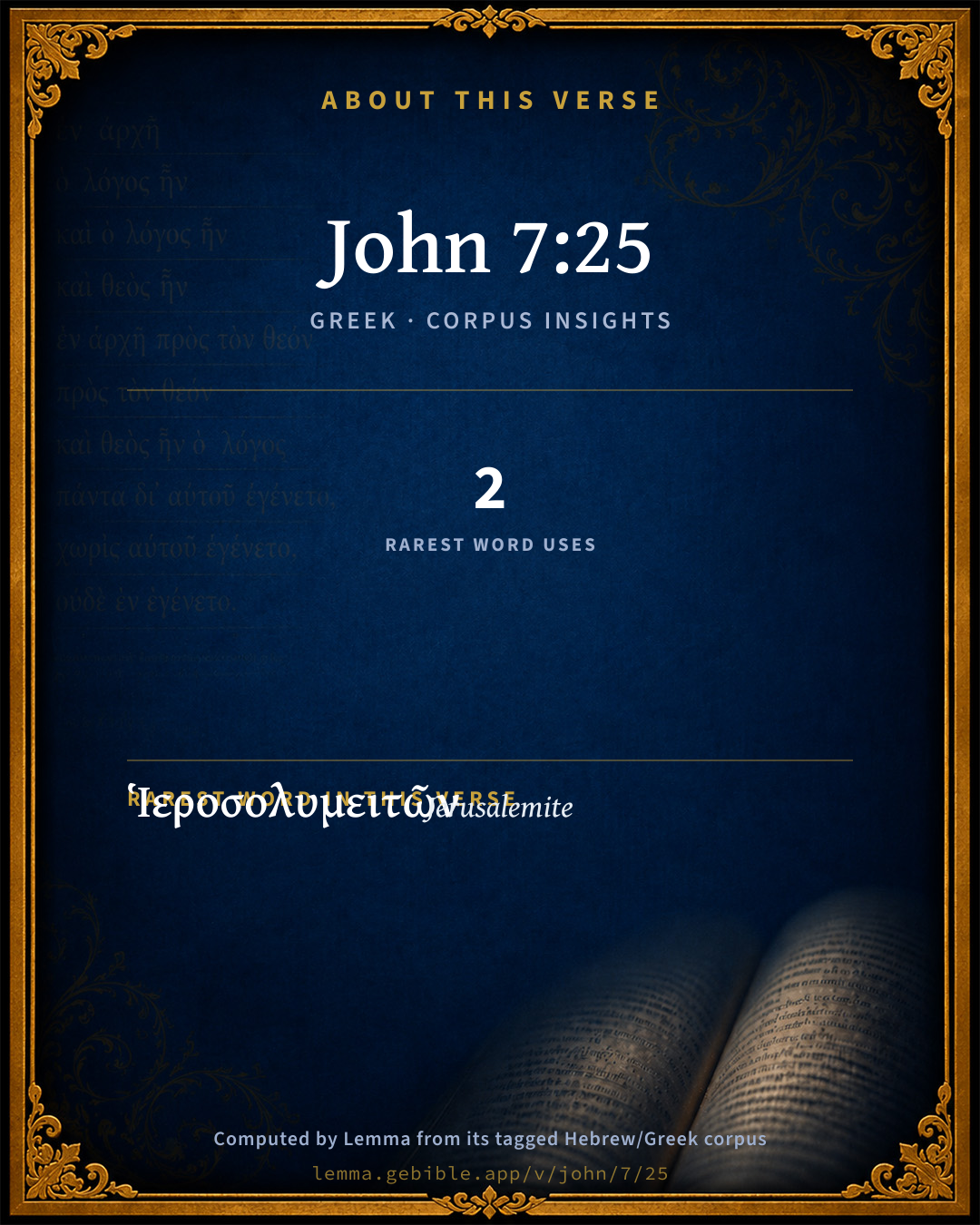
The rarest word here is Ἱεροσολυμειτῶν Jerusalemite G2415 — appearing just 2 times in the whole Greek New Testament.

Shared distinctive vocabulary

Ἱεροσολυμειτῶν Jerusalemite G2415 occurs in 2 verses of the Greek New Testament. Also found in:

Cross-references

1

Topical passages linked to John 7:25 in the Treasury of Scripture Knowledge — connected by theme and wording, ordered by reader-vote popularity; previews shown in the World English Bible.

  • John 7:10–11 But when his brothers had gone up to the feast, then he also went up, not publicly, but as it were in secret.

Cross-references courtesy of OpenBible.info (CC BY 4.0).

Commentary

Notes on John 7:25 from classic Christian and Jewish commentators (each source and its license shown beneath its notes). The classic Christian expositions comment on the surrounding passage and are grouped to its opening verse, so a note may address several verses; the Jewish commentaries on the Tanakh (Rashi and others) are per-verse, so they appear only where the commentator wrote on this verse.

Lemma curates 59 commentaries, every one of them public domain or Creative Commons licensed, each selected and text-cleaned for this edition rather than reprinted as found. About our sources →

Joseph Benson's Commentary

Joh 7:25-27. Then — While our Lord was thus discoursing in the temple; some of them of Jerusalem — Some of the inhabitants of the city, who knew more of the designs of the sanhedrim than the others who had spoken before; said, Is not this he whom they seek to kill? — Seek an opportunity to put to death? But lo — He is not only come up hither to the feast, but speaks openly and freely in the very temple itself, and they are so far from seizing him, that they do not so much as say any thing to prohibit him. Do the rulers know indeed — Are they now fully convinced; that this is the very Christ — And that therefore they were mistaken in their former censures? Howbeit, we know this man, whence he is — And therefore have sufficient reason to conclude, that he cannot be the Messiah: for, when Christ cometh, no man knoweth whence he is — This Jewish tradition was true in regard to his pre-existing and divine nature: in that respect, according to the obvious popular sense of Isa 53:8, None could declare his generation: but it was not true with regard to his human nature, for both his family, and the place of his birth, were plainly foretold. And “it is evident from Mat 2:4-5, that the Jews apprehended the Messiah was to be born at Bethlehem; and from a multitude of other places, that they knew he was to be a descendant of David.” Archbishop Tillotson supposes, that the words, no man knoweth whence he is, “refer to an expectation the Jews had, that he would be born of a virgin. As for the notion which Justin Martyr mentions, that the Messiah should, for a while, be hid, it seems more modern, and they must put a strange interpretation on Isa 53:8; Mic 5:2; and Psa 110:4, to draw any such consequence from these passages, as Dr. Whitby and M. L’Enfant suppose they did.” — Doddridge.

Joseph Benson's Commentary on the Old and New Testaments (1811–1818) — public domain. Text from a community e-Sword module.

Whedon's Commentary on the Bible

Daniel D. Whedon

Reasonings of the Jerusalemites and Jesus’s reply, Joh_7:25-29.

The Lord’s reference in Joh_7:23, to his miracle at Bethesda, (Joh_7:2-9,) months before, awakens the recollections of a number of permanent inhabitants of the capital of his person, miracle, and the conspiracy of the Jews against him.

25. Seek to kill—Thus refuting the interruption of the others in Joh_7:20.

Daniel D. Whedon (gen. ed.), Commentary on the Old and New Testaments (1874–1909) — public domain. Text from a community e-Sword module.

Bengel's Gnomon

Johann Albrecht Bengel

Joh 7:25. Ἱεροσολυμιτῶν, of the people of Jerusalem) who knew what was going on in the city.

Bengel's Gnomon of the New Testament — English translation (T&T Clark, Edinburgh, 1860) — public domain. Text from a community e-Sword module.

Meyer's Critical & Exegetical Commentary

Heinrich August Wilhelm Meyer

Joh_7:25-27. Οὖν] in consequence of this bold vindication. These Ἱεροσολυμῖται, as distinct from the uninitiated ὄχλος of Joh_7:20, as inhabitants of the Holy City, have better knowledge of the mind of the hierarchical opposition; they wonder that the Sanhedrim should let Him speak so boldly and freely, and they ask, After all, do they not know in very deed that this etc.? This, however, is only a momentary thought which strikes them, and they at once answer it themselves.

πόθεν ἐστιν] does not denote the birth-place, which was known both in the case of Jesus (Joh_7:41) and of the Messiah (Joh_7:42), but the descent; not, indeed, the more remote, which in the case of the Messiah was undoubted as being Davidic, but (comp. Joh_6:42) the nearerfather, mother, family (Mat_13:55). Comp. Joh_19:9; Homer, Od. p. 373: αὐτὸν δʼ οὐ σάφα οἶδα, πόθεν γένος εὔχεται εἶναι; Soph. Trach. 1006; Eur. Rhes. 702; Heliod. iv. 16, vii. 14.

ὁ δὲ Χρι.] is in antithesis with τοῦτον, and it therefore takes the lead. The popular belief that the immediate ancestry of the Messiah would be unknown when He came, cannot further be historically proved, but is credible, partly from the belief in His divine origin (Bertholdt, Christol. p. 86), and partly from the obscurity into which the Davidic family had sunk, and was supported, probably, by the import of many O. T. passages, such as Isa_53:2; Isa_53:8, Mic_5:2, and perhaps also by the sudden appearance of the Son of man related in Daniel 7 (Tholuck), and is strongly confirmed by the description in the book of Enoch of the heavenly Messiah appearing from heaven (Ewald). The passages which Lücke and De Wette quote from Justin (c. Tryph. pp. 226, 268, 336, ed. Col.) are inapplicable, as they do not speak of an unknown descent of the Messiah, but intimate that, previous to His anointing by Elias, His Messiahship was unknown to Himself and others. The beginning of Marcions Gospel (see Thilo, p. 403), and the Rabbinical passages in Lightfoot and Wetstein, are equally inapplicable.

Meyer — Critical and Exegetical Commentary on the New Testament — English translation by Peter Christie, edited by Frederick Crombie (T&T Clark, 1880) — public domain. Text from a community e-Sword module.

Expositor's Greek Testament

ed. W. Robertson Nicoll

Joh 7:25-31 . Opinion of inhabitants of Jerusalem regarding Jesus . Knowing the hostility of the authorities, they express surprise that Jesus should be allowed to teach openly; and wonder whether the authorities themselves can have changed their opinion about Him. This they find it difficult to believe, because on the point of origin Jesus does not satisfy Messianic requirements.

Joh 7:25 . Ἔλεγον οὖν , in consequence of the bold denunciation which they had heard from the lips of Jesus. τινὲς ἐκ τῶν Ἱεροσολυμιτῶν [or Ἱεροσολυμειτῶν , or Ἰεροσολυμειτῶν ], distinct from the ὄχλος of Joh 7:20 , which was unaware of any intention to kill Him; but themselves not so familiar as the Galileans with the appearance of Jesus, and therefore they asked: Οὐχ οὗτος … λέγουσι . Or the words may only be a strong way of expressing their astonishment at the inactivity of the authorities. μήποτε ἀληθῶς … ὁ Χριστός ; “Can it be that the rulers indeed know that this man is the Christ?” But this idea, again, is at once dismissed, ἀλλὰ τοῦτον … ἐστίν . “Howbeit we know this man whence He is: but when the Christ comes, no one knows whence He is.” There was a general belief that the Christ would spring from David’s line and be born in Bethlehem; see Joh 7:42 . The words “no one knows whence He is” must refer to the belief encouraged by the Apocalyptic literature that He would appear suddenly “in the clouds” or “from the sun”. Cf. 4 Ezr 7:28 , 13:32, Apoc. Baruch 13:32; with Mr. Charles’ note; and other passages cited in Drummond’s Messiah , 279 ff. Different sections of the community may have had different expectations. The surmises of the Jerusalemites came to the ears of Jesus, and stirred Him to further and more emphatic statements, Ἔκραξεν οὖν ἐν τῷ ἱερῷ . From the repetition of the words “in the Temple,” Westcott gathers that a break occurred between this scene and the last; but this idea seems to be precluded by the continuity of the conversation. Jesus takes up the words of the doubters, Κἀμὲ οἴδατε … Some interpreters think there is a touch of irony in the first clauses; thus Weizsäcker translates: “So? mich kennet ihr und wisset wo ich her bin? Und doch bin ich,” etc. Similarly Lücke and Godet. But this is unnecessary. Jesus concedes their ability to identify Him as the carpenter of Nazareth. This knowledge they had; but the knowledge which they had not was of far greater importance. To know my native place and to be able to recognise me as Jesus is not enough; for I am not come at my own prompting. To deduce from your knowledge of my origin that I am a self-constituted prophet and therefore not the Messiah, is to mistake; for I am not come of myself. To know me apart from Him that sent me is empty knowledge. He that sent me has a real existence, and is not a fancy of mine. You indeed do not know Him; but I know Him because from Him I have my being and He has sent me. Weiss rightly observes that ὅτι (Joh 7:29 ) does not include κἀκεῖνος με ἀπέστειλεν under its government. Jesus knew the Father because He was from Him; but His being sent was the result, not the cause, of His knowledge. These statements exasperated the Jews, (Joh 7:30 ) Ἐζήτουν οὖν αὐτὸν πιάσαι . They sought to seize or apprehend Him. πιάζω , Doric and Hellenistic for πιέζω , “I press”; in later Greek “I catch” (Joh 21:3 ), “I arrest,” Joh 7:32 , etc. But οὐδεὶς ἐπέβαλεν “no one laid hands [or, ‘his hand,’ R.V [60] ] upon Him, for His hour was not yet come”; the immediate cause being that they were not all of one mind, and feared resistance on the part of some of the people.

[60] Revised Version.

The Expositor's Greek Testament, edited by W. Robertson Nicoll (1897–1910) — public domain. Text from a community e-Sword module.

International Critical Commentary

25. The section introduced by v. 14, and then including vv. 25-36, has no reference to the Sabbatical Controversy.1 The discussion about the breach of the Sabbath by Jesus, begun in c. 5, and ending with 7:15-24, is not continued on this visit to Jerusalem, which took place some months after the former one (see on 7:1). About the fourth day of the celebration of the Feast of Tabernacles (7:14) Jesus began to teach publicly in the Temple, and His teaching attracted the attention of the citizens, who began to ask themselves if He might not be the Messiah after all, although the Jewish leaders were seeking to arrest and silence Him (7:25-27). At this point, Jesus declares openly that His mission is from God, and that in a short time He will return to Him (7:28-33). His strange language about Himself disconcerts the Pharisees, who say scornful words (7:35, 36), but they do not arrest Him on this occasion.

Some of the Jews were impressed by the public teaching now begun (v. 14). τινες ἐκ τῶν Ἱροσολυμειτῶν, sc. the inhabitants of Jerusalem, as distinct from the multitudes of country folk who had come up for the feast. The term Ἱεροσολυμεῖται is found in N.T. only here and Mar 1:5 (cf. 4 Macc. 4:22, 18:5).

The Vulgate has ex Hierosolymis here instead of ex Hierosolymitanis, which the Oxford editors suggest may be due to the use by Jerome of some Greek text now lost. But Hierosolymitanis appears in d f q as Hierosolymitis, from which the transition is easy to Hierosolymis.

These shrewd townsmen were surprised that their religious leaders were seeking the death of One who spoke with such power. With ὅν ζητοῦσιν ἀποκτεῖναι, Cf. v. 1.

International Critical Commentary — older volumes (1896–1929), various authors — public domain. Text from a community e-Sword module.

Geneva Bible (1599)

Geneva Bible translators

Many do marvel that the endeavors of the enemies of God have no success: yet in the mean season they do not acknowledge the virtue and power of God.

Geneva Bible (1599) marginal notes — public domain. Text via Bolls.life.

Jamieson, Fausset & Brown

Robert Jamieson, A. R. Fausset & David Brown

some of them of Jerusalem--the citizens, who, knowing the long-formed purpose of the rulers to put Jesus to death, wondered that they were now letting Him teach openly.

Jamieson, Fausset & Brown — Commentary Critical and Explanatory on the Whole Bible (1871) — public domain (CC PDM 1.0). Text via the HelloAO Bible API.

John Calvin's Commentaries

25. Some of the inhabitants of Jerusalem; that is, those to whom the rulers had communicated their plots, and who knew how much Christ was hated; for the people at large — as we saw lately — looked upon this as a dream, or as madness. Those persons, therefore, who knew with what inveterate rage the rulers of their nation burned against Christ, have some reason for wondering that, while Christ in the temple not only converses openly but preaches freely, the rulers say nothing to him. But they err in this respect, that in a miracle altogether Divine they do not take into account the providence of God. Thus carnal men, whenever they behold any unusual work of God, do indeed wonder, but no consideration of the power of God ever enters into their mind. But it is our duty to examine more wisely the works of God; and especially when wicked men, with all their contrivances, do not hinder the progress of the Gospel so much as they would desire, we ought to be fully persuaded that their efforts have been rendered fruitless, because God, by interposing his word, has defeated them.

John Calvin's Commentaries (1540-1563) — public domain. Text from the Calvin Translation Society English edition (1840s-50s) via the Christian Classics Ethereal Library (ccel.org). Calvin's coverage is partial (roughly two-thirds of the Bible); uncommented books and verses are honest gaps, never fabricated. The 19th-century editor's footnotes and remarks are omitted so the notes are faithfully Calvin's own voice.

Ellicott's Commentary for English Readers

(25) Then said some of them of Jerusalem.—These Jerusalemites are distinct from the multitude of Joh_7:20, and are acquainted with the intention which seemed so impossible to the latter.

A Bible Commentary for English Readers, edited by Charles John Ellicott (1878–1897) — public domain. Text from a community e-Sword module.

The Cambridge Bible for Schools and Colleges

gen. ed. J. J. S. Perowne

25. Then said some] Or, Some therefore said (see on Joh_6:53, Joh_7:11; Joh_7:15), i.e. in consequence of Christ’s vindication of Himself. These inhabitants of the capital know better than the provincials, who speak in Joh_7:20, what the intentions of the hierarchy really are.

The Cambridge Bible for Schools and Colleges (gen. ed. J. J. S. Perowne; Cambridge University Press, 1878–1918) — public domain. Text from a community e-Sword module.

John Gill's Exposition

But lo, he speaketh boldly,.... And with great freedom, and openly and publicly in the temple, as if he had a licence from the chief priests for so doing:

and they say nothing to him; do not contradict him, or forbid him speaking; he goes on without control; though he takes great liberty in charging the Jews with an intention to kill him, in arguing from their practices in vindication of himself, and in suggesting that they judged in favour of men, and not according to the truth of things.

Do the rulers know indeed that this is the very Christ? have they changed their minds concerning him, and so their conduct towards him? are they convinced, and do they know by plain demonstrations, and full proof, that he is really the Messiah that has been promised of old, and long expected?

John Gill's Exposition of the Whole Bible (1746–1763) — public domain (CC PDM 1.0). Text via the HelloAO Bible API.

Trapp's Complete Commentary

John Trapp

25 Then said some of them of Jerusalem, Is not this he, whom they seek to kill?

Ver. 25. Then said some of them of Jerusalem] That knew more of the ruler’s mind than the common people, who believed not that there was any such deadly designs, Joh 7:26. Howbeit these wits of Jerusalem take no notice at all of God’s hand in Christ’s deliverance, and his present boldness in so extreme a danger.

John Trapp, A Commentary or Exposition upon All the Books of the Old and New Testament (1647–1656) — public domain. Text from a community e-Sword module.

Matthew Poole's English Annotations

Those who here speak are said to be of Jerusalem, (probably citizens), who knew more of the designs and counsels of the chief priests and elders, than those who said before, Joh 7:20, Thou hast a devil: who seeketh to kill thee?

Matthew Poole's English Annotations on the Holy Bible (1683–1685) — public domain. Text from a community e-Sword/MySword module.

The Pulpit Commentary

Vers. 25-29. (4) Special perplexity of some Jerusalemites, and Christ"s reply.

A second scene is here described, not necessarily on the day of his first appearance in the temple, though it took place in the temple (ver. 28). We see, however, a new wave of feeling. The multitude, or part of it, that gathered round him was maddened with his intimation of the murderous animosity of the authorities; but the dwellers in Jerusalem were better informed of the malignant spirit he had excited.

Therefore by reason of his bold self-vindicationsome of the Jerusalemites (this word occurs nowhere else in the New Testament, except in Mar_1:5) were saying, Is not this he, whom they seek to kill? If the multitudes of the provincials were ignorant of the design of the hierarchy, the plot was not a complete secret.

Vers. 25-29. The true origin of our Lord.

The opportunity again arises of asserting his Divine origin.

I THE PERPLEXITY OF THE JERUSALEM JEWS RESPECTING THE POLICY AND VIEWS OF THEIR RULERS. "Then said some of the inhabitants of Jerusalem, Is not this he whom they seek to kill? And, lo, he speaketh boldly, and they say nothing to him.

1. The question is put, not by the Jews from foreign lands, who were attending the feast, but by Jews of the city, who understood the various phases of change in the temper and attitude of the rulers toward Christ.

2. They were aware of the plot formed at the Passover before the last to kill him.

3. They were puzzled to account for the passiveness of the religious guides of the nation, in presence of provocations so stinging as these supplied by our Lord"s rebukes. They are almost disposed to believe that the rulers recognize Jesus as the Messiah. "Do the rulers indeed perceive that he is the Christ?

4. Their own obstinate resistance to such a view. "Howbeit, we know this man whence he is: but the Christ, when he comes, no one will know whence he is." They professed to know the parentage and family of Jesus, identifying them with Galilee; but they held that the origin of the Messiah would be utterly unknown. He would appear suddenly as an adult, like another Melehizedek, "without father, without mother." The Scriptures plainly pointed out the tribe, the family, the lineage, the place of the Messiah"s birth. Yet they said, "When Christ cometh, no man knoweth whence he is." The nature of their ignorance is soon made manifest.

II OUR LORD"S EXPLANATION OF THE JEWS" PERPLEXITY. "Ye both know me, and know whence I am.

1. He asserts that they knew him as a man.

2. But asserts at once that they did not recognize his Divine nature.

(1) They did not acknowledge his essential Sonship. "But I know him: for I am from him implying that his knowledge of his Father arose from his community of nature with him.

(2) They did not acknowledge his Divine mission. "He hath sent me.

(3) They were not only ignorant of the Son, but also of the Father. "He that sent me is true, whom ye know not.

(a) It was a severe thing to charge the Jews with ignorance of that God whose worship was their boast.

(b) The truth of the Father was staked upon the Messianic mission of the Son. Therefore, to deny Christ was to exclude the Father from the range of their knowledge.

The Pulpit Commentary (1880–1919), ed. H.D.M. Spence-Jones & Joseph S. Exell — public domain. Text from a community e-Sword module.

Kretzmann's Popular Commentary

Paul E. Kretzmann

The origin of Jesus:

v. 25. Then said some of them of Jerusalem, Is not this He whom they seek to kill?

v. 26. But, lo, He speaketh boldly, and they say nothing unto Him. Do the rulers know indeed that this is the very Christ?

v. 27. Howbeit we know this man whence He is; but when Christ cometh, no man knoweth whence He is.

v. 28. Then cried Jesus in the Temple as He taught, saying, Ye both know Me, and ye know whence I am; and I am not come of Myself, but He that sent Me is true, whom ye know not.

v. 29. But I know Him; for I am from Him, and He hath sent Me.

v. 30. Then they sought to take Him; but no man laid hands on Him, because His hour was not yet come.

A diversion was created at this point by the inquiry of some local people that may have come upon the scene at that moment. They were surprised at Christ’s teaching so openly. He was surely the man whom the chief men in the nation had sought to kill and were even then planning to put out of the way. The inference was that the rulers had been convinced as to the truth of Christ’s claims and were reconsidering their intention of putting Him to death. But this idea, in turn, is dismissed, as the babblers continue to express their conviction that they knew the origin of this man who was teaching before them; but concerning the Christ, the Messiah, the supposition had gained ground that no one would know whence He would come. This idea was due to a misunderstanding of some Old Testament passages referring to the eternity of the Messiah and to sections of apocryphal literature which were circulating among the Jews in those days. In this man Jesus they saw nothing miraculous. His powerful testimony of His heavenly origin they did not believe, and the miracles which He did in healing the sick were insignificant in their eyes. Their position is shared by a great many modern critics, the foolishness of whose reason renders them just as blind. Jesus, in the midst of this excited babel of voices, purposely cried out loudly at this point, to attract attention to Himself and to His words. For the sake of getting their interest, He places Himself on their side. They thought they knew whence He was; a bit of scornful irony. Their entire ideas concerning the Messiah were indistinct and hazy, and just as foolish were their conjectures as to His origin. They should know that Jesus did not presume upon the mission which He is now trying to fulfill. It is in truth and beyond all doubt God that sent Him. But of the essence of this God, the heavenly Father, they had not the faintest idea in spite of all their boasting. He that does not know the Son cannot understand the essence of the Father. Jesus is well acquainted with the Father, for He has His ministry, His ambassadorship, from Him. For the Jews to draw this conclusion from their knowledge of Christ’s origin that He was a self-constituted prophet and therefore not the Messiah, is to make the biggest mistake that is possible in the wide world. This frank statement again made the Jews angry; they sought to seize Him; their hands fairly itched to be laid upon Him in reigning fury. But they were held back by a power that lamed their hands, for the hour of Jesus bad not yet come. The time when He should enter into the glory of His Father by the path of suffering and death was not yet at hand. The enemies of Christ can do nothing unless God gives them permission.

Paul E. Kretzmann, Popular Commentary of the Bible (1921–1924) — public domain. Text from a community e-Sword module.

The People's New Testament

B. W. Johnson

25–29. Some of them of Jerusalem. Citizens who understood the purposes of the rulers, of which the visitors were ignorant.

Do the rulers know, etc.? As they did not seize him according to their purpose, the question arose what had changed the mind of the rulers. Had they found out that he was the Christ?

Howbeit we know … whence he is. The Jews had an idea, due probably to Dan. 7:13, that when the Messiah came no one would know from whence he came.

Ye know whence I am. This is a reply to their assertion that they did. If they really did they would know that he came from God. They did not even know God, or they would know him whom God sent.

B. W. Johnson's The People's New Testament with Notes (1889–1891) — public domain. Electronic text from the Christian Classics Ethereal Library (CCEL) ThML edition.

unfoldingWord translationNotes

Door43 World Missions Community

Is not this the one they seek to kill?

This remark appears in the form of a question to add emphasis. AT: "This is Jesus whom they are seeking to kill!" (See: Rhetorical Question)

they say nothing to him

This implies that the Jewish leaders are not opposing Jesus. AT: "they say nothing to oppose him" (See: Assumed Knowledge and Implicit Information)

It cannot be that the rulers indeed know that this is the Christ, can it?

This remark appears in the form of a question to add emphasis. AT: "Maybe they have decided that he is truly the Messiah!" (See: Rhetorical Question)

translationWords

Jerusalem

Christ

unfoldingWord translationNotes — © Distant Shores Media and the Door43 World Missions Community, licensed CC BY-SA 4.0. Source: git.door43.org/Door43/en_tn.

Cambridge Greek Testament for Schools and Colleges

25. ἐλ. οὖν τ. Some therefore of them of Jerusalem said; i.e. in consequence of Christ’s vindication of Himself. Living in the capital, they know better than the provincials (Joh 7:20) what the intentions of the hierarchy are. Ἱεροσολυμῖται occurs only here and Mar 1:5.

Cambridge Greek Testament for Schools and Colleges (Cambridge University Press, 1896; 21 vols, various authors incl. Carr, Maclear, Plummer, Farrar, Lumby, Moule, M. R. James, Simcox) — public domain. Text from a community e-Sword module.

Alford’s Greek Testament

Henry Alford

25-31.] He Himself is from the Father.

25,

Henry Alford, The Greek Testament (1849–1861) — public domain. Text from a community e-Sword module.

Vincent's Word Studies in the New Testament

Marvin R. Vincent

Them of Jerusalem [ιεροσολυμιτων] . Literally, of the Jerusalemites, who knew better than the multitude the designs of the priesthood. The word occurs only here and Mr 1:5.

Marvin R. Vincent, Word Studies in the New Testament (1887–1900) — public domain. Text from a community e-Sword/MySword module.

Godet's Commentaries

Frédéric Louis Godet

ADDITIONAL NOTES BY THE AMERICAN EDITOR.

Vv. 25-36.

1. The ῾Ιεροσολυμεῖται are evidently a different class from the ὄχλος, and are more fully acquainted with the desires of the rulers; but even they are left in some doubt and perplexity. That the supposed designs are not carried out is a matter of surprise to them, so that they even ask doubtingly whether it can be that the rulers, after all, recognize that Jesus is the Christ. This accurate description of the state of mind of all parties is what a later writer, of the introvertive character of this author, would have been little disposed to think of or to give. It comes into the narrative, from time to time, incidentally, and testifies of the eye and ear witness.

2. In Joh 7:28 Jesus acknowledges what they claim as to their knowledge of His origin, but affirms that He has a different origin which they do not understand. He thus, in reality, meets the difficulty in their minds, and shows that He can be the Christ whose origin is unknown, notwithstanding the fact that they know whence He is. This explanation, notwithstanding what Godet says in opposition to it, seems to be the most simple one and meets the demands of the passage.

3. The words I am from Him, of Joh 7:29, may, not improbably, imply a community of essence between Jesus and God, as Godet holds; but whether it can be positively affirmed that it must have this meaning, and cannot be in a parallelism of meaning withHe has sent me, may be questioned. Meyer holds, with Godet, that the clause He has sent me is not dependent onὅτι . Weiss ed. Mey. holds the same view. There seems to be no difficulty in adopting either construction, but, if the latter clause is independent, the argument for Godet’s view of the meaning of the former clause becomes stronger.

4. The reference in Joh 7:34, You shall seek me and not find me, etc., must, it would seem, be to a seeking for the Messiah as connected with the securing of the life and blessedness of the Messianic kingdom. This verse can hardly be unconnected in thought with Joh 8:21, where dying in their sins takes the place of the words not find me, of this verse. The thought is apparently, therefore, that, after rejecting Him and after His death, they would, in their continual seeking after the Messiah—which He truly was—continually fail, and so they would die in their sins and be separated from Him and His kingdom. The reference to the Divine judgments in the destruction of Jerusalem, which Meyer gives, is not suggested by the passage, and is too limited for the general character of the expression. Weiss is correct, also, in denying the position taken by Meyer, that the explanation given above is inconsistent with the distinct personal reference, and “empties the words of their tragic nerve and force.” The force, says Weiss, properly, “lies in the fact that in their seeking after a Messiah they will, without being themselves conscious of it, be seeking after Him who is the only true Messiah, but is then forever separated from them.”

Vv. 25-27. “Some of the inhabitants of Jerusalem said therefore, Is not this man here the one whom they seek to kill? 26. And behold, he speaks openly, and they say nothing to him. Can the rulers indeed have recognized the fact that he is the Christ? 27. But as for this man, we know whence he is, while as for the Christ, when he shall come, no one will know whence he is.”

So great freedom and eclat in the preaching of Jesus struck some of the dwellers in Jerusalem with surprise (οὖν, therefore). Knowing the intentions of the priestly authorities better than the multitude who had come from outside (ὁ ὄχλος, of Joh 7:20), they were on the point of drawing from this fact conclusions favorable to Jesus; but they feel themselves arrested by an opinion which was generally spread abroad at that time, and which seemed to them irreconcilable with the supposition of His Messianic dignity: that the origin of the Messiah was to be entirely unknown. We find an opinion which is nearly related to this expressed byJustin. About the middle of the second century, this Father puts into the mouth of the Jew Trypho these words: “The Christ, even after His birth, is to remain unknown and not to know Himself and to be without power, until Elijah comes and anoints Him and reveals Him to all.” “Three things,” say the Rabbis, “come unexpectedly: the Messiah, the God- send and the scorpion” (Sanhedr. 97a, see Westcott).

This idea probably arose from the prophecies which announced the profound humiliation to which the family of David would be reduced at the time of the advent of the Christ (Isa 11:1; Isa 53:2). It was true that it was not unknown, that the Messiah would be born at Bethlehem; but the words: whence He is, refer not to the locality, but to the parents and family of the Messiah. Those who speak thus imagine of course that they are acquainted with the origin of Jesus, in this second relation also. Comp. Joh 6:42. Thus they sacrifice the moral impression produced upon them by the person and word of the Lord to a mere critical objection: a bad method of reaching the truth!

Frédéric Louis Godet — Commentaries on Luke, John, Romans, and 1 Corinthians — English translation (T&T Clark, Edinburgh, 1870s–1890s) — public domain. Text from a community e-Sword module.

Lesson kit

Teaching starters — assembled from the data on this page, not authored interpretation. Every prompt links to the verse data it draws on. Edit before teaching.

John, in the Gospels, opens this verse with 12 words (12 distinct Greek lemmas). Its most distinctive word is Hierosolymítēs (“Jerusalemite”). A historical commentator’s framing appears above. Read the whole chapter for the surrounding context.

Discussion questions

  1. How does “Jerusalemite” (Hierosolymítēs) shape what this verse is saying?
  2. How does Mark 1:5, which shares the word «Jerusalemite», read alongside this verse?
  3. These translations render this verse differently. What is at stake in choosing one wording over another?
  4. Compare how Joseph Benson's Commentary and Whedon's Commentary on the Bible read this verse. Where do they agree or differ?

Things to notice

Reading settings

Reading text

Shown beneath each verse's original-language words.

Old Testament
Old Testament edition

Read the OT as the Masoretic Hebrew (MT) or the Greek Septuagint (LXX).

English shown for the Greek Septuagint (in the Hebrew ↔ Greek comparison).

Comparing translations? Open the Compare panel on any verse page to stack up to four side by side.