John 1:51

Greek (Tischendorf 8th ed.) John 1:51 appears in the Greek New Testament. The text above is from the Tischendorf 8th edition. Each word links to its Strong’s number and a concise gloss. Click any word for its full Thayer’s Greek Lexicon entry.
Download image
Cite this verse

John 1:51 (World English Bible). Public Domain. Lemma interlinear Bible study tool, https://lemma.gebible.app/v/john/1/51.

Show BibTeX & RIS
BibTeX
RIS
English Translation
He said to him, "Most assuredly, I tell you, hereafter you will see heaven opened, and the angels of God ascending and descending on the Son of Man."
World English Bible · Public Domain
Download a study sheet

One document with this verse’s original text, its word-by-word gloss line, the meaning frame, cross-references with their text, attributed commentary, and full source and license credits — printable, and it pastes into notes with its structure intact.

This verse Autodidact and up

Study sheet (.html) Plain text (.txt)

A passage Seminary Student

Up to 50 verses in one chapter. A passage sheet keeps up to 6 commentary sources and 12 cross-references per verse, in the order this page ranks them, and says so on the sheet whenever that leaves anything out. Ask for a single verse and you get the Autodidact verse sheet above.

Everything on this page stays free to read, with no account — the sheet is a download of what is already on screen, not access to it.

Want to remove ads? Support Godless Engineer
Compare translations 3

The same verse in 3 English versions, stacked beneath the original-language interlinear above. Click any original word for its lexicon entry.

Each is an independent rendering of the whole verse — the interlinear is not word-aligned to these translations.

Highlighted words mark where these versions differ — a whole-verse word diff, not a word-by-word alignment.

  • World English Bible Public Domain
    He said to him, "Most assuredly, I tell you, hereafter you will see heaven opened, and the angels of God ascending and descending on the Son of Man."
  • King James Version Public Domain
    And he saith unto him, Verily, verily, I say unto you, Hereafter ye shall see heaven open, and the angels of God ascending and descending upon the Son of man.
  • unfoldingWord Literal Text CC BY-SA 4.0
    And he says to him, “Truly, truly, I say to you, you will see the heaven opened, and the angels of God ascending and descending upon the Son of Man.”

unfoldingWord Literal Text — © unfoldingWord, licensed CC BY-SA 4.0. Word-aligned USFM3 via Door43 (git.door43.org/unfoldingWord/en_ult).

Versions to compare (up to 4)

3 of 4 selected

Show all 19 translations

Every available English version of this verse, each an independent rendering of the whole verse.

  • World English Bible Public Domain
    He said to him, "Most assuredly, I tell you, hereafter you will see heaven opened, and the angels of God ascending and descending on the Son of Man."
  • Berean Standard Bible Public Domain
    Then He declared, “Truly, truly, I tell you, you will all see heaven open and the angels of God ascending and descending on the Son of Man.”
  • Majority Standard Bible Public Domain
    Then He declared, “Truly, truly, I tell you, from now on you will all see heaven open and the angels of God ascending and descending on the Son of Man.”
  • King James Version Public Domain
    And he saith unto him, Verily, verily, I say unto you, Hereafter ye shall see heaven open, and the angels of God ascending and descending upon the Son of man.
  • American Standard Version (1901) Public Domain
    And he saith unto him, Verily, verily, I say unto you, Ye shall see the heaven opened, and the angels of God ascending and descending upon the Son of man.
  • Revised Version (1885) Public Domain
    And he saith unto him, Verily, verily, I say unto you, Ye shall see the heaven opened, and the angels of God ascending and descending upon the Son of man.
  • Geneva Bible (1599) Public Domain
    And he saide vnto him, Verely, verely I say vnto you, hereafter shall yee see heauen open, and the Angels of God ascending, and descending vpon that Sonne of man.
  • Douay-Rheims (1899) Public Domain
    And he saith to him: Amen, amen I say to you, you shall see the heaven opened, and the angels of God ascending and descending upon the Son of man.
  • Young's Literal Translation Public Domain
    and he saith to him, `Verily, verily, I say to you, henceforth ye shall see the heaven opened, and the messengers of God going up and coming down upon the Son of Man.'
  • Literal Standard Version CC BY-SA 4.0
    and He says to him, “Truly, truly, I say to you, from now on you will see Heaven opened, and the messengers of God going up and coming down on the Son of Man.”
  • Unlocked Literal Bible CC BY-SA 4.0
    Then he said, “Truly, truly, I say to you, you will see the heavens opened, and the angels of God ascending and descending upon the Son of Man.”
  • unfoldingWord Literal Text CC BY-SA 4.0
    And he says to him, “Truly, truly, I say to you, you will see the heaven opened, and the angels of God ascending and descending upon the Son of Man.”
  • Darby Bible Public Domain
    And he says to him, Verily, verily, I say to you, Henceforth ye shall see the heaven opened, and the angels of God ascending and descending on the Son of man.
  • World Messianic Bible Public Domain
    He said to him, “Most certainly, I tell you all, hereafter you will see heaven opened, and the angels of God ascending and descending on the Son of Man.”
  • Webster's Bible Public Domain
    And he saith to him, Verily, verily, I say to you, Hereafter ye shall see heaven open, and the angels of God ascending and descending upon the Son of man.
  • Free Bible Version CC BY-SA 4.0
    Then Jesus said, “I tell you the truth, you will all see heaven open, and the angels of God going up and down on the Son of man.”
  • Bible in Basic English Public Domain
    And he said to him, Truly I say to you all, You will see heaven opening and God's angels going up and coming down on the Son of man.
  • Text-Critical English NT CC BY 4.0
    Then he said to him, “Truly, truly, I say to you, before long you will see heaven opened and the angels of God ascending and descending on the Son of Man.”
  • Tyndale New Testament (1534) Public Domain
    And he sayde vnto him: Verely verely I saye vnto you: herafter shall ye se heven open and the angels of God ascendynge and descendynge over the sonne of man.

Literal Standard Version (2020), Covenant Press — licensed CC BY-SA 4.0. Text via the HelloAO Bible API (eBible.org). Unlocked Literal Bible (unfoldingWord) — licensed CC BY-SA 4.0. Text via the HelloAO Bible API (eBible.org). unfoldingWord Literal Text — © unfoldingWord, licensed CC BY-SA 4.0. Word-aligned USFM3 via Door43 (git.door43.org/unfoldingWord/en_ult). Free Bible Version, Dr. Jonathan Gallagher — licensed CC BY-SA 4.0. Text via the HelloAO Bible API (eBible.org).

Word by word

More ways to search: Search by grammar → Find every occurrence → Compare this word →

Practice this passage: Drill this verse → Learn its vocabulary →

ὑποκάτω
hypokátō
G5270
“underneath”
Adverb
Part of Speech
Adverb
Full Thayer's Definition

Origin: from G5259 and G2736

TDNT: None

1. under, underneath
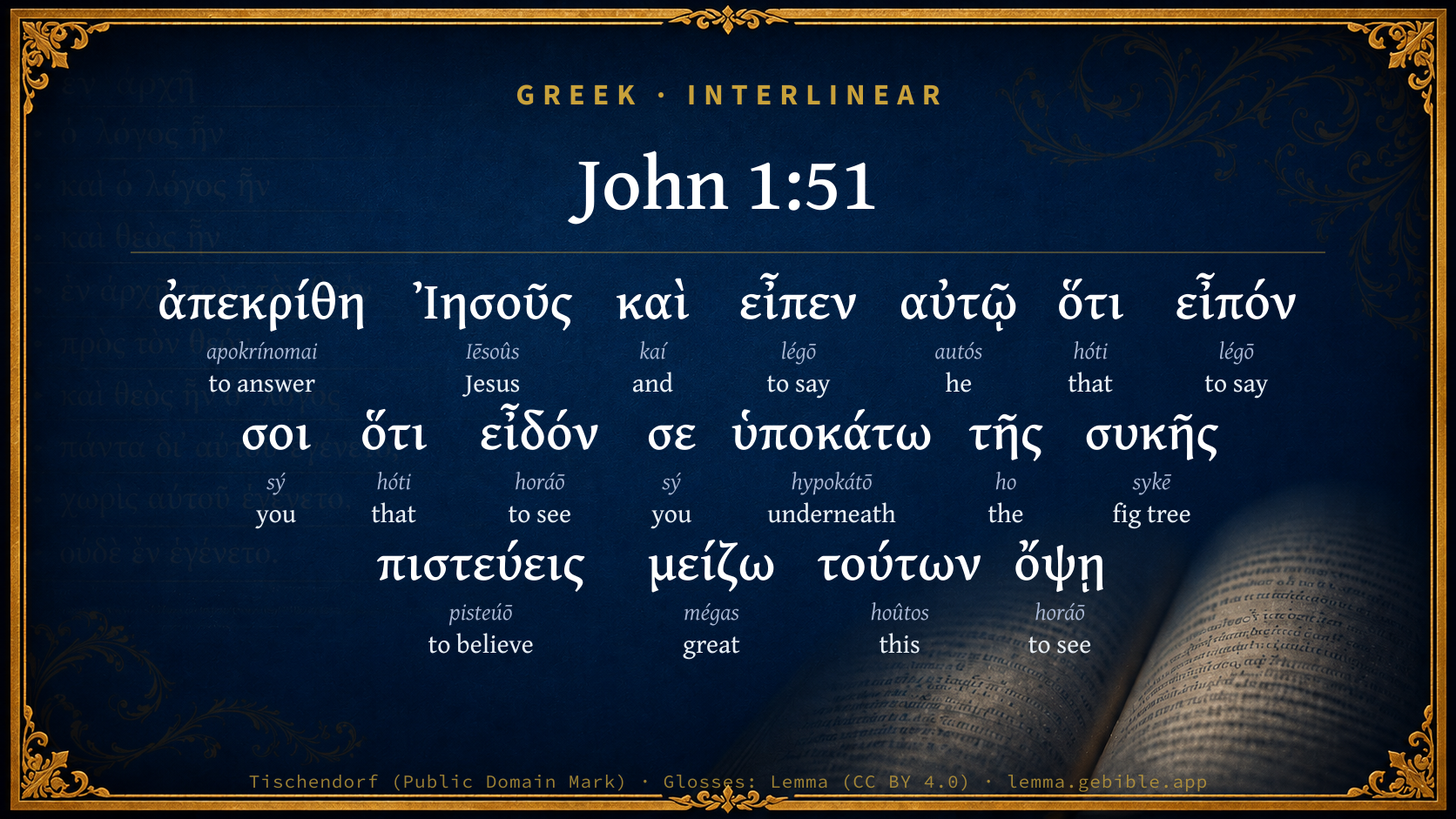
  1. ἀπεκρίθη apokrínomai G611 “to answer” Verb, Aorist, Middle deponent, Indicative, 3rd person, Singular
  2. Ἰησοῦς Iēsoûs G2424 “Jesus” Noun, Nominative, Singular, Masculine
  3. καὶ kaí G2532 “and” Conjunction
  4. εἶπεν légō G3004 “to say” Verb, Aorist, Active, Indicative, 3rd person, Singular
  5. αὐτῷ autós G846 “he” Personal pronoun, Dative, Singular, Masculine
  6. ὅτι hóti G3754 “that” Conjunction
  7. εἶπόν légō G3004 “to say” Verb, Aorist, Active, Indicative, 1st person, Singular
  8. σοι sý G4771 “you” Personal pronoun, 2nd person, Dative, Singular
  9. ὅτι hóti G3754 “that” Conjunction
  10. εἶδόν horáō G3708 “to see” Verb, Aorist, Active, Indicative, 1st person, Singular
  11. σε sý G4771 “you” Personal pronoun, 2nd person, Accusative, Singular
  12. τῆς ho G3588 “the” Article, Genitive, Singular, Feminine
  13. συκῆς sykē G4808 “fig tree” Noun, Genitive, Singular, Feminine
  14. πιστεύεις pisteúō G4100 “to believe” Verb, Present, Active, Indicative, 2nd person, Singular
  15. μείζω mégas G3173 “great” Adjective, Accusative, Plural, Neuter, Comparative
  16. τούτων hoûtos G3778 “this” Demonstrative pronoun, Genitive, Plural, Neuter
  17. ὄψῃ horáō G3708 “to see” Verb, Future, Middle deponent, Indicative, 2nd person, Singular

About this verse

These counts appear in no published source. They are computed here, from the morphology-tagged text and Lemma’s own curated glosses. What Lemma adds →

18
words
14
distinct lemmas
Gospels
section

Notable vocabulary

The rarest word here is ὑποκάτω underneath G5270 — appearing just 10 times in the whole Greek New Testament.

Shared distinctive vocabulary

ὑποκάτω underneath G5270 occurs in 10 verses of the Greek New Testament. Also found in:

Repetition

Words recur within this verse:

  • εἶπεν to say G3004 ×2
  • εἶδόν to see G3708 ×2
  • ὅτι that G3754 ×2
  • σοι you G4771 ×2

Cross-references

54

Topical passages linked to John 1:51 in the Treasury of Scripture Knowledge — connected by theme and wording, ordered by reader-vote popularity; previews shown in the World English Bible.

  • Genesis 28:12 He dreamed. Behold, a stairway set up on the earth, and the top of it reached to heaven. Behold, the angels of God ascending and descending on it.
  • Acts 7:56 and said, "Behold, I see the heavens opened, and the Son of Man standing at the right hand of God!"
  • Luke 22:43 An angel from heaven appeared to him, strengthening him.
  • Matthew 16:27–28 For the Son of Man will come in the glory of his Father with his angels, and then he will render to everyone according to his deeds.
  • Mark 1:10 Immediately coming up from the water, he saw the heavens parting, and the Spirit descending on him like a dove.
  • Mark 14:62 Jesus said, "I AM. You will see the Son of Man sitting at the right hand of Power, and coming with the clouds of the sky."
  • Luke 2:13 Suddenly, there was with the angel a multitude of the heavenly host praising God, and saying,
  • Acts 10:11 He saw heaven opened and a certain container descending to him, like a great sheet let down by four corners on the earth,
  • Ezekiel 1:1 Now it happened in the thirtieth year, in the fourth [month], in the fifth [day] of the month, as I was among the captives by the river Chebar, that the heavens were opened, and I saw visions of God.
  • Matthew 3:16 Jesus, when he was baptized, went up directly from the water: and behold, the heavens were opened to him. He saw the Spirit of God descending as a dove, and coming on him.
  • Luke 3:21 Now it happened, when all the people were baptized, Jesus also had been baptized, and was praying. The sky was opened,
  • John 3:13–14 No one has ascended into heaven, but he who descended out of heaven, the Son of Man, who is in heaven.
  • Acts 1:10–11 While they were looking steadfastly into the sky as he went, behold, two men stood by them in white clothing,
  • Daniel 7:13–14 I saw in the night-visions, and, behold, there came with the clouds of the sky one like a son of man, and he came even to the ancient of days, and they brought him near before him.
  • Matthew 4:11 Then the devil left him, and behold, angels came and ministered to him.
  • Luke 2:9 Behold, an angel of the Lord stood by them, and the glory of the Lord shone around them, and they were terrified.
  • 2 Thessalonians 1:7 and to give relief to you that are afflicted with us, when the Lord Jesus is revealed from heaven with his mighty angels in flaming fire,
  • Matthew 25:31 "But when the Son of Man comes in his glory, and all the holy angels with him, then he will sit on the throne of his glory.
  • Luke 22:69 From now on, the Son of Man will be seated at the right hand of the power of God."
  • John 10:1 "Most assuredly, I tell you, one who doesn't enter by the door into the sheep fold, but climbs up some other way, the same is a thief and a robber.
  • 1 Timothy 3:16 Without controversy, the mystery of godliness is great: God was revealed in the flesh, Justified in the spirit, Seen by angels, Preached among the nations, Believed on in the world, And received up in glory.
  • Hebrews 1:14 Aren't they all ministering spirits, sent out to do service for the sake of those who will inherit salvation?
  • Revelation 4:1 After these things I looked and saw a door opened in heaven, and the first voice that I heard, like a trumpet speaking with me, was one saying, "Come up here, and I will show you the things which must happen after this."
  • Revelation 19:11 I saw the heaven opened, and behold, a white horse, and he who sat on it is called Faithful and True. In righteousness he judges and makes war.
  • John 14:12 Most assuredly I tell you, he who believes in me, the works that I do, he will do also; and greater works than these will he do; because I am going to my Father.
  • 2 Thessalonians 1:9 who will pay the penalty: eternal destruction from the face of the Lord and from the glory of his might,
  • Jude 1:14 About these also Enoch, the seventh from Adam, prophesied, saying, "Behold, the Lord came with ten thousands of his holy ones,
  • Daniel 7:9–10 I saw until thrones were placed, and one who was ancient of days sat: his clothing was white as snow, and the hair of his head like pure wool; his throne was fiery flames, [and] the wheels of it burning fire.
  • Matthew 26:24 The Son of Man goes, even as it is written of him, but woe to that man through whom the Son of Man is betrayed! It would be better for that man if he had not been born."
  • Luke 24:4 It happened, while they were greatly perplexed about this, behold, two men stood by them in dazzling clothing.
  • John 6:47 Most assuredly, I tell you, he who believes in me has eternal life.
  • Matthew 16:13–16 Now when Jesus came into the parts of Caesarea Philippi, he asked his disciples, saying, "Who do men say that I, the Son of Man, am?"
  • John 3:5 Jesus answered, "Most assuredly I tell you, unless one is born of water and spirit, he can't enter into the Kingdom of God!
  • John 5:24–25 "Most assuredly I tell you, he who hears my word, and believes him who sent me, has eternal life, and doesn't come into judgment, but has passed out of death into life.
  • John 6:32 Jesus therefore said to them, "Most assuredly, I tell you, it wasn't Moses who gave you the bread out of heaven, but my Father gives you the true bread out of heaven.
  • John 8:51 Most assuredly, I tell you, if a person keeps my word, he will never see death."
  • John 21:18 Most assuredly I tell you, when you were young, you dressed yourself, and walked where you wanted to. But when you are old, you will stretch out your hands, and another will dress you, and carry you where you don't want to go."
  • Zechariah 13:7 "Awake, sword, against my shepherd, And against the man who is close to me," says Yahweh of Hosts. Strike the shepherd, and the sheep will be scattered; And I will turn my hand against the little ones.
  • Matthew 8:20 Jesus said to him, "The foxes have holes, and the birds of the sky have nests, but the Son of Man has nowhere to lay his head."
  • Matthew 9:6 But that you may know that the Son of Man has authority on earth to forgive sins..." (then he said to the paralytic), "Get up, and take up your mat, and go up to your house."
  • John 3:3 Jesus answered him, "Most assuredly, I tell you, unless one is born anew, he can't see the Kingdom of God."
  • John 5:19 Jesus therefore answered them, "Most assuredly, I tell you, the Son can do nothing of himself, but what he sees the Father doing. For whatever things he does, these the Son also does likewise.
  • John 5:27 He also gave him authority to execute judgment, because he is a son of man.
  • John 6:53 Jesus therefore said to them, "Most assuredly I tell you, unless you eat the flesh of the Son of Man and drink his blood, you don't have life in yourselves.
  • John 10:7 Jesus therefore said to them again, "Most assuredly, I tell you, I am the sheep's door.
  • John 12:23–24 Jesus answered them, "The time has come for the Son of Man to be glorified.
  • John 13:16 Most assuredly I tell you, a servant is not greater than his lord, neither one who is sent greater than he who sent him.
  • John 13:20–21 Most assuredly I tell you, he who receives whomever I send, receives me; and he who receives me, receives him who sent me."
  • John 16:20 Most assuredly I tell you, that you will weep and lament, but the world will rejoice. You will be sorrowful, but your sorrow will be turned into joy.
  • John 6:26 Jesus answered them, "Most assuredly I tell you, you seek me, not because you saw signs, but because you ate of the loaves, and were filled.
  • John 8:34 Jesus answered them, "Most assuredly I tell you, everyone who commits sin is the bondservant of sin.
  • John 8:58 Jesus said to them, "Most assuredly, I tell you, before Abraham came into existence, I AM."
  • John 13:38 Jesus answered him, "Will you lay down your life for me? Most assuredly I tell you, the rooster won't crow until you have denied me three times.
  • John 16:23 "In that day you will ask me no questions. Most assuredly I tell you, whatever you may ask of the Father in my name, he will give it to you.

Cross-references courtesy of OpenBible.info (CC BY 4.0).

Where the printed editions differ

1 variant

Places in this verse where the major printed Greek editions disagree on the wording in a way that affects the translation — a comparison of editions, not a manuscript-by-manuscript collation. The editions are the modern critical texts (Nestlé-Aland 28/27, SBL, Westcott-Hort, Tregelles, Tyndale House) and the traditional texts behind the KJV (the Textus Receptus and the Byzantine/Majority text). It is not a claim about which reading is original.

  1. Extra text
    ἀπ᾽ ἄρτι,

    “from now”

    In TRByz Not in NA28NA27TynSBLWHTreg

    ἀπ᾽ ἄρτι, (ap᾽ arti) 'from now' is only in traditional manuscripts (TR+Byz)

Textual data: Translators Amalgamated Greek New Testament (STEPBible TAGNT) · CC BY 4.0.

Commentary

Notes on John 1:51 from classic Christian and Jewish commentators (each source and its license shown beneath its notes). The classic Christian expositions comment on the surrounding passage and are grouped to its opening verse, so a note may address several verses; the Jewish commentaries on the Tanakh (Rashi and others) are per-verse, so they appear only where the commentator wrote on this verse.

Lemma curates 59 commentaries, every one of them public domain or Creative Commons licensed, each selected and text-cleaned for this edition rather than reprinted as found. About our sources →

The Biblical Illustrator

Joseph S. Exell

Joh_1:51

Hereafter ye shall see the heaven open

The verilies of Christ

1.

Nothing is more characteristic of our age than its questioning and doubt.

(1) Science has opened many fields in all of which much is yet unsolved.

(2) Philosophy has unsettled much that was once believed.

(3) The growing complications of society force upon us questions to every one of which jarring answers are returned.

(4) The Church is so divided that she is unable to guide herself, much less the world. Hence thousands are asking whether there can be any certainty for man.

2. There was another age which resembled ours--the age when the old-world civilizations broke up: when Greece and Rome were bankrupt, and when Israels sun turned into darkness. In that dark age He came who could meet doubt with certain truth.

3. The Truth still lives who had and still has a message for a doubting age, and for those who received Him there was and is now certainty and rest.

4. This amen has altered some memorable amens--amens which He has marked with reiterated affirmations; the unusual form showing us

(1) That we need light; and

(2) That He will not withhold the light we need.

5. The Verily, verily is only employed by John because he sets forth Christ in His higher relations, and therefore conveys transcendent truth that requires emphasis.

6. Not one of the verilies refers to the Church, but all refer to the peculiar forms of eternal life which are only outwardly manifested in the Church; and will survive its failure.

7. This revelation of eternal life is distinctive of St. John. The other apostles have each their special truth suited to some stage of the Church and individual.

(1) Pauls comes first, meeting us with words relative to our ruin and the righteousness which is by faith.

(2) James meets our advancing needs touching the moralities which belong to Christian doctrine.

(3) Peter comes next with words of our present suffering and future glory.

(4) Once mere we advance and come to Johns witness to the new life which the sons of God are called to manifest.

8. It is this teaching of Johns which the reiterated amens sum up, showing us the course and stages of eternal life in Christ. Twelve of these are distinguished.

(1) The home of the new man: heaven, long shut, is reopened (Joh_1:51).

(2) We enter this home by a new birth (Joh_3:3; Joh_3:5).

(3) The law of the life of the new man (Joh_5:19-22).

(4) His meat (Joh_6:26-58).

(5) His liberty (Joh_8:31-35).

(6) His divinity (Joh_8:48-58).

(7) His service (Joh_10:1-18).

(8) His sacrifice and its results (Joh_12:24-26).

(9) His lowliness (13:1-32).

(10) His glory (Joh_14:8-31.

(11) His sorrow and joy (Joh_16:16-25).

(12) His perfecting (Joh_21:15-23). (A. Jukes, M. A.)

The verilies of Christ teach us three lessons

I. AS TO THE AUTHORITY OF THE TEACHER. The Jews were astonished at His doctrine, for He taught as one having authority, and not as the scribes, which suggests a contrast with other teachers.

1. Put side by side with the autocratic ring of this Verily, verily I say unto you, the formula of the prophets--Thus saith the Lord.

2. Contrast again the bare utterance of His own word as a reason for our acceptance of His sayings with the teaching that was busy around Him. One rabbi says this and another that, and so on through all the wearisome Talmud. They drew their authority from their faithfulness to tradition. Christ steps forward as a fresh fountain of certitude.

3. Contrast His teaching with the tone of modesty suitable to mere thinkers who have learned their truths. The philosopher may argue, Christ asserts. Now, what business has Christ to talk in this fashion and demand that I should take from His lips anything He chooses to say? The only answer is, that He is the Word, the Truth of God.

II. AS TO THE CERTITUDE AND IMPORTANCE OF THE LESSON. Other teachers have to say, Peradventure, This I deem to be true. Jesus says, Most assuredly.

1. In our day of uncertainties and unsolved problems the world wants more than ever to listen to that voice. Much is dark and doubtful, but here at least is a central core of hard rock that no pressure can grind nor any force shift.

2. Think of the difference between the freshness and adaptation of Christs words and the film of old-fashioned untimeliness which has crept over all other ancient utterances, and say what is the secret of this immortal youth. It is because they are free from all admixture of human limitation and transitoriness, and so fit every generation, and are to every generation the source of certitude.

3. Classify the utterances to which this formula is attached, First, those which refer to Himself. He asserts

(1) His Divine nature (Joh_8:58).

(2) His absolute unity of being and identity of action with the

Father (Joh_5:19).

(3) His place as the medium of all communication between earth and heaven (Joh_1:51).

(4) That He is the way by which all men enter the fold of God Joh_10:7).

(5) That He is the infallible Teacher (Joh_3:11).

(6) That He is the God-given source of life (Joh_6:32).

(7) The certain granting of all prayers offered in His name (Joh_16:23).

(8) The necessity for His death, that His mission may be accomplished (Joh_12:24).

Secondly, those which refer to us,

(1) Union by faith with Him is the condition of our life (Joh_6:58; Joh_8:51; Joh_5:24).

(2) The necessity of a new nature ere we can see or enter the kingdom (Joh_3:3; Joh_3:6).

(3) The promise of our complete assimilation and conformity with Him on condition of our faith (Joh_13:16; Joh_13:20; Joh_14:12).

Thirdly, those which contain predictions of a near or remote future which could only be made from supernatural knowledge (Joh_13:21; Joh_16:20; Joh_13:38; Joh_21:18).

Fourthly, those which lay bare to men the hidden foulness of their nature Joh_6:26; Joh_8:34).

III. AS TO THE BACKWARDNESS OF THE SCHOLARS.

1. Verily implies that they to whom it was addressed had dull ears, whose languid attention needed to be stimulated, or that the words which He was going to utter were too great to be easily believed, or too unwelcome to be swiftly accepted.

2. It is a warning against prejudice and sluggish apathy.

3. It is a solemn appeal to us to permit no indifference to come between us and His Word. Two things are required of us as His scholars.

1. That which it is degradation to give to man, but which is blasphemy to withhold from Christ. Speak, Lord, for Thy servant heareth.

2. The absolute certitude of His messsge has for its correlative our unwavering steadfastness. (A. Maclaren, D. D.)

The first Verily, verily,--the home of the new man

1. The first question of the Old Testament is, Where art thou?--Gods question to fallen man. The first of the New is, Where is He?--asked by men who have just been awakened to feel their need of a Saviour. Gods question reveals mans state that he is not where God placed him; mans question draws forth the purpose of Gods heart, that, fallen as we are, He is with us, our Tabernacle.

2. This first verily teaches both these truths. Heaven, mans proper home, long shut, is now opened, and that all man has lost shall be restored through the Heir, the Son of man. The old man by disobedience lost his home; the New Man comes back again to the opened heavens as His dwelling-place.

3. These words were spoken by one who had just had heaven open to Him, and He comes forth to tell men how they are to enter.

4. Heaven is not far off; it is the spirit-world which is lost or shut only to the natural man. What will be manifested at death may be anticipated here.

5. Take some examples of this opened heaven.

(1) That which took place at Christs baptism. This is fulfilled to Christs members. The Spirit like a dove abides on them; for the mark of the beast is gone, and the voice from heaven proclaims their sonship.

(2) Christs transfiguration is recorded to teach a communion with saints who are not far from us. But this blessing is not without its peril, inasmuch as it awakens in imperfect disciples thoughts which if followed out would give to creatures a place and honour which belongs to God alone. Hence Peter wanted three tabernacles; but is called back to Jesus only by the voice, This is My beloved Son, etc.

(3) Peters vision (Act_10:9-16), which taught him that we should call no man common or unclean.

(4) Johns visions in the Apocalypse, revealing the glory of the Son of man and the endless bliss of His brethren.

6. Whenever mans true home is opened the servants (angels) also are seen, ever near.

(1).Ministering to mans wants (1Ki_19:5-6).

(2) Directing his steps (Gen_16:9).

(3) Barring his way if he turns aside from God (Num_22:24-26).

(4) Present in the assemblies of believers (1Co_11:10).

(5) Specially related to little children (Mat_18:10).

(6) Rejoicing over repenting sinners (Luk_15:10).

(7) Ministering: to the heirs of salvation (Heb_1:14). (A. Jukes, M. A.)

The positiveness of Jesus

This expression is one of the signs and evidences of the originality of Jesus Christ. It occurs more than seventy times, and was a characteristic which separated His conversation from that of other men. There were and are examples enough of mere dogmatism.

1. The scribes, whether of theology or science, will open their books and say, It is written, and that is the end of all controversy.

2. The bigot will hold fast to the letter of his creed and anathematize all who do not hold it.

3. Ignorance will stand firm upon tradition and swear to all passers by, I know. Everywhere there has lived the man who could not be mistaken.

But the assurance of Jesus Christ was wholly different.

1. Nor was it like the positiveness of the prophets of old who proclaimed, Thus saith the Lord.

2. Nor like the confidence of the philosopher in his reasonings, the naturalist in his verifications. Christs verilies precede rather than conclude His teachings. He gave no demonstrations.

3. Nor with the religious faiths of His disciples. Faith is for us an achievement, and after the struggle Jesus comes and saysbelieve. But no Christ came to Jesus, nor is there in His positiveness any trace of conflict. He believed spontaneously and directly out of His own consciousness of God. This positiveness marked Christs teaching from the beginning when He spoke to His mother in the Temple; and never afterwards was there a hesitating note. This peculiar quality appears when we reflect on the subjects on which He was absolutely sure. They are those on which other men are not sure.

(1) His verilies have nothing to do with natural truths which we can discover or demonstrate.

(2) Nor with matters of history which scholars may search out.

(3) Nor with such things as Sanhedrims wrangle over.

(4) But with vital, spiritual, eternal truths not otherwise discoverable by man.

Learn, then:

1. That over against all our human ignorance, sinfulness, and need, the gospel is one grand affirmation of God; an assertion of those things of which we most need to be made sure.

2. If we want true hearts and strength to do and dare; if we would learn the secret of cheerful, patient lives; if we wish to live with all our souls for noble purpose, and with great faiths and immortal hope, there is a verily waiting to impart to us its power and its peace.

3. Christian unity is only to be realized upon the high plane of this positiveness, and along the lines of those great spiritual affirmations.

4. There is some verily speaking to each at all times and everywhere. (Newman Smyth, D. D.)

Heaven opened

I. A CERTAIN FACT: Christ has come forth.

II. A BLESSED GOSPEL: Christs appearing a manifestation of Divine grace.

III. A JOYOUS HOPE: Christs coming forth suggests the possibility of mans going in.

IV. A GLORIOUS PREDICTION: the reinstitution of fellowship between earth and heaven predicts the assimilation of the former to the latter. (T. Whitelaw, D. D.)

Verily

is simply the familiar amen! which properly is an adjective meaning firm or steadfast, and is used in two connections. Sometimes it precedes an assertion which it confirms, in which case it may be paraphrased by Thus it certainly is. Sometimes it follows a prayer which it sums up and reiterates, and in that case it may be paraphrased by So may it be. Doubled it has the force of a superlative, Most assuredly. It is heard only from the lips of Christ. It becomes no other lips. (A. Maclaren, D. D.)

Angels ascending and descending

Some of these angelic appearances had already taken place. An angel announced the conception of Christ to His mother. An angel, accompanied by a multitude of the heavenly host, proclaimed His birth to the shepherds, and after His temptation angels came and ministered to Him. These instances of angels descending on the Son of man had taken place before this period, and Nathanael knew them not; but there remained other manifestations of the same kind, which were yet to be afforded. An angel appeared to Him, and strengthened Him in His agony. At His resurrection an angel rolled away the stone from His sepulchre, and two angels sat, the one at the head, the other at the feet where the Lord had lain. And, lastly, angels attended His ascension, and as an angel had announced His first coming, so angels foretold to the witnesses of this great event that the same Jesus who had been parted from them should come again in like manner as they had seen Him go up into heaven. (J. Fawcett, M. A.)

Jesus a ladder to heaven

To the north of Scotland lies an island called Bressay. It is one of the Shetland Islands, and its shores are very rocky. On the south coast of Bressay is a slate-quarry. The workmen had to descend the cliff to it by means of a ladder. One evening, a violent and sudden storm drove the quarrymen from their work. The ladder was left fastened to the cliff. The night was very dark and stormy. A ship which was struggling with the waves was driven close to the island. Her crew beheld with terror the white foam of the breakers as they dashed against the rocks. They knew that, if their ship were stranded, they must be wrecked. Still the howling winds drove her forward. The waves dashed over her, filled the cabin with water, and drowned the wife of the captain. The sailors now climbed into the rigging. They were at the mercy of the furious wind and of the raging sea. They gave themselves up for lost. Many prayers and cries for deliverance were uttered. On came the ship, and struck against the shore. The poor seamen felt that death was almost certain. On the summit of the cliff was safety; but how could they reach it, who were helplessly dashed at its foot? But just as the ship struck near the rock, their terror was changed to joy. Close beside them, on the steep face of the cliff, was a ladder. It seemed as if placed there on purpose for them. In haste they sprang from the rigging, mounted the ladder, and reached the top of the cliff in safety. The vessel went to pieces so quickly that, by the next morning, hardly a trace of her was left.

The Biblical Illustrator, edited by Joseph S. Exell (c. 1880s–1900s) — public domain. Text from a community e-Sword module.

Tyndale Open Study Notes

Tyndale Open Resources

1:51 I tell you the truth (Greek amēn amēn): Jesus often used this expression to emphasize what he was about to say. In John’s Gospel, the Greek word amēn is always doubled. • you will all see heaven open: Jesus made the comparison with Jacob explicit (see study note on 1:47; see Gen 28:10-22). Like Jacob, Nathanael would see God at work. Jesus himself is the new Bethel (“house of God,” Gen 28:19), the place where God lives. • Son of Man: See study note on John 9:35; see also Dan 7:13-14; Mark 8:31. • John the apostle used several names for Jesus (Son of God, Son of Man, Messiah). Knowing Jesus’ true identity is necessary to fully understanding and following him.

Tyndale Open Study Notes — © Tyndale Open Resources, licensed CC BY-SA 4.0. Text via the HelloAO Bible API.

Bengel's Gnomon

Johann Albrecht Bengel

Joh 1:51. Ἀμὴν, ἀμήν, verily, verily) Matthew, Mark, and Luke, in the speeches of Jesus, are wont to set down ἀμήν once, John twice [repeating the word], upon which see Jac. Gaillius tr. de Filio hom. qu. 11, 12, p. 231–239. The others indeed do so too in those passages, which are not parallel; but yet even in parallels too, Mat 26:21; Mat 26:34 [ἀμήν, once]; Joh 13:21; Joh 13:38 [ἀμήν, twice]: whence it appears, that the Saviour either always used this prefatory affirmation, ἀμήν, once, or, as we rather think, always twice. At the time of Matthew, Mark, and Luke, it was not yet the seasonable time to record it [the double ἀμήν]: when John wrote, it was seasonable. But why [is it repeated] twice? Jesus spake in the name of the Father and in His own: add the note on 2Co 1:20 [The promises of God—are in Him, Amen]: and His Word is Truth with the Speaker and with believers; 1Jn 2:8 [A new commandment,—which thing is true in Him and in you]: [both] in substance and in words. Mat 5:37 “Let your communication be yea, yea; nay nay:” They are λόγοι ἀληθινοὶ καὶ πιστοὶ [words], faithful and true: comp. Rev 19:11 [He that sat upon the horse was called Faithful and True], This is a Hebrew epizeuxis, as Psa 41:13; Psa 89:52; Psa 72:19 [Amen and Amen]: as מאד מאד, very, very.—ὑμῖν, you) [Plur.] To thee and the rest.—ὄψεσθε, ye shall see) Answering to ὄψει, thou shalt see) Joh 1:50. Great faith, and [a decided] profession on the part of one, obtains even for others greater gifts.—τὸν οὐρανὸν ἀνεῳγότα, heaven open) i.e. Ye shall see the greatest signs, which are to show, that heaven is open. The Lord has descended scended from heaven, and now stays on [“versatur in,” walks familiarly on] earth: and thence His heavenly messengers will have much to do; for they will have to attend on their Lord.—ἀνεῳγότα, opened) The præterite, properly, comp. Mat 3:16, ἀνεῴχθησαν αὐτῷ οἱ οὐρανοί; and with [i.e. implying also] continuance to the time subsequent, Joh 3:13, “No man hath ascended up to heaven, but He that came down from heaven, even the Son of man which is in heaven;” Act 7:56, [The dying Stephen] “I see the heavens opened;” Rev 11:12, “A great voice from heaven saying unto them, Come up hither. And they ascended up to heaven in a cloud.”—τοὺς ἀγγέλους τοῦ Θεοῦ, the angels of God) The same beings, whom the Only-begotten Son of GOD has as His ministering servants.—ἀναβαίνοντας καὶ καταβαίνοντας, ascending and descending) Ascending is put in the first place: therefore there will be a staving of angels on earth. Jacob saw some such vision, Gen 28:12. How much more [shall] Israelites without guile under the New Testament [see it].—τὸν Υἱὸν τοῦ ἀνθρώπου, the Son of man) See note on Mat 16:13.

Bengel's Gnomon of the New Testament — English translation (T&T Clark, Edinburgh, 1860) — public domain. Text from a community e-Sword module.

Meyer's Critical & Exegetical Commentary

Heinrich August Wilhelm Meyer

Joh_1:51. Πιστεύεις is, with Chrysostom and most others (even Lachmann and Tischendorf, not Godet), to be taken interrogatively; see on Joh_20:29.[129] But the question is not uttered in a tone of censure, which would only destroy the fresh bloom of this first meeting (Theophylact: he had not yet rightly believed in Christs Godhead); nor is it even the expression of slight disapproval of a faith which was not yet based upon adequate grounds (De Wette, comp. Ewald); but, on the contrary, it is an expression of surprise, whereby Jesus joyfully recognises a faith in Nathanael which could hardly have been expected so soon. And to this faith, so surprisingly ready in its beginning, He promises something greater (ἐς ἐλπίδα φέρτερον ἕλκων, Nonnus) by way of further confirmation.

τούτων] Plural of the category: than this which you now have met with, and which has become the ground of your faith.

καὶ λέγει αὐτῷ] specially introduces the further statement of the μείζω τούτων as a most significant word.

ἀμὴν ἀμὴν λέγω ὑμῖν] The double ἈΜῊΝ does not occur in other parts of the N. T., but we find it twenty-five times in John, and only in the mouth of Jesus,therefore all the more certainly original.

ὙΜῖΝ] to thee and Andrew, John, Peter (James, see in Joh_1:42), and Philip.

ἈΠΆΡΤΙ] from now onwards, for Jesus was about to begin His Messianic work. See chap. 2. Thus, in this weighty word He furnishes His disciples with the key for the only correct understanding of that work.

ὄψεσθε, κ.τ.λ.] The opened heaven is not intended to be taken in its literal sense, as if it stood alone, but is part of the figurative moulding of the sentence in keeping with the following metaphor. Observe here the perfect participle: heaven stands open; comp. Act_7:56. The ascending and descending angels are, according to Gen_28:12, a symbolical representation of the uninterrupted and living intercourse subsisting between the Messiah and God,an intercommunion which the disciples would clearly and vividly recognise, or, according to the symbolic form of the thought, would see as a matter of experience throughout the ministry of Jesus which was to follow.[130] The angels are not therefore to be regarded as personified divine powers (Olshausen, De Wette, and several), or as personal energies of Gods Spirit (Luthardt and Hofmann), but as always Gods messengers, who brought to the Messiah Gods commands, or executed them on Him (comp. Mat_4:11; Mat_26:53; Luk_22:43), and return to God again (ἀναβαίνοντας), while others with new commissions came down (ΚΑΤΑΒΑΊΝ.), and so on. We are not told whether, and if so, to what extent, Nathanael and his companions now already perceived the symbolic meaning of the declaration. It certainly is not to be understood as having reference to the actual appearances of angels in the course of the Gospel history (Chrysostom, Cyril., Euthymius Zigabenus, and most of the early expositors), against which ἀπάρτι is conclusive; nor merely to the working of miracles (Storr, Godet), which is in keeping neither with the expression itself, nor with the necessary reference to the Messiahs ministry as a whole, which must be described by ἀπάρτι ὄψεσθε, etc.

ἈΝΑΒΑΊΝ.] is placed first, in remembrance of Gen_28:12, without any special purpose, but not inappropriately, because when the ὄψεσθε takes place, the intercourse between heaven and earth does not then begin, but is already going on. We may supply ἈΠῸ ΤΟῦ ΥἹΟῦ ΤΟῦ ἈΝΘΡ. after ἈΝΑΒΑΊΝ. from the analogy of what follows. See Kühner, II. p. 603.

Concerning Ὁ ΥἹῸς ΤΟῦ ἈΝΘΡ., see on Mat_8:20; Mar_2:8, note. In John likewise it is the standing Messianic designation of Jesus as used by Himself; here, where angelic powers are represented as waiting upon Him who bears the Messianic authority, it corresponds rather with the prophetic vision of the Son of man (Dan_7:14), and forms the impressive conclusion of the whole section, confirming and ratifying the joyous faith and confession of the first disciples, as the first solemn self-avowal on the part of Jesus in their presence. It thus retained a deep and indelible hold upon the recollection of John, and therefore it stands as the utterance of the clear Messianic consciousness of Jesus unveiled before us at the outset of His work. It is exactly in John that the Messiahship of Jesus comes out with the greatest precision, not as the consequence and result, but as already, from the beginning onwards, the subject-matter of our Lords self-consciousness.[131]

[129] As to the paratactic protasis, which may be read interrogatively or not according to the character of the discourse, see C. F. Hermann, Progr. 1849, p. 18; Scheibe in Schneidew. Philolog. 1850, p. 362 ff. Comp. also Nägelsbachs note on the Iliad, p. 350, ed. 3.

[130] This expression tells us nothing concerning the origin of Christs knowledge of God, which ver. 18 clearly declares, and which cannot therefore be attributed to a series of progressive revelations (Weizsäcker); the expression rather presupposes that origin. Comp. also Weiss, Lehrbegr. p. 286 ff.

[131] The historic accuracy of this relation, as testified by John, stands with the apostolic origin of the Gospel, against which even the objections of Holtzmann in his investigation, which are excellent in a historical point of view (Jahrb. f. D. Theol. 1867, p. 389), can have no effect.

Note.

The synoptical account of the call of the two pairs of brothers, Mat_4:18 ff. and parallels, is utterly irreconcilable with that of John as to place, time, and circumstances; and the usual explanations resorted tothat what is here recorded was only a preliminary call,[132] or only a social union with Christ (Luther, Lücke, Ebrard, Tholuck; comp. also Ewald and Godet), or only the gathering together of the first believers (Luthardt), but not their callfall to the ground at once when we see how the narrative proceeds; for according to it the μαθηταί, Joh_2:2, are with Jesus, and remain with Him. See on Mat_4:19-20. The harmony of the two accounts consists in this simply, that the two pairs of brothers are the earliest apostles. To recognise in Johns account not an actual history, but a picture of the authors own, drawn by himself for the sake of illustrating his idea (Baur, Hilgenfeld, Schenkel),that, viz., the knowledge of the disciples and that of Jesus Himself as to His Messianic call might appear perfect from the outset,is only one of the numerous self-deceptions in criticism which form the premisses of the unhistorical conclusion that the fourth Gospel is not the work of the apostle, but of some writer of much later date, who has moulded the history into the form of his own ideal. On the contrary, we must here specially observe that the author, if he wished to antedate the time and place of the call, certainly did not need, for the carrying out of his idea, to invent a totally different situation from that which was before his eyes in the Synoptics. Over and above this, the assumption that, by previously receiving Johns baptism, Jesus renounced any independent action (Schenkel), is pure imagination. Weizsäcker (p. 404) reduces Johns account to this: The first acquaintance between Jesus and these followers of His was brought about by His meeting with the Baptist; and on that occasion, amid the excitement which the Baptist created, Messianic hopes, however transitory, were kindled in this circle of friends. But this rests upon a treatment of the fourth Gospel, according to which it can no longer claim the authority of an independent witness; instead of this witness, we have merely the poet of a thoughtful Idyll. And when Keim (I. p. 553) finds here only the narration of an age that could no longer endure the humble and human beginnings of Jesus, but would transplant into the time of His first appearance that glory which, as a matter of history, first distinguished His departure and His exaltation, this is all the more daring a speculation, the more closely, according to Keim, the origin of the Gospel verges upon the lifetime of the apostle, and must therefore present the most vivid recollections of His disciples.

[132] So, most recently, Märcker, Uebereinstimm. der Evang. d. Matt. u. Joh., Meiningen 1868, p. 10 ff. The τὸν λεγόμενον Πέτρον, Mat_4:18, furnishes no proof, as is plain from the parallel in Mar_1:16, which is the source of Matthews account, but as not those words. They are simply a personal notice added from the standing-point of the writer, as in Mat_10:2.

Meyer — Critical and Exegetical Commentary on the New Testament — English translation by Peter Christie, edited by Frederick Crombie (T&T Clark, 1880) — public domain. Text from a community e-Sword module.

Expositor's Greek Testament

ed. W. Robertson Nicoll

Joh 1:51 . ἀπεκρίθη … ὄψῃ . In accordance with the habit of this evangelist, who calls attention to the moving cause of faith in this or that individual, the source of Nathanael’s faith is indicated with some surprise that it should have proved sufficient: and with the announcement that his nascent faith will find more to feed upon: μείζω τούτων ὄψῃ .

John 1:52. What these things are is described in the words ὄψεσθε … ἀνθρώπου , introduced by the emphatic ἀμὴν , ἀμὴν λέγω ὑμῖν , used in this double form twenty-five times in this Gospel (always single in Synop.) and well rendered “verily, verily”. Christ as the Faithful and True Witness is Himself called the Amen in Rev 3:14 . The words ἀπʼ ἄρτι are omitted by recent editors. The announcement describes the result of the incarnation of Christ as a bringing together of heaven and earth, a true mediation between God and man, an opening of what is most divine for the satisfaction of human need. It is made in terms of Jacob’s dream (Gen 28:10 ff.). In his dream Jacob saw a ladder fixed on earth with its top in heaven, οἱ ἄγγελοι τοῦ θεοῦ ἀνέβαινον καὶ κατέβαινον ἐπʼ αὐτῇ . What Jacob had dreamt was in Christ realised. The Son of Man, the Messiah or actual representative of God on earth, brings God to man and makes earth a Bethel, and the gate of heaven. What Nathanael under his fig tree had been longing for and unconsciously preparing, an open communication with heaven, a ladder reaching from the deepest abyss of an earth submerged in sin to the highest heaven of purity, Jesus tells him is actually accomplished in His person. “The Son of Man” is the designation by which Jesus commonly indicates that He is the Messiah, while at the same time He suggests that His kingdom is not founded by earthly power or force, but by what is especially human, sympathy, reason, self-sacrifice.

The Expositor's Greek Testament, edited by W. Robertson Nicoll (1897–1910) — public domain. Text from a community e-Sword module.

International Critical Commentary

51. καὶ λέγει αὐτῷ, Ἀμὴν ἀμὴν λέγω ὑμῖν. Despite the singular αὐτῷ, the plural ὑμῖν suggests that the words which follow were addressed to others besides Nathanael. When Jesus prefaces a saying addressed to an individual by this solemn introduction, He is represented by Jn. as putting it in the form ἀμὴν ἀμὴν λέγω σοι (3:3, 5, 11, 21:18). Further, although the promise is in the singular μείζω τούτων ὅψῃ, the vision is described as to be seen by more than one, ὅψεσθε κτλ. Nathanael is only one of those who are to see “the heaven opened and the angels ascending and descending,” etc.

ἀμὴν ἀμὴν λέγω ὑμῖν. The authority with which Jesus was accustomed to speak has been noted above (Introd., p. cx). His authoritative manner of speech is indicated sometimes in the Synoptists by the mere addition of λέγω σοι or λέγω ὑμῖν, e.g. Mar 2:11, Mar 11:24, Luk 5:24, Luk 5:6:27, Luk 5:7:28, Luk 5:10:12, Luk 5:24, Luk 5:11:8, Luk 5:9 etc., Mat 5:44, Mat 16:18, Mat 21:43, Mat 23:39 etc. This is often found in the expanded form ἀμὴν λέγω ὑμῖν (30 times in Mt., 13 in Mk., and 6 in Lk., who also translates אמן by ναί, ἀληθῶς or ἐπʼ ἀληθείας). Jn. always gives it in the form ἀμὴν ἀμὴν λέγω ὑμῖν (25 times; cf. 4:35, 13:33 for λέγω ὑμῖν simply). In Jn. the formula is usually associated with sayings not given by the Synoptists; but cf. 3:5, 13:16, 20. It is clear from the Gospels that this was a characteristic usus loguendi of the Lord (Himself the Amen, Rev 3:14; cf. Isa 65:16), who never rested His sayings on the authority of other masters, as the Rabbinical habit was, but spoke as One possessed of the secrets of life.

Why the ἀμήν is doubled in the Johannine reports cannot be confidently explained. There are instances in the other Gospels of Jesus repeating at the beginning of a sentence the name of the person addressed, for greater emphasis, e.g. Martha, Martha (Luk 10:41), Simon, Simon (Luk 22:31), Eloi, Eloi (Mar 15:34); but this does not provide, an exact parallel. It would appear that ἀμήν was for Him a form of solemn attestation (see also on 4:21); and it may be that the solemnity was emphasised by Him sometimes by doubling the ἀμήν. He forbade oaths (cf. 4:21), but where people wished to be emphatic He allowed them to say Yea, yea, ναὶ ναί (Mat 5:37), and this is Verily, verily.1 See Luk 7:26, Luk 11:51 for ναί as equivalent to ἀμήν. Hence, in Mat 5:37, Jesus recommends as a form of solemn affirmation ἀμὴν ἀμήν, which we find from the report of Jn. to have been frequently adopted by Himself. The duplication of ἀμήν impressed the disciple, who remembered it, the Synoptic record having lost this characteristic feature.

In Jn. (as in the Synoptic Gospels, where λέγω ὑμῖν only or ἀμὴν λέγω ὑμῖν is found) ἀμὴν ἀμὴν λέγω ὑμῖν, while special emphasis is laid on the words which follow, always carries a reference to what has gone before—either a reply to an observatiosn (e.g. 3:3, 6:26, 32, 5:19, 8:34, 58, 13:38; cf. Mar 10:29, Mat 26:34), or an explanation and expansion of something that has already been said (e.g. 1:51, 5:24, 25, 10:1, 7, 12:24, 13:16, 20, 21, 16:20, 23, 14:12; cf. Mar 13:30, Mat 26:13). Even 8:51 goes back to 8:43, 6:47 to 6:40, 5:25 to 5:24, although the connexion is not so obvious. But it is important to observe that in Jn. the prelude ἀμὴν ἀμὴν λέγω ὑμῖν never introduces a new saying unrelated to what precedes (see on 10:1). In like manner in the O.T. we find ἀμήν prefacing a responsive agreement to something that has been already said (1Ki 1:36, Neh 5:13, Jer 11:5); or in its doubled form, ἀμὴν ἀμήν, as concluding a sort of liturgical response (Num 5:22, Judith 13:20, Psa 41:13). But in the O.T. we do not find ἀμήν used at the beginning of a sentence, to strengthen what is to follow.

The phrase ἀπʼ ἄρτι (for which see on 13:19) is prefixed to ὄψεσθε by AΓΔΘ and the Syriac vss., but is omitted by אBLW latt., etc., and must be rejected. It has been added by scribes because of a misunderstanding of the meaning of the words which follow (cf. Mat 26:64). The vision which is described is not one which was to be revealed henceforth, i.e. from the time of speaking; it was for the future, perhaps the distant future.

ὄψεσθε. ὄπτομαι (but not ὁρᾶν in the pres. or perf. tenses) is always used in Jn. (3:36, 11:40, 16:16, 1Jn 3:2) of the vision of heavenly or spiritual realities, as distinct from a seeing with the eyes of the body. The same usage is common in the rest of the N.T., but there are exceptions (e.g. Act 7:26, Act 20:25). For the difference in usage between ὅπτομαι and θεωρεῖν see on 2:23, and cf. Abbott (Diat. 1307, 1597 f.).

ὄψωσθε τὸν οὐρανὸν ἀνεῳγότα κτλ. We can hardly doubt that some words here are taken from the story of Jacob’s vision at Bethel, viz. κλίμαξ ἐστηριγμένη ἐν τῇ γῇ ἧς ἡ κεφαλὴ ἀφικνεῖτο εἰς τὸν οὐρανόν, καὶ οἱ ἄγγελοι τοῦ θεοῦ ἀνέβαινον καὶ κατέβαινον ἐπʼ αὐτῆς. ὁ δὲ κύριος ἐπεστήρικτο ἐπʼ αὐτῆς καὶ εἶπεν κτλ. (Gen 28:12, Gen 28:13). It is, however, remarkable that no Christian writer before Augustine seems to have noticed that Joh 1:51 is, in part, a quotation (see, for the patristic interpretations of the passage, Additional Note, p. 70 f.). The promise to Nathanael, as an “Israelite indeed,” that he (with others) shall see angelic visions, is couched in terms which recall the vision of Jacob, the father of his race, of whom Nathanael is no unworthy descendant. That the vision of Bethel was seen by Jacob before he received the new and pregnant name of Israel does not constitute a difficulty, for we are not concerned with the details of Jacob’s vision. The evangelist’s report does not indicate that he thought of it as fulfilled in Nathanael. The words ascribed to Jesus have to do with Jacob’s vision only in so far as they suggest to Nathanael that he was not the first Israelite to have visions of heaven and the angels.

What is to be the occasion of the vision promised to Nathanael and his companions? The direction in which an answer must be sought is indicated by the use, for the first time, in the Gospel of the strange designation of Jesus as “the Son of Man.” We have already seen (Introd., p. cxxvii) that the title “the Son of Man,” applied by Jesus to Himself, most frequently appears in eschatological passages, which have reference to His final and glorious Advent, after which His indestructible kingdom is to be fully established (cf. Dan 7:13). The vision of this Advent seems to be what is promised to Nathanael and his believing companions. Nathanael is represented as acknowledging that Jesus is “the Son of God, the King of Israel” (v. 49), i.e. that He is the Messiah as looked for under the aspect of King, the “political” Messiah (see on v. 34) of Israel’s hope. But there was a higher conception than this, a more spiritual picture than that of an earthly prince; and it was to this (as suggested by the words of Dan 7:13) that Jesus pointed His followers, when He spoke of Himself as the Son of Man. It was a greater thing to see Him as the Son of Man than as the King of Israel. The vision which would be the condemnation of the high priest who presumed to condemn Jesus, viz. ὄψεσθε τὸν υἱὸν τοῦ ἀνθρώπου ἐκ δεξίων καθήμενον τῆς δυνάμεως καὶ ἐρχόμενον μετὰ τῶν νεφελῶν τοῦ οὐρανοῦ (Mar 14:62), would be the reward of disciples who faithfully accepted Him as the Messiah.

The parallel to this passage in the Synoptists is the promise which followed upon the confession of Peter and the rest. Peter’s confession, like that of Nathanael, was σὺ εἶ ὁ χριστός and in making it he was the spokesman of the others. And the promise which follows is the counterpart of the promise to Nathanael, viz.: “The Son of Man shall come in the glory of His Father with His angels. … Verily I say unto you, There be some of them that stand here which shall in no wise taste of death, till they see the Son of Man coming in His Kingdom” (Mat 16:27, Mat 16:28; cf. Mar 8:38, Mar 9:1, Luk 9:26, Luk 9:27). The parallelism with Joh 1:51 is remarkable, and the difficulty of explaining both passages (for they are left unexplained by the evangelists) shows that, alike in the Synoptists and in Jn., they embody a genuine reminiscence or tradition.1 See on 6:69 for Jn.’s version of Peter’s confession.

There is in Jn. a third confession of faith, which should be placed beside that of Nathanael and that of Peter, viz. that of Martha (11:27), who says σὺ εἶ ὁ χριστός, ὁ υἱὸς τοῦ θεοῦ, ὁ εἰς τὸν κόσμον ἐρχόμενος. No reply of Jesus is recorded until we reach v. 40, when He says, with apparent reference to her previous confession, “Said I not unto thee, that if thou believedst, thou shouldest see the glory of God?” That is, again, as in the case of Nathanael, Vision is the reward of Faith: the vision of the Divine glory, as exhibited in the power over death which Jesus had (see note on 11:40).

The attempts which have been made to trace a detailed correspondence between what is said about Jacob’s vision at Bethel and the vision promised to Nathanael are quite unsuccessful. Nathanael, it must be borne in mind, is here typified by Jacob or Israel as “the man who sees.” It is, therefore, impossible to take Jacob as the type of Christ or the Son of Man; and this rules out several modern interpretations. E.g., to take (see Meyer) the angels ascending and descending as typical of the continuous intercourse between God and Christ, the Father and the Son (see on 5:19, 6:57), presupposes that Jacob at Bethel typifies Christ, not to mention that the idea of the intercourse between the Father and the Son being carried on by the ministry of angels is quite foreign to the Gospels.

Burney2 points out that the Hebrew בּוֹ, which is rendered at Gen 28:13 ἐπʼ αὐτῆς by the LXX, and by the English versions “on it,” sc. on the ladder, might also be rendered “on him,” sc. on Jacob. He cites a Midrash where this interpretation is proposed, and where it is said of the angels at Bethel that they were ascending on high and looking at Jacob’s εἰκών (which was in heaven), and then descending and finding his sleeping body. Burney suggests that the heavenly εἰκών of Israel was the Son of Man, and that Gen 28:13 is quoted here by Jn. from the Hebrew, בּוֹ being rendered “on Him,” i.e. the heavenly Ideal of Israel. If the heavens were opened, Nathanael would then see the angels of God “ascending and descending upon the Son of Man.” But, as we have said, Jn. certainly does not intend Jacob at Bethel to be taken as the type of the Son of Man, and so this interesting interpretation does not help us.

Additional Note on the Promise to Nathanael

1:51. No commentator before Augustine suggests any connexion between Gen 28:13 and Joh_1:5l. When the proneness of the early exegetes to seek O.T. testimonia is remembered, this is remarkable. A few passages may be cited to illustrate the various interpretations that were placed on both texts.

(a) Philo, as one would expect, has much to say about Jacob’s vision at Bethel (de somn. i. 22). Between heaven and earth, he says, there is the air, the abode of incorporeal souls, immortal citizens. The purest of the beings who pass to and fro are angels, who report the Father’s orders to His children, and their needs to Him. Here (§ 23) is an image of man’s soul, of which the foundation, as it were, is earthly (αἴσθησις), but the head is heavenly (νοῦς). And the λόγοι of God move incessantly up and down, ascending that they may draw the soul heavenwards, condescending that they may impart life from above. This, despite some verbal similarities, has no bearing on the exegesis of Joh 1:51.

(b) Origen (c. Celsum, vi. 21) recalls the Platonist doctrine, favoured by Celsus, that souls can make their way to and from the earth through the planets, and speaks with approval of Philo’s exposition of Gen 28:13 which has been cited above. He says that Gen 28:13 either refers to the Platonic view or to “something greater,” but he does not explain what this is.

(c) Origen quotes Joh 1:51 several times. In Hom. in Luc. xxiii. (Lommatzsch, v. 178) he quotes it to show that visions of angels are seen only by those to whom special grace is given; and similarly in de Orat. 11 (Lommatzsch, xvii. 128) he says that the angels ascending and descending are visible only to eyes illuminated by the light of knowledge (γνῶσις). In another place (c. Celsum, i. 48) he interprets the phrase τὸν οὐρανὸν ἀνεῳγότα of the opening of the heavens at the Baptism of Christ, forgetting that Jn. represents the Baptism as prior to the call of Nathanael. In none of these passages is it suggested that Gen 28:13 had occurred to him as a parallel.

(d) Tertullian refers twice to Jacob’s ladder. Just as some men behave badly in time of persecution, and others well, so in Jacob’s dream some mount to higher places, others go down to lower (de Fuga, 1). More interesting is his comment in another place (c. Marcion. iii. 24): By the vision of Jacob’s ladder, with God standing above, is shown the way to heaven, which some take and others fall from. “This,” said Jacob, “is the gate of heaven,” and the gate is provided by Christ. Tertullian never mentions Joh 1:51. It may be added that Cyprian quotes neither Gen 28:13 nor Joh 1:51.

(e) Irenæus (Dem. 45) says that Jacob’s ladder signifies the Cross, “for thereby they that believe on Him go up to the heavens,” adding that “all such visions point to the Son of God, speaking with men and being with men.” He does not quote Joh 1:51 anywhere.

(f) Justin (Tryph. 58, 86) quotes in full the story of Jacob at Bethel. He urges that it was not God the Father who stood above the ladder (Gen 28:13), but the Angel of His presence; and he finds the type of Christ, not in the ladder, but in the stone which Jacob had used for a pillow, and which he anointed (Gen 28:18). He does not allude to Joh 1:51.

(g) Chrysostom (in loc.) regards the ministry of angels in Gethsemane (Luk 22:43) and the Resurrection (Joh 20:12) as a fulfilment of Joh 1:51, an inadequate explanation. In an obscure passage (in Col. ii. 5), he refers to Gen 28:13 as a sign of the Divine Sonship of Christ, but he does not associate it with Joh 1:51.

(h) Jerome alludes to Jacob’s ladder several times (e.g. Epp 98. 3, 118. 7, 123. 15, and Tract. de Psa 119.). It represents, he says, the Christian life, the Lord standing above holding out His hand to help those going up, and casting down the careless. Like Justin, he takes the stone of Jacob as a type of Christ the cornerstone; but he does not quote Joh 1:51 in this context.

(i) Augustine is the first exegete to find in Joh 1:51 an allusion to Gen 28:13. He, too, regards Jacob’s stone as a type of Christ; and he suggests that the confession of Nathanael that Jesus is the Christ was like the anointing of the stone by Jacob (Gen 23:18). The “angels, ascending and descending,” typify the preachers of the Gospel. Augustine, however, introduces two ideas not altogether consistent with each other. First the angels “ascend and descend upon the Son of Man,” because He is at once above and below, in heaven and on earth. “Filius enim hominis sursum in capite nostro, quod est ipse Salvator; et Filius hominis deorsum in corpore suo, quod est Ecclesia.” Secondly, he explains that the Ladder is a type of Christ, who said, “I am the Way”; and it is notable that Augustine is the first Christian writer to suggest this thought (c. Faustum, xii. 26). He refers again to the association between Gen 28:13 and Joh 1:51 in de Civ. Dei, xvi. 39, and in Serm. cxxiii. 3, 4; but he does not elsewhere speak of Jacob’s ladder as typifying Christ. Augustine does not seem to be clear as to the correspondence between the details of Jacob’s vision and the promise to Nathanael; and, in fact, the correspondence cannot be set out precisely. But his general idea has left its mark on modern exegesis.

1 Cf. Introd., p. cxliv.

Diat. E. A. Abbott’s Diatessarica, including his Johannine Vocabulary and Johannine Grammar, Parts I.-X. (1900-1915).

L Regius (ε 56). Paris. viii. Cc. 15:2-20 21:15-25 are missing.

1 See Introd., p. cxl.

1 Also the Peshitta; see Burkitt, J.T.S., April 1903, p. 436.

2 “Stoic Origins of St. John’s Gospel,” in Bulletin of John Rylands Library, Jan. 1922, quoting Stobæus, Phys. 180.

אԠSinaiticus (δ 2). Leningrad. iv.

D Bezæ (δ 5). Cambridge. v-vi. Græco-Latin. Cc. 18:14-20:13 are missing in the Greek text, and the gap has been filled by a ninth-century scribe (Dsupp).

Moulton-Milligan Vocabulary of the Greek Testament, illustrated from the papyri, by J. H. Moulton and G.Milligan (1914-). This is being completed by Dr. Milligan; it is indispensable.

1 See also the reading of אD at 6:17 and the note there.

2 In loann. 76; cf. also Brooke’s edition, ii. 214.

3 de opif. mundi, 9.

4 Quoted by Burney, Aramaic Origin, etc., p. 30.

1 Cf. F. C. Burkitt in Theology, July 1922. p. 49, for a criticism of Ball’s emendation.

1 Aramaic Origin, etc., p. 31.

B Vaticanus (δ 1). Rome. Cent. iv.

2 Cf. Westcott-Hort, Appx., p. 59, and E.B. 2504.

1 Cf. Abbott, Diat. 2093, 2687.

2 Aramaic Origin, etc., p. 70.

3 Per contra, πιστεύειν never occurs in the Apocalypse, while πίστις occurs 4 times. See Introd., p. lxv.

4 Aramaic Origin, etc., p. 82.

1 Aramaic Origin, etc., pp. 32, 75.

2 In Ioann. (ed. Brooke, ii. 216).

3 It is found, however, several times in the Talmud; see Lightfoot, Hor. Hebr., in loc.; and cf. Schlatter, Sprache u. Heimat., u.s.w., p. 18.

1 Cf. Trench, Synonyms of N. T.

2 Dalman, Words of Jesus, pp. 162, I71.

1 Cf. Burkitt, J.T.S., Oct. 1908; Plummer, Comm. on St. Matthew, p. xxxiv. f.

1 Aramaic Origin, etc., p. 66.

2 See Hippol. Ref. ix. 9, cited by Pfleiderer, Primitive Christianity, iv. 7.

3 Apol. i. 46.

1 Aramaic Origin, etc., p. 64.

2 Paul has τέκνα θεοῦ at Rom 8:16, Rom 8:17, Rom 8:21, Php 2:15 (from Deu 32:5).

1 Note that πιστεύουσιν is the present participle, and expresses the continual life of faith, not an isolated act of faith (see on 6:29). See, further, for the unclassical constr. πιστεύειν εἰς, Abbott, Diat. 1470 f.

2 I have discussed this expression in Studia Sacra, p. 66 f. A similar use of the construction εἰς τὸ ὅνομά τινος occurs in papyri; e.g. ἕντευξις εἰς τοῦ βασιλέως ὄνομα is a “petition to the king’s majesty,” the name of the king being the essence of what he is as ruler. Cf. Deissmann, Bible Studies, Eng. Tr., 146 f., 196 f.

3 Cf. also Burney, Aramaic Origin, etc., p. 43.

1 See H. J. Cadbury (Expositor, Dec. 1924, P. 432). to whom these references are due.

1 Cf. Introd., p. clxx.

2 Cf. Introd., p. clxix.

3 Cf. Burkitt, Ephraim’s Quotations from the Gospel, p. 50.

4 Of the Resurrection, § 15.

5 Comm. in Ioann. 20, 142, 202.

6 In loc.

1 Burkitt (Ev. da Mepharreshe, ii. 307) favours this mode of rendering the Syriac.

1 Cf. Marshall in D.B., s.v “Shekinah”; and see Burney, Aramaic Origin, etc., PP. 35-37.

2 Generally in the LXX, δόξα is the rendering of כָּבוֹך (as in Psa 85:9, Isa 60:1); but in Est 1:1, Est 6:3 it represents יְקָר which is the word commonly used in the Targums.

1 So the original Nicene Creed ran, γεννηθέντα ἐκ τοῦ πατρὸς μονογενῆ.

2 Hort, Two Dissertations, p. 13. Cf. Php 2:6 ἐν μορφῇ θεοῦ ὑπάρχων.

3 Justin (Tryph. 105) associates Psa 22:30 with Joh 1:14, using the term μονογενής.

1 See J. A. Robinson, Ephesians, p. 229 f.

2 See D.C.G., s.v. “Only-Begotten”; and for a different line of reasoning reaching the same conclusion, cf. Harris, Bulletin of John Rylands Library, July 1922.

3 See Hort, Select Readings, p. 24; Blass, Gram., p. 81; Turner, J.T.S., 1899, p. 121 f., and 1900, p. 561, for many examples.

4 J.T.S., 1899, p. 123 f., 1900, p. 561.

5 See Burkitt, J.T.S., 1900, p. 562.

6 See Origen, Comm. in Ioann., ed. Brooke, ii. 219, 220.

1 J. A. Robinson (Ephesians, p. 224), in a valuable note on χάρις, does not think that Paul introduced the word in its new sense to the Christian vocabulary, but that he did much to develop its use, especially in connexion with the extension of the Gospel to the Gentiles.

1 As it is with Paul (cf. 2Th 2:10).

1 Cf. Augustine (de pecc. mer. ii. 31), who notes that when you compare Joh 1:14 with Psa 85:10, you have to substitute gratia for misericordia.

C Ephræmi (δ 3). Paris. v. Palimpsest. Contains considerable fragments of Jn.

A Alexandrinus (δ 4). British Museum. v. Cc. 6:50-8:52 are missing.

Θ̠Koridethi (ε 050). Tiflis. vii-ix. Discovered at Koridethi, in Russian territory, and edited by Beermann & Gregory (Leipzig, 1913). The text is akin to that of fam. 13, fam. 1, and the cursives 28, 565, 700 See Lake and Blake in Harvard Theol. Review (July 1923) and Streeter, The Four Gospels. Cf. also J.T.S. Oct. 1915, April and July 1925.

2 See further, for the variants, Abbott, Diat. 2507a.

3 See Introd., p. ci.

W Freer (ε 014). Washington. iv-vi. Discovered in Egypt in 1906. The Gospels are in the order Mt., Jn., Lk., Mk. Collation in The Washington MS. of the Four Gospels, by H. A. Sanders (1912).

1 For πλήρωμα, see Lightfoot, Colossians, p. 255 f., and J. A. Robinson, Ephesians, p. 255 f.

2 Ephesians, p. 223.

3 The LXX of Zec 4:7 has the difficult phrase ἰσότητα χάριτος χάριτα αὐτῆς, but the resemblance to χάριν ἀντὶ χάριτος here seems to be only verbal.

1 See Drummond’s Philo Judæus, ii. 9, 206.

2 See Introd., p. cxxxviii.

1 Two Dissertations (1876), the most valuable of commentaries on Joh 1:18.

2 μουνογένεια θεά is cited by Harris from the Orphic literature as a title of Persephone (Bulletin of John Rylands Library, July, 1922).

1 See Turner, J.T.S., Oct. 1924, p. 14.

2 Bulletin of John Rylands Library, July 1922.

1 See Introd., p. cxlv.

Δ̠Sangallensis (ε 76). St. Gall. ix-x. Græco-Latin.

1 Westcott-Hort do not adopt the rough breathing, “as due to a false association with ἱερός”; but see Moulton-Milligan, s.v. Ἱεροσόλυμα.

2 For the vagueness, and also the prevalence, of the expectation in the first century that a divinely appointed leader, popularly called Messiah, should appear, see G. F. Moore in The Beginnings of Christianity, i. 356.

1 Cf. Lightfoot, Colossians, p. 401 f.

Γ̠(ε 70) Oxford and Leningrad. ix-x. Contains Son 1:1-13 8:3-15:24 19:6 to end.

1 Edujoth, viii. 7, quoted by Schürer, Hist. of Jewish People, II. ii. 156.

2 Cf. Headlam, Life and Teaching of Jesus Christ, p. 166.

1 Cf. Burkitt, Evangelion da-Mepharreshê, ii. 89, and Abbott, Diat. 1883, 2640. Jn.’s usage of οὖν corresponds somewhat to the Hebrew “wāw consecutive.”

2 Justin reproduces (Tryph. 88) this peculiar feature of the Fourth Gospel, and represents the Baptist as saying οὐκ εἰμὶ ὁ Χριστός, ἀλλὰ φωνὴ βοῶντος vv. (20, 23).

3 See Lightfoot. Biblical Essays, p. 139, and Burney, Aramaic Origin, etc., p. 114.

N Purpureus Petropolitanus (ε 19). Dispersed through the libraries of Leningrad, Patmos, Rome, Vienna, and British Museum. vi. Some pages are missing. Edited by H. S. Cronin in Cambridge Texts and Studies (1899).

T Muralt (ε 31). Leningrad. vi. Contains cc. 1:25-42 2:Son 1:9-14 4:34-50.

1 Cf. R. Law, The Tests of Life (p. 364), for γινώσκειν and εἰδέναι.

1 D.B., s.v. “Bethabara.”

2 Eusebius, Onom.

3 See Smith’s D.B.2, s.v. “Beth-Nimrah”; cf. also E.B., s.v. “Bethany,” and see Rix, Tent and Testament, p. 175 f.

1 In Ioann. vi. 53.

1 Secondarily, as Charles shows, the Apocalyptist conceives of the Lamb as leader, an idea prominent in Jewish apocalyptic, but not present in the Fourth Gospel (Revelation, I. cxiii).

2 Cyprian’s Testimonia (ii. 15) for Joh 1:29 include both Exo 12:3f. and Isa 53:7.

3 Clement of Rome (§ 16), writing in the same decade, cites Isa_53 in full, applying it all to Christ.

1 See Introd., p. ci.

2 Cf. also Justin, Tryph. 32, and Introd., p. cxxxiii.

3 See Burney, Aramaic Origin, etc., p. 108.

1 Burkitt, Christian Beginnings, p. 39, points out that the application of Isa_53 to the Passion was made by Greek-speaking Christians in the first instance. Cf. Theology, July 1922, p. 50.

1 In Quis rer. div. hær. § 25, Philo, when discoursing on Gen 15:9, interprets the turtle dove and pigeon (τρυγόνα καὶ περιστεράν) of divine and human wisdom respectively, the περιστερά standing for human wisdom, as being gentle (ἤμερος and fond of the haunts of men.

2 Clement of Alexandria says that the Syrians venerate doves, as the Eleans venerate Zeus (Protrept. ii. 35).

3 Quoted by Wetstein on Mat 3:16 from Chagiga, 15A.

4 Students of the fantastic science of Gematria have not failed to note that the arithmetical value of the letters in περιστερά is 801, the same total as that represented by αω (Alpha and Omega). Cf. Irenæus, Hær. i. 14, 6, who gives this as a Gnostic fancy.

5 See Introd., p. c.

1 Irenæus (Hær. iii. 17. 1) associates Isa 11:2 with the Baptism of Jesus.

2 See Abbott, Diat. 712 ff., for speculations as to why Jn. avoided the word rest and preferred abide.

3 Cf. Introd., p. cxlvi.

1 Jackson and Lake, The Beginnings of Christianity, i. 102.

1 Cf. contra, Dalman, Words of Jesus, Eng. Tr., p. 275; Burkitt (Christian Beginnings, p. 25) regards “Son of God” as the most primitive of the Christological titles.

1 This form (plpft. with sense of impft.), “was standing,” occurs again 7:37, 18:5, 16, 20:11. The MSS. vary between εἱστήκει and ἱστήκει, the latter being always adopted by Westcott-Hort.

2 Cf. Introd., p. xxxvi.

1 See on the whole subject, Dalman, Words of Jesus, Eng. Tr., pp. 324-340. and Burkitt, Christian Beginnings, pp. 43 ff.

2 Nicodemus, naturally, says Rabbi (3:2).

B Vaticanus (δ 1). Rome. Cent. iv.

C Ephræmi (δ 3). Paris. v. Palimpsest. Contains considerable fragments of Jn.

L Regius (ε 56). Paris. viii. Cc. 15:2-20 21:15-25 are missing.

T Muralt (ε 31). Leningrad. vi. Contains cc. 1:25-42 2:Son 1:9-14 4:34-50.

W Freer (ε 014). Washington. iv-vi. Discovered in Egypt in 1906. The Gospels are in the order Mt., Jn., Lk., Mk. Collation in The Washington MS. of the Four Gospels, by H. A. Sanders (1912).

אԠSinaiticus (δ 2). Leningrad. iv.

A Alexandrinus (δ 4). British Museum. v. Cc. 6:50-8:52 are missing.

N Purpureus Petropolitanus (ε 19). Dispersed through the libraries of Leningrad, Patmos, Rome, Vienna, and British Museum. vi. Some pages are missing. Edited by H. S. Cronin in Cambridge Texts and Studies (1899).

Δ̠Sangallensis (ε 76). St. Gall. ix-x. Græco-Latin.

Θ̠Koridethi (ε 050). Tiflis. vii-ix. Discovered at Koridethi, in Russian territory, and edited by Beermann & Gregory (Leipzig, 1913). The text is akin to that of fam. 13, fam. 1, and the cursives 28, 565, 700 See Lake and Blake in Harvard Theol. Review (July 1923) and Streeter, The Four Gospels. Cf. also J.T.S. Oct. 1915, April and July 1925.

1 The idea (adopted by Westcott) that Jn. follows a method of counting the hours from midnight has been shown by W. M. Ramsay (D.B., 475-479) to be untenable; cf. A. Wright, N.T. Problems, PP. 147 ff.

Γ̠(ε 70) Oxford and Leningrad. ix-x. Contains Son 1:1-13 8:3-15:24 19:6 to end.

1 The Old Syriac does not reproduce here any word like πρῶτον ο πρωί.

1 Cf. Introd., p. cxxxiv.

2 See a full note on “The Tames of St. Peter” in Hort, 1 Peter, p. 152.

1 See Moffatt, Introd., p. 524.

Diat. E. A. Abbott’s Diatessarica, including his Johannine Vocabulary and Johannine Grammar, Parts I.-X. (1900-1915).

Moulton-Milligan Vocabulary of the Greek Testament, illustrated from the papyri, by J. H. Moulton and G.Milligan (1914-). This is being completed by Dr. Milligan; it is indispensable.

1 Salmon, Introd. to N.T., p. 280; cf. p. 34 above.

1 By Seydel. See D.C.G., ii. 288.

2 E.B., s.v. “Nathanael.”

1 Allen, in Mat 5:37, writes: “The Talmud Sanhed. 36a discusses whether Yes and No are oaths, and decides that they are oaths if repeated twice.”

1 Both Justin (Apol. i. 6) and Irenæus (Deu_10) speak of angels as following and attending the Son. Cf. J. A. Robinson, St. Irenceus and the Apostolic Preaching, pp. 27 ff.

2 Aramaic Origin, etc., p. 116; cf. for Rabbinical speculations about the angels and Jacob’s ladder, Abbott, Diat. 2998 (xiii.).

International Critical Commentary — older volumes (1896–1929), various authors — public domain. Text from a community e-Sword module.

Godet's Commentaries

Frédéric Louis Godet

Ver. 51. “Jesus answered and said to him: Because I said unto thee that I saw thee under the fig-tree, thou believest; thou shalt see greater things than these.”

Since Chrysostom, most interpreters (Lucke, Meyer, etc.), editors and translators (Tischendorf, Rilliet), give to the words: Thou believest, an interrogative sense. They put into this question either the tone of surprise (Meyer) because of a faith so readily formed, or even that of reproach (de Wette), as if Nathanael had believed before he had sufficient grounds for it. I think, notwithstanding the observations of Weiss and Keil, that there is a more serene dignity in the answer of Jesus, if it is taken as an affirmation. He recognizes and approves the nascent faith of Nathanael; He congratulates him upon it; but He promises him a succession of increasing miraculous manifestations, of which he and his fellow-disciples will be witnesses, and which from this moment onward will develop their nascent faith. This expression proves that from that day Nathanael remained with Jesus. Up to this point, Jesus had spoken to Nathanael alone: “Thou believest...thou shalt see.” What He now declares, although also promised to him, concerns, nevertheless, all the persons present.

Ver. 52. “And he says to him: Verily, verily, I say unto you, From this time onward you shall see the heaven opened and the angels of God ascending and descending upon the Son of man.”

We meet for the first time the formula amen, amen, which is found twenty-five times in John (Meyer), and nowhere else in the New Testament. Matthew says amen (not repeated) thirty times. This expression amen, serving as an introduction to a declaration which is about to follow, is found nowhere either in the Old Testament, or in the Rabbinical writings. It belongs exclusively to the language of Jesus. Hence is the fact more easily explained that Jesus is Himself called the Amen in the Apocalypse (Joh 3:14). This word (coming from the Hebrew aman, firmum fuit) is properly a verbal adjective, firm, worthy of faith; it is used as a substantive in Isa 65:16 : Elohe8 amen, “the God of truth.” It also becomes an adverb in a large number of passages in the Old Testament, to signify: that remains sure; or: let it be realized! This adverb is doubled, as in St. John, in the two following passages: Num 5:22 : “Then the woman (accused of adultery)answered: Amen, amen; Neh 8:6 : All the people answered: Amen, amen.” This doubling implies a doubt to be overcome in the hearer’s mind. The supposed doubt arises sometimes, as here, from the greatness of the thing promised, sometimes from a prejudice against which the truth affirmed has to contend (for example, Joh 3:3; Joh 3:5).

The words ἀπ᾿ ἄρτι, from now on, are rejected by three of the ancient Alexandrian authorities; they were, in general, adopted by the moderns, and by Tischendorf himself who said in 1859 (7th ed.): cur omissum sit, facile dictu; cur additum, vix dixeris. But the omission in the Sinaitic MS. has caused him to change his opinion (8th ed.). The rejection can be easily understood, as the Gospel history does not contain any appearance of an angel in the period which followed these first days. It would be very difficult, on the contrary, to account for the addition. Weissand Keil allege the words of Mat 26:64. But there is no resemblance either in situation or thought between that passage and this one, which can explain such an importation; and I persist in thinking, with the Tischendorf of 1859, that the rejection is much more easily explained than the addition. Jesus means to say that heaven, which was opened at the time of His baptism, is not closed. The communication re- established between heaven and earth continues, and the two regions form for the future only one, so that the inhabitants of the one communicate with those of the other; comp. Eph 1:10 and Col 1:20. The expression ascend and descend is a very clear allusion to the vision of Jacob (Gen 28:12-13).

There it represented the continual protection of divine providence, and of its invisible agents assured to the patriarch. What the disciples are about to behold from now on will be a higher realization of the truth represented by that ancient symbol. Jesus certainly does not mean to speak of certain appearances of angels which occurred at the close of His life. The question is of a phenomenon which from this moment is to continue uninterruptedly. Most moderns, putting themselves at the opposite spiritualistic extreme to the literal interpretation, see here only an emblem of the heavenly and holy character of the daily activity of Jesus and, as Lucke and Meyer say, of the living communion between God and His organ, in which the divine forces and revelations are concentrated. Reuss says, with the same meaning: “Angels are the divine perfections common to the two persons...,” together with this observation: “The literal explanation would here be as poor as it is absurd.”Luthardt (following Hofmann): “the (personified) forces of the Divine Spirit.” If the explanation of the Fathers was too narrow, that of the moderns is too broad. There is no passage where the spiritual activity of Jesus is referred, even symbolically, to the ministry of angels. It is derived from the Spirit (Joh 1:32; Joh 3:34), or, still more commonly, from the Father dwelling and acting in Jesus (Joh 6:57). Angels are the instruments of the divine force in the domain of nature (see the angel of the waters, Rev 16:5; of the fire, Rev 14:18).

This expression refers, therefore, to phenomena, which, while taking place in the domain of nature, are due to a causality superior to the laws of nature. Could Jesus characterize His miracles more clearly without naming them? It is also the only sense which connects itself with what has just passed, even at this moment, between Nathanael and Himself: “Thou believest because of this wonder ofomniscience; this is only the prelude of more remarkable signs of the same kind.” By this Jesus means the works ofpower of which the event that follows, the miracle of Cana, will be the first example (from now on). This explanation is confirmed, moreover, by the remarkable parallel, Mat 8:9-10. It is difficult to explain why the angels who ascendare placed before those who descend. Is it simply owing to a reminiscence of Genesis? But there, there was a special reason: Jacob must understand that the angels were already near him at the moment when he was receiving that revelation.

According to Meyer and Lucke, Jesus would here also mean that, at the moment when the “you shall see” shall take place, this relation with heaven shall be already in full activity. I think, rather, that the angels are here presented by Jesus as an army grouped around their chief, the Son of man, who says to one, Go, and to another, Do this.These servants ascend first, to seek power in the presence of God; afterwards, they descend again to accomplish the work.

Were not these two allusions, one to the name of Israel (Joh 1:48), the other to the dream of Jacob, suggested by the sight of the very localities through which Jesus was, at this moment, passing? He was going from Judea to Galilee, either by the valley of the Jordan or by one of the two plateaus which extend along that valley on the east and the west. Now Bethel was on the eastern plateau, the very locality in which Jacob’s dream had occurred, and whose name perpetuated the remembrance of that event; on the eastern plateau Mahanaim was situated (thedouble camp of angels) and the ford of Jabbok, two places which equally recalled appearances of angels (Gen 32:1-2; Gen 32:24 ff.). It is possible that, in passing through these places which were classic for every Israelitish heart, Jesus conversed with His disciples concerning those scenes precisely which they recalled, and that this circumstance was the occasion of the figure which He makes use of at this moment.

What are the purpose and meaning of the expression: Son of man, by which Jesus here describes Himself? We examine this question here only in its relation to the context (see the following appendix). It is manifest that this title has a relation to the two titles which Nathanael has just given to Jesus. This is intended to make His disciples sensible of the fact that, besides His particular relation to God and to Israel, He sustains a third no less essential one, His relation to the whole of humanity. It is to this last that this third title refers. By making this designation His habitual title and by avoiding the use of the title of Christ, which had a very marked political and particularistic hue, Jesus wished from the first to establish His ministry on its true and broad foundation, already laid by that saying of His forerunner: “who takes away the sin of the world.” His task was not, as Nathanael imagined, to found the Israelitish monarchy: it was to save the world. He did not come to complete the theocratic drama, but to bring to its consummation the history of man.

This title, thus, completes the two others; the three relations of Jesus to God, to men, and to the people of Israel exhaust, indeed, His life and His history.

The Son of Man.

Jesus designates Himself here, for the first time, by the name Son of man, and it is quite probable that this occasion was really the first on which He assumed this title. We find it thirty-nine times in the Synoptics (by connecting the parallels: most frequently in Matt. and Luke); ten times in John (Joh 1:51; Joh 3:13-14; Joh 5:27 (without the article); Joh 6:27; Joh 6:53; Joh 6:62; Joh 8:28; Joh 12:23; Joh 12:34; Joh 13:31). Three very different opinions prevail respecting the meaning, the origin and the purpose of this designation. We can, however, arrange these in two principal classes.

I. Some think that Jesus here borrows from the Old Testament a title in some measure technical, which was adapted to designate Him either as prophet —there would thus be an illusion to the name son of man by which God often designates Ezekiel, when addressing His word to him—or as Messiah, in allusion to Dan 7:13 : “And I saw one like unto a son of man coming on the clouds of heaven.” This Messianic prophecy had become popular in Israel, to such an extent that the Messiah had received the name Anani, א, the man of the clouds. It would thus be natural to suppose that Jesus made choice of this term as in a popular way designating his Messianic function; the more so, as there exists a saying of Jesus, in which He solemnly recalls this description of Daniel, applying it to Himself, Mat 26:64: “Henceforth ye shall see the Son of man seated at the right hand of power and coming on the clouds of heaven.” Of these two alleged allusions, the first cannot be sustained. For it is not as a prophet that God calls Ezekiel son of man, but as a creature completely powerless to perform the divine work of which he is inviting him to become the agent—thus, as a man. Would it not be contrary to all logic to maintain that, because God on one occasion has called a prophet son of man, it follows that this name is the equivalent of the title prophet.

The allusion to Daniel, as the foundation of this peculiar name of Jesus, is admitted by almost all modern interpreters, Lucke, Bleek, Ewald, Hilgenfeld, Renan, Strauss, Meyer, Keil, Weiss, etc. This is also, apparently, the opinion of M. Wabnitz.

If the question were this: Did Jesus, in designating Himself thus, bring together in His own mind this name and the: as a son of man, of Daniel? it would seem difficult to deny it, at least as to the time when He proclaimed Himself the Messiah in reply to the high-priest before the Sanhedrim. But this is not the question. The point in hand is to determine whether, in choosing this title as His habitual name, as His title by predilection, Jesus meant to say: “I am the Messiah announced by Daniel.” As for myself, I think that this name is rather an immediate creation of His own heart, with which He was inspired by the profound feeling of what He was for humanity. The following are the reasons which impel me to reject the first view; and to prefer the second to it:

1. The borrowings of Jesus from the O. T. have, in general, a character of formal accommodation rather than that of a real imitation. The idea always springs up as perfectly original from His heart and mind; and if He connects it with some saying of Scripture, it is that He may give it support with His hearers, rather than that He may cite it as a source. How, then, could the name of which Jesus, by preference, makes use to designate His relation to humanity be the product of a servile imitation? If anything must have come forth from the depths of His own consciousness, it is this name.

2. Throughout the whole course of the Gospel of John, Jesus, as we shall see, carefully avoids proclaiming Himself as the Messiah, Χριστός, before the people, because He knows too well the political meaning commonly attached to this term, and that the least misunderstanding on this point would have been immediately fatal to His work. He makes use, therefore, of all kinds of circumlocutions to avoid designating Himself as the Messiah: comp. Joh 8:24-25; Joh 10:24-25, etc. Comp. also, in the Synoptics, Luk 4:41; Luk 9:21, where he forbids the demons and His disciples to declare Him to be the Christ. And in direct contradiction to this procedure, He would have chosen, for His habitual name, a designation to which the popular opinion had attached this sense of Messiah!

3. Two passages in John prove, moreover, that the name Son of man was not generally applied to the Messiah: Joh 12:34, where the people ask Jesus who this personage is whom He designates by the name Son of man (see the exegesis); and Joh 5:27, where Jesus says that the Father has committed the judgment to Him because He is Son of man. Certainly, if this expression had here meant: the Messiah, the article the could not have been wanting It was necessary, in that case, since the question was of a personage well-known and designated under this name. Without the article, there is here a mere indication of quality: God makes Him judge of men as having the quality of man. Besides, let us not forget that in Daniel judgment is exercised, not, as Renan wrongly says, by the Son of man, but by Jehovah Himself; and it is only after this act is wholly finished, that the Son of man, to whom the title is given, appears on the clouds.

4. In the Synoptics, also, there are passages where the meaning Messiah does not suit the term Son of man. It is sufficient to cite Mat 16:13; Mat 16:15, where Jesus asks His disciples: “Who do men say that I, the Son of Man, am?...And you, who do you say that I am?” Had this term been equivalent to Messiah, would not the first question contain an intolerable tautology, and would not Holtzmann have ground for asking how Jesus, after having designated Himself a hundred times as Son of Man, could still propose to His disciples this question, “Whom do you take me to be?”

5. The appearance of the Son of man in the prophecy of Daniel has an exclusively eschatological bearing. The question is of the glorious establishment of the final kingdom. Now one cannot comprehend how from such a representation, especially, Jesus could have derived the title of which He makes use to designate His person during the period of His earthly abasement. But one can easily understand that, when this title had once been adopted by Him for other reasons, He should have made express allusion to this term employed by Daniel, at the solemn moment when, before the Sanhedrim, He wished to affirm His glorious return and His character as judge of His judges. Let us add, finally, that Daniel had not said: I saw the Son of man, or even a Son of man, but vaguely: like [the figure of] a son of man; and could Jesus have derived from such a vague expression His title of Son of man?

6. If we believe the common exegesis, the term Son of God had the sense of Messiah. Now, according to the same exegesis, this also is the meaning of the term Son of man, and it would follow from this that these two titles, which are evidently antithetic, would both have the same sense—a thing which is impossible. They do not, either the one or the other, properly designate the office of the Messiah, but rather two aspects of the Messianic personage, which are complementary of each other.

II. We are led thus to the second class of interpretations, that which finds in this title a spontaneous expression of the consciousness which Jesus had of Himself—some finding the feeling of His greatness expressed in it, and others, the feeling of His humiliation.

1. There is no longer any need of refuting the explanation of Paulus and Fritzsche, according to which Jesus simply meant to say: This individual whom you see before you homo ille quem bene nostis. Jesus would not, by so exceptional a term, have paraphrased more than fifty times the simple pronoun of the first person.

2. Chrysostom, Tholuck and others explain this title by a deliberate antithesis to the feeling which Jesus had of His own essential sonship to God. To choose, as His characteristic name, the title of descendant of the human race, He must feel Himself a stranger by nature to that race. This explanation is ingenious: but only too much so for the simplicity of the feeling of Jesus.

3. Keerl thought that Jesus meant to designate Himself thereby as the eternal man, pre-existent in God, of whom the Rabbis spoke, the Messiah differing from that heavenly man only through the flesh and blood with which He clothed Himself when He came to the earth. But no others than the Scribes could have attached such a sense to this title which Jesus habitually used, and nothing in His teaching indicates that He Himself shared in that Rabbinical opinion. Moreover, the term Son of man would be very ill adapted to a heavenly man.

4. Gess expresses an analogous idea, but less extra-Biblical. According to him, Jesus wished to express thereby the idea of “the divine majesty as having appeared in the form of human life.” He rests upon the passages in which divine functions are ascribed to the Son of man, as such; thus the pardon of sins (Mat 9:6, and parallels), lordship over the angels (Mat 13:41), judgment (Mat 16:27; Mat 25:31, Joh 5:27). But, if the destiny of man is to be exalted even to participate in the functions and works of God, there is nothing in the acts cited which surpasses that sublime destiny, and consequently the limits of the human life when it has reached the summit of its perfection. Besides, is the idea of the Kenosis, which Gess adopts, compatible with that of the divine majesty realized in Jesus—in Jesus in the form of the human life?

5. De Wette and others think, on the contrary, that by this name Jesus meant to make prominent the weakness of His earthly state. It seems to us that the words of Joh 5:27 are altogether opposed to this sense. It is not because of the meanness of His earthly state, that the judgment is committed to Christ.

6. Only one explanation remains for us, in itself the most simple and natural one, which in various forms has been given by Bohme, Neander, Ebrard, Olshausen, Beyschlag, Holtzmann, Wittichen, Hofmann, Westcott, Schaff, etc., which we have already set forth in the first edition of this work, aud which we continue to defend. Jesus meant to designate by this title, in the first place, His complete participation in our human nature. A son of man is not the son of such or such a man, but an offspring of the human race of which He presents an example; a legitimate representative. It is in this sense that this expression is used in Psa 8:5 : “What is man that thou art mindful of him, and the son of man that thou visitest him?” The same is true in the frequent addresses of the Lord to Ezekiel. It is also the same in Dan 7:13, where the being who appeared like a Son of man represents the human, gentle, holy character of the Messianic kingdom, just as the wild beasts, which preceded him, were figures of the violent, harsh, despotic character of earthly empires. Jesus, therefore, above all, obeyed the instinct of His love in adopting this designation of His person, which expressed the feeling of His perfect homogeneousness with the human family of which He had made Himself a member.

This name was, as it were, the theme of which those words of John: “the Word was made flesh,” are the paraphrase. But Jesus does not merely name Himself: a son of man; a true man; He names Himself the Son of man; He declares Himself, thereby, the true man, the only normal representative of the human type. Even in affirming, therefore, His equality with us, He affirms, by means of the article, the, His superiority over all the other members of the human family, who are simply sons of men; comp. Mar 3:28; Eph 3:5. To designate Himself thus was, indeed, to affirm, yet only implicitly, His dignity as Messiah. He expressed the idea, while yet avoiding the word whose meaning was falsified. Without saying: “I am the Christ,” He said to every man: “Look on me, and thou shalt see what thou oughtest to have been, and what, through me, thou mayest yet become.” He succeeded thus in attaining two equally important ends: to inaugurate the pure Messianism separated from all political alloy, and to present Himself as the chief of a kingdom of God, comprehending, not only Israel, but all the human race. This is what has led Bohme to say (Versuch das Geheimniss des Menschensohns zuenthullen, 1839), that the design of Jesus in choosing this designation was to de-judaize the idea of the Messiah.

We see with what admirable wisdom Jesus acted in the choice of this designation, the creation of His own consciousness and of His inner life. It was His love which guided Him wonderfully in this matter, as it did in everything. Perhaps His inward tact was directed in this choice by the recollection of the most ancient of all the prophecies—the one which was the germ of the tree of the Messianic revelations: “The seed of the woman shall bruise the serpent’s head.” As the term ἄνθρωπος, man, refers equally to the two sexes, and as the woman represents the human nature, rather than the human individuality, the term Son of man is not far removed from the term seed of the woman. Jesus would designate Himself, thus, as the normal man, charged with accomplishing the victory of humanity over its own enemy and the enemy of God.

Frédéric Louis Godet — Commentaries on Luke, John, Romans, and 1 Corinthians — English translation (T&T Clark, Edinburgh, 1870s–1890s) — public domain. Text from a community e-Sword module.

Geneva Bible (1599)

Geneva Bible translators

By these words the power of God is signified which should appear in his ministry by the angels serving him as the head of the Church.

Geneva Bible (1599) marginal notes — public domain. Text via Bolls.life.

Jamieson, Fausset & Brown

Robert Jamieson, A. R. Fausset & David Brown

Hereafter, &c.--The key to this great saying is Jacob's vision (Gen 28:12-22), to which the allusion plainly is. To show the patriarch that though alone and friendless on earth his interests were busying all heaven, he was made to see "heaven opened and the angels of God ascending and descending upon a" mystic "ladder reaching from heaven to earth." "By and by," says Jesus here, "ye shall see this communication between heaven and earth thrown wide open, and the Son of man the real Ladder of this intercourse."

Next: John Chapter 2

Jamieson, Fausset & Brown — Commentary Critical and Explanatory on the Whole Bible (1871) — public domain (CC PDM 1.0). Text via the HelloAO Bible API.

Adam Clarke's Commentary

Verse 51. Verily, verily] Amen, amen. The doubling of this word probably came from this circumstance: that it was written both in Hebrew אמן and in Greek αμην, signifying, it is true.

Heaven open] This seems to be a figurative expression:

1. Christ may be understood by this saying to mean, that a clear and abundant revelation of God's will should be now made unto men; that heaven itself should be laid as it were open, and all the mysteries which had been shut up and hidden in it from eternity, relative to the salvation and glorification of man; should be now fully revealed.

2. That by the angels of God ascending and descending, is to be understood, that a perpetual intercourse should now be opened between heaven and earth, through the medium of Christ, who was God manifested in the flesh. Our blessed Lord is represented in his mediatorial capacity as the ambassador of God to men; and the angels ascending and descending upon the Son of man, is a metaphor taken from the custom of despatching couriers or messengers from the prince to his ambassador in a foreign court, and from the ambassador back to the prince.

This metaphor will receive considerable light when compared with 2Co 5:19-20: God was in Christ reconciling the world unto himself:- We are ambassadors for Christ, as though God did beseech you by us, we pray you in Christ's stead to be reconciled to God. The whole concerns of human salvation shall be carried on, from henceforth, through the Son of man; and an incessant intercourse be established between heaven and earth. Some have illustrated this passage by the account of Jacob's vision, Ge 28:12. But though that vision may intimate that God had established at that time a communication between heaven and earth, through the medium of angels, yet it does not appear that our Lord's saying here has any reference to it; but that it should be understood as stated above.

What a glorious view does this give us of the Gospel dispensation! It is heaven opened to earth; and heaven opened on earth. The Church militant and the Church triumphant become one, and the whole heavenly family, in both, see and adore their common Lord. Neither the world nor the Church is left to the caprices of time or chance. The Son of man governs as he upholds all. Wherever we are praying, studying, hearing, meditating, his gracious eye is upon us. He notes our wants, our weakness, and our petitions; and his eye affects his heart. Let us be without guile, deeply, habitually sincere, serious, and upright; and then we may rest assured, that not only the eye, but the hand, of our Lord shall be ever upon us for good. Happy the man whose heart can rejoice in the reflection, Thou God seest me!

Adam Clarke's Commentary on the Bible (1810–1826) — public domain. Text from a community e-Sword/MySword module.

John Calvin's Commentaries

51. You shall see heaven opened. They are greatly mistaken, in my opinion, who anxiously inquire into the place where, and the time when, Nathanael and others saw heaven opened; for he rather points out something perpetual which was always to exist in his kingdom. I acknowledge indeed, that the disciples sometimes saw angels, who are not seen in the present day; and I acknowledge also that the manifestation of the heavenly glory, when Christ ascended to heaven, was different from what we now behold. But if we duly consider what took place at that time, it is of perpetual duration; for the kingdom of God, which was formerly closed against us, is actually opened in Christ. A visible instance of this was shown to Stephen, (Acts 7:55,) to the three disciples on the mountain, (Matthew 17:5,) and to the other disciples at Christ’s ascension, (Luke 24:51; Acts 1:9.) But all the signs by which God shows himself present with us depend on this opening of heaven, more especially when God communicates himself to us to be our life.

Ascending and descending on the Son of man. This second clause refers to angels. They are said to ascend and descend, so as to be ministers of God’s kindness towards us; and therefore this mode of expression points out the mutual intercourse which exists between God and men. Now we must acknowledge that this benefit was received through Christ, because without him the angels have rather a deadly enmity against us than a friendly care to help us. They are said to ascend and descend on the son of man, not because they minister to him, but because — in reference to him, and for his honor — they include the whole body of the Church in their kindly regard. Nor have I any doubt that he alludes to the ladder which was exhibited to the patriarch Jacob in a dream, (Genesis 28:12;) for what was prefigured by that vision is actually fulfilled in Christ. In short, this passage teaches us, that though the whole human race was banished from the kingdom of God, the gate of heaven is now opened to us, so that we are fellow-citizens of the saints, and companions of the angels, (Ephesians 2:19;) and that they, having been appointed to be guardians of our salvation, descend from the blessed rest of the heavenly glory to relieve our distresses.

John Calvin's Commentaries (1540-1563) — public domain. Text from the Calvin Translation Society English edition (1840s-50s) via the Christian Classics Ethereal Library (ccel.org). Calvin's coverage is partial (roughly two-thirds of the Bible); uncommented books and verses are honest gaps, never fabricated. The 19th-century editor's footnotes and remarks are omitted so the notes are faithfully Calvin's own voice.

Ellicott's Commentary for English Readers

(51) Verily, verily.—This is the first use of this formula of doubled words, which is not found in the New Testament outside St. John’s Gospel. They are always spoken by our Lord, and connected with some deeper truth, to which they direct attention. They represent, in a reduplicated form, the Hebrew “Amen,” which is common in the Old Testament as an adverb, and twice occurs doubled (Num_5:22; Neh_8:6). In the Hebraic style of the Apocalypse the word is a proper name of “the faithful and true witness” (Rev_3:14).,

I say unto you . . . ye shall see.—The earlier words have been addressed to Nathanael. The truth expressed in these holds for all disciples, and is spoken to all who were then present—to Andrew and John and Peter and James (Joh_1:41) and Philip, as well as to Nathanael.

Hereafter is omitted by several ancient authorities, including the Sinaitic and Vatican MSS., but there is early evidence for the insertion, and as the omission removes a difficulty in the interpretation, it is probably to be traced to this source. If retained, the better rendering is, henceforth, from this time onwards.

Heaven opened.—More exactly, the heaven opened, made and continuing open. The thought was familiar, for Psalmist and Prophet had uttered it to God in the prayers, “Bow Thy heavens, O Lord, and come down” (Psa_144:5); “O that Thou wouldest rend the heavens, that Thou wouldest come down” (Isa_64:1). The Presence then before Nathanael was the answer to these longings of the soul.

The angels of God ascending and descending.—Referring again to the history of Jacob (Gen_28:12-13).

The Son of man.—This is probably the first time that this phrase, which became the ordinary title used by our Lord of Himself, fell from His lips; but it meets us more than seventy times in the earlier Gospels, and has been explained in the Note on Mat_8:20. It will be enough to observe here that it is suggested by, and is in part opposed to and in part the complement of, the titles used by Nathanael. He could clothe the Messianic idea only in Jewish titles, “Son of God,” “King of Israel.” The true expression of the idea was not Hebrew, but human, “the Son of Man,” “the Word made flesh;” the Son, the true representative of the race, the Second Adam, in whom all are made alive; the Son of Man. The word is ἄνθρωπος, not ἀνήρ; homo, not vir. It is man as man; not Jew as holier than Greek; not free-man as nobler than bond-man; not man as distinct from woman: but humanity in all space and time and circumstance; in its weakness as in its strength; in its sorrows as in its joys; in its death as in its life. And here lies the explanation of the whole verse. The ladder from earth to heaven is in the truth “The Word was made flesh.” In that great truth heaven was, and has remained, opened. From that time onwards messengers were ever going backward and forward between humanity and its God. The cry of every erring and helpless child to its Father for guidance and strength; the silent appeal of the wronged and down-trodden to the All-Just Avenger; the fears and hopes of the soul burdened by the unbearable weight of sin, and casting itself on the mercy of the Eternal Love—all these are borne by messengers who always behold the face of God (Mat_18:10). And every light that falls upon the path, and strength that nerves the moral frame; every comfort to the heart smarting beneath its wrong; every sense of forgiveness, atonement, peace—all these like angels descend that ladder coming from heaven to earth. Ascending precedes descending, as in the vision of old, Heaven’s messengers are ever ready to descend when earth’s will bid them come. The revelation of the fullest truth of God is never wanting to the heart that is open to receive it. The ladder is set up upon the earth, but it reaches to heaven, and the Lord stands above it. It goes down to the very depths of man’s weakness, wretchedness, and sin; and he may lay hold of it, and step by step ascend it. In the Incarnation, Divinity took human form on earth; in the Ascension, Humanity was raised to heaven.

A Bible Commentary for English Readers, edited by Charles John Ellicott (1878–1897) — public domain. Text from a community e-Sword module.

The Cambridge Bible for Schools and Colleges

gen. ed. J. J. S. Perowne

51. Verily, verily] The double ‘verily’ occurs 25 times in this Gospel, and nowhere else, always in the mouth of Christ. It introduces a truth of special solemnity and importance. The single ‘verily’ occurs about 30 times in Matthew 14 in Mark , , 7 in Luke. The word represents the Hebrew ‘Amen,’ which in the LXX. never means ‘verily.’ In the Gospels it has no other meaning. The ‘Amen’ at the end of sentences (Mat_6:13; Mat_28:20; Mar_16:20; Luk_24:53; Joh_21:25) is in every case of doubtful authority.

unto you] Plural; all present are addressed, Andrew, John, Peter (James), and Philip, as well as Nathanael.

Hereafter] Better, from henceforth; from this point onwards Christ’s Messianic work of linking earth to heaven, and re-establishing free intercourse between man and God, goes on. But the word is wanting in the best MSS.

heaven open] Better, the heaven opened; made open and remaining so.

the angels of God] Like Joh_1:47, an apparent reference to the life of Jacob, perhaps suggested by the scene, which may have been near to Bethel. This does not refer to the angels which appeared after the Temptation, at the Agony, and at the Ascension: rather to the perpetual intercourse between God and the Messiah during His ministry.

the Son of man] This phrase in all four Gospels is invariably used by Christ Himself of Himself as the Messiah, upwards of 80 times in all. None of the Evangelists direct our attention to this strict limitation in the use of the expression: their agreement on this striking point is evidently undesigned, and therefore a strong mark of their veracity. See notes on Mat_8:20; Mar_2:10. In O.T. the phrase ‘Son of Man’ has three distinct uses; (1) in the Psalms, for the ideal man; Psa_8:4-8; Psa_80:17; Psa_144:3; Psa_146:3 : (2) in Ezekiel, as the name by which the Prophet is addressed by God; Eze_2:1; Eze_2:3; Eze_2:6; Eze_2:8; Eze_3:1; Eze_3:3-4, &c., &c., more than 80 times in all; probably to remind Ezekiel, that in spite of the favour shewn to him, and the wrath denounced against the children of Israel, he, no less than they, had a mortal’s frailty: (3) in the ‘night visions’ of Dan_7:13-14, where ‘One like a son of man came with the clouds of heaven, and came to the Ancient of Days … and there was given Him dominion, and glory, and a kingdom, that all people, nations, and languages should serve Him, &c.’ That ‘Son of man henceforth became one of the titles of the looked-for Messiah’ may be doubted. Rather, the title was a new one assumed by Christ, and as yet only dimly understood (comp. Mat_16:13).

This first chapter alone is enough to shew that the Gospel is the work of a Jew of Palestine, well acquainted with the Messianic hopes, and traditions, and phraseology current in Palestine at the time of Christ’s ministry, and able to give a lifelike picture of the Baptist and of Christ’s first disciples.

The Cambridge Bible for Schools and Colleges (gen. ed. J. J. S. Perowne; Cambridge University Press, 1878–1918) — public domain. Text from a community e-Sword module.

John Gill's Exposition

And he saith unto him, verily, verily, I say unto you,.... Not only to Nathanael, but to the rest of the disciples that were then with him; and to show himself to be the "Amen", and faithful witness, as well as more strongly to asseverate what he was about to say, he doubles the expression:

hereafter you shall see heaven open; either in a literal sense, as it had been at his baptism; or, in a mystical sense, that there should be a clearer manifestation of heavenly truths made by his ministry; and that the way into the holiest of all should be made more manifest; and a more familiar intercourse he opened between God and his people; and also between angels and saints:

and the angels of God ascending and descending upon the son of man; or to the son of man, as the Syriac, Arabic, and Ethiopic versions render it; meaning himself in human nature; the second Adam, and seed of the woman; and is expressive both of the truth, and infirmity of that nature. Reference may here be had to the ladder Jacob dreamed of, in Gen 28:12, which was a representation of Christ, in his person, as God-man; who, as God, was in heaven, whilst he, as man, was on earth; and in his office, as Mediator between God and man, making peace between them both; and in the ministration of angels to him in person, and to his body the church. And it is observable, that some of the Jewish writers (y) understand the ascent, and descent of the angels, in Gen 28:12, to be, not upon the ladder, but upon Jacob; which makes the phrase there still more agreeable to this; and so they render in Gen 28:13, not "above it", but "above him". Or the, sense is, that there would be immediately made such clearer discoveries of his person, and grace by his ministry, and such miracles would be wrought by him in confirmation of it, that it would look as if heaven was open, and the angels of God were continually going to and fro, and bringing fresh messages, and performing miraculous operations; as if the whole host of them were constantly employed in such services: and this the rather seems to be the sense, since the next account we have, is, of the beginning of Christ's miracles to manifest forth his glory in Cana of Galilee, where Nathanael lived; and since the word, rendered "hereafter", signifies, "from henceforward"; or, as the Persic version renders it, "from this hour"; though the word is left out in the Vulgate Latin and Ethiopic versions,

(y) Bereshit Rabba, sect. 68. fol. 61. 2. & sect. 69. fol. 61. 3, 4.

Next: John Chapter 2

John Gill's Exposition of the Whole Bible (1746–1763) — public domain (CC PDM 1.0). Text via the HelloAO Bible API.

Trapp's Complete Commentary

John Trapp

51 And he saith unto him, Verily, verily, I say unto you, Hereafter ye shall see heaven open, and the angels of God ascending and descending upon the Son of man.

Ver. 52. Upon the Son of man] The Jacob’s ladder, the bridge that joineth heaven and earth together, γεφυρωσας, as Gregory hath it.

John Trapp, A Commentary or Exposition upon All the Books of the Old and New Testament (1647–1656) — public domain. Text from a community e-Sword module.

Albert Barnes' Notes on the Bible

Verily, verily - In the Greek, “Amen, amen.” The word “amen” means “truly, certainly, so be it” - from the Hebrew verb to confirm, to establish, to be true. It is often used in this gospel. When repeated it expresses the speaker’s sense of the importance of what he is saying, and the “certainty” that it is as he affirms.

Ye shall see - Not, perhaps, with the bodily eyes, but you shall have “evidence” that it is so. The thing shall take place, and you shall be a witness of it.

Heaven open - This is a figurative expression, denoting “the conferring of favors.” Psa 78:23-24; “he opened the doors of heaven, and had rained down manna.” It also denotes that God was about to work a miracle in attestation of a particular thing. See Mat 3:16. In the language, here, there is an evident allusion to the ladder that Jacob saw in a dream, and to the angels ascending and descending on it, Gen 28:12. It is not probable that Jesus referred to any particular instance in which Nathanael should literally see the heavens opened. The baptism of Jesus had taken place, and no other instance occurred in his life in which it is said that the “heavens were” opened.

Angels of God - Those pure and holy beings that dwell in heaven, and that are employed as ministering spirits to our world, Heb 1:14. Good men are represented in the Scriptures as being under their protection, Psa 91:11-12; Gen 28:12. They are the agents by which God often expressed his will to men, Heb 2:2; Gal 3:19. They are represented as strengthening the Lord Jesus, and ministering unto him. Thus they aided him in the wilderness Mar 1:13, and in the garden Luk 22:43, and they were present when he rose from the dead, Mat 28:2-4; Joh 20:12-13. By their ascending and descending upon him it is probable that he meant that Nathanael would have evidence that they came to his aid, and that he would have “the” kind of protection and assistance from God which would show “more fully that he was the Messiah.” Thus his life, his many deliverances from dangers, his wisdom to confute his skilled and cunning adversaries, the scenes of his death, and the attendance of angels at his resurrection, may all be represented by the angels descending upon him, and all would show to Nathanael and the other disciples most clearly that he was the Son of God.

The Son of man - A term by which lie often describes himself. It shows his humility, his love for man, his willingness to be esteemed “as a man,” Phi 2:6-7.

From this interview with Nathanael we may learn:

1.That Jesus searches the heart.

2.That he was truly the Messiah.

3.That he was under the protection of God.

4.That if we have faith in Jesus, it will be continually strengthened the evidence will grow brighter and brighter.

5.That if we believe his word, we shall yet see full proof that his word is true.

Since Jesus was under the protection of God, so all his friends will be. God will defend and save us also if we put our trust in Him. Jesus applied terms expressive of humility to himself. He was not solicitous even to be called by titles which he might claim.

So we should not be ambitious of titles and honors. Ministers of the gospel most resemble him when they seek for the fewest titles, and do not aim at distinctions from each other or their brethren. See the notes at Mat 23:8.

Albert Barnes' Notes on the Bible (1834–1885) — public domain. Text from a community e-Sword/MySword module.

Haydock's Catholic Bible Commentary

You shall see the heaven open, &c. It is not certain when this was to be fulfilled: St. John Chrysostom thinks at Christ’s ascension; others refer it to the day of judgment. (Witham)

George Leo Haydock (1774–1849), Haydock's Catholic Family Bible and Commentary, 1859 edition — public domain. Excludes Psalms (Douay-Rheims chapter numbering differs from Protestant) and Deuterocanonical books (Catholic canon only).

Matthew Poole's English Annotations

These things he ushers in with a Verily, verily, and declareth them spoken not to Nathanael alone, but unto you; viz. all you that are my disciples indeed, who are (like Nathanael) true Israelites, in whom there is no guile. For the terms, Amen, Amen, (by us translated, Verily, verily), some of the ancients accounted them an oath; but the most learned modern writers have seen no reason to agree with them. Surely (see a large discourse about these particles in our learned Fuller, his Miscellan. 1.1. cap. 2, to which nothing need be added) if Amen is never used in the Old Testament but as a term of prayer or wishing, in the New Testament it is used to assert or affirm a thing, or as a particle of wishing and prayer. The word in the Hebrew properly signifies, truth, Isa 65:16; whence Christ (the truth) is called the Amen, Rev 3:14. As the prophets were wont to begin their discourses with The word of the Lord, and Thus saith the Lord, to assert the truth of what they were about to say; so Christ, to show that himself was God, and spake from himself, begins with Amen; and Amen, Amen, sometimes: it is observed that John constantly doubles the particle, and saith Amen, Amen, that is, Verily, verily; either (as interpreters say) for further confirmation of the thing, or to get the greater attention, or to assert as well the truth of the speaker as of the thing spoken. Now the thing spoken followeth as a thing promised, not to Nathanael only, but to all believers, that they should

see the heavens opened, and the angels of God ascending and descending upon the Son of man. Some think that hereby is meant the spiritual, metaphorical opening of heaven to believers by Christ. But it seems more properly to signify such an opening of the heavens as we read of, Mat 3:16. Some understand it of the appearances of angels to Christ at his passion, and resurrection, and ascension; but it seems rather to refer to the day of judgment, when ten thousands of angels shall wait upon Christ, as the Judge of the quick and the dead, and minister unto him; which ministration, they say, is expressed by the terms of ascending and descending, with reference (doubtless) to Jacob’s vision, Gen 28:12; Jacob saw it sleeping, Nathanael and other believers shall see it with open eyes. Others interpret it more generally, viz. You shall see as many miracles as if you saw the heavens opened, and the angels ascending and descending. Others think it refers to some further appearances of the angels to Christ in their ministration to him than the Scripture records. Christ doth not say, You shall see angels ascending and descending upon me, but upon the Son of man; by which our learned Lightfoot saith, he did not only declare himself to be truly man, but the Second Adam, in whom what was lost in the first was to be restored. It is observed, that only Ezekiel in the Old Testament, and Christ in the New Testament, are thus called; and that Christ was never thus called but by himself. Ezekiel was doubtless so called to distinguish him from those spiritual beings with which he often conversed: Christ, to distinguish his human nature from his Divine nature, both which (in him) made up one person. Christ’s calling himself so was but a further indication of his making himself of no reputation, while he was in the form of a servant. Others think, that the Son of man in the gospel, used by Christ, signifies no more than I, and me; (it being usual in the Hebrew dialect for persons to speak of themselves in the third person); so, upon the Son of man, is, upon me, who am truly man. Chemnitius thinks, that as the term Messiah (by which the people commonly called Christ) was taken out of Daniel; so this term, by Christ applied to the same person, is taken out thence too, Dan 7:13, where it is said, one like the Son of man came with the clouds of heaven, and came to the Ancient of days, & c.; and that Christ did ordinarily so call himself, to correspond with the prophecy of Daniel, to assert himself truly man, and to declare himself his Father’s servant, according to the prophecy, Isa 42:1.

Matthew Poole's English Annotations on the Holy Bible (1683–1685) — public domain. Text from a community e-Sword/MySword module.

Whedon's Commentary on the Bible

Daniel D. Whedon

51. Angels… ascending and descending upon the Son of man—Christ now presents himself to this Israelite indeed, as the reality, of which the ladder that ancient Israel saw (Gen_28:12) is the symbol; as the mediator through which the intercourse of heaven and earth shall be opened in the new dispensation. Prayers and holy intercession should ascend; blessings and holy communions, revelations, miracles, powers, and gifts of the Holy Ghost should descend; blessings of which angels are but the messengers and symbols. The person of the Son of man, with his feet upon the earth and his head above the highest heavens, should be the conduct or of these communications. This miracle of Jesus’s knowledge of Nathanael’s secret prayer was how small compared with these intercourses of the new dispensation!

Son of man—Though Nathanael has just acknowledged Jesus as the Son of God, Jesus himself here appropriates the humbler title of Son of man. See note on Mat_8:20; Luk_1:35.

Jesus thus, having by divine attraction attached these five disciples to himself, proceeds on his return home to Nazareth; whence he had last departed to receive baptism, to undergo temptation, and to attain from his harbinger his due attestation, preparatory to the hour of his ministration to the world, by miracles of power and mercy. It is now full time to receive the narrative of his first miracle.

Daniel D. Whedon (gen. ed.), Commentary on the Old and New Testaments (1874–1909) — public domain. Text from a community e-Sword module.

The Pulpit Commentary

And he saith unto him, Verily, verily, I say unto you. The reduplicated Amhn occurs twenty-five times in John"s Gospel, and is in this form peculiar to the Gospel, although in its single form it occurs fifty times in the three synoptists. The word is, strictly speaking, an adjective, meaning "firm," "trustworthy," corresponding with the substantive ma truth, and hnma and hnma, confidence, the covenant. (Neh_10:1) The repetition of the word in an adverbial sense is found in Num_5:22 and Neh_8:6. In Rev_3:14 "Amen" is the name given to the Faithful Witness. The repetition of the word involves a powerful asseveration, made to overcome a rising doubt and meet a possible objection. The "I say unto you" takes, on the lips of Jesus, the place which "Thus saith the Lord" occupied on those of the ancient prophets. He speaks in the fulness of conscious authority, with the certain knowledge that he is therein making Divine revelation. He knows that he saith true; his word is truth. Verily, verily, I say unto you, Fromhenceforth ye shall see the heaven that has been opened, and the angels of God ascending and descending upon the Son of man.

Notwithstanding the formidable superficial difficulty in the common reading, which declares that from the moment when the Lord spake, Nathanael should see what there is no other record that he ever literally saw; yet a deeper pondering of the passage shows the sublime spiritual sense in which those disciples who fully realized that they had been brought into blessed relationship with the "Son of man," saw also that heaven, the abode of blessedness and righteousness, the throne of God, had been opened behind him and around him. The dream of Jacob is manifestly referred to the union between heaven and earth, between God and man, which dawned like a vision of a better time upon the old patriarchal life. That which was the dream of a troubled night may now be the constant experience of the disciples of the Lord. The ascension of the angelic ministers is here said to precede their descent. This is due to the original form of the dream of Jacob, but must be supplemented by the Lord"s own statement, (Joh_3:13) "No one hath ascended into heaven, but he that descended out of heaven." The free access to the heart of the Father, and to the centre of all authority in heaven and earth, is due only to those who have come already thence, who belong to him, "who go and return as the appearance of a flash of lightning." They ascend with the desires of the Son of man; they descend with all on the faculty needed for the fulfilment of those desires. He, "the Son of man," is now on earth to commence his ministry of reconciliation, and is thus now equipped with all the powers needed for its realization. The same truth is taught by our Lord, when he said (cf. notes Joh_3:13) that "the Son of man is in heaven," even when he walked the earth. The angelic ministry attendant upon our Lord is so inconspicuous that it does not fulfil the notable description of this verse, nor fill out its suggestions. The miraculous energies, the Divine revelations, the consummate heavenliness of his life, the power which his personality supplied to see and believe in heaven in heaven opened, heaven near, heaven accessible, heaven propitious, heaven lavish of love answers to the meaning of the mighty words. Thoma ("Die Genesis des Johannes-Evan.") sees the Johannine interpretation of the angels who ministered to Jesus after the conclusion of his temptation. But why does he call himself "the Son of man," in sharp response to, or in comment, on, the ascription by John the Baptist and Nathanael of the greater title "Son of God"? (see Mat_8:20 Mar_2:28)

(1) The phrase is one that our Lord currently used for himself, as especially descriptive of his position. It has been said that its origin must be looked for in the prophecies of Daniel, (Dan_7:13) where angelic powers are seen in loving lowly attendance on "one like to the Son of man," one whose human-hearted force contrasts with the "beast forces," the uncouth, sphynx-like blending of animal faculties which characterizes all the kingdoms and dynasties which the empire of the one like the Son of man would supersede. The term, "Son of man," is used repeatedly by Ezekiel for humanity set over against the Divine voice and power. There it corresponds with the Aramaic "Bar-Enosh," Son of man a simple paraphrasis for "man" in his weakness, and often in his depression and sin. The "Book of Henoch," in numerous places, identifies "Son of man" with the Messiah (ch. 46 and 48), but it cannot be clearly proved that the term was popularly current for the Messiah. Christ seems, in one place, to discriminate the two terms in popular expectation; (Mat_16:13, Mat_16:16) Mat_8:20 he discriminates his earthly ministry as that of Son of man, from the dispensation of the Holy Spirit, though the dispensation of his human life, and of his eternal Spirit, constitute that of the erie Christ.

(2) Another very remarkable fact is that, though Jesus calls himself "the Son of man" no fewer than seventy times, the apostles never attribute the favourite expression to him. The only instances of its use by other than the Lord himself, is by the dying Stephen, who thus describes his power and exalted majesty, (Act_7:56) and John in the Apocalypse, who says the vision of the Lord was of one like unto the Son of man a phrase clearly built upon the passage in Da 7.

(3) The Saviour did not throughout the Gospel of John proclaim himself openly to the people as the Christ, avoiding a term which was so miserably degraded from his own conception of it; but he used a multitude of expressions to denote the spiritual force and significance of the Messianic dignity. Thus he described himself" as he that came down from heaven;" as the "Bread of heaven;" as the "Light of the world;" as "the good Shepherd; .... I am he;" "that which I said from the beginning," etc.; and therefore, when he adopted the phrase, "the Son of man," he attributed to it very special powers and dignities. The word seems to involve the Man, the perfect Man, the ideal Man, the second Adam, the supreme Flower engrafted on the barren stock of humanity, the Representative of the whole of humankind. Chronologically, this must have been the primary revelation. Through humanity that was archetypal and perfect, answering God"s idea of man, the thought of the race has risen to a conception of Divine sonship. But metaphysically, logically, he could only fulfil the functions of Son of man, of the Man, because he was essentially the Son of God.

(4) The dominant thought of the term has fluctuated between that which connotes his earthly ministry and humiliation, and lays stress on the privations and sufferings of the Son of man, and that which recites his highest claim to reverence and homage. Seeing that he claims to be the link between heaven and earth, Judge of quick and dead, the Head of the kingdom of God, who will come in his glory, with his holy angels, to divide sheep from goats, etc., as Son of man; and seeing that, as Son of man, he gave himself for a ransom, and was as one that serveth, and presented his flesh and blood as the spiritual food of all that live; the synthetic thought that issues from the twofold survey is that his highest glory is based upon his entire and utter sympathy with man. His humanity is that which gives him all his hold upon our heart; his sacrifice is his title to universal sovereignty. "He humbled himself to the death of the cross, wherefore God also has highly exalted him, giving even to him humanity included THE NAME that is above every name." Archdeacon Watkins, in loco, has called attention to the fact that it is not anhr , but anyrwpov , "man as man, not Jew as holier than Greek, not freeman as nobler than bondman, not man as distinct from woman, but humanity....The ladder from earth to heaven is in the truth, "The Word was made flesh." In that great truth heaven was and has remained open." The cries of earth, the answers of heaven, are like angels evermore ascending and descending on the Word-made-flesh. It is perfectly true, though in a different sense than that which Thorns adopts it, that this prehistory (vorgeschichte) is the vorgeschichte of Christendom, as of each soul becoming Christian, the different eventualities which lead from one revelation to another betoken the several stations on the blessed pilgrimage (heilsweg). (Cf. Introduction; the excursuses of Godet; Westcott on "The Son of Man;" Orme"s dissertation on "Sin against the Holy Ghost;" Schaff"s note to Lange, on John, in loco; Schmidt, "Bibl. Theol. N.T.," pp. 107, etc.; Weiss, "Bibl. Theol. N.T.," Liddon, "Divinity of Our Lord," lect. 1.; Pearson on the Creed, Oxford edit., p. 122; Andrew Jukes, "The New Man," lect. 2: "The Openings of Heaven in the Experience of Christ and of Christians.")

The Pulpit Commentary (1880–1919), ed. H.D.M. Spence-Jones & Joseph S. Exell — public domain. Text from a community e-Sword module.

John Wesley's Explanatory Notes

Hereafter ye shall see - All of these, as well as thou, who believe on me now in my state of humiliation, shall hereafter see me come in my glory, and all the angels of God with me. This seems the most natural sense of the words, though they may also refer to his ascension.

John Wesley, Explanatory Notes Upon the Whole Bible (1754–1765) — public domain. Text via the GEBible commentary corpus.

Scofield Reference Notes

C. I. Scofield

angels

(See Scofield "Heb 1:4")

The Scofield Reference Bible (1917 edition), notes by C. I. Scofield — public domain. Text from a community e-Sword module.

Burkitt's Expository Notes on the New Testament

William Burkitt

The heavens were open to Christ, and the angels attended upon him, first at his baptism, Mat 3:13-17 then at his ascension, Act 1:9 Whether Christ alludes to the one or the other, or to both, I shall not positively say; but gather this note, That the ministry and attendance of the holy angels upon the Lord Jesus Christ, in the time of his humiliation, was very remarkable:

An angel foretells his conception to the Virgin, Luke 1-24; Luk 24:31.

An angel publishes his birth to the shepherds, Luk 2:14.

In his temptations in the wilderness, the angels came and ministered unto him, Mat 4:11.

In his agony in the garden, an angel is sent to comfort him, Luk 22:42-43.

At his resurrection an angel rolls away the stone, and proclaims him risen to the women that sought for him, Mat 28:6.

At his ascension, the angels attended upon him, and bare him company to heaven.

And at the day of judgment, he shall be revealed from heaven with his mighty angels.

Now, thus officious are the holy angels to our blessed Saviour, and thus subservient to him upon all occasions.

1. In point of affection and singular love to Christ.

2. In point of duty and special obligation to Christ.

There is no such cheerful and delightful service, as the service of love. Such is the angel’s service to Christ for the services he has done them, he being an Head of confirmation to them: For, that they are established in that holy and glorious state in which they were at first created, is owing to the special grace of the Redeemer: Glorify him then, all ye angels, and praise him all his host.

William Burkitt's Expository Notes on the New Testament (1700–1703) — public domain. Text from a community e-Sword module.

The People's New Testament

B. W. Johnson

51. Ye shall see heaven open, and the angels of God ascending. Jacob, old Israel, in his dream at Bethel, saw the ladder that reached to heaven with the angels upon it (Gen. 28:12). Christ is that ladder, the way from earth to heaven, the way heaven sends messages to the world and the way we must go to reach it. Nathanael would be permitted to see that Jesus was the Mediator, that through him the Father speaks to man; that through him there is intercommunication between earth and heaven.

B. W. Johnson's The People's New Testament with Notes (1889–1891) — public domain. Electronic text from the Christian Classics Ethereal Library (CCEL) ThML edition.

Cambridge Greek Testament for Schools and Colleges

51. Before ὄψεσθε omit ἀπ’ ἄρτι (Mat 26:64).

51. πιστεύεις. As in Joh 16:31, Joh 20:29, the sentence is half a question, half an exclamation. He, who marvelled at the unbelief of the people of Nazareth, expresses joyous surprise at the ready belief of the guileless Israelite of Cana.

51. Ἀμὴν, ἀμὴν. The double ἀμήν occurs 25 times in this Gospel, and nowhere else, always in the mouth of Christ. It introduces a truth of special solemnity and importance. The single ἀμήν occurs about 30 times in Matthew , 14 in Mark , , 7 in Luke. Hence the title of Jesus, ‘the Amen’ (Rev 3:14). The word is originally a verbal adjective, ‘firm, worthy of credit,’ sometimes used as a substantive; e.g. ‘God of truth’ (Isa 65:16) is literally ‘God of (the) Amen.’ In the LXX. ἀμήν never means ‘verily;’ in the Gospels it always does. The ἀμήν at the end of sentences (Joh 21:25; Mat 6:13; Mat 28:20; Mar 16:20; Luk 24:53) is in every case of doubtful authority.

ὑμῖν. Nathanael alone had been first addressed; now all present.

τ. οὐρ. ἀνεῳγότα. The heaven opened; made open and remaining so. What Jacob saw in a vision they shall see realised. The Incarnation brings heaven down to earth; the Ascension takes earth up to heaven. These references to Jacob (Joh 1:48) were possibly suggested by the locality: Bethel, Mahanaim, and the ford Jabbok, all lay near the road that Jesus would traverse between Judaea and Galilee.

τ. ἀγγέλους τ. θ. The reference is not to the angels which appeared after the Temptation, at the Agony, and at the Ascension; rather to the perpetual intercourse between God and the Messiah during His ministry, and afterwards between God and Christ’s Body, the Church; those ‘ministering spirits’ who link earth to heaven.

ἀναβαίνοντας. Placed first: prayers and needs ascend; then graces and blessings descend. But see Winer, p. 692.

τ. υἱὸν τ. ἀνθρώπου. This phrase in all four Gospels is invariably used by Christ Himself of Himself as the Messiah; upwards of 80 times in all. None of the Evangelists direct our attention to this strict limitation in the use of the expression: their agreement on this striking point is evidently undesigned, and therefore a strong mark of their veracity. See notes on Mat 8:20; Mar 2:10. In O.T. the phrase ‘Son of Man’ has three distinct uses; (1) in the Psalms, for the ideal man; Psa 8:4-8; Psa 80:17; Psa 144:3; Psa 146:3. (2) in Ezekiel, as the name by which the Prophet is addressed by God; Joh 2:1; Joh 2:3; Joh 2:6; Joh 2:8, Joh 3:1; Joh 3:3-4, &c., &c., more than 80 times in all; probably to remind Ezekiel that in spite of the favour shewn to him, and the wrath denounced against the children of Israel, he, no less than they, had a mortal frailty: (3) in the ‘night visions’ of Dan 7:13-14, where ‘One like a son of man came with the clouds of heaven, and came to the Ancient of Days … and there was given Him dominion, and glory, and a kingdom, that all people, nations, and languages should serve Him, &c.’ That ‘Son of man henceforth became one of the titles of the looked-for Messiah’ may be doubted. Rather, the title was a new one assumed by Christ, and as yet only dimly understood (comp. Mat 16:13). Just as ‘the Son of David’ marked Him as the one in whom the family of David culminated, so ‘the Son of Man’ as the one in whom the whole human race culminates.

This first chapter alone is enough to shew that the Gospel is the work of a Jew of Palestine, well acquainted with the Messianic hopes, and traditions, and with the phraseology current in Palestine at the time of Christ’s ministry; able also to give a lifelike picture of the Baptist and of Christ’s first disciples.

CHAPTER 2

Cambridge Greek Testament for Schools and Colleges (Cambridge University Press, 1896; 21 vols, various authors incl. Carr, Maclear, Plummer, Farrar, Lumby, Moule, M. R. James, Simcox) — public domain. Text from a community e-Sword module.

Alford’s Greek Testament

Henry Alford

51.] Our Lord says this not in blame, rather in praise of the simple and honest expression of Nathanael’s conviction; but principally to shew him, that if he believed by reason of this comparatively small proof of His divine power, his faith would increase from strength to strength at the greater proofs which should from that time forward be given.

It is perhaps best to set a question at πιστεύεις; but see notes on the similar sentences, ch. 16:31, and 20:29.

Henry Alford, The Greek Testament (1849–1861) — public domain. Text from a community e-Sword module.

Lesson kit

Teaching starters — assembled from the data on this page, not authored interpretation. Every prompt links to the verse data it draws on. Edit before teaching.

John, in the Gospels, opens this verse with 18 words (14 distinct Greek lemmas). Its most distinctive word is hypokátō (“underneath”). A historical commentator’s framing appears above. Read the whole chapter for the surrounding context.

Discussion questions

  1. What does “underneath” (hypokátō) contribute to the verse as a whole?
  2. Matthew 22:44 shares the word «underneath» with this verse. How do the two illuminate each other?
  3. “to say” occurs 2× in this one verse. What is the effect of the repetition?
  4. These translations render this verse differently; the difference is in the English rendering, not the original. What questions does that raise?
  5. Reading how The Biblical Illustrator and Tyndale Open Study Notes read this verse, where do the two commentators agree and where do they part?

Things to notice

Reading settings

Reading text

Shown beneath each verse's original-language words.

Old Testament
Old Testament edition

Read the OT as the Masoretic Hebrew (MT) or the Greek Septuagint (LXX).

English shown for the Greek Septuagint (in the Hebrew ↔ Greek comparison).

Comparing translations? Open the Compare panel on any verse page to stack up to four side by side.