John 13:35

Greek (Tischendorf 8th ed.) John 13:35 appears in the Greek New Testament. The text above is from the Tischendorf 8th edition. Each word links to its Strong’s number and a concise gloss. Click any word for its full Thayer’s Greek Lexicon entry.

Download image
Cite this verse

John 13:35 (World English Bible). Public Domain. Lemma interlinear Bible study tool, https://lemma.gebible.app/v/john/13/35.

Show BibTeX & RIS
BibTeX
RIS
English Translation
By this everyone will know that you are my disciples, if you have love for one another."
World English Bible · Public Domain
Download a study sheet

One document with this verse’s original text, its word-by-word gloss line, the meaning frame, cross-references with their text, attributed commentary, and full source and license credits — printable, and it pastes into notes with its structure intact.

This verse Autodidact and up

Study sheet (.html) Plain text (.txt)

A passage Seminary Student

Up to 50 verses in one chapter. A passage sheet keeps up to 6 commentary sources and 12 cross-references per verse, in the order this page ranks them, and says so on the sheet whenever that leaves anything out. Ask for a single verse and you get the Autodidact verse sheet above.

Everything on this page stays free to read, with no account — the sheet is a download of what is already on screen, not access to it.

Want to remove ads? Support Godless Engineer
Compare translations 3

The same verse in 3 English versions, stacked beneath the original-language interlinear above. Click any original word for its lexicon entry.

Each is an independent rendering of the whole verse — the interlinear is not word-aligned to these translations.

Highlighted words mark where these versions differ — a whole-verse word diff, not a word-by-word alignment.

  • World English Bible Public Domain
    By this everyone will know that you are my disciples, if you have love for one another."
  • King James Version Public Domain
    By this shall all men know that ye are my disciples, if ye have love one to another.
  • unfoldingWord Literal Text CC BY-SA 4.0
    By this everyone will know that you are my disciples, if you have love one for another.”

unfoldingWord Literal Text — © unfoldingWord, licensed CC BY-SA 4.0. Word-aligned USFM3 via Door43 (git.door43.org/unfoldingWord/en_ult).

Versions to compare (up to 4)

3 of 4 selected

Show all 19 translations

Every available English version of this verse, each an independent rendering of the whole verse.

  • World English Bible Public Domain
    By this everyone will know that you are my disciples, if you have love for one another."
  • Berean Standard Bible Public Domain
    By this everyone will know that you are My disciples, if you love one another.”
  • Majority Standard Bible Public Domain
    By this everyone will know that you are My disciples, if you love one another.”
  • King James Version Public Domain
    By this shall all men know that ye are my disciples, if ye have love one to another.
  • American Standard Version (1901) Public Domain
    By this shall all men know that ye are my disciples, if ye have love one to another.
  • Revised Version (1885) Public Domain
    By this shall all men know that ye are my disciples, if ye have love one to another.
  • Geneva Bible (1599) Public Domain
    By this shall all men knowe that ye are my disciples, if ye haue loue one to another.
  • Douay-Rheims (1899) Public Domain
    By this shall all men know that you are my disciples, if you have love one for another.
  • Young's Literal Translation Public Domain
    in this shall all know that ye are my disciples, if ye may have love one to another.'
  • Literal Standard Version CC BY-SA 4.0
    in this will all know that you are My disciples, if you may have love one to another.”
  • Unlocked Literal Bible CC BY-SA 4.0
    By this everyone will know that you are my disciples, if you have love one for another.”
  • unfoldingWord Literal Text CC BY-SA 4.0
    By this everyone will know that you are my disciples, if you have love one for another.”
  • Darby Bible Public Domain
    By this shall all know that ye are disciples of mine, if ye have love amongst yourselves.
  • World Messianic Bible Public Domain
    By this everyone will know that you are my disciples, if you have love for one another.”
  • Webster's Bible Public Domain
    By this shall all men know that ye are my disciples, if ye have love one to another.
  • Free Bible Version CC BY-SA 4.0
    If you love one another you will prove to everyone that you are my disciples.”
  • Bible in Basic English Public Domain
    By this it will be clear to all men that you are my disciples, if you have love one for another.
  • Text-Critical English NT CC BY 4.0
    By this everyone will know that you are my disciples, if you have love for one another.”
  • Tyndale New Testament (1534) Public Domain
    By this shall all me knowe that ye are my disciples yf ye shall have love one to another.

Literal Standard Version (2020), Covenant Press — licensed CC BY-SA 4.0. Text via the HelloAO Bible API (eBible.org). Unlocked Literal Bible (unfoldingWord) — licensed CC BY-SA 4.0. Text via the HelloAO Bible API (eBible.org). unfoldingWord Literal Text — © unfoldingWord, licensed CC BY-SA 4.0. Word-aligned USFM3 via Door43 (git.door43.org/unfoldingWord/en_ult). Free Bible Version, Dr. Jonathan Gallagher — licensed CC BY-SA 4.0. Text via the HelloAO Bible API (eBible.org).

Word by word

More ways to search: Search by grammar → Find every occurrence → Compare this word →

Practice this passage: Drill this verse → Learn its vocabulary →

About this verse

These counts appear in no published source. They are computed here, from the morphology-tagged text and Lemma’s own curated glosses. What Lemma adds →

13
words
12
distinct lemmas
Gospels
section

Repetition

A word recurs within this verse:

Cross-references

8

Topical passages linked to John 13:35 in the Treasury of Scripture Knowledge — connected by theme and wording, ordered by reader-vote popularity; previews shown in the World English Bible.

  • 1 John 4:20–21 If a man says, "I love God," and hates his brother, he is a liar; for he who doesn't love his brother whom he has seen, how can he love God whom he has not seen?
  • 1 John 2:10 He who loves his brother remains in the light, and there is no occasion for stumbling in him.
  • 1 John 3:10–14 In this the children of God are revealed, and the children of the devil. Whoever doesn't do righteousness is not of God, neither is he who doesn't love his brother.
  • John 17:21 that they may all be one; even as you, Father, are in me, and I in you, that they also may be one in us; that the world may believe that you sent me.
  • 1 John 2:5 But whoever keeps his word, God's love has most assuredly been perfected in him. This is how we know that we are in him:
  • Acts 4:32–35 The multitude of those who believed were of one heart and soul. Not one of them claimed that anything of the things which he possessed was his own, but they had all things in common.
  • Genesis 13:7–8 There was a strife between the herdsmen of Abram's cattle and the herdsmen of Lot's cattle: and the Canaanite and the Perizzite lived then in the land.
  • Acts 5:12–14 By the hands of the apostles many signs and wonders were done among the people. They were all with one accord in Solomon's porch.

Cross-references courtesy of OpenBible.info (CC BY 4.0).

Commentary

Notes on John 13:35 from classic Christian and Jewish commentators (each source and its license shown beneath its notes). The classic Christian expositions comment on the surrounding passage and are grouped to its opening verse, so a note may address several verses; the Jewish commentaries on the Tanakh (Rashi and others) are per-verse, so they appear only where the commentator wrote on this verse.

Lemma curates 59 commentaries, every one of them public domain or Creative Commons licensed, each selected and text-cleaned for this edition rather than reprinted as found. About our sources →

The Biblical Illustrator

Joseph S. Exell

Joh_13:35

By this shall all men know that ye are My disciples

The social principles of Christianity

(2):--How seldom is this test of true discipleship to Christ appealed to.

We look for orthodoxy of sentiment, moral character, denominational zeal, attention to ordinances, but we are apt to overlook the one great criterion laid down in the text. Quite in harmony with this verse is 1Jn_3:14. Consider

I. THE NATURE OF THIS LOVE. It consists mainly of two elements, an admiration of the peculiar spiritual character of Gods saints, and a deep personal sympathy with them in their struggles and temptations. To these elements may sometimes be added a high sense of gratitude to them if they have been made instrumental in conveying light, grace, and comfort to our minds, and a hearty desire of pure benevolence to do them good and be helpers of their joy. It will be borne in mind that the objects of this love are Christian believers, simply as such. Now

II. HOW DOES SUCH AN AFFECTION EVINCE OUR DISCIPLESHIP TO CHRIST?

1. Because He commands it; therefore not to cherish it is to disobey Him, and prove that we do not love Him.

2. Because the character of the saints is the very one which we are striving to acquire if we are followers of Christ; and therefore we cannot help but admire it.

3. As Christians we are called to pass through the same tribulations and trials as they have; therefore we are constrained to sympathy with them according to that fundamental law of human nature--A fellow feeling makes the whole world kin.

4. Gratitude for spiritual mercies is only possible to those who have ceased to be carnally-minded: while, again, to receive spiritual mercies through the medium of a fellow believer must attach us specially to him, on the common principle of human gratitude.

5. To love Gods people so as to be willing to go through great sacrifices for them, must surely be impossible to the worldly mind, because it is at enmity with God and cannot honestly seek the good of those who are born of Him. If, therefore, any man loves us as Christian disciples, the inference must be that he is a disciple and has ceased to stand connected with our enemies.

III. CONSIDER THIS AFFECTION AS A STANDING PROOF OF OUR DISCIPLESHIP.

1. Nothing else, without this, can prove a man to be a child of God. He that is destitute of this love, whatever else he possesses, abideth in death.

2. Where this exists, nothing else need be looked for.

Conclusions:

1. As a professed believer test your sincerity by this principle: Do you love the followers of Jesus?

2. Judge of your growth or declension in grace by your waxing or waning love to the brethren.

3. Prepare for greater usefulness by seeking more of this love to the people of God.

4. Appeal to the unconverted and inquiring. We want you amongst us only if you can love us; and we want you to love us only because you and we together have learned to love the Saviour. (T. G. Horton.)

The badge of true Christians

I. CHRIST WOULD HAVE EVERY CHRISTIAN KNOWN TO BE A DISCIPLE. And this cannot be otherwise. The fire of grace will ever show itself both by smoke and light. But wherein must we show ourselves disciples of Christ? In five things.

1. The disciples were called by Christs voice, and depended on His mouth for instruction and direction. So must we be made disciples by the word of Christ. But if thou carest not for the preaching of the Word, or canst content thyself in thy ignorance, or with some confused knowledge, thou showest thou art no disciple.

2. The disciples being called, denied themselves, left all for Christ, and acknowledged no master but Him alone (Mat_4:22; Mat_23:8; Mat_23:10). If thou likewise be a disciple thou must renounce all other masters and all employments which will not stand with Christianity.

3. The disciples were called to be near attendants of Christ and perform all His commandments (Joh_8:31; Joh_15:14-15).

4. The disciples were glad of Christs presence, and when He was absent their hearts were full of sorrow. If thou art a disciple thy soul rejoiceth in the presence of Christ, in His ordinances, in the directions and consolations of His Spirit.

5. The disciples had commission and commandment to make other disciples, accordingly were diligent in their callings, spending themselves in doing good to others. Dost thou gain others to Christ and form thine own course to His?

II. CHRIST WOULD HAVE ALL KNOW HIS DISCIPLES BY THIS BADGE OF LOVE 1Jn_2:10).

1. What is this true Christian love?

(1) The act--love; it is a fruit of the Spirit (Gal_5:22). No natural man is capable of it, nor any but such as are entered into Gods school (1Th_4:9).

(2) The object of it is good men, and all good men (Eph_1:15), even the poorest and meanest, without accepting of persons; it must not offend one of the little ones.

(3) The bond of this love is goodness. Christian love loves not only in the truth, but for the truth (2Jn_1:2).

(4) The rule of this love is according to Christ (verse 34). Thus

(a) He loved us first, before we loved Him.

(b) When we were enemies.

(c) Not for His benefit, but ours.

(d) To make us better.

1. Constantly, even to the end.

2. This is a badge of a true Christian man. And that for these reasons

(1) It is a note of Gods child, or one that is born of God (1Jn_4:7-8; 1Jn_3:14).

(2) It is a note of the Spirits presence, who dwells nowhere but in the heart of a sound Christian.

(3) A lively and inseparable fruit of living faith is a badge of a true Christian, but true love of the brethren is such a fruit of living faith Gal_5:6).

(4) A note of a true member of the Church is a badge of a true Christian, but it is a note of a true member of the Church when the lion and lamb feed together, etc. (Isa_11:7-8), that is, when a man brought into the kingdom of Christ putteth off his fierce, lionish, and poisonful affection, and is now become tame and tractable as a lamb of Christs fold, or as a child resembles his heavenly Father, who is loving and merciful. (T. Taylor.)

The badge of discipleship

Love was to be the grand distinctive sign which hence on through all the ages was to denote, distinguish, and define the followers of Jesus from all other guilds, schools, creeds, and combinations under heaven. The Pharisee was known by his broad phylactery, the Sadducee was known by his contempt for ritual and his ostentatious contrast to the rival sect. The priests and scribes were marked out by their peculiar robes; the Roman, by his toga, or the eagle on his helmet according as he was citizen or soldier. Today the Brahmin is known by the mystic character cut upon his breast and brow, and the Mahometan by his headgear. The soldiers red, the sailors blue, the clerics black--by this, that, and the other sign, classes, creeds, professions, preferences, races, are distinguished the wide world over. Some time ago there was quite a warm burst of indignation from our Scottish fellow countrymen because the distinctive plaids and colours of the tartan, which denote the difference between the Campbell, the Mackintosh, and Macgregor, were in peril. Well, to those who are Israelites indeed, those who are enlisted under the banner of the Lion of the tribe of Judah, those who are faithful followers of Jesus, and bend a loyal knee to Him of the Crown of Thorns--to these Jesus says, I institute a new order. In it neither star, ribbon,medal, stripe, nor outward garb, mark, or colour shall find place; but you shall wear a token by which all men shall take knowledge of you that you belong to Me, By this shall all men know that ye are My disciples, if ye have love one to another. (J. Jackson Wray.)

The criterion of discipleship

Love is

I. A SIMPLE TEST. Had it been the adoption of a certain set of beliefs, or conformity to certain rites, it would have been too complicated to be of easy application or practical use; but here how simple--He that loveth not his brother whom he hath seen, etc.

II. AN INFALLIBLE TEST. Other tests, even the best, are of doubtful accuracy; the application may lead to wrong conclusions. But this is infallible, and will determine the destiny of all men at the last day (Mat_25:1-46).

III. A SOLEMN TEST. If we apply it to the Christians of this age and country, where men hate, cheat, and fight each other, how few will prove genuine disciples l Could all men stand it the world would be a paradise. (D. Thomas, D. D.)

The proof of discipleship

The marks of a true disciple of any master are

I. BELIEF in his masters words.

II. ATTACHMENT to his masters person.

III. OBEDIENCE to his masters precepts.

IV. IMITATION of his masters example. Obedience and imitation may be summed up in one word--love. If we love Christ we shall believe, obey, and imitate Him; and we must show that love by loving one another. (J. R. Bailey.)

The Biblical Illustrator, edited by Joseph S. Exell (c. 1880s–1900s) — public domain. Text from a community e-Sword module.

Joseph Benson's Commentary

Joh 13:35. By this shall all men know that you are my disciples — Your loving one another sincerely and fervently, and in the manner and degree I now enjoin, will be the most acceptable and the most ornamental token of your relation to me, and the noblest badge of your profession. The reader will not need to be told how remarkably this new precept of our Lord was exemplified in the spirit and conduct of the first Christians, when he recollects their historian has attested, (Act 4:32,) that though they were a great multitude, consisting of many thousands, they were all of one heart and of one soul; insomuch that not any of them accounted any of the things which he possessed as his own, but they had all things in common. And the ancient apologists for Christianity inform us, that the persecuting heathen themselves could not help exclaiming in rapture, on observing the prevalence of this grace among them, See how these Christians love one another!

Joseph Benson's Commentary on the Old and New Testaments (1811–1818) — public domain. Text from a community e-Sword module.

Bengel's Gnomon

Johann Albrecht Bengel

Joh 13:35. Γνώσονται, shall know) A mark whereby Christians may be known, is love: Rom 14:18, at the close of the ver., comparing with it the middle of Joh 13:15, “He that in these things serveth Christ is approved of men: walkest—charitably;” 1Jn 3:10, “In this the children of God are manifest, and the children of the devil: whosoever, etc., is not of God, neither He that loveth not his brother.”—ἐμοί) of Me, who love even to [the endurance of] death for the sake of others.—μαθηταί, disciples) ch. Joh 15:8, “That ye bear much fruit: so shall ye be My disciples.”—ἀγαπήν, love) and this, for My sake, and even as I have loved.

Bengel's Gnomon of the New Testament — English translation (T&T Clark, Edinburgh, 1860) — public domain. Text from a community e-Sword module.

Meyer's Critical & Exegetical Commentary

Heinrich August Wilhelm Meyer

Joh_13:35. ʼΕν τούτῳ] in that, with ἐάν following; comp. 1Jn_2:3.

ἐμοί] not dative, but mei, with emphasis, however, as in Joh_15:8, comp. Joh_18:36.

How greatly love was really the Gnorisma of the Christians (1Jn_3:10 ff.), see e.g. Tertullian, Apol. 39.

Meyer — Critical and Exegetical Commentary on the New Testament — English translation by Peter Christie, edited by Frederick Crombie (T&T Clark, 1880) — public domain. Text from a community e-Sword module.

Expositor's Greek Testament

ed. W. Robertson Nicoll

Joh 13:35 . And this Christian love is to be the sole sufficing evidence of the individual’s Christianity: ἐν τούτῳ (emphatic) γνώσονται … ἀλλήλοις . Cf. Act 4:32 , 1Jn 3:10 ; also Tertull., Apol. , 39, “vide, inquiunt, ut invicem se diligant”; Clem. Alex., Strom. , ii. 9; Min. Felix, Octavius , 9.

The Expositor's Greek Testament, edited by W. Robertson Nicoll (1897–1910) — public domain. Text from a community e-Sword module.

Jamieson, Fausset & Brown

Robert Jamieson, A. R. Fausset & David Brown

By this shall all men know that ye are my disciples--the disciples of Him who laid down His life for those He loved.

if ye have love one to another--for My sake, and as one in Me; for to such love men outside the circle of believers know right well they are entire strangers. Alas, how little of it there is even within this circle!

Jamieson, Fausset & Brown — Commentary Critical and Explanatory on the Whole Bible (1871) — public domain (CC PDM 1.0). Text via the HelloAO Bible API.

Adam Clarke's Commentary

Verse 35. By this shall all men know, c.] From this time forward, this mutual and disinterested love shall become the essential and distinctive mark of all my disciples. When they love one another with pure hearts, fervently, even unto death, then shall it fully appear that they are disciples of that person who laid down his life for his sheep, and who became, by dying, a ransom for all.

The disciples of different teachers were known by their habits, or some particular creed or rite, or point of austerity, which they had adopted but the disciples of Christ were known by this love which they bore to each other. The primitive Christians were particularly known by this among the Gentiles. Tertullian, in his Apology, gives us their very words: Vide, inquiunt, ut se diligunt; et pro alterutro mori parati sunt. "See, said they, how they love one another, and are ready to lay down their lives for each other."

Adam Clarke's Commentary on the Bible (1810–1826) — public domain. Text from a community e-Sword/MySword module.

John Calvin's Commentaries

35. By this all men will know. Christ again confirms what he had formerly said, that they who mutually love one another have not been in vain taught in his school; as if he had said, Not only will you know that you are my disciples, but your profession will also be acknowledged by others to be sincere.” Since Christ lays down this mark for distinguishing between his disciples and strangers, they who lay aside brotherly love, and adopt new and invented modes of worship, labor in vain; and folly of this kind prevails at this day in Popery. Nor is it superfluous that Christ dwells so largely on this subject. There is no greater agreement between the love of ourselves, and the love of our neighbor, than there is between fire and water. Self love keeps all our senses bound in such a manner that brotherly love is altogether banished; and yet we think that we fully discharge our duty, because Satan has many enticements to deceive us, that we may not perceive our faults. Whoever, then, desires to be truly a disciple of Christ, and to be acknowledged by God, let him form and direct his whole life to love the brethren, and let him pursue this object with diligence.

John Calvin's Commentaries (1540-1563) — public domain. Text from the Calvin Translation Society English edition (1840s-50s) via the Christian Classics Ethereal Library (ccel.org). Calvin's coverage is partial (roughly two-thirds of the Bible); uncommented books and verses are honest gaps, never fabricated. The 19th-century editor's footnotes and remarks are omitted so the notes are faithfully Calvin's own voice.

Ellicott's Commentary for English Readers

(35) By this shall all men know that ye are my disciples.—The thought of their state of orphanage when He should depart from them is still present. He gives them a bond of union, by which they should always be linked to Him and to each other in the principle of love. The followers of great Teachers and Rabbis had their distinctive marks. Here was the distinctive Christian mark, which all men should be able to read. It is instructive that the characteristic mark of Christianity should thus be asserted by its Founder to consist, not in any formulary or signs, but in the love which asserts the brotherhood of man. The apologists of the first centuries delighted in appealing to the striking fact of the common love of Christians, which was a new thing in the history of mankind; and while the Church has sometimes forgotten the characteristic, the world never has. By their love for each other, for mankind, for God, is it known or denied that men who call themselves Christians are really Christ’s disciples.

A Bible Commentary for English Readers, edited by Charles John Ellicott (1878–1897) — public domain. Text from a community e-Sword module.

The Cambridge Bible for Schools and Colleges

gen. ed. J. J. S. Perowne

35. By this shall all men know that ye are my disciples] This is the true ‘Note of the Church;’ not miracles, not formularies, not numbers, but love. “The working of such love puts a brand upon us; for see, say the heathen, how they love another,” Tertullian, Apol. xxxix. Comp. 1Jn_3:10; 1Jn_3:14. ‘My disciples’ is literally, disciples to Me.

The Cambridge Bible for Schools and Colleges (gen. ed. J. J. S. Perowne; Cambridge University Press, 1878–1918) — public domain. Text from a community e-Sword module.

John Gill's Exposition

By this shall all men know,.... Not only by this you yourselves will know that ye have passed from death to life, that the true work of grace is begun upon your hearts; nor only by this will you know one another to be Christians; but by this all men, even the men of the world will know,

that ye are my disciples, if ye have love one to another: and own and acknowledge it, as Tertullian (n) says the very Heathens did in his time; who would say, when they saw the Christians pass along the streets, and meet and express their affection to each other, "see how they love one another": would to God the same was as observable now. The distinguishing badge and character of a disciple of Christ, is not any outward garb, or any austerities of life, by which the disciples of John and of the Pharisees were known; nor were the ordinary nor extraordinary gifts of the Spirit, bestowed upon the disciples of Christ, what distinguished them as such; since those who were not truly his disciples, had these bestowed on them; but love to one another, brotherly love was the distinguishing character, and this is another reason or argument enforcing a regard unto it.

(n) Apolog. c. 39.

John Gill's Exposition of the Whole Bible (1746–1763) — public domain (CC PDM 1.0). Text via the HelloAO Bible API.

Trapp's Complete Commentary

John Trapp

35 By this shall all men know that ye are my disciples, if ye have love one to another.

Ver. 35. By this shall all men know] Other men’s disciples are known by their titles, habits, ceremonies, &c., as the pope’s shavelings (which yet is grown so bald a business, that now they begin to be ashamed of it); but love is Christ’s cognizance, acknowledged by very heathens, who could say that no people in the world did love one another so as Christians did. Vide ut invicem se ament Christiani! dixerunt Pagani, referente. (Tertulliano in Apologet.) As the curtains of the tabernacle were joined by loops, so are true Christians by love. Philadelphia is blamed for nothing, Rev 3:18.

John Trapp, A Commentary or Exposition upon All the Books of the Old and New Testament (1647–1656) — public domain. Text from a community e-Sword module.

Albert Barnes' Notes on the Bible

By this shall all men ... - That is, your love for each other shall be so decisive evidence that you are like the Saviour, that all people shall see and know it. It shall be the thing by which you shall be known among all men. You shall not be known by special rites or habits; not by a special form of dress or manner of speech; not by special austerities and unusual customs, like the Pharisees, the Essenes, or the scribes, but by deep, genuine, and tender affection. And it is well known it was this which eminently distinguished the first Christians, and was the subject of remark by the surrounding pagans. “See,” said the pagan, “see how they love one another! They are ready to lay down their lives for each other.” Alas! how changed is the spirit of the Christian world since then! Perhaps, of all the commands of Jesus, the observance of this is that which is least apparent to a surrounding world. It is not so much that they are divided into different sects, for this may be consistent with love for each other; but it is the want of deep-felt, genuine love toward Christians even of our own denomination; the absence of genuine self-denial; the pride of rank and wealth; and the fact that professed Christians are often known by anything else rather than by true attachment to those who bear the same Christian name and image. The true Christian loves religion wherever it is found equally in a prince or in a slave, in the mansion of wealth or in the cottage of poverty, on the throne or in the hut of want. He overlooks the distinction of sect, of color, and of nations; and wherever he finds a man who bears the Christian name and manifests the Christian spirit, he loves him. And this, more and more as the millennium draws near, will be the special badge of the professed children of God. Christians will love their own denominations less than they love the spirit and temper of the Christian, wherever it may be found.

Albert Barnes' Notes on the Bible (1834–1885) — public domain. Text from a community e-Sword/MySword module.

Matthew Poole's English Annotations

A disciple hath his name, either from learning from his master, or from following his master and treading in his steps: take it in either sense, loving one another is a certain note of being Christ’s disciples; for as Christ continually pressed this by his precepts, so he set them his own example, by showing the greatest love to them he could show.

Matthew Poole's English Annotations on the Holy Bible (1683–1685) — public domain. Text from a community e-Sword/MySword module.

Whedon's Commentary on the Bible

Daniel D. Whedon

35. If ye have love—”See how these Christians love one another,” was the testimony of ancient heathenism to the newness, peculiarity, and power of the Christian law of love. That new power of love now reigns in Christendom in the form of countless benevolent institutions for the good of mankind; institutions unknown to unchristian lands, and strange to the spirit of heathenism.

Daniel D. Whedon (gen. ed.), Commentary on the Old and New Testaments (1874–1909) — public domain. Text from a community e-Sword module.

The Pulpit Commentary

By (or, in) this shall all men know that ye are my disciples, if ye have love one toward another. Not by works of majesty and power, but by love to one another. All commentators refer to the well-known saying of St. John at Ephesus, as recorded by Jerome, "This is the Lord"s commandment. If ye love one another it is enough" (Tholuck refers to Tertullian"s "Apol.," 39; Minucius Felix, "They love before they know each other;" and Lucian, "Their Master makes them believe they are brothers," "De Mort. Pereg."). Analogies to the great law of Christ may be found in the Law of Moses, in Talmudical writings, in the Confucian "Analcets," and in Stoical maxims; but this entolh in its fullness, and as sustained by this motive, or inspired by this pattern, and lifted to this standard, is new to the human race: and it is the power which has revolutionized thought, society, and life. So long as this great power prevailed, the Church made astounding progress; when the so-called disciples of Christ began to hale and kill one another the progress was arrested. But, thank God, the "new commandment" has always had marvelous power over the Church of Christ.

The Pulpit Commentary (1880–1919), ed. H.D.M. Spence-Jones & Joseph S. Exell — public domain. Text from a community e-Sword module.

Burkitt's Expository Notes on the New Testament

William Burkitt

To recommend the foregoing duty, of loving one another, with the greater advantage, our Saviour tells us here, that it will be the best evidence of our relation to him as sincere disciples: By this shall all men know that ye are my disciples. The disciples of John were known by the austerity of their lives, the disciples of the Pharisees by their habit and separation from other men. Christ will have his disciples known by their profound affection to each other, which in the primitive times was so conspicuous, that the very heathens did cry out and say, See how the Christians love one another!

Here observe, 1. Our Saviour doth not say, By this men shall conjecture and guess that you belong to me, as being my disciples, but they shall certainly know it.

2. He doth not say: By this shall ye know yourselves to be my disciples, and one another to be so; but by this shall all others know it as well as yourselves.

3. He doth not say, By this shall all men know that you look like my disciples, but that you are indeed what you pretend to be, namely by your assembling often together in my house of prayer, by your frequent fastings, by your reading the scriptures daily, by your hearing all these put together, will be not sufficient evidence of your discipleship, if you keep up a secret grudge in you hearts one against another; but by this shall all men know that ye are my discples, if ye love one another.

Learn hence, That one of the best proofs and evidences we can have of our relation to Christ, as his sincere disciples, is an hearty love and good will one towards another.

William Burkitt's Expository Notes on the New Testament (1700–1703) — public domain. Text from a community e-Sword module.

The People's New Testament

B. W. Johnson

35. By this shall all men know that ye are my disciples. The love and self sacrifice of Christians has done more to extend the name of Christ than argument. In the early ages, heathen were wont to say: “See how these Christians love one another.”

B. W. Johnson's The People's New Testament with Notes (1889–1891) — public domain. Electronic text from the Christian Classics Ethereal Library (CCEL) ThML edition.

Cambridge Greek Testament for Schools and Colleges

35. ἐν τούτῳ γν. π. This is the true ‘Note of the Church;’ not miracles, not formularies, not numbers, but love. “The working of such love puts a brand upon us; for see, say the heathen, how they love one another,” Tertullian, Apol. XXXIX. Comp. 1Jn 3:10; 1Jn 3:14. Ἐμοί is emphatic; disciples to Me.

Cambridge Greek Testament for Schools and Colleges (Cambridge University Press, 1896; 21 vols, various authors incl. Carr, Maclear, Plummer, Farrar, Lumby, Moule, M. R. James, Simcox) — public domain. Text from a community e-Sword module.

Alford’s Greek Testament

Henry Alford

35.] πάντες,—all the world,—and the object is to be, not mere vain praise or display before the world, but that men may be attracted by the exhibition of the Spirit of Christ, and won over to Him. The world, notwithstanding this proof of His presence among them, shall hate them: see 1Jn 3:10-15. But among πάντες they themselves are also included—brotherly love is the true sign to them of being children of God, 1Jn 2:3-5.

Henry Alford, The Greek Testament (1849–1861) — public domain. Text from a community e-Sword module.

International Critical Commentary

35. ἐν τούτῳ γνώσονται κτλ. This use of ἐν τούτῳ, followed by γινώσκομεν, is thoroughly Johannine; cf. 1Jn 2:3, 1Jn 2:3:16, 1Jn 2:19, 1Jn 2:24, 1Jn 2:4:13, 1Jn 2:5:2. We have ἐν τούτῳ πιστεύομεν at 16:30. “In this” in such passages is equivalent to “by this.” The causal or instrumental use of ἐν is illustrated from the papyri by Moulton-Milligan, and is not necessarily a Semitism, although its frequent employment in the Apocalypse points that way.1

γνώσονται πάντες κτλ., “all men (cf. ὁ κόσμος, 14:31, 17:21) shall know that ye are my disciples” (cf. 1Jn 3:14). μαθητής is the highest title of a Christian: the apostles can aspire to nothing higher than ἐμοὶ μαθηταί implies (see on 15:8).

The badge of discipleship was to be mutual love, and so it proved. Cf. Tertullian, Apol. 39, “Vide, inquiunt, ut inuicem se diligant.”

Peter Breaks in with a Wish to Follow Jesus Even to Death: He is Warned that He Will Soon Deny His Master (vv. 36-38)

International Critical Commentary — older volumes (1896–1929), various authors — public domain. Text from a community e-Sword module.

Vincent's Word Studies in the New Testament

Marvin R. Vincent

Shall - know [γνωσονται] . Perceive, or come to know.

My disciples [εμοι μαθηται] . See on Mt 12:49. Literally, disciples unto me. Compare Joh 14:8.

36 - 38. Compare Mt 26:31 - 35; Mr 14:27 - 31; Luk 22:31 - 38.

Marvin R. Vincent, Word Studies in the New Testament (1887–1900) — public domain. Text from a community e-Sword/MySword module.

Lesson kit

Teaching starters — assembled from the data on this page, not authored interpretation. Every prompt links to the verse data it draws on. Edit before teaching.

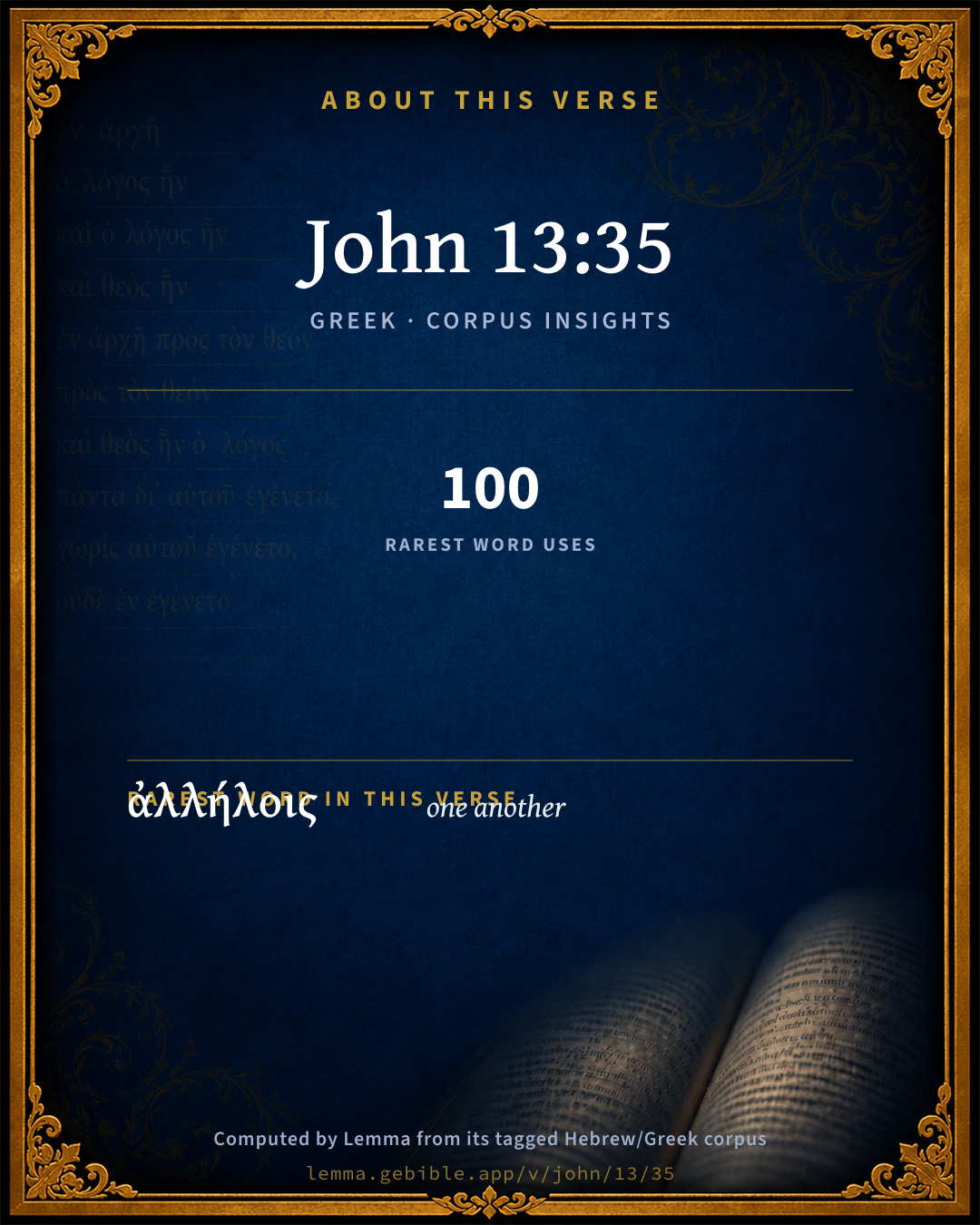
John, in the Gospels, opens this verse with 13 words (12 distinct Greek lemmas). Its most distinctive word is allḗlōn (“one another”). A historical commentator’s framing appears above. Read the whole chapter for the surrounding context.

Discussion questions

  1. How does “one another” (allḗlōn) shape what this verse is saying?
  2. How does 1 John 4:20–21, which shares this passage’s theme, read alongside this verse?
  3. What does the repetition of “in” (2× in this one verse) do in this verse?
  4. These translations render this verse differently; the difference is in the English rendering, not the original. What questions does that raise?
  5. Compare how The Biblical Illustrator and Joseph Benson's Commentary read this verse. Where do they agree or differ?

Things to notice

Reading settings

Reading text

Shown beneath each verse's original-language words.

Old Testament
Old Testament edition

Read the OT as the Masoretic Hebrew (MT) or the Greek Septuagint (LXX).

English shown for the Greek Septuagint (in the Hebrew ↔ Greek comparison).

Comparing translations? Open the Compare panel on any verse page to stack up to four side by side.