John 10:19

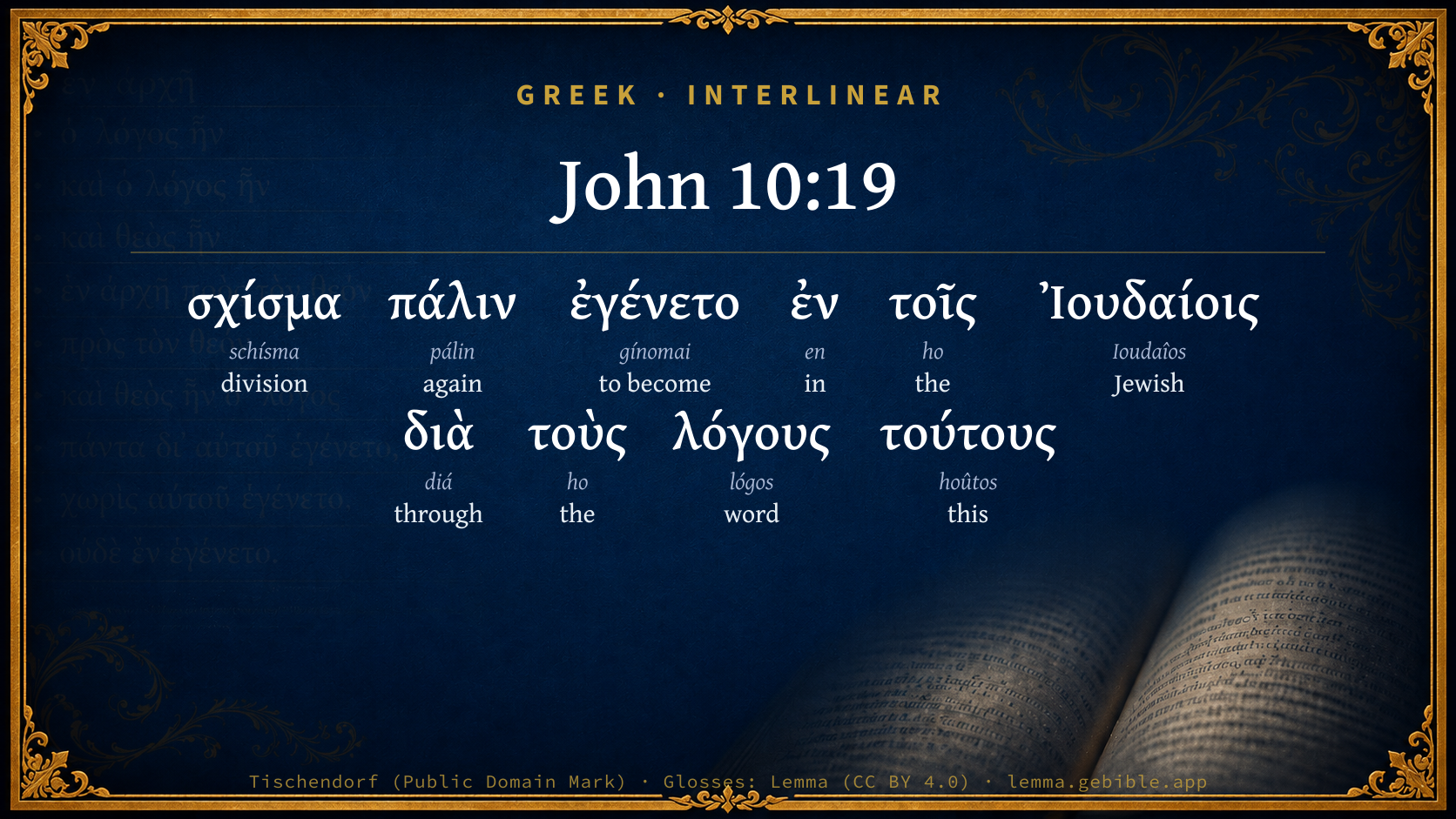
Greek (Tischendorf 8th ed.) John 10:19 appears in the Greek New Testament. The text above is from the Tischendorf 8th edition. Each word links to its Strong’s number and a concise gloss. Click any word for its full Thayer’s Greek Lexicon entry.
Download image
Cite this verse

John 10:19 (World English Bible). Public Domain. Lemma interlinear Bible study tool, https://lemma.gebible.app/v/john/10/19.

Show BibTeX & RIS
BibTeX
RIS
English Translation
Therefore a division arose again among the Jews because of these words.
World English Bible · Public Domain
Download a study sheet

One document with this verse’s original text, its word-by-word gloss line, the meaning frame, cross-references with their text, attributed commentary, and full source and license credits — printable, and it pastes into notes with its structure intact.

This verse Autodidact and up

Study sheet (.html) Plain text (.txt)

A passage Seminary Student

Up to 50 verses in one chapter. A passage sheet keeps up to 6 commentary sources and 12 cross-references per verse, in the order this page ranks them, and says so on the sheet whenever that leaves anything out. Ask for a single verse and you get the Autodidact verse sheet above.

Everything on this page stays free to read, with no account — the sheet is a download of what is already on screen, not access to it.

Want to remove ads? Support Godless Engineer
Compare translations 3

The same verse in 3 English versions, stacked beneath the original-language interlinear above. Click any original word for its lexicon entry.

Each is an independent rendering of the whole verse — the interlinear is not word-aligned to these translations.

Highlighted words mark where these versions differ — a whole-verse word diff, not a word-by-word alignment.

  • World English Bible Public Domain
    Therefore a division arose again among the Jews because of these words.
  • King James Version Public Domain
    There was a division therefore again among the Jews for these sayings.
  • unfoldingWord Literal Text CC BY-SA 4.0
    A division again occurred among the Jews because of these words.

unfoldingWord Literal Text — © unfoldingWord, licensed CC BY-SA 4.0. Word-aligned USFM3 via Door43 (git.door43.org/unfoldingWord/en_ult).

Versions to compare (up to 4)

3 of 4 selected

Show all 19 translations

Every available English version of this verse, each an independent rendering of the whole verse.

  • World English Bible Public Domain
    Therefore a division arose again among the Jews because of these words.
  • Berean Standard Bible Public Domain
    Again there was division among the Jews because of Jesus’ message.
  • Majority Standard Bible Public Domain
    Therefore there was again division among the Jews because of Jesus’ message.
  • King James Version Public Domain
    There was a division therefore again among the Jews for these sayings.
  • American Standard Version (1901) Public Domain
    There arose a division again among the Jews because of these words.
  • Revised Version (1885) Public Domain
    There arose a division again among the Jews because of these words.
  • Geneva Bible (1599) Public Domain
    Then there was a dissension againe among the Iewes for these sayings,
  • Douay-Rheims (1899) Public Domain
    A dissension rose again among the Jews for these words.
  • Young's Literal Translation Public Domain
    Therefore, again, there came a division among the Jews, because of these words,
  • Literal Standard Version CC BY-SA 4.0
    Therefore, again, there came a division among the Jews, because of these words,
  • Unlocked Literal Bible CC BY-SA 4.0
    A division again occurred among the Jews because of these words.
  • unfoldingWord Literal Text CC BY-SA 4.0
    A division again occurred among the Jews because of these words.
  • Darby Bible Public Domain
    There was a division again among the Jews on account of these words;
  • World Messianic Bible Public Domain
    Therefore a division arose again among the Judeans because of these words.
  • Webster's Bible Public Domain
    There was a division therefore again among the Jews for these sayings.
  • Free Bible Version CC BY-SA 4.0
    The Jews were again divided in their opinion about Jesus over these words.
  • Bible in Basic English Public Domain
    There was a division again among the Jews because of these words.
  • Text-Critical English NT CC BY 4.0
    At these words there was again a division among the Jews.
  • Tyndale New Testament (1534) Public Domain
    And ther was a dissencion agayne amonge the Iewes for these sayinges

Literal Standard Version (2020), Covenant Press — licensed CC BY-SA 4.0. Text via the HelloAO Bible API (eBible.org). Unlocked Literal Bible (unfoldingWord) — licensed CC BY-SA 4.0. Text via the HelloAO Bible API (eBible.org). unfoldingWord Literal Text — © unfoldingWord, licensed CC BY-SA 4.0. Word-aligned USFM3 via Door43 (git.door43.org/unfoldingWord/en_ult). Free Bible Version, Dr. Jonathan Gallagher — licensed CC BY-SA 4.0. Text via the HelloAO Bible API (eBible.org).

Word by word

More ways to search: Search by grammar → Find every occurrence → Compare this word →

Practice this passage: Drill this verse → Learn its vocabulary →

About this verse

These counts appear in no published source. They are computed here, from the morphology-tagged text and Lemma’s own curated glosses. What Lemma adds →

10
words
9
distinct lemmas
Gospels
section

Notable vocabulary

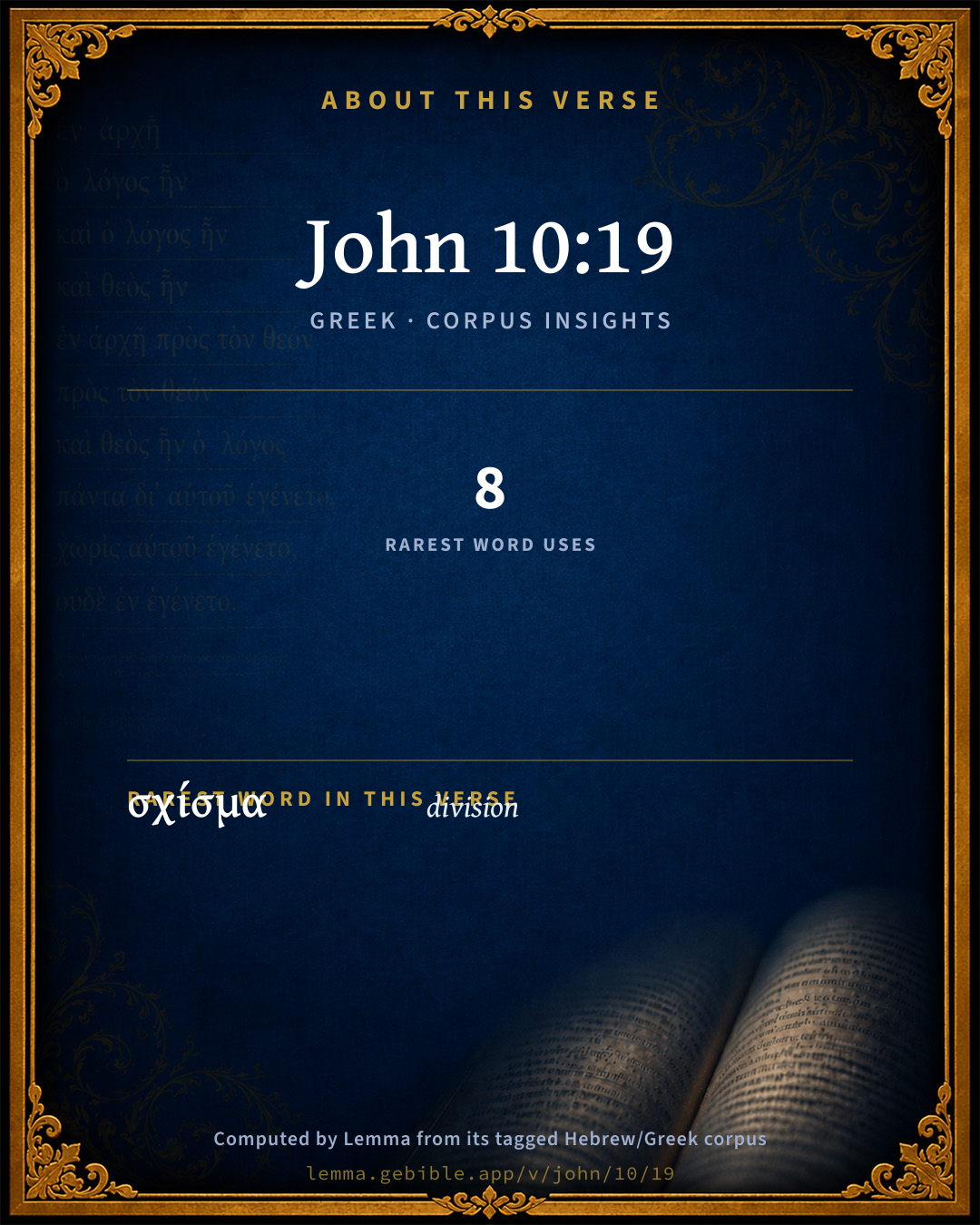
The rarest word here is σχίσμα division G4978 — appearing just 8 times in the whole Greek New Testament.

Shared distinctive vocabulary

σχίσμα division G4978 occurs in 8 verses of the Greek New Testament. Also found in:

Repetition

A word recurs within this verse:

  • τοῖς the G3588 ×2

Cross-references

8

Topical passages linked to John 10:19 in the Treasury of Scripture Knowledge — connected by theme and wording, ordered by reader-vote popularity; previews shown in the World English Bible.

  • John 9:16 Some therefore of the Pharisees said, "This man is not from God, because he doesn't keep the Sabbath." Others said, "How can a man who is a sinner do such signs?" There was division among them.
  • 1 Corinthians 3:3 for you are still fleshly. For insofar as there is jealousy, strife, and factions among you, aren't you fleshly, and don't you walk in the ways of men?
  • John 7:40–43 Many of the multitude therefore, when they heard these words, said, "This is truly the prophet."
  • Acts 14:4 But the multitude of the city was divided. Part sided with the Jews, and part with the apostles.
  • Acts 23:7–10 When he had said this, an argument arose between the Pharisees and Sadducees, and the assembly was divided.
  • Matthew 10:34–35 "Don't think that I came to send peace on the earth. I didn't come to send peace, but a sword.
  • Luke 12:51–53 Do you think that I have come to give peace in the earth? I tell you, no, but rather division.
  • 1 Corinthians 11:18 For first of all, when you come together in the assembly, I hear that divisions exist among you, and I partly believe it.

Cross-references courtesy of OpenBible.info (CC BY 4.0).

Where the printed editions differ

1 variant

Places in this verse where the major printed Greek editions disagree on the wording in a way that affects the translation — a comparison of editions, not a manuscript-by-manuscript collation. The editions are the modern critical texts (Nestlé-Aland 28/27, SBL, Westcott-Hort, Tregelles, Tyndale House) and the traditional texts behind the KJV (the Textus Receptus and the Byzantine/Majority text). It is not a claim about which reading is original.

  1. Extra text
    οὖν

    “therefore”

    In TRByz Not in NA28NA27TynSBLWHTreg

    οὖν (oun) 'therefore' is only in traditional manuscripts (TR+Byz)

Textual data: Translators Amalgamated Greek New Testament (STEPBible TAGNT) · CC BY 4.0.

Commentary

Notes on John 10:19 from classic Christian and Jewish commentators (each source and its license shown beneath its notes). The classic Christian expositions comment on the surrounding passage and are grouped to its opening verse, so a note may address several verses; the Jewish commentaries on the Tanakh (Rashi and others) are per-verse, so they appear only where the commentator wrote on this verse.

Lemma curates 59 commentaries, every one of them public domain or Creative Commons licensed, each selected and text-cleaned for this edition rather than reprinted as found. About our sources →

The Biblical Illustrator

Joseph S. Exell

Joh_10:19-21

There was a division … for these sayings.

--Here was

I. A BAD SPIRIT.

1. Schismatic. There was a division. Sad that Christ and His doctrines should divide men into sects. One might have thought that as His life was so pure, loving, morally commanding, and His doctrine so congruous with reason and spiritual wants, that all men would have centred in Him. Schism in relation to Christ is bad--a calumny on the gospel and a curse to the race.

2. Blasphemous (Joh_10:20). There are two evils men commit on the question of moral causation.

(1) Some ascribe bad deeds to God. The warrior after his bloody achievements returns thanks to God who commanded us not to kill, and declared that woes arise from the lusts of the wicked heart. The priest who presumes to stand between God and the people ascribes his crafty deeds to God. Islam and Mormon leaders impose on credulity a pretended heavenly authority. How much despotism, plunder, and oppression are enacted in Gods name!

(2) Some ascribe good deeds to Satan, as these jealous, cavilling, and malicious Jews. To trace this Divine act to Gods arch foe was heinous sin; yet the principle of this is too common in every age. What is the conduct of those who assign the effects of Christianity to the ingenuity of imposters who designate the Bible a cunningly-devised fable, and brand as hypocrites the most holy and useful men?

3. Intolerant. Why hear ye Him? This is the spirit of all bigots and persecutors. The same language is often used by one sect about a preacher of another sect.

II. A SOUND ARGUMENT (Joh_10:21). A devil could not, and would not if he could, give eyes to the blind. This is the same principle as Christs--By their fruits ye shall know them. This is an infallible test. Judge, then, Christianity by its works. (D. Thomas, D. D.)

Christs words and deeds

There arose a division again among the Jews because of the words which Jesus had uttered. It is the old story. Jesus Christ has always divided human communities. He cannot be ignored. How can He be accounted for? He is the great enigma which calls forth many answers. In the preceding verses we have one of those hurried estimates of Christ given in the white heat of anger--He hath a devil and is mad. There are a class of men who never fail to come to very speedy and decided conclusions. They arrive at them by a short cut, and very often by astounding leaps. They have a keen sensitiveness to the presence of a devil a long time before he appears, and as a rule point in the direction from which he is least likely to come. The explanation that Jesus had a devil had became a commonplace, but had carried with it no conviction in being frequently repeated. There were keen-sighted men in the crowd who saw through it all--Others said, These are not the words of Him that hath a devil. Can a devil open the eyes of the blind? There is true philosophy in these words uttered hurriedly by unknown speakers in that surging throng. Some of the worlds best utterances are anonymously recorded. The truth suggested by our text is--That words and deeds are tests of character which men should not ignore.

I. Our Lords SPEECH as a test of His character--These are not the sayings of one possessed with a devil. Some one possibly smiles incredulously and asks--Who can judge a man by his speech? Napoleon the Great held that speech was made to conceal thoughts and purposes. But did he succeed in confining speech within these ignoble limits? For a time and in certain cases he doubtless did. But what of those peevish and angry utterances of his at St. Helena? As we read the story we are forced to exclaim, Oh, man, thy speech bewrayeth thee! That great actor was no longer able to conceal himself, when he fretted and fumed and swore in helpless pevishness. Watch a mans utterances through and through, and he cannot hide himself from you. He may at times flatter himself that he has succeeded in the attempt, but his speech so wronged and misused at length plays traitor with him in return, and reveals what manner of man he is. Speech, graciously given by God to man alone on earth, as a means by which he shall be able to express truth, will not suffer itself evermore to be made the degraded instrument of diplomacy and deceit. It will at times involuntarily start and assert itself. In the records of the best lives we find words uttered in haste, unpremeditated, or under great provocation, which needed an apology, since they revealed the weaker and less noble side of character. When did Christ utter such words? In speech He was never overtaken in a fault. His disciples often were, but He never. Again, see if there were immature words uttered at the outset of His ministry, which revealed the crudities of youth, or an imperfect estimate of that ministry to which He had committed His life. Was there ever anything said by Him which betrayed a wrong motive, or defective moral teaching? Have succeeding ages been able to find a flaw in His doctrine, or have they been able to add a single virtue to those which He taught men? Have any words lived like His, or living, exerted such a sanctifying, healing and ennobling influence over human lives? Let us refer to one or two features of His incomparable utterances. What does he say about God? No teacher of men can be silent on this great theme. He tells men many tender, loving things concerning God--that He clothes the lily, feeds the sparrow, numbers the hairs of our head, and, finally, that He so loved the world as to give His only begotten Son, that whosoever believeth in Him should not perish but have everlasting life. Has any teaching concerning God given such light and joy to human heart as this? Verily, These are not the sayings of one possessed with a devil! Again, what has He to say about man? By the graveside of our dearest and best ones can any assurance compare with His--I am the Resurrection and the Life, he that believeth in Me shall never die? Because I live ye shall live also? Whence hath this man these things? These are not the words of one possessed with a devil. We consider

II. Our Lords DEEDS as tests of His character. Can a devil open the eyes of the blind? It is the prerogative of the devil to close mens eyes, not to open them. It is not so much the miracle of giving sight as the beneficent nature of it that stamps it as undiabolic. What was the tendency of our Lords deeds? Precisely the same as His teaching. Did He not always go about doing good? There is a harmony of goodness and of benevolence in His works from the beginning to the close. Above all, is there anything for power and tenderness to compare with His Cross? And here we come to the root of the whole matter. Theology, history, and moral philosophy can all apply their tests; but no test can compare with Chat of our own experience. Our experience may fail to appeal powerfully to others, but nothing is so convincing to ourselves. Among our Lords disciples are the noblest men and women whom the world has ever known, and they attribute all their blessings to Him. (David Davies.)

The Biblical Illustrator, edited by Joseph S. Exell (c. 1880s–1900s) — public domain. Text from a community e-Sword module.

Joseph Benson's Commentary

Joh 10:19-21. There was a division among the Jews — These sayings of our Lord “affected the minds of the Jews differently, for some of them cried out that he was possessed and mad, and that it was folly to hear him; others, judging more impartially of him and his doctrine, declared that his discourses were not the words of a lunatic, nor his miracles the works of a devil. Moreover, they asked his enemies if they imagined any devil was able to impart the faculty of sight to one that was born blind alluding to the astonishing cures which Jesus had lately performed.” — Macknight.

Joseph Benson's Commentary on the Old and New Testaments (1811–1818) — public domain. Text from a community e-Sword module.

Tyndale Open Study Notes

Tyndale Open Resources

10:19-21 Jesus divided his audience yet again (see also 6:66-69; 7:43; 9:16), inspiring either opposition or faith. • He’s demon possessed: Cp. 7:20; 8:48-49, 52.

Tyndale Open Study Notes — © Tyndale Open Resources, licensed CC BY-SA 4.0. Text via the HelloAO Bible API.

Bengel's Gnomon

Johann Albrecht Bengel

Joh 10:19. Σχίσμα, a division) Whence do such various reasonings concerning Christ originate? I reply, Inasmuch as His person is not known.

Bengel's Gnomon of the New Testament — English translation (T&T Clark, Edinburgh, 1860) — public domain. Text from a community e-Sword module.

Meyer's Critical & Exegetical Commentary

Heinrich August Wilhelm Meyer

Joh_10:19-21. Πάλιν] see Joh_9:16.

ἐν τοῖς Ἰουδαίοις.] These words refer to the Pharisees (Joh_9:40) who, in keeping with their relationship to Jesus (against De Wette), are designated according to the class to which they belonged (as the Jewish hierarchical opposition). The majority of them clung to the hostile judgment (compare Joh_8:48), which they had contemptuously expressed; some of them, however, felt themselves impressed, and deny the assertion of the rest. Comp. Joh_9:16.

τί αὐτοῦ ἀκούετε] i.e. of what use is it to you to listen to His discourses?

καὶ μαίνεται] in consequence of being possessed by a demon.

μὴ δαιμόνιον, etc.] surely a demon cannot, etc.; a confirmation of that denial from the miracle which had given rise to the entire discussion. We see from this that these ἄλλοι belonged to the more unprejudiced and conscientious class which had given expression to its feelings in Joh_9:16. At the same time, the conclusion must not be drawn that they would have refused to recognise any demoniacal miracles (were they even in themselves beneficent),

Mat_12:24 is opposed to this view; but they believed it impossible to attribute a miracle of so great a kind to a demon, who must have been working through the medium of Jesus. Note, moreover, that even here they do not get further than a negative judgment.

Meyer — Critical and Exegetical Commentary on the New Testament — English translation by Peter Christie, edited by Frederick Crombie (T&T Clark, 1880) — public domain. Text from a community e-Sword module.

Expositor's Greek Testament

ed. W. Robertson Nicoll

Joh 10:19-21 . The result of this discourse briefly described .

Joh 10:19 . As usual, diverse judgments were elicited, and once more a division of opinion appeared, Σχίσμα οὖν πάλιν ἐγένετο … Many thought Him possessed and mad, as in Mar 3:21 ; cf. οὐ μαίνομαι of Paul, Act 26:24 . Others took the more sensible view. These words they had heard were not the wild exclamations and ravings they usually heard from demoniacs; and His acts, such as opening the blind man’s eyes, were not within the compass of a demon.

The Expositor's Greek Testament, edited by W. Robertson Nicoll (1897–1910) — public domain. Text from a community e-Sword module.

Vincent's Word Studies in the New Testament

Marvin R. Vincent

There was a division [σχισμα εγενετο] . Rev., more correctly, there arose. The word scisma, division, from scizw, to cleave, describes a fact which continually recurs in John's narrative. See Joh 6:52, 60, 66; Joh 7:12, 25 sqq.; Joh 8:22; Joh 9:16, 17; Joh 10:19, 24, 41; Joh 11:37 sqq.; Joh 12:19, 29, 42; Joh 16:18, 19. Words [λογους] . Or, discourses.

Marvin R. Vincent, Word Studies in the New Testament (1887–1900) — public domain. Text from a community e-Sword/MySword module.

Geneva Bible (1599)

Geneva Bible translators

The Gospel discovereth hypocrisy, and therefore the world must needs rage when it cometh forth.

Geneva Bible (1599) marginal notes — public domain. Text via Bolls.life.

Matthew Henry's Commentary

We have here an account of the people's different sentiments concerning Christ, on occasion of the foregoing discourse; there was a division, a schism, among them; they differed in their opinions, which threw them into heats and parties. Such a ferment as this they had been in before (Joh 7:43; Joh 9:16); and where there has once been a division again. Rents are sooner made than made up or mended. This division was occasioned by the sayings of Christ, which, one would think, should rather have united them all in him as their centre; but they set them at variance, as Christ foresaw, Luk 12:51. But it is better that men should be divided about the doctrine of Christ than united in the service of sin, Luk 11:21. See what the debate was in particular.

I. Some upon this occasion spoke ill of Christ and of his sayings, either openly in the face of the assembly, for his enemies were very impudent, or privately among themselves. They said, He has a devil, and is mad, why do you hear him? 1. They reproach him as a demoniac. The worst of characters is put upon the best of men. He is a distracted man, he raves and is delirious, and no more to be heard than the rambles of a man in bedlam. Thus still, if a man preaches seriously and pressingly of another world, he shall be said to talk like an enthusiast; and his conduct shall be imputed to fancy, a heated brain, and a crazed imagination. 2. They ridicule his hearers: "Why hear you him? Why do you so far encourage him as to take notice of what he says?" Note, Satan ruins many by putting them out of conceit with the word and ordinances, and representing it as a weak and silly thing to attend upon them. Men would not thus be laughed out of their necessary food, and yet suffer themselves to be laughed out of what is more necessary. Those that hear Christ, and mix faith with what they hear, will soon be able to give a good account why they hear him.

II. Others stood up in defence of him and his discourse, and, though the stream ran strong, dared to swim against it; and, though perhaps they did not believe on him as the Messiah, they could not bear to hear him thus abused. If they could say no more of him, this they would maintain, that he was a man in his wits, that he had not a devil, that he was neither senseless nor graceless. The absurd and most unreasonable reproaches, that have sometimes been cast upon Christ and his gospel, have excited those to appear for him and it who otherwise had no great affection to either. Two things they plead: - 1. The excellency of his doctrine: "These are not the words of him that hath a devil; they are not idle words; distracted men are not used to talk at this rate. These are not the words of one that is either violently possessed with a devil or voluntarily in league with the devil." Christianity, if it be not the true religion, is certainly the greatest cheat that ever was put upon the world; and, if so, it must be of the devil, who is the father of all lies: but it is certain that the doctrine of Christ is no doctrine of devils, for it is levelled directly against the devil's kingdom, and Satan is too subtle to be divided against himself. So much of holiness there is in the words of Christ that we may conclude they are not the words of one that has a devil, and therefore are the words of one that was sent of God; are not from hell, and therefore must be from heaven. 2. The power of his miracles: Can a devil, that is, a man that has a devil, open the eyes of the blind? Neither mad men nor bad men can work miracles. Devils are not such lords of the power of nature as to be able to work such miracles; nor are they such friends to mankind as to be willing to work them if they were able. The devil will sooner put out men's eyes than open them. Therefore Jesus had not a devil.

Matthew Henry's Commentary on the Whole Bible (1708–1710) — public domain (CC PDM 1.0). Text via the HelloAO Bible API.

Jamieson, Fausset & Brown

Robert Jamieson, A. R. Fausset & David Brown

There was a division . . . again among the Jews for these sayings--the light and the darkness revealing themselves with increasing clearness in the separation of the teachable from the obstinately prejudiced. The one saw in Him only "a devil and a madman"; the other revolted at the thought that such words could come from one possessed, and sight be given to the blind by a demoniac; showing clearly that a deeper impression had been made upon them than their words expressed.

Jamieson, Fausset & Brown — Commentary Critical and Explanatory on the Whole Bible (1871) — public domain (CC PDM 1.0). Text via the HelloAO Bible API.

Adam Clarke's Commentary

Verse 19. There was a division] σχισμα, a schism, a rent. They were divided in their opinions; one part received the light, and the other resisted it.

Again] There was a dissension of this kind before among the same people; see Joh 9:16.

Adam Clarke's Commentary on the Bible (1810–1826) — public domain. Text from a community e-Sword/MySword module.

John Calvin's Commentaries

19. A division therefore arose again. The advantage gained by Christ’s discourse was, that it procured him some disciples; but as his doctrine has also many adversaries, hence arises a division, so that they are split into parties, who formerly appeared to be one body of the Church. for all, with one consent, professed that they worshipped the God of Abraham and complied with the Law of Moses; but now, when Christ comes forward, they begin to differ on his account. If that profession had been sincere, Christ, who is the strongest bond of charity, and whose office it is to gather those things which are scattered, would not break up their agreement. But Christ, by the light of his Gospel, exposes the hypocrisy of many who, while they had nothing but a false and hypocritical pretense, boasted that they were the people of God.

Thus, the wickedness of many is still the reason why the Church is troubled by divisions, and why contentions are kindled. Yet those who disturb the peace, throw the blame on us, and call us Schismatics; for the principal charge which the Papists bring against us is, that our doctrine has shaken the tranquillity of the Church. Yet the truth is, that, if they would yield submissively to Christ, and give their support to the truth, all the commotions would immediately be allayed. But when they utter murmurs and complaints against Christ, and will not allow us to be at rest on any other condition than that the truth of God shall be extinguished, and that Christ shall be banished from his kingdom, they have no right to accuse us of the crime of schism; for it is on themselves, as every person sees, that this crime ought to be charged. We ought to be deeply grieved that the Church is torn by divisions arising among those who profess the same religion; but it is better that there are some who separate themselves from the wicked, to be united to Christ their Head, than that all should be of one mind in despising God. Consequently, when schisms arise, we ought to inquire who they are that revolt from God and from his pure doctrine.

John Calvin's Commentaries (1540-1563) — public domain. Text from the Calvin Translation Society English edition (1840s-50s) via the Christian Classics Ethereal Library (ccel.org). Calvin's coverage is partial (roughly two-thirds of the Bible); uncommented books and verses are honest gaps, never fabricated. The 19th-century editor's footnotes and remarks are omitted so the notes are faithfully Calvin's own voice.

Ellicott's Commentary for English Readers

(19) There was a division therefore again . . .—The words carry us back to those of Joh_9:16, where a like division was noted.

Among the Jews.—The Pharisees are mentioned before, and they are the persons who have been present all through this discourse. (Comp. Joh_9:40.) The wider word is here, and in Joh_9:18, applied to them. They were identifying themselves with, and becoming leaders of, the party who were the enemies of Christ. (Comp. Note on Joh_1:19.)

A Bible Commentary for English Readers, edited by Charles John Ellicott (1878–1897) — public domain. Text from a community e-Sword module.

The Cambridge Bible for Schools and Colleges

gen. ed. J. J. S. Perowne

19–21. Opposite Results of the Teaching

19. again] As about the man born blind (Joh_9:6) among the Pharisees, and at the Feast of Tabernacles (Joh_7:43), among the multitude. ‘Therefore’ should be omitted here as wanting authority; and ‘there arose’ would be more accurate than ‘there was’ (see on Joh_1:6); there arose a division again. See on Joh_7:43.

among the Jews] Some even among the hostile party are impressed, and doubt the correctness of their position: comp. Joh_11:45.

The Cambridge Bible for Schools and Colleges (gen. ed. J. J. S. Perowne; Cambridge University Press, 1878–1918) — public domain. Text from a community e-Sword module.

John Gill's Exposition

There was a division therefore again among the Jews,.... As there had been before; see Joh 7:12.

For these sayings; concerning his being the good shepherd, and laying down his life for the sheep, and having both a power to lay it down, and take it up again.

John Gill's Exposition of the Whole Bible (1746–1763) — public domain (CC PDM 1.0). Text via the HelloAO Bible API.

Trapp's Complete Commentary

John Trapp

19 There was a division therefore again among the Jews for these sayings.

Ver. 19. There was a division therefore, &c.] This our Saviour foresaw, and yet forbears not. God’s truth must be spoken, however it be taken. Men, be they pleased or displeased, God must be obeyed, and his whole will declared. If men refuse to receive it, we must turn them over to God, with a non convertentur, obstinate sinner, and then let him alone with them.

John Trapp, A Commentary or Exposition upon All the Books of the Old and New Testament (1647–1656) — public domain. Text from a community e-Sword module.

Matthew Poole's English Annotations

Christ by his words often caused a division amongst the Jews, so as they could not agree in their sentiments and censures about him; which was either caused through the mixture amongst them of such as truly believed with those who believed not; or else from the mixture of a more considering part amongst them with others who were more brutish, irrational, and full of passion. We met with much the same, Joh 7:43, and again, Joh 9:16. It is one method of God’s providence for the deliverance of his servants from unreasonable men, to cause divisions among them, so as they cannot agree among themselves.

Matthew Poole's English Annotations on the Holy Bible (1683–1685) — public domain. Text from a community e-Sword/MySword module.

Whedon's Commentary on the Bible

Daniel D. Whedon

19. A division—From the first interruption of Jesus by the Pharisees in Joh_9:40, he has prosecuted a discourse, expanding, in its progress, from reproof, through monitory picture, and finishing with the deepest, grandest truth and mystery of his death. The crowd, gathering perhaps as his discourse expanded, are not all one wilfully opposing mass. As at Joh_9:16, and Joh_7:43, there is a division. But the opposers are many, and the susceptible are only others. Had truth and honesty been their purpose the believers would have been all. They were free to choose right, but decided for the wrong.

Daniel D. Whedon (gen. ed.), Commentary on the Old and New Testaments (1874–1909) — public domain. Text from a community e-Sword module.

The Pulpit Commentary

Vers. 19-21. (b) The twofold effect of this declaration.

Vers. 19, 20. There arosea division again among the Jews because of these words. And many of them were saying, He hath a daemon, and is mad; why hear ye him? The division among the Jews had repeatedly taken place. In Joh_7:12, Joh_7:30, Joh_7:31, Joh_7:40, Joh_7:41, and Joh_9:8, Joh_9:9, Joh_9:16, we see different stages of the hostility and different aspects of opinion. They reached a similar point of expression in Joh_7:20 Joh_8:48. With bitter madness the Pharisees charged the Lord with being under the power of a "daemon," and with consequent raving, i.e. with irrationality and even evil motive. By this means "the Jews" sought to dissuade the people from any attention to such logouv (sermones, Vulgate), discourses. They would not have done this if the impression on some had not been conspicuous and overpowering. "Why hear ye him?" This was not the first time such division had occurred, and hence the palin , again. (see notes, Joh_8:48) Some were listening with eager, bewildering excitement. They knew not what to think. Their nascent faith is rebuked by the authorities.

Vers. 19-21. Calumny confuted.

Every faithful teacher, coming into a morally mixed society, meets with a twofold experience: he evokes the hostility of those who hate truth and righteousness, and he rallies to him those who are candid, just, and pure. Such was eminently the result of our Lord"s ministry among the Jews. It was foretold that, as a consequence of Christ"s coming, "thoughts out of many hearts should be revealed." Never was this more manifestly the case than during those discussions which arose between Jesus and the Jews towards the close of his ministry.

I THE CALUMNY ADVANCED AGAINST CHRIST.

1. The real and lasting ground of calumny. It was the truthfulness and purity of Christ"s character; it was the justice and severity of his denunciations of formalism and hypocrisy, that incensed the Jewish leaders against the holy, outspoken, and fearless Prophet of Nazareth.

2. The immediate and special ground of calumny. It is noticeable that, on the several occasions upon which the slander mentioned in the context was uttered, Jesus had just been making some high claim to communion with his Divine Father, and to a consequent authority altogether above any wielded by created beings.

3. The real motive of the calumnies of the Jews was, therefore, their moral indisposition to tolerate the highest excellence. They loved darkness rather than light.

4. The nature of the calumny. It was said to Jesus, and of him, that he was possessed by a demon, and was insane. How it could be supposed that such gross slanders could meet with any credit, we are at a loss to say. It is certainly an instance of the malignity of sinners that such a calumny could be invented, and of the credulity of fools that it could be believed.

5. The purpose of the calumny. This was to discredit Jesus, to weaken his influence with the people, and so to aid the Jews in their malevolent aim, which was, no doubt, to bring his ministry to a shameful and violent close.

II THE CONFUTATION OF THE CALUMNY.

1. It is observable that this did not proceed from Jesus himself, or from his immediate friends and professed disciples. Its effect must have been all the greater from its origin in the minds of impartial. spectators and auditors.

2. The sayings of Christ are declared incompatible with the supposition that Jesus was possessed by a demon. Their sobriety and reasonableness was a refutation of the charge of madness; whilst their justice, their purity, their opposition to falsehood, error, and deceit, were conclusive against the foolish accusation that they were inspired by the prince of darkness.

3. The works of Christ were, if possible, even more exclusive of such an imagination, such an invention as that referred to. Jesus had opened the eyes of a blind man, he had wrought other miracles of a nature most beneficent, he had relieved men from privations and sufferings, and restored them to health, to sanity, to happiness. It was incredible that such deeds of mercy as these could be inspired by the emissary of the foe of man. T.

The Pulpit Commentary (1880–1919), ed. H.D.M. Spence-Jones & Joseph S. Exell — public domain. Text from a community e-Sword module.

Burkitt's Expository Notes on the New Testament

William Burkitt

Here the evangelist shews what different effects this sermon of our Saviour had upon the Jews; many of them calumniate and slander him, as one possessed and mad, and therefore not to be heard and minded; others of calmer thoughts said, That the doctrine be taught, and the late miracle which he had wrought in curing the blind man, were abundantly sufficient to confute such a groundless slander.

Learn hence, That the doctrine of Christ meeting with diversity of dispositions, it is no wonder that it occasions different effects, to the softening of some, and hardening of others: even as the same sun that melteth the wax, hardeneth the clay; yet is not this to be imputed to the doctrine of our Saviour, but to men’s corruptions which oppose the truth, and the maintainers of it. There was a division again amongst them.

William Burkitt's Expository Notes on the New Testament (1700–1703) — public domain. Text from a community e-Sword module.

unfoldingWord translationNotes

Door43 World Missions Community

Connecting Statement:

These verses tell how the Jews responded to what Jesus had said.

Why do you listen to him?

This remark appears in the form of a question to emphasize the point that the people should not listen to Jesus. AT: "Do not listen to him!" (See: Rhetorical Question)

Can a demon open the eyes of the blind?

This remark appears in the form of a question to add emphasis. AT: "Certainly a demon cannot cause a blind man to see!" or "Certainly a demon cannot give sight to blind people!" (See: Rhetorical Question)

translationWords

Jew

demon

demon-possessed

unfoldingWord translationNotes — © Distant Shores Media and the Door43 World Missions Community, licensed CC BY-SA 4.0. Source: git.door43.org/Door43/en_tn.

Cambridge Greek Testament for Schools and Colleges

19–21. OPPOSITE RESULTS OF THE TEACHING

19. σχίσμα πάλιν ἐγ. There arose (Joh 1:6) a division (Joh 7:43) again among the Jews, as among the Pharisees about the blind man (Joh 9:16), and among the multitude at the Feast of Tabernacles (Joh 7:43). Here we see that some even of the hostile party are impressed, and doubt the correctness of their position: comp. Joh 11:45.

τ. λόγους τ. These words or discourses (sermones), whereas ῥήματα (Joh 10:21) are the separate sayings or utterances (verba): τ. λόγους is the larger expression.

Cambridge Greek Testament for Schools and Colleges (Cambridge University Press, 1896; 21 vols, various authors incl. Carr, Maclear, Plummer, Farrar, Lumby, Moule, M. R. James, Simcox) — public domain. Text from a community e-Sword module.

Alford’s Greek Testament

Henry Alford

19-21.] The concluding words bind this discourse to the miracle of ch. 9, though not necessarily in immediate connexion.

Henry Alford, The Greek Testament (1849–1861) — public domain. Text from a community e-Sword module.

Godet's Commentaries

Frédéric Louis Godet

Vv. 19-21. “There was therefore again a division among the Jews because of these discoursings. 20. Many of them said, He is possessed of a demon, and is mad; why do you listen to him? 21. Others said, These are not the discoursings of one possessed; can a demon open the eyes of the blind?”

Always the same result; a division, which forms the prelude to the final choice; comp. Joh 7:12; Joh 7:30-31; Joh 7:40-41; Joh 9:8-9; Joh 9:16. The word πάλιν, again, awakens the attention of the reader to the constant repetition of this result. The words: Why do you listen to Him? show with what uneasiness the decidedly hostile party observed the favorable impression produced by the discourses of Jesus on those who were better disposed. The answer of these latter (Joh 10:21) contains two arguments in juxtaposition. The first is the simple avowal of their impression: the discourse of Jesus does not appear to them to be that of a madman. But immediately they seem to be ashamed of this avowal and withdraw behind another argument which is less compromising: the patent fact of the cure of the blind man. The second argument might be connected with the first by an And besides.

Thus continually more and more do the sheep of Jesus in the vast inclosure of the theocracy separate themselves from the mass of the flock; and for the theme: I and you, which was that of chap. 8 is substituted more and more that theme which is to sum up the new situation: I and mine.

Frédéric Louis Godet — Commentaries on Luke, John, Romans, and 1 Corinthians — English translation (T&T Clark, Edinburgh, 1870s–1890s) — public domain. Text from a community e-Sword module.

Lesson kit

Teaching starters — assembled from the data on this page, not authored interpretation. Every prompt links to the verse data it draws on. Edit before teaching.

John, in the Gospels, opens this verse with 10 words (9 distinct Greek lemmas). Its most distinctive word is schísma (“division”). A historical commentator’s framing appears above. Read the whole chapter for the surrounding context.

Discussion questions

  1. How does “division” (schísma) shape what this verse is saying?
  2. Matthew 9:16 shares the word «division» with this verse. How do the two illuminate each other?
  3. “the” occurs 2× in this one verse. What is the effect of the repetition?
  4. The translations on this page render this verse differently — a whole-verse word diff, not a word-by-word alignment. What might account for the different wordings?
  5. Reading how The Biblical Illustrator and Joseph Benson's Commentary read this verse, where do the two commentators agree and where do they part?

Things to notice

  • These translations choose different wording for 7 words in this verse.
  • “the” occurs 2× in this single verse.
  • 9 distinct Greek lemmas span 10 words in this verse.

Reading settings

Reading text

Shown beneath each verse's original-language words.

Old Testament
Old Testament edition

Read the OT as the Masoretic Hebrew (MT) or the Greek Septuagint (LXX).

English shown for the Greek Septuagint (in the Hebrew ↔ Greek comparison).

Comparing translations? Open the Compare panel on any verse page to stack up to four side by side.