
Luke 16:26

Greek (Tischendorf 8th ed.) Luke 16:26 appears in the Greek New Testament. The text above is from the Tischendorf 8th edition. Each word links to its Strong’s number and a concise gloss. Click any word for its full Thayer’s Greek Lexicon entry.
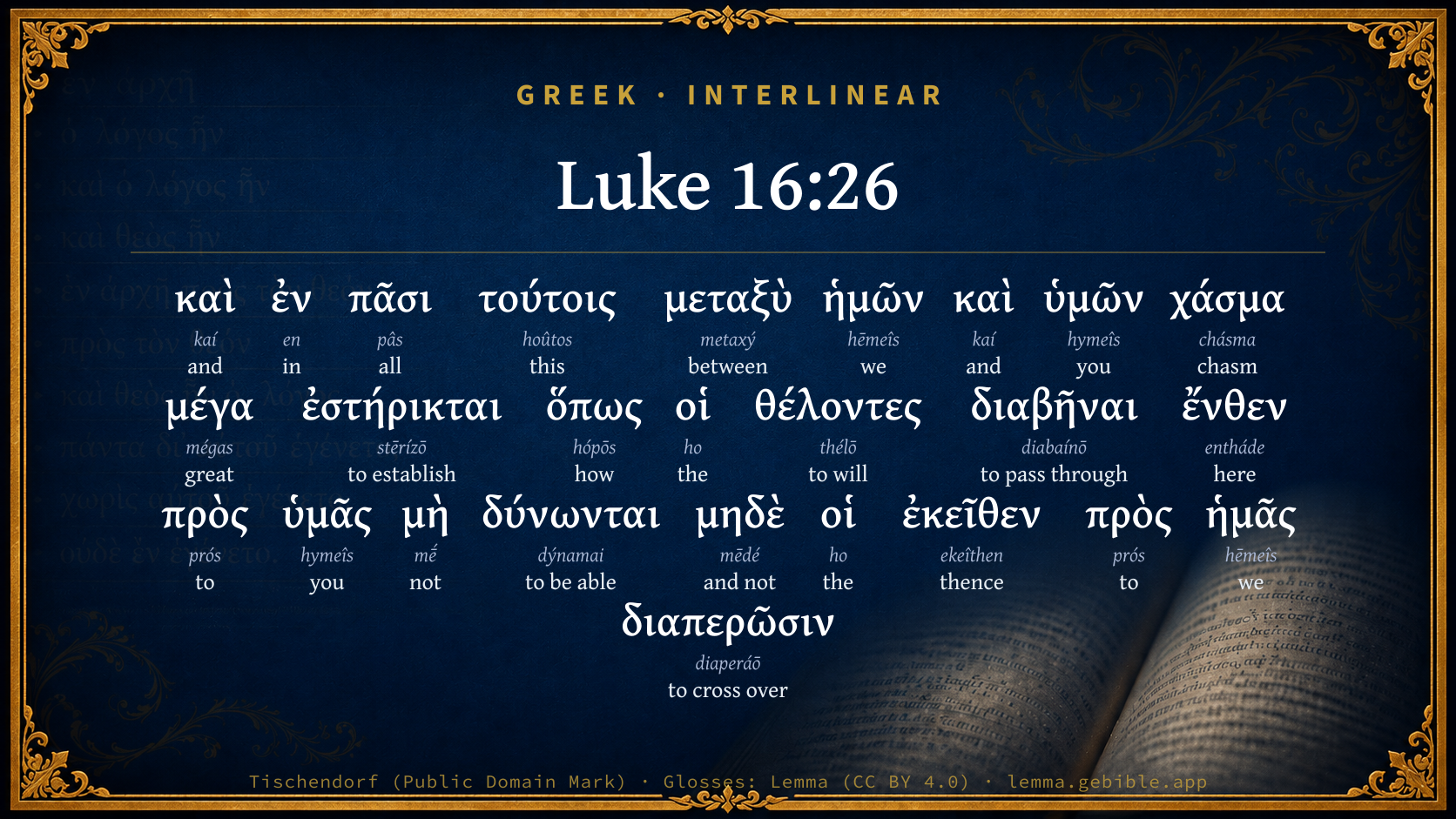
Download image
Cite this verse

Luke 16:26 (World English Bible). Public Domain. Lemma interlinear Bible study tool, https://lemma.gebible.app/v/luke/16/26.

Show BibTeX & RIS
BibTeX
RIS
English Translation
Besides all this, between us and you there is a great gulf fixed, that those who want to pass from here to you are not able, and that none may cross over from there to us.'
World English Bible · Public Domain
Highlights
  • 1 hapax legomenon — only here in the Greek New Testament
  • 2 first appearances in the Greek New Testament
Full analysis ↓
Download a study sheet

One document with this verse’s original text, its word-by-word gloss line, the meaning frame, cross-references with their text, attributed commentary, and full source and license credits — printable, and it pastes into notes with its structure intact.

This verse Autodidact and up

Study sheet (.html) Plain text (.txt)

A passage Seminary Student

Up to 50 verses in one chapter. A passage sheet keeps up to 6 commentary sources and 12 cross-references per verse, in the order this page ranks them, and says so on the sheet whenever that leaves anything out. Ask for a single verse and you get the Autodidact verse sheet above.

Everything on this page stays free to read, with no account — the sheet is a download of what is already on screen, not access to it.

Want to remove ads? Support Godless Engineer
Compare translations 3

The same verse in 3 English versions, stacked beneath the original-language interlinear above. Click any original word for its lexicon entry.

Each is an independent rendering of the whole verse — the interlinear is not word-aligned to these translations.

Highlighted words mark where these versions differ — a whole-verse word diff, not a word-by-word alignment.

  • World English Bible Public Domain
    Besides all this, between us and you there is a great gulf fixed, that those who want to pass from here to you are not able, and that none may cross over from there to us.'
  • King James Version Public Domain
    And beside all this, between us and you there is a great gulf fixed: so that they which would pass from hence to you cannot; neither can they pass to us, that would come from thence.
  • unfoldingWord Literal Text CC BY-SA 4.0
    And with all these things, between us and you a great chasm has been set in place, so that the ones wanting to cross from here to you may not be able, nor may they go across from there to us.’

unfoldingWord Literal Text — © unfoldingWord, licensed CC BY-SA 4.0. Word-aligned USFM3 via Door43 (git.door43.org/unfoldingWord/en_ult).

Versions to compare (up to 4)

3 of 4 selected

Show all 19 translations

Every available English version of this verse, each an independent rendering of the whole verse.

  • World English Bible Public Domain
    Besides all this, between us and you there is a great gulf fixed, that those who want to pass from here to you are not able, and that none may cross over from there to us.'
  • Berean Standard Bible Public Domain
    And besides all this, a great chasm has been fixed between us and you, so that even those who wish cannot cross from here to you, nor can anyone cross from there to us.’
  • Majority Standard Bible Public Domain
    And besides all this, a great chasm has been fixed between us and you, so that even those who wish cannot cross from here to you, nor can anyone cross from there to us.’
  • King James Version Public Domain
    And beside all this, between us and you there is a great gulf fixed: so that they which would pass from hence to you cannot; neither can they pass to us, that would come from thence.
  • American Standard Version (1901) Public Domain
    And besides all this, between us and you there is a great gulf fixed, that they that would pass from hence to you may not be able, and that none may cross over from thence to us.
  • Revised Version (1885) Public Domain
    And beside all this, between us and you there is a great gulf fixed, that they which would pass from hence to you may not be able, and that none may cross over from thence to us.
  • Geneva Bible (1599) Public Domain
    Besides all this, betweene you and vs there is a great gulfe set, so that they which would goe from hence to you, can not: neither can they come from thence to vs.
  • Douay-Rheims (1899) Public Domain
    And besides all this, between us and you, there is fixed a great chaos: so that they who would pass from hence to you, cannot, nor from thence come hither.
  • Young's Literal Translation Public Domain
    and besides all these things, between us and you a great chasm is fixed, so that they who are willing to go over from hence unto you are not able, nor do they from thence to us pass through.
  • Literal Standard Version CC BY-SA 4.0
    and besides all these things, between us and you a great chasm is fixed, so that they who are willing to go over from here to you are not able, nor do they pass through from there to us.
  • Unlocked Literal Bible CC BY-SA 4.0
    Besides all this, a great chasm has been put in place, so that those who want to cross over from here to you cannot, and no one can cross over from there to us.'
  • unfoldingWord Literal Text CC BY-SA 4.0
    And with all these things, between us and you a great chasm has been set in place, so that the ones wanting to cross from here to you may not be able, nor may they go across from there to us.’
  • Darby Bible Public Domain
    And besides all this, between us and you a great chasm is fixed, so that those who desire to pass hence to you cannot, nor do they who [desire to cross] from there pass over unto us.
  • World Messianic Bible Public Domain
    Besides all this, between us and you there is a great gulf fixed, that those who want to pass from here to you are not able, and that no one may cross over from there to us.’
  • Webster's Bible Public Domain
    And besides all this, between us and you there is a great gulf fixed: so that they who would pass from hence to you, cannot; neither can they pass to us, that would come from thence.
  • Free Bible Version CC BY-SA 4.0
    Apart from that, there's a great gulf that stretches between us and you. Nobody who wants to cross from here to you can do so, and nobody can cross from there over to us.’
  • Bible in Basic English Public Domain
    And in addition, there is a deep division fixed between us and you, so that those who might go from here to you are not able to do so, and no one may come from you to us.
  • Text-Critical English NT CC BY 4.0
    And besides all this, a great chasm has been set in place between you and us, so that those who want to cross over to you from here cannot do so, nor can anyone cross over to us from there.’
  • Tyndale New Testament (1534) Public Domain
    Beyonde all this bitwene you and vs ther is a greate space set so that they which wolde goo from thence to you cannot: nether maye come from thence to vs.

Literal Standard Version (2020), Covenant Press — licensed CC BY-SA 4.0. Text via the HelloAO Bible API (eBible.org). Unlocked Literal Bible (unfoldingWord) — licensed CC BY-SA 4.0. Text via the HelloAO Bible API (eBible.org). unfoldingWord Literal Text — © unfoldingWord, licensed CC BY-SA 4.0. Word-aligned USFM3 via Door43 (git.door43.org/unfoldingWord/en_ult). Free Bible Version, Dr. Jonathan Gallagher — licensed CC BY-SA 4.0. Text via the HelloAO Bible API (eBible.org).

Word by word

More ways to search: Search by grammar → Find every occurrence → Compare this word →

Practice this passage: Drill this verse → Learn its vocabulary →

χάσμα
chásma
G5490
“chasm”
Noun, Nominative, Singular, Neuter
Part of Speech
Noun
Case
Nominative
Number
Singular
Gender
Neuter
Full Thayer's Definition

Origin: "from a form of an obsolete prim chao (to "gape" or "yawn")"

TDNT: None

1. a gaping opening, a chasm, a gulf
  1. καὶ kaí G2532 “and” Conjunction
  2. ἐν en G1722 “in” Preposition
  3. πᾶσι pâs G3956 “all” Adjective, Dative, Plural, Neuter
  4. τούτοις hoûtos G3778 “this” Demonstrative pronoun, Dative, Plural, Neuter
  5. μεταξὺ metaxý G3342 “between” Adverb
  6. ἡμῶν hēmeîs G2249 “we” Personal pronoun, 1st person, Genitive, Plural
  7. καὶ kaí G2532 “and” Conjunction
  8. ὑμῶν hymeîs G5210 “you” Personal pronoun, 2nd person, Genitive, Plural
  9. μέγα mégas G3173 “great” Adjective, Nominative, Singular, Neuter
  10. ἐστήρικται stērízō G4741 “to establish” Verb, Perfect, Passive, Indicative, 3rd person, Singular
  11. ὅπως hópōs G3704 “how” Adverb
  12. οἱ ho G3588 “the” Article, Nominative, Plural, Masculine
  13. θέλοντες thélō G2309 “to will” Verb, Present, Active, Participle, Nominative, Plural, Masculine
  14. διαβῆναι diabaínō G1224 “to pass through” Verb, Aorist, Active, Infinitive
  15. ἔνθεν entháde G1759 “here” Adverb
  16. πρὸς prós G4314 “to” Preposition
  17. ὑμᾶς hymeîs G5210 “you” Personal pronoun, 2nd person, Accusative, Plural
  18. μὴ mḗ G3361 “not” Particle, Negative
  19. δύνωνται dýnamai G1410 “to be able” Verb, Present, Middle or Passive deponent, Subjunctive, 3rd person, Plural
  20. μηδὲ mēdé G3366 “and not” Conjunction, Negative
  21. οἱ ho G3588 “the” Article, Nominative, Plural, Masculine
  22. ἐκεῖθεν ekeîthen G1564 “thence” Adverb
  23. πρὸς prós G4314 “to” Preposition
  24. ἡμᾶς hēmeîs G2249 “we” Personal pronoun, 1st person, Accusative, Plural
  25. διαπερῶσιν diaperáō G1276 “to cross over” Verb, Present, Active, Subjunctive, 3rd person, Plural

About this verse

These counts appear in no published source. They are computed here, from the morphology-tagged text and Lemma’s own curated glosses. What Lemma adds →

26
words
21
distinct lemmas
Gospels
section

Notable vocabulary

1 hapax legomenon — a word that appears only here in the entire Greek New Testament:

First appearance in Scripture

These words make their first canonical appearance in the Greek New Testament here:

  • χάσμα chasm G5490
  • διαβῆναι to pass through G1224

Shared distinctive vocabulary

διαβῆναι to pass through G1224 occurs in 3 verses of the Greek New Testament. Also found in:
Repetition

Words recur within this verse:

Cross-references

9

Topical passages linked to Luke 16:26 in the Treasury of Scripture Knowledge — connected by theme and wording, ordered by reader-vote popularity; previews shown in the World English Bible.

  • John 3:36 One who believes in the Son has eternal life, but one who disobeys the Son won't see life, but the wrath of God remains on him."
  • Psalms 49:14 They are appointed as a flock for Sheol. Death shall be their shepherd. The upright shall have dominion over them in the morning. Their beauty shall decay in Sheol, Far from their mansion.
  • Psalms 50:22 "Now consider this, you who forget God, Lest I tear you into pieces, and there be none to deliver.
  • James 1:11–12 For the sun arises with the scorching wind, and withers the grass, and the flower in it falls, and the beauty of its appearance perishes. So also will the rich man fade away in his pursuits.
  • Malachi 3:18 Then you shall return and discern between the righteous and the wicked, between him who serves God and him who doesn't serve him.
  • Matthew 25:46 These will go away into eternal punishment, but the righteous into eternal life."
  • 2 Thessalonians 1:4–10 so that we ourselves boast about you in the assemblies of God for your patience and faith in all your persecutions and in the afflictions which you endure.
  • James 5:1–7 Come now, you rich, weep and howl for your miseries that are coming on you.
  • Revelation 20:10 The devil who deceived them was thrown into the lake of fire and sulfur, where the beast and the false prophet are also. They will be tormented day and night forever and ever.

Cross-references courtesy of OpenBible.info (CC BY 4.0).

Commentary

Notes on Luke 16:26 from classic Christian and Jewish commentators (each source and its license shown beneath its notes). The classic Christian expositions comment on the surrounding passage and are grouped to its opening verse, so a note may address several verses; the Jewish commentaries on the Tanakh (Rashi and others) are per-verse, so they appear only where the commentator wrote on this verse.

Lemma curates 59 commentaries, every one of them public domain or Creative Commons licensed, each selected and text-cleaned for this edition rather than reprinted as found. About our sources →

Joseph Benson's Commentary

Luk 16:26-29. Besides all this — As to the favour thou desirest from the hand of Lazarus, it is a thing impossible to be granted; for between us and you there is a great gulf fixed — Χασμα μεγα εστηρικται, a great chasm, or void, is established. Dr. Campbell renders the clause, There lieth a huge gulf betwixt us and you, so that they who would pass hence to you cannot. If any should be so compassionate as to desire to help you, they are not able: neither can they pass to us who would come thence — But we must still continue in an unapproachable distance from each other: the passage is for ever closed: the great gulf is for ever fixed: and whether a person be happy or miserable in a future state, each is unchangeable! Each, O solemn thought! each is eternal! Then he said, I pray that thou wouldest send him to my father’s house — The rich man, finding that nothing could be done for himself, and that his own case was irretrievable, began to be in pain about his relations. He had five brethren alive, who, it seems, were living in pride and luxury, and either entertaining the Sadducean opinion concerning a future state, or living in forgetfulness and neglect of it; therefore, that he might prevent their ruin, and, if possible, ease himself of the painful reflections which he felt for having been instrumental in corrupting them, he entreated Abraham to send Lazarus unto them, in hopes it would reclaim them: for he supposed, if those in paradise could not pass to those in torment, there might be a passage from paradise to the earth, as it was evident there was from the earth thither. By making this request, the man acknowledged both his own wickedness and the principle from which it proceeded: he had either disbelieved the doctrine of a future state, or had disregarded it, had set his affections on the present world, and chosen it for his portion; and by his example, at least, had seduced his brethren into the same destructive courses. That he may testify unto them — The certain truth of the immortality of the soul, and of a future state of rewards and punishments, and the infinite importance thereof; lest they also come into this place of torment — He might justly fear lest their reproaches should add to his own misery. Abraham saith, They have Moses, &c. — Abraham replied, that they had the books of Moses and the prophets, from which they might learn the certainty and importance of these things, if they would be at the pains to read and consider them: let them hear them — Let them hearken to the warnings and instructions given them in those divine records, and they will have means sufficient to prevent their damnation.

Joseph Benson's Commentary on the Old and New Testaments (1811–1818) — public domain. Text from a community e-Sword module.

Tyndale Open Study Notes

Tyndale Open Resources

16:26 No one can cross over to you from here: A person’s state after death is permanent.

Tyndale Open Study Notes — © Tyndale Open Resources, licensed CC BY-SA 4.0. Text via the HelloAO Bible API.

Bengel's Gnomon

Johann Albrecht Bengel

Luk 16:26. Καὶ, and) An argument drawn from the impossibility of the case.—ἐπὶ) This accumulates fresh reasons for rejecting his request. Comp. ἐπὶ, ch. Luk 3:20 [“Herod added this yet to (Engl. Ver. above) all,” ἐπὶ πᾶσιν, and ch. Luk 24:21, σῦν πᾶσι τούτοις, beside all this.—ὑμῶν, you) [not thee] Therefore there are many in hell.—χάσμα, a gulf) viz. the distance that there is between the bosom of Abraham and hell.—ἐστήρικται, there is firmly fixed) By this word the prayer of the self-indulger is cut off hopelessly.—οἱ θέλοντες, they who wish) if they could.—διαβῆναι) διαβαίνω is said of one passing unrestrictedly and of one’s self: διαπερῶ is said of one who crosses[178] by being carried.—ΟἹ ἘΚΕῖΘΕΝ) Expressed in abbreviated form for ΟἹ ἘΚΕῖ, ἘΚΕῖΘΕΝ.

[178] Over a river or lake.—E. and T.

Bengel's Gnomon of the New Testament — English translation (T&T Clark, Edinburgh, 1860) — public domain. Text from a community e-Sword module.

Meyer's Critical & Exegetical Commentary

Heinrich August Wilhelm Meyer

Luk_16:26. Ἐπὶ πᾶσι τούτοις] Moreover, in addition to all. Comp. Luk_3:20. See on Eph_6:16, and Wetstein. There follows now after the argumentum ab aequo, Luk_16:25, still the argumentum ab impossibili for the non-compliance with the request.

χάσμα] a yawning chasm, cleft, frequently found in the classical writers; comp. χάσμα μέγα in the LXX. 2Sa_18:17. The idea of such a separation between the two portions of Hades does not occur among the Rabbins, among whom sometimes a separating wall is mentioned, sometimes it is said that the intervening space is only a hand, nay, only a thread in breadth. See Lightfoot, p. 857; Eisenmenger, Entdeckt. Judenth. II. p. 314 f. The chasm belongs to the poetical representation; the thought is the unalterable separation. The reference to Hesiod, Theog. 740, where in Tartarus itself is a χάσμα (comp. Eur. Phoen. 1599), is inappropriate.

ἐστήρικται] is established, so that it is never again closed.

ὅπως] purpose of the μεταξύ down to ἐστήρ.

διαβῆναι] pass over.

μηδὲ κ.τ.λ.] omitting the article before ἐκεῖθεν: and therewith they may not cross over thence to us. The subject is self-evident. The Recepta οἱ ἐκεῖθεν would have to be explained either, with Buttmann, by supplying θέλοντες διαβῆναι, or as a case of attraction instead of οἱ ἐκεῖ ἐκεῖθεν, Kühner, II. p. 319. Comp. Plat. Cratyl. p. 403 D; Thuc. viii. 107. 2.

Meyer — Critical and Exegetical Commentary on the New Testament — English translation by Peter Christie, edited by Frederick Crombie (T&T Clark, 1880) — public domain. Text from a community e-Sword module.

Expositor's Greek Testament

ed. W. Robertson Nicoll

Luk 16:26 . The additional reason in this verse is supplementary to the first, as if to buttress its weakness. For the tormented man might reply: surely it is pressing the principle of equity too far to refuse me the petty comfort I ask. Will cooling my tongue increase beyond what is equitable the sum of my good things? Abraham’s reply to this anticipated objection is in effect: we might not grudge you this small solace if it were in our power to bring it to you, but unfortunately that is impossible. ἐν ( ἐπὶ , T.R.) πᾶσι τούτοις , in all those regions : the cleft runs from end to end, too wide to be crossed; you cannot outflank it and go round from Paradise to the place of torment. With ἐπὶ the phrase means, “in addition to what I have said”. χάσμα μέγα , a cleft or ravine (here only in N.T.), vast in depth, breadth, and length; an effectual barrier to intercommunication. The Rabbis conceived of the two divisions of Hades as separated only by a wall, a palm breadth or a finger breadth ( vide Weber, Lehre des Talmud , p. 326 f.). ὅπως implies that the cleft is there for the purpose of preventing transit either way; location fixed and final.

The Expositor's Greek Testament, edited by W. Robertson Nicoll (1897–1910) — public domain. Text from a community e-Sword module.

Jamieson, Fausset & Brown

Robert Jamieson, A. R. Fausset & David Brown

besides all this--independently of this consideration.

a great gulf fixed--By an irrevocable decree there has been placed a vast impassable abyss between the two states, and the occupants of each.

Jamieson, Fausset & Brown — Commentary Critical and Explanatory on the Whole Bible (1871) — public domain (CC PDM 1.0). Text via the HelloAO Bible API.

Ellicott's Commentary for English Readers

(26) There is a great gulf fixed.—Literally, a chasm, the opening or gaping of the earth. The scene brought before us is like one of the pictures of Dante’s Commedia—steep rocks and a deep gorge, and on one side the flames that burn and do not consume, and on the other, the fair garden of Paradise and the kingly palace, and the banquet at which Abraham presides. And those that are bearing the penalty, or reaping the reward, of their life are within sight and hearing of each other, and hold conversation and debate. It is obvious that no single detail of such a description can be pressed as a literal representation of the unseen world. What was wanted for the purpose of the parable was the dramatic and pictorial vividness which impresses itself on the minds and hearts of men, and this could not otherwise be gained.

So that they which would pass from hence . . .—So far as we may draw any inference from such a detail as this, it suggests the thought that the blessed look with pity and compassion on those who are in the penal fires, and would fain help them if they could. They that wish to pass are spoken of in tones which present a striking contrast to the vindictive exultation that has sometimes shown itself in Christian writers, such, e.g., as Tertullian (de Spectac. c. 30), and Milton (Reformation in England, ad fin.). A further lesson is, of course, implied, which strikes at the root of the specifically Romish theory of Purgatory and Indulgences—viz., that the wish is fruitless, that no interposition of the saints avails beyond the grave. The thought of their intercession that the discipline may do its appointed work is, indeed, not absolutely excluded, but that work must continue as long as God wills, i.e., till it attains its end.

A Bible Commentary for English Readers, edited by Charles John Ellicott (1878–1897) — public domain. Text from a community e-Sword module.

The Cambridge Bible for Schools and Colleges

gen. ed. J. J. S. Perowne

26. there is a great gulf fixed] Change of place is not a possible way of producing change of soul. Dives while he still had the heart of Dives would have been in agony even in Abraham’s bosom. But 1Pe_3:19-20 throws a gleam of hope athwart this gulf. It may be (for we can pretend to no certainty) no longer impassable, since Christ died and went to preach to spirits in prison. With this “great gulf” compare the interesting passage of Plato on the vain attempts of great criminals to climb out of their prisons. Rep. x. 14.

The Cambridge Bible for Schools and Colleges (gen. ed. J. J. S. Perowne; Cambridge University Press, 1878–1918) — public domain. Text from a community e-Sword module.

John Gill's Exposition

Then he said, I pray thee therefore father,.... The Cambridge, copy of Beza's, and the Ethiopic version read, "father Abraham"; finding he could have no redress of his misery, nor any relief for himself, he applies for others:

that thou wouldst send him to my father's house; the house of Israel and Jacob, the surviving Jews: and this agrees also with a notion of theirs, that the dead seek for mercy for them (l). The Persic and Ethiopic versions read, "that thou wouldst send Lazarus", &c. whom the one calls Gazarus, and the other Eleazar.

(l) T. Bab. Taanith, fol. 16. 1.

John Gill's Exposition of the Whole Bible (1746–1763) — public domain (CC PDM 1.0). Text via the HelloAO Bible API.

Trapp's Complete Commentary

John Trapp

26 And beside all this, between us and you there is a great gulf fixed: so that they which would pass from hence to you cannot; neither can they pass to us, that would come from thence.

Ver. 26. There is a great gulf fixed] viz. By the unmovable and immutable decree of God, called mountains of brass, Zec 6:1, from between which all effects and actions come forth as so many chariots. εστηρικται. Firmissimum Dei statutum. Jansen.

John Trapp, A Commentary or Exposition upon All the Books of the Old and New Testament (1647–1656) — public domain. Text from a community e-Sword module.

Albert Barnes' Notes on the Bible

A great gulf - The word translated “gulf” means chasm, or the broad, yawning space between two elevated objects. In this place it means that there is no way of passing from one to the other.

Fixed - Strengthened - made firm or immovable. It is so established that it will never be movable or passable. It will forever divide heaven and hell.

Which would pass - We are not to press this passage literally, as if those who are in heaven would “desire” to go and visit the wicked in the world of woe. The simple meaning of the statement is, that there can be no communication between the one and the other - there can be no passing from one to the other. It is impossible to conceive that the righteous would desire to leave their abodes in glory to go and dwell in the world of woe; nor can we suppose that they would wish to go for any reason unless it were possible to furnish relief. That will be out of the question. Not even a drop of water will be furnished as a relief to the sufferer.Neither can they pass to us ... - There can be no doubt that the wicked will desire to pass the gulf that divides them from heaven. They would be glad to be in a state of happiness; but all such wishes will be vain. How, in the face of the solemn statement of the Saviour here, can people believe that there will be a “restoration” of all the wicked to heaven? He solemnly assures us that there can be no passage from that world of woe to the abodes of the blessed; yet, in the face of this, many Universalists hold that hell will yet be vacated of its guilty millions, and that all its miserable inhabitants will be received to heaven! Who shall conduct them across this gulf, when Jesus Christ says it cannot be passed? Who shall build a bridge over that yawning chasm which he says is “fixed?” No: if there is anything certain from the Scripture, it is that they who enter hell return no more; they who sink there sink forever.

Albert Barnes' Notes on the Bible (1834–1885) — public domain. Text from a community e-Sword/MySword module.

Haydock's Catholic Bible Commentary

Between us and you is fixed a great chaos, or gulf; i.e. God’s justice has decreed, that the bad should forever be separated from the good. We may here take notice thta the Latin and Greek word, (ver. 22) translated hell, even in the Protestant translation, cannot signify only the grave. (Witham)

George Leo Haydock (1774–1849), Haydock's Catholic Family Bible and Commentary, 1859 edition — public domain. Excludes Psalms (Douay-Rheims chapter numbering differs from Protestant) and Deuterocanonical books (Catholic canon only).

Whedon's Commentary on the Bible

Daniel D. Whedon

26. A great gulf—A chasm, or gorge; one impossible for even the disembodied spirit to overpass.

Fixed—Permanently established. We have thus, as far as sense can conceive, a complete view of the invisible state of the departed. Two regions there are of settled bliss and woe, with a broad impassable separation between them.

Daniel D. Whedon (gen. ed.), Commentary on the Old and New Testaments (1874–1909) — public domain. Text from a community e-Sword module.

The Pulpit Commentary

And beside all this, between us and you there is a great gulf fixed: so that they which would pass from hence to you cannot; neither can they pass to us, that would come from thence. Although the whole thought which runs through this parable is new, and peculiar to Christ, yet the colouring of the picture is nearly all borrowed from the great rabbinic schools; one of the few exceptions to this rule being this chasm or gulf which separates the two regions of Hades. The rabbis represented the division as consisting only of a wall. "What is the distance between Paradise and Gehenna? According to R. Johanan, a wall; according to other teachers, a palm-breadth, or only a finger-breadth" ("Midrash on Koheleth"). What, asks the awestruck reader, is this dreadful chasm? why is it impassable? will it be for ever there? will no ages of sorrow, no tears, no hitter heartfelt repentance succeed in throwing a bridge across it? Many have written here, and kindly souls have tried to answer the stern question with the gentle, loving reply which their souls so longed to hear. What is impossible to the limitless love of God? Nothing, wistfully says the heart. But, when interrogated closely, the parable and, indeed, all the Master"s teaching on this point preserves a silence complete, impenetrable.

The Pulpit Commentary (1880–1919), ed. H.D.M. Spence-Jones & Joseph S. Exell — public domain. Text from a community e-Sword module.

John Wesley's Explanatory Notes

Beside this there is a great gulf fixed - Reader, to which side of it wilt thou go?

John Wesley, Explanatory Notes Upon the Whole Bible (1754–1765) — public domain. Text via the GEBible commentary corpus.

MacLaren's Expositions of Holy Scripture

Alexander MacLaren

Luke

DIVES AND LAZARUS

Luk 16:19 - Luk 16:31.

This, the sternest of Christ’s parables, must be closely connected with verses 13 and 14. Keeping them in view, its true purpose is plain. It is meant to rebuke, not the possession of wealth, but its heartless, selfish use. Christ never treats outward conditions as having the power of determining either character or destiny. What a man does with his conditions settles what he is and what becomes of him. Nor does the parable teach that the use of wealth is the only determining factor, but, as every parable must do, it has to isolate the lesson it teaches in order to burn it into the hearers.

There are three parts in the story-the conduct of the rich man, his fate, and the sufficiency of existing warnings to keep us from his sin and his end.

I. Properly speaking, we have here, not a parable-that is, a representation of physical facts which have to be translated into moral or religious truths-but an imaginary narrative, embodying a normal fact in a single case.

The rich man does not stand for something else, but is one of the class of which Jesus wishes to set forth the sin and fate. It is very striking that neither he nor the beggar is represented as acting, but each is simply described. The juxtaposition of the two figures carries the whole lesson.

It has sometimes been felt as a difficulty that the one is not said to have done anything bad, nor the other to have been devout or good; and some hasty readers have thought that Jesus was here teaching the communistic doctrine that wealth is sin, and that poverty is virtue. No such crude trash came from His lips. But He does teach that heartless wallowing in luxury, with naked, starving beggars at the gate, is sin which brings bitter retribution. The fact that the rich man does nothing is His condemnation. He was not damned because he had a purple robe and fine linen undergarments, nor because he had lived in abundance, and every meal had been a festival, but because, while so living, he utterly ignored Lazarus, and used his wealth only for his own gratification. Nothing more needs to be said about his character; the facts sufficiently show it.

Still less needs to be said about that of Lazarus. In this part of the narrative he comes into view simply as the means of bringing out the rich man’s heartlessness and self-indulgence. For the purposes of the narrative his disposition was immaterial; for it is not our duty to help only deserving or good people. Manhood and misery are enough to establish the right to sympathy and succour. There may be a hint of character in the name ‘Lazarus,’ which probably means ‘God is help.’ Since this is the only name in the parables, it is natural to give it significance, and it most likely suggests that the beggar clung to God as his stay. It may glance, too, at the riddle of life, which often seems to mock trust by continued trouble. Little outward sign had Lazarus of divine help, yet he did not cast away his confidence. No doubt, he sometimes got some crumbs from Dives’ table, but not from Dives. That the dogs licked his sores does not seem meant as either alleviation or aggravation, but simply as vividly describing his passive helplessness and utterly neglected condition. Neither he nor any one drove them off.

But the main point about him is that he was at Dives’ gate, and therefore thrust before Dives’ notice, and that he got no help. The rich man was not bound to go and hunt for poor people, but here was one pushed under his nose, as it were. Translate that into general expressions, and it means that we all have opportunities of beneficence laid in our paths, and that our guilt is heavy if we neglect these. ‘The poor ye have always with you.’ The guilt of selfish use of worldly possessions is equally great whatever is the amount of possessions. Doing nothing when Lazarus lies at our gate is doing great wickedness. These truths have a sharp edge for us as well as for the ‘Pharisees who were covetous’; and they are wofully forgotten by professing Christians.

II. In the second part of the narrative, our Lord follows the two, who had been so near each other and yet so separated, into the land beyond the grave.

It is to be especially noticed that, in doing so, He adopts the familiar Rabbinical teaching as to Hades. He does not thereby stamp these conceptions of the state of the dead with His assent; for the purpose of the narrative is not to reveal the secrets of that land, but to impress the truth of retribution for the sin in question. It would not be to a group of Pharisaic listeners that He would have unveiled that world.

He takes their own notions of it-angel bearers, Abraham’s bosom, the two divisions in Hades, the separation, and yet communication, between them. These are Rabbis’ fancies, not Christ’s revelations. The truths which He wished to force home lie in the highly imaginative conversation between the rich man and Abraham, which also has its likeness in many a Rabbinical legend.

The difference between the ends of the two men has been often noticed, and lessons, perhaps not altogether warranted, drawn from it. But it seems right to suppose that the omission of any notice of the beggar’s burial is meant to bring out that the neglect and pitilessness, which had let him die, left his corpse unburied. Perhaps the dogs that had licked his sores tore his flesh. A fine sight that would be from the rich man’s door! The latter had to die too, for all his purple, and to be swathed in less gorgeous robes. His funeral is mentioned, not only because pomp and ostentation went as far as they could with him, but to suggest that he had to leave them all behind. ‘His glory shall not descend after him.’

The terrible picture of the rich man’s torments solemnly warns us of the necessary end of a selfish life such as his. The soul that lives to itself does not find satisfaction even here; but, when all externals are left behind, it cannot but be in torture. That is not drapery. Character makes destiny, and to live to self is death. Observe, too, that the relative positions of Dives and Lazarus are reversed-the beggar being now the possessor of abundance and delights, while the rich man is the sufferer and the needy.

Further note that the latter now desires to have from the former the very help which in life he had not given him, and that the retribution for refusing succour here is its denial hereafter. There had been no sharing of ‘good things’ in the past life, but the rich man had asserted his exclusive rights to them. They had been ‘thy good things’ in a very sinful sense, and Lazarus had bean left to carry his evil things alone. There shall be no communication of good now. Earth was the place for mutual help and impartation. That world affords no scope for it; for there men reap what they have sown, and each character has to bear its own burden.

Finally, the ineffaceableness of distinctions of character, and therefore of destiny, is set forth by the solemn image of the great gulf which cannot be crossed. It is indeed to be remembered that our Lord is speaking of ‘the intermediate state,’ before resurrection and final judgment, and that, as already remarked, the intention of the narrative is not to reveal the mysteries of the final state. But still the impression left by the whole is that life here determines life hereafter, and that character, once set and hardened here, cannot be cast into the melting-pot and remoulded there.

III. The last part of the narrative teaches that the fatal sin of heartless selfishness is inexcusable.

The rich man’s thought for his brethren was quite as much an excuse for himself. He thought that, if he had only known, things would have been different. He shifts blame from himself on to the insufficiency of the warnings given him. And the two answers put into Abraham’s mouth teach the sufficiency of ‘Moses and the prophets,’ little as these say about the future, and the impossibility of compelling men to listen to a divine message to which they do not wish to listen.

The fault lies, not in the deficiency of the warnings, but in the aversion of the will. No matter whether it is Moses or a spirit from Hades who speaks, if men do not wish to hear, they will not hear. They will not be persuaded-for persuasion has as much, or more, to do with the heart and inclination than with the head. We have as much witness from heaven as we need. The worst man knows more of duty than the best man does. Dives is in torments because he lived for self; and he lived for self, not because he did not know that it was wrong, but because he did not choose to do what he knew to be right.

Alexander MacLaren, Expositions of Holy Scripture (1904–1910) — public domain. Text from a community e-Sword module.

Burkitt's Expository Notes on the New Testament

William Burkitt

The meaning is, that there neither is, nor can be, any commerce or interaction between glorified saints and damned sinners; but the state of souls at death is unalterably fixed and stated.

Learn, that the miserable condition of damned souls in the next world, and the blessed condition of glorified souls is unchangeably and unalterably such: the power of God is irresistible, and the will of God is invariable, the oath of God is immutable; I have sworn that they never shall enter into my rest.

William Burkitt's Expository Notes on the New Testament (1700–1703) — public domain. Text from a community e-Sword module.

The People's New Testament

B. W. Johnson

26. There is a great gulf fixed. It is permanent and impassable. There is no bridging over the abyss. Destiny has been decided in life.

B. W. Johnson's The People's New Testament with Notes (1889–1891) — public domain. Electronic text from the Christian Classics Ethereal Library (CCEL) ThML edition.

Cambridge Greek Testament for Schools and Colleges

26. χάσμα μέγα ἐστήρικται. This, as Meyer says, is the argument ex impossibili after the argument ex aequo. Change of place is not a possible way of producing change of soul. Dives while he still had the heart of Dives would have been in agony even in Abraham’s bosom. But 1Pe 3:19-20 throws a gleam of hope athwart this gulf. It may be (for we can pretend to no certainty) no longer impassable, since Christ died and went to preach to spirits in prison. With this “great gulf” (2Sa 18:17, LXX[303]) compare the interesting passage of Plato on the vain attempts of great criminals to climb out of their prisons. Rep. x. 14.

[303] LXX. Septuagint.

ὅπως … μὴ δύνωνται. ‘In order that they may not be able.’

Cambridge Greek Testament for Schools and Colleges (Cambridge University Press, 1896; 21 vols, various authors incl. Carr, Maclear, Plummer, Farrar, Lumby, Moule, M. R. James, Simcox) — public domain. Text from a community e-Sword module.

Alford’s Greek Testament

Henry Alford

26.] Even if it were not so,—however, and for whatsoever reason, God’s decree hath placed thee there—thy wish is impossible.

χάσμα μέγα] In the interpretation,—the irresistible decree—then truly so, but no such on earth—by which the Almighty Hand hath separated us and you, in order that, not merely so that, none may pass it. In the graphic description, a yawning chasm impassable.

ἐστήρικται, is fixed for ever. This expression precludes all idea that the following verse indicates the beginning of a better mind in the rich man.

Henry Alford, The Greek Testament (1849–1861) — public domain. Text from a community e-Sword module.

International Critical Commentary

26. ἐν πᾶσι τούτοις. In his omnibus (Vulg.). The ἐπί (A, etc.) for ἐν (א B L) is a manifest correction. While ver. 25 shows that on equitable grounds no alleviation of the lot of Dives is admissible, ver. 26 shows that the particular kind of alleviation asked for is impossible. Can it mean, “In all these regions, from end to end”?

χάσμα μέγα ἐστήρικται. “Has been and remains fixed.” Evidence is lacking to show that the Jews pictured the two parts of Hades as divided by a chasm. Here only in bibl. Grk. is χάσμα found: not Num 16:30.

Chaos magnum firmatum est (Vulg. f), chaus magnum confirmatus est (d), chaos magnus firmatus est (1). For this use of chaos comp. Posita est mihi regia cælo: Possidet alter aquas, alter inane chaos (Ovid, Fast. iv. 599). Bentley conjectured chasma, the ma having been lost in magnum and chas expanded into chaos. This conjecture finds support in two MSS. of Vulg., M having chasma and Y chasmagnum. Jerome would be likely to correct chaos into chasma.

ὅπως…μὴ δύωνται. Not, “so that they cannot” (AV.); but, “in order that they may not be able.”

μηδέ. “Nor yet”: this would be still less permissible. The οἱ before ἐκεῖθεν is probably not genuine, but we may understand a new subject. Groups from each side are supposed to contemplate crossing; not one group to cross and recross.

International Critical Commentary — older volumes (1896–1929), various authors — public domain. Text from a community e-Sword module.

Lesson kit

Teaching starters — assembled from the data on this page, not authored interpretation. Every prompt links to the verse data it draws on. Edit before teaching.

Luke, in the Gospels, opens this verse with 26 words (21 distinct Greek lemmas). Its most distinctive word is chásma (“chasm”). A historical commentator’s framing appears above. Read the whole chapter for the surrounding context.

Discussion questions

  1. How does “chasm” (chásma) shape what this verse is saying?
  2. This verse holds 1 word here found nowhere else in the Greek New Testament. What might the rare word draw attention to?
  3. 2 words here appear for the first time in Scripture. What is being introduced at this debut?
  4. Acts 16:9 shares the word «to pass through» with this verse. How do the two illuminate each other?
  5. “and” occurs 2× in this one verse. What is the effect of the repetition?
  6. These translations render this verse differently; the difference is in the English rendering, not the original. What questions does that raise?
  7. Reading how Joseph Benson's Commentary and Tyndale Open Study Notes read this verse, where do the two commentators agree and where do they part?

Things to notice

  • 1 word in this verse appears nowhere else in the Greek New Testament.
  • 2 words make their first canonical appearance in Scripture here.
  • These translations choose different wording for 31 words in this verse.
  • “and” occurs 2× in this single verse.
  • 21 distinct Greek lemmas span 26 words in this verse.

Reading settings

Reading text

Shown beneath each verse's original-language words.

Old Testament
Old Testament edition

Read the OT as the Masoretic Hebrew (MT) or the Greek Septuagint (LXX).

English shown for the Greek Septuagint (in the Hebrew ↔ Greek comparison).

Comparing translations? Open the Compare panel on any verse page to stack up to four side by side.