John 16:15

Greek (Tischendorf 8th ed.) John 16:15 appears in the Greek New Testament. The text above is from the Tischendorf 8th edition. Each word links to its Strong’s number and a concise gloss. Click any word for its full Thayer’s Greek Lexicon entry.
Download image
Cite this verse

John 16:15 (World English Bible). Public Domain. Lemma interlinear Bible study tool, https://lemma.gebible.app/v/john/16/15.

Show BibTeX & RIS
BibTeX
RIS
English Translation
All things whatever the Father has are mine; therefore I said that he takes of mine, and will declare it to you.
World English Bible · Public Domain
Download a study sheet

One document with this verse’s original text, its word-by-word gloss line, the meaning frame, cross-references with their text, attributed commentary, and full source and license credits — printable, and it pastes into notes with its structure intact.

This verse Autodidact and up

Study sheet (.html) Plain text (.txt)

A passage Seminary Student

Up to 50 verses in one chapter. A passage sheet keeps up to 6 commentary sources and 12 cross-references per verse, in the order this page ranks them, and says so on the sheet whenever that leaves anything out. Ask for a single verse and you get the Autodidact verse sheet above.

Everything on this page stays free to read, with no account — the sheet is a download of what is already on screen, not access to it.

Want to remove ads? Support Godless Engineer
Compare translations 3

The same verse in 3 English versions, stacked beneath the original-language interlinear above. Click any original word for its lexicon entry.

Each is an independent rendering of the whole verse — the interlinear is not word-aligned to these translations.

Highlighted words mark where these versions differ — a whole-verse word diff, not a word-by-word alignment.

  • World English Bible Public Domain
    All things whatever the Father has are mine; therefore I said that he takes of mine, and will declare it to you.
  • King James Version Public Domain
    All things that the Father hath are mine: therefore said I, that he shall take of mine, and shall shew it unto you.
  • unfoldingWord Literal Text CC BY-SA 4.0
    Everything, as much as the Father has, is mine. Therefore, I said that he will take from the things of mine and he will announce to you.

unfoldingWord Literal Text — © unfoldingWord, licensed CC BY-SA 4.0. Word-aligned USFM3 via Door43 (git.door43.org/unfoldingWord/en_ult).

Versions to compare (up to 4)

3 of 4 selected

Show all 19 translations

Every available English version of this verse, each an independent rendering of the whole verse.

  • World English Bible Public Domain
    All things whatever the Father has are mine; therefore I said that he takes of mine, and will declare it to you.
  • Berean Standard Bible Public Domain
    Everything that belongs to the Father is Mine. That is why I said that the Spirit will take from what is Mine and disclose it to you.
  • Majority Standard Bible Public Domain
    Everything that belongs to the Father is Mine. That is why I said that the Spirit will take from what is Mine and disclose it to you.
  • King James Version Public Domain
    All things that the Father hath are mine: therefore said I, that he shall take of mine, and shall shew it unto you.
  • American Standard Version (1901) Public Domain
    All things whatsoever the Father hath are mine: therefore said I, that he taketh of mine, and shall declare `it' unto you.
  • Revised Version (1885) Public Domain
    All things whatsoever the Father hath are mine: therefore said I, that he taketh of mine, and shall declare it unto you.
  • Geneva Bible (1599) Public Domain
    All thinges that the Father hath, are mine: therefore said I, that he shall take of mine, and shewe it vnto you.
  • Douay-Rheims (1899) Public Domain
    All things whatsoever the Father hath, are mine. Therefore I said, that he shall receive of mine, and shew it to you.
  • Young's Literal Translation Public Domain
    `All things, as many as the Father hath, are mine; because of this I said, That of mine He will take, and will tell to you;
  • Literal Standard Version CC BY-SA 4.0
    All things, as many as the Father has, are Mine; because of this I said that He will take of Mine, and will tell to you;
  • Unlocked Literal Bible CC BY-SA 4.0
    Everything that the Father has is mine. Therefore, I said that the Spirit will take from what is mine and he will tell it to you.
  • unfoldingWord Literal Text CC BY-SA 4.0
    Everything, as much as the Father has, is mine. Therefore, I said that he will take from the things of mine and he will announce to you.
  • Darby Bible Public Domain
    All things that the Father has are mine; on account of this I have said that he receives of mine and shall announce [it] to you.
  • World Messianic Bible Public Domain
    All things that the Father has are mine; therefore I said that he takes of mine and will declare it to you.
  • Webster's Bible Public Domain
    All things that the Father hath are mine: therefore I said, that he will take of mine, and show it to you.
  • Free Bible Version CC BY-SA 4.0
    All that belongs to the Father is mine. This is why I said that the Spirit teaches you whatever he receives from me.
  • Bible in Basic English Public Domain
    Everything which the Father has is mine: that is why I say, He will take of what is mine and will make it clear to you.
  • Text-Critical English NT CC BY 4.0
    All that the Father has is mine. That is why I said that the Spirit will receive from me what is mine and declare it to you.
  • Tyndale New Testament (1534) Public Domain
    All thinges that the father hath aremyne. Therfore sayd I vnto you that he shall take of myne and shewe vnto you.

Literal Standard Version (2020), Covenant Press — licensed CC BY-SA 4.0. Text via the HelloAO Bible API (eBible.org). Unlocked Literal Bible (unfoldingWord) — licensed CC BY-SA 4.0. Text via the HelloAO Bible API (eBible.org). unfoldingWord Literal Text — © unfoldingWord, licensed CC BY-SA 4.0. Word-aligned USFM3 via Door43 (git.door43.org/unfoldingWord/en_ult). Free Bible Version, Dr. Jonathan Gallagher — licensed CC BY-SA 4.0. Text via the HelloAO Bible API (eBible.org).

Word by word

More ways to search: Search by grammar → Find every occurrence → Compare this word →

Practice this passage: Drill this verse → Learn its vocabulary →

ἀναγγελεῖ
anangéllō
G312
“to announce”
Verb, Future, Active, Indicative, 3rd person, Singular
Part of Speech
Verb
Tense
Future
Voice
Active
Mood
Indicative
Person
3rd person
Number
Singular
Full Thayer's Definition

Origin: from G303 and the base of G32

TDNT: 02:01,1

1. to announce, make known 2. to report, bring back tidings, rehearse
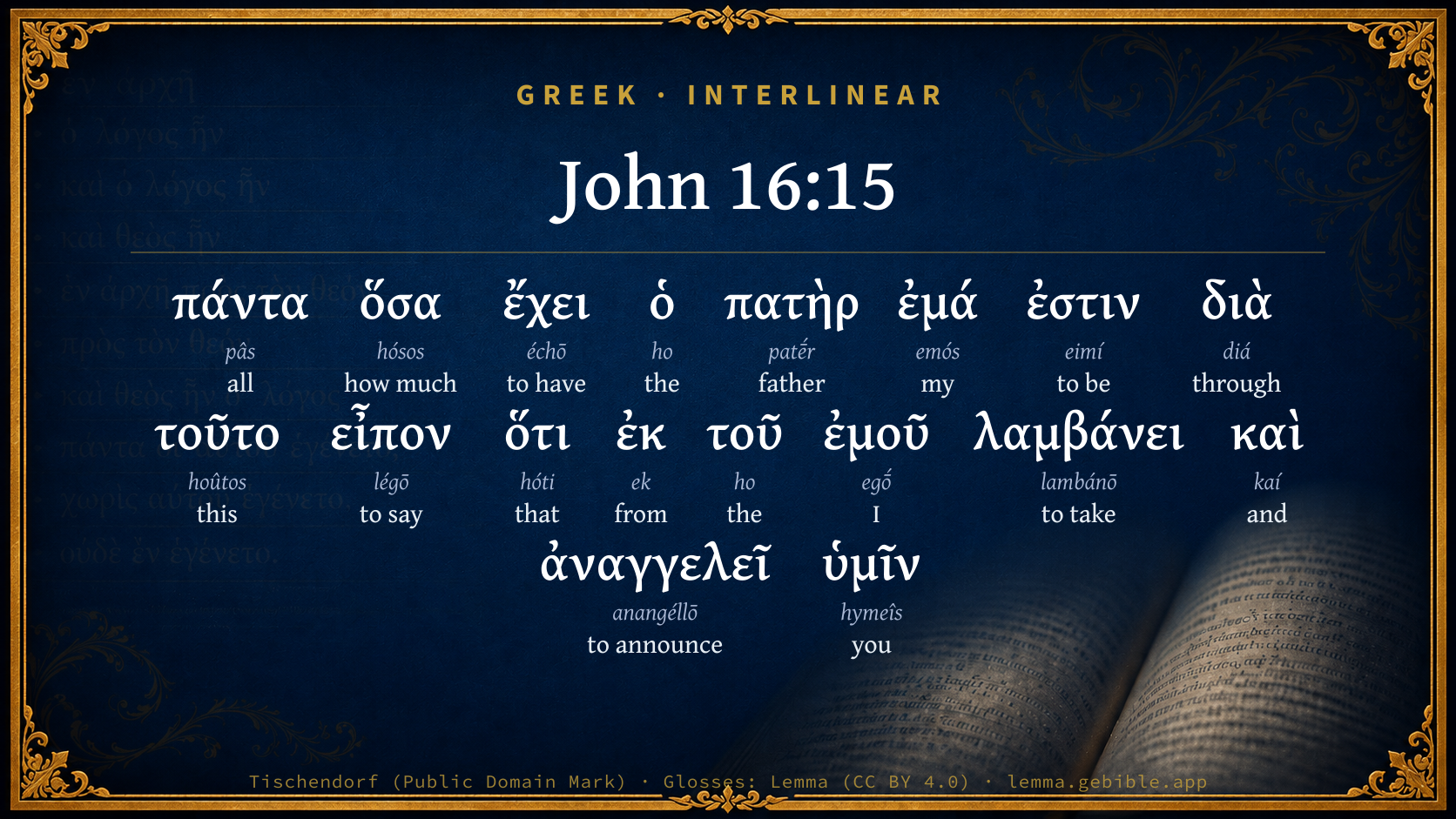
  1. πάντα pâs G3956 “all” Adjective, Nominative, Plural, Neuter
  2. ὅσα hósos G3745 “how much” Correlative pronoun, Accusative, Plural, Neuter
  3. ἔχει échō G2192 “to have” Verb, Present, Active, Indicative, 3rd person, Singular
  4. ὁ ho G3588 “the” Article, Nominative, Singular, Masculine
  5. πατὴρ patḗr G3962 “father” Noun, Nominative, Singular, Masculine
  6. ἐμά emós G1699 “my” Possessive pronoun, 1st person, Nominative, Plural, Neuter
  7. ἐστιν eimí G1510 “to be” Verb, Present, Active, Indicative, 3rd person, Singular
  8. διὰ diá G1223 “through” Preposition
  9. τοῦτο hoûtos G3778 “this” Demonstrative pronoun, Accusative, Singular, Neuter
  10. εἶπον légō G3004 “to say” Verb, Aorist, Active, Indicative, 1st person, Singular
  11. ὅτι hóti G3754 “that” Conjunction
  12. ἐκ ek G1537 “from” Preposition
  13. τοῦ ho G3588 “the” Article, Genitive, Singular, Masculine
  14. ἐμοῦ egṓ G1473 “I” Personal pronoun, 1st person, Genitive, Singular
  15. λαμβάνει lambánō G2983 “to take” Verb, Present, Active, Indicative, 3rd person, Singular
  16. καὶ kaí G2532 “and” Conjunction
  17. ὑμῖν hymeîs G5210 “you” Personal pronoun, 2nd person, Dative, Plural

About this verse

These counts appear in no published source. They are computed here, from the morphology-tagged text and Lemma’s own curated glosses. What Lemma adds →

18
words
17
distinct lemmas
Gospels
section

Notable vocabulary

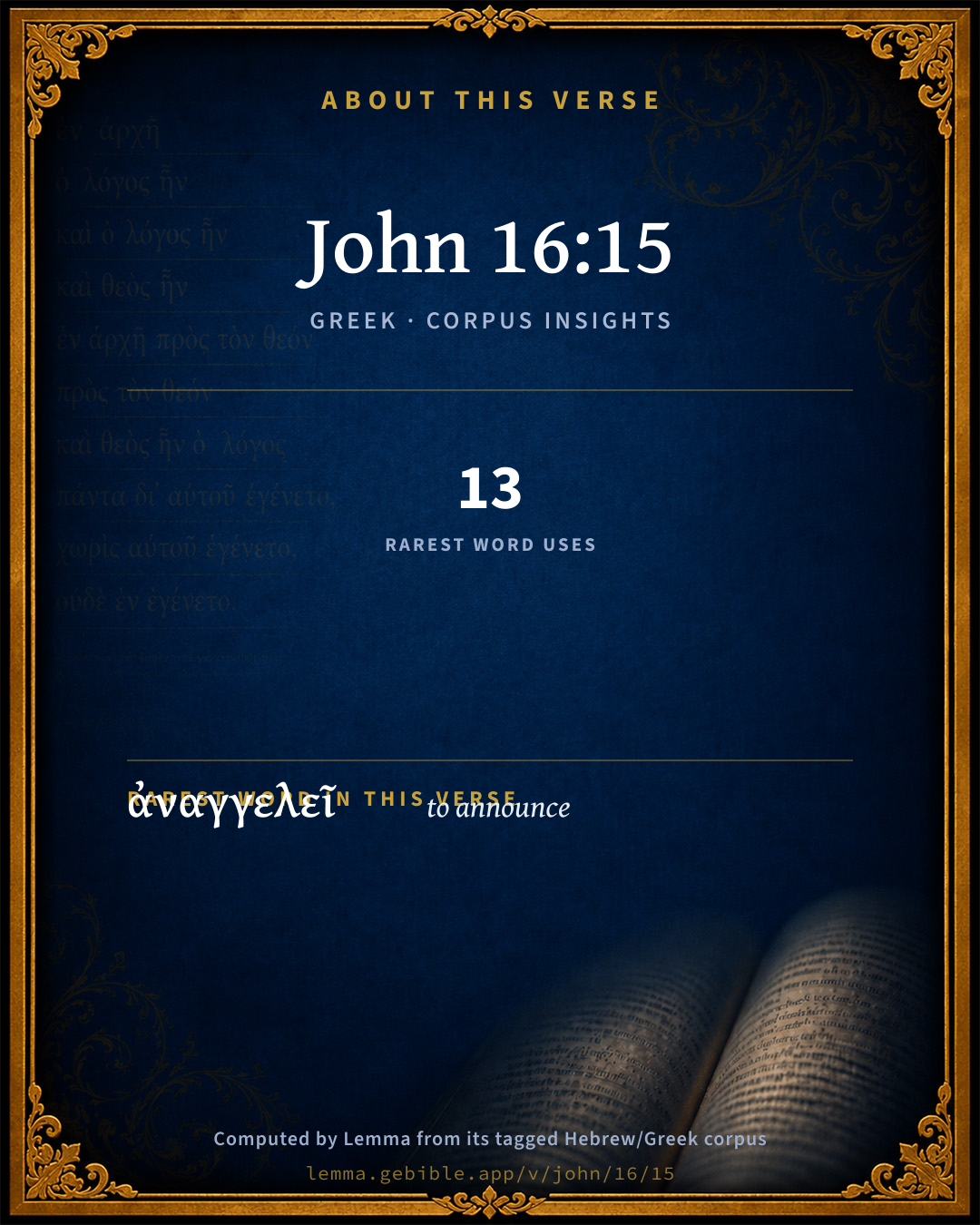
The rarest word here is ἀναγγελεῖ to announce G312 — appearing just 13 times in the whole Greek New Testament.

Shared distinctive vocabulary

ἀναγγελεῖ to announce G312 occurs in 13 verses of the Greek New Testament. Also found in:

Repetition

A word recurs within this verse:

Cross-references

11

Topical passages linked to John 16:15 in the Treasury of Scripture Knowledge — connected by theme and wording, ordered by reader-vote popularity; previews shown in the World English Bible.

  • John 17:10 All things that are mine are yours, and yours are mine, and I am glorified in them.
  • Matthew 11:27 All things have been delivered to me by my Father. No one knows the Son, except the Father; neither does anyone know the Father, except the Son, and he to whom the Son desires to reveal him.
  • John 3:35 The Father loves the Son, and has given all things into his hand.
  • Luke 10:22 Turning to the disciples, he said, "All things have been delivered to me by my Father. No one knows who the Son is, except the Father, and who the Father is, except the Son, and he to whomever the Son desires to reveal him."
  • Colossians 1:19 For all the fullness was pleased to dwell in him;
  • Matthew 28:18 Jesus came to them and spoke to them, saying, "All authority has been given to me in heaven and on earth.
  • John 10:29–30 My Father, who has given them to me, is greater than all. No one is able to snatch them out of my Father's hand.
  • John 13:3 Jesus, knowing that the Father had given all things into his hands, and that he came forth from God, and was going to God,
  • John 17:2 even as you gave him authority over all flesh, he will give eternal life to all whom you have given him.
  • Colossians 2:3 in whom are all the treasures of wisdom and knowledge hidden.
  • Colossians 2:9 For in him all the fullness of the Godhead dwells bodily,

Cross-references courtesy of OpenBible.info (CC BY 4.0).

Commentary

Notes on John 16:15 from classic Christian and Jewish commentators (each source and its license shown beneath its notes). The classic Christian expositions comment on the surrounding passage and are grouped to its opening verse, so a note may address several verses; the Jewish commentaries on the Tanakh (Rashi and others) are per-verse, so they appear only where the commentator wrote on this verse.

Lemma curates 59 commentaries, every one of them public domain or Creative Commons licensed, each selected and text-cleaned for this edition rather than reprinted as found. About our sources →

The Biblical Illustrator

Joseph S. Exell

Joh_16:15

All things that the Father hath are Mine

The fulness that is in Christ

I.

CHRIST HAS A LEGAL RIGHT TO THE PROPERTY OF THE FATHER. Because He has

1. A natural right to it, as He is God.

2. A federal right as Mediator, i.e., God the Father and God the Son are represented in Scripture as having agreed together in a covenant respecting the salvation of the human race. It was in this agreement that God the Father made over all the blessings that He had unto Jesus Christ.

3. A donative right as Saviour (Joh_3:35).

4. An acquisitive right as Conqueror. Suppose two individuals are combating for some property or privilege, and this is to belong to the individual who comes off victorious; you say of him afterwards, he has acquired that. Just so Christ came into the world to contend with sin and Satan for us, and He came off victorious.

5. A hereditary right as Gods Son and Heir (Heb_1:2.)

II. SOME OF THOSE ALL THINGS WHICH JESUS CHRIST IS SAID TO HAVE.

1. All the perfections of God. If, as is said, in 1Co_1:24, He is the power of God and the wisdom of God, then all the rest must be His.

2. The glory of the Father (Heb_1:3).

3. All the fulness of the Father (Col_1:19; Col_2:19).

III. IN WHAT SENSE ARE ALL THINGS CHRISTS?

1. Substantially, not figuratively or nominally, but really.

2. Communicatively. Some persons may possess great and inestimable treasures, but they may not have the power of communicating them. But Christ possesses all things for the express purpose of communicating Joh_1:16). He has pardon for our sins, and we have received it;He has justification for our souls, and He has imputed it, &c.

3. Sufficiently (Psa_107:9).

4. Efficiently. It shall be really applied to the heart, and go to the extent which necessity requires. There may be many things that may be said to be sufficient and yet not efficient. Some of us may have enough for ourselves and others, but it is not efficient unless they partake of it.

5. Unchangeably.

6. Eternally. He that believeth on the Son hath everlasting life.

IV. FOR WHAT REASON IT IS SO ARRANGED THAT THE FATHERS PROPERTY IS CHRISTS.

1. The right and the property of no party is lost. The Father has the same property as the Son, and the Son has the same property as the Spirit.

2. Herein is seen the pleasure of the Father, the pleasure of the Son, and the pleasure of the Holy Spirit.

3. Here is Gods honour in choosing His people; Christs honour in redeeming them, and the Spirits honour in regenerating them. (T. B. Baker, M. A.)

The joint proprietorship of the Father and the children

I once heard a father tell, that when he removed his family to a new residence, where the accommodation was much more ample, and the substance much more rich and varied, his youngest son, yet a lisping infant, ran round every room, and scanned every article with ecstasy, calling out, in childish wonder at every new sight, Is this ours, father? and is this ours? The child did not say yours, and I observed that the father while he told the story was not offended with the freedom. You could read in his glistening eye that the infants confidence in appropriating as his own all that his father had, was an important element in his satisfaction. Such, I suppose, will be the surprise, and joy, and appropriating confidence, with which the child of our Fathers family will count all his own, when he is removed from the comparatively mean condition of things present, and enters the infinite of things to come. When the glories of heaven burst upon his view, he does not stand at a distance, like a stranger, saying, O God, these are Thine. He bounds forward to touch and taste every provision which those blessed mansions contain, exclaiming, as he looks in the Fathers face, Father, this and this is ours. The dear child is glad of all the Fathers riches, and the Father is gladder of His dear child. (W. Arnot.)

The revealing work of the Spirit

The Holy Spirit is given for the purpose of restoring to spiritual truth its natural and reasonable efficiency. It is as though we had our eyes fixed on a book in the deep gloom of twilight. We believe that the page reveals truth, we know the language in which it is written; but the light is so imperfect, that, though here and there we can distinguish a capital letter, and now and then decipher a word, yet we are unable to make out distinctly a single sentence. But let light now fall upon the page, and every word and every letter is instantly revealed, the thought of the writer beams upon our understanding, and the channel of communication between His mind and ours is, for the time, fully established. Very similar to this is the case before us. We read and we hear about God, the Judge of all, and Christ, the Redeemer of men, about sin and repentance, heaven and hell, the wages of guilt and the reward of holiness, and we care so little about them that the words hardly awaken a thought, or leave a trace upon our recollection. But let now the Holy Spirit show these things of Christ unto us, and they are at once invested with the terrors or the joys of a most solemn reality. (F. Wayland, D. D.)

The Biblical Illustrator, edited by Joseph S. Exell (c. 1880s–1900s) — public domain. Text from a community e-Sword module.

Bengel's Gnomon

Johann Albrecht Bengel

Joh 16:15. Λήψεται, A considerable number of manuscripts read λαμβάνει.[364] The ἔχει and ἐστι, Joh 16:15, accords with λαμβάνει, giving a magnificent signification in the use of the present tense: and the receiving certainly precedes the announcing, ἀναγγελεῖ.

[364] A reading to which greater value is attached by the margin of the 2d Ed. than by the larger Ed. But the Germ. Vers. adhered to the reading ληψεται.—E. B. Λήμψεται, an Alexandrine form for λήψεται, is the reading of AD. These less polished forms are retained in our LXX. Rec. Text, because it was taken from the very ancient Vatican MS. Whereas in our New Testament Rec. Text we have substituted the smoother forms, because our Rec. Text is formed according to the mass of modern MSS. instead of the few more authoritative old MSS. which have the rougher forms. Orig. 471e, 346d, however, supports the Rec. reading λήψεται. Λαμβάνει. is probably a reading drawn from the genuine original λήμψεται.—E. and T.

Bengel's Gnomon of the New Testament — English translation (T&T Clark, Edinburgh, 1860) — public domain. Text from a community e-Sword module.

Expositor's Greek Testament

ed. W. Robertson Nicoll

Joh 16:15 . There is no need that the Spirit go beyond Christ and no possibility He should do so, because πάντα ὅσα ἔχει ὁ Πατὴρ ἐμά ἐστι , “all things whatsoever the Father has are mine,” cf. Joh 17:10 and Joh 13:3 ; 1Co 15:24-28 ; Heb 2:8 . The Messianic reign involved that Christ should be truly supreme and have all things at His disposal. So that when He said that the Spirit would take of what was His, that was equivalent to saying that the Spirit had the unlimited fulness of the Godhead to draw upon.

The Expositor's Greek Testament, edited by W. Robertson Nicoll (1897–1910) — public domain. Text from a community e-Sword module.

Jamieson, Fausset & Brown

Robert Jamieson, A. R. Fausset & David Brown

All things that the Father hath are mine--a plainer expression than this of absolute community with the Father in all things cannot be conceived, though the "all things" here have reference to the things of the Kingdom of Grace, which the Spirit was to receive that He might show it to us. We have here a wonderful glimpse into the inner relations of the Godhead.

Jamieson, Fausset & Brown — Commentary Critical and Explanatory on the Whole Bible (1871) — public domain (CC PDM 1.0). Text via the HelloAO Bible API.

Adam Clarke's Commentary

Verse 15. All things that the Father hath are mine] If Christ had not been equal to God, could he have said this without blasphemy?

And show it unto you.] As Christ is represented the Ambassador of the Father, so the Holy Spirit is represented the ambassador of the Son, coming vested with his authority, as the interpreter and executor of his will.

Adam Clarke's Commentary on the Bible (1810–1826) — public domain. Text from a community e-Sword/MySword module.

John Calvin's Commentaries

15. All things that the Father hath are mine. As it might be thought that Christ took away from the Father what he claimed for himself, he acknowledges that he has received from the Father all that he communicates to us by the Spirit. When he says that all things that the Father hath are his, he speaks in the person of the Mediator, for we must draw out of his fullness, (John 1:16.) He always keeps his eye on us, as we have said. We see, on the other hand, how the greater part of men deceive themselves; for they pass by Christ, and go out of the way to seek God by circuitous paths.

Other commentators explain these words to mean, that all that the Father hath belongs equally to the Son, because he is the same God. But here he does not speak of his hidden and intrinsic power, as it is called, but of that office which he has been appointed to exercise toward us. In short, he speaks of his riches, that he may invite us to enjoy them, and reckons the Spirit among the gifts which we receive from the father by his hand.

John Calvin's Commentaries (1540-1563) — public domain. Text from the Calvin Translation Society English edition (1840s-50s) via the Christian Classics Ethereal Library (ccel.org). Calvin's coverage is partial (roughly two-thirds of the Bible); uncommented books and verses are honest gaps, never fabricated. The 19th-century editor's footnotes and remarks are omitted so the notes are faithfully Calvin's own voice.

Ellicott's Commentary for English Readers

(15) All things that the Father hath are mine.—He has told them that the Spirit’s work is to glorify Him, to receive of His, and announce to the world. The ground of this saying is in the fact that the Son is the Revealer of the Father, and that the fulness of the truth (Joh_16:13) is given unto Him. The words appear from the context not to express the spiritual relation of the Son to the Father, but the fulness of the communication to Him in His human nature of the divine truth which He should reveal to man. (Comp. Notes on Joh_1:18; Joh_8:42; Joh_10:36; Joh_17:10; Mat_11:27; Col_1:19; Col_2:2-3.)

He shall take of mine, and shall shew it unto you.—Better, He taketh of Mine, and shall declare it unto you. The present expresses the unchanging relation of the Spirit to the Son. It should be noted that in these verses (14 and 15) there is an implication of the following doctrinal truths. They are implied, let us remember, in the words of our Lord Himself, and that they are implied and not stated increases the force of their meaning:—(1) The divinity of the Son: “He shall glorify Me;” “All things that the Father hath are Mine.” (2) The personality of the Holy Ghost: “He shall receive of Mine.” The Greek word, ἐκεῖυος, expresses this in the most emphatic way. The word is used of the Holy Spirit in Joh_16:8; Joh_16:13, and in Joh_14:26; Joh_15:26. (3) The Trinity in Unity, and Unity in Trinity: “the Father;” “I;” “He.”

A Bible Commentary for English Readers, edited by Charles John Ellicott (1878–1897) — public domain. Text from a community e-Sword module.

The Cambridge Bible for Schools and Colleges

gen. ed. J. J. S. Perowne

15. All things] Literally, All things whatsoever: comp. Joh_17:10.

therefore said I] For this cause (Joh_12:18; Joh_12:27) said I: see on Joh_5:16; Joh_5:18.

shall take] Better, taketh: the Spirit is already revealing the Truth which is both of the Father and of the Son.

The Cambridge Bible for Schools and Colleges (gen. ed. J. J. S. Perowne; Cambridge University Press, 1878–1918) — public domain. Text from a community e-Sword module.

John Gill's Exposition

Then said some of his disciples among themselves,.... It may be, some of them might better understand the meaning of Christ than others, or they might all be ignorant of it; for before the effusion of the Spirit on them, they were attended with a great deal of ignorance; and what through their being overwhelmed at this time with sorrow, and what with their national sentiments they retained about a temporal kingdom, they understood very little of what Christ said to them concerning his death, the nature, use, and end of it. Wherefore some might make the motion first, and inquire,

what is this that he saith unto us, a little while and ye shall not see me? they knew not what he meant by it, though he had so often and so clearly spoken of his death unto them: and as ignorant were they what he should design by saying,

and again a little while and ye shall see me; though he had expressly told them, in so many words, some time ago, that whereas he should die, he should rise again the third day: and as much at a loss were they to guess what he should intend by the reason he gives,

and because I go to the Father; though he had often mentioned it already, and as what might be matter of joy unto them.

John Gill's Exposition of the Whole Bible (1746–1763) — public domain (CC PDM 1.0). Text via the HelloAO Bible API.

Trapp's Complete Commentary

John Trapp

15 All things that the Father hath are mine: therefore said I, that he shall take of mine, and shall shew it unto you.

Ver. 15. All things that the Father hath, &c.] So that if we can but marry the heir, we have all. The Father saith unto him, as he did to his eldest son, Luk 15:31; "Son, thou art ever with me, and all that I have is thine;" therefore we may go boldly to him for all things needful for life and godliness. When Joseph sent to Jacob, that Pharaoh had put all into his hands, he was not a little comforted that one so near to him in nature was so able to accommodate him. Let us also come boldly to the throne of grace, since our flesh and blood hath all power to do us good. Christ, as mediator, is able to make all grace abound toward us, that we "always, having all sufficiency in all things, may abound to every good work," 2Co 8:8. Well might Ignatius say, Ignis, crux, et diaboli tormenta in me verdant, tantummodo ut Iesum nanciscar. The fire, the troubles and the torments of the devil change me, only merely so I may find Jesus.

John Trapp, A Commentary or Exposition upon All the Books of the Old and New Testament (1647–1656) — public domain. Text from a community e-Sword module.

Albert Barnes' Notes on the Bible

All things ... - See Mat 28:18; Mat 11:27. No one could have said this who was not equal with the Father. The union was so intimate, though mysterious, that it might with propriety be said that whatever was done in relation to the Son, was also done in regard to the Father. See Joh 14:9.

Albert Barnes' Notes on the Bible (1834–1885) — public domain. Text from a community e-Sword/MySword module.

Haydock's Catholic Bible Commentary

All things whatsoever the Father hath, are mine. The obvious sense of these words, shews, that the Son hath the same nature, and the same substance with the Father, and that he is one, and the same God with him. And by Christ’s adding: therefore he (the Holy Ghost) shall receive of mine, we are taught, that the third person proceeds from both the Father, and the Son, and that he receives, and has the same perfections. (Witham)

George Leo Haydock (1774–1849), Haydock's Catholic Family Bible and Commentary, 1859 edition — public domain. Excludes Psalms (Douay-Rheims chapter numbering differs from Protestant) and Deuterocanonical books (Catholic canon only).

Matthew Poole's English Annotations

All the Divine essence, wisdom, power, which is in the Father, are mine; I am, in all things that concern the Deity, one and equal with the Father; and that was the reason that I said that he should

take of mine, and show it to you; which is the same as if I had said, he shall take of my Father’s, and shall show it to you; for all that the Father hath is mine; I and my Father are one in essence, wisdom, power, &c.

Matthew Poole's English Annotations on the Holy Bible (1683–1685) — public domain. Text from a community e-Sword/MySword module.

Whedon's Commentary on the Bible

Daniel D. Whedon

15. All things that the Father hath—How stupendous is this all! Omnipotence, omniscience, omnipresence, eternity, all these the Father hath, and, therefore, the Son. Yet, by the very terms, the Father possesses alone his Fatherhood, and the Son his Sonship.

Therefore—Because the Son hath this fulness, therefore had Jesus included this all in the things revealed by the Spirit.

Daniel D. Whedon (gen. ed.), Commentary on the Old and New Testaments (1874–1909) — public domain. Text from a community e-Sword module.

The Pulpit Commentary

In this verse our Lord makes a still more superlative claim. All things which the Father hath (osa ecei) are mine. Perhaps no sentence recorded by St. John is more difficult to reconcile with the mere humanity of our Lord, even of the loftiest kind. The "mine" of the previous verse is declared to embrace something more than the mystery of his Person and sacrifice. "All that the Father hath," all his fullness of being, all the treasures of wisdom and knowledge, all the power, all the effulgence of the glory of the Father, of the human race, and of all things, "are mine." This makes a spiritual apprehension of Christ include a perfect revelation of all the Father"s character and work. Therefore said I, that he (the Spirit of truth, in being your Guide into all the truth) taketh of mine, and will declare (it) unto you. Because "mine is the Father"s, and the Father"s is mine;" because, i.e. , he is the Center, and Agent, and Motive, and Force in all the Divine self-revelation, and because he possessed as his own this vast range, this infinite fullness of Divine operations, he promised them this spiritual teaching, and assured them that his highest glory was simply to be made known as he is. Calvin, "We see how the greater part of men deceive themselves; for they pass by Christ, and go out of the way to seek God by circuitous paths.

In these verses we have a very abundant exhibition of the unity of the Father, Son, and Holy Spirit, coupled with a very remarkable setting forth of the tri-personality. The Father "hath" (ecei) that which is in very. essence the Son"s (ema); and the Spirit, whose purpose is to glorify the Son by making him known to men (lambanei), takes of "mine" and will declare it (see Stier, Schaff, note to Lange). Luthardt once thought with Stier, but now limits the reference, without giving any reason for it, to what he calls "the deposit of Divine truth in the humanity of Jesus." The sum of this astonishing assurance is that the Holy Spirit of truth, an essential element if not Personality in the Godhead, will lead these apostles into the fullness of truth, and of knowledge of the future, by taking up the essential realities of the Christ in the fullness of his being and work, and disclosing them by spiritual insight and supernatural quickening. These realities of the Christ will prove to be the fullness of the Father"s heart all that the Father hath. Again we ask Does St. John even here travel beyond his prologue?

The Pulpit Commentary (1880–1919), ed. H.D.M. Spence-Jones & Joseph S. Exell — public domain. Text from a community e-Sword module.

John Wesley's Explanatory Notes

All things that the Father hath are mine - Could any creature say this?

John Wesley, Explanatory Notes Upon the Whole Bible (1754–1765) — public domain. Text via the GEBible commentary corpus.

unfoldingWord translationNotes

Door43 World Missions Community

Father

This is an important title for God. (See: Translating Son and Father)

the Spirit will take from what is mine and he will tell it to you

The Holy Spirit will tell people that the words and works of Jesus are true. AT: "The Holy Spirit will tell everyone that my words and works are true" (See: Assumed Knowledge and Implicit Information)

In a short amount of time

"Soon" or "Before much time passes"

after another short amount of time

"again, before much time passes"

translationWords

God the Father

Holy Spirit

unfoldingWord translationNotes — © Distant Shores Media and the Door43 World Missions Community, licensed CC BY-SA 4.0. Source: git.door43.org/Door43/en_tn.

Alford’s Greek Testament

Henry Alford

15.] Here we have given us a glimpse into the essential relations of the Blessed Trinity. The Father hath given the Son to have life and all things in Himself (Col 1:19; Col 2:2, Col 2:3), the relation being, that the Son glorifies not Himself but the Father, by revealing the Father, whom He alone knows (Mat 11:27). And this Revelation, the Revelation of the Father by Christ—is carried on by the blessed Spirit in the hearts of the disciples of Christ; Who takes (λαμβάνει, indefinite, of the office of the Spirit) of the things of Christ, and declares, proclaims, to them.

διὰ τοῦτο] For this cause I (rightly) said.… i.e. ‘this was the ground of My asserting:’—not the reason why it was said, but the justification of it when said.

This verse contains the plainest proof by inference of the orthodox doctrine of the Holy Trinity.

Henry Alford, The Greek Testament (1849–1861) — public domain. Text from a community e-Sword module.

International Critical Commentary

15. πάντα ὅσα ἔχει ὁ πατὴρ ἐμά ἐστιν. This is the perpetual claim of the Johannine Christ, repeated once more at 17:10. So Paul can speak of “the unsearchable wealth of the Christ” (Eph 3:8).

διὰ τοῦτο, referring to what precedes (see on 5:16). “Wherefore I said that (ὄτι recitantis) He takes of mine and shall show it unto you,” repeated from v. 14, with the slight verbal change of λαμβάνει (BDLNWΘ) for λήμψεται of v. 14 (which is retained by the rec. with אcA, the Latin vss., and Syr. sin.). This repetition of a striking phrase, a word or two being altered, is a feature of Johannine style (see on 3:16).

ἀναγγελεῖ ὑμῖν, thrice repeated at the end of vv. 13, 14, 15, is like a solemn refrain, calling special attention to the revealing office of the Spirit.

The Disciples’ Perplexity as to Jesus’ Return (vv. 16-19)

International Critical Commentary — older volumes (1896–1929), various authors — public domain. Text from a community e-Sword module.

Vincent's Word Studies in the New Testament

Marvin R. Vincent

All things that [παντα οσα] . Literally, all things as many as. Rev., all things whatsoever.

Shall take [ληψεται] . The best texts read lambanei, taketh. The relation between the Son and the Spirit is put by Jesus as present and constant.

Marvin R. Vincent, Word Studies in the New Testament (1887–1900) — public domain. Text from a community e-Sword/MySword module.

Lesson kit

Teaching starters — assembled from the data on this page, not authored interpretation. Every prompt links to the verse data it draws on. Edit before teaching.

John, in the Gospels, opens this verse with 18 words (17 distinct Greek lemmas). Its most distinctive word is anangéllō (“to announce”). A historical commentator’s framing appears above. Read the whole chapter for the surrounding context.

Discussion questions

  1. How does “to announce” (anangéllō) shape what this verse is saying?
  2. John 4:25 shares the word «to announce» with this verse. How do the two illuminate each other?
  3. “the” occurs 2× in this one verse. What is the effect of the repetition?
  4. These translations render this verse differently. What is at stake in choosing one wording over another?
  5. Reading how The Biblical Illustrator and Bengel's Gnomon read this verse, where do the two commentators agree and where do they part?

Things to notice

Reading settings

Reading text

Shown beneath each verse's original-language words.

Old Testament
Old Testament edition

Read the OT as the Masoretic Hebrew (MT) or the Greek Septuagint (LXX).

English shown for the Greek Septuagint (in the Hebrew ↔ Greek comparison).

Comparing translations? Open the Compare panel on any verse page to stack up to four side by side.