John 16:4

Greek (Tischendorf 8th ed.) John 16:4 appears in the Greek New Testament. The text above is from the Tischendorf 8th edition. Each word links to its Strong’s number and a concise gloss. Click any word for its full Thayer’s Greek Lexicon entry.
Download image
Cite this verse

John 16:4 (World English Bible). Public Domain. Lemma interlinear Bible study tool, https://lemma.gebible.app/v/john/16/4.

Show BibTeX & RIS
BibTeX
RIS
English Translation
But I have told you these things, so that when the time comes, you may remember that I told you about them. I didn't tell you these things from the beginning, because I was with you.
World English Bible · Public Domain
Download a study sheet

One document with this verse’s original text, its word-by-word gloss line, the meaning frame, cross-references with their text, attributed commentary, and full source and license credits — printable, and it pastes into notes with its structure intact.

This verse Autodidact and up

Study sheet (.html) Plain text (.txt)

A passage Seminary Student

Up to 50 verses in one chapter. A passage sheet keeps up to 6 commentary sources and 12 cross-references per verse, in the order this page ranks them, and says so on the sheet whenever that leaves anything out. Ask for a single verse and you get the Autodidact verse sheet above.

Everything on this page stays free to read, with no account — the sheet is a download of what is already on screen, not access to it.

Want to remove ads? Support Godless Engineer
Compare translations 3

The same verse in 3 English versions, stacked beneath the original-language interlinear above. Click any original word for its lexicon entry.

Each is an independent rendering of the whole verse — the interlinear is not word-aligned to these translations.

Highlighted words mark where these versions differ — a whole-verse word diff, not a word-by-word alignment.

  • World English Bible Public Domain
    But I have told you these things, so that when the time comes, you may remember that I told you about them. I didn't tell you these things from the beginning, because I was with you.
  • King James Version Public Domain
    But these things have I told you, that when the time shall come, ye may remember that I told you of them. And these things I said not unto you at the beginning, because I was with you.
  • unfoldingWord Literal Text CC BY-SA 4.0
    But I have spoken these things to you so that when their hour comes, you may remember that I told you about them. But I did not tell you these things in the beginning, because I was with you.

unfoldingWord Literal Text — © unfoldingWord, licensed CC BY-SA 4.0. Word-aligned USFM3 via Door43 (git.door43.org/unfoldingWord/en_ult).

Versions to compare (up to 4)

3 of 4 selected

Show all 19 translations

Every available English version of this verse, each an independent rendering of the whole verse.

  • World English Bible Public Domain
    But I have told you these things, so that when the time comes, you may remember that I told you about them. I didn't tell you these things from the beginning, because I was with you.
  • Berean Standard Bible Public Domain
    But I have told you these things so that when their hour comes, you will remember that I told you about them. I did not tell you these things from the beginning, because I was with you.
  • Majority Standard Bible Public Domain
    But I have told you these things so that when the hour comes, you will remember that I told you about them. I did not tell you these things from the beginning, because I was with you.
  • King James Version Public Domain
    But these things have I told you, that when the time shall come, ye may remember that I told you of them. And these things I said not unto you at the beginning, because I was with you.
  • American Standard Version (1901) Public Domain
    But these things have I spoken unto you, that when their hour is come, ye may remember them, how that I told you. And these things I said not unto you from the beginning, because I was with you.
  • Revised Version (1885) Public Domain
    But these things have I spoken unto you, that when their hour is come, ye may remember them, how that I told you. And these things I said not unto you from the beginning, because I was with you.
  • Geneva Bible (1599) Public Domain
    But these things haue I tolde you, that when the houre shall come, ye might remember, that I tolde you them. And these things said I not vnto you from ye beginning, because I was with you.
  • Douay-Rheims (1899) Public Domain
    But these things I have told you, that when the hour shall come, you may remember that I told you of them.
  • Young's Literal Translation Public Domain
    `But these things I have spoken to you, that when the hour may come, ye may remember them, that I said `them' to you, and these things to you from the beginning I did not say, because I was with you;
  • Literal Standard Version CC BY-SA 4.0
    But these things I have spoken to you, that when the hour may come, you may remember them, that I said [them] to you, and I did not say these things to you from the beginning, because I was with you;
  • Unlocked Literal Bible CC BY-SA 4.0
    I have spoken these things to you so that when their hour comes, you will remember that I told you about them. I did not tell you about these things in the beginning, because I was with you.
  • unfoldingWord Literal Text CC BY-SA 4.0
    But I have spoken these things to you so that when their hour comes, you may remember that I told you about them. But I did not tell you these things in the beginning, because I was with you.
  • Darby Bible Public Domain
    But I have spoken these things to you, that when their hour shall have come, ye may remember them, that I have said [them] unto you. But I did not say these things unto you from [the] beginning, because I was with you.
  • World Messianic Bible Public Domain
    But I have told you these things so that when the time comes, you may remember that I told you about them. I didn’t tell you these things from the beginning, because I was with you.
  • Webster's Bible Public Domain
    But these things have I told you, that when the time shall come, ye may remember that I told you of them. And these things I said not to you at the beginning, because I was with you.
  • Free Bible Version CC BY-SA 4.0
    I didn't need to tell you this right at the beginning because I was going to be with you.
  • Bible in Basic English Public Domain
    I have said these things to you so that when the time comes, what I have said may come to your mind. I did not say them to you at the first, because then I was still with you.
  • Text-Critical English NT CC BY 4.0
    But I have said these things to you so that when the hour comes you will remember that I said them to you. I did not say these things to you from the beginning, because I was with you.
  • Tyndale New Testament (1534) Public Domain
    But these thinges have I tolde you that when that houre is come ye myght remember them that I tolde you so. These thinges sayde I not unto you at the begynninge because I was present with you.

Literal Standard Version (2020), Covenant Press — licensed CC BY-SA 4.0. Text via the HelloAO Bible API (eBible.org). Unlocked Literal Bible (unfoldingWord) — licensed CC BY-SA 4.0. Text via the HelloAO Bible API (eBible.org). unfoldingWord Literal Text — © unfoldingWord, licensed CC BY-SA 4.0. Word-aligned USFM3 via Door43 (git.door43.org/unfoldingWord/en_ult). Free Bible Version, Dr. Jonathan Gallagher — licensed CC BY-SA 4.0. Text via the HelloAO Bible API (eBible.org).

Word by word

More ways to search: Search by grammar → Find every occurrence → Compare this word →

Practice this passage: Drill this verse → Learn its vocabulary →

μνημονεύητε
mnēmoneúō
G3421
“to remember”
Verb, Present, Active, Subjunctive, 2nd person, Plural
Part of Speech
Verb
Tense
Present
Voice
Active
Mood
Subjunctive
Person
2nd person
Number
Plural
Full Thayer's Definition

Origin: from a derivative of G3420

TDNT: 15:22,6

1. to be mindful of, to remember, to call to mind a. to think of and feel for a person or thing b. to hold in memory, keep in mind 2. to make mention of
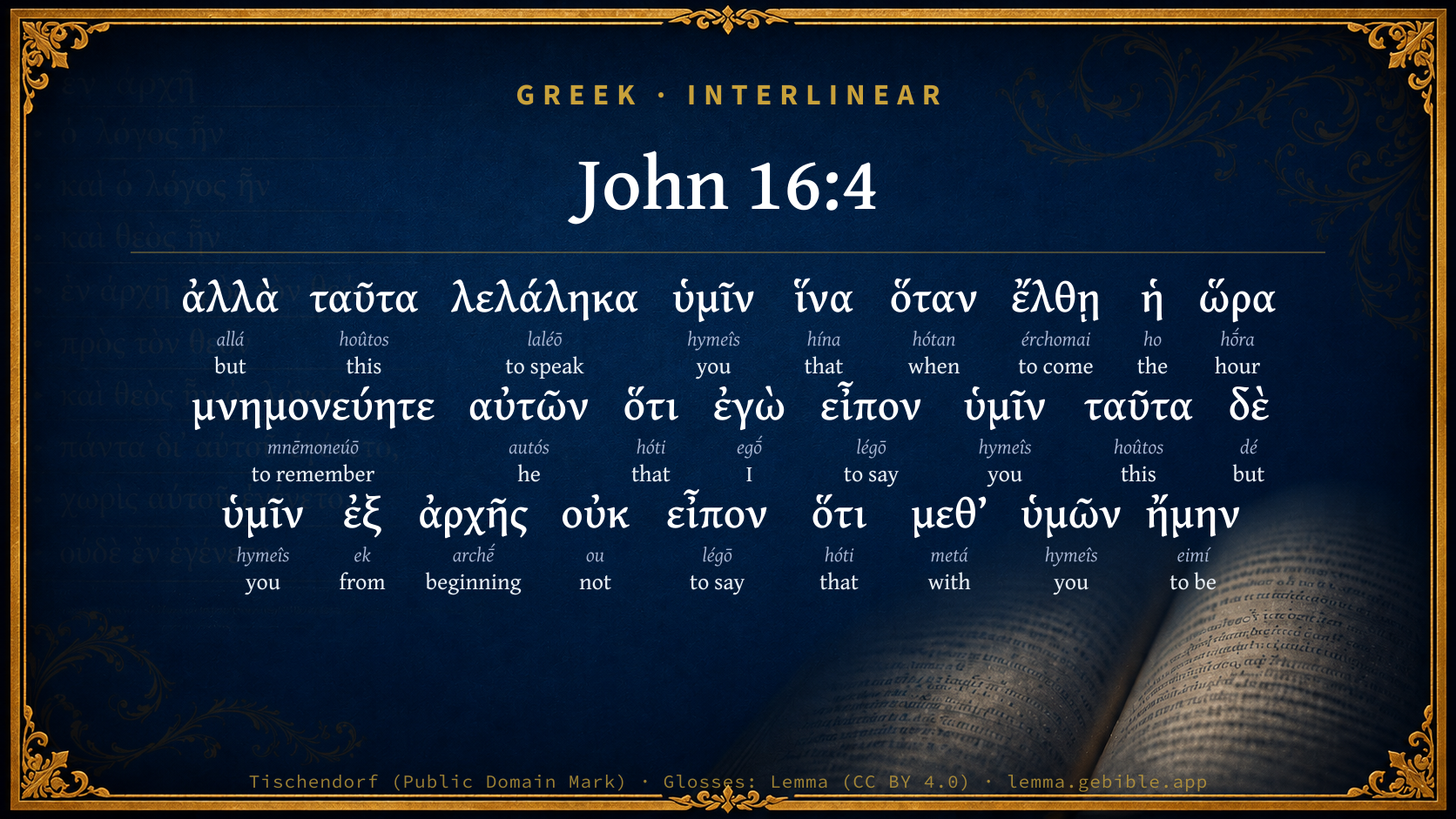
  1. ἀλλὰ allá G235 “but” Conjunction
  2. ταῦτα hoûtos G3778 “this” Demonstrative pronoun, Accusative, Plural, Neuter
  3. λελάληκα laléō G2980 “to speak” Verb, Perfect, Active, Indicative, 1st person, Singular
  4. ὑμῖν hymeîs G5210 “you” Personal pronoun, 2nd person, Dative, Plural
  5. ἵνα hína G2443 “that” Conjunction
  6. ὅταν hótan G3752 “when” Conjunction
  7. ἔλθῃ érchomai G2064 “to come” Verb, Aorist, Active, Subjunctive, 3rd person, Singular
  8. ἡ ho G3588 “the” Article, Nominative, Singular, Feminine
  9. ὥρα hṓra G5610 “hour” Noun, Nominative, Singular, Feminine
  10. αὐτῶν autós G846 “he” Personal pronoun, Genitive, Plural, Neuter
  11. ὅτι hóti G3754 “that” Conjunction
  12. ἐγὼ egṓ G1473 “I” Personal pronoun, 1st person, Nominative, Singular
  13. εἶπον légō G3004 “to say” Verb, Aorist, Active, Indicative, 1st person, Singular
  14. ὑμῖν hymeîs G5210 “you” Personal pronoun, 2nd person, Dative, Plural
  15. ταῦτα hoûtos G3778 “this” Demonstrative pronoun, Accusative, Plural, Neuter
  16. δὲ dé G1161 “but” Conjunction
  17. ὑμῖν hymeîs G5210 “you” Personal pronoun, 2nd person, Dative, Plural
  18. ἐξ ek G1537 “from” Preposition
  19. ἀρχῆς archḗ G746 “beginning” Noun, Genitive, Singular, Feminine
  20. οὐκ ou G3756 “not” Particle, Negative
  21. εἶπον légō G3004 “to say” Verb, Aorist, Active, Indicative, 1st person, Singular
  22. ὅτι hóti G3754 “that” Conjunction
  23. μεθ’ metá G3326 “with” Preposition
  24. ὑμῶν hymeîs G5210 “you” Personal pronoun, 2nd person, Genitive, Plural
  25. ἤμην eimí G1510 “to be” Verb, Imperfect, Middle, Indicative, 1st person, Singular

About this verse

These counts appear in no published source. They are computed here, from the morphology-tagged text and Lemma’s own curated glosses. What Lemma adds →

26
words
20
distinct lemmas
Gospels
section

Notable vocabulary

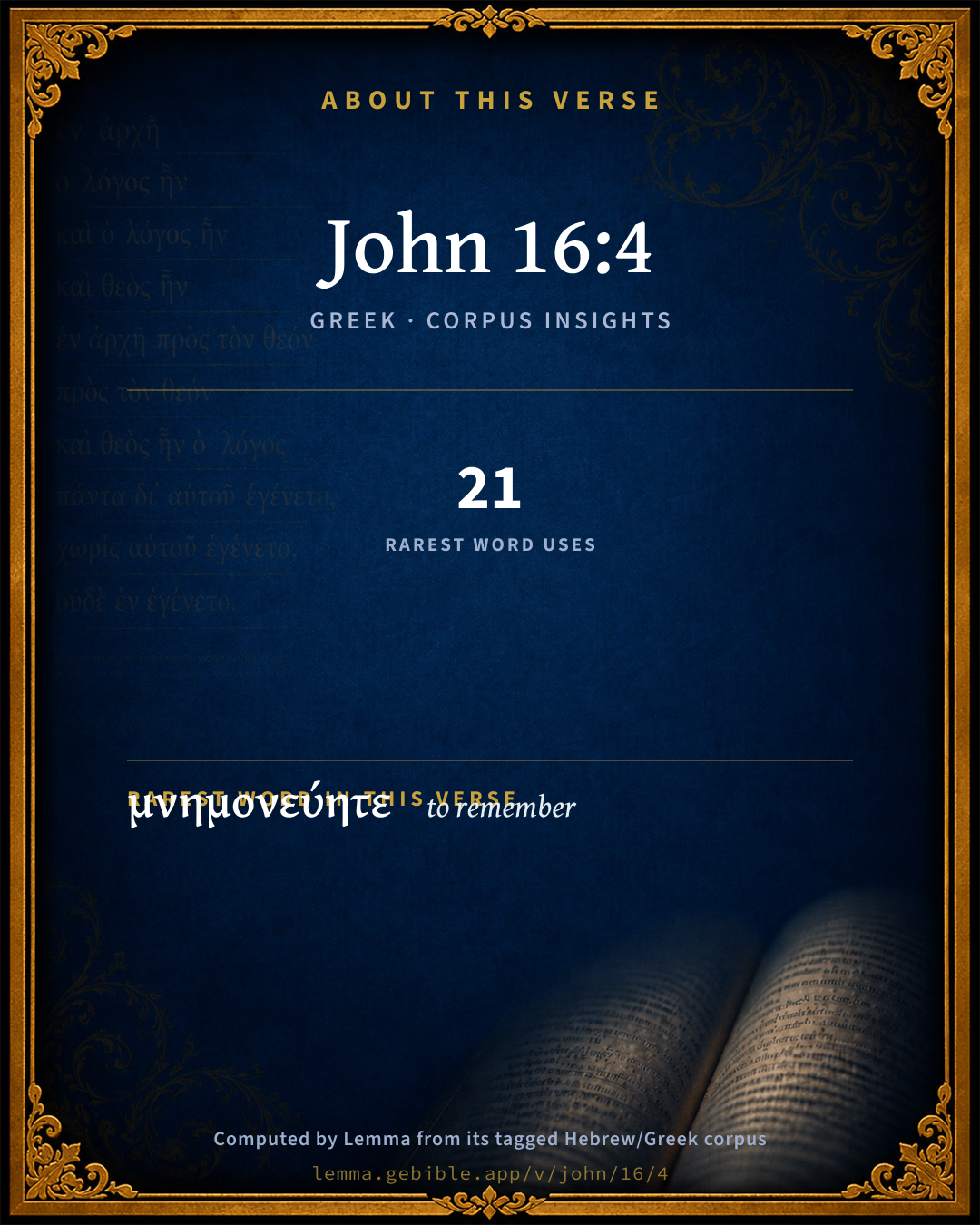
The rarest word here is μνημονεύητε to remember G3421 — appearing just 21 times in the whole Greek New Testament.

Shared distinctive vocabulary

μνημονεύητε to remember G3421 occurs in 21 verses of the Greek New Testament. Also found in:

Repetition

Words recur within this verse:

  • εἶπον to say G3004 ×2
  • ὑμῖν you G5210 ×4
  • ταῦτα this G3778 ×2
  • ὅτι that G3754 ×2

Cross-references

13

Topical passages linked to John 16:4 in the Treasury of Scripture Knowledge — connected by theme and wording, ordered by reader-vote popularity; previews shown in the World English Bible.

  • John 14:29 Now I have told you before it happens so that, when it happens, you may believe.
  • Mark 13:23 But you watch. "Behold, I have told you all things beforehand.
  • John 13:19 From now on, I tell you before it happens, that when it happens, you may believe that I AM.
  • John 17:12–13 While I was with them in the world, I kept them in your name. Those whom you have given me I have kept. None of them is lost, except the son of destruction, that the Scripture might be fulfilled.
  • Matthew 9:15 Jesus said to them, "Can the friends of the bridegroom mourn, as long as the bridegroom is with them? But the days will come when the bridegroom will be taken away from them, and then they will fast.
  • Matthew 24:25 "Behold, I have told you beforehand.
  • Acts 9:16 For I will show him how many things he must suffer for my name's sake."
  • Isaiah 41:22–23 Let them bring forth, and declare to us what shall happen: declare you the former things, what they are, that we may consider them, and know the latter end of them; or show us things to come.
  • Matthew 10:7 As you go, preach, saying, 'The Kingdom of Heaven is at hand!'
  • Mark 2:19 Jesus said to them, "Can the groomsmen fast while the bridegroom is with them? As long as they have the bridegroom with them, they can't fast.
  • 2 Peter 1:14 knowing that the putting off of my tent comes swiftly, even as our Lord Jesus Christ made clear to me.
  • Luke 21:12–13 But before all these things, they will lay their hands on you and will persecute you, delivering you up to synagogues and prisons, bringing you before kings and governors for my name's sake.
  • Acts 20:23–24 except that the Holy Spirit testifies in every city, saying that bonds and afflictions wait for me.

Cross-references courtesy of OpenBible.info (CC BY 4.0).

Commentary

Notes on John 16:4 from classic Christian and Jewish commentators (each source and its license shown beneath its notes). The classic Christian expositions comment on the surrounding passage and are grouped to its opening verse, so a note may address several verses; the Jewish commentaries on the Tanakh (Rashi and others) are per-verse, so they appear only where the commentator wrote on this verse.

Lemma curates 59 commentaries, every one of them public domain or Creative Commons licensed, each selected and text-cleaned for this edition rather than reprinted as found. About our sources →

Joseph Benson's Commentary

Joh 16:4-6. But these things have I told you — And forewarned you of them; that when the time shall come — In which they shall happen; ye may remember that I told you of them — And so may turn what has so discouraging an aspect into a further confirmation of your faith. And these things I said not at the beginning — Of my ministry; because I was with you — And could easily suggest proper instructions and consolations, as new circumstances of difficulty arose; and because, being with you, I could bear the chief shock of persecution in my own person, and so screen you from it. But now I go to him that sent me — But now, that my ministry is drawing toward a conclusion, and I am going to leave you, I could no longer defer speaking of these things to you; because it is of great importance you should know them, in order that when they come to pass you may not be surprised and stumbled. And none of you asketh me — Now when it is most seasonable; whither goest thou? — Though I mentioned to you my departure once before, (Joh 13:33,) none of you has inquired of me the reasons of my departure, nor the effects of it; nor is concerned to make those inquiries about that better world, which surely might well become you in such a circumstance. But because I have said these things — Have spoken of leaving you for a time, and have informed you of the persecutions you will meet with when I am gone; sorrow hath filled your heart — Hath engrossed your thoughts, and filled you with sadness.

Joseph Benson's Commentary on the Old and New Testaments (1811–1818) — public domain. Text from a community e-Sword module.

Bengel's Gnomon

Johann Albrecht Bengel

Joh 16:4. Μνημονεύητε) ye may remember, with faith: ch. Joh 13:19, “Now I tell you before it come, that when it is come to pass ye may believe that I am He.”—οὐκ εἶπον) I said not, although knowing it. A most wise method of Christ was this. He had told them, even a little before, of the hatred of the world, but less openly, and more sparingly. [Now that they were fortified by the promise of the Holy Spirit against that hatred He speaks more openly concerning that subject.—V. g.] Mat 10:17; Mat 10:21; Mat 10:25; Mat 24:9.

Bengel's Gnomon of the New Testament — English translation (T&T Clark, Edinburgh, 1860) — public domain. Text from a community e-Sword module.

Meyer's Critical & Exegetical Commentary

Heinrich August Wilhelm Meyer

Joh_16:4. Ἀλλά] At, breaks off the enumeration (Baeumlein, Partik. p. 15). Jesus will not go further into details, and recurs to the thought in Joh_16:1. The explanation: although it is not to be expected otherwise, I have nevertheless foretold it to you (Lücke, De Wette), is the less agreeable to the text, since ταῦτα λελάλ. had just been already said, and that without any antithetic reference of the kind. The explanations of Tholuck and Lange, again, are importations: but so little would I terrify (?) you hereby, that I have only (?) said it to you, etc.

ταῦτα] What was said in Joh_16:2-3.

αὐτῶν, ὅτι ἐγὼ εἶπ. ὑμ.] Attraction. See Winer, p. 581 f. [E. T. p. 665 ff.]

ἐγώ] with weighty emphasis: I, the Person, with whom your faith is concerned. Comp. Joh_16:1, ἵνα μὴ σκανδαλ.

ἐξ ἀρχῆς] Joh_15:27. The question, how this declaration of Jesus may be reconciled with the announcements found in the Synoptics, even from the time of the Sermon on the Mount, of predestined sufferings (Mat_5:10 ff.; Luk_6:22 ff.; Mat_10:16 ff.; Luk_12:4 ff.; Mat_21:12 ff; Mat_24:9), is not solved by saying that here φοβερώτερα ἐκείνων (Euth. Zigabenus, comp. also Chrysostom) are announced (see, on the contrary, Mat_10:16-18; Mat_10:28); or that Christ spoke at an earlier period minus aperte et parcius (Bengel, comp. Grotius), and in much more general terms (Ebrard), but now more expressly set forth in its principles the character of the worlds attitude towards the disciples (Tholuck, comp. Lange); or, that He has now stated more definitely the cause of the hatred (Lampe); or, that He utters it here as a parting word (Luthardt); or even, that at an earlier period, because the thoughts of the disciples had not yet dwelt upon it, it was for them as good as not said (Hengstenberg); but the difference lies clearly before us, and is simply to be recognised (comp. also Godet), to be explained, however, from the fact that in the Synoptics more general and less definite allusions belonging to the earlier time appear with the more definite form and stamp of later expressions. The living recollection of John must here also preponderate as against the Synoptics so that his relation to theirs here is that of a corrector.

ὅτι μεθʼ ὑμῶν ἤμην] It would have been unnecessary in the time of my personal association with you, since it is not till after my departure that your persecution (up to that time the hatred of the world affected Himself) is to commence. Because you have me with you, they cannot well but leave you in peace, and can do nothing to you, they must have done it to me previously, but now it will begin, etc., Luther. Comp. Chrysostom, Euth. Zigabenus, Grotius. As yet they had suffered no persecution; hence the thought, I could console you (Lücke, De Wette, and older expositors), is not to be introduced. The interpretation also: now first, when I promise you the Spirit, can I thus openly speak to you (Bengel, Tholuck), is not in harmony with the words.

Meyer — Critical and Exegetical Commentary on the New Testament — English translation by Peter Christie, edited by Frederick Crombie (T&T Clark, 1880) — public domain. Text from a community e-Sword module.

Expositor's Greek Testament

ed. W. Robertson Nicoll

Joh 16:4 . ἀλλὰ ταῦτα … ὑμῖν . This repeats Joh 16:1 , but He now adds an explanation of His silence up to this time regarding their future: ταῦτα δὲ ὑμῖν … ἤμην . ἐξ ἀρχῆς = ἀπʼ ἀρχῆς of Joh 15:27 , Holtzmann. If there is a difference, ἐξ ἀρχῆς indicates rather the point of time ( cf. its only other occurrence, Joh 6:64 ) while ἀπʼ ἀρχῆς indicates continuity. The fact of the silence has been disputed: but no definite and full intimations have hitherto been given of the future experience of the Apostles, as representing an absent Lord. The reason of His silence was ὅτι μεθʼ ὑμῶν ἤμην , “because I was with you”. While He was with them they leant upon Him and could not apprehend a time of weakness and of persecution. See Mat 9:15 .

The Expositor's Greek Testament, edited by W. Robertson Nicoll (1897–1910) — public domain. Text from a community e-Sword module.

Cambridge Greek Testament for Schools and Colleges

4. ἀλλά. But, to return (to Joh 16:1), these things have I spoken to you (Joh 16:1; Joh 16:4; Joh 16:6 must be rendered alike), that when their hour (the hour appointed for these things; Joh 16:2) is come, ye may remember them, how that I told you, Ἐγώ is emphatic, ‘I Myself, the object of your faith.’

ἐξ ἀρχῆς. Here and Joh 6:64 only: it expresses consequence and continuity, whereas ἀπ’ ἀρχῆς (Joh 15:27) expresses simple departure. And these things I told you not from the beginning. There is no inconsistency between this statement and passages like Mat 10:16-39; Mat 24:9; Luk 6:22: ταῦτα covers not only the prediction of persecutions, but the explanation of them, and the promise of the Paraclete, &c. All this was new. While He was with them to explain and exhort, they did not need these truths.

Cambridge Greek Testament for Schools and Colleges (Cambridge University Press, 1896; 21 vols, various authors incl. Carr, Maclear, Plummer, Farrar, Lumby, Moule, M. R. James, Simcox) — public domain. Text from a community e-Sword module.

Jamieson, Fausset & Brown

Robert Jamieson, A. R. Fausset & David Brown

these things I said not . . . at--from.

the beginning--He had said it pretty early (Luk 6:22), but not quite as in Joh 16:2.

because I was with you.

Jamieson, Fausset & Brown — Commentary Critical and Explanatory on the Whole Bible (1871) — public domain (CC PDM 1.0). Text via the HelloAO Bible API.

Adam Clarke's Commentary

Verse 4. At the beginning] I would not trouble you by speaking of these things pointedly at first, when I chose you to be my disciples, but have referred them to the present time, lest you should be discouraged; and now only declare them because it is absolutely necessary that you should be put upon your guard.

Adam Clarke's Commentary on the Bible (1810–1826) — public domain. Text from a community e-Sword/MySword module.

John Calvin's Commentaries

4. That when the hour cometh, you may remember. He repeats what he had already said, that this is not a philosophy fitted only for a season of leisure, but that it is adapted to practice and use, and that he now discourses on these matters, that they may actually demonstrate that they have not been taught in vain. When he says, that you may remember, he enjoins them, first, to lay up in their minds what they have heard; secondly, to remember them, when they shall be required to put them in practice; and, lastly, he declares that no small importance attaches to the fact, that he utters predictions of future events.

And I told you not these things at the beginning. As the apostles were still weak and tender, so long as Christ conversed with them in the flesh, their singularly good and indulgent Master spared them, and did not suffer them to be urged beyond what they were able to bear. At that time, therefore, they had no great need of confirmation, while they enjoyed leisure and freedom from persecution; but now he tells them that they must change their mode of life, and as a new condition awaits them, he likewise exhorts them to prepare for a conflict.

John Calvin's Commentaries (1540-1563) — public domain. Text from the Calvin Translation Society English edition (1840s-50s) via the Christian Classics Ethereal Library (ccel.org). Calvin's coverage is partial (roughly two-thirds of the Bible); uncommented books and verses are honest gaps, never fabricated. The 19th-century editor's footnotes and remarks are omitted so the notes are faithfully Calvin's own voice.

Ellicott's Commentary for English Readers

(4) But these things have I told you . . .—He recurs to the thought of Joh_16:1. (Comp. also Joh_13:19; Joh_14:29.) He strengthens them by forewarning them. When the persecution comes they will remember His word, and find in it support for their faith and evidence of His presence with them.

These things I said not unto you at the beginning, because I was with you.—While with them, He would spare them, and it was against Himself that the hatred of His foes was directed. When He shall have left them they will represent Him, and must stand in the foreground of the battle.

These words seem to be opposed to Matthew 10 and parallel passages, where our Lord did tell the Apostles at the time of their call of the persecutions which awaited them. (See especially Joh_16:17; Joh_16:21; Joh_16:28.) The passages are not, however, really inconsistent, for “these things” in this verse (comp. Joh_16:3; Joh_16:1, and Joh_15:21) refers to the full account He has given them of the world’s hatred and the principles lying at the foot of it, and the manner in which it was to be met by the Spirit’s witness and their witness of Him. These things which the infant Church would have to meet, and meet without His bodily presence, He told them not at the beginning.

A Bible Commentary for English Readers, edited by Charles John Ellicott (1878–1897) — public domain. Text from a community e-Sword module.

The Cambridge Bible for Schools and Colleges

gen. ed. J. J. S. Perowne

4. But] Making a fresh start; But, to return (to Joh_16:1).

have I told] See on Joh_16:6.

when the time] Rather, when their hour, according to the better reading; i.e. the hour appointed for these things (Joh_16:2).

ye may … of them] Better, ye may remember them, that I told you. ‘I’ is emphatic, ‘I Myself, the object of your faith.’

And these things … beginning] Better, But these things I told you not from the beginning. Not exactly the same phrase as in Joh_15:27 (ἀπ' ἀρχῆς) but ἐξ ἀρχῆς (here and Joh_6:64 only): the one expresses simple departure, the other consequence and continuity. There is no inconsistency between this statement and passages like Mat_10:16-39; Mat_24:9; Luk_6:22, &c. ‘These things’ will cover a great deal more than the prediction of persecutions, e.g. the explanation of the persecutions, the promise of the Paraclete, &c.

because I was with you] See notes on Mat_9:15.

The Cambridge Bible for Schools and Colleges (gen. ed. J. J. S. Perowne; Cambridge University Press, 1878–1918) — public domain. Text from a community e-Sword module.

John Gill's Exposition

But these things have I told you,.... Christ enlarged on this disagreeable subject, and was the more particular in enumerating the evils his apostles were to endure for his name's sake:

that when the time shall come; some copies read it, "their time"; so the Vulgate Latin, Syriac, and Arabic render it; that is, the time when wicked men will be suffered to vent all their rage and malice:

ye may remember that I told you of them; which might serve greatly to confirm them in the faith of him as the omniscient God, and the true Messiah, and encourage them to depend on his veracity and faithfulness in his promises; that since the evil things which he spoke of came upon them, so they might hope, believe, and expect, that all the good things he had assured them of, should be accomplished; and also to engage them to bear their sufferings with the greater patience, since they were appointed by God, and foretold by their Lord and master.

And these things, adds Christ,

I said not unto you at the beginning; when he first called them to be followers of him; for though when he ordained them, and sent them forth to preach the Gospel in the cities of Judea, which was some time after he had called them by his grace, he did acquaint them with some of the troubles and exercises they should meet with; as that they should be hated by all men, persecuted from city to city, beat in the synagogues, delivered up to councils, and brought before kings and governors; see Mat 10:17; yet he did not so fully and distinctly speak of these things, as here and at this time: his reason for such a conduct was this,

because, says he,

I was with you: wherefore he never spoke so fully and distinctly of their troubles, because he was with them, and took them upon himself; and indeed, whilst he was with them, the rage and malice of the Jews were not so much against his disciples, as himself; nor did he for the same reason speak so largely of the Comforter, and of the comforts they should receive from him, because as they had not the exercises they should afterwards have, so they had him to be their comforter.

John Gill's Exposition of the Whole Bible (1746–1763) — public domain (CC PDM 1.0). Text via the HelloAO Bible API.

Trapp's Complete Commentary

John Trapp

4 But these things have I told you, that when the time shall come, ye may remember that I told you of them. And these things I said not unto you at the beginning, because I was with you.

Ver. 4. Ye may remember, &c.] And act, what I have foretold and taught you. The difference between divinity and other sciences is, that it is not enough to know, but you must do it; as lessons of music must be practised, and a copy not read only, but written after. Non est haec umbratilis philosophia, sed quae ad usum et praxin aptanda. (Calvin.)

John Trapp, A Commentary or Exposition upon All the Books of the Old and New Testament (1647–1656) — public domain. Text from a community e-Sword module.

Albert Barnes' Notes on the Bible

These things - These things which are about to happen, Joh 16:1-2. He had foretold them that they would take place.

Ye may remember ... - By calling to mind that he had foretold these things they would perceive that he was omniscient, and would remember, also, the consolations which he had afforded them and the instructions which he had given them. Had these calamities come upon them without their having been foretold, their faith might have failed; they might have been tempted to suppose that Jesus was not aware of them, and of course that he was not the Messiah. God does not suffer his people to fall into trials without giving them sufficient warning, and without giving all the grace that is needful to bear them.

At the beginning - In the early part of the ministry of Jesus. The expression these things here refers, probably, to all the topics contained in these chapters. He had, in the early part of his ministry, forewarned them of calamities and persecutions Mat 10:16; Mat 5:10-12; Mat 9:15, but he had not so fully acquainted them with the nature, and design, and sources of their trials; he had not so fully apprised them of the fact, the circumstances, and the object of his death and of his ascension to heaven; he had not revealed to them so clearly that the Holy Spirit would descend, and sanctify, and guide them; and especially he had not, in one continued discourse, grouped all these things together, and placed their sorrows and consolations so fully before their minds. All these are included, it is supposed, in the expression “these things.”

Because I was with you - This is the reason which he gives why he had not at first made known to them clearly the certainty of their calamities and their joys; and it implies:

1.That it was not needful to do it at once, as he was to be with them for more than three years, and could have abundant opportunity gradually to teach these things, and to prepare them for the more full announcement when he was about to leave them.

2.That while he was with them he would go before them, and the weight of calamities would fall on him, and consequently they did not so much then need the presence and aid of the Holy Spirit as they would when he was gone.

3.That his presence was to them what the presence of the Holy Spirit would be after his death, Joh 16:7. He could teach them all needful truth. He could console and guide them. Now that he was to leave them, he fully apprised them of what was before them, and of the descent of the Holy Spirit to do for them what he had done when with them.

Albert Barnes' Notes on the Bible (1834–1885) — public domain. Text from a community e-Sword/MySword module.

Haydock's Catholic Bible Commentary

That when the hour of them shall come[1] , you may remember that I told you. This is both the sense and the construction, by the Greek text, which here determines the construction of the Latin. (Witham)

===============================

[BIBLIOGRAPHY]

Ut cum venerit hora eorum, reminiscamini quia Ego dixi vobis, Greek: otan elthe e ora, mnemoneuete auton, &c. where the construction is not hora eorum, but reminiscamini eorum, &c.

George Leo Haydock (1774–1849), Haydock's Catholic Family Bible and Commentary, 1859 edition — public domain. Excludes Psalms (Douay-Rheims chapter numbering differs from Protestant) and Deuterocanonical books (Catholic canon only).

Matthew Poole's English Annotations

Whatsoever I have discovered to you formerly, of my going to my Father, the coming of the Holy Ghost, your sufferings from the world, I have told you of before; you will see that they will most certainly come to pass: then you will remember what I have said unto you; and I have told you them on purpose that you may remember them, and thereby know, that although I am in the form of a man, yet I also am God blessed for ever, and did know things that should afterward come to pass, and could tell you the truth about them. And having been with you, I have not from the first of your converse with me told you these things; that is, those which relate to the world’s dealing with you (which he had told them, Mat 10:16, &c, but that was after some good while’s converse with them); nor yet had he spoken to them at first about his death, resurrection, and ascension, because he was with them, and to stay with them some time, during which time he bare the brunt of all; the whole hatred of the Jews was poured out upon him: and for those other things relating to his death, and ascension, and the sending of the Spirit, he, who taught his disciples as they were able to bear them, Mar 4:33, had concealed these things till by his other doctrine he had prepared them to receive this revelation, and there was a necessity of his relieving them against his bodily absence, by the promise of that other Comforter the Holy Ghost.

Matthew Poole's English Annotations on the Holy Bible (1683–1685) — public domain. Text from a community e-Sword/MySword module.

Whedon's Commentary on the Bible

Daniel D. Whedon

4. These things have I told you—Again does the Lord cast back a recapitulating glance in order fully to impress his words upon their memory for future use, both for confirmation of faith and consolation of heart.

Said not… at the beginning—Commentators of different ages have found it difficult to reconcile this apparent statement of our Lord, that he had not predicted persecutions heretofore, with passages like Mat_5:10-12; Mat_10:21-28; Mat_16:24-25; Mat_24:9; Luk_6:22, etc. That he had predicted persecutions heretofore, again and again, is beyond all question. What, then, is it that our Lord had not said at the beginning? We answer: all these things; namely, that under a persecution of a spiritual character their support was to be the Spirit of truth. This entire shape and substance of things were entirely new. It was his last revelation to them previous to that departure which should produce the coming of that Spirit. He had not said it at the beginning; for he had reserved it until now, the close.

Daniel D. Whedon (gen. ed.), Commentary on the Old and New Testaments (1874–1909) — public domain. Text from a community e-Sword module.

The Pulpit Commentary

But the alla suggests a kind of pause, as if he had said, "I will go into no further details" (Meyer)these things these prophecies of approaching persecutionI have spoken to you, that (here ina has its proper relic force) when their hour is come, ye may remember them how that I told you. This awkward form is that due to the perplexities of the position of autwn in the text. Frequently our Lord thus prepared his disciples for the future, called upon them to remember his predictions as pledges of his Divine mission, but still more as consolations and supply of strength when they would most of all need it. These things I told you not from the beginning; not "at the beginning," en arch , nor ap archv , but ex archv , (cf. Isa_40:21 Isa_41:26 Isa_43:9) from the beginning of my ministry, (as Mar_1:1) and continuously throughout it. If "these things" are restricted to the prediction of cruel persecution, they are certainly contradicted by the language of Mat_10:17, Mat_10:21, 28 Luk_6:22 Mat_5:10, Mat_21:36 Luk_12:4, etc. The numerous explanations of the commentators, that Christ had now given a more detailed, particular, and tragic outlook, cannot be sustained. Nor does the supposition that John is here the corrector of the synoptic narrative satisfy (Meyer); nor that of Godet, that Matthew, in his tenth chapter, was gathering together all that Christ had said of this nature, antedating instructions that the Lord had given, at all explain the corresponding passages in Luke"s Gospel. The language of the last clause, because I was with you, throws more light upon it. This does not surely mean "because I was bearing for you the brunt of the opposition, it would be unnecessary altogether to say that. All along they must have bitterly felt the antagonism which their Lord encountered. The difficulty is removed by including in the tauta of Ver. 4 what certainly is involved in the tauta of Ver. 1; and the reference is to the whole of his instructions touching his departure and the coming of the other Paraclete, and the principle from which the hatred of the world would spring; the explanation of the anticipated hostility which he had now offered, and the way in which they might overcome it. So long as he was with them they could not be made to understand the Divine riches of the consolation which was now so near. From the beginning he had not given all this class of instruction, because he was with them. While at their side, it was premature to speak of the special help they would require in their bereaved condition.

The Pulpit Commentary (1880–1919), ed. H.D.M. Spence-Jones & Joseph S. Exell — public domain. Text from a community e-Sword module.

John Wesley's Explanatory Notes

I did not tell you these things at the beginning, because I was with you - To bear the chief shock in my own person, and to screen you from it.

John Wesley, Explanatory Notes Upon the Whole Bible (1754–1765) — public domain. Text via the GEBible commentary corpus.

The People's New Testament

B. W. Johnson

4. These things I said not unto you at the beginning. He had made his instructions as they were prepared to receive them, lesson by lesson.

B. W. Johnson's The People's New Testament with Notes (1889–1891) — public domain. Electronic text from the Christian Classics Ethereal Library (CCEL) ThML edition.

Alford’s Greek Testament

Henry Alford

4.] ἀλλὰ here indicates no contrast, but only breaking off the mournful details, and passing back to the subject of ver. 1. Cf. Æsch. Agam. 507-9. Hartung, Partikellehre, ii. p. 35. If we are to seek any contrast, it will be between the οὐκ ἔγνωσαν of the world, and the μνημονεύητε of the Church. The one know not what they are doing: the other know well what they are suffering.

ἡ ὥρα αὐτῶν, the time of their happening

ἐγώ before εἶπον is emphatic, ‘I myself:’—that it was I myself who told you. A difficulty has been found in the latter part of the verse, because our Lord had repeatedly announced to them future persecutions, and that at least as plainly as here, Mat 5:10; 10:16, 21-28 . freq. And hence, De Wette, Meyer, and Lücke, and even Olsh., find ground for supposing that the chronological order of the discourses has not been followed in the Synoptic Gospels. But there is in reality no inconsistency, and therefore no need for such a supposition. This declaration, as here meant, was not made before, because He was with them. Then clearly it is now made, in reference to His immediate departure. And if so, to what will ταῦτα most naturally refer? To that full and complete account of the world’s motives, and their own office, and their comfort under it, which He has been giving them. This He had never before done so plainly, though occasional mention has been made even of the help of the Spirit under such trials, see Mat 10:19, Mat 10:20.

μεθʼ ὑμ. ἤμ.] While the Lord was with them (cf. Mat 9:15), the malice of the world was mainly directed against Him,—and they were overlooked: see ch. 18:8.

In ἤμην we have the proleptical character of the discourse again manifest.

Henry Alford, The Greek Testament (1849–1861) — public domain. Text from a community e-Sword module.

International Critical Commentary

4. For ταῦτα λελάληκα ὑμῖν, see on 15:11. It is preceded by ἀλλά, not because what follows is in contrast with what goes before, but as a resumptive particle, v. 3 being in the nature of an explanatory parenthesis.

ἡ ὥρα αὐτῶν is the true reading (ABΘ syrr.), although αὐτῶν is omitted by אDΓΔ, to assimilate the sentence to the more usual ἔλθῃ ἡ ὥρα.

ταῦτα refers primarily (but cf. v. 1) to the persecutions which have been foreshadowed (15:20, 16:1-3), of which Jesus says that when their hour comes the disciples will remember that He had predicted them. See on 13:19; and cf. 2:22.

ἐγώ is emphatic, “that I told you.” See Introd., p. cxvii.

ταῦτα δὲ ὑμῖν ἐξ ἀρχῆς οὐκ εἶπον. We cannot distinguish ἐξ ἀρχῆς from ἀπʼ ἀρχῆς of 15:27 (see on 6:64). The statement is precise: “These things I did not tell you from the beginning”; that is, He did not speak in the early stages of His teaching of the persecutions which would come upon His disciples after He had gone. That is what one would have expected; and the predictions of future persecutions in the Synoptists are mainly found at the close of His ministry, e.g. Mat 23:34, Mar 13:9f. = Luk 21:12f. It is true that Mt. puts his parallel passage to Mar 13:9f. as early as the tenth chapter (Mat 10:17f.); and it is also noteworthy that persecution is foreshadowed in the Sermon on the Mount (Mat 5:10, Mat 5:11, Luk 6:22). But Mt. has rearranged our Lord’s sayings in such contexts as suit the frame of his narrative, and it is not surprising that he has placed the warning about persecution immediately after the charge to the Twelve. Nor is it to be thought that all the reported sayings in the Sermon on the Mount were delivered at one time: the Beatitude of the Persecuted would naturally be one of the last that would have been proclaimed, so austere a saying is it. There is, therefore, no good reason for doubting the statement which Jn. places in the mouth of Jesus, sc. that He did not speak at the beginning of His ministry of the ardua in store for His followers, although the perpetual burden of His exhortation was that they must be ready to “take up the cross.” Cf. 15:18.

The reason assigned for this reserve is ὅτι μεθʼ ὑμῶν ἤμην, “because I was with you.” That is, seemingly, as long as He was there, the attacks of His enemies would be directed against Him rather than against them; persecution of a serious kind would come upon them only after His departure.

The Coming of the Paraclete Consequent on the Departure of Jesus (vv. 5-7)

International Critical Commentary — older volumes (1896–1929), various authors — public domain. Text from a community e-Sword module.

Vincent's Word Studies in the New Testament

Marvin R. Vincent

But [αλλα] . Marks a breaking off of the enumeration of fearful details; but (to say no more of these things), I have spoken these, etc.

At the beginning [εξ αρχης] . Properly, from the beginning. So Rev. The phrase only here and Joh 6:64.

Marvin R. Vincent, Word Studies in the New Testament (1887–1900) — public domain. Text from a community e-Sword/MySword module.

Lesson kit

Teaching starters — assembled from the data on this page, not authored interpretation. Every prompt links to the verse data it draws on. Edit before teaching.

John, in the Gospels, opens this verse with 26 words (20 distinct Greek lemmas). Its most distinctive word is mnēmoneúō (“to remember”). A historical commentator’s framing appears above. Read the whole chapter for the surrounding context.

Discussion questions

  1. How does “to remember” (mnēmoneúō) shape what this verse is saying?
  2. Matthew 16:9 shares the word «to remember» with this verse. How do the two illuminate each other?
  3. “to say” occurs 2× in this one verse. What is the effect of the repetition?
  4. The translations on this page render this verse differently — a whole-verse word diff, not a word-by-word alignment. What might account for the different wordings?
  5. Reading how Joseph Benson's Commentary and Bengel's Gnomon read this verse, where do the two commentators agree and where do they part?

Things to notice

Reading settings

Reading text

Shown beneath each verse's original-language words.

Old Testament
Old Testament edition

Read the OT as the Masoretic Hebrew (MT) or the Greek Septuagint (LXX).

English shown for the Greek Septuagint (in the Hebrew ↔ Greek comparison).

Comparing translations? Open the Compare panel on any verse page to stack up to four side by side.