John 15:19

Greek (Tischendorf 8th ed.) John 15:19 appears in the Greek New Testament. The text above is from the Tischendorf 8th edition. Each word links to its Strong’s number and a concise gloss. Click any word for its full Thayer’s Greek Lexicon entry.
Download image
Cite this verse

John 15:19 (World English Bible). Public Domain. Lemma interlinear Bible study tool, https://lemma.gebible.app/v/john/15/19.

Show BibTeX & RIS
BibTeX
RIS
English Translation
If you were of the world, the world would love its own. But because you are not of the world, since I chose you out of the world, therefore the world hates you.
World English Bible · Public Domain
Download a study sheet

One document with this verse’s original text, its word-by-word gloss line, the meaning frame, cross-references with their text, attributed commentary, and full source and license credits — printable, and it pastes into notes with its structure intact.

This verse Autodidact and up

Study sheet (.html) Plain text (.txt)

A passage Seminary Student

Up to 50 verses in one chapter. A passage sheet keeps up to 6 commentary sources and 12 cross-references per verse, in the order this page ranks them, and says so on the sheet whenever that leaves anything out. Ask for a single verse and you get the Autodidact verse sheet above.

Everything on this page stays free to read, with no account — the sheet is a download of what is already on screen, not access to it.

Want to remove ads? Support Godless Engineer
Compare translations 3

The same verse in 3 English versions, stacked beneath the original-language interlinear above. Click any original word for its lexicon entry.

Each is an independent rendering of the whole verse — the interlinear is not word-aligned to these translations.

Highlighted words mark where these versions differ — a whole-verse word diff, not a word-by-word alignment.

  • World English Bible Public Domain
    If you were of the world, the world would love its own. But because you are not of the world, since I chose you out of the world, therefore the world hates you.
  • King James Version Public Domain
    If ye were of the world, the world would love his own: but because ye are not of the world, but I have chosen you out of the world, therefore the world hateth you.
  • unfoldingWord Literal Text CC BY-SA 4.0
    If you were from the world, the world would love its own. But because you are not from the world, but I chose you from the world, on account of this the world hates you.

unfoldingWord Literal Text — © unfoldingWord, licensed CC BY-SA 4.0. Word-aligned USFM3 via Door43 (git.door43.org/unfoldingWord/en_ult).

Versions to compare (up to 4)

3 of 4 selected

Show all 19 translations

Every available English version of this verse, each an independent rendering of the whole verse.

  • World English Bible Public Domain
    If you were of the world, the world would love its own. But because you are not of the world, since I chose you out of the world, therefore the world hates you.
  • Berean Standard Bible Public Domain
    If you were of the world, it would love you as its own. Instead, the world hates you, because you are not of the world, but I have chosen you out of the world.
  • Majority Standard Bible Public Domain
    If you were of the world, it would love you as its own. Instead, the world hates you, because you are not of the world, but I have chosen you out of the world.
  • King James Version Public Domain
    If ye were of the world, the world would love his own: but because ye are not of the world, but I have chosen you out of the world, therefore the world hateth you.
  • American Standard Version (1901) Public Domain
    If ye were of the world, the world would love its own: but because ye are not of the world, but I chose you out of the world, therefore the world hateth you.
  • Revised Version (1885) Public Domain
    If ye were of the world, the world would love its own: but because ye are not of the world, but I chose you out of the world, therefore the world hateth you.
  • Geneva Bible (1599) Public Domain
    If ye were of the worlde, the world woulde loue his owne: but because ye are not of ye world, but I haue chosen you out of the world, therefore the world hateth you.
  • Douay-Rheims (1899) Public Domain
    If you had been of the world, the world would love its own: but because you are not of the world, but I have chosen you out of the world, therefore the world hateth you.
  • Young's Literal Translation Public Domain
    if of the world ye were, the world its own would have been loving, and because of the world ye are not -- but I chose out of the world -- because of this the world hateth you.
  • Literal Standard Version CC BY-SA 4.0
    if you were of the world, the world would have been cherishing its own, but because you are not of the world, but I chose [you] out of the world—because of this the world hates you.
  • Unlocked Literal Bible CC BY-SA 4.0
    If you were of the world, the world would love you as its own. But because you are not of the world and because I chose you out of the world, therefore the world hates you.
  • unfoldingWord Literal Text CC BY-SA 4.0
    If you were from the world, the world would love its own. But because you are not from the world, but I chose you from the world, on account of this the world hates you.
  • Darby Bible Public Domain
    If ye were of the world, the world would love its own; but because ye are not of the world, but I have chosen you out of the world, on account of this the world hates you.
  • World Messianic Bible Public Domain
    If you were of the world, the world would love its own. But because you are not of the world, since I chose you out of the world, therefore the world hates you.
  • Webster's Bible Public Domain
    If ye were of the world, the world would love its own: but because ye are not of the world, but I have chosen you out of the world, therefore the world hateth you.
  • Free Bible Version CC BY-SA 4.0
    If you were part of this world, it would love you as its own. But you're not part of the world, and I chose you out of the world—that's why the world hates you.
  • Bible in Basic English Public Domain
    If you were of the world, you would be loved by the world: but because you are not of the world, but I have taken you out of the world, you are hated by the world.
  • Text-Critical English NT CC BY 4.0
    If you were of the world, the world would love you as its own. However, because you are not of the world, but I have chosen you out of the world, the world hates you.
  • Tyndale New Testament (1534) Public Domain
    Yf ye were of the worlde the worlde wolde love his awne. How be it because ye are not of the worlde but I have chosen you out of the worlde therfore hateth you the worlde.

Literal Standard Version (2020), Covenant Press — licensed CC BY-SA 4.0. Text via the HelloAO Bible API (eBible.org). Unlocked Literal Bible (unfoldingWord) — licensed CC BY-SA 4.0. Text via the HelloAO Bible API (eBible.org). unfoldingWord Literal Text — © unfoldingWord, licensed CC BY-SA 4.0. Word-aligned USFM3 via Door43 (git.door43.org/unfoldingWord/en_ult). Free Bible Version, Dr. Jonathan Gallagher — licensed CC BY-SA 4.0. Text via the HelloAO Bible API (eBible.org).

Word by word

More ways to search: Search by grammar → Find every occurrence → Compare this word →

Practice this passage: Drill this verse → Learn its vocabulary →

ἐξελεξάμην
eklégomai
G1586
“to choose”
Verb, Aorist, Middle, Indicative, 1st person, Singular
Part of Speech
Verb
Tense
Aorist
Voice
Middle
Mood
Indicative
Person
1st person
Number
Singular
Full Thayer's Definition

Origin: middle voice from G1537 and G3004 (in its primary sense)

TDNT: 06:24,5

1. to pick out, choose, to pick or choose out for one's self a. choosing one out of many, i.e. Jesus choosing his disciples b. choosing one for an office c. of God choosing whom he judged fit to receive his favours and separated from the rest of mankind to be peculiarly his own and to be attended continually by his gracious oversight 1. i.e. the Israelites d. of God the Father choosing Christians, as those whom he set apart from the irreligious multitude as dear unto himself, and whom he has rendered, through faith in Christ, citizens in the Messianic kingdom: ( James 2:5 ) 2. so that the ground of the choice lies in Christ and his merits only
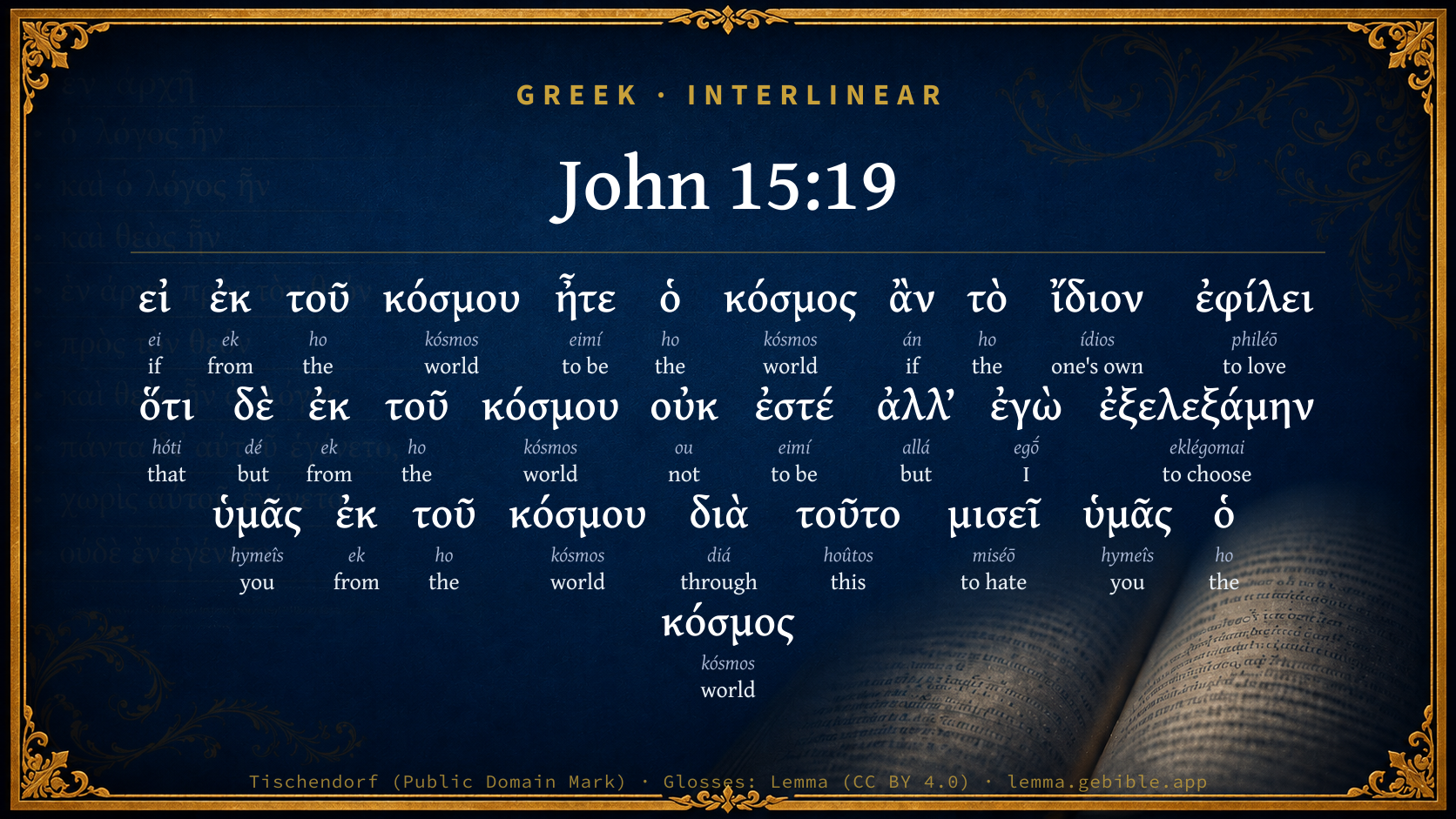
  1. εἰ ei G1487 “if” Conditional
  2. ἐκ ek G1537 “from” Preposition
  3. τοῦ ho G3588 “the” Article, Genitive, Singular, Masculine
  4. κόσμου kósmos G2889 “world” Noun, Genitive, Singular, Masculine
  5. ἦτε eimí G1510 “to be” Verb, Imperfect, Active, Indicative, 2nd person, Plural
  6. ὁ ho G3588 “the” Article, Nominative, Singular, Masculine
  7. κόσμος kósmos G2889 “world” Noun, Nominative, Singular, Masculine
  8. ἂν án G302 “if” Particle
  9. τὸ ho G3588 “the” Article, Accusative, Singular, Neuter
  10. ἴδιον ídios G2398 “one's own” Adjective, Accusative, Singular, Neuter
  11. ἐφίλει philéō G5368 “to love” Verb, Imperfect, Active, Indicative, 3rd person, Singular
  12. ὅτι hóti G3754 “that” Conjunction
  13. δὲ dé G1161 “but” Conjunction
  14. ἐκ ek G1537 “from” Preposition
  15. τοῦ ho G3588 “the” Article, Genitive, Singular, Masculine
  16. κόσμου kósmos G2889 “world” Noun, Genitive, Singular, Masculine
  17. οὐκ ou G3756 “not” Particle, Negative
  18. ἐστέ eimí G1510 “to be” Verb, Present, Active, Indicative, 2nd person, Plural
  19. ἀλλ’ allá G235 “but” Conjunction
  20. ἐγὼ egṓ G1473 “I” Personal pronoun, 1st person, Nominative, Singular
  21. ὑμᾶς hymeîs G5210 “you” Personal pronoun, 2nd person, Accusative, Plural
  22. ἐκ ek G1537 “from” Preposition
  23. τοῦ ho G3588 “the” Article, Genitive, Singular, Masculine
  24. κόσμου kósmos G2889 “world” Noun, Genitive, Singular, Masculine
  25. διὰ diá G1223 “through” Preposition
  26. τοῦτο hoûtos G3778 “this” Demonstrative pronoun, Accusative, Singular, Neuter
  27. μισεῖ miséō G3404 “to hate” Verb, Present, Active, Indicative, 3rd person, Singular
  28. ὑμᾶς hymeîs G5210 “you” Personal pronoun, 2nd person, Accusative, Plural
  29. ὁ ho G3588 “the” Article, Nominative, Singular, Masculine
  30. κόσμος kósmos G2889 “world” Noun, Nominative, Singular, Masculine

About this verse

These counts appear in no published source. They are computed here, from the morphology-tagged text and Lemma’s own curated glosses. What Lemma adds →

31
words
18
distinct lemmas
Gospels
section

Notable vocabulary

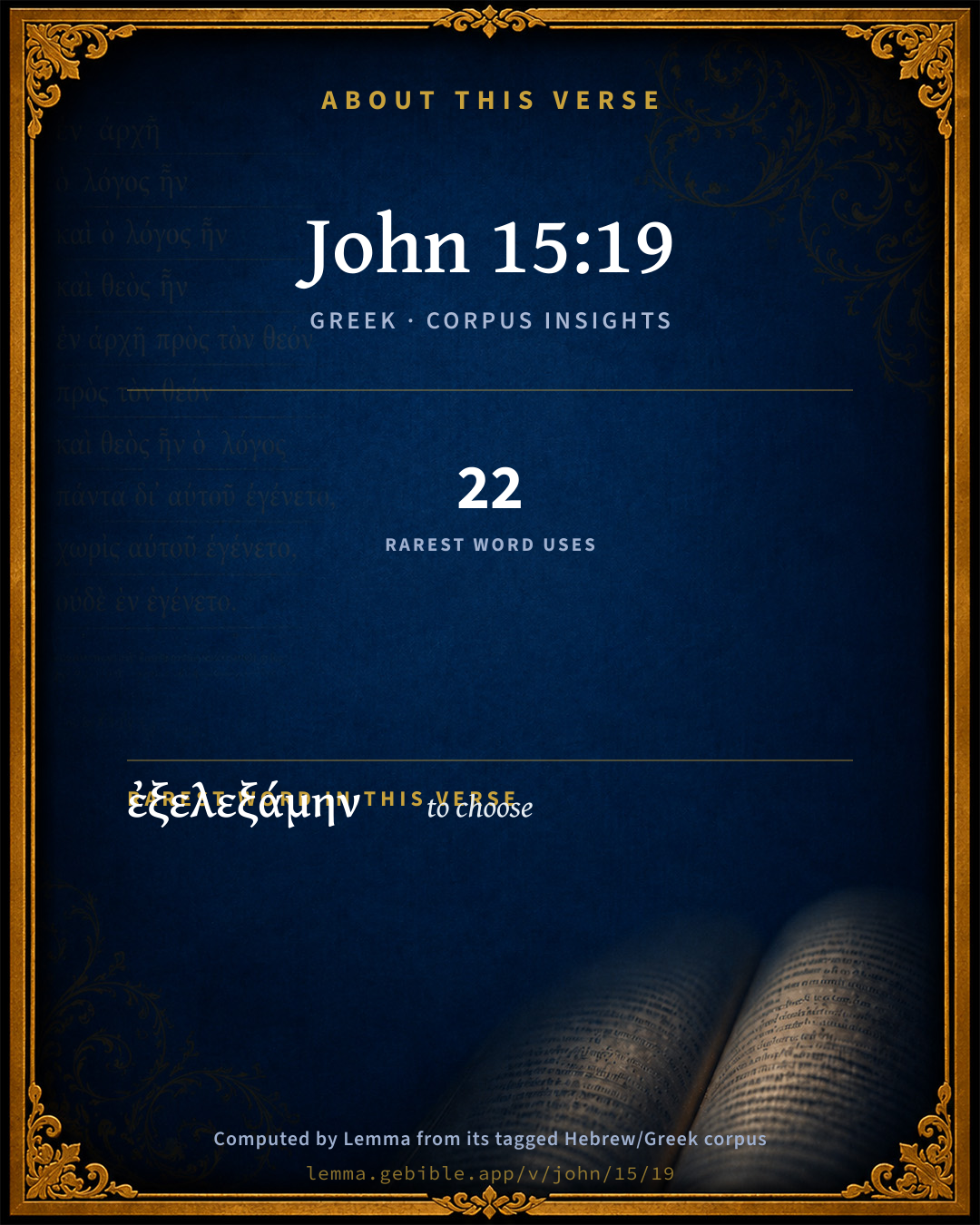
The rarest word here is ἐξελεξάμην to choose G1586 — appearing just 22 times in the whole Greek New Testament.

Shared distinctive vocabulary

ἐξελεξάμην to choose G1586 occurs in 20 verses of the Greek New Testament. Also found in:

Repetition

Words recur within this verse:

Cross-references

13

Topical passages linked to John 15:19 in the Treasury of Scripture Knowledge — connected by theme and wording, ordered by reader-vote popularity; previews shown in the World English Bible.

  • 1 John 4:4–5 You are of God, little children, and have overcome them; because greater is he who is in you than he who is in the world.
  • John 17:14–16 I have given them your word. The world hated them, because they are not of the world, even as I am not of the world.
  • Ephesians 1:4–11 even as he chose us in him before the foundation of the world, that we would be holy and without blemish before him in love;
  • Titus 3:3–7 For we were also once foolish, disobedient, deceived, serving various lusts and pleasures, living in malice and envy, hateful, and hating one another.
  • John 15:16 You didn't choose me, but I chose you, and appointed you, that you should go and bear fruit, and that your fruit should remain; that whatever you will ask of the Father in my name, he may give it to you.
  • Ephesians 2:2–5 in which you once walked according to the course of this world, according to the prince of the powers of the air, the spirit who now works in the children of disobedience;
  • 1 John 5:19–20 We know that we are of God, and the whole world lies in the power of the evil one.
  • 1 Peter 2:9–12 But you are a chosen race, a royal priesthood, a holy nation, a people for God's own possession, that you may show forth the excellencies of him who called you out of darkness into his marvelous light:
  • Luke 6:32 If you love those who love you, what credit is that to you? For even sinners love those who love them.
  • 1 John 3:12 unlike Cain, who was of the evil one, and killed his brother. Why did he kill him? Because his works were evil, and his brother's righteous.
  • 1 Peter 4:3 For we have spent enough of our past time doing the desire of the Gentiles, and having walked in lewdness, lusts, drunken binges, orgies, carousings, and abominable idolatries.
  • Revelation 20:7–9 And after the thousand years, Satan will be released from his prison,
  • Revelation 12:17 The dragon grew angry with the woman, and went away to make war with the rest of her seed, who keep God's commandments and hold Jesus' testimony.

Cross-references courtesy of OpenBible.info (CC BY 4.0).

Commentary

Notes on John 15:19 from classic Christian and Jewish commentators (each source and its license shown beneath its notes). The classic Christian expositions comment on the surrounding passage and are grouped to its opening verse, so a note may address several verses; the Jewish commentaries on the Tanakh (Rashi and others) are per-verse, so they appear only where the commentator wrote on this verse.

Lemma curates 59 commentaries, every one of them public domain or Creative Commons licensed, each selected and text-cleaned for this edition rather than reprinted as found. About our sources →

The Biblical Illustrator

Joseph S. Exell

Joh_15:19

If ye were of the world the world, would love his own

The pedigree and position of true men

I.

THE PEDIGREE OF TRUE MEN.

1. They were once in the world. That world is characterized by

(1) Practical athiesm. They who make it up are without God, if not avowedly, at least in spirit, conduct and aim.

(2) Imperial materialism. They have no practical recognition of a spiritual universe, relationship, obligation. They walk after the flesh, and seek their happiness, wealth, dignity in earthly things.

(3) Dominant selfishness. Each one is governed by selfish interests. These are the goal towards which their steps are directed; the idol they worship.

2. They have been brought out of the world by Christ. No one but Christ can bring men out of such a state. Philosophy, civilization, natural religion are powerless. Christ penetrates men with the idea of the true God. He draws the curtain of materialism and reveals the spiritual world. He destroys selfishness and constrains men with His own love. This work is represented by an emancipation, regeneration, resurrection, creation--and none of these words are too strong.

II. THE POSITION OF TRUE MEN. They are rendered repugnant to the world by Christ.

1. The hatred of the world to true men is of the same kind as that which Christ experienced. The forms of persecution change, but the spirit remains. If it is prevented from mangling the body, it will mangle the reputation.

2. Then hatred is for the same reason. The world hated Christ because

(1) His purity condemned their depravity.

(2) His benevolence their selfishness.

(3) His humility their pride.

(4) His truth their prejudices.

(5) His spirituality their carnal pleasures. For these reasons now the world hates true men. (D. Thomas, D. D.)

The world we have renounced

1. Perhaps there is no word more commonly in our mouth than the world; and yet hardly any to which we attach less clear and certain meaning, Indeed, the sense intended by it varies according to the character of the person that uses it. Some people denounce the world as unmixed evil; some say it is for the most part good, or at least innocent: some profess to see its deceitful workings everywhere; some will see them nowhere: some make their religion to consist in a separation from the world; some think the field of their religious duty is in the world: in a word, there is little or no agreement or certainly but in this, that there is such a power and reality as the world, and that it is of great moment to us to know what it is.

2. In its original sense, the world is altogether good. By the work and will of God it is all sinless and pure. It is only in its second intention that the world has an evil sense; but that sense is its prevailing and true one--the weed is the creation of God as it is possessed by sin and death. So subtle and far spreading is the original sin of man, that no living soul is without a taint. The original sin was not a measured quantity, so to speak, of evil, which, like a hereditary disease, might exhaust itself in the course of two or three descents. Every several generation renewed it afresh; every several man reproduced it, and sustained the tradition of evil by example, habit, and license; it was perpetuated in races, nations, families; by custom, usage, law. And what is this great tradition of human thought and will, action and imagination, with all its illusions, misjudgments, indulgences, and abuses of Gods creatures, but the world? We mean by it something external to our minds, and yet not identical with the creation of God; something which has thrust itself between it and us; something parasitical, which has fastened upon all Gods works, and has wound itself into its inmost action, and into its very being.

I. It is true to DISTINGUISH BETWEEN THE CHURCH AND THE WORLD, as between things antagonistic and irreconcilable: for the Son of God, by His incarnation and atonement, and by the calling and mission of His apostles, has founded and built up in the earth a visible kingdom, which has no other Head but Him alone. That visible kingdom is so taken out of the world, that a man must either be in it or out of it; and must, therefore, be either in the Church or in the world. In the visible kingdom of Christ are all the graces and promises of life; in the world are the powers and traditions of death.

II. But it is no less true to say, that THE WORLD, WHICH IN THE BEGINNING WAS VISIBLY WITHOUT THE CHURCH, IS NOW INVISIBLY WITHIN IT. So long as the world was heathen, it warred against the Church in bitter and relentless persecutions. The two great traditions--the one of God, the other of the world, the powers of the regeneration and of the fall--kept their own integrity by contradiction and perpetual conflict. The Church stood alone--a kingdom ordained of God, having her own princes and thrones, her own judges and tribunals, her own laws and equity, her own public customs and private economy of life. It was when the conversion of individuals drew after it, at last, the whole civil state; when the secular powers, with all their courts, pomps, institutions, laws, judicatures, and the entire political order of the world, came into the precincts of the Church; then it was that the great tradition of human thought, passion, belief, prejudice, and custom, mingled itself with the unwritten usages of the Church. In the beginning the Church had a sorer and a more fiery trial: but who can say that the peril of souls is not greater now? In those days it was no hard matter to discern between the world and the Church. But now our very difficulty is, to know what is that world which we have renounced; to detect its snares, and to overcome its allurements … I will say, that the state of public morals, the habits of personal and social life, popular amusements, and the policy of governments, so far as they are not under the direct guidance of religion, are examples of the presence and power of that which is properly and truly called the world. And nobody need fear to add, that the tone and moral effect of all these, except when they are especially guided by religion to a Christian use and purpose, is almost always, in a greater or less degree, at variance with God. This, then, is the world which in our baptism we renounced. It was no remote or imaginary notion, but a present and active reality: that very same principle of original evil which, in all ages, under all shapes, in all places, has issued in lust, pride, covetousness, vainglory. We are not called to separate ourselves from any outward system, but to be inwardly as estranged from the evil that cleaves to the system around us, as if we were not of it. (Archdeacon Manning.)

Christians separated from the world

It is a remarkable act, that while the baser metals are diffused through the body of the rocks, gold and silver usually lie in veins; collected together in distinct metallic masses. They are in the rocks but not of them And as by some power in nature God has separated them from the base and common earths, even so by the power of His grace will he separate His chosen from a reprobate and rejected world. (T. Guthrie, D. D.)

The believer not of the world

When courtiers come down into the country, the common home-bred people possibly think their habits strange; but they care not for that. It is the fashion at Court. What need, then, have the godly to be so tender-foreheaded, to be out of countenance because the world looks on holiness as a singularity? It is the only fashion in the highest Court,--yea, of the King of kings Himself. (H. G. Salter.)

Christians not to compromise with the world

That idea is very popular. Now then, Moses, do not be too strict. Some people are a deal too particular. Those old-fashioned puritanical people are narrow and straitlaced: be liberal and take broader views. Cannot you make a compromise? Tell Pharaohs daughter you are an Israelite, but that, in consequence of her great kindness, you will also be an Egyptian. Thus you can become an Egypto-Israelite--what a fine blend! Or say an Israelito-Egyptian--with the better part in the front. You see, it seems a simple way out of a difficulty, to hold with the hare and run with the hounds. It saves you from unpleasant decisions and separations: Besides, Jack-of-both-sides has great praise from both parties for his large-heartedness. My hearers, come out, I pray you, one way or the other. If God be God, serve Him; if Baal be God, serve him. If it is right to be an Israelite, be an Israelite; if it is right to be an Egyptian, be an Egyptian. None of your trimming. It will go hard with trimmers at the last great day. When Christ comes to divide the sheep from the goats, there will be no middle sort, and meanwhile you border people will be driven down to hell. May God grant us grace to be decided! (C. H.Spurgeon.)

The Biblical Illustrator, edited by Joseph S. Exell (c. 1880s–1900s) — public domain. Text from a community e-Sword module.

Bengel's Gnomon

Johann Albrecht Bengel

Joh 15:19. Ἐκ τοῦ κόσμου) of the world and on its side, of its party.—τὸ ἴδιον, its own) It would love you for its own sake, not for yours. Its own is said instead of you, and so the fact of it being the interest of the world to do so is marked.—ἐζελεξάμην ὑμᾶς, I have chosen you) as ἰδίους, My own, ch. Joh 13:1, “Jesus having loved His own which were in the world, He loved them unto the end.” Believers are no better than the world, as considered in themselves, but are so only by election. This it is which makes the great distinction.

Bengel's Gnomon of the New Testament — English translation (T&T Clark, Edinburgh, 1860) — public domain. Text from a community e-Sword module.

Expositor's Greek Testament

ed. W. Robertson Nicoll

Joh 15:19 . εἰ ἐκ … ἐφίλει , “If ye were of the world, the world would love [that which is] its own”; not always the case, but generally. ὅτι δὲ … ὁ κόσμος , “but because ye are not of the world,” do not belong to it, and are not morally identified with it, “but I have chosen you out of the world, therefore the world hates you”. So that the hatred of the world, instead of being depressing, should be exhilarating, as being an evidence and guarantee that they have been chosen by Christ.

The Expositor's Greek Testament, edited by W. Robertson Nicoll (1897–1910) — public domain. Text from a community e-Sword module.

Adam Clarke's Commentary

Verse 19. Ye are not of the world - therefore, &c.] On this very account, because ye do not join in fellowship with those who know not God, therefore they hate you. How true is that saying:-

"The laws of Christ condemn a vicious world,

And goad it to revenge!"

GAMBOLD.

Adam Clarke's Commentary on the Bible (1810–1826) — public domain. Text from a community e-Sword/MySword module.

John Calvin's Commentaries

19. If you were of the world. This is another consolation, that the reason why they are hated by the world is, that they have been separated from it. Now, this is their true happiness and glory, for in this manner they have been rescued from destruction.

But I have chosen you out of the world. To choose means here to separate Now, if they were chosen out of the world, it follows that they were a part of the world, and that it is only by the mercy of God that they are distinguished from the rest who perish. Again, by the term, the world, Christ describes, in this passage, all who have not been regenerated by the Spirit of God; for he contrasts the Church with the world, as we shall see more fully under the seventeenth chapter. And yet this doctrine does not contradict the exhortation of Paul,

Be at peace with all men, as far as lieth in you, (Romans 12:18;)

for the exception which he adds amounts to saying, that we ought to see what is right and proper for us to do that no man, by seeking to please the world, may give himself up to its corruptions.

But there is still another objection that may be urged; for we see that it commonly happens that wicked men, who are of the world, are not only hated, but accursed by others. In this respect, certainly, the world loveth not what is its own. I reply, earthly men, who are regulated by the perception of their flesh, never have a true hatred of sin, but only so far as they are affected by the consideration of their own convenience or injury. And yet the intention of Christ was not to deny that the world foams and rages within itself by internal quarrels. He only intended to show, that the world hates nothing in believers but what is of God. And hence, too, it plainly appears how foolish are the dreams of the Anabaptists, who conclude, from this single argument that they are the servants of God, because they displease the greater part of men. For it is easy to reply, that many who are of the world favor their doctrine, because they are delighted at the thought of having every thing in shameful confusion; while many who are out of the world hate it, because they are desirous that the good order of the state should remain unbroken.

John Calvin's Commentaries (1540-1563) — public domain. Text from the Calvin Translation Society English edition (1840s-50s) via the Christian Classics Ethereal Library (ccel.org). Calvin's coverage is partial (roughly two-thirds of the Bible); uncommented books and verses are honest gaps, never fabricated. The 19th-century editor's footnotes and remarks are omitted so the notes are faithfully Calvin's own voice.

Ellicott's Commentary for English Readers

(19) If ye were of the world, the world would love his own.—The force of the expression indicates the utter selfishness of the world’s love. It would love not them, but that in them which was its own. (Comp. Note on Joh_7:7.)

I have chosen you out of the world.—Comp. Joh_15:16, and Note on Joh_7:7. There He had told them that the world could not hate them. The very fact of its hatred would prove a moral change in them, by which they had ceased to belong to the world, and had become the children of God. Both thoughts are repeated in 1Jn_3:13; 1Jn_4:5.

A Bible Commentary for English Readers, edited by Charles John Ellicott (1878–1897) — public domain. Text from a community e-Sword module.

The Cambridge Bible for Schools and Colleges

gen. ed. J. J. S. Perowne

19. the world would love his own] In Joh_7:7 He told His brethren, who did not believe on Him, that the world could not hate them. This shews why: in their unbelief it still found something of its own (comp. 1Jn_4:5). ‘His own,’ or its own, is neuter singular not masculine plural. The selfishness of the world’s love is thus indicated: it loves not so much them, as that in them which is to its own advantage; and hence the lower word for ‘love’ is used (philein), not the higher one (agapân) as in Joh_15:17. It is mere natural liking. Note the solemn repetition of ‘world’ in this verse. For the construction comp. Joh_5:46, Joh_8:19; Joh_8:42, Joh_9:41, Joh_18:36 and contrast Joh_4:10, Joh_11:21, Joh_14:28.

I have chosen] I chose: see on Joh_15:16.

therefore the world hateth you] Or, for this cause (see on Joh_8:47 and Joh_12:39) &c. Comp. 1Jn_3:13.

The Cambridge Bible for Schools and Colleges (gen. ed. J. J. S. Perowne; Cambridge University Press, 1878–1918) — public domain. Text from a community e-Sword module.

John Gill's Exposition

But all these things will they do unto you,.... Christ here signifies, that all the hatred and persecutions raised against his people by the world, would not be on their own account, for any evil actions done by them; they would not suffer as thieves, murderers, and evildoers, but as Christians; or as he says,

for my name's sake: because they were called by his name, and called upon his name; because they professed his name, and confessed him to be the Messiah and Redeemer; because they loved his name Jesus, a Saviour, believed in his name, and hoped in him for eternal life; and also preached him, and in his name salvation, and encouraged others to believe in him; and therefore they had no reason to be ashamed, but rather to rejoice; as they afterwards did, that they were counted worthy to suffer shame for his name: besides, this malice and hatred of theirs arose from ignorance of the Father of Christ:

because they know not him that sent me; they did not know that Jesus was the Christ, and sent of God; they did not acknowledge him to be so, or the Father to be the sender of him; and because Christ and his disciples asserted this, therefore they were the objects of their hatred.

John Gill's Exposition of the Whole Bible (1746–1763) — public domain (CC PDM 1.0). Text via the HelloAO Bible API.

Trapp's Complete Commentary

John Trapp

19 If ye were of the world, the world would love his own: but because ye are not of the world, but I have chosen you out of the world, therefore the world hateth you.

Ver. 19. If ye were of the world, &c.] They jangle among themselves, and intertear one another as dogs fighting. For though there be not a disagreement in hell (being but the place of retribution, not of action), yet on earth there is no sound peace among the wicked. Howbeit let Ephraim be against Manasseh, and Manasseh against Ephraim, they will be soon against Judah; as if a hare ran by dogs that are fighting, they will agree to pursue the hare.

Therefore the world hateth you] As inhospitable savages do those that land on their coasts; as the Cyprians, for an old grudge, slay all Jews they meet with, though but cast upon their coasts by contrary winds. Odio humani generis, et per flagitia invisi, saith Tacitus of Christians. (xv.) Tanti non est bonum, quanti est odium Christianorum. Of such it is not good, how much is the hatred of Christians. David’s adversaries sought not only his life, but his soul, his damnation too; as that monster of Milan, mentioned by Bodinus. Now we commit thy soul to the devil, said the persecutors to John Huss. And Jerome of Prague could hardly obtain a confessor, being, it seems, conscientious that way.

John Trapp, A Commentary or Exposition upon All the Books of the Old and New Testament (1647–1656) — public domain. Text from a community e-Sword module.

Albert Barnes' Notes on the Bible

If ye were of the world - If you were actuated by the principles of the world. If, like them, you were vain, earthly, sensual, given to pleasure, wealth, ambition, they would not oppose you.

Because ye are not of the world - Because you are influenced by different principles from men of the world. You are actuated by the love of God and holiness; they by the love of sin.

I have chosen you out of the world - I have, by choosing you to be my followers, separated you from their society, and placed you under the government of my holy laws.

Therefore ... - A Christian may esteem it as one evidence of his piety that he is hated by wicked men. Often most decided evidence is given that a man is the friend of God by the opposition excited against him by the profane, by Sabbath-breakers, and by the dissolute, 1Jo 3:13; Joh 7:7.

Albert Barnes' Notes on the Bible (1834–1885) — public domain. Text from a community e-Sword/MySword module.

Matthew Poole's English Annotations

Men and women may be in the world, yet not of the world.

Of the world here signifies carnal men, such as are like to the men of the world in their studies, designs, counsels, affections; as of the devil, and of God, signifies, Joh 8:44,47. If you had affections, lusts, and dispositions like them, and drove no other designs than they drive, you might expect, that as it is of the nature of all men to love such as are like to them in manners and studies; so they would love you, take a delight in you, be kind to you, and do you all offices of love: but because you are not of such tempers, dispositions, and inclinations; but that I, having chosen you out of the world, have given you new hearts, new frames and dispositions, quite contrary to theirs; therefore the world, disliking you, and seeing that your principles are quite opposite to theirs, abhor and hate you, and will be ready to do you all that evil and mischief, which is the product of a rooted hatred and malice in the heart. This is a second argument by which our Lord comforts them. It is drawn from the cause and root of that hatred which they would meet with: it was not for their faults or sins, but because they were the objects of Christ’s love, which being also shed abroad in their hearts by the Holy Ghost, produced again in them holy affections and dispositions, making them wholly unlike to men in the world.

Matthew Poole's English Annotations on the Holy Bible (1683–1685) — public domain. Text from a community e-Sword/MySword module.

Whedon's Commentary on the Bible

Daniel D. Whedon

19. The world—Five times is the world named in this verse. And what, truly, is this so-named world? It is, of course, not the physical frame of the globe, nor is it the human race as such. It is the living, fallen, unregenerate race, with whom self-interest is supreme; to whom right is a word of feeble meaning, and holiness a term of disgust; to whom sin is a trifle or an unreality; to whom God in his true attributes is offensive, and of whom Satan, but dimly disguised, is the actual god. This world is a realm of sordid appetite, of turbulent passion, of unprincipled ambition; a kingdom of evil, in which, were the inhabitants not mortal, and occupied with compulsory labour, there would be a complete likeness and sameness with hell. Were God to render the bodies of unregenerate men at once immortal, men would become fiends and earth a pandemonium. No wonder, then, that one being the incarnation of goodness, should be the central object of its antipathy.

World would love its own—Were the apostles of this same world they would be the objects of such love as the world entertains, namely, the affinity of evil with evil. It would shed its grim smile upon them as its own, and welcome them into the compact and strife that the world affords and enjoys.

Because… not of the world—Chosen by him from the world, the affinity of the world is broken and the antipathy is established. And it is not merely the antipathy of unlikeness. For the world hates them because, by assuming to be better than the world, the world feels itself to be by them condemned. And their mission of reproof, of warning, of threatening, and of reformation, is accepted by the world as a rebuke, an attack, and a war. Hence the world is in arms against them unarmed. It is the war of the many with the few; of the powerful with the weak; of the fierce with the mild; of the armored with the defenceless. But still he now propounds a consolation and justification. And these are threefold. First, they share this hatred with their Lord, Joh_15:20; second, that hatred guiltily strikes against God the Father, 21-25; and third, they co-operate in their testimony with the holy Comforter, 26, 27. Then, through the entire sixteenth chapter, does the Lord expand this struggle between the Comforter and the world before their view, closing with the grand trumpet peal of triumph, Be of good cheer, I HAVE OVERCOME THE WORLD! Such is the joyous close of the Lord’s earthly ministry to his apostles. His Gospel is a gospel of ultimate triumph.

Daniel D. Whedon (gen. ed.), Commentary on the Old and New Testaments (1874–1909) — public domain. Text from a community e-Sword module.

The Pulpit Commentary

If ye were of the worldi.e. still a part of it, deriving your life, maxims, and pleasures from it; if you could sympathize with its vulgar passion, and its temporary fleeting excitements, partisanships, and bigotries the world would be loving (efilei , notice the form of the conditional sentence, a supposition contrary to fact, therefore anticipating the negative clause that follows, "but ye are not of the world;" notice also that filew , the love of affection, not agapaw , the love of reverence and profound regard, which you are to show to one another and to me) would be loving its own. The world loves its priests and mouthpieces, its own organization ("Caiaphas, Pilate, Herod, and Judas, and all devils," Luther); the world loves its own offspring. But because ye are not of the world, but I chose you, withdrawing you for my service, out of the world (the two meanings of ek here differ; the first ek denotes origin, the second corresponds with the compound ek in eklegomai), therefore the world hateth you. I have caused you to break with it, and you are no longer "its own." Just in proportion as you are one with me, you draw upon yourself its hatred of me. "The offence of the cross" is not ceased. Thoma comments on the harmony between this statement and that of the Acts, Epistles, and Apocalypse, whose colors and features are here, as he thinks, drawn upon. It is profoundly interesting to trace the fulfillment of the Lord"s prescient words in earlier Scripture. (1Pe_4:17 Gal_6:17 Php_3:10 Heb_12:3)

The Pulpit Commentary (1880–1919), ed. H.D.M. Spence-Jones & Joseph S. Exell — public domain. Text from a community e-Sword module.

John Wesley's Explanatory Notes

Because ye are not of the world, therefore the world hateth you - Because your maxims, tempers, actions, are quite opposite to theirs. For the very same reason must the world in all ages hate those who are not of the world.

John Wesley, Explanatory Notes Upon the Whole Bible (1754–1765) — public domain. Text via the GEBible commentary corpus.

Scofield Reference Notes

C. I. Scofield

the world kosmos = world-system. Joh 16:11; Joh 16:33; Joh 7:7. (See Scofield "Rev 13:8").

out of the world kosmos = mankind. (See Scofield "Mat 4:8").

The Scofield Reference Bible (1917 edition), notes by C. I. Scofield — public domain. Text from a community e-Sword module.

Cambridge Greek Testament for Schools and Colleges

19. τὸ ἴδιον. Its own. In Joh 7:7 He told His brethren, who did not believe on Him, that the world could not hate them. This shews why. In their unbelief it still found something of its own (1Jn 4:5). The selfishness of the world’s love is thus indicated. It loves not so much them, as that in them which is to its own advantage: hence the lower word φιλεῖν rather than ἀγαπᾷν (contrast Joh 15:17); it is mere natural liking. With the solemn repetition of κόσμος comp. Joh 3:17; Joh 3:31, Joh 12:36, Joh 17:14. For the construction comp. Joh 5:46, Joh 8:19; Joh 8:42, Joh 9:41, Joh 18:36 and contrast Joh 4:10, Joh 11:21, Joh 14:28. For διὰ τοῦτο see on Joh 7:21-22.

Cambridge Greek Testament for Schools and Colleges (Cambridge University Press, 1896; 21 vols, various authors incl. Carr, Maclear, Plummer, Farrar, Lumby, Moule, M. R. James, Simcox) — public domain. Text from a community e-Sword module.

International Critical Commentary

19. εἰ ἐκ τοῦ κόσμου ἦτε. Those who are “of the world” (cf. 1Jn 4:5) are sharply contrasted by Jn. with the Christian disciples, whose “otherworldliness” he always speaks of with emphasis. See, particularly, 17:14, 16. One of the characteristics of the writings of Jn. is that he always paints in black and white, without allowing for intermediate shades of colour. He will have no compromise with evil. For him the Church and the world are set over against each other, and he does not contemplate their reconcilement.1

ὁ κόσμος ἂν τὸ ἴδιον ἐφίλει, “the world would have loved its own,” that which is in harmony with worldly ideals. The apostles, on the other hand, are not “of the world.” Out of it they had been chosen (see v. 16, and cf. 13:18), and so the world hated them. διὰ τοῦτο refers to what has gone before, as at 6:65. Thus vv. 16-20 taught the apostles that if to abide in Christ is the secret of fruitful lives and of effectiveness in prayer, it also provokes the world’s hostility. But this hostility carries with it a promise and a benediction (cf. 1Pe 4:14, Mat 5:11).

With the Johannine teaching as to the hatred of the Church by the world (7:7, 17:14, 1Jn 3:13), cf. the fine saying of Ignatius: “Christianity (χριστιανισμός) is not talk, but power, when it is hated by the world” (Rom_3).

International Critical Commentary — older volumes (1896–1929), various authors — public domain. Text from a community e-Sword module.

Vincent's Word Studies in the New Testament

Marvin R. Vincent

Of the world [εκ του κοσμου] . Sprung out of the world. See on of the earth, Joh 3:31.

Would love [αν εφιλει] . The verb for natural affection. See on 5 20.

Marvin R. Vincent, Word Studies in the New Testament (1887–1900) — public domain. Text from a community e-Sword/MySword module.

Lesson kit

Teaching starters — assembled from the data on this page, not authored interpretation. Every prompt links to the verse data it draws on. Edit before teaching.

John, in the Gospels, opens this verse with 31 words (18 distinct Greek lemmas). Its most distinctive word is eklégomai (“to choose”). A historical commentator’s framing appears above. Read the whole chapter for the surrounding context.

Discussion questions

  1. What does “to choose” (eklégomai) contribute to the verse as a whole?
  2. How does Mark 13:20, which shares the word «to choose», read alongside this verse?
  3. What does the repetition of “world” (5× in this one verse) do in this verse?
  4. The translations on this page render this verse differently — a whole-verse word diff, not a word-by-word alignment. What might account for the different wordings?
  5. Compare how The Biblical Illustrator and Bengel's Gnomon read this verse. Where do they agree or differ?

Things to notice

  • These translations choose different wording for 9 words in this verse.
  • “world” occurs 5× in this single verse.
  • 18 distinct Greek lemmas span 31 words in this verse.

Reading settings

Reading text

Shown beneath each verse's original-language words.

Old Testament
Old Testament edition

Read the OT as the Masoretic Hebrew (MT) or the Greek Septuagint (LXX).

English shown for the Greek Septuagint (in the Hebrew ↔ Greek comparison).

Comparing translations? Open the Compare panel on any verse page to stack up to four side by side.