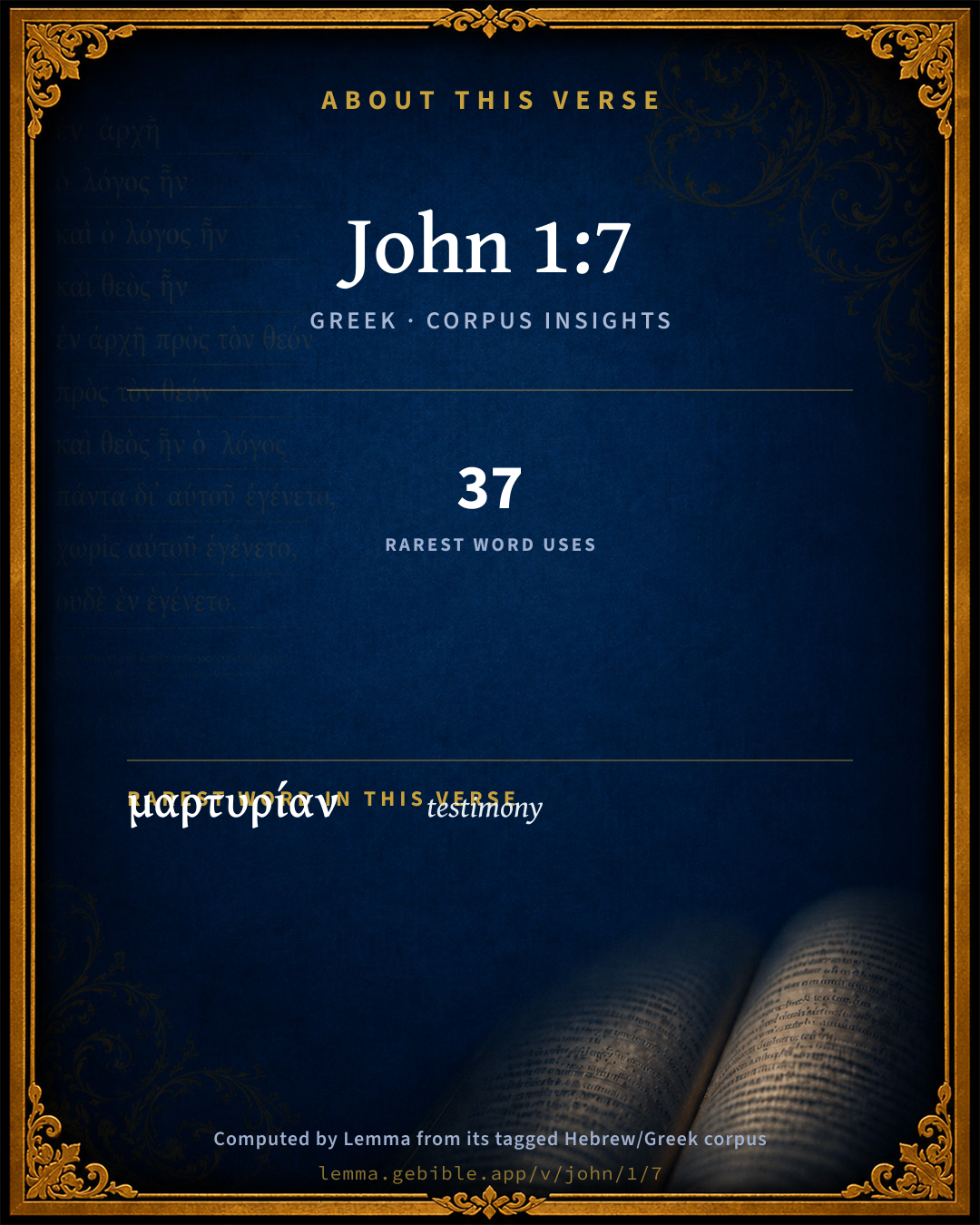
John 1:7

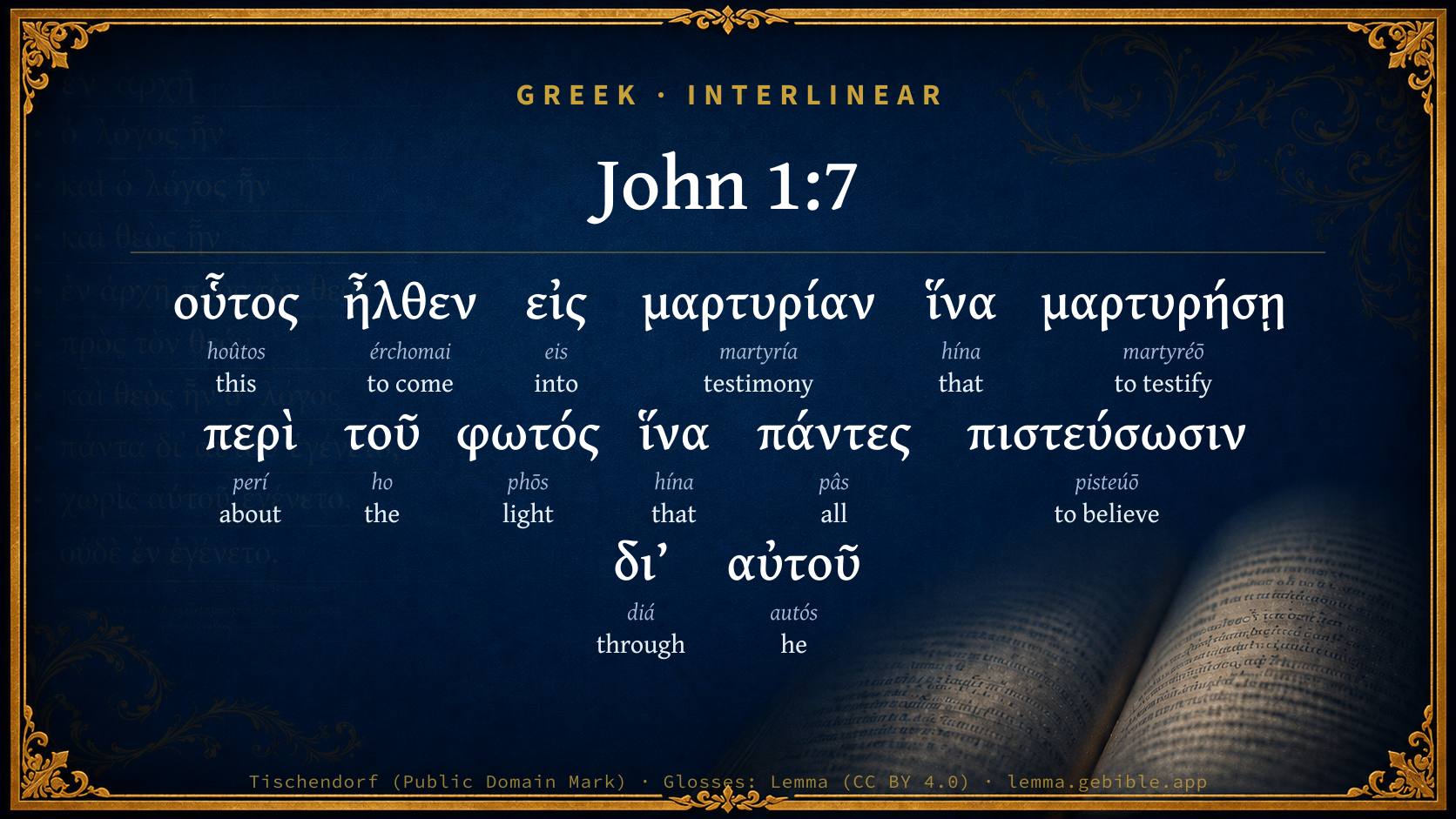
Greek (Tischendorf 8th ed.) John 1:7 appears in the Greek New Testament. The text above is from the Tischendorf 8th edition. Each word links to its Strong’s number and a concise gloss. Click any word for its full Thayer’s Greek Lexicon entry.
Download image
Cite this verse

John 1:7 (World English Bible). Public Domain. Lemma interlinear Bible study tool, https://lemma.gebible.app/v/john/1/7.

Show BibTeX & RIS
BibTeX
RIS
English Translation
The same came as a witness, that he might testify about the light, that all might believe through him.
World English Bible · Public Domain
Download a study sheet

One document with this verse’s original text, its word-by-word gloss line, the meaning frame, cross-references with their text, attributed commentary, and full source and license credits — printable, and it pastes into notes with its structure intact.

This verse Autodidact and up

Study sheet (.html) Plain text (.txt)

A passage Seminary Student

Up to 50 verses in one chapter. A passage sheet keeps up to 6 commentary sources and 12 cross-references per verse, in the order this page ranks them, and says so on the sheet whenever that leaves anything out. Ask for a single verse and you get the Autodidact verse sheet above.

Everything on this page stays free to read, with no account — the sheet is a download of what is already on screen, not access to it.

Want to remove ads? Support Godless Engineer
Compare translations 3

The same verse in 3 English versions, stacked beneath the original-language interlinear above. Click any original word for its lexicon entry.

Each is an independent rendering of the whole verse — the interlinear is not word-aligned to these translations.

Highlighted words mark where these versions differ — a whole-verse word diff, not a word-by-word alignment.

  • World English Bible Public Domain
    The same came as a witness, that he might testify about the light, that all might believe through him.
  • King James Version Public Domain
    The same came for a witness, to bear witness of the Light, that all men through him might believe.
  • unfoldingWord Literal Text CC BY-SA 4.0
    He came as a witness in order that he might testify about the light, so that all might believe through him.

unfoldingWord Literal Text — © unfoldingWord, licensed CC BY-SA 4.0. Word-aligned USFM3 via Door43 (git.door43.org/unfoldingWord/en_ult).

Versions to compare (up to 4)

3 of 4 selected

Show all 19 translations

Every available English version of this verse, each an independent rendering of the whole verse.

  • World English Bible Public Domain
    The same came as a witness, that he might testify about the light, that all might believe through him.
  • Berean Standard Bible Public Domain
    He came as a witness to testify about the Light, so that through him everyone might believe.
  • Majority Standard Bible Public Domain
    He came as a witness to testify about the Light, so that through him everyone might believe.
  • King James Version Public Domain
    The same came for a witness, to bear witness of the Light, that all men through him might believe.
  • American Standard Version (1901) Public Domain
    The same came for witness, that he might bear witness of the light, that all might believe through him.
  • Revised Version (1885) Public Domain
    The same came for witness, that he might bear witness of the light, that all might believe through him.
  • Geneva Bible (1599) Public Domain
    This same came for a witnesse, to beare witnesse of that light, that all men through him might beleeue.
  • Douay-Rheims (1899) Public Domain
    This man came for a witness, to give testimony of the light, that all men might believe through him.
  • Young's Literal Translation Public Domain
    this one came for testimony, that he might testify about the Light, that all might believe through him;
  • Literal Standard Version CC BY-SA 4.0
    this one came for testimony, that he might testify about the Light, that all might believe through him;
  • Unlocked Literal Bible CC BY-SA 4.0
    He came as a witness to testify about the light, that all might believe through him.
  • unfoldingWord Literal Text CC BY-SA 4.0
    He came as a witness in order that he might testify about the light, so that all might believe through him.
  • Darby Bible Public Domain
    He came for witness, that he might witness concerning the light, that all might believe through him.
  • World Messianic Bible Public Domain
    The same came as a witness, that he might testify about the light, that all might believe through him.
  • Webster's Bible Public Domain
    The same came for a witness, to bear testimony of the Light, that all men through him might believe.
  • Free Bible Version CC BY-SA 4.0
    He came as a witness to explain about the light so that everyone might believe through him.
  • Bible in Basic English Public Domain
    He came for witness, to give witness about the light, so that all men might have faith through him.
  • Text-Critical English NT CC BY 4.0
    He came as a witness to testify about the light, so that all might believe through him.
  • Tyndale New Testament (1534) Public Domain
    The same cam as a witnes to beare witnes of the lyght that all men through him myght beleve.

Literal Standard Version (2020), Covenant Press — licensed CC BY-SA 4.0. Text via the HelloAO Bible API (eBible.org). Unlocked Literal Bible (unfoldingWord) — licensed CC BY-SA 4.0. Text via the HelloAO Bible API (eBible.org). unfoldingWord Literal Text — © unfoldingWord, licensed CC BY-SA 4.0. Word-aligned USFM3 via Door43 (git.door43.org/unfoldingWord/en_ult). Free Bible Version, Dr. Jonathan Gallagher — licensed CC BY-SA 4.0. Text via the HelloAO Bible API (eBible.org).

Word by word

More ways to search: Search by grammar → Find every occurrence → Compare this word →

Practice this passage: Drill this verse → Learn its vocabulary →

μαρτυρίαν
martyría
G3141
“testimony”
Noun, Accusative, Singular, Feminine
Part of Speech
Noun
Case
Accusative
Number
Singular
Gender
Feminine
Full Thayer's Definition

Origin: from G3144

TDNT: 11:54,6

1. a testifying a. the office committed to the prophets of testifying concerning future events 2. what one testifies, testimony, i.e. before a judge
  1. οὗτος hoûtos G3778 “this” Demonstrative pronoun, Nominative, Singular, Masculine
  2. ἦλθεν érchomai G2064 “to come” Verb, Aorist, Active, Indicative, 3rd person, Singular
  3. εἰς eis G1519 “into” Preposition
  4. ἵνα hína G2443 “that” Conjunction
  5. μαρτυρήσῃ martyréō G3140 “to testify” Verb, Aorist, Active, Subjunctive, 3rd person, Singular
  6. περὶ perí G4012 “about” Preposition
  7. τοῦ ho G3588 “the” Article, Genitive, Singular, Neuter
  8. φωτός phōs G5457 “light” Noun, Genitive, Singular, Neuter
  9. ἵνα hína G2443 “that” Conjunction
  10. πάντες pâs G3956 “all” Adjective, Nominative, Plural, Masculine
  11. πιστεύσωσιν pisteúō G4100 “to believe” Verb, Aorist, Active, Subjunctive, 3rd person, Plural
  12. δι’ diá G1223 “through” Preposition
  13. αὐτοῦ autós G846 “he” Personal pronoun, Genitive, Singular, Masculine

About this verse

These counts appear in no published source. They are computed here, from the morphology-tagged text and Lemma’s own curated glosses. What Lemma adds →

14
words
13
distinct lemmas
Gospels
section

Shared distinctive vocabulary

μαρτυρίαν testimony G3141 occurs in 33 verses of the Greek New Testament. Also found in:

Repetition

A word recurs within this verse:

Cross-references

14

Topical passages linked to John 1:7 in the Treasury of Scripture Knowledge — connected by theme and wording, ordered by reader-vote popularity; previews shown in the World English Bible.

  • Acts 19:4 Paul said, "John indeed baptized with the baptism of repentance, saying to the people that they should believe in the one who would come after him, that is, in Jesus."
  • John 1:12 But as many as received him, to them he gave the right to become God's children, to those who believe in his name:
  • John 1:32–34 John testified, saying, "I have seen the Spirit descending like a dove out of heaven, and it remained on him.
  • John 1:36 and he looked at Jesus as he walked, and said, "Behold, the Lamb of God!"
  • John 5:33–35 You have sent to John, and he has testified to the truth.
  • John 1:9 The true light that enlightens everyone was coming into the world.
  • John 1:26–27 John answered them, "I baptize in water, but among you stands one whom you don't know.
  • John 3:26–36 They came to John, and said to him, "Rabbi, he who was with you beyond the Jordan, to whom you have testified, behold, the same baptizes, and everyone is coming to him."
  • 2 Peter 3:9 The Lord is not slow concerning his promise, as some count slowness; but is patient with us, not wishing that any should perish, but that all should come to repentance.
  • Titus 2:11 For the grace of God has appeared, bringing salvation to all men,
  • John 1:15 John testified about him. He cried out, saying, "This was he of whom I said, 'He who comes after me has surpassed me, for he was before me.'"
  • Ephesians 3:9 and to make all men see what is the administration of the mystery which for ages has been hidden in God, who created all things through Jesus Christ;
  • 1 Timothy 2:4 who desires all people to be saved and come to full knowledge of the truth.
  • John 1:19 This is John's testimony, when the Jews sent priests and Levites from Jerusalem to ask him, "Who are you?"

Cross-references courtesy of OpenBible.info (CC BY 4.0).

Commentary

Notes on John 1:7 from classic Christian and Jewish commentators (each source and its license shown beneath its notes). The classic Christian expositions comment on the surrounding passage and are grouped to its opening verse, so a note may address several verses; the Jewish commentaries on the Tanakh (Rashi and others) are per-verse, so they appear only where the commentator wrote on this verse.

Lemma curates 59 commentaries, every one of them public domain or Creative Commons licensed, each selected and text-cleaned for this edition rather than reprinted as found. About our sources →

The Biblical Illustrator

Joseph S. Exell

Joh_1:7

The same came for a witness.

A witness is wanted in the period of ignorance and darkness. Such a witness is the moon, which reflects a borrowed portion of light from the sun, and so assures us of him; but when the sun itself arises, himself becomes invisible, and as not existing. His borrowed light also is temporary and changeable. It waxes and wanes, and is sometimes full, and round, and perfect almost as the sun himself; at other times it diminishes and decays, and dies away till it is invisible. So the prophets had the Holy Spirit by time and by measure; and sometimes they were bright and luminous, and shone, as it were, with a celestial and perfect brightness; but then at other times, again, the Spirit in them declined and departed, and left them only the dark lump, waiting till its office should again return, of reflecting some greater or less portion of the suns own proper rays, and invisible till illuminated. But when the sun itself arose upon the world, this should be the sign of him. The light by which he shone should be his own; and should be in himself, and inherent in him. When the Spirit of God should descend upon him; when the hitherto unembodied light should find this rest, and take this place and station--the embodied Sun of Righteousness, and the light and life, the Divinity itself should be incarnate--then, this Spirit of God, the Godhead itself so united to man, should be the sign of the expected Messiah and the witness himself become extinct, in this the last triumphant exercise of his office and witness, (S. R. Bosanquet.)

The witness of the light

Does the light then need that witness should be borne to it? Is not light its own evidence? Yes, if men have eyes to see; but because they lay in the darkness and slumber of sin, it was necessary to arouse them, and to give testimony to the true light, distinguishing it from all false lights that could only lure to death. In an obvious sense, the law and the prophets formed a great system of witness to the coming One Act_10:43; Rom_3:21-22); but it required completing, and Johns ministry was the completion of it--the grand close of the prophetic symphony. The morning star, days harbinger, bears witness of the sun, by shining in his light; and so also does the mountain top, kindled with the first rays of morning, to the dwellers in the deep valley beneath, or the far-stretching plain. But Johns testimony went beyond even this: he not merely preceded the Messiah, closing the prophetic line, but, having first aroused the nation by that cry, Repent, he actually introduced and named Him to Israel. (J. Culross, D. D.)

The force of testimony

Testimony is like an arrow shot from a longbow; the force of it depends on the strength of the hand that draws it. Argument is like an arrow from a cross-bow, which has equal force though shot by a child. (Lord Bacon.)

The Biblical Illustrator, edited by Joseph S. Exell (c. 1880s–1900s) — public domain. Text from a community e-Sword module.

Bengel's Gnomon

Johann Albrecht Bengel

Joh 1:7. Εἰς μαρτυρίαν, for a witness) The evangelist again touches on this, Joh 1:15, and again, Joh 1:19. But with the fullest and most tender feeling he interweaves with this testimony of the Forerunner his own testimony as an apostle, by means of most noble digressions, in which he states the nature and grounds of the Baptist’s office, and partly premises, partly subjoins an explanation of his [the Baptist’s] brief sentences, and declares the full complement of his testimony [gives a clear filling up of it]: [thus forming a kind of succinct prelude to our Lord’s own speeches, which He was about to set forth in this very Gospel.—Harm., p. 153.] What Matthew, Mark, and Luke term a Gospel, this John for the most part terms a testimony or witness: the former term expresses the relation to the promise, that went before: the latter expresses the altogether certain knowledge of him, who announces it: the former is used in reference to Christ as He was manifested; the latter, with reference to the Glory of Jesus Christ, the Son of GOD, when raised from the dead: accordingly, in the Acts and Epistles of the Apostles, both are often employed. Testimony applies to a thing, known for certain by witnesses, a thing not falling under the eyes at least of the hearers, and yet all important to them: accordingly to it answers faith. There follows immediately the declaration, that he might bear witness of the Light: and the words, that he might bear witness, are handled forthwith: the words, of the Light, are handled at Joh 1:9.—ἳνα μαρτυρήσῃ, that he might bear witness) The sum of his testimony was: He, who comes after me, etc., Joh 1:15.—περί τοῦ Θωτός, concerning the Light) John comprises under the appellation of the Light, the things which he wrote, Joh 1:1-5.—ἳνα, in order that) They need Testimony, who were in darkness.—πάντες, all men) to whom He had come.[14]—ΔἸ ΑὐΤΟῦ, through him) through John, not εἰς αὐτόν, not in John, but in Christ, Joh 1:12.[15] The power of John’s testimony extended itself so as even to come under the knowledge of the Gentiles, Act 10:37 [Peter addressing the Gentiles, Cornelius and others, “That word ye know, which was published throughout all Judea, etc., after the baptism, which John preached.”] Διά, through, in a higher sense, is said of Christ, 1Pe 1:21 [Who by Him do believe in God.]

[14] May it not express the grace of God, “who will, θέλει, have all men to be saved and to come to the knowledge of the truth,” 1Ti 2:4.—E.

[15] Grot. wrongly understands διʼ αὐτοῦ through Him, the Light, which would confuse the whole, by rendering it necessary to understand εἰς θεόν after πιστεύσωσι.—E.

Bengel's Gnomon of the New Testament — English translation (T&T Clark, Edinburgh, 1860) — public domain. Text from a community e-Sword module.

Meyer's Critical & Exegetical Commentary

Heinrich August Wilhelm Meyer

Joh_1:7. Εἰς μαρτυρίαν] to bear witness; for John testified what had been prophetically made known to him by divine revelation respecting the Light which had come in human form. Comp. Joh_1:33.

ἵνα πάντες, κ.τ.λ.] Purpose of the μαρτυρήσῃ, final end of the ἦλθεν.

πιστεύσ.] i.e. in the light; comp. Joh_1:8-9; Joh_12:36.

διʼ αὐτοῦ] by means of John, so far as he by his witness-bearing was the medium of producing faith: and thus John is a servant and guide to the Light, which is Christ (Luther); not by means of the light (Grotius, Lampe, Semler), for here it is not faith in God (1Pe_1:21) that is spoken of.

Meyer — Critical and Exegetical Commentary on the New Testament — English translation by Peter Christie, edited by Frederick Crombie (T&T Clark, 1880) — public domain. Text from a community e-Sword module.

Expositor's Greek Testament

ed. W. Robertson Nicoll

Joh 1:7 . οὗτος ἦλθεν εἰς μαρτυρίαν … δι αὐτοῦ . “The same (or, this man) came for witness,” etc. “John’s mission is first set forth under its generic aspect: he came for witness; and then its specific object ( ἵνα μαρτ . περὶ τ . φ .) and its final object ( ἵνα παντ . πιστ .) are defined co-ordinately,” Westcott. John was not to do a great work of his own but to point to another. All his experience, zeal, and influence were to be spent in testifying to the true Light. This he was to do “that all might believe through him”. The whole of this Gospel is a citing of witnesses, but John’s comes first and is of most importance. At first sight it might seem that his mission had failed. All did not believe. No; but all who did believe, speaking generally, believed through him. The first disciples won by Jesus were of John’s training; and through them belief has become general.

The Expositor's Greek Testament, edited by W. Robertson Nicoll (1897–1910) — public domain. Text from a community e-Sword module.

Geneva Bible (1599)

Geneva Bible translators

Through John.

Geneva Bible (1599) marginal notes — public domain. Text via Bolls.life.

Jamieson, Fausset & Brown

Robert Jamieson, A. R. Fausset & David Brown

through him--John.

Jamieson, Fausset & Brown — Commentary Critical and Explanatory on the Whole Bible (1871) — public domain (CC PDM 1.0). Text via the HelloAO Bible API.

Adam Clarke's Commentary

Verse 7. That all men through him might believe.] He testified that Jesus was the true light-the true teacher of the way to the kingdom of glory, and the lamb or sacrifice of God, which was to bear away the sin of the world, Joh 1:29, and invited men to believe in him for the remission of their sins, that they might receive the baptism of the Holy Ghost, Joh 1:32-34. This was bearing the most direct witness to the light which was now shining in the dark wilderness of Judea; and, from thence, shortly to be diffused over the whole world.

Adam Clarke's Commentary on the Bible (1810–1826) — public domain. Text from a community e-Sword/MySword module.

Ellicott's Commentary for English Readers

(7) For a Witness.—Stress is laid upon the work of John as “witness.” This was generally the object of his coming. It was specially to “bear witness of the Light.” The purpose of testimony is conviction “that all men through him might believe,” i.e., through John, through his witness. Compare with this purpose of the Baptist’s work the purpose of the Apostle’s writing, as he himself expresses it in the closing words of John 20; and also the condition and work of the Apostleship, as laid down by St. Peter at the first meeting after the Resurrection (Act_1:21-22). The word “witness,” with its cognate forms, is one of the key-notes of the Johannine writings recurring alike in the Gospel the Epistles, and the Apocalypse. This is partly concealed from the general reader by the various renderings “record,” “testimony,” “witness,” for the one Greek root; but he may see by consulting any English concordance under these words, how frequently the thought was in the Apostle’s mind. See especially Rev_1:2; Rev_1:9, Notes.

A Bible Commentary for English Readers, edited by Charles John Ellicott (1878–1897) — public domain. Text from a community e-Sword module.

The Cambridge Bible for Schools and Colleges

gen. ed. J. J. S. Perowne

7. for a witness] Better, for witness, i.e. to bear witness, not to be a witness: what follows shews the meaning. The word ‘witness’ and ‘to bear witness’ are very frequent in S. John’s writings, and this frequency should be marked by retaining the same translation throughout: testimony to the truth is one of his favourite thoughts.

through him] i.e. through the Baptist, the Herald of the Truth. Comp. Joh_5:33; Act_10:37; Act_13:24.

The Cambridge Bible for Schools and Colleges (gen. ed. J. J. S. Perowne; Cambridge University Press, 1878–1918) — public domain. Text from a community e-Sword module.

John Gill's Exposition

The same came for a witness,.... The end of his being sent, and the design of his coming were,

to bear witness of the light: by which is meant, not the light of nature, or reason; nor the light of the Gospel: but Christ himself, the author of light, natural, spiritual, and eternal. This was one of the names of the Messiah with the Jews; of whom they say (u), , "light is his name"; as it is said in Dan 2:22 and the light dwelleth with him; on which they have (w) elsewhere this gloss, this is the King Messiah; and so they interpret Psa 43:3 of him (x). Philo the Jew often speaks of the Logos, or word, as light, and calls him the intelligible light; the universal light, the most perfect light; represents him as full of divine light; and says, he is called the sun (y). Now John came to bear a testimony to him, as he did; of which an account is given in this chapter, very largely, and elsewhere; as that he testified of his existence before his incarnation; of his being with the Father, and in his bosom: of his deity and divine sonship; of his being the Messiah; of the fulness of grace that was in him; of his incarnation and satisfaction; of his descent from heaven; and of his relation to his church, as in Joh 1:15 the end of which witness was,

that all men through him might believe; that is, that the Jews, to whom he preached, might, through his testimony, believe that Jesus was the light, and true Messiah; for these words are to be taken in a limited sense, and not to be extended, to every individual of mankind; since millions were dead before John began his testimony, and multitudes then in being, and since, whom it never reached: nor can it design more than the Jews, to whom alone he bore witness of Christ; and the faith which he taught, and required by his testimony, was an assent unto him as the Messiah; though the preaching of the Gospel is a means of true spiritual faith in Christ; and doubtless it was so to many, as preached by John: it points out the object of faith, and encourages souls to believe in Christ; and hence, Gospel ministers are instruments by whom ethers believe; and faith comes by hearing, and hearing by the word of God; and then is it, considerable end of the Gospel ministry answered,

(u) Echa Rabbati, fol. 50. 2. (w) Bereshit Rabba, fol. 1. 3. (x) Jarchi in ib. (y) De Maudi Opificio, p. 6. De Allegor. l. 2. p. 80. & de Somniis, p. 576, 578.

John Gill's Exposition of the Whole Bible (1746–1763) — public domain (CC PDM 1.0). Text via the HelloAO Bible API.

Trapp's Complete Commentary

John Trapp

7 The same came for a witness, to bear witness of the Light, that all men through him might believe.

Ver. 7. The same came for a witness] This he performed with a witness, verbis non solum disertis, sed et exertis. He witnessed plainly and plentifully, with a clear and punctual pronunciation, profession, indigitation, Joh 1:26; Joh 1:29; Joh 1:32; Joh 1:36.

That all men through him might believe] Our Saviour expected that men should have come as far to hear his forerunner and him as the Queen of Sheba came to hear Solomon, Mat 12:42. But the one thing necessary lies, alas, neglected. Men will run to hell as fast as they can: and if God cannot catch them (saith Mr Shephard) they care not, they will not come to Christ that they might live, Joh 5:40.

John Trapp, A Commentary or Exposition upon All the Books of the Old and New Testament (1647–1656) — public domain. Text from a community e-Sword module.

Albert Barnes' Notes on the Bible

For a witness - To give testimony. He came to prepare the minds of the people to receive him Matt. 3; Luke 3; to lead them by repentance to God; and to point out the Messiah to Israel when he came, Joh 1:31.

Of the Light - That is, of the Messiah. Compare Isa 60:1.

That all men ... - It was the object of John’s testimony that all people might believe. He designed to prepare them for it; to announce that the Messiah was about to come, to direct the minds of men to him, and thus to prepare them to believe on him when he came. Thus, he baptized them, saying “That they should believe on him who should come after him” Act 19:4, and thus he produced a very general expectation that the Messiah was about to come. The testimony of John was especially valuable on the following accounts:

It was made when he had no personal acquaintance with Jesus of Nazareth, and of course there could have been no collusion or agreement to deceive them, Joh 1:31. It was sufficiently long before he came to excite general attention, and to fix the mind on it. It was that of a man acknowledged by all to be a prophet of God - “for all men held John to be a prophet,” Mat 21:26. It was “for the express purpose” of declaring beforehand that he was about to appear. It was “disinterested.”

He was himself extremely popular. Many were disposed to receive him as the Messiah. It was evidently in his “power” to form a large party, and to be regarded extensively as the Christ. This was the highest honor to which a Jew could aspire; and it shows the value of John’s testimony, that he was willing to lay all his honors at the feet of Jesus, and to acknowledge that he was unworthy to perform for him the office of the humblest servant, Mat 3:11.

Through him - Through John, or by means of his testimony.

Was not that Light - Was not “the Messiah.” This is an explicit declaration designed to satisfy the disciples of John. The evidence that he was not the Messiah he states in the following verses.

From the conduct of John here we may learn,

The duty of laying all our honors at the feet of Jesus. As John came that all might believe, so it is no less true of the ministry of Jesus himself. He came for a similar purpose, and we may all, therefore, trust in him for salvation. We should not rely too much on ministers of the gospel. They cannot save us any more than John could; and their office, as his was, is simply to direct people “to the Lamb of God that taketh away the sin of the world.”

Albert Barnes' Notes on the Bible (1834–1885) — public domain. Text from a community e-Sword/MySword module.

Haydock's Catholic Bible Commentary

That all men might believe through him; i.e. by John the Baptist’s preaching, who was God’s instrument to induce them to believe in Jesus the Christ, or the Messias, their only Redeemer. (Witham)

George Leo Haydock (1774–1849), Haydock's Catholic Family Bible and Commentary, 1859 edition — public domain. Excludes Psalms (Douay-Rheims chapter numbering differs from Protestant) and Deuterocanonical books (Catholic canon only).

Matthew Poole's English Annotations

The same came for a witness: John was called a messenger to denote his authority; a witness, to denote his work, which is the work of every true minister of the gospel. John was the first witness, and witnessed a thing wholly unknown (before him) to the generality of the world; for though the shepherds, and Simeon, and Anna, had given some testimony to Christ, when he was born, and brought into the temple to be offered to the Lord, yet that was thirty years since, and generally forgot; neither could they bear a testimony to him as an actual minister of the gospel. The apostles were to be witnesses to Christ, Act 1:8; witnesses of his resurrection, Act 1:22; 4:33; 5:32; 10:41; 13:31. All the prophets bare witness to him, that whosoever believeth in his name should be saved, Act 10:43. So did John also; and John further pointed to him passing by, and witnessed that it was he of whom the prophets spake. So that the apostles, and so following ministers, were and are greater witnesses than John the Baptist. The prophets witnessed that he should come, John Baptist witnessed that he should come; the apostles witnessed that he was not only come, but had died, and was again risen from the dead.

To bear witness of the Light; for John’s office was to give a testimony to Christ the true Light, mentioned before; so called, because he maketh manifest, Eph 5:13. He revealeth his Father, Mat 11:27. He is the brightness of his Father’s glory, Heb 1:3, who is light, 1Jo 1:5, and the world is by him enlightened. It was prophesied of his times, Isa 11:9, that the earth should be full of the knowledge of the Lord. That all men through him might believe; the end of John’s testimony was, that multitudes of all sorts might believe by him, or by it, as an instrumental cause of their faith. If we read it by him, it is most proper to understand the pronoun of John the Baptist; for we are not said to believe by Christ, but in him, in his name, & c.

Matthew Poole's English Annotations on the Holy Bible (1683–1685) — public domain. Text from a community e-Sword/MySword module.

The Pulpit Commentary

This man came (historic, hlye) for witness, that he might bear witness concerning the Light. The entire prophetic dispensation is thus characterized. That which the Baptist did, Malachi, Isaiah, Elijah, Hosea, Moses, had done in their day. He came, and by penetrating insight and burning word, by flashes of moral revelation and intense earnestness, "bare witness concerning the Light" which was ever shining into the darkness. His aim and theirs was to prevent the forces of darkness from suppressing or absorbing the light. He came to sting the apathy and disturb the self-complacency of the darkness. He came to interpret the fact of the Light which was shining but not apprehended; and so did all the prophetic ministry of which he was the latest and most illustrious exponent. He came to assert the meaning for man of all God"s perfections; to call conscience from its death sleep; to draw distinctions of tremendous significance between moral and ceremonial obedience; to exalt obedience above sacrifice, and works meet for repentance above Abrahamic privilege; to warn by lurid threatenings of a fiery wrath and a terrible curse which would fall on the disobedient, though consecrated, people. In this he was but the last of a goodly fellowship of prophets who bore witness to the Light of life which had its being in the Eternal Logos of God. He came, as they all had come, with a view of producing results far greater than, as a matter of fact, they have actually achieved. He came to bear such testimony that all through him, i.e. by the force of his appeal or by the fierce glow thus cast upon the perils and follies of the hour, might believe might realize the full significance of the Light which they had hitherto refused to accept. The greatness of this expectation corresponds with the hope which the ministry of Jesus failed also to realize. (Mat_11:9-14) The splendid ministry of this "burning and shining lamp" might, it would seem, have brought all Israel to acknowledge Christ as the Light of the world; but "the darkness apprehended it not." The entire prophetic dispensation, the testimony which the priestly services and sacrifices bore to the evil of sin and to the awfulness of righteousness, as well as the condemnation of the follies and pleasures of the world, involved in John the Baptist"s ascetic profession, might have roused all Israel to believe in the Light. He gathered together all the forces of the Mosaic, prophetic, Levitical, Essenic ministries to bear on the people. Everything that Law could do was done to reveal the Light; but "all" did not believe, for "the darkness apprehended it not."

The Pulpit Commentary (1880–1919), ed. H.D.M. Spence-Jones & Joseph S. Exell — public domain. Text from a community e-Sword module.

John Wesley's Explanatory Notes

The same came for (that is, in order to give) a testimony - The evangelist, with the most strong and tender affection, interweaves his own testimony with that of John, by noble digressions, wherein he explains the office of the Baptist; partly premises and partly subjoins a further explication to his short sentences. What St. Matthew, Mark, and Luke term the Gospel, in respect of the promise going before, St. John usually terms the testimony, intimating the certain knowledge of the relator; to testify of the light - Of Christ.

John Wesley, Explanatory Notes Upon the Whole Bible (1754–1765) — public domain. Text via the GEBible commentary corpus.

Cambridge Greek Testament for Schools and Colleges

7. πιστεύσωσιν. Following the uncial MSS., the best editors add ν ἐφελκυστικόν before consonants and vowels alike: πᾶσι and δυσί are occasional exceptions, and perhaps γιγνώσκουσι (Joh 10:14). Winer, 43.

7. οὗτος sums up the preceding verse as in Joh 1:2. ἦλθεν refers to the beginning of his public teaching: ἐγένετο in Joh 1:6 refers to his birth.

εἰς μαρτυρίαν. For witness, not ‘for a witness;’ to bear witness, not ‘to be a witness.’ What follows, ἵνα μ. π. τ. φ., is the expansion of εἰς μαρτυρίαν. The words μαρτυρία and μαρτυρεῖν are very frequent in S. John’s writings (see on Joh 1:34). Testimony to the truth is one of his favourite thoughts; it is inseparable from the idea of belief in the truth. Testimony and belief are correlatives.

ἵνα μαρτυρήσῃ. The subjunctive with ἵνα after a past tense, where in classical Greek we should have the optative, prevails throughout the N.T. The optative gradually became less and less used until it almost disappeared. When the pronunciation of οι became very similar to that of η, it was found that a distinction not discernible in speaking was not needed at all. On ἵνα see next verse.

πιστεύσωσιν. Used absolutely without an object expressed: comp. Joh 1:51, Joh 4:41-42; Joh 4:48; Joh 4:53, Joh 5:44, Joh 6:36; Joh 6:64, Joh 11:15; Joh 11:40, Joh 12:39, Joh 14:29, Joh 19:35, Joh 20:8; Joh 20:29; Joh 20:31.

δι’ αὐτοῦ. Through the Baptist, the Herald of the Truth. Cf. Joh 5:33; Act 10:37; Act 13:24.

Cambridge Greek Testament for Schools and Colleges (Cambridge University Press, 1896; 21 vols, various authors incl. Carr, Maclear, Plummer, Farrar, Lumby, Moule, M. R. James, Simcox) — public domain. Text from a community e-Sword module.

Alford’s Greek Testament

Henry Alford

7.] The purpose of John’s coming was to bear witness to a fact, which fact (ver. 33) was made known to him by divine revelation.

εἰς μαρτυρίαν, not as E. V., ‘for a witness,’ but for witness, for the purpose of bearing witness: so A.V.R.

ἵνα μαρτ. κ.τ.λ. is an expansion of εἰς μαρτ.:—the subject of his testimony was to be the Light,—and the aim of it, that all might believe (εἰς τὸ φῶς, see ch. 12:36) through him (i.e. John: not τοῦ φωτός (Grot.), which confuses the whole, for then we must understand εἰς θεόν after πιστ. which is here out of place).

Henry Alford, The Greek Testament (1849–1861) — public domain. Text from a community e-Sword module.

International Critical Commentary

7. οὗτος ἦλθεν εἰς μαρτυρίαν. This was the characteristic feature of the Baptist’s mission, “to bear witness” to the claims of Him who was to come. The Fourth Gospel is full of the idea of “witness” (see Introd., p. xc), the words μαρτυρία, μαρτυρεῖν, being frequent in Jn., while they occur comparatively seldom in the rest of the N.T. The cognate forms μαρτύς,

μαρτύριον, are, on the other hand, not found in Jn., although they occur in the Apocalypse.

ἴνα μαρτυρήσῃ. ἴνα with a finite verb, in a telic sense, where in classical Greek we should expect an infinitive, is a common constr. in κοινή Greek, and is specially frequent in Joh_1 Burney2 held that this linguistic feature is due to the Aramaic origin of Jn., and that behind ἴνα is the particle דְּ or דִּי. But the colloquial character of Jn.’s style provides a sufficient explanation (cf. 11:50 and 18:14).

περὶ τοῦ φωτός. John Baptist says (v. 33) that it was revealed to him that Jesus was the Coming One.

ἴνα πάντες πιστεύσωσιν διʼ αὐτοῦ (“that all might believe through him,” i.e. through, or by means of, the testimony of John the Baptist). Ultimately the Baptist’s mission would affect not Israel only, but all men (πάντες). As the Divine Law is said to have come διὰ Μωυσέως (v. 17), so there is a sense in which Christian faith came διʼ Ἰωάνου. Abbott (Diat. 2302 f.) inclines to the view that αὐτοῦ refers here to Christ, αὐτός throughout the Prologue being used for the Word; but Jn. never uses the expression πιστεύειν διὰ Ἰησοῦ (see on 3:15). Jesus, for him, is the end and object of faith, rather than the medium through which it is reached (see on 1:12).

Jn. uses the verb πιστεύειν about 100 times, that is, with nine times the frequency with which it is used by the Synoptists, although the noun πίστις, common in the Synoptists, never occurs in Jn., except at 1Jn 5:4.1Jn 5:3 See further on v. 12.

Here πιστεύειν is used absolutely, the object of faith being understood without being expressed; cf. 1:50, 4:42, 53, 5:44, 6:64, 11:15

12:39, 14:29, 19:35, 20:8, 25.

International Critical Commentary — older volumes (1896–1929), various authors — public domain. Text from a community e-Sword module.

Godet's Commentaries

Frédéric Louis Godet

[See also the "General Considerations on the Prologue" in the comments of Joh 1:18.]

Ver. 7. “This one came as a witness, to bear witness to the light, that all might believe through him.”

The pronoun οὖτος, this one, sums up all the statements of the preceding verse, as οὗτος of Joh 1:2 summed up all those of Joh 1:1. The verb ἦλθε, came, indicates a more advanced step than the ἐγένετο, appeared, of Joh 1:6; the entrance of John upon his public activity.— This character of witness has such importance, in the view of the evangelist, that he presents it, the first time, without an object: as a witness or (more literally), for testimony; the second time, with an indication of the object of the testimony. The first expression makes prominent the quality of witness in itself (in contrast to the superior dignity of the personage who is to follow). The second completes the idea of this testimony.

This idea of testimony is one of the fundamental notions of our Gospel. It is correlative to and inseparable from that of faith. Testimony is given only with a view to faith, and faith is impossible except by means of testimony. The only faith worthy of the name is that which fastens itself upon a divine testimony given either in act or in word. Testimony resembles the vigorous trunk of the oak; faith, the slender twig which embraces this trunk and makes it its support. But did the light need to be attested, pointed out? Does not the sun give its own proof of itself? Certainly, if the Word had appeared here below in the glory which belongs to Him (the form of God, Php 2:6), the sending of a witness would not have been necessary. But He was obliged to appear enveloped in a thick veil (the flesh, Joh 1:14); and, in the condition of blindness into which sin had plunged man (Joh 1:5, the darkness), he could not recognize Him except with the help of a testimony. The evangelist adds: That all might believe through him; evidently: Believe on Christ through John, and not on God through Christ, as Grotius and Ewald thought. The question in this verse is not of the office of Christ, but of that of John. When the critics of Baur’s school charge our author with setting up, in agreement with the Gnostics, two kinds of men, of opposite origins and destinies, the psychical and the pneumatical, they seem to be forgetful of these words: “That all might believe through him.”

We find here a new indication of the part which the forerunner had played in the development of the writer’s own faith. To the affirmation of the fact, John adds, as in Joh 1:3, a negative proposition, designed to exclude every opposite idea.

Frédéric Louis Godet — Commentaries on Luke, John, Romans, and 1 Corinthians — English translation (T&T Clark, Edinburgh, 1870s–1890s) — public domain. Text from a community e-Sword module.

Lesson kit

Teaching starters — assembled from the data on this page, not authored interpretation. Every prompt links to the verse data it draws on. Edit before teaching.

John, in the Gospels, opens this verse with 14 words (13 distinct Greek lemmas). Its most distinctive word is martyría (“testimony”). A historical commentator’s framing appears above. Read the whole chapter for the surrounding context.

Discussion questions

  1. What does “testimony” (martyría) contribute to the verse as a whole?
  2. How does Mark 14:55, which shares the word «testimony», read alongside this verse?
  3. What does the repetition of “that” (2× in this one verse) do in this verse?
  4. These translations render this verse differently. What is at stake in choosing one wording over another?
  5. Compare how The Biblical Illustrator and Bengel's Gnomon read this verse. Where do they agree or differ?

Things to notice

  • These translations choose different wording for 6 words in this verse.
  • “that” occurs 2× in this single verse.
  • 13 distinct Greek lemmas span 14 words in this verse.

Reading settings

Reading text

Shown beneath each verse's original-language words.

Old Testament
Old Testament edition

Read the OT as the Masoretic Hebrew (MT) or the Greek Septuagint (LXX).

English shown for the Greek Septuagint (in the Hebrew ↔ Greek comparison).

Comparing translations? Open the Compare panel on any verse page to stack up to four side by side.