Genesis 10:9

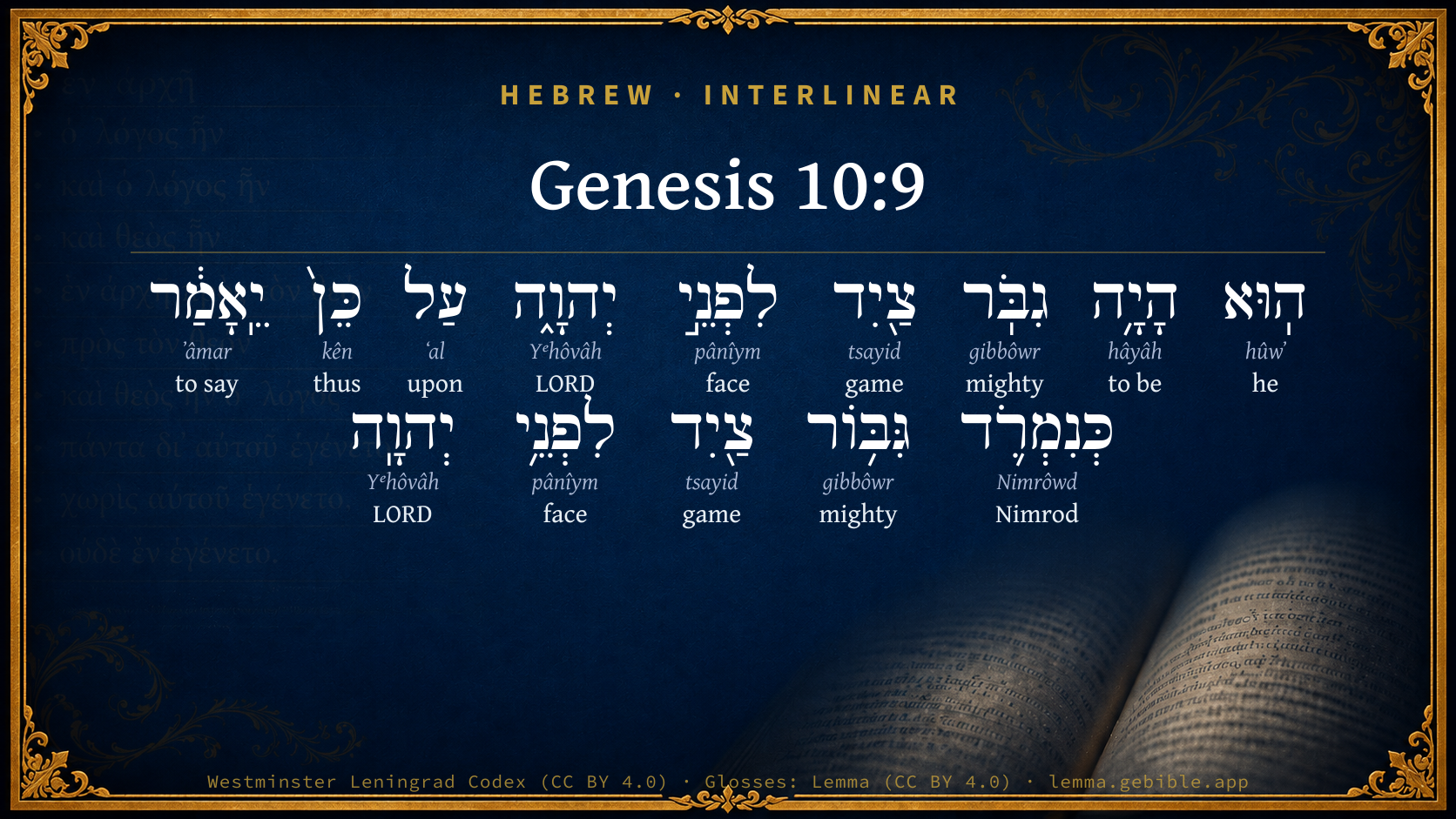
Hebrew (Westminster Leningrad Codex) Genesis 10:9 appears in the Hebrew Old Testament. The text above is from the Westminster Leningrad Codex. Each word links to its Strong’s number, a concise gloss, and parsing drawn from the Open Scriptures Hebrew Bible morphology. Click any word for its full Brown-Driver-Briggs (BDB) entry.
Download image
Cite this verse

Genesis 10:9 (World English Bible). Public Domain. Lemma interlinear Bible study tool, https://lemma.gebible.app/v/genesis/10/9.

Show BibTeX & RIS
BibTeX
RIS
English Translation
He was a mighty hunter before Yahweh. Therefore it is said, "Like Nimrod, a mighty hunter before Yahweh."
World English Bible · Public Domain
Highlights
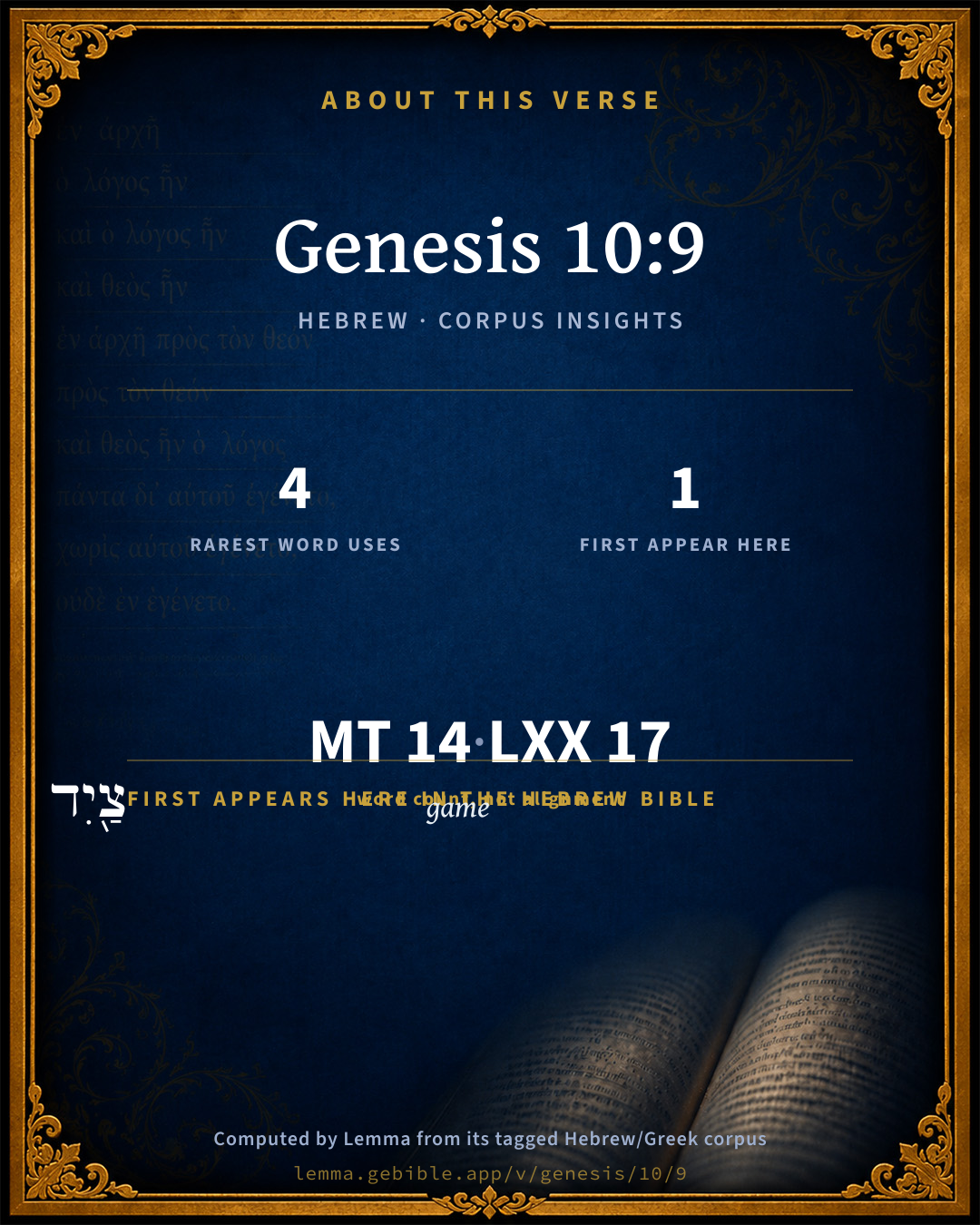
  • 1 first appearance in the Hebrew Bible
Full analysis ↓
Download a study sheet

One document with this verse’s original text, its word-by-word gloss line, the meaning frame, cross-references with their text, attributed commentary, and full source and license credits — printable, and it pastes into notes with its structure intact.

This verse Autodidact and up

Study sheet (.html) Plain text (.txt)

A passage Seminary Student

Up to 50 verses in one chapter. A passage sheet keeps up to 6 commentary sources and 12 cross-references per verse, in the order this page ranks them, and says so on the sheet whenever that leaves anything out. Ask for a single verse and you get the Autodidact verse sheet above.

Everything on this page stays free to read, with no account — the sheet is a download of what is already on screen, not access to it.

Want to remove ads? Support Godless Engineer
Compare translations 3

The same verse in 3 English versions, stacked beneath the original-language interlinear above. Click any original word for its lexicon entry.

Each is an independent rendering of the whole verse — the interlinear is not word-aligned to these translations.

Highlighted words mark where these versions differ — a whole-verse word diff, not a word-by-word alignment.

  • World English Bible Public Domain
    He was a mighty hunter before Yahweh. Therefore it is said, "Like Nimrod, a mighty hunter before Yahweh."
  • King James Version Public Domain
    He was a mighty hunter before the LORD: wherefore it is said, Even as Nimrod the mighty hunter before the LORD.
  • unfoldingWord Literal Text CC BY-SA 4.0
    He was a mighty hunter before Yahweh. For that reason it is said, “Like Nimrod, a mighty hunter before Yahweh.”

unfoldingWord Literal Text — © unfoldingWord, licensed CC BY-SA 4.0. Word-aligned USFM3 via Door43 (git.door43.org/unfoldingWord/en_ult).

Versions to compare (up to 4)

3 of 4 selected

Show all 18 translations

Every available English version of this verse, each an independent rendering of the whole verse.

  • World English Bible Public Domain
    He was a mighty hunter before Yahweh. Therefore it is said, "Like Nimrod, a mighty hunter before Yahweh."
  • Berean Standard Bible Public Domain
    He was a mighty hunter before the LORD; so it is said, “Like Nimrod, a mighty hunter before the LORD.”
  • Majority Standard Bible Public Domain
    He was a mighty hunter before the LORD; so it is said, “Like Nimrod, a mighty hunter before the LORD.”
  • King James Version Public Domain
    He was a mighty hunter before the LORD: wherefore it is said, Even as Nimrod the mighty hunter before the LORD.
  • American Standard Version (1901) Public Domain
    He was a mighty hunter before Jehovah: wherefore it is said, Like Nimrod a mighty hunter before Jehovah.
  • Revised Version (1885) Public Domain
    He was a mighty hunter before the LORD: wherefore it is said, Like Nimrod a mighty hunter before the LORD.
  • Geneva Bible (1599) Public Domain
    He was a mightie hunter before the Lord. wherefore it is saide, As Nimrod the mightie hunter before the Lord.
  • Douay-Rheims (1899) Public Domain
    And he was a stout hunter before the Lord. Hence came a proverb: Even as Nemrod the stout hunter before the Lord.
  • Young's Literal Translation Public Domain
    he hath begun to be a hero in the land; he hath been a hero in hunting before Jehovah; therefore it is said, `As Nimrod the hero `in' hunting before Jehovah.'
  • Literal Standard Version CC BY-SA 4.0
    he has begun to be a hero in the land; he has been a hero in hunting before YHWH; therefore it is said, “As Nimrod the hero [in] hunting before YHWH.”
  • Unlocked Literal Bible CC BY-SA 4.0
    He was a mighty hunter before Yahweh. That is why it is said, “Like Nimrod, a mighty hunter before Yahweh.”
  • unfoldingWord Literal Text CC BY-SA 4.0
    He was a mighty hunter before Yahweh. For that reason it is said, “Like Nimrod, a mighty hunter before Yahweh.”
  • Darby Bible Public Domain
    He was a mighty hunter before Jehovah; therefore it is said, As Nimrod, the mighty hunter before Jehovah!
  • World Messianic Bible Public Domain
    He was a mighty hunter before the LORD. Therefore it is said, “like Nimrod, a mighty hunter before the LORD”.
  • Webster's Bible Public Domain
    He was a mighty hunter before the LORD: wherefore it is said, Even as Nimrod the mighty hunter before the LORD.
  • Free Bible Version CC BY-SA 4.0
    He was a powerful fighter who defied the Lord; which is why there's the expression, “Like Nimrod, a powerful fighter who defied the Lord.”
  • Bible in Basic English Public Domain
    He was a very great bowman, so that there is a saying, Like Nimrod, a very great bowman.
  • JPS Tanakh (1917) Public Domain
    He was a mighty hunter before the LORD; wherefore it is said: 'Like Nimrod a mighty hunter before the LORD.'

Literal Standard Version (2020), Covenant Press — licensed CC BY-SA 4.0. Text via the HelloAO Bible API (eBible.org). Unlocked Literal Bible (unfoldingWord) — licensed CC BY-SA 4.0. Text via the HelloAO Bible API (eBible.org). unfoldingWord Literal Text — © unfoldingWord, licensed CC BY-SA 4.0. Word-aligned USFM3 via Door43 (git.door43.org/unfoldingWord/en_ult). Free Bible Version, Dr. Jonathan Gallagher — licensed CC BY-SA 4.0. Text via the HelloAO Bible API (eBible.org).

Word by word

More ways to search: Search by grammar → Find every occurrence → Compare this word →

Practice this passage: Drill this verse → Learn its vocabulary →

כְּנִמְרֹ֛ד
Nimrôwd
H5248
“like/as · Nimrod”
Preposition + Noun, Proper
Part of Speech
Preposition + Noun
Type
Proper
Full BDB Definition

Origin: probably of foreign origin

TWOT: None

Nimrod = "rebellion" or " the valiant" - the son of Cush, grandson of Ham, and great grandson of Noah; a mighty hunter, he established an empire in the area of Babylon and Assyria
  1. הֽוּא hûwʼ H1931 “he” Pronoun, Personal, 3rd Person, Masculine, Singular
  2. הָיָ֥ה hâyâh H1961 “to be” Verb, Qal, Perfect, 3rd Person, Masculine, Singular
  3. גִבֹּֽר gibbôwr H1368 “mighty of” Adjective, Adjective, Masculine, Singular, Construct
  4. צַ֖יִד tsayid H6718 “game” Noun, Common, Masculine, Singular, Absolute
  5. לִפְנֵ֣י pânîym H6440 “to/for · face(s) of” Preposition + Noun, Common, Both, Plural, Construct
  6. יְהוָ֑ה Yᵉhôvâh H3068 “LORD” Noun, Proper
  7. עַל ʻal H5921 “upon” Preposition
  8. כֵּן֙ kên H3651 “thus” Particle, Demonstrative
  9. יֵֽאָמַ֔ר ʼâmar H559 “to say” Verb, Niphal, Imperfect, 3rd Person, Masculine, Singular
  10. גִּבּ֥וֹר gibbôwr H1368 “mighty of” Adjective, Adjective, Masculine, Singular, Construct
  11. צַ֖יִד tsayid H6718 “game” Noun, Common, Masculine, Singular, Absolute
  12. לִפְנֵ֥י pânîym H6440 “to/for · face(s) of” Preposition + Noun, Common, Both, Plural, Construct
  13. יְהוָֽה Yᵉhôvâh H3068 “LORD” Noun, Proper

About this verse

These counts appear in no published source. They are computed here, from the morphology-tagged text and Lemma’s own curated glosses. What Lemma adds →

14
words
10
distinct lemmas
Pentateuch
section

Notable vocabulary

The rarest word here is כְּנִמְרֹ֛ד Nimrod H5248 — appearing just 4 times in the whole Hebrew Bible.

First appearance in Scripture

This word makes its first canonical appearance in the Hebrew Bible here:

  • צַ֖יִד game H6718

Shared distinctive vocabulary

כְּנִמְרֹ֛ד Nimrod H5248 occurs in 4 verses of the Hebrew Bible. Also found in:

Grammatical profile

  • 2 verbs
  • 7 nouns
  • 2 adjectives
  • 1 pronoun
  • 1 preposition
  • 1 particle

Verb forms

  • הָיָ֥ה Qal · Perfect
  • יֵֽאָמַ֔ר Niphal · Imperfect

Repetition

Words recur within this verse — often emphatic in Hebrew:

  • גִבֹּֽר mighty H1368 ×2
  • צַ֖יִד game H6718 ×2
  • לִפְנֵ֣י face H6440 ×2
  • יְהוָ֑ה LORD H3068 ×2

Hebrew & Septuagint length

In English translation the verse runs 18 words from the Hebrew and 20 from the Septuagint (LXX English) — closely comparable.

A rough comparison of the two English renderings, which tokenize alike — not a word-level alignment.

Word counts can differ between the Hebrew and the Greek without any difference in meaning — e.g. the Hebrew direct-object marker אֵת has no separate Greek word, and Greek often adds the article ὁ.

In the original languages it is 14 Hebrew tokens and 17 Greek tokens — but the two are counted differently (Hebrew bundles its prefixes and suffixes into one token; the Greek is in lemma form), so that isn’t a like-for-like length.

Cross-references

10

Topical passages linked to Genesis 10:9 in the Treasury of Scripture Knowledge — connected by theme and wording, ordered by reader-vote popularity; previews shown in the World English Bible.

  • 2 Chronicles 28:22 In the time of his distress did he trespass yet more against Yahweh, this same king Ahaz.
  • Genesis 6:4 The Nephilim were in the earth in those days, and also after that, when God's sons came to men's daughters. They bore children to them: the same were the mighty men who were of old, men of renown.
  • Genesis 6:11 The earth was corrupt before God, and the earth was filled with violence.
  • Genesis 13:13 Now the men of Sodom were exceedingly wicked and sinners against Yahweh.
  • Genesis 25:27 The boys grew. Esau was a skillful hunter, a man of the field. Jacob was a quiet man, living in tents.
  • Genesis 27:30 It happened, as soon as Isaac had made an end of blessing Jacob, and Jacob had just gone out from the presence of Isaac his father, that Esau his brother came in from his hunting.
  • Psalms 52:7 "Behold, this is the man who didn't make God his strength, But trusted in the abundance of his riches, And strengthened himself in his wickedness."
  • Jeremiah 16:16 Behold, I will send for many fishermen, says Yahweh, and they shall fish them up; and afterward I will send for many hunters, and they shall hunt them from every mountain, and from every hill, and out of the clefts of the rocks.
  • Ezekiel 13:18 and say, Thus says the Lord Yahweh: Woe to the women who sew pillows on all elbows, and make kerchiefs for the head of [persons of] every stature to hunt souls! Will you hunt the souls of my people, and save souls alive for yourselves?
  • Micah 7:2 The godly man has perished out of the earth, And there is no one upright among men. They all lie in wait for blood; Every man hunts his brother with a net.

Cross-references courtesy of OpenBible.info (CC BY 4.0).

Hebrew and Greek witnesses Masoretic Hebrew ↔ Greek Septuagint

The same verse in the two great witnesses to the Old Testament, shown verse-for-verse.

These are two independent witnesses, not word-aligned to each other, and the Septuagint is shown in lemma (dictionary) form.

Hebrew Genesis 10:9 Masoretic · Westminster Leningrad Codex

הֽוּא הָיָ֥ה גִבֹּֽר צַ֖יִד לִפְנֵ֣י יְהוָ֑ה עַל כֵּן֙ יֵֽאָמַ֔ר כְּנִמְרֹ֛ד גִּבּ֥וֹר צַ֖יִד לִפְנֵ֥י יְהוָֽה

He was a mighty hunter before Yahweh. Therefore it is said, "Like Nimrod, a mighty hunter before Yahweh."

World English Bible · Public Domain

Greek LXX Genesis 10:9 Septuagint · lemma form

οὗτος εἰμί γίγας κυνηγός ἐναντίον κύριος ὁ θεός διά οὗτος εἶπον ὡς νεβρωδ γίγας κυνηγός ἐναντίον κύριος

He was a giant hunter before the Lord God; therefore they say, As Nebrod the giant hunter before the Lord.

LXX2012 (modern English Septuagint) · Public Domain

On this verse, Joseph Benson's Commentary discusses the Septuagint’s reading. Read the note in Commentary ↓

Hebrew: Westminster Leningrad Codex (CC BY 4.0). Greek: Septuagint (public domain); English from LXX2012 (modern English Septuagint) (Public Domain). How the Septuagint differs from the Hebrew →

Targum (Aramaic paraphrase)

2

The Targum is the ancient Jewish Aramaic paraphrase of the Hebrew Scriptures — an interpretive translation, not the Hebrew text itself. Onkelos (literal) and Pseudo-Jonathan (expansive) render the Torah, and Jonathan the Prophets. Coverage is partial: where no permissively-licensed English translation exists for a verse, only the Aramaic is shown. This is verse-level text, not a word-by-word alignment to the Hebrew.

  1. Targum Onkelos Torah (Genesis–Deuteronomy)
    הוּא הֲוָה גִבַּר תַּקִּיף קֳדָם יְיָ עַל כֵּן יִתְאֲמַר כְּנִמְרֹד גִּבַּר תַּקִּיף קֳדָם יְיָ

    He was a powerful man before the Lord: therefore it is said, Like Nimrod the man of might before the Lord.

    Targum Onkelos — Aramaic: “Onkelos Genesis” (public domain); “Onkelos Exodus” (public domain); “Onkelos Leviticus” (public domain); “Onkelos Numbers” (public domain); “Onkelos Deuteronomy” (public domain). English: “Sefaria Community Translation” (CC0 1.0 (public-domain dedication)); “J.W. Etheridge. The Targums of Onkelos and Jonathan Ben Uzziel on the Pentateuch. London: Longmans, Green, 1862” (public domain). Text via Sefaria.

  2. Targum Pseudo-Jonathan Torah (Genesis–Deuteronomy)
    הוּא הֲוָה גִבַּר מְרוֹדָא קֳדָם יְיָ בְּגִין כֵּן יִתְאַמֵר מִן יוֹמָא דְאִיתְבְּרִי עַלְמָא לָא הֲוָה כְּנִמְרוֹד גִבַּר בְּצֵידָא וּמְרוֹדָא קֳדָם יְיָ

    He was a mighty rebel before the Lord; therefore it is said, From the day that the world was created there hath not been as Nimrod, mighty in hunting, and a rebel before the Lord.

    Targum Pseudo-Jonathan — Aramaic: “Targum Jonathan on Genesis” (public domain); “Targum Jonathan on Exodus” (public domain); “Targum Jonathan on Leviticus” (public domain); “Targum Jonathan on Numbers” (public domain); “Targum Jonathan on Deuteronomy” (public domain). English: “The Targum of Jonathan ben Uzziel, trans. J. W. Etheridge, London, 1862” (public domain). Text via Sefaria.

Commentary

Notes on Genesis 10:9 from classic Christian and Jewish commentators (each source and its license shown beneath its notes). The classic Christian expositions comment on the surrounding passage and are grouped to its opening verse, so a note may address several verses; the Jewish commentaries on the Tanakh (Rashi and others) are per-verse, so they appear only where the commentator wrote on this verse.

Lemma curates 59 commentaries, every one of them public domain or Creative Commons licensed, each selected and text-cleaned for this edition rather than reprinted as found. About our sources →

Trapp's Complete Commentary

John Trapp

Gen 10:9 He was a mighty hunter before the LORD: wherefore it is said, Even as Nimrod the mighty hunter before the LORD.

Ver. 9. He was a mighty hunter.] Of men, whose lives he sacrificed to his lust, not of beasts for sacrifice to the Lord, as Aben-Ezra will have it, and takes occasion thereupon highly to commend him. {a} But there wanted not those that commended Cain also for killing his brother, and were therefore called Cainites. Of others we read that extolled the Sodomites, Korah and his complices, Judas the traitor. Yea, there was one Bruno found that wrote an oration in commendation of the devil, who hath given him his reward, no doubt, by this, unless he recanted that monstrous madness.

{a} Epiphan. Heres., 38.

John Trapp, A Commentary or Exposition upon All the Books of the Old and New Testament (1647–1656) — public domain. Text from a community e-Sword module.

Joseph Benson's Commentary

Gen 10:9. Nimrod was a mighty hunter — In the Septuagint it is, He was a giant hunter: — the Arabic has it, He was a terrible giant before the Lord: and the Syriac, He was a great warrior. It is probable he began with hunting, and for this became famous to a proverb. He served his country by ridding it of wild beasts, and so insinuating himself into the affections of his neighbours, he got to be their prince. And perhaps, under pretence of hunting, he gathered men under his command, to make himself master of the country. Thus he became a mighty hunter, a violent invader of his neighbours’ rights and properties. Great conquerors are but great hunters before the Lord. Alexander and Cesar would not make such a figure in Scripture history as they do in common history. The former is represented in prophecy, but as a he-goat pushing, Dan 8:5.

Joseph Benson's Commentary on the Old and New Testaments (1811–1818) — public domain. Text from a community e-Sword module.

Tyndale Open Study Notes

Tyndale Open Resources

10:9 Nimrod attained great fame by conquest and terror; his empire extended from Babylonia in the south to Assyria in the north (10:10-12). • the greatest hunter in the world: Assyrian monarchs glorified their own power, often depicting themselves as valiant hunter-conquerors.

Tyndale Open Study Notes — © Tyndale Open Resources, licensed CC BY-SA 4.0. Text via the HelloAO Bible API.

Geneva Bible (1599)

Geneva Bible translators

His tyranny came into a proverb as hated both of God and man: for he passed not to commit cruelty even in God’s presence.

Geneva Bible (1599) marginal notes — public domain. Text via Bolls.life.

Ellicott's Commentary for English Readers

(9) He was a mighty hunter.—When men were still leading a pastoral life, and were but poorly armed, the war with wild beasts was a most important and dangerous occupation. Probably from single combats with fierce animals, Nimrod, now recognised as a public benefactor, was led to organise hunts upon a large scale, and so, like Romulus, became the chief of a band of the most spirited and vigorous shepherds. “With their aid, he next undertook the more serious duty of introducing order and rule among men who had hitherto lived in scattered groups without control, and without the means of suppressing feuds and of punishing deeds of violence.

Before the Lord.—A strong superlative. (Comp. Gen_13:13.)

A Bible Commentary for English Readers, edited by Charles John Ellicott (1878–1897) — public domain. Text from a community e-Sword module.

The Cambridge Bible for Schools and Colleges

gen. ed. J. J. S. Perowne

9. a mighty hunter before the Lord] The phrase “before the Lord” is merely descriptive of magnitude, cf. Gen_23:6, “a great prince” (Heb. a prince of God), Jon_3:3, “Nineveh was an exceeding great city” (Heb. a city great unto God). But it is possible that the expression is traceable to some primitive traditions respecting the hunting exploits of Nimrod, and the favour shewn to him by his God.

The popularity of hunting scenes in Assyrian art may have led to a general impression that the founders of the Assyrian and Babylonian kingdoms were famous huntsmen.

It is noteworthy that in later times Nimrod was identified with Orion, both as a hunter and as a constellation. Hence some have fancifully explained these words to mean “a hunter in heaven.”

wherefore it is said] The quotation of a proverb: Nimrod’s name became proverbial for a great hunter.

The Cambridge Bible for Schools and Colleges (gen. ed. J. J. S. Perowne; Cambridge University Press, 1878–1918) — public domain. Text from a community e-Sword module.

John Gill's Exposition

He was a mighty hunter before the Lord,.... Which might be literally true; for, from the time of the flood to his days, wild beasts might increase very much, and greatly annoy men who dwelt very likely for the most part in tents scattered up and down in divers places: so that he did a good office in hunting and destroying them. An Arabic writer (o), of some authority in the eastern parts, says, that by hunting he got food sufficient for the builders of Babel, while they were employed therein; and Aben Ezra interprets it in his favour, that he built altars, and the creatures he took in hunting he offered them on them a burnt offering to God. But neither of these is probable; however, it may be observed, that in this way by hunting he arrived to the power and dominion over men he afterwards had; for not only he ingratiated himself into their favour by hunting down and destroying the wild beasts which molested them, but by these means he might gather together a large number of young men, strong and robust, to join him in hunting; whereby they were inured to hardships, and trained up to military exercises, and were taught the way of destroying men as well as beasts; and by whose help and assistance he might arrive to the government he had over men; and hunting, according to Aristotle (p), is a part of the military art, which is to be used both on beasts, and on such men who are made to be ruled, but are not willing; and it appears, from Xenophon (q), that the kings of Persia were fitted for war and government by hunting, and which is still reckoned in many countries a part of royal education. And it may be remarked, that, as Nimrod and Bacchus are the same, as before observed, one of the titles of Bacchus is "an hunter". Cedrenus (r) says, that the Assyrians deified Nebrod, or Nimrod, and placed him among the constellations of heaven, and called him Orion; the same first discovered the art of hunting, therefore they joined to Orion the star called the dog star. However, besides his being in a literal sense an hunter, he was in a figurative sense one, a tyrannical ruler and governor of men. The Targum of Jonathan is;"he was a powerful rebel before the Lord;''and that of Jerusalem,"he was powerful in hunting in sin before the Lord,''and another Jewish writer (s) says, he was called a mighty hunter, because he was all his days taking provinces by force, and spoiling others of their substance; and that he was "before the Lord", truly so, and he seeing and taking notice of it, openly and publicly, and without fear of him, and in a bold and impudent manner, in despite of him, see Gen 6:11. The Septuagint render it, "against the Lord"; he intended, as Jarchi's note is, to provoke him to his face:

wherefore it is said; in a proverbial way, when any man is grown mighty and powerful, or is notoriously wicked, or is become a tyrant and an oppressor of the people, that he is

even as Nimrod the mighty hunter before the Lord. This was a proverb used in the times of Moses, as it is common now with us to call a hunter Nimrod.

(o) Abulpharag. Hist. Dynast. p. 18. (p) Politic. l. 1. c. 8. (q) Cyropaed. l. 1. c. 5. (r) Apud Abrami Pharum, l. 5. sect. 6. p. 128. (s) R. Gedaliah, Shalshalet Hakabala, fol. 76. 2.

John Gill's Exposition of the Whole Bible (1746–1763) — public domain (CC PDM 1.0). Text via the HelloAO Bible API.

Haydock's Catholic Bible Commentary

A stout hunter. Not of beasts, but of men; whom by violence and tyranny he brought under his dominion. And such he was, not only in the opinion of men, but before the Lord; that is, in his sight who cannot be deceived. (Challoner) --- The Septuagint call him a giant; that is, a violent man. According to Josephus, he stirred up men to rebel against the Lord, maintaining that all their happiness must come from themselves, &c., Antiquities i. 4. Thus he broached the first heresy after the deluge. (Worthington) --- He seems to have been the same as Bel, father of Ninus, and the author of idolatry. (Menochius)

George Leo Haydock (1774–1849), Haydock's Catholic Family Bible and Commentary, 1859 edition — public domain. Excludes Psalms (Douay-Rheims chapter numbering differs from Protestant) and Deuterocanonical books (Catholic canon only).

Matthew Poole's English Annotations

He was a mighty hunter, first of beasts, and by that occasion of men. For when men were few, and lived dispersedly, and wild beasts abounded, and most of all in those parts, by hunting and destroying of those beasts he got much reputation and favour with men, who thereby were secured in their dwellings. In confidence hereof, and having this occasion to gather great companies of the youngest and strongest men together to himself, by their help he established a tyranny and absolute power over men, insnaring, hunting after, and destroying like beasts all those men who opposed his dominion. Tyrants and persecutors are oft in Scripture called fowlers and hunters, as Psa 91:3; Jer 16:16; Lam 3:52; 4:18.

Before the Lord; an aggravation of his crime, that it was done in of God's presence, impudently and in contempt both God, who had so lately manifested his detestation of this sin, by the destruction of the world, amongst other sins, for this very sin of violence, Gen 6:13, and of his great-grandfather Noah, then living and preaching, who probably did admonish him of the wickedness and danger of this practice. Thus he showed that he neither feared God nor reverenced man, if they withstood him in his unsurpation of dominion. It became a proverb, when any man was haughty, and cruel, and tyrannical, and that joined with impudence and obstinacy, That he was another Nimrod.

Matthew Poole's English Annotations on the Holy Bible (1683–1685) — public domain. Text from a community e-Sword/MySword module.

Whedon's Commentary on the Bible

Daniel D. Whedon

9. A mighty hunter — Or, a hero of hunting; a powerful man in the chase. Such a hero would also be likely to become a mighty warrior. Bold and expert hunters have usually been the great pioneers of civilization, and their prowess became developed by fierce conflicts both with savage beasts and savage men. The Assyrian monuments, covered with scenes of hunting and of war, commemorate the daring and the prowess of ancient Ninevite kings. Accordingly some of the best interpreters (as Delitzsch and Lange) regard this description of Nimrod as a praiseworthy account of his work as a pioneer of culture and civilization; and the proverb recorded in this verse, instead of being a stigma on his name, was rather intended to commemorate him as a benefactor of the race. Others, however, understand the words before the Lord to imply some hostility towards Jehovah; like the phrase before God (Elohim) in Gen_6:11, which seems to enhance the wickedness of the antediluvians. So the Septuagint (εναντιον) and the Jerusalem Targum. These regard him as notoriously violent; so bad that God could not take his eyes from him. (Lewis.) Nimrod was the first of the long line of bloody conquerors whose cruel ambition has cursed the earth.

Daniel D. Whedon (gen. ed.), Commentary on the Old and New Testaments (1874–1909) — public domain. Text from a community e-Sword module.

The Pulpit Commentary

He was a mighty hunter. Originally doubtless of wild beasts, which, according to Bochart, was the first step to usurping dominion over men and using them for battle. "Nempe venationum prsetextu collegit juvenum robustam manum, quam talibus exercitus ad belli labores induravit" ("Phaleg.," 54:12). Before the Lord.

1. jEnantion kuriou (LXX), in a spirit of defiance (Augustine, Keil, Murphy, Bush).

2. Coram Des, in God"s sight, as an aggravation of his sin el. (Gen_13:3 (Cajetan)

3. As a superlative, declaring his excellence of. Gen_13:10 Gen_30:8; 1Sa_11:7; Joh_3:3; Act_7:20 (Aben Ezra, Kimchi, Kalisch, "Speaker"s Commentary") 4. With the Divine approbation, as one who broke the way through rude, uncultivated nature for the institutions of Jehovah (Lange). (Cf. Gen_17:18 Gen_24:40; 1Sa_11:15; Psa_41:12) Probably the first or the third conveys the sense of the expression. Wherefore it is said, Even as Nimrod the mighty hunter before the Lord. The precise import of this is usually determined by the view taken of the previous phrase.

The Pulpit Commentary (1880–1919), ed. H.D.M. Spence-Jones & Joseph S. Exell — public domain. Text from a community e-Sword module.

John Wesley's Explanatory Notes

Nimrod was a mighty hunter - This he began with, and for this became famous to a proverb. Some think he did good with his hunting, served his country by ridding it of wild beasts, and so insinuated himself into the affections of his neighbours, and got to be their prince. And perhaps, under pretense of hunting, he gathered men under his command, to make himself master of the country. Thus he became a mighty hunter, a violent invader of his neighbour's rights and properties. And that, before the Lord - Carrying all before him, and endeavouring to make all his own by force and violence. He thought himself a mighty prince; but before the Lord, that is, in God's account, he was but a mighty hunter. Note, Great conquerers are but great hunters. Alexander and Caesar would not make such a figure in scripture history as they do in common history. The former is represented in prophecy but as a he-goat pushing, Dan. viii, 5. Nimrod was a mighty hunter against the Lord, so the seventy; that is, he set up idolatry, as Jeroboam did, for the confirming of his usurped dominion; that he might set up a new government, he set up a new religion upon the ruin of the primitive constitution of both.

John Wesley, Explanatory Notes Upon the Whole Bible (1754–1765) — public domain. Text via the GEBible commentary corpus.

Rashi

Rabbi Shlomo Yitzchaki (Rashi)

גבור ציד A MIGHTY HUNTER — He ensnared the minds of people by his words, misleading them to rebel against the Omnipresent (Genesis Rabbah 37:2).

‘לפני ה BEFORE THE LORD — intending purposely to provoke Him to His face

על כן יאמר WHEREFORE IT IS SAID — Regarding any man who brazenly acts wickedly — knowing his Master and yet of set purpose rebelling against Him — it is said. “This man is like Nimrod a mighty hunter” (Sifra, Bechukotai, Section 2 1-2).

Rashi on the Tanakh — English translations: “The Judaica Press complete Tanach with Rashi, translated by A. J. Rosenberg” (CC BY 4.0); “Pentateuch with Rashi's commentary by M. Rosenbaum and A.M. Silbermann, 1929-1934” (public domain); “The Metsudah Tanach series, Lakewood, N.J” (CC BY 4.0); and “The Book of Joshua, Metsudah Publications, 1997” (CC BY 4.0). Text via Sefaria.

Ramban (Nachmanides)

Rabbi Moshe ben Nachman (Ramban / Nachmanides)

HE WAS A MIGHTY HUNTER BEFORE THE ETERNAL. He ensnared the minds of people by his words, misleading them to rebel against the Omnipresent. Therefore it is said regarding any man who brazenly acts wickedly, knowing his Master and yet intentionally rebelling against Him — it is said, “This man is like Nimrod.” Thus the language of Rashi, and so is the opinion of our Rabbis. But Rabbi Abraham ibn Ezra explained the matter in the opposite way, by way of the plain meaning of Scripture, for he interpreted the verses thus: He began to be a mighty one over the animals in hunting them. Before the Eternal, Ibn Ezra explained, means that he would build altars and offer the animals as whole-offerings before G-d. But Ibn Ezra’s words do not appear to be correct, and lo he justifieth the wicked, for our Rabbis knew by tradition of Nimrod’s wickedness.The correct interpretation appears to me to be that Nimrod began to be a ruler by force over people, and he was the first monarch. Until his era there were no wars and no reigning monarchs; it was he who first prevailed over the people of Babylon until they crowned him. After that he went to Assyria, and he did according to his will, and magnified himself, and there he built fortified cities with his power and with his might. This is what Scripture intended when it said, And the beginning of his kingdom was Babel…and Accad…and Shinar.

Ramban (Nachmanides) on the Tanakh — English translation: “Commentary on the Torah by Ramban (Nachmanides). Translated and annotated by Charles B. Chavel. New York, Shilo Pub. House, 1971-1976” (CC BY 4.0). Text via Sefaria.

Radak

Rabbi David Kimhi (Radak)

'הוא היה גבור ציד לפני ה, the word ציד tells us that Nimrod was also a mighty hunter, i.e. that the beasts were in awe of him, too. He both shot and trapped them. People wondered how he managed this. His fame became proverbial. When one encountered an exceptionally powerful individual either then or in the future, one would compare him to Nimrod, saying that he was as great a hero as Nimrod. The meaning of the words לפני ה', is a figure of speech, i.e. if one uses this simile one pays the subject described as such a supreme compliment. Expressions such as עיר גדולה לאלוקים, (Jonah 3,3) or הררי א-ל (Psalms 36,7) and numerous other examples, all use the name of G’d to describe something as outstanding in its category, i.e. as almost divine in nature. Some scholars understand the words לפני ה'' as meaning that Nimrod offered some of the animals he had hunted to G’d as a sacrifice, acknowledging His help. Onkelos is closer to our interpretation when he writes גבר תקיף, an aggressive and powerful man.

Radak on the Tanakh — English translations: “Sefaria Community Translation” (CC0 1.0 (public-domain dedication)); “Eliyahu Munk, HaChut Hameshulash” (CC BY 4.0); “Rabbi Mike Feuer, Jerusalem Anthology” (CC BY 4.0); and “R. David Kimhi on the first book of Psalms, Translated by R.G. Finch, London, 1919” (public domain). Text via Sefaria.

Lesson kit

Teaching starters — assembled from the data on this page, not authored interpretation. Every prompt links to the verse data it draws on. Edit before teaching.

Genesis, in the Pentateuch, opens this verse with 14 words (10 distinct Hebrew lemmas). Its most distinctive word is Nimrôwd (“Nimrod”). A historical commentator’s framing appears above. Read the whole chapter for the surrounding context.

Discussion questions

  1. What does “Nimrod” (Nimrôwd) contribute to the verse as a whole?
  2. The word “game” first appears here in Scripture. What is being introduced at this debut?
  3. Genesis 10:8 shares the word «Nimrod» with this verse. How do the two illuminate each other?
  4. “mighty” occurs 2× in this one verse. What is the effect of the repetition?
  5. These translations render this verse differently; the difference is in the English rendering, not the original. What questions does that raise?
  6. The verb «הָיָ֥ה» is Qal Perfect. How does its form color the action?
  7. Reading how Trapp's Complete Commentary and Joseph Benson's Commentary read this verse, where do the two commentators agree and where do they part?

Things to notice

Reading settings

Reading text

Shown beneath each verse's original-language words.

Old Testament
Old Testament edition

Read the OT as the Masoretic Hebrew (MT) or the Greek Septuagint (LXX).

English shown for the Greek Septuagint (in the Hebrew ↔ Greek comparison).

Comparing translations? Open the Compare panel on any verse page to stack up to four side by side.