
Matthew 12:41

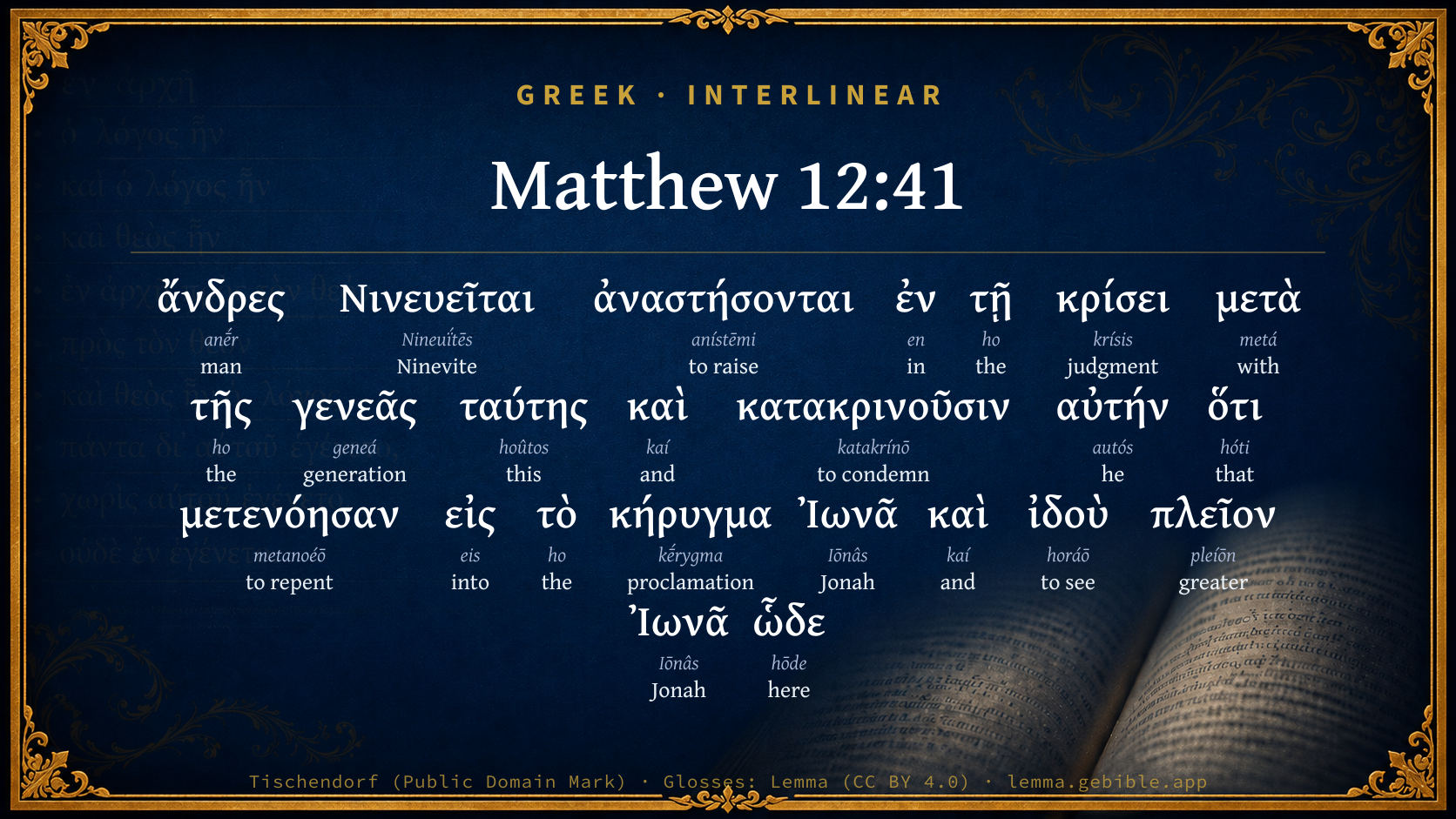
Greek (Tischendorf 8th ed.) Matthew 12:41 appears in the Greek New Testament. The text above is from the Tischendorf 8th edition. Each word links to its Strong’s number and a concise gloss. Click any word for its full Thayer’s Greek Lexicon entry.
Download image
Cite this verse

Matthew 12:41 (World English Bible). Public Domain. Lemma interlinear Bible study tool, https://lemma.gebible.app/v/matthew/12/41.

Show BibTeX & RIS
BibTeX
RIS
English Translation
The men of Nineveh will stand up in the judgment with this generation, and will condemn it, for they repented at the preaching of Jonah; and behold, someone greater than Jonah is here.
World English Bible · Public Domain
Highlights
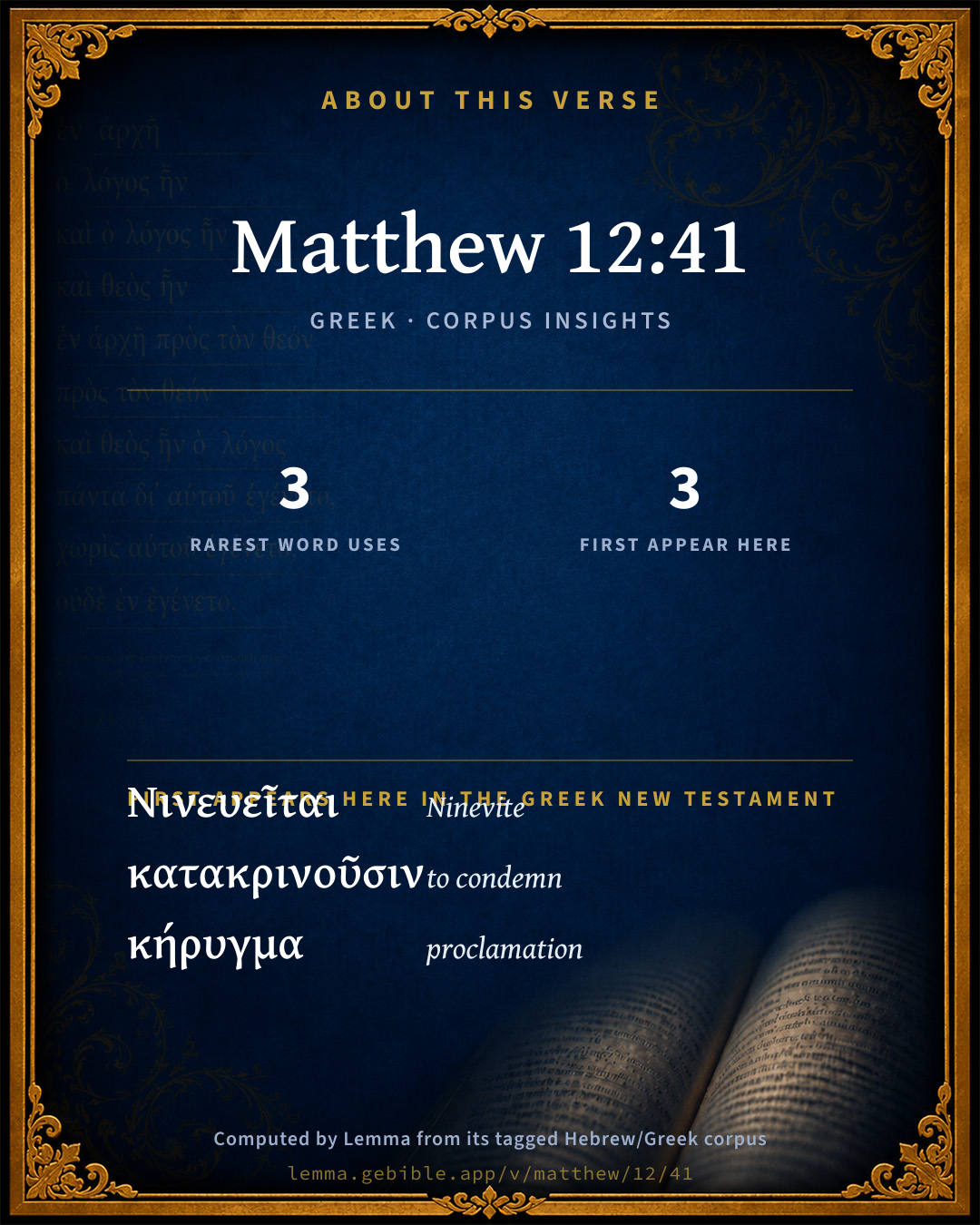
  • 3 first appearances in the Greek New Testament
Full analysis ↓
Download a study sheet

One document with this verse’s original text, its word-by-word gloss line, the meaning frame, cross-references with their text, attributed commentary, and full source and license credits — printable, and it pastes into notes with its structure intact.

This verse Autodidact and up

Study sheet (.html) Plain text (.txt)

A passage Seminary Student

Up to 50 verses in one chapter. A passage sheet keeps up to 6 commentary sources and 12 cross-references per verse, in the order this page ranks them, and says so on the sheet whenever that leaves anything out. Ask for a single verse and you get the Autodidact verse sheet above.

Everything on this page stays free to read, with no account — the sheet is a download of what is already on screen, not access to it.

Want to remove ads? Support Godless Engineer
Compare translations 3

The same verse in 3 English versions, stacked beneath the original-language interlinear above. Click any original word for its lexicon entry.

Each is an independent rendering of the whole verse — the interlinear is not word-aligned to these translations.

Highlighted words mark where these versions differ — a whole-verse word diff, not a word-by-word alignment.

  • World English Bible Public Domain
    The men of Nineveh will stand up in the judgment with this generation, and will condemn it, for they repented at the preaching of Jonah; and behold, someone greater than Jonah is here.
  • King James Version Public Domain
    The men of Nineveh shall rise in judgment with this generation, and shall condemn it: because they repented at the preaching of Jonas; and, behold, a greater than Jonas is here.
  • unfoldingWord Literal Text CC BY-SA 4.0
    The men of Nineveh will rise up in the judgment with this generation and condemn it, for they repented at the preaching of Jonah, and behold, something greater than Jonah here.

unfoldingWord Literal Text — © unfoldingWord, licensed CC BY-SA 4.0. Word-aligned USFM3 via Door43 (git.door43.org/unfoldingWord/en_ult).

Versions to compare (up to 4)

3 of 4 selected

Show all 19 translations

Every available English version of this verse, each an independent rendering of the whole verse.

  • World English Bible Public Domain
    The men of Nineveh will stand up in the judgment with this generation, and will condemn it, for they repented at the preaching of Jonah; and behold, someone greater than Jonah is here.
  • Berean Standard Bible Public Domain
    The men of Nineveh will stand at the judgment with this generation and condemn it; for they repented at the preaching of Jonah, and now One greater than Jonah is here.
  • Majority Standard Bible Public Domain
    The men of Nineveh will stand at the judgment with this generation and condemn it; for they repented at the preaching of Jonah, and now One greater than Jonah is here.
  • King James Version Public Domain
    The men of Nineveh shall rise in judgment with this generation, and shall condemn it: because they repented at the preaching of Jonas; and, behold, a greater than Jonas is here.
  • American Standard Version (1901) Public Domain
    The men of Nineveh shall stand up in the judgment with this generation, and shall condemn it: for they repented at the preaching of Jonah; and behold, a greater than Jonah is here.
  • Revised Version (1885) Public Domain
    The men of Nineveh shall stand up in the judgment with this generation, and shall condemn it: for they repented at the preaching of Jonah; and behold, a greater than Jonah is here.
  • Geneva Bible (1599) Public Domain
    The men of Nineue shall rise in iudgement with this generation, and condemne it: for they repented at the preaching of Ionas: and behold, a greater then Ionas is here.
  • Douay-Rheims (1899) Public Domain
    The men of Ninive shall rise in judgment with this generation, and shall condemn it: because they did penance at the preaching of Jonas. And behold a greater than Jonas here.
  • Young's Literal Translation Public Domain
    `Men of Nineveh shall stand up in the judgment with this generation, and shall condemn it, for they reformed at the proclamation of Jonah, and lo, a greater than Jonah here!
  • Literal Standard Version CC BY-SA 4.0
    Men of Nineveh will stand up in the judgment with this generation, and will condemn it, for they converted at the proclamation of Jonah, and behold, [One] greater than Jonah [is] here!
  • Unlocked Literal Bible CC BY-SA 4.0
    The men of Nineveh will stand up at the judgment with this generation of people and will condemn it. For they repented at the preaching of Jonah, and see, someone greater than Jonah is here.
  • unfoldingWord Literal Text CC BY-SA 4.0
    The men of Nineveh will rise up in the judgment with this generation and condemn it, for they repented at the preaching of Jonah, and behold, something greater than Jonah here.
  • Darby Bible Public Domain
    Ninevites shall stand up in the judgment with this generation, and shall condemn it: for they repented at the preaching of Jonas; and behold, more than Jonas [is] here.
  • World Messianic Bible Public Domain
    The men of Nineveh will stand up in the judgment with this generation and will condemn it, for they repented at the proclaiming of Jonah; and behold, someone greater than Jonah is here.
  • Webster's Bible Public Domain
    The men of Nineveh shall rise in judgment with this generation, and shall condemn it: because they repented at the preaching of Jonah; and behold, a greater than Jonah is here.
  • Free Bible Version CC BY-SA 4.0
    The people of Nineveh will rise in the judgment together with this generation and they will condemn it because they repented in response to Jonah's message—and as you see, there's someone greater than Jonah here!
  • Bible in Basic English Public Domain
    The men of Nineveh will come up in the day of judging and give their decision against this generation: because they were turned from their sins at the preaching of Jonah; and now a greater than Jonah is here.
  • Text-Critical English NT CC BY 4.0
    The men of Nineveh will rise up at the judgment with this generation and condemn it, for they repented at the preaching of Jonah, and behold, something greater than Jonah is here.
  • Tyndale New Testament (1534) Public Domain
    The men of Ninivie shall rise at the daye of iugdement with this nacion and condemne them: for they amended at the preachinge of Ionas. And beholde a greater then Ionas is here.

Literal Standard Version (2020), Covenant Press — licensed CC BY-SA 4.0. Text via the HelloAO Bible API (eBible.org). Unlocked Literal Bible (unfoldingWord) — licensed CC BY-SA 4.0. Text via the HelloAO Bible API (eBible.org). unfoldingWord Literal Text — © unfoldingWord, licensed CC BY-SA 4.0. Word-aligned USFM3 via Door43 (git.door43.org/unfoldingWord/en_ult). Free Bible Version, Dr. Jonathan Gallagher — licensed CC BY-SA 4.0. Text via the HelloAO Bible API (eBible.org).

Word by word

More ways to search: Search by grammar → Find every occurrence → Compare this word →

Practice this passage: Drill this verse → Learn its vocabulary →

Νινευεῖται
Nineuḯtēs
G3536
“Ninevite”
Noun, Nominative, Plural, Masculine
Part of Speech
Noun
Case
Nominative
Number
Plural
Gender
Masculine
Full Thayer's Definition

Origin: from G3535

TDNT: None

1. a Ninevite, an inhabitant of Nineveh
  1. ἄνδρες anḗr G435 “man” Noun, Nominative, Plural, Masculine
  2. ἀναστήσονται anístēmi G450 “to raise” Verb, Future, Middle, Indicative, 3rd person, Plural
  3. ἐν en G1722 “in” Preposition
  4. τῇ ho G3588 “the” Article, Dative, Singular, Feminine
  5. κρίσει krísis G2920 “judgment” Noun, Dative, Singular, Feminine
  6. μετὰ metá G3326 “with” Preposition
  7. τῆς ho G3588 “the” Article, Genitive, Singular, Feminine
  8. γενεᾶς geneá G1074 “generation” Noun, Genitive, Singular, Feminine
  9. ταύτης hoûtos G3778 “this” Demonstrative pronoun, Genitive, Singular, Feminine
  10. καὶ kaí G2532 “and” Conjunction
  11. κατακρινοῦσιν katakrínō G2632 “to condemn” Verb, Future, Active, Indicative, 3rd person, Plural
  12. αὐτήν autós G846 “he” Personal pronoun, Accusative, Singular, Feminine
  13. ὅτι hóti G3754 “that” Conjunction
  14. μετενόησαν metanoéō G3340 “to repent” Verb, Aorist, Active, Indicative, 3rd person, Plural
  15. εἰς eis G1519 “into” Preposition
  16. τὸ ho G3588 “the” Article, Accusative, Singular, Neuter
  17. κήρυγμα kḗrygma G2782 “proclamation” Noun, Accusative, Singular, Neuter
  18. Ἰωνᾶ Iōnâs G2495 “Jonah” Noun, Genitive, Singular, Masculine
  19. καὶ kaí G2532 “and” Conjunction
  20. ἰδοὺ horáō G3708 “to see” Verb, Aorist, Middle, Imperative, 2nd person, Singular
  21. πλεῖον pleíōn G4119 “greater” Adjective, Nominative, Singular, Neuter, Comparative
  22. Ἰωνᾶ Iōnâs G2495 “Jonah” Noun, Genitive, Singular, Masculine
  23. ὧδε hōde G5602 “here” Adverb

About this verse

These counts appear in no published source. They are computed here, from the morphology-tagged text and Lemma’s own curated glosses. What Lemma adds →

24
words
20
distinct lemmas
Gospels
section

Notable vocabulary

The rarest word here is Νινευεῖται Ninevite G3536 — appearing just 3 times in the whole Greek New Testament.

First appearance in Scripture

These words make their first canonical appearance in the Greek New Testament here:

  • Νινευεῖται Ninevite G3536
  • κατακρινοῦσιν to condemn G2632
  • κήρυγμα proclamation G2782

Shared distinctive vocabulary

Νινευεῖται Ninevite G3536 occurs in 3 verses of the Greek New Testament. Also found in:
Repetition

Words recur within this verse:

Cross-references

19

Topical passages linked to Matthew 12:41 in the Treasury of Scripture Knowledge — connected by theme and wording, ordered by reader-vote popularity; previews shown in the World English Bible.

  • Matthew 12:42 The queen of the south will rise up in the judgment with this generation, and will condemn it, for she came from the ends of the earth to hear the wisdom of Solomon; and behold, someone greater than Solomon is here.
  • Hebrews 11:7 By faith, Noah, being warned about things not yet seen, moved with godly fear, prepared an ark for the saving of his house, through which he condemned the world, and became heir of the righteousness which is according to faith.
  • Jeremiah 3:11 Yahweh said to me, Backsliding Israel has shown herself more righteous than treacherous Judah.
  • Jonah 1:2 "Arise, go to Nineveh, that great city, and preach against it, for their wickedness has come up before me."
  • Matthew 12:6 But I tell you that one greater than the temple is here.
  • Luke 11:32 The men of Nineveh will stand up in the judgment with this generation, and will condemn it: for they repented at the preaching of Jonah, and behold, one greater than Jonah is here.
  • John 3:31 He who comes from above is above all. He who is from the Earth belongs to the Earth, and speaks of the Earth. He who comes from heaven is above all.
  • Romans 2:27 Won't the uncircumcision which is by nature, if it fulfills the law, judge you, who with the letter and circumcision are a transgressor of the law?
  • Hebrews 3:5–6 Moses indeed was faithful in all his house as a servant, for a testimony of those things which were afterward to be spoken,
  • Isaiah 54:17 No weapon that is formed against you shall prosper; and every tongue that shall rise against you in judgment you shall condemn. This is the heritage of the servants of Yahweh, and their righteousness which is of me, says Yahweh.
  • Ezekiel 16:51–52 Neither has Samaria committed half of your sins; but you have multiplied your abominations more than they, and have justified your sisters by all your abominations which you have done.
  • Jonah 3:5–10 The people of Nineveh believed God; and they proclaimed a fast, and put on sackcloth, from the greatest of them even to the least of them.
  • Matthew 12:39 But he answered them, "An evil and adulterous generation seeks after a sign, but no sign will be given it but the sign of Jonah the prophet.
  • Matthew 12:45 Then he goes, and takes with himself seven other spirits more evil than he is, and they enter in and dwell there. The last state of that man becomes worse than the first. Even so will it be also to this evil generation."
  • Matthew 16:4 An evil and adulterous generation seeks after a sign, and there will be no sign given to it, except the sign of the prophet Jonah." He left them, and departed.
  • Matthew 17:17 Jesus answered, "Faithless and perverse generation! How long will I be with you? How long will I bear with you? Bring him here to me."
  • Matthew 23:36 Most assuredly I tell you, all these things will come upon this generation.
  • John 4:12 Are you greater than our father, Jacob, who gave us the well, and drank of it himself, as did his children, and his cattle?"
  • John 8:53–58 Are you greater than our father, Abraham, who died? The prophets died. Who do you make yourself out to be?"

Cross-references courtesy of OpenBible.info (CC BY 4.0).

Commentary

Notes on Matthew 12:41 from classic Christian and Jewish commentators (each source and its license shown beneath its notes). The classic Christian expositions comment on the surrounding passage and are grouped to its opening verse, so a note may address several verses; the Jewish commentaries on the Tanakh (Rashi and others) are per-verse, so they appear only where the commentator wrote on this verse.

Lemma curates 59 commentaries, every one of them public domain or Creative Commons licensed, each selected and text-cleaned for this edition rather than reprinted as found. About our sources →

Joseph Benson's Commentary

Mat 12:41. The men of Nineveh, &c. — “The Ninevites being judged at the same time with the men of that generation, and their behaviour being compared with theirs, should make their guilt appear in its true colour and condemn them. For though they were idolaters, they repented at the preaching of Jonah, a stranger, a poor person, one that continued among them only three days, and wrought no miracle to make them believe him. But the men of that generation, though worshippers of the true God by profession, could every day hear unmoved the much more powerful preaching of a prophet infinitely greater than Jonah, even the preaching of the eternal Son of God, who confirmed his doctrine by the most astonishing miracles.” — Macknight. Of the reasons which might induce the Ninevites to repent, see note on Jon 3:5-6.

Joseph Benson's Commentary on the Old and New Testaments (1811–1818) — public domain. Text from a community e-Sword module.

MacLaren's Expositions of Holy Scripture

Alexander MacLaren

Matthew

‘A GREATER THAN JONAS’

Mat 12:41.

There never was any man in his right mind, still more of influence on his fellows, who made such claims as to himself in such unmistakable language as Jesus Christ does. To say such things of oneself as come from His lips is a sign of a weak, foolish nature. It is fatal to all influence, to all beauty of character. It is not only that He claims official attributes as a fanatical or dishonest pretender to inspiration may do. He does that, but He does more-He declares Himself possessed of virtues which, if a man said he had them, it would be the best proof that he did not possess them and did not know himself. ‘I am the way and the truth and the life.’ ‘I am the light of the world’-a ‘greater than the temple,’ a greater than Jonah, a ‘greater than Solomon,’ and then withal ‘I am meek and lowly of heart.’ And the world believes Him, and says, Yes! it is true.

These three comparisons of Jesus with Temple, Jonas, and Solomon, carry great claims and great lessons. By the first Jesus asserts that He is in reality all that the Temple was in shadowy symbol, and sets Himself above ritual, sacrifices, and priests. By the second he asserts His superiority not only to one prophet but to them all. By the third He asserts His superiority to Solomon, whom the Jews reverenced as the bright, consummate flower of kinghood.

Now we may take this comparison as giving us positive thoughts about our Lord. The points of comparison may be taken to be three, with Jonah as one of an order, with Jonah in his personal character as a servant of God, with Jonah as a prophet charged with a special work.

I. The prophets and the Son.

The whole prophetic order may fairly be taken as included here. And over against all these august and venerable names, the teachers of wisdom, the speakers of the oracles of God, this Nazarene peasant stands there before Pharisees and Scribes, and asserts His superiority. It is either the most insane arrogance of self-assertion, or it is a sober truth. If it be true that self-consciousness is ever the disease of the soul, and that the religious teacher who begins to think of himself is lost, how marvellous is this assertion!

Compare it with Paul’s, ‘Unto me who am less than the least of all saints’-’I am not a whit behind the chief of the Apostles’-’though I be nothing’-’Not I, but Christ in me.’ And yet this is meekness, for it is infinite condescension in Him to compare Himself with any son of man.

{a} The contrast is suggested between the prophets and the theme of the prophets.

‘The testimony of Jesus is the spirit of prophecy.’ Though undoubtedly the prophet order had other work than prediction to do, yet the soul of their whole work was the announcement of the Messiah.

In testimony whereof, Elijah, who was traditionally the chief of the prophets, stood beside Jesus on the Mount of Transfiguration, and passed away as lost in His light.

{b} The contrast is suggested between the recipients of the word of God and the Word of God.

The relation of the prophets to their message is contrasted with His who was the Truth, who not merely received, but was, the Word of God.

There is nothing in Christ’s teaching to show that He was conscious of standing in a human relation to the truths which He spoke. His own personality is ever present in His teaching instead of being suppressed-as in all the prophets. His own personality is His teaching, for His revelation is by being as much as by saying. Similarly, His miracles are done by His own power.

{c} The contrast is suggested between the partial teacher of God’s Name and the complete revealer of it.

The foundation was laid by the prophets, Jesus Christ Himself being the chief corner stone {Heb 1:1}.

II. The disobedient prophet and the perfect Son.

Jonah stands as the great example of human weakness in the chosen instruments of God’s hand.

Take the story-his shrinking from the message given him. We know not why; but perhaps from faint-hearted fear, or from a sense of his unworthiness and unfitness for the task. His own words about God as long-suffering seem to suggest another reason, that he feared to go with a message of judgment which seemed to him so unlikely to be executed by the long-suffering God. If so, then what made him recreant was not so much fear from personal motives as intellectual perplexity and imperfect comprehension of the ways of God. Then we hear of his pitiable flight with its absurdity and its wickedness. Then comes the prayer which shows him to have been right and true at bottom, and teaches us that what makes a good man is not the absence of faults, but the presence of love and longing after God. Then we see the boldness of his mission. Then follows the reaction from that lofty height, the petulance or whatever else it was with which he sees the city spared. Even the mildest interpretation cannot acquit him of much disregard for the poor souls whom he had brought to repentance, and of dreadful carelessness for the life and happiness of his fellows.

Now Jonah’s behaviour is but a specimen of the vacillations, the alternations of feeling which beset every man; the loftiest, the truest, the best. Moses, David, Solomon, Elijah, John the Baptist, Peter, Luther, Cranmer. And it is full of instruction for us.

Then we turn to the contrast in Christ’s perfect obedience and faithfulness in His prophetic office. In Him is no trace of shrinking even when the grimness of the Cross weighed most on His heart. No confusion of mind as to the Father’s will, or as to the union in Him of perfect righteousness and infinite mercy, ever darkened His clear utterances or cast a shadow over his own soul. He was never weakened by the collapse that follows on great effort or strong emotion. He never failed in his mission through lack of pity.

But there is no need to draw out the comparison. We look on all God’s instruments, and see them all full of faults and flaws. Here is one stainless name, one life in which is no blot, one heart in which are no envy, no failings-one obedience which never varied. He says of Himself, ‘I do always those things which please Him,’ and we, thinking of all the noblest examples of virtue that the world has ever seen, and seeing in them all some speck, turn to this whole and perfect chrysolite and say, Yes! ‘a greater than they!’

III. The bearer of a transitory message of repentance to one Gentile people, and the bearer of an eternal message of grace and love to the whole earth.

Jonah is remarkable as having had the sphere of his activity wholly outside Israel.

The nature of his message; a preaching of punishment; a call to repentance.

The sphere of it-one Gentile city. The effect of it-transitory. We know what Nineveh became.

Jesus is greater than Jonah or any prophet in this respect, that His message is to the world, and in this, that what He preaches and brings far transcends even the loftiest and most spiritual words of any of them.

His voice is sweetest, tenderest, clearest and fullest of all that have ever sounded in men’s ears. And just because it is so, the hearing of it brings the most solemn responsibility that was ever laid on men, and to us still more gravely and truly may it be said than to those who heard Jesus speak on earth, ‘The men of Nineveh shall rise in judgment with this generation and condemn it.’

Alexander MacLaren, Expositions of Holy Scripture (1904–1910) — public domain. Text from a community e-Sword module.

Tyndale Open Study Notes

Tyndale Open Resources

12:41-42 someone greater: Jesus is greater than the Temple (12:6), a prophet (Jonah), and a king (Solomon); therefore, rejection of him entails greater judgment on this “evil, adulterous generation” (12:39).

Tyndale Open Study Notes — © Tyndale Open Resources, licensed CC BY-SA 4.0. Text via the HelloAO Bible API.

Bengel's Gnomon

Johann Albrecht Bengel

Mat 12:41. Ἄνδερες Νινευῖται, men of Nineveh) whose example was followed by their wives and children. In the following verse, the example of one woman is added, who heard a wise man, though it might seem more natural for the weaker sex to seek prophecy than wisdom.—ἀναστήσονται, shall rise) In the next verse, we find ἐγερθήσεται, shall he raised up; cf. in Luk 11:32; Luk 11:31; shall rise of their own accord, shall be raised up by the Divine volition. The force of each word is contained in the other.—μετὰ, with—κατακρινοῦσιν, shall condemn) Cf. Rom 2:27. Therefore, at the Last Judgment, those whose conduct is similar or opposite,[585] will be pitted in turn against each other.—ΕἸς, at) The faith of the Ninevites is hereby[586] asserted (proprie dicitur).—See Jon 3:5. Cf. the use of εἰς, in Rom 4:20.—κήρυγμα, preaching) without miracles.[587]—Ἰωνᾶ, of Jonah) who was mentioned also in Mat 12:39. The messengers of salvation are prophets, wise men, and scribes; see ch. Mat 23:34. It did not become the Lord to act the Scribe; see Joh 7:15, and cf. Gnomon on Luk 4:16: but He, the greatest Prophet, from the race of prophets selects him who best suited this occasion, namely Jonah; and, being wisdom itself, He, from the race of wise men, selects that distinguished wise man, Solomon; and declares that Something Greater than either of them was then present. Both of them had been believed without signs.—Πλεῖον, Something Greater) He who is rather to be heard.[588]—ὧδε, here) close at hand, cf. in the following verse.—ἐκ τῶν περάτων τῆς γῆς, from the uttermost parts of the earth.

[585] “Quorum par aut opposita est ratio,”—who stand on a like, or a contrasted and opposite footing, in relation to the judgment.—ED.

[586] The εἰς implies the faith whereby they turned to, and believed in, the preaching of Jonah.—ED.

[587] As in the case of Solomon, Mat 12:42.—V. g.

[588] Who is Himself about to be the Judge.—V. g.

Bengel's Gnomon of the New Testament — English translation (T&T Clark, Edinburgh, 1860) — public domain. Text from a community e-Sword module.

Meyer's Critical & Exegetical Commentary

Heinrich August Wilhelm Meyer

Mat_12:41 f. Ἀναστήσονται] Men of Nineveh will come forward, that is to say, as witnesses. Similarly קוּם, Job_16:8; Mar_14:57; Plat. Legg. xi. p. 937 A; Plut. Marcell. 27. Precisely similar is the use of ἐγερθήσεται below (comp. Mat_11:11, Mat_24:11). Others (Augustine, Beza, Elsner, Fritzsche) interpret: in vitam redibunt. This is flat and insipid, and inconsistent with ἐν τῇ κρίσει.

μετά] with, not: against. Both parties are supposed to be standing alongside of each other, or opposite each other, in the judgment.

κατακρ.] by their conduct, ὅτι μετενόησαν, etc. Ex ipsorum comparatione isti merito damnabuntur, Augustine. Comp. Rom_2:27.

ὧδε] like Mat_12:6, refers to the person of Jesus, which is a grander phenomenon than Jonah. For πλεῖον, comp. Mat_12:6.

βασίλισσα νότου] a queen from the South, i.e. from Sheba in Southern Arabia, 1Ki_10:1 ff.; 2Ch_9:1 ff.

Meyer — Critical and Exegetical Commentary on the New Testament — English translation by Peter Christie, edited by Frederick Crombie (T&T Clark, 1880) — public domain. Text from a community e-Sword module.

Expositor's Greek Testament

ed. W. Robertson Nicoll

Mat 12:41 . pplication of the reference in Mat 12:39 . The men of Nineveh are cited in condemnation of the Jewish contemporaries of Jesus. Cf. similar use of historic parallels in Mat 11:20-24 . πλεῖον Ἰωνᾶ , more than Jonah, cf. Mat 12:6 ; refers either to Jesus personally as compared with Jonah, or to His ministry as compared with Jonah’s. In the latter case the meaning is: there is far more in what is now going on around you to shut you up to repentance than in anything Jonah said to the men of Nineveh (so Grotius).

The Expositor's Greek Testament, edited by W. Robertson Nicoll (1897–1910) — public domain. Text from a community e-Sword module.

Geneva Bible (1599)

Geneva Bible translators

Christ teacheth by the sorrowful example of the Jews, that there are none more miserable than they which put out the light of the Gospel which was kindled in them.

Geneva Bible (1599) marginal notes — public domain. Text via Bolls.life.

Jamieson, Fausset & Brown

Robert Jamieson, A. R. Fausset & David Brown

The men of Nineveh shall rise in judgment with this generation, &c.--The Ninevites, though heathens, repented at a man's preaching; while they, God's covenant-people, repented not at the preaching of the Son of God--whose supreme dignity is rather implied here than expressed.

Jamieson, Fausset & Brown — Commentary Critical and Explanatory on the Whole Bible (1871) — public domain (CC PDM 1.0). Text via the HelloAO Bible API.

Adam Clarke's Commentary

Verse 41. The men of Nineveh shell rise in judgment] The voice of God, threatening temporal judgments, caused a whole people to repent, who had neither Moses nor Christ, neither the law nor the prophets; and who perhaps never had but this one preacher among them. What judgment may not we expect, if we continue impenitent, after all that God has bestowed upon us?

A greater than Jonas is here.] πλειον, for τιπλειον, something more. The evidence offered by Jonah sufficed to convince and lead the Ninevites to repentance; but here was more evidence, and a greater person; and yet so obstinate are the Jews that all is ineffectual.

1. Christ, who preached to the Jews, was infinitely greater than Jonah, in his nature, person, and mission.

2. Jonah preached repentance in Nineveh only forty days, and Christ preached among the Jews for several years.

3. Jonah wrought no miracles to authorize his preaching; but Christ wrought miracles every day, in every place where he went, and of every kind. And

4. Notwithstanding all this, the people of Judea did not repent, though the people of Nineveh did.

Adam Clarke's Commentary on the Bible (1810–1826) — public domain. Text from a community e-Sword/MySword module.

Ellicott's Commentary for English Readers

(41) The men of Nineveh shall rise . . .—The reasoning is parallel with that of the references to Tyre and Sidon, Sodom and Gomorrah in Mat_11:21-24, but with this difference, that there the reference was to what might have been, here to what actually had been. The repentance of the heathen, and their search after wisdom, with far poorer opportunities, would put to shame the slowness and unbelief of Israel. The word “rise” is used not of the mere fact of resurrection but of standing up as witnesses. (Comp. Joh_16:8.)

A greater than Jonas.—No chapter contains more marvellous assertions of our Lord’s superhuman majesty. Greater than the Temple (Mat_12:6), greater than Jonas, greater than Solomon: could this be rightly claimed by any man for himself who was not more than man?

A Bible Commentary for English Readers, edited by Charles John Ellicott (1878–1897) — public domain. Text from a community e-Sword module.

The Cambridge Bible for Schools and Colleges

gen. ed. J. J. S. Perowne

41. in judgment with] More exactly, stand up in the judgment, i. e. in the day of judgment, beside. When on the day of judgment the Ninevites stand side by side with the men of that generation, they will by their penitence condemn the impenitent Jews.

The Cambridge Bible for Schools and Colleges (gen. ed. J. J. S. Perowne; Cambridge University Press, 1878–1918) — public domain. Text from a community e-Sword module.

John Gill's Exposition

While he yet talked to the people,.... Upon these subjects, which so nearly concerned the Scribes and Pharisees, and which could not fail of drawing upon him their resentment and ill will.

Behold his mother and his brethren: by "his mother" is meant Mary; but who are "his brethren", is not so easy to say: some are of opinion, that Joseph had children by Mary, who are here meant; but it is more generally believed, that these were either the sons of Joseph by a former wife, whose name is said to be Escha; or rather, Mary's sister's sons, the wife of Cleophas, the cousin-germans of Christ, it being usual with the Jews to call such kindred brethren; and so they might be James, Joses, Simon, and Judas: these

stood without: for Christ was within doors, not in a synagogue, as Piscator thought, but in an house; see Mat 13:1 and his mother and brethren stood without doors, either because they could not get in for the throng of the people; or because they would not, it not being proper to make all within acquainted with what they had to say to him:

desiring to speak with him; not with a pure view to interrupt him in his work, or to divert him from it, lest he should overspend himself; nor from a principle of ambition and vain glory, to show that they were related to him, and that he was at their beck and command; but rather, to observe unto him the danger he exposed himself to, by the freedom he took with the Pharisees in his discourses, and probably to acquaint him with some conspiracies formed against him.

John Gill's Exposition of the Whole Bible (1746–1763) — public domain (CC PDM 1.0). Text via the HelloAO Bible API.

Trapp's Complete Commentary

John Trapp

41 The men of Nineveh shall rise in judgment with this generation, and shall condemn it: because they repented at the preaching of Jonas; and, behold, a greater than Jonas is here.

Ver. 41. They repented at the preaching of Jonas] At one single sermon of a mere stranger, who sang so doleful a ditty to them as the destruction of their town, and yet they repented. What will become of us? Vae torpori nostro. Alas, our numbness. If Mr Bradford so complained of his own unprofitableness under means, in those dim days, what cause have we now much more! Here in London, saith he, be such godly, goodly, and learned sermons, which these uncircumcised ears of mine do hear, at the least thrice a week, which were able to burst any man’s heart to relent, to repent, to believe, to love and fear that omnipotent gracious Lord. But mine adamantine, obstinate, most unkind, unthankful heart, hearing my Lord so sweetly calling and crying unto me, now by his law, now by his gospel, now by all his creatures, to come, to come even to himself; I hide me with Adam; I play not only Samuel running to Eli, but I play Jonah running to the sea, and there I sleep upon the hatches until he please to raise up a tempest, to turn and look upon me as he did upon Peter, &c.

John Trapp, A Commentary or Exposition upon All the Books of the Old and New Testament (1647–1656) — public domain. Text from a community e-Sword module.

Matthew Poole's English Annotations

The story of the men of Nineveh we have in Jon 3:1-10. Luke repeateth the same passage, Luk 11:32.

The men of Nineveh shall rise in judgment, that is, shall at the general resurrection rise, and stand up in judgment as witnesses against the scribes and Pharisees, and the other unbelieving Jews of this age, and shall be instruments as to that condemnation which God shall that day pronounce against them. Why?

Because they repented at the preaching of Jonas and, behold, a greater than Jonas is here. Jonas was a stranger to them, he wrought no miracles amongst them to confirm that he was sent of God, he only came and cried, Yet forty days, and Nineveh shall be destroyed; yet they repented, if not truly and sincerely, yet in appearance; they showed themselves to be affected with what Jonah said, his words made some impressions upon them, as that the king arose from his throne, laid his robe from him, covered him with sackcloth, and sat in ashes, called a fast, as Jon 3:5-8. But, saith our Saviour, I am greater than Jonah: I was long since prophesied of, and foretold to this people, to come; I am come; I have preached amongst them, and not only preached, but wrought many wonderful works amongst them, yet they are not so much affected as to show the least signs of repentance.

Matthew Poole's English Annotations on the Holy Bible (1683–1685) — public domain. Text from a community e-Sword/MySword module.

Whedon's Commentary on the Bible

Daniel D. Whedon

41. Shall condemn it — The far superior example of the Ninevites shall reflect condemnation on the Jerusalemites. They repented — Though Jonah and Nineveh were a type of Jesus and Jerusalem, yet there is one point in which there is contrast rather than parallel. Nineveh repented on much less evidence. Jerusalem rejected the most beneficent miracles, persisted in sin, and died in impenitence. Thus did our Lord, in refusing a sign, give a sign and a witness.

Daniel D. Whedon (gen. ed.), Commentary on the Old and New Testaments (1874–1909) — public domain. Text from a community e-Sword module.

The Pulpit Commentary

Verbally identical with Luk_11:32. The men of Nineveh (andrev Nineuitai). No article, because the evangelist desired to call attention to the character of the Ninevites. The men of Nineveh, heathen though they were, shall do this. Andrev (not anyrwpoi); hardly because of the approaching mention of a woman, (cf. Luk_11:31) but because the men in the city would naturally take the lead, and not the women. So also in the LXX of Jon_3:5 (contrast ver. 7, of the population generally). Shall rise in judgment; shall stand up in the judgment (Revised Version); i.e. shall stand up as witnesses (Job_16:8 Mar_14:57) in the final judgment. (Luk_10:14) With this generation; i.e. present before the judgment-seat with them, for what purpose is shown by the following words (cf. Winer, h). And shall condemn it: because they repented at the preaching of Jonas. (Jon_3:5, sqq.) Observe that this was without miracles or signs being wrought. At (eiv). Marking the direction of their faith. (Rom_4:20) And, behold, a greater than more than" (Revised Version margin)Jonas is here (ver 6, note).

The Pulpit Commentary (1880–1919), ed. H.D.M. Spence-Jones & Joseph S. Exell — public domain. Text from a community e-Sword module.

Scofield Reference Notes

C. I. Scofield

The men of Nineveh

Again the rejected King announces judgment (cf) Mat 11:20-24 Israel, in the midst of the Pharisaic revival of outward religious strictness, was like a man out of whom a demon had "gone," i.e, of his own volition. He would come back and find an empty house, etc. The personal application is to a mere self-cleansed moralist.

Nineveh vs. Jon 3:5-9; Luk 11:32 (See Scofield "Nah 1:1").

The Scofield Reference Bible (1917 edition), notes by C. I. Scofield — public domain. Text from a community e-Sword module.

Kretzmann's Popular Commentary

Paul E. Kretzmann

A warning call:

v. 41. The men of Nineveh shall rise in judgment with this generation and shall condemn it, because they repented at the preaching of Jonas; and, behold, a greater than Jonas is here.

v. 42. The queen of the South shall rise up in the Judgment with this generation, and shall condemn it; for she came from the uttermost parts of the earth to hear the wisdom of Solomon; and, behold, a greater than Solomon is here.

The mention of Jonas brings on the further thought. The Ninevites heard and heeded the call to repentance as it was made by Jonas, Jon 3:10. He was only a prophet called by God to bring this message, whereas here was the Author of the message Himself in the midst of the Jews, and both His person and His message were unheeded. On the Day of Judgment, therefore, these heathen people will rise in accusation against the Jewish nation and their leaders. They will bring a formal charge and complaint, and show them to be guilty in their rejection of Christ. In the same way the great queen that came to see Solomon and hear his wisdom, 1Ki 10:1-29, will appear before the tribunal of God on the last day and add her testimony to that of the Ninevites for the condemnation of the Jews. From a far country, from Arabia Felix, she came to hear the wisdom of a mere man. But here the eternal Wisdom from on high was expounding the counsel of God from eternity, and yet that generation rejected Man and message.

Paul E. Kretzmann, Popular Commentary of the Bible (1921–1924) — public domain. Text from a community e-Sword module.

The People's New Testament

B. W. Johnson

41. The men of Nineveh. The great capital of the Assyrian Empire, situated on the Tigris river, in its day the greatest city in the world, to which Jonah was sent to warn it of judgment for its sins. It has been for many hundred years a ruin. Shall stand up in judgment. They repented at the preaching of Jonah, but “this generation” of Jews remained impenitent under the preaching of “one greater than Jonah.” The example of the Ninevites condemns the Jews.

B. W. Johnson's The People's New Testament with Notes (1889–1891) — public domain. Electronic text from the Christian Classics Ethereal Library (CCEL) ThML edition.

unfoldingWord translationNotes

Door43 World Missions Community

Connecting Statement:

Jesus continues to rebuke the scribes and Pharisees.

The men of Nineveh

"The citizens of Nineveh"

at the judgment

"on judgment day" or "when God judges people"

this generation of people

This refers to the people living during the time Jesus was preaching.

and will condemn it

Possible meanings are 1) "condemn" here represents accusing. AT: "and will accuse this generation of people" or 2) God will condemn this generation of people because they did not repent as the people of Nineveh had. AT: "and God will condemn this generation" (See: Metonymy)

and see

"and look." This emphasizes what Jesus says next.

someone greater

"someone more important"

someone

Jesus is speaking about himself. (See: First, Second, or Third Person)

than Jonah is here

You can make explicit the implicit meaning of Jesus' statement. AT: "than Jonah is here, yet you still have not repented, which is why God will condemn you" (See: Assumed Knowledge and Implicit Information)

translationWords

Nineveh

judgment day

generation

condemn

repent

preach

unfoldingWord translationNotes — © Distant Shores Media and the Door43 World Missions Community, licensed CC BY-SA 4.0. Source: git.door43.org/Door43/en_tn.

Cambridge Greek Testament for Schools and Colleges

41. ἀναστήσονται κ.τ.λ., ‘Shall stand up in the judgment, (i.e. in the day of judgment) beside.’ When on the day of judgment the Ninevites stand side by side with the men of that generation, they will by their penitence condemn the impenitent Jews.

εἰς τὸ κήρυγμα. Cp. εἰς διαταγὰς ἀγγέλων, Act 7:53. In both instances εἰς appears to be equivalent to ἐν. The two prepositions were originally identical in form and meaning -ενς. In proof of this cp. ἄμειψεν ἐν κοιλόπεδον νάπος θεοῦ. Pind. Pyth. Mat 12:37. In later Greek the two forms are interchanged: ὁ ὢν εἰς τὸν κόλπον τοῦ πατρός, Joh 1:18. ἵνʼ αὐτὸ λούσῃ εἰς σκάφην, Epict. III. 22, 71. On the other hand, ἐν for εἰς, as ἐπιστρέψαι ἀπειθεῖς ἐν φρονήσει δικαίων, Luk 1:17. ἀπελθεῖν ἐν βαλανείῳ, Epict. I. 11, 32. See Donaldson’s Greek Grammar, p. 510. Clyde’s Greek Syntax, § 83, obs. 4.

Cambridge Greek Testament for Schools and Colleges (Cambridge University Press, 1896; 21 vols, various authors incl. Carr, Maclear, Plummer, Farrar, Lumby, Moule, M. R. James, Simcox) — public domain. Text from a community e-Sword module.

Alford’s Greek Testament

Henry Alford

41.] In this verse there is no reference to the sign of Jonas spoken of above, but to a different matter, another way in which he should be a sign to this generation. See Luk 11:29 f., and note. (But the preaching of Jonas to the Ninevites was a sign after his resurrection: so shall the preaching of the Son of Man by His Spirit in His Apostles be after His resurrection. Stier.)

41,

Henry Alford, The Greek Testament (1849–1861) — public domain. Text from a community e-Sword module.

International Critical Commentary

(L) 41. The men of Nineveh shall rise up at the judgement with this generation, and shall condemn it: because they repented at the message of Jonah; and, behold, more than Jonah is here.] Lk. transposes this and the next verse, probably simply in order to secure a chronological sequence. He has this verse in verbal agreement with Mt.

ἀναστήσονται ἐν τῇ κρίσει] shall stand or rise up at the judgement. Except in this and the next verse, Mt. uses ἡμέρα κρίσεως in this sense; cf. 10:15, 11:22, 24, 12:36. For ἡ κρίσις = the last judgement, cf. Luk 10:14. The idea is that at the final judgement the men of Nineveh will indict the men of this generation for not having repented at the preaching of Christ, who had been a greater sign to them than Jonah had been to the Ninevites. Wellhausen urges that in Aramaic “stand or rise up in judgement with” means “to accuse.” That is true; but even so the implied period of accusation must have been the final judgement day. The Greek translator, who rendered the Aramaic original by ἀναστήσονται ἐν τῇ κρίσει μετά, only made his words express what he supposed to be implied in the original.—πλεῖον Ἰωνᾶ] cf. 12:6 τοῦ ἱεροῦ μεῖζον.

International Critical Commentary — older volumes (1896–1929), various authors — public domain. Text from a community e-Sword module.

Vincent's Word Studies in the New Testament

Marvin R. Vincent

Shall rise up [αναστησονται] . Rev., stand up. Come forward as witnessed. Compare Job 16:9, Sept.; Mr 14:57. There is no reference to rising from the dead. Similarly shall rise up, ver. 42. Compare Mt 11:11; Mt 24:11.

A greater [πλειον] . Lit., something more. See on ver. 6.

Marvin R. Vincent, Word Studies in the New Testament (1887–1900) — public domain. Text from a community e-Sword/MySword module.

Lesson kit

Teaching starters — assembled from the data on this page, not authored interpretation. Every prompt links to the verse data it draws on. Edit before teaching.

Matthew, in the Gospels, opens this verse with 24 words (20 distinct Greek lemmas). Its most distinctive word is Nineuḯtēs (“Ninevite”). A historical commentator’s framing appears above. Read the whole chapter for the surrounding context.

Discussion questions

  1. What does “Ninevite” (Nineuḯtēs) contribute to the verse as a whole?
  2. 3 words here appear for the first time in Scripture. What is being introduced at this debut?
  3. Luke 11:30 shares the word «Ninevite» with this verse. How do the two illuminate each other?
  4. “Jonah” occurs 2× in this one verse. What is the effect of the repetition?
  5. These translations render this verse differently. What is at stake in choosing one wording over another?
  6. Reading how Joseph Benson's Commentary and MacLaren's Expositions of Holy Scripture read this verse, where do the two commentators agree and where do they part?

Things to notice

  • 3 words make their first canonical appearance in Scripture here.
  • These translations choose different wording for 10 words in this verse.
  • “Jonah” occurs 2× in this single verse.
  • 20 distinct Greek lemmas span 24 words in this verse.

Reading settings

Reading text

Shown beneath each verse's original-language words.

Old Testament
Old Testament edition

Read the OT as the Masoretic Hebrew (MT) or the Greek Septuagint (LXX).

English shown for the Greek Septuagint (in the Hebrew ↔ Greek comparison).

Comparing translations? Open the Compare panel on any verse page to stack up to four side by side.