John 12:41

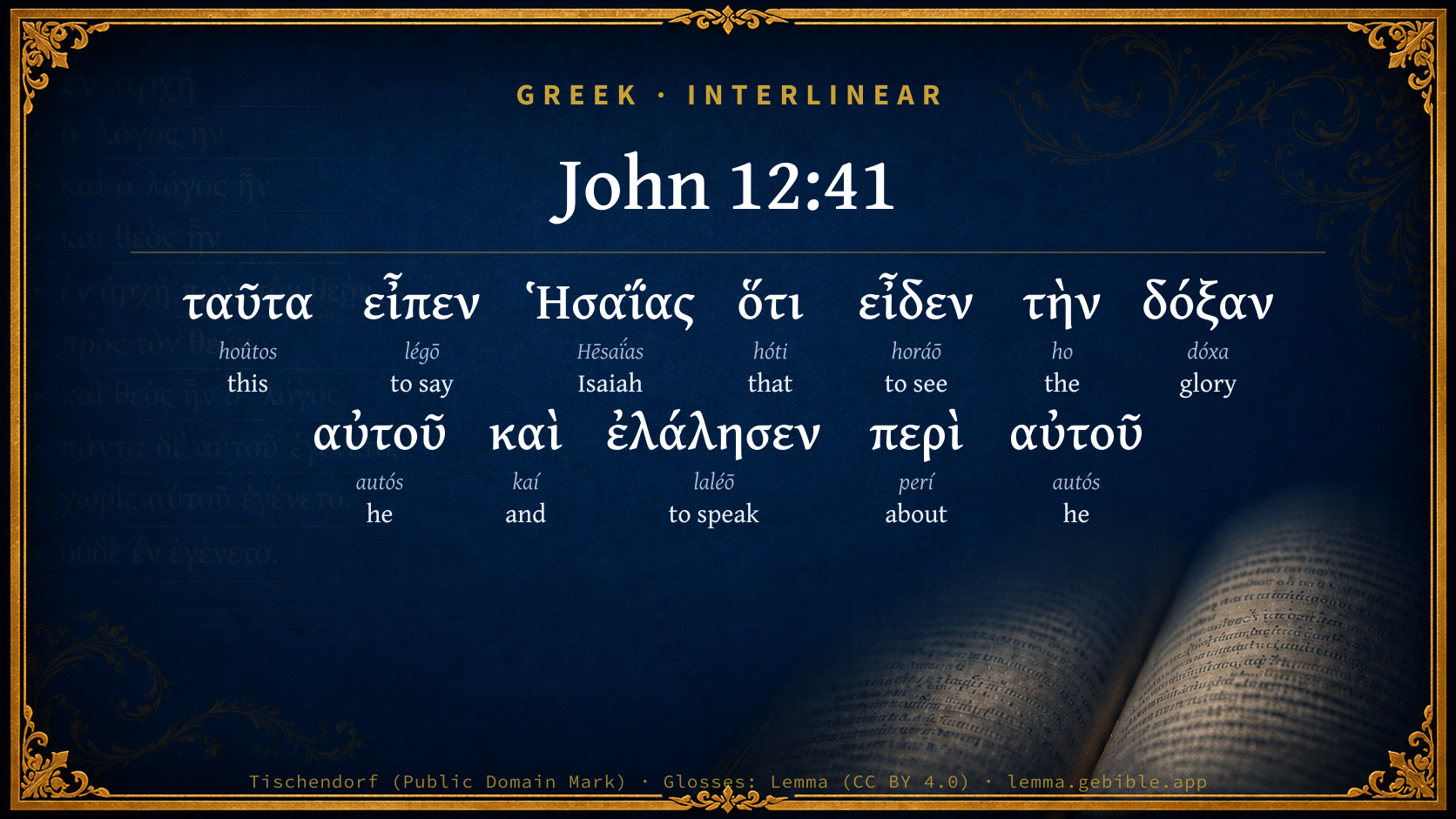
Greek (Tischendorf 8th ed.) John 12:41 appears in the Greek New Testament. The text above is from the Tischendorf 8th edition. Each word links to its Strong’s number and a concise gloss. Click any word for its full Thayer’s Greek Lexicon entry.
Download image
Cite this verse

John 12:41 (World English Bible). Public Domain. Lemma interlinear Bible study tool, https://lemma.gebible.app/v/john/12/41.

Show BibTeX & RIS
BibTeX
RIS
English Translation
Isaiah said these things when he saw his glory, and spoke of him.
World English Bible · Public Domain
Download a study sheet

One document with this verse’s original text, its word-by-word gloss line, the meaning frame, cross-references with their text, attributed commentary, and full source and license credits — printable, and it pastes into notes with its structure intact.

This verse Autodidact and up

Study sheet (.html) Plain text (.txt)

A passage Seminary Student

Up to 50 verses in one chapter. A passage sheet keeps up to 6 commentary sources and 12 cross-references per verse, in the order this page ranks them, and says so on the sheet whenever that leaves anything out. Ask for a single verse and you get the Autodidact verse sheet above.

Everything on this page stays free to read, with no account — the sheet is a download of what is already on screen, not access to it.

Want to remove ads? Support Godless Engineer
Compare translations 3

The same verse in 3 English versions, stacked beneath the original-language interlinear above. Click any original word for its lexicon entry.

Each is an independent rendering of the whole verse — the interlinear is not word-aligned to these translations.

Highlighted words mark where these versions differ — a whole-verse word diff, not a word-by-word alignment.

  • World English Bible Public Domain
    Isaiah said these things when he saw his glory, and spoke of him.
  • King James Version Public Domain
    These things said Esaias, when he saw his glory, and spake of him.
  • unfoldingWord Literal Text CC BY-SA 4.0
    Isaiah said these things because he saw his glory and spoke about him.

unfoldingWord Literal Text — © unfoldingWord, licensed CC BY-SA 4.0. Word-aligned USFM3 via Door43 (git.door43.org/unfoldingWord/en_ult).

Versions to compare (up to 4)

3 of 4 selected

Show all 19 translations

Every available English version of this verse, each an independent rendering of the whole verse.

  • World English Bible Public Domain
    Isaiah said these things when he saw his glory, and spoke of him.
  • Berean Standard Bible Public Domain
    Isaiah said these things because he saw Jesus’ glory and spoke about Him.
  • Majority Standard Bible Public Domain
    Isaiah said these things when he saw Jesus’ glory and spoke about Him.
  • King James Version Public Domain
    These things said Esaias, when he saw his glory, and spake of him.
  • American Standard Version (1901) Public Domain
    These things said Isaiah, because he saw his glory; and he spake of him.
  • Revised Version (1885) Public Domain
    These things said Isaiah, because he saw his glory; and he spake of him.
  • Geneva Bible (1599) Public Domain
    These things sayd Esaias when he sawe his glory, and spake of him.
  • Douay-Rheims (1899) Public Domain
    These things said Isaias, when he saw his glory, and spoke of him.
  • Young's Literal Translation Public Domain
    these things said Isaiah, when he saw his glory, and spake of him.
  • Literal Standard Version CC BY-SA 4.0
    Isaiah said these things when he saw His glory, and spoke of Him.
  • Unlocked Literal Bible CC BY-SA 4.0
    Isaiah said these things because he saw the glory of Jesus and spoke of him.
  • unfoldingWord Literal Text CC BY-SA 4.0
    Isaiah said these things because he saw his glory and spoke about him.
  • Darby Bible Public Domain
    These things said Esaias because he saw his glory and spoke of him.
  • World Messianic Bible Public Domain
    Isaiah said these things when he saw his glory, and spoke of him.
  • Webster's Bible Public Domain
    These things said Isaiah, when he saw his glory, and spoke of him.
  • Free Bible Version CC BY-SA 4.0
    Isaiah saw Jesus' glory and said this in reference to him.
  • Bible in Basic English Public Domain
    (Isaiah said these words because he saw his glory. His words were about him.)
  • Text-Critical English NT CC BY 4.0
    Isaiah said these things when he saw the Lord's glory and spoke about him.
  • Tyndale New Testament (1534) Public Domain
    Soche thinges sayde Esaias when he sawe his glory and spake of him.

Literal Standard Version (2020), Covenant Press — licensed CC BY-SA 4.0. Text via the HelloAO Bible API (eBible.org). Unlocked Literal Bible (unfoldingWord) — licensed CC BY-SA 4.0. Text via the HelloAO Bible API (eBible.org). unfoldingWord Literal Text — © unfoldingWord, licensed CC BY-SA 4.0. Word-aligned USFM3 via Door43 (git.door43.org/unfoldingWord/en_ult). Free Bible Version, Dr. Jonathan Gallagher — licensed CC BY-SA 4.0. Text via the HelloAO Bible API (eBible.org).

Word by word

More ways to search: Search by grammar → Find every occurrence → Compare this word →

Practice this passage: Drill this verse → Learn its vocabulary →

About this verse

These counts appear in no published source. They are computed here, from the morphology-tagged text and Lemma’s own curated glosses. What Lemma adds →

12
words
11
distinct lemmas
Gospels
section

Notable vocabulary

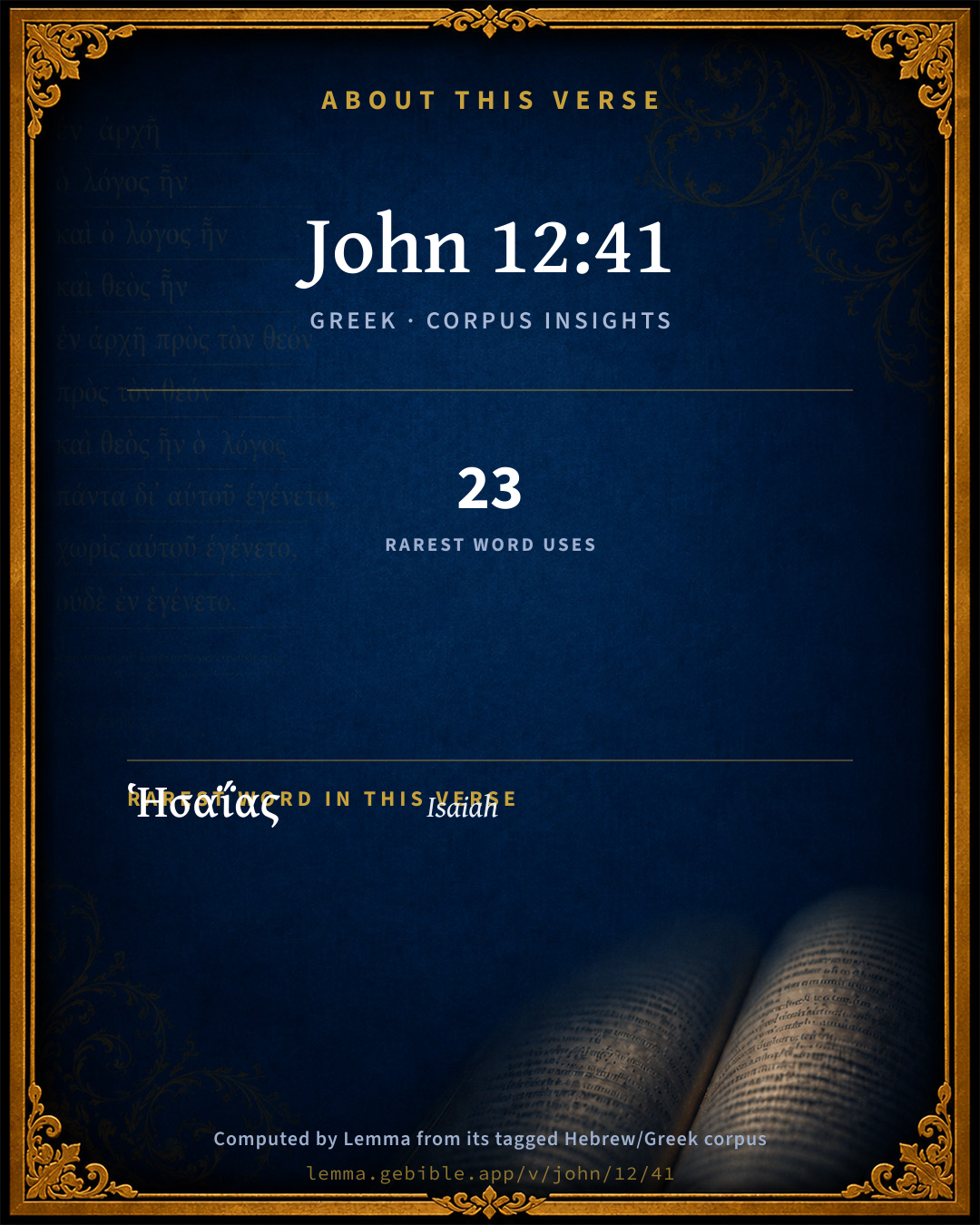
The rarest word here is Ἡσαΐας Isaiah G2268 — appearing just 23 times in the whole Greek New Testament.

Shared distinctive vocabulary

Ἡσαΐας Isaiah G2268 occurs in 23 verses of the Greek New Testament. Also found in:

Repetition

A word recurs within this verse:

  • αὐτοῦ he G846 ×2

Cross-references

13

Topical passages linked to John 12:41 in the Treasury of Scripture Knowledge — connected by theme and wording, ordered by reader-vote popularity; previews shown in the World English Bible.

  • Isaiah 6:1–5 In the year that king Uzziah died, I saw the Lord sitting on a throne, high and lifted up; and his train filled the temple.
  • Isaiah 6:9–10 He said, "Go, and tell this people, 'You hear indeed, But don't understand; And you see indeed, But don't perceive.'
  • John 1:14 The Word became flesh, and lived among us. We saw his glory, such glory as of the one and only Son of the Father, full of grace and truth.
  • John 1:18 No one has seen God at any time. The one and only Son, who is in the bosom of the Father, he has declared him.
  • John 5:39 "You search the Scriptures, because you think that in them you have eternal life; and these are they which testify about me.
  • 2 Corinthians 4:6 seeing it is God who said, "Light will shine out of darkness," who has shone in our hearts, to give the light of the knowledge of the glory of God in the face of Jesus Christ.
  • John 14:9 Jesus said to him, "Have I been with you such a long time, and do you not know me, Philip? He who has seen me has seen the Father. How do you say, 'Show us the Father?'
  • Hebrews 1:3 His Son is the radiance of his glory, the very image of his substance, and upholding all things by the word of his power, when he had by himself made purification for our sins, sat down on the right hand of the Majesty on high;
  • Exodus 33:18–23 He said, "Please show me your glory."
  • Luke 24:27 Beginning from Moses and from all the prophets, he explained to them in all the Scriptures the things concerning himself.
  • Acts 10:43 All the prophets testify about him, that through his name everyone who believes in him will receive remission of sins."
  • 1 Peter 1:11 searching for who or what kind of time the Spirit of Christ, which was in them, pointed to, when he predicted the sufferings of Christ, and the glories that would follow them.
  • Revelation 19:10 I fell down before his feet to worship him. He said to me, "Look! Don't do it! I am a fellow bondservant with you and with your brothers who hold the testimony of Jesus. Worship God, for the testimony of Jesus is the Spirit of Prophecy."

Cross-references courtesy of OpenBible.info (CC BY 4.0).

Where the printed editions differ

1 variant

Places in this verse where the major printed Greek editions disagree on the wording in a way that affects the translation — a comparison of editions, not a manuscript-by-manuscript collation. The editions are the modern critical texts (Nestlé-Aland 28/27, SBL, Westcott-Hort, Tregelles, Tyndale House) and the traditional texts behind the KJV (the Textus Receptus and the Byzantine/Majority text). It is not a claim about which reading is original.

  1. Different wording
    ὅτι

    “because”

    In NA28NA27TynSBLWHTreg Not in TRByz

    ὅτε (hote) 'when' occurs in traditional manuscripts (TR+Byz) instead of ὅτι (hoti) 'because' in older manuscripts (NA28+NA27+Tyn+SBL+WH+Treg)

Textual data: Translators Amalgamated Greek New Testament (STEPBible TAGNT) · CC BY 4.0.

Commentary

Notes on John 12:41 from classic Christian and Jewish commentators (each source and its license shown beneath its notes). The classic Christian expositions comment on the surrounding passage and are grouped to its opening verse, so a note may address several verses; the Jewish commentaries on the Tanakh (Rashi and others) are per-verse, so they appear only where the commentator wrote on this verse.

Lemma curates 59 commentaries, every one of them public domain or Creative Commons licensed, each selected and text-cleaned for this edition rather than reprinted as found. About our sources →

Tyndale Open Study Notes

Tyndale Open Resources

12:41 Isaiah had glimpsed the Messiah’s glory and how the world would respond (see Isa 6:10).

Tyndale Open Study Notes — © Tyndale Open Resources, licensed CC BY-SA 4.0. Text via the HelloAO Bible API.

Bengel's Gnomon

Johann Albrecht Bengel

Joh 12:41. Ὅτε εἶδε τὴν δόξαν αὐτοῦ, when he saw His glory) Instead of αὐτοῦ, one or two copies write τοῦ Θεοῦ from Joh 12:43; but with this reading the application of Isaiah’s inspired declaration to the times of Christ would be weakened.[327] Isaiah, ch. Joh 6:1 [In the year that king Uzziah died, I saw also the Lord sitting upon a throne], saw the divine glory of Jesus: Joh 1:14, “We beheld His glory, the glory of the Only-begotten of the Father,” Joh 17:1, etc., in such a way, moreover, as it was about to be revealed in the New Testament, and as the Jews were not about to recognise it.—ΚΑῚ ἘΛΆΛΗΣΕ, and spake) There is to be understood ὅτε, when, as ὅτι, that, is understood at Joh 12:16. What is pointed to is that speech of the prophet, which is mentioned conjointly with the vision which he saw: Isa 6:5, “Then said I, Woe is me! for I am undone; because I am a man of unclean lips, and I dwell in the midst of a people of unclean lips: for mine eyes have seen the King, the Lord of hosts.”

[327] Dd read τοῦ Θεοῦ αὐτοῦ. Memph. and Theb. Versions read τοῦ Θεοῦ. But ABabc Vulg. Rec. Text and Hil. read αὐτοῦ. Note also that the oldest MSS. ABLX, the Memph. and Theb. Versions, read ὅτι. Dabc Vulg. however support the Rec. Text, ὅτε.—E. and T.

Bengel's Gnomon of the New Testament — English translation (T&T Clark, Edinburgh, 1860) — public domain. Text from a community e-Sword module.

Meyer's Critical & Exegetical Commentary

Heinrich August Wilhelm Meyer

Joh_12:41. Ὅτι (see the critical notes): because he saw His glory, and (in consequence of this view) spoke of Him. This was the occasion that moved him, and it led to his speaking what is contained in Joh_12:40.

αὐτοῦ] refers to Christ, the subject of ἰάσομαι, Joh_12:40, and the chief person in the whole subject under contemplation (Joh_12:37). According to Isa_6:1 ff., the prophet, indeed, beheld Gods glory, God sitting upon His throne, attended by seraphim, etc.; but in the O. T. theophanies, it is just Christ who is present as the Logos,[119] and their glory is His. See on Joh_1:1. Of course the glory of Christ before the incarnation is intended, the μορφὴ θεοῦ (Php_2:6), in which He was.

καὶ ἐλαλ. περὶ αὐτοῦ] still dependent on ὅτι; ἐλάλησε has the emphasis as the correlate of εἶδε.

[119] From which a conclusion can as little be drawn against the personality of the Logos (Beyschlag, p. 166 f.), as from the angelic theophanies against the personality of the angel or angels concerned (not even in Rev_5:6). That the idea of angels in the N. T. wavers between personality and personification is not correct. Observe also, that the self-revelation of the devil does not set aside the personality of the man who is the bearer of it (as Judas). Further, the αὐτοῦ, implying the identity of Christ with the Logos, here shows clearly enough that the latter is viewed as personal. Comp. also Pfleiderer, in Hilgenfeld, ZeitsChr. 1866, p. 258.

Meyer — Critical and Exegetical Commentary on the New Testament — English translation by Peter Christie, edited by Frederick Crombie (T&T Clark, 1880) — public domain. Text from a community e-Sword module.

Expositor's Greek Testament

ed. W. Robertson Nicoll

Joh 12:41 . John’s view of prophecy is given in the words Ταῦτα … αὐτοῦ . “The Targum renders the original words of Isaiah ‘I saw the Lord’ by ‘I saw the Lord’s glory’. St. John states the truth to which this expression points, and identifies the Divine Person seen by Isaiah with Christ.” Westcott. This involves that the Theophanies of the O.T. were mediated by the pre-existent Logos.

The Expositor's Greek Testament, edited by W. Robertson Nicoll (1897–1910) — public domain. Text from a community e-Sword module.

Jamieson, Fausset & Brown

Robert Jamieson, A. R. Fausset & David Brown

These things said Esaias, when he saw his glory, and spake of him--a key of immense importance to the opening of Isaiah's vision (Isa 6:1-13), and all similar Old Testament representations. "THE SON is the King Jehovah who rules in the Old Testament and appears to the elect, as in the New Testament THE SPIRIT, the invisible Minister of the Son, is the Director of the Church and the Revealer in the sanctuary of the heart" [OLSHAUSEN].

Jamieson, Fausset & Brown — Commentary Critical and Explanatory on the Whole Bible (1871) — public domain (CC PDM 1.0). Text via the HelloAO Bible API.

Adam Clarke's Commentary

Verse 41. When he saw his glory] Isa 6:1, c. I saw Jehovah, said the prophet, sitting upon a throne, high and lifted up, and his train filled the temple. Above it stood the seraphim and one cried unto another, and said, Holy, holy, holy, is Jehovah, God of hosts; the whole earth shall be full of his glory! It appears evident, from this passage, that the glory which the prophet saw was the glory of Jehovah: John, therefore, saying here that it was the glory of Jesus, shows that he considered Jesus to be Jehovah. See Bishop Pearce. Two MSS. and a few versions have Θεου, and του Θεου αὑτου, the glory of God, or of his God.

Adam Clarke's Commentary on the Bible (1810–1826) — public domain. Text from a community e-Sword/MySword module.

John Calvin's Commentaries

41. These things spoke Jesus. Lest readers should think that this prediction was inappropriately quoted, John expressly states, that the prophet was not sent as a teacher to a single age, but, on the contrary, that the glory of Christ was exhibited to him, that he might be a witness of those things which should take place under his reign. Now the Evangelist takes for granted, that Isaiah saw the glory of Christ; and hence he infers, that Isaiah accommodates his instruction to the future state of Christ’s kingdom.

John Calvin's Commentaries (1540-1563) — public domain. Text from the Calvin Translation Society English edition (1840s-50s) via the Christian Classics Ethereal Library (ccel.org). Calvin's coverage is partial (roughly two-thirds of the Bible); uncommented books and verses are honest gaps, never fabricated. The 19th-century editor's footnotes and remarks are omitted so the notes are faithfully Calvin's own voice.

Ellicott's Commentary for English Readers

(41) These things said Esaias, when he saw his glory.—The better text is, . . . because he saw His glory. (Comp. Note on the reading in Joh_12:17.) The result of seeing His glory was that he spake of Him. This is St. John’s interpretation of the prophecy. Isaiah himself tells us, “I saw also the Lord sitting upon a throne, high and lifted up, and his train filled the temple” (Joh_6:1). But no man hath seen God at any time. The Word is the express image of His Person. This glory was of the pre-incarnate Word, who was in the beginning with God, and was God.

A Bible Commentary for English Readers, edited by Charles John Ellicott (1878–1897) — public domain. Text from a community e-Sword module.

The Cambridge Bible for Schools and Colleges

gen. ed. J. J. S. Perowne

41. when he saw] The better reading is, because he saw. We had a similar double reading in Joh_12:17, where ‘when’ is to be preferred. In the Greek the difference is only a single letter, ὅτε and ὅτι. Christ’s glory was revealed to Isaiah in a vision, and therefore he spoke of it. The glory of the Son before the Incarnation, when He was ‘in the form of God’ (Php_2:6), is to be understood.

The Cambridge Bible for Schools and Colleges (gen. ed. J. J. S. Perowne; Cambridge University Press, 1878–1918) — public domain. Text from a community e-Sword module.

John Gill's Exposition

Nevertheless among the chief rulers also,.... These were the members of the Jewish sanhedrim, as Nicodemus, Joseph of Arimathea, and others:

many believed on him; that he was the Messiah, though they did not believe in him in a spiritual and saving manner, as their Redeemer and Saviour, only in their minds, being convicted by his miracles, gave an assent unto him, as the promised Messiah. The two persons just mentioned may be thought truly to have believed in Christ; but the many here spoken of seem to have had only an historical faith in him, as appears by what follows:

but because of the Pharisees they did not confess him; as they ought to have done, and as they would have done, if their faith had been right; for where with the heart men believe in Christ to righteousness, there, with the mouth, confession is made to salvation; and between a non-confession of Christ, and a denying him, is no medium; and Christ interprets the one to be the same with the other; see Rom 10:9; and this they did not do, because of the Pharisees, who were the inveterate and implacable enemies of Christ, and were the prevailing party in the sanhedrim: wherefore these chief rulers, though many, were afraid of them,

lest they should be put out of the synagogue; for they had made a decree in the sanhedrim, that whoever confessed that Jesus was the Messiah, should be cast out; and they had put it into execution upon the man born blind, whose eyes Christ opened, for speaking in favour of his benefactor; and this had struck terror in the minds, not only of the common people; but of the chief rulers themselves; for it was looked upon as a very dreadful thing to be put out of the synagogue; See Gill on Joh 9:22.

John Gill's Exposition of the Whole Bible (1746–1763) — public domain (CC PDM 1.0). Text via the HelloAO Bible API.

Trapp's Complete Commentary

John Trapp

41 These things said Esaias, when he saw his glory, and spake of him.

Ver. 41. When he saw his glory] His train only in the temple, Isa 6:1, where the seraphims are said to hide their faces with two wings, as with a double scarf, before God’s glorious brightness, that would put out their eyes else; they clap their wings on their faces, as men do their hands when the lightning flasheth in their eyes.

John Trapp, A Commentary or Exposition upon All the Books of the Old and New Testament (1647–1656) — public domain. Text from a community e-Sword module.

Albert Barnes' Notes on the Bible

When he saw his glory - Isa 6:1-10. Isaiah saw the Lord (in Hebrew, יהוה Yahweh) sitting on a throne and surrounded with the seraphim. This is perhaps the only instance in the Bible in which Yahweh is said to have been seen by man, and for this the Jews affirm that Isaiah was put to death. God had said Exo 33:20, “No man shall see me and live;” and as Isaiah affirmed that he had seen Yahweh, the Jews, for that and other reasons, put him to death by sawing him asunder. See Introduction to Isaiah, Section 2. In the prophecy Isaiah is said expressly to have seen Yahweh Joh 12:1; and in Joh 12:5, “Mine eyes have seen the King Yahweh of hosts.” By his glory is meant the manifestation of him - the Shechinah, or visible cloud that was a representation of God, and that rested over the mercy-seat. This was regarded as equivalent to seeing God, and John here expressly applies this to the Lord Jesus Christ; for he is nor affirming that the people did not believe in God, but is assigning the reason why they believed not on Jesus Christ as the Messiah. The whole discourse has respect to the Lord Jesus, and the natural construction of the passage requires us to refer it to him. John affirms that it was the glory of the Messiah that Isaiah saw, and yet Isaiah affirms that it was Yahweh; and from this the inference is irresistible that John regarded Jesus as the Yahweh whom Isaiah saw. The name Yahweh is never, in the Scriptures, applied to a man, or an angel, or to any creature. It is the unique, incommunicable name of God. So great was the reverence of the Jews for that name that they would not even pronounce it. This passage is therefore conclusive proof that Christ is equal with the Father.

Spake of him - Of the Messiah. The connection requires this interpretation.

Albert Barnes' Notes on the Bible (1834–1885) — public domain. Text from a community e-Sword/MySword module.

Matthew Poole's English Annotations

The evangelist saith, that these things Esaias said, when he saw his glory, and spake of him. Isaiah’s sight of God’s glory is described, Isa 6:1, I saw the Lord sitting upon a throne, high and lifted up, &c. The evangelist expounds this of Christ, which is an evident proof of the Deity of Christ, that he is Jehovah; for it was Jehovah whom the prophet there saw: and that the revelation of that dreadful wrath of God, did not only concern that particular age in which Isaiah lived, but the successive generation of the Jews, whom the prophet saw by the eye of prophecy would tread in the same steps, and use Christ (the Heir) as their forefathers had used him, and the prophets of that age.

Matthew Poole's English Annotations on the Holy Bible (1683–1685) — public domain. Text from a community e-Sword/MySword module.

Whedon's Commentary on the Bible

Daniel D. Whedon

41. Saw his glory—Saw whose glory? Plainly, according to the passage in the prophet Isa_6:1-10, Jehovah’s glory; the term Lord in capitals standing in our Old Testament translation. And this Jehovah is the proper incommunicable name of the God of Israel. And here the Evangelist tells us that this glory of Jehovah was the glory of Jesus—of Jehovah-Jesus. He assumes this as being of course the belief of his contemporaneous readers. And this accords with the fact that the earliest Christian Fathers, as Justin Martyr, as well as the biblical scholars of all ages, have held that the Jehovah of the Old Testament, manifesting himself in various ways to the Old Testament saints, was no other than the God manifest in the flesh of the new dispensation.

Daniel D. Whedon (gen. ed.), Commentary on the Old and New Testaments (1874–1909) — public domain. Text from a community e-Sword module.

The Pulpit Commentary

These things said Isaiah, becausehe saw his glory, and he spake of him. By this reference to the theophany of Isa_6:1, 2 the evangelist here identifies Christ with the Adonai whom the prophet saw in his vision, and thus expresses his conception of the Christ. (comp. 1Co_10:4 Php_2:6) Because the prophet saw the glory of Christ, the unutterable majesty of the "Word of God," he delivered, as we know, this tremendous burden. Few utterances of the New Testament convey in more startling form the conviction of the apostles touching the pre-existence of the Lord, and the identification of the Divine Personality of the Christ, with the highest conception that the Hebrew prophet entertained of the Almighty One, of the eternal Godhead.

The Pulpit Commentary (1880–1919), ed. H.D.M. Spence-Jones & Joseph S. Exell — public domain. Text from a community e-Sword module.

John Wesley's Explanatory Notes

When he saw his glory - Christ's, Isaiah vi, 1, &c. And it is there expressly said to be the glory of the Lord, Jehovah, the Supreme God.

John Wesley, Explanatory Notes Upon the Whole Bible (1754–1765) — public domain. Text via the GEBible commentary corpus.

unfoldingWord translationNotes

Door43 World Missions Community

so that they would not be banned from the synagogue

You can translate this in an active form. AT: "so people would not stop them from going to the synagogue" (See: Active or Passive)

They loved the praise that comes from people more than the praise that comes from God

"They wanted people to praise them more than they wanted God to praise them"

translationWords

Isaiah

glory

Jesus

rule

believe

Pharisee

synagogue

praise

God

unfoldingWord translationNotes — © Distant Shores Media and the Door43 World Missions Community, licensed CC BY-SA 4.0. Source: git.door43.org/Door43/en_tn.

Cambridge Greek Testament for Schools and Colleges

41. ὅτι for ὅτε: comp. Joh 12:17.

41. ὅτι εἶδεν. Because he saw. Here, as in Joh 12:17, authorities vary between ὅτι and ὄτε, and here ὅτι is to be preferred. Christ’s glory was revealed to Isaiah in a vision, and therefore he spoke of it. The glory of the Son before the Incarnation, when He was ἐν μορφῇ Θεοῦ (Php 2:6), is to be understood.

Cambridge Greek Testament for Schools and Colleges (Cambridge University Press, 1896; 21 vols, various authors incl. Carr, Maclear, Plummer, Farrar, Lumby, Moule, M. R. James, Simcox) — public domain. Text from a community e-Sword module.

Alford’s Greek Testament

Henry Alford

41.] ὅτι εἶδ., because he saw. “This apocalyptic vision was the occasion of that prophecy.” Meyer.

αὐτοῦ, of Christ. The Evangelist is giving his judgment,—having (Luk 24:45) had his understanding opened to understand the Scriptures,—that the passage in Isaiah is spoken of Christ. And indeed, strictly considered, the glory which Isaiah saw could only be that of the Son, Who is the ἀπαύγασμα τῆς δόξης of the Father, Whom no eye hath seen.

κ. ἐλάλ. π. αὐτ. does not depend on ὅτι: and he spake concerning Him.

Henry Alford, The Greek Testament (1849–1861) — public domain. Text from a community e-Sword module.

International Critical Commentary

41. The true reading is ὅτι (אABLΘ), not ὅτε of the rec. text or ἔπει with W. It was not when Isaiah saw his vision of Yahweh and the seraphim that he announced the blindness of men’s eyes (Isa 6:1, Isa 6:2, Isa 6:10), but it was because the vision was so dazzling that he realised how far men were from being equal to it.

The vision was not with the eye of sense; it was spiritually that Isaiah “saw the Lord,” a statement that the Targum characteristically softens by saying he saw the glory of the Lord. But Jn. goes farther. He declares that in this vision Isaiah saw the glory of Christ, and spake of Him (εἶδεν τὴν δόξαν αὐτοῦ, καὶ ἐλάλησεν περὶ αὐτοῦ, αὐτοῦ necessarily referring to the same person in both limbs of the sentence). This illustrates well the freedom, so to speak, with which Jn. treats the O.T. In the vision of Isa_6, the prophet contemplates the awful glory of the invisible God; but the evangelist, in affirming that he spoke of the glory of Christ, identifies Christ with the Yahweh of Israel. It was a later Christian thought that the Logos was the agent of the O.T. theophanies, and it may be that Jn. means to suggest this. In any case, he seems to be aware of the Targum which says that Isaiah saw the glory of Yahweh (see on 1:14).

International Critical Commentary — older volumes (1896–1929), various authors — public domain. Text from a community e-Sword module.

Vincent's Word Studies in the New Testament

Marvin R. Vincent

When [οτε] . The best texts read oti, because.

His glory. In the vision in the temple, Isa 6:1, 3, 5.

Of Him. Christ.

Marvin R. Vincent, Word Studies in the New Testament (1887–1900) — public domain. Text from a community e-Sword/MySword module.

Godet's Commentaries

Frédéric Louis Godet

Ver. 41. “This did Isaiah say, when he saw his glory and spoke of him.”

John justifies in this verse the application which he has just made to Jesus Christ of the vision of Isaiah 6. The Adonai whom Isaiah beheld at that moment was the divine being who is incarnated in Jesus. Herein also John and Paul meet together; comp. 1Co 10:4, where Paul calls the one who guided Israel from the midst of the cloud Christ. Some interpreters have tried to refer the pronoun αὐτοῦ, of him, not to Christ, but to God. But the last words: and spoke of him, would be useless in this sense and this remark would be aimless in the context. The Alexandrian reading, “because he saw,” instead of “when he saw,” is adopted by Tischendorf, Weiss, Keil, etc. But it does not appear to me acceptable. Its only reasonable sense would be: “because he really saw his glory and spoke of Him so long beforehand (a thing which seems impossible).” But this reflection would be very coldly apologetic and quite useless for readers who were accustomed to hear the prophecies quoted. It is much more easy to understand how the conjunction ὅτε, which is quite rarely used, may have been replaced by ὅτι, which appears in every line, than how the reverse could have taken place. The ancient Latin and Syriac versions are agreed in supporting the received text. The sense of the latter is simple and perfectly suitable. “It was of Christ, who manifested Himself to him as Adonai, that Isaiah spokewhen he uttered such words.” John proves that he has the right to apply this passage here.

It might be inferred from Joh 12:37-41 that no Jew had either believed or been able to believe; Joh 12:42-43, while completing this historical resume, remove this misapprehension, but, at the same time, explain the want of significance of these few exceptions with reference to the general course of the history.

Frédéric Louis Godet — Commentaries on Luke, John, Romans, and 1 Corinthians — English translation (T&T Clark, Edinburgh, 1870s–1890s) — public domain. Text from a community e-Sword module.

Lesson kit

Teaching starters — assembled from the data on this page, not authored interpretation. Every prompt links to the verse data it draws on. Edit before teaching.

John, in the Gospels, opens this verse with 12 words (11 distinct Greek lemmas). Its most distinctive word is Hēsaḯas (“Isaiah”). A historical commentator’s framing appears above. Read the whole chapter for the surrounding context.

Discussion questions

  1. How does “Isaiah” (Hēsaḯas) shape what this verse is saying?
  2. How does Matthew 3:3, which shares the word «Isaiah», read alongside this verse?
  3. What does the repetition of “he” (2× in this one verse) do in this verse?
  4. These translations render this verse differently. What is at stake in choosing one wording over another?
  5. Compare how Tyndale Open Study Notes and Bengel's Gnomon read this verse. Where do they agree or differ?

Things to notice

Reading settings

Reading text

Shown beneath each verse's original-language words.

Old Testament
Old Testament edition

Read the OT as the Masoretic Hebrew (MT) or the Greek Septuagint (LXX).

English shown for the Greek Septuagint (in the Hebrew ↔ Greek comparison).

Comparing translations? Open the Compare panel on any verse page to stack up to four side by side.