
Matthew 7:24

Greek (Tischendorf 8th ed.) Matthew 7:24 appears in the Greek New Testament. The text above is from the Tischendorf 8th edition. Each word links to its Strong’s number and a concise gloss. Click any word for its full Thayer’s Greek Lexicon entry.
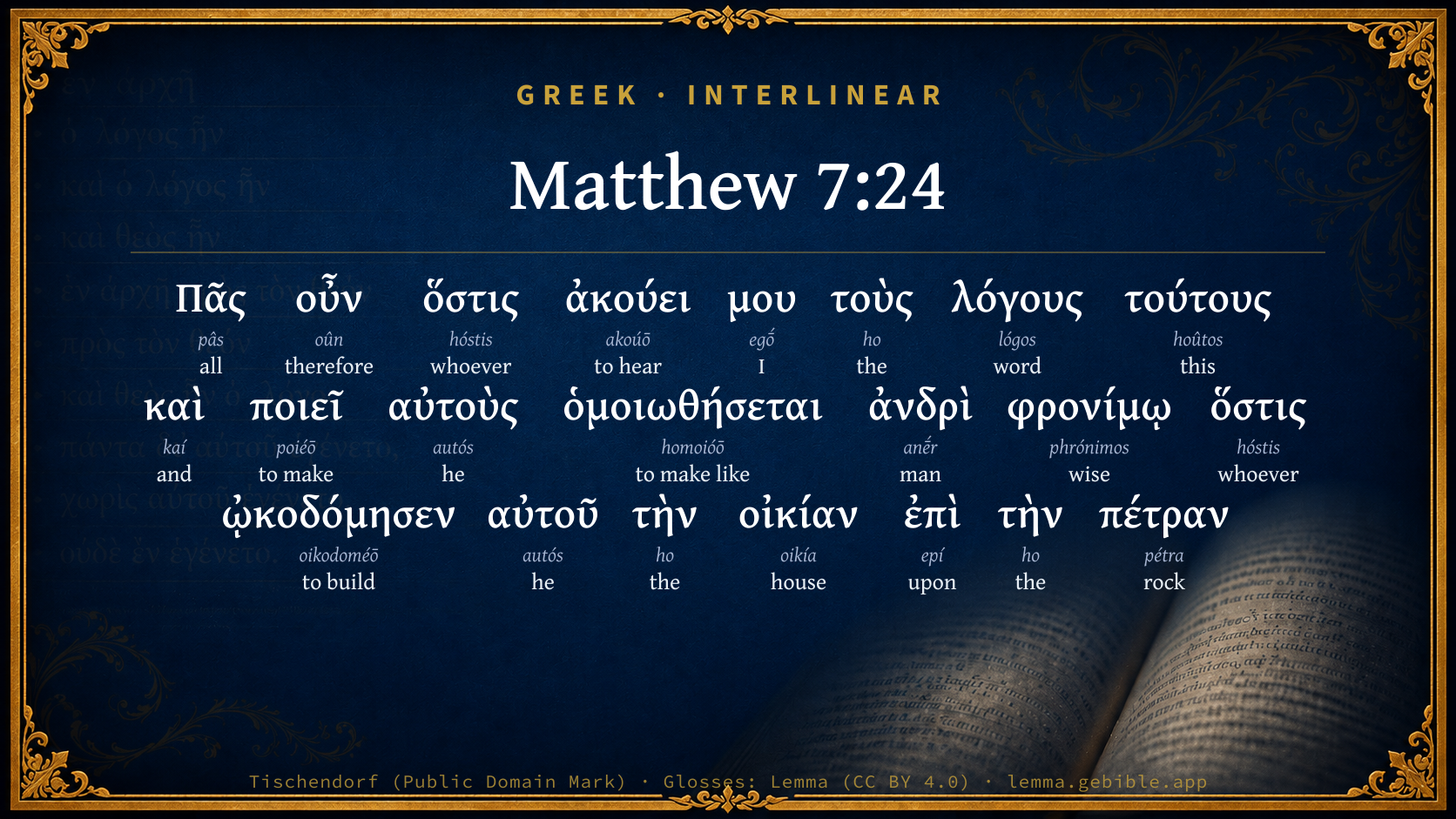
Download image
Cite this verse

Matthew 7:24 (World English Bible). Public Domain. Lemma interlinear Bible study tool, https://lemma.gebible.app/v/matthew/7/24.

Show BibTeX & RIS
BibTeX
RIS
English Translation
"Everyone therefore who hears these words of mine, and does them, I will liken him to a wise man, who built his house on a rock.
World English Bible · Public Domain
Highlights
  • 3 first appearances in the Greek New Testament
Full analysis ↓
Download a study sheet

One document with this verse’s original text, its word-by-word gloss line, the meaning frame, cross-references with their text, attributed commentary, and full source and license credits — printable, and it pastes into notes with its structure intact.

This verse Autodidact and up

Study sheet (.html) Plain text (.txt)

A passage Seminary Student

Up to 50 verses in one chapter. A passage sheet keeps up to 6 commentary sources and 12 cross-references per verse, in the order this page ranks them, and says so on the sheet whenever that leaves anything out. Ask for a single verse and you get the Autodidact verse sheet above.

Everything on this page stays free to read, with no account — the sheet is a download of what is already on screen, not access to it.

Want to remove ads? Support Godless Engineer
Compare translations 3

The same verse in 3 English versions, stacked beneath the original-language interlinear above. Click any original word for its lexicon entry.

Each is an independent rendering of the whole verse — the interlinear is not word-aligned to these translations.

Highlighted words mark where these versions differ — a whole-verse word diff, not a word-by-word alignment.

  • World English Bible Public Domain
    "Everyone therefore who hears these words of mine, and does them, I will liken him to a wise man, who built his house on a rock.
  • King James Version Public Domain
    Therefore whosoever heareth these sayings of mine, and doeth them, I will liken him unto a wise man, which built his house upon a rock:
  • unfoldingWord Literal Text CC BY-SA 4.0
    Therefore, everyone who hears these words of mine and does them will be compared to a wise man who built his house upon the rock.

unfoldingWord Literal Text — © unfoldingWord, licensed CC BY-SA 4.0. Word-aligned USFM3 via Door43 (git.door43.org/unfoldingWord/en_ult).

Versions to compare (up to 4)

3 of 4 selected

Show all 19 translations

Every available English version of this verse, each an independent rendering of the whole verse.

  • World English Bible Public Domain
    "Everyone therefore who hears these words of mine, and does them, I will liken him to a wise man, who built his house on a rock.
  • Berean Standard Bible Public Domain
    Therefore everyone who hears these words of Mine and acts on them is like a wise man who built his house on the rock.
  • Majority Standard Bible Public Domain
    Therefore everyone who hears these words of Mine and acts on them I will liken to a wise man who built his house on the rock.
  • King James Version Public Domain
    Therefore whosoever heareth these sayings of mine, and doeth them, I will liken him unto a wise man, which built his house upon a rock:
  • American Standard Version (1901) Public Domain
    Every one therefore that heareth these words of mine, and doeth them, shall be likened unto a wise man, who built his house upon the rock:
  • Revised Version (1885) Public Domain
    Every one therefore which heareth these words of mine, and doeth them, shall be likened unto a wise man, which built his house upon the rock:
  • Geneva Bible (1599) Public Domain
    Whosoeuer then heareth of mee these words, and doeth the same, I will liken him to a wise man, which hath builded his house on a rock:
  • Douay-Rheims (1899) Public Domain
    Every one therefore that heareth these my words, and doth them, shall be likened to a wise man that built his house upon a rock,
  • Young's Literal Translation Public Domain
    `Therefore, every one who doth hear of me these words, and doth do them, I will liken him to a wise man who built his house upon the rock;
  • Literal Standard Version CC BY-SA 4.0
    Therefore, everyone who hears these words of Mine, and does them, I will liken him to a wise man who built his house on the rock;
  • Unlocked Literal Bible CC BY-SA 4.0
    Therefore, everyone who hears my words and obeys them will be like a wise man who built his house upon a rock.
  • unfoldingWord Literal Text CC BY-SA 4.0
    Therefore, everyone who hears these words of mine and does them will be compared to a wise man who built his house upon the rock.
  • Darby Bible Public Domain
    Whoever therefore hears these my words and does them, I will liken him to a prudent man, who built his house upon the rock;
  • World Messianic Bible Public Domain
    “Everyone therefore who hears these words of mine and does them, I will liken him to a wise man who built his house on the rock.
  • Webster's Bible Public Domain
    Therefore whoever heareth these sayings of mine, and doeth them, I will liken him to a wise man, who built his house upon a rock:
  • Free Bible Version CC BY-SA 4.0
    Everyone that hears the words I say, and follows them, is like a wise man who built his house on solid rock.
  • Bible in Basic English Public Domain
    Everyone, then, to whom my words come and who does them, will be like a wise man who made his house on a rock;
  • Text-Critical English NT CC BY 4.0
    “Everyone then who hears these words of mine and does them I will compare to a wise man who built his house on the rock.
  • Tyndale New Testament (1534) Public Domain
    Whosoever heareth of me these sayinges and doethe the same I wyll lyken hym vnto a wyse man which bylt hys housse on a rocke:

Literal Standard Version (2020), Covenant Press — licensed CC BY-SA 4.0. Text via the HelloAO Bible API (eBible.org). Unlocked Literal Bible (unfoldingWord) — licensed CC BY-SA 4.0. Text via the HelloAO Bible API (eBible.org). unfoldingWord Literal Text — © unfoldingWord, licensed CC BY-SA 4.0. Word-aligned USFM3 via Door43 (git.door43.org/unfoldingWord/en_ult). Free Bible Version, Dr. Jonathan Gallagher — licensed CC BY-SA 4.0. Text via the HelloAO Bible API (eBible.org).

Word by word

More ways to search: Search by grammar → Find every occurrence → Compare this word →

Practice this passage: Drill this verse → Learn its vocabulary →

φρονίμῳ
phrónimos
G5429
“wise”
Adjective, Dative, Singular, Masculine
Part of Speech
Adjective
Case
Dative
Number
Singular
Gender
Masculine
Full Thayer's Definition

Origin: from G5424

TDNT: 12:40,1

1. intelligent, wise 2. prudent, i.e. mindful of one's interests
  1. Πᾶς pâs G3956 “all” Adjective, Nominative, Singular, Masculine
  2. οὖν oûn G3767 “therefore” Conjunction
  3. ὅστις hóstis G3748 “whoever” Relative pronoun, Nominative, Singular, Masculine
  4. ἀκούει akoúō G191 “to hear” Verb, Present, Active, Indicative, 3rd person, Singular
  5. μου egṓ G1473 “I” Personal pronoun, 1st person, Genitive, Singular
  6. τοὺς ho G3588 “the” Article, Accusative, Plural, Masculine
  7. λόγους lógos G3056 “word” Noun, Accusative, Plural, Masculine
  8. τούτους hoûtos G3778 “this” Demonstrative pronoun, Accusative, Plural, Masculine
  9. καὶ kaí G2532 “and” Conjunction
  10. ποιεῖ poiéō G4160 “to make” Verb, Present, Active, Indicative, 3rd person, Singular
  11. αὐτοὺς autós G846 “he” Personal pronoun, Accusative, Plural, Masculine
  12. ὁμοιωθήσεται homoióō G3666 “to make like” Verb, Future, Passive, Indicative, 3rd person, Singular
  13. ἀνδρὶ anḗr G435 “man” Noun, Dative, Singular, Masculine
  14. ὅστις hóstis G3748 “whoever” Relative pronoun, Nominative, Singular, Masculine
  15. ᾠκοδόμησεν oikodoméō G3618 “to build” Verb, Aorist, Active, Indicative, 3rd person, Singular
  16. αὐτοῦ autós G846 “he” Personal pronoun, Genitive, Singular, Masculine
  17. τὴν ho G3588 “the” Article, Accusative, Singular, Feminine
  18. οἰκίαν oikía G3614 “house” Noun, Accusative, Singular, Feminine
  19. ἐπὶ epí G1909 “upon” Preposition
  20. τὴν ho G3588 “the” Article, Accusative, Singular, Feminine
  21. πέτραν pétra G4073 “rock” Noun, Accusative, Singular, Feminine

About this verse

These counts appear in no published source. They are computed here, from the morphology-tagged text and Lemma’s own curated glosses. What Lemma adds →

22
words
18
distinct lemmas
Gospels
section

Notable vocabulary

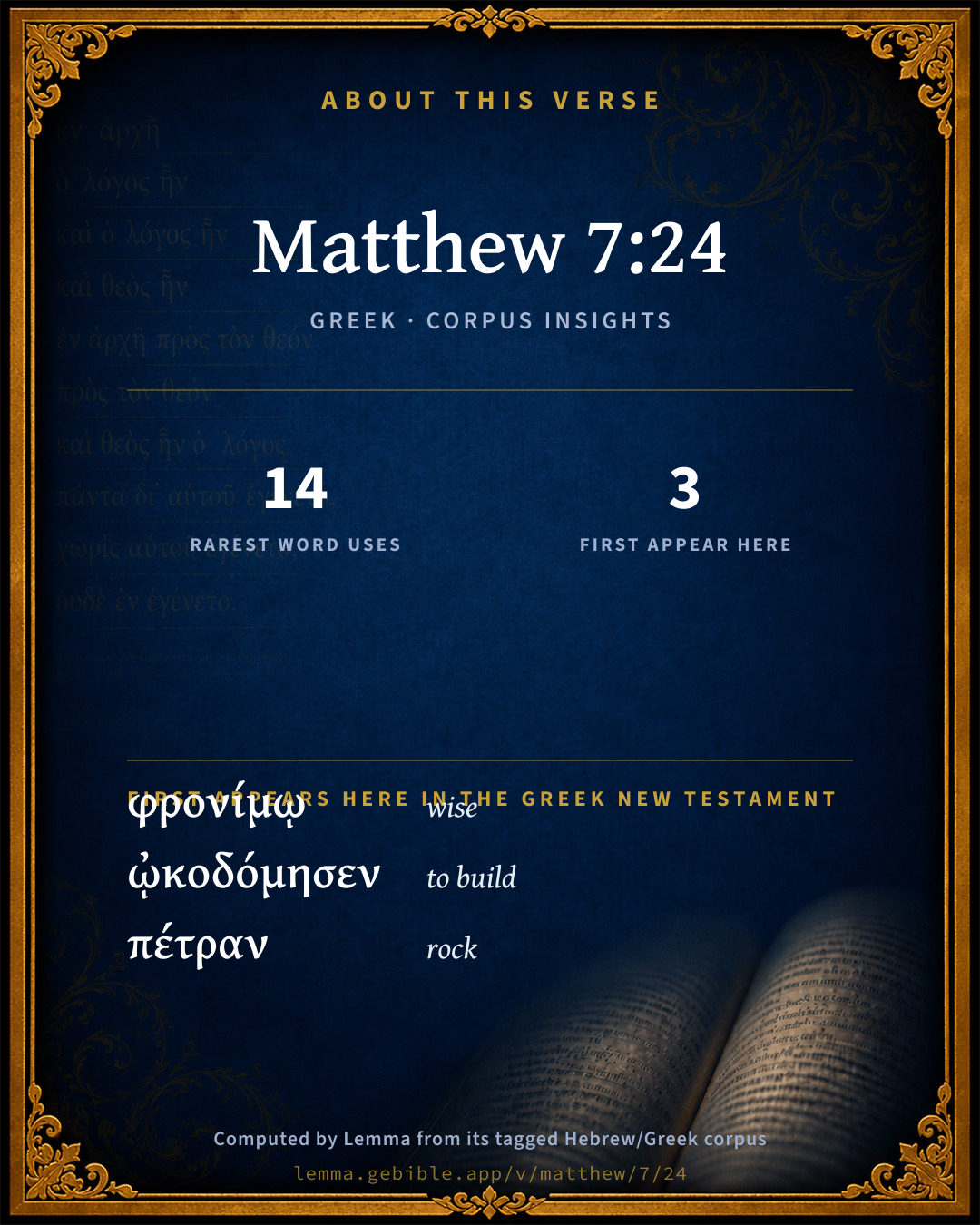
The rarest word here is φρονίμῳ wise G5429 — appearing just 14 times in the whole Greek New Testament.

First appearance in Scripture

These words make their first canonical appearance in the Greek New Testament here:

  • φρονίμῳ wise G5429
  • ᾠκοδόμησεν to build G3618
  • πέτραν rock G4073

Shared distinctive vocabulary

φρονίμῳ wise G5429 occurs in 14 verses of the Greek New Testament. Also found in:
Repetition

Words recur within this verse:

  • ὅστις whoever G3748 ×2
  • τοὺς the G3588 ×3
  • αὐτοὺς he G846 ×2

Cross-references

31

Topical passages linked to Matthew 7:24 in the Treasury of Scripture Knowledge — connected by theme and wording, ordered by reader-vote popularity; previews shown in the World English Bible.

  • Luke 6:47–49 Everyone who comes to me, and hears my words, and does them, I will show you who he is like.
  • John 13:17 If you know these things, blessed are you if you do them.
  • Luke 11:28 But he said, "On the contrary, blessed are those who hear the word of God, and keep it."
  • 1 Corinthians 3:10–11 According to the grace of God which was given to me, as a wise master builder I laid a foundation, and another builds on it. But let each man be careful how he builds on it.
  • James 2:17–26 Even so faith, if it has no works, is dead in itself.
  • 1 John 2:3 This is how we know that we know him: if we keep his commandments.
  • Psalms 111:10 The fear of Yahweh is the beginning of wisdom. All those who do his work have a good understanding. His praise endures forever!
  • Proverbs 10:8 The wise in heart accept commandments, But a chattering fool will fall.
  • 1 John 3:22–24 and whatever we ask, we receive from him, because we keep his commandments and do the things that are pleasing in his sight.
  • James 1:21–27 Therefore, putting away all filthiness and overflowing of wickedness, receive with humility the implanted word, which is able to save your souls.
  • John 14:15 If you love me, keep my commandments.
  • John 15:14 You are my friends, if you do whatever I command you.
  • Galatians 6:7–8 Don't be deceived. God is not mocked, for whatever a man sows, that will he also reap.
  • Job 28:28 To man he said, 'Behold, the fear of the Lord, that is wisdom. To depart from evil is understanding.'"
  • John 14:22–24 Judas (not Iscariot) said to him, "Lord, what has happened that you are about to reveal yourself to us, and not to the world?"
  • John 15:10 If you keep my commandments, you will remain in my love; even as I have kept my Father's commandments, and remain in his love.
  • Matthew 12:50 For whoever does the will of my Father who is in heaven, he is my brother, and sister, and mother."
  • Matthew 6:19–21 "Don't lay up treasures for yourselves on the earth, where moth and rust consume, and where thieves break through and steal;
  • Matthew 7:7–8 "Ask, and it will be given you. Seek, and you will find. Knock, and it will be opened for you.
  • 1 John 5:3–5 For this is the love of God, that we keep his commandments. His commandments are not grievous.
  • Psalms 119:99 I have more understanding than all my teachers, For your testimonies are my meditation.
  • Matthew 7:13–14 "Enter in by the narrow gate; for wide is the gate and broad is the way that leads to destruction, and many are those who enter in by it.
  • Psalms 119:130 The entrance of your words gives light. It gives understanding to the simple.
  • Matthew 5:3–12 "Blessed are the poor in spirit, For theirs is the Kingdom of Heaven.
  • Romans 2:6–9 who "will pay back to everyone according to their works:"
  • Proverbs 14:8 The wisdom of the prudent is to think about his way, But the folly of fools is deceit.
  • Galatians 5:6–7 For in Christ Jesus neither circumcision amounts to anything, nor uncircumcision, but faith working through love.
  • James 3:13–18 Who is wise and understanding among you? Let him show by his good conduct that his deeds are done in gentleness of wisdom.
  • Revelation 22:14–15 Blessed are those who do his commandments, that they may have the right to the tree of life, and may enter in by the gates into the city.
  • Matthew 5:28–32 but I tell you that everyone who gazes at a woman to lust after her has committed adultery with her already in his heart.
  • Matthew 6:14–15 "For if you forgive men their trespasses, your heavenly Father will also forgive you.

Cross-references courtesy of OpenBible.info (CC BY 4.0).

Where the printed editions differ

1 variant

Places in this verse where the major printed Greek editions disagree on the wording in a way that affects the translation — a comparison of editions, not a manuscript-by-manuscript collation. The editions are the modern critical texts (Nestlé-Aland 28/27, SBL, Westcott-Hort, Tregelles, Tyndale House) and the traditional texts behind the KJV (the Textus Receptus and the Byzantine/Majority text). It is not a claim about which reading is original.

  1. Different wording
    ὁμοιωθήσεται

    “he will be like”

    In NA28NA27TynSBLWHTreg Not in TRByz

    ὁμοιώσω αὐτὸν (homoiōsō auton) 'I will liken him' occurs in traditional manuscripts (TR+Byz) instead of ὁμοιωθήσεται (homoiōthēsetai) 'he will be like' in older manuscripts (NA28+NA27+Tyn+SBL+WH+Treg)

Textual data: Translators Amalgamated Greek New Testament (STEPBible TAGNT) · CC BY 4.0.

Commentary

Notes on Matthew 7:24 from classic Christian and Jewish commentators (each source and its license shown beneath its notes). The classic Christian expositions comment on the surrounding passage and are grouped to its opening verse, so a note may address several verses; the Jewish commentaries on the Tanakh (Rashi and others) are per-verse, so they appear only where the commentator wrote on this verse.

Lemma curates 59 commentaries, every one of them public domain or Creative Commons licensed, each selected and text-cleaned for this edition rather than reprinted as found. About our sources →

The Biblical Illustrator

Joseph S. Exell

Mat_7:24

I will liken him unto a wise man which built his house upon a rock.

I. The building. Every immortal creature is supposed to be building a house-entertaining a hope of heaven. They know they cannot always live in their present earthly house, etc.

II. The foundation. There is the foundation of the formalist, hypocrite, presumptuous enthusiast. The foundation of the real saint-Christ, the Rock. All his hopes of pardon, etc., founded on Christ alone.

III. The trial The storm of tribulation and persecution, affliction, death, judgment, will try every mans work, what sort it is. All joy to the believer.

IV. The result, certain. Nothing can then prevent the fall of a house not built on the true foundation; nothing can then endanger the hope that is built on Christ. Total: Irrevocable.

1. Look well to the foundation.

2. If the true foundation be laid, see that the superstructure goes on.

3. No ground for boasting. (J. Hirst.)

The two builders

I. The points of resemblance. They both heard Christs sayings; both saw the necessity of building a house, or place of refuge; both actually erected a house; both houses were exposed to storms; both builders rested with security in the edifices they had raised.

II. Those things in which they differed. In their personal character; in their practice; in the foundations on which they built; in the final result of each.

1. How necessary is careful examination.

2. How important a saving knowledge of Christ.

3. How indispensable practical godliness. (J. Burns, LL. D.)

The wise and foolish builders

I. The builders.

1. They were alike

(1) in their need of a house.

(2) In their privileges. Both heard the same words of Jesus.

(3) In their efforts; both built.

2. They were unlike

(1) in their character.

(2) In their choice.

(3) In faith and love. One heard and did not. If a man love Me, he will keep My words.

II. The foundations. The one sure, the other insecure.

III. The superstructure.

IV. The trial.

V. The results. (American Hom. Monthly.)

The wise and the foolish building for eternity

I. The designation-Whosoever heareth these sayings of mine, and doeth them.

1. Fortuity. Whosoever, a pronoun contingent; we cannot foresee the issue. We must leave our spiritual toils with God.

2. Privilege. Privilege to hear the gospel.

3. Docility. Doeth them.

II. Wisdom.

1. Design. Building a house denotes an intention to live in it.

2. Selection. If you build, you must look after a place.

3. Perseverance. He went on building in face of difficulties.

4. Stability. If the works of art are less durable than the works of nature, the works of grace outshine the works of nature much more. There is something enduring when you are enabled to build upon the Rock of Ages.

III. Folly.

1. Concession. He could not manage without a house.

2. Labour. He took much pains.

3. Promise. It looked fair.

4. Fall. The fall of a soul! Ruinous. (E. Andrews, LL. D.)

The great Teacher

I. The sayings of Christ are eminently practical.

II. They are practicable. It Was no impossible ideal. God has provided helpful agencies.

1. The agency of the Holy Ghost.

2. A means of Christian holiness is the earthly life of the personal and human Christ.

3. There is the encouragement of conscious progress.

III. The sayings of Christ are authoritative.

IV. The sayings of Christ are imperative. (H. Allele.)

The wise and foolish builders

1. We have every one of us a house to build; or, in other words, a soul to save.

2. There is a Rock provided for us, on which we may safely build our house.

3. On this Rock we must build if we would escape everlasting destruction.

4. The danger of delaying to place your building upon the right foundation. (E. Cooper.)

I. Wherein these two builders resembled each other.

1. They both heard Christs sayings.

2. They both saw the necessity of building a refuge.

3. They both actually erected a house.

4. Both houses were exposed to storms.

5. Both builders rest securely in their houses.

II. Wherein they differed.

1. In their characters.

2. In their practice-one was a hearer, the other a doer.

3. In their judgments of the foundation.

4. In the final issue.

III. The consequences which followed.

1. The fallen house involves the eternal ruin of the inmate.

2. It is a disappointment of fondly-cherished hopes.

3. It is fall, total and irreparable, for ever.

4. The inmate in the other house is in no danger.

5. He lives in peace and plenty on earth.

6. He shall reign with God in glory. (J. B. Baker.)

The sure foundation

I. The points of resemblance between the converted and the unconverted professor,

1. Both profess to be religious. Both build a house.

2. Both have their religion put to the test.

II. The points of difference between them.

1. In their conduct. The one indolent, the other was laborious; one idly plants his house, the other digs for foundation.

2. In the foundation of their hopes.

3. In their end, How wise the genuine believer! How foolish the unconverted professor! (C. Clayton, M. A.)

Building upon the Rock

1. True religion is likened to a mans own house. Every ones real life is his own home.

2. There are a few persons who are fond of looking at foundations, and questioning whether they rest on the right place; others make the far more vital mistake of not searching into them enough.

3. Foundations are found, after much search, in deep places; certain floating ideas about religion are not enough to build a life upon-such as He is a kind God, and will not punish.

4. The Spirit of God shows a man the Rock. (J. Vaughan, M. A.)

The foundation imparts strength to the structure

But what can the hurricane do? Just what the elements do in nature. Whatever they do not break, they consolidate. Your trials will only consolidate-they will consolidate your principles, your affections, your hopes-they will make you, on the Rock, yourselves a rock. Judgments may fall from above, like the descending rain. Disappointments, afflictions, persecutions, may swell around you, like rolling floods. Temptations may buffet you with all the mysteriousness of the invisible wind. Yet St. Luke says, They could not shake it. The strength of the Rock is in the believer-he passes all his troubles on to his Rock, and from his Rock he draws his strength. And the eternal unchangeableness of the foundation, makes the poorest, weakest stone that is once fastened to it, unshaken and impregnable as the throne of Jehovah. (J. Vaughan, M. A.)

The two builders and their houses

I. The two builders,

1. They were equally impressed with the need of building a house.

2. They were both alike resolved to obtain a house.

3. They were equally well skilled in architecture.

4. They both persevered and finished their structure.

II. their houses.

1. The chief apparent difference between the two edifices probably was this, that one of them built his house more quickly than the other,

2. One was built with far less trouble than the other.

3. The main difference lay out of sight-underground.

III. The common trial of the two houses.

IV. The different results of the trials. (C. H. Spurgeon.)

False foundations removed, and true ones laid for such wise builders as design to build for eternity

I. To show the reasons why practice or obedience is the best and surest foundation for a man to build his design for heaven and the hopes of his salvation upon.

1. Because, according to the economy of Gods working upon the hearts of men, nothing but practice can change our corrupt nature; and practice continued in, by the grace of God, will.

2. Because action is the highest perfection and drawing forth of the utmost power, vigour, and activity of mans nature.

3. Because the main drift of religion is the active part of it.

(1) Thus God is honoured.

(2) The good of society.

II. Those false and sandy foundations which many venture to build upon, and are accordingly deceived by.

1. An unoperative faith.

2. Honesty of intention.

3. Party and singularity.

III. Whence it is that such ill-founded structures are, upon trial, sure to fall. The force and opposition from without. Satan. (R. South, D. D.)

The wise builder

I. The sayings to which the Saviour refers.

II. The practical attention they demand.

III. The dispositions of mind necessary for the due reception and practice of the truth.

1. A holy vigilance against whatever may prove an obstacle; custom, curiosity, criticism.

2. To cherish whatever may be likely to promote the due reception of the gospel, freedom of the mind from worldly entanglements; there must be reverence for the truth, docility, self-application, faith in the Son of God, prayer.

IV. The inviolable safety of such hearers of the word.

1. The faith and hope of the Christian may be rudely assailed in the present life.

2. However assailed the Christian is secure. (J. E. Good.)

The foolish builder

I. Who among the hearers of the gospel are intended by this representation.

1. It applies to all who build their hope of heaven upon the mere belief of the doctrines of Christianity.

2. The individual who builds upon his own goodness, and rejects, either in part or whole, the atonement of the Lord Jesus Christ.

3. The foolish builder represents likewise the hearer of the gospel, on whose mind its Divine truths only partially operate.

4. The persons on whose minds the influence of the Word is transient,

II. The fearful and tremendous overthrow which awaits such hearers of the word.

1. As regards the time of its occurrence. It fell in the storm, when the builder had most need of it.

2. It was great as to the sacrifice of property. The plans and toils of the wicked are vain.

3. It was great because it was irreparable. Too late to build another. (J. E. Good.)

The builders

The two houses in building; the two houses in the storm.

I. We are all of us builders. People are often building something quite different from what they fancy. A man fancies lie is building a fortune, when in reality he is building a prison for himself. Some persons go on building for sixty years, and have nothing to show worth calling a life.

II. If we would build safely and well we must build on a right foundation. It is so in small things. The want of a good foundation does not always show at once, but sooner or later the trial comes.

1. Sometimes it is the temptations of worldly companionship and influence that try our foundations.

2. Sometimes it is sorrow.

3. Sometimes sickness searches out the hidden weakness of the foundation. (E. R. Conder, D. D.)

Life a structural process

The trust-house. A quiet, bright girl is sitting at work in a cottage by her mothers side; ready, with cheerful promptness, to run on an errand, to spread the table, to fetch her little brother from school, or to teach and amuse the younger children. Is she building anything? Many things. For one thing, a feeling of trust in her mothers heart. Years hence, when that mother is stricken down with sickness, she will not have to say with a sigh, Jane means well, but I cant trust her. She will say, I can trust you, my child, to do all that I have been used to do-all that you know I should wish. (E. R. Conder, D. D.)

The memory-house

A brother and sister are sitting together by the fireside, listening to their fathers teaching, to their mothers sweet voice reading aloud: they repeat the same hymns; they turn over the leaves of one book; they kneel side by side at firefly prayer. What are they building? A happy, holy chamber of memory, of which they two alone will have the key. (E. R. Conder, D. D.)

The thought-house

Shall we look at one or two other builders? A grave, bright-eyed boy is sitting before a fire, earnestly watching the bubbling, hissing, steaming tea-kettle, and thinking, thinking, thinking. What is he building? Neither he nor any one else can guess; but in truth he is building things as wonderful as the enchanted castles and palaces of the genii in fairy-tales. Steam-engines, steamboats, locomotives, with their long trains of railway carriages, and the long lines of railway made for them to run on: all these are, in time, to grow out of the thought which that boy is building in his busy brain. All the steam-engines that ever will be built were wrapped up, like a forest of oaks in a single acorn, in the first thought of the steam-engine in the mind of James Watt. For, let me tell you (though I scarcely expect you to understand it), of all that men build in granite, or marble, or iron, or whatever else they please, nothing is so strong and lasting as thought. The pyramids themselves might be blown up and shattered into fragments, but what power could destroy the twenty-third Psalm? (E. R. Conder, D. D.)

Life-structures are varied

Some mens lives are like palaces, fair and spacious and lofty; full of nobleness. Some are like castles, grim and stern and tyrannical, with dark cells and secret winding passages. Some are like mills and warehouses, stuffed so full with machinery and merchandise that the owner has scarce room to move about; and not a glimpse of the bright blue sky can he catch through their dusty windows. Some, again, are lighthouses, standing bravely on their rock amid the dashing waves, and holding forth the light by which many a storm-tossed voyager is guided into port. Some lives are more like ships than houses, ever wandering, nowhere abiding. Some are like quiet cottage homes, with no splendid outside or towering pinnacles, but full of homely peace and quiet usefulness. And some-how many!-never get beyond the beginning: just a few courses laid. (E. R. Conder, D. D.)

Foundations always important even in small things.

If you are going to paint a picture, and get the outline wrong (which is the foundation of the picture), all the picture will be wrong. If you have a long division sum to do, and make a mistake in the first step, all the sum will be wrong. A child soon learns that he cannot even build a card house on a shining, polished table, or on a crooked, ricketty table; or a house of toy bricks without a firm level foundation. How much more must this be so in greater matters! (E. R. Conder, D. D.)

The Biblical Illustrator, edited by Joseph S. Exell (c. 1880s–1900s) — public domain. Text from a community e-Sword module.

Joseph Benson's Commentary

Mat 7:24-27. Therefore, whosoever heareth these sayings of mine, &c. — In these words our Lord attests, in the most solemn manner, the certain truth and infinite importance of all he had delivered in the foregoing sermon, and applies it to the consciences of his hearers. Whosoever heareth these sayings of mine, and doeth them — Whosoever he be that hears, considers, understands, believes, and obeys the doctrine which I have now taught you; I will liken him unto a wise man which built his house upon a rock — Whatever his former conduct may have been, being now brought to repentance and amendment of life, and becoming a new creature, he lays a solid foundation for present comfort and everlasting security and joy. Observe well, reader, although other foundation for confidence toward God, and a hope of eternal life, can no man lay than that is laid, which is Jesus Christ, 1Co 3:11; yet we pretend in vain to build on him, if we do not obey his doctrine, and make it the rule of our whole conduct. Therefore there is no inconsistency between the doctrine here advanced by our Lord, and that of the apostle in the passage just quoted; nor between the same apostle’s declaring, 1Co 7:19, Circumcision is nothing, &c., but the keeping of the commandments of God; and his asserting to the Galatians, chap. Mat 5:6, That nothing availeth but faith which worketh by love. For the faith he speaks of is always followed by obedience to the commandments of God, of which it is the root and principle. And the rain descended, and the floods came, and beat upon that house — These words of our Lord imply that every man’s religion, with the confidence and hope which he builds thereon, must, sooner or later, be severely tried; and it fell not, for it was founded on a rock — Thus the religion of the true, practical Christian, with all his present comforts and future hopes, remains firm and unshaken, how severely and violently soever it may be assaulted. And every one that heareth these sayings, and doeth them not — Who is a mere hearer of the word, and not a doer of it, how constantly soever he may attend to hear it, and whatever zeal he may profess for the doctrine he hears; shall be likened unto a foolish man, &c. — A man possessed of neither foresight nor consideration; who built his house upon the sand — Without taking any care to find or lay a firm foundation for it, as if he were sure that no wintry storm or tempest would ever assail it. And the rain descended, &c. and beat upon that house, and it fell — For the foundation being bad, neither the height of the structure, nor its wide dimensions, could be any security to it: and great was the fall of it — Even as great as the building had been. “A lively emblem,” says Doddridge, “of the ruin which will another day overwhelm the unhappy man who trusts to an outward profession and form of godliness, when he does not sincerely and practically regard it.”

Joseph Benson's Commentary on the Old and New Testaments (1811–1818) — public domain. Text from a community e-Sword module.

Whedon's Commentary on the Bible

Daniel D. Whedon

(5.) We stand only by obedience to Christ’s words, Mat_7:24-27.

Our Lord now arrives at the final consummation to which the whole discourse has tended. So the judgment is the final consummation of all the world’s history.26. Heareth… doeth not — It is not the mere hearing, nor believing, but the doing these sayings which places our house upon the rock. Faith cometh, indeed, by hearing; but faith must be justified by works.

Daniel D. Whedon (gen. ed.), Commentary on the Old and New Testaments (1874–1909) — public domain. Text from a community e-Sword module.

The Preacher's Complete Homiletical Commentary

Joseph S. Exell (gen. ed.)

CRITICAL NOTES

Mat_7:27. Great was the fall of it.—How lively must this imagery have been to an audience accustomed to the fierceness of an Eastern tempest, and the suddenness and completeness with which it sweeps everything unsteady before it! (Brown). We see, from the present example, that it is not necessary for all sermons to end in a consolatory strain (Bengel).

Mat_7:28. Doctrine.—Teaching (R.V.). Not only the matter, but the manner.

Mat_7:29. Not as the scribes.—As a rule the scribe hardly ever gave his exposition without at least beginning by a quotation from what had been said by Hillel or by Shammai, by Rabbi Joseph or Rabbi Meir, depending almost or altogether upon what had thus been ruled before, as much as an English lawyer depends on his precedents. In contrast with this usual custom, our Lord fills the people with amazement by speaking to them as One who has a direct message from God (Plumptre).

MAIN HOMILETICS OF THE PARAGRAPH.—Mat_7:24-29

Striking home.—In the earlier part of these words we find our Saviour bringing His solemn discourse to a close. In the latter part we have an account of the effect it produced at the time. The two together may be regarded as showing us two opposite things, viz. on the one hand, the solemn testimony of Christ to His hearers; and, on the other, the open testimony of His hearers to Him.

I. His testimony to them.—This was such as to put before them, in the first place, a serious twofold choice. Just before (Mat_7:21-23), He seems to have been speaking of more than one unsatisfactory way of dealing with His words; the way of mere profession, the way of mere preaching, the way of mere work. In reality and essence, these came to but one. These were all ways—however varied ways—of doing one thing, viz. of hearing Christ with contempt. Here is the vital point in this matter of hearing. To hear and obey is to hear with respect. To hear without doing is to hear with contempt. One of the two all His hearers must do (Mat_7:24; Mat_7:26). There is no other method; no middle course; no possible third. This testimony gives warning, in the next place, of a serious common experience. Both these ways of hearing will be tested in time in a similar way. Both “buildings” will be exposed, in the nature of things, to essentially identical perils, perils of waters, perils of winds, perils of both not only “beating” on, but as it were “smiting” their walls (Mat_7:25; Mat_7:27). Cf. also such passages as Job_1:11; Luk_22:31; 2Co_12:7; 1Co_3:13; 1Pe_1:7; Rev_3:10. Also such passages as declare that the “good fish” and the “bad,” the “tares” and the “wheat,” the “goats” and the “sheep,” are to be discriminated first and then divided asunder. A day of judgment—a day of testing—on whichever side we really are—is to come to us all. Lastly, this testimony speaks, in consequence, of a serious twofold result. There will be the result of failure, or else of success; of approval or of condemnation; of confirmed stability or of ruin. This is inevitable in the nature of things. The man who does as the Saviour counsels is treating those counsels with reverence; in other words, he is building on a “rock,” and doing as wisdom dictates. The man who does otherwise is practically despising them. He, on the other hand, is building on the “sand,” and doing as folly dictates. It is impossible, therefore, that such different courses, when they come to be tested, should have a common result. Hardly any amount of wind and water will affect the removal of a “rock.” Almost any amount of wind and water will do this for the “sand”; and therefore, of course, for all that which has been erected upon it. The more conspicuous this is, therefore, the more conspicuous also will be the magnitude of its wreck (Mat_7:27).

II. Their testimony to Him.—In a general way, this may be expressed in one word. It was the testimony of astonishment. “They were astonished at His doctrine.” Astonished at it in two ways, and on two different grounds. Astonished, first, at its claims. All that their usual teachers even pretended to was very much less. They claimed only to sit “in Moses’ seat,” and to be the expounders of his teaching. Only up to that—not a step above that—did they venture to claim. Cf. Mat_19:7; Mar_12:19; Joh_9:28. As to “adding to” his words, whatever they did in practice (Mar_7:13), that they professed to abhor (Act_6:14). Yet this, on the other hand, though only in the way of confirming, is just what Christ claimed to do in this case. Moses said so much. I say to you more. Moses gave this law. I give you a further. Also the Saviour did this—which is of even greater importance—in a way of His own. The utmost that could be said of Moses was that he spake as he was told. He was faithful as a servant in all his house (Heb_3:5). Christ speaks here as a son. He adds and explains; He alters and modifies; He assures and predicts; He legislates and enacts—all on no authority but His own. No wonder, therefore, that His hearers compared this with that lack of authority which was so conspicuous with the scribes; and were astounded thereby. Equally astounded were they, in the next place, at His manifest power. It was not only that He claimed such authority. It was felt also that His teaching possessed it. There was that about it which compelled their attention. There was that in it which made it sink into their thoughts. From the peculiarity of the expression employed, ἦν διδάσκων, He “was teaching” with authority—it would appear that they felt this all the way through. All that they heard Him say they felt to be worthy of saying. All that His manner claimed His matter justified. There was a weight and lucidity and decision—a holiness also, and justice and mercy—a majesty, and at the same time a meekness—about all that He said which made them listen to it, if not as yet with perfect faith, yet with the profoundest respect. “Never man spake like this man” (Joh_7:46). “As He spake these words, many believed on Him” (Joh_8:30). “He was mighty in word” (Luk_24:19). These things, which were said of Him afterwards, describe what was felt concerning Him from the first.

From this account of the close of our Saviour’s great opening discourse several reflections arise:—

1. How completely it answered its purpose.—Coming when it did, its great object was to prepare men for His ministry. The verdict of His hearers shows that this was thoroughly effected. They left Him with the conviction that He was one who knew what He said, and who, therefore, was worth hearing again.

2. How comparatively limited, yet, was its scope.—It is full of our duties, less full of our hopes. It was not such an “invitation” as afterwards (Mat_11:28). Nor had it quite such a result as afterwards (Joh_16:29). It was the “Sinai,” in short, rather than the “Zion” of the New Testament (Heb_12:22); an introduction to the gospel—as became its position—rather than the gospel itself.

3. How suggestive, therefore, its position.—Does it not point us, for fulness of knowledge, to the end of Christ’s ministry? And do we not find this fulness in those discourses pronounced by Him (Mat_26:26-29; John 14; John 16.) on the night of His death? Here, as we have seen, we are taught principally about the nature of our duties. In Matthew, as above, we are taught where to find mercy for our failures in duty. In John, as above, where to find help in doing better in future.

HOMILIES ON THE VERSES

Mat_7:24. General observations from the Sermon on the Mount.—

I. The connection of this part with the foregoing in the particle “therefore.” From what has gone before it follows clearly that he is a very unwise man who bestows his pains and places his hopes in his knowledge, or faith, or profession, or in his gifts, or in the great esteem he acquires in the world, if he neglects the main thing, a sincere obedience to the laws of the gospel.

II. Our Saviour’s Sermon on the Mount contains all things which were then necessary to salvation.—As to faith in Christ, it is probable they had it as far as was then necessary for persons in their circumstances. As to Christian hope, besides what the Jews knew before of a future state, our Saviour had, in this Sermon, acquainted them with the great rewards in heaven, and everlasting life, to which the narrow way of duty leads, and with that destruction which attends the going on securely in the broad way of sin. He had acquainted them, likewise, with the great day of accounts, and what would and what would not be accepted as a discharge of their duty.

III. This doctrine of our Saviour’s, contained in the Sermon on the Mount, belongs to all men.—“Whosoever.”

IV. Christ’s doctrine is a practical doctrine.—“Doeth them.”

1. In its own nature it is all reducible to practice.—It is not a system of hard and unintelligible terms and distinctions, etc.

2. It is our Saviour’s great design that it be applied to this use.—For,

(1) God’s glory;

(2) our neighbour’s good;

(3) our own soul’s benefit.—Jas. Blair, M.A.

Mat_7:24-27. The wise and foolish hearers.—The contrast intended is not that between two men deliberately selecting different foundations on which to build, but that between two men, one of whom makes the foundation a matter of deliberate consideration, while the other, on the contrary, never takes a moment’s thought about a foundation, but proceeds to build at haphazard, on the surface, anywhere, just where he happens to be—on the loose sand on the banks, or even in the bed, of a river dried up by the severe drought and scorching heat of summer, as rivers are so apt to be in the East. Insight into the whole connection of thought in the Sermon might lead us to this conclusion, even were we to confine our attention to Matthew’s narrative; but it is forced on our attention by the way in which Luke reports Christ’s words (Luk_6:48-49). Evidently this foolish man is not one who makes a mistake in judgment as to the best foundation for a house, judging sand to be the best, which in certain circumstances it really is; but, rather, one who loses sight of the fact that the foundation of a house is matter of prime importance, and thoughtlessly begins to build, like children who amuse themselves by erecting miniature houses on the seashore, within high-water mark, destined to be washed away a few hours after by the inrolling tide. Let us now see what light this fact throws on the interpretation of the whole passage.

I. We can see the special appropriateness of the emblems employed by our Lord to represent two different types of men in reference to religion. On the general appropriateness of these emblems it is unnecessary to dilate.

1. The building of a house is manifestly an apt emblem of the profession and practice of religion.

(1) A house is for rest.—It is our place of abode, our home. In like manner religion is the rest of the soul (Psa_116:7; Psa_90:1).

(2) A house is for shelter from the elements.—In like manner religion is the soul’s shelter from sin, temptation, fear, and care (Psa_91:1-2).

(3) A house is for comfort.—It is the scene of domestic happiness and peace. Even so is religion the bliss of the soul (Psa_84:4; Psa_65:4).

2. A difficulty may be felt in reference to the house built on the sand. A flood in a river is a thing of annual, or even more frequent, occurrence; and it seems to violate all natural probability to represent men as acting in entire disregard of so great a risk. But in this very violation of probability lies the very point and peculiar appositeness of the metaphor. For Christ would suggest that men do in religion things the like of which they would not dream of doing in the ordinary affairs of life; and the implied assertion is unhappily too true.

3. We are at the same time impressed with the peculiar appositeness of the other comparison, of the man who heareth and doeth, to one who being minded to build a house, begins by digging, and going deep in digging, for a foundation. It points him out in contrast to the other as one who considers well what he is about, bears in mind all the uses of a house, and all that it may have to endure. In a word, his characteristics are considerateness and thoroughness, as those of the other are inconsiderateness and superficiality.

II. What light is thrown on the difference between the two classes of men spoken of by the Preacher, by the contrast drawn between the two builders.—Our Lord Himself distinguishes the two classes by representing a man of the one class as one who heareth His sayings and doeth them, and a man of the other class as one who heareth His sayings and doeth them not. The distinction is sufficiently definite for practical purposes. We all have an approximately correct idea of the two types of character thus discriminated. It will be observed that in the figurative representation both men appear as building a house. The difference lies in the quality of their work.

1. Two points of difference in character are clearly hinted at.

(1) The wise builder has a prudent regard to the future; the foolish builder thinks only of the present.

(2) The wise builder does not look merely to appearance; the foolish builder cares for appearance only. His house looks as well as another’s, so far as what is above ground is concerned; and as for what is below ground, that, in his esteem, goes for nothing. Carrying these two distinctions with us into the spiritual sphere, we are supplied with the means of distinguishing very exactly between the genuine and the spurious professors of religion. The spurious look only to what is seen, the outward act; the genuine look to what is not seen, the hidden foundation of inward disposition, the heart-motive, out of which flow the issues of life.

2. But another equally marked distinction between the genuine and the counterfeit disciple is to be found in their respective attitudes towards the future. The one has forethought, the other none.

III. The infallible judges of the builders and their work.—The rain, the wind, the floods. Trial is to be expected and may come quite suddenly.—A. B. Bruce, D.D.

Character-building.—

I. All men are building.

II. All builders have a choice of foundations.

III. All foundations will be tried.

IV. Only one foundation will stand.—Joseph Parker, D.D.

The wise builder and the foolish.—Moses descended a terrible mountain in the wilderness, bringing the law for Israel inscribed on tablets of stone. The Prophet “like unto Moses” sat on a mountain of Palestine in the sunshine, with His disciples and the multitude listening while He opened His mouth in blessings, and then proceeded to indicate the deeper meanings of the Divine law, and to explain the righteousness which belongs to the Divine kingdom among men. Sore punishments were denounced against those “who despised Moses’ law.” A grave responsibility fell on those who heard Christ’s teaching; on the mount. So in closing His discourse, He warned His hearers not to think it enough to pay an outward respect to His instruction. They should be doers of the word, and not hearers only. The admonition is for all who read His words, as much as for those who originally heard them. It is much needed; for scarcely any part of Scripture has been more praised and less obeyed than the Sermon on the Mount.

I. The two builders.—

1. To the wise builder “shall be likened” the obedient hearer of the words of Christ. To some this mode of describing a Christian appears to be scarcely evangelical. It seems to lay stress on doing, and not on believing. But in reality to “do the words” and to believe on Him who uttered them are not different actions of the mind, but essentially one and the same. It should be observed that the Sermon on the Mount was delivered at an early stage of our Lord’s career, when He showed Himself in Galilee as a prophet. In that capacity He spoke, and the proper mode in which to express faith in Him was to hearken to His sayings and keep them. When He came to be more fully revealed in His saving purpose and power, more emphasis was laid on faith in Him. Those who follow Him are disciples, as He is their Teacher; believers, as He is their Saviour. In fact, it is the adherence of the whole heart and mind to the Lord Jesus that is essential and fundamental. This is to base the house upon the rock.

2. To the foolish builder “shall be likened” the disobedient hearer of the words of Christ. He listens and seems to honour and approve, yet does not keep or do the word—is no true disciple.

II. The day of trial.—In fair weather the two houses described may look equally safe, but a day of storm soon tells the difference. Now there are many critical hours in life that test to some extent our spiritual character and hope; but the day of judgment indicated for the two houses is properly that day of which our Lord had spoken in which doers of His Father’s will will be received into the kingdom of heaven, and workers of iniquity, however they may cry “Lord, Lord,” will be shut out. The higher and larger the foolish builder’s house, the greater the ruin into which it falls. Disappointment of vain hopes confidently cherished, enhances the misery of perdition. With these sad words, “Great was the fall of it,” ended the Sermon on the Mount.—D.Fraser, D.D.

Builders in the kingdom: a contrast.

—

I. The two builders.

II. The two foundations.

III. The two results.—J. Harries.

Mat_7:24-25. The right hearers of Christ’s sayings.—

I. The description of a good Christian.—He is a man well instructed in the Christian doctrine, and one that frames his life and conversation according to the direction thereof.

1. The right qualifications of a hearer.—

(1) It is necessary that he shake off whatever may obstruct his hearing, or attending to what he hears.

(2) Hearing must be mixed with faith.

(3) What is heard must be retained.

2. The doing.—There are a great many good Christian exercises comprehended under this practical part; namely, holy resolution, vigilance against temptations, fervent prayer for grace, repentance after lapses, courage against evil examples, and patience and perseverance to the end.

II. The good success of his labours.—Consider:

1. The comparison between the fabric of religion and the fabric of a house.—As building a great house is one of the greatest designs men commonly undertake, a design which ought to be well laid, and the expense of it well considered before it is gone about, so it is with religion.

2. The comparison between a lively faith in Christ, and the laying a good solid foundation for building upon.—This means,

(1) serious consideration and forecast;

(2) faith in Christ;

(3) a firm resolution to add practice to our knowledge of Christ’s doctrine. These three are the digging deep, and laying the foundation of religion so solidly that it will never fail.

3. The superstructure of a good life.

4. The proof of the excellency and solidity of his religion, beyond that of the hypocrite, in that it stood firm against all shocks and trials.

5. The consequence of this.—That his religion served him not only for his present temporary ends, but like a good, well-built, durable house, answered the ends of a lasting habitation.—Jas. Blair, M.A.

Mat_7:28-29. The climax.—The teaching of Jesus Christ all through His marvellous life excited not only admiration; it also excited wonder and amazement. The Evangelists record such several times. His majestic authority everywhere commanded reverence where it did not secure love. Such also were the effects and results after our Lord concluded His Sermon on the Mount, that the whole multitude who heard it were “astonished at His doctrine,” and doubtless scores were converted under the Sermon and sought discipleship. Observe:—

I. The doctrine which He taught.—“These sayings,” the gospel of righteousness. Jesus Christ did not deal in metaphysical subtleties, or philosophical abstractions, or theological mysticism, but in practical Christianity. His theoretic theology was always intended to lead to practical religion. He addressed the understanding always in order to reach the heart. The Sermon on the Mount is worth more than all human commentaries upon the law; infinitely superior to all codes and treatises on ethics, and incomparably above all systems of moral philosophy.

1. The teaching of Christ is practical.—Practice is the truth lived.

2. The teaching of Christ is practicable.—The Sermon on the Mount has given us a very high ideal, holding forth a standard of the highest excellence conceivable; yet, the ideal is approachable and attainable.

II. The impression produced.—“Astonished;” or, as the word is sometimes rendered, amazed or astounded. But what gave this extraordinary power to His teaching? Some might suggest as a reason His naturalness, others His originality, others His beautiful simplicity, others His catholicity, others His winning manner. Doubtless these characteristics had much to do in popularising the teaching of Jesus of Nazareth, and in making it tell on the people; even “the common people”—that is, what we call in our day “the masses”—“heard Him gladly.” But there is a deeper secret in His teaching than the above characteristics, viz:—

1. His power lay in Himself.—He did not repeat lessons given Him. He did not teach from books or traditions. What would be offensive and intolerable egotism in other teachers was essential in Christ.

2. His power lay in His life.—His life is an expression of His Divine thoughts, is the melody, the charm, and the secret and the convincing power in all His teaching. But learn here—

3. The terrible possibility of being filled with amazement and yet not saved.—Astonishment or admiration will not save.

III. The reason assigned.—“For He taught as one having authority,” etc. As Dr. Caird puts it, “the truth we receive from the lips of another may either derive its authority from the teacher, or reflect on him the authority it contains. As the receiver of money may argue, either that the money is good because it is an honest man who pays it, or that the man is honest because he pays good money; so in the communication of truth, it may be a valid inference, either that the doctrine is true because it is a trustworthy man who teaches it, or that the man who teaches is veracious or trustworthy because his doctrine is true!” The word authority can be taken in both senses in the text.

1. The teaching of Jesus Christ came with authority, because of His inherent Divine character.

2. Because of the credibility of Him who taught.—J. Harries.

The Divine Teacher.—

I. The excellency of the doctrine.—Instead of a discourse of rites and. ceremonies, customs and traditions, wherewith the scribes and Pharisees used to entertain them, here was an instruction of the purest morals the world had ever been taught; morals, which do not rest in regulating only our external behaviour, but such as reach to the root of all our disorders, the thoughts and imaginations of the heart. The doctrine was:

1. Admirable in itself.

2. Well adapted to the condition and circumstances of the hearers.

II. The admirable design, order, and contrivance of the whole discourse.—It was when Christ had ended these sayings that the people were astonished at His doctrine. This Sermon was so contrived that though every particular part of it was beautiful, there is a new beauty results from the whole. The first part (Mat_5:1-13) meets the carnal expectations of men, from the Messiah’s temporal kingdom, as they imagined it would be. And this gave our Saviour an opportunity to guard His disciples against all gross immorality and profaneness, and to principle them in the contrary virtues. Then in the second part (Mat_5:13 to Mat_7:7) which exposes the Pharisaical righteousness and describes at large how the Christian morals are to exceed it, we find the several parts of duty set off to a higher degree of perfection than ever the world knew before, and those vices of pride, covetousness and censoriousness, which are apt to stick to the better sort of people, most excellently guarded against. Then, lastly (Mat_7:7-28) being now well principled against both profaneness and hypocrisy, great care is taken in the end to direct us to the best means of reducing these precepts to practice, and to guard against all the ways whereby holiness and virtue are commonly undermined; and we are excellently instructed how to stand against these.

III. The wonderful authority of the Speaker.—

1. He spake not like a common interpreter of the law, confirming his doctrine as the Jewish doctors commonly did, by the authority of their learned men, but with the air and authority of a prophet, and by that authority took upon Him to correct the doctrine even of the scribes and Pharisees themselves. And He showed His authority for this His mission and commission from God, by the many miracles which He wrought.

2. By His speaking with authority may be meant, His delivering those divine truths with a seriousness, gravity, and majesty, suitable to the great weight and importance of them, and not drily and coldly, as the scribes did the doctrines about their traditions and ceremonies.

3. By His speaking with authority, or with a powerful influence, so as to touch the hearers, may be meant, the inward grace, which accompanied His outward preaching.—Jas. Blair, M.A.

Sources of pulpit power.—Jesus is pre-eminently the Preacher, and the Pattern and Inspiration of preachers. We therefore ask, what can we learn as to our work as students and preachers of the Word from the Evangelist’s report of the emotions of the crowd of listeners to the teaching of this marvellous Preacher? His words suggest at least five lines along which we may travel in quest of the chief sources of the preacher’s power; and at the head of each line we see the comprehensive and suggestive words, God, Character, Truth, Aim, and Sympathy. God: seen, trusted, and obeyed, the light of the preacher’s intelligence, the inspiration of his life. Character: based on the one foundation, and carefully built up after the likeness of Christ. Truth: as truth is in Jesus. An Aim that lifts out of self and places the worker at the centre of man, charged with and made victorious by the energies of a true human Sympathy. The most incisive element in this characterisation of the power of our Pattern Preacher is in the brief and forcible contrast between the teaching of Jesus and that of His contemporaries. A world of meaning lies in the phrase “not as the scribes.”

I. He was original.—Himself; sharply separated from the generation of mimics. True, as a Jew, He adopted some of the Jews’ ways, and even cast His discourses in the moulds used by the Jewish Rabbis. They used parables; so did He. They questioned their hearers and received and answered questions from them; so did He. They moved from place to place in the fulfilment of their teaching functions; so did He. But the resemblances went little further.

II. He inculcated inwardness and reality (Mat_7:20).

III. The truth he taught was self-witnessing.—The “golden rule” will not need argument till the sun, shining in his undimmed strength, requires the labours of Euclid to demonstrate his presence. The blessing on the pure-hearted, on peace-makers, on those who hunger and thirst for righteousness; the parables of the good Samaritan, and of the prodigal son, are their own credentials. They do not ask for logic; they receive welcome. They make no call for argument; they are revelations, and force their way into the souls of men by their own light.

IV. His aim differed radically from that of the scribes.—They made more of the mechanism of worship than of its soul, and served systems till they became their taskmasters. Jesus worked for souls, not systems.

V. His aim was originated and sustained by intense love and glowing sympathy.—He who is most man works best for and speaks best to man.

1. Sympathy affects the preacher’s style, making it telling, direct, powerful and homely.

2. It kindles fancy, filling the mouth with parables, and the preaching with illustrations.

3. It gives persuasive power. Nothing gets hold of men like manly sympathy.

4. It renders the preacher a messenger of hope, a helper of joy, a source of brightness and sunshine.—J. Clifford, D.D.

Mat_7:29. Christ’s originality.—

I. The manner of Christ’s teaching.—If we reflect on His three years of missionary work in Palestine, and on the specimens of His methods of work which are published in His biography, we shall find abundance of material for illustrating this. We can see at once how patient, how graphic, and how effective the manner of Christ’s teaching was. But withdrawing our thoughts from all these, the writer here directs our attention to one special feature of His teaching, viz. the authority with which He spoke. Nor is the matter in any way difficult of explanation. We all know that truth has a genuine ring about it which renders it unmistakable, while falsehood is characterised by cowardice and nervousness. And so the quibbling doctors, at whose feet the people sat, slavish, and speculative, and superstitious, were neither forcible in their utterances, nor commanding in their address. But when Christ taught He did so as One who came out from God to preach what was true, and who felt intensely the worth of what He spoke.

II. The matter of Christ’s teaching.—The particular cause of their amazement at this time was the teaching contained in the Sermon on the Mount, which had just been delivered. And well might such a homily startle a Jewish audience! It announced ideas which were altogether unfamiliar to the Hebrew mind, and laid down principles of life and conduct which ran counter to much of their teaching and many of their traditions. Now on these topics we might dwell, as furnishing many points of contrast with the theology of the Jews, and as well fitted to excite surprise in their minds. But it will be more for our profit to select from the teaching as a whole one or two of the new ideas which Christ propounded, and, through the Jews, communicated to the world.

1. The idea of a spiritual empire and constitution.—“The kingdom of God,” “the kingdom of heaven.”

2. A new and second birth.

3. That the Holy Spirit is a real, living, personal presence in the world.

III. The results of Christ’s teaching.—Christ, with no pretensions to culture, came forth from the obscurity of a Galilean hamlet to startle Jerusalem with His wisdom, and make hundreds of bigoted Hebrews proselytes to the Christian faith.—J. Barclay.

The Preacher's Complete Homiletical Commentary (gen. ed. Joseph S. Exell; Funk & Wagnalls, c. 1892) — public domain (pre-1929). A full-Bible homiletical/sermon-outline anthology covering 65 of 66 books (2 John is absent from the source module). Text from a community e-Sword module.

Tyndale Open Study Notes

Tyndale Open Resources

7:24-27 The emphasis in this whole sermon (5:3–7:27) is on doing what Jesus teaches by walking in righteousness (5:20). To hear and not obey is to choose the wide gate and the broad highway that lead to destruction (Jas 1:22-25; 2:14-26). Decision is necessary in light of what has been revealed. See Lev 26; Deut 28, 30.

7:24 A wise . . . person perceives that Jesus is the fulfillment of Old Testament promises, willingly submits to him, and walks the path that ultimately leads to blessing (5:3-12; 7:13-14). • Building a house directly on rock provides a much stronger foundation than would a dry, sandy riverbed or floodplain (7:26).

Tyndale Open Study Notes — © Tyndale Open Resources, licensed CC BY-SA 4.0. Text via the HelloAO Bible API.

Bengel's Gnomon

Johann Albrecht Bengel

Mat 7:24. Ὁμοιώσω, I will liken) In Mat 7:26 it is, he shall he likened. God refers salutary things[348] to Himself; He removes evil things[349] from Himself; cf. ch. Mat 25:34; Mat 25:41.—φρονίμῳ, prudent) True prudence spontaneously accompanies true righteousness; cf. ch. Mat 25:2.

[348] i.e. things connected with salvation, as ex. gr. the building on the rock.—ED.

[349] As ex. gr. the building on the sand; therefore it is here, “he shall be likened,” not “I will liken.”—ED.

Bengel's Gnomon of the New Testament — English translation (T&T Clark, Edinburgh, 1860) — public domain. Text from a community e-Sword module.

Meyer's Critical & Exegetical Commentary

Heinrich August Wilhelm Meyer

Mat_7:24-27. Conclusion of the whole sermon, but, as appears from οὖν, taking the form of an inference from what is said immediately before, where admission into the Messianic kingdom is made to depend on moral obedience.

πᾶς οὖν ὅστις, κ.τ.λ.] The nominative with rhetorical emphasis placed anacolouthologically at the beginning in Mat_10:14, Mat_13:12, Mat_23:16. See Kühner, II. 1, p. 42; Winer, p. 534 f. [E. T. 718].

ὁμοιώσω] This future, as well as ὁμοιωθήσεται, Mat_7:26, is not to be taken as referring to the comparison immediately following (which is the common view), which is not warranted by the interrogatory passages, Mat_11:16, Mar_4:30, Luk_7:31; Luk_13:18; Luk_13:20, but to be understood (like ὁμολογήσω in Mat_7:23) of the day of judgment (Tholuck), when Christ will make him who yields obedience to those sayings of His, like (i.e. demonstrate as matter of fact that he is like) a wise man, and so on. Ὁμοιόω therefore does not here denote comparare, but the actual making him like to (Plat. Rep. p. 393 C; Mat_6:8; Mat_25:1; Mat_13:24; Rom_9:29). See the scholion of Photius in Matthaei, ad Euth. Zig. p. 290. De Wette is at one with Fritzsche as regards ὁμοιώσω, but differs from him, however, in his view of ὁμοιωθήσεται as referring to the future result that is developing itself.

φρονίμῳ] as in Mat_25:2.

ἐπὶ τὴν πέτραν] upon the rock. No particular rock is intended, but the category, as in Mat_7:26 : upon the sand.

Observe the emphatic, nay solemn, polysyndeta, and (instead of ὅτε or ἐπεί, followed by a statement of the consequence; Krüger, Xen. Anab. p. 404; Kühner, II. 2, p. 782 f.) the paratactic mode of representation in Mat_7:25; Mat_7:27, as also the important verbal repetition in Mat_7:27, where, in the last of the assaults, προσέκοψαν (they assailed it) is only a more concrete way of describing the thing than the corresponding προσέπεσον of Mat_7:25. The three points in the picture are the roof, the foundation, and the sides of the house.

On the pluperfect τεθεμελίωτο without the augment, see Winer, p. 70 [E. T. 85].

μεγάλη] magna, sane totalis, Bengel.

The meaning of this simple but grand similitude, harmonizing in some of its features with Eze_13:11 ff., is this: Whoever conforms to the teaching just inculcated is certain to obtain salvation in my kingdom, though trying times may await him; but he who is disobedient will lose the expected felicity, and the dire catastrophe that is to precede the advent of the Messiah will overwhelm him with ἀπώλεια (inasmuch as the Messiah, at His coming, will consign him to eternal death).

With regard to the Sermon generally, the following points may be noted:

(1.) It is the same discourse which, though according to a different tradition and redaction, is found in Luk_6:20-49. For although it is there represented as occurring at a later date and in another locality (Mat_7:17), and although, in respect of its contents, style, and arrangement it differs widely from that in Matthew, yet, judging from its characteristic introduction and close, its manifold and essential identity as regards the subject-matter, as well as from its mentioning the circumstance that, immediately after, Jesus cured the sick servant in Capernaum (Luk_7:1 ff.), it is clear that Matthew and Luke do not record two different discourses (Augustine, Erasmus, Andr. Osiander, Molinaeus, Jansen, Büsching, Hess, Storr, Gratz, Krafft), but different versions of one and the same (Origen, Chrysostom, Bucer, Calvin, Chemnitz, Calovius, Bengel, and most modern commentators).

(2.) The preference as regards originality of tradition is not to be accorded to Luke (Schneckenburger, Olshausen, Wilke, B. Bauer, Schenkel, and, in the main, Bleek and Holtzmann), but to Matthew (Schleiermacher, Kern, Tholuck, de Wette, Weiss, Weizsäcker, Keim), because, as compared with Matthew, Lukes version is so incomplete in its character, that one sees in it merely the disjointed fragments of what had once been a much more copious discourse. In Matthew, on the other hand, there is that combination of full detail, and sententious brevity, and disregard of connection, which is so natural in the case of a lengthened extemporaneous and spirited address actually delivered, but not suited to the purpose of a mere compiler of traditions, to whose art Ewald (Jahrb. I. p. 131) ascribes the structure of the discourse. The Sermon on the Mount is omitted in Mark. But the view that this evangelist originally borrowed it, though in an abridged form, from Matthews collection of our Lords sayings, and that the place where it stood in Mar_3:19, just before καὶ ἔρχ. εἰς οἶκον, may still be traced (Ewald, Holtzmann), rests on the utterly unwarrantable supposition (Introduction, sec. 4) that the second Gospel has not come down to us in its original shape. On the other hand, see especially Weiss. Besides, there is no apparent reason why so important a passage should have been entirely struck out by Mark, if it had been originally there.

(3.) Since the original production of Matthew the apostle consisted of the λόγια τοῦ κυρίου (Introduction, sec. 2), it may be assumed that the Sermon on the Mount, as given in the present Gospel of Matthew, was in all essential respects one of the principal elements in that original. However, it is impossible to maintain that it was delivered (and reproduced from memory), in the precise form in which it has been preserved in Matthew. This follows at once from the length of the discourse and the variety of its contents, and is further confirmed by the circumstance that Matthew himself, according to Mat_9:9, did not as yet belong to the number of those to whom it had been addressed. By way of showing that the Sermon on the Mount cannot have been delivered (Luk_6:20) till after the choice of the Twelve (Wieseler, Tholuck, Hilgenfeld, Ebrard, Bleek, Holtzmann, Keim), reasons of this sort have been alleged, that, at so early a stage, Jesus could not have indulged in such a polemical style of address toward the Pharisees. This, however, is unsatisfactory, since even a later period would still be open to a similar objection. On the other hand, it is to be observed further, that so important a historical connection (viz. with the choice of the Twelve) could not fail to have been preserved among the ancient traditions recorded by Matthew if such connection had actually existed, while again it is in accordance with the natural development of tradition, to suppose that the presence of the μαθηταί (Mat_5:1), which is historically certain, as well as the numerous important references to the calling of the disciples, may have led to the adoption of a later date in the subsequent traditions. Those who represent the evangelist as introducing the Sermon at an earlier stage than that to which it strictly belongs, are therefore charging him with gross confusion in his determination of the place in which it ought to stand. But although Matthew was not present himself at the Sermon on the Mount, but only reports what he learned indirectly through those who were so, still his report so preserves that happy combination of thoughtful purpose with the freedom of extemporaneous speech which distinguished the discourse, that one cannot fail clearly enough to recognise its substantial originality. This, however, can only be regarded as a relative originality, such as makes it impossible to say not only to what extent the form and arrangement of the discourse have been influenced by new versions of the λόγια on the one hand, and new modifications of the Gospel on the other, but also how much of what our Lord altered on some other occasion has been, either unconsciously or intentionally, interwoven with kindred elements in the address. But, in seeking to eliminate such foreign matters, critics have started with subjective assumptions and uncertain views, and so have each arrived at very conflicting results. Utterly inadmissible is the view of Calvin and Semler, which has obtained currency above all through Pott (de natura atque indole orat. mont. 1788) and Kuinoel, that the Sermon on the Mount is a conglomerate, consisting of a great many detached sentences uttered by Jesus on different occasions,[428] and in proof of which we are referred especially to the numerous fragments that are to be found scattered throughout Luke. No doubt, in the case of the Lords Prayer, Mat_6:9 ff., the claim of originality must be decided in favour of Lukes account. Otherwise, however, the historical connection of Lukes parallel passages is such as, in no single instance, to justify their claim to the originality in question. In fact, the connection in which most of them stand is less appropriate than that of Matthew (Luk_11:34-36 compared with Mat_6:22 f.; Luk_16:17 compared with Mat_5:18; Luk_12:58 ff. compared with Mat_5:24 ff.; Luk_16:18 compared with Mat_5:32), while others leave room for supposing that Jesus has used the same expression twice (Luk_12:33 f. comp. Mat_6:19-21; Luk_13:24 comp. Mat_7:13; Luk_13:25-27 comp. Mat_7:22 f.; Luk_14:34 comp. Mat_5:13; Luk_16:13 comp. Mat_6:24) on different occasions, which is quite possible, especially when we consider the plastic nature of the figurative language employed. For, when Luke himself makes use of the saying about the candle, Mat_5:15, on two occasions (Mat_8:16, Mat_11:23), there is no necessity for thinking (as Weiss does) that he has been betrayed into doing so by Mar_4:21. Lukes secondary character as regards the Sermon on the Mount is seen, above all, in his omitting Jesus fundamental exposition of the law. In deriving that exposition from some special treatise dealing with the question of Jesus attitude towards the law, Holtzmann adopts a view that is peculiarly untenable in the case of the first Gospel (which grew directly out of the λόγια); so, on the other hand, Weiss, 1864, p. 56 f.

[428] Strauss compares the different materials of the discourse to boulders that have been washed away from their original bed; while Matthew, he thinks, has shown special skill in grouping together the various cognate elements. This is substantially the view of Baur. Both, however, are opposed to the notion that Lukes version is distinguished by greater originality. Holtzmann ascribes to Matthew the arrangement and the grouping of the ideas, while to Jesus again he ascribes the various apothegms that fill up the outline. Weizsäcker regards the discourse as fabricated, and having no reference to any definite situation, with a view, as he thinks, to show the relation of Jesus to the law, and therewith its introduction into the kingdom of God; what interrupts this branch of the discourse, which was sketched as a unity, viz. Mat_5:11 f., Mat_6:9 ff., Mat_7:21-23, are inexplicable additions, and Mat_7:1-23 contains insertions which have a general relationship to the principal thoughts. According to Weiss, the following passages in particular belong to the insertions: Mat_5:13-16, Mat_5:25 f., Mat_6:7-15, Mat_6:19-34, Mat_7:7-11. The discourse, moreover, is said to have begun originally with only four beatitudes.

(4.) Those whom Jesus addressed in the Sermon on the Mount were, in the first instance, His own disciples (Mat_5:1), among whom were present some of those who were afterwards known as the Twelve (Mat_4:18 ff.), for which reason also a part of the discourse has the apostolic office distinctly in view; but the surrounding multitude (Mat_7:28) had also been listening, and were deeply astonished at the instruction they received. Accordingly, it may well be supposed that though Jesus words were intended more immediately for the benefit of His disciples (Mat_5:2), the listening multitude was by no means overlooked, but formed the outer circle of His audience, so that by look and gesture He could easily make it appear what was intended for the one circle and what for the other; comp. Mat_5:2. What is said of ancient oratory is no less true of the animation with which Jesus spoke: in antiqua oratione oculus, manus, digitus vice interpretis funguntur (Wolf, ad Leptin. p. 365). These observations will suffice to explain the presence of a mixed teaching suited to the outer and inner circle, partly ideal and partly of a popular and less abstract character (in answer to Wittichen, Jahrb. f. D. Th. 1862, p. 318 ff.).

(5.) The object of the sermon cannot have been the consecration of the apostles (Zacharias, Pott, Ewald, Jahrb. I. p. 129), partly because the connection in which Luke places this address with the choosing of the Twelve is not to be preferred to the historical connection given in Matthew (see above, under 2); partly because Matthew, who does not record any passage containing special instructions for the apostles till ch. 10, makes no mention whatever of such an object (he only says ἐδίδασκεν αὐτούς, Mat_5:2); and partly because the contents are, as a whole, by no means in keeping with such a special aim as is here supposed. Judging from the contents, the object of Jesus, as the fulfiller of the law and the prophets, is to set forth the moral conditions of admission to the approaching Messianic kingdom. But the principle of a morality rooted in the heart, on which He insists, is, seeing that it is His disciples that are immediately addressed, necessarily faith in Him, as Luther especially has so often and so ably maintained (comp. Hofmann, Schriftbew. I. p. 598 ff., Tholuck). The whole discourse is a lively commentary on the words with which Jesus introduced His public ministry: μετανοεῖτε, ἤγγικε γὰρ ἡ βασιλεία τῶν οὐρανῶν, setting forth the great moral effects of the μετάνοια which He requires, and declaring them to be the condition of Messianic bliss for those who believe in Him. So far the discourse may be correctly described as the inaugural address of His kingdom, as its magna charta (Tholuck), less appropriately as the compendium of His doctrine (de Wette).

(6.) The passages in which Jesus plainly reveals Himself as the Messiah (Mat_5:17 f., Mat_7:21 ff.) are not at variance with Mat_16:17 (see note on this passage), but fully harmonize with the Messianic conviction of which He was already possessed at His baptism, and which was divinely confirmed on that occasion, and with which He commenced His public ministry (Mat_4:17); just as in the fourth Gospel, also, He gives expression to His Messianic consciousness from the very outset, both within and beyond the circle of His disciples. Consequently, it is not necessary to suppose that a ὕστερον πρότερον (de Wette, Baur) has taken place, which, according to Köstlin, had already been forced into the λόγια; nor need we allow ourselves to be driven to the necessity of assigning a later date to the discourse (Tholuck, Hilgenfeld). Besides, in the Sermon on the Mount, Jesus does not as yet assume to Himself any express or formal designation as Messiah, although a Messianic sense of the importance of His ἐγώ runs through the entire discourse; and the notion that His consciousness of being the Messiah only gradually developed itself at a later period (Strauss, Schenkel, Weissenbach), is contrary to the whole testimony of the Gospels.

Meyer — Critical and Exegetical Commentary on the New Testament — English translation by Peter Christie, edited by Frederick Crombie (T&T Clark, 1880) — public domain. Text from a community e-Sword module.

Expositor's Greek Testament

ed. W. Robertson Nicoll

Mat 7:24-27 . Epilogue (Luk 6:47-49 , which see for comparative exegesis). οὖν , Mat 7:24 , may be taken as referring to the whole discourse, not merely to Mat 7:21-23 (Tholuck and Achelis). Such a sublime utterance could only be the grand finale of a considerable discourse, or series of discourses. It is a fit ending of a body of teaching of unparalleled weight, dignity, and beauty. The τούτους after λόγους (Mat 7:24 ), though omitted in [51] , therefore bracketed in W. H [52] , is thoroughly appropriate. It may have fallen out through similar ending of three successive words, or have been omitted intentionally to make the statement following applicable to the whole of Christ’s teaching. Its omission weakens the oratorical power of the passage. It occurs in Mat 7:26 .

[51] Codex Vaticanus (sæc. iv.), published in photographic facsimile in 1889 under the care of the Abbate Cozza-Luzi.

[52] Westcott and Hort.

Mat 7:24 . Πᾶς ὅστις . Were the reading ὁμοιώσω adopted, this would be a case either of attraction πᾶς for πάντα to agree with ὅστις (Fritzsche), or of a broken construction: nominative, without a verb corresponding, for rhetorical effect. (Meyer, vide Winer, § lxiii., 2, d.) ἀκούει , ποιεῖ : hearing and doing, both must go together; vide Jas 1:22-25 , for a commentary on this logion . “Doing” points generally to reality , and what it means specifically depends on the nature of the saying. “Blessed are the poor in spirit”; doing in that case means being poor in spirit. To evangelic ears the word has a legal sound, but the doing Christ had in view meant the opposite of legalism and Pharisaism. ὁμοιωθησεται : not at the judgment day (Meyer), but, either shall be assimilated by his own action (Weiss), or the future passive to be taken as a Gerund = comparandus est (Achelis). φρονίμῳ : perhaps the best rendering is “thoughtful”. The type of man meant considers well what he is about, and carefully adopts measures suited to his purpose. The undertaking on hand is building a house a serious business a house not being meant for show, or for the moment, but for a lasting home. A well-selected emblem of religion. τὴν πέτραν : the article used to denote not an individual rock, but a category a rocky foundation.

The Expositor's Greek Testament, edited by W. Robertson Nicoll (1897–1910) — public domain. Text from a community e-Sword module.

Geneva Bible (1599)

Geneva Bible translators

True godliness resteth only upon Christ, and therefore always remaineth invincible.

Geneva Bible (1599) marginal notes — public domain. Text via Bolls.life.

Jamieson, Fausset & Brown

Robert Jamieson, A. R. Fausset & David Brown

Therefore--to bring this discourse to a close.

whosoever heareth these sayings of mine, and doeth them--see Jam 1:22, which seems a plain allusion to these words; also Luk 11:28; Rom 2:13; Jo1 3:7.

I will liken him unto a wise man--a shrewd, prudent, provident man.

which built his house upon a rock--the rock of true discipleship, or genuine subjection to Christ.

Jamieson, Fausset & Brown — Commentary Critical and Explanatory on the Whole Bible (1871) — public domain (CC PDM 1.0). Text via the HelloAO Bible API.

Adam Clarke's Commentary

Verse 24. Therefore whosoever heareth these sayings of mine] That is, the excellent doctrines laid down before in this and the two preceding chapters. There are several parables or similitudes like to this in the rabbins. I shall quote but the two following: -

Rabbi Eleasar said, "The man whose knowledge exceeds his works, to whom is he like? He is like a tree which had many branches, and only a few roots; and, when the stormy winds came, it was plucked up and eradicated. But he whose good works are greater than his knowledge, to what is he like? He is like a tree which had few branches, and many roots; so that all the winds of heaven could not move it from its place." Pirke Aboth.

Elisha, the son of Abuja, said, "The man who studies much in the law, and maintains good works, is like to a man who built a house, laying stones at the foundation, and building brick upon them; and, though many waters come against it, they cannot move it from its place. But the man who studies much in the law, and does not maintain good words, is like to a man who, in building his house, put brick at the foundation, and laid stones upon them, so that even gentle waters shall overthrow that house." Aboth Rab. Nath.

Probably our Lord had this or some parable in his eye: but how amazingly improved in passing through his hands! In our Lord's parable there is dignity, majesty, and point, which we seek for in vain in the Jewish archetype.

I will liken him unto a wise man] To a prudent man - ανδρι φρονιμω, to a prudent man, a man of sense and understanding, who, foreseeing the evil hideth himself, who proposes to himself the best end, and makes use of the proper means to accomplish it. True wisdom consists in getting the building of our salvation completed: to this end we must build on the Rock, CHRIST JESUS, and make the building firm, by keeping close to the maxims of his Gospel, and having our tempers and lives conformed to its word and spirit; and when, in order to this, we lean on nothing but the grace of Christ, we then build upon a solid rock.

Adam Clarke's Commentary on the Bible (1810–1826) — public domain. Text from a community e-Sword/MySword module.

Ellicott's Commentary for English Readers

(24) Whosoever.—The Greek is more emphatically universal, every one whosoever.

These sayings of mine.—The reference to what has gone before tends, so far as it goes, to the conclusion that we have in these chapters a continuous discourse, and not a compilation of fragments. On the assumption that the Sermon on the Plain was different from that on the Mount, the recurrence of the same image there makes it probable that this or some similar parable was not an uncommon close to our Lord’s discourses.

I will liken him unto a wise man.—The surrounding scenery may, in this as in other instances, have suggested the illustration. As in all hilly countries, the streams of Galilee rush down the torrent-beds during the winter and early spring, sweep all before them, overflow their banks, and leave beds of alluvial deposit on either side. When summer comes their waters fail (comp. Jer_15:18; Job_6:15), and what had seemed a goodly river is then a tract covered with debris of stones and sand. A stranger coming to build might be attracted by the ready-prepared level surface of the sand. It would be easier to build there instead of working upon the hard and rugged rock. But the people of the land would know and mock the folly of such a builder, and he would pass (our Lord’s words may possibly refer to something that had actually occurred) into a by-word of reproach. On such a house the winter torrent had swept down in its fury, and the storms had raged, and then the fair fabric, on which time and money had been expended, had given way, and fallen into a heap of ruins. Interpreting the parable in the connection in which our Lord has placed it, it is clear that the house is the general fabric of an outwardly religious life. “The rock” can be nothing else than the firm foundation of repentance and obedience, the assent of the will and affections as well as of the lips. The “sand” answers to the shifting, uncertain feelings which are with some men (the “foolish” ones of the parable) the only ground on which they act—love of praise, respect for custom, and the like. The “wind,” the “rain,” the “floods” hardly admit, unless by an unreal minuteness, of individual interpretation, but represent collectively the violence of persecution, of suffering, of temptations from without, beneath which all but the life which rests on the true foundation necessarily gives way.

Such is obviously the primary meaning of the parable here, but, like most other parables, it has other meanings, which, though secondary, are yet suggestive and instructive, and are not unsanctioned by the analogy of our Lord’s teaching. (1.) Already He had bestowed upon one of His disciples the name of Cephas, Peter, the Rock, and in so doing had at least indicated the type of character represented by the “rock” upon which the wise man built. When He afterwards said, “Upon this rock will I build my Church,” He was speaking in the character of a wise Master-builder who saw in fervent faith and unhesitating obedience the ground-work on which the Christian society, which He designated as His kingdom, was to rest. (2.) Personal experience and the teaching of the Spirit led men to the thought that there must be a yet deeper foundation, a rock below the rock even of obedience and holiness; and they found in Christ Himself that Rock and that Foundation (1Co_3:10-11). Only in personal union with Him could they find the stability of will without which even their firmest purposes would be as the shifting sand.

A Bible Commentary for English Readers, edited by Charles John Ellicott (1878–1897) — public domain. Text from a community e-Sword module.

The Cambridge Bible for Schools and Colleges

gen. ed. J. J. S. Perowne

24. whosoever heareth] Cp. Mat_7:26, every one that heareth. Both classes of men hear the word. So far they are alike. In like manner the two houses have externally the same appearance. The great day of trial shews the difference. The imagery is from a mountain country where the torrent-beds, sometimes more than half a mile in width in the plain below the mountain, are dry in summer, and present a level waste of sand and stones. We may picture the foolish man building on this sandy bottom, while the wise or prudent man builds on a rock planted on the shore, or rising out of the river bed, too high to be affected by the rush of waters. In the autumn the torrents stream down filling the sandy channel and carrying all before them. For the spiritual sense of the parable see 1Co_3:10 foll.

(e) A description of the true subjects of the Kingdom as opposed to the false. The wise and foolish builders, 24–27

Luk_6:47-49, where the phraseology differs a good deal from St Matthew. St Matthew, who living near the lake had often witnessed such sudden floods as are described, uses more vigorous language and draws the picture more vividly. St Luke marks the connection with the insincere “Lord, Lord,” more distinctly, but omits the reference to the last day and to the future of the Church.

The Cambridge Bible for Schools and Colleges (gen. ed. J. J. S. Perowne; Cambridge University Press, 1878–1918) — public domain. Text from a community e-Sword module.

John Gill's Exposition

And it came to pass, when Jesus had ended these sayings,.... Delivered in this, and the two foregoing chapters, concerning true happiness; the duty and usefulness of Gospel ministers; the true sense and meaning of several commandments in the law; concerning alms, prayer, and fasting; concerning the care of worldly things, rash judging, rigid censures, and reproofs; the straitness and narrowness of the way to eternal life, and the largeness and breadth of the way to destruction; concerning false prophets, and the right hearing of the word.

The people were astonished at his doctrine; it being something new, and unheard of, what they had not been used to; and coming in the demonstration of the Spirit, and of power, it carried its own evidence along with it, wrought conviction in their minds, and obliged them to acknowledge the truth of it.

John Gill's Exposition of the Whole Bible (1746–1763) — public domain (CC PDM 1.0). Text via the HelloAO Bible API.

Trapp's Complete Commentary

John Trapp

24 Therefore whosoever heareth these sayings of mine, and doeth them, I will liken him unto a wise man, which built his house upon a rock:

Ver. 24. Therefore whosoever heareth these sayings of mine, &c.] Here we have the conclusion of this, if not first, yet certainly fullest, of our Saviour’s sermons; for matter most heavenly, and for order more than methodical. Most men think, if they sit out a sermon, it is sufficient; when the preacher hath once done they are done too. Away they go, and (for any practice) they leave the word where they found it, or depart sorrowful, as he in the Gospel, that Christ requireth such things as they are not willing to perform. Our Saviour had four sorts of hearers and but one good, that brought forth fruit with patience. When St Paul preached at Athens some mocked, others doubted, a few believed, Act 17:32, but no church was founded there as at other places, because "Christ crucified" was preached, "unto the Jews a stumblingblock, and to those Greeks foolishness;" while the Jews required a sign, and the Greeks sought after wisdom, 1Co 1:22-23. But what saith the prophet? "Behold, they have rejected the word of the Lord, and what wisdom is in them?" Jer 8:9. He is a wise builder, a wise servant, a wise virgin, a wise merchant (if our Saviour may be judge), that heareth these sayings of his, and doeth them. "And behold" (saith Moses), "I have taught you statutes and judgments: keep therefore and do them; for this is your wisdom," &c. "A good understanding have all they that do thereafter," Deu 4:6; Psa 111:10. David hereby became wiser than his teachers, ancients, enemies; and Paul counted it his chief policy to keep a good conscience void of offence toward God and men (πεπολιτευμαι), Act 23:1, which cannot be until it may be said of a man, as Shaphan said of Josiah’s workmen, "All that was given in charge to thy servants, they do it," 2Ch 34:16. For not the hearers of the law, but the doers shall be justified, saith Paul, Rom 2:12; shall be blessed, saith our Saviour often, Luk 11:28; Joh 13:17; shall be made thereby the friends of Christ, Joh 15:14, the kindred of Christ, Mat 12:50; the glory of Christ, a royal diadem in the hand of Jehovah; yea, such as have the honour to set the crown royal upon Christ’s head in the day of his espousals, 2Co 8:23; Isa 62:3; Son 3:11; "Be ye therefore doers of the word," saith St James, "and not hearers only," deceiving, or putting paralogisms (παραλογιζομενοι), Jas 1:22, tricks and fallacies (sophistry like) upon your own souls. They that place religion in hearing, and go no further, will prove egregious and outstanding fools in the end. Which to prevent, look intently and accurately (παρακυψας), saith that apostle, stoop down, and pry heedfully into the "perfect law of liberty" (as the cherubims did into the propitiatory, as the angels do into the mystery of Christ, as the disciples did into the sepulchre of Christ, 1Pe 1:12; Joh 20:5), "and continue therein," till ye be transformed thereinto; "not being forgetful hearers, but doers of the work:" so shall ye "be blessed in the deed." It is not enough to hear, "but take heed how you hear." Bring with you the loan of your former hearing. "For to him that hath shall be given, and with what measure ye mete it shall be measured to you." As ye measure to God in preparation and practice, he will measure to you in success and blessing: and every time that you hear, God will come to you in "the fulness of the blessing of the gospel of" peace, Rom 15:29. See that ye shift not off (παραιτησησθε) him that speaketh, Heb 12:25. Veniat, veniat verbum Domini, et submittemus illi, sexcenta si nobis essent colla, saith a notable Dutch divine: Let God speak, and we will yield, though it were to the loss of a thousand lives. The Macedonians delivered themselves up to God, and the Romans to the form of doctrine that was delivered unto them, 2Co 8:7; Rom 6:17; they took impression from it, as the metal doth from the mould, or as the wax doth from the seal. David lifted up his hands to God’s commandments, Psa 119:48, he did "all the wills of God," Act 13:35, who had set him both his time and his task. He sets all his servants a work, and requireth their pains. Hos 10:11, Ephraim was a heifer used to dance and delight in the soft straw, and could not abide to plough, but the Lord will make him both bear and draw. Religion is not a name, saith one (Mr Harris at Paul’s Cross), goodness a word; it is active like fire, communicative like light. As the life of things stand in goodness, so the life of goodness in action. The chiefest goods are most active, the best good a mere act. And the more good we do, the more God-like and excellent we be, and the better provided against a rainy day.

Which built his house upon a rock] This rock is Christ; and conscionable hearers are living stones built upon him, Eph 2:20; 1Pe 2:5. The conies are a people weak and wise, saith Solomon, Pro 30:26; and their wisdom herein appears, they work themselves holes and burrows in the bosom of the earth, in the roots of the rocks. Learn we to do the like, and be sure to dig deep enough (as St Luke hath it); which while the stony ground hearers did not, their blade was scorched up, and came to nothing, Luk 6:49. ( Exoriuntur, sed exuruntur.) Some flashing joy they had upon the hearing of the word, and many meltings (according to the nature of the doctrine delivered); but these sudden affections, being not well bottomed, nor having principles to maintain them, they were but like conduits running with wine at the coronation, or like a land flood, that seems to be a great sea, but is soon gone again.

John Trapp, A Commentary or Exposition upon All the Books of the Old and New Testament (1647–1656) — public domain. Text from a community e-Sword module.

Albert Barnes' Notes on the Bible

Jesus closes the sermon on the mount by a beautiful comparison, illustrating the benefit of attending to his words. It was not sufficient to “hear” them; they must be “obeyed.” He compares the man who should hear and obey him to a man who built his house on a rock. Palestine was to a considerable extent a land of hills and mountains. Like other countries of that description, it was subject to sudden and violent rains. The Jordan, the principal stream, was annually swollen to a great extent, and became rapid and furious in its course. The streams which ran among the hills, whose channels might have been dry during some months of the year, became suddenly swollen with the rain, and would pour down impetuously into the plains below. Everything in the way of these torrents would be swept off. Even houses, erected within the reach of these sudden inundations, and especially if founded on sand or on any unsolid basis, would not stand before them. The rising, bursting stream would shake it to its foundation; the rapid torrent would gradually wash away its base; it would totter and fall. Rocks in that country were common, and it was easy to secure for their houses a solid foundation. No comparison could, to a Jew, have been more striking. So tempests, and storms of affliction and persecution, beat around the soul. Suddenly, when we think we are in safety, the heavens may be overcast, the storm may lower, and calamity may beat upon us. In a moment, health, friends, comforts may be gone. How desirable, then, to be possessed of something that the tempest cannot reach! Such is an interest in Christ, reliance on his promises, confidence in his protection, and a hope of heaven through his blood. Earthly calamities do not reach these; and, possessed of religion, all the storms and tempests of life may beat harmlessly around us.

There is another point in this comparison. The house built upon the sand is beat upon by the floods and rains; its foundation gradually is worn away; it falls, and is borne down the stream and is destroyed. So falls the sinner. The floods are wearing away his sandy foundation; and soon one tremendous storm shall beat upon him, and he and his hopes shall fall, for ever fall. Out of Christ; perhaps having “heard” his words from very childhood; perhaps having taught them to others in the Sunday school; perhaps having been the means of laying the foundation on which others shall build for heaven, he has laid for himself no foundation, and soon an eternal tempest shall beat around his naked soul. How great will be that fall! What will be his emotions when sinking forever in the flood, and when he realizes that he is destined forever to live and writhe in the peltings of that ceaseless storm that shall beat when “God shall rain snares, fire, and a horrible tempest” upon the wicked!

Albert Barnes' Notes on the Bible (1834–1885) — public domain. Text from a community e-Sword/MySword module.

Haydock's Catholic Bible Commentary

In the Greek text, "I will compare him;" an apposite comparison, to shew the necessity of good works. It is the duty of each individual to erect this spiritual edifice of good works in the interior of his soul, which may be able to resist all the attacks of our spiritual enemy: whilst those men who have true faith and no works are compared to a fool, and are sure to perish. (Menochius) ---Here again our Saviour dispenses his rewards to such as order their lives according to his instructions; but as before he promised the kingdom of heaven, divine consolations, and other rewards, so here he promises them the numberless blessings attendant on virtue in this life. The just alone are surrounded with virtue as with a strong guard, and amidst the high swelling waves of worldly troubles, enjoy a calm and unchangeable tranquillity. Thus was Job strengthened by his virtue against the attacks both of men and satan. (St. John Chrysostom, hom. xxv.)

George Leo Haydock (1774–1849), Haydock's Catholic Family Bible and Commentary, 1859 edition — public domain. Excludes Psalms (Douay-Rheims chapter numbering differs from Protestant) and Deuterocanonical books (Catholic canon only).

Matthew Poole's English Annotations

Our Saviour maketh frequent use of that ancient way of instructing people by similitudes and parables, which by their easy incurring into the senses give advantage to the memory: he here chooseth a similitude to conclude his excellent sermon upon the mount. The builder intended, who our Saviour dignifies with the name of

a wise man, is he that not only heareth Christ’s sayings, but doeth them. Under the notion of hearing is comprehended understanding and believing them; by doing them, he understandeth a sincere desire and endeavour to do them, with a practice so far as human frailty will permit. The

house intended seems to be a hope for eternal life and salvation: by the

rock is meant Christ, 1Co 10:4; Eph 2:20; 1Pe 2:4. Every wise Christian, before he buildeth up to must himself a hope of eternal life and salvation through Christ, must find that he is one who doth not only read and hear the word of God, but so hears as to understand and believe it, that has an operative faith, working upon his soul to the obedience of the will of God, or at least a sincere endeavour to it. And he who doth so, though his hope may be sometimes assaulted with fears, doubts, temptations, (which are like the assaults of a house builded on a rock, by winds; floods, and storms), yet it shall not fail, because it is truly founded on Christ, according to the revelation of his will, Pro 10:28; 1Jo 3:3.

Matthew Poole's English Annotations on the Holy Bible (1683–1685) — public domain. Text from a community e-Sword/MySword module.

The Pulpit Commentary

Vers. 24-27. Parallel passage: Luk_6:47-49. (cf. also Eze_13:10-16) A solemn close to the sermon. By the similitude of two builders our Lord warns his followers that to have heard his words will have been useless unless they put them into practice.

Observe that although the word hear"in these verses cannot indicate that full hearing" which it sometimes connotes, (Mat_10:14) yet it seems to mean more than merely listening, and to imply both a grasp of what is intended by the statements made and at least some acquiescence in their truth. (Act_2:22 Rev 1:3Jo Rev 5:24)

According to the above explanation, it will be seen that in the imagery the rock represents practice; the sand, mere sentiment. There is thus a partial correspondence with the works insisted on by St. James in contrast to a bare orthodox faith. (Jam_2:24) Assent is insufficient; there must be action.

Not uncommonly, indeed, the rock is considered to refer to the Lord himself, and the sand to human effort. Cf. Ford: "The parallel passage, (Luk_6:48) where the words, "cometh unto Me," are inserted, indicates clearly the foundation of faith, the receiving the Lord Jesus as our Prophet, Priest, and King, which is the only basis on which good works can be built" (cf. even Allord). This, however, is hardly exegesis, but application, for the "coming to Christ" is in Luke only introductory to the hearing and doing, and is altogether omitted here. Although the statement is true in itself, it is only so far proper to this passage in that, apart from practice, there is (ver. 23) no heart-union with Christ.

Vers. 24-27. The rock and the sand.

Christ turns from the judgment of the teacher, in the parable of the tree and the fruit, to the judgment of the hearer, in the parable now before us. The hearer is responsible as well as the teacher.

I LIVING IS BUILDING. Every man is building himself a house, for all life-work is the putting together of a habitation in which the worker will have to dwell. Some build feebly and set up but slight structures, mere huts and shanties. Others work with more ambitious designs, and will make themselves spacious mansions, gorgeous palaces, or massive castles. Whatever a man builds, in that he must dwell. We cannot get away from the results of our own life-work. These will either become a shelter to protect us or a ruin to fall about our heads.

II THE SECURITY OF A BUILDING IS DETERMINED BY THE SOLIDITY OF THE FOUNDATION. Our Lord"s imagery would be particularly vivid in his own country. Nazareth is built in a cleft of the hills, some of its houses perched on jutting rocks. A similar character of foundation would be found in the neighbourhood of Gennesaret, where Jesus was now teaching. If the foundation is rotten, the greater the building the more insecure will it be, and the greater will be the fall thereof when it comes down. It is vain and foolish to be bestowing care on the towers and pinnacles while the foundation is giving way. Efforts spent on mere ornamentation are quite wasted if the question of the foundation has not been first of all carefully attended to. Yet in practical life this is the last thing that many consider. They would reach the goal without entering the strait gate; they would gather the fruit without grafting in the right stock; they would complete the house without attending to the foundation. Yet the first great question is as to what we are building on.

III THE FOUNDATION WILL BE TESTED. All is well at first. The house on the sand looks as fair and solid as that on the rock. Perhaps it is of a more pretentious character. But the calm dry weather will not last for ever. The rainy season ensues. Torrents scour the mountain-sides and sweep the loose soil from the rocks. Wind and rain beat on the house at the same time that it is being undermined by the raging flood that washes the sand from beneath its foundation. This is like the persecution and tribulation that scorch the growth on the stony ground. (Mat_13:20, Mat_13:21) Trouble is a test of the foundation of a professedly Christian life. Death is a great final test.

IV THE SOLID FOUNDATION IS OBEDIENCE. A careless hearer of this parable might be ready to assume that Christ is the Foundation, and that faith in him is building on that Foundation. Of course, these are truths expressed elsewhere. (e.g. 1Co_3:11) But they are not the lessons of the present parable. Our Lord is distinctly warning us against a superficial profession of allegiance to himself (vers. 22, 23). All is useless if there is not obedience. Faith without works is dead. (Jam_2:17) In other words, the only living.faith in Christ is that which proves its existence by bringing forth fruit in active service. Only they are on the rock who do what Christ teaches. W.F.A. Therefore whosoever hoareth; Revised Version, every one therefore which heareth. (pav oun ostiv , Mat_10:32) The relative used lays stress on the quality implied in the verb: every one who is of the kind that hears (contrast ver. 26). These sayings (Revised Version, words) of mine, and doeth them. Not the individual utterances, (rhmata , Joh_6:63) nor the substance of my message considered as a whole, (logon , Mat_13:19, Mat_13:20) but the substance of its parts, the various truths that I announce (logouv). I will liken him; Revised Version, shall be likened, with the manuscripts. Not shall, in fact, be made like, Mat_6:8 (Weiss), but shall be likened in figure and parable. Unto a wise man. Prudent, sensible (fronimov). Which built his house upon a rock; Revised Version, the rock. Which in not a few cases may be found at no great distance from the surface.

The Pulpit Commentary (1880–1919), ed. H.D.M. Spence-Jones & Joseph S. Exell — public domain. Text from a community e-Sword module.

John Wesley's Explanatory Notes

Luke vi, 47.

John Wesley, Explanatory Notes Upon the Whole Bible (1754–1765) — public domain. Text via the GEBible commentary corpus.

Kretzmann's Popular Commentary

Paul E. Kretzmann

A concluding parable:

v. 24. Therefore, whosoever heareth these sayings of Mine and doeth them, I will liken him unto a wise man, which built his house upon a rock;

v. 25. and the rain descended, and the floods came, and the winds blew, and beat upon that house; and it fell not, for it was founded upon a rock,

v. 26. And every one that heareth these sayings of Mine, and doeth them not, shall be likened unto a foolish man, which built his house upon the sand;

v. 27. and the rain descended, and the floods came, and the winds blew, and beat upon that house; and it fell, and great was the fall of it.

A majestic utterance referring to the entire discourse with all its lessons, intended, as they were, to teach wisdom and understanding in the lives of His disciples, as an outflow of the intimacy with Him and the power of faith. Jesus distinguishes only two classes of men, as in other parables and sayings, Mat 12:30. He here makes the distinction, the comparison which holds true even in this life, with regard to the foundation which men select for the structure of their faith and life. He bases His statement on the maxim that a proper hearing implies the obedience in life, Jas 1:22-25. There is the wise, the prudent, the thoughtful, the long-headed man, that uses his reason properly, that carefully weighs all propositions and selects judiciously what is suited to his purpose. When he builds a house, he lays the foundation firmly in solid ground, if possible, on rocky soil. Note the eloquence of the description, to denote the suddenness and the fury of the enraged elements: rain on the roof, river against the foundation, wind against the walls,— but the house stood, its foundation was laid in the heart of the mighty rock. But there is also the foolish man, whom Christ mentions only in deep sorrow, the man who neglects prudence and common sense. He may build a house whose outward appearance differs in no way from that of the wise man. But he neglects to look to the proper foundation; he chooses a place with loose sand, near the bed of a mountain torrent. And again the elements were unleashed. Down came the vehement rain; down rushed the mighty river; fiercely blew the winds. And in this case they not merely fell upon, like an enemy or a wild beast which may yet be put to flight, but they struck down that house, and the ruin of it was complete. Nothing was left of its proud beauty. Prudent is he that does, that fulfills, the sayings of Christ, and thus lays the foundation of his spiritual life in a rock. He will stand firm in the midst of all assaults of the enemies. Not that his doing, his obedience, make him firm. But his life is rooted in his faith in Christ; from Him he daily gains new strength; by faith he conquers and is more than conqueror, Rom 8:37. But foolish is he that hears the words of Christ with his ears only, but presents no evidence of the works that flow out of Christian obedience. He thereby furnishes proof that faith either never gained a foothold in his life or has died out of his heart. Tribulation and temptation will find such a one unprepared. Without faith in Christ he has no hold and will perish most miserably.

Paul E. Kretzmann, Popular Commentary of the Bible (1921–1924) — public domain. Text from a community e-Sword module.

Burkitt's Expository Notes on the New Testament

William Burkitt

Christ here speaks of two houses, the one built upon a rock, the other on the sand; these two houses were alike skilfully and strongly built to outward appearance; while the sun shone and the weather was fair, none could discern but that the house upon the sand was built as well, and might stand as long, as that on the rock; but when the rain fell the foundation failed.

Thus, where is the hypocrite with all his faith and fear, with all his shew and appearance of grace, in a wet and windy day? His goodly outside is like the apples of Sodom, fair and alluring to the eye, being touched, instantly evaporate into dust and smoke. A hypocrite stands in grace no longer than till he falls into trouble; and accordingly our Saviour here concludes his excellent sermon with an elegant similitude.

The wise builder is not the frequent hearer, but the faithful doer of the word, or the obedient Christian; the house is heaven, and the hope of eternal life; the rock is Christ; the building upon the sand, is rested in the rare performance of outward duties: the rains, the winds, and the floods, are all kinds of afflicting evils, sufferings, and persecutions, that may befall us.

Note, 1. That the obedient believer is the only wise man, that builds his hope of heaven upon a sure and abiding foundation.

Note, 2. That such professors as rest in the outward performances of holy duties, are foolish builders, their foundation is weak and sandy, and all their hopes of salvation vain and uncertain. An outward profession of Christianity, though set off by prophesying and doing miracles, will not avail any man towards his account at the great day, without that real and faithful, that universal and impartial, obedience to the laws of Christ which the gospel requires.

William Burkitt's Expository Notes on the New Testament (1700–1703) — public domain. Text from a community e-Sword module.

McGarvey & Pendleton's Commentaries

J. W. McGarvey

J. W. McGarvey's The Fourfold Gospel [XLII. K. Two Builders].

XLII. THE SERMON ON THE MOUNT. (A Mountain Plateau not far from Capernaum.) Subdivision K. CONCLUSION AND APPLICATION: TWO BUILDERS. aMATT. VII. 24-29; cLUKE VI. 46-49.

c46 And why call ye me, Lord, Lord, and do not the things which I say? [Why do ye give me the title, but withhold the service which should go with it?-- Mal_1:6.] a24 Every one therefore that ccometh unto me, and heareth my words athese words of mine, and doeth them [ Joh_13:17, Jam_1:22], cI will show you whom he is like: 48 he is like ashall be likened unto ca man building a house, who digged and went deep, and laid a foundation upon the rock: aa wise man who built his house upon the rock [The word "rock" suggests Christ himself. No life can be founded upon Christ's teaching unless it be founded also upon faith and trust in his personality. For this we must dig deep, for as St. Gregory says, "God is not to be found on the surface"]: 25 and the rain descended, and the floods came, and the winds blew, and beat upon that house; cand when a flood arose, the stream brake against that house, and could not shake it: aand it fell not: cbecause it had been well builded. afor it was founded upon the rock. [The imagery of this passage would be impressive anywhere, but is especially so when used before an audience accustomed to the fierceness of an Eastern tempest. Rains, floods, etc., represent collectively the trials, the temptations and persecutions which come upon us from without. There comes a time to every life when these things throng together and test the resources of our strength.] 26 And every one { c49 But he athat heareth these words of mine, and doeth them not shall be likened unto cis like aa foolish man, who cthat built a ahis house upon the sand: cearth without a foundation; a27 and the rain [269] descended, and the floods came, and the winds blew, and smote upon that house; { cagainst which the stream brake, and straightway it fell in; aand great was the fall thereof. cand the ruin of that house was great. [We do not need to go to Palestine to witness the picture portrayed here. Whole towns on the Missouri and the lower Mississippi have been undermined and swept away because built upon the sand. Jesus here limits the tragedy to a single house. "A single soul is a great ruin in the eyes of God" (Godet). Jesus did not end his sermon with a strain of consolation. It is not always best to do so.] a28 And it came to pass, when Jesus had finished these words, the multitudes were astonished at his teaching: 29 for he taught them as one having authority, and not as their scribes. [See page 166.]

[FFG 269-270]

J. W. McGarvey (with Philip Y. Pendleton), Commentaries on the New Testament (The Fourfold Gospel, 1914; Acts; and the epistles) — public domain. Text from a community e-Sword/MySword module.

The People's New Testament

B. W. Johnson

24. Every one that heareth these sayings of mine. The words that he has spoken in this discourse, and all his teachings. I will liken him unto a wise man. The wise man, with wise forethought, has built on a firm foundation. In a country with a rainy season and heavy floods this was essential. The man who “hears and does” Christ's words is building upon the rock (Matt. 16:16).

B. W. Johnson's The People's New Testament with Notes (1889–1891) — public domain. Electronic text from the Christian Classics Ethereal Library (CCEL) ThML edition.

unfoldingWord translationNotes

Door43 World Missions Community

Therefore

"For that reason"

my words

Here "words" refers to what Jesus says. (See: Metonymy)

like a wise man who built his house upon a rock

Jesus compares those who obey his words to a person who builds his house where nothing can harm it. (See: Simile)

rock

This is the bedrock below the topsoil and clay, not a large stone or boulder above the ground.

it was built

This can be stated in active form. AT: "he built it" (See: Active or Passive)

translationWords

word

obey

wise

flood

unfoldingWord translationNotes — © Distant Shores Media and the Door43 World Missions Community, licensed CC BY-SA 4.0. Source: git.door43.org/Door43/en_tn.

Cambridge Greek Testament for Schools and Colleges

24. ὁμοιώσω, the reading of textus receptus for ὁμοιωθήσεται, has considerable, but not the most ancient evidence to support it. The variation from the passive ὁμοιωθήσεται, Mat 7:26, has some point. Christ Himself sanctions the first part of the comparison, but leaves the other as a generally accepted and obvious fact without any special sanction on his part. See Jebb, Sacr. Lit. p. 217.

24. πᾶς ὅστις ἀκούει. Cp. Mat 7:26, every one that heareth. Both classes of men hear the word. So far they are alike. Moreover the two houses have externally the same appearance. The great day of trial shews the difference. The imagery is from a mountain-country where the torrent-beds, sometimes more than half a mile in width in the plain below the mountain, are dry in summer, and present a level waste of sand and stones. We may picture the foolish man building on this sandy bottom, while the wise or prudent man builds on a rock planted on the shore, or rising out of the river-bed, too high to be affected by the rush of waters. In the autumn the torrents stream down, filling the sandy channel and carrying all before them. For the spiritual sense of the parable see 1Co 3:10 foll.

The effect of the two pictures is heightened by the poetical form. Observe the three long slow lines that describe the building of the houses succeeded by the brief vivid sentences that recall the beating of a fierce tropical tempest, and then the lasting result when the tempest passes away described by another long line.

The points of similarity in the two descriptions give prominence to the points of difference. ἄμμον and πέτραν are contrasted in the third line of each stanza. But the fatal and infinite distinction is reserved for the close. Like line and like condition succeed each other in the parallel images, and all seems safe and well for each alike until the fatal last line falls on heart and ear with a crash.

Cambridge Greek Testament for Schools and Colleges (Cambridge University Press, 1896; 21 vols, various authors incl. Carr, Maclear, Plummer, Farrar, Lumby, Moule, M. R. James, Simcox) — public domain. Text from a community e-Sword module.

Alford’s Greek Testament

Henry Alford

24.] πᾶς οὖν ὅστις is a pendent nominative, of which examples are found in the classics, especially in Plato: so Περσέφαττα δέ, πολλοὶ μὲν καὶ τοῦτο φοβοῦνται τὸ ὄνομα. Cratyl. p. 464 c. See also ib. p. 403 a: Gorg. p. 474 e. Kühner, Gramm. ii. § 508.

Notice the ὅστις both times, not merely ὅς. ὅς identifies only: ὅστις classifies.

μου may be from me, as in Act 1:4 ref.: and the τούτους makes this perhaps more probable than the ordinary rendering “these words of mine.”

τοὺς λόγους τούτους seems to bind together the Sermon, and preclude, as indeed does the whole structure of the Sermon, the supposition that these last chapters are merely a collection of sayings uttered at different times.

ὁμοιώσω αὐτόν (or, ὁμοιωθήσεται)] Meyer and Tholuck take this word to signify, not ‘I will compare him,’ but ‘I will make him like,’ viz. ἐν ἐκείνῃ τῇ ἡμέρᾳ, as in ch. 6:8: Rom 9:29. But it is, perhaps, more in analogy with the usage of the Lord’s discourses to understand it, I will compare him: so ὁμοιώσω, ch. 11:10: Luk 13:18, and reff.

Henry Alford, The Greek Testament (1849–1861) — public domain. Text from a community e-Sword module.

International Critical Commentary

24-27. Closing parable. Cf. Luk 6:47-49.

(L)

24. Every one, therefore, who hears these My words, and doeth them, shall be likened to a wise man, who built his house upon the rock.] Lk. has: “Every one who cometh to Me and heareth My words, and doeth them, I will show you to whom he is like. He is like a man building a house, who digged and went deep, and laid the foundation upon the rock.”

(L)

International Critical Commentary — older volumes (1896–1929), various authors — public domain. Text from a community e-Sword module.

Lesson kit

Teaching starters — assembled from the data on this page, not authored interpretation. Every prompt links to the verse data it draws on. Edit before teaching.

Matthew, in the Gospels, opens this verse with 22 words (18 distinct Greek lemmas). Its most distinctive word is phrónimos (“wise”). A historical commentator’s framing appears above. Read the whole chapter for the surrounding context.

Discussion questions

  1. What does “wise” (phrónimos) contribute to the verse as a whole?
  2. 3 words make their first appearance in Scripture here. What does this debut establish?
  3. How does Matthew 10:16, which shares the word «wise», read alongside this verse?
  4. What does the repetition of “whoever” (2× in this one verse) do in this verse?
  5. These translations render this verse differently; the difference is in the English rendering, not the original. What questions does that raise?
  6. Compare how The Biblical Illustrator and Joseph Benson's Commentary read this verse. Where do they agree or differ?

Things to notice

  • 3 words make their first canonical appearance in Scripture here.
  • These translations choose different wording for 15 words in this verse.
  • “whoever” occurs 2× in this single verse.
  • 18 distinct Greek lemmas span 22 words in this verse.

Reading settings

Reading text

Shown beneath each verse's original-language words.

Old Testament
Old Testament edition

Read the OT as the Masoretic Hebrew (MT) or the Greek Septuagint (LXX).

English shown for the Greek Septuagint (in the Hebrew ↔ Greek comparison).

Comparing translations? Open the Compare panel on any verse page to stack up to four side by side.