John 7:4

Greek (Tischendorf 8th ed.) John 7:4 appears in the Greek New Testament. The text above is from the Tischendorf 8th edition. Each word links to its Strong’s number and a concise gloss. Click any word for its full Thayer’s Greek Lexicon entry.
Download image
Cite this verse

John 7:4 (World English Bible). Public Domain. Lemma interlinear Bible study tool, https://lemma.gebible.app/v/john/7/4.

Show BibTeX & RIS
BibTeX
RIS
English Translation
For no one does anything in secret, and himself seeks to be known openly. If you do these things, reveal yourself to the world."
World English Bible · Public Domain
Download a study sheet

One document with this verse’s original text, its word-by-word gloss line, the meaning frame, cross-references with their text, attributed commentary, and full source and license credits — printable, and it pastes into notes with its structure intact.

This verse Autodidact and up

Study sheet (.html) Plain text (.txt)

A passage Seminary Student

Up to 50 verses in one chapter. A passage sheet keeps up to 6 commentary sources and 12 cross-references per verse, in the order this page ranks them, and says so on the sheet whenever that leaves anything out. Ask for a single verse and you get the Autodidact verse sheet above.

Everything on this page stays free to read, with no account — the sheet is a download of what is already on screen, not access to it.

Want to remove ads? Support Godless Engineer
Compare translations 3

The same verse in 3 English versions, stacked beneath the original-language interlinear above. Click any original word for its lexicon entry.

Each is an independent rendering of the whole verse — the interlinear is not word-aligned to these translations.

Highlighted words mark where these versions differ — a whole-verse word diff, not a word-by-word alignment.

  • World English Bible Public Domain
    For no one does anything in secret, and himself seeks to be known openly. If you do these things, reveal yourself to the world."
  • King James Version Public Domain
    For there is no man that doeth any thing in secret, and he himself seeketh to be known openly. If thou do these things, shew thyself to the world.
  • unfoldingWord Literal Text CC BY-SA 4.0
    For no one does anything in secret and seeks himself to be in openness. If you do these things, show yourself to the world.”

unfoldingWord Literal Text — © unfoldingWord, licensed CC BY-SA 4.0. Word-aligned USFM3 via Door43 (git.door43.org/unfoldingWord/en_ult).

Versions to compare (up to 4)

3 of 4 selected

Show all 19 translations

Every available English version of this verse, each an independent rendering of the whole verse.

  • World English Bible Public Domain
    For no one does anything in secret, and himself seeks to be known openly. If you do these things, reveal yourself to the world."
  • Berean Standard Bible Public Domain
    For no one who wants to be known publicly acts in secret. Since You are doing these things, show Yourself to the world.”
  • Majority Standard Bible Public Domain
    For no one who wants to be known publicly acts in secret. Since You are doing these things, show Yourself to the world.”
  • King James Version Public Domain
    For there is no man that doeth any thing in secret, and he himself seeketh to be known openly. If thou do these things, shew thyself to the world.
  • American Standard Version (1901) Public Domain
    For no man doeth anything in secret, and himself seeketh to be known openly. If thou doest these things, manifest thyself to the world.
  • Revised Version (1885) Public Domain
    For no man doeth anything in secret, and himself seeketh to be known openly. If thou doest these things, manifest thyself to the world.
  • Geneva Bible (1599) Public Domain
    For there is no man that doeth any thing secretely, and hee himselfe seeketh to be famous. If thou doest these things, shewe thy selfe to the worlde.
  • Douay-Rheims (1899) Public Domain
    For there is no man that doth any thing in secret, and he himself seeketh to be known openly. If thou do these things, manifest thyself to the world.
  • Young's Literal Translation Public Domain
    for no one in secret doth anything, and himself seeketh to be in public; if thou dost these things -- manifest thyself to the world;'
  • Literal Standard Version CC BY-SA 4.0
    for no one does anything in secret, and himself seeks to be in public; if you do these things—reveal Yourself to the world”;
  • Unlocked Literal Bible CC BY-SA 4.0
    No one does anything in secret if he himself wants to be known openly. If you do these things, show yourself to the world.”
  • unfoldingWord Literal Text CC BY-SA 4.0
    For no one does anything in secret and seeks himself to be in openness. If you do these things, show yourself to the world.”
  • Darby Bible Public Domain
    for no one does anything in secret and himself seeks to be [known] in public. If thou doest these things, manifest thyself to the world:
  • World Messianic Bible Public Domain
    For no one does anything in secret while he seeks to be known openly. If you do these things, reveal yourself to the world.”
  • Webster's Bible Public Domain
    For there is no man that doeth any thing in secret, and he himself seeketh to be known openly. If thou doest these things, show thyself to the world.
  • Free Bible Version CC BY-SA 4.0
    No one who wants to be famous keeps what they do hidden. If you can do such miracles, then show yourself to the world!”
  • Bible in Basic English Public Domain
    Because no man does things secretly if he has a desire that men may have knowledge of him. If you do these things, let yourself be seen by all men.
  • Text-Critical English NT CC BY 4.0
    For no one does anything in secret while seeking to be known publicly. If yoʋ are going to do these things, show yoʋrself to the world.”
  • Tyndale New Testament (1534) Public Domain
    For ther is no man that doeth eny thing secretly and he him selfe seketh to be knowen. Yf thou do soche thinges shewe thy selfe to the worlde.

Literal Standard Version (2020), Covenant Press — licensed CC BY-SA 4.0. Text via the HelloAO Bible API (eBible.org). Unlocked Literal Bible (unfoldingWord) — licensed CC BY-SA 4.0. Text via the HelloAO Bible API (eBible.org). unfoldingWord Literal Text — © unfoldingWord, licensed CC BY-SA 4.0. Word-aligned USFM3 via Door43 (git.door43.org/unfoldingWord/en_ult). Free Bible Version, Dr. Jonathan Gallagher — licensed CC BY-SA 4.0. Text via the HelloAO Bible API (eBible.org).

Word by word

More ways to search: Search by grammar → Find every occurrence → Compare this word →

Practice this passage: Drill this verse → Learn its vocabulary →

κρυπτῷ
kryptós
G2927
“hidden”
Adjective, Dative, Singular, Neuter
Part of Speech
Adjective
Case
Dative
Number
Singular
Gender
Neuter
Full Thayer's Definition

Origin: from G2928

TDNT: 18:57,5

1. hidden, concealed, secret
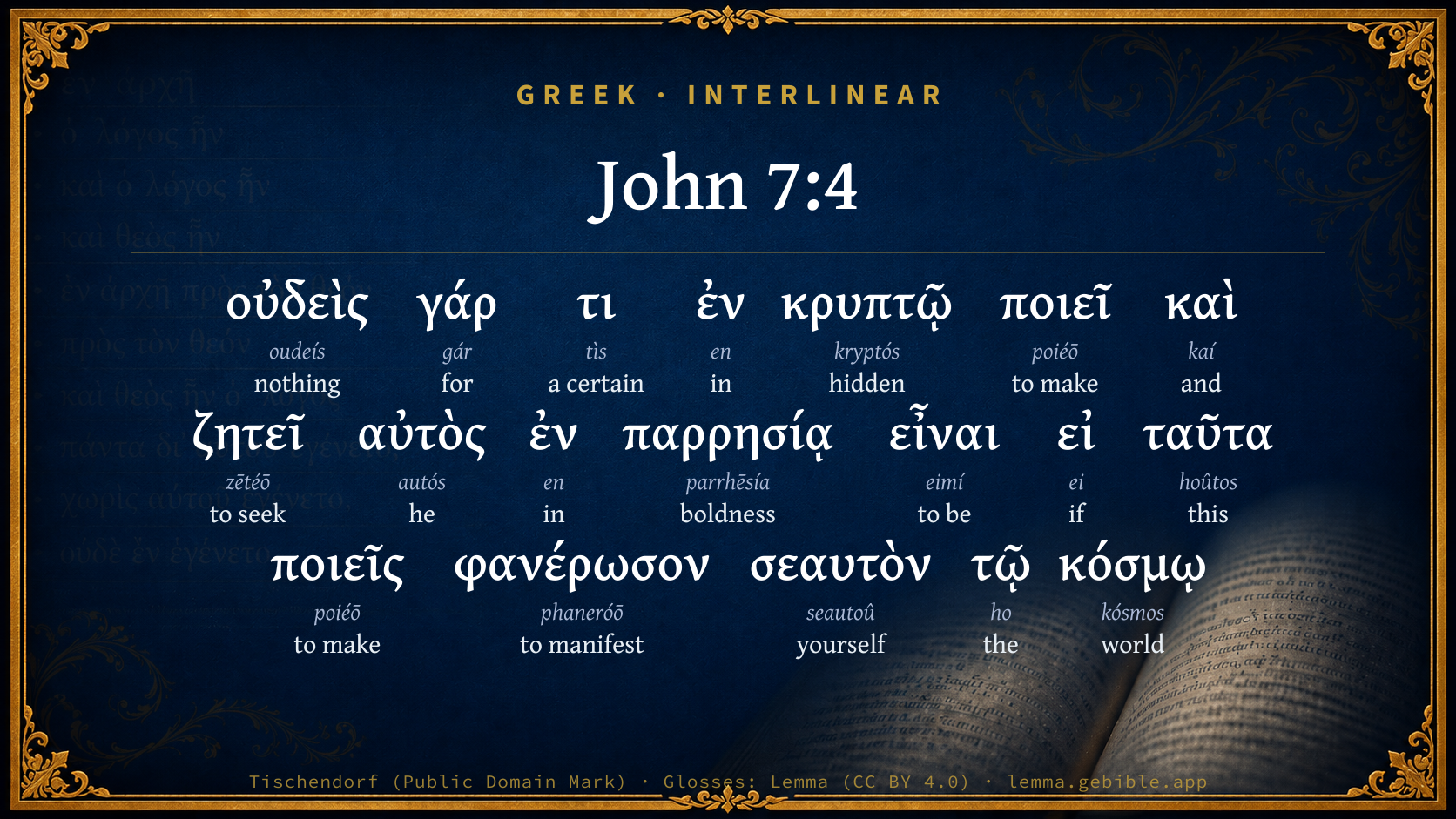
  1. οὐδεὶς oudeís G3762 “nothing” Adjective, Nominative, Singular, Masculine, Negative
  2. γάρ gár G1063 “for” Conjunction
  3. τι tìs G5100 “a certain” Indefinite pronoun, Accusative, Singular, Neuter
  4. ἐν en G1722 “in” Preposition
  5. ποιεῖ poiéō G4160 “to make” Verb, Present, Active, Indicative, 3rd person, Singular
  6. καὶ kaí G2532 “and” Conjunction
  7. ζητεῖ zētéō G2212 “to seek” Verb, Present, Active, Indicative, 3rd person, Singular
  8. αὐτὸς autós G846 “he” Personal pronoun, Nominative, Singular, Masculine
  9. ἐν en G1722 “in” Preposition
  10. παρρησίᾳ parrhēsía G3954 “boldness” Noun, Dative, Singular, Feminine
  11. εἶναι eimí G1510 “to be” Verb, Present, Active, Infinitive
  12. εἰ ei G1487 “if” Conditional
  13. ταῦτα hoûtos G3778 “this” Demonstrative pronoun, Accusative, Plural, Neuter
  14. ποιεῖς poiéō G4160 “to make” Verb, Present, Active, Indicative, 2nd person, Singular
  15. φανέρωσον phaneróō G5319 “to manifest” Verb, Aorist, Active, Imperative, 2nd person, Singular
  16. σεαυτὸν seautoû G4572 “yourself” Reflexive pronoun, 2nd person, Accusative, Singular, Masculine
  17. τῷ ho G3588 “the” Article, Dative, Singular, Masculine
  18. κόσμῳ kósmos G2889 “world” Noun, Dative, Singular, Masculine

About this verse

These counts appear in no published source. They are computed here, from the morphology-tagged text and Lemma’s own curated glosses. What Lemma adds →

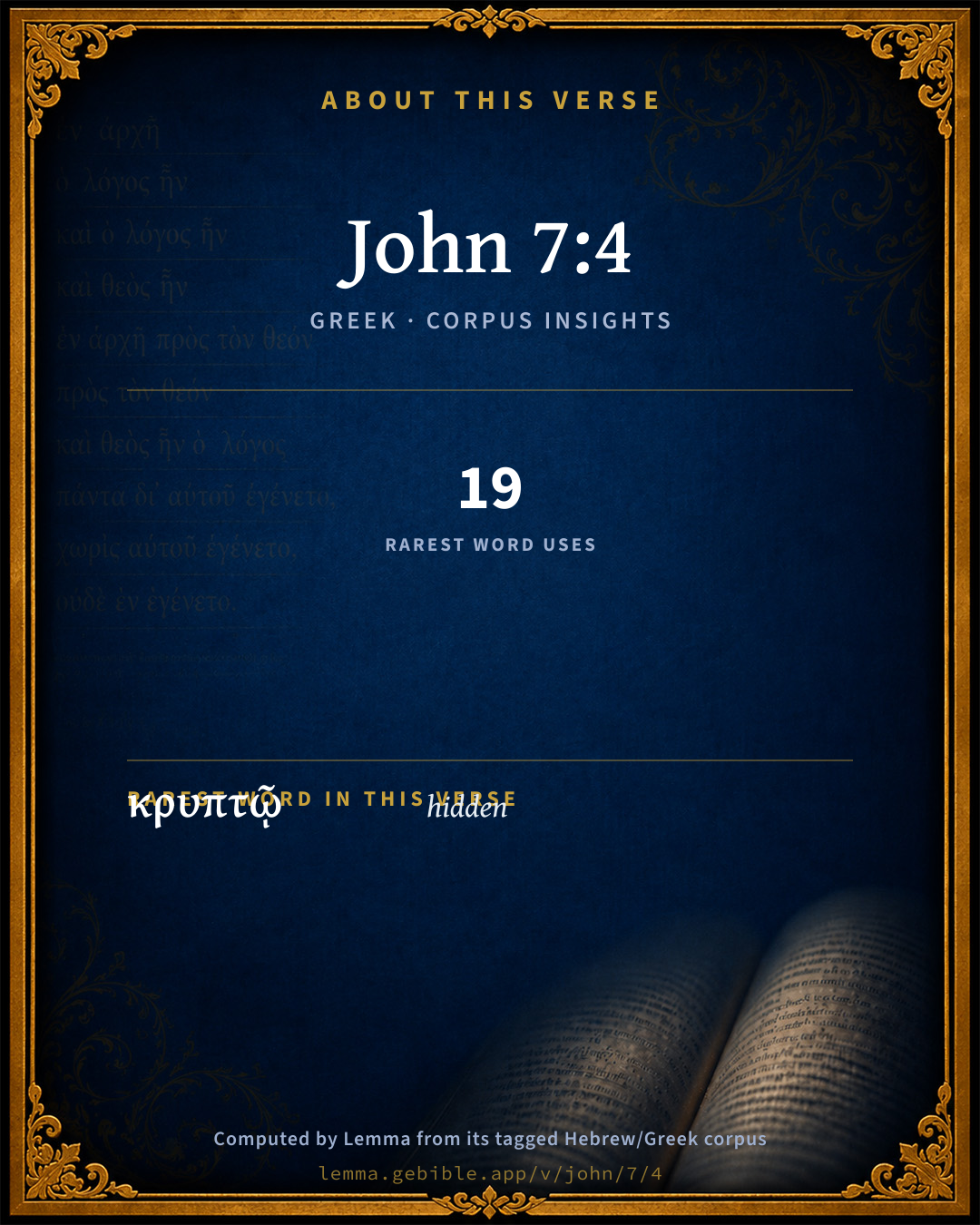
19
words
17
distinct lemmas
Gospels
section

Notable vocabulary

The rarest word here is κρυπτῷ hidden G2927 — appearing just 19 times in the whole Greek New Testament.

Shared distinctive vocabulary

κρυπτῷ hidden G2927 occurs in 16 verses of the Greek New Testament. Also found in:

Repetition

Words recur within this verse:

  • ποιεῖ to make G4160 ×2
  • ἐν in G1722 ×2

Cross-references

10

Topical passages linked to John 7:4 in the Treasury of Scripture Knowledge — connected by theme and wording, ordered by reader-vote popularity; previews shown in the World English Bible.

  • John 18:20 Jesus answered him, "I spoke openly to the world. I always taught in synagogues, and in the temple, where the Jews always meet. I said nothing in secret.
  • Proverbs 18:1–2 An unfriendly man pursues selfishness, And defies all sound judgment.
  • Matthew 6:5 "When you pray, you shall not be as the hypocrites, for they love to stand and pray in the synagogues and in the corners of the streets, that they may be seen by men. Most assuredly, I tell you, they have received their reward.
  • Matthew 23:5 But all their works they do to be seen by men. They make their phylacteries broad, enlarge the fringes of their garments,
  • Luke 6:45 The good man out of the good treasure of his heart brings out that which is good, and the evil man out of the evil treasure of his heart brings out that which is evil, for out of the abundance of the heart, his mouth speaks.
  • Matthew 6:1–2 "Be careful that you don't do your charitable giving before men, to be seen by them, or else you have no reward from your Father who is in heaven.
  • 1 Kings 22:13 The messenger who went to call Micaiah spoke to him, saying, See now, the words of the prophets [declare] good to the king with one mouth: please let your word be like the word of one of them, and speak you good.
  • Matthew 4:6 and said to him, "If you are the Son of God, throw yourself down, for it is written, 'He will give his angels charge concerning you.' and, 'On their hands they will bear you up, So that you don't dash your foot against a stone.'"
  • Matthew 6:16 "Moreover when you fast, don't be like the hypocrites, with sad faces. For they disfigure their faces, that they may be seen by men to be fasting. Most assuredly I tell you, they have received their reward.
  • Acts 2:4–12 They were all filled with the Holy Spirit, and began to speak with other languages, as the Spirit gave them the ability to speak.

Cross-references courtesy of OpenBible.info (CC BY 4.0).

Commentary

Notes on John 7:4 from classic Christian and Jewish commentators (each source and its license shown beneath its notes). The classic Christian expositions comment on the surrounding passage and are grouped to its opening verse, so a note may address several verses; the Jewish commentaries on the Tanakh (Rashi and others) are per-verse, so they appear only where the commentator wrote on this verse.

Lemma curates 59 commentaries, every one of them public domain or Creative Commons licensed, each selected and text-cleaned for this edition rather than reprinted as found. About our sources →

Matthew Poole's English Annotations

The things which thou doest, thou doest out of a desire by them to be made known, and to spread thy own fame and glory: for this, Galilee is not a proper place, because it is an obscure part in the country. The phrase which we translate

to be known, is in the Greek εν παρρησια ειναι. The usage of it here seemeth to be something different from the use of it in other places of holy writ. It sometimes signifies confidence and security; and we translate it boldness, Act 13:46; 26:26; 28:31; Phi 1:20; Heb 3:6; 10:19. But this cannot be the sense of this text; for it were no sense to read it, seeketh to be known boldly, confidently, or securely. Sometimes we translate it openly, as in this text, and Joh 11:54; Col 2:15. It sometimes signifieth a freedom of speech, Act 2:29; 4:13; 2Co 7:4. Sometimes it signifieth clearness and plainness of speech, Joh 10:24; Joh 11:14. Sometimes it signifieth a speaking in public meetings, as in Mar 8:32; Joh 18:20. Dr. Hammond notes, that it also sometimes signifies to speak with authority, Act 4:29,31; Eph 6:19. Certainly the word in its primary signification signifieth a freedom and boldness of speech; which freedom and boldness is necessary to him that speaketh openly, and in public meetings; and is advantaged by the authority which any man hath to speak: hence in a secondary sense it may signify both to speak with authority, and also to speak in public assemblies; and this last I take to be here signified. It is (as our Saviour’s friends tell him) both against reason, and the ordinary course of the world, for men desirous of opportunities to speak boldly and freely in public assemblies, to keep themselves in obscure places, where are no such public assemblies. They therefore advise him, that if indeed he wrought these miraculous operations, and were able to produce such effects, he would not bury up himself and his reputation in such a hole as Galilee, but show himself to the more noted and famous part of the world, which was, as to that part of the world, Jerusalem, and at the feast now, where multitudes of the people would be to celebrate the feast of tabernacles.

Matthew Poole's English Annotations on the Holy Bible (1683–1685) — public domain. Text from a community e-Sword/MySword module.

Bengel's Gnomon

Johann Albrecht Bengel

Joh 7:4. Καὶ ζητεῖ, and seeketh) An affirmative assertion, as is clear from the verb manifest [Thyself], which is inferred from this clause. No man includes in it every man and not: every man belongs to both parts of the sentence: not to the former part; in this sense, Every man, who doeth anything, doeth it not in secret, but so as that he seeks himself to be known openly. Καί, and, for but [and yet], as frequently. The figure Diasyrmus [teasing, as if He managed His affairs carelessly].—αὐτός,) himself; in antithesis to that, which he himself doeth: so, corresponding to this, σεαυτόν, Thyself, follows in the next clause.—εἰ, if) This particle often has more, not less weight, than when.[163]—ταῦτα) these miracles, which Thou doest.—τῷ κόσμῳ, to the world) to all. Seek a larger theatre of action, say they, especially at the feast time.

[163] Since, εἰ, joined to the Indicative—E. and T.

Bengel's Gnomon of the New Testament — English translation (T&T Clark, Edinburgh, 1860) — public domain. Text from a community e-Sword module.

Meyer's Critical & Exegetical Commentary

Heinrich August Wilhelm Meyer

Joh_7:4. For no one does anything in secret, and is thereby personally striving to he of a frank, open-hearted nature; i.e. no one withdraws himself and his works also into quiet secrecy, and yet strives frankly to assert his personal position (as you must do if you are the Messiah). The two things are, indeed, contradictory! On ἐν παῤῥησ. comp. Joh_11:54; Wis_5:1; and Grimm, Exeg. Handb. p. 110 f.; Eph_6:19; Php_1:20; Col_2:15. The word does not signify manifest or known (De Wette, Godet, and most others), but it means the opposite of a shy and timid nature, which shrinks from playing the part of a fearless and frank character.

τὶ] is the simple aliquid, not magnum quid (Kuinoel and others); and καί does not stand for ὅς, so that αὐτός would be superfluous (Grotius, Kuinoel), but is the simple and, while air αὐτός[258] is ipse, thus putting the person attributively over-against the work (Herm. ad Vig. p. 735; Fritzsche ad Rom. II. p. 75), and not merely resuming the subject (Lücke, Tholuck), as also it must not be taken in Mat_12:50.

As to εἶναι ἐν, versari in (Bernhardy, p. 210), thus designating the adverbial predicate as permanent, see Buttmann, N. T. Gr. p. 284 [E. T. p. 330].

εἰ ταῦτα ποιεῖς] answers to the τὰ ἔργα σου ἃ ποιεῖς, Joh_7:3, and to οὐδεὶς … ποιεῖ, Joh_7:4, and therefore, according to the context (comp. also the consequent clause, which corresponds with καὶ ζητεῖ αὐτὸς, κ.τ.λ.), refers to the miracles which Jesus did in Galilee. Ταὐτα has the emphasis: If thou doest these things, i.e. if thy work consists in such wonderful deeds as thou art performing here in Galilee, do not act so foolishly as to confine thyself with such works within so narrow and obscure a range, but present thyself openly before the world, as thou must do in Judaea, which during the feast is the theatrum mundi. Σεαυτόν, like the preceding αὐτός, gives prominence to His person, as opposed to His work. But the εἰ is not expressive of doubt (Euthymius Zigabenus: εἰ ταῦτα σημεῖα ποιεῖς καὶ οὐ φαντάζεις; Lücke, De Wette, and most: as if we were to supply, if it be really as we hear; comp. also Brückner, who considers that it is intended to intimate in a disagreeable manner that the fact was doubtful), it is argumentative; the brothers know that His works are of an extraordinary kind, as was evident to them in Galilee (ποιεῖς denotes a permanent course of action; Bernhardy, p. 370); and they consider it absurd that He should withdraw Himself personally from the place whither all the world was flocking.

[258] The reading αὐτό (Lachm. following B. D.*) is only an error in transcription. Ebrard, who maintains its genuineness, yet marvellously renders: but he strives, that it may take place openly. καί, meaning but, is said to be Johannean; it is really neither Johannean nor Greek at all, but simply wrong. The frequent Greek use of it in John in the sense of and yet is something quite different; see on ver. 29.

Meyer — Critical and Exegetical Commentary on the New Testament — English translation by Peter Christie, edited by Frederick Crombie (T&T Clark, 1880) — public domain. Text from a community e-Sword module.

Adam Clarke's Commentary

Verse 4. No man that doeth any thing in secret, c.] They took it for granted that Christ was influenced by the same spirit which themselves felt and that therefore he should use every opportunity of exhibiting himself to the public, that he might get into repute; and they hoped that a part of his honour would be reflected back upon themselves, as being his near relations. They seem to have said: "It is too little to employ thyself in working miracles in Galilee, in the country, and in small villages, among an ignorant and credulous people, from whom thou canst not get much credit: go to Jerusalem, the capital, and among the learned doctors, in the presence of the whole nation assembled at this feast, work thy miracles, and get thyself a name."

Adam Clarke's Commentary on the Bible (1810–1826) — public domain. Text from a community e-Sword/MySword module.

John Calvin's Commentaries

4. If thou dost these things; that is, if thou aspirest to such greatness that all may applaud thee, direct towards thee the eyes of all. And they add, show thyself to the world, using the word world, as contrasted with the small number of persons among whom he was spending his time without honor. We might also draw from it another meaning. “If thou dost these things, that is, since thou art endued with so great power as to procure reputation for thyself by miracles, do not throw them away; for all that has been given to thee by God thou spendest here to no purpose, because there are none to bear thee testimony, or to hold thee in just estimation.” Hence we perceive how great is the indolence of men in considering the works of God; for the relations of Christ would never have spoken in this manner, if they had not — as it were — trampled under foot the manifest proofs of his Divine power, which they ought to have beheld with the greatest admiration and reverence. What is here told us concerning Christ happens in daily experience, that the children of God suffer greater annoyance from their near relations than from strangers; for they are instruments of Satan which tempt, sometimes to ambition, and sometimes to avarice, those who desire to serve God purely and faithfully. But such Satans receive a vigorous repulse from Christ, who thus instructs us by his example, that we ought not to yield to the foolish wishes of brethren or relations.

John Calvin's Commentaries (1540-1563) — public domain. Text from the Calvin Translation Society English edition (1840s-50s) via the Christian Classics Ethereal Library (ccel.org). Calvin's coverage is partial (roughly two-thirds of the Bible); uncommented books and verses are honest gaps, never fabricated. The 19th-century editor's footnotes and remarks are omitted so the notes are faithfully Calvin's own voice.

Ellicott's Commentary for English Readers

(4) For there is no man.—His course of action seems to them to contradict His personal claim. It is opposed, they think, to the common-sense conduct of mankind.

If thou do these things.—The emphasis is on these things. There is no doubt that He does them; but if the acts themselves are such as they seem to be, and establish the claim which He bases on them, they should be done in Jerusalem, not in the villages of Galilee. They are for the world, and not for the retirement of home.

A Bible Commentary for English Readers, edited by Charles John Ellicott (1878–1897) — public domain. Text from a community e-Sword module.

The Cambridge Bible for Schools and Colleges

gen. ed. J. J. S. Perowne

4. there is no man that doeth] More simply, no man doeth.

and he himself seeketh] i.e. no one does anything in secret and is thereby personally seeking to act with openness. To conceal His miracles is to deny His Messiahship; the Messiah must accept His position.

to be known openly] Literally, to be in openness or frankness. The word for ‘frankness’ occurs nine times in this Gospel and four times in the First Epistle; not in Matt. or Luke; only once in Mark.

If thou do these things] Feeding the 5000, and other miracles. If Thou doest such miracles at all, do them at Jerusalem at the Feast and convince the whole nation. It is assuming a false position to do such things and hide them in obscure parts of Galilee: it is claiming to be the Messiah and being afraid to shew one’s credentials. They knew probably that He had not gone up to Jerusalem for the Passover.

shew thyself] Better, manifest Thyself. See on Joh_1:31, Joh_21:1, and comp. Joh_9:3, Joh_17:6.

The Cambridge Bible for Schools and Colleges (gen. ed. J. J. S. Perowne; Cambridge University Press, 1878–1918) — public domain. Text from a community e-Sword module.

John Gill's Exposition

For there is no man that doeth anything in secret,.... For so they reckoned his doing miracles in such a corner of the land, and in so obscure a place as Galilee:

and he himself seeketh to be known openly; suggesting hereby, that Christ was an ambitious person, and sought popular applause, and honour and glory from men, when nothing was more foreign from him; see Joh 5:41.

If thou do these things; for they question whether the miracles he wrought were real; and suspected that they were deceptions of the sight, and delusions; or at least they questioned their being done by him; and rather thought that they were done by diabolical influence, by Beelzebub the prince of devils: but if they were real ones, they advise him, saying,

shew thyself to the world; or do these openly, and in the presence of the great men of the world; the princes of it, the rulers of the people, the chief priests and sanhedrim; and before all the males of Israel; who at this feast would come up from all parts of the land, and are for their multitude called the world: the reason of this their advice was, that if his miracles were real, and he was the person he would be thought to be, the doing of them before such, would gain him great credit and esteem; and if not, he might be detected by such numbers, and by men of such penetration as were among them.

John Gill's Exposition of the Whole Bible (1746–1763) — public domain (CC PDM 1.0). Text via the HelloAO Bible API.

Trapp's Complete Commentary

John Trapp

4 For there is no man that doeth any thing in secret, and he himself seeketh to be known openly. If thou do these things, shew thyself to the world.

Ver. 4. For there is no man, &c.] Here they proceed to charge Christ with folly; and presume to lesson him with their

" Vile latens vlrtus: quid enim submersa latebris

Proderit? Obscuro veluti sine remige puppis:

Vel lyra quae reticet, vel qui non tenditur arcus."

Claudian.

John Trapp, A Commentary or Exposition upon All the Books of the Old and New Testament (1647–1656) — public domain. Text from a community e-Sword module.

Albert Barnes' Notes on the Bible

For there is no man ... - The brethren of Jesus supposed that he was influenced as others are. As it is a common thing among men to seek popularity, so they supposed that he would also seek it; and as a great multitude would be assembled at Jerusalem at this feast, they supposed it would be a favorable time to make himself known. What follows shows that this was said, probably, not in sincerity, but in derision; and to the other sufferings of our Lord was to be added, what is so common to Christians, derision from his relatives and friends on account of his pretensions. If our Saviour was derided, we also may expect to be by our relatives; and, having his example, we should be content to bear it.

If thou do ... - It appears from this that they did not really believe that he performed miracles; or, if they did believe it, they did not suppose that he was the Christ. Yet it seems hardly credible that they could suppose that his miracles were real, and yet not admit that he was the Messiah. Besides, there is no evidence that these relatives had been present at any of his miracles, and all that they knew of them might have been from report. See the notes at Mar 3:21. On the word brethren in Joh 7:5, see the Mat 13:55 note, and Gal 1:19 note.

Albert Barnes' Notes on the Bible (1834–1885) — public domain. Text from a community e-Sword/MySword module.

Whedon's Commentary on the Bible

Daniel D. Whedon

4. No man—Omitting the italics, (injudiciously inserted by the translators,) the verse may read, No man doeth anything in secret yet seeketh to be himself known openly. That is, no man does both stay in secret and desire to be public. It is inconsistent, and contrary to common sense or ordinary human conduct.

If thou do these things—If thou proposest thyself to be a miraculous founder. There is a non-committalism in this if that leads the Evangelist to the explanation in the following verse.

Daniel D. Whedon (gen. ed.), Commentary on the Old and New Testaments (1874–1909) — public domain. Text from a community e-Sword module.

The Pulpit Commentary

For no man doeth anything in secret, and himself seeketh to be known openly. Vulgate, in palam esse. Lucke translates in Latin, "idemque cupit celeber ease." The autov answers to the subject of the verb "doeth," who yet is denied to exist by the oudeiv . The en parrhsia einai says Meyer, is "to be the opposite of a shy and timid nature," which is very unmeaning. Grimm says of the phrase en parrhsia , "Is se gerendi modus quo aliquis omnibus conspicuus est," and justifies it by this passage Joh_11:54; Coss. 2:15. (cf. RAPC Wis 5:1, Tote sthsetai en parrhsia pollh o dikaiov) So Luthardt: "It denotes that which is open, in contrast to that which is concealed. Westcott settles the meaning of the word by the remark that "the phrase (ayshrpb) is commonly used by the rabbinical writers for "in public," as opposed to "in secret. The man who persists in quiet, secret ways of acting, and strenuously avoids publicity, is not the man who seeketh to be illustrious and conspicuous. The brethren see a palpable contradiction between the claims which Jesus is making and the comparative retirement to which he is confining himself. The crowds of the Galilaean lake are blank retirement when compared with the metropolis in the great climacteric festival of the year. The brethren call on Christ to solve the contradiction. It cannot be concealed that Jesus had (Luk_8:16 Luk_11:33 Luk_12:2) repeatedly said, "No man lighteth a lamp and putteth it under a bushel, but on a candlestick," etc.; and so the brothers use Christ"s words against himself. But the Lord"s idea of needful manifestation, both as to degree, time, and place, was accurately realized and represented in both narratives. If thou doest these things. The ai is simply the logical premise, without necessarily throwing doubt on the facts. It is not equal, however, to the particle epei , "since." Admitting these works to be real, and these mighty deeds to be correctly reported, there, is from the standpoint of the brethren no other course than that which they suggest: Manifest thyself to the world; i.e. "proceed to the widest arena at once;" "thou art compromising thyself by thy retirement;" "what thou art doing with one hand thou art undoing with the other." "All the Israel world from all lands is crowding to the great feast, thy disciples amongst them; make thyself known; claim the place that belongs to thee." It must be remembered that the disciples (Judas, not Iscariot, especially) said on the very night of the Passion, "How is it that thou wilt manifest thyself to us, and not unto the world?" This slight note of resemblance with the form of the present admonition of the brothers, is more coincident in the letter than the spirit, and received from the Lord a profoundly different reply. (see Joh_14:22, Joh_14:23, notes)

The Pulpit Commentary (1880–1919), ed. H.D.M. Spence-Jones & Joseph S. Exell — public domain. Text from a community e-Sword module.

John Wesley's Explanatory Notes

For no man doth any thing - Of this kind, in secret; but rather desireth to be of public use. If thou really dost these things -These miracles which are reported; show thyself to the world - To all men.

John Wesley, Explanatory Notes Upon the Whole Bible (1754–1765) — public domain. Text via the GEBible commentary corpus.

Scofield Reference Notes

C. I. Scofield

world

kosmos = mankind. (See Scofield "Mat 4:8").

The Scofield Reference Bible (1917 edition), notes by C. I. Scofield — public domain. Text from a community e-Sword module.

The People's New Testament

B. W. Johnson

4. If thou do these things. These brethren still were doubters. He differed so from their idea of the Christ that they could not understand him, and they hoped that at Jerusalem he would be made manifest. They afterwards became believers.

B. W. Johnson's The People's New Testament with Notes (1889–1891) — public domain. Electronic text from the Christian Classics Ethereal Library (CCEL) ThML edition.

Cambridge Greek Testament for Schools and Colleges

4. οὐδεὶς γ. For no man doeth anything in secret and himself seeketh to be in openness: or, according to BD1, and seeketh it (αὐτό) to be in openness. They imply that He works miracles to prove His Messiahship and hides them from those who would be convinced by them. To conceal His miracles is to deny His Messiahship; the Messiah must assert His position. Winer, p. 786.

ἐν παῤῥησίᾳ. Here and Joh 16:29 only with a preposition; see on Joh 7:13.

εἰ ταῦτα ποιεῖς. If Thou doest these things, not ‘If Thou do these things;’ no doubt as to the fact of His miracles is expressed. ‘If Thou doest miracles at all, do them before the whole nation, instead of in obscure parts of Galilee.’

φανέρωσον σ. Manifest Thyself; see on Joh 1:31 and Joh 21:1.

οὐδὲ γ. Evidence of the Evangelist’s candour; he admits that those who were thus closely connected with Jesus did not put their trust in Him: For not even did His brethren (as one would certainly expect) believe on Him. It is marvellous that in the face of this verse any one should have maintained that three of His brethren (James, Simon, and Judas) were Apostles. This verse is also fatal to the common theory, that these ‘brethren’ are really our Lord’s cousins, the sons of Alphæus. Certainly one of the sons of Alphæus (James) was an Apostle; probably a second was (Matthew, if Levi and Matthew are the same person, as is almost universally admitted); possibly a third was (Judas, if ‘Judas of James’ means ‘Judas, brother of James,’ as is commonly supposed). By this time the company of the Twelve was complete (Joh 6:67; Joh 6:70-71); so that we cannot suppose that some of the Twelve have still to be converted. If then one, two, or three sons of Alphæus were Apostles, how could it be true that the sons of Alphæus ‘did not believe on Him?’ ‘His brethren’ cannot be the sons of Alphæus. They seem to have been converted by the Resurrection. Immediately after the Ascension we find them with the Apostles and the holy women (Act 1:14; comp. 1Co 9:5; Gal 1:19).

Cambridge Greek Testament for Schools and Colleges (Cambridge University Press, 1896; 21 vols, various authors incl. Carr, Maclear, Plummer, Farrar, Lumby, Moule, M. R. James, Simcox) — public domain. Text from a community e-Sword module.

International Critical Commentary

4. The principle laid down by the brethren of Jesus is sound, sc. that no one who seeks public recognition can afford to keep his deeds a secret. οὐδεὶς γάρ τι ἐν κρυπτῷ ποιεῖ καὶ ζητεῖ αὐτὸς ἐν παρρησίᾳ εἶναι, “No one does anything in secret, and (at the same time) himself seeks to be in the public eye.”

καί is used like καίτοι (see on 1:10).

For αὐτός BD*W have αὐτό, through misunderstanding. παρρησία (from πᾶν ῥῆμα) expresses primarily a complete openness and freedom of speech (cf. Mar 8:32, the only place where the word occurs in the Synoptics), and in this sense it is a favourite word with Joh 7:13; Joh 7:26; Joh 10:24; Joh 16:25; Joh 16:29; Joh 18:20 (where ἐν κρυπτῷ and ἐν παρρησίᾳ are again contrasted). It is thus, according to Pro 1:20, that Wisdom speaks: ἐν πλατείαις παρρησίαν ἄγει. The word then comes to connote intrepidity or courage; and it is used in 1Jn 2:28, 1Jn 3:21, 1Jn 4:17, 1Jn 5:14 of boldness in man’s attitude to God (cf. Job 27:10).

In this passage ἐν παρρησίᾳ εἶναι signifies “to be boldly in public view,” as in 11:54, where we have οὐκέτι παρρησίᾳ περιεπάτει ἐν τοῖς Ἰουδαίοις; cf. Wisd. 5:1, Col 2:15. What the brethren of Jesus suggest is that to hide Himself in Galilee is incompatible with the claim for public recognition, as One sent by God, which He makes for Himself.

εἰ ταῦτα ποιεῖς, “if you do these things,” sc. the wonderful works with which rumour associated His name. The brethren do not express definite unbelief, but they are sceptical.

φανέρωσου σεαυτὸν τῷ κόσμῳ, “show thyself to the world,” i.e. to the great public at Jerusalem (cf. v. 7), where multitudes would be gathered at the Feast of Tabernacles. The wider meaning of κόσμας (see on 1:9) cannot be intended, as present to the minds of the brethren of Jesus. For φανερόω, see on 1:31; and cf. 14:22.

International Critical Commentary — older volumes (1896–1929), various authors — public domain. Text from a community e-Sword module.

Vincent's Word Studies in the New Testament

Marvin R. Vincent

Openly [εν παρρησια] . Literally, in boldness. The reasoning is : no man can assert the position which Christ claims, and at the same time keep secret the works which go to vindicate it.

Marvin R. Vincent, Word Studies in the New Testament (1887–1900) — public domain. Text from a community e-Sword/MySword module.

Lesson kit

Teaching starters — assembled from the data on this page, not authored interpretation. Every prompt links to the verse data it draws on. Edit before teaching.

John, in the Gospels, opens this verse with 19 words (17 distinct Greek lemmas). Its most distinctive word is kryptós (“hidden”). A historical commentator’s framing appears above. Read the whole chapter for the surrounding context.

Discussion questions

  1. How does “hidden” (kryptós) shape what this verse is saying?
  2. Matthew 6:4 shares the word «hidden» with this verse. How do the two illuminate each other?
  3. “to make” occurs 2× in this one verse. What is the effect of the repetition?
  4. The translations on this page render this verse differently — a whole-verse word diff, not a word-by-word alignment. What might account for the different wordings?
  5. Reading how Matthew Poole's English Annotations and Bengel's Gnomon read this verse, where do the two commentators agree and where do they part?

Things to notice

Reading settings

Reading text

Shown beneath each verse's original-language words.

Old Testament
Old Testament edition

Read the OT as the Masoretic Hebrew (MT) or the Greek Septuagint (LXX).

English shown for the Greek Septuagint (in the Hebrew ↔ Greek comparison).

Comparing translations? Open the Compare panel on any verse page to stack up to four side by side.