
John 7:18

Greek (Tischendorf 8th ed.) John 7:18 appears in the Greek New Testament. The text above is from the Tischendorf 8th edition. Each word links to its Strong’s number and a concise gloss. Click any word for its full Thayer’s Greek Lexicon entry.
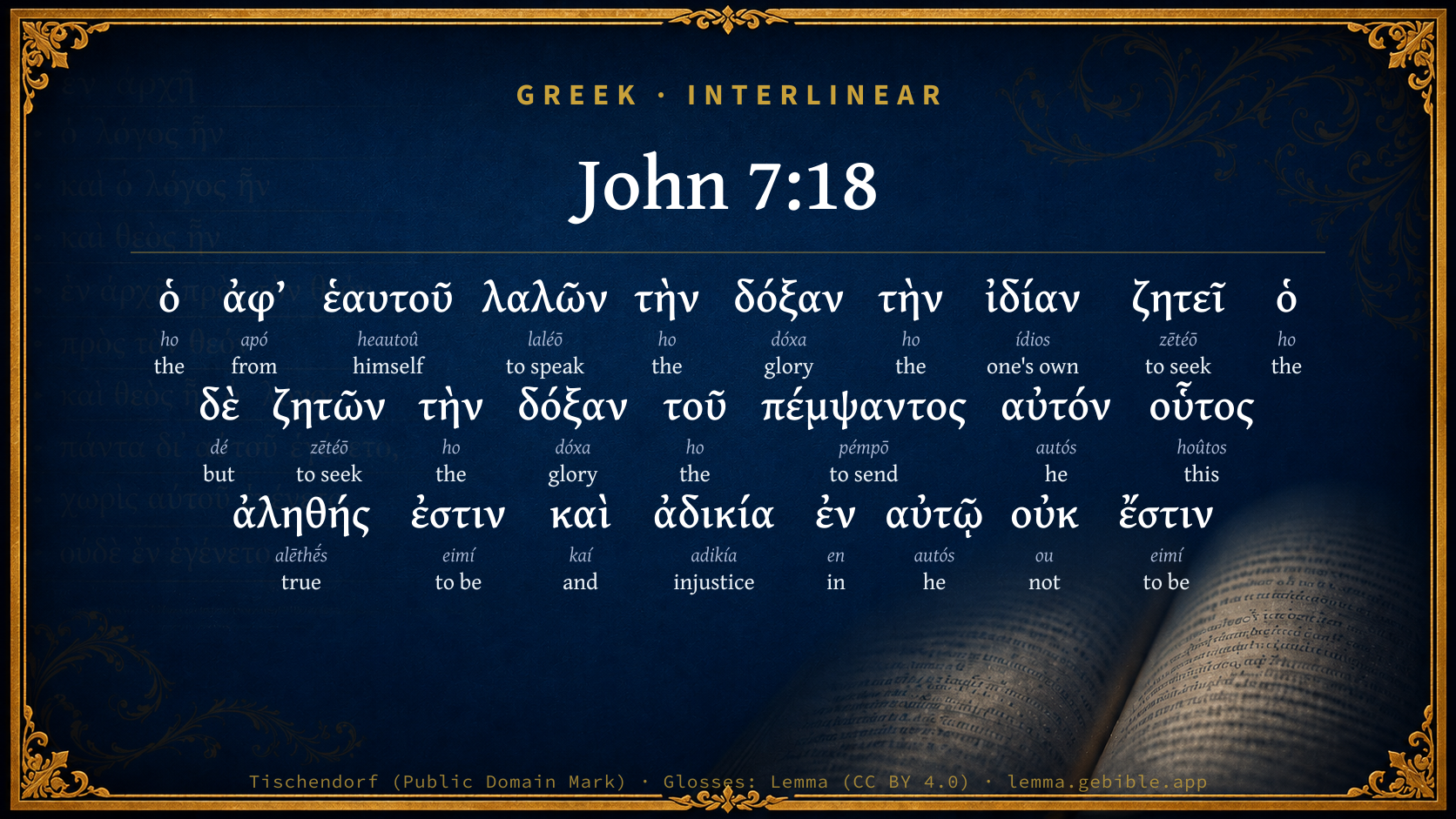
Download image
Cite this verse

John 7:18 (World English Bible). Public Domain. Lemma interlinear Bible study tool, https://lemma.gebible.app/v/john/7/18.

Show BibTeX & RIS
BibTeX
RIS
English Translation
He who speaks from himself seeks his own glory, but he who seeks the glory of him who sent him, the same is true, and no unrighteousness is in him.
World English Bible · Public Domain
Download a study sheet

One document with this verse’s original text, its word-by-word gloss line, the meaning frame, cross-references with their text, attributed commentary, and full source and license credits — printable, and it pastes into notes with its structure intact.

This verse Autodidact and up

Study sheet (.html) Plain text (.txt)

A passage Seminary Student

Up to 50 verses in one chapter. A passage sheet keeps up to 6 commentary sources and 12 cross-references per verse, in the order this page ranks them, and says so on the sheet whenever that leaves anything out. Ask for a single verse and you get the Autodidact verse sheet above.

Everything on this page stays free to read, with no account — the sheet is a download of what is already on screen, not access to it.

Want to remove ads? Support Godless Engineer
Compare translations 3

The same verse in 3 English versions, stacked beneath the original-language interlinear above. Click any original word for its lexicon entry.

Each is an independent rendering of the whole verse — the interlinear is not word-aligned to these translations.

Highlighted words mark where these versions differ — a whole-verse word diff, not a word-by-word alignment.

  • World English Bible Public Domain
    He who speaks from himself seeks his own glory, but he who seeks the glory of him who sent him, the same is true, and no unrighteousness is in him.
  • King James Version Public Domain
    He that speaketh of himself seeketh his own glory: but he that seeketh his glory that sent him, the same is true, and no unrighteousness is in him.
  • unfoldingWord Literal Text CC BY-SA 4.0
    The one speaking from himself seeks his own glory, but the one seeking the glory of the one having sent him, this one is true, and there is no unrighteousness in him.

unfoldingWord Literal Text — © unfoldingWord, licensed CC BY-SA 4.0. Word-aligned USFM3 via Door43 (git.door43.org/unfoldingWord/en_ult).

Versions to compare (up to 4)

3 of 4 selected

Show all 19 translations

Every available English version of this verse, each an independent rendering of the whole verse.

  • World English Bible Public Domain
    He who speaks from himself seeks his own glory, but he who seeks the glory of him who sent him, the same is true, and no unrighteousness is in him.
  • Berean Standard Bible Public Domain
    He who speaks on his own authority seeks his own glory, but He who seeks the glory of the One who sent Him is a man of truth; in Him there is no falsehood.
  • Majority Standard Bible Public Domain
    He who speaks on his own authority seeks his own glory, but He who seeks the glory of the One who sent Him is a man of truth; in Him there is no falsehood.
  • King James Version Public Domain
    He that speaketh of himself seeketh his own glory: but he that seeketh his glory that sent him, the same is true, and no unrighteousness is in him.
  • American Standard Version (1901) Public Domain
    He that speaketh from himself seeketh his own glory: but he that seeketh the glory of him that sent him, the same is true, and no unrighteousness is in him.
  • Revised Version (1885) Public Domain
    He that speaketh from himself seeketh his own glory: but he that seeketh the glory of him that sent him, the same is true, and no unrighteousness is in him.
  • Geneva Bible (1599) Public Domain
    Hee that speaketh of himselfe, seeketh his owne glorie: but hee that seeketh his glory that sent him, the same is true, and no vnrighteousnes is in him.
  • Douay-Rheims (1899) Public Domain
    He that speaketh of himself, seeketh his own glory: but he that seeketh the glory of him that sent him, he is true, and there is no injustice in him.
  • Young's Literal Translation Public Domain
    `He who is speaking from himself his own glory doth seek, but he who is seeking the glory of him who sent him, this one is true, and unrighteousness is not in him;
  • Literal Standard Version CC BY-SA 4.0
    He who is speaking from himself seeks his own glory, but he who is seeking the glory of him who sent him, this one is true, and unrighteousness is not in him;
  • Unlocked Literal Bible CC BY-SA 4.0
    Whoever speaks from himself seeks his own glory, but whoever seeks the glory of him who sent him, that person is true, and there is no unrighteousness in him.
  • unfoldingWord Literal Text CC BY-SA 4.0
    The one speaking from himself seeks his own glory, but the one seeking the glory of the one having sent him, this one is true, and there is no unrighteousness in him.
  • Darby Bible Public Domain
    He that speaks from himself seeks his own glory; but he that seeks the glory of him that has sent him, he is true, and unrighteousness is not in him.
  • World Messianic Bible Public Domain
    He who speaks from himself seeks his own glory, but he who seeks the glory of him who sent him is true, and no unrighteousness is in him.
  • Webster's Bible Public Domain
    He that speaketh from himself, seeketh his own glory: but he that seeketh his glory that sent him, the same is true, and no unrighteousness is in him.
  • Free Bible Version CC BY-SA 4.0
    Those who speak for themselves want to glorify themselves, but someone who glorifies the one who sent him is truthful and not deceitful.
  • Bible in Basic English Public Domain
    The man whose words come from himself is looking for glory for himself, but he who is looking for the glory of him who sent him--that man is true and there is no evil in him.
  • Text-Critical English NT CC BY 4.0
    He who speaks on his own authority seeks his own glory, but he who seeks the glory of the one who sent him is true, and there is no unrighteousness in him.
  • Tyndale New Testament (1534) Public Domain
    He that speaketh of him selfe seketh his awne prayse. But he that seketh his prayse that sent him the same is true and no vnrightewesnes is in him.

Literal Standard Version (2020), Covenant Press — licensed CC BY-SA 4.0. Text via the HelloAO Bible API (eBible.org). Unlocked Literal Bible (unfoldingWord) — licensed CC BY-SA 4.0. Text via the HelloAO Bible API (eBible.org). unfoldingWord Literal Text — © unfoldingWord, licensed CC BY-SA 4.0. Word-aligned USFM3 via Door43 (git.door43.org/unfoldingWord/en_ult). Free Bible Version, Dr. Jonathan Gallagher — licensed CC BY-SA 4.0. Text via the HelloAO Bible API (eBible.org).

Word by word

More ways to search: Search by grammar → Find every occurrence → Compare this word →

Practice this passage: Drill this verse → Learn its vocabulary →

ἀληθής
alēthḗs
G227
“true”
Adjective, Nominative, Singular, Masculine
Part of Speech
Adjective
Case
Nominative
Number
Singular
Gender
Masculine
Full Thayer's Definition

Origin: from G1 (as a negative particle) and G2990

TDNT: 05:07,4

1. true 2. loving the truth, speaking the truth, truthful
  1. ὁ ho G3588 “the” Article, Nominative, Singular, Masculine
  2. ἀφ’ apó G575 “from” Preposition
  3. ἑαυτοῦ heautoû G1438 “himself” Reflexive pronoun, 3rd person, Genitive, Singular, Masculine
  4. λαλῶν laléō G2980 “to speak” Verb, Present, Active, Participle, Nominative, Singular, Masculine
  5. τὴν ho G3588 “the” Article, Accusative, Singular, Feminine
  6. δόξαν dóxa G1391 “glory” Noun, Accusative, Singular, Feminine
  7. τὴν ho G3588 “the” Article, Accusative, Singular, Feminine
  8. ἰδίαν ídios G2398 “one's own” Adjective, Accusative, Singular, Feminine
  9. ζητεῖ zētéō G2212 “to seek” Verb, Present, Active, Indicative, 3rd person, Singular
  10. ὁ ho G3588 “the” Article, Nominative, Singular, Masculine
  11. δὲ dé G1161 “but” Conjunction
  12. ζητῶν zētéō G2212 “to seek” Verb, Present, Active, Participle, Nominative, Singular, Masculine
  13. τὴν ho G3588 “the” Article, Accusative, Singular, Feminine
  14. δόξαν dóxa G1391 “glory” Noun, Accusative, Singular, Feminine
  15. τοῦ ho G3588 “the” Article, Genitive, Singular, Masculine
  16. πέμψαντος pémpō G3992 “to send” Verb, Aorist, Active, Participle, Genitive, Singular, Masculine
  17. αὐτόν autós G846 “he” Personal pronoun, Accusative, Singular, Masculine
  18. οὗτος hoûtos G3778 “this” Demonstrative pronoun, Nominative, Singular, Masculine
  19. ἐστιν eimí G1510 “to be” Verb, Present, Active, Indicative, 3rd person, Singular
  20. καὶ kaí G2532 “and” Conjunction
  21. ἀδικία adikía G93 “injustice” Noun, Nominative, Singular, Feminine
  22. ἐν en G1722 “in” Preposition
  23. αὐτῷ autós G846 “he” Personal pronoun, Dative, Singular, Masculine
  24. οὐκ ou G3756 “not” Particle, Negative
  25. ἔστιν eimí G1510 “to be” Verb, Present, Active, Indicative, 3rd person, Singular

About this verse

These counts appear in no published source. They are computed here, from the morphology-tagged text and Lemma’s own curated glosses. What Lemma adds →

26
words
17
distinct lemmas
Gospels
section

Shared distinctive vocabulary

ἀληθής true G227 occurs in 25 verses of the Greek New Testament. Also found in:
Repetition

Words recur within this verse:

  • δόξαν glory G1391 ×2
  • ζητεῖ to seek G2212 ×2
  • ἐστιν to be G1510 ×2
  • ὁ the G3588 ×6
  • αὐτόν he G846 ×2

Cross-references

17

Topical passages linked to John 7:18 in the Treasury of Scripture Knowledge — connected by theme and wording, ordered by reader-vote popularity; previews shown in the World English Bible.

  • John 5:41 I don't receive glory from men.
  • John 13:31–32 When he had gone out, Jesus said, "Now the Son of Man has been glorified, and God has been glorified in him.
  • 1 Corinthians 10:31–33 Whether therefore you eat, or drink, or whatever you do, do all to the glory of God.
  • Philippians 2:3–5 doing nothing through rivalry or through conceit, but in humility, each counting others better than himself;
  • John 8:49–50 Jesus answered, "I don't have a demon, but I honor my Father, and you dishonor me.
  • John 12:28 Father, glorify your name!" Then there came a voice out of the sky, saying, "I have both glorified it, and will glorify it again."
  • Matthew 6:9 Pray like this: 'Our Father in heaven, may your name be kept holy.
  • John 3:26–30 They came to John, and said to him, "Rabbi, he who was with you beyond the Jordan, to whom you have testified, behold, the same baptizes, and everyone is coming to him."
  • John 17:4–5 I glorified you on the earth. I have accomplished the work which you have given me to do.
  • 1 Thessalonians 2:6 nor seeking glory from men (neither from you nor from others), when we might have claimed authority as apostles of Christ.
  • Proverbs 25:27 It is not good to eat much honey; Nor is it honorable to seek one's own honor.
  • 1 Peter 4:11 If any man speaks, let it be as it were oracles of God. If any man serves, let it be as of the strength which God supplies, that in all things God may be glorified through Jesus Christ, to whom belong the glory and the dominion forever and ever. Amen.
  • Exodus 32:10–13 Now therefore leave me alone, that my wrath may burn hot against them, and that I may consume them; and I will make of you a great nation."
  • Numbers 11:29 Moses said to him, Are you jealous for my sake? would that all Yahweh's people were prophets, that Yahweh would put his Spirit on them!
  • John 8:54 Jesus answered, "If I glorify myself, my glory is nothing. It is my Father who glorifies me, of whom you say that he is our God.
  • John 11:4 But when Jesus heard it, he said, "This sickness is not to death, but for the glory of God, that God's Son may be glorified by it."
  • Galatians 6:12–14 As many as desire to look good in the flesh, they compel you to be circumcised; only that they may not be persecuted for the cross of Christ.

Cross-references courtesy of OpenBible.info (CC BY 4.0).

Commentary

Notes on John 7:18 from classic Christian and Jewish commentators (each source and its license shown beneath its notes). The classic Christian expositions comment on the surrounding passage and are grouped to its opening verse, so a note may address several verses; the Jewish commentaries on the Tanakh (Rashi and others) are per-verse, so they appear only where the commentator wrote on this verse.

Lemma curates 59 commentaries, every one of them public domain or Creative Commons licensed, each selected and text-cleaned for this edition rather than reprinted as found. About our sources →

The Biblical Illustrator

Joseph S. Exell

Joh_7:18

He that speaketh of himself seeketh his own glory.

The Jews marvelled that Christ had been educated in no school (Joh_7:15). This He contradicts (Joh_7:16), for the conclusion would have been that He was self-taught, and was therefore speaking His own theories, promulgating them on His own authority, and as a further consequence seeking His own glory--faults into which self-taught superficial men often fall, whereas the profoundly learned, recognizing their indebtedness to others, are usually humble and self-abnegating. Whether this doctrine was His own or not could be tested in two ways.

(1) By willingness to do Gods will.

(2) By an observation of His own character and aim. His words and works would show in whose name He spake and by whose power He wrought, and thus prove that His doctrine was of God. The text affords a basis for some remarks on

I. CONCEIT.

Conceit and humility

1. Its nature speaketh of Himself, which is true in two senses. The conceited man

(l) Speaks out of himself. He is known everywhere by his ostentatious parade of originality and infallibility. His own opinions evolved from his inner consciousness, in proud independence of other thinkers, are the standard of truth and untruth. His predecessors were all very well in their day; but their teaching is now obsolete. His contemporaries are right according to their light, but their light is only one remove from darkness. To raise the least objection against his ipse dixit is only an evidence of knowing nothing about it. How many such original geniuses afflict the Church, the state, halls of science and schools of philosophy!

(2) Speaks about himself. The conceited man is impatient of any talk that does not lead up to himself. He is known in the pulpit and literature by his extravagant use of the first person singular or plural. He is known in society by his monopoly of conversation, and his persistent obtrusion of his own opinions, achievements, property, etc. Who has not suffered from the infliction of his senseless and incessant babble!

2. Its aim--his own glory. This is the end which the conceited man never loses sight of, and everything he does has as its motive the gratification of his own personal vanity. He dresses and attitudinizes for the purpose of attracting attention; he talks to secure praise for his sagacity or adventures; he schemes and works that he may be talked about, or to obtain gain. And verily he has his reward.

II. HUMILITY.

1. Its nature.

(1) Acceptance of a mission from God that sent Him. To go because sent is an acknowledgment of servitude and obligation; and the consciousness of being sent by God can only convey the conviction of unworthiness. This is shown by the unvarying testimony of the greatest of Gods servants--Moses, David, Isaiah, Jeremiah, Paul. And then the missions on which God sends us are often of the humblest character--to teach in a ragged school, to visit an obscure invalid, etc. But humility accepts them unmurmuringly, and fulfils them diligently.

(2) Giving all the glory to God. Sometimes the faithful discharge of some humble duty secures brilliant results. Here is the great test of humility. Men praise the missionary who, when he emerges from his obscurity, is found to have civilized a tribe of barbarians. Will he accept it or give it to God?

2. Its characteristics.

(1) Truth. Truth is everywhere humble, and the humble man is usually safe from temptations to untruthfulness because he has no appearances to keep up, and no self-interests to secure. He has given himself to God and lives for God. The conceited man, on the contrary, has to resort to very questionable practices and professions to maintain a reputation for consistency, and is haunted with the fear of being found out. The humble man is afraid of nothing and no one.

(2) Righteousness. God gave us our gifts whatever they are, and the opportunity for using them, and by His influence has produced what results crown our efforts. Humility recognizes His righteous due and gives it. Conclusion:

1. Pride goeth before destruction often in this life and at the hands of men; always in the next and at the hands of God.

2. He that humbleth himself shall be exalted, perhaps by men, certainly by God. (J. W. Burn.)

The Biblical Illustrator, edited by Joseph S. Exell (c. 1880s–1900s) — public domain. Text from a community e-Sword module.

Bengel's Gnomon

Johann Albrecht Bengel

Joh 7:18. Ὁ) Most sure characteristics. A syllogism; He who speaks of himself, seeketh his own glory, being untrue and unrighteous; but Jesus doth not seek His own glory, but truly the glory of the Father, by whom He was sent. Therefore Jesus doth not speak of Himself, but is true and worthy of belief.—τὴν δόξαν τοῦ πέμψαντος, the glory of Him, who sent) Two things are here included; that He was sent; and that He seeks the glory of Him, who sent Him. The latter is the test of the former.—οὗτος) he, and he only.—ἀληθής) true, and to be esteemed as true.—ἀδικία, unrighteousness) falsehood; comp. Joh 7:24 [Judge righteous judgment], true, righteous.

Bengel's Gnomon of the New Testament — English translation (T&T Clark, Edinburgh, 1860) — public domain. Text from a community e-Sword module.

Meyer's Critical & Exegetical Commentary

Heinrich August Wilhelm Meyer

Joh_7:18. Here is the characteristic proof and token, given almost in syllogistic form, that He spoke not of Himself.

τὴν δόξ. τ. ἰδ. ζητ.] that is, among others. Comp. Joh_5:41.

ὁ δὲ ζητῶν, κ.τ.λ.] minor premiss and (οὗτος, κ.τ.λ.) conclusion, in which, instead of the negative, He speaks not of Himself, we have the positive, the same is true, etc. But this positive conclusion is logically correct, both in itself, because ἀφʼ ἑαυτοῦ λαλεῖν is throughout the context regarded as something untrue and immoral (Grotius: sua cogitata proferens, cum Dei mandatum prae se ferat), and with reference to the hierarchy, and some of the people, who took Jesus to be a deceiver. Observe further, that ὁ δὲ ζητῶν, κ.τ.λ., is in the form of a general proposition, corresponding with the opposite proposition, ὁ ἀφʼ ἑαυτοῦ λαλῶν, κ.τ.λ.; but it is derived exclusively from the relation of Jesus, and is descriptive therefore of no other than He.

ἀδικία] improbitas, immorality of nature, a stronger antithesis to ἀληθής than ψεῦδος, for which τινὲς in Euthymius Zigabenus, Grotius, Bengel, B. Crusius, Maier, and many take it,a view which cannot be justified by the inexact LXX. translation of Job_36:4 (Psa_52:4; Theod. Mic_6:12). Ἀδικία is the inner (ἐν αὐτῷ) moral basis of the ψεῦδος. For the contrast between ἀλήθεια and ἀδικία, see Rom_1:18; Rom_2:8; 1Co_13:6; 2Th_2:12; see also on Joh_8:46. An allusion to the charge of breaking the Sabbath (Godet) is not indicated, and anticipates what follows, Joh_7:21.

Meyer — Critical and Exegetical Commentary on the New Testament — English translation by Peter Christie, edited by Frederick Crombie (T&T Clark, 1880) — public domain. Text from a community e-Sword module.

Expositor's Greek Testament

ed. W. Robertson Nicoll

Joh 7:18 . There are also two different kinds of teachers: the one ἀφʼ ἑαυτοῦ λαλῶν , speaks his own mind, teaches his own ideas, does not represent God and reveal His mind; because he τὴν δόξαν τὴν ἰδίαν ζητεῖ , “seeks his own glory,” which of course cannot be reached by representing himself to be merely the herald of another’s glory. The other style of teacher is described in the words ὁ δὲ ζητῶν … ἔστιν . Plainly He who seeks the glory of Him whose ambassador He is, has no interest in falsifying matters to advance His own interests. If His aim is to advance the glory of Him who has sent Him, He will truthfully deliver His message; ἀληθής ἐστι , καὶ ἀδικία … and injustice, dishonesty, is not in Him. The application of this general principle to Jesus was obvious.

The Expositor's Greek Testament, edited by W. Robertson Nicoll (1897–1910) — public domain. Text from a community e-Sword module.

Godet's Commentaries

Frédéric Louis Godet

Ver. 18. “He that speaks from himself, seeks his own glory; but he that seeks the glory of him that sent him, this one is true, and there is no unrighteousness in him.”

The messenger who seeks only the glory of the master who sends him, and does not betray any personal interest in his communications, gives, in this very fact, proof of the fidelity with which he delivers his message; as certainly as he does not say anything with a view to himself, so certainly also he does not say anything as self-moved. The application to Jesus which is to be made of this evident and general truth is left to the mind of the hearers. The teaching of Jesus presents a characteristic which is particularly fitted to strike the man who is eager for holiness: it is that it tends altogether to glorify God, and God alone. From the aim one can infer the origin; since everything in the Gospel is with a view to God, everything in it must also proceed from God. Here is one of the experiences by means of which the moral syllogism is formed, through which the soul eagerly desirous of good discerns God as the author of the teaching of Christ. There is, at the same time, in this saying, a reply to the accusation of those who said: He leads the people astray. He who abuses others, certainly acts thus for himself, not with a view to God. In order thoroughly to understand this reasoning, it is sufficient to apply it to the Bible in general: He who is glorified in this book, from the first page to the last, to the exclusion of every man, is God; man is constantly judged and humbled in it. This book, therefore, is of God. This argument is the one which most directly affects the conscience.

The last words of Joh 7:18 : And there is no unrighteousness in him, contain the transition from the teaching of Jesus (His λαλεῖν, Joh 7:17-18) to His conduct (His ποιεῖν Joh 7:19-23), but this not in a general and commonplace way. If Jesus comes to speak here of His moral conduct, it is because there was thought to be discovered in it a certain subject of reproach which was alleged against the divinity of His teaching and His mission, and with reference to which He had it in mind, by this argument, to justify Himself.

Without the following verses, we might think that these last words: And there is no unrighteousness in him, apply only to the accusation stated in Joh 7:12 : He is an impostor. But the argument contained in Joh 7:19-23 shows clearly, in spite of the denials of Meyer, Weiss and Keil, that Jesus is already thinking especially of the accusation which was still hanging over Him as violating the Sabbath, since His previous visit to Jerusalem (chap. 5). This was the the offense by which the summary judgment: He deceives the people, was justified in presence of the multitude. The term ἀδικία, unrighteousness, therefore, does not here signify, as some think: falsehood: but, as ordinarily:unrighteousness, moral disorder. Jesus passes to the accusation of which He was the object in chap. 5, because He is anxious to take away with reference to this point every pretext for unbelief.

Frédéric Louis Godet — Commentaries on Luke, John, Romans, and 1 Corinthians — English translation (T&T Clark, Edinburgh, 1870s–1890s) — public domain. Text from a community e-Sword module.

Geneva Bible (1599)

Geneva Bible translators

The true doctrine of salvation differeth from the false in this, that the same setteth forth the glory of God, and this by puffing up of men darkeneth the glory of God.

Geneva Bible (1599) marginal notes — public domain. Text via Bolls.life.

Jamieson, Fausset & Brown

Robert Jamieson, A. R. Fausset & David Brown

seeketh his own glory--(See on Joh 5:41-44).

Jamieson, Fausset & Brown — Commentary Critical and Explanatory on the Whole Bible (1871) — public domain (CC PDM 1.0). Text via the HelloAO Bible API.

Adam Clarke's Commentary

Verse 18. He that speaketh of himself, c.] I will give you another rule, whereby you shall know whether I am from God or not: If I speak so as to procure my own glory, to gratify vanity, or to secure and promote my secular interests, then reject me as a deceiver and as a false prophet. But if I act only to promote the glory of God, to induce all men to love and obey him if I propose nothing but what leads to the perfection of his law, and the accomplishment of its ordinances, you cannot help acknowledging me at least for a true prophet; and, if you add to this the proofs which I have given of my mission and power, you must acknowledge me as the mighty power of God, and the promised Messiah.

And no unrighteousness is in him.] Or, there is no falsehood in him: so the word αδικια should be translated here; and it is frequently used by the Septuagint for שקר sheker, a lie, falsehood, c. See in Ps 52:3; Ps 119:29; Ps 119:69; Ps 119:104; Ps 119:163; Ps 144:8. This is its meaning in Ro 2:8; where αδικια, falsehood, is put in opposition to αληθεια, truth.

Adam Clarke's Commentary on the Bible (1810–1826) — public domain. Text from a community e-Sword/MySword module.

John Calvin's Commentaries

18. He who speaketh from himself. Hitherto he has showed that there is no other reason why men are blind, but because they are not governed by the fear of God. He now puts another mark on the doctrine itself, by which it may be known whether it is of God or of man. For every thing that displays the glory of God is holy and divine; but every thing that contributes to the ambition of men, and, by exalting them, obscures the glory of God, not only has no claim to be believed, but ought to be vehemently rejected. He who shall make the glory of God the object at which he aims will never go wrong; he who shall try and prove by this touchstone what is brought forward in the name of God will never be deceived by the semblance of right. We are also reminded by it that no man can faithfully discharge the office of teacher in the Church, unless he be void of ambition, and resolve to make it his sole object to promote, to the utmost of his power, the glory of God. When he says that there is no unrighteousness in him, he means that there is nothing wicked or hypocritical, but that he does what becomes an upright and sincere minister of God.

John Calvin's Commentaries (1540-1563) — public domain. Text from the Calvin Translation Society English edition (1840s-50s) via the Christian Classics Ethereal Library (ccel.org). Calvin's coverage is partial (roughly two-thirds of the Bible); uncommented books and verses are honest gaps, never fabricated. The 19th-century editor's footnotes and remarks are omitted so the notes are faithfully Calvin's own voice.

Ellicott's Commentary for English Readers

(18) He that speaketh of himself.—Again the words repeat the thoughts of the earlier discourse. (See Notes on Joh_5:41-44.) They contrast His position and that of His hearers. Professional teachers, they sought glory one from another, and regarded their teaching as of themselves, the special honour of their caste. In the pride of their own knowledge they willed not the glory of God, and so had not the faculty to know and receive His teaching. He sought the will of Him that sent Him, and therefore was true, in harmony with the eternal will of God. The effect of the submission of His will to the Father’s, and His seeking in word and work the Father’s glory, was that there was no possibility of unrighteousness in Him. This emphasis laid upon truth and righteousness has reference to the charges which they are plotting against Him, and which have already been expressed in the murmuring of the multitude (Joh_7:12). The words are clearly to be explained with special reference to their position and His, but the general form of the expressions, “He that speaketh of himself . . .” “He that seeketh His glory . . .” show that this is not the exclusive reference. They, too, hold good of every man who speaketh of himself, and of every man who seeketh the glory of Him that sent Him.

A Bible Commentary for English Readers, edited by Charles John Ellicott (1878–1897) — public domain. Text from a community e-Sword module.

The Cambridge Bible for Schools and Colleges

gen. ed. J. J. S. Perowne

18. Proof almost in the form of a syllogism that He does not speak of Himself. It applies to Christ alone. Human teachers who seek God’s glory are not thereby secured from erroneous teaching. These verses (16–18) remind us, and might remind some of His hearers of an earlier discourse delivered in Jerusalem some seven months before: comp. Joh_5:19; Joh_5:30; Joh_5:37; Joh_5:44.

the same is true] and therefore does not speak of himself, for whoever speaks what comes from himself is not true.

no unrighteousness is in him] Or, unrighteousness is not in him. S. John does not say ‘falsehood’ as we might expect, but uses a wider word which points out the moral root of the falsehood. Comp. Joh_8:46. Throughout S. John’s writings the connexion between truth and righteousness, falsehood and unrighteousness is often brought before us. Hence his peculiar phrases ‘to do the truth’ (1Jn_1:6), ‘to do a lie’ (Rev_21:27; Rev_22:15).

There is no need to suppose that anything is omitted between 18 and 19, though the transition is abrupt. Christ has answered them and now takes the offensive. He exposes the real meaning of their cavillings; they seek His life.

The Cambridge Bible for Schools and Colleges (gen. ed. J. J. S. Perowne; Cambridge University Press, 1878–1918) — public domain. Text from a community e-Sword module.

John Gill's Exposition

Did not Moses give you the law,.... After Christ had vindicated himself and his doctrine, he proceeds to reprove the Jews for their breaking the law, which contained the will of God: by which it appeared, that they were no proper judges of his doctrine, though they cavilled at it: the question he puts could not be denied by them; for though, properly speaking, God was the lawgiver, yet inasmuch as it was delivered by Moses, it is ascribed to him, and said to come by him; and it was put into his hands, to be delivered by him, peculiarly to the people of Israel; and being given to the Jewish fathers, not only for themselves, but for their posterity in ages to come, is said to be given to the then present generation; and may be understood, either of the whole system of laws, moral, ceremonial, and, judicial, belonging to that people; or else of the particular law, concerning the keeping of the sabbath, which was a peculiar law of Moses, and proper to the children of Israel only:

and yet none of you keepeth the law; though they boasted of it as a singular privilege, and rested in it, and their obedience to it for life and salvation, yet daily broke it in various instances, in thought, word, or deed; yea, those that sat in Moses's chair, and taught it, did not observe and do what they taught; nor could the most holy and righteous man among them perfectly keep it: and many of them, who were most forward to censure others, for the violation of it, paid the least regard to it; and particularly to the law of the sabbath, which both priests and people transgressed, in one point or another, every sabbath day: wherefore our Lord reasons with them,

why go ye about to kill me? an harmless and innocent man, who never injured you in your persons and properties; and which is a proof of their not keeping that body of laws Moses gave them, since "thou shalt not kill" is one of them: though rather this may refer to the law of the sabbath, and the sense he, that since Moses had given them the law of the sabbath, and they did not keep it themselves, why should they seek to take away his life, for what they pretended was a breach of it? for our Lord here, as appears by what follows, refers to what they sought to do, above a year and a half ago, and still continued to seek after; namely, to kill him, because he had healed a man on the sabbath day, Joh 5:16.

John Gill's Exposition of the Whole Bible (1746–1763) — public domain (CC PDM 1.0). Text via the HelloAO Bible API.

Trapp's Complete Commentary

John Trapp

18 He that speaketh of himself seeketh his own glory: but he that seeketh his glory that sent him, the same is true, and no unrighteousness is in him.

Ver. 18. Seeketh his own glory] All seducers are self-seekers, and drive on their own interests, how to set up themselves in the hearts of the people: they study their own share more than God’s, and yet they would seem to do otherwise; as those proud boasters that cried out, "Let the Lord be glorified," Isa 66:5; and the Swenckfeldians (stenck-feldians Luther calleth them, from the ill-savour of their opinions) entitled themselves with that glorious name, "The confessors of the glory of Christ." Schlusserib.

John Trapp, A Commentary or Exposition upon All the Books of the Old and New Testament (1647–1656) — public domain. Text from a community e-Sword module.

Albert Barnes' Notes on the Bible

That speaketh of himself - This does not mean about or concerning himself, but he that speaks by his own authority, without being sent by God, as mere human teachers do.

Seeketh his own glory - His own praise, or seeks for reputation and applause. This is the case with mere human teachers, and as Jesus in his discourses manifestly sought to honor God, they ought to have supposed that he was sent by him.

No unrighteousness - This word here means, evidently, there is no falsehood, no deception in him. He is not an impostor. It is used in the same sense in 2Th 2:10-12. It is true that there was no unrighteousness, no sin in Jesus Christ, but that is not the truth taught here. It is that he was not an impostor, and the evidence of this was that he sought not his own glory, but the honor of God. This evidence was furnished:

1.In his retiring, unobtrusive disposition; in his not seeking the applause of people;

2.In his teaching such doctrines as tended to exalt God and humble man;

3.In his ascribing all glory and praise to God;

Albert Barnes' Notes on the Bible (1834–1885) — public domain. Text from a community e-Sword/MySword module.

Haydock's Catholic Bible Commentary

He is true: seeketh truth, and not his own glory. (Witham)

George Leo Haydock (1774–1849), Haydock's Catholic Family Bible and Commentary, 1859 edition — public domain. Excludes Psalms (Douay-Rheims chapter numbering differs from Protestant) and Deuterocanonical books (Catholic canon only).

Matthew Poole's English Annotations

Here our Saviour giveth them another note, by which they might know that his doctrine was of God, because he spake not of himself, nor sought his own glory in what he delivered. No man doth an action of and from himself, but he maketh himself the end of his action; for to what purpose should a man devise and broach new notions, but for some selfish advantage, that he may get some profit, or some honour and applause from men? But if a man acts as servant to another, and seeketh only the honour and applause of another, he is true, and cannot be presumed to have spoken of and from himself, but of and from him whose honour and glory he seeketh to advance; and in reason ought to be judged sincere and faithful in the execution of the trust committed to him, and to be without fraud and deceit, having no unrighteousness in him; there being no just cause to be presumed which should move him to speak any thing that is false. Hence also may be learned a good rule or direction, which divines ordinarily make use of to help us to judge of the truth of doctrines. Those doctrines which most tend to the advancing the honour and glory of God, and least to the advancement of the creature, those are most likely to be of God. And this also much tendeth to confirm the reputation of holy writ, and the penmen of it; for it is manifest that the penmen of it sought not their own glory in their writings, but the honour and glory of God, taking all shame to themselves.

Matthew Poole's English Annotations on the Holy Bible (1683–1685) — public domain. Text from a community e-Sword/MySword module.

Whedon's Commentary on the Bible

Daniel D. Whedon

18. His own glory—Jesus preserved his rectitude by seeking God’s will and glory alone; the Jew lost his by seeking his own glory, disregarding God’s will, and breaking God’s law.

Daniel D. Whedon (gen. ed.), Commentary on the Old and New Testaments (1874–1909) — public domain. Text from a community e-Sword module.

The Pulpit Commentary

The following sentence is perfectly general and applicable to all teachers of Divine truth, though it only reaches its highest expression in Christ himself. But while it has numerous applications, its first use is to ratify the previous statements, and prepare the way for what is to follow. He that speaketh from himself. This was an act which he, in his own case, disclaimed. The "himself" was here the personality which then was in question as a human Teacher. He that speaketh from himself as the Source of all his instructions. He who would take the credit of being the primal Cause and Orion of the message which he delivers is a man who seeketh his own glory, his own reputation, at the expense of those who instructed him. The Jewish schoolmen were most anxious at all times to found their instructions on Rabbi "This," or "That," who had himself quoted from some more ancient father of their erudition. A man who should presume to teach in his own name would be one who was manifestly not seeking any higher end than his own glory. Ambition of personal glory and renown is the very thing the absence of which the multitude condemned in Christ"s case. The brethren of Jesus had taunted him with the lack of bold self assertion. Our Lord"s own position just taken was that his teaching was not self-originated, but was the teaching or message "of him that sent him." But whoso (he added) seeketh the glory of him that sent him, whether the sender be a mortal man and earthly teacher, or be the Lord God of the whole world, i.e. "whoso loses his own individual purpose in the will of God, and is content to be nothing so that God may be glorified," this person (outov) is true, trustworthy; his message is not perverted by any of the contaminating influences of the self-hood, or flesh, and there is no unrighteousness (adikia is a stronger antithesis to alhyhv than qeudov is. It is the moral basis out of which falsehood springs)no unrighteousness in him. The sentence is general, but has its prime application to Christ"s own ease. It is a reply to the charge that "he deceiveth the people." It is a further challenge to those who are willing to do the will of God. It is a summons to proceed a step further, and recognize the fact that the glory of God, and not his own glory, was the sole end of his teaching, and that the direct command from him that sent him formed the substance of his doctrine, however much it might clash with their preconceived ideas or dominant prejudices.

The Pulpit Commentary (1880–1919), ed. H.D.M. Spence-Jones & Joseph S. Exell — public domain. Text from a community e-Sword module.

John Wesley's Explanatory Notes

There is no unrighteousness in him - No deceit or falsehood.

John Wesley, Explanatory Notes Upon the Whole Bible (1754–1765) — public domain. Text via the GEBible commentary corpus.

Cambridge Greek Testament for Schools and Colleges

18. Proof almost in the form of a syllogism that He does not speak of Himself. It applies to Christ alone. Human teachers who seek God’s glory are not thereby secured from erroneous teaching. These verses (16–18) remind us, and might remind some of His hearers, of an earlier discourse delivered in Jerusalem some seven months before: comp. Joh 5:19; Joh 5:30; Joh 5:37; Joh 5:44.

οὗτος ἀληθής ἐστιν. Emphatic retrospective pronoun; see on Joh 3:32. Any one who speaks from himself seeks his own glory: but an ambassador who speaks from himself is not only vain-glorious but false; he claims his master’s message as his own. The ambassador who seeks his master’s glory is true.

ἀδικία. Unrighteousness is not in him. S. John does not say ‘falsehood’ as we might expect, but uses a wider word which points out the moral root of the falsehood. Comp. Joh 8:46. Throughout S. John’s writings the connexion between truth and righteousness, falsehood and unrighteousness, is often brought before us. Hence his peculiar phrases ‘to do the truth’ (1Jn 1:6), ‘to do a lie’ (Rev 21:27; Rev 22:15).

There is no need to suppose that anything is omitted between 18 and 19, though the transition is abrupt. Christ has answered them and now takes the offensive. He exposes the real meaning of their cavillings; they seek His life.

Cambridge Greek Testament for Schools and Colleges (Cambridge University Press, 1896; 21 vols, various authors incl. Carr, Maclear, Plummer, Farrar, Lumby, Moule, M. R. James, Simcox) — public domain. Text from a community e-Sword module.

Alford’s Greek Testament

Henry Alford

18.] This gives us the reason why he, who wishes to do God’s will, will know of the teaching of Christ: viz. because both are seeking one aim—the glory of God:—and the humility of him, whose will it is to do God’s will, can best appreciate that more perfect humility of the divine Son, who speaks not of himself, but of Him that sent him,—see ch. 5:41-44, of which this verse is a repetition with a somewhat different bearing. In its general sense, it asserts that self exaltation and self-seeking necessarily accompany the unaided teaching of man, but that all true teaching is from God. But then we must remember that, simply taken, the latter part of the sentence is only true of the Holy One Himself; that owing to human infirmity, purity of motive is no sure guarantee for correctness of doctrine;—and therefore in this second part it is not τοῦ θεοῦ, which would generalize it to all men, but τοῦ πέμψ. αὐτόν, which confines it to Himself.

Henry Alford, The Greek Testament (1849–1861) — public domain. Text from a community e-Sword module.

International Critical Commentary

18. ὁ ἀφʼ ἐαυτοῦ λαλῶν τὴν δόξαν τὴν ἰδίαν ζητεῖ κτλ. He returns to what He has said at 5:41 (where see note), and He repeats it again 8:50, 54. The contrast is between the teacher who represents himself as the fount of knowledge, and him who speaks as a herald and ambassador of a superior from whom he has what he has. The former seeks his own honour (for δόξα means “honour” here, see on 1:14); the latter is only concerned to proclaim the truth that he has received, and in proclaiming it he seeks to bring honour to him from whom he received it. The former, therefore, may be under suspicion of false teaching; but the latter has no self-interest to further, οὗτος ἀληθής ἐστιν. There is no ἀδικία “unrighteousness,” in him, such as is several times contrasted by Paul with “truth” (Rom 2:8, 1Co 13:6, 2Th 2:12).

For the emphatic use of οὗτος, cf. 6:46.

The special form of ἀδικία with which Jesus had been charged was that of Sabbath-breaking (5:10, 18), and He now brings the discussion back to this, by making a direct attack on His Jewish critics. They blamed Him for a technical breach of the Sabbath, but it was their own practice to condone such breaches in special circumstances (v. 23). His argument from v. 19 to v. 24 is ad hominem.

Psa 40:8 provides a parallel for the sequence of thought, vv. 17-19, which perhaps is fortuitous:

τοῦ ποιῆσαι τὸ θέλημά σου, ὁ θεός μου, ἐβουλήθην,

καὶ τὸν νόμον σου ἐν μεσῷ τῆς καρδίας μου.

In Psa 40:8 τὸν νόμον σου in the second line corresponds, after the fashion of Hebrew poetry, to τὸ θελημά σου in the first line. The argument, implied but not explicitly stated, of vv. 17-19, is that if a man does not will to do God’s will, he has not God’s law in his heart, and does not keep it.

International Critical Commentary — older volumes (1896–1929), various authors — public domain. Text from a community e-Sword module.

Vincent's Word Studies in the New Testament

Marvin R. Vincent

His own glory [την δοξαν την ιδιαν] . Literally, the glow which is His own; the second article throwing His own into sharp contrast with His that sent Him. On His own, see on Act 1:7; Mt 22:5; Mt 25:15. The same [ουτος] . Notice the characteristic use of the pronoun taking up and emphasizing the principal subject of the sentence.

Unrighteousness [αδικια] . See on 2Pe 2:13.

Marvin R. Vincent, Word Studies in the New Testament (1887–1900) — public domain. Text from a community e-Sword/MySword module.

Lesson kit

Teaching starters — assembled from the data on this page, not authored interpretation. Every prompt links to the verse data it draws on. Edit before teaching.

John, in the Gospels, opens this verse with 26 words (17 distinct Greek lemmas). Its most distinctive word is alēthḗs (“true”). A historical commentator’s framing appears above. Read the whole chapter for the surrounding context.

Discussion questions

  1. The word alēthḗs carries the sense “true.” How does it shape the verse?
  2. How does Matthew 22:16, which shares the word «true», read alongside this verse?
  3. What does the repetition of “glory” (2× in this one verse) do in this verse?
  4. These translations render this verse differently; the difference is in the English rendering, not the original. What questions does that raise?
  5. Compare how The Biblical Illustrator and Bengel's Gnomon read this verse. Where do they agree or differ?

Things to notice

Reading settings

Reading text

Shown beneath each verse's original-language words.

Old Testament
Old Testament edition

Read the OT as the Masoretic Hebrew (MT) or the Greek Septuagint (LXX).

English shown for the Greek Septuagint (in the Hebrew ↔ Greek comparison).

Comparing translations? Open the Compare panel on any verse page to stack up to four side by side.