
Matthew 17:20

Greek (Tischendorf 8th ed.) Matthew 17:20 appears in the Greek New Testament. The text above is from the Tischendorf 8th edition. Each word links to its Strong’s number and a concise gloss. Click any word for its full Thayer’s Greek Lexicon entry.
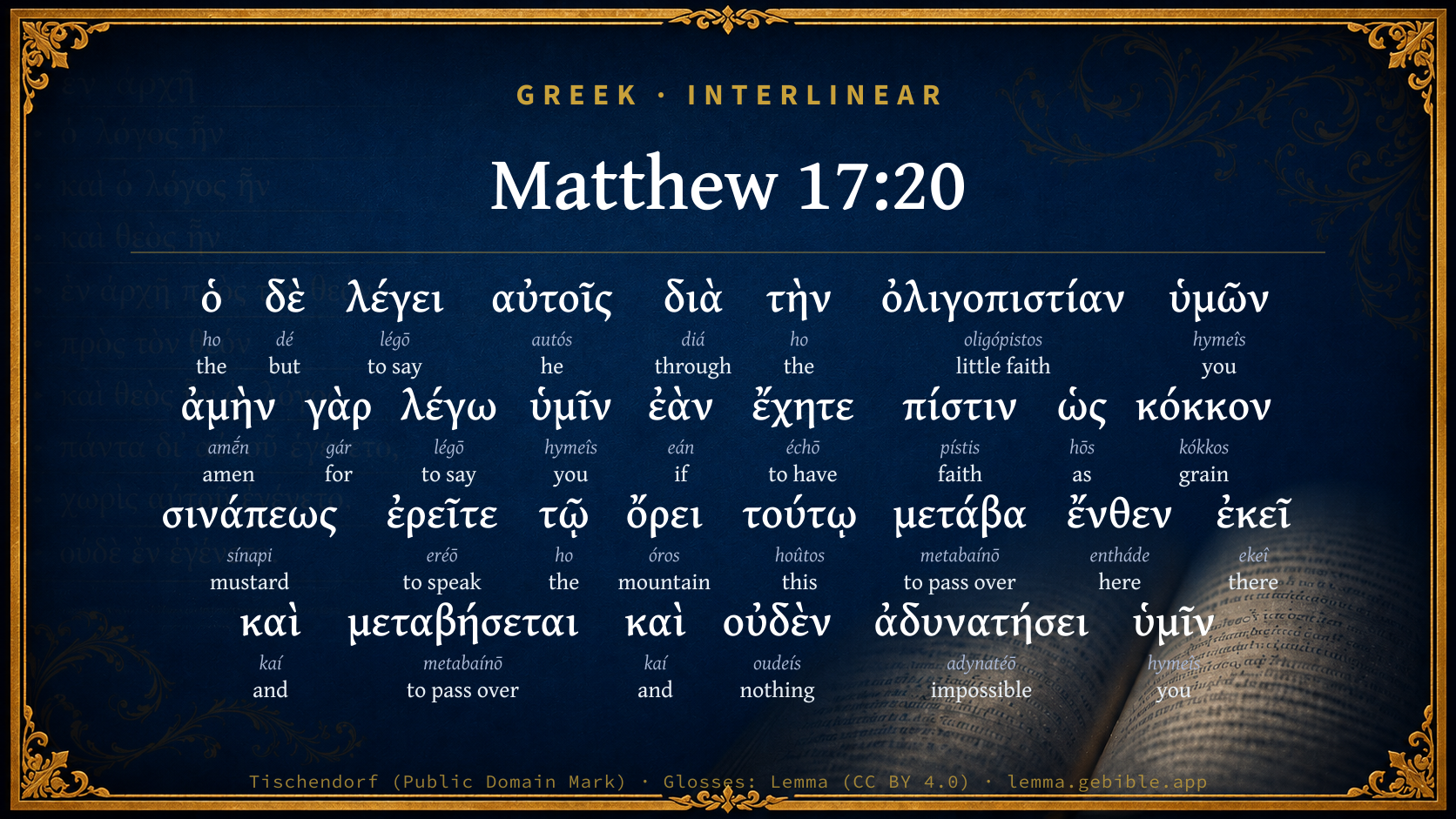
Download image
Cite this verse

Matthew 17:20 (World English Bible). Public Domain. Lemma interlinear Bible study tool, https://lemma.gebible.app/v/matthew/17/20.

Show BibTeX & RIS
BibTeX
RIS
English Translation
He said to them, "Because of your unbelief. For most assuredly I tell you, if you have faith as a grain of mustard seed, you will tell this mountain, 'Move from here to there,' and it will move; and nothing will be impossible for you.
World English Bible · Public Domain
Highlights
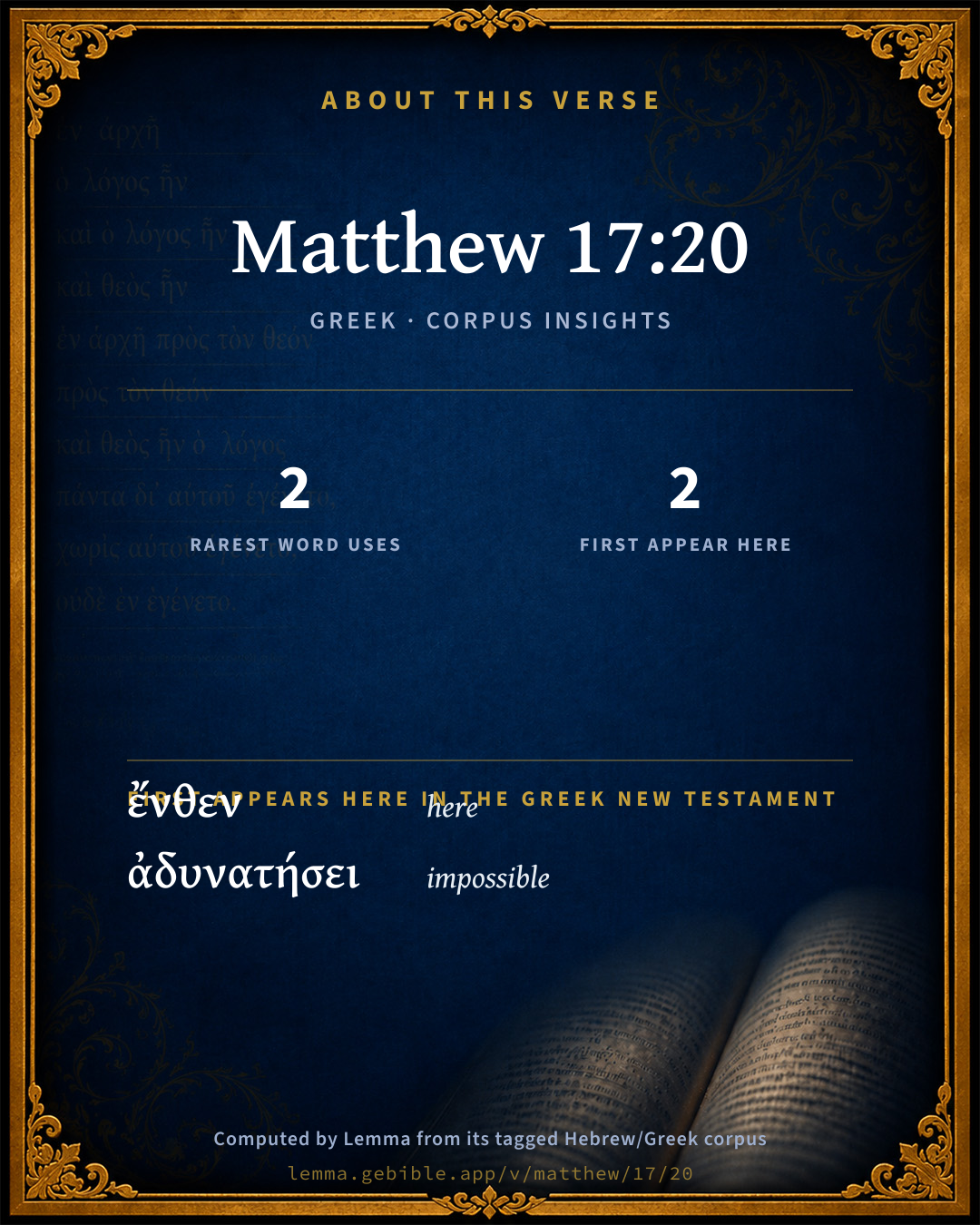
  • 2 first appearances in the Greek New Testament
Full analysis ↓
Download a study sheet

One document with this verse’s original text, its word-by-word gloss line, the meaning frame, cross-references with their text, attributed commentary, and full source and license credits — printable, and it pastes into notes with its structure intact.

This verse Autodidact and up

Study sheet (.html) Plain text (.txt)

A passage Seminary Student

Up to 50 verses in one chapter. A passage sheet keeps up to 6 commentary sources and 12 cross-references per verse, in the order this page ranks them, and says so on the sheet whenever that leaves anything out. Ask for a single verse and you get the Autodidact verse sheet above.

Everything on this page stays free to read, with no account — the sheet is a download of what is already on screen, not access to it.

Want to remove ads? Support Godless Engineer
Compare translations 3

The same verse in 3 English versions, stacked beneath the original-language interlinear above. Click any original word for its lexicon entry.

Each is an independent rendering of the whole verse — the interlinear is not word-aligned to these translations.

Highlighted words mark where these versions differ — a whole-verse word diff, not a word-by-word alignment.

  • World English Bible Public Domain
    He said to them, "Because of your unbelief. For most assuredly I tell you, if you have faith as a grain of mustard seed, you will tell this mountain, 'Move from here to there,' and it will move; and nothing will be impossible for you.
  • King James Version Public Domain
    And Jesus said unto them, Because of your unbelief: for verily I say unto you, If ye have faith as a grain of mustard seed, ye shall say unto this mountain, Remove hence to yonder place; and it shall remove; and nothing shall be impossible unto you.
  • unfoldingWord Literal Text CC BY-SA 4.0
    And he says to them, “Because of your little faith. For truly I say to you, if you had faith like a mustard seed, you will say to this mountain, ‘Move from here to there,’ and it will move, and nothing will be impossible for you.

unfoldingWord Literal Text — © unfoldingWord, licensed CC BY-SA 4.0. Word-aligned USFM3 via Door43 (git.door43.org/unfoldingWord/en_ult).

Versions to compare (up to 4)

3 of 4 selected

Show all 19 translations

Every available English version of this verse, each an independent rendering of the whole verse.

  • World English Bible Public Domain
    He said to them, "Because of your unbelief. For most assuredly I tell you, if you have faith as a grain of mustard seed, you will tell this mountain, 'Move from here to there,' and it will move; and nothing will be impossible for you.
  • Berean Standard Bible Public Domain
    “Because you have so little faith,” He answered. “For truly I tell you, if you have faith the size of a mustard seed, you can say to this mountain, ‘Move from here to there,’ and it will move. Nothing will be impossible for you.”
  • Majority Standard Bible Public Domain
    “Because of your unbelief,” Jesus answered. “For truly I tell you, if you have faith the size of a mustard seed, you can say to this mountain, ‘Move from here to there,’ and it will move. Nothing will be impossible for you.
  • King James Version Public Domain
    And Jesus said unto them, Because of your unbelief: for verily I say unto you, If ye have faith as a grain of mustard seed, ye shall say unto this mountain, Remove hence to yonder place; and it shall remove; and nothing shall be impossible unto you.
  • American Standard Version (1901) Public Domain
    And he saith unto them, Because of your little faith: for verily I say unto you, If ye have faith as a grain of mustard seed, ye shall say unto this mountain, Remove hence to yonder place; and it shall remove; and nothing shall be impossible unto you.
  • Revised Version (1885) Public Domain
    And he saith unto them, Because of your little faith: for verily I say unto you, If ye have faith as a grain of mustard seed, ye shall say unto this mountain, Remove hence to yonder place; and it shall remove; and nothing shall be impossible unto you.
  • Geneva Bible (1599) Public Domain
    And Iesus said vnto them, Because of your vnbeliefe: for verely I say vnto you, if ye haue faith as much as is a graine of mustarde seede, ye shall say vnto this mountaine, Remooue hence to yonder place, and it shall remoue: and nothing shalbe vnpossible vnto you.
  • Douay-Rheims (1899) Public Domain
    But this kind is not cast out but by prayer and fasting.
  • Young's Literal Translation Public Domain
    And Jesus said to them, `Through your want of faith; for verily I say to you, if ye may have faith as a grain of mustard, ye shall say to this mount, Remove hence to yonder place, and it shall remove, and nothing shall be impossible to you,
  • Literal Standard Version CC BY-SA 4.0
    And Jesus said to them, “Through your want of faith; for truly I say to you, if you may have faith as a grain of mustard, you will say to this mountain, Move from here to there, and it will move, and nothing will be impossible to you,
  • Unlocked Literal Bible CC BY-SA 4.0
    Jesus said to them, “Because of your small faith. For I truly say to you, if you have faith even as small as a grain of mustard seed, you can say to this mountain, 'Move from here to there,' and it will move, and nothing will be impossible for you.
  • unfoldingWord Literal Text CC BY-SA 4.0
    And he says to them, “Because of your little faith. For truly I say to you, if you had faith like a mustard seed, you will say to this mountain, ‘Move from here to there,’ and it will move, and nothing will be impossible for you.
  • Darby Bible Public Domain
    And he says to them, Because of your unbelief; for verily I say unto you, If ye have faith as a grain of mustard [seed], ye shall say to this mountain, Be transported hence there, and it shall transport itself; and nothing shall be impossible to you.
  • World Messianic Bible Public Domain
    He said to them, “Because of your unbelief. For most certainly I tell you, if you have faith as a grain of mustard seed, you will tell this mountain, ‘Move from here to there,’ and it will move; and nothing will be impossible for you.
  • Webster's Bible Public Domain
    And Jesus said to them, Because of your unbelief: for verily I say to you, If ye have faith as a grain of mustard-seed, ye shall say to this mountain, Remove hence to yonder place, and it shall remove; and nothing shall be impossible to you.
  • Free Bible Version CC BY-SA 4.0
    “Because you don't trust enough,” Jesus told them. “I tell you, even if your trust was as small as a mustard seed, you could say to this mountain, ‘Move from here to there,’ and it would move. Nothing would be impossible for you.”
  • Bible in Basic English Public Domain
    And he says to them, Because of your little faith: for truly I say to you, If you have faith as a grain of mustard seed, you will say to this mountain, Be moved from this place to that; and it will be moved; and nothing will be impossible to you.
  • Text-Critical English NT CC BY 4.0
    Jesus said to them, “Because of your unbelief. For truly I say to you, if you have faith like a grain of mustard seed, you will say to this mountain, ‘Move from here to there,’ and it will move. Nothing will be impossible for you.
  • Tyndale New Testament (1534) Public Domain
    Iesus sayd vnto the: Because of youre vnbelefe For I saye veryly vnto you: yf ye had faythe as a grayne of musterd seed ye shuld saye vnto this moutayne remove hence to yonder place and he shuld remove: nether shuld eny thinge be vnpossible for you to do.

Literal Standard Version (2020), Covenant Press — licensed CC BY-SA 4.0. Text via the HelloAO Bible API (eBible.org). Unlocked Literal Bible (unfoldingWord) — licensed CC BY-SA 4.0. Text via the HelloAO Bible API (eBible.org). unfoldingWord Literal Text — © unfoldingWord, licensed CC BY-SA 4.0. Word-aligned USFM3 via Door43 (git.door43.org/unfoldingWord/en_ult). Free Bible Version, Dr. Jonathan Gallagher — licensed CC BY-SA 4.0. Text via the HelloAO Bible API (eBible.org).

Word by word

More ways to search: Search by grammar → Find every occurrence → Compare this word →

Practice this passage: Drill this verse → Learn its vocabulary →

ἀδυνατήσει
adynatéō
G101
“impossible”
Verb, Future, Active, Indicative, 3rd person, Singular
Part of Speech
Verb
Tense
Future
Voice
Active
Mood
Indicative
Person
3rd person
Number
Singular
Full Thayer's Definition

Origin: from G102

TDNT: 06:44,2

1. impossible a. not to have strength, power, or ability, to be weak b. can not be done, to be impossible
  1. ὁ ho G3588 “the” Article, Nominative, Singular, Masculine
  2. δὲ dé G1161 “but” Conjunction
  3. λέγει légō G3004 “to say” Verb, Present, Active, Indicative, 3rd person, Singular
  4. αὐτοῖς autós G846 “he” Personal pronoun, Dative, Plural, Masculine
  5. διὰ diá G1223 “through” Preposition
  6. τὴν ho G3588 “the” Article, Accusative, Singular, Feminine
  7. ὀλιγοπιστίαν oligópistos G3640 “little faith” Noun, Accusative, Singular, Feminine
  8. ὑμῶν hymeîs G5210 “you” Personal pronoun, 2nd person, Genitive, Plural
  9. ἀμὴν amḗn G281 “amen” Hebrew transliteration
  10. γὰρ gár G1063 “for” Conjunction
  11. λέγω légō G3004 “to say” Verb, Present, Active, Indicative, 1st person, Singular
  12. ὑμῖν hymeîs G5210 “you” Personal pronoun, 2nd person, Dative, Plural
  13. ἐὰν eán G1437 “if” Conditional
  14. ἔχητε échō G2192 “to have” Verb, Present, Active, Subjunctive, 2nd person, Plural
  15. πίστιν pístis G4102 “faith” Noun, Accusative, Singular, Feminine
  16. ὡς hōs G5613 “as” Adverb
  17. κόκκον kókkos G2848 “grain” Noun, Accusative, Singular, Masculine
  18. σινάπεως sínapi G4615 “mustard” Noun, Genitive, Singular, Neuter
  19. ἐρεῖτε eréō G2046 “to speak” Verb, Future, Active, Indicative, 2nd person, Plural
  20. τῷ ho G3588 “the” Article, Dative, Singular, Neuter
  21. ὄρει óros G3735 “mountain” Noun, Dative, Singular, Neuter
  22. τούτῳ hoûtos G3778 “this” Demonstrative pronoun, Dative, Singular, Neuter
  23. μετάβα metabaínō G3327 “to pass over” Verb, Aorist, Active, Imperative, 2nd person, Singular
  24. ἔνθεν entháde G1759 “here” Adverb
  25. ἐκεῖ ekeî G1563 “there” Adverb
  26. καὶ kaí G2532 “and” Conjunction
  27. μεταβήσεται metabaínō G3327 “to pass over” Verb, Future, Middle deponent, Indicative, 3rd person, Singular
  28. καὶ kaí G2532 “and” Conjunction
  29. οὐδὲν oudeís G3762 “nothing” Adjective, Nominative, Singular, Neuter, Negative
  30. ὑμῖν hymeîs G5210 “you” Personal pronoun, 2nd person, Dative, Plural

About this verse

These counts appear in no published source. They are computed here, from the morphology-tagged text and Lemma’s own curated glosses. What Lemma adds →

31
words
24
distinct lemmas
Gospels
section

Notable vocabulary

The rarest word here is ἀδυνατήσει impossible G101 — appearing just 2 times in the whole Greek New Testament.

First appearance in Scripture

These words make their first canonical appearance in the Greek New Testament here:

  • ἔνθεν here G1759
  • ἀδυνατήσει impossible G101

Shared distinctive vocabulary

ἀδυνατήσει impossible G101 occurs in 2 verses of the Greek New Testament. Also found in:
Repetition

Words recur within this verse:

  • λέγει to say G3004 ×2
  • μετάβα to pass over G3327 ×2
  • ὁ the G3588 ×3
  • ὑμῶν you G5210 ×3
  • καὶ and G2532 ×2

Cross-references

14

Topical passages linked to Matthew 17:20 in the Treasury of Scripture Knowledge — connected by theme and wording, ordered by reader-vote popularity; previews shown in the World English Bible.

  • Luke 17:6 The Lord said, "If you had faith like a grain of mustard seed, you would tell this sycamore tree, 'Be uprooted, and be planted in the sea,' and it would obey you.
  • Mark 11:23 For most assuredly I tell you, whoever may tell this mountain, 'Be taken up and cast into the sea,' and doesn't doubt in his heart, but believes that what he says is happening; he shall have whatever he says.
  • Luke 1:37 For everything spoken by God is possible."
  • Luke 18:27 But he said, "The things which are impossible with men are possible with God."
  • Matthew 21:21 Jesus answered them, "Most assuredly I tell you, if you have faith, and don't doubt, you will not only do what is done to the fig tree, but even if you told this mountain, 'Be taken up and cast into the sea,' it would be done.
  • Mark 9:23 Jesus said to him, "If you can believe, all things are possible to him who believes."
  • 1 Corinthians 13:2 If I have the gift of prophecy, and know all mysteries and all knowledge; and if I have all faith, so as to remove mountains, but don't have love, I am nothing.
  • Matthew 13:31 He set another parable before them, saying, "The Kingdom of Heaven is like a grain of mustard seed, which a man took, and sowed in his field;
  • John 11:40 Jesus said to her, "Didn't I tell you that if you believed, you would see God's glory?"
  • Mark 4:31 It's like a grain of mustard seed, which, when it is sown in the earth, though it is less than all the seeds that are on the earth,
  • Matthew 14:30–31 But when he saw that the wind was strong, he was afraid, and beginning to sink, he cried out, saying, "Lord, save me!"
  • Hebrews 3:19 We see that they were not able to enter in because of unbelief.
  • Matthew 17:17 Jesus answered, "Faithless and perverse generation! How long will I be with you? How long will I bear with you? Bring him here to me."
  • 1 Corinthians 12:9 to another faith, by the same Spirit; and to another gifts of healings, by the same Spirit;

Cross-references courtesy of OpenBible.info (CC BY 4.0).

Where the printed editions differ

1 variant

Places in this verse where the major printed Greek editions disagree on the wording in a way that affects the translation — a comparison of editions, not a manuscript-by-manuscript collation. The editions are the modern critical texts (Nestlé-Aland 28/27, SBL, Westcott-Hort, Tregelles, Tyndale House) and the traditional texts behind the KJV (the Textus Receptus and the Byzantine/Majority text). It is not a claim about which reading is original.

  1. Different wording
    ὀλιγοπιστίαν

    “little faith”

    In NA28NA27TynSBLWHTreg Not in TRByz

    ἀπιστίαν (apistian) 'unbelief' occurs in traditional manuscripts (TR+Byz) instead of ὀλιγοπιστίαν (oligopistian) 'little faith' in older manuscripts (NA28+NA27+Tyn+SBL+WH+Treg)

Textual data: Translators Amalgamated Greek New Testament (STEPBible TAGNT) · CC BY 4.0.

Commentary

Notes on Matthew 17:20 from classic Christian and Jewish commentators (each source and its license shown beneath its notes). The classic Christian expositions comment on the surrounding passage and are grouped to its opening verse, so a note may address several verses; the Jewish commentaries on the Tanakh (Rashi and others) are per-verse, so they appear only where the commentator wrote on this verse.

Lemma curates 59 commentaries, every one of them public domain or Creative Commons licensed, each selected and text-cleaned for this edition rather than reprinted as found. About our sources →

Tyndale Open Study Notes

Tyndale Open Resources

17:20 Here, the expression don’t have enough faith is virtually synonymous with no faith. • faith even as small as a mustard seed: This could mean that if the disciples had even very little faith they would be able to accomplish great things (21:21; cp. 1 Cor 13:2). It could also mean that if they would allow their faith to grow (see Matt 13:31-32), they could act with courageous belief. • Moving mountains is an adage for overcoming obstacles and fulfilling God’s purposes (Isa 40:4; 49:11; 54:10; 1 Cor 13:2).

Tyndale Open Study Notes — © Tyndale Open Resources, licensed CC BY-SA 4.0. Text via the HelloAO Bible API.

Bengel's Gnomon

Johann Albrecht Bengel

Mat 17:20. Ἀπιστίαν, unbelief) in this case.—πίστιν ὡς κόκκον σινάπεως, faith as a grain of mustard seed) contrasted with a huge mountain. This faith is contrasted with a strong faith, and one stimulated by prayer and fasting [see Mat 17:21]. From this it is clear, that the transportation of a mountain is a less miracle than the ejection of a devil of the kind mentioned in the text; for the devil clings more closely to a man spiritually, than the mountain to its roots physically; and faith, even the smallest, is more powerful than the fixture of a mountain. You will say, “Why then is that miracle less frequent (than the other)?” Answer. It has nevertheless been performed sometimes; but it is not necessary that it should be performed frequently, although the opulence of faith reaches thus far. A mountain is naturally by creation in its proper place: a devil is not so when possessing a man: wherefore it is more beneficial that the latter should be cast out, than that the former should be removed; cf. on faith, Mar 11:22-24; Mar 16:17; Joh 14:12-13.—ἐρεῖτε, ye shall say) i.e. ye are able to say—ye have the power of saying. This is said especially to the apostles; for all have not the gift of miracles.—τῷ ὄρει τούτῳ, to this mountain) sc. that mentioned in Mat 17:1; see also ch. Mat 21:21. Examples of such miracles are not wanting in the history of the Church; see one of them in Note to the Panegyric on Gregory Thaumaturgus,[794] pp. 127, 128; see also Le Fevre’s Commentary, f. 78.—ἘΚΕῖ, there) Ye shall be able also to assign a place to a mountain.—οὐδὲν, nothing) not even if the sun is to be staid in his course.

[794] See foot-note, p. 187.—(I. B.)

Bengel's Gnomon of the New Testament — English translation (T&T Clark, Edinburgh, 1860) — public domain. Text from a community e-Sword module.

Meyer's Critical & Exegetical Commentary

Heinrich August Wilhelm Meyer

Mat_17:20. The disciples ought to have applied to themselves the general exclamation in Mat_17:17. This they failed to do, hence their question. But the ἀπιστία with which Jesus now charges them is to be understood in a relative sense, while the πίστις, of which it is the negation, means simply faith in Jesus Christ, the depositary of supernatural power, so that, in virtue of their fellowship with His life, the disciples, as His servants and the organs of His power, were enabled to operate with greater effect in proportion to the depth and energy of the faith with which they could confide in Him.

ἐὰν ἔχητε] if you have (not: had).

ὡς κόκκον σιν.] found likewise in Rabbinical writers as a figurative expression for a very small quantity of anything. Lightfoot on Mat_13:32. The point of the comparison does not lie in the stimulative quality of the mustard (Augustine; on the other hand, Maldonatus).

To remove mountains, a figurative expression for: to accomplish extraordinary results, 1Co_13:2. Lightfoot on Mat_21:21; Buxtorf, Lex. Talm. p. 1653. For legends in regard to the actual removing of mountains, see Calovius.

οὐδέν] the hyperbole of popular speech. For ἀδυνατ., comp. Job_42:2.

Meyer — Critical and Exegetical Commentary on the New Testament — English translation by Peter Christie, edited by Frederick Crombie (T&T Clark, 1880) — public domain. Text from a community e-Sword module.

Expositor's Greek Testament

ed. W. Robertson Nicoll

Mat 17:20 . διὰ τὴν ὀλιγοπιστίαν , here only, and just on that account to be preferred to ἀπιστίαν (T. R.); a word coined to express the fact exactly: too little faith for the occasion ( cf. Mat 14:31 ) That was a part of the truth at least, and the part it became them to lay to heart. ἀμὴν , introducing, as usual, a weighty saying. ἐὰν ἔχητε , if ye have, a present general supposition. κόκκον σινάπεως proverbial for a small quantity (Mat 13:31 ), a minimum of faith. The purpose is to exalt the power of faith, not to insinuate that the disciples have not even the minimum. Schanz says they had no miracle faith (“fides miraculorum”). τῷ ὄρει τούτῳ , the Mount of Transfiguration visible and pointed to. μετάβα (- βηθι T. R.), a poetical form of imperative like ἀνάβα in Rev 4:1 . Vide Schmiedel’s Winer , p. 115. ἔνθεν ἐκεῖ for ἐντεῦθεν ἐκεῖσε . μεταβήσεται : said, done. Jesus here in effect calls faith an “uprooter of mountains,” a phrase current in the Jewish schools for a Rabbi distinguished by legal lore or personal excellence (Lightfoot, Hor. Heb. , ad Mat 21:21 , Wünsche). ἀδυνατήσει used in the third person singular only in N. T. with dative = to be impossible; a reminiscence of Mar 9:23 (Weiss).

The Expositor's Greek Testament, edited by W. Robertson Nicoll (1897–1910) — public domain. Text from a community e-Sword module.

Adam Clarke's Commentary

Verse 20. Because of your unbelief] Are we preachers of the Gospel? Do the things of God rest upon our minds with a deep and steady conviction? Can we expect that a doctrine which we do not, from conviction, credit ourselves, can be instrumental in our hands of begetting faith in others? So we preached, end so ye believed. The word preached generally begets in the people the same spirit which the preacher possesses. Instead of απιστιαν, unbelief, the famous Vatican MS. and Cod. Cyprius, six others, Coptic, Ethiopic, Armenian, and Arabic, Origen, and Chrysostom, read ολιγοπιστιαν, littleness of faith. The disciples had some faith, but not enough-they believed, but not fully.

As a grain of mustard seed] Some eminent critics think this a proverbial expression, intimating a GREAT DEGREE of faith, because removing mountains, which St. Paul, 1Co 13:2, attributes to ALL FAITH; i.e. the greatest possible degree of faith, is attributed here, by our Lord, to that faith which is as a grain of mustard seed. However this may be, there can be no doubt that our Lord means, as BISHOP PEARCE well remarks, a thriving and increasing faith; which like the grain of mustard seed, from being the least of seeds, becomes the greatest of all herbs; even a tree in whose branches the fowls of the air take shelter. See WAKEFIELD'S Comment, and See Clarke on Mt 13:32.

Adam Clarke's Commentary on the Bible (1810–1826) — public domain. Text from a community e-Sword/MySword module.

Ellicott's Commentary for English Readers

(20) Because of your unbelief.—The various reading, “Because of your little faith,” found in many, but not the most authoritative MSS., is interesting as an example of a tendency to tone down the apparent severity of our Lord’s words. They show conclusively that the disciples themselves came under the range of His rebuke to the “faithless and perverse generation.”

If ye have faith as a grain of mustard seed.—The hyperbolical form of our Lord’s words, repeated afterwards in Mat_21:21, excluded from the thoughts of the disciples, as from our own, the possibility of a literal interpretation. The “grain of mustard seed” was, as in Mat_13:31, the proverbial type of the infinitely little. To “remove mountains” was, as we see in 1Co_13:2 (this may, however, have been an echo of our Lord’s teaching), the proverbial type of overcoming difficulties that seemed insurmountable. The words were, we may believe, dramatised by a gesture pointing to the mountain from which our Lord and the three disciples had descended, as afterwards by a like act in reference to the Mount of Olives (Mat_21:21).

Nothing shall be impossible unto you.—The words, absolute as they sound, are yet, ipso facto, conditional. Nothing that comes within the range of faith in the wisdom and love of God, and therefore of submission to His will, is beyond the range of prayer.

A Bible Commentary for English Readers, edited by Charles John Ellicott (1878–1897) — public domain. Text from a community e-Sword module.

The Cambridge Bible for Schools and Colleges

gen. ed. J. J. S. Perowne

20. ye shall say unto this mountain, Remove hence] Such expressions are characteristic of the vivid imagery of Eastern speech generally. To “remove mountains” is to make difficulties vanish. The Jews used to say of an eminent teacher, he is “a rooter up of mountains.” See Lightfoot ad loc.

The Cambridge Bible for Schools and Colleges (gen. ed. J. J. S. Perowne; Cambridge University Press, 1878–1918) — public domain. Text from a community e-Sword module.

John Gill's Exposition

And Jesus said unto them, because of your unbelief,.... The Arabic and Ethiopic versions read, "because of your little faith", or "the smallness of your faith"; and so does one Greek manuscript; and which is what is doubtless meant by their unbelief; for they were not altogether destitute of faith, but their faith was very low, and their unbelief very great. Christ says, not because of the unbelief of the parent of the child, and those that were with him, though that also was a reason; but because of their unbelief, being willing to convince them of their unbelief, as he had done the father of the child, who had confessed it, and desired it might be removed from him: but lest they should think they had lost their power of doing miracles, Christ adds;

for verily I say unto you, if ye have faith as a grain of mustard seed; which was a very small seed, the least of all seeds, and is used very often proverbially by the Jews, to signify anything of a small quantity or weight (b), and is sometimes used of faith, as here; so speaking of the congregation of Edom, meaning the Christians, they (c) say,

"they have not , "faith as a grain of mustard seed".''

And it is used in like sense in other eastern nations; and by Mahomet in his Alcoran (d), who says,

"We will appoint just balances in the day of resurrection, neither shall any soul be injured at all, although the merit or guilt of an action be of the weight of "a grain of mustard seed".''

So that it has no reference to the quality of mustard seed, being hot and acrimonious; which has led some interpreters wrong, to compare faith unto it, for its liveliness and fervency: when our Lord only means, that if his apostles had ever so small a degree of faith in exercise, which might be compared for its smallness to this least of seeds, such an effect as he after mentions would follow; and which therefore is to be understood, not of an historical faith, by which men assent to all that is in the Bible as true; nor of a special, spiritual faith, by which souls believe in Christ, as their Saviour and Redeemer; for of neither of these can the following things in common be said; but of a faith of miracles, peculiar to certain persons in those early times, for certain reasons; which such as had but ever so small a degree of, as the apostles here spoken to might say, as Christ observes to them,

ye shall say to this mountain; pointing perhaps to that he was just come down from, which might be in sight of the house where he was,

remove hence to yonder place, and it shall remove: meaning, not that it would be ordinarily or ever done in a literal sense by the apostles, that they should remove mountains; but that they should be able to do things equally difficult, and as seemingly impossible, if they had but faith, when the glory of God, and the good of men, required it. So that it does not follow, because the apostles did not do it in a literal sense, therefore they could not, as the Jew insultingly says (e); since it was meant that they should, and besides, have done, things equally as great as this, and which is the sense of the words. So the apostle expresses the faith of miracles, by "removing mountains", Co1 13:2 i.e. by doing things which are difficult, seem impossible to be done: wherefore Christ adds,

and nothing shall be impossible to you; you shall not only be able to perform such a wonderful action as this, were it necessary, but any, and everything else, that will make for the glory of God, the enlargement of my kingdom and interest, the confirmation of truth, and the good of mankind.

(b) T. Bab. Beracot, fol. 3l. 1. Megilla, fol. 28. 2. Nidda, fol. 66. 1. Maimon. lssure Biah, c. 11. sect. 4. Maacolot Asurot, c. 2. sect. 21. &c. 14. sect. 8. Tumaot Okelim, c. 4. sect. 2. & 7. 6. (c) Vet. Nizzachon, p. 148. (d) C. 21. p. 268. & c. 31. p. 336. Ed. Sale. (e) Vet. Nizzachon, p. 237.

John Gill's Exposition of the Whole Bible (1746–1763) — public domain (CC PDM 1.0). Text via the HelloAO Bible API.

Trapp's Complete Commentary

John Trapp

20 And Jesus said unto them, Because of your unbelief: for verily I say unto you, If ye have faith as a grain of mustard seed, ye shall say unto this mountain, Remove hence to yonder place; and it shall remove; and nothing shall be impossible unto you.

Ver. 20. Because of your unbelief] q.d. That is the naked truth of it, never deceive yourselves: there is no shuffling will serve turn: be content (hard though it be) to hear your own. Veritas aspera est, verum amaritudo eius utilior, et integris sensibus gratior, quam meretricantis linguae distillans favus. A smart truth takes better with an honest heart than a smooth supparasitation (flattery ŒD).

If ye have faith as a grain of, &c.] The disciples might object, if no faith but that which is entire and perfect can do such cures as this, then we may despair of ever doing any. Our Saviour answers, that the least measure of true faith (fitly compared to mustard seed, for its acrimony and vivacity), if exerted and exercised, will work wonders. Neither is justifying faith beneath miraculous in the sphere of its own activity, and where it hath warrant of God’s word, to remove mountains of guilt and grief. A weak faith is a joint possessor, though no faith can be a joint purchaser of sin’s remission. And a man may have faith enough to bring him to heaven, though he want this or that faith, as to rely upon God without failing, Luk 18:1; Luk 18:8, without feeling, Psa 22:1, &c., as resolved, that God nevertheless will hear him in that very thing he prays for.

John Trapp, A Commentary or Exposition upon All the Books of the Old and New Testament (1647–1656) — public domain. Text from a community e-Sword module.

Albert Barnes' Notes on the Bible

As a grain of mustard-seed - See the notes at Mat 13:31-32. The mustard-seed was the smallest of all seeds. It has been supposed by some, therefore, that he meant to say, If you have the smallest or feeblest faith that is genuine, you can do all things. The mustard-seed produced the largest of all herbs. It has been supposed by others, therefore, to mean, If you have increasing, expanding, enlarged faith, growing and strengthening from small beginnings, you can perform the most difficult undertaking. There is a principle of vitality in the grain of seed stretching forward to great results, which illustrates the nature of faith. Your faith should be like that. This is probably the true meaning.

Ye shall say unto this mountain ... - Probably he pointed to a mountain near, to assure them that if they had such faith they might accomplish the most difficult undertakings - things that at first would appear impossible.

Albert Barnes' Notes on the Bible (1834–1885) — public domain. Text from a community e-Sword/MySword module.

Haydock's Catholic Bible Commentary

See here the efficacy of prayer and fasting! What the apostles could not do, prayer accompanied with fasting can effect. How then can that be genuine religion, which makes fasting an object of ridicule? We see also here that the true Church in her exorcisms follows Scripture, when she uses besides the name of Jesus, many prayers and much fasting to drive out the devils, because these, as well as faith, are here required. (Bristow)

George Leo Haydock (1774–1849), Haydock's Catholic Family Bible and Commentary, 1859 edition — public domain. Excludes Psalms (Douay-Rheims chapter numbering differs from Protestant) and Deuterocanonical books (Catholic canon only).

Whedon's Commentary on the Bible

Daniel D. Whedon

20. Because of your unbelief — During the absence of their Lord, the disciples seem to have become as it were secularized. See introduction to the section. Faith as a grain of mustard seed — That is, in size; in contrast with the size of the mountain it is able to remove. This mountain — This faith, be it remembered, supposes a concurrence between God and man.

On the part of God a mission or duty assigned to the man, for which the power of faith is granted; and without this, the true faith is impossible. On the part of man there must be exercised all the granted faith-power, by which he puts forth the act, or pursues the course which is opened in the way of duty before him. When these two things combine, it is literally true that anything is possible. If the man’s mission be to remove the Andes into the Pacific it can be done. If there be no duty to it, there can be no true faith for it; and the attempt to do it would not be faith but rash self-will. God gives no man faith wherewith to play miraculous pranks. On the other hand, if there be the duty and the God-given power of faith, and yet it be not exercised with the full strength of heart and the firm trust in God which knows the impossibility will be done, no miracle shall follow. This the disciples had not, even to a mustard seed’s amount; and a mustard seed’s amount could have as easily accomplished its mission as my hand moves a pen. There doubtless lives many a Christian now with faith sufficient to remove real material mountains, if God had any such work for him to do. Yet it may be safely presumed that our Lord used the word mountain as well as the mustard seed by way of figure. He may have used it as Isa_40:4, prophesies that “every valley shall be exalted, and every mountain shall be brought low.” Or as Zec_4:7, declares that the “great mountain shall disappear before Zerubbabel.”

Daniel D. Whedon (gen. ed.), Commentary on the Old and New Testaments (1874–1909) — public domain. Text from a community e-Sword module.

The Pulpit Commentary

Because of your unbelief. The Revised Version adopts the reading, little faith, in accordance with the best authorities; but it looks like a softening of the original term "unbelief," which corresponds better with Christ"s own censure, "faithless generation." Jesus gives two reasons for the apostles" failure, one connected with their own moral condition, and one (ver. 21) derived from the nature of the demons exorcised. They had, indeed, shown some faith by making even the attempt at the expulsion of the devil, and were not to be classed with the unbelieving scribes; but they had acted in a half-hearted manner, and had not displayed that perfect confidence and trust which alone can win success and make all things possible. Verily I say unto you. The Lord proceeds to give that lesson concerning perfect faith and its results, which he afterwards repeated in connection with the withered fig tree (Mat_21:21, where see note) and elsewhere. (Luk_17:6) If ye have faith as a grain of mustard seed, which, as he says, (Mat_13:32) "is less than all seeds." He means a faith real and trustful, though it be small and weak. The phrase is proverbial, expressive of littleness and insignificance. The mustard seed is quite little, but, grown in favourable soil and under sunny skies, it becomes, as it were, a tree among herbs, so that birds may nestle in its branches. To it faith is compared, because, small at first, it contains within itself power of large development and increase; from minute grains copious results are produced. Ye shall say unto this mountain. He points to the hill of Hermon, where the Transfiguration had taken place. Remove hence. It is usual to consider the expression here as an Eastern hyperbole, not to be taken literally, but meaning merely that the greatest difficulties may be overcome by faith. This may be true, but it seems hardly adequate to the explanation of our Lord"s emphatic words. St. Paul writes in a similar strain, (1Co_13:2) "If I have all faith, so that I could remove mountains;" where there is nothing necessarily hyperbolical in the supposition. It seems rather that Jesus meant his words to be received literally, implying that if such a removal as he mentioned was ever expedient and in accordance with God"s will, it would be effected by the power of faith; not that he hereby sanctioned an arbitrary and wanton display of miraculous power, but he gives an assurance that, were such a measure rendered necessary for the cause of religion, it would be performable at the call of one whose whole trust was centred on God, and whose will was one with God"s will. Mediaeval writers, followed by later Roman Catholic commentators, give instances of such stupendous effects of faith. The evidence of such miracles is, of course, defective, and would not satisfy modern criticism, but the existence of such legends proves that a literal view was taken of our Lord"s saying. Nothing shall be impossible unto you. The man of faith is practically omnipotent; moral and material difficulties vanish before him.

The power of faith.

This was the comment of our Lord on the failure of the disciples to cure the lunatic boy, and on his own subsequent success. The difference was accounted for by the fact that the disciples had not faith, while Christ possessed it. On another occasion, when there was no question of any attempt of his disciples, our Lord answered the amazement caused by one of his miracles by pointing in a similar way to the power of faith. (Mat_21:21)

I THE FAITH.

1. Its existence. "If ye have faith." These words imply uncertainty. Many people have much religion, but no faith. They have a creed, but not faith. They do not really and actively trust God. Faith begins in us when we put our belief into action.

2. Its smallness. It may be but as a grain of mustard seed. It is sad to think of its being so minute; certainly there is no virtue in its meagreness. Yet even a small faith may do great things if it is indeed a real faith. The great question is not How many things do we believe? but How firm is our grasp upon the objects of faith? The area of belief may be vast as a windswept desert, and faith may be small as a shepherd"s cot. Then it is that little hut of faith that saves us, while the storm passes overhead.

3. Its life. The mustard seed is better than a grain of sand. It is alive, and therefore it can grow. The living faith will not be always small. But even while it is small it is capable of wonderful. possibilities.

II THE WORK OF FAITH.

1. An active work. Christ here speaks of what faith does, and the author of the Epistle to the Hebrews recites achievements of faith (Hebrews 11). Faith not only affords shelter in trouble, it is an inspiration for service. The man of faith is the man of action, for he has within him a fountain of energy. It is, therefore, an utter mistake to suppose that "believing" is to be instead of "doing." Faith is given to enable us to do great things which we could not accomplish without it.

2. A great work. This small faith is to accomplish grand results. The mustard seed is to remove a mountain. Only a foolish literalism can occasion any perplexity in the reading of Christ"s words. His disciples were too familiar with Oriental metaphors to fall into the absurd mistake of supposing that Jesus really expected them to toss mountains of rock and earth from one place to another. It was customary for the Jews to refer to a great rabbi as a remover of mountains, and therefore Christ was employing proverbial language which would be well understood by his hearers. But this does not mean that his words contained no statement of importance. What it teaches is that faith can accomplish stupendous achievements, such as the strongest men" would fail in attempting without it.

3. A work of removing difficulties. The forerunner of Christ was to lower mountains in order to prepare the way for the King. (Isa_40:4) There are many hindrances in the path of Christian work. Some of these seem to be insuperable. Sultans frown on the gospel; empires bar their gates against it. But faith, working by prayer, has removed many such a mountain of difficulty, and it will do so again. W.F.A.

The Pulpit Commentary (1880–1919), ed. H.D.M. Spence-Jones & Joseph S. Exell — public domain. Text from a community e-Sword module.

John Wesley's Explanatory Notes

Because of your unbelief - Because in this particular they had not faith. If ye have faith as a grain of mustard seed - That is, the least measure of it. But it is certain, the faith which is here spoken of does not always imply saving faith. Many have had it who thereby cast out devils, and yet will at last have their portion with them. It is only a supernatural persuasion given a man, that God will work thus by him at that hour. Now, though I have all this faith so as to remove mountains, yet if I have not the faith which worketh by love, I am nothing. To remove mountains was a proverbial phrase among the Jews, and is still retained in their writings, to express a thing which is very difficult, and to appearance impossible. Matt. xxi, 21; Luke xvii, 6.

John Wesley, Explanatory Notes Upon the Whole Bible (1754–1765) — public domain. Text via the GEBible commentary corpus.

Cambridge Greek Testament for Schools and Colleges

20. ὀλιγοπιστίαν for ἀπιστίαν, the term of gentler blame has the earliest evidence in its favour.

20. ἐρεῖτε τῷ ὄρει τούτῳ κ.τ.λ. Such expressions are characteristic of the vivid imagery of Eastern speech generally. To ‘remove mountains’ is to make difficulties vanish. The Jews used to say of an eminent teacher, he is ‘a rooter up of mountains.’ See Lightfoot ad loc.

Cambridge Greek Testament for Schools and Colleges (Cambridge University Press, 1896; 21 vols, various authors incl. Carr, Maclear, Plummer, Farrar, Lumby, Moule, M. R. James, Simcox) — public domain. Text from a community e-Sword module.

International Critical Commentary

20. And He with to them, Because of your little faith: for verily I say to you, If you have faith as a grain of mustard seed, you shall say to this mountain, Remove hence yonder; and it shall remove; and nothing shall be impossible to you.] Mk. has: “And He said to them, This kind cannot go out by anything except by prayer.” This apparently means, “devils (or this particular species of devil) can only be expelled by the power of prayer which you lacked.” But the words are vague and ambiguous. Mt. omits them, and substitutes a direct reproof, “because of your little faith.” Cf. the editor’s use of ὀλιγόπιστος in 6:30, 8:26, 14:31, 16:8. To emphasise the effect of faith, he adds a saying, influenced, perhaps, by ὄρος, 17:1, 9, which recurs in a different form in 21:21, where it is taken from Mk. Luk 17:6 has a similar but quite independent saying.—ὀλιγοπιστίαν] πίστις here is different from the trust implied in 8:10, 9:2, 22, 29, 15:8, 6:30, 8:26, 14:31, 16:8. In all these passages it is assurance, trust in the power and love of God or of Christ. Here it is the same trust, but combined with the confidence that the man who has it can himself apply the divine power to work miracles. Cf. 21:21 and 1Co 13:2. The Talmudic writers use “uprooter of mountains” as a term of praise for a skilful expositor of the law who removed difficulties of interpretation. See Lightfoot on Mat 21:21.

20. όλιγοπιστίαν] א B. 1 13 22 33 124 346 S2. ἀπιστίαν, C D al S1 latt όλιγοπιστια occurs only here, but όλιγόπιστος occurs 4 times in Mt. Internal evidence is in favour of όλιγοπιστία—(1) in view of the facts collected in Introduction, pp. xxxiii f., it is unlikely that the editor would have written ἀπιστία here, whilst his use of όλιγόπιστος 4 times of the Apostles would suggest όλιγοπιστία as a suitable word here; (2) the substitution in the MSS. of the common άπιστία for the rare όλιγοπιστία is easier than the reverse process.

International Critical Commentary — older volumes (1896–1929), various authors — public domain. Text from a community e-Sword module.

Vincent's Word Studies in the New Testament

Marvin R. Vincent

Unbelief [απιστιαν] . But the better reading is ojligopistian, littleness of faith. Hence Rev., Because of your little faith.

Marvin R. Vincent, Word Studies in the New Testament (1887–1900) — public domain. Text from a community e-Sword/MySword module.

Lesson kit

Teaching starters — assembled from the data on this page, not authored interpretation. Every prompt links to the verse data it draws on. Edit before teaching.

Matthew, in the Gospels, opens this verse with 31 words (24 distinct Greek lemmas). Its most distinctive word is adynatéō (“impossible”). A historical commentator’s framing appears above. Read the whole chapter for the surrounding context.

Discussion questions

  1. What does “impossible” (adynatéō) contribute to the verse as a whole?
  2. 2 words here appear for the first time in Scripture. What is being introduced at this debut?
  3. Luke 1:37 shares the word «impossible» with this verse. How do the two illuminate each other?
  4. “to say” occurs 2× in this one verse. What is the effect of the repetition?
  5. These translations render this verse differently. What is at stake in choosing one wording over another?
  6. Reading how Tyndale Open Study Notes and Bengel's Gnomon read this verse, where do the two commentators agree and where do they part?

Things to notice

  • 2 words make their first canonical appearance in Scripture here.
  • These translations choose different wording for 24 words in this verse.
  • “to say” occurs 2× in this single verse.
  • 24 distinct Greek lemmas span 31 words in this verse.

Reading settings

Reading text

Shown beneath each verse's original-language words.

Old Testament
Old Testament edition

Read the OT as the Masoretic Hebrew (MT) or the Greek Septuagint (LXX).

English shown for the Greek Septuagint (in the Hebrew ↔ Greek comparison).

Comparing translations? Open the Compare panel on any verse page to stack up to four side by side.