John 12:39

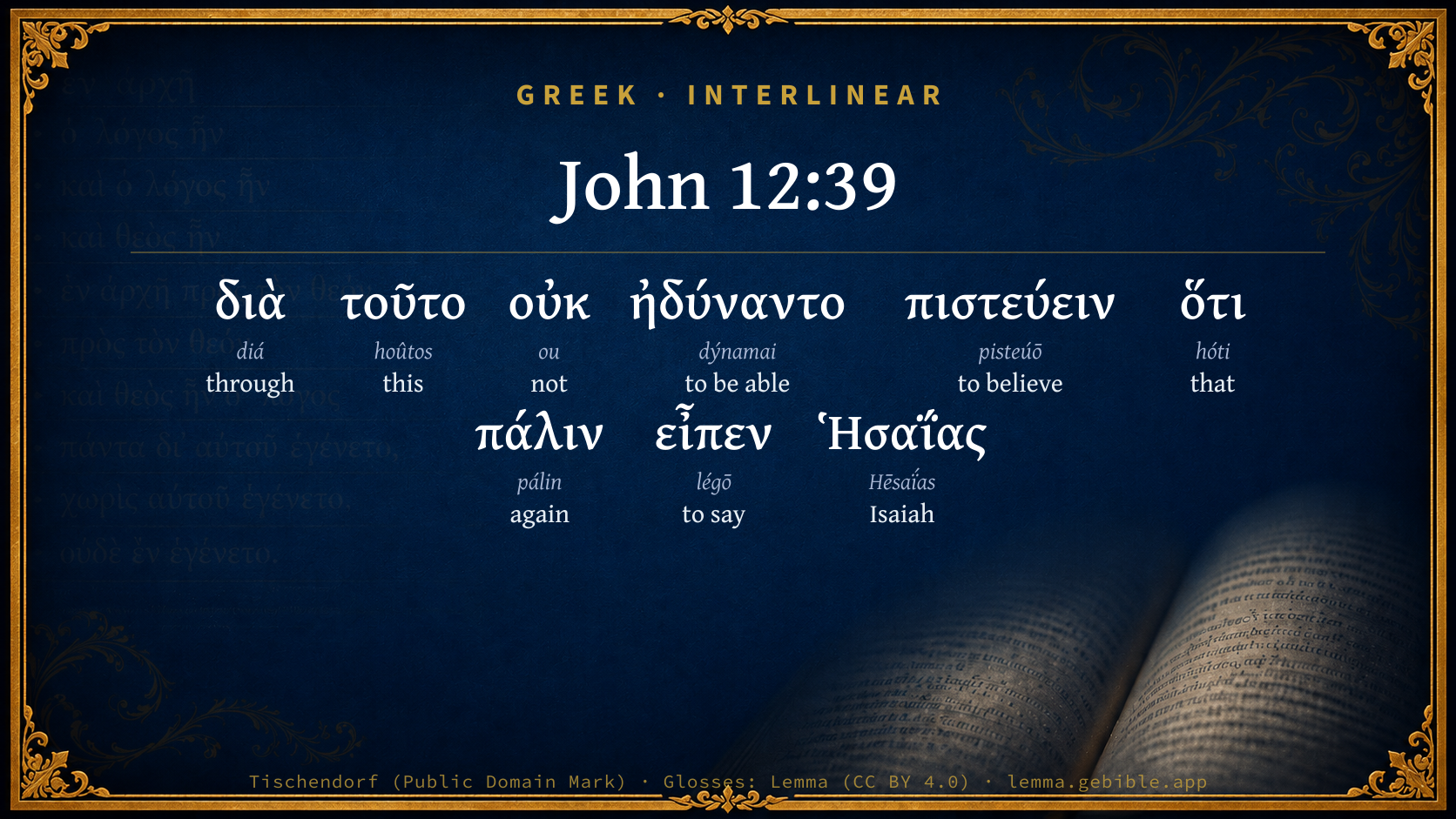
Greek (Tischendorf 8th ed.) John 12:39 appears in the Greek New Testament. The text above is from the Tischendorf 8th edition. Each word links to its Strong’s number and a concise gloss. Click any word for its full Thayer’s Greek Lexicon entry.
Download image
Cite this verse

John 12:39 (World English Bible). Public Domain. Lemma interlinear Bible study tool, https://lemma.gebible.app/v/john/12/39.

Show BibTeX & RIS
BibTeX
RIS
English Translation
For this cause they couldn't believe, for Isaiah said again,
World English Bible · Public Domain
Download a study sheet

One document with this verse’s original text, its word-by-word gloss line, the meaning frame, cross-references with their text, attributed commentary, and full source and license credits — printable, and it pastes into notes with its structure intact.

This verse Autodidact and up

Study sheet (.html) Plain text (.txt)

A passage Seminary Student

Up to 50 verses in one chapter. A passage sheet keeps up to 6 commentary sources and 12 cross-references per verse, in the order this page ranks them, and says so on the sheet whenever that leaves anything out. Ask for a single verse and you get the Autodidact verse sheet above.

Everything on this page stays free to read, with no account — the sheet is a download of what is already on screen, not access to it.

Want to remove ads? Support Godless Engineer
Compare translations 3

The same verse in 3 English versions, stacked beneath the original-language interlinear above. Click any original word for its lexicon entry.

Each is an independent rendering of the whole verse — the interlinear is not word-aligned to these translations.

Highlighted words mark where these versions differ — a whole-verse word diff, not a word-by-word alignment.

  • World English Bible Public Domain
    For this cause they couldn't believe, for Isaiah said again,
  • King James Version Public Domain
    Therefore they could not believe, because that Esaias said again,
  • unfoldingWord Literal Text CC BY-SA 4.0
    Because of this they were not able to believe, for Isaiah had again said,

unfoldingWord Literal Text — © unfoldingWord, licensed CC BY-SA 4.0. Word-aligned USFM3 via Door43 (git.door43.org/unfoldingWord/en_ult).

Versions to compare (up to 4)

3 of 4 selected

Show all 19 translations

Every available English version of this verse, each an independent rendering of the whole verse.

  • World English Bible Public Domain
    For this cause they couldn't believe, for Isaiah said again,
  • Berean Standard Bible Public Domain
    For this reason they were unable to believe. For again, Isaiah says:
  • Majority Standard Bible Public Domain
    For this reason they were unable to believe. For again, Isaiah says:
  • King James Version Public Domain
    Therefore they could not believe, because that Esaias said again,
  • American Standard Version (1901) Public Domain
    For this cause they could not believe, for that Isaiah said again,
  • Revised Version (1885) Public Domain
    For this cause they could not believe, for that Isaiah said again,
  • Geneva Bible (1599) Public Domain
    Therefore could they not beleeue, because that Esaias saith againe,
  • Douay-Rheims (1899) Public Domain
    Therefore they could not believe, because Isaias said again:
  • Young's Literal Translation Public Domain
    Because of this they were not able to believe, that again Isaiah said,
  • Literal Standard Version CC BY-SA 4.0
    Because of this they were not able to believe, that again Isaiah said,
  • Unlocked Literal Bible CC BY-SA 4.0
    For this reason they could not believe, for Isaiah had also said,
  • unfoldingWord Literal Text CC BY-SA 4.0
    Because of this they were not able to believe, for Isaiah had again said,
  • Darby Bible Public Domain
    On this account they could not believe, because Esaias said again,
  • World Messianic Bible Public Domain
    For this cause they couldn’t believe, for Isaiah said again:
  • Webster's Bible Public Domain
    Therefore they could not believe, because that Isaiah said again,
  • Free Bible Version CC BY-SA 4.0
    They were not able to trust him, and as a result they fulfilled what Isaiah also said:
  • Bible in Basic English Public Domain
    For this reason they were unable to have belief, because Isaiah said again,
  • Text-Critical English NT CC BY 4.0
    For this reason they could not believe, for again Isaiah said,
  • Tyndale New Testament (1534) Public Domain
    Therfore coulde they not beleve because that Esaias sayth agayne:

Literal Standard Version (2020), Covenant Press — licensed CC BY-SA 4.0. Text via the HelloAO Bible API (eBible.org). Unlocked Literal Bible (unfoldingWord) — licensed CC BY-SA 4.0. Text via the HelloAO Bible API (eBible.org). unfoldingWord Literal Text — © unfoldingWord, licensed CC BY-SA 4.0. Word-aligned USFM3 via Door43 (git.door43.org/unfoldingWord/en_ult). Free Bible Version, Dr. Jonathan Gallagher — licensed CC BY-SA 4.0. Text via the HelloAO Bible API (eBible.org).

Word by word

More ways to search: Search by grammar → Find every occurrence → Compare this word →

Practice this passage: Drill this verse → Learn its vocabulary →

About this verse

These counts appear in no published source. They are computed here, from the morphology-tagged text and Lemma’s own curated glosses. What Lemma adds →

9
words
9
distinct lemmas
Gospels
section

Notable vocabulary

The rarest word here is Ἡσαΐας Isaiah G2268 — appearing just 23 times in the whole Greek New Testament.

Shared distinctive vocabulary

Ἡσαΐας Isaiah G2268 occurs in 23 verses of the Greek New Testament. Also found in:

Cross-references

6

Topical passages linked to John 12:39 in the Treasury of Scripture Knowledge — connected by theme and wording, ordered by reader-vote popularity; previews shown in the World English Bible.

  • Isaiah 6:9–10 He said, "Go, and tell this people, 'You hear indeed, But don't understand; And you see indeed, But don't perceive.'
  • John 5:44 How can you believe, who receive glory from one another, and you don't seek the glory that comes from the only God?
  • John 10:38 But if I do them, though you don't believe me, believe the works; that you may know and believe that the Father is in me, and I in the Father."
  • 2 Peter 2:14 having eyes full of adultery, and who can't cease from sin; enticing unsettled souls; having a heart trained in greed; children of cursing;
  • John 6:44 No one can come to me unless the Father who sent me draws him, and I will raise him up in the last day.
  • Isaiah 44:18–20 They don't know, neither do they consider: for he has shut their eyes, that they can't see; and their hearts, that they can't understand.

Cross-references courtesy of OpenBible.info (CC BY 4.0).

Commentary

Notes on John 12:39 from classic Christian and Jewish commentators (each source and its license shown beneath its notes). The classic Christian expositions comment on the surrounding passage and are grouped to its opening verse, so a note may address several verses; the Jewish commentaries on the Tanakh (Rashi and others) are per-verse, so they appear only where the commentator wrote on this verse.

Lemma curates 59 commentaries, every one of them public domain or Creative Commons licensed, each selected and text-cleaned for this edition rather than reprinted as found. About our sources →

Tyndale Open Study Notes

Tyndale Open Resources

12:39-40 The people couldn’t believe: John quotes Isa 6:10 to explain Israel’s unbelief (see Matt 13:13-15; Mark 4:12; Luke 8:10; Acts 28:26-27). When revelation comes, we must believe. If we refuse, the light disappears (John 12:35-36). When God’s light departs from the world, the darkness closes over unbelieving hearts.

Tyndale Open Study Notes — © Tyndale Open Resources, licensed CC BY-SA 4.0. Text via the HelloAO Bible API.

Bengel's Gnomon

Johann Albrecht Bengel

Joh 12:39. Διὰ τοῦτο) for this reason; because, namely, this just judgment on them had been foretold. The Evangelist stops short at this point: who may venture [strive to reach] farther? [First, they do not believe, as being refractory; then, they cannot believe. They are mistaken, who suppose what is said to be in the inverse order: they could not believe; therefore they did not believe.—V. g.]

Bengel's Gnomon of the New Testament — English translation (T&T Clark, Edinburgh, 1860) — public domain. Text from a community e-Sword module.

Meyer's Critical & Exegetical Commentary

Heinrich August Wilhelm Meyer

Joh_12:39-40. Διὰ τοῦτο … ὅτι] as always in John (see on Joh_10:17): therefore, referring to what precedes, on account of this destiny contained in Joh_12:38namely, because, so that thus with ὅτι the reason is still more minutely set forth. Ebrard foists in an entirely foreign course of thought, because Israel has not willed to believe, therefore has she not been able to believe. Contrary to that Johannean use of διὰ τοῦτο … ὅτι, Theophylact, Beza, Jansen, Lampe, and several others, including Lücke, Tholuck, Olshausen, Maier, B. Crusius, Luthardt, take διὰ τοῦτο as preparative.

οὐκ ἠδύναντο] not: nolebant (Chrysostom, Theophylact, Euth. Zigabenus, Wolf), butand therewith the enigma of that tragic unbelief is solvedthey could not, expressing the impossibility which had its foundation in the divine judgment of obduracy. Hic subsistit evangelista, quis ultra nitatur? Bengel. On the relation of this inability, referred back to the determination of God, to moral freedom and responsibility, see on Romans 9-11.

τετύφλωκεν] The passage is Isa_6:9-10, departing freely from the original and from the LXX. In the original the prophet is said, at the command of God, to undertake the blinding, etc., that is, the intellectual and moral hardening (harden the heart, etc.). Thus what God then will allow to be done is represented by John in his free manner of citation as done by God Himself, to which the recollection of the rendering of the passage given by the LXX. (the heart has become hardened, etc.) might easily lead. The subject is thus neither Christ (Grotius, Calovius, and several others, including Lange and Ebrard), nor the devil (Hilgenfeld, Scholten), but, as the reader would understand as a matter of course, and as also the entire context shows (for the necessity in the divine fate is the leading idea), God. Christ first appears as subject in ἰάσομαι.

πεπώρ.] has hardened. See Athenaeus, 12, p. 549 B; Mar_6:52; Mar_8:17; Rom_11:7; 2Co_3:14.

καὶ στραφῶσι] and (not) turn, return to me.

ἰάσομαι] Future, dependent on ἵνα μή. See on Mat_13:15. The moral corruption is viewed as sickness, which is healed by faith (Joh_12:37; Joh_12:39). Comp. Mat_9:12; 1Pe_2:24. The healing subject, however, cannot, as in Mat_8:15, Act_28:27, be God (so usually), simply because this is the subject of τετύφλωκεν, κ.τ.λ., but it must be Christ; in His mouth, according to the Johannean view of the prophecy from the standpoint of its fulfilment, Isaiah puts not merely the utterance in Joh_12:38, but also the words τετύφλωκεν … ἰάσομαι αὐτούς, and thus makes Him say: God has blinded the people, etc., that they should not see, etc., and should not turn to Him (Christ), and He (Christ) should heal them. Nonnus aptly says: Ὀφθαλμοὺς ἀλάωσεν ἐμῶν ἐπιμάρτυρας ἔργων … μὴ κραδίῃ νοέωσι … καί μοι ὑποστρέψωσι, νοοβλαβέας δὲ σαώσω ἄνδρας ἀλιτραίνοντας ἐμῷ παιήονι μύθῳ. Thus the 1st person ἰάσομαι is not an instance of negligence (Tholuck, comp. his A. T. im N. T. p. 3 5 f. ed. 6), but of consistency.

Meyer — Critical and Exegetical Commentary on the New Testament — English translation by Peter Christie, edited by Frederick Crombie (T&T Clark, 1880) — public domain. Text from a community e-Sword module.

Expositor's Greek Testament

ed. W. Robertson Nicoll

Joh 12:39 . Διὰ τοῦτο seems to have a double reference, first to what precedes, second to the ὅτι following, cf. Joh 8:47 . οὐκ ἠδύναντο , “they were not able,” irrespective of will; their inability arose from the fulfilment in them of Isaiah’s words, Joh 6:10 (Joh 12:40 ), Τετύφλωκεν … αὐτούς . τετύφλωκεν refers to the blinding of the organ for perceiving spiritual truth, ἐπώρωσεν (from πῶρος , a callus) to the hardening of the sensibility to religious and moral impressions. This process prevented them from seeing the significance of the miracles and understanding with the heart the teaching of Jesus. By abuse of light, nature produces callousness; and what nature does God does.

The Expositor's Greek Testament, edited by W. Robertson Nicoll (1897–1910) — public domain. Text from a community e-Sword module.

Godet's Commentaries

Frédéric Louis Godet

Vv. 39, 40. “And indeed they could not believe, because Isaiah said again, 40 He has blinded their eyes and hardened their hearts, that they should not see with their eyes and understand with their heart, and be converted, and I should heal them.”

The omnipotence of God itself worked to the end of realizing that which His omniscience had foretold, and to make Israel do the impossible thing. Not only they did not believe (Joh 12:37); but they could not believe (Joh 12:39). The word πάλιν (again) reminds us that there is here a second idea, serving to explain the fact by completing the first. This logical relation answers to the meaning of the two expressions of Isaiah quoted by John. The διὰ τοῦτο, for this cause, refers, as ordinarily in John (Joh 12:18, Joh 10:17, etc.), to the following ὅτι,because: “And this is the reason why they could not believe: it is because Isaiah in another passage (πάλιν) said.” It is in vain that Weiss tries to make the διὰ τοῦτο, for this cause, also refer to the preceding idea, namely, that of the fact; it refers to the following ὅτι and consequently to the cause of the fact (see Keil). These words are taken from Isa 6:9-10.

The word of address, Lord, added by the LXX., passed thence to John. The quotation differs both from the Hebrew text and from that of the LXX., in that according to the former, it is Isaiah who is said to blind and harden the people by his ministry: “Make the heart of this people fat;” according to the latter, this hardening is a simple fact laid to the charge of Israel: “The heart of this people is hardened;” in John, on the contrary, the understood subject of the two verbs (he has blinded, he has hardened) can only be God. This third form is evidently a deliberate correction of the latter, in order to go back to the meaning of the former. For this fact accomplished by Isaiah, being the execution of the command of God, is rightly attributed by John to God Himself. This passage proves that the evangelist, while attaching himself to the Greek translation, was not dependent on it and was acquainted with the Hebrew text (vol. I., p. 197f.). Τυφλοῦν, to make blind, designates the depriving of intellectual light, of the sense of the true and even of the useful, of simple good sense; πωροῦν, to harden the skin, the depriving of moral sensibility, the sense of the good. From the paralysis of these two organs unbelief must necessarily result; the people may see miracle after miracle, may hear testimony after testimony, yet they will not discern in the one whom God thus points out, and who gives all these testimonies to Himself, their Messiah. The subject of the two verbs is undoubtedly God (Meyer, Reuss), but God in the person of that Adonai who (according to Isa 6:1) gives the command to the prophet. The reading of nearly all the Mjj. is ἰάσομαι, and I shall heal them.This future might signify: “And I shall end by bringing them to myself through the means of their very hardening.” The two καί and...and, however, are too closely related to each other for such a contrast between the last verb and those which precede it to be admissible. The force of the formidable ἵνα μή, in order that I ..., evidently extends as far as the end of the sentence. The construction of the indicative with this conjunction has nothing unusual in it (1Co 13:3; 1Pe 3:1; Rev 22:14); it is frequent also in the classic Greek with ὅπως . We might undoubtedly explain in this way: “lest they should be converted, in which case I will heal them” (for: I would heal them). But the other sense remains the more natural one: God does not desire to heal them; it is not in accordance with His actual intentions towards them. This is precisely the reason why He does not desire that they should believe—a thing which would force Him to pardon and heal them.

If such is the meaning of the words of the prophet and of those of the evangelist, how can it be justified? These declarations would be inexplicable and revolting if, at the moment when God addresses them to Israel and treats Israel in this way, this people were in the normal state, and God regarded them still as His people.

But it was by no means so; when sending Isaiah, God said to him: “Go and tell THIS people” (Isa 6:9). And we know what a father means, when speaking of his son, he says: this child, instead of my child: the paternal and filial relation is momentarily broken. An abnormal state has begun, which obliges God to use means of an extraordinary character. This divine dispensation towards Israel enters therefore into the category of chastisements. The creature who has long abused the divine favors falls under the most terrible of punishments; from an end it becomes for the time ameans. In fact man can, by virtue of his liberty, refuse to glorify God by his obedience and salvation; but even in this case he cannot prevent God from glorifying Himself in him by a chastisement capable of making the odious character of his sin shine forth conspicuously. “God,” says Hengstenberg, “has so constituted man, that, when he does not resist the first beginnings of sin, he loses the right of disposing of himself and forcibly obeys even to the end the power to which he has surrendered himself.” God does not merely permit this development of evil; He wills it and concurs in it. But how, it will be said, will the holiness of God, as thus understood, be reconciled with His love? This is that which St. Paul explains to the Jews by the example of their ancient oppressor, Pharaoh, Rom 9:17 : In the first place, this king refuses to hearken to God and to be saved; he has the prerogative to do so. But after this he is passively used for the salvation of others.

God paralyses in him both the sense of the true and the sense of the good; he becomes deaf to the appeals of conscience and even to the calculations of self-interest properly understood; he is given up to the inspirations of his own foolish pride, in order that, through the conspicuous example of the ruin into which he precipitates himself, the world may learn what it costs wickedly to resist the first appeals of God. Thereby he at least serves the salvation of the world. The history of Pharaoh is reproduced in that of the Jews in the time of Jesus Christ. Already at the epoch of Isaiah the mass of the people were so carnal that their future unbelief in the Messiah, the man of sorrows, appears to the prophet an inevitable moral fact (Isaiah 53). We must even go further and say, with Paul and John, that, things being thus, this unbelief must have been willed of God. What would have become of the kingdom of God, indeed, if an Israel like this had outwardly and without a change of heart received Jesus as its Messiah and had become with such dispositions the nucleus of the Church?

This purely intellectual adherence of Israel, instead of advancing the divine work in the heathen world, would have served only to hinder it. We have the proof of this in the injurious part which was played in the Apostolic Church by the Pharisaic minority who accepted the faith. Suppose that the Jewish people en masse had acted thus and had governed the Church, the work of St. Paul would not have been possible; the Jewish monopoly would have taken possession of the gospel; there would have been an end of the universalism which is the essential characteristic of the new covenant. The rejection of the Jews thus disposed was therefore a measure necessary to the salvation of the world. It is in this sense that St. Paul says in Rom 11:12 : “that the fall of Israel has become the riches of the world,” and Joh 12:15 : “that its rejection has been the reconciliation of the world.” How, indeed, could the Gentiles have welcomed a salvation connected with circumcision and the Mosaic observances? God was therefore obliged to make Israel blind, that the miracles of Jesus might be as nothing in their eyes and as not having taken place, and to harden them, that His preachings might remain for them as empty sounds (Isaiah 6). Thus Israel proud, legal, carnal, rejected and could be rejectedfreely. This decided position did not in reality make Israel’s lot worse; but it had for the salvation of the Gentiles the excellent results which St. Paul develops in Romans 11. Far more than this, by this very chastisement, Israel became what it had refused to be by its salvation, the apostle of the world; and, like Judas its type, it fulfilled, willingly or unwillingly, its irrevocable commission; comp. Rom 11:7-10. Moreover, it is clear that, in the midst of this national judgment, every individual remained free to turn to God by repentance and to escape the general hardening. Joh 12:13 of Isaiah and Joh 12:42 of John are the proof of this.

As to the relation of the Jewish unbelief to the divine prevision (Joh 12:37-38), John does not indicate the metaphysical theory by means of which he succeeds in reconciling the foreknowledge of God with the responsibility of man; he simply accepts these two data, the one of the religious sentiment, the other of the moral consciousness. But if we reflect that God is above time, that, properly speaking, He does not foresee an event which is for us yet to come, but that He sees it, absolutely as we behold a present event; that, consequently, when He declares it at any moment whatsoever, He does not foretellit, but describes it as a spectator and witness, the apparent contradiction between these two seemingly contradictory elements vanishes. Once foretold, the event undoubtedly cannot fail to happen, because the eye of God cannot have presented to Him as existing that which will not be. But the event does not exist because God has seen it; God, on the contrary, has seen it because it will be, or rather because to His view it already is. Thus the real cause of Jewish unbelief, foretold by God, is not the divine foreseeing. This cause is, in the last analysis, the moral state of the people themselves. This state it is which, when once established by the earlier unfaithfulnesses of Israel, necessarily implies the punishment of unbelief which must strike the people at the decisive moment, the judgment of hardening.

Frédéric Louis Godet — Commentaries on Luke, John, Romans, and 1 Corinthians — English translation (T&T Clark, Edinburgh, 1870s–1890s) — public domain. Text from a community e-Sword module.

Jamieson, Fausset & Brown

Robert Jamieson, A. R. Fausset & David Brown

Therefore they could not believe, because Esaias said again, He hath blinded their eyes, that they should not see, &c.--That this expresses a positive divine act, by which those who wilfully close their eyes and harden their hearts against the truth are judicially shut up in their unbelief and impenitence, is admitted by all candid critics [as OLSHAUSEN], though many of them think it necessary to contend that this is in no way inconsistent with the liberty of the human will, which of course it is not.

Jamieson, Fausset & Brown — Commentary Critical and Explanatory on the Whole Bible (1871) — public domain (CC PDM 1.0). Text via the HelloAO Bible API.

Adam Clarke's Commentary

Verse 39. Therefore they could not believe] Why? Because they did not believe the report of the prophets concerning Christ; therefore they credited not the miracles which he wrought as a proof that he was the person foretold by the prophets, and promised to their fathers. Having thus resisted the report of the prophets, and the evidence of Christ's own miracles, God gave them up to the darkness and hardness of their own hearts, so that they continued to reject every overture of Divine mercy; and God refused to heal their national wound, but, on the contrary, commissioned the Romans against them, so that their political existence was totally destroyed.

The prophecy of Isaiah was neither the cause nor the motive of their unbelief: it was a simple prediction, which imposed no necessity on them to resist the offers of mercy. They might have believed, notwithstanding the prediction, for such kinds of prophecies always include a tacit condition; they may believe, if they properly use the light and power which God has given them. Such prophecies also are of a general application-they will always suit somebody, for in every age persons will be found who resist the grace and Spirit of God like these disobedient Jews. However, it appears that this prediction belonged especially to these rejecters and crucifiers of Christ; and if the prophecy was infallible in its execution, with respect to them, it was not because of the prediction that they continued in unbelief, but because of their own voluntary obstinacy; and God foreseeing this, foretold it by the prophet. Should I say that, they could not believe, means, they would not believe, I should perhaps offend a generation of his children; and yet I am pretty certain the words should be so understood. However, that I may put myself under cover from all suspicion of perverting the meaning of a text which seems to some to be spoken in favour of that awful doctrine of unconditional reprobation, the very father of it shall interpret the text for me. Thus then saith St. AUGUSTIN: Quare autem non POTERANT, si a me quaeratur, cito respondeo; Quia NOLEBANT: MALAM quippe eorum VOLUNTATEM praevidit Deus, et per prophetam praenunciavit. "If I be asked why they COULD not believe? I immediately answer, Because THEY WOULD NOT. And God, having foreseen their BAD WILL, foretold it by the prophet." Aug. Tract. 53, in Joan.

Adam Clarke's Commentary on the Bible (1810–1826) — public domain. Text from a community e-Sword/MySword module.

John Calvin's Commentaries

39. Therefore they could not believe. This is somewhat more harsh; because, if the words be taken in their natural meaning, the way was shut up against the Jews, and the power of believing was taken from them, because the prediction of the prophet adjudged them to blindness, before they determined what choice they should make. I reply, there is no absurdity in this, if nothing could happen different from what God had foreseen. But it ought to be observed, that the mere foreknowledge of God is not in itself the cause of events; though, in this passage, we ought to consider not so much the foreknowledge of God as his justice and vengeance. For God declares not what he beholds from heaven that men will do, but what He himself will do; and that is, that he will strike wicked men with giddiness and stupidity, and thus will take vengeance on their obstinate wickedness. In this passage he points out the nearer and inferior cause why God intends that his word, which is in its own nature salutary and quickening, shall be destructive and deadly to the Jews. It is because they deserved it by their obstinate wickedness.

This punishment it was impossible for them to escape, because God had once decreed to give them over to a reprobate mind, and to change the light of his word, so as to make it darkness to them. For this latter prediction differs from the former in this respect, that in the former passage the prophet testifies that none believe but those whom God, of his free grace, enlightens for his own good pleasure, the reason of which does not appear; for since all are equally ruined, God, of his mere good pleasure, distinguishes from others those whom he thinks fit to distinguish. But, in the latter passage, he speaks of the hardness by which God has punished the wickedness of an ungrateful people. They who do not attend to these steps mistake and confound passages of Scripture, which are quite different from each other.

John Calvin's Commentaries (1540-1563) — public domain. Text from the Calvin Translation Society English edition (1840s-50s) via the Christian Classics Ethereal Library (ccel.org). Calvin's coverage is partial (roughly two-thirds of the Bible); uncommented books and verses are honest gaps, never fabricated. The 19th-century editor's footnotes and remarks are omitted so the notes are faithfully Calvin's own voice.

Ellicott's Commentary for English Readers

(39) Therefore they could not believe, because.—The words refer to those which have gone before, not to those which follow, and then by an addition give the reason more fully. “It was on account of the divine will expressed in Isaiah’s prophecy.” “It was therefore, namely, because Isaiah said again.”

The words, “they could not believe,” must be taken in their plain meaning as expressing impossibility. The Apostle is looking back upon the national rejection of Christ, and seeks a reason for it. He remembers how our Lord Himself had explained His method of teaching by parables, and has based it upon this prophecy of Isaiah (Mat_13:14). The principle was that which has been repeated in His last public words (Joh_12:35-36); that power used is increased, and power neglected destroys itself. Here, then, in these prophetic words was the reason they could not believe. Wilful rejection had been followed by rejection which was no longer within the power of the will. With this statement of St. John’s should be compared our Lord’s words on the same subject in Joh_5:40; Joh_6:37, Notes, and St. Paul’s arguments in Romans 9-11.

A Bible Commentary for English Readers, edited by Charles John Ellicott (1878–1897) — public domain. Text from a community e-Sword module.

The Cambridge Bible for Schools and Colleges

gen. ed. J. J. S. Perowne

39. Therefore] Or, For this cause (Joh_12:18; Joh_12:27); see on Joh_7:21-22. It refers to what precedes, and the ‘because’ which follows gives the reason more explicitly. This use is common in S. John: comp. Joh_5:18, Joh_8:47, Joh_10:17.

they could not] It had become morally impossible. Grace may be refused so persistently as to destroy the power of accepting it. ‘I will not’ leads to ‘I cannot.’ Pharaoh first hardened his heart and then God hardened it. Comp. Rom_9:6 to Rom_11:32.

The Cambridge Bible for Schools and Colleges (gen. ed. J. J. S. Perowne; Cambridge University Press, 1878–1918) — public domain. Text from a community e-Sword module.

John Gill's Exposition

He hath blinded their eyes, and hardened their heart,.... It is of no great moment, whether the he, who is said to blind and harden, be God or Christ, or whether the words be rendered, "it hath blinded", &c. that is, malice or wickedness; or whether they be read impersonally, "their eyes are blinded", &c. since God or Christ blind and harden not by any positive act, but by leaving and giving men up to the blindness and hardness of their hearts, and denying them the grace which could only cure them, and which they are not obliged to give; and which was the case of these Jews, so as never to be converted, or be turned even by external repentance and reformation, that they might be healed in a national way, and be preserved from national ruin, as it follows,

that they should not see with their eyes,.... See Gill on Mat 13:14, See Gill on Mat 13:15. The Syriac and Persic versions read, "they have blinded their eyes", &c.

John Gill's Exposition of the Whole Bible (1746–1763) — public domain (CC PDM 1.0). Text via the HelloAO Bible API.

Trapp's Complete Commentary

John Trapp

39 Therefore they could not believe, because that Esaias said again,

Ver. 39. Therefore they could not believe, &c.] They could not, because they would not, saith Theophylact out of Chrysostom, who yet extolleth man’s free will more than is meet. Pelagianis nondum litigantibus, patres securius loquebantur, saith Augustine, contra Julian. i. 2.

John Trapp, A Commentary or Exposition upon All the Books of the Old and New Testament (1647–1656) — public domain. Text from a community e-Sword module.

Albert Barnes' Notes on the Bible

They could not believe - See Mar 6:5; “He could there do no mighty works,” etc. The works can and could are often used in the Bible to denote the existence of such obstacles as to make a result certain, or as affirming that while one thing exists another thing cannot follow. Thus, Joh 5:44; “How can ye believe which receive honor one of another.” That is, while this propensity to seek for honor exists, it will effectually prevent your believing. Thus Gen 37:4 it is said of the brethren of Joseph that they “could not speak peaceably unto him.” That is, while their hatred continued so strong, the other result would follow. See also Mat 12:34; Rom 8:7; Joh 6:60; Amo 3:3. In this case it means that there was some obstacle or difficulty that made it certain that while it existed they would not believe. What that was is stated in the next verse; and while that blindness of mind and that hardness of heart existed, it was impossible that they should believe, for the two things were incompatible. But this determines nothing about their power of removing that blindness, or of yielding their heart to the gospel. It simply affirms that while one exists the other cannot follow. Chrysostom and Augustine understand this of a moral inability, and not of any natural want. of power. “They could not, because they would not” (Chrysostom in loco). So on Jer 13:23, “Can the Ethiopian change his skin,” etc., he says, “he does not say if is impossible for a wicked man to do well, but, because “they will not, therefore they cannot.” Augustine says on this place: “If I be asked why they could not believe, I answer without hesitation, because they would not: because God foresaw their evil will, and he announced it beforehand by the prophet.”

Said again - Isa 6:9-10.

Albert Barnes' Notes on the Bible (1834–1885) — public domain. Text from a community e-Sword/MySword module.

Haydock's Catholic Bible Commentary

They could not believe,[3] that is, they would not, says St. Augustine, or it could not be, considering their wilful obstinate blindness. (Witham) --- But where then is the sin, if they could not believe? They could not believe, because they would not. For as it is the glory of the will of God, that it cannot be averse to its own glory, so it is the fault of the will of man, that it cannot believe. (St. Augustine, tract. 53. in Joan.) They could not believe. Since the prophet has foretold it, and he cannot but say the truth, it is impossible that they should now believe. Not but they had it in their power to believe; and had they believed, the prophet would never have foretold the contrary. (St. John Chrysostom, hom. lxvii. in Joan.)

===============================

[BIBLIOGRAPHY]

Non poterant credere. St. Augustine (tract. 53.) Quare autem non potuerunt, si a me quæratur, cito respondeo, quia nolebant.

====================

George Leo Haydock (1774–1849), Haydock's Catholic Family Bible and Commentary, 1859 edition — public domain. Excludes Psalms (Douay-Rheims chapter numbering differs from Protestant) and Deuterocanonical books (Catholic canon only).

Matthew Poole's English Annotations

Some will have, they could not believe, to be the same with, they did not; as, Mar 6:5, it is said Christ could not do mighty works at Nazareth; or the same with, they would not, as Gen 19:22; but this seemeth a hard interpretation of ουκ ηδυναντο. It is most certain, that in all there is a natural impotency and disability to believe; but this text seemeth to speak of a further degree of impossibility than that, occasioned through their wilful obstinacy, and God’s judicial hardening of them.

Because Esaias said, is no more than, for Esaias said; the particle doth not denote the cause influencing them, but the effect of the prophecy: God’s word (saith the evangelist) must be made good, and Isaiah had prophesied of what now came to pass.

Matthew Poole's English Annotations on the Holy Bible (1683–1685) — public domain. Text from a community e-Sword/MySword module.

Whedon's Commentary on the Bible

Daniel D. Whedon

39. Therefore they could not believe—For the reason assigned in our note on Joh_5:44, that they had intrenched themselves in the opposite error; so long as they would hold fast that error, the reception of truth was impossible—they could not believe.

Daniel D. Whedon (gen. ed.), Commentary on the Old and New Testaments (1874–1909) — public domain. Text from a community e-Sword module.

The Pulpit Commentary

Vers. 39, 40. In these verses, however, a deeper difficulty still is involved. The dia touto ... oti leave us no option (see Joh_7:21, Joh_7:22) but to translate: For from this reason they were unable to believe. (see other illustrations of the usage, Joh_5:18 Joh_8:47 Joh_10:17) There was a moral impossibility inherited by them through ages of rebellion and insensibility to Divine grace, and through their misuse of Divine revelation. The issue of it was, could not believe." Because Isaiah said again; i.e. in another place; illustrative of this great Messianic oracle and the reception it would meet with from the nation as a whole. In the passage which follows we have a translation which does not directly correspond with either the Hebrew or the LXX of Isa_6:9, Isa_6:10. The prophet is bidden by the Lord to punish the people for their obduracy by blinding their eyes and hardening their heart, and even arresting the conversion and healing of the covenant people. This same solemn passage is quoted in four other places in the New Testament. Perhaps Luk_8:10 is hardly to be regarded as a citation; a small portion only of the passage is introduced from the prophet without reference to him, and this is inverted in order. In Mat_13:14, 15 there is the nearer approach to the LXX, which, however, transforms the Wmvi, "to hear, hear ye," into akoh akousete , "by hearing ye shall hear;" and similarly with the other clauses, the imperative of God"s command to the prophet being resolved intothe future of most certain accomplishment, and in place of "Lest they understand with their heart, and convert, and he God heal them," LXX reads, "Lest... should convert, and I who give you the command to deliver such a message, notwithstanding its results upon them heal them." This St. Matthew has followed. Mar_4:12 has given a different representation again, and, while omitting a considerable portion of the passage, passes to the climax, which is put thus: "Lest they should be converted, and their sin should be forgiven them," showing that the evangelist, looking to the Hebrew rather than to the LXX, has resolved its meaning into a clearly related paraphrase. In Act_28:26, 27 the passage almost verbally follows the LXX Here in the remarks of St. John the whole passage seems independent of the LXX, and to have resolved the Hebrew "imperative," addressed to the prophet, into an awful assurance of Divine agency in the matter. Instead of "shut their eyes," Hebrew imperative, or LXX "their eyes they closed," ekammusan , LXX, he says, tetuflwken , He hath blinded their eyes; and so with the other terms: He hardenedtheir heart; in order that they should not (lest they should) see with their eyes, and perceive with their heart, and should turn, and I should heal them. In iaswmai the evangelist, returning to the first person, draws a distinction between the retributive activity of the pre-existent Christ of the earlier revelation and the historical Savior. There is no slip or negligence. Godet and Hengstenberg go a long way in making God the Author of the sin and rejection, and the cause of the impossibility of their repentance and healing. That which in all the several quotations of this passage we learn from Isaiah"s oracle is that the unforced and willful rejection of the Divine Word is visited by condign withdrawment of the faculty to receive even more accessible and apprehensible truth. This is the great law of Divine operation in the nature of all moral beings. This law is described as a distinctly foreseen event, and by LXX as an apprehensible and even conspicuous fact, and it is quoted by St. John as the direct consequence of the Divine activity. He does not mean to say that, because Isaiah foretold this as a Divine reprobation, they, whether they would or not as individuals, were fated to die the death of blindness, but they could not believe, because, on the principle involved in Isaiah"s predictions, the Divine government had fulfilled itself, had acted upon its universal law, and in consequence of vows and acts of willful disobedience, they had thus fallen into the curse that belongs to a neglect of the Divine. "They could not believe." Thus even now disinclination to God and to righteousness leads to moral incapacity. Sin is punished by its natural consequences: unbelief is punished by unsusceptibility to clearest evidence; prejudice by blindness; rejection of Divine love by inability to see it at its best. How is this natural evolution brought about? Surely by laws of God. What are these laws but God"s ways of acting with all moral agents whatever?

The Pulpit Commentary (1880–1919), ed. H.D.M. Spence-Jones & Joseph S. Exell — public domain. Text from a community e-Sword module.

John Wesley's Explanatory Notes

Therefore now they could not believe - That is, by the just judgment of God, for their obstinacy and wilful resistance of the truth, they were at length so left to the hardness of their hearts, that neither the miracles nor doctrines of our Lord could make any impression upon them.

John Wesley, Explanatory Notes Upon the Whole Bible (1754–1765) — public domain. Text via the GEBible commentary corpus.

unfoldingWord translationNotes

Door43 World Missions Community

he has hardened their hearts ... understand with their hearts

Here "hearts" is a metonym for a person's mind. The phrase "hardened their hearts" is a metaphor for making someone become stubborn. Also, to "understand with their hearts" means to "truly understand." AT: "he has made them stubborn ... truly understand" (See: Metonymy and Metaphor)

and turn

Here "turn" is a metaphor for "repent." AT: "and they would repent" (See: Metaphor)

translationWords

hard

heart

understand

cure

unfoldingWord translationNotes — © Distant Shores Media and the Door43 World Missions Community, licensed CC BY-SA 4.0. Source: git.door43.org/Door43/en_tn.

Cambridge Greek Testament for Schools and Colleges

39. διὰ τοῦτο. For this cause: as usual (Joh 12:18; Joh 12:27, Joh 5:18, Joh 7:21-22, Joh 8:47, Joh 10:17) this refers to what precedes, and ὅτι following gives the reason more explicitly. For οὐκ ἐδύναντο see on Joh 7:7. It had become morally impossible for them to believe. Grace may be refused so persistently as to destroy the power of accepting it. ‘I will not’ leads to ‘I cannot’ (Rom 9:6 to Rom 11:32).

Cambridge Greek Testament for Schools and Colleges (Cambridge University Press, 1896; 21 vols, various authors incl. Carr, Maclear, Plummer, Farrar, Lumby, Moule, M. R. James, Simcox) — public domain. Text from a community e-Sword module.

Alford’s Greek Testament

Henry Alford

39.] διὰ τοῦτο refers to the last verse, and ὅτι sets forth the reason more in detail: see ch. 5:16: 1Jn 3:1: Mat 24:44. The common interpretation (Theophyl., Vulg., Lampe, Tholuck, Olsh., al.), by which διὰ τοῦτο is referred forward to ὅτι, would require some particle, καί, or δέ, to denote a transition to the fresh subject. De Wette, Meyer, Lücke, edn. 3, Grot. al.

οὐκ ἠδύν.] could not—i.e. it was otherwise ordained in the divine counsels. No attempt to escape this meaning (as “nolebant,” , Thl. &c.) will agree with the prophecy cited ver. 40. But the inability, as thus stated, is coincident with the fullest freedom of the human will: compare οὐ θέλετε, ch. 5:40.

ὅτι, not ‘for,’ but because. A more special ground is alleged why they could not believe: see above.

Henry Alford, The Greek Testament (1849–1861) — public domain. Text from a community e-Sword module.

International Critical Commentary

39. διὰ τοῦτο, i.e. because of the prophetic words of Isaiah which follow: they had to be fulfilled, for they were the expression of Divine foreknowledge.1

διὰ τοῦτο refers to what follows, not to what precedes; see note on 5:16, and cf. 1Jn 3:1.

ὅτι πάλιν κτλ., “because again Isaiah said, etc.”

International Critical Commentary — older volumes (1896–1929), various authors — public domain. Text from a community e-Sword module.

Lesson kit

Teaching starters — assembled from the data on this page, not authored interpretation. Every prompt links to the verse data it draws on. Edit before teaching.

John, in the Gospels, opens this verse with 9 words (9 distinct Greek lemmas). Its most distinctive word is Hēsaḯas (“Isaiah”). A historical commentator’s framing appears above. Read the whole chapter for the surrounding context.

Discussion questions

  1. What does “Isaiah” (Hēsaḯas) contribute to the verse as a whole?
  2. Matthew 3:3 shares the word «Isaiah» with this verse. How do the two illuminate each other?
  3. These translations render this verse differently; the difference is in the English rendering, not the original. What questions does that raise?
  4. Reading how Tyndale Open Study Notes and Bengel's Gnomon read this verse, where do the two commentators agree and where do they part?

Things to notice

Reading settings

Reading text

Shown beneath each verse's original-language words.

Old Testament
Old Testament edition

Read the OT as the Masoretic Hebrew (MT) or the Greek Septuagint (LXX).

English shown for the Greek Septuagint (in the Hebrew ↔ Greek comparison).

Comparing translations? Open the Compare panel on any verse page to stack up to four side by side.